What to look for in nature in Alabama this April
April is when Alabama's spring stops tiptoeing. Warblers and tanagers drop out of the sky onto Dauphin Island after a night over the Gulf, the pitcher plant bogs near Perdido reach their peak bloom, wild azaleas open on the hillsides, and treefrogs add their calls to the chorus after dark. Days lengthen by roughly two minutes every day, and the last freeze has usually passed everywhere except the northern hills. April is also the heart of Alabama's tornado season, so the guide below pairs each wonder with its source and a practical note on storms. Every window is a typical one, not a promise, and the organizers named in the families section have the final word on dates.
Other months in Alabama: October, November, December, January, February, March.
Start here
- Spend a morning on Dauphin Island. Alabama Birding Trails calls mid-April the peak at the Audubon Bird Sanctuary, and an Audubon magazine guide to warbler photography points to the first two weeks of April for the widest variety of species. Walk the Lake Loop boardwalk, check the live oaks at Shell Mound Park, and write down every new species with the date.
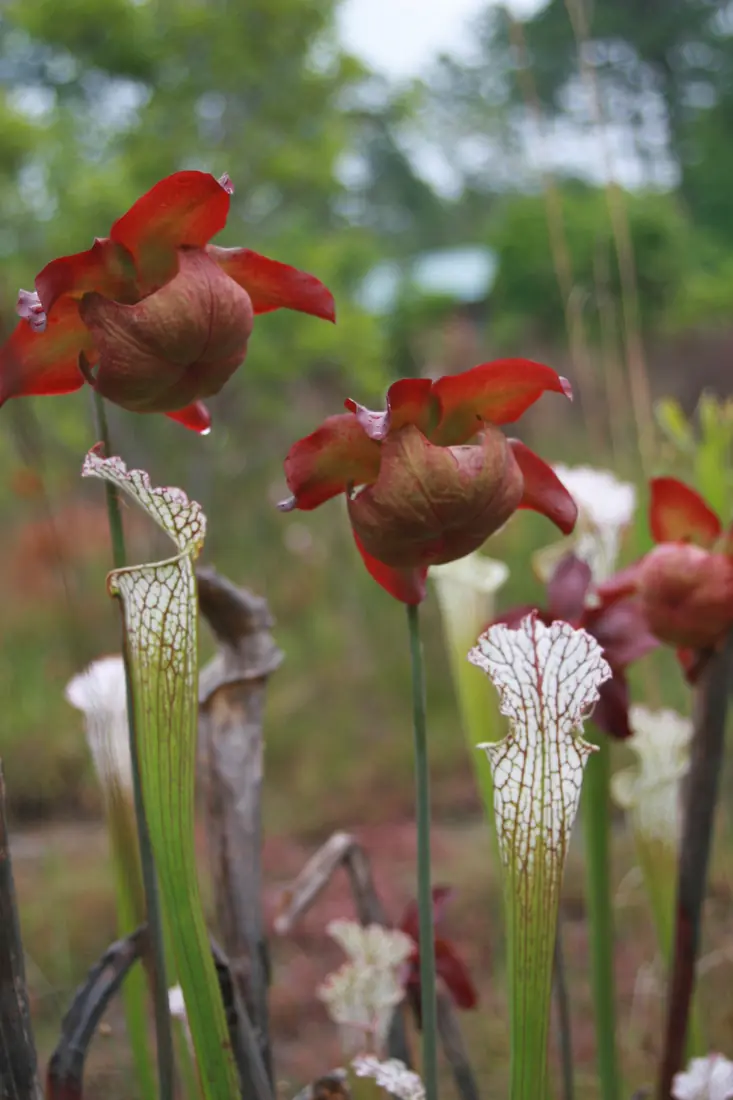
- Visit a pitcher plant bog in bloom. The Nature Conservancy (TNC) says its Splinter Hill Bog Preserve is in peak bloom during April and May. Wear shoes that can get wet, stay on the marked trail, and call ahead, since the preserve closes at times for controlled burns.
- Listen for treefrogs on a warm, wet night. ADCNR, the state's conservation agency, lists April as the start of breeding for green and Cope's gray treefrogs. Stand quietly near a swamp edge or woodland pool for ten minutes and note which call you hear and the air temperature.
For the Naturalist's Field Journal: add each new migrant to birds I have seen with its first-sighting date; log every treefrog and cricket frog call, plus the night's temperature, on a map of sounds; follow a pitcher plant bog or an azalea hillside with a second visit in May on the same place twice; use one dogwood for a tree through the seasons page of bloom and leaf-out dates; and note the Pink Moon and the Lyrid evening on dusk and dawn watch.
Regions used below: Tennessee Valley and the northwest hills; Lookout Mountain and northeast Alabama; Birmingham and the Cheaha highlands; Montgomery and the Black Belt; The Wiregrass; Mobile Bay and the Gulf Coast.
Why do birders crowd onto Dauphin Island in April?
Dauphin Island is the first solid ground many songbirds meet after crossing the Gulf of Mexico, and April is when the crowd arrives. Alabama Birding Trails says that during the mid-April peak, cars may need to park in the median on Bienville Boulevard when the sanctuary lot is full. An Audubon magazine guide to warbler photography adds that some species reach their greatest numbers by April 1, but the best variety comes in the first two weeks of April. The birds leave the far shore at dusk and fly for 18 hours or more, so many do not touch down until mid-afternoon, which makes the afternoon walk as rewarding as sunrise.
A volunteer land trust, Dauphin Island Bird Sanctuaries, protects much of the habitat, including the Goat Tree Reserve and several swamp parcels. It grew out of a group formed in 1992 when the National Audubon Society ended its lease on the sanctuary. Please stay on the trails.
-
Dauphin Island Audubon Bird Sanctuary
Busiest around mid-April · Dauphin Island, with parking off Bienville Boulevard
The sanctuary has two named trails, the Lake Loop with a boardwalk to Gaillard Lake and the Dune Edge Trail that reaches the beach. Alabama Birding Trails tells visitors to check the eBird hotspot page for current lists, because conditions change from year to year. After a night of north wind or a front, the woods can look empty at dawn and full by afternoon, so plan on more than one visit.
-
Shell Mound Park and the Goat Tree Reserve
Spring migration, peaking in April · Northern shore and the middle of the island
The Audubon magazine guide names water features at Shell Mound Park and the Goat Tree Reserve as productive spots, and suggests watching the island's bottlebrush trees, whose red flowers attract several warbler species. It also notes that vegetation at the Goat Tree Reserve is often very close to the trail. ADCNR also lists the 11-acre Indian Shell Mound Park, on the island's north shore, as a prime place to watch arriving migrants under moss-draped live oaks.
-
Fort Morgan bird banding
A spring and a fall program; ask for current dates · Fort Morgan, west end of the Gulf Shores peninsula
ADCNR says banders use fine mesh nets to catch migrants, record the species, sex and weight, band each bird and release it, and that visitors can watch closely. The program was begun by Bob and Martha Sargent in 1989 and revived in 2017 by a partnership that includes Birmingham Audubon, ADCNR, Mississippi State University and Mobile Bay Audubon Society. Organizers call it the only banding program on the Gulf Coast open to the public. We found no 2027 dates, so check with Birmingham Audubon or the Alabama Coastal Birding Trail before you plan around it.
Keep one line per species and date in birds I have seen, then return to the same trail in May for a second entry under the same place twice. The change in the oak canopy between visits is a lesson of its own.
What are beach-nesting birds and sea turtles doing on the Gulf shore?
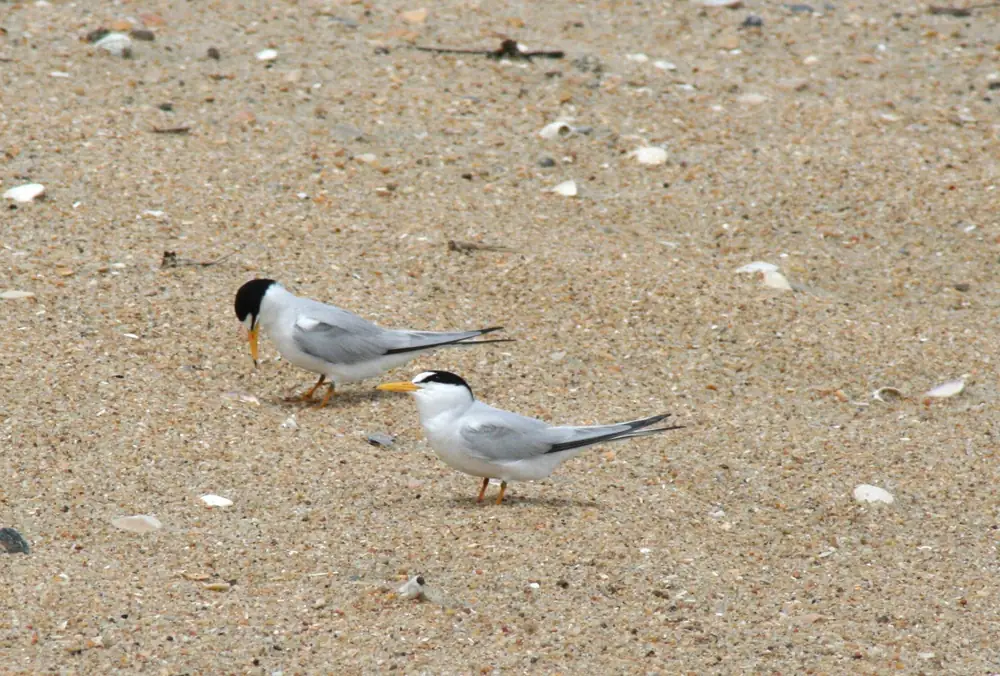
Alabama's beaches are a nursery in April. The Gulf Shores and Orange Beach visitor bureau lists nine species that commonly nest on the sand: snowy plovers, Wilson's plovers, American oystercatchers, black skimmers, least terns, gull-billed terns, royal terns, Caspian terns and Sandwich terns. It puts the main nesting season at roughly mid-March through August, with snowy plovers starting territories as early as late February. Adults incubate eggs for 24 to 27 days and the chicks need another three to four weeks before they can fly, so April beaches hold eggs and fuzzy chicks that look like pebbles.
The bureau's rules for beachgoers are simple: never walk on the dunes, keep away from birds sitting on eggs or tending chicks, do not dig holes deeper than 12 inches, do not feed the birds, and take your belongings home each day. It also notes that harming or harassing nesting shorebirds is a federal crime under the Migratory Bird Treaty Act, and asks people to report a suspected nest to Alabama Audubon.
-
Snowy plovers and least terns
Eggs and chicks from April through summer · Dune edges and open sand on the Gulf beaches of Baldwin County
Their ground nests blend into the sand, as the bureau notes. A bird that stands its ground, calls or runs ahead of you may be guarding a nest or chicks, so back away and walk along the wet sand near the water. Binoculars bring the show close without costing a nest.
-
Sea turtle nesting season opens May 1
May 1 through October 31 · Gulf beaches, monitored by the Share the Beach program of the Alabama Coastal Foundation
ADCNR says three species nest on the Alabama coast, with loggerheads the most common and Kemp's ridleys and green turtles also nesting. Females dig a chamber and lay between 80 and 120 eggs, which take roughly two months to hatch. April is the time for beachfront owners and visitors to prepare: ADCNR asks people to turn off or reduce lights visible from the beach, use red, orange or amber bulbs, and close curtains on ocean-view windows after dark. For a sick, injured or dead sea turtle, ADCNR lists a 24-hour hotline at 1-866-732-8878.
Which songbirds and hummingbirds are arriving in Alabama's woods?
Away from the coast, the migrants that make it across the Gulf spread into forests and swamps, and the resident birds are already singing for territory. The best April birding often comes from a single listening stop rather than a long walk, because the singing bird is usually high in new leaves.
-
Sipsey Wilderness songbirds
Spring; the trailhead page names the season, not a date · Sipsey Wilderness trailhead, Bankhead National Forest, Winston County
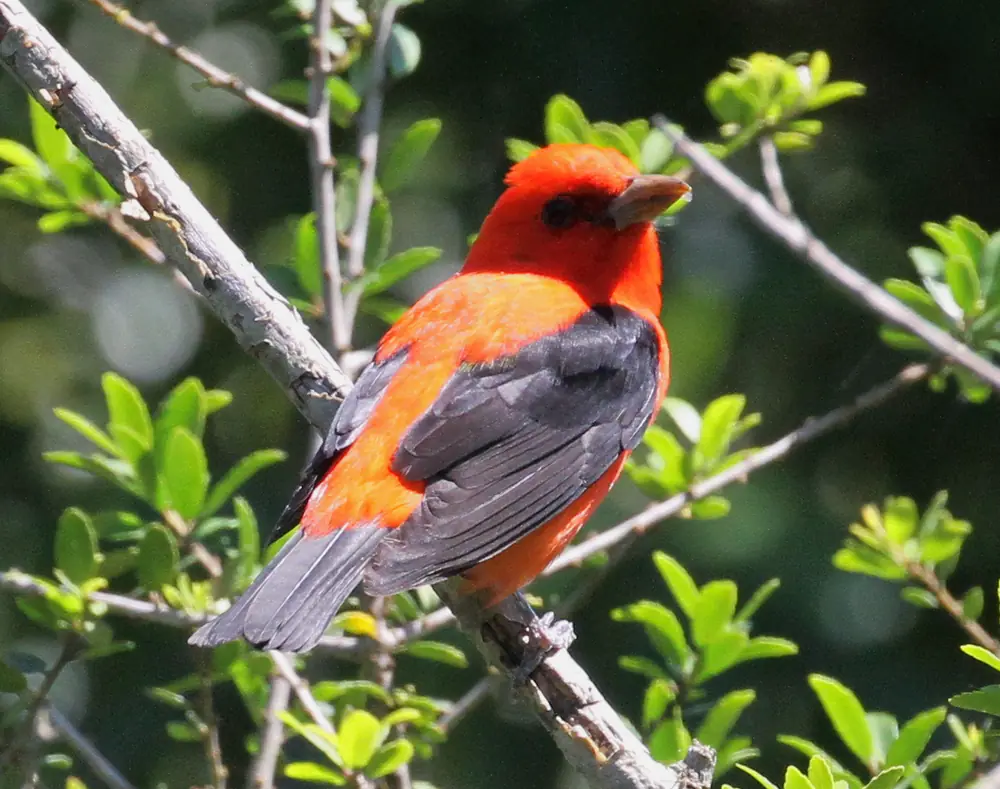
Alabama Birding Trails says the forest trail is surrounded each spring by cerulean and black-throated green warblers, summer and scarlet tanagers, and ovenbirds, with American woodcocks and chuck-will's-widows also on its list. Arrive near dawn, stand still and let the canopy sing. The same page asks visitors to wear hunter orange when sharing the forest with hunters in hunting season.
-
Birds of the Splinter Hill uplands and swamps
Spring and summer · Splinter Hill Bog Preserve, near Perdido, northern Baldwin County
A TNC brochure names summer tanagers, indigo buntings, prairie warblers, yellow-throated warblers, pine warblers and eastern towhees as the most common birds in spring and summer, with prothonotary warblers in the swamps. Bachman's sparrow, a rare resident of the longleaf pines, is also on the preserve's list of rare animals.
-
Hummingbird feeders
Usually beginning in April or early May · Gardens, porches and woodland edges statewide
The Alabama Cooperative Extension System says hummingbirds are easily drawn to feeders in spring, usually beginning in April or early May. Its homemade nectar is table sugar dissolved in warm water at a ratio of 1 to 4 or 5, and it asks owners to rinse feeders with vinegar and hot water at least weekly. Red flowers such as salvia and trumpet vine also help. Journey North collects volunteer sightings, so report the first bird you see.
Where do pitcher plants, wild azaleas and wildflowers bloom in April?
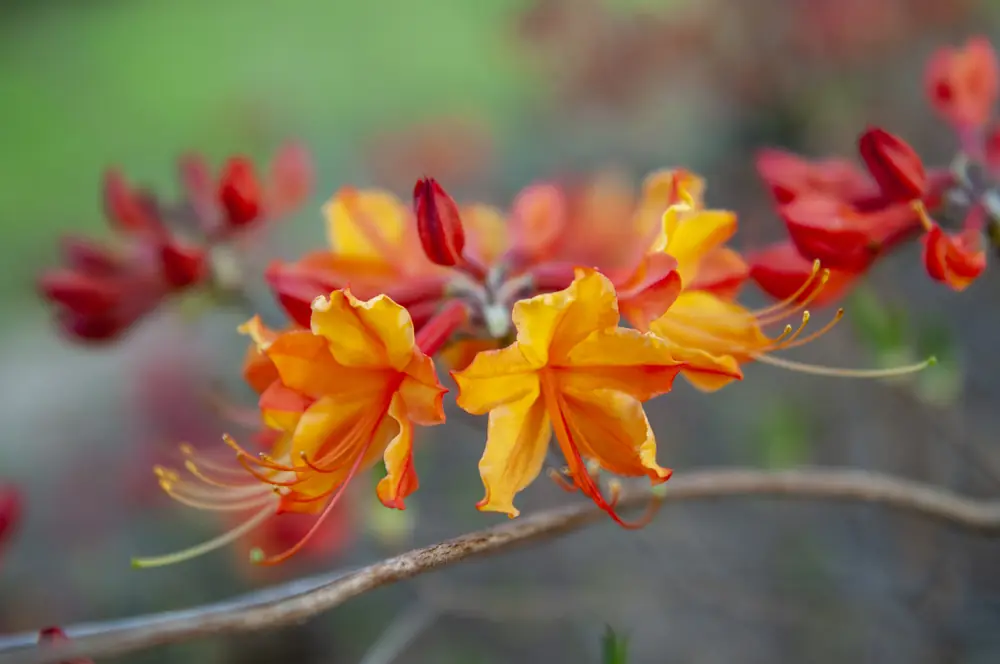
April bloom in Alabama comes in waves. The Alabama Cooperative Extension System lists Piedmont azalea and Florida azalea as blooming from late March into early April, the white, lemon-scented Alabama azalea in April, and swamp azalea from mid-May to early June. Extension also says flowering dogwood begins blooming in late March in the south and two to three weeks later in the north, and that each bloom period lasts two to four weeks. That means a late-April walk in the north can still catch dogwood, while the Gulf Coast is already leafing out.
-
Splinter Hill Bog Preserve
Peak bloom in April and May, according to TNC · Near Perdido, northern Baldwin County. From I-65 Exit 45, go west on County Road 47 for about 2 miles; the George W. Folkerts Bog Trail parking is on the left
TNC describes more than 12 species of carnivorous plants, including five pitcher plants, two butterworts and several sundews, and says the preserve protects some of the most intact seepage bog communities on the Gulf Coast. The preserve is open dawn to dusk but may close during controlled burns, and TNC bars removing plants or animals, leaving the marked trail, camping, unleashed pets and motor vehicles. Alabama Birding Trails gives the Conservancy tract as open March 1 to October 15, so confirm access with TNC before you drive. The Weeks Bay Reserve bog near Fairhope, described in the March guide, is a second place to see the plants. The brochure advises dressing to get your feet wet, and warns that eastern cottonmouths can be abundant in the small stream drains. Prescribed fire keeps the bog open, as the Alabama Extension article on pitcher plants explains.
-
Green pitcher plant and canyon wildflowers
Wildflowers bloom from late February to November, with a spring burst · Little River Canyon National Preserve, Fort Payne area
The National Park Service says spring brings an explosion of wildflowers and shows the Catawba rhododendron blooming there. The Encyclopedia of Alabama names the endangered green pitcher plant as one of two plants specific to northeast Alabama, and the same article notes the preserve covers about 14,000 acres. The park's weather page warns that tornadoes are possible in spring, usually in the afternoon, so check the forecast before a canyon hike.
-
Wildflower Saturday at DeSoto State Park
Friday, April 30 (6 to 7 p.m. speaker) and Saturday, May 1, 2027, hikes starting at 9 a.m., with two more in the afternoon · DeSoto State Park, Fort Payne, on Lookout Mountain
The park's 2027 schedule lists the event as free, with no pre-registration needed, though it asks groups of 10 or more to RSVP. Plants named on the page include pink lady's slipper, mountain laurel, Catawba rhododendron, wild camellia, yellowroot, Solomon's seal and Joe Pye weed. Check the park for updates.
Press a single petal or leaf from each site on colours of the day and mark the date. Please photograph the flowers and leave the plants: removing wild plants is banned at Splinter Hill, and collecting pitcher plants has pushed wild populations downward, according to the Extension article.
Which frogs and alligators are active in April nights?
Warm, wet nights from April on bring the second wave of Alabama frogs. The early breeders you heard in March, such as spring peepers and chorus frogs, now share the dark with treefrogs, whose voices carry from swamp edges and flooded yards.
-
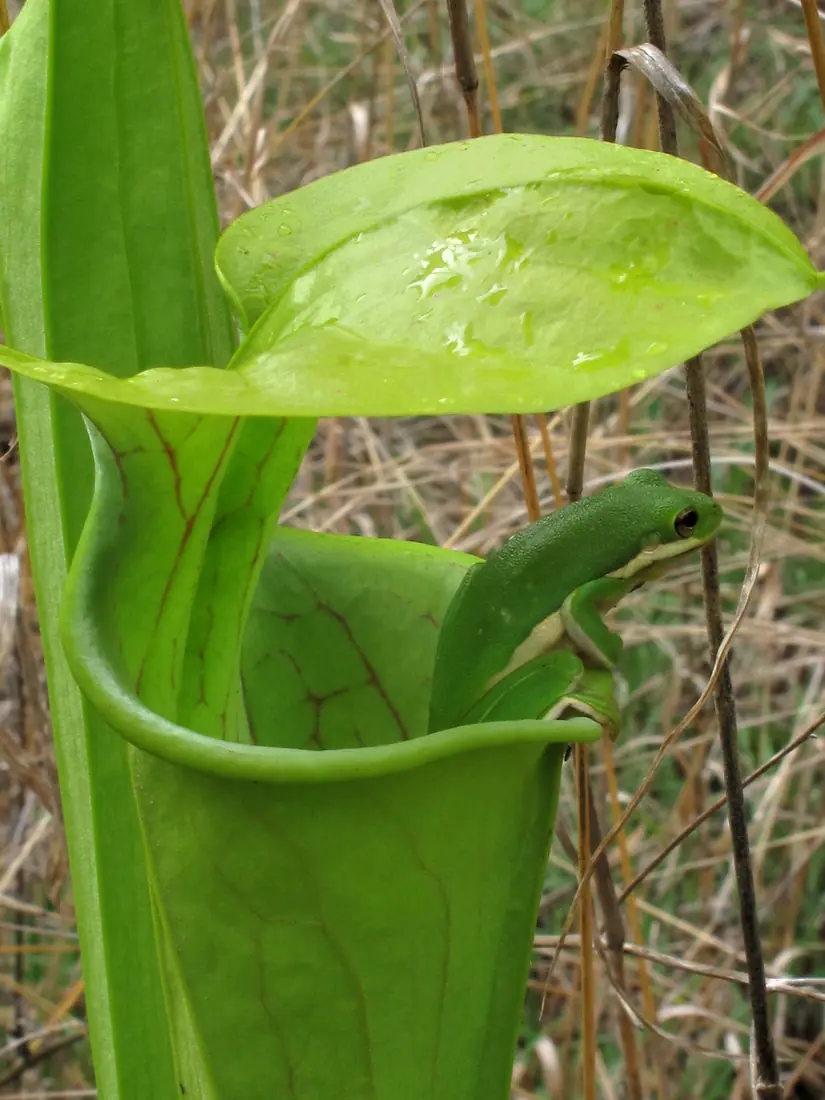
Green treefrog
Breeding usually begins in April and runs into August · Swamps, lake sides and the edges of streams, nearly statewide
ADCNR describes the male call as a harsh, nasal quank repeated about once per second, sometimes bell-like at a distance, which explains the local name cowbell frog. Calling and egg laying are most frequent after rain. The frog grows to about 2.5 inches and is rated common nearly everywhere in the state.
-
Cope's gray treefrog
April to August, busiest in warm, rainy weather · Wooded areas near temporary and semi-permanent pools, common statewide
The call is a short trill repeated at regular intervals. ADCNR says the frog is seldom seen in numbers except during breeding, and that its skin can shift from green or brown to nearly white, which hides it against bark.
-
Bird-voiced treefrog
April to July · Wooded swamps, river valleys and beaver ponds in central and south Alabama
Its piping, bird-like whistles in rapid succession are unlike the trill of a gray treefrog. ADCNR notes these frogs climb tupelo, bald cypress and birch trees, so the caller is almost always overhead.
-
American alligators
Mating season April through May · Freshwater swamps, rivers, lakes and marshes in the south
ADCNR says breeding takes place in open water, and nests of 30 to 70 eggs follow, hatching after about nine weeks. Keep a long distance, never feed an alligator, and keep dogs out of the water.
Draw each pond on a map of sounds and mark which call came from which corner, with a temperature. A repeat visit a few nights later shows how the chorus moves with the weather.
What else is stirring in April: swallowtails, turkeys and bass?
Three more things reward a slow walk or a lake visit in April. Butterflies come out as host plants leaf, turkey hens turn from courtship to nesting, and anglers follow the bass spawn.
-
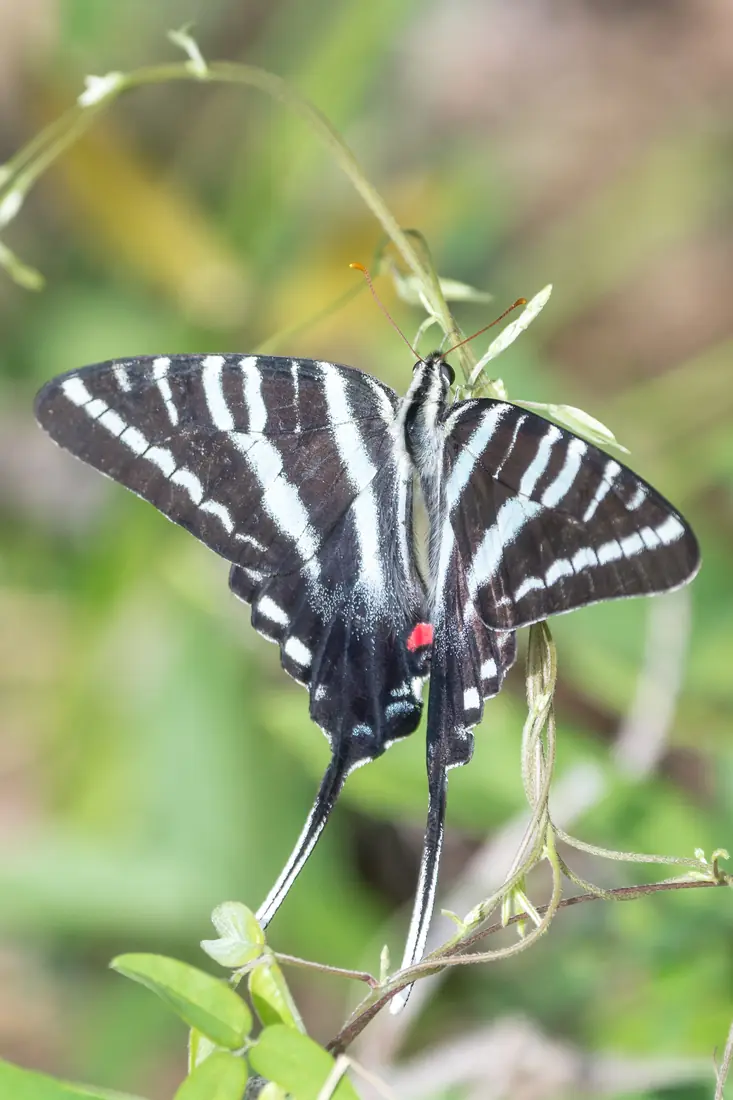
Zebra swallowtails and pawpaws
On the wing from March; the Alabama Butterfly Atlas lists March through September · Hardwood forests, bottomlands and stream corridors statewide, wherever pawpaw grows
The Atlas says pawpaws are the sole host plants and that the butterfly occurs in every Alabama county. Spring forms are smaller with shorter tails than the summer generations, so an April zebra swallowtail looks different from a July one. Look for males patrolling woodland trails and gathering at mud puddles.
-
Eastern tiger swallowtails
The first brood emerges early in spring · Woodlands and gardens statewide
The Atlas names tulip poplar, sweet bay magnolia, black cherry and green ash as Alabama host plants, and says this is Alabama's official state butterfly, supported by the argument that tiger swallowtails choose to live here, unlike passing monarchs.
-
Wild turkey hens on the nest
Gobbling and courtship from early March through April; laying and incubating follow · Hardwood and mixed pine-hardwood forests with openings, statewide
ADCNR says a hen lays a clutch of 10 to 12 eggs over about two weeks, usually one egg a day, then incubates them for roughly 28 days. Newly hatched poults leave the nest with the hen within 12 to 24 hours. If you flush a hen from the woods floor, back away, since leaving the nest uncovered puts the eggs at risk.
-
Bass, crappie and bream
Bass spawn later than crappie; bluegill spawning begins in May · Reservoirs and small ponds statewide
ADCNR's spring fishing tips say the best bass fishing comes just before and for about two weeks after spawning, and that records from reservoir bass tournaments show larger fish landed in March and April. The tips add that water takes about three days after a cold front to warm enough to raise activity, and that the north side of a lake warms faster in spring. ADCNR also notes that bluegill spawn monthly from May through October, often near the full moon.
What is April weather like in Alabama, and why is it tornado season?
April is warm, wet and unsettled. In NOAA's 1991 to 2020 normals, April highs average about 75 °F at Huntsville and Birmingham, near 79 °F at Montgomery and Dothan, and 77.8 °F at Mobile, with lows between 51 °F and 56 °F. Normal rain runs from 3.99 inches at Montgomery to 5.71 inches at Mobile. Frost has nearly vanished: the normal number of April nights that reach 32 °F or colder is 0.4 at Huntsville, 0.6 at Birmingham and 0.1 at Montgomery.
The same warm, moist air makes April the busiest month for tornadoes. The Alabama Office of the State Climatologist reports that April averages 13.8 tornadoes on the 1991 to 2020 record, that most occur in the afternoon and evening with a peak near 5 p.m. CST, and that a good share arrive overnight. The Encyclopedia of Alabama notes the state has two tornado seasons, one in spring and a second in November. NWS Birmingham keeps a database of Alabama tornadoes back to 1794, and its summary of April 27, 2011, counts 29 confirmed tornadoes in central Alabama, including one EF-5 near Hackleburg in Marion County.
Flooding is the other spring hazard (see the safety notes). For the official seasonal outlook, see the maps on NOAA's Climate Prediction Center page, which the agency updates each month.
| Station | Average high | Average low | Rain and melted snow | Nights at or below 32 °F |
|---|---|---|---|---|
| Huntsville | 74.8 °F | 51.0 °F | 4.86 in | 0.4 |
| Birmingham | 75.0 °F | 52.1 °F | 5.08 in | 0.6 |
| Montgomery | 78.8 °F | 52.6 °F | 3.99 in | 0.1 |
| Dothan | 79.3 °F | 55.2 °F | 4.79 in | 0.0 |
| Mobile | 77.8 °F | 56.0 °F | 5.71 in | 0.0 |
Open the weather page before a hike or a lake trip, and keep warnings switched on overnight. The cloud cover forecast helps with planning too, and a line of towering anvil tops building in the west is a signal to head for shelter.
Is the last spring freeze behind us in Alabama?
For most of the state, yes. The Gulf side finishes first: the median last freeze comes at Dothan on March 1 and at Mobile on March 3. Montgomery follows on March 13, Tuscaloosa on March 16, Birmingham on March 21 and Huntsville on March 24. The cooler hills run later, with a median of April 7 at Valley Head on Lookout Mountain and April 11 at Hamilton. In nine years out of ten the freezing is finished by April 8 at Huntsville and Birmingham, April 25 at Valley Head and April 27 at Hamilton.
| Station | One year in ten | Median | Nine years in ten |
|---|---|---|---|
| Hamilton 3 S (northwest hills) | Mar 26 | Apr 11 | Apr 27 |
| Valley Head 1 SSW (Lookout Mountain) | Mar 20 | Apr 7 | Apr 25 |
| Huntsville International Airport (Tennessee Valley) | Mar 4 | Mar 24 | Apr 8 |
| Birmingham Airport | Feb 28 | Mar 21 | Apr 8 |
| Tuscaloosa Municipal Airport (west-central) | Feb 24 | Mar 16 | Apr 3 |
| Montgomery Airport (Black Belt edge) | Feb 20 | Mar 13 | Mar 31 |
| Dothan Regional Airport (Wiregrass) | Feb 3 | Mar 1 | Mar 21 |
| Mobile (Regional Airport) | Feb 6 | Mar 3 | Mar 21 |
Find your own station on the Alabama frost page. Blooming dogwoods and native azaleas can handle a light freeze, but tomato and pepper transplants usually cannot, so in the northern hills many gardeners wait until the last week of April.
How much daylight does Alabama gain in April?
Between 51 and 60 minutes, depending on how far south you live, at a pace of roughly two minutes a day. The north gains most: Florence goes from 12 hours 34 minutes on April 1 to 13 hours 34 minutes on April 30, and Huntsville from 12 hours 33 minutes to 13 hours 33 minutes. Dothan and Mobile gain 51 minutes, ending the month at 13 hours 22 minutes and 13 hours 21 minutes. The gain is smaller than in March and keeps shrinking toward the June solstice.
| City | Apr 1 | Apr 30 | Gained | Per day |
|---|---|---|---|---|
| Florence | 12 h 34 m | 13 h 34 m | 60 min | 2.1 min |
| Huntsville | 12 h 33 m | 13 h 33 m | 60 min | 2.1 min |
| Fort Payne | 12 h 34 m | 13 h 33 m | 59 min | 2.0 min |
| Birmingham | 12 h 33 m | 13 h 29 m | 56 min | 1.9 min |
| Tuscaloosa | 12 h 33 m | 13 h 28 m | 55 min | 1.9 min |
| Montgomery | 12 h 31 m | 13 h 26 m | 55 min | 1.9 min |
| Dothan | 12 h 31 m | 13 h 22 m | 51 min | 1.8 min |
| Mobile | 12 h 30 m | 13 h 21 m | 51 min | 1.8 min |
Longer evenings are the reason April bird walks, frog walks and dusk watches fit after work. Open the daylight page for the sunrise and sunset times in your own town, then plan your outing around them.
What can you see in the night sky over Alabama in April?
April brings the Pink Moon, a weak Lyrid shower, a morning Venus and an evening Jupiter. Times are Central daylight time (CDT) throughout, because the clocks changed on March 14.
-
The Pink Moon
Full on Tuesday, April 20, 5:27 p.m. CDT · Rising in the east around sunset
The full moon of April is called the Pink Moon after early spring wildflowers, according to SeaSky. It turns full in the late afternoon, so the first rise after the full moment, on the evening of April 20, is the one to watch, and the Moon looks round again the evenings before and after. Look up your town's moonrise on the moon phase page.
-
The Lyrid meteor shower
Active about April 14 to 30; peak night April 22, about 8:41 p.m. CDT · Low in the east and northeast in the early evening, in the constellation Lyra
This is a poor year. The Moon is 95 percent lit, only three days past full, and rises late in the evening, leaving only the early evening hours before moonrise dark. SeaSky puts the shower at around 20 an hour at best, and bright moonlight will drown out the dimmer streaks. Expect a few an hour, not a display.
-
Venus and the thin crescent at dawn
Venus all month; the Moon is nearby on April 3 and 4 · Low in the east before sunrise
Venus, the brightest point in the dawn sky, sits a little lower every week. By our calculation for the central United States it clears the horizon about an hour and a quarter before sunrise on April 1 and an hour before sunrise on May 1. A thin waning crescent, only 9 percent lit, hangs close by on those two mornings.
-
Jupiter and Mars after dark
Evenings all month; Moon nearby April 14 and 15 · High in the south to southwest in the evening
Jupiter, in the region of Leo, remains up well past midnight; by our calculation it sets about 9 hours after sunset on April 1 and about 7 hours after on May 1. The waxing gibbous Moon, about 68 percent lit, slides within 0.9 degrees of it on April 15 and sits about 3 degrees from Mars, which by then glows at about magnitude 0.0. These separations are our own calculations.
| Phase | Date | Time |
|---|---|---|
| New moon | Tuesday, Apr 6 | 6:51 p.m. CDT |
| First quarter | Tuesday, Apr 13 | 5:56 p.m. CDT |
| Full moon, the Pink Moon | Tuesday, Apr 20 | 5:27 p.m. CDT |
| Last quarter | Wednesday, Apr 28 | 3:18 p.m. CDT |
| New moon | Thursday, May 6 | 5:58 a.m. CDT |
For faint stars, choose the evenings from about April 1 to 10, when the Moon is a thin crescent or out of the sky. The cloud cover forecast is worth a look before the drive.
What can Alabama families do outside in April 2027?
- Tuesday, April 20: the Pink Moon turns full at 5:27 p.m. CDT. Watch it rise in the east near sunset.
- Thursday, April 22: Earth Day and the peak night of the Lyrids, around 8:41 p.m. CDT, with the near-full Moon making the shower hard to see. Earth Day is observed every April 22.
- Friday, April 30: National Arbor Day. The Arbor Day Foundation observes it on the last Friday in April. Alabama's own Arbor Week is the last full week of February, according to the Alabama Forestry Commission, so a native tree planted on April 30 is a way to join the national day.
- Friday, April 30 and Saturday, May 1: Wildflower Saturday at DeSoto State Park, with a Friday evening speaker (6 to 7 p.m.) and guided hikes on Saturday starting at 9 a.m. (see the wildflower section).
- Early May: Feather Fest at Monte Sano State Park, an annual bird festival with guided birding hikes that has been held on a Saturday in early May. We could not find a 2027 date, so check with the park.
- Gulf State Park Nature Center. The park says it is open Monday to Saturday, with guided nature, beach and pier walks. Its calendar ran only through March 2027 when we looked, so watch for April programs or call (251) 948-7275, extension 62093.
- Citizen science. Send your first hummingbird to Journey North, post frog calls and flowers to iNaturalist, and file bird lists from Dauphin Island with eBird.
We read the DeSoto dates above on the park's own Wildflower Saturday page on October 8, 2026; the state parks events calendar did not yet list April 2027 programs. Confirm each event with the park, since registration and fees vary. See the March Alabama guide for the start of the spring migration, browse every state's guide or keep your own records in a Naturalist's Field Journal.
Safety notes for April in Alabama
- Spring turkey season is still open. ADCNR's 2026 to 2027 regulations show the season ending May 3 in all three zones, with shooting hours of daylight to 1 p.m. and a bag limit of one gobbler per day. Zone 2 in the Tennessee Valley opened a week after Zones 1 and 3, and some public lands use two sets of dates, so check ADCNR for the land you plan to enter.
- No blaze orange for turkey hunters. ADCNR exempts turkey hunters from the hunter orange rule, so nobody in the woods this month can be counted on to wear it. Keep to marked trails, speak up as you walk, and consider a bright vest of your own.
- Tornadoes and lightning. NWS Birmingham says to stay in a sturdy building, move to the lowest level and put as many walls as possible between yourself and the outside, and that if you can hear thunder you are close enough to be struck. If you are caught outside in a storm, avoid open spaces, isolated objects and high ground.
- Flash floods. Six inches of racing water is enough to topple an adult, the National Weather Service warns, and a foot can carry off most cars. Skip creek fords and canyon trails after hard rain.
- Ticks. The CDC puts the peak of tick activity between April and September. It recommends an EPA-registered repellent, clothing treated with 0.5 percent permethrin, a 10-minute spin in a hot dryer when you get home, a shower within two hours and a full body check.
- Snakes. ADCNR lists six venomous species: copperhead, cottonmouth, pigmy and timber rattlesnakes, eastern diamondback and coral snake. ADCNR says copperheads mate shortly after emerging from hibernation in spring and cottonmouths also breed in spring, and TNC warns of cottonmouths in stream drains at Splinter Hill. Watch where you put hands and feet, and leave snakes alone.
- Burning and smoke. The Alabama Forestry Commission requires a permit for prescribed burns done for forestry or agricultural purposes, and none is needed for a fire under a quarter acre; its dispatch center is at 800-392-5679. Controlled burns can close preserves such as Splinter Hill, so call ahead.
- Young animals. ADCNR asks the public to leave seemingly abandoned fawns where they are, since does leave fawns alone for hours in the first month. Most wild birds and mammals are protected and may not be taken from the wild.
Sources (56)
- Alabama Birding Trails: Dauphin Island Audubon Bird Sanctuary
- Audubon magazine: Seven Spring Hotspots for Warbler Photography
- ADCNR: Indian Shell Mound Park
- Dauphin Island Bird Sanctuaries: About
- Alabama Ornithological Society: Dauphin Island
- ADCNR: Fort Morgan Bird Banding Project Revived
- Gulf Shores and Orange Beach: Nesting Shorebirds on Alabama's Beaches
- ADCNR: What to Know About Sea Turtles
- ADCNR: Share the Beach's Training for Sea Turtle Monitoring
- Alabama Birding Trails: Bankhead National Forest, Sipsey Wilderness Trailhead
- Alabama Birding Trails: Splinter Hill Bog
- The Nature Conservancy: Splinter Hill Bog Preserve brochure
- The Nature Conservancy: Splinter Hill Bog
- The Nature Conservancy: Where Wildflowers Bloom
- Alabama Extension: Hummingbirds in Alabama
- Journey North: Hummingbirds
- Alabama Extension: Native Azaleas for Alabama
- Alabama Extension: Selection and Care of Dogwoods
- Alabama Extension: Meet Alabama's Meat-Eating Pitcher Plants
- National Park Service: Little River Canyon, Weather
- National Park Service: Little River Canyon National Preserve
- Encyclopedia of Alabama: Little River Canyon National Preserve
- Alabama State Parks: Wildflower Saturday at DeSoto State Park
- ADCNR: Green Treefrog
- ADCNR: Cope's Gray Treefrog
- ADCNR: Bird-voiced Treefrog
- ADCNR: American Alligator
- Alabama Butterfly Atlas: Zebra Swallowtail
- Alabama Butterfly Atlas: Eastern Tiger Swallowtail
- ADCNR: Wild Turkey
- ADCNR: Spring Fishing Tips
- NOAA NCEI: 1991-2020 monthly normals for Alabama airports
- Alabama Office of the State Climatologist: Understanding Tornadoes in Alabama
- Encyclopedia of Alabama: Alabama's Climate
- NWS Birmingham: Alabama Tornado Database
- NWS Birmingham: April 27, 2011 tornado outbreak
- NWS Birmingham: Severe Thunderstorm Safety Rules
- NWS: Turn Around Don't Drown
- NOAA Climate Prediction Center: 90-day outlooks
- U.S. Naval Observatory: 2027 moon phases
- SeaSky: Astronomy Calendar 2027
- Alabama State Parks: Events calendar
- Alabama State Parks: Gulf State Park events and programs
- Alabama State Parks: Gulf State Park Nature Center
- Arbor Day Foundation: National Arbor Day
- Alabama Forestry Commission: Arbor Day
- Alabama Forestry Commission: Burn Permits
- EARTHDAY.ORG
- ADCNR: Spring turkey season
- ADCNR: Hunter orange requirements
- ADCNR: Venomous snakes
- ADCNR: Copperhead
- ADCNR: Cottonmouth
- ADCNR: Leave fawns in the wild
- CDC: Preventing tick bites
- Photos via Wikimedia Commons; licenses and photographers are credited under each picture
