What to look for in nature in Alaska this April
April is when Alaska’s first big waves of birds arrive and the rivers begin to wake, even though the freeze is far from over: the median last freeze of spring is still weeks away in most of the state, and Fairbanks still averages 26 nights at or below freezing this month. The daylight keeps racing. Anchorage goes from about 13 hours 23 minutes of sun on April 1 to just over 16 hours by the 30th, and Utqiagvik is within two weeks of its midnight sun. Canada geese and trumpeter swans drop onto the first open water around Fairbanks, wood frogs start to call, birch sap begins to run, gray whales stream past Kodiak, bowhead whales follow cracks in the ice off the north coast, and in Wrangell a free birding festival has already set its 2027 dates, April 21 to 25. Each entry below gives a typical window, a region and its source.
Other months in Alaska: October, November, December, January, February, March.
Start here
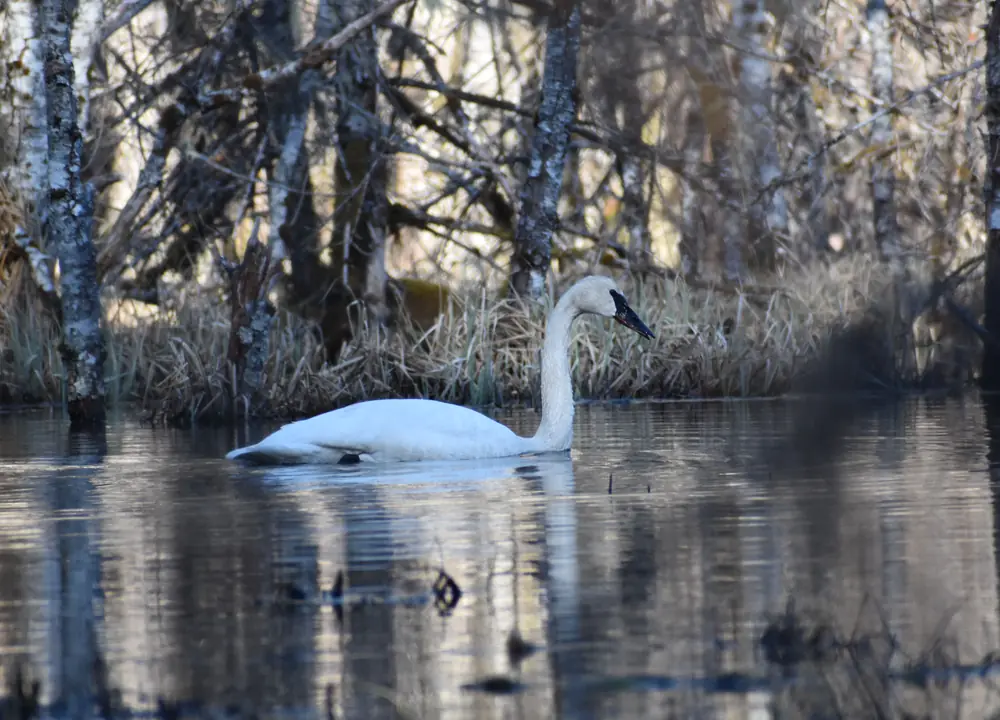
- Geese and swans on the first open water. Watch ponds, river edges and plowed fields for the first Canada geese and trumpeter swans. In the Interior the first ones usually come in the second week of April.
- Wood frogs calling. Listen at dusk beside a meltwater pond once the snow is gone. The duck-like clucking of wood frogs starts in April in Anchorage and late April in the Interior.
- The Pink Moon on the evening of April 20. Full at 2:27 p.m. AKDT on Tuesday, April 20, so it is already up when it gets dark; in Anchorage it rises at about 10:32 p.m.
Record it: In the Naturalist’s Field Journal, April suits the birds I have seen plate for the first goose, swan and kinglet, with the daily field log for the date the snow leaves your yard and the ice goes out. A map of sounds fits the wood frog chorus and the first crane overhead, the same place twice a pond photographed on April 1 and April 30, and nest observed is for the raven pair already sitting. Reading the signs suits the sap run and the opening of the first pasqueflower bud.
Regions used below: Southeast and the Inside Passage; Southcentral: Anchorage, Mat-Su and the Kenai; Interior and Fairbanks; Southwest: Kodiak, Bristol Bay, the Alaska Peninsula and the Aleutians; Western Alaska: the Y-K Delta and Seward Peninsula; Arctic and the North Slope.
How much daylight does Alaska gain in April?
Roughly two and three-quarter hours in Anchorage over the month, and more to the north. The table counts only the hours between sunrise and sunset, which the March clock change never affects. Ketchikan adds about two hours and nine minutes between April 1 and April 30, Anchorage nearly two hours and 46 minutes, Fairbanks just over three hours and 19 minutes, and Utqiagvik more than five hours, at nearly 11 minutes a day.
The Far North is nearing its midnight sun. According to the U.S. Naval Observatory, Utqiagvik’s last sunset of spring comes on the night of May 10 to 11 at 2:20 a.m. daylight time, and from May 12 the Sun stays up all day, so April is the last month in which the town has a regular night.
-
Earth Day
Thursday, April 22, 2027 · Anywhere you can step outside
Earth Day falls on April 22 every year, and in 2027 it lands on a Thursday, right in the middle of the migration. EARTHDAY.ORG says the first one was held on April 22, 1970. A short walk with a notebook and a pair of binoculars is a fine way to mark it in a state where the birds are only just arriving.
| City | Apr 1 | Apr 30 | Gained | Per day |
|---|---|---|---|---|
| Ketchikan | 13 h 06 m | 15 h 15 m | 129 min | 4.4 min |
| Juneau | 13 h 14 m | 15 h 39 m | 145 min | 5.0 min |
| Kodiak | 13 h 13 m | 15 h 35 m | 142 min | 4.9 min |
| Anchorage | 13 h 23 m | 16 h 09 m | 166 min | 5.7 min |
| Bethel | 13 h 22 m | 16 h 04 m | 162 min | 5.6 min |
| Fairbanks | 13 h 37 m | 16 h 56 m | 199 min | 6.9 min |
| Nome | 13 h 36 m | 16 h 52 m | 196 min | 6.8 min |
| Utqiagvik | 14 h 15 m | 19 h 32 m | 317 min | 10.9 min |
Sunrise and sunset for any Alaska town are on the daylight calculator page. Clocks moved forward on March 14, so every time it shows this month already includes that extra hour.
When do geese, swans and cranes return to Alaska?
The first big waves of waterfowl come in April, and the Interior is where the calendar is easiest to follow, because the Creamer’s Field Migratory Waterfowl Refuge in Fairbanks has kept arrival records for decades. Mark Ross, the refuge’s biologist and educator, told the Fairbanks Daily News-Miner that a deep snowpack and cold in late March and early April tend to push arrivals later, so every date below is a typical window and not a promise. Snow and cold can hold the whole parade back by a week or more.
-
Canada geese, the first waterfowl
Canada goose arrival has averaged about April 9 over four recent years, per the refuge biologist · Creamer’s Field, Fairbanks
White-cheeked Canada geese are traditionally the first migratory waterfowl to show up in the Interior, Ross told the News-Miner. He also told Alaska’s News Source in 2025 that the last 50 years of refuge records show waterfowl arriving earlier: an average date of about April 16 in the mid-1970s, and up to about April 7 now. In 2023, a cold April, the first goose was logged on April 15.
-
Trumpeter swans
Usually around April 11 or 12; more than 100 on the fields by the end of the month, per the refuge biologist · Creamer’s Field, the Chena River and open water around Fairbanks
Swans trickle in as small family groups, and Ross said the refuge may hold 100 or more by the end of April. In 2023 the first swan arrived on April 14. In a cold year, look at the open water along the Chena River as well as the fields.
-
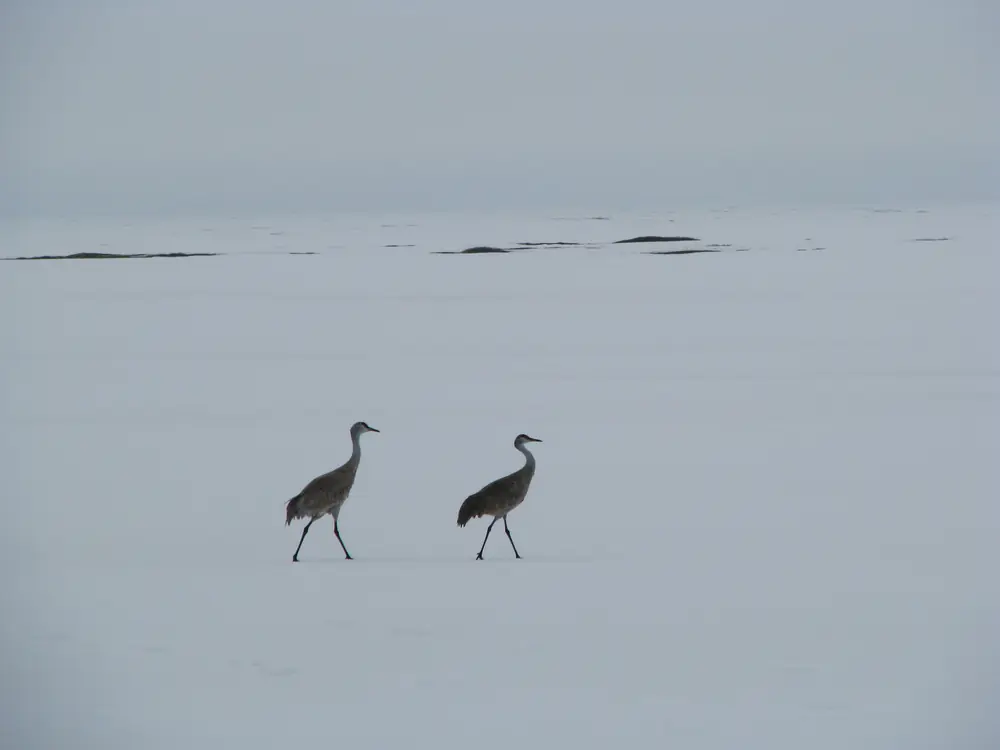
Sandhill cranes
Fairbanks: late April (first crane April 24 in 2023); breeding grounds: early to mid-May, per ADF&G · Fields and wetlands around Fairbanks, then tundra and muskeg
ADF&G reports that cranes reach their nesting grounds in early to mid-May, so April sightings are birds passing through or arriving at the earliest edge. Cranes are wary birds, and the department notes that their dancing display peaks in late winter and early spring.
-
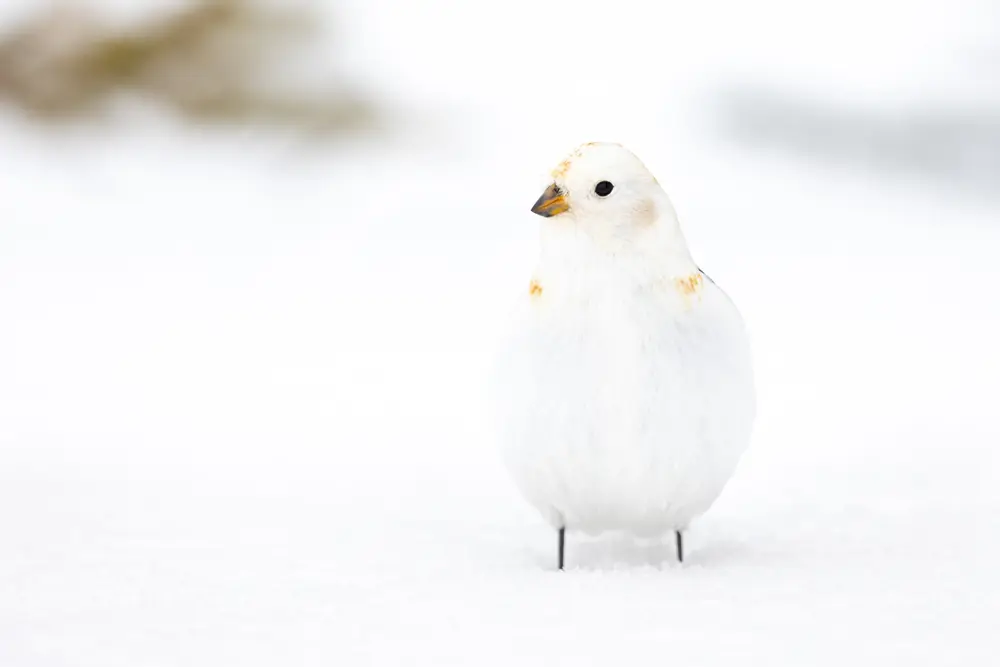
Snow buntings on their way out
Usually gone by mid-April; the last one was logged April 27 in the cold spring of 2023 · Open fields and roadsides in the Interior
These small white-and-rusty songbirds arrive in late March and move on to nest in the mountains and on tundra. The News-Miner’s 2023 migration recap noted that the spring was unusually cold, and that the cold kept buntings and even gray-crowned rosy finches in the valley longer than usual.
-
The first songbirds and the second wave of ducks
Expected through April, per the refuge biologist; about 100 more species follow in May · Creamer’s Field and other Interior wetlands
Ross listed rough-legged hawks, northern pintails, herring gulls, Lapland longspurs, American tree sparrows, ruby-crowned kinglets, yellow-rumped (myrtle) warblers, green-winged teal, varied thrushes and violet-green swallows among the birds due in April. A ruby-crowned kinglet was the first migratory songbird heard at the refuge in 2025.
-
Potter Marsh, Anchorage
From late April through September, per ADF&G · Seward Highway south of Anchorage; 1,550-foot boardwalk
ADF&G’s viewing guide lists Canada geese, northern pintails, canvasbacks, red-necked phalaropes, grebes and northern harriers using the marsh from late April, with gulls, Arctic terns and shorebirds from May. Eagles nest in the cottonwoods near the base of the bluff.
-
Spring Migration Celebration
Annual, in late April; the 2026 event was Saturday, April 25; the 2027 date was not posted when we looked · Creamer’s Field, Fairbanks
Friends of Creamer’s Field hosts a free celebration with local outdoor groups, nature walks and activities, timed to the arrival of the birds. Check its site for the 2027 date, because the organizers pick the day close to the event.
-
Spring bird banding
Spring banding runs over a few weeks in May; check with the institute · Creamer’s Field
The Alaska Songbird Institute runs the northernmost bird banding station in North America, on the refuge. The News-Miner’s 2023 recap reported 22 days of spring banding that year, ending June 2, and volunteers are welcome.
The Copper River Delta Shorebird Festival in Cordova, which its website lists as May 6 to 9, 2027, belongs to next month, but the first shorebirds there are already stirring by the end of April. For a month-by-month look at what comes next, the guide to nature in every state will add Alaska’s May page.
Where can I watch eagles, sea lions and the hooligan run in April?
Southeast Alaska is a few weeks ahead of the Interior. At the mouth of the Stikine River near Wrangell, the spring show is built around one small fish: the hooligan, also called eulachon. Eagles gather in town waiting for it, sea lions wait offshore, and the festival that celebrates all of this has already published its 2027 dates.
-
Stikine River Birding Festival
April 21 to 25, 2027, per Travel Wrangell · Wrangell and the Stikine River delta
Travel Wrangell says admission is free, lists field trips, speakers and workshops, and describes the delta as one of the biggest staging areas on the Pacific Flyway. It suggests binoculars, layers, rain gear and boots for the tide flats, and asks birders to keep their distance from nesting and feeding birds.
-
Eagles gathering for the hooligan
Eagles begin arriving in early February; the organizers’ page lists a peak count of 1,600 · Wrangell and the Stikine delta
The organizer’s page says eagles settle all over town waiting for the hooligan to start up the river in April. Timing follows the fish, not the calendar.
-
Steller sea lions waiting offshore
April, with the run · Islands north of Wrangell
Sea lions congregate on the islands north of town to wait for the same fish. They are best watched from a boat tour or from shore with a spotting scope, never approached.
-
Sandhill cranes overhead
Around mid-April, in flocks of hundreds or even thousands, according to the festival’s 2024 organizer · Wrangell and the delta
The organizer told KSTK radio in 2024 that cranes always arrive right about mid-April and use the delta as a stopover. Travel Wrangell’s birding guide calls the delta the main staging ground and also names Mallard Slough as a spot for migration.
-
Hooligan, or eulachon, spawning runs
Main spawning migration as early as April in Southeast; generally May in Southcentral and Western Alaska, per ADF&G · Rivers from the Stikine to the Twentymile near Turnagain Arm
ADF&G says the date a run returns to a given stream varies a lot from year to year. At the Twentymile River, ADF&G’s run-timing guide for the Anchorage area lists hooligan from April through May, with a saltwater dip-net window of April 1 to May 31 and a freshwater window of April 1 to June 15, for Alaska residents only. That guide was printed in 2022, so read the current regulations summary before going.
-
Rufous hummingbirds
Often the first week of April in Southeast, reported as early as March 31 in Juneau · Ketchikan, Sitka, Juneau and other Southeast towns
Journey North recorded a first rufous hummingbird in Ketchikan on April 1, 2001 and in Juneau by April 8 that year, and Bob Armstrong’s Nature Alaska notes males reaching Juneau by April 1 in 2015. These are only two sources, so treat the dates as a rough guide; Journey North takes sighting reports.
Ethical birding rules are posted on the Wrangell festival’s page: no playback of calls to lure birds, no deliberate flushing, and a long distance from anything nesting or feeding.
Which whales pass Alaska in April, and where can I see them?
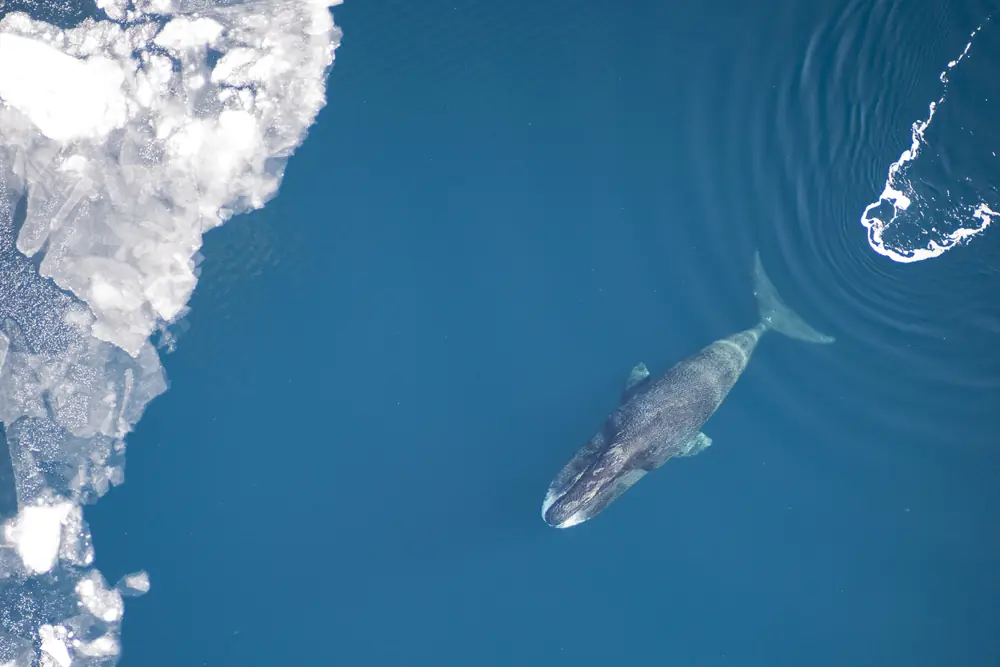
April belongs to two very different whale migrations: gray whales moving north along the southern coast, and bowheads following cracks in the sea ice along the northern edge of the state.
-
Gray whales at Kodiak
Late February to May along the coast, with the entry into the Bering Sea mostly in April and May, per ADF&G · Kodiak Island, then Unimak Pass and Bristol Bay
ADF&G’s Kodiak viewing guide says almost the entire eastern Pacific population passes the island each spring, and that the whales can be seen from shore or from a boat, sometimes by the thousands. The 2024 festival calendar sent whale-watching hikes to Narrow Cape, near the Pasagshak State Recreation Area.
-
Whale Fest Kodiak
Annual, in April; the 2027 dates were not found · Kodiak
ADF&G describes the festival as Kodiak’s celebration of the whales’ spring migration. The 2024 calendar ran from April 5 to April 27, with Audubon whale-watching hikes on two Saturdays, a marine mammal stranding talk, and a science symposium. Check whalefestkodiak.com for the 2027 schedule.
-
Bowhead whales off Utqiagvik
April through May, per NOAA Fisheries stock assessment · Leads in the sea ice off Alaska’s north coast
The assessment says the Western Arctic bowheads migrate through the Chukchi and Beaufort seas in April and May, following cracks between the shorefast ice and the moving pack to Point Barrow. A NOAA Marine Fisheries Review article describes ice-based counts there each spring from April 15 to May 30, beginning in 1976. NOAA Fisheries puts the population at about 15,229, from surveys in 2019.
-
Subsistence whaling is under way
Spring, along the north coast · Utqiagvik and other whaling communities
The Alaska Eskimo Whaling Commission manages the Alaska Native subsistence hunt under an agreement with NOAA. Visitors should stay off the ice and away from whaling camps unless invited.
NOAA Fisheries and ADF&G both publish pages on each species. Gray whales were a March story as they left the south; this month they are the ones passing Kodiak and turning west toward the Bering Sea.
When do wood frogs start calling in Alaska, and when does the birch sap run?
The first living things to announce spring in the thawed lowlands are frogs, and the first thing people can collect from a tree is birch sap. Both depend more on the snow than on the date.
-
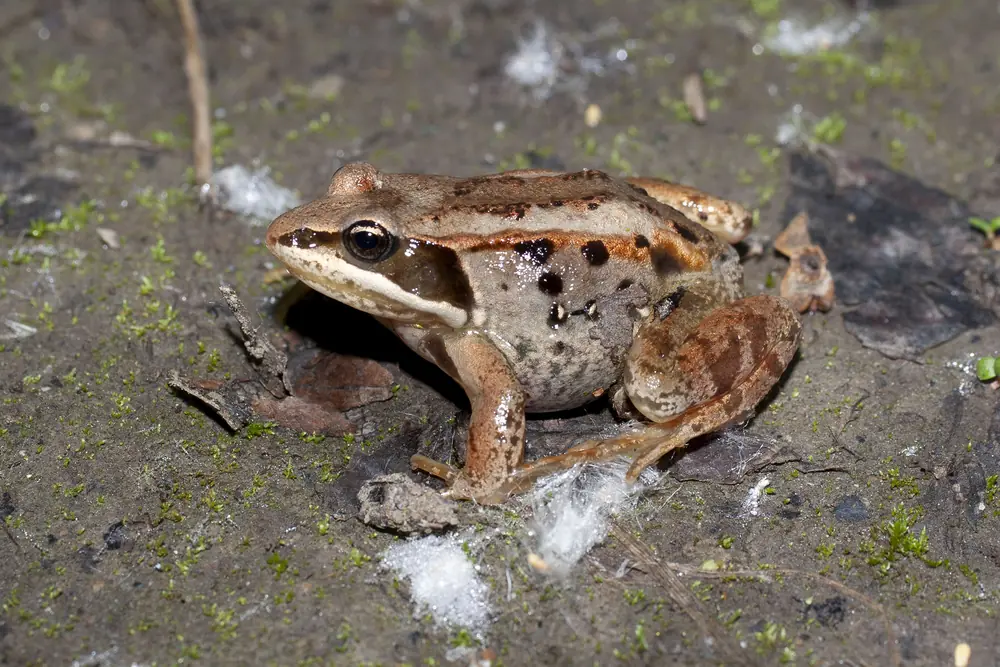
Wood frogs calling
April and May in Anchorage; late April around Fairbanks in at least one year · Ponds, meltwater pools and wetlands statewide, north to the Brooks Range
The wood frog is the only amphibian in most of Alaska. The National Park Service says it emerges just after the snow melts and the air warms, and that its calling follows snowpack and temperature. Alaska Science Forum reported male wood frogs singing at a University of Alaska Fairbanks pond in late April 2016, and the Anchorage Daily News said in 2026 that wood frogs sing, mate and lay eggs in local ponds every April and May. They freeze solid over winter.
-
The birch sap run
Around mid-April, per UAF Cooperative Extension; later in a cold spring · Birch trees across the Interior and Southcentral
The extension’s tapping guide says sap begins to run when days warm and the ground thaws, and that daytime highs consistently above 50 °F mean it will run soon. OneTree Alaska adds up the degrees by which each day’s high exceeds 32 °F; sap usually starts by 225 degrees, and a “sap watch” goes out at 175. In the cold April of 2023 the count was still only 85 on April 17.
-
Green-up still ahead
Fairbanks long-term average May 8 · Birch and aspen on Chena Ridge and elsewhere
In UAF’s 2023 report, climate specialist Rick Thoman gave May 8 as the long-term average for green-up, defined as the day birch and aspen leaves give the canopy “a faint but distinct green flush.” April is therefore the last bare month.
-
Pasqueflower buds
Blooms mostly in May · South-facing slopes and dry gravel
The pasqueflower is among the first wildflowers, but both Georgeson Botanical Garden and Wrangell-St. Elias National Park say it blooms in May, so April is for watching the fuzzy buds push up through the old grass.
Anchorage-area readers who want to listen can try Potter Marsh, Bicentennial Park or the Chugach foothills, the ponds named by the writer in the Daily News piece. Note the weather first: a cold snap shuts the chorus down until the next warm spell.
What are caribou and moose doing in April?
April is more about shedding and waiting than about births, which come mostly in late May and June. Bears, which left their dens in March and April, are covered in the safety notes.
-
Caribou herds start north
Satellite-collar studies define spring migration as April 16 to May 31 for the Teshekpuk and Central Arctic herds · North Slope and Brooks Range
The North Slope Borough’s collar maps label April 16 to May 31 as the spring migration period. ADF&G says small bulls and non-pregnant cows drop their antlers in April, while pregnant cows keep theirs until calves arrive in late May or early June.
-
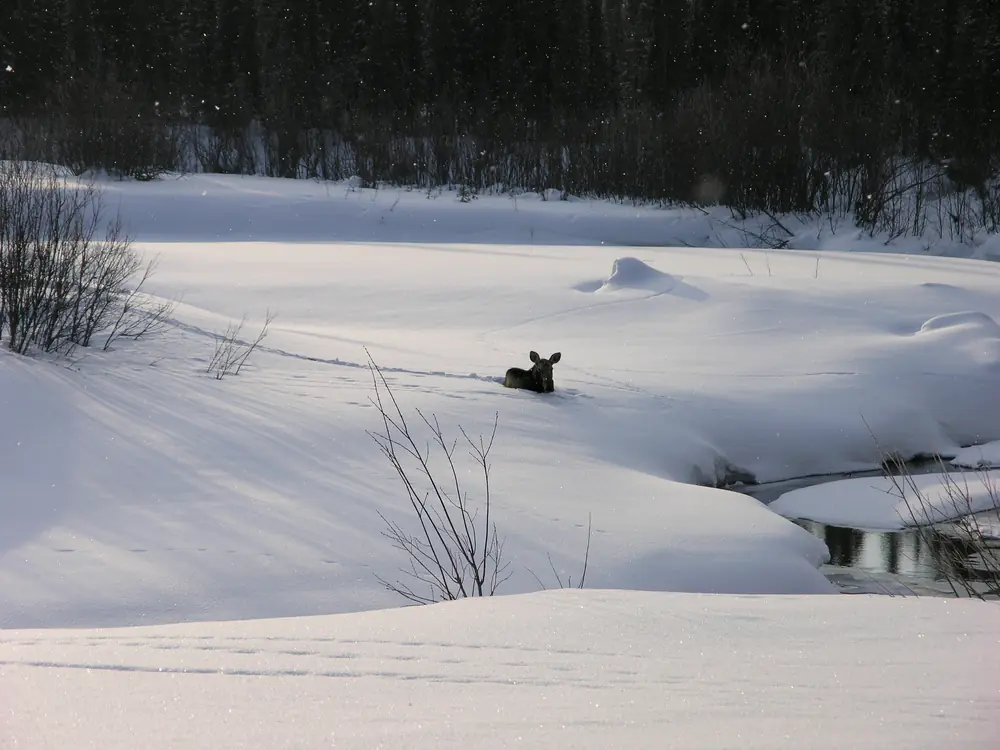
Moose in the last of the snow
April · River bottoms, willow flats and roadsides
Moose may still be wading through snow in April. ADF&G says cows chase off the previous year’s calf just before giving birth in spring, so a young moose near a cow in April is probably last year’s calf.
The field journal’s tracks to know plate is a good place to sketch the first bear print of the year in soft mud.
What opens or begins in Alaska nature in April?
April is the month when roads, permits and fire season change, and a few events fall on dates that are firm.
-
Denali Park Road opens to Mile 30
Usually late April; April 30 in 2022, April 24 in 2024, April 25 in 2025 · Denali National Park and Preserve
Once the plowing crews finish, the National Park Service opens the road to private vehicles as far as the Teklanika Rest Area at Mile 30. In its releases the park warns of snow, ice and mud in shaded stretches, and says the road may open and close several times. It stays open, weather permitting, until May 19; buses begin on May 20. The park announces the day, so check before driving up.
-
Fire season and burn permits
April 1 each year · Alaska, state, municipal and private land without a local program
The Division of Forestry’s 2025 announcement said the wildland fire season was underway on April 1, with burn permits required statewide, and that southern and southwest regions had begun early on March 17 that year. Permits are free; campfires under 3 feet across with flames under 2 feet tall need none.
-
Flood Preparedness Week
Proclaimed each spring by the governor; April 12 to 18 in 2026; the 2027 week was not announced · Statewide
The proclamation asks Alaskans to learn about flood risk and plan ahead. Watch for a 2027 announcement.
-
Spring subsistence bird harvest
The season usually opens April 2; the 2026 season ran April 2 to August 31, and the 2027 rules were not out · Eligible communities in each region
The U.S. Fish and Wildlife Service regulations for the spring and summer subsistence harvest cover only eligible residents in listed regions, with different open seasons by region. Other people should not hunt migratory birds during this period.
The Nenana Ice Classic, which closed ticket sales on April 5 in 2026, picks up next month, as the Tanana River ice finally goes out.
What is April weather like in Alaska, and what is breakup?
April is the turning month in the numbers. Averages show a long way to travel: Fairbanks has an average high of 45.6 °F but an average low of 21.7 °F and still records 26.4 nights at or below freezing, while in Utqiagvik the average high is only 10.6 °F. In Southeast, Ketchikan and Sitka average only 6.8 and 4.6 freezing nights. These are NOAA 1991–2020 normals from the National Centers for Environmental Information.
-
River breakup starts
Spring, varying by river and year · Tanana, Yukon, Kuskokwim and others
The Alaska-Pacific River Forecast Center publishes breakup outlooks each spring. In 2026 its forecaster Kyle Van Peursem told Alaska’s News Source that a breakup stretched across about six weeks is the preferred outcome, while a rapid thaw makes ice jams more likely.
-
Late snow and avalanche danger
April, mostly in the mountains · Chugach, Kenai, Alaska Range and Southeast peaks
Valdez still averages 22.3 inches of snow in April, and avalanche centers keep publishing forecasts through spring. Read the advisory first.
| Station | Average high | Average low | Snowfall | Precipitation (water) | Nights at or below 32 °F |
|---|---|---|---|---|---|
| Ketchikan | 49.8 °F | 37.2 °F | not published | 10.25 in | 6.8 |
| Sitka | 48.1 °F | 37.2 °F | not published | 4.31 in | 4.6 |
| Juneau | 48.7 °F | 32.9 °F | 1.2 in | 3.47 in | 13.0 |
| Valdez | 46.4 °F | 31.9 °F | 22.3 in | 3.37 in | 16.2 |
| Kodiak | 44.7 °F | 33.6 °F | 6.2 in | 6.14 in | 12.4 |
| Anchorage | 45.1 °F | 29.9 °F | 4.0 in | 0.43 in | 18.8 |
| Bethel | 36.9 °F | 21.2 °F | 6.0 in | 0.79 in | 26.5 |
| Nome | 29.4 °F | 15.9 °F | 6.8 in | 0.74 in | 28.0 |
| Fairbanks | 45.6 °F | 21.7 °F | 3.1 in | 0.34 in | 26.4 |
| Utqiagvik | 10.6 °F | −2.5 °F | 3.6 in | 0.18 in | 30.0 |
NOAA’s Climate Prediction Center posts a new three-month outlook every month; the latest maps are on its 90-day outlook site. The weather page covers the coming days for your town.
When is the last spring freeze in Alaska?
Not in April, in most places. The median last freeze of spring falls on April 22 at the Ketchikan airport, but on May 4 to 5 for Juneau, Anchorage and Kodiak, May 13 in Fairbanks, May 21 in Bethel and June 5 in Nome, according to NOAA’s 1991–2020 normals. Tender garden plants therefore generally wait for May or June.
| Station | One year in ten | Median | Nine years in ten |
|---|---|---|---|
| Fairbanks International Airport | May 2 | May 13 | May 26 |
| Anchorage International Airport | Apr 24 | May 5 | May 15 |
| Juneau International Airport (Mendenhall Valley) | Apr 23 | May 4 | May 18 |
| Kodiak Airport | Apr 19 | May 5 | May 21 |
| Bethel Airport | May 8 | May 21 | Jun 2 |
| Nome Municipal Airport | May 20 | Jun 5 | Jun 26 |
| Ketchikan International Airport | Apr 2 | Apr 22 | May 9 |
For the date at your own address, our Alaska frost lookup lists many more stations. The first column is the hopeful date; only about one spring in ten is finished with freezing that early.
What is in the sky over Alaska in April 2027?
Times are Alaska daylight time (AKDT). In the western Aleutians, subtract one hour. The nights are short and getting shorter.
-
The Pink Moon
Full at 2:27 p.m. AKDT on Tuesday, April 20; the best evening is April 20 · Rises in the east well after sunset: about 10:32 p.m. in Anchorage
Moonrise comes late in Alaska this month, so the Moon is low in the east well after sunset. It also looks full for about three nights, so the evenings on either side work too.
-
The Lyrids, a poor year
The shower is predicted to peak at about 5:41 p.m. AKDT on Thursday, April 22 (01:41 UT on April 23); Sea and Sky lists the peak nights as April 22 and 23 · North and east of Lyra, after dark
With the Moon nearly full and rising late, the meteors will be few. In Anchorage the Moon rises at about 1:55 a.m. on the 22nd. Expect only a few per hour at best.
-
The Moon beside Jupiter and Mars
Moon near Jupiter on the evenings of April 14 and 15 (about 68 percent lit); Mars about 3 degrees from the Moon on April 15 · South and southwest after dark
Jupiter, in the Leo and Cancer region, stays in the evening sky through spring; Mars is dimming. The Moon's separations from both planets are our own calculations.
-
The thin morning crescent and Venus
Mornings of April 3 and 4 · Low in the east before sunrise
By our calculation, a crescent Moon about 9 percent lit passes within about 3 degrees of Venus.
-
Northern lights
Any clear, dark night; storms tend to cluster near the equinoxes · Best in the Interior and Arctic
No agency issues a seasonal aurora forecast; the Geophysical Institute in Fairbanks posts a daily outlook. The long light of May washes the lights out until mid to late August.
| Phase | Date | Time |
|---|---|---|
| New moon | Tuesday, Apr 6 | 3:51 p.m. (AKDT) |
| First quarter | Tuesday, Apr 13 | 2:56 p.m. (AKDT) |
| Full moon, the Pink Moon | Tuesday, Apr 20 | 2:27 p.m. (AKDT) |
| Last quarter | Wednesday, Apr 28 | 12:18 p.m. (AKDT) |
To find moonrise for your town, open the moon phases page.
What can families do outdoors in Alaska this April?
- Listen for wood frogs after the snow goes. Go to a pond on a mild evening, stand still, and listen for a sound that is closer to a duck’s quack than a frog’s croak.
- Count the geese and swans. Keep a tally on a calendar from the first honk in April. If you live in the Interior, see how your date compares with Creamer’s Field.
- Tap a birch tree with an adult. UAF Cooperative Extension’s guide lists the equipment and the right tree size, and says to expect the run to begin around mid-April.
- Join a citizen science project. GLOBE Observer takes tree and cloud observations, Journey North takes hummingbird and other sighting reports, and the Arctic Audubon Society in Fairbanks sends a monthly newsletter listing field trips. COASST trains Alaskans online to survey beached birds.
- Mark Earth Day on April 22 by writing down the first bird song of the year in the Naturalist’s Field Journal.
Next month’s page will pick up the shorebirds. Meanwhile the guide to nature in each state lists every month. The month before this one is March in Alaska.
Safety notes for April in Alaska
- River ice. April is when river and lake ice turns unreliable, even while it looks thick. Ask locally before you cross, and stay away from the edges of the ice during breakup, when jams can send water over banks quickly.
- Bears. Bears are leaving their dens. ADF&G’s Living With Bears pages explain how to secure food and what to do in an encounter. Carry bear spray and make noise on trails.
- Spring hunting seasons. ADF&G’s 2026–2027 hunting booklet runs through June 30, 2027. It lists no closed season on black bears in Units 7 and 20, a brown bear season to June 15 by permit in Unit 7, and wolf seasons that end April 30 in Unit 18 and in the remainder of Unit 20, and May 31 in parts of Unit 1. Seasons differ by unit and by area inside a unit, so read your unit’s page. Alaska’s booklet does not set a general blaze orange rule. We found hunter orange required only in the Hatcher Pass Youth Management Area; wear bright colors anyway.
- Spring migratory birds. The subsistence harvest is limited to eligible residents. If you are not one, leave the cranes, geese and swans alone.
- Wildfire. The Division of Forestry’s 2025 notice said burn permits were required statewide from April 1, with small campfires exempt, and that dry grass exposed by melting snow carries fire easily. Keep fires small and fully out.
- Avalanches. Read the Chugach Avalanche Center advisory, or the one for your area, before going near steep slopes.
- Moose. A moose can charge when it feels crowded, so give every one wide space.
The Naturalist’s Field Journal has room for the first goose, the first frog chorus and the date the ice goes out near your house.
Sources (64)
- U.S. Naval Observatory: phases of the moon, 2027
- Sea and Sky: Astronomy calendar of celestial events, 2027
- NOAA Space Weather Prediction Center: Solar Cycle Progression
- UAF Geophysical Institute: aurora forecast
- NOAA NCEI: monthly normals data service, 1991–2020 (Anchorage)
- NOAA NCEI: monthly normals data service, 1991–2020 (Fairbanks)
- NOAA NCEI: monthly normals data service, 1991–2020 (Utqiagvik)
- NOAA Climate Prediction Center: 90-day outlooks
- National Weather Service: Alaska-Pacific River Forecast Center
- National Weather Service: Spring Breakup Outlook and Summary Products
- National Weather Service: Break Up Database
- Alaska's News Source: NWS warns of ice jam flooding along Yukon, Tanana rivers (March 2026)
- Governor of Alaska: Flood Preparedness Week 2026 proclamation
- Chugach Avalanche Center
- Fairbanks Daily News-Miner: migratory birds at Creamer’s Field announce the arrival of spring
- Fairbanks Daily News-Miner: your spring migration recap, the feathered finds of Fairbanks
- Alaska's News Source: Creamer’s Field welcomes migratory birds back to Fairbanks (April 2025)
- Friends of Creamer’s Field: Spring Migration Celebration
- Alaska Songbird Institute
- Arctic Audubon Society
- ADF&G: Sandhill crane species profile
- ADF&G: Trumpeter swan species profile
- ADF&G: Potter Marsh viewing location
- Copper River Delta Shorebird Festival
- Travel Wrangell: Stikine River Bird Festival
- Travel Wrangell: Stikine River Birding Festival
- KSTK: As the birds migrate, Wrangell celebrates with the Stikine River Birding Festival (2024)
- ADF&G: Eulachon species profile
- ADF&G: Anchorage-area sport fishing run timing
- ADF&G: 2022 Southcentral Alaska sport fishing regulations summary
- Journey North archive: Hummingbird migration update, April 12, 2001
- Bob Armstrong’s Nature Alaska: The male rufous hummingbird
- Journey North
- ADF&G: Gray whale species profile
- ADF&G: Kodiak wildlife viewing guide
- Alaska Sea Grant: Whale Fest Kodiak 2024 calendar of events
- NOAA Fisheries: Western Arctic bowhead whale stock assessment, 2023
- NOAA Fisheries: Bowhead whale
- NOAA Marine Fisheries Review: bowhead whale spring census at Point Barrow
- NPS: How climate changes the timing of wood frog calls
- Alaska Science Forum (Juneau Empire): Calling frogs signal change of the season
- Anchorage Daily News: Largely undetected, wood frogs are small miracles (June 2026)
- UAF Cooperative Extension: Backyard Birch Tapping and Syrup Basics
- UAF news: When is green-up? It’s going to be late this year, and so is the birch sap run
- UAF Georgeson Botanical Garden: Growing Alaska native pasqueflowers
- NPS Wrangell-St. Elias: Wildflowers
- ADF&G: Brown bear species profile
- ADF&G: Black bear species profile
- ADF&G: Living with bears
- ADF&G: Caribou species profile
- ADF&G: Moose species profile
- North Slope Borough: Caribou satellite collar maps
- NPS Denali: Visiting in fall or spring
- NPS Denali: Park Road opening to Teklanika, April 25, 2025
- NPS Denali: Park Road opening to Teklanika, April 24, 2024
- NPS Denali: Park Road opening to Teklanika, April 30, 2022
- Alaska Division of Forestry: Alaska’s wildland fire season begins, burn permits required (2025)
- U.S. Fish and Wildlife Service: Alaska spring and summer subsistence migratory bird harvest
- Nenana Ice Classic
- ADF&G: 2026–2027 Alaska Hunting Regulations (complete booklet)
- EARTHDAY.ORG
- GLOBE Observer
- COASST: Coastal Observation and Seabird Survey Team
- Photos via Wikimedia Commons; licenses and photographers are credited under each picture
