What to look for in nature in Alaska this October
In most of Alaska, October is when winter moves in. Nights get long and dark enough for the aurora, snow settles on the Interior and the Arctic coast, lakes skim over, bears go to ground, and the last swans head south. Southeast is the exception: there, October brings some of the heaviest rain of the year and the first frosts. Here is what to watch for in each region, with dates.
Start here

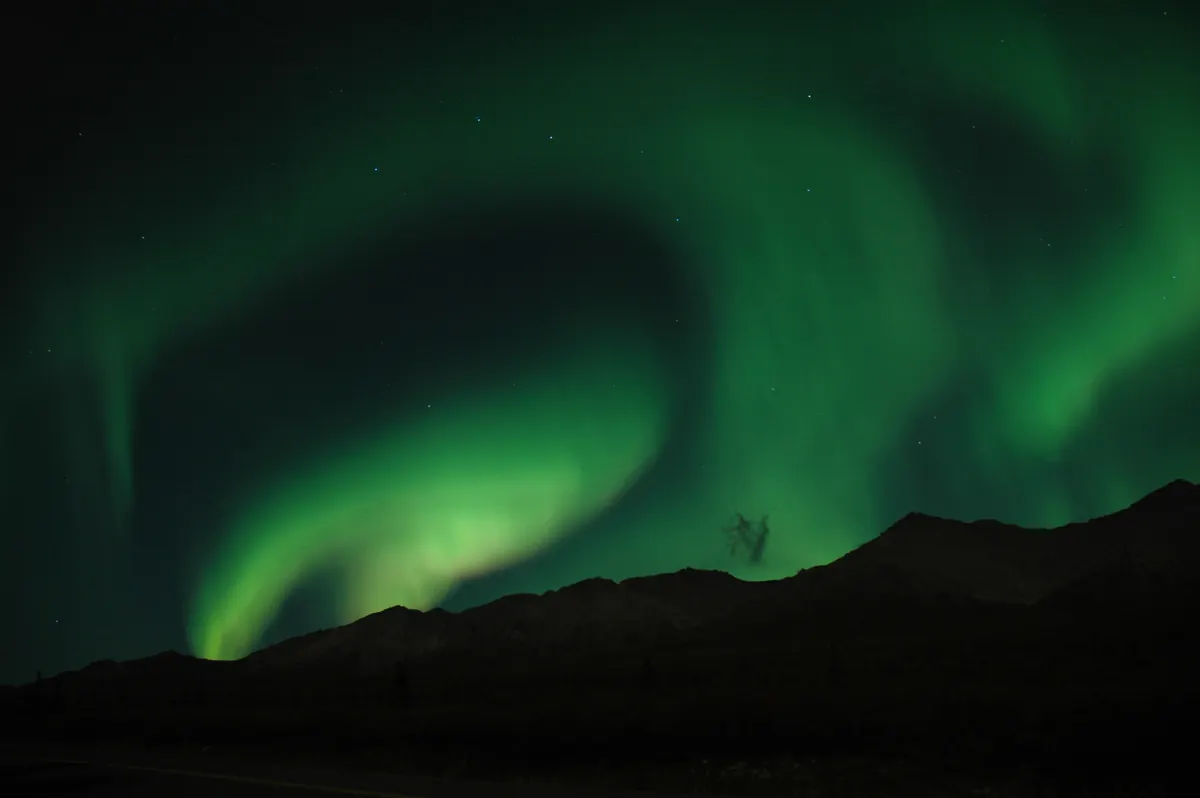
- The aurora. October nights are long and still fairly mild. Around Fairbanks, the Geophysical Institute says the lights are most likely in the three or four hours around midnight, and the new moon on October 10 gives the darkest skies of the month. Get away from streetlights and watch the north.
- Bears getting ready for dens. Bears are at their heaviest now and still feeding hard. Many black bears den in October and November, and Kodiak’s brown bears start going in during late October. Until snow covers the ground, treat every trail and every garbage can as bear country.
- The first lasting snow. Fairbanks’ average first inch of snow comes on October 9, and Anchorage’s first measurable snow on October 16. By now the first snow on the peaks, which Alaskans call termination dust, is usually creeping down the mountains a little more each week.
Record it: use the dusk and dawn watch page in the Naturalist’s Field Journal for the aurora and the shrinking days, the “birds I have seen” page for swans, geese and eagles, and a tracks to know plate for the first snow, when every hare, fox and moose leaves its signature. Write down the date the lake near you first skims over.
Regions used below: Southeast and the Inside Passage; Southcentral: Anchorage, Mat-Su and the Kenai; Interior and Fairbanks; Southwest: Kodiak, Bristol Bay, the Alaska Peninsula and the Aleutians; Western Alaska: the Y-K Delta and Seward Peninsula; Arctic and the North Slope.
When can you see the northern lights in Alaska in October?
On any clear, dark night, from about late August until late April. The University of Alaska Fairbanks Geophysical Institute counts the Fairbanks aurora season as roughly August 21 to April 21, and it points out something useful for October: over the Interior, the statistical chance of seeing aurora near an equinox is about twice what it is at a solstice. Early autumn combines that with nights that are dark but not yet brutally cold.
The institute’s advice is simple. The best window is the three or four hours centered on midnight, and good displays are most likely between about 9 p.m. and 3 a.m. You need both darkness and a clear sky, so watch the cloud forecast as closely as the space-weather one. Pick a hill away from town lights with an open view, because the lights can show up anywhere in the sky, and plan on more than one night. Its forecast uses the Kp index, from 0 (quiet) to 9, and anything above Kp 5 counts as a geomagnetic storm; under the auroral oval, though, a modest number can still mean a good night.
-
Where in Alaska
Any clear night; darkest around the Oct 10 new moon · Interior and Arctic best; Southcentral often; Southeast on stronger nights
Fairbanks sits under the auroral oval, so the lights often show high overhead. Farther south, around Anchorage, the Kenai and Southeast, a display usually sits lower in the northern sky, so a clear northern horizon matters more. Coastal cloud is the usual problem in Southeast and on Kodiak; October in the Interior is drier.
-
Report what you see
All season · Online
Aurorasaurus, a participatory science project run by the New Mexico Consortium with NASA and National Science Foundation support, collects sighting reports and puts them on a live map alongside the space-weather forecast. A report from Alaska on a night when forecasters expected nothing is exactly the kind of data it wants.
Before driving out of town to a dark spot, look up the cloud forecast for your area on Today’s sky.
How much daylight does Alaska lose in October?
A lot, and the farther north you live, the more. Ketchikan loses about two hours and eleven minutes over the month, Anchorage nearly three hours, and Fairbanks and Nome well over three. Utqiagvik loses 299 minutes, five full hours, at about ten minutes a day. By Halloween, the sun in Fairbanks is up just under eight hours. In Anchorage, sunrise slides from 8:07 a.m. on October 1 to 9:26 a.m. on October 31, and sunset from 7:30 p.m. to 6:00 p.m.
| City | Oct 1 | Oct 31 | Lost | Per day |
|---|---|---|---|---|
| Ketchikan | 11 h 31 m | 9 h 20 m | 131 min | 4.4 min |
| Juneau | 11 h 28 m | 8 h 59 m | 149 min | 5.0 min |
| Kodiak | 11 h 29 m | 9 h 03 m | 146 min | 4.9 min |
| Anchorage | 11 h 23 m | 8 h 34 m | 169 min | 5.6 min |
| Bethel | 11 h 24 m | 8 h 38 m | 166 min | 5.5 min |
| Fairbanks | 11 h 17 m | 7 h 56 m | 201 min | 6.7 min |
| Nome | 11 h 17 m | 7 h 59 m | 198 min | 6.6 min |
| Utqiagvik | 10 h 59 m | 6 h 00 m | 299 min | 10.0 min |
Utqiagvik’s last sunrise and sunset of the year come on November 18; by the Naval Observatory’s tables the sun does not clear the horizon again until January 23, 2027, though noon twilight stays bright enough to work by. Daylight saving time ends statewide at 2 a.m. on Sunday, November 1; the switch pulls Anchorage’s sunrise back to around 8:30 for a few days before the slide resumes. For your own coordinates, the Field almanac lists sunrise, sunset, twilight and this week’s loss.
When does the first snow and first freeze come to Alaska?
For most of the state, the first freeze has already happened by October 1. The Fairbanks airport’s median first freeze is September 13, Nome’s is September 3, Bethel’s September 22, and even Anchorage’s airport has a median of October 1. October’s story in the Interior, the west and the north is snow and ice, not frost. Only Southeast, Kodiak and the Aleutians are still waiting on a first freeze: the median is October 3 at Juneau’s airport and Kodiak, October 18 at Dutch Harbor, October 23 at Ketchikan and November 1 at Sitka.
Snow follows close behind. The National Weather Service in Fairbanks keeps records back to 1915: the first trace of snow there comes on average about September 21, the first measurable snow (0.1 inch) about October 1, and the first inch about October 9, with a latest first inch of December 27. Those averages run through 2015. In Anchorage, forecasters quoted by local news put the average first measurable snow at October 16, with records from September 21, 1996, to November 13, 2002.
| Station | One year in ten | Median | Nine years in ten |
|---|---|---|---|
| Nome Municipal Airport | Aug 15 | Sep 3 | Sep 22 |
| Fairbanks International Airport | Aug 29 | Sep 13 | Sep 24 |
| Bethel Airport | Sep 7 | Sep 22 | Oct 4 |
| Anchorage International Airport | Sep 18 | Oct 1 | Oct 14 |
| Kodiak Airport | Sep 22 | Oct 3 | Oct 17 |
| Juneau International Airport (Mendenhall Valley) | Sep 18 | Oct 3 | Oct 20 |
| Dutch Harbor (Aleutians) | Sep 20 | Oct 18 | Nov 5 |
| Ketchikan International Airport | Oct 3 | Oct 23 | Nov 10 |
| Sitka Airport | Oct 13 | Nov 1 | Nov 21 |
Local terrain matters enormously here: Juneau’s downtown gauge has a median of October 22, nearly three weeks after the airport a few miles away. The Alaska frost dates page lists every station with a record, from Hyder to Kotzebue. In Southeast, now is the time to carry potted plants indoors; farther north, it is the month to note the day your pond or the nearest slough freezes over and stays that way.
When do Alaska’s bears go into their dens?
Through October and into November, and it depends on the bear. The Alaska Department of Fish and Game says black bears go into dens in October and November after a fall of salmon, roots and late berries, and in the far north they can stay in for seven or eight months. Kodiak brown bears begin denning in late October; pregnant females go first and adult males last, and some males never den at all. On the North Slope, a biologist studying grizzlies in the oilfield region told ADF&G that his earliest pregnant female denned on September 21, that all the females were in by mid-October, and that about 80 percent of the males had denned by November 1.
Katmai’s Fat Bear Week finished on September 29, and the bears it celebrated are close to their peak weight now. Full visitor services at Brooks Camp ended on September 17, with only limited services through September 30, but the bears keep fishing the river for spawned-out salmon into the fall.
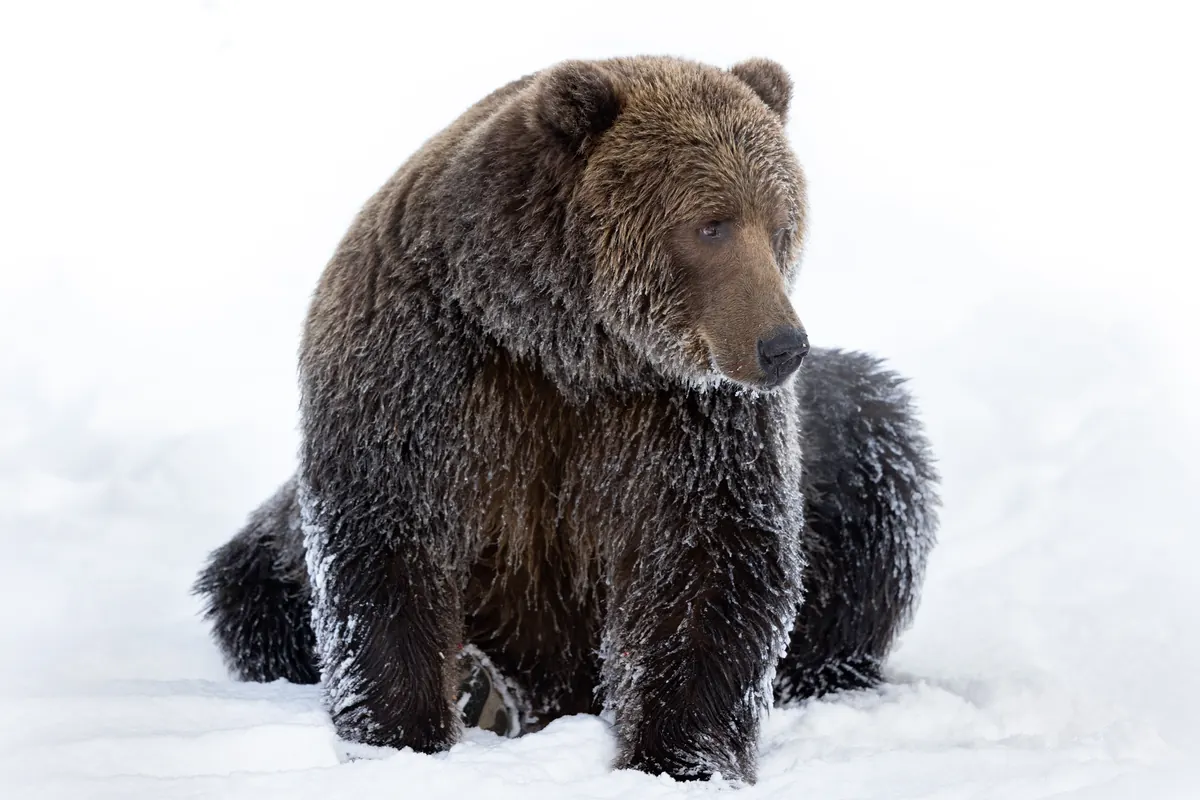
Until the ground is white and the bears are gone, keep garbage, pet food, chicken feed and birdseed locked away. A bear that finds food near houses in October has only a few weeks left to fatten up and will be bold about it.
Where are the last salmon, and where do the eagles gather?
Coho, the silvers, are the last big salmon run of the year. ADF&G says they enter spawning streams anywhere from July to November, usually riding high water, and by October many are in their spawning colors: dark heads and backs with maroon to red sides. Their eggs sit in the gravel all winter, hatch in early spring, and the young stay in the gravel on yolk until May or June. Look from bridges and banks on small clear streams, and give the redds a wide berth.
-
The Chilkat eagle gathering
Mid-October to January; best viewing October–December · Alaska Chilkat Bald Eagle Preserve, Haines Highway miles 18–21
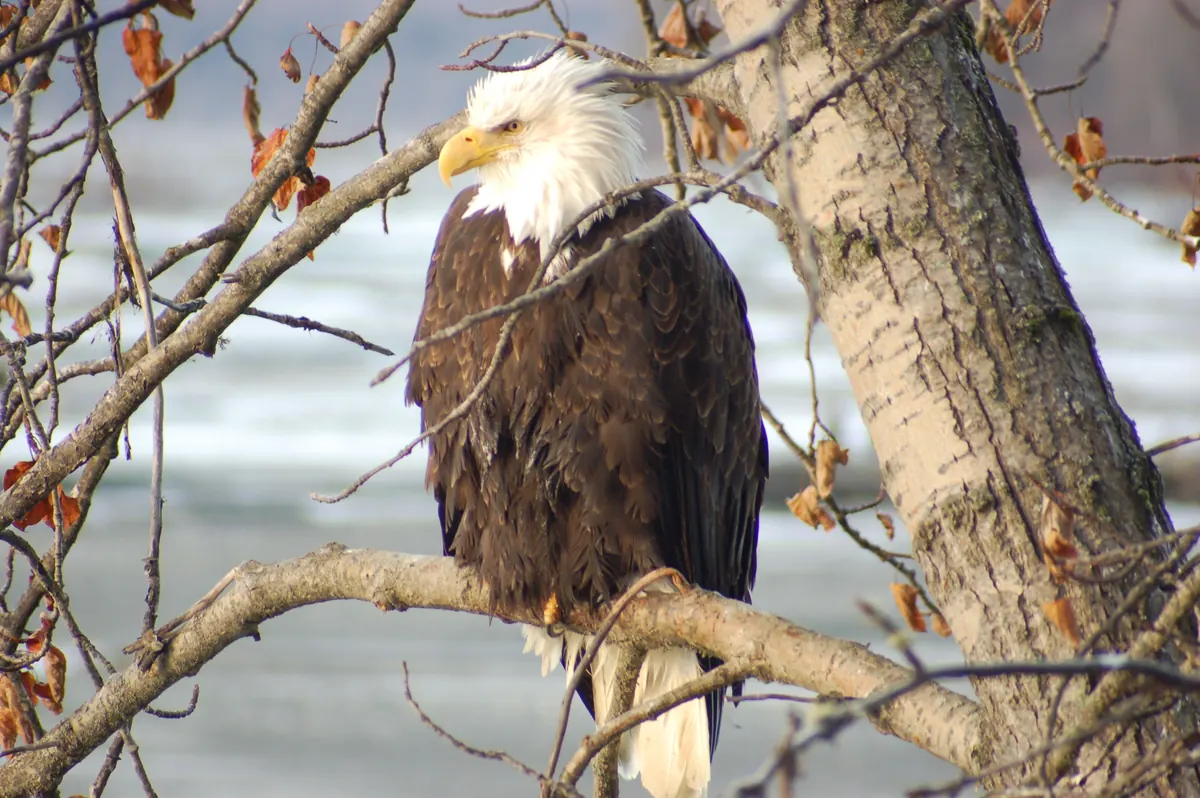
Water stored in a buried alluvial fan seeps into the Chilkat through the winter and keeps stretches of it open, and ADF&G says a late chum salmon run in that open water draws more than 3,000 bald eagles between mid-October and January. Alaska State Parks calls it one of the world’s largest gatherings of the birds, on a 48,000-acre preserve north of Haines. The best viewing is from the four pullouts at the Council Grounds, between miles 18 and 21 of the Haines Highway; the 19-mile pullout has a boardwalk and telescope, and a two-mile riverside trail starts nearby. Stay on the pullouts and trail so the birds can feed and roost undisturbed.
-
The Alaska Bald Eagle Festival
November; confirm 2026 dates · Haines
The American Bald Eagle Foundation hosts the festival each November, with talks, photography and guided viewing. Listings we found for 2026 disagree on the exact weekend, so check with the foundation before you book a ferry.
Anywhere spawned-out salmon collect on gravel bars in October, from the Kenai to the Interior rivers, expect eagles, gulls, ravens, magpies and, until they den, bears.
Which birds leave Alaska in October, and which stay?
-
Brant and emperor geese at Izembek
Peak late September to late October; most leave in early November · Izembek Lagoon, near Cold Bay on the Alaska Peninsula
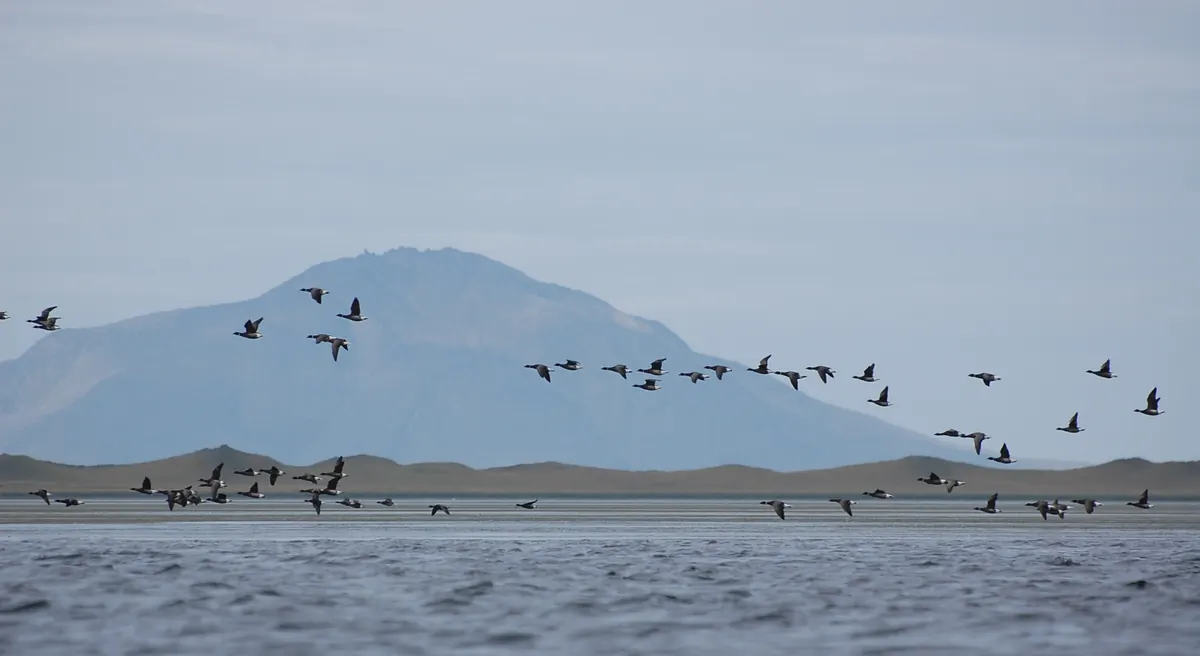
Nearly the whole world population of Pacific black brant gathers on Izembek Lagoon each fall to fatten on one of the largest eelgrass beds anywhere, and the U.S. Fish and Wildlife Service has counted them from the air since 1975. ADF&G adds that the lagoon also hosts about half the world’s emperor geese, tens of thousands of cackling geese and more than 20,000 molting Steller’s eiders; September and October are the peak months. In one detailed federal study from the late 1980s, the first brant left on October 21 and the main departure came in early November, when tens of thousands left in a single day, though timing shifts with the weather. About 40 miles of gravel road from Cold Bay lead into the refuge.
-
Trumpeter and tundra swans
October into November · Interior and Southcentral lakes and rivers, the Copper River Delta
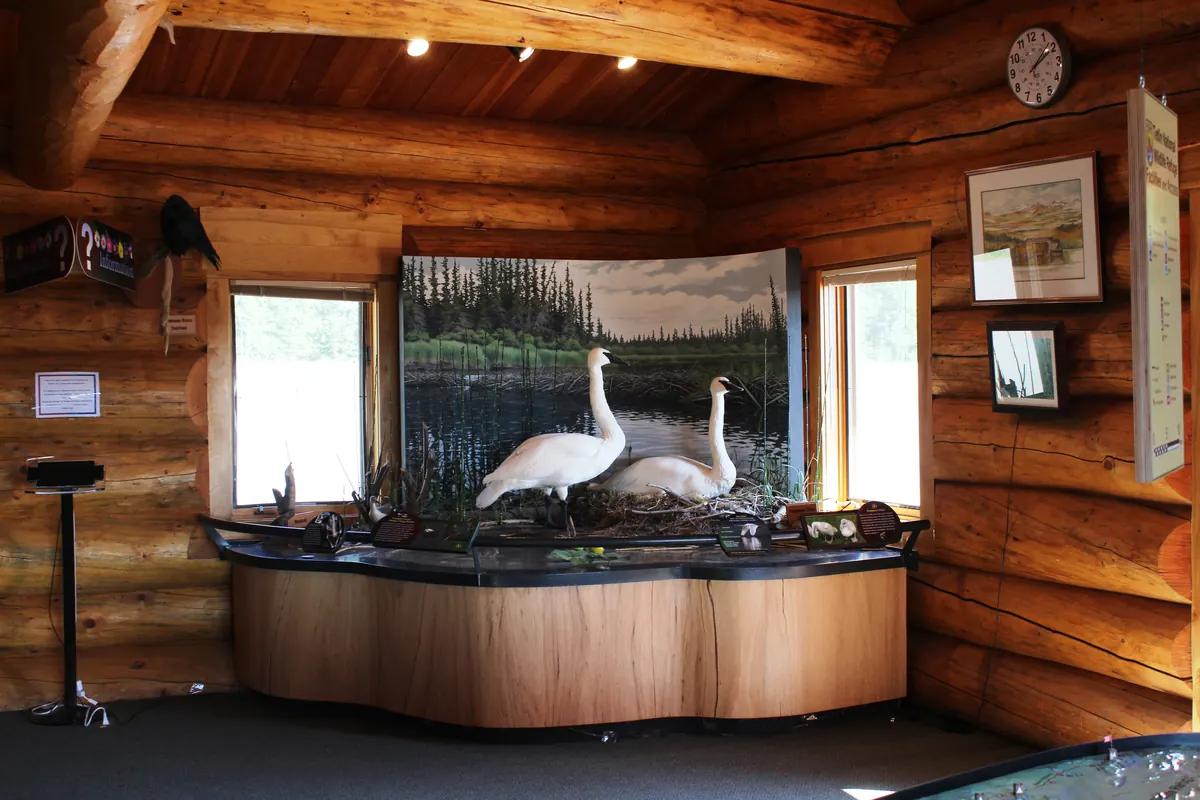
ADF&G says trumpeter swans head south once temperatures start to fall in October or November, to coastal waters from Cordova down to the Columbia River, with a large concentration on Vancouver Island. Watch for family groups, with gray young, on lakes that have not yet frozen, and listen for their bugling overhead on clear cold mornings.
-
Sandhill cranes: the stragglers
Main flight mid-September; a few into October · Tanana Valley near Delta Junction; the Copper River Delta
ADF&G puts the cranes’ fall migration in mid-September, when around 200,000 pass the Delta Junction–George Lake area and as many as 50,000 can go through in a day. By October most have gone to Texas, the Southwest and Mexico. A late flock rattling overhead in early October is worth a line in the journal.
-
Ptarmigan changing color
Molt started in August; white by snowfall · Tundra, willow flats and timberline statewide
Willow ptarmigan, the state bird, gather into family flocks in September. In late September and October the sexes tend to split, and hens move lower in small groups to find food and shelter. Cocks start growing white feathers as early as August, so an October bird can look patched brown and white until the snow catches up with it.
-
Winter birds settling in
From October · Towns with fruiting trees; boreal forest
Bohemian waxwings wander in big flocks in winter, looking for berries, and Audubon names mountain-ash among their favorites. The ornamental mountain-ash in Anchorage and Fairbanks yards can be stripped in an afternoon when a flock finds it. Chickadees, redpolls, ravens and Canada jays are the birds that stay; if you feed them, use the bear rule above and wait until the bears are denned.
What are moose, caribou, hares and frogs doing?
-
The moose rut winds down
Late September into early October · Statewide, including city greenbelts
ADF&G puts the moose rut in late September and early October, so bulls are still swollen-necked and short-tempered in the first part of the month. Later in the fall, moose turn to willow, birch and aspen twigs and often feed along roads and trails, where they are hard to see in the dark afternoon commute.
-
Caribou rut in the northwest
Mid to late October · Western Arctic Herd range
For the Western Arctic Herd, ADF&G says the bulls spar in September but the real rut, with serious fighting and breeding, comes in mid to late October. Southern herds breed earlier, in September. Caribou can travel up to 50 miles a day once the fall migration starts.
-
Hares turning white
Fall, timed to the season rather than the snow · Forests statewide
Snowshoe hares trade their brown summer coat for white in winter, with gray underfur and dusky bases to the hairs. In a year when snow comes late, a white hare on brown leaves is easy to spot, and so are its tracks once the first snow does stick.
-
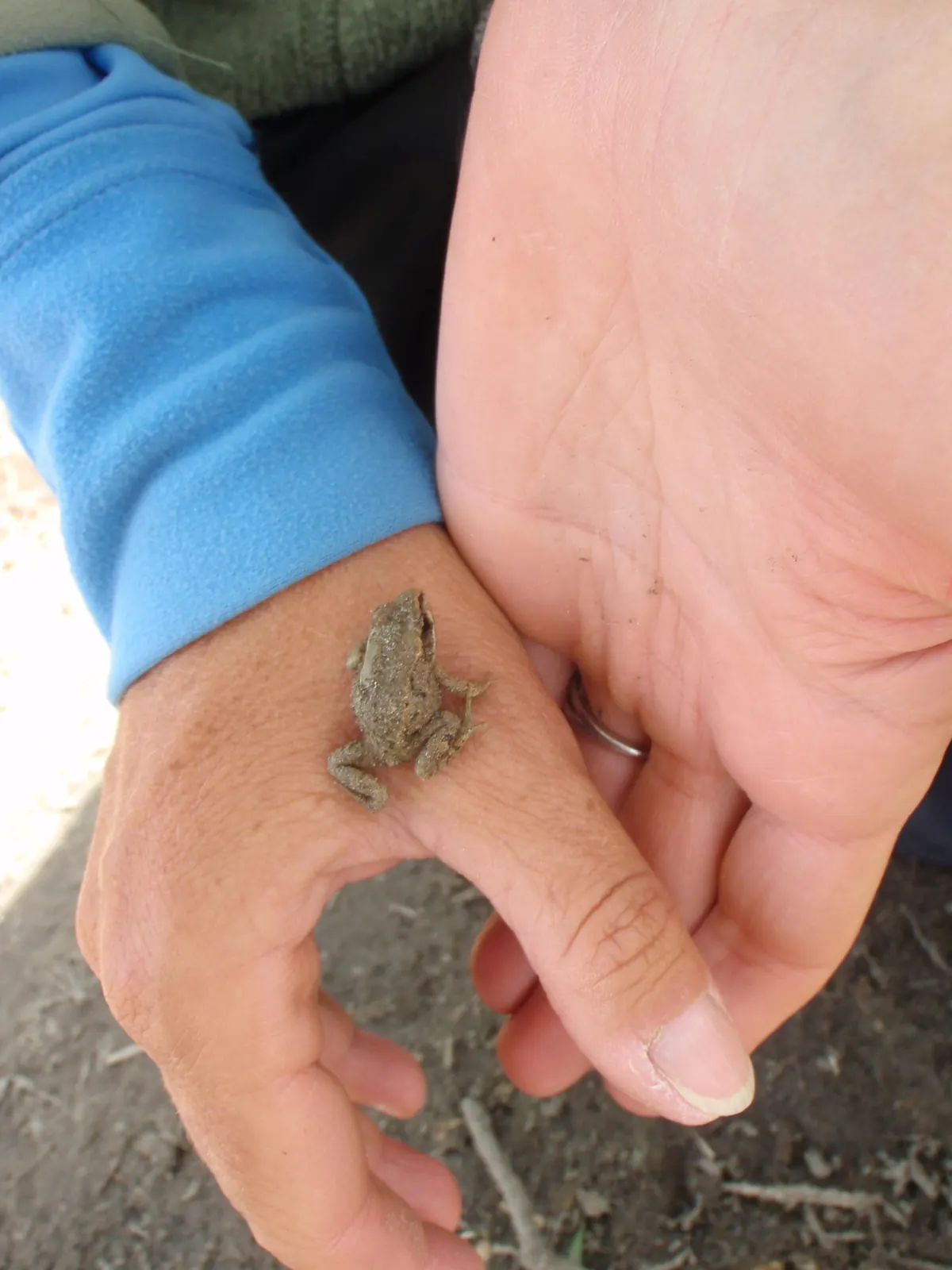
Wood frogs that freeze solid
From the first hard frosts until spring · Under leaf litter in forests and wetlands
The wood frog, the only frog across most of mainland Alaska, does not escape the cold; it freezes. Researchers at the University of Alaska Fairbanks found wood frogs surviving outdoors with up to 60 percent of their bodies frozen for as long as seven months, hearts and breathing stopped, at temperatures below 0 °F. The frogs thawed and refroze 10 to 15 times in fall before freezing for the season, and each round built up glucose, up to ten times the normal level, which protects their cells. So the October frost-and-thaw you notice in the mornings is doing real work for them.
-
Humpbacks heading for Hawaii
Fall and early winter · Southeast Alaska, the Gulf and the Aleutians
Many of the humpbacks that fatten in Southeast Alaska, the Gulf of Alaska and the Aleutians spend the winter in Hawaii, and NOAA Fisheries says some make the 3,000-mile trip in as few as 28 days. Not all leave at once: Sitka’s WhaleFest is held in November partly because whales are still there to watch.
Is October rainy or snowy in Alaska, and what about El Niño?
That depends entirely on where you are. In the Southeast rain forest, October is the soggy peak: the 1991–2020 normal at Ketchikan’s airport is 18.4 inches, the most of any month, and Sitka’s 11.8 inches edges out September for first place. Juneau’s airport averages 8.4 inches, second only to September, and Kodiak 8.9. Inland it is a different world. Anchorage averages 1.8 inches of precipitation and 5.6 inches of snow in October; Fairbanks gets 0.8 inch of water, 8.2 inches of snow and an average high of 34 °F; Utqiagvik gets 10.3 inches of snow with an average temperature of 21 °F.
Out on the Arctic Ocean, the sea ice is growing again. The National Snow and Ice Data Center says this year’s minimum came on September 12, at 4.60 million square kilometers, tied for tenth lowest in the satellite record, and it notes that the twenty lowest minimums are the twenty years from 2007 to 2026. How quickly new ice reaches the Chukchi and Beaufort coasts in October and November shapes the early winter for coastal villages.
El Niño is the big winter question. Federal forecasters rated a very strong event for 2026–27 as better than nine-in-ten likely in the Climate Prediction Center’s mid-September update (dated the 10th), and NOAA’s winter outlook comes out in mid-October. For Alaska, the historical signal is modest but real. A National Weather Service climatologist writing for NOAA found that 20 of the 30 El Niño winters since 1925 ran warmer than average, because the pattern favors south winds that carry mild Pacific air inland, and that El Niño winters tend to be drier, especially near the coast. The federal Climate Adaptation Science Centers put the tilt at only 5 to 10 percent better odds of a mildly warm winter, strongest in Southeast and fading to nothing in the northwest; they also allow for a bit more rain in the south, so the sources do not fully agree on precipitation. After Alaska’s coldest December-to-March stretch in about half a century last winter, a milder season would be a sharp turn. The effect shows up in winter, though; October weather this year owes little to it.
For daily conditions and the week ahead where you live, the weather page pulls the National Weather Service forecast.
What is in the sky over Alaska this October?
-
The Hunter’s Moon
Sunday, October 25, full at 8:12 p.m. AKDT · Low in the east-northeast at dusk
The full moon after September’s Harvest Moon. It rises in Anchorage at about 5:26 p.m. on October 25, some fifty minutes before sunset, and in Fairbanks at about 4:53 p.m., so it is already up as the light fades. It looks full on the evenings of both the 25th and the 26th. It is not a supermoon under the perigee definition.
-
Orionid meteors
Active Oct 2 – Nov 7; best pre-dawn Oct 21 and 22 · Anywhere dark; face south or east
The Orionids peak broadly on October 21–22, and Alaska’s late dawns work in your favor. In Anchorage the waxing gibbous moon sets at about 2:34 a.m. on the 21st and 4:06 a.m. on the 22nd, and morning twilight does not begin until after 8:10, which leaves several dark hours. In Fairbanks, moonset is about 2:07 and 3:49 a.m. on those mornings. Ten to twenty meteors an hour is a typical good count; a bright aurora will wash some out.
-
Draconid meteors
Evening of Thursday, October 8 · High in the north after dark
A weak shower, at best a handful an hour, but it is an evening one, and from Alaska its radiant in the head of Draco stays high in the northern sky all night. The moon does not rise until the next morning. It is a good excuse to take children out right after dark.
-
Saturn at its best
Opposition Sunday, October 4; moon beside it Oct 23–24 · Rises in the east at sunset; low in the south at midnight
On October 4 Saturn reaches opposition: the ringed planet is at its nearest and brightest of 2026 and stays up from dusk until dawn. From Alaska’s latitudes it never climbs very high, so find a clear southern horizon. A bright, nearly full moon sits close to Saturn on October 23 and again on the 24th.
-
Jupiter, Mars and a moon that just misses
Pre-dawn all month; Mars at the Beehive on the morning of Oct 11 · East before dawn
Before sunrise, look east: the dazzling point is Jupiter, and the fainter orange one close by is Mars, which grazes the Beehive star cluster (M44) as the sky pales on Sunday the 11th. Binoculars show the cluster as a spray of faint stars. On October 6 the moon covers Jupiter for much of the Lower 48, but the event ends before the moon rises in Alaska. When the thin crescent comes up here, around 1:43 a.m. in Juneau, 2:00 in Fairbanks and 2:34 in Anchorage, Jupiter will be sitting just beside it, very close in Southeast and a little farther off in the Interior. Venus, heading for its October 23 inferior conjunction, stays too near the sun and horizon to catch from most of Alaska this month.
| Phase | Date | Time |
|---|---|---|
| Last quarter | Saturday, Oct 3 | 5:25 a.m. |
| New moon | Saturday, Oct 10 | 7:50 a.m. |
| First quarter | Sunday, Oct 18 | 8:12 a.m. |
| Full moon, the Hunter’s Moon | Sunday, Oct 25 | 8:12 p.m. (looks full Oct 25 and 26) |
| Last quarter | Sunday, Nov 1 | 11:28 a.m. AKST |
Moonrise and moonset for your own town, which swing widely at Alaska’s latitudes, are on the moon phases page.
What can families do outside in Alaska this October?
- Watch the Draconids on Thursday, October 8. An evening shower with no moon, right after dark. Bundle up, lie back and look north.
- Go aurora hunting around the new moon on October 10. Check the Geophysical Institute forecast and the clouds, and if the lights show up, send a report to Aurorasaurus.
- Drop, cover and hold on for the Great Alaska ShakeOut on Thursday, October 15. The ShakeOut organizers list October 15, 2026, as the day for all regions. A family drill takes two minutes and is worth doing anywhere in Alaska.
- Go to the Seward Science Symposium, October 16–17. Stewards of the Bay presents two days of local research at the Alaska SeaLife Center, including Indigenous-led work, with a poster session and an evening film; it is free and open to everyone.
- Walk the Creamer’s Field trails in Fairbanks. The Farmhouse Visitor Center is open weekdays 9:30 a.m. to 5 p.m. and Saturdays noon to 4. The cranes are mostly gone, but the fields are good for tracks after the first snow.
- Zoo Boo at the Alaska Zoo, Saturday, October 31. The zoo lists it for Halloween; check its site for times.
- Start a first-ice log. Pick one pond or slough and write down the date of the first skim of ice, the day it holds a thrown stone, and the day it stays white. Repeat every year.
- Get ready for Project FeederWatch. The Cornell Lab’s winter feeder count runs November 1 to April 30; U.S. participants pay $18. Put feeders out only once the bears near you are denned.
- Plan ahead for Sitka WhaleFest, November 5–9. Its 30th year includes a three-day science symposium, workshops and whale-watching trips.
- Add sightings to eBird or iNaturalist. Swans, waxwings, the first white hare and the last salmon are all useful records from a state with few observers per square mile.
More seasonal guides for other states and months are on the nature index.
Safety notes for October in Alaska
- Bears. Fall bears are feeding around the clock. Secure garbage, pet food and livestock feed, keep bird feeders down until bears den, and make noise on brushy trails and salmon streams. ADF&G’s advice boils down to this: how you behave often decides how the encounter goes.
- Moose. Give rutting bulls in early October plenty of room, and slow down on dark roads; moose feeding on roadside willows are hard to see until the last second.
- Thin ice and cold water. New ice on lakes and sloughs is unreliable and often thinner near inlets, outlets and springs. Keep children and dogs off it until it has been measured. October water is cold enough to disable a swimmer within minutes, so wear a life jacket in any boat.
- Short days. Start hikes early and carry a headlamp; in Fairbanks daylight is under eight hours by the end of the month. Snow can arrive on any trail above treeline.
- Southeast rain. October is the wettest month in much of the region; streams rise fast, and steep slopes can fail after long heavy rain.
- Hunting. Alaska’s seasons are set unit by unit in the 2026–2027 hunting regulations, in effect July 1, 2026, to June 30, 2027, so check the booklet for your Game Management Unit. Examples: in Unit 4 (Admiralty, Baranof and Chichagof islands) the deer season runs August 1 to December 31, with residents allowed any deer from September 15; grouse are open August 10 to March 31 in Units 13, 14A, 14B and 16; ptarmigan are open August 10 to February 28 in Units 12, 20 and 25C; and a Kodiak brown bear permit hunt in part of Unit 8 runs October 25 to November 30. Many general moose seasons closed in September, but some permit hunts run later. Waterfowl seasons are set by zone in ADF&G’s separate migratory bird regulations.
- Hunter orange. Alaska has no statewide orange rule. ADF&G’s hunter education program says the state “does not require wearing hunter orange clothing”, but that investigators consistently find it reduces accidents, and the only place the 2026–2027 booklet requires it is the Hatcher Pass Youth Management Area during its August youth small-game period. Wear bright orange yourself on any trail in hunting country anyway, and put some on the dog.
Ready to keep your own record of the season? The Naturalist’s Field Journal has plates for exactly this kind of month.
Sources
- UAF Geophysical Institute: aurora forecast and viewing notes
- Aurorasaurus: report an aurora sighting
- U.S. Naval Observatory: sun and moon rise, set and transit for one day
- U.S. Naval Observatory: phases of the moon
- NWS Fairbanks: first trace of snow, 1915–2015
- NWS Fairbanks: first measurable snowfall, 1915–2015
- NWS Fairbanks: first one-inch snowfall, 1915–2015
- Alaska Public Media: Anchorage’s first snowfall (Oct 2022), NWS average date
- Alaska’s News Source: Anchorage first-snow average and records
- NOAA NCEI: U.S. Climate Normals, 1991–2020 (freeze dates, precipitation, snow, temperature)
- NOAA Regional Climate Centers: Applied Climate Information System (station normals)
- National Snow and Ice Data Center: Arctic Sea Ice News, 2026 minimum
- NOAA Climate Prediction Center: ENSO diagnostic discussion, September 10, 2026
- NOAA Climate.gov: Moose tracks through Alaska and ENSO
- USGS Climate Adaptation Science Centers: Regional super El Niño impacts, Alaska
- Alaska Public Media: after Alaska’s coldest winter in a half-century, El Niño warmup (April 2026)
- ADF&G: Grizzly bear denning (North Slope)
- ADF&G: Kodiak brown bear fact sheet
- ADF&G: Black bear species profile
- ADF&G: Living with bears
- Katmai National Park: Fat Bear Week 2026
- Katmai National Park: Brooks Camp season and permits
- ADF&G: Coho salmon species profile
- Alaska State Parks: Chilkat Bald Eagle Preserve
- ADF&G: Haines and the Bald Eagle Preserve, wildlife viewing
- American Bald Eagle Foundation, Haines
- U.S. Fish and Wildlife Service: Izembek National Wildlife Refuge
- U.S. Fish and Wildlife Service: Pacific brant fall staging survey at Izembek
- ADF&G: Wildlife viewing at Izembek
- BOEM: Response of Pacific black brant and other geese to aircraft overflights at Izembek Lagoon (staging and departure dates)
- ADF&G: Trumpeter swan species profile
- ADF&G: Sandhill crane species profile
- ADF&G: Willow ptarmigan species profile
- Audubon Guide to North American Birds: Bohemian waxwing
- ADF&G: Moose species profile
- ADF&G: Caribou species profile
- ADF&G: Snowshoe hare species profile
- Audubon: Frogs freeze to survive the Alaskan winter (UAF research)
- NOAA Fisheries: Humpback whale
- Sitka WhaleFest 2026
- Friends of Creamer’s Field, Fairbanks
- Alaska SeaLife Center: event calendar (Seward Science Symposium)
- The Alaska Zoo
- Great ShakeOut Earthquake Drills
- Project FeederWatch: project overview
- ADF&G: 2026–2027 Alaska Hunting Regulations (complete booklet)
- ADF&G: Hunter education (hunter orange)
- ADF&G: Waterfowl hunting in Alaska
- eBird
- iNaturalist
- Photos via Wikimedia Commons; licenses and photographers are credited under each picture
