What to look for in nature in Alaska this December
Meteorologists count winter from December 1, the first of the three coldest months, and in Alaska December is also the darkest month. Fairbanks gets under four hours of sun at the solstice, Utqiagvik gets none, and even Ketchikan sees the sun set before half past three. Yet the dark month is busy: great horned owls start their courtship duets, birders fan out for the Christmas Bird Count, and voles run their tunnels under the snow. Here is what to look and listen for, region by region, with dates and sources.
Other months in Alaska: October, November.
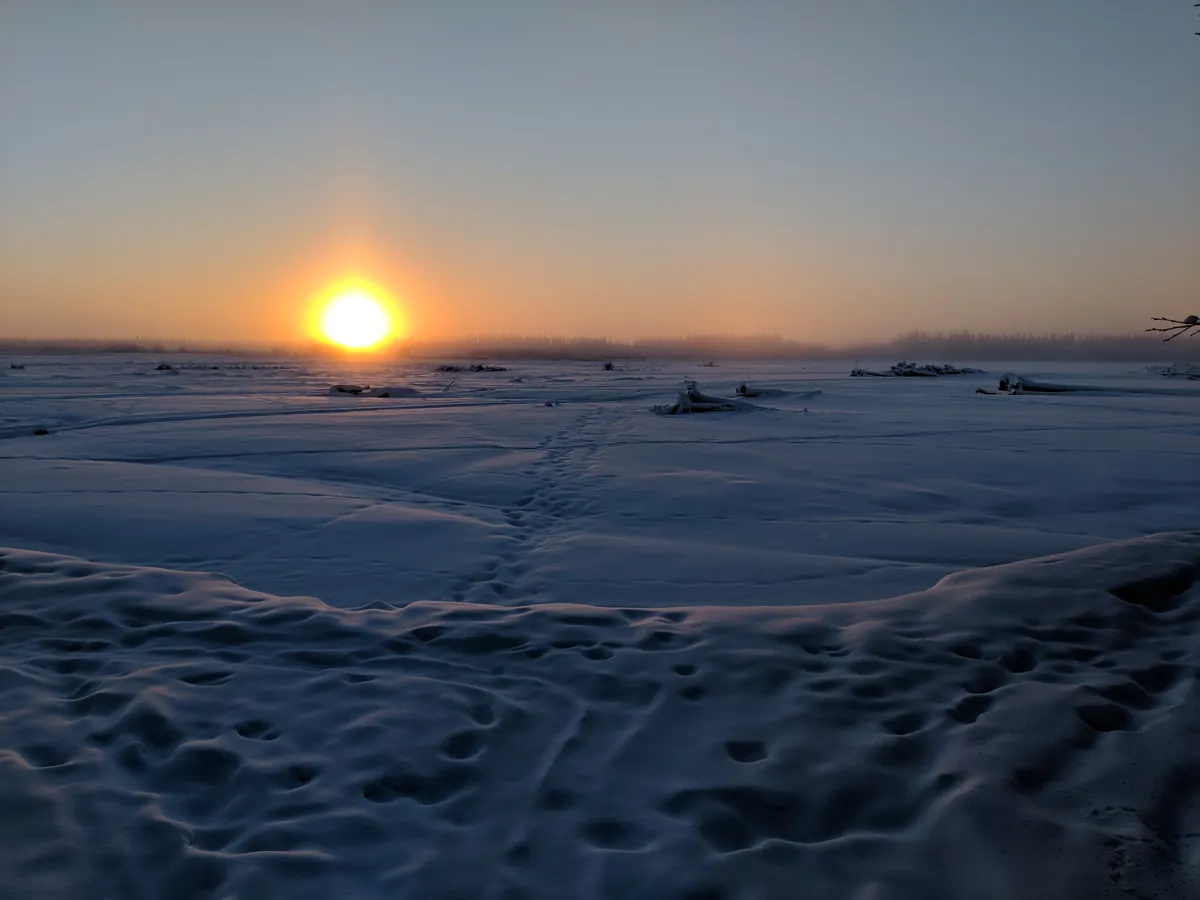
Start here
- The turn of the light. The solstice comes at 11:50 a.m. Alaska Standard Time on Monday, December 21. Sunsets stop getting earlier a few days before that, so by Christmas the afternoons are already holding on a little longer. Step outside at noon that day and note where the sun sits, if it rises at all.
- Owls in the long evenings. Great horned owls begin their main courtship calling in December, and in Alaska that means calling at teatime. Stand still on a calm evening near a spruce or birch woodland and listen for the deep five-note hoot, often answered by a second bird.
- A Christmas Bird Count near you. The count period is December 14 through January 5, and Alaska has close to 40 circles, from Ketchikan to Nome, and anyone can join a field team or, inside a count circle, count from a kitchen window.
Record it: In the Naturalist’s Field Journal, December belongs to the dusk and dawn watch plate, since sunrise and sunset fit inside a single lunch break up north. Keep “birds I have seen” for your Christmas Bird Count day, use tracks to know on the first calm morning after snowfall, and let seeds, pods and cones hold a sketch of a black spruce cone beside a white spruce one. A map of sounds works well on an owl evening.
Regions used below: Southeast and the Inside Passage; Southcentral: Anchorage, Mat-Su and the Kenai; Interior and Fairbanks; Southwest: Kodiak, Bristol Bay, the Alaska Peninsula and the Aleutians; Western Alaska: the Y-K Delta and Seward Peninsula; Arctic and the North Slope.
When is the shortest day in Alaska, and when is the earliest sunset?
The shortest day is the solstice, Monday, December 21, when the sun reaches its southernmost point at 11:50 a.m. Alaska Standard Time according to the U.S. Naval Observatory. But the earliest sunset comes days before the solstice, and the latest sunrise comes days after it. In Anchorage the sun sets at 3:40 p.m. through the middle of December and is already setting a little later by Christmas, while sunrise keeps creeping later until about December 26.
At the solstice, Juneau gets about 6 hours 22 minutes between sunrise and sunset, Anchorage about 5 hours 27 minutes, and Fairbanks about 3 hours 42 minutes, with the sun barely clearing the hills to the south. Utqiagvik has had no sunrise since its last sunset of the year on November 18, which is why its last column below shows that date: it is the final sunset before the polar night, not a December one.
| City | Dec 1 | Dec 21 | Dec 31 | Earliest sunset |
|---|---|---|---|---|
| Ketchikan | 7 h 31 m | 7 h 06 m | 7 h 12 m | 3:16 p.m., Dec 14 |
| Juneau | 6 h 53 m | 6 h 22 m | 6 h 30 m | 3:06 p.m., Dec 15 |
| Kodiak | 7 h 00 m | 6 h 30 m | 6 h 38 m | 4:22 p.m., Dec 15 |
| Anchorage | 6 h 05 m | 5 h 27 m | 5 h 38 m | 3:40 p.m., Dec 16 |
| Bethel | 6 h 12 m | 5 h 36 m | 5 h 46 m | 4:32 p.m., Dec 16 |
| Fairbanks | 4 h 40 m | 3 h 42 m | 3 h 58 m | 2:39 p.m., Dec 18 |
| Nome | 4 h 49 m | 3 h 54 m | 4 h 10 m | 3:56 p.m., Dec 18 |
| Utqiagvik | no sunrise | no sunrise | no sunrise | 1:42 p.m., Nov 18 |
By December 31 every town on the list has gained back several minutes, and the gain speeds up through January. Even in polar night, the hours around noon at Utqiagvik bring a long blue twilight bright enough to walk by. Plug your coordinates into the daylight calculator to see how much usable light, twilight included, any winter day will bring.
What is in the sky over Alaska this December?
Long nights make December the best month of the year for anything after dark, from meteors to planets to the aurora. Times below are Alaska Standard Time; the western Aleutians, on Hawaii–Aleutian time, are an hour earlier.
-
The Geminid meteor shower
Night of Sunday, December 13, into Monday, December 14 · Anywhere dark; the radiant is in Gemini, high in the sky late at night
The Geminids are usually the richest shower of the year. This year the International Meteor Organization expects the maximum around 5 a.m. Alaska time on December 14, which is ideal for Alaska: the radiant is still well up in a sky that will not brighten for hours yet. The moon is only a thin waxing crescent and sets early in the evening, so the whole night is dark. On paper the shower tops out near 150 meteors hourly; snowy yards near town lights will see far fewer, yet a good Geminid night still delivers. The rates are best in the small hours, when Gemini is highest.
-
The Cold Moon, the year’s closest full moon
Full at 4:28 p.m. on Wednesday, December 23 · Rises around sunset, which in Alaska means mid-afternoon
No full moon this year sits nearer to Earth: perigee, the low point of the lunar orbit, falls roughly seven hours after the Cold Moon turns full, so it is a true supermoon. On snow, a full moon gives enough light to read animal tracks at midnight. It also drowns out the weak Ursid meteors, which peak on December 22.
-
Planets for the long nights
All month · Saturn in the south after dark; Venus, Jupiter and Mars before dawn
Saturn is the only bright evening planet, low in the south and southwest after dark. Venus is a brilliant morning star, with the crescent moon and the star Spica nearby before dawn on December 4 and 5. Jupiter rises earlier every night and by late December is up by mid-evening, and Mars, also a morning object, slowly brightens. The swelling moon drifts past the Pleiades on December 21, though its glare hides most of the cluster’s stars.
-
The aurora on the longest nights
Any clear night; darkest skies around the new moon on December 8 · Interior and Arctic most of all
Solar activity has eased since the 2024 maximum, yet strong storms still arrive with little warning. The University of Alaska Fairbanks Geophysical Institute publishes a short-range aurora forecast. In December the limit is cloud and cold, not darkness, so pick a clear, still night and dress warmly.
| Phase | Date | Time |
|---|---|---|
| New moon | Tuesday, Dec 8 | 3:52 p.m. |
| First quarter | Wednesday, Dec 16 | 8:42 p.m. |
| Full moon, the Cold Moon | Wednesday, Dec 23 | 4:28 p.m. |
| Last quarter | Wednesday, Dec 30 | 9:59 a.m. |
| New moon | Thursday, Jan 7, 2027 | 11:24 a.m. |
Looking ahead: the Quadrantid shower reaches its maximum on the evening of January 3, 2027, shortly ahead of new moon, so the first week of the new year should be dark. At high latitudes the moon’s rising and setting times jump around a great deal from day to day; so look up your own town on the moon phase page.
When is the Christmas Bird Count in Alaska, and how can you join?
This season’s Christmas Bird Count, the National Audubon Society’s 127th, opens on December 14 and closes on January 5. Teams work inside a fixed circle about 15 miles wide, and on one day picked by the local compiler they tally every bird they can find. Alaska ran 38 counts in the 125th season, from Southeast towns to Nome and Unalaska. The results stand out nationally: in that season Alaska held the national high count for 28 species, including 2,134 emperor geese, 214 Steller’s eiders and 1,201 harlequin ducks at Kodiak, 2,585 Bohemian waxwings in the Matanuska Valley, 149 pine grosbeaks at Fairbanks and seven McKay’s buntings at Nome. Ketchikan and Kodiak tied for the most species in the state that year, 67 each.
-
Anchorage
Date for 2026 not yet posted; last season’s count was held on December 14, 2025 · Anchorage count circle
One of the biggest counts in the country by number of people. Last season 141 counters found 41 species and 13,225 birds in brutal wind, according to the Anchorage Daily News, including a record 90 bald eagles and the count’s first ruffed grouse. Watch Anchorage Audubon’s site for this year’s date and area leaders.
-
Fairbanks
Date for 2026 not yet posted; last season’s count was Saturday, December 27, 2025 · Fairbanks count circle, about 177 square miles
Arctic Audubon organizes the count and welcomes both field teams and feeder watchers who live inside the circle. Feeder counters report, for each species, the largest group visible together. Ravens and ptarmigan are part of the Interior list, and Fairbanks had the nation’s top pine grosbeak count in the 125th season.
-
Portage, a new circle
Date for 2026 not yet set · Portage Valley, Twentymile River and part of Turnagain Pass
The Alaska Wildlife Conservation Center started this count in 2025, the first time Portage birds were included in the national data. Volunteers meet at the center in the morning and compile results there in the afternoon; the center asks people to sign up by email.
Other circles include Juneau, Ketchikan, Sitka, Kodiak, Homer, the Matanuska Valley and Nome. Audubon’s online map lists every circle with its compiler; email the compiler a few weeks ahead to be placed on a team. Birding alone? Lists entered in eBird add to the same winter record.
Which owls can you see or hear in Alaska in December?
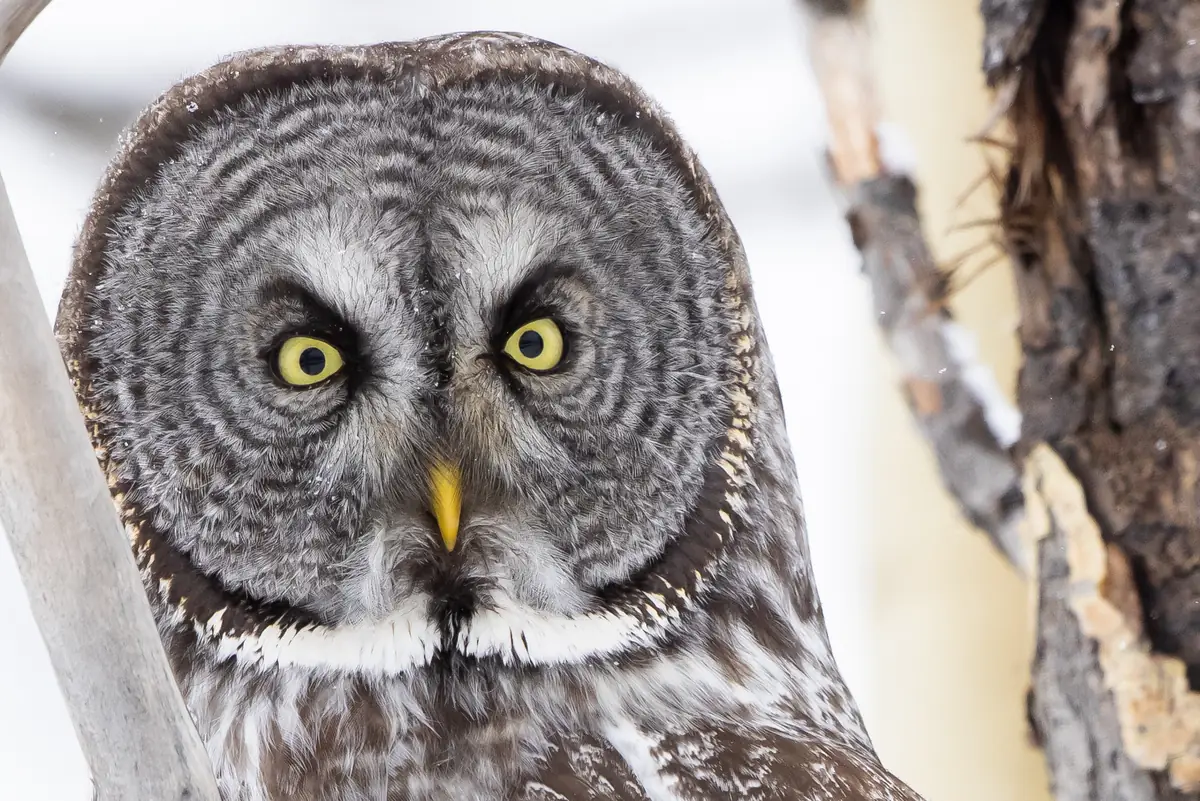
Alaska has ten owl species, and the dark months are when most of them are easiest to notice. Short days mean owls that hunt at dusk and dawn are active while people are still out and about, and many resident owls court in winter so they can nest before spring. Keep an eye out, too, for the great gray owl: the Owlmanac notes that at 24 to 33 inches long it looks like the biggest owl in Alaska, even though great horned and snowy owls outweigh it.
-
Great horned owl courtship
Intensive calling from December through March · Forest edges, river corridors and big-tree neighborhoods across mainland Alaska and Southeast
The Alaska Department of Fish and Game’s Owlmanac says this is the one Alaska owl in which both male and female sing, and that intensive courtship calling runs from December through March. The song is a deep, rhythmic hoo, hoo-hoo, hoo, hoo. They hunt mostly at twilight, and snowshoe hares are their main prey, so their numbers rise and fall with the hares.
-
Northern hawk owl
All winter, by day · Tops of spruces beside clearings, burns and muskegs
Unlike most owls, the hawk owl hunts in daylight, most actively early and late in the day, which in December means it is often perched up during the few bright hours. Look for a long-tailed, falcon-shaped silhouette on a spruce spire. Voles, lemmings and shrews are its usual food.
-
Snowy owl
Winter, numbers vary from year to year · Open tundra and coast in the west and north; occasionally farther south
Alaska’s heaviest owl hunts both by day and by night and relies on lemmings and voles. When prey runs short, many snowy owls leave their usual range, which is why they turn up some winters as far away as the Lower 48. Only adult males are nearly pure white; females and young birds are heavily barred.
-
Barred and boreal owls
Barred owls court in winter · Barred owls in Southeast forests; boreal owls in the Interior and Southcentral
In Alaska, barred owls live only in Southeast, where their “who cooks for you” call carries through the rainforest in winter. The tiny boreal owl is a bigger challenge; the Anchorage Christmas Bird Count turned up two in its 125th season, the highest count in the nation.
Owls are protected under federal law; listen from a distance, do not play recorded calls to them during the courtship season, and never approach a roosting bird.
Where do Alaska’s eiders and sea ducks spend the winter?
Many ducks that nest on Alaska’s tundra winter offshore, wherever the sea stays open.
-
Spectacled eiders in the Bering Sea ice
Through the winter, until the ice breaks up · Openings in the sea ice between St. Lawrence and St. Matthew islands
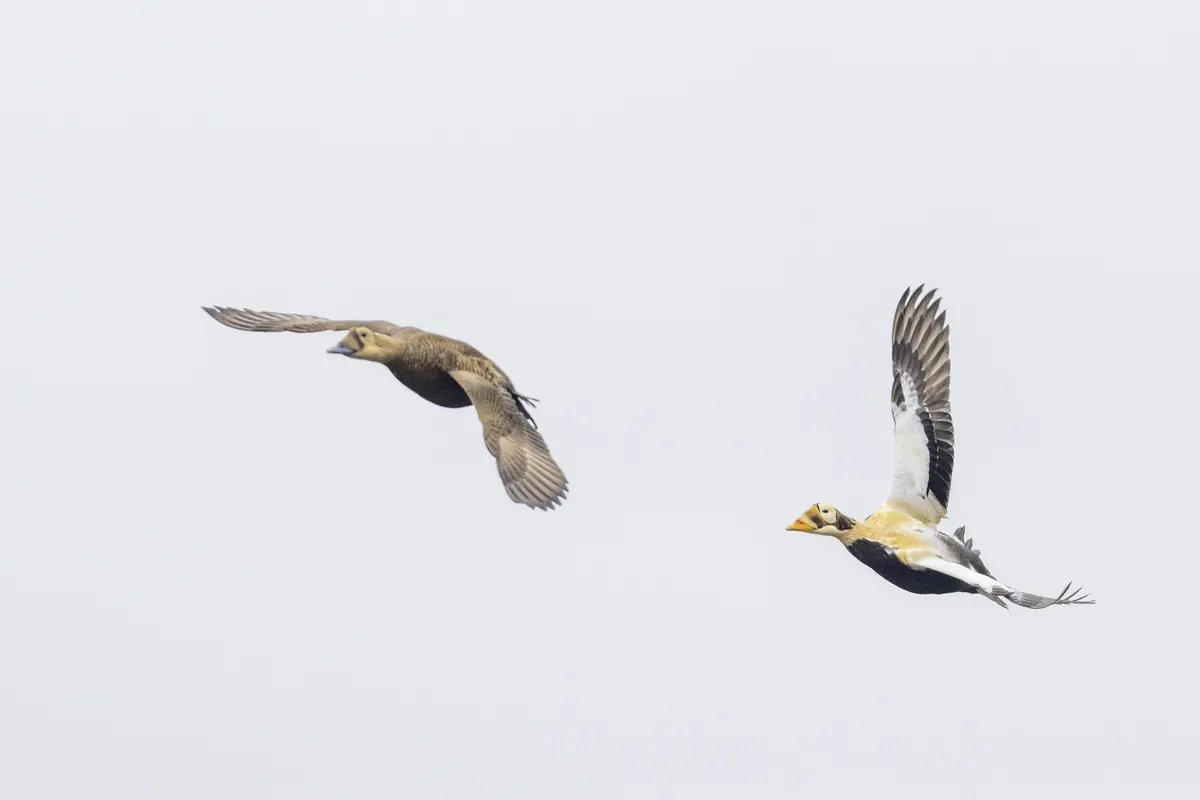
For decades no one knew where these strikingly marked sea ducks went for the winter. ADF&G says the answer, found in 1995, is that the entire world population crowds into polynyas, openings in the pack ice, between St. Lawrence and St. Matthew islands, and dives through them for mollusks and crustaceans on the sea floor. Federal law lists the species as threatened.
-
Steller’s eiders, harlequins and emperor geese at Kodiak
All winter · Kodiak, the Alaska Peninsula and the Aleutians
In the 125th Christmas Bird Count, Kodiak posted the nation’s highest totals of harlequin ducks, Steller’s eiders, pelagic cormorants and emperor geese. Harlequins, small and slate blue with white slashes, ride the surf right against rocky shores. Steller’s and spectacled eiders are both closed to hunting statewide.
-
The ice edge itself
December, as the pack builds · Norton Sound, the northern Bering Sea and Cook Inlet
The National Weather Service’s Alaska Sea Ice Program issues a daily ice analysis that shows the pack growing south through the Bering Sea and ice floes spreading in upper Cook Inlet. How far the ice reaches matters to eiders, seals and coastal hunters alike; NOAA researchers warn that winters with very little Bering Sea ice, like 2018, are likely to recur one to three times a decade through the 2030s.
How do Alaska’s animals get through the cold and dark?
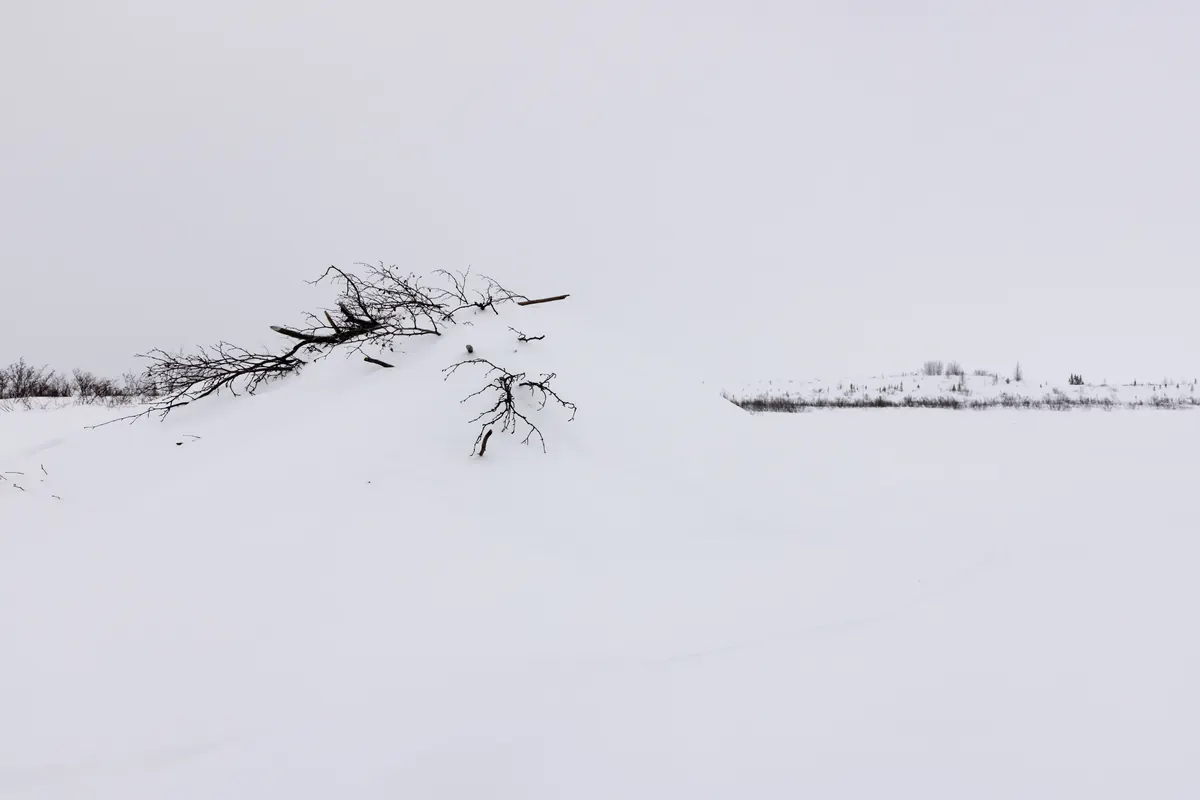
By December, every animal still in Alaska has settled on a strategy: sleep through it, hide under it, store food for it, or simply eat enough to keep going.
-
Arctic ground squirrels: below freezing and still alive
Hibernating from late summer until spring · Tundra and alpine slopes, from the Brooks Range to Denali and the Alaska Range
These squirrels hibernate about eight months a year. ADF&G says their body temperature falls from about 99 °F to as low as 27 °F, colder than the freezing point of water, for bouts of up to three weeks. Between bouts they shiver themselves warm for a day or two, then cool off again.
-
Voles under the snow
Once the snow is deep enough to insulate · Fields, forest floors and lawns statewide
Voles do not hibernate or even use torpor; a University of Alaska Anchorage biologist studying them in the Eagle River Valley put it simply, saying they just get through the winter as best they can. Their refuge is the subnivean space between snow and ground, where the temperature stays close to 32 °F however cold the air. ADF&G says their tunnels can run for hundreds of meters, and that weasels, foxes and owls hunt them right through the snow. Look for small holes in the snow surface and, in spring, the winding tracks of their tunnels in the flattened grass.
-
Beavers under the ice
All winter · Ponds and sloughs with lodges
Beavers stay awake all winter. In fall they sink a pile of branches near the lodge, and every lodge or bank den has at least one entrance in water deep enough to stay ice-free, so the family can swim out under the ice to its pantry.
-
Ptarmigan on willow buds
All winter · Willow flats and shrubby valleys
ADF&G says buds, twigs and catkins of willows make up four-fifths or more of a willow ptarmigan’s winter food. Look for flocks near the tops of willows sticking out of the snow.
What tracks can you find in the snow in December?
With snow on the ground across most of the state and the sun low enough to throw long shadows into every print, December is tracking season. The best time is the morning after a calm, light snowfall.
-
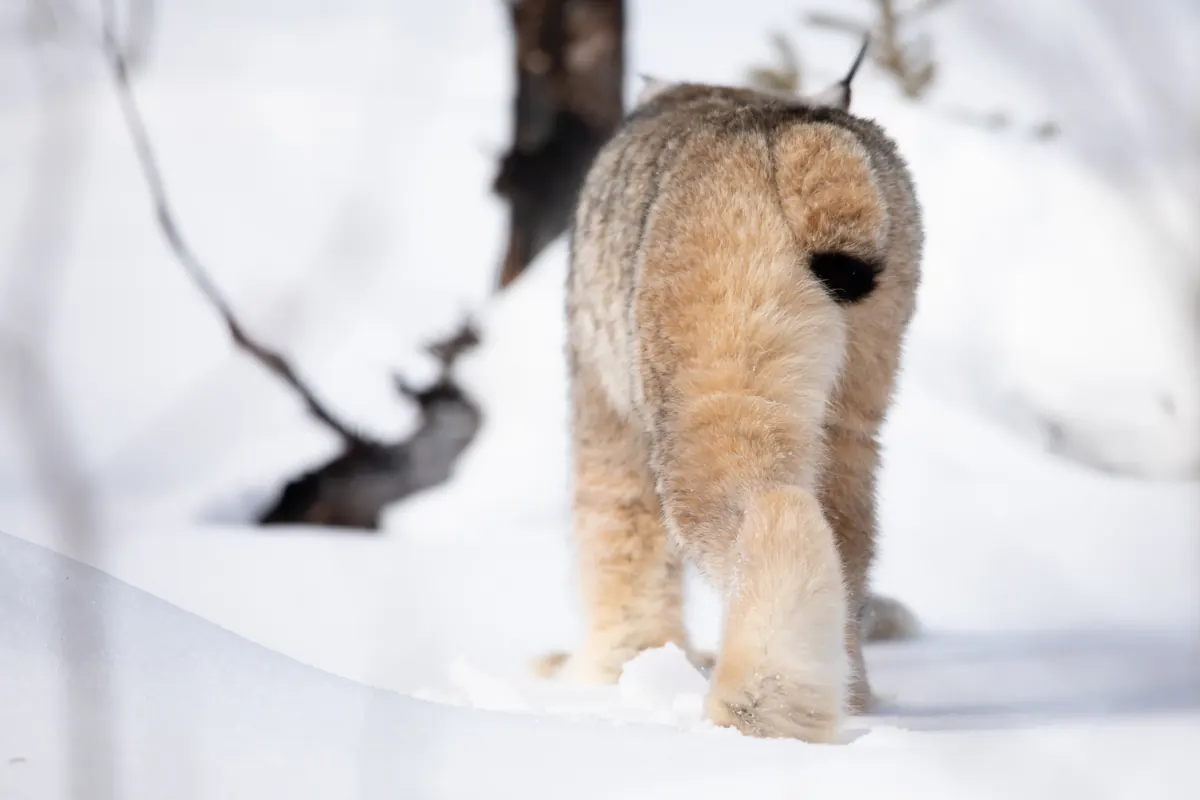
Lynx
All winter, often along hare trails · Boreal forest, Interior and Southcentral
Big, round, lightly printed tracks with no claw marks. ADF&G says the lynx’s broad feet work like snowshoes, and that the cats depend on snowshoe hares, whose numbers swing through a cycle of eight to eleven years.
-
Red fox
All winter; breeding comes in February and March · Field edges, river bars, town greenbelts
A neat, nearly straight line of small oval prints, one foot placed in front of the other. Where the line suddenly stops at a scuffed hole, the fox has pounced on a vole under the snow; voles appear to be its favorite food, according to ADF&G.
-
Moose beds and trails
All winter · Willow stands, riversides and road edges
Deep post-holes in a line, oval melted beds in the snow, and freshly nipped willow tips at about chest height.
How do you tell Alaska’s evergreens apart in winter?
With the birches, aspens and willows bare, the conifers carry the landscape. Most of Alaska has only a few kinds, so they are easy to learn.
-
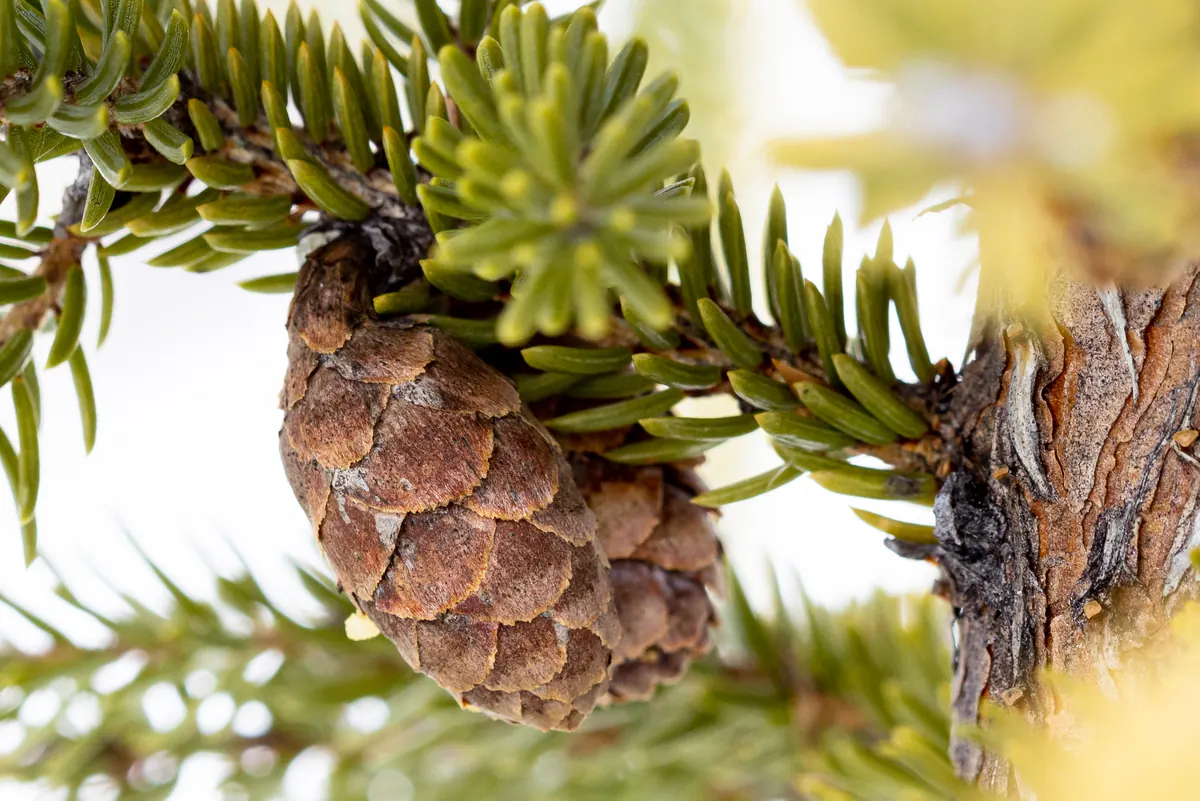
White spruce and black spruce
All year · Interior and Southcentral forest
Both have short, stiff, four-sided needles that roll easily between your fingers, each attached to a little woody peg on the twig. The Denali Education Center describes white spruce as the larger tree, with light brown, elongated cones up to about two inches long, and the most common tree in central Alaska. Black spruce is smaller and often spindly, with rounded purple-brown cones clustered near the top, and it grows in bogs, muskegs and other wet ground, often over permafrost.
-
Tamarack
Bare in winter · Interior lowlands and muskegs
The only northern conifer that drops its needles in fall. In December it stands bare among the spruce, studded with tiny cones and knobby spur shoots where next year’s needles will appear.
-
The rainforest conifers of Southeast
All year · Southeast and the Gulf coast
Western hemlock forms the closed forest over most of Sitka National Historical Park, the National Park Service says, with occasional taller Sitka spruce standing above it; one spruce there is about 500 years old. Hemlock has soft, flat needles and a drooping leader at the top; Sitka spruce has sharp, stiff needles that prickle your palm.
-
Cutting your own tree
Before Christmas · Tongass National Forest and other public lands
Last season the Tongass National Forest allowed one free tree per household for personal use with no permit, no larger than seven inches across at the stump, and not within 330 feet of an eagle nest or 100 feet of a salmon stream or road, and asked people to stay out of muskegs, where trees grow back slowly. Check for the 2026 notice, and for the rules on other forests and state land, before you go.
How cold and snowy is December in Alaska, and what might El Niño change?
December is one of the coldest months of the year almost everywhere in Alaska. By NOAA’s 1991–2020 normals, Fairbanks averages a high of 4 °F and a low of −13 °F, and Utqiagvik’s average high is below zero. In a typical December Fairbanks sees about 26 nights at or below 0 °F. Anchorage and Juneau each average about 18 inches of snow for the month. In Southeast the main story is still water: Ketchikan’s December normal is over 16 inches of precipitation, and with an average low near freezing, much of it falls as rain or slush.
| Station | Average high | Average low | Snowfall | Nights at or below 0 °F | Days with 1 in or more of snow on the ground |
|---|---|---|---|---|---|
| Ketchikan | 40.2 °F | 32.6 °F | not published | 0.0 | not published |
| Sitka | 41.5 °F | 33.4 °F | not published | 0.0 | not published |
| Juneau | 34.7 °F | 25.9 °F | 18.1 in | 0.5 | 13.6 |
| Kodiak | 37.3 °F | 26.5 °F | 15.6 in | 0.1 | 11.2 |
| Anchorage | 25.0 °F | 13.8 °F | 18.2 in | 4.5 | 28.1 |
| Bethel | 16.3 °F | 3.7 °F | 12.2 in | 13.6 | 27.5 |
| Nome | 16.2 °F | 2.0 °F | 15.8 in | 14.7 | 29.4 |
| Fairbanks | 4.3 °F | −13.0 °F | 10.9 in | 25.6 | 31.0 |
| Utqiagvik | −0.4 °F | −12.2 °F | 5.0 in | 27.1 | 31.0 |
Ice fog and inversions. On calm, clear December nights in the Interior, cold air settles into the valleys and stays there. When Fairbanks falls to about −30 °F, water vapor from car exhausts, chimneys and open water freezes straight into tiny ice crystals: ice fog. The Geophysical Institute reports that Fairbanks averaged more than two weeks of ice-fog days a year from 1950 to 1980 but only about six a year from 1990 to 2020, because it now gets fewer days that cold.
After a hard winter, an El Niño one? Last winter was a reminder of how cold Alaska can still get: Alaska Public Media reported that December through March was the coldest in about 50 years statewide, and Juneau had its coldest December on record. This winter starts from a very different place. NOAA’s El Niño team, writing on September 10, judged it more than nine chances in ten that the warm Pacific phase now underway will reach very strong levels by winter. Brian Brettschneider of the National Weather Service told Alaska Public Media that El Niño winters in Alaska tend to run about 2 to 4 degrees above normal, with noticeably less snow in most of the state. The USGS Climate Adaptation Science Centers add a caution: the link is weak, nudging the odds of a mildly warm winter up by only 5 to 10 percent, most of all in Southeast, and other North Pacific patterns often win out. NOAA releases its own winter outlook on October 15, after this page went up; it will appear with the Climate Prediction Center seasonal maps. For this week’s forecast, open the weather page, and the cloud forecast for an aurora or meteor night is on the cloud page.
When is lake and river ice safe in Alaska in December?
Not until you have measured it, and in December much of it still is not. ADF&G’s ice-fishing guide gives a rule of thumb for new, clear ice: at least 4 to 6 inches for a few people spread out, 6 to 7 inches for a small group, 8 to 10 inches for a snowmachine and 12 inches or more for a car. It also warns that sometimes no thickness is safe. Moving water eats ice from below, ice near docks, logs and weeds is weaker, and a few warm, windy days can ruin ice that was fine the week before.
-
Anchorage’s skating lakes
Once the ice reaches a foot · Westchester Lagoon, Cheney Lake, Cuddy Family Midtown Park
Anchorage Parks and Recreation maintains skating areas on these ponds only once the ice is 12 inches thick, and tells skaters on natural ice to be extra careful about thickness and conditions. Until the city clears an area, treat the ice as unchecked.
-
Rivers and trails
Through freeze-up · Interior and western rivers
River ice can look solid over open leads and springs. The NWS Alaska-Pacific River Forecast Center gathers reports from observers on when rivers freeze and when local people begin traveling on them; those reports are a starting point, never a guarantee.
Carry a pair of ice picks on a cord around your neck, go with a friend, and tell someone your route. Typical first-freeze dates for towns across the state are on Alaska’s frost and freeze page, a rough clue to how many weeks the ice near you has had to thicken.
What can families do outside in Alaska this December?
- Join Arctic Audubon or Anchorage Audubon for a Christmas Bird Count. Dates for 2026 were not yet posted in early October; last season Anchorage counted on December 14 and Fairbanks on December 27. Feeder counts from homes inside a circle count too.
- Walk the Luminary Trail at Creamer’s Field in Fairbanks, Saturday, December 5, 6 to 9 p.m. The Friends of Creamer’s Field also list free holiday craft afternoons at the Farmhouse Visitor Center from 11 a.m. to 3 p.m. on December 5, 12 and 19.
- Ski or walk the Solstice Tree Tour at Kincaid Park, Anchorage, Saturday, December 12, 4 to 8 p.m. The Nordic Ski Association of Anchorage lines a 2.5-kilometer loop with decorated trees, with hot chocolate and warming barrels; non-skiers are welcome.
- Bundle up for Geminid watching, Sunday night, December 13. Even an hour in the early evening can show a few bright meteors.
- Hear Anchorage Audubon’s December evening program, Monday, December 14, 6 to 7 p.m. The topic and place were not posted in early October; check the chapter’s site.
- Go to the Fairbanks Winter Solstice Festival, December 11–19, downtown, with light displays, dog-mushing demonstrations and reindeer.
- Skate the oval at Anchorage’s Winter Solstice Festival, Friday, December 18, 5 to 8 p.m., at Cuddy Family Midtown Park. Activities are free, with wagon and dog sled rides.
- Mark the solstice at noon on Monday, December 21. Put a stick in the snow and mark the end of its shadow; do it again on January 21 and compare.
- Look for the Eagle River Nature Center’s solstice ice-lantern walk, a long-running tradition at the center. No 2026 date was listed when this page went up.
- Watch the Cold Moon rise on December 23, in the late afternoon, then go out after supper to look at moon shadows on the snow.
- Start 2027 on a trail on New Year’s Day. Alaska State Parks has joined the national First Day Hikes effort in past years, including a guided 2.2-mile loop at Eklutna in Chugach State Park; watch the parks events page for this year’s list.
For the season just ended, with eagles, rams and the last sunset at Utqiagvik, read November in Alaska. Every month and state is gathered on the nature guides page.
Safety notes for December in Alaska
- Cold. In the Interior and the Arctic, average December lows are well below zero. Cover every bit of skin in wind, keep children’s mittens on strings, and turn back early if anyone’s feet go numb.
- Darkness. With five and a half hours of sun in Anchorage and under four in Fairbanks, a midday walk can end in twilight. Carry a headlamp with fresh batteries.
- Ice. See the ice section above. Never let a dog run out onto new ice, and never follow one in.
- Avalanches. Mountain snowpacks in December are often thin and weak. Check the Chugach National Forest Avalanche Information Center or your regional center before going onto or under steep slopes.
- Moose. In deep snow moose use plowed roads, trails and driveways, and a dark-coated moose is nearly invisible at dusk. Drive slowly, and back away from any moose with its ears pinned back.
- Hunting. Several seasons in ADF&G’s 2026–2027 regulations run into or through December. Resident deer hunters on Admiralty, Baranof and Chichagof islands (Unit 4) may take any deer through December 31. On Kodiak’s road system, deer hunting through December 31 is limited to youth hunters with bow, crossbow or muzzleloader; elsewhere in Unit 8, residents may take any deer until the end of the month. Ptarmigan, grouse and hare seasons are open through December in most units. Duck seasons in the Gulf Coast and Northern zones end December 16; Southeast is closed December 1–15 and reopens December 16–31; the Kodiak and Pribilof/Aleutian zones run to January 22. Check hunt.alaska.gov for your unit.
- Be visible. Alaska leaves hunter orange up to the individual in almost every hunt (the 2026–2027 booklet requires it only in an August youth hunt at Hatcher Pass), so do not count on hunters near you wearing it. Wear something bright on trails during open seasons, and put an orange vest on your dog.
Short days leave long evenings for writing up what you saw. A page in the Naturalist’s Field Journal for each outing turns a dark month into a record you will be glad of in June.
Sources
- U.S. Naval Observatory: Earth’s seasons, 2026 (December solstice)
- U.S. Naval Observatory: phases of the moon, 2026
- U.S. Naval Observatory: sun and moon rise and set for one day
- International Meteor Organization: 2026 Meteor Shower Calendar (Geminids, Ursids)
- International Meteor Organization: 2027 Meteor Shower Calendar (Quadrantids)
- EarthSky: What is a supermoon? (2026 full supermoons)
- BBC Sky at Night: Supermoons in 2026
- NASA JPL Horizons ephemeris system (planet and moon positions)
- RASC Observer’s Handbook 2026: lunar occultations (Pleiades, December 21)
- UAF Geophysical Institute: aurora forecast
- NOAA Space Weather Prediction Center: Solar Cycle Progression
- National Audubon Society: Christmas Bird Count (December 14 to January 5)
- National Audubon Society: Join a Christmas Bird Count (circle map and compilers)
- National Audubon Society: The 125th Christmas Bird Count Summary
- National Audubon Society: 125th Christmas Bird Count high counts of species in the United States
- National Audubon Society: The 123rd Christmas Bird Count in Alaska
- Anchorage Daily News: Christmas Bird Count collects valuable data for conservation efforts (January 11, 2026)
- Arctic Audubon Society: Fairbanks Christmas Bird Count
- Alaska Wildlife Conservation Center: Christmas Bird Count, Portage circle
- Anchorage Audubon Society: events and December program
- eBird
- ADF&G: The Alaska Owlmanac, a guide to ten owl species
- ADF&G: Great horned owl (Wildlife Notebook Series)
- ADF&G: Alaska’s iconic birds, snowy owl
- ADF&G: Spectacled eider species profile
- NWS Alaska Sea Ice Program
- Alaska Public Media: Record-low Bering Sea ice conditions of 2018 expected to be repeated (December 5, 2024)
- ADF&G: Arctic ground squirrel species profile
- UAF Geophysical Institute, Alaska Science Forum: Why did the vole climb the tree?
- ADF&G: Voles in Alaska
- ADF&G: Beaver species profile
- ADF&G: Willow ptarmigan species profile
- ADF&G: Black bear species profile
- ADF&G: Lynx species profile
- ADF&G: Red fox species profile
- Denali Education Center: Evergreens
- National Park Service, Sitka National Historical Park: Plants
- USDA Forest Service, Tongass National Forest: Christmas tree harvest guidelines (November 2025)
- NOAA NCEI: U.S. Climate Normals 1991–2020, monthly normals (December)
- UAF Geophysical Institute, Alaska Science Forum: Ice fog not often a part of northern life
- Alaska Public Media: After Alaska’s coldest winter in a half-century, El Niño warmup is coming (April 9, 2026)
- NOAA Climate Prediction Center: ENSO diagnostic discussion, September 10, 2026
- NOAA Climate Prediction Center: 90-day outlooks (winter outlook due October 15, 2026)
- USGS Climate Adaptation Science Centers: Regional super El Niño impacts, Alaska
- ADF&G: Cure for the Cold, Let’s Go Ice Fishing (ice safety chapter)
- Municipality of Anchorage Parks and Recreation: park maintenance and ice skating
- NWS Alaska-Pacific River Forecast Center: freeze-up observations
- Friends of Creamer’s Field: program and event schedule (December 2026)
- Nordic Ski Association of Anchorage: Solstice Tree Tour, December 12, 2026
- Anchorage Park Foundation: Winter Solstice Festival, December 18, 2026
- Explore Fairbanks: Winter Solstice Festival, December 11–19, 2026
- Eagle River Nature Center: public programs
- Alaska State Parks: First Day events news release (December 30, 2024)
- Alaska State Parks: current events
- ADF&G: 2026–2027 Alaska Hunting Regulations (complete booklet)
- ADF&G: 2026–2027 Alaska Migratory Game Bird Hunting Regulations
- ADF&G: Hunter education
- Chugach National Forest Avalanche Information Center
- Photos via Wikimedia Commons; licenses and photographers are credited under each picture
