What to look for in nature in Alaska this January
Weather scientists treat January as the heart of winter, and across most of Alaska it is the coldest month of all. It is also the month the light comes back in earnest. Anchorage gains about two hours of daylight between New Year’s Day and the end of the month, Fairbanks nearly three, and on Saturday, January 23, the sun finally peeks over the horizon at Utqiagvik after some nine weeks away. In the dark and cold, ravens begin their courtship, polar bear cubs are born under the snow, and walruses gather to mate in the Bering Sea pack ice. Below, by region, are the sights and sounds of the month, each with its timing and a source.
Other months in Alaska: October, November, December, February.
Start here
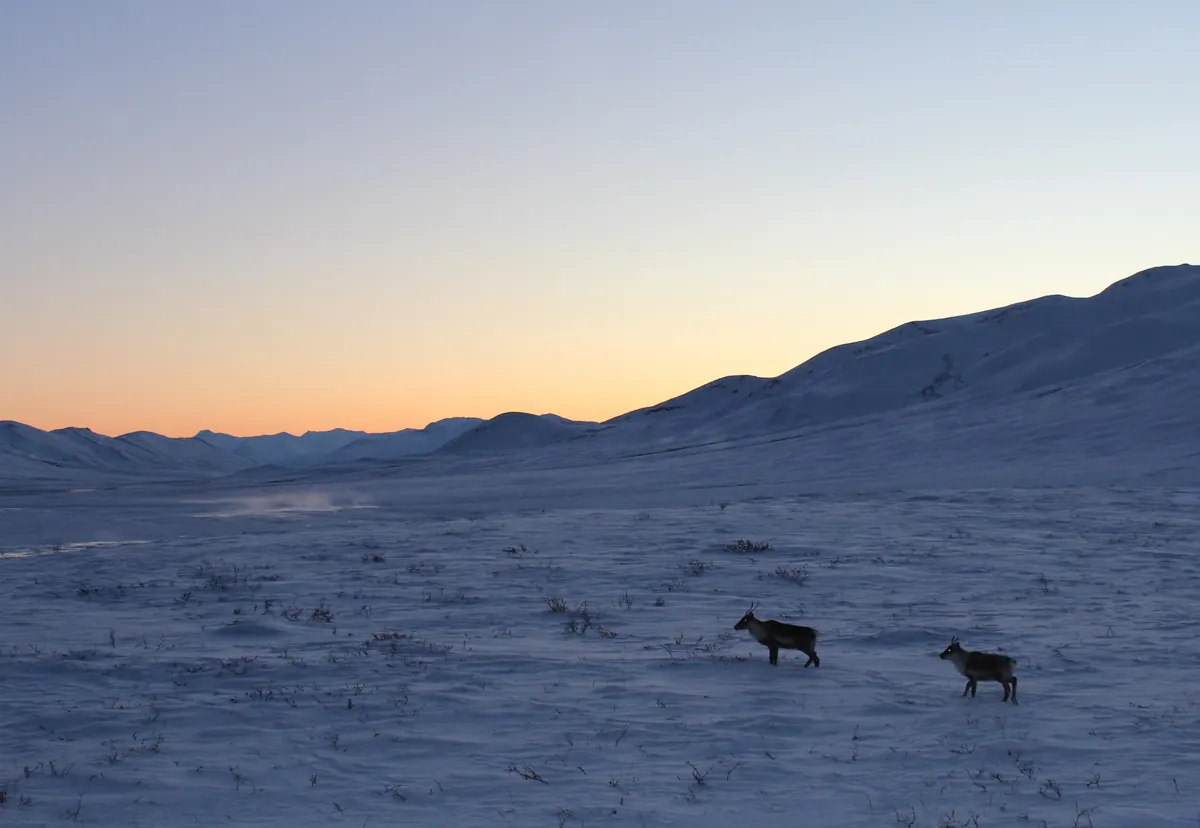
- The sun’s return at Utqiagvik. The U.S. Naval Observatory puts the first sunrise of 2027 at the top of the state on Saturday, January 23, at about 1:03 p.m., with sunset just over an hour later. Wherever you live, January is the month to notice the light: write down your sunset time on the 1st and again on the 31st.
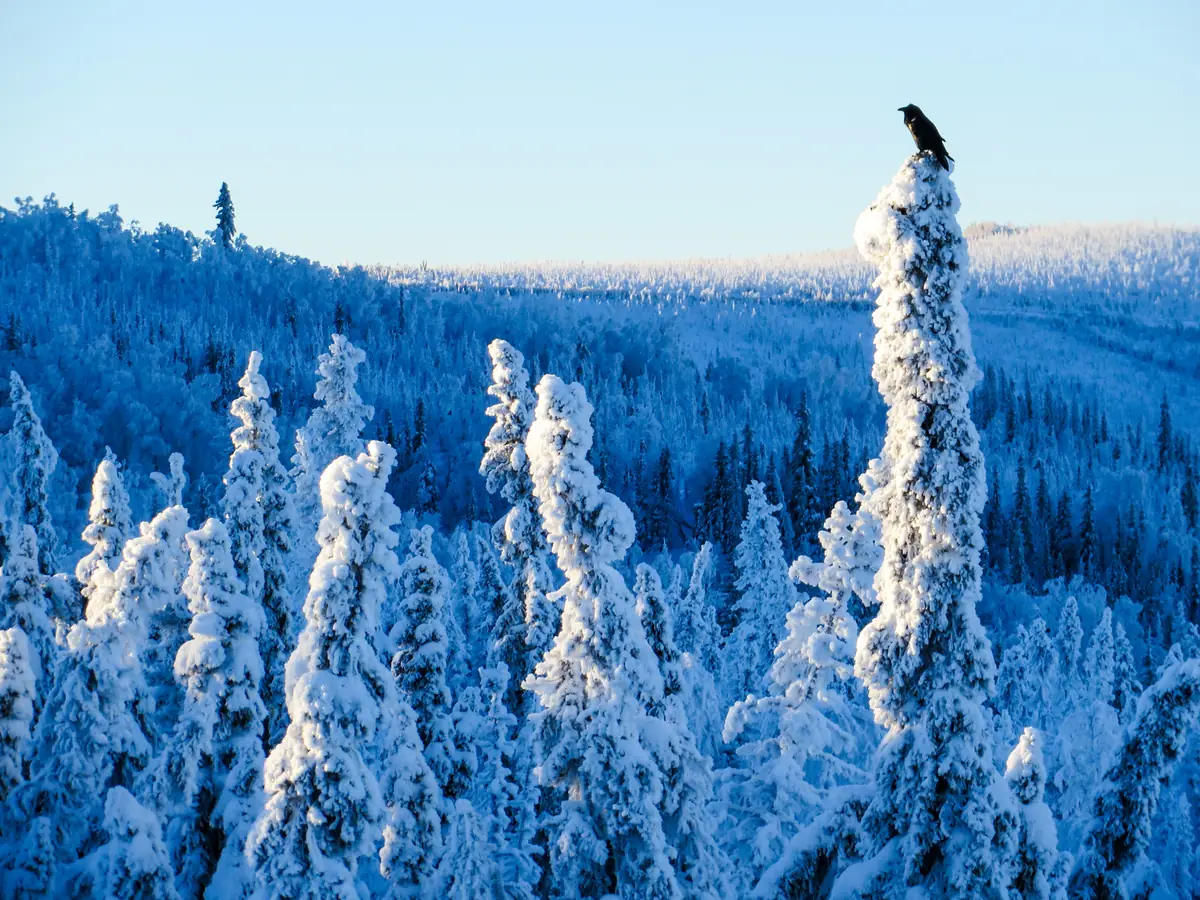
- Ravens pairing up. In the Interior, ravens start courting in the middle of January. Watch for pairs chasing each other, diving and rolling over town, and listen for the odd, talkative calls that are nothing like the usual croak.
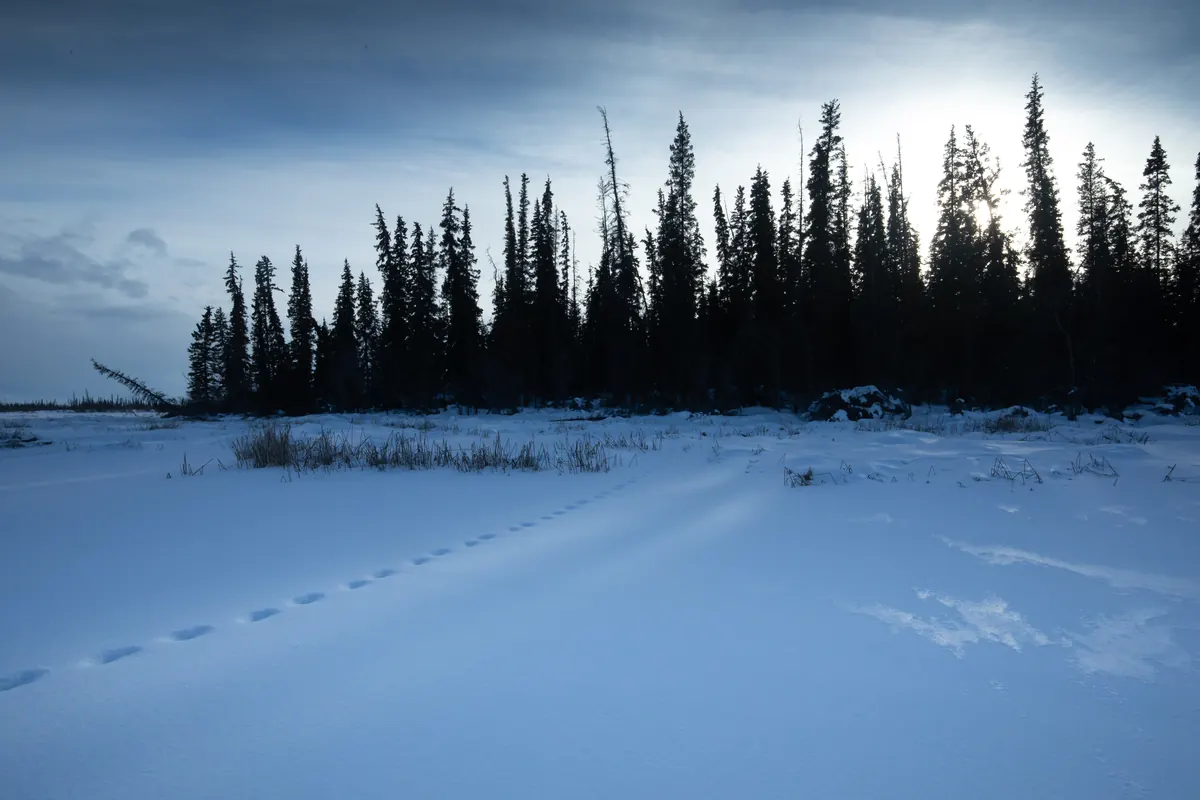
- A supermoon on the snow. No full moon of 2027 comes nearer than the Wolf Moon, which turns full at 3:17 a.m. on January 22. On the night of the 21st, a snowy clearing lit by it is bright enough to read fresh tracks without a headlamp.
Record it: In the Naturalist’s Field Journal, January suits the dusk and dawn watch plate, with sunrise and sunset written down on the same day each week so the gain shows on paper. Keep mammal watch for moose, muskoxen or a flying squirrel at the feeder, use tracks to know to compare a shrew’s five-toed prints with a mouse’s, and turn to the same place twice for a noon shadow measured on December 21 and again on January 21. Colours of the day fits a sky that runs from rose to violet in a single short afternoon.
Regions used below: Southeast and the Inside Passage; Southcentral: Anchorage, Mat-Su and the Kenai; Interior and Fairbanks; Southwest: Kodiak, Bristol Bay, the Alaska Peninsula and the Aleutians; Western Alaska: the Y-K Delta and Seward Peninsula; Arctic and the North Slope.
When does the sun come back to Utqiagvik, and how fast do Alaska’s days grow in January?
The sun returns to Utqiagvik on Saturday, January 23. The U.S. Naval Observatory lists the sun as continuously below the horizon there through January 22; on the 23rd it rises at about 1:03 p.m. and sets at about 2:16 p.m. Alaska Standard Time, a little over an hour of direct sun. The next day it stays up from about 12:47 to 2:33 p.m. The town’s polar night began with the last sunset of 2026 on November 18, so the sun has been gone for about 65 days. That is why Utqiagvik’s January 1 column below reads “no sunrise”, and why its gain cannot be worked out.
Everywhere else, January is the month the light comes racing back. Fairbanks starts the year with about 4 hours of sun (sunrise 10:54 a.m., sunset 2:55 p.m. on New Year’s Day) and ends January with close to 7. Anchorage climbs from about 5 hours 39 minutes to 7 hours 43 minutes. In Anchorage the first sunset at or after 5 p.m. comes on January 30; Fairbanks has to wait until February 9.
| City | Jan 1 | Jan 31 | Gained | Per day |
|---|---|---|---|---|
| Ketchikan | 7 h 13 m | 8 h 40 m | 87 min | 2.9 min |
| Juneau | 6 h 32 m | 8 h 13 m | 101 min | 3.4 min |
| Kodiak | 6 h 40 m | 8 h 19 m | 99 min | 3.3 min |
| Anchorage | 5 h 39 m | 7 h 43 m | 124 min | 4.1 min |
| Bethel | 5 h 48 m | 7 h 48 m | 120 min | 4.0 min |
| Fairbanks | 4 h 01 m | 6 h 50 m | 169 min | 5.6 min |
| Nome | 4 h 13 m | 6 h 57 m | 164 min | 5.5 min |
| Utqiagvik | no sunrise | 3 h 57 m | — | — |
The farther north the town, the faster the gain: just under three minutes a day in Ketchikan, about five and a half in Fairbanks and Nome. Utqiagvik, starting from nothing, is up to nearly four hours of sun by January 31. Sunrise and sunset times also hide a lot of usable light. Long civil twilight at these latitudes means a January morning is bright enough to ski well before the sun clears the ridges. Before a midwinter hike, the daylight calculator will give you the light, twilight included, for your exact trailhead.
Is January the coldest month in Alaska, and how cold has it ever been?
Across most of Alaska it is. By the official 1991–2020 normals from NOAA, January has the lowest average temperature of the year at Anchorage, Fairbanks, Nome and Juneau. Fairbanks averages −8.3 °F for the month, with an average high of just 0.6 °F, and about 26 January nights at or below zero. Utqiagvik is the exception that proves how long the Arctic winter lasts: its February normal, −11.9 °F, edges out January’s −11.5 °F as the coldest month. In Southeast, January is simply wet and raw; Ketchikan averages over 16 inches of precipitation and only a fraction of a night below zero.
Snow tells its own story. January is Juneau’s snowiest month by a wide margin, averaging 24.5 inches at the airport, while the dry Interior gets about 10 inches and the North Slope only 3.5.
-
The nation’s coldest reading: −80 °F at Prospect Creek
January 23, 1971 · Prospect Creek Camp, near the Jim River, about 160 miles north of Fairbanks
A weather observer at a camp housing trans-Alaska pipeline workers, just north of the Arctic Circle, recorded −80 °F on January 23, 1971. The University of Alaska Fairbanks Geophysical Institute notes that it is still the lowest temperature on record for Alaska and the United States. The high at Prospect Creek that day was −64 °F, and Fairbanks set its own record for the date at −55 °F. The anniversary happens to fall on the same date as Utqiagvik’s first sunrise of 2027.
-
Why the coldest air pools in the valleys
Clear, calm spells · Interior valleys, the Tanana and Yukon flats, Fairbanks
The Interior’s worst cold comes when the sky clears and the wind dies. The University of Alaska Fairbanks Geophysical Institute explains the recipe: clear skies let heat escape, the low winter sun barely warms the ground, calm air lets the cold settle, and the hills around the Tanana Valley hold it in. The result is an inversion, with milder air sitting above the cold, so the hillsides above Fairbanks are often noticeably warmer than the valley floor, and a drive up a ridge road can feel like a change of season.
| Station | Average high | Average low | Snowfall | Precipitation (water) | Nights at or below 0 °F |
|---|---|---|---|---|---|
| Ketchikan | 39.7 °F | 31.5 °F | not published | 16.17 in | 0.2 |
| Sitka | 40.5 °F | 32.4 °F | not published | 8.22 in | 0.0 |
| Juneau | 33.1 °F | 23.8 °F | 24.5 in | 6.02 in | 0.9 |
| Kodiak | 36.1 °F | 26.2 °F | 14.5 in | 8.35 in | 0.3 |
| Anchorage | 22.7 °F | 11.0 °F | 12.4 in | 0.75 in | 7.0 |
| Bethel | 12.7 °F | 1.2 °F | 9.4 in | 0.77 in | 14.9 |
| Nome | 13.2 °F | −2.0 °F | 13.4 in | 0.94 in | 16.6 |
| Fairbanks | 0.6 °F | −17.2 °F | 10.2 in | 0.61 in | 25.7 |
| Utqiagvik | −5.2 °F | −17.8 °F | 3.5 in | 0.14 in | 29.2 |
El Niño and the second half of winter. On September 10 the national Climate Prediction Center wrote that it is over 90 percent likely the tropical Pacific warming now under way reaches the very strong category of El Niño by the heart of the cold season. Looking back to 1925, Climate.gov counts 20 of 30 El Niño winters warmer than average in Alaska, with precipitation more often light, so a mild January is somewhat more likely than usual, not a sure thing. The official three-month maps (first out for this winter on October 15, with a fresh set each month) live on the Climate Prediction Center site, and the local seven-day picture is on our weather page.
What is in the sky over Alaska this January?
Long nights and a moonless first week give January real promise for stargazers dressed for it. All times below are given in Alaska Standard Time, and clocks in the western Aleutians read one hour earlier.
-
The Quadrantid meteor shower
Evening of Sunday, January 3, into Monday, January 4 · Anywhere dark, facing north to northeast
The Quadrantids have a short, sharp peak, only about six hours wide. The American Meteor Society’s prediction puts it around 6:30 p.m. Alaska time on January 3; EarthSky gives about 8:47 p.m. Either way, the maximum falls after dark in Alaska, and only a slim waning crescent moon comes up, and that not until the small hours. Well away from town lights, a few dozen meteors an hour is a fair hope near the peak. Their radiant starts out near the northern horizon after dusk and climbs as the hours pass; patience pays.
-
The Wolf Moon, the closest full moon of 2027
Full at 3:17 a.m. on Friday, January 22 · Rises in the late afternoon of the 21st
The moon reaches perigee about 14 hours before it turns full, so this is a true supermoon, the nearest full moon of the year. Watch it on the night of January 21 into the 22nd, or on the evening of the 22nd. The next evening, the 23rd, the moon slides close to the planet Jupiter.
-
Earth at perihelion
5:33 p.m. Saturday, January 2 · Not something you can see
At perihelion only about 91.4 million miles separate Earth from the sun, the shortest gap all year, while Fairbanks shivers through its coldest weeks. Ask a child to puzzle that out: the answer is the tilt of Earth’s axis, which keeps northern winter sunlight low and brief.
-
Planets
All month · Venus before dawn in the southeast; Jupiter in the evening east; Saturn low in the southwest after dark
Venus blazes before sunrise and stands farthest from the sun, as seen from Earth, on January 3. Jupiter is up from evening onward and builds toward its February opposition, while Saturn drops a little closer to the southwestern horizon every week.
| Phase | Date | Time |
|---|---|---|
| New moon | Thursday, Jan 7 | 11:24 a.m. |
| First quarter | Friday, Jan 15 | 11:34 a.m. |
| Full moon, the Wolf Moon | Friday, Jan 22 | 3:17 a.m. |
| Last quarter | Friday, Jan 29 | 1:55 a.m. |
| New moon | Saturday, Feb 6 | 6:56 a.m. |
Near full, a high-latitude moon may stay above the horizon around the clock, and near new it may not rise at all. Rising and setting times worked out for your location are on the moon phases page.
Is January a good time to see the northern lights in Alaska?
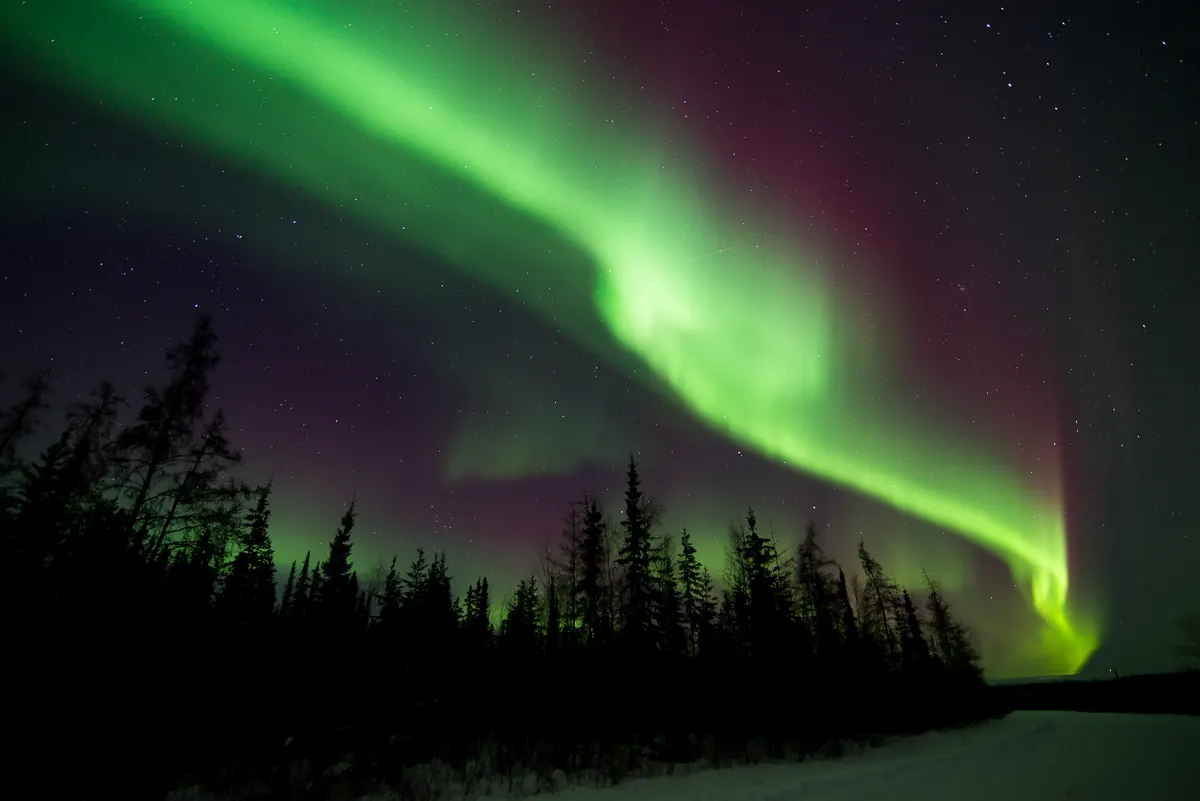
Darkness is not the problem in January; weather and cold are. Over the Interior and the Arctic the sky is dark for most of every 24 hours, so any clear night is an aurora night if the sun cooperates. Solar maximum came and went in late 2024. NOAA’s Space Weather Prediction Center counted a monthly sunspot number of about 60 in September 2026, well below the peak, but a sun on the downslope of its cycle is still active, and strong geomagnetic storms remain possible all winter.
-
Moonless windows
About January 3–12, and again from early February · Away from town lights, with a clear view north
With new moon on January 7, the evenings stay free of moonlight for roughly a week and a half. Faint, diffuse aurora that would vanish under a bright moon shows up well then. Near the full moon on January 22, only stronger displays stand out.
-
When to look
Roughly 9 p.m. to 3 a.m. · Interior and Arctic most of all; lower in the northern sky from Southcentral and Southeast
The Geophysical Institute at the University of Alaska Fairbanks points aurora watchers to the middle of the night: its forecast page names a window of about 9 p.m. to 3 a.m. for strong Interior displays, peaking near midnight. Its three-day forecast is the more reliable one; the 27-day outlook is a rough guide only. A Kp index above 5 marks a geomagnetic storm, though conditions over Fairbanks can differ from the global number.
-
Surviving the wait
Every aurora night · Wherever you stand
An aurora night in January means standing still at well below zero. Dress in layers under a parka, keep spare camera batteries warm in an inside pocket, and check the cloud cover forecast before driving out, since cloud ruins more aurora nights than a quiet sun.
Saw a display? Aurorasaurus, a citizen science project supported by NASA and the National Science Foundation, maps reports from the public alongside the forecast.
What are Alaska’s winter birds doing in January?
The birds still here in January are the true residents, and several are already thinking about spring.
-
Ravens courting
From mid-January · Towns, dumps, river corridors and highways statewide
According to the Alaska Department of Fish and Game, Interior ravens begin courtship displays in mid-January, and by mid-March pairs are settling near their nest sites. Paired birds fly close together, roll and swoop, perch side by side and preen each other. Outside the nesting season ravens gather at night in communal roosts; ADF&G reports up to 800 in a single roost near Fairbanks, and the Denali Education Center notes that birds may commute 30 to 40 miles a day between roost and feeding areas.
-
Spruce grouse in the treetops
All winter · Spruce forest of the Interior and Southcentral
In winter spruce grouse feed almost entirely on conifer needles and do nearly all their foraging up in the trees, according to the Denali Education Center. On the coldest nights and days they burrow into dry snow and stay there for hours, using it as insulation.
-
Great horned owls getting ready to nest
Hooting all winter; eggs by March · Forest edges and river bottoms
Few Alaska birds nest as early as the great horned owl. The Denali Education Center says egg laying can be well underway in the Interior by March, and earliest in years when snowshoe hares are abundant. The deep hooting you hear on still January evenings is pairs holding territory before then. Under a favorite roost, look for gray pellets of fur and bone three to four inches long.
-
The last days of the Christmas Bird Count
Through Tuesday, January 5 · Count circles statewide
Audubon’s count season lasts from December 14 until January 5, so a count circle may still schedule its day after New Year’s. If you live inside one, feeder watchers are welcome too. Contact the compiler through Audubon’s circle map.
It is not too late to sign up for Project FeederWatch, which keeps counting at backyard feeders across the continent into April. Put feeders out only where bears are denned, and keep the ground under them clean.
What is happening on Alaska’s sea ice in January?
By January the pack ice has spread far south through the Bering Sea, and some of the state’s most remarkable wildlife events take place on or under it, out of sight of almost everyone.
-
Polar bear cubs born in snow dens
Cubs born in December or January · Snow drifts on river banks, coastal bluffs and sea ice along the northern coast
Pregnant polar bears dig dens in drifted snow in October and November. ADF&G says the cubs, usually twins, are typically born in December or January, weighing only 1 to 2 pounds. Mother and young stay sealed in until late March or early April, when the cubs weigh about 20 to 25 pounds. A den works, according to federal polar bear biologists at the Fish and Wildlife Service, only if it stays warm, lasts long enough for the cubs to grow and is left undisturbed, so give any big drift on a bluff or bank that might hide a den a very wide berth.
-
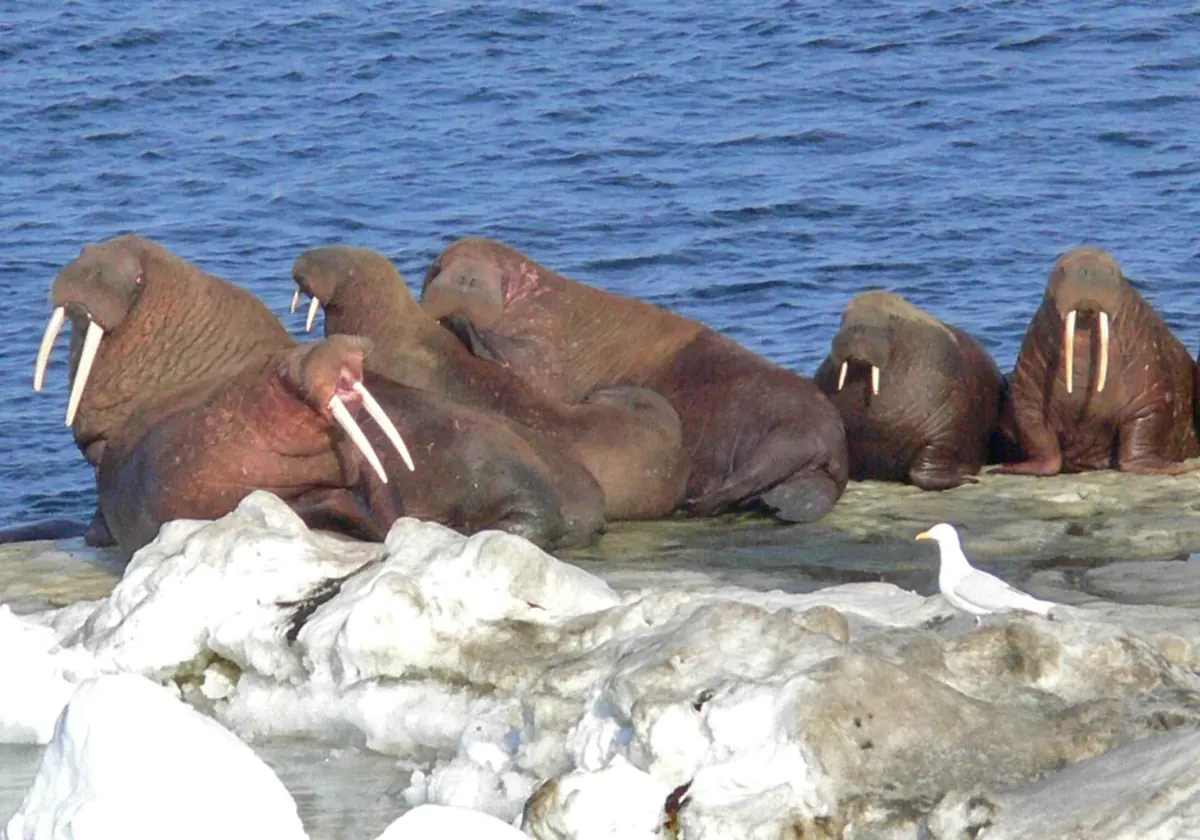
Walruses mating in the pack ice
January into March · Bering Sea pack ice, especially around St. Lawrence Island
Most Pacific walruses spend the winter in the Bering Sea pack ice, and that is where they breed. ADF&G’s species profile puts mating in January through March. Even the several thousand bulls that summer around Bristol Bay head north in fall to join the herd in the ice near St. Lawrence Island. On the ice, walruses settle disputes by raising their heads to show their tusks, and the bull with smaller tusks usually gives way. Calves born of these winter matings arrive about 15 months later, in late April or May.
-
Cook Inlet belugas in the ice
All winter · Mid and lower Cook Inlet, Chinitna and Tuxedni bays; some in the upper inlet
Cook Inlet’s small population of white whales, about 331 animals and listed as endangered, does not leave the inlet. NOAA Fisheries says that once the fish runs end and ice forms in the upper inlet, many belugas scatter into smaller groups and move to deeper water farther south. Underwater microphones have also shown the whales using the ice-choked upper inlet more often in winter than scientists once believed.
Walruses and polar bears are protected under the Marine Mammal Protection Act.
How do moose, caribou and muskoxen get through January in Alaska?
For big plant-eaters, January is a long exercise in saving energy. Food is scarce and poor, snow makes every step cost more, and the strategies differ from one species to the next.
-
Moose on packed trails
All winter, worst in deep-snow years · Willow flats, river bottoms, roads and rail lines
Winter browse of willow, birch and aspen twigs gives a moose less energy than summer food, so it has to eat more of it, and the Denali Education Center notes that wading through deep snow burns energy just when it is hardest to replace. In hard winters with deep snow and severe cold, many moose starve. To save effort they walk on packed trails, plowed roads and train tracks, which puts them in the way of cars, skiers and dog teams. ADF&G counts about 185 moose killed by vehicles and 16 by trains each year in the Matanuska Valley.
-
Caribou on lichen
Winter range from fall to spring · Taiga and tundra; the Western Arctic herd in the northwest
From September on, ADF&G says, caribou switch to lichens, dried sedges and small shrubs such as blueberry. Their large, concave hooves spread wide to carry them over snow and soft tundra, and many herds spend the winter in the boreal forest rather than on open tundra.
-
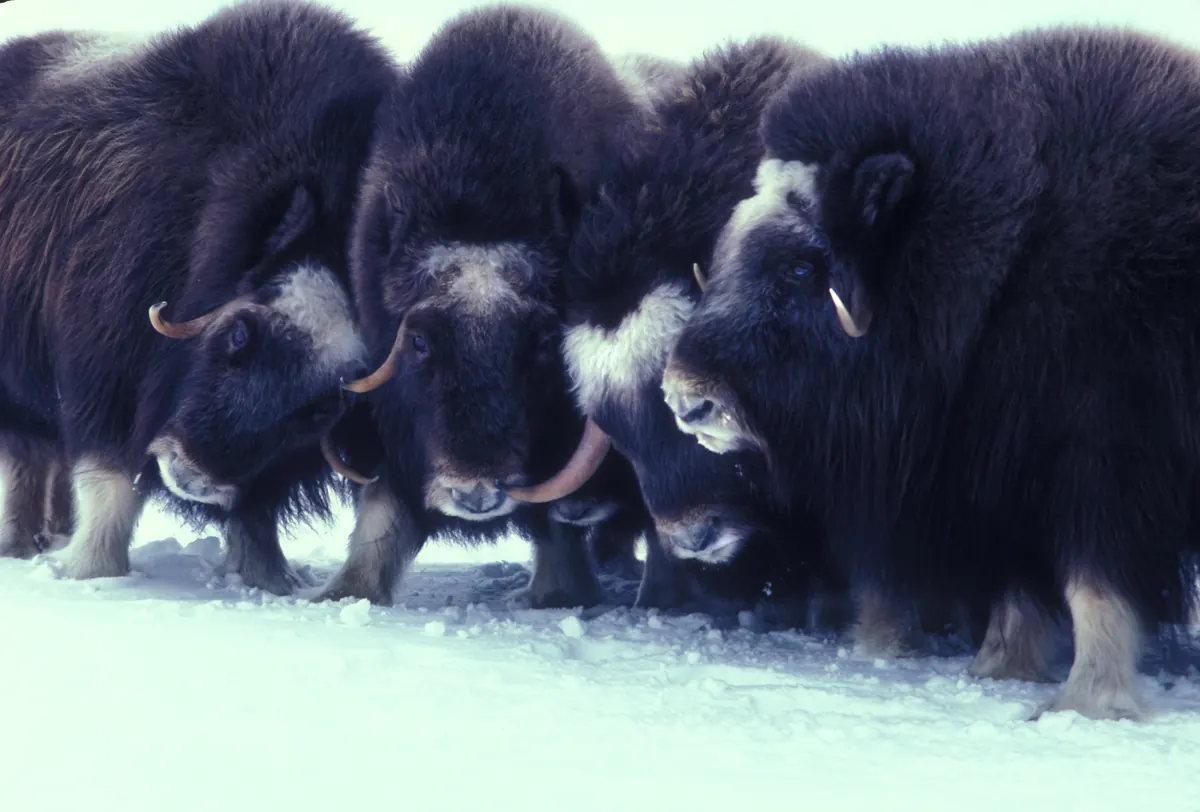
Muskoxen where the wind clears the snow
All winter · Nunivak and Nelson islands, the Seward Peninsula, Cape Thompson, the North Slope
Muskoxen are poor diggers, so ADF&G says their winter range is mostly limited to places with shallow snow or ground swept bare by wind. Winter herds can number up to 75 animals. Under the long guard hair lies qiviut, a soft brown underwool that, ADF&G notes, has been called the rarest fiber in the world. The department’s profile counts about 4,000 muskoxen in Alaska.
-
Snowshoe hares and their runways
All winter · Boreal forest and brushy edges
Hares spend the winter eating spruce twigs and needles, bark, and the buds of aspen and willow. They do not dig burrows. Instead they travel the same runways night after night, and in January those runways become trenches worn deep into the snow; look for them under low spruce boughs and through willow thickets.
-
Flying squirrels at the feeder
After dark · Spruce and birch woodland across the Interior and Southcentral
The northern flying squirrel is strictly nocturnal and often visits bird feeders on winter nights. It does not hibernate, but in very cold weather several may huddle together in a light torpor. One squirrel can use as many as twenty dens in a year, including old woodpecker holes and witches’ brooms. A soft thud on a cabin roof at night may be a squirrel landing.
Wolves are hunting hard now; ADF&G says a pack may take a moose or deer every few days in winter. Their breeding season, which the Denali Education Center puts at about late February to mid-March, is still ahead.
How do insects and shrews survive an Alaska January?
The smallest animals have the hardest time keeping warm, and their answers are some of the strangest in nature.
-
Insects with antifreeze
All winter · Under bark, in leaf litter, in pond mud, in galls on willow twigs
Most insects spend the winter dormant as eggs, larvae or pupae tucked into sheltered places. Some overwinter as adults and load their body fluids with sugars, proteins and glycerol that lower the freezing point. Combined with supercooling, the ability of tiny droplets of body water to stay liquid far below 32 °F, this protects some Alaska species down to −76 °F, according to the Denali Education Center. Look for swellings on willow stems: many are insect galls with a dormant occupant inside.
-
Shrews that never stop
Day and night, all winter · Runways under the snow and ground cover statewide
Alaska has nine kinds of shrews, and the common masked shrew weighs about a fifth of an ounce. A shrew’s heart beats about 700 times a minute, and it eats more than its own weight in food every day; some kinds starve within hours without a meal. They hunt along runways under the snow for insects and other small invertebrates, and will eat mice or meat from a cache. In fresh snow, a shrew’s front feet print five toes, while a mouse or vole’s front feet usually show four.
Is lake and river ice safe in Alaska in January?
Often thicker than it was in December, but never safe by default. ADF&G’s ice-fishing guide gives minimums that apply only to new, clear ice: a minimum of 4 inches for a few people well spread out, 8 to 10 inches before taking out a snowmachine, and a foot or more for a car or truck. The same guide points out something that matters in January: a snowfall after the first ice acts as insulation and slows how fast the ice below it thickens, so a deep-snow winter can leave thinner ice than the cold suggests.
-
Test as you go
Every trip · Lakes, ponds and sloughs
ADF&G recommends thumping the ice with an ice spud, a heavy chisel on a long handle, as you walk, and backing off at once if it punches through. Expect weak spots over moving water and springs and around bridge supports, docks, logs and weeds. Carry spike nails or ice picks on a cord, a compass or GPS, and above all a companion.
-
Rivers and overflow
All winter · Interior and western rivers and trails
River ice is uneven over currents and springs. Overflow, water forced up over the ice that often hides under the snow, can soak boots and swamp a snowmachine; the Geophysical Institute notes that springs keep pushing it to the surface no matter how cold the air is. Follow trails already in local use, and check the Alaska-Pacific River Forecast Center’s ice reports for your stretch of river.
If someone goes through, ADF&G’s advice is to call for help and reach with a rope, branch or ladder rather than going in after them. Typical freeze dates for your town are on Alaska’s frost page, a rough guide to how long the ice has had to grow.
What can families do outside in Alaska this January?
- Start the year on a trail on Friday, January 1. Alaska State Parks has joined in First Day Hikes before; for New Year’s Day 2025, it listed events in places including Ketchikan and Delta Junction. No 2027 hikes had been announced by early October; look at the state parks events page after Christmas.
- Help finish the Christmas Bird Count by Tuesday, January 5. Some circles hold their count day after the holidays.
- Count Quadrantid meteors on Sunday evening, January 3. The peak falls in the early evening in Alaska, so even young children can take part before bedtime.
- Visit Denali in winter. From late September to early May the National Park Service uses the Murie Science and Learning Center, at Mile 1.3 of the park road, as its winter visitor center, and lends snowshoes free. The sled dog kennels are open Saturdays and Sundays from 1 to 4 p.m. The park road is usually closed at Mile 3 in midwinter.
- Hear Anchorage Audubon’s January evening program, Thursday, January 21, 6 to 7:30 p.m., at 1014 Energy Court in Anchorage. The speaker had not been announced in early October.
- Walk under the Wolf Moon on Thursday night, January 21. Look for moon shadows on the snow, and see whose tracks have crossed the yard.
- Measure the noon shadow again on January 21. If you marked a stick’s shadow at the solstice, mark it again a month later at the same time and see how much it has shortened.
- Keep a sunset chart. Note sunset every Sunday on the fridge. In Anchorage, it reaches 5 p.m. on January 30.
- Plan for the Great Backyard Bird Count. This four-day February count normally falls in the middle of the month; birdcount.org will post the 2027 weekend.
Last month’s page, with the solstice, owls and the Christmas Bird Count, is December in Alaska. Every state and month we have written up is on the nature guides page.
Safety notes for January in Alaska
- Cold and wind. January lows average below zero from Bethel to Utqiagvik. On the National Weather Service chart, a 15 mph breeze at zero gives a wind chill of −19 °F, and at that level bare skin can freeze in half an hour. Cover faces, check children’s cheeks and fingers often, and head in at the first numb patch.
- Darkness. Even with the light returning, a short afternoon outing can end after sunset. Carry a headlamp and a spare battery kept warm in a pocket.
- Avalanches. Before skiing, snowmachining or hiking under steep slopes, read the forecast from the Chugach National Forest Avalanche Information Center for Turnagain Pass and Girdwood, or from the Alaska Avalanche Information Center’s regional centers in Cordova, Valdez, Haines and the eastern Alaska Range.
- Moose. Moose on trails and roads are stressed and short on energy. Give them the trail, keep dogs leashed, and drive slowly after dark.
- Hunting and trapping. Several seasons in ADF&G’s 2026–2027 regulations are open in January. Ptarmigan are open in most units into February, March or later, though the season north of Kachemak Bay in Unit 15C closes January 31; grouse stay open through at least March 31 in most units, and snowshoe hares have no closed season in much of the state. Duck and goose seasons are closed everywhere except the Kodiak and Pribilof/Aleutian zones, which run to January 22. General wolf hunting seasons, which run from August into spring in nearly every unit, are open all January. On the Kenai Peninsula (Units 7 and 15), lynx trapping runs December 15 to February 28. ADF&G urges trappers to avoid trails used by hikers, skijorers and mushers, but keep pets close on winter trails anyway. Check hunt.alaska.gov for your unit.
- Be visible. The 2026–2027 hunting booklet requires hunter orange only for youth small-game hunting in the Hatcher Pass Youth Management Area in August, so do not expect hunters around you in January to be wearing it. Wear a bright layer yourself.
A January evening is long enough to write up the day properly. Set down the tracks, the ravens and the turning light while they are fresh, in the Naturalist’s Field Journal or any notebook you keep by the door.
Sources
- U.S. Naval Observatory: sun and moon rise and set for one day (Utqiagvik, January 2027)
- U.S. Naval Observatory: phases of the moon, 2027
- U.S. Naval Observatory: Earth’s seasons and apsides, 2027 (perihelion)
- Fred Espenak: Sky Event Almanac 2027 (planets, conjunctions)
- American Meteor Society: meteor shower calendar (Quadrantids)
- EarthSky: Quadrantid meteor shower
- EarthSky: What is a supermoon?
- Sea and Sky: Astronomy calendar of celestial events, 2027
- NOAA Space Weather Prediction Center: Solar Cycle Progression
- NOAA Space Weather Prediction Center: aurora 30-minute forecast
- UAF Geophysical Institute: aurora forecast
- Aurorasaurus: report an aurora sighting
- NOAA NCEI: U.S. Climate Normals 1991–2020, monthly normals
- UAF Geophysical Institute, Alaska Science Forum: Dangerous cold across the land (Prospect Creek, −80 °F)
- NOAA Climate Prediction Center: ENSO diagnostic discussion, September 10, 2026
- NOAA Climate Prediction Center: 90-day outlooks
- NOAA Climate.gov ENSO blog: Moose tracks through Alaska and ENSO
- ADF&G: Common raven species profile
- Denali Education Center: Ravens
- Denali Education Center: Spruce grouse
- Denali Education Center: Great horned owls
- National Audubon Society: Christmas Bird Count (December 14 to January 5)
- National Audubon Society: Join a Christmas Bird Count (circle map)
- Project FeederWatch
- ADF&G: Polar bear species profile
- U.S. Fish and Wildlife Service: Polar bear
- ADF&G: Walrus species profile
- ADF&G: Walrus (Wildlife Notebook Series)
- U.S. Fish and Wildlife Service: Pacific walrus
- NOAA Fisheries: Beluga whale (Cook Inlet population)
- Denali Education Center: Moose in winter
- ADF&G: Moose species profile
- ADF&G: Caribou species profile
- ADF&G: Muskox species profile
- ADF&G: Snowshoe hare species profile
- ADF&G: Wolf species profile
- Denali Education Center: Wolves
- Denali Education Center: Northern flying squirrels
- Denali Education Center: Insects in winter
- Denali Education Center: Shrews
- ADF&G: Cure for the Cold, Let’s Go Ice Fishing (ice safety chapter)
- NWS Alaska-Pacific River Forecast Center: river ice observations
- Alaska State Parks: First Day events news release (December 30, 2024)
- Alaska State Parks: current events
- National Park Service, Denali: winter activities
- National Park Service, Denali: sled dog kennels
- Anchorage Audubon Society: January Evening Program, January 21, 2027
- National Weather Service: wind chill chart
- Chugach National Forest Avalanche Information Center
- Alaska Avalanche Information Center
- ADF&G: 2026–2027 Alaska Hunting Regulations (complete booklet)
- ADF&G: 2026–2027 Alaska Migratory Game Bird Hunting Regulations
- ADF&G: 2026–2027 Alaska Trapping Regulations
- UAF Geophysical Institute, Alaska Science Forum: Live higher, stay warmer (at least in Fairbanks) (inversions)
- UAF Geophysical Institute, Alaska Science Forum: Wet overflow a winter hazard in Alaska (February 2024)
- Photos via Wikimedia Commons; licenses and photographers are credited under each picture
