What to look for in nature in Arizona this April
April is the month Arizona hands the desert from one set of flowers to the next. The wildflower annuals of March thin out, the palo verdes turn yellow, hedgehog and prickly pear cacti open, and the first saguaro buds start to swell toward their May and June show. Up in the Sky Islands, migrating warblers crowd the gravel roads of Mount Lemmon and hummingbird numbers climb at the feeders near Patagonia. The reptiles are fully awake: Gila monsters peak early in the month and rattlesnakes are at their most active. This is also the windiest stretch of the year for several Arizona cities, the last month before Phoenix usually sees its first 100 °F afternoon, and the beginning of the period when forest managers start deciding on fire restrictions. The Verde Valley Birding and Nature Festival is listed for April 22 to 25, 2027, the full Pink Moon arrives on April 20, and moonlight swamps the Lyrid meteors two nights later. Because Arizona stretches from river-level desert to 12,000-foot peaks, this page is as much about where to stand as when.
Other months in Arizona: October, November, December, January, February, March.
Start here
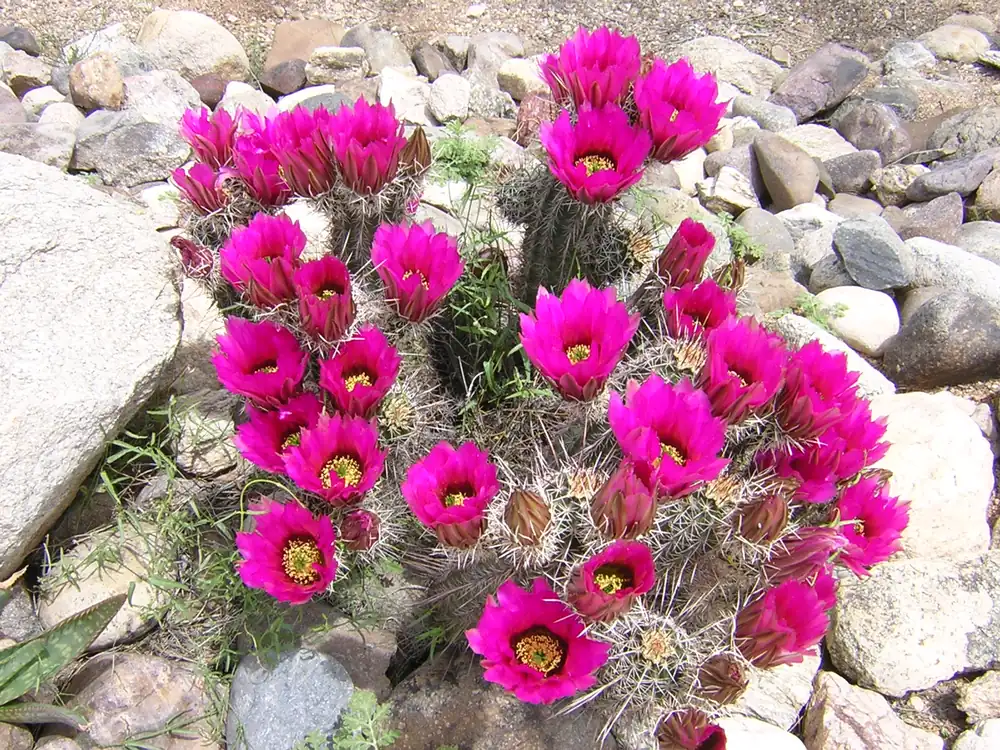
- Look for yellow palo verdes, then hedgehog cactus blooms. The most colorful event of an Arizona April is the palo verde bloom, and the cacti follow: Saguaro National Park lists April and May as the cactus flower season, with cholla, prickly pear, hedgehog and saguaro all in the mix by late in the month. Go in the cool of the morning and stay on the trail.
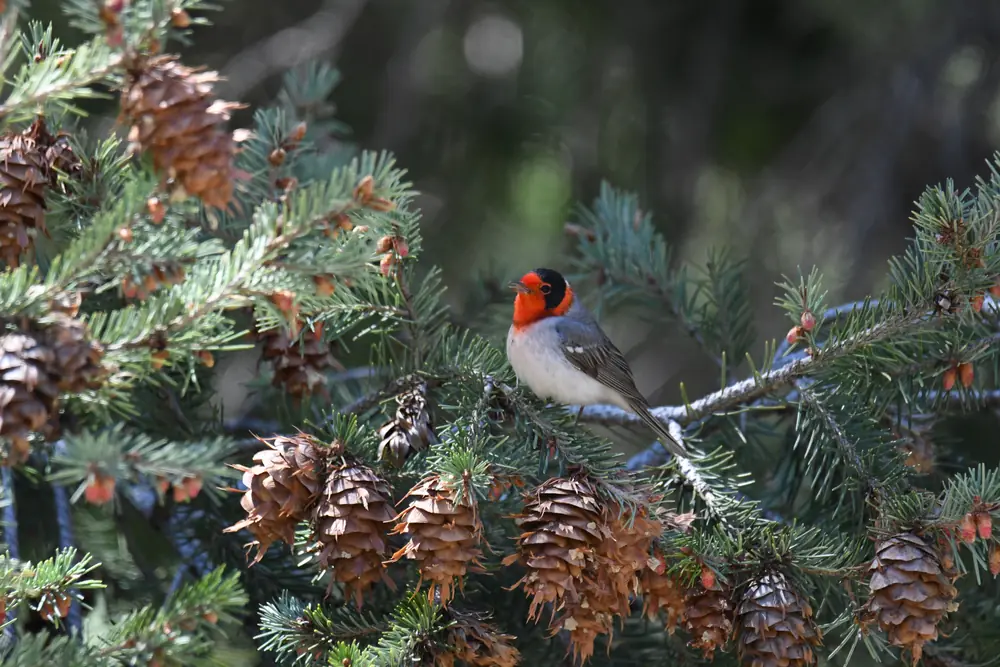
- Walk a Sky Island road for warblers. Tucson Bird Alliance recommends the gravel roads at Incinerator Ridge and Bear Wallow on Mount Lemmon in April and May, where Mexican specialties such as Red-faced Warbler and Painted Redstart mix with western migrants. Bring layers: the top of the mountain is far cooler than Tucson.
- Give snakes and Gila monsters room. Gila monster activity at Tonto National Monument peaks in early April, and Arizona wildlife biologists say rattlesnakes leave their winter dens in March or April. Watch your feet and hands, keep dogs leashed, and never try to move a snake.
Put the palo verde and cactus bloom in a colours of the day plate and use the same place twice, once in early April and once at the end of the month, to show how fast the desert changes. Let birds I have seen hold your Red-faced Warbler or Violet-crowned Hummingbird, a nest observed plate hold a Lucy’s Warbler or cactus wren nest seen from a distance, and tracks to know or reading the signs hold the first snake or lizard you meet, with the air temperature. A map of sounds suits a Mount Lemmon dawn, and dusk and dawn watch suits the Pink Moon and the Venus mornings, all in the Naturalist’s Field Journal.
Regions used below: Phoenix and the low deserts; Tucson and the southeastern Sky Islands; Yuma and the Colorado River; Prescott, Sedona and the Verde Valley; Flagstaff, the Grand Canyon and the Mogollon Rim; The White Mountains; The Navajo Nation and Hopi lands.
When do Arizona’s palo verdes and cacti bloom in April?
April is the changeover month. Saguaro National Park’s own conditions page says the spring annuals peak in March and early April, with the west side of Tucson blooming first, and that by late April the cactus flowers (cholla, prickly pear, hedgehog and saguaro) take over in both districts. The park’s flower page calls the first week of May the time when the greatest number of species is in bloom, and adds that saguaros are often in peak flower toward the end of May. Arizona State Parks gives the saguaro bloom as usually May and June. Put those together and the saguaro is a May story that starts with buds in April, while the shrubs and smaller cacti are the April story. Timing shifts with winter rain and spring warmth, so treat every window as an estimate.
-
Blue palo verde and its cousins
Early to mid April for blue palo verde · Washes, bajadas and roadsides around Phoenix, Tucson and Yuma
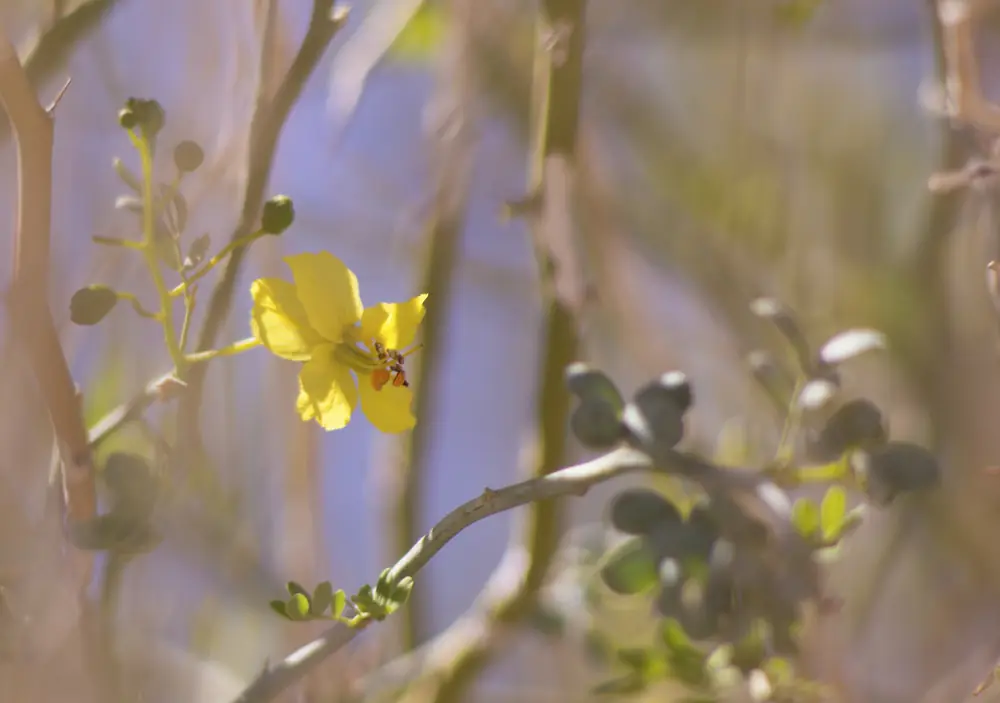
A plant profile from Arizona State University lists blue palo verde, the state tree, as bearing masses of yellow flowers in early to mid April, and an Arizona gardening column calls the palo verde bloom clearly the most colorful event of an Arizona April, with each species a different shade of yellow. After a dry year the trees can drop their small leaves and keep working through their green bark, which is how they get their name.
-
Hedgehog, prickly pear and cholla
Late April into May · Rocky slopes in Saguaro National Park, Catalina State Park and other Sonoran Desert parks
The park service’s April and May flower page names saguaro, several chollas, prickly pear and pincushion cacti among the bloomers, and says the cacti are more reliable than the spring wildflowers. The cactus flowers last only days, so a hillside can change between one visit and the next.
-
The first saguaro buds
Buds from April, flowers mostly May and June · Saguaro National Park, Lost Dutchman, Catalina and Picacho Peak State Parks
Each saguaro blossom opens for a single day, and Arizona State Parks says bats, bees and native birds all carry the pollen. From 2017 to 2023 the national park tracked the buds, flowers and fruit of more than 50 saguaros on its west side, photographing them from April 1 to mid-July with a camera on a 30-foot pole. The counts swung from 1,705 flowers in 2022 to more than 9,400 in 2023, a reminder that no two Aprils or Mays look alike.
The March guide covers the poppy and lupine peak that comes before this one. Do not pick or trample the blooms, and use the official pullouts instead of parking on roadsides, as the park asks. For a quick comparison across a month, visit the same trail in the first and last weeks of April and note which species have faded and which have opened; the national park’s west side tends to bloom before its east side, and higher, cooler ground trails the low desert by weeks.
Where can I see spring warblers and other migrants in Arizona in April?
Songbird migration is at full tide in the Sky Islands and along the river corridors. Tucson Bird Alliance’s spring 2025 almanac points to the top of Mount Lemmon in the Santa Catalina Mountains as a place where, during spring migration, species more common in Mexico (Red-faced, Olive and Grace’s Warblers and Painted Redstart) mix with other western warblers. It adds that resident Black-throated Gray, Virginia’s and Yellow-rumped Warblers forage beside migrants such as Wilson’s, Townsend’s, Hermit and MacGillivray’s on the gravel roads in April and May. Its advice is to go during migration rather than any random week, and the exact seasonal timing changes from year to year.
-
Mount Lemmon warbler parade
April and May · Incinerator Ridge and Bear Wallow, Santa Catalina Mountains, north of Tucson
Both are gravel roads that can be walked slowly. The mountain top is much cooler and often windier than the city, so carry a jacket, binoculars and water, and check road and fire-closure notices with the Coronado National Forest before you drive up.
-
Cottonwood and willow corridors
Spring and summer mornings · Santa Cruz River near Tubac, Sabino Canyon, Tanque Verde Wash and Ciénega Creek around Tucson
The alliance names these riparian strips as good places to find arriving songbirds. At the Anza Trail near Tubac the old cottonwoods and willows host nesting hawks, and the dawn chorus of Summer Tanagers, Yellow-breasted Chats and Yellow Warblers is described as loud enough to compete with passing trains.
-
Orioles and tanagers at a fruit feeder
Spring migration · Backyards and desert parks in Tucson and Phoenix
Tucson Bird Alliance notes that orioles and tanagers eat fruit as well as insects, so a fruit feeder can draw them through the desert during migration. Keep feeders clean and out of reach of cats.
-
Colorado River backwaters
Spring migration · Havasu and Imperial National Wildlife Refuges, near Lake Havasu City and Yuma
Havasu National Wildlife Refuge reports 318 bird species using its marsh, cottonwood and willow habitat, and Imperial National Wildlife Refuge protects 30 miles of habitat along the lower Colorado River, where backwaters are key for wildlife. In the Yuma area, temperatures are already high, so go at dawn. Havasu’s monthly guided tours run through April by reservation.
-
The Verde Valley Birding and Nature Festival
April 22 to 25, 2027 (organizer’s page) · Dead Horse Ranch State Park, Cottonwood
Friends of the Verde River list the 2027 festival for April 22 to 25 and describe it as birding during peak spring migration on the banks of the Verde River, with guided tours, hikes and workshops; registration is shown as open. A free Family Nature Day is listed for Saturday, April 24, 10 a.m. to 3 p.m. Confirm details and registration with the organizer.
For the days you cannot travel, Journey North’s hummingbird reports and Nature’s Notebook (both linked below) are ways to follow the wave from home.
Which hummingbirds arrive in Arizona in April, and where are the best places to see them?
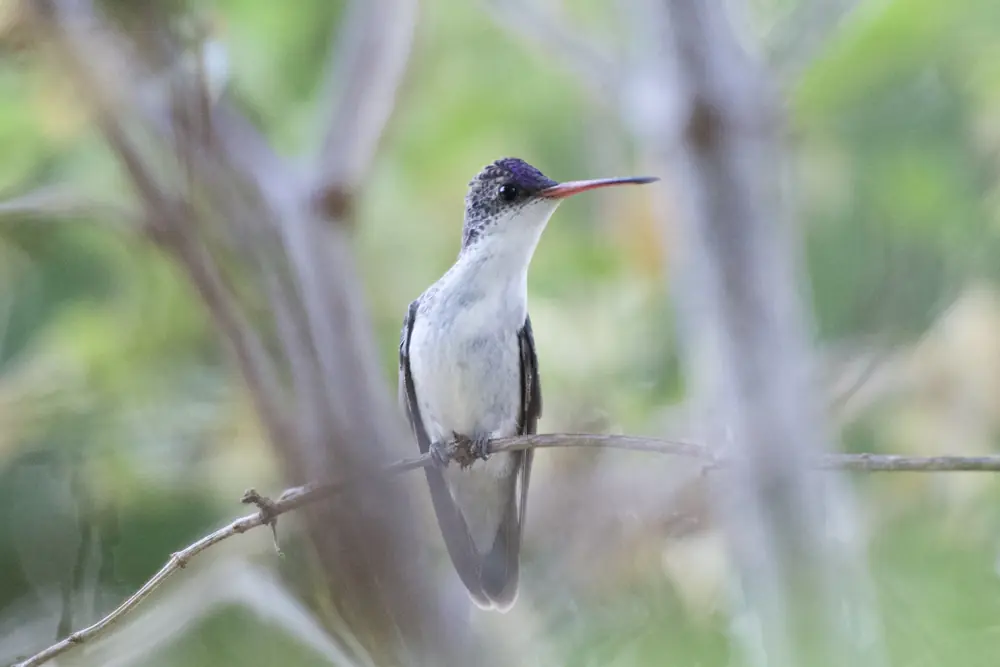
Southeastern Arizona is a hummingbird hotspot, and April is when the numbers begin to build. Tucson Bird Alliance says the number and variety of hummingbirds really picks up in April at its Paton Center for Hummingbirds in Patagonia, one of the few places in the country where seeing 11 species in a day is possible and a Violet-crowned Hummingbird is a sure thing. The Nature Conservancy lists April through September as the best months for birding at Ramsey Canyon Preserve, and Costa’s Hummingbirds, which nest here in late winter and spring, are already well into their season.
-
Paton Center for Hummingbirds
From April; builds through spring · Patagonia, Santa Cruz County
Feeders sit just a few feet from the viewing seats, and the alliance says rare nesting birds such as Gray Hawk, Thick-billed Kingbird and Mississippi Kite have been found nearby in recent years. Check the alliance’s page for current hours and any habitat-work days.
-
Ramsey Canyon Preserve
April through September · Hereford, near Sierra Vista, in the Huachuca Mountains
The preserve lists Rivoli’s and Anna’s Hummingbirds among its birds and a live hummingbird camera. It is open from 8 a.m. to 5 p.m. between March 1 and October 31 and closed Tuesdays and Wednesdays; groups should call 520-378-2785 in advance.
-
Costa’s Hummingbird in the city
Late winter and spring · Desert neighborhoods and parks in Tucson and Phoenix
The alliance explains that Costa’s raise their young in the desert during late winter and spring, and most then head for coastal California and Baja before the summer heat. Because most leave before summer, April and early May are a closing window to see them in a yard. A Journey North report from a recent spring noted Costa’s appearing early across Arizona, and a Tucson watcher logging a female on a salvia.
Which birds are nesting in Arizona in April, and where are the eagles and condors?
The desert is full of nests right now, and most of them are tucked where you would never look. The three stories below are all things you can watch without disturbing anything.
-
Lucy’s Warbler
Arrival in spring; nesting through the season · Mesquite bosques and riparian forest, including neighborhoods in Tucson
Tucson Bird Alliance says spring means the arrival of Lucy’s Warblers in Tucson and that they sing right away. The species lives in what the alliance calls the most arid habitat of any North American warbler, and it is one of only two warblers on the continent that nest in cavities, using Gila Woodpecker holes, old Verdin nests and bark crevices in velvet mesquite.
-
Phainopepla and the mistletoe
Winter and spring in the desert; leave when it heats up · Palo verde and mesquite with desert mistletoe, then oak woodlands such as Madera Canyon
The alliance says Phainopeplas spend the winter defending clumps of mistletoe in palo verde and mesquite, breed in that desert habitat in spring, and then move to riparian areas or higher oak woodlands when the berries dwindle and temperatures climb. Look for the glossy black males perched on a treetop.
-
Cactus wren nests
Spring · Cholla and saguaro in Tucson and Phoenix yards and parks
The same almanac mentions a nest of young Cactus Wrens inside the spiny fortress of a cholla. Watch from a distance and never trim a cactus that holds a nest.
-
Bald eagle nestlings
Nestlings in the nest through May and June · Lower Verde River, Salt River lakes and other desert rivers
The Southwestern Bald Eagle Management Committee says eggs take 35 days to hatch and nestlings fledge about 12 weeks after hatching, in May and June, with young birds migrating north about 45 days after leaving the nest. More than 60 breeding areas are known in the state, and the nestwatch program runs from about February to June. Nestwatchers ask boaters and hikers to stay away, and seasonal breeding-area closures are in force.
-
California condors
Best viewing begins mid-April · South Rim, Grand Canyon National Park
The park says that from mid-April through July you can pretty well count on seeing condors if you spend a full day in the park, and that the evening roosts start to form near Bright Angel Lodge in late April. The park puts the free-flying population of northern Arizona and southern Utah at 73 birds. Scan the cliffs late in the afternoon and never approach or feed a bird.
Are Gila monsters and rattlesnakes active in Arizona in April?
Yes. The research at Tonto National Monument, east of Phoenix, found Gila monsters leaving their hibernation sites from late March, with activity peaking in early April. In that study, 55 percent of the animals people met moved under cover, ran off or dug deeper rather than staying put, so they are far from aggressive. Researchers also recorded them eating a clutch of Gambel’s quail eggs and young desert cottontails.
-
Gila monsters
Peak activity in early April · Rocky foothills and washes; Tonto National Monument is a research site
Look on warm days near boulder piles and washes. If you see one, stay back and let it go; never pick one up. The species is venomous but the study found most animals avoided people.
-
Rattlesnakes
March and April, active again in late summer · Trails, washes and yards all over the low and middle elevations
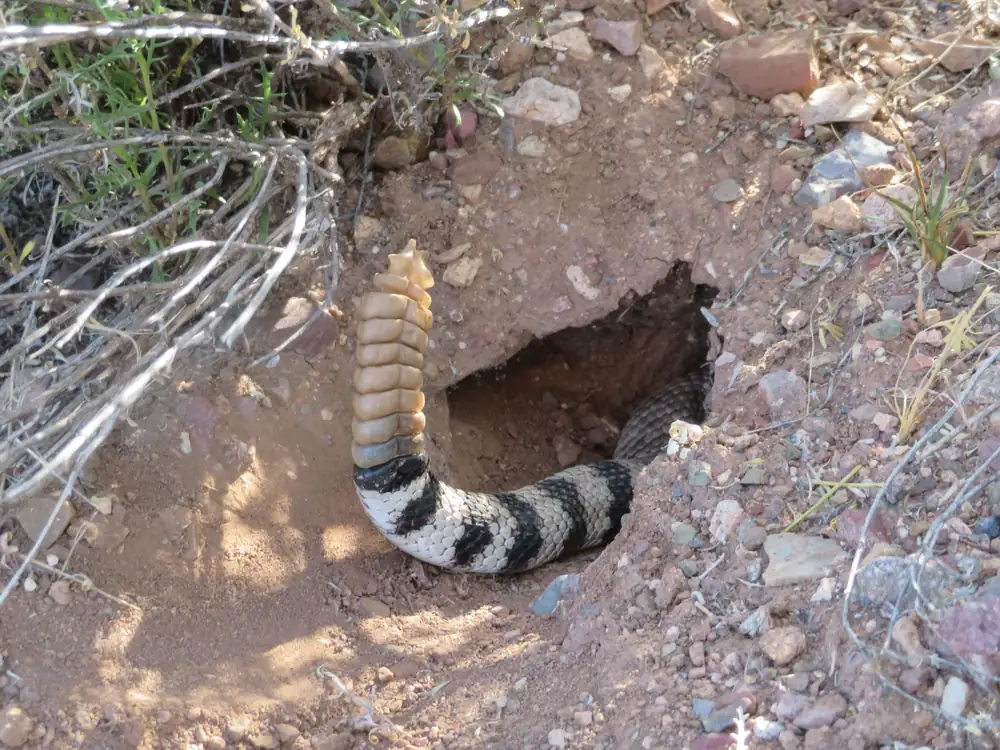
A 2015 Arizona Daily Star report (updated in 2016) quotes an Arizona Game and Fish biologist saying rattlesnakes typically come out of their winter dens in March or April. The Arizona Poison and Drug Information Center’s director told the paper that 150 to 160 bites a year are reported to the center (which covers every county except Maricopa), that monthly counts usually hover in the double digits through May, June and July, and that they jump to about 30 a month in August and September. The medical advice in the article is to get to a hospital at once, with no cutting, sucking or tourniquets.
See the safety notes below for what to do on the trail.
What is the weather in Arizona in April?
April is the month the low desert tips toward summer while the high country is still holding on to winter. The NOAA 1991–2020 normals in the table put Phoenix Sky Harbor at 85.5 °F for the average high and 60.8 °F for the low, Yuma Proving Ground at 86.1 °F and 58.5 °F, and Tucson at 82.9 °F and 53.3 °F, each with a quarter inch of rain or less. On the plateau the normal low at Flagstaff Pulliam is 28.2 °F, and its April snow normal is 5.0 inches; the Grand Canyon NP 2 station records 2.8 inches, Show Low 1.6 inches, and Payson 2.0 inches. In other words, freezing mornings and spring snow are still part of the picture above about 5,000 feet.
The National Weather Service in Phoenix lists the average first 90 °F day at Sky Harbor (1991–2020) as March 30, the average first 100 °F day as May 2, and the average first 105 °F day as May 22. The earliest 100 °F day on record there is March 26, 1988, and the earliest 105 °F day is April 20, 1989. So April in Phoenix is usually the last month before triple digits, not a guarantee.
The in-between towns show how much elevation matters. Willcox, in the Sulphur Springs Valley, has a normal high of 78.7 °F but a normal low of only 41.6 °F, and Show Low’s normals are 64.9 °F and 36.8 °F. Willcox swings about 37 degrees between its normal high and low, and Show Low about 28, which is why a Tucson-area hiker in shorts at noon can need a jacket at sunrise on the same trip. The normals describe an average April; individual days vary widely, and a spring storm can bring a late snowfall to Flagstaff or the White Mountains while Phoenix is warm. Check the National Weather Service forecast the day before any outing, and remember that the table lists each station under the exact name NOAA gives it, so the Grand Canyon figure comes from the station named Grand Canyon NP 2, which NCEI places on the South Rim at about 6,800 feet, not in the much warmer inner canyon.
| Station | Normal high (°F) | Normal low (°F) | Precipitation (in) |
|---|---|---|---|
| Phoenix Sky Harbor Intl Ap | 85.5 | 60.8 | 0.22 |
| Yuma Proving Ground | 86.1 | 58.5 | 0.12 |
| Tucson Intl Ap | 82.9 | 53.3 | 0.24 |
| Willcox | 78.7 | 41.6 | 0.22 |
| Show Low Ap | 64.9 | 36.8 | 0.57 |
| Grand Canyon NP 2 | 60.9 | 28.8 | 0.64 |
| Flagstaff Pulliam Ap | 59.2 | 28.2 | 0.89 |
The latest NOAA three-month outlook, updated each month, is posted at cpc.ncep.noaa.gov. Look up your own town on the Arizona frost dates page and read our weather guide, and for what the sky is doing see the cloud guide.
When is the last spring freeze in Arizona?
Arizona’s last freeze is spread across half the year. The table below shows the NOAA 1991–2020 dates for eight main stations. The Yuma, Phoenix and Tucson stations finish with freezes by January to early March, so April rarely brings frost there. The middle elevations are the ones to watch: the table has Kingman’s median at April 2, Sierra Vista’s at April 5 and Prescott’s at April 30. On the plateau the median is much later: June 4 at Flagstaff, in the table, and later still in the high country. If you garden at elevation, a warm April spell is not permission to plant tender things.
| Station | One year in ten | Median | Nine years in ten |
|---|---|---|---|
| Page | Mar 8 | Mar 27 | Apr 16 |
| Flagstaff | May 21 | Jun 4 | Jun 19 |
| Kingman | Mar 8 | Apr 2 | Apr 21 |
| Prescott | Apr 14 | Apr 30 | May 15 |
| Phoenix | Dec 19 | Jan 5 | Jan 22 |
| Yuma | Dec 17 | Jan 11 | Feb 14 |
| Tucson | Jan 4 | Feb 5 | Mar 2 |
| Sierra Vista | Mar 15 | Apr 5 | Apr 21 |
Check your own town on the Arizona frost dates page.
Why is April so windy in Arizona, and when does fire season start?
An azfamily weather report, using Iowa State University’s Environmental Mesonet records going back to 1948, says April is typically the windiest month in Flagstaff, Show Low and Tucson, and that Phoenix is less clear-cut because sources disagree. The cause is the spring tug-of-war between cool and warm air masses. Wind plus dry vegetation is why forests begin their fire-restriction watch now. On the Kaibab National Forest, weekly conference calls among national forests, parks, tribal fire units, state agencies and the National Weather Service run from April through August to decide on restrictions. Stage 1 restrictions generally prohibit campfires and charcoal outside developed sites with provided fire rings, limit smoking to enclosed vehicles, developed sites or cleared areas, and the forest says fireworks and exploding targets are never allowed.
Restrictions start on different dates in different forests and can come with little notice, so check the forest’s page the week you go. The National Weather Service in Flagstaff posts fire weather and red flag information; links are in the sources. Blowing dust can cut visibility on highways with little warning, so slow down, turn on your lights and avoid stopping in a travel lane if you cannot see. On hikes, wind makes it feel colder and dries you out faster than the thermometer suggests, and wind is the reason a spark from a chain, a cigarette or a vehicle in dry grass can spread quickly.
How much daylight does Arizona gain in April?
Arizona gains close to two minutes of daylight a day this month, between about 52 and 65 minutes over the whole month depending on the town. Below, eight towns are compared on April 1 and April 30, sunrise to sunset. Arizona does not change its clocks (the Navajo Nation does), so the gain is all you see in the evenings.
| City | Apr 1 | Apr 30 | Gained | Per day |
|---|---|---|---|---|
| Page | 12 h 36 m | 13 h 41 m | 65 min | 2.2 min |
| Flagstaff | 12 h 35 m | 13 h 35 m | 60 min | 2.1 min |
| Kingman | 12 h 35 m | 13 h 35 m | 60 min | 2.1 min |
| Prescott | 12 h 34 m | 13 h 33 m | 59 min | 2.0 min |
| Phoenix | 12 h 33 m | 13 h 29 m | 56 min | 1.9 min |
| Yuma | 12 h 32 m | 13 h 27 m | 55 min | 1.9 min |
| Tucson | 12 h 31 m | 13 h 26 m | 55 min | 1.9 min |
| Sierra Vista | 12 h 31 m | 13 h 23 m | 52 min | 1.8 min |
Compare with the daylight guide for your own town.
What can you see in Arizona’s night sky in April?
The Moon is new on April 6, full on April 20 (the Pink Moon, named for the pink spring flowers called moss pink) and the table uses Arizona time, Mountain Standard Time all year (the Navajo Nation, which observes daylight time, is an hour ahead). International Dark Sky Week is timed to the week of the April new moon, so check DarkSky International for the official 2027 dates. The dark mornings around the new moon are good for the Milky Way core before dawn: our own calculation (made for 30 degrees north, near southern Arizona) in the early part of April and in its final days, with about two hours of dark core sky.
- Lyrids, a poor year. The shower runs through the later weeks of April and peaks on the night of April 22 to 23, but the Moon, about 95 percent illuminated and only three days past full, climbs over Phoenix’s horizon near 9:22 p.m. That leaves just the early evening dark. Sea and Sky puts the peak rate near 20 an hour under ideal skies and warns that moonlight will erase the fainter streaks.
- Venus before dawn. The brilliant morning star clears the horizon roughly 75 minutes ahead of sunrise at the start of April and about 60 minutes ahead by May 1. A thin old crescent Moon sits close by on April 3 and 4 by our calculation.
- Mercury fades. It rises about 42 minutes before sunrise on April 1 and only about 22 minutes on April 15, so the morning chance is brief.
- Jupiter and Mars in the evening. Jupiter stays up into the small hours, and the Moon passes beside it on the evenings of April 14 and 15, within about a degree at their closest by our own calculation. Mars is nearby, about 3 degrees from the Moon on April 15 (also our calculation).
- Saturn. The ringed planet is behind the Sun on April 7 and reappears before dawn in the last days of the month.
| Phase | Date | Time |
|---|---|---|
| New moon | Tuesday, Apr 6 | 4:51 p.m. |
| First quarter | Tuesday, Apr 13 | 3:56 p.m. |
| Full moon, the Pink Moon | Tuesday, Apr 20 | 3:27 p.m. |
| Last quarter | Wednesday, Apr 28 | 1:18 p.m. |
See the moon phases guide for other months. The Eta Aquariids, an excellent shower at the May 6 new moon, come just after this month ends. A practical plan for a Pink Moon outing is to catch the Moon as it clears the eastern horizon on April 20 and then to leave the lights off for a while on the nights before and after, when the Moon is lower and the sky is better for the planets.
What can families do outdoors in Arizona this April?
- Verde Valley Birding and Nature Festival, April 22 to 25. Friends of the Verde River list these dates for 2027 at Dead Horse Ranch State Park in Cottonwood, with Family Nature Day on Saturday, April 24, from 10 a.m. to 3 p.m. Registration questions go to the organizer at 928-282-2202.
- Bird walks at Catalina State Park. The state parks listing shows 7 a.m. walks on Sundays and Wednesdays in April, plus Mondays April 5 and 19, three to four hours each, through May 17. Check the page for changes.
- Tucson Bird Count. The count’s own page says it takes place between April 15 and May 15 each year, with volunteers choosing one morning and making five-minute counts at each stop along an adopted route. Check with the count coordinator for 2027 details.
- Earth Day, April 22, and Arbor Day. Earth Day is April 22. Arizona law names the last Friday in April as Arbor Day, which is April 30 in 2027, and it is not a legal holiday.
- City Nature Challenge. The organizers list four observation days, April 30 to May 3, 2027, then identification until May 16. Families can join with a phone camera on any walk.
- Havasu National Wildlife Refuge tours. Monthly guided outings, listed for the second Tuesday of each month during the November to April season, in the morning for two hours, in the morning, need a reservation at 928-259-9632.
- Pink Moon evening. Take a flashlight and a jacket to a desert park after the Moon rises on April 20, and look for the Moon near Jupiter the week before.
- Join a count. Log birds from your yard, report hummingbirds to Journey North, or record the bloom with Nature’s Notebook. It is free.
Browse other states at the nature hub and record what you see in the Naturalist’s Field Journal. Every date above came from the organizer’s own page when we checked in October 2026; please confirm by phone or online before leaving home.
Safety notes for April in Arizona
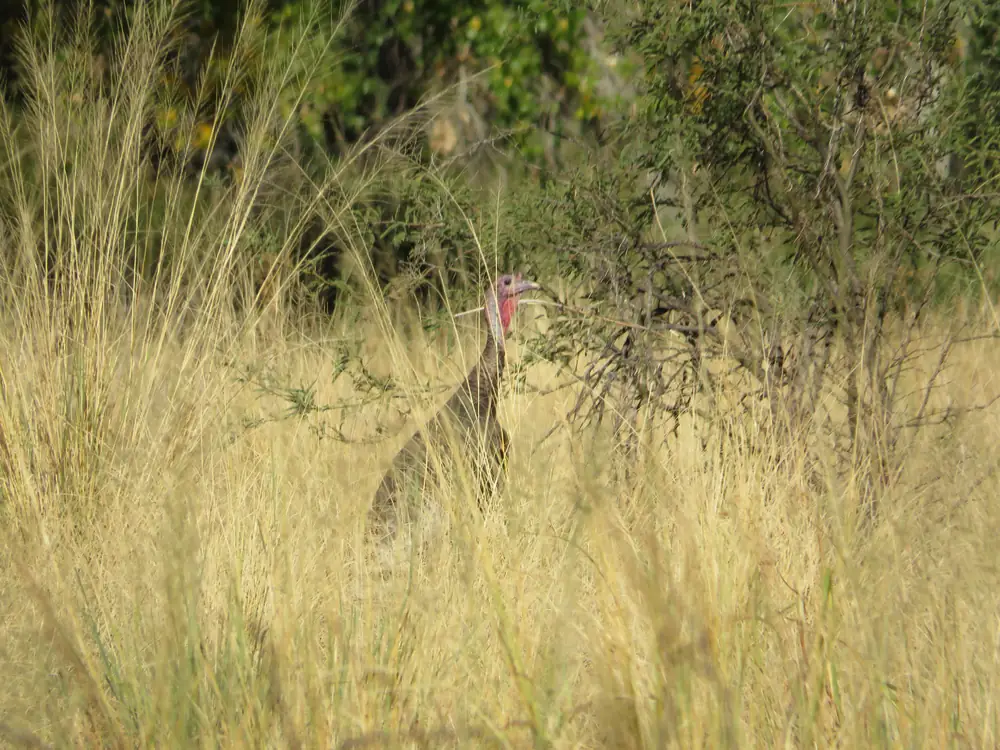
- Spring turkey. The Game and Fish Department’s 2027 spring booklet lists shotgun and archery turkey hunts that are by draw permit. Youth-only Merriam’s hunts run April 16 to 22 and again May 7 to 20 in listed units. Most permit hunts run April 23 to 29 and May 7 to 20, or April 30 to May 20, while permit hunts for Gould’s turkey in units 29 and 30A begin April 30 and run into late May, and an archery-only Gould’s hunt in Unit 33 opens April 16. The limit is one turkey per calendar year. Expect hunters in forest at dawn.
- Spring bear. The booklet lists a general bear season March 19 to April 22 in many of the units it names, with a nonpermit tag, and cubs and females with cubs are off limits. Hunters must report within 48 hours.
- Orange and color. Arizona’s hunter safety course says hunter orange is not required but may be a good idea. On forest trails, choose bright clothing, and outfit a dog in a vividly colored vest.
- Snakes. Keep to trails and leashed dogs, check the ground before you reach or step, and detour around any snake you see. If bitten, call 911 and get to a hospital; Arizona’s poison center is at 800-222-1222.
- Bighorn rules. At Pusch Ridge Wilderness north of Tucson, the Forest Service forbids leaving system trails by more than 400 feet through April 30 for the sheep’s lambing season, and dogs may not enter the bighorn management area in any season.
- Refuges. Visiting Cabeza Prieta National Wildlife Refuge takes a Goldwater Range access permit, and the refuge has had fawning-season closures; confirm the current rules with the refuge.
- Warmth in the low desert. Where normal highs top 85 °F in Phoenix and Yuma, start hikes at dawn, carry far more water than you expect to need and turn back early.
- Cold above 5,000 feet. A normal low of 28 °F at Grand Canyon and Flagstaff means ice on shaded trails. Check road and trail conditions with the park at 928-638-7496 before you go.
- Wind, dust and fire. Slow down if dust reduces visibility, and follow the forest’s fire restrictions. Never leave a campfire unattended.
Sources (46)
- Arizona Game and Fish Department: 2027 Spring Turkey, Javelina, Bison, Bear and Raptor Capture booklet (PDF)
- Arizona hunter education course: hunter orange
- National Park Service: Saguaro National Park April-May blooms
- National Park Service: Saguaro National Park current wildflower conditions
- National Park Service: Saguaro Flower Power Project
- National Park Service: Saguaro cactus facts
- Arizona State Parks and Trails: saguaro cactus flower
- Arizona State Parks and Trails: Arizona’s wildflowers
- Arizona State Parks and Trails: Picacho Peak wildflower reports (Bloomdar)
- Arizona State Parks and Trails: events calendar
- Arizona State Parks and Trails: guided bird walks at Catalina
- Arizona State Parks and Trails: Picacho Peak bird walk
- Arizona State University: blue palo verde plant profile
- Desert Gardening 101: April showers bring golden flowers
- Friends of the Verde River: Verde Valley Birding and Nature Festival 2027
- Tucson Bird Alliance: Vermilion Flycatcher, Spring 2025 (April to June bird almanac, PDF)
- Tucson Bird Alliance: Lucy’s Warbler
- Tucson Bird Alliance: Phainopepla
- Tucson Bird Alliance: Costa’s Hummingbird
- Tucson Bird Count: about
- The Nature Conservancy: Ramsey Canyon Preserve
- Journey North: hummingbirds, Advancing in April
- National Park Service: Grand Canyon California condors
- National Park Service: Grand Canyon alerts and conditions
- Southwestern Bald Eagle Management Committee: biology of bald eagles in Arizona
- Southwestern Bald Eagle Management Committee: Arizona Bald Eagle Nestwatch Program
- National Park Service: Tonto National Monument Gila monster research
- Arizona Daily Star: rattlesnake season and bites
- U.S. Fish and Wildlife Service: Havasu National Wildlife Refuge
- U.S. Fish and Wildlife Service: Imperial National Wildlife Refuge
- U.S. Fish and Wildlife Service: Cabeza Prieta National Wildlife Refuge
- Coronado National Forest: Pusch Ridge Wilderness
- NOAA NCEI: 1991–2020 monthly climate normals, Arizona stations (data query)
- National Weather Service Phoenix: first and last dates for temperature thresholds
- National Weather Service Phoenix
- National Weather Service Flagstaff
- azfamily: April is typically the windiest month for much of Arizona
- Kaibab National Forest: fire restrictions
- Climate Prediction Center: seasonal outlooks
- U.S. Naval Observatory: moon phases, 2027
- Sea and Sky: astronomy calendar 2027
- Arizona Revised Statutes 1-304: Arbor Day
- EARTHDAY.ORG
- City Nature Challenge
- USA National Phenology Network: Nature’s Notebook
- Photos via Wikimedia Commons; licenses and photographers are credited under each picture
