What to look for in nature in Arizona this January
Midwinter in Arizona is a season of eggs and counts. Along the Salt and Verde rivers most desert bald eagle pairs lay in January or February, so this is the month you are most likely to see one bird sitting low in a nest while its mate keeps watch. Great horned owls can be incubating by January too. Biologists are out counting: wintering eagles on standard routes across the state, Mexican wolves from the air and on the ground, cranes in the Sulphur Springs Valley, where more than 20,000 birds spend the winter. Up on the plateau, Flagstaff has its snowiest month of the year on average, and that snow is the water supply for much of the Phoenix area. The sky opens the year with the Quadrantid meteors and closes the month’s third week with the nearest full moon of 2027.
Other months in Arizona: October, November, December, February.
Start here

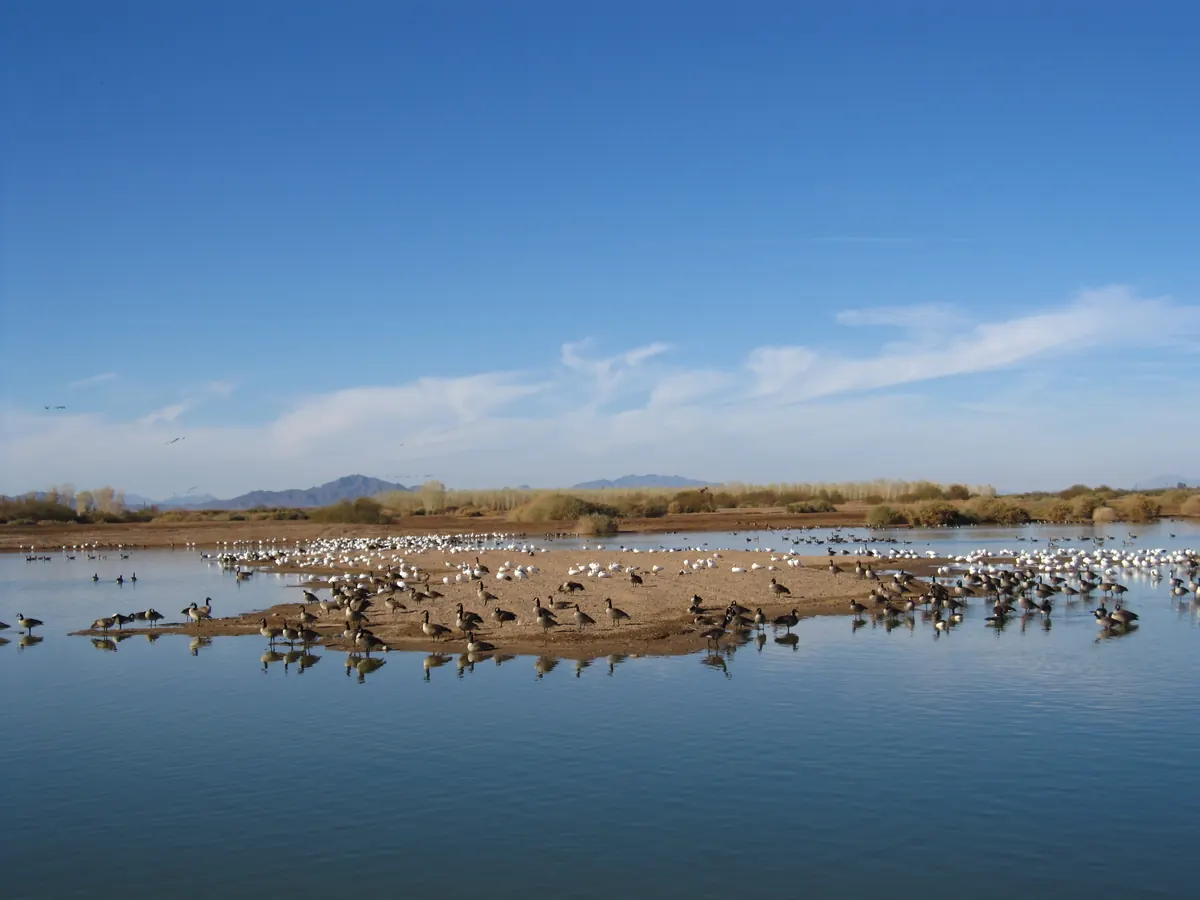
- Be at Whitewater Draw before sunrise. Arizona Game and Fish says the cranes are best seen in the half hour either side of sunrise, before they fly out to feed. In early January that means arriving before 7 a.m. at the wildlife area near McNeal, with gloves, a thermos and patience. The birds drift back in before noon.
- Listen for owls after dark. Step outside on a still January evening anywhere from a Tucson neighborhood to the pines of Prescott and listen for deep, soft hoots. Great horned owls can begin nesting this month, and the pairs are vocal while they settle on a site.
- The closest full moon of 2027. The Wolf Moon is full at 5:17 a.m. on Friday, January 22, Arizona time. Watch it rise in the east at dusk on Thursday the 21st; no full moon all year comes nearer to Earth.
In the Naturalist’s Field Journal, use the dusk and dawn watch plate for a crane liftoff at Whitewater Draw, with the minute the first flock rose; give a map of sounds to the owls and coyotes calling after dark; keep nest observed for an eagle or owl seen only from a legal distance; and use tracks to know for prints in fresh snow under the pines or the clipped twigs an Abert’s squirrel leaves behind. Write down the elevation and the morning’s low beside each entry.
Regions used below: Phoenix and the low deserts; Tucson and the southeastern Sky Islands; Yuma and the Colorado River; Prescott, Sedona and the Verde Valley; Flagstaff, the Grand Canyon and the Mogollon Rim; The White Mountains; The Navajo Nation and Hopi lands.
Are Arizona’s bald eagles sitting on eggs in January?
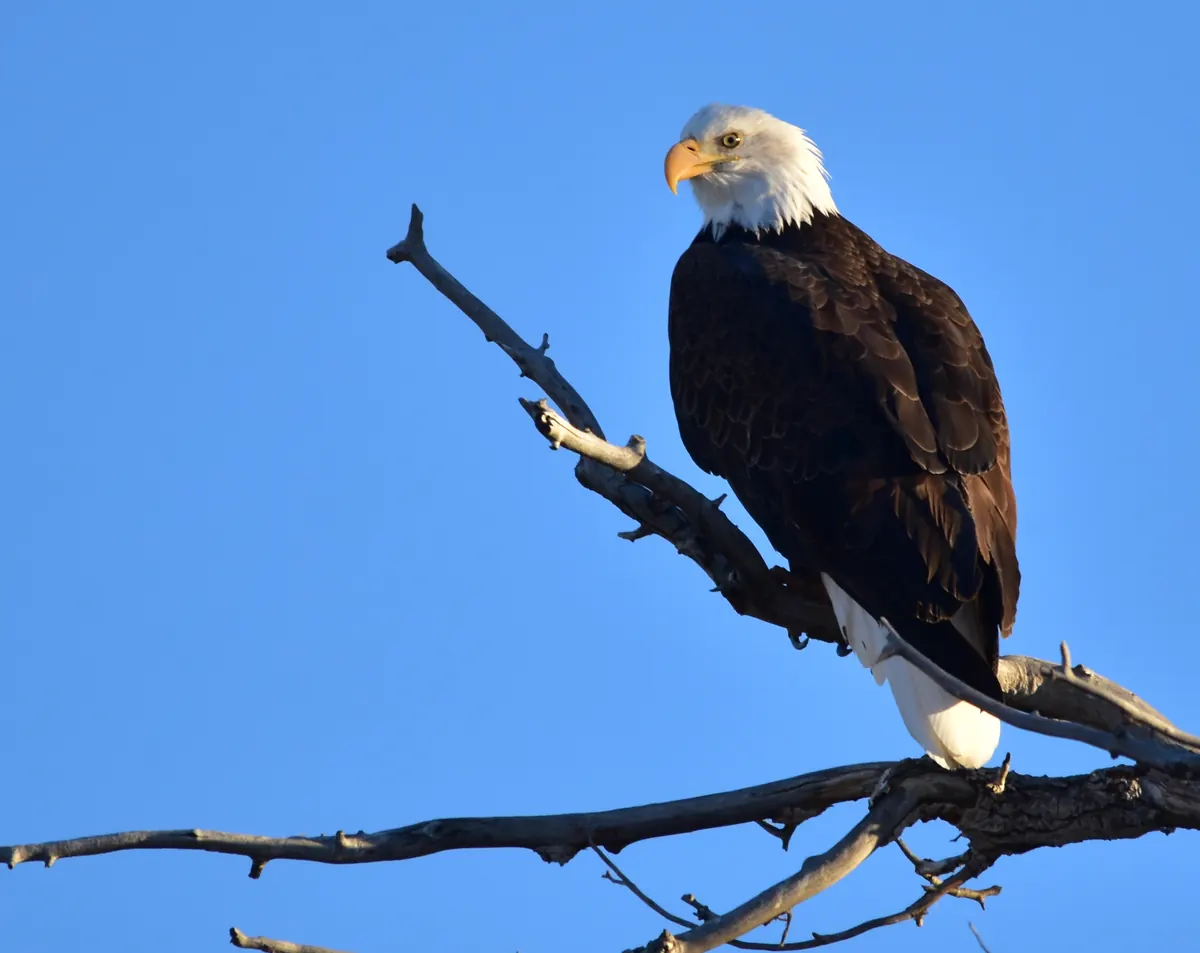
Many of them are. The Southwestern Bald Eagle Management Committee, which coordinates the agencies that look after the state’s desert-nesting eagles, says Arizona pairs lay one to three eggs anywhere from December to March, but mostly in January and February. Both parents share the incubation, which takes about 35 days, and the young leave the nest roughly twelve weeks after hatching, in May or June. Arizona Game and Fish counted 111 bald eagle breeding areas in the state in its December 2025 bulletin. Nests sit on cliff edges and rock pinnacles as well as in cottonwoods, sycamores and big snags, usually within a mile of a river, creek or lake.
-
Watching an incubating pair
January and February · The Salt and Verde rivers, the Tonto Creek arm of Roosevelt Lake and other central Arizona reservoirs
An eagle on eggs shows as little more than a white head above the rim of the nest, often for hours. Its mate perches on a snag or cliff nearby and swaps places now and then, which is the moment worth waiting for. Do this from an overlook or the far shore with a spotting scope. The seasonal closures that began December 1 run through June 30, and the management committee publishes the closed stretches and buffer zones on its website; check them before a river trip or a day on the water.
-
The January eagle survey
Through January · 102 standard routes statewide
Every January, observers drive, walk or fly the same set of routes to count wintering bald eagles; the committee says the survey covers 102 routes and turns up about 300 eagles in a typical year. Most of these are migrants from farther north, and the committee names the places they gather most: Mormon Lake and Upper and Lower Lake Mary south of Flagstaff, and San Carlos Reservoir, wherever there is open water and fish. A brown, blotchy eagle is most likely a young bald eagle: they do not get the white head and tail until they are several years old, and until then they are easy to mistake for golden eagles.
The committee notes another quirk of the desert population: Arizona’s males are noticeably smaller than bald eagles from farther north, and their diet leans on Sonora and desert suckers, catfish and carp from the rivers.
How many sandhill cranes spend January in Arizona, and where can I see them?
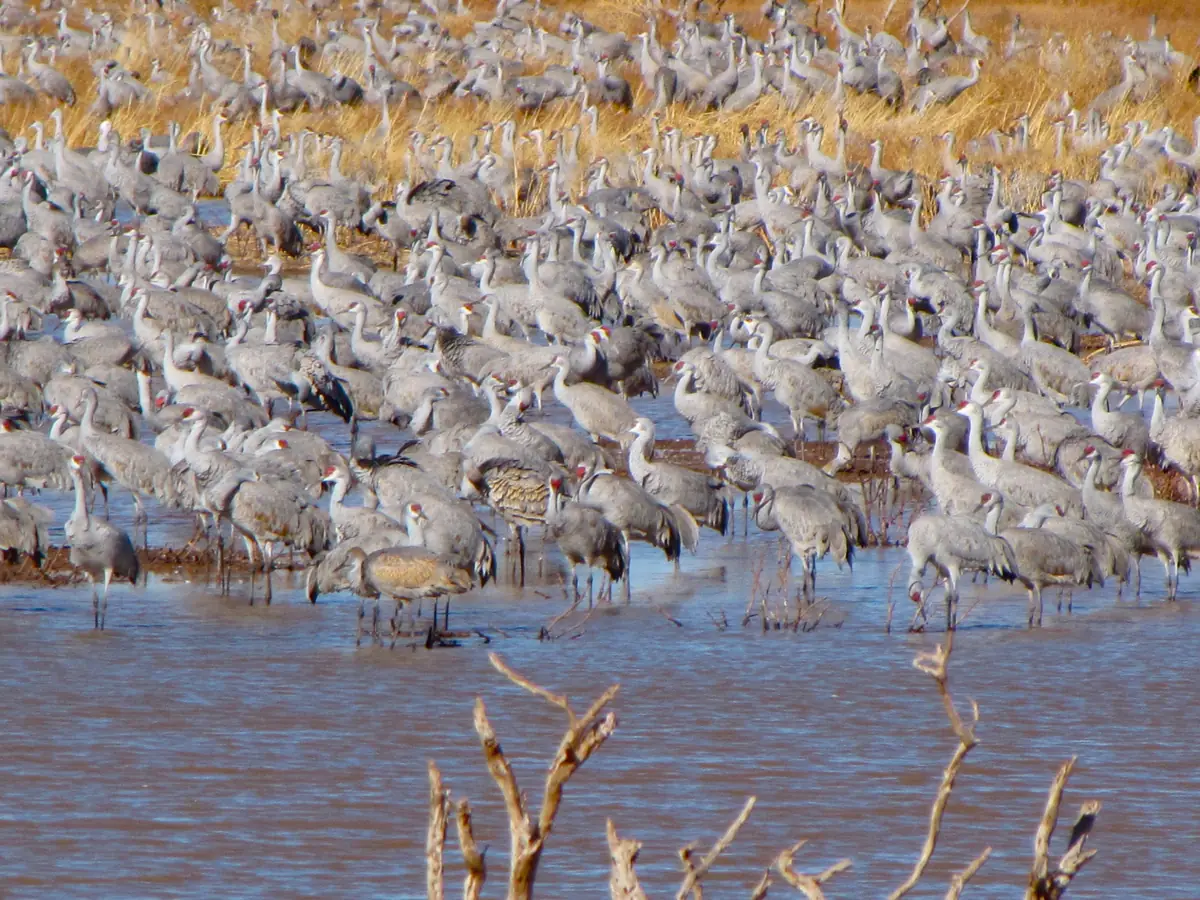
Tens of thousands. In its November 2025 release, Arizona Game and Fish said more than 20,000 sandhill cranes would spend the following months at and around Whitewater Draw Wildlife Area in southeastern Arizona, and the department’s wildlife viewing manager called it the best wildlife-viewing opportunity in the state. By January the flocks have long since settled into a routine: they roost in shallow water at night, leave for the grain fields at dawn and come back to loaf and bugle through the afternoon. The department surveys the wintering flocks each year, so watch its news page for this winter’s total.
-
Morning flight at Whitewater Draw
About 30 minutes either side of sunrise; birds return before noon · Whitewater Draw Wildlife Area, near McNeal
The department’s advice is simple: come early, because the leggy birds leave to feed for the morning and generally return before midday, then stay for the rest of the day. Cranes prefer open ground and water where they can see danger coming, which is why they pack onto the flats instead of hiding in cover. Ducks and geese share the ponds. If you cannot drive down, the department streams a live crane camera from the site, and it added a second camera on a barn owl nest box at the same wildlife area.
-
Wings Over Willcox and a crane scientist
January 14–17, 2027 (Martin Luther King Jr. weekend) · Willcox Community Center, 312 Stewart Street, with tours across Cochise County
The 34th festival’s featured speaker is George Archibald, a co-founder of the International Crane Foundation, who will talk about the cranes of the world. The program mixes field trips to the playa and Whitewater Draw with talks on birds, geology, history and ranching. Popular tours sell out, so book through the festival website as soon as you can.
-
Cranes along the lower Colorado River
Winter · Cibola National Wildlife Refuge on the lower Colorado River
A separate, much smaller flock winters on the Colorado River. The U.S. Fish and Wildlife Service counts this Lower Colorado River Valley population every winter by airplane, at four main wintering areas in Arizona and California. Cibola refuge was set aside largely as wintering ground for migratory waterfowl, so January there also means geese and ducks on the fields and backwaters.
Departures begin between late February and mid-March, and by April the cranes are all on their way north, some as far as Siberia. October’s and November’s guides cover the arrival; this is the month to count them at their steadiest.
When are Arizona’s Mexican wolves counted?
Right now. The interagency field team that manages the Mexican wolf gathers its population data from November through February, using ground and aerial surveys, remote cameras, scat collection and sightings, and tracking collared animals. The U.S. Fish and Wildlife Service explains why it counts in winter: doing it at the same time every year makes the numbers comparable, and winter is the time of year when the wolf population is most stable.
-
What the latest count found
Results usually announced in late winter or spring · Arizona and New Mexico
The latest count, for the end of 2025, was released in February 2026: at least 319 wild Mexican wolves, 143 of them in Arizona and 176 in New Mexico, up from 286 a year earlier and the tenth straight year of growth. The team counted at least 23 breeding pairs in New Mexico; the Fish and Wildlife Service will add Arizona’s pair and pup figures when they are ready. New Mexico’s wildlife department notes that the goal for downlisting the species is an average of 320 wolves a year over four years, so the count under way this winter is one more step on that road. The Mexican wolf was listed as endangered in 1976, a captive breeding program followed, and the first captive wolves were released into the wild in 1998.
When do great horned owls start nesting in Arizona?
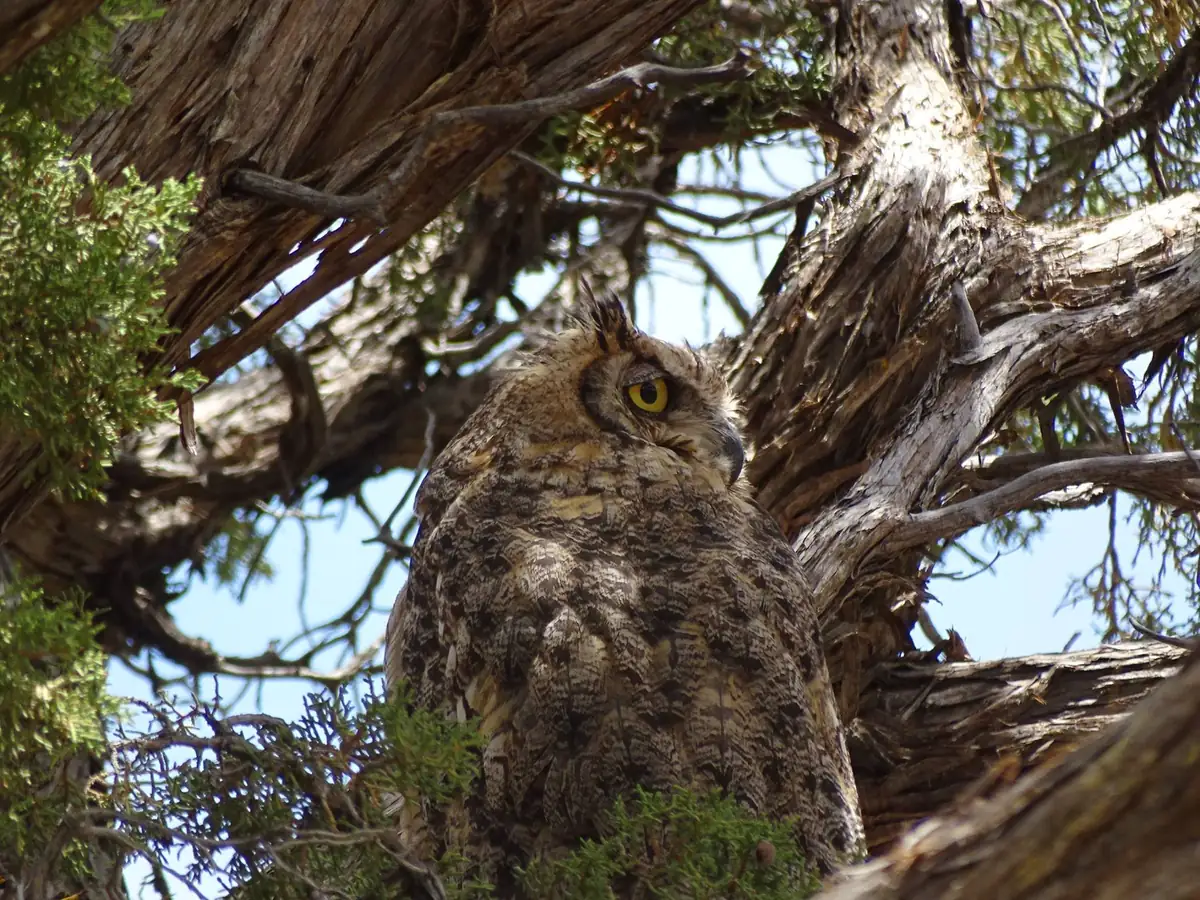
As early as January, says the Tucson Bird Alliance, which makes them one of the first birds in the state to settle down. Great horned owls do not build nests of their own. They take over nests that other birds built, or settle on ledges, including ones on buildings. The female, usually a bit larger than the male, does all the incubating, and the male hunts for both of them; once the chicks grow, she joins him in bringing food.
-
The owls of Ventana Canyon
Nesting season, from about January · The Lodge at Ventana Canyon, Tucson (watch online)
Great horned owls have nested on the ledges above the entrance to the lodge in the Catalina foothills for more than 37 years, by the account of a long-time employee. After one of the original pair died, the site sat empty for some years, and then a new pair, probably raised there, took it over. The Tucson Bird Alliance and the Ventana Canyon Golf and Racquet Club now run a nest camera from inside the lobby, looking out through a window at the ledge, so you can follow the eggs and owlets from home.
-
Finding your own pair
Dusk and the first hours of darkness · Desert washes, saguaro forest, city parks, ponderosa edges
Listen at dusk for a deep, stuttering series of hoots, then for a second, slightly different voice answering. In the desert, look at the tops of saguaros and power poles at last light for a bulky, eared silhouette. A whitewash of droppings and a scatter of gray pellets under a cliff ledge or a big tree marks a regular roost. If you find a nest, keep well back and do not linger; a flushed female leaves the eggs exposed to cold.
How do Abert’s squirrels and other animals get through winter in Arizona’s pine forests?
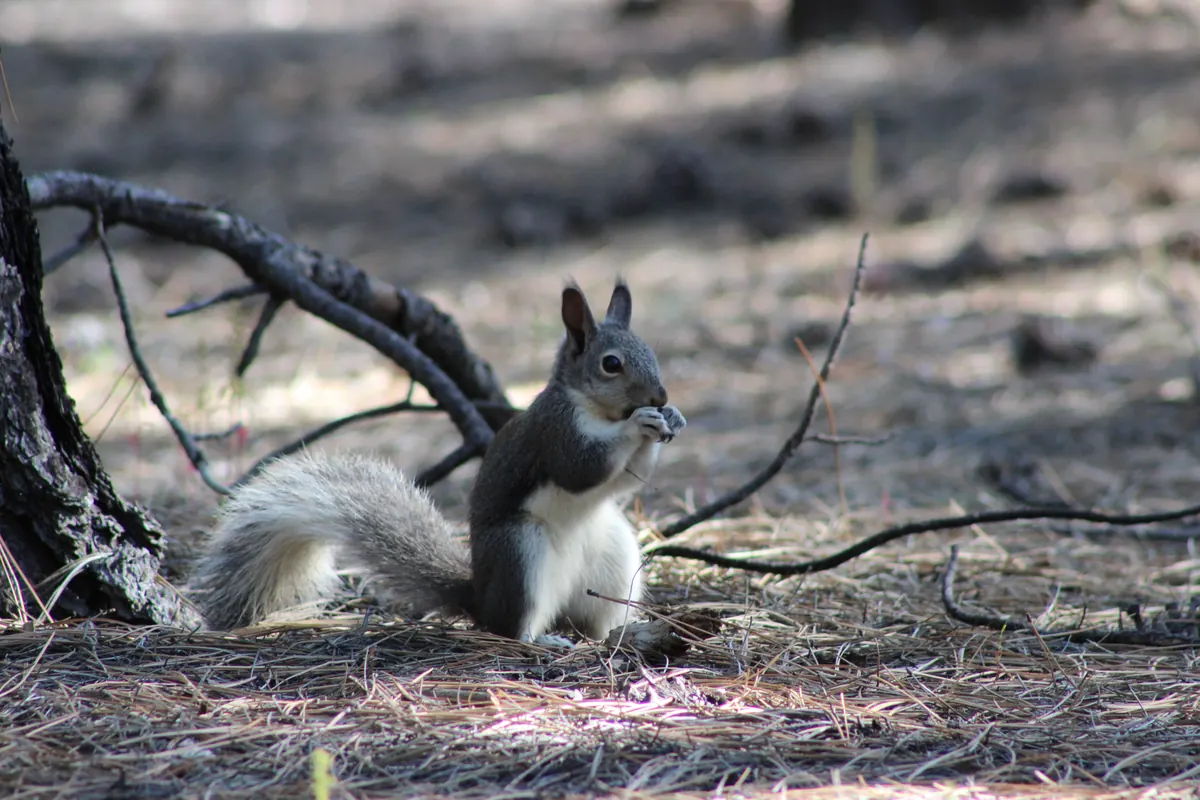
Abert’s squirrel, the tassel-eared squirrel of the ponderosa pine forest, stays active all winter. The U.S. Forest Service’s Fire Effects Information System says it eats the succulent inner bark of pine twigs all year but most heavily in winter. Once the seeds have been shed, inner bark makes up the bulk of its diet from November to April, and in winter a single squirrel eats about 45 twigs a day. The squirrels shelter in nests of pine twigs high in the trees, and in winter a pair, usually an adult female and a young squirrel presumed to be her offspring, share a nest.
-
Clipped twigs on the snow
Any time after a snowfall · Ponderosa forest around Flagstaff, Sunset Crater Volcano and Walnut Canyon, the South Rim, Prescott, the Mogollon Rim
The squirrel bites off a short twig with its tuft of needles, peels away the outer bark, eats the soft layer underneath and drops the rest. Under a favorite tree the snow becomes littered with green needle clusters and short, stripped sticks, often with a set of bounding tracks leading to the trunk. On the North Rim plateau, the related Kaibab squirrel, a subspecies with a white tail and dark belly, lives the same way in the snow-covered forest.
-
Reading fresh snow
The morning after a storm · Forest roads, meadow edges and campgrounds closed for the season
Snow on the plateau records who was out overnight. Elk leave big, split-hoof prints in lines along the meadow edges; coyotes travel in neat single file; the paired front and back feet of a squirrel land in tight groups of four. Look for the wing marks where a raven or hawk struck at something, and for the tiny tunnels of voles where the snow is thin. Note the hour, because tracks soften quickly in Arizona sun.
-
A lean year for pine seeds
All winter · Ponderosa and pinyon country statewide
This autumn’s winter finch outlook from the Finch Research Network describes a cone crop that failed widely on limber, whitebark, pinyon and ponderosa pines across the interior mountain West, and says type 2 red crossbills, the kind tied to ponderosa pine, began moving eastward across the continent in July and August. The forecast is written mostly for eastern birders and does not single out Arizona, but if the crop failed here too, expect fewer crossbills in the pines this winter, and perhaps more seed-eaters turning up at feeders in mountain towns.
How much snow does Arizona get in January, and why does the snowpack matter?
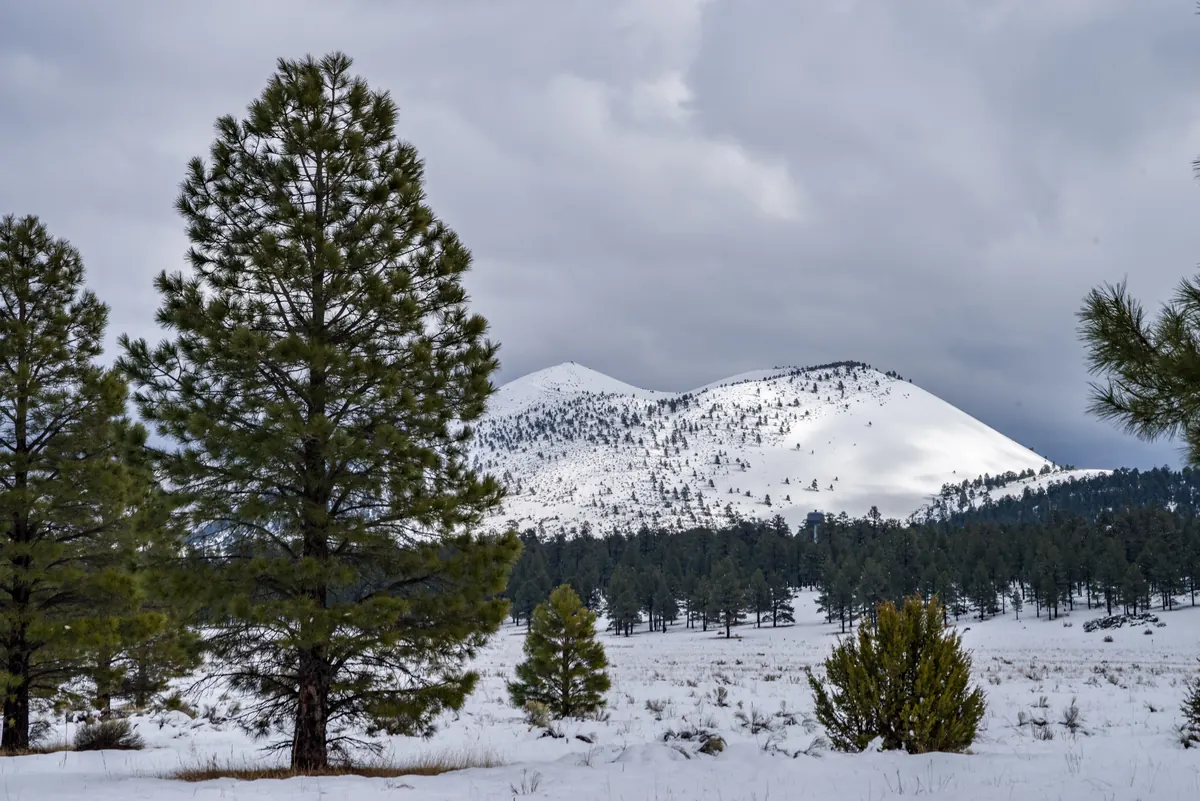
January is Flagstaff’s snowiest month: NOAA’s 1991–2020 normals give it 20.9 inches, a little more than February’s 19.3 and December’s 18.5, though December’s nights average a shade colder. The South Rim of the Grand Canyon averages 12.9 inches in January and Alpine in the White Mountains 10.7. In the low desert, January is mild and sunny on most days, with a normal high of 67.6 °F at Phoenix Sky Harbor and 66.5 °F at Tucson, and just under an inch of rain at both. Winslow and Yuma are the driest stations here, with about half an inch each.
-
The snow that fills Phoenix’s taps
Snowpack builds January to March; melt usually peaks in spring · The White Mountains and Mogollon Rim, headwaters of the Salt and Verde rivers
Arizona State University and Salt River Project note that mountain snowmelt supplies a significant share of the Phoenix area’s water, through a reservoir system that serves more than 2.5 million people. Last winter they mapped the snow from the air with lidar over the Upper Black River basin, which drains into the Salt above Roosevelt Dam. The January 21 flight measured about 9.1 thousand acre-feet of water in the snow and the February flight 9.5; by March 12, after a warm, dry stretch, only 0.8 remained, a loss of more than 90 percent in under three weeks. That is why water managers watch January storms so closely.
| Station | Normal high | Normal low | Precipitation | Snowfall |
|---|---|---|---|---|
| Flagstaff Pulliam Airport | 43.4 °F | 17.6 °F | 2.05 in | 20.9 in |
| Grand Canyon National Park (South Rim) | 44.3 °F | 19.2 °F | 1.76 in | 12.9 in |
| Alpine (White Mountains) | 45.6 °F | 15.3 °F | 1.26 in | 10.7 in |
| Payson | 56.1 °F | 26.0 °F | 2.27 in | 4.7 in |
| Show Low Airport | 46.0 °F | 23.6 °F | 1.35 in | 4.0 in |
| Page | 44.6 °F | 26.4 °F | 0.65 in | 1.4 in |
| Willcox | 61.3 °F | 28.4 °F | 1.02 in | 0.6 in |
| Prescott | 53.3 °F | 26.2 °F | 1.21 in | no normal |
| Winslow | 49.8 °F | 22.0 °F | 0.51 in | no normal |
| Phoenix Sky Harbor | 67.6 °F | 46.0 °F | 0.87 in | no normal |
| Tucson International Airport | 66.5 °F | 40.8 °F | 0.84 in | 0.0 in |
| Yuma Proving Ground | 69.2 °F | 44.7 °F | 0.52 in | 0.0 in |
Whether tonight will be clear where you live is on Today’s sky, and our weather page has radar and the short-range forecast.
Will El Niño bring a wet January to Arizona?
It raises the odds without settling the question. Federal forecasters wrote on September 10 that odds exceeded 90 percent for this El Niño to reach the very strong class by winter. University of Arizona Extension explains the mechanism: El Niño can push the winter storm track south so that it crosses the Southwest more often. Looking at events since 1950, Extension found rain and snow from December through February above normal across much of Arizona in 5 of 6 moderate El Niño winters, and on average cooler than usual in moderate events, while weak events were close to a coin toss (6 of 12 wetter). The university’s CLIMAS climate program adds a caution from the long record: El Niño years tended to have wet cool seasons in the earliest period it studied (1896–1937), but precipitation was more variable in the middle period (1938–1979).
-
What the two strong events did at Tucson
December through February · Tucson International Airport
The Tucson Weather Service office’s study of El Niño lists every event since 1950 with its winter rainfall. Its only two strong events at the time of writing, 1982–83 and 1997–98, brought 4.23 and 6.25 inches from December through February, against an 80-year normal of 2.63 inches for those months. Two winters are a small sample, and Arizona’s experience in the 2015–16 event was drier than many hoped, as our November guide describes.
-
Where to find the official outlook
Updated monthly · Climate Prediction Center
NOAA’s winter outlook is issued October 15 and refreshed every month after that. For the current January and January-to-March odds for Arizona, go straight to the CPC three-month outlook maps, and read the September ENSO discussion for the background.
A wet January matters to the desert as well as the dams: the spring annuals that germinated after autumn rain need steady moisture through the winter to bloom, as the December guide explains.
How much daylight does Arizona gain in January?
Roughly half an hour, and a few minutes more at Page than at Sierra Vista. The gain comes almost entirely at the evening end at first: in Phoenix the sun sets at 5:32 p.m. on New Year’s Day and keeps setting later through the month, while sunrise does not start getting earlier until after it reaches its latest, 7:33 a.m., around January 8. In January every clock in the state, on the Navajo Nation as well, reads Mountain Standard Time; the Navajo Nation moves its clocks forward on March 14, 2027, and the rest of the state does not.
| City | Jan 1 | Jan 31 | Gained | Per day |
|---|---|---|---|---|
| Page | 9 h 41 m | 10 h 21 m | 40 min | 1.3 min |
| Flagstaff | 9 h 50 m | 10 h 27 m | 37 min | 1.2 min |
| Kingman | 9 h 50 m | 10 h 28 m | 38 min | 1.3 min |
| Prescott | 9 h 53 m | 10 h 29 m | 36 min | 1.2 min |
| Phoenix | 10 h 00 m | 10 h 34 m | 34 min | 1.1 min |
| Yuma | 10 h 02 m | 10 h 36 m | 34 min | 1.1 min |
| Tucson | 10 h 05 m | 10 h 38 m | 33 min | 1.1 min |
| Sierra Vista | 10 h 08 m | 10 h 40 m | 32 min | 1.1 min |
To look up sunrise, sunset and the length of twilight at your own spot, try the Field almanac.
What can you see in Arizona’s night sky in January?
A strong start: a good meteor shower in the first week, Venus at its farthest from the Sun before dawn, and the year’s biggest full moon. In the evening, Saturn sits low in the southwest and sinks a little each week, while Jupiter rises in the east and climbs toward its opposition in February. All times here are Mountain Standard Time. There are no eclipses this month.
-
Earth closest to the Sun
7:33 p.m., Saturday, January 2 · Everywhere
Perihelion, when Earth is nearest the Sun, falls in the depth of the northern winter, at about 91.4 million miles. Winter here is caused by the tilt of the axis; the distance changes by only about three percent.
-
The Quadrantids
Night of Sunday, January 3 into Monday, January 4 · Look north and east after midnight, from a dark site
The predictions for the peak range from about 8:30 to nearly 11 p.m. Arizona time on the 3rd, and the shower’s best rates last only a few hours. Because the shower’s radiant (in the far northern sky, where Boötes meets Draco) starts the night close to the northern horizon and climbs after midnight, the hours before dawn on Monday usually give the most meteors here even after the peak has passed. The Moon is only a thin crescent rising shortly before dawn. Under truly dark skies, a few dozen per hour is a good result; town lights cut that sharply.
-
Venus at its greatest elongation
Sunday, January 3, and the mornings around it · Southeast before sunrise
Venus swings out to 47 degrees west of the Sun, its widest separation of this apparition, and shines at about magnitude minus 4.3, by far the brightest thing in the morning sky after the Moon. Through a backyard telescope its disk is about half lit. Expect it before dawn until early summer.
-
Dark skies around the new moon
Roughly January 3 to 12 · Any dark site
With the new moon on January 7, the first half of the month gives moonless evenings for the winter Milky Way, Orion and the Pleiades. The state parks calendar shows two star parties on January 2, one at Picacho Peak, where the Tucson Amateur Astronomy Association brings telescopes, and at Cattail Cove on Lake Havasu; check each park’s page for times.
-
The Wolf Moon, the closest full moon of 2027
Full at 5:17 a.m., Friday, January 22 · Rising in the east-northeast at dusk on Thursday the 21st
Because the exact moment of full falls before Friday’s sunrise, plan your moon walk for Thursday evening, January 21: the Moon comes up around sunset and stays up until morning. The Moon passes perigee on the afternoon of the 21st, and at about 222,200 miles from us this full moon counts as a supermoon under any of the usual definitions. It will still look full on Friday evening.
-
The Moon beside Jupiter
Evening of Saturday, January 23 · East after dark
A day past full, the Moon comes up in the east with Jupiter just beside it and Regulus, the brightest star of Leo, not far off. Jupiter is approaching its best of the year and is worth a look in binoculars for its four bright moons.
-
Mercury at dusk
Last days of January into early February · Low in the west-southwest, 30 to 45 minutes after sunset
Mercury’s best evening showing of the winter peaks on February 2, Arizona time, when it stands farthest east of the Sun. In the final week of January, look for a small, steady point just above the horizon in the afterglow; a flat western horizon helps.
| Phase | Date | Time |
|---|---|---|
| Last quarter | Wednesday, Dec 30 | 11:59 a.m. |
| New moon | Thursday, Jan 7 | 1:24 p.m. |
| First quarter | Friday, Jan 15 | 1:34 p.m. |
| Full moon, the Wolf Moon | Friday, Jan 22 | 5:17 a.m. (closest full moon of 2027) |
| Last quarter | Friday, Jan 29 | 3:55 a.m. |
Rising and setting times for every night of the month are on our moon phase calendar.
What can families do outdoors in Arizona this January?
- Friday, January 1: First Day Hike at Picacho Peak State Park, 10 a.m.; hikers pick either the Hunter Trail or the Calloway Trail. America’s State Parks lists First Day Hikes across the country on New Year’s Day.
- January 1–5: the closing days of the Christmas Bird Count season. Some Arizona circles have held their counts in the first days of January in past seasons; the Tucson Bird Alliance’s statewide list gives each circle’s date and compiler, and beginners are welcome on most teams.
- Saturday, January 2: birds by day, stars by night at Picacho Peak. A ranger-led bird walk starts at 8 a.m., and the park’s star party with the Tucson Amateur Astronomy Association follows that evening. Cattail Cove State Park on Lake Havasu holds its own star party the same night. A second Picacho bird walk is set for Sunday, January 17, at 8 a.m.
- January 14–17: Wings Over Willcox. Crane tours, talks and the keynote by George Archibald of the International Crane Foundation; book tours early.
- Weekly and monthly programs. Arizona State Parks’ calendar lists guided bird walks at Catalina State Park on Sundays, Wednesdays and some Mondays through May, nature journaling there on the second and fourth Fridays, a Saturday nature program with live reptiles, buffelgrass pulls on first Saturdays, and a monthly Thursday desert birding walk at Lost Dutchman. Confirm times on each park’s page before you go.
- Watch nests from home. Follow the great horned owl camera at Ventana Canyon on the Tucson Bird Alliance site, and Arizona Game and Fish’s crane and barn owl cameras at Whitewater Draw.
- Citizen science. Keep a Project FeederWatch count going through the winter, or enter a walk around the block on eBird; January lists from the low desert are full of wintering sparrows, warblers and hummingbirds.
Every state’s monthly guide is linked from the nature hub; for keeping your own winter record, see the Naturalist’s Field Journal. We took these dates from each organizer’s own listing in early October 2026, and plans change, so confirm before driving out.
Safety notes for January in Arizona
- Archery deer and January hunts. Arizona Game and Fish’s 2026–27 regulations keep archery-only deer seasons open in much of the state through January 31, and add archery hunts from January 1 to 31 in Units 45A, 45B and 45C and on Fort Huachuca. The department reminds archers that the tags run by calendar year, so January needs a new tag. January javelina hunts appear in the department’s separate 2027 spring regulations; check them before hiking desert units in January and February.
- Ducks, geese, quail and squirrels. Ducks, coots, geese, scaup and snipe stay open statewide until January 31, and falconers have a short duck season on February 1–4. Gambel’s, scaled and California quail are open until February 7, as are Mearns’ quail in the southeast grasslands and oak woodlands. The general tree squirrel season runs to January 31. Expect shotguns at dawn around marshes, river bottoms and desert washes.
- Crane hunts in the Sulphur Springs Valley. Three-day permit hunts for sandhill cranes fall on January 9–11, 19–21 and 23–25 in Units 30A, 30B, 31 and 32. The Willcox Playa and Whitewater Draw wildlife areas themselves are closed to crane hunting, so the viewing sites stay quiet; posted parts of the Roosevelt Wildlife Area are closed to hunting until February 15.
- Be visible anyway. Arizona does not require hunter orange, but the state’s hunter education course recommends it. Hikers in hunting units this month should wear a bright color, keep dogs in a bright vest and on the trail, and remember that the desert open for quail is often the same desert people hike.
- Cold nights, short days. Flagstaff’s normal January low is 17.6 °F and Alpine’s is 15.3 °F; for freeze odds at the nearest of the state’s stations, see our Arizona frost dates. Daylight runs only about 10 hours, so set out in the morning, pack a light and an extra layer, and aim to finish before the sun goes down.
- Ice on canyon trails and roads. The upper switchbacks of Grand Canyon trails, north-facing slopes and shaded forest roads stay icy for days after a storm. Traction devices for boots, and chains and a winter kit in the car north of the Mogollon Rim, are worth carrying. On I-17 and I-40, check road conditions before you leave, because snow squalls can close the passes quickly.
- Winter storms and running washes. If El Niño delivers a series of Pacific storms, rain on bare desert and snowmelt from the mountains can send water down normally dry washes fast. Do not drive into a flooded crossing.
- Eagle closures. Areas near bald eagle nests stay closed through June 30. They are enforced even when no birds are in view.
Sources
- Southwestern Bald Eagle Management Committee: biology of bald eagles in Arizona
- Southwestern Bald Eagle Management Committee: closure areas
- Arizona Game and Fish Department: seasonal restrictions as bald eagle breeding begins (bulletin, Dec. 2, 2025)
- Arizona Game and Fish Department: Northern Arizona wildlife viewing by month (PDF)
- Arizona Game and Fish Department: sandhill cranes arriving daily at Whitewater Draw (news release, Nov. 6, 2025; archived copy)
- Arizona Game and Fish Department: sandhill crane cam
- Wings Over Willcox Birding and Nature Festival 2027
- U.S. Fish and Wildlife Service: sandhill crane surveys
- U.S. Fish and Wildlife Service: Cibola National Wildlife Refuge
- U.S. Fish and Wildlife Service: Mexican wolf population grows for eighth consecutive year (March 5, 2024)
- U.S. Fish and Wildlife Service: conserving the Mexican wolf
- Tucson Bird Alliance: great horned owl cam
- USDA Forest Service Fire Effects Information System: Abert’s squirrel
- Finch Research Network: winter finch forecast 2026–2027
- NOAA NCEI: 1991–2020 monthly climate normals, Arizona stations (data query)
- NOAA NCEI: 1991–2020 monthly climate normals, Show Low, Willcox, Payson, Alpine (data query)
- NOAA NCEI: U.S. climate normals
- Arizona State University News: ASU-SRP snow surveys show much of Arizona’s headwater snowpack melted in weeks (March 25, 2026)
- National Weather Service Flagstaff: winter weather information
- Climate Prediction Center: ENSO diagnostic discussion, September 10, 2026
- Climate Prediction Center: seasonal outlooks
- University of Arizona Cooperative Extension: 2018–2019 El Niño overview for Arizona
- CLIMAS, University of Arizona: ENSO and monsoon
- National Weather Service Tucson: El Niño and La Niña episodes and their impact on the weather in the Tucson metropolitan area (PDF)
- Arizona-Sonora Desert Museum: predicting desert wildflower blooms
- U.S. Naval Observatory: moon phases
- U.S. Naval Observatory: Earth’s seasons and apsides, 2027
- Fred Espenak: Sky Event Almanac 2027
- American Meteor Society: meteor shower calendar
- EarthSky: Quadrantid meteor shower
- EarthSky: what is a supermoon?
- EarthSky: Venus before sunrise, greatest elongation
- Fred Espenak: full moons at perigee, 2001 to 2100
- Sea and Sky: astronomy calendar 2027
- Uniform Time Act, 15 U.S.C. 260a (Legal Information Institute)
- Arizona State Parks and Trails: events calendar
- Arizona State Parks and Trails: First Day Hike at Picacho Peak
- Arizona State Parks and Trails: Picacho Peak bird walk
- Arizona State Parks and Trails: star party at Picacho Peak
- Arizona State Parks and Trails: star party at Cattail Cove
- Arizona State Parks and Trails: guided bird walks at Catalina
- America’s State Parks: First Day Hikes
- Tucson Bird Alliance: Arizona Christmas Bird Counts
- National Audubon Society: join the Christmas Bird Count
- Project FeederWatch (Cornell Lab of Ornithology)
- eBird (Cornell Lab of Ornithology)
- Arizona Game and Fish Department: 2026–27 Arizona hunting regulations (PDF)
- Arizona Game and Fish Department: 2026–27 Arizona waterfowl and snipe regulations (PDF)
- Arizona hunter education course (with Arizona Game and Fish): hunter orange
- U.S. Fish and Wildlife Service: Mexican wolf population statistics, minimum population estimate by state, 1998–2025 (data as of December 31, 2025)
- New Mexico Department of Wildlife: Mexican wolf population count complete (2025 count)
- Photos via Wikimedia Commons; licenses and photographers are credited under each picture
