What to look for in nature in Arizona this May
May is when the Sonoran Desert puts on its last big show and then closes the door on spring. Saguaros crown themselves with white flowers that open at night and are visited by doves, woodpeckers and bats, the cactus holes are full of owls and nesting birds, and willow flycatchers settle into the riverside thickets. In an average year Phoenix has had its first 100 °F afternoon by the first days of May and its first 105 °F day by the 22nd, while on the plateau the last freeze can still wait until June. The North Rim of the Grand Canyon usually reopens for the season in mid-May (it was May 15 in 2026; no 2027 date was posted yet), the Eta Aquariid meteors arrive at the new moon, and a Flower Moon on May 20 counts as a seasonal Blue Moon. Arizona climbs from river-level desert to 12,000-foot peaks, so location counts as much as timing.
Other months in Arizona: October, November, December, January, February, March, April.
Start here
- Find a saguaro in flower, then come back. Peak bloom is usually the last week of May and first week of June. Go in the first hours of the morning, when the flowers that opened overnight are still fresh, and stay on the trail.
- Listen for owls and flycatchers. Elf Owls call after dark from saguaro holes, and the Southwestern Willow Flycatcher gives its sneezy “fitz-bew” in streamside thickets. Listen from the trail and keep out of the nesting areas.
- Respect heat and young animals. Head out at first light, pack more water than seems necessary, and leave fawns, calves and tortoises where you find them.
A colours of the day plate suits the saguaro bloom, and a same place twice plate can pair a visit in the first week of May with another in the last. Let birds I have seen hold your Elf Owl, Southwestern Willow Flycatcher or Coppery-tailed Trogon, a nest observed plate hold a cactus wren or Gila woodpecker hole seen from far away, and a dusk and dawn watch plate hold the Flower Moon, Mercury and the Eta Aquariid mornings. A map of sounds suits a night walk in the saguaros, and reading the signs suits the week the first 100-degree day arrives, all in the Naturalist’s Field Journal.
Regions used below: Phoenix and the low deserts; Tucson and the southeastern Sky Islands; Yuma and the Colorado River; Prescott, Sedona and the Verde Valley; Flagstaff, the Grand Canyon and the Mogollon Rim; The White Mountains; The Navajo Nation and Hopi lands.
When do saguaros bloom in Arizona, and who pollinates them?
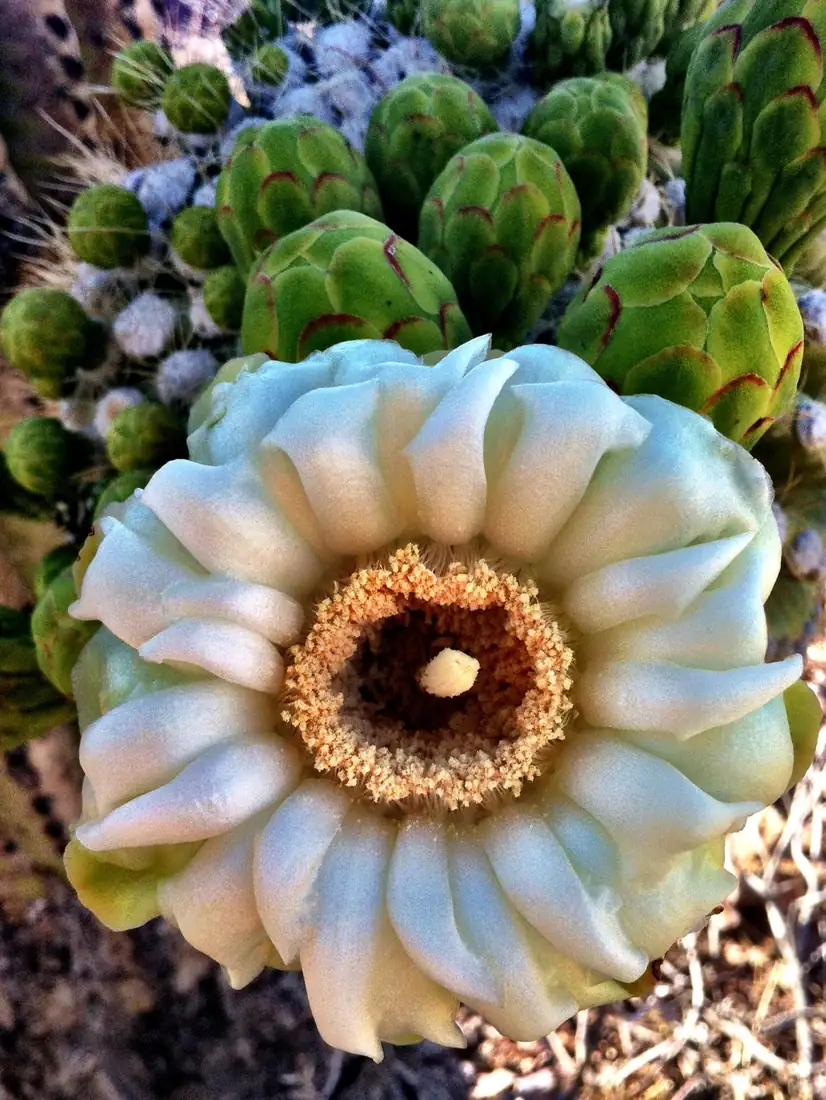
May is the saguaro’s month. The giant cactus that stands for the Sonoran Desert wears a crown of white flowers on the tips of its arms, and the whole desert organizes itself around the nectar. Saguaro National Park says the cactus is often at peak bloom toward the end of May, and its Flower Power project, which tracks more than 50 saguaros with a camera on a pole, puts the start in the last two weeks of April and the peak in the last week of May and first week of June. The flowers open at night and close the next day, and red fruit follows in late June and early July. In the park’s own 2024 notes, the east side near Tucson bloomed later than the west side, so a walk on both sides can show two different stages.
-
The late-May crown
Peak usually the last week of May into early June; flowers open at night and close the next day · Saguaro National Park (Tucson Mountain and Rincon Mountain districts) and Organ Pipe Cactus National Monument
Flowers that opened overnight are gone the following day, so go early. The park describes white blooms in May and June, followed by bright red fruit that holds up to 2,000 small black seeds apiece. It posts bloom reports on its conditions page, and the 2024 reports noted that cholla, prickly pear and hedgehog cacti were flowering alongside the saguaros, so check the page before you drive out.
-
Doves, woodpeckers and bats
Doves and woodpeckers by day, bats by night, through the bloom · Anywhere a flowering saguaro stands, from Tucson to Organ Pipe Cactus National Monument
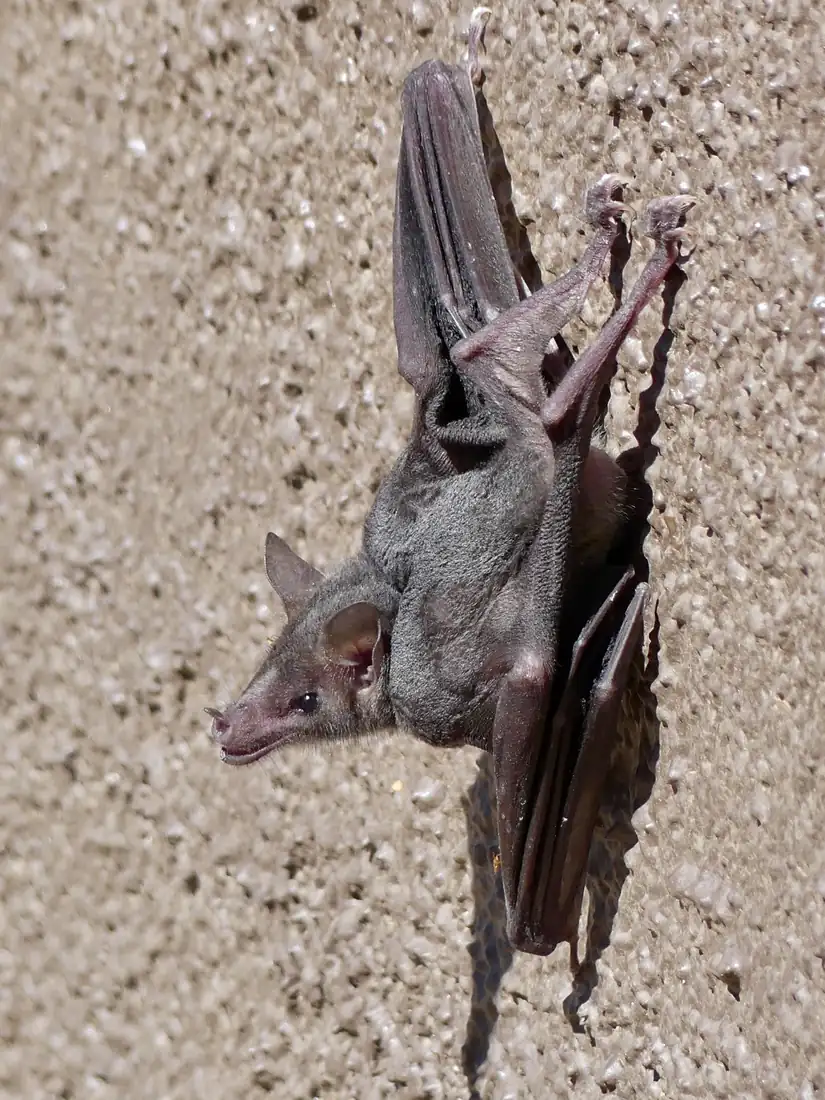
For decades the saguaro was treated as a bat flower, because it opens at night, smells strong and makes plenty of nectar. A recent Arizona-Sonora Desert Museum post describes a Cornell University doctoral student who spent two summers recording white-winged doves and Gila woodpeckers at saguaro flowers, to learn how much pollinating the birds do. At Organ Pipe, the National Park Service calls the lesser long-nosed bat the saguaro’s only true night-time pollinator and says it follows the blooms north along a “nectar trail”, using a tongue about as long as its body. Saguaro National Park adds that birds, bats, other mammals, reptiles and insects all take nectar from the flowers.
-
The Queen of the Night
One night a year, usually a few weeks after the saguaros, and not always in May · Desert gardens and washes around Tucson, including Tohono Chul
The night-blooming cereus is a gray, stick-like cactus that is easy to miss all year, then opens every flower in an area on one evening. Tohono Chul in Tucson watches its buds and publishes weekly Bloom Watch updates. In 2024 the garden estimated the big night was three to six weeks off as of June 5, and its 2025 recap says that year’s night came nearly 20 days earlier than the year before, after rain. So the date moves with the weather. Do not plan a May trip around it, but do sign up for the updates if you want to follow the buds.
Bring the saguaro bloom into your Naturalist’s Field Journal as a same-place-twice entry: once in early May, once at the end. The flowers are open for hours, not days, so the notes tell the story.
Which desert birds nest in saguaros in May?
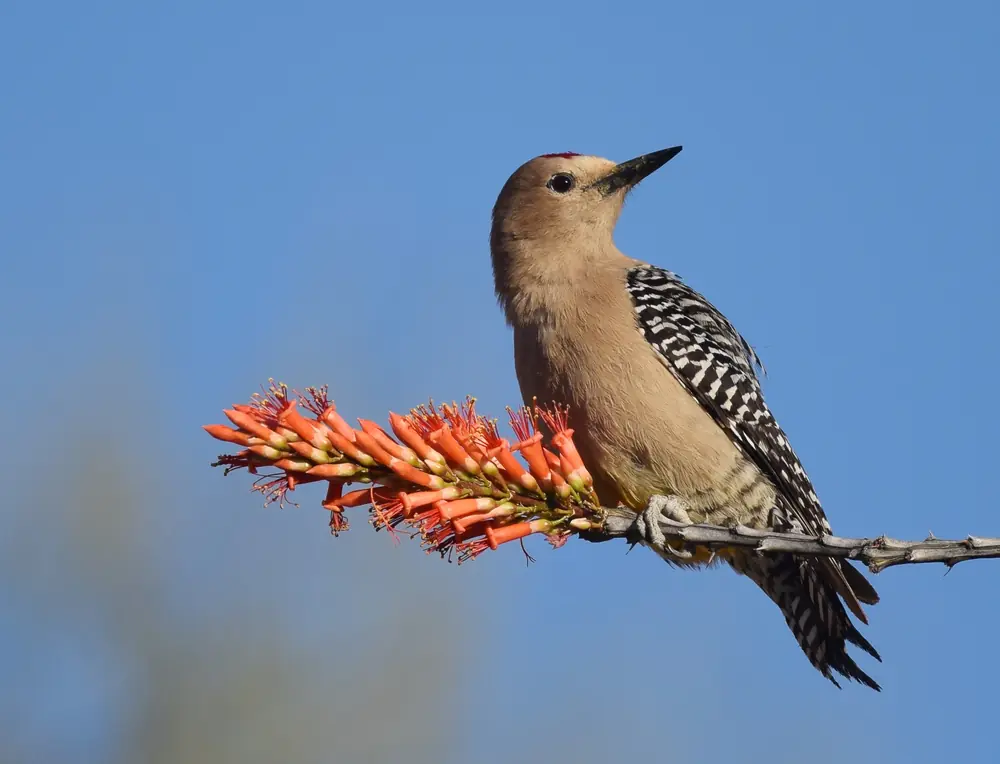
A saguaro is a block of apartments. Gila woodpeckers chisel round holes into the trunk, the cactus seals the wound with a hard lining, and in later years other birds move in. In May the holes are busy.
-
Gila woodpecker cavities
Year-round residents; watch the holes in spring · Saguaro stands across the Sonoran Desert, including Saguaro National Park and the Phoenix preserves
Tucson Bird Alliance calls the cavities invaluable nest sites for birds that cannot make their own holes. The tenants it lists include Elf Owl, Western Screech-Owl, Ferruginous Pygmy-Owl, Ash-throated and Brown-crested Flycatchers, Cactus Wren, Lucy’s Warbler, Purple Martin and American Kestrel. European Starlings compete for the same holes and can take over an active one. Watch a hole from a distance with binoculars and note who goes in; getting too close can flush a nesting bird.
-
Elf Owls after dark
Spring evenings, once the desert warms; the owls leave in September · Mature saguaro stands and, higher up, sycamore canyons
The Elf Owl nests in holes that woodpeckers have already made. Tucson Bird Alliance says the loss of big saguaros is a concern, and the group is testing whether nest boxes could help at lower elevations; the owls already use boxes higher up. Spring is the best time to hear the laughing calls on a night walk, and walking after dark also avoids the daytime heat. Use a dim red light and keep dogs home.
Which birds arrive on Arizona’s rivers and in the Sky Islands in May?
By May the big warbler push in the lowlands is thinning, but the birds that stay to breed are settling in. The riverbanks and the mountain canyons are where to look.
-
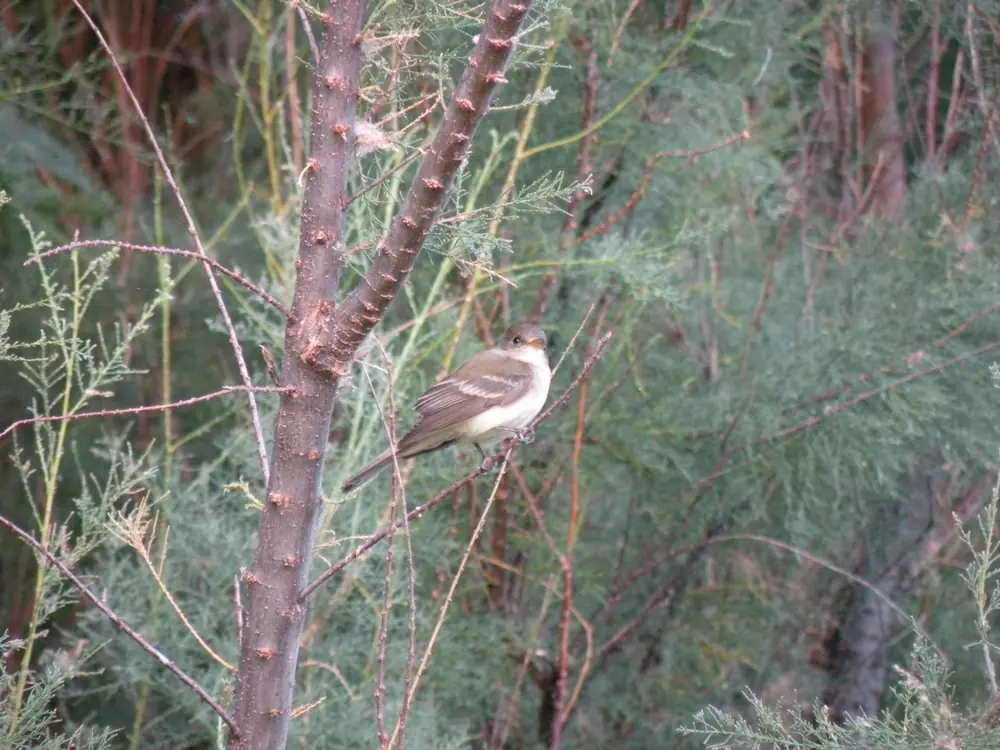
Southwestern willow flycatcher
Males arrive late April to early May; eggs late May into early June · Dense streamside willow, cottonwood and tamarisk below about 8,500 feet
This small, drab bird, an endangered subspecies, nests only in thick vegetation beside water. The National Park Service says males claim territories first and females arrive a week or two later, and the Fish and Wildlife Service says nesting begins in late May or early June, with young leaving the nest from late June to mid-August. The song is a sneezy “fitz-bew”. Because human disturbance at a nest can cause it to be abandoned, the best plan is to listen from the trail and stay out of the thicket.
-
Verde Valley migrants and breeders
All month · Tuzigoot National Monument and Tavasci Marsh
Tavasci Marsh is an Audubon-designated Important Bird Area, and the National Park Service says about 75 percent of the monument’s breeding species are neotropical migrants that leave the valley in fall or winter. Its common breeding birds include the Black-throated Sparrow and Bewick’s Wren. The monument offers a downloadable checklist.
-
Trogons in the Sky Islands
Calling through the summer breeding season; surveys are held in late May · Sycamore and oak canyons in the Santa Rita, Huachuca and Chiricahua mountains
The bird long called the Elegant Trogon was split into two species in 2025, and Arizona’s is now the Coppery-tailed Trogon, which Tucson Bird Alliance says is the easiest to find by its barking calls. Chiricahua National Monument still lists the older name among its Mexican specialties. Cave Creek Canyon is a long-standing hot spot. Because older field guides, apps and signs use the old name, check both when you search.
-
World Migratory Bird Day
No 2027 date was posted yet in October 2026 · Wherever local groups hold events
The official site lists the 2026 events for May 9 and October 10 but nothing yet for 2027. Check worldmigratorybirdday.org and with Arizona bird groups for any Arizona events.
What is blooming in northern Arizona in May?
Up on the plateau the desert annuals are mostly finished, and the stalks of a yucca stand out. The National Park Service says April and May, after winter snow and rain, are generally the best months for wildflowers across the Southwest, and its Petrified Forest page singles out banana yucca.
-
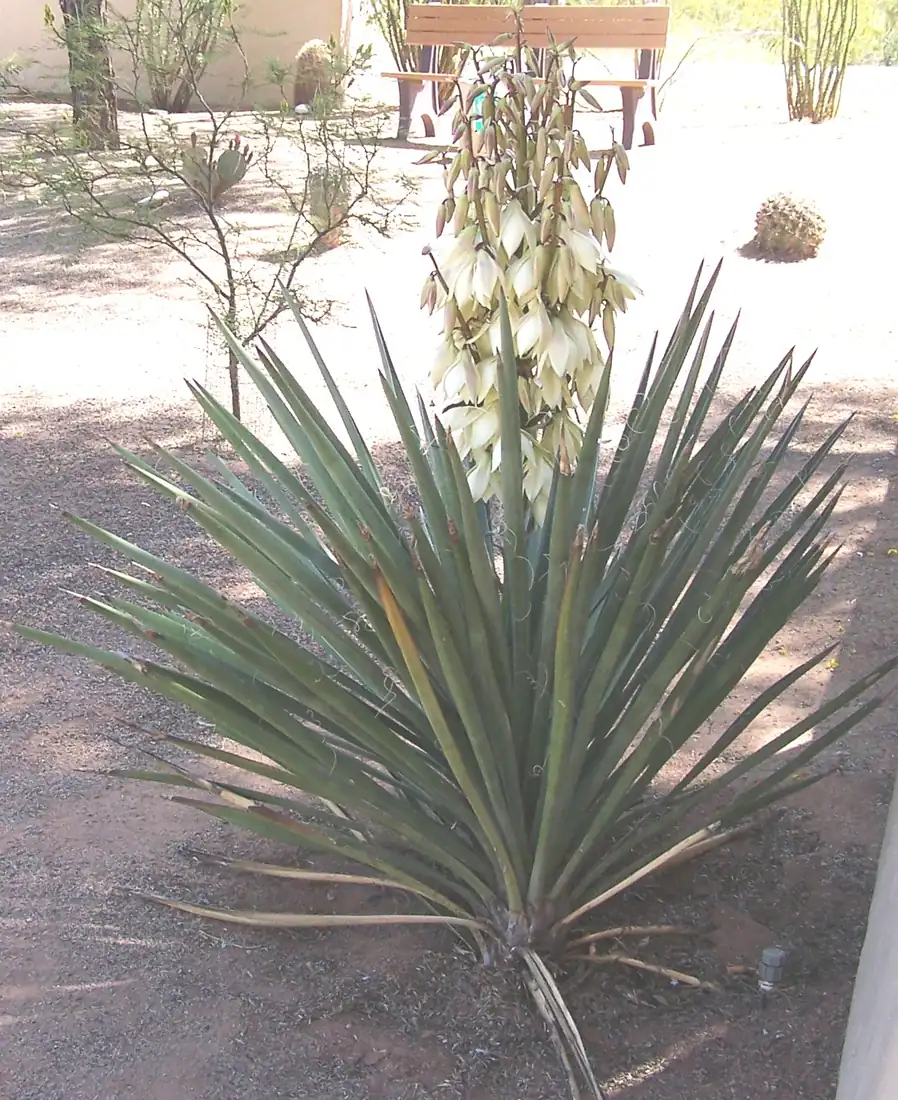
Banana yucca and its moth
Bloom in spring; look for tall stalks of creamy flowers · Petrified Forest National Park
The park says yucca flowers are pollinated only by yucca moths, and the plant and the insect depend on each other. The yucca leaves are sharp and spiky, so keep hands and children back. Late freezes remain possible on the plateau in May, as the table in the weather section shows.
-
Spring snowmelt and last frosts
Thaw into early June · San Francisco Peaks, White Mountains, Rim country
The high stations in the table are not done with frost in May: the median last freeze is May 5 at Show Low, May 29 at Window Rock and June 4 at Flagstaff, so spring on the upper plateau runs well behind the low desert.
When does the Grand Canyon’s North Rim reopen, and how hot is the inner canyon in May?
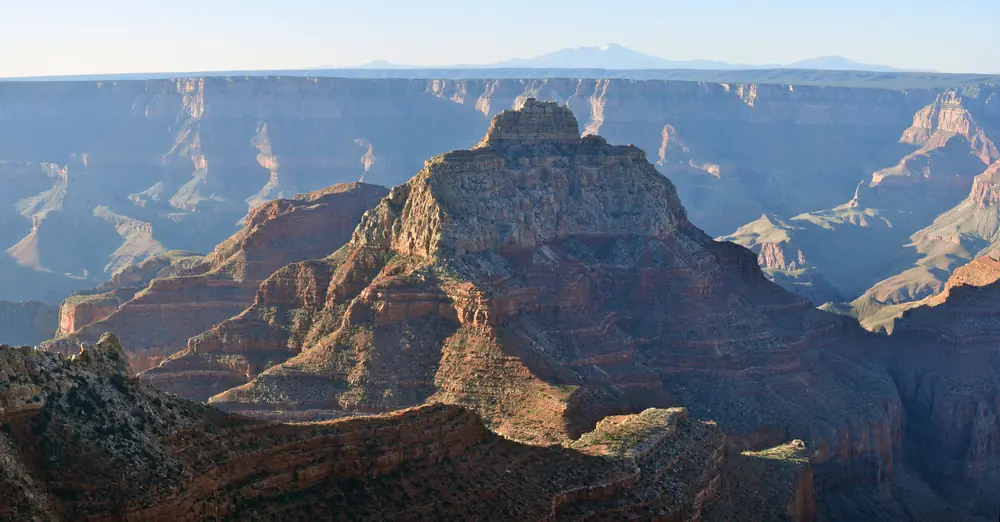
The North Rim is a seasonal destination. The park announced that it would reopen at 6 a.m. on Friday, May 15 in 2026; a 2027 date has not been announced, so look at the National Park Service pages for the 2027 plan.
-
What the 2026 reopening looked like
The 2026 reopening was May 15; no 2027 date was posted · Highway 67 from Jacob Lake to the North Rim
For 2026 the park said Highway 67 and the other paved roads would reopen together, that the North Kaibab Trail would be open to foot traffic only, and that Cottonwood Campground would reopen the same day. The park listed no lodging inside the park for that season, with fuel, food and water at the North Rim Country Store and at Jacob Lake, and it barred vehicles over 22 feet from Cape Royal and Point Imperial roads. The 2027 plan may differ, so read the park’s current notice before you book anything.
-
Heat at the bottom
All month · Phantom Ranch, Bright Angel, South Kaibab and North Kaibab trails
Phantom Ranch’s May average shade high is 91 °F and its average low 61 °F, according to the National Weather Service in Flagstaff via the park’s hiking-safety page, which also says the sun runs 15 to 20 degrees hotter than shade readings and that hiking between 10 a.m. and 4 p.m. is strongly discouraged. The page notes that only Bright Angel and North Kaibab trails have drinking-water spigots, which can be out of service, and that South Kaibab has none. The rim, thousands of feet higher, is cool: the normal May high at the South Rim’s weather station is near 70 °F.
-
Condors on the rim
Seen most days March to October; the park calls mid-April through July especially reliable · South Rim cliffs near Bright Angel Lodge, early morning or late afternoon
The park says condors do not build nests but lay a single egg in a cave or crevice, and young birds leave the nest at five to six months old. Stay at least 150 feet from a perched bird. Lead from ammunition remains the biggest challenge to their recovery, and the park encourages hunters to use non-lead bullets. Ranger talks run roughly March through October.
Should I help a baby animal I find outdoors in Arizona?
Almost always, no. From May on, fawns, calves, rabbits, fledglings and tortoises are on their own for hours at a time, and a well-meant rescue is how many of them end up orphaned.
-
Leave fawns, calves and fledglings
Late spring through summer · Backyards, trailheads and forest roads
The Arizona Game and Fish Department says in an April 2025 news release that it is best to leave baby wild animals where you find them, because the parents of animals such as baby rabbits and newly hatched birds are likely nearby and usually return after people leave. Fawns and elk calves taken in may have to be euthanized later, since they cannot go back to the wild and sanctuaries often lack space. Call a licensed wildlife rehabilitator only if a young animal looks hurt, sick, unresponsive or sluggish, or if its parent is clearly dead. Leave the eggs of ground-nesting birds alone as well.
-
Desert tortoises
Active when conditions are favorable; hatchlings appear in late summer · The Sonoran Desert
Saguaro National Park says tortoises come out of their burrows only rarely, to drink and feed. Its advice is to leave them alone unless one is crossing a busy road; then move it just off the road in the direction it was already heading. Do not relocate a wild tortoise, do not release a pet tortoise, and know that handling wild ones is illegal in Arizona.
What is the weather in Arizona in May, and when is the last freeze?
May is when the low desert crosses into summer while the high country is still hanging on to spring. In NOAA’s 1991–2020 normals, Phoenix Sky Harbor averages 94.5 °F for the May high and 69.5 °F for the low, with just 0.13 inch of rain. Tucson International’s normal is 91.8 °F and 61.8 °F with 0.20 inch, and Yuma Proving Ground’s is 94.1 °F and 65.8 °F with 0.03 inch. On the plateau Flagstaff’s normal is 68.1 °F and 34.6 °F with 0.77 inch of precipitation and 1.1 inches of snow; the Grand Canyon South Rim station reads 69.9 °F and 35.6 °F. Show Low is at 73.6 °F and 44.5 °F, and Alpine, at 8,000 feet, is 68.8 °F and 31.5 °F with a normal 0.5 inch of snow.
The first big heat arrives in May. For 1991–2020 the National Weather Service in Phoenix lists an average first 100 °F day of May 2, a first 105 °F day of May 22 and a first 110 °F day of June 11. Records show it can come earlier: the first 100 °F day has come as early as March 26 (1988) and the first 110 °F day as early as May 8 (1989).
| Station | One year in ten | Median | Nine years in ten |
|---|---|---|---|
| Flagstaff | May 21 | Jun 4 | Jun 19 |
| Window Rock | May 12 | May 29 | Jun 10 |
| Show Low | Apr 21 | May 5 | May 20 |
| Prescott | Apr 14 | Apr 30 | May 15 |
| Willcox | Mar 20 | Apr 9 | Apr 29 |
| Alpine | Jun 2 | Jun 15 | Jun 30 |
| Payson | Apr 13 | Apr 29 | May 20 |
| Page | Mar 8 | Mar 27 | Apr 16 |
The table shows why the same week has two seasons. Dates for your own town are on the Arizona frost page. Each month, close to its middle, the Climate Prediction Center releases fresh 90-day outlooks, which you can find at cpc.ncep.noaa.gov. The weather pages show how to read forecasts, and the cloud guide covers the high, thin cirrus that often rides spring winds ahead of the summer pattern. For the month before, see Arizona in April.
How dangerous is the heat and fire risk in Arizona in May?
Heat and fire both ramp up before the summer rains, so May is the month to rehearse the routine.
-
Heat illness starts early
From late April on in the low desert · Phoenix, Tucson, Yuma and the river valleys, and the inner canyons
The National Weather Service in Phoenix says heat-associated deaths in Arizona can happen at temperatures in the mid-80s and above, and that 105 °F in May feels hotter on the body than the same temperature in July because people are not yet acclimated. It advises drinking 1 to 2 liters of water for each hour outdoors, doing strenuous activity during the coolest part of the day (usually about 4 to 7 a.m.), and taking breaks in a cool place. Its experimental HeatRisk scale runs from 0 to 4, and an Extreme Heat Watch means about 50 percent confidence of extreme heat while a Warning means 80 percent or higher. Check your own city’s parks site for any trail closures on hot days.
-
Fire restrictions
Rules change with conditions; check before every trip · National forests statewide
On the Kaibab National Forest, Stage 1 bans campfires, stove fires and charcoal outside developed sites with fire rings, and bans smoking except in vehicles, buildings and cleared 3-foot areas. Stage 2 bans campfires even in developed sites, except for stoves fueled only by propane. Fireworks and exploding targets are never allowed on national forest land. The Kaibab page points to wildlandfire.az.gov for restrictions across Arizona. The Coconino National Forest’s alerts page, as of fall 2026, also listed year-round camping and campfire restrictions near Flagstaff, west of Sedona, in Oak Creek Canyon and at Lake Mary, so check even when no stage is in force.
-
The wait for monsoon
Weeks away · Southern deserts first
May is dry. Organ Pipe Cactus National Monument says its monsoon season does not start until mid-July,, so May’s afternoons are dry. Do not count on afternoon showers to cool the day or douse a spark.
How much daylight does Arizona gain in May?
Day length is still increasing in May, at a slower pace than April: between about 39 and 48 minutes over the month depending on the town, which is 1.3 to 1.6 minutes a day. The table compares eight towns on May 1 and May 31, sunrise to sunset. The longest day is June 21, and by our own calculation Phoenix’s earliest sunrise (5:18 a.m.) falls around June 12 and its latest sunset (7:42 p.m.) around June 29, so the evenings keep stretching after the day length peaks. Clocks stay put in Arizona except on Navajo land.
| City | May 1 | May 31 | Gained | Per day |
|---|---|---|---|---|
| Page | 13 h 43 m | 14 h 31 m | 48 min | 1.6 min |
| Flagstaff | 13 h 36 m | 14 h 21 m | 45 min | 1.5 min |
| Kingman | 13 h 37 m | 14 h 22 m | 45 min | 1.5 min |
| Prescott | 13 h 35 m | 14 h 18 m | 43 min | 1.4 min |
| Phoenix | 13 h 31 m | 14 h 12 m | 41 min | 1.4 min |
| Yuma | 13 h 29 m | 14 h 09 m | 40 min | 1.3 min |
| Tucson | 13 h 27 m | 14 h 07 m | 40 min | 1.3 min |
| Sierra Vista | 13 h 25 m | 14 h 04 m | 39 min | 1.3 min |
The daylight guide has figures for your own town.
What can you see in Arizona’s night sky in May?
The Moon is new on May 6 and full on May 20. Arizona stays on Mountain Standard Time all year, so the table shows that clock (Navajo Nation clocks run an hour ahead, because the Nation observes daylight time).
- Eta Aquariids, an excellent year. The shower is debris from Halley’s Comet and peaks around May 5 to 7, the new moon, which leaves the sky dark. Sea and Sky says the peak can reach up to 60 an hour under ideal skies, but the radiant (in Aquarius) rises in the small hours, so a realistic count is 10 to 30 an hour in the last hours before sunrise. Look east on the mornings of May 5, 6 and 7 after the Moon has set; the Moon is a thin crescent.
- The Flower Moon and a seasonal Blue Moon. The full Flower Moon arrives at 3:59 a.m. on Thursday, May 20, which makes Wednesday evening the best one for a rise-and-glow view. Phoenix moonrise on Wednesday, May 19 is at 7:09 p.m., by our calculation. Sea and Sky calls it a blue moon because it is the third of four full moons in this astronomical spring, an older definition; the label needs two full moons within a single calendar month, and none occurs in 2027.
- Mercury in the evening. Mercury reaches its greatest eastern elongation on May 28, 22.9 degrees from the Sun by Sea and Sky’s count (6:14 a.m. Arizona time). Look low in the west-northwest 45 to 90 minutes after sunset from about May 12 to June 5, with the evenings of May 27 and 28 the widest (our own calculation, made for the central United States).
- Venus and Saturn at dawn. On May 6 to 8 the two are about 1 degree apart, the closest on May 7 at about 0.6 degrees, very low in the east before sunrise, and spotting them calls for a flat horizon and binoculars (our own calculation).
- Jupiter and the Moon. The first-quarter Moon sits near Jupiter high in the evening on May 12, within about 1.2 degrees at the closest (by our own calculation). Mars is about 3 degrees from the Moon on May 13.
- The Milky Way core. Our own calculation for 40 degrees north finds the best dark-sky windows from May 1 to 14 and May 25 to 31, before dawn and away from the Moon; Arizona is farther south, so treat these dates as a guide.
| Phase | Date | Time |
|---|---|---|
| New moon | Thursday, May 6 | 3:58 a.m. |
| First quarter | Wednesday, May 12 | 9:44 p.m. |
| Full moon, the Flower Moon | Thursday, May 20 | 3:59 a.m. |
| Last quarter | Friday, May 28 | 6:58 a.m. |
Other months are in the moon phases guide. Expect a full-looking Moon on both May 19 and May 20; the lowest, most golden views come as it clears the eastern horizon after sunset.
What can families do outdoors in Arizona this May?
- Catalina State Park bird walks. On the state parks page, the Monday walks for May fall on the 3rd and 17th at 6:30 a.m., and the series closes on May 17; Sunday and Wednesday walks vary by month. Walks last three to four hours; bring binoculars and a field guide.
- Catalina’s other programs. The park’s events page lists a buffelgrass pull on first Saturdays (November to May) and an archaeology hike on second and fourth Mondays through May. It does not give May dates, so confirm with the park.
- Saguaro Flower Power. Saguaro National Park’s Flower Power project tracks more than 50 saguaros with photographs; in past seasons collection has run from April 1 to mid-July, so check the park’s page for how to take part in 2027.
- Tohono Chul Bloom Watch. Sign up for its email updates on the night-blooming cereus.
- Join a count. Track bloom and nesting times with Nature’s Notebook, and log your sightings in a field journal.
- Memorial Day, Monday, May 31. Plan early starts, and check heat and fire restrictions before a holiday trip.
The nature hub links to other states; jot your own finds into the Naturalist’s Field Journal. Dates above come from organizers’ own pages as read in October 2026; confirm by phone or online before heading out.
Safety notes for May in Arizona
- Spring turkey. In the Game and Fish Department’s 2027 spring hunt booklet, Merriam’s turkey draw hunts in most listed units end on May 20 (starting April 23 or April 30, and in some units skipping April 30 to May 6 and resuming May 7), while Gould’s turkey hunts in units 29 to 35 run on dates between April 16 and May 27. Youth-only hunts run May 7 to 20 in the listed units (April 16 to 22 as well), and archery-only nonpermit hunts run May 7 to 20 in some units. Dates and units differ by hunt number, so read the booklet entry for yours. Each hunter may take one turkey a calendar year, and hunters will be out at first light.
- Spring bear. The booklet’s general spring bear season ended April 22, but it lists a nonpermit season of May 7 to August 13 in the Alpine Hunt Area, with special restrictions, and archery-only seasons of May 7 to August 19 in the Mogollon Oso and Naeglin Shadow hunt areas. Cubs and sows with cubs are off limits.
- Orange. The spring 2027 hunt booklet has no blaze orange rule that we could find, so confirm the current rule at azgfd.com; orange does make you easier to spot anyway. On forest trails in May, wear bright clothing and put a bright vest on a dog.
- Heat. Drink water before you feel thirsty, start before 7 a.m. in the low desert, and turn back early. At the Grand Canyon, avoid the inner canyon between 10 a.m. and 4 p.m.
- Bees. City of Mesa guidance says swarms are temporary and may settle in a tree for hours or days. Stay away, do not spray or throw things at them, keep doors and windows closed, and call 911 if the bees are aggressive.
- Wildlife young. Leave fawns, calves and fledglings alone, and keep dogs leashed near nests and burrows.
- Cabeza Prieta. Entry needs a Goldwater Range access permit (Barry M. Goldwater Range); ask the refuge about current rules and closures.
- Fire. Check restrictions before you camp, never leave a fire unattended, and know that fireworks are never allowed on national forest land.
- Time zones. Arizona does not change its clocks, but the Navajo Nation does, so allow for an hour when you cross onto Navajo land.
Sources (44)
- Arizona Game and Fish Department, 2027 Spring Hunt Regulations (turkey, javelina, bison, bear)
- Saguaro National Park: flowers
- Saguaro National Park: current wildflower and cactus bloom conditions
- Saguaro National Park: Saguaro Flower Power project
- National Park Service: saguaro cactus facts
- Saguaro National Park: desert tortoise
- Arizona-Sonora Desert Museum: Birds, saguaros and the art of pollination
- Organ Pipe Cactus National Monument: bats
- Organ Pipe Cactus National Monument: weather
- Organ Pipe Cactus National Monument: plants
- Tohono Chul: Bloom Watch 2024
- Tohono Chul: Bloom Night
- Tucson Bird Alliance: Elf Owl
- Tucson Bird Alliance: Gila Woodpecker
- Tucson Bird Alliance: Coppery-tailed (Elegant) Trogon
- National Park Service: Southwestern Willow Flycatcher
- U.S. Fish and Wildlife Service: Southwestern Willow Flycatcher
- Tuzigoot National Monument: birds
- Chiricahua National Monument: birds
- World Migratory Bird Day
- Petrified Forest National Park: wildflowers
- Grand Canyon National Park: North Rim 2026 summer season access
- Grand Canyon National Park: current conditions
- Grand Canyon National Park: Hike Smart
- Grand Canyon National Park: California condors
- Arizona Game and Fish Department: baby wildlife should be left alone (April 2025)
- NOAA NCEI: 1991–2020 monthly climate normals, Arizona stations
- National Weather Service Phoenix: first and last temperatures
- National Weather Service Phoenix: heat
- National Weather Service Phoenix
- National Weather Service: heat safety
- Kaibab National Forest: fire restrictions
- Coconino National Forest: alerts
- NOAA Climate Prediction Center: seasonal outlooks
- U.S. Naval Observatory: moon phases 2027
- Sea and Sky: astronomy calendar 2027
- Arizona State Parks: events
- Arizona State Parks: Catalina guided bird walks
- Arizona State Parks: Catalina State Park events
- USA National Phenology Network: Nature’s Notebook
- U.S. Fish and Wildlife Service: Cabeza Prieta National Wildlife Refuge
- Canyon de Chelly National Monument: plan your visit (Navajo Nation daylight time)
- City of Mesa: bees and safety
- Photos via Wikimedia Commons; licenses and photographers are credited under each picture
