What to look for in nature in Arkansas this April
April is when Arkansas gets loud and green. Toads trill from ditches, green treefrogs quack in the cypress, and tom turkeys gobble from the ridges as spring turkey season opens zone by zone. Warblers, buntings and prothonotary warblers drop into the river bottoms and the wooded mountains, crappie move onto their nests in the shallows, and blue phlox, columbine and Indian paintbrush color the Ozark slopes. The same warm, wet air that feeds all this brings the heart of storm season, and April has produced some of the state’s most destructive tornadoes. Here is where and when to look.
Other months in Arkansas: October, November, December, January, February, March.
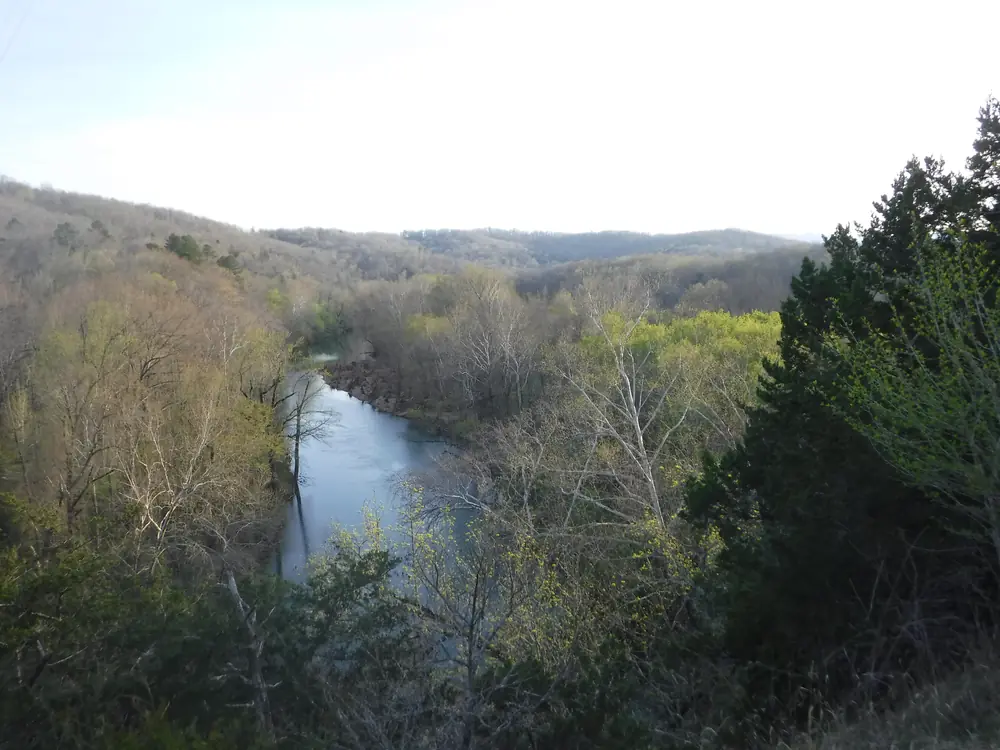
Start here

- Go out at dusk to a pond edge and listen. On a warm evening, stand quietly beside a pond, ditch or swamp and count the voices. Toads trill, green treefrogs quack and gray treefrogs pulse. Note the temperature and the date.
- Spend a morning where the warblers drop in. Pick a wooded park or refuge and arrive at sunrise, when birds that migrated overnight are hungry and low in the trees. Binoculars and a notebook are enough.
- Take a spring wildflower walk after a rain. Choose a shaded slope or stream bank and look low for blue phlox, columbine and geranium. If a waterfall is nearby, it is likely at its best a day or two after rain.
Field Journal ideas: log the first night each frog or toad calls on a map of sounds; record each new migrant on birds I have seen; sketch phlox or columbine on reading the signs; note a turkey’s dawn gobble or a nest box visit on nest observed; return to your adopted tree for a tree through the seasons page; and mark the Pink Moon on dusk and dawn watch.
Regions used below: The Ozarks and the Buffalo River; Arkansas River Valley; Ouachita Mountains; Central Arkansas and Little Rock; The Delta and Crowley’s Ridge; South Arkansas and the Timberlands.
Which frogs and toads are calling in Arkansas in April?
More of them each week, and the voices change as the nights warm. The earliest callers of late winter are giving way as April brings the trills of toads, the quacking of green treefrogs and the pulsing trill of gray treefrogs. Arkansas has 23 frog and toad species, according to coverage of a statewide frog-call seminar series, so an evening beside any pond or ditch can carry a mixed choir.
Timing details below come mostly from the Missouri Department of Conservation, whose field guide is the most specific published source for the region. Arkansas is south of Missouri, so expect each species to start the same week or a little sooner, and expect cold snaps to quiet everything for a few nights.
-
American toad (including the dwarf form)
Males call on warm nights from mid-March; Missouri’s guide says breeding peaks from late April into May · Statewide; the Arkansas atlas has museum records from 73 of 75 counties for the dwarf American toad
The call is a long, sweet trill, sustained for anywhere from 6 to 30 seconds in the Missouri guide’s description. Toads breed in shallow puddles, ditches and pond edges, then scatter into gardens and woods. They hide by day under logs and rocks or burrow into leaf litter, and they feed on insects that fall under porch lights on summer evenings.
-
Green treefrog
Males chorus in the evenings from mid-April to early August, per Missouri’s guide · Cattail marshes, cypress swamps, oxbows and pond banks; the Arkansas atlas shows it in 61 of 75 counties, mainly in the Delta, the South and the Arkansas Valley
A bright green frog with a white or pale yellow stripe down each side and round sticky toe pads. A chorus sounds like a distant flock of Canada geese, a series of ringing, nasal notes. The Arkansas atlas describes the call as a duck-like quack. The frogs rest by day among green leaves and cattail blades, so you will hear them long before you see one.
-
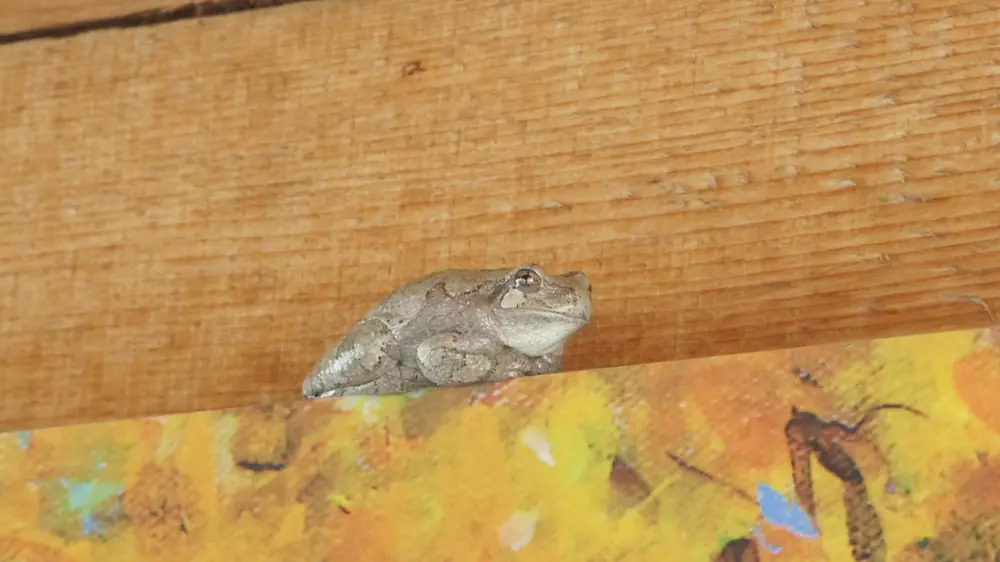
Gray treefrog complex
Calling builds with warm nights from spring into summer · Wooded wetlands, ponds and tree-lined streams; the atlas has records from 70 of the state’s 75 counties
Two nearly identical species share the state: Cope’s gray treefrog over most of Arkansas and the gray treefrog in the northwest corner. The Arkansas atlas says the calls help tell them apart. Cope’s call is a quick, pulsing trill with nearly twice the pulse rate of its northwestern cousin. Look high on branches and window screens at night, where a mottled gray or green frog may be waiting for insects.
Frogging does not open in April. The Arkansas Game and Fish Commission lists bullfrog season as noon June 1 through midnight December 31, with a fishing license required, so the big frogs calling now are left alone. Spring is a time to listen. FrogWatch USA is a free program in which families learn about local wetlands and report frog and toad calls, and the Little Rock Zoo has offered registration-only workshops.
Where can you watch spring bird migration in Arkansas in April?
At river bottoms and wooded hills, from the second week of April and building toward early May. Arkansas’s tourism agency says the first returning residents and migrants start arriving around mid-March and peak the first week of May, with more than 35 species of warblers, vireos, orioles, thrushes and buntings passing through. April is the ramp. Each warm night with a south wind can drop a new wave of birds into the trees by morning.
Songbirds migrate mostly after dark and settle to feed at sunrise, so the first two hours after dawn are best. Cornell’s BirdCast offers live migration maps, forecast maps and a county dashboard built from weather radar, so you can see when a big movement is underway.
-
Petit Jean State Park
Mid-April through May · A mountain above the Arkansas River near Morrilton
Audubon magazine calls it probably the best of the river-valley mountains for spring migrants, with extensive trails and scenic gorges. The state park advertises more than 20 miles of trails, including the route to the 90-foot Cedar Falls. Check the park’s page for trail conditions after heavy rain.
-
Holla Bend National Wildlife Refuge
April and May · Pope and Yell counties along the Arkansas River, about five miles downstream of Dardanelle
Audubon magazine ranks Holla Bend among the state’s best all-round birding sites for its mix of habitats. The refuge’s federal page says spring and summer are a good time to see nesting songbirds, wildflowers, turkey poults and amphibians on the refuge’s auto tour and trails. A day-use fee applies.
-
Little Rock’s city parks and Pinnacle Mountain
Mid-April to early May · Knoop Park, Boyle Park and Pinnacle Mountain State Park
Audubon Delta’s guide to Little Rock says Boyle Park can turn up more than 25 warbler species during migration, and that 32 warblers plus most of the state’s sparrows, vireos, thrushes and buntings are possible at Pinnacle Mountain. Knoop Park, it adds, has an impressive list for its size.
-
Crowley’s Ridge and the Delta
Late April through early May · St. Francis National Forest, Craighead Forest Park and the eastern refuges
Audubon magazine names St. Francis National Forest as a top spring choice and points to the first week of May at Craighead Forest Park. Eastern Arkansas refuges also host east-trending migrants such as Cape May and black-throated blue warblers.
-
Prothonotary warbler
Arrives in April in Missouri, per its field guide; nesting follows soon after · Cypress swamps and flooded bottomlands such as the Cache River refuge
A glowing golden warbler with blue-gray wings that nests in tree cavities near water, filling the opening with moss and twigs. Its song is a loud, ringing series of notes. The Cache River National Wildlife Refuge, established in 1986, protects some of the least disturbed bottomland hardwood forest in the Mississippi Valley, and parts of it close to hunting when river gauges pass flood thresholds.
-
Indigo bunting
Arrives in April in Missouri, per its field guide · Brushy fields, woodland edges, yards and gravel roadsides
Males look turquoise in sunlight and nearly black in shade. They sing from wires and treetops in whistled pairs of notes that drop slightly in pitch.
-
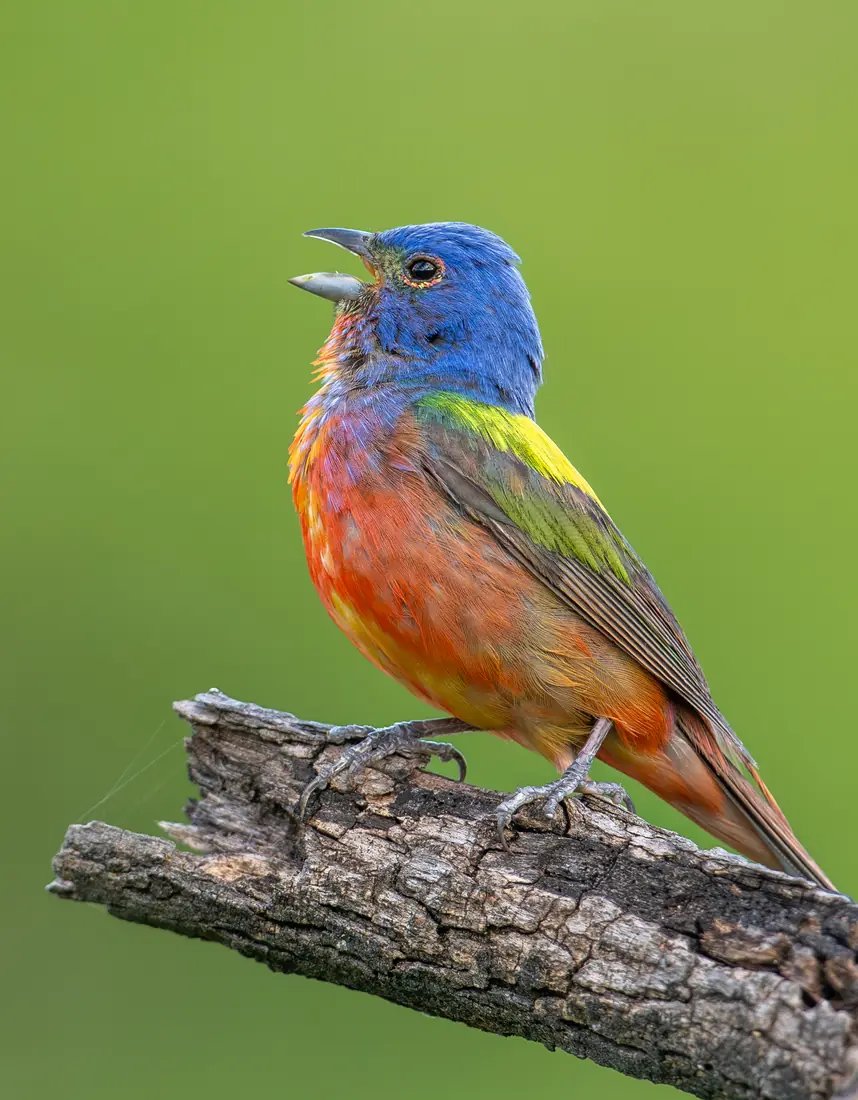
Painted bunting and scissor-tailed flycatcher
Spring arrivals; they usually trail the early warblers, so check recent reports for your county · Painted bunting in brushy thickets and edges; scissor-tailed flycatcher in open country
Audubon magazine lists both among the breeding specialties to watch for in spring. Treat an early sighting as a fine surprise and write down the date.
Log each first date on a birds I have seen page, with the weather. Compare your dates with the BirdCast maps.
When is spring turkey season in Arkansas in 2027, and what are the toms doing?
Season dates are set, and they overlap the whole month. By the Commission’s 2027 schedule, young hunters ages 6 to 15 get the weekend of April 10 and 11 in zones 1, 1A, 2 and 2A with one legal turkey allowed. Regular seasons then open zone by zone: zone 3 runs April 5 to 25, zones 2 and 2A open April 12 (zone 2 closes May 2, zone 2A April 20), and zones 1 and 1A open April 19 (zone 1 closes May 9, zone 1A April 27). The statewide limit is two turkeys, no more than one taken during the first seven days in a zone and no more than one a day. Birds may not be taken from 30 minutes after sunset until 30 minutes before sunrise. In zones 1A and 2A the limit is one bird, and the Commission says a hunter who takes it must travel elsewhere for a second.
For everyone else the season means gobbling at dawn, and it means hens are about to start nesting. Missouri’s guide says toms gobble in spring to announce themselves and attract mates, and perform strutting displays with fanned tails and puffed feathers. Hens make a shallow ground nest, lay 10 to 14 eggs over several days and incubate them for about a month. Poults can leave the nest within a day of hatching.
If you are not hunting, walk quietly at dawn along forest edges and clearings on public land and expect to meet hunters. Wear bright clothing. Check the Commission’s turkey page for any change to zone boundaries or permits before you go.
What blooms in the Arkansas Ozarks in April, and are the waterfalls running?
The woods fill up. The National Park Service’s wildflower list for Buffalo National River puts a long run of flowers into April, and blue phlox is described as one of the first each spring. The park lists hepatica and bloodroot among the earliest bloomers, with May apple and shooting star coming later in spring. Local outfitters add that prime wildflower season on the Buffalo falls in late April, when favorites such as Indian paintbrush, fire pink and wild iris tend to cluster near waterfalls and other moist places. Waterfalls depend on rain, and the April normals above average roughly five inches in the hills, which keeps many flowing.
-
Blue phlox, Ozark blue star and spiderwort
April into June, per the park’s list · Woodlands, bluffs and old fields at Buffalo National River
Blue phlox is among the first to open, with fire pink, columbine and Indian pink also listed from April. Spiderwort and the starry blue Ozark blue star fill in through early summer.
-
Wild geranium, Jacob’s ladder and dwarf crested iris
April and May · Shaded woods and moist slopes
The park lists these three as April and May bloomers. Look low along trails after a rain, when the colors are strongest and the ground is soft.
-
Scarlet Indian paintbrush and the Cherokee Prairie
April through June · Cherokee Prairie Natural Area, 2 miles north of Charleston, and limestone slopes in the Ozarks
The Arkansas Natural Heritage Commission protects 584 acres at Cherokee Prairie, one of the largest remaining tallgrass tracts in the Arkansas Valley, with Prairie Creek running through the middle. Its forbs include compass plant, purple prairie clover and Indian paintbrush. Hunting is allowed on the site, so check the current season before a spring visit.
-
Wildflower weekends at the state parks
Annual events, usually in April · Petit Jean State Park and Devil’s Den State Park
Petit Jean holds a Wildlife and Wildflower Weekend with talks and guided walks, and its 2026 edition ran April 10 to 13. Devil’s Den offered a short Wildflower Wonder Hike on April 12 in 2026. No 2027 dates were posted at the time of writing, so check the Arkansas State Parks calendar or call the park.
-
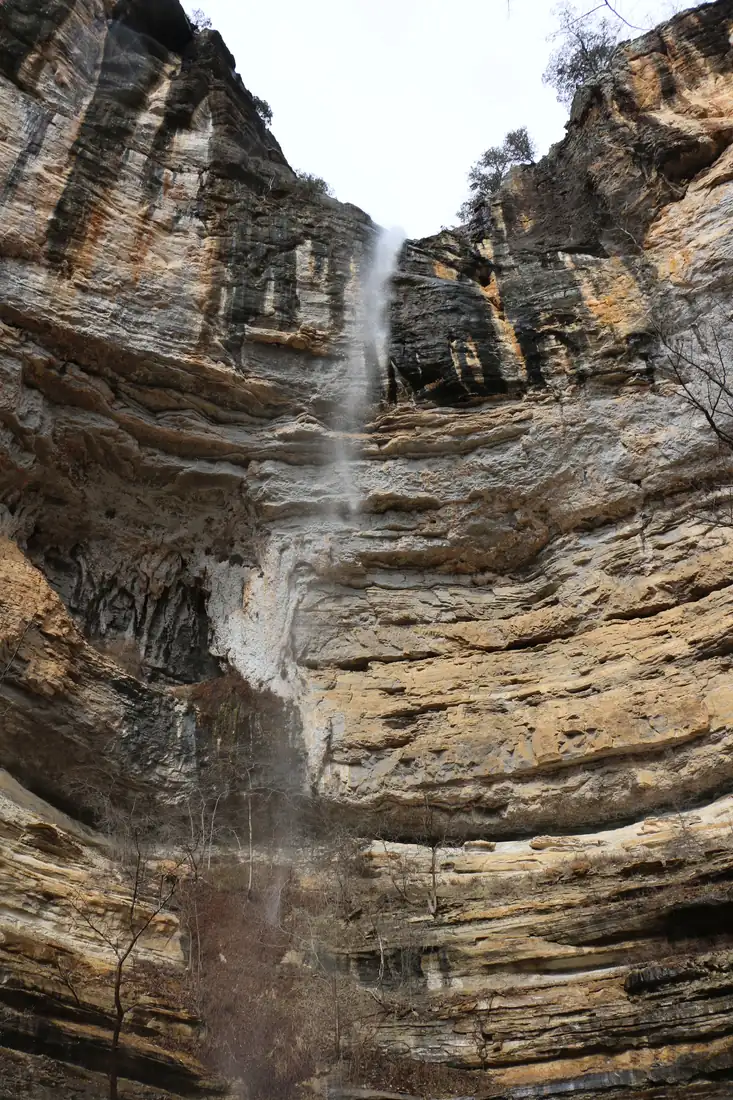
Hemmed-in Hollow and Eden Falls
After rain, especially in spring · Buffalo National River, Ponca area, Newton County
Hemmed-in Hollow is a tall, narrow fall off a sandstone bluff that can blow sideways in the wind when flowing well. Both falls depend on recent rain and may be a trickle in dry weeks.
On the river itself, the Park Service says use is heaviest from April through August, with spring crowds concentrated on the upper river, and it recommends weekdays or a lower section for quiet. Water levels follow rainfall, and the river can run very low or even flow underground in places. After a storm the same stretch can turn fast and cold within hours, so check gauges and local advice before launching a canoe.
When do crappie spawn in Arkansas lakes?
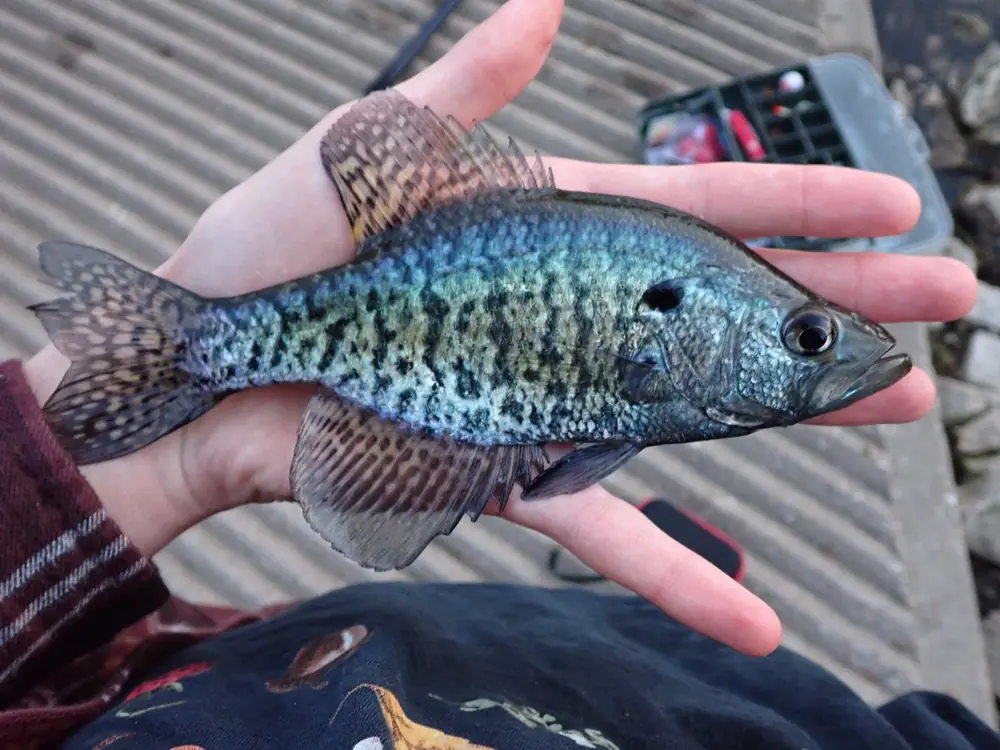
Usually from early to mid-April, as water passes the upper 50s and reaches the 60s. A weekly Arkansas Game and Fish Commission fishing report from April 8, 2021 captured the pattern. At Lake Maumelle, with water at 58 to 61 degrees, males sat on beds in 2 to 4 feet while females waited in 8 to 10 feet. At DeGray Lake the water was in the mid-60s, and an angler said temperatures staying above 60 would turn the fish on. At Lake Dardanelle some crappie were as shallow as a foot, and at Lake Ouachita they were caught anywhere from 3 to 12 feet. Dates shift with each spring, so treat this as a pattern, not a calendar.
-
White and black crappie
Early to mid-April in most years; earlier in the warm south, later in the northern lakes · Shallow coves, brush piles and shoreline cover at Maumelle, DeGray, Dardanelle and Ouachita
Males build nests in shallow water and guard them, while females stage on brush a little deeper. Wildlife watchers will see the same cover anglers target: standing timber, docks and brush piles near the bank.
Anyone fishing needs a valid Arkansas license, and length and creel limits are set by lake, so read the Commission’s current regulations first. Cold water and spring wind remain real hazards for small boats.
Why are turtles and alligators moving around in Arkansas in April?
Warm days pull cold-blooded animals out of hiding. Three-toed box turtles, the most common land turtle in Arkansas, wander widely in spring while looking for food and mates. The Commission says the other box turtle in the state, the ornate box turtle, is protected and illegal to possess or collect. In the southern third of the state, American alligators begin basking again on warm afternoons. University extension specialists note that most sightings are confined to that southern third, and that alligators range north to the Arkansas River and along the Mississippi River into the northeast.
-
Three-toed box turtle
Active on warm, damp days from spring through early summer · Woodlands, fields, ditches and road edges statewide
The hinged lower shell closes like a box. The Commission’s herpetology coordinator, Kelly Irwin, says only 47 percent of turtles moved to a new spot established a home range there, while three-toed box turtles often live their whole lives within a 10 to 25 acre range. The Commission’s advice is to leave box turtles where you find them and never paint a shell, which makes the animal easier for predators to find.
-
American alligator
Basking on warm spring afternoons as the water warms · Swamps, bayous, lakes and rivers in southern and southeastern Arkansas
Keep your distance, do not feed alligators and keep dogs and children back from the water’s edge in gator country. The extension service says the state had no documented alligator attacks on people in the preceding 20 years, despite about 100 nuisance reports a year.
How stormy is April in Arkansas, and what should you watch?
Warm and wet, with tornado season ramping up. April highs in the 1991–2020 normals run from about 70 °F in the northwest hills to 76 °F at El Dorado, with 4.4 to 5.6 inches of rain, as the table shows. A Little Rock television report on National Weather Service data back to 1950 says the peak of tornado season begins in late April and runs through early May. The same report notes that the state’s two largest outbreaks came in January 1999 and June 1960, so danger is never confined to one season.
April has made history in Arkansas. On April 25, 2011, the National Weather Service in Little Rock rated the Vilonia tornado EF2, with four deaths at a mobile home park southwest of town, a track just over 51 miles and a width of 2,900 yards, the widest on record in the state since 1950. On April 27, 2014, an EF4 tornado tracked 41 miles through Mayflower and Vilonia into White County and killed 16 people, the deadliest single tornado in the state since Jonesboro in 1968. In early April 2025, the Weather Service’s summary says storms and flooding killed three people in Arkansas and injured 14, mostly from flooding, with rainfall totals as high as 14.14 inches across April 2 to 5 that it compared to events that happen once in a generation to once in a lifetime.
The Climate Prediction Center posts a fresh round of seasonal outlooks every month on its 90-day outlook page.
| City | Average high | Average low | Precipitation |
|---|---|---|---|
| Fayetteville (Drake Field) | 69.7 °F | 44.5 °F | 5.01 in |
| Harrison | 69.6 °F | 47.0 °F | 4.98 in |
| Fort Smith | 74.5 °F | 49.8 °F | 4.87 in |
| Jonesboro | 71.3 °F | 50.1 °F | 5.15 in |
| Little Rock | 72.8 °F | 50.1 °F | 5.59 in |
| Texarkana | 74.5 °F | 52.7 °F | 4.43 in |
| El Dorado | 76.4 °F | 51.3 °F | 5.39 in |
Open the forecast and radar before any outing, set your phone to receive warnings overnight, and choose a shelter now. Never drive through flooded roads; low-water crossings on the Ozark and Ouachita streams can fill quickly. Late freezes can still bite in the hills early in the month, and the Arkansas frost dates page gives numbers for your town.
When does the last freeze of spring arrive in Arkansas?
By April it is finished across most of the state, and only the hills are still in play. The federal 1991–2020 normals put the median last freeze at March 16 in Little Rock and April 8 at Fayetteville. The last column is the cautious one: nine springs in ten are freeze-free at Fayetteville by April 26, and at Harrison by April 8.
For gardeners, that means tomatoes and tender bedding plants belong in the ground after the date in the last column, or under cover on a cold night before it. Low spots and hollows run colder than airport thermometers.
| Station | One year in ten | Median | Nine years in ten |
|---|---|---|---|
| Fayetteville | Mar 21 | Apr 8 | Apr 26 |
| Harrison | Mar 1 | Mar 22 | Apr 8 |
| Jonesboro | Mar 7 | Mar 23 | Apr 9 |
| Little Rock | Feb 27 | Mar 16 | Apr 2 |
| Hot Springs | Mar 3 | Mar 24 | Apr 13 |
| Pine Bluff | Feb 27 | Mar 14 | Apr 2 |
| El Dorado | Mar 1 | Mar 24 | Apr 9 |
Many more towns are listed on the Arkansas frost dates page, drawn from the same federal normals.
How much daylight does Arkansas gain in April?
Between 56 and 63 minutes over the month, depending on the city, or about 2 minutes a day. The gain is a little larger in the north than the south. Daylight time is in force all month, so every sunrise and sunset you read is on the clock as the state keeps it.
| City | Apr 1 | Apr 30 | Gained | Per day |
|---|---|---|---|---|
| Fayetteville | 12 h 35 m | 13 h 38 m | 63 min | 2.2 min |
| Harrison | 12 h 35 m | 13 h 38 m | 63 min | 2.2 min |
| Jonesboro | 12 h 36 m | 13 h 37 m | 61 min | 2.1 min |
| Fort Smith | 12 h 35 m | 13 h 36 m | 61 min | 2.1 min |
| Little Rock | 12 h 34 m | 13 h 33 m | 59 min | 2.0 min |
| Hot Springs | 12 h 34 m | 13 h 33 m | 59 min | 2.0 min |
| Pine Bluff | 12 h 34 m | 13 h 31 m | 57 min | 2.0 min |
| El Dorado | 12 h 32 m | 13 h 28 m | 56 min | 1.9 min |
For exact sunrise and sunset in your town, use the daylight tables. With the late sunsets, evening is the time for a family walk to listen for frogs.
What can you see in the Arkansas night sky in April?
A dark week early, a poor Lyrids display, the Pink Moon and a very low Mercury. All clock times below are Central Daylight Time.
-
A thin crescent beside Venus
Mornings of April 3 and 4 · Low in the east before sunrise
A slim old Moon about 9 percent lit passes Venus, the brilliant morning star, on the mornings of the 3rd and 4th. Venus is rising about 75 minutes ahead of the Sun this month and is slowly sinking toward summer.
-
Dark nights around the new moon
Around Tuesday, April 6 · A field or lake shore well away from streetlights
New moon arrives at 6:51 p.m., so the nights from about April 4 to 9 are good for faint clusters. By our own calculation, on the 10th the young Moon passes close to the Pleiades.
-
Jupiter and the Moon
Evenings of April 14 and 15 · Climbing the southern sky after dark, in Leo
The waxing Moon, about two-thirds lit, stands beside Jupiter, which sets roughly nine hours after sunset at the start of April and outshines every star in the evening. Mars is also in Leo and about three degrees from the Moon on the 15th. The planet positions and separations on this page are our own calculations.
-
The Pink Moon
Full on Tuesday, April 20, at 5:27 p.m. · Low in the east at dusk
Tradition ties the name to the pink moss phlox that blooms in spring. Moonrise is about 7:50 to 8:00 p.m. at Chicago and Houston, so expect it to rise close to 8 p.m. in Arkansas, just after it is full.
-
Lyrids, a poor year
Peak about 8:41 p.m. on Thursday, April 22 · Radiant in Lyra, low in the northeast early
The shower is active from about April 14 to 30 and gives around 20 an hour at best, but the Moon, nearly full, rises about 10 p.m. and drowns the fainter ones. The only dark hours are the early evening, when Lyra is still low. Expect a few meteors an hour, and the Lyrids sometimes surprise with short bursts.
-
Mercury
Hard to see in early April, gone by the end · Low in the east before dawn
After its March morning showing, Mercury rises only about 40 minutes before the Sun on April 1 and about 20 minutes on the 15th, so it is lost in the glare soon after. It passes behind the Sun on the 28th and returns as an evening star in May.
| Phase | Date | Time |
|---|---|---|
| New moon | Tuesday, Apr 6 | 6:51 p.m. CDT |
| First quarter | Tuesday, Apr 13 | 5:56 p.m. CDT |
| Full moon, the Pink Moon | Tuesday, Apr 20 | 5:27 p.m. CDT |
| Last quarter | Wednesday, Apr 28 | 3:18 p.m. CDT |
The Eta Aquariid meteor shower begins about April 19 and peaks around May 5 and 6, an excellent year with a nearly new Moon, so keep that in mind for the next page. Today’s sky shows where the clouds are, and the moon phase calendar has moonrise times for your town.
What can Arkansas families do outdoors in April?
- Tuesday, April 6: a dark-sky night. The new moon is at 6:51 p.m. Bring a red flashlight and look for the Pleiades on the 10th.
- All month: an evening frog walk. Carry a dim red light to a pond or ditch, stand back and list each species you hear. FrogWatch USA trains volunteers to report calls, and the Little Rock Zoo has offered free workshops in spring.
- Early to mid-April: a Petit Jean or Devil’s Den wildflower walk. Both parks offer guided hikes in April in most years. Their 2027 programs had not been announced yet, so call the park or check the Arkansas State Parks calendar.
- Tuesday, April 20: the Pink Moon rises. Watch from a hilltop or lakeshore just before sunset.
- Thursday, April 22: Earth Day. The organizers’ 2027 theme is food for our planet. Plant a native tree or start a garden bed for pollinators.
- Thursday, April 22: Lyrids. Poor with the bright Moon, but try the first hour after dark.
- All month: nest watching. Cornell’s NestWatch lets you monitor a bird box and enter results. Write down when each pair arrives.
- April 30 to May 3: City Nature Challenge. This worldwide count of wild plants and animals uses these dates in 2027. Check whether your area is taking part.
Browse the rest of the nature section, and keep a Naturalist’s Field Journal in your pack. For the month before, see Arkansas in March.
Safety notes for April in Arkansas
- Hunting. Spring turkey season is open in April. Youth hunt April 10 and 11; zone 3 April 5 to 25; zones 2 and 2A from April 12; zones 1 and 1A from April 19 (see the turkey section). Shooting hours stop 30 minutes after sunset and start 30 minutes before sunrise. The spring light-goose season for snow, blue and Ross’s geese continues through April 25, with shooting starting half an hour before sunrise and ending half an hour after sunset. Deer, bear and elk seasons are closed, and trapping seasons ended March 31.
- Blaze orange. The Commission requires hunter orange where modern gun or alternative-firearms deer, bear or elk seasons are open. None is open in April, so the rule does not apply to spring turkey and goose hunters. Bright clothing is still smart when sharing public land.
- Severe weather. Know your shelter, set your phone to wake you for a warning, and treat every tornado warning as real. Do not drive through flooded roads.
- Floating and cold water. Spring flow can be high and cold on the Buffalo and other streams. Wear a life jacket, check gauges and stay off swollen water.
- Ticks. University of Arkansas extension reports that lone star and American dog ticks are the main spring species. It advises repellent with DEET or permethrin-treated clothing, light colors that show ticks, and prompt removal with tweezers. Put clothes in a hot dryer after outings.
- Snakes and wildlife. Watch where you put hands and feet in brush and rock piles. Do not touch turtles, nestlings or fawn-like young; adults are usually close.
- Alligators. In the south, keep pets and children away from the water’s edge.
- Caves. Stay out of caves used by bats.
Sources (54)
- Arkansas Game and Fish Commission: 2027 spring turkey season dates, bag limits and shooting hours
- Arkansas Game and Fish Commission: turkey hunting overview
- Arkansas Game and Fish Commission: Light Goose Conservation Order (2027 dates)
- Arkansas Game and Fish Commission: deer-specific regulations (hunter orange rule)
- Arkansas Game and Fish Commission: 2026-27 furbearer trapping seasons
- Arkansas Game and Fish Commission: alternative fishing methods (bullfrogs)
- Arkansas Game and Fish Commission: Arkansas Wildlife Weekly fishing report, April 8, 2021 (crappie spawn)
- Arkansas Game and Fish Commission: Arkansas Wildlife Weekly fishing report, November 29, 2017 (crappie depths)
- Arkansas Game and Fish Commission: turtles taking to the streets (June 2022)
- Arkansas Tourism: bird watching tips and spring migration
- Audubon magazine: birding in Arkansas
- Audubon Delta: Little Rock birding hotspots
- U.S. Fish and Wildlife Service: Holla Bend National Wildlife Refuge
- U.S. Fish and Wildlife Service: Cache River National Wildlife Refuge
- Arkansas State Parks: Petit Jean State Park
- Arkansas State Parks: Pinnacle Mountain State Park
- Arkansas State Parks: Devil’s Den State Park
- Arkansas State Parks: Wildlife and Wildflower Weekend, Petit Jean (2026 listing)
- National Park Service: wildflowers at Buffalo National River
- National Park Service: Buffalo National River frequently asked questions (float season)
- Buffalo Outdoor Center: spring adventure guide to Buffalo River country
- Arkansas Natural Heritage Commission: Cherokee Prairie Natural Area
- Encyclopedia of Arkansas: wildflowers
- Herps of Arkansas: gray treefrog complex
- Herps of Arkansas: green treefrog
- Herps of Arkansas: dwarf American toad
- Herps of Arkansas: frogs and toads
- Arkansas Democrat-Gazette: frog call recognition seminars (23 frog and toad species)
- Missouri Department of Conservation field guide: American toad
- Missouri Department of Conservation field guide: green treefrog
- Missouri Department of Conservation field guide: prothonotary warbler
- Missouri Department of Conservation field guide: indigo bunting
- Missouri Department of Conservation field guide: wild turkey
- SciStarter: FrogWatch USA training at the Little Rock Zoo
- University of Arkansas Cooperative Extension Service: alligators in Arkansas
- University of Arkansas Cooperative Extension Service: Arkansas tick season
- Cornell Lab of Ornithology: BirdCast
- Cornell Lab of Ornithology: NestWatch
- Journey North: hummingbird migration
- City Nature Challenge: 2027 dates
- Earth Day Network: Earth Day 2027
- KATV: peak tornado season arrives in Arkansas
- National Weather Service Little Rock: April 25, 2011 Vilonia tornado and April 2011 summary
- National Weather Service Little Rock: April 27, 2014 Mayflower-Vilonia tornado
- National Weather Service Little Rock: April 2025 flood and tornado summary
- National Weather Service Little Rock: Arkansas climate page
- National Weather Service Little Rock: home page
- NOAA NCEI: 1991–2020 monthly normals for Arkansas stations (data API)
- NOAA NCEI: U.S. Climate Normals 1991–2020
- Climate Prediction Center: 90-day seasonal outlooks
- U.S. Naval Observatory: moon phases from April 1, 2027
- Sea and Sky: astronomy calendar of celestial events, 2027
- NOAA Global Monitoring Laboratory: solar calculator (equations used for the day-length table)
- Photos via Wikimedia Commons; licenses and photographers are credited under each picture
.JPG)