What to look for in nature in Arkansas this December
December is the first month of meteorological winter, and in Arkansas it is a month of birds by the hundred thousand. Snow geese settle over the rice country of the Delta in flocks that look like drifting smoke, bald eagles take up perches above the White and Cache rivers, and Christmas Bird Count volunteers fan out across some thirty count circles to tally all of it. On the ground, black bears are slow and sleepy but mostly still awake, and Ozark witch hazel opens its first ragged flowers by the streams. Arkansas sees its earliest sunsets during December’s opening week and its latest sunrises in January, and the solstice falls between them. What follows is a month of things to look for across the state, with places and dates.
Other months in Arkansas: October, November.
Start here
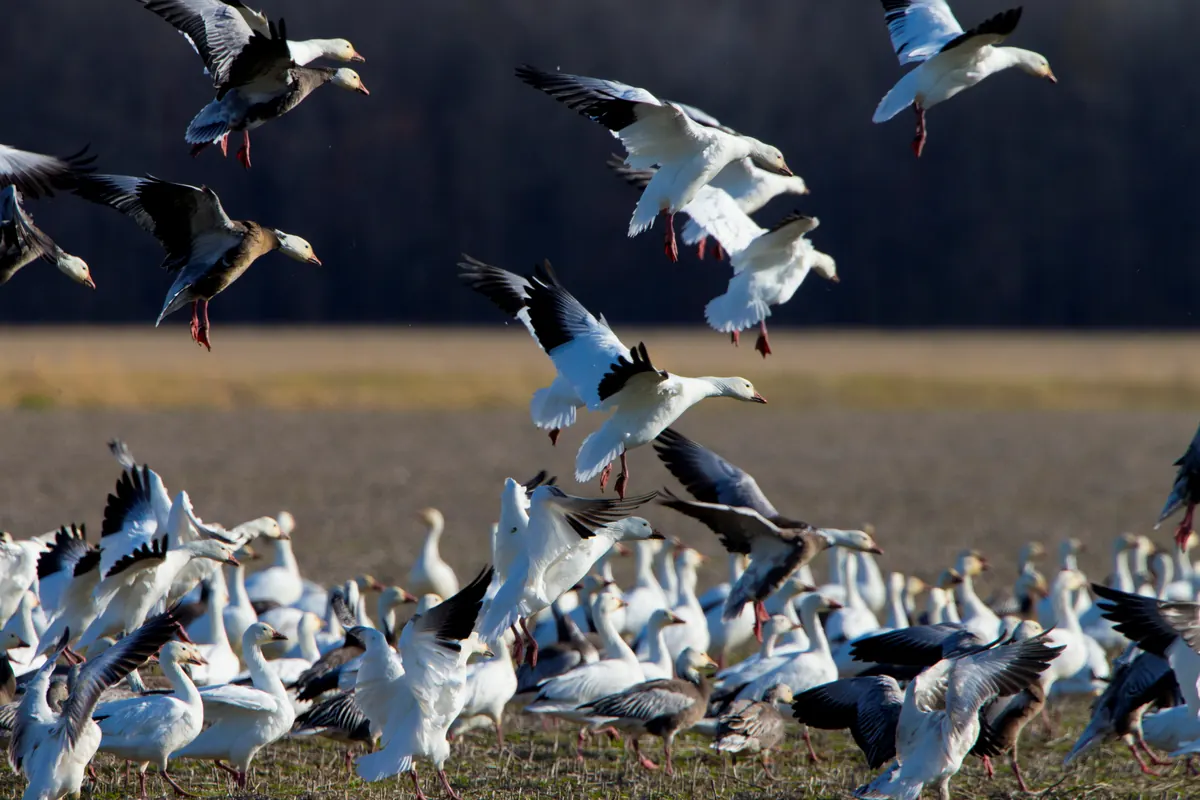
- Snow geese over the Delta. Drive the farm roads east of Little Rock on a December morning and watch the sky. In December 2025 the Game and Fish Commission estimated close to three million snow and Ross’s geese in the Delta. Look for white flocks lifting off harvested rice fields, and listen for the high, barking chorus.
- Sunset at the solstice mounds. On Saturday, December 19, Plum Bayou Mounds Archeological State Park near Scott leads a walk across a thousand-year-old mound site and ends on a mound built to line up with the setting sun near the winter solstice.
- A night for the Geminids. Arkansas gets its best meteor show of 2026 after dark on Sunday, December 13, running into Monday’s small hours. The crescent moon sets in the evening, so from about 10 p.m. until dawn the sky is dark. A lawn chair tipped back, a sleeping bag and a spot shielded from porch lights are all the gear you need.
For the Naturalist’s Field Journal: the Christmas Bird Count tally belongs in the birds I have seen pages; a holly sprig and a cedar “berry” suit the seeds, pods and cones plate; the Plum Bayou sunset and the Geminid night each earn a dusk and dawn watch; and a muddy refuge levee calls for tracks to know.
Regions used below: The Ozarks and the Buffalo River; Arkansas River Valley; Ouachita Mountains; Central Arkansas and Little Rock; The Delta and Crowley’s Ridge; South Arkansas and the Timberlands.
Where can you see snow geese and ducks in Arkansas in December?
In the Delta, where they arrive by the million. Snow geese and their smaller look-alike, Ross’s goose, breed on Arctic tundra and pass the cold months on the flooded fields and harvested rice of the Mississippi Alluvial Valley. The Arkansas Game and Fish Commission flies aerial surveys over the Delta in December, and its biologists count ducks along random transects and estimate the geese as well. The numbers swing from year to year with rain and habitat. December 2025 was a big goose month: 2,992,914 light geese (the survey’s term for snow and Ross’s geese together) and 285,292 greater white-fronted geese, the brown “specklebellies.”
Ducks matter as much to Arkansas as geese. The December 2025 survey, delayed by weather and aircraft maintenance until December 15–23, estimated 498,164 mallards and 1,458,354 ducks of all kinds in the Delta. That was about 345,000 more mallards than the poor December of 2024, though still some 35,000 short of the December average since 2009. In a dry year the birds crowd onto whatever water is managed for them, which is why the refuges and public wildlife management areas fill up first.
-
Big Lake National Wildlife Refuge
Building through December; peak in January and February · Near Manila, Mississippi County
One of the oldest refuges in the country, set aside by President Woodrow Wilson in 1915 as a sanctuary for migratory birds. The Fish and Wildlife Service says its winter waterfowl can top 200,000 birds at the January and February peak, and more than 225 bird species have been recorded there.
-
Wapanocca National Wildlife Refuge
December through February · Near Turrell, Crittenden County
Created in 1961 as a waterfowl sanctuary, Wapanocca is a block of bottomland woods and water surrounded by flat cropland. The visitor contact station is closed for now because of staffing, but the auto tour route and trails stay open. In the 2024–25 Christmas Bird Count, the Wapanocca circle tallied more species than any other count in Arkansas.
-
Second duck season
December 10–23 and December 26 to January 31 · Statewide, heaviest in the Delta and Arkansas River Valley
The regular duck season closed after Thanksgiving weekend and reopens on Thursday, December 10. Goose seasons follow the same December dates. On wildlife management areas, duck hunters must stop shooting at noon through January 30, so an afternoon visit to a WMA levee is quieter for birders.
| December survey | Mallards | All ducks | Light geese (snow and Ross’s) |
|---|---|---|---|
| Dec 16–20, 2019 | 447,083 | 898,656 | nearly 1 million |
| Dec 7–10, 2020 | 255,052 | 632,977 | 542,231 |
| Dec 6–9, 2021 | 326,064 | 566,456 | 902,848 |
| Dec 4–15, 2022 | 480,846 | 1,136,558 | 1,275,732 |
| Dec 15–23, 2025 | 498,164 | 1,458,354 | 2,992,914 |
A big flock of snow geese includes dark “blue geese,” a color form of the same species, and Ross’s geese, which are smaller with a stubby bill. Note the time, the field and roughly how many birds rose at once. The November page covers the swans and the first ducks that came before them.
Where are the bald eagles in Arkansas in December?
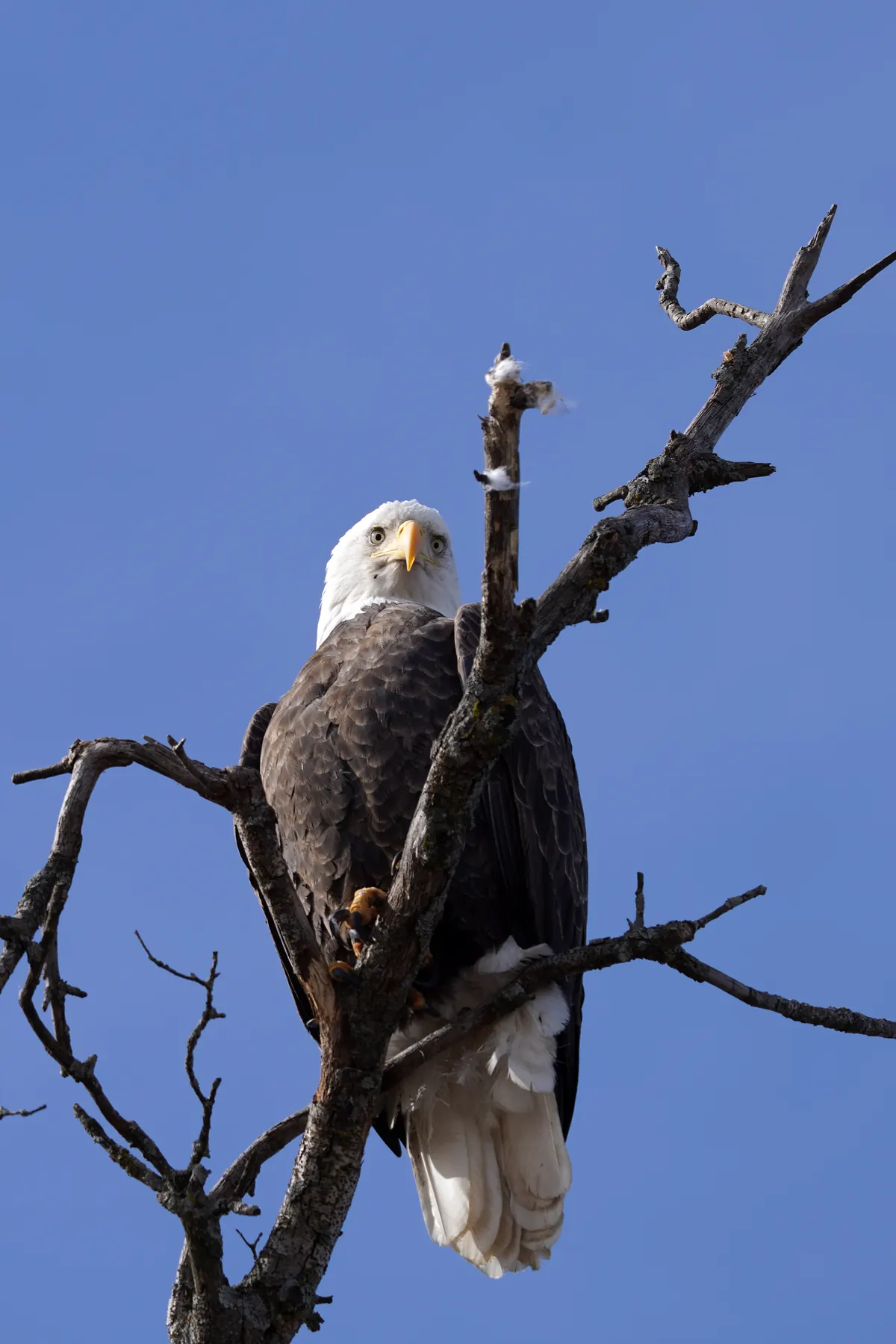
Along the big water, wherever ducks and fish gather. Arkansas has its own nesting eagles, but northern birds pour in as lakes freeze up north and their food goes with the waterfowl. AGFC’s nongame bird coordinator points eagle watchers to the state’s large rivers, the Corps of Engineers reservoirs and seasonally flooded rice fields, and names Holla Bend National Wildlife Refuge and DeGray Lake in the west as the best-known places. The Delta hosts hundreds of eagles each winter as well, she says, especially along the White and Cache rivers.
The local comeback is recent. No bald eagles nested in Arkansas in the 1960s, when the species was endangered; the first nest since the 1950s turned up on what is now Dale Bumpers White River National Wildlife Refuge in 1983. The recovery target for Arkansas was ten nesting pairs. AGFC now estimates 150 to 160.
-
How to find one
Mornings, all month · Shorelines, river bends and the edges of flooded fields
Scan the tallest trees standing above the rest along a shoreline or field edge; eagles like a high, open perch with a view. Around open water on the reservoirs and Delta oxbows, look for a big dark bird sitting very still.
-
Eagle, hawk or vulture?
Any time one is soaring · Overhead
An eagle’s wings can span seven to eight feet, nearly twice most hawks. Vultures are just as big but tilt their wings up in a shallow V, while eagles and hawks soar on flat wings. Brown, white-splotched youngsters fool people into calling them golden eagles; per AGFC, a bald eagle needs roughly five years to earn its white head and tail. A golden eagle has a small dark bill and feathered legs, and is the rarer bird here.
-
Holla Bend in winter
December through early spring · Holla Bend National Wildlife Refuge, Pope and Yell counties
Holla Bend has eagles year-round, refuge staff say, but winter and early spring are when you are most likely to find one, along with deer and big flocks of waterfowl.
Keep a running eagle log: date, place, adults versus brown immatures, and what the bird was doing.
When is the Christmas Bird Count in Arkansas, and how can you join?
This season’s Christmas Bird Count, the 127th, opens Monday, December 14, 2026, and closes Tuesday, January 5, 2027. Each Arkansas count gets a single day and a fixed circle of country 15 miles wide, and its teams list every bird by sight or call. Newcomers are welcome and usually ride along with experienced birders. Arkansas usually has around thirty circles. In the 2023–24 season the state submitted 30 counts, led by Holla Bend National Wildlife Refuge with 117 species; in 2024–25 there were 27, and Wapanocca topped the list with 112.
The totals can be staggering. In the winter of 2020–21, Arkansas counters logged 173 species and more than 6.2 million individual birds, with the Lake Dardanelle circle reaching 123 species. Audubon’s online map shows each circle and its compiler, who sets the date and assigns the routes.
-
A count you can walk
Saturday, December 19, 9 to 11 a.m. · Falls Branch Trail, Lake Catherine State Park, near Hot Springs
The park interpreter leads a free count along the 2-mile Falls Branch Trail with the Garland County Audubon Society, listing every bird seen or heard. Wear hiking shoes and bring water and a snack.
-
Blackbird roosts at dusk
All winter, the last half hour of daylight · Woodlots, cane thickets and shelterbelts in farm country
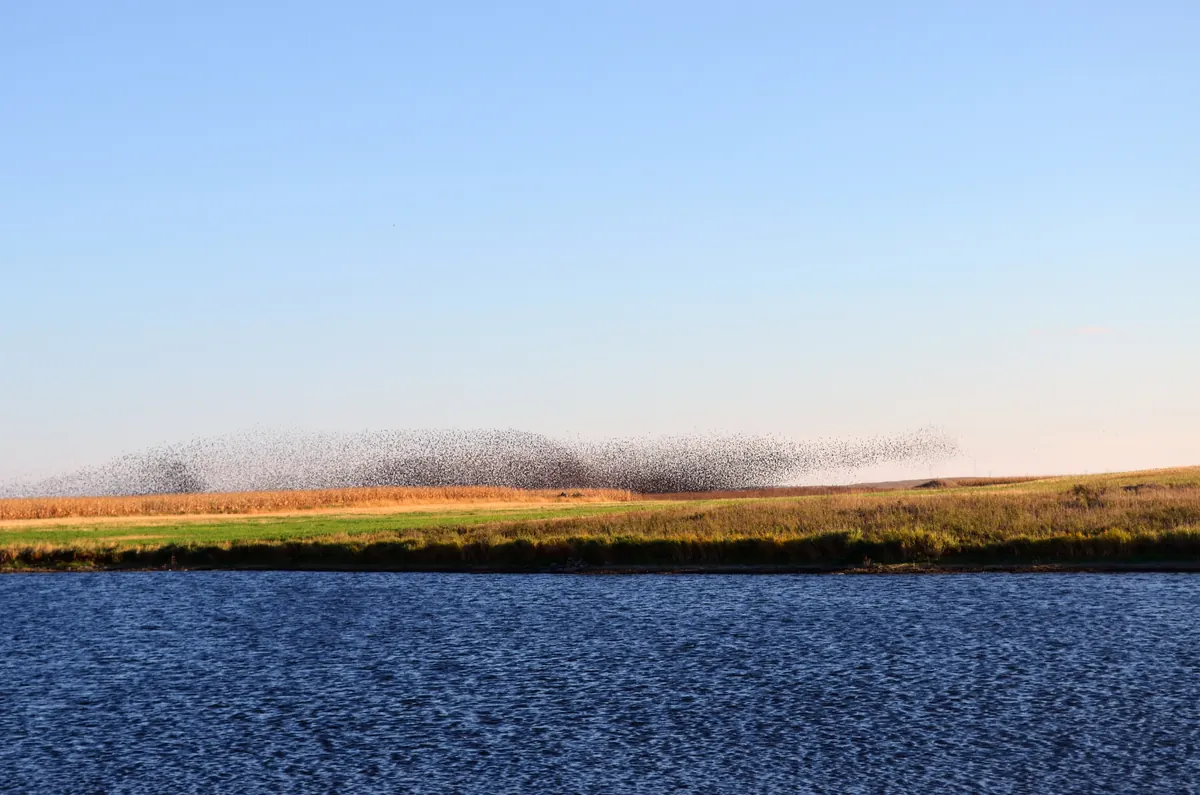
Red-winged blackbirds, common grackles, brown-headed cowbirds and European starlings spend the winter together and stream into a shared night roost at sunset, ribbon after ribbon across the sky. Audubon describes these roosts as holding anywhere from tens of thousands of birds to twenty million. The birds fly poorly in the dark. On New Year’s Eve 2010, about 4,000 to 5,000 blackbirds fell dead on the town of Beebe; AGFC’s ornithologist judged loud fireworks the most likely cause, flushing a roost into the dark, and necropsies found impact injuries. Set off fireworks well away from any big winter roost.
-
Count from your kitchen
Through the winter · Your feeder and yard
Project FeederWatch, run by the Cornell Lab of Ornithology, keeps going all winter, two days at a time, and each December count adds to the record of which sparrows, juncos and woodpeckers settled in for the cold months.
If you join a count, copy the circle’s final total beside your own list.
When is the shortest day and the earliest sunset in Arkansas?
The winter solstice falls on Monday, December 21, at 2:50 p.m. Central Standard Time, when the sun stands farthest south. That is the shortest day of the year in every Arkansas town, but the earliest sunset comes about two and a half weeks before it and the latest sunrise about three weeks after. Little Rock’s earliest sunset is 4:58 p.m., centered on December 5 (sunset holds on that minute for several days either side), and sunset has already slipped a few minutes later by the solstice, while sunrise keeps sliding later until about 7:17 a.m. in the second week of January. Its day shrinks from ten hours on December 1 to 9 hours 49 minutes on the 21st, then wins back three minutes by New Year’s Eve. Jonesboro, farther east in the same time zone, sees the sun go down earliest of the cities below, at 4:49 p.m. The cause is Earth’s tilt working together with its elliptical orbit, which pushes the moment of local noon later each day this month.
Weather scientists count December 1 as the start of winter, since the coldest three months of the year, on average, are December through February. Astronomers wait for the solstice.
-
A solstice sunset on a thousand-year-old calendar
Saturday, December 19, 3:30 to 6:30 p.m. · Plum Bayou Mounds Archeological State Park, Scott, Lonoke County
Between about 650 and 1050 AD the Plum Bayou people raised eighteen mounds around two open plazas near what is now Scott, southeast of Little Rock. The tallest still stands 49 feet. The Encyclopedia of Arkansas notes that several mounds were placed to line up with the sun rising or setting on the equinoxes and solstices, and that the layout used a standard unit of 155.8 feet. The park’s Winter Solstice Celebration starts with a guided walk at 3:30 p.m. and ends on Mound H, where the group watches the sun go down over Mound S, followed by a fire, hot drinks and a Native American story. Admission is $5 for adults, $4 for children 6 to 12 and free under 6.
| City | Dec 1 | Dec 21 | Dec 31 | Earliest sunset |
|---|---|---|---|---|
| Fayetteville | 9 h 53 m | 9 h 42 m | 9 h 45 m | 5:02 p.m., Dec 5 |
| Harrison | 9 h 53 m | 9 h 41 m | 9 h 45 m | 4:57 p.m., Dec 5 |
| Jonesboro | 9 h 54 m | 9 h 44 m | 9 h 46 m | 4:49 p.m., Dec 5 |
| Fort Smith | 9 h 57 m | 9 h 46 m | 9 h 49 m | 5:05 p.m., Dec 5 |
| Little Rock | 10 h 00 m | 9 h 49 m | 9 h 52 m | 4:58 p.m., Dec 5 |
| Hot Springs | 10 h 01 m | 9 h 51 m | 9 h 53 m | 5:02 p.m., Dec 5 |
| Pine Bluff | 10 h 02 m | 9 h 52 m | 9 h 55 m | 4:58 p.m., Dec 4 |
| El Dorado | 10 h 07 m | 9 h 58 m | 10 h 00 m | 5:03 p.m., Dec 4 |
Pick a fixed spot, a fence post or a window frame, and note where on the horizon the sun sets once a week through December; at the solstice it stops moving south and turns back. The Field almanac will look up first light, sunrise and sunset wherever you live.
Do Arkansas bears hibernate, and where do bats spend the winter?
Bears wait longer than most people expect. A University of Arkansas extension fact sheet written by a wildlife ecologist at UA Monticello says Arkansas black bears usually go into their dens between early January and mid-February and come out in March and April, about 100 days in all. So December bears are slow, sleepy and often bedded down, but many are still moving. Bats, on the other hand, have been tucked into caves since late fall.
-
Black bears getting ready
December; denning from early January · Ozark and Ouachita mountains, and the big river bottoms
Pregnant females den first and stay in longest. In the mountains bears favor rock crevices, while bears in the flooded bottomland forests climb into hollow trees above the water and may stay put for 150 days or more. Others just curl up under a root wad or a brush pile. In the den, a bear’s heart slows from 40 or 50 beats a minute to as few as 8, and its body temperature drops only 8 to 12 degrees, so it can wake if disturbed; the fact sheet says a disturbed bear will abandon the den. Cubs about the size of a soda can are born in January or February. On a mild December day, keep the bird feeder and the trash in until bears settle for good.
-
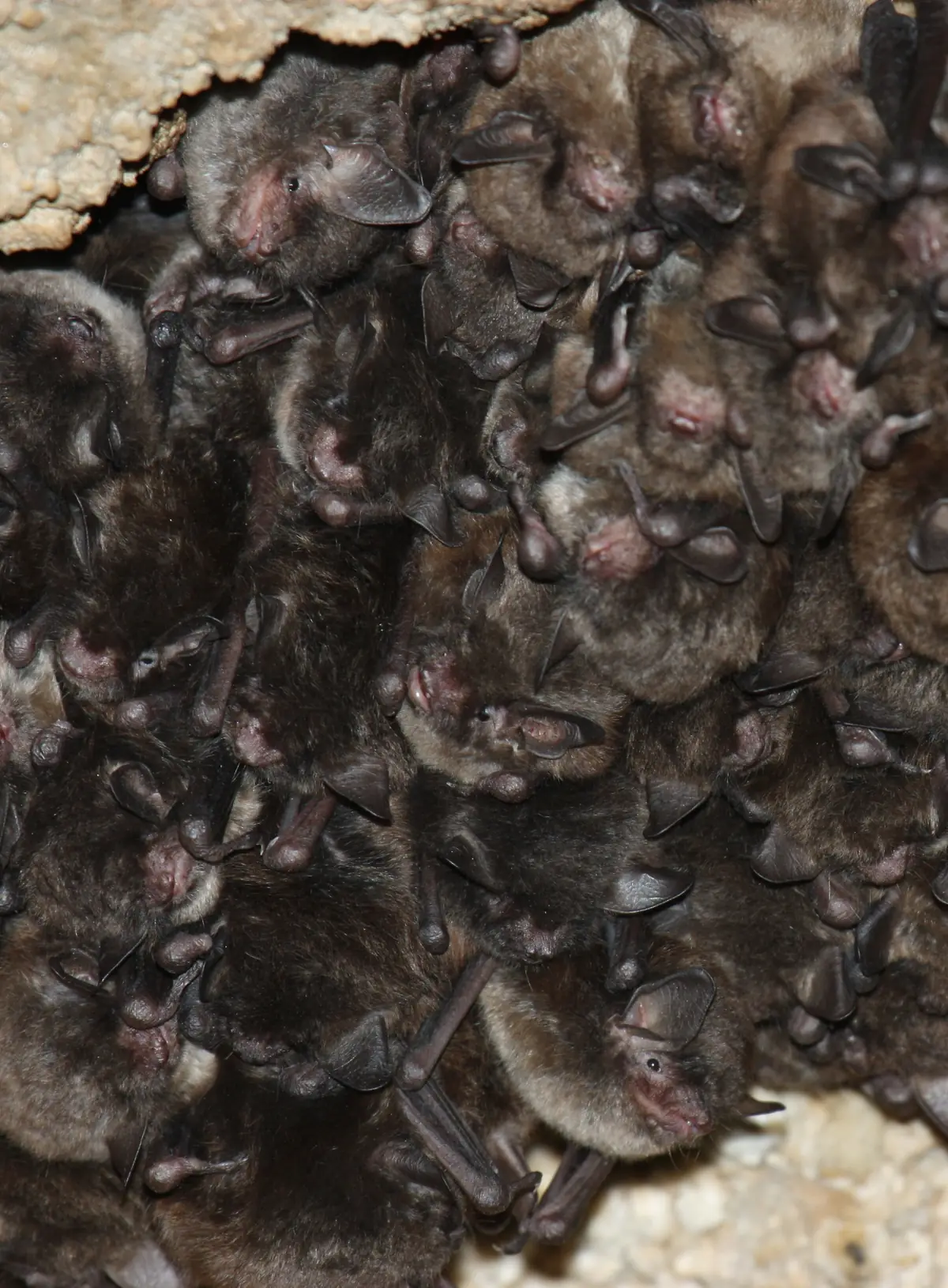
Bats in the caves
Hibernation through the winter · Caves and old mines in the Ozarks and Ouachitas
Arkansas cave bats hibernate in clusters where the air stays cool and damp, the same conditions favored by the fungus that causes white-nose syndrome. The Encyclopedia of Arkansas says the fungus grows best between about 39 and 59 °F, damages the skin of sleeping bats and makes them wake and burn through the fat they need to last until spring; by 2019 it had been found in fifteen Arkansas counties. A bat flying in daylight in midwinter is a warning sign worth reporting to AGFC. On the Ozark-St. Francis National Forest, every cave and mine is closed by order except for guided tours of Blanchard Springs Caverns, so admire the bluffs from outside.
-
The last of the rut
Early to mid-December · The counties along the Mississippi River
AGFC’s fetal studies put peak breeding in the river counties, from Crittenden south to Chicot, in the first two weeks of December, weeks after the rest of the state. Bucks there are still chasing does and crossing roads at odd hours.
Mud after a December rain records the whole neighborhood. Check the edge of a refuge levee or a creek sandbar for raccoon hand prints, the neat line of a fox and the split hearts of deer, and add them to your tracks page.
What is green, berried or blooming in the Arkansas woods in December?
With the hardwoods bare, the evergreens and the winter fruits stand out, and one Arkansas native picks this month to flower.
-
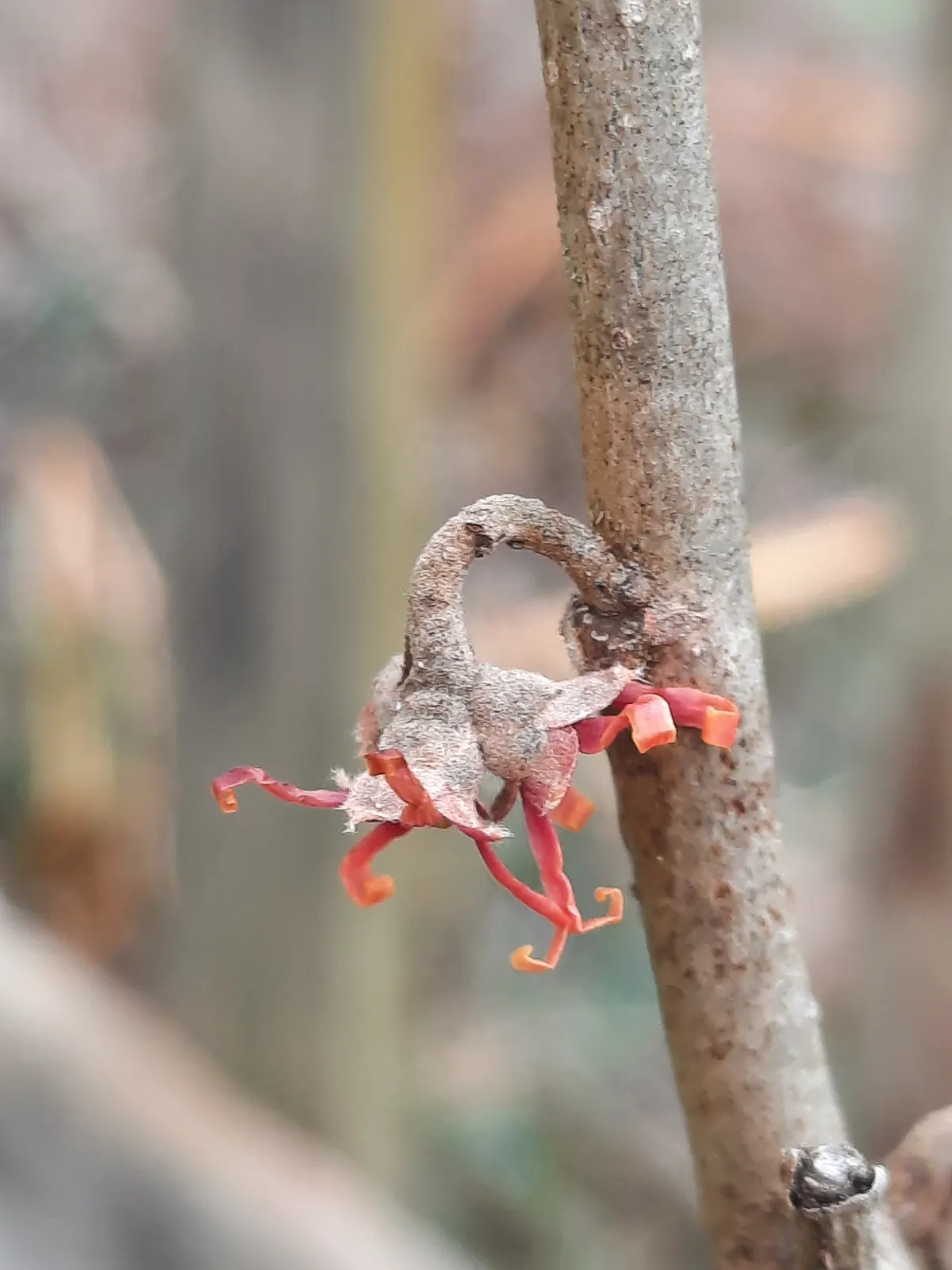
Ozark witch hazel in bloom
December to March · Gravelly streambanks in the Ozarks and Ouachitas
A shrub of rocky creek beds that grows naturally only from southern Missouri to eastern Texas and Alabama, with Arkansas in the middle of that range. The Lady Bird Johnson Wildflower Center gives its flowering months as December to March. The flowers are small knots of thin, crinkled petals in yellow, orange or dark red. Birds eat the seeds from the woody capsules, and deer and beavers browse the twigs.
-
American holly
Berries all winter · Moist woods and stream bottoms
Holly keeps its stiff, spine-tipped leaves through winter, and berries form only on female trees, and only if a male holly flowers somewhere close by. Songbirds, game birds and mammals eat the bitter fruit, but the Wildflower Center warns it is poisonous to people. Holly is slow-growing, so a tall one in the woods is an old one.
-
Eastern redcedar and its blue “berries”
December and January · Old fields, glades, fencerows and roadsides statewide
The dusty blue “berries” on female redcedars are really soft seed cones, and the foliage goes bronze in cold weather. They feed a long list of birds and small mammals; the cedar waxwing takes its name from this tree. When a flock of waxwings strips a cedar in an hour, write down the date.
-
Mistletoe high in the bare trees
Easiest to see in December · In the crowns of hardwoods
The green clumps in leafless trees are mistletoe, a partial parasite that takes water and some of its nourishment from the host tree. People should never eat the white berries. Cedar waxwings and bluebirds do, and the gluey seeds get planted when a bird cleans its bill against a branch or passes them in its droppings.
Bare branches make December the time to learn trees from their buds, bark and shape. Draw a holly twig and a redcedar sprig next to each other on the journal page for seeds, pods and cones, noting where and when.
Does it snow in Arkansas in December, and what will El Niño bring?
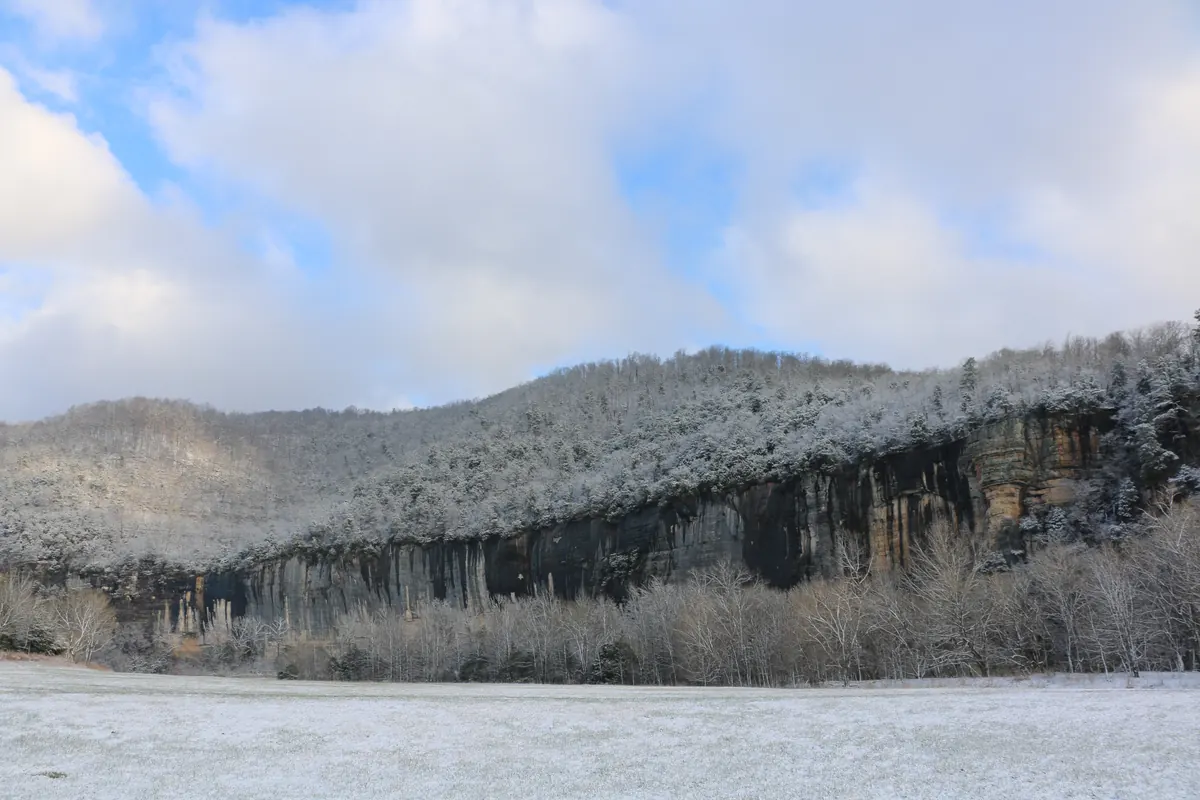
Snow is possible but unusual; ice is the bigger danger. NOAA’s 1991–2020 normals put the average December high at 49 to 50 °F in Harrison, Jonesboro and Fayetteville, 52.6 °F in Little Rock and 58 °F in El Dorado, with average lows from 27.8 °F at Fayetteville’s Drake Field to 37.2 °F in Texarkana. Normal December snowfall is only 0.6 inch at Little Rock and Fort Smith and 1.1 inches at Drake Field. December is wet, though: 5.08 inches of precipitation in Little Rock and 5.61 in El Dorado, against about 3 inches in the northwest.
Averages hide the big storms. On Christmas Day 2012, Little Rock got 10.3 inches of snow, its first snow on Christmas Day since 1926. And December 2000 brought two ice storms two weeks apart, on December 12–13 and on Christmas night into the 26th. The National Weather Service in Little Rock reports up to three inches of ice, more than 500,000 customers without power, some of them for weeks, and the worst icing in nearly 70 years. Severe weather is not over in winter either: of 919 tornadoes in Arkansas from 2000 through 2023, the same office counts 346 between September and February.
This winter will be shaped by El Niño. The federal Climate Prediction Center, writing on September 10, gave better-than-90-percent odds that this El Niño reaches the very strong class by winter. Forecasters at the National Weather Service office in Jackson, Mississippi, whose area takes in southeastern Arkansas, describe the usual pattern: the jet stream dips south, a deep trough settles over the central states, and the Deep South tends toward a wetter, cooler winter and spring, though no two El Niños play out the same way. An Arkansas Weather Network meteorologist interviewed by the extension service in August expected a stretch of above-normal rain through the end of 2026. NOAA’s winter map, covering December to February, was still unpublished as this was written and is set for release October 15 on the CPC outlook maps.
When an ice storm is forecast, fill water jugs, charge batteries and park away from big trees. The Weather now page has radar and the local forecast, and the Arkansas frost dates page lists the last spring freeze for each station, the date that matters once the seed catalogs arrive.
What can you see in the Arkansas night sky in December?
The longest nights of the year, a top-tier meteor shower and the year’s closest full moon. Times below are Central Standard Time.
-
The Geminids
Active December 4–20; best on the night of Sunday, December 13, into Monday, December 14 · Anywhere dark, away from town lights
The International Meteor Organization lists a peak rate of about 150 meteors an hour under perfect skies, with the maximum around 8 a.m. Central on the 14th, so the night before is the one to watch. By mid-evening the young crescent has dropped below the western trees, and from then until dawn moonlight is no problem. Expect the busiest stretch near 2 a.m., with the shower’s radiant at its highest. Dress as if for a deer stand and stay out long enough for your night vision to sharpen.
-
The Cold Moon, closest of the year
Evening of Wednesday, December 23 · Rising in the northeast around sunset
Full moon arrives at 7:28 p.m. Central, and the moon swings to perigee, its least distance from Earth, in the small hours of Christmas Eve, a gap of roughly seven hours. That makes it the biggest-looking full moon of 2026 and a true supermoon.
-
Planets
All month · Saturn in the evening; Venus, Jupiter and Mars before dawn
After dusk, Saturn holds the south and southwest alone, a steady, golden light with no rival among the evening planets. The mornings belong to Venus, blazing in the southeast before sunrise, with Jupiter high up and fainter, reddish Mars nearby. By late December Jupiter rises in mid-evening. Before dawn on December 4 and 5, look for the waning crescent close to the star Spica, with Venus nearby, and on the evening of the 21st a fat gibbous moon passes close to the Pleiades.
-
Ursids, then a January bonus
Ursids December 22; Quadrantids evening of January 3 · Face north for both
The Ursids are a minor shower near the Little Dipper and this year are drowned by a nearly full moon. Better to wait for the Quadrantids, which peak around 9:25 p.m. Central on Sunday, January 3, with the moon close to new.
| Phase | Date | Time |
|---|---|---|
| Last quarter | Tuesday, Dec 1 | 12:08 a.m. CST (just past midnight, as Monday, Nov 30, ends) |
| New moon | Tuesday, Dec 8 | 6:52 p.m. CST |
| First quarter | Wednesday, Dec 16 | 11:42 p.m. CST |
| Full moon, the Cold Moon | Wednesday, Dec 23 | 7:28 p.m. CST (full on the evening of Dec 23; nearly so on Christmas Eve) |
| Last quarter | Wednesday, Dec 30 | 12:59 p.m. CST |
Long nights make December the easiest month for kids to stargaze and still be in bed on time. Check Today’s sky for clear breaks between fronts, and for the hour your town sees the moon come up, open the moon phases page.
What are the best nature outings for Arkansas families in December?
- Saturday, December 5, Queen Wilhelmina State Park near Mena: Owl Pellet Dissection at 4 p.m. (best for ages 7 and up), then Journaling the Journey at 6:30 p.m., where children make a nature journal of their own. Both free.
- Saturday, December 5, Petit Jean State Park: the free Christmas Open House at Mather Lodge, 2 to 4 p.m., with crafts and music.
- Friday, December 11, Lake Catherine State Park: Build a Bird Feeder at the Nature Cabin, 2:30 p.m., free, using materials from the woods.
- Sunday, December 13, Lake Catherine: Birding Basics Hike, 9 a.m., on the paved, 5/8-mile Slunger Creek Nature Trail, good for strollers and wheelchairs. Then stay up for the Geminids that night.
- Thursday, December 17, Crowley’s Ridge State Park near Paragould: Winter Birding for school-age children, four sessions by age group starting at 9 a.m., with homemade suet feeders to take home. Aimed at homeschoolers but open to others; call the park to register, since spots are limited.
- Friday, December 18, Lake Catherine: Hiking Horseshoe Mountain, a strenuous 3.5-mile guided hike at 9 a.m., or the gentler Feel the Furs program at 2:30 p.m.
- Saturday, December 19: the Christmas Bird Count at Lake Catherine (9 a.m.) and the Winter Solstice Celebration at Plum Bayou Mounds (3:30 p.m.).
- Sunday, December 20, Lake Catherine: Owl’s Last Supper, 3:30 p.m., more owl pellets and a look at the park’s owls.
- Wednesday, December 23: watch the Cold Moon rise; let children trace their moon shadows on the driveway.
- Friday, January 1, 2027: First Day Hikes. Arkansas State Parks has joined this national New Year’s Day program since 2014; for 2025 it offered 46 ranger-led hikes at 36 parks. The 2027 list is usually posted in December.
Program times can change with weather, so check each park’s event page before driving out. You’ll find the rest of the country on the nature hub; take the Naturalist’s Field Journal along to every one of these.
Safety notes for December in Arkansas
- Deer seasons in December. Modern gun deer season runs through December 6 in Zones 1, 2, 3, 6, 7, 8, 10 and 11, through December 13 in Zones 4A, 5A, 14 and 15, through December 20 in Zones 9, 12 and 13, and through December 28 in Zones 16, 16A and 17. Every zone is open again, or still open, for the holiday hunt December 26–28. Muzzleloader (alternative firearms) weekends fall on December 12–14 in Zones 1, 2, 3, 6, 7, 8, 10 and 11 and December 19–21 in Zones 4A, 5A, 14 and 15. Archery continues to February 28, and the youth gun hunt returns January 2–3.
- Bears, ducks and geese. A short modern gun bear hunt is open December 19–25 in Bear Zones 3, 4, 5 and 5A, closing early if quotas fill. Duck and goose seasons run December 10–23 and from December 26 to January 31.
- Safety colors. Under AGFC rules, a hunter and every companion must have on a cap plus 400 or more square inches above the belt in hunter orange, chartreuse or blaze camouflage any time they are somewhere open to modern gun or muzzleloader hunting of deer, elk or bear. Waterfowl and other migratory bird hunters are exempt. Hikers are not covered by the rule, but on public land in December, bright clothing for you, and orange on your dog, make sense.
- Ice and cold water. Freezing rain is Arkansas’s worst winter hazard, bringing down limbs and power lines. Stay out from under heavy, iced trees, and stay home when bridges and overpasses glaze. Arkansas ponds seldom freeze hard enough to hold anyone, so keep children and dogs off the ice. Cold lake water can bring on cold shock quickly; anyone in a boat should wear a life jacket.
- Early dark and closed roads. Sunset comes at about 5 p.m. through the first half of the month. Set out early, pack a headlamp and an extra warm layer, and know that some refuge roads close for the season: on the South Unit of Dale Bumpers White River National Wildlife Refuge, most roads and trails close to vehicles after December 15.
- Winter storms. Tornadoes can still strike in December, sometimes after dark, so have a way to be woken by a warning.
Sources
- Arkansas Game and Fish Commission: waterfowl surveys and reports (December aerial survey reports 2019–2022)
- Arkansas Game and Fish Commission: Aerial Waterfowl Survey Report, December 4–15, 2022
- Arkansas Game and Fish Commission: Aerial Waterfowl Survey Report, December 6–9, 2021
- Arkansas Game and Fish Commission: Aerial Waterfowl Survey Report, December 7–10, 2020
- Arkansas Game and Fish Commission: Aerial Waterfowl Survey Report, December 2019
- Arkansas Game and Fish Commission: mallard estimates jump in Delta, December 2025 aerial survey (December 31, 2025)
- Arkansas Game and Fish Commission: 2026–27 waterfowl season dates and WMA shooting hours
- U.S. Fish and Wildlife Service: Big Lake National Wildlife Refuge
- U.S. Fish and Wildlife Service: Wapanocca National Wildlife Refuge
- U.S. Fish and Wildlife Service: Holla Bend National Wildlife Refuge
- U.S. Fish and Wildlife Service: Dale Bumpers White River National Wildlife Refuge (seasonal road closures)
- Arkansas Game and Fish Commission: eagles inspire awe, appreciation for conservation efforts
- National Audubon Society: Christmas Bird Count
- National Audubon Society: the 125th Christmas Bird Count summary (counts and top circle by state)
- National Audubon Society: the 124th Christmas Bird Count summary
- National Audubon Society: the 121st Christmas Bird Count in Arkansas
- Arkansas State Parks: Christmas Bird Count, Lake Catherine State Park, December 19, 2026
- National Audubon Society: illegal fireworks likely cause of the Beebe blackbird deaths
- Project FeederWatch: how to participate
- U.S. Naval Observatory: Earth’s seasons, 2026 (solstice time)
- U.S. Naval Observatory: moon phases from November 1, 2026
- NOAA Global Monitoring Laboratory: solar calculator (equations used for the sunrise and sunset times)
- Arkansas State Parks: Winter Solstice Celebration, Plum Bayou Mounds Archeological State Park, December 19, 2026
- CALS Encyclopedia of Arkansas: Toltec Mounds site (Plum Bayou culture, solar alignments)
- University of Arkansas Cooperative Extension Service: Arkansas Black Bears, Biology and Habits (FSA9086)
- CALS Encyclopedia of Arkansas: white-nose syndrome
- USDA Forest Service, Ozark-St. Francis National Forest: climbing and caving (cave and mine closure)
- Arkansas Game and Fish Commission: White-tailed Deer Strategic Management Plan (peak conception dates by region)
- Lady Bird Johnson Wildflower Center: Ozark witch hazel
- Lady Bird Johnson Wildflower Center: American holly
- Lady Bird Johnson Wildflower Center: eastern redcedar
- Lady Bird Johnson Wildflower Center: American mistletoe
- NOAA NCEI: 1991–2020 monthly normals for Arkansas stations, including December snowfall (data API)
- National Weather Service Little Rock: Winter Weather Awareness (Christmas 2012 snow, ice storms, cool-season tornadoes)
- National Weather Service Little Rock: historic snow and ice storms of 2000
- Climate Prediction Center: ENSO diagnostic discussion, September 10, 2026
- Climate Prediction Center: 90-day seasonal outlooks (winter outlook issued October 15, 2026)
- National Weather Service Jackson, Mississippi: El Niño and the Deep South
- University of Arkansas System Division of Agriculture: will El Niño bring winter precipitation? (August 17, 2026)
- International Meteor Organization: 2026 meteor shower calendar (Geminids, Ursids)
- International Meteor Organization: 2027 meteor shower calendar (Quadrantids)
- EarthSky: what is a supermoon? (2026 full supermoons)
- NASA JPL Horizons: planetary and lunar positions used for the December conjunctions
- Arkansas State Parks: Owl Pellet Dissection, Queen Wilhelmina State Park, December 5, 2026
- Arkansas State Parks: Journaling the Journey, Queen Wilhelmina State Park, December 5, 2026
- Arkansas State Parks: Christmas Open House, Petit Jean State Park, December 5, 2026
- Arkansas State Parks: Build a Bird Feeder, Lake Catherine State Park, December 11, 2026
- Arkansas State Parks: Birding Basics Hike, Lake Catherine State Park, December 13, 2026
- Arkansas State Parks: Crowley’s Ridge Adventure School, Winter Birding, December 17, 2026
- Arkansas State Parks: Hiking Horseshoe Mountain, Lake Catherine State Park, December 18, 2026
- Arkansas State Parks: Feel the Furs, Lake Catherine State Park, December 18, 2026
- Arkansas State Parks: Owl’s Last Supper, Lake Catherine State Park, December 20, 2026
- Arkansas Tourism: begin a new year with First Day Hikes at Arkansas State Parks
- Arkansas Game and Fish Commission: 2026–27 deer seasons and limits by zone
- Arkansas Game and Fish Commission: 2026 bear seasons and limits
- Arkansas Game and Fish Commission: deer-specific hunting regulations (hunter orange requirements)
- Photos via Wikimedia Commons; licenses and photographers are credited under each picture
