What to look for in nature in Arkansas this February
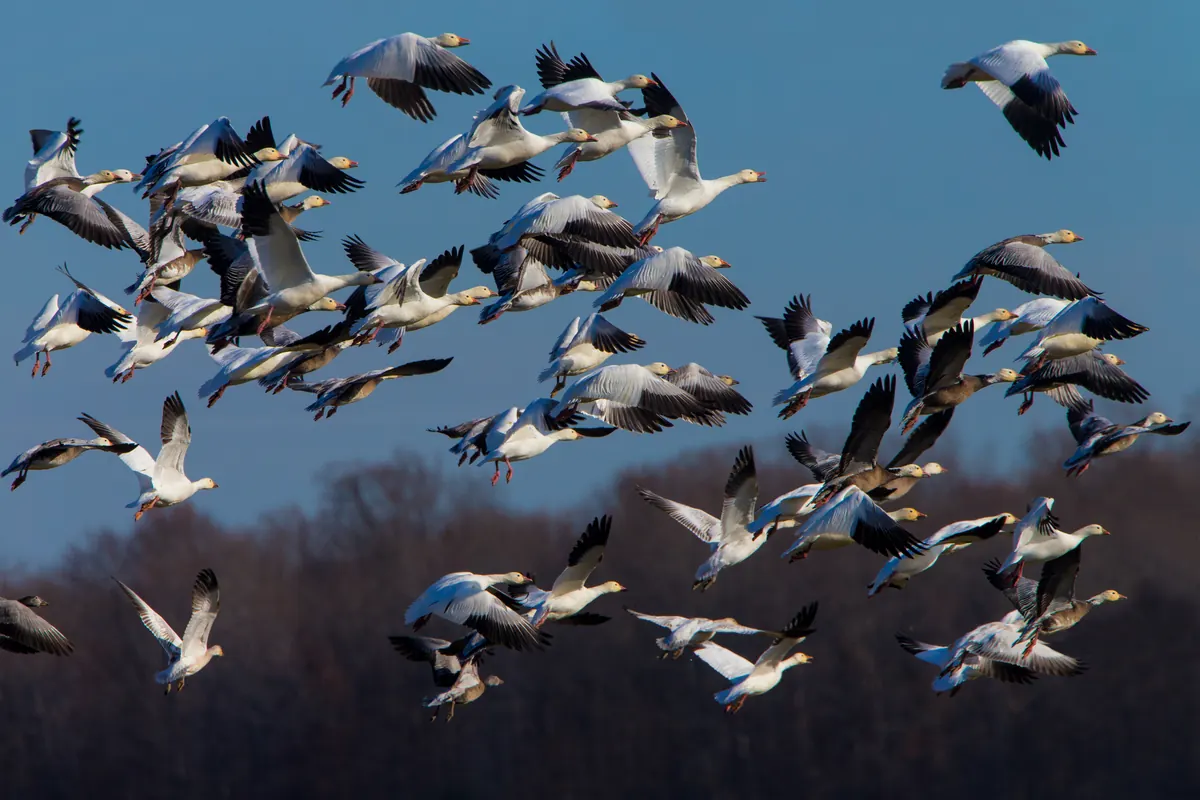
Winter’s final month in Arkansas sounds like spring well before it looks like spring. On mild, wet evenings the ditches and flooded fields fill with the comb-scraping trill of chorus frogs, and in young pine stands and brushy fields male woodcocks spiral into the dusk. Flocks of snow geese begin pouring north across the rice country, and the oldest purple martins, back from Brazil, turn up at backyard colonies in the south and east. Silver maples bloom along the creeks and harbinger of spring opens on wooded slopes. Winter still has teeth: February 2021 brought Little Rock its snowiest month on record. Overhead, Jupiter and Mars reach opposition nine days apart, and a barely visible eclipse touches the Snow Moon as it comes up on the 20th. Here is where and when to look.
Other months in Arkansas: October, November, December, January.
Start here

- Stand at the edge of a field at dusk. On a calm, mild evening, find a brushy old field, a young pine stand or a clearcut next to bottomland woods and wait from sunset until it is nearly dark. Listen for a buzzy “peent” from the ground, then a twittering bird spiraling up into the sky. That is a male American woodcock courting.
- Count birds for the Great Backyard Bird Count. This winter’s four-day count, the 30th, starts on Friday the 12th and ends on Presidents’ Day, Monday the 15th. Count for as little as 15 minutes from your yard, a park or a refuge levee and enter what you saw at birdcount.org.
- Find Jupiter at opposition. On Wednesday evening, February 10, Jupiter reaches opposition, climbing out of the east just as the sun goes down and shining until dawn, the brightest thing in the evening sky after the Moon. Binoculars braced on a fence post may show its four big moons in a line.
For the Naturalist’s Field Journal: give a woodcock evening its own dusk and dawn watch page; start a map of sounds the first night the chorus frogs call; sketch harbinger of spring or a silver maple twig in flower for reading the signs; log your Great Backyard Bird Count tallies on birds I have seen; and return to the tree you chose in January for a tree through the seasons.
Regions used below: The Ozarks and the Buffalo River; Arkansas River Valley; Ouachita Mountains; Central Arkansas and Little Rock; The Delta and Crowley’s Ridge; South Arkansas and the Timberlands.
When do woodcocks do their sky dance in Arkansas?
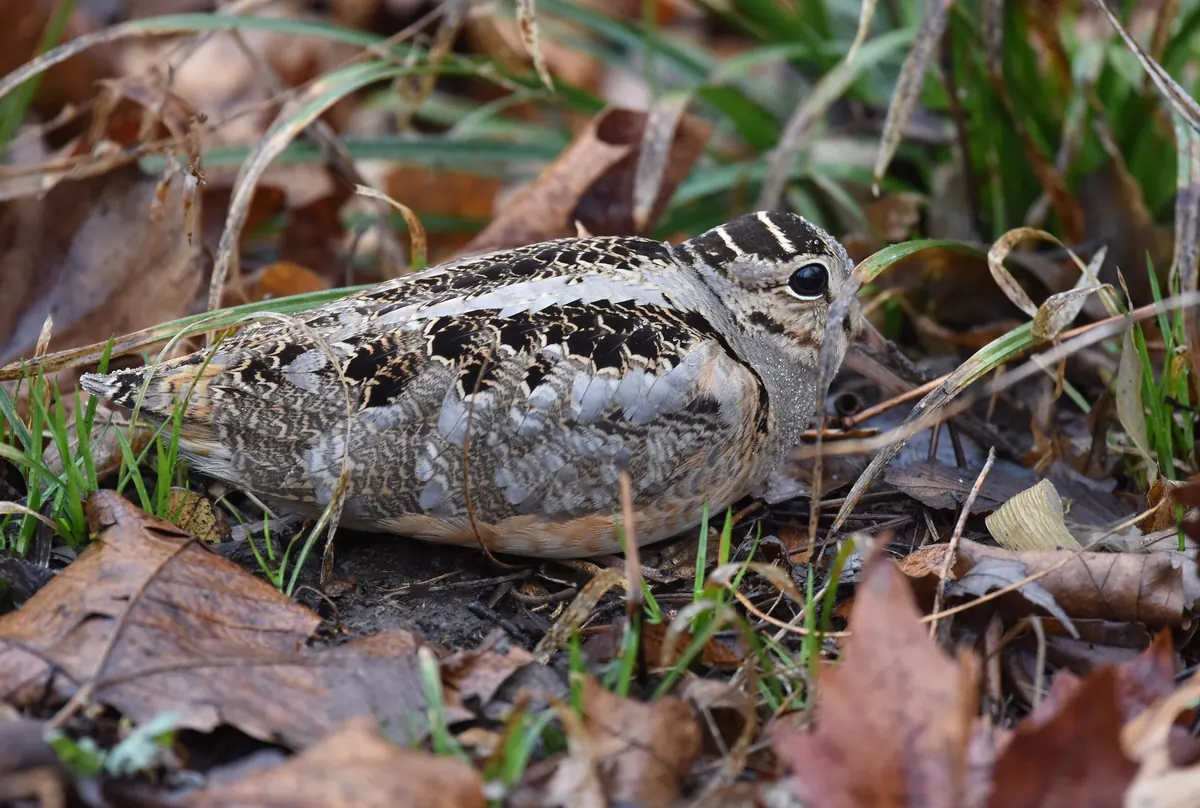
Usually from late January through March, on calm evenings, and February is the heart of it. The American woodcock is a chunky, upland cousin of the sandpipers that hides in damp thickets by day, with eyes set high on its head and a long bill for pulling earthworms out of soft ground. Woodcocks winter across the southern states, Arkansas included, and the males start courting during the trip north, long before they reach their breeding grounds.
The Missouri Department of Conservation describes the display: on the ground the male gives a raspy, loud “peent” every few seconds, then launches into a twittering spiral flight that climbs 200 to 300 feet before he tumbles back to earth. He lands near where he started and begins peenting again. Displays are mostly at twilight, especially dusk.
Researchers from the University of Arkansas at Monticello tracked this behavior on an industrial timberland bordered by the Saline River in Cleveland and Bradley counties. They listened for peenting males from 20 minutes before to 20 minutes after sunset from January to March of 2010 and 2011. The peak came between January 17 and 27 in 2010 and between February 3 and 9 in 2011, so the busiest week shifts with the weather. Males chose young pine plantations with more shrubs and more standing and flattened grass than the bare, sparse openings other southern studies had described.
-
Where to listen
Calm evenings from late January through March; start at sunset · Young pine stands, overgrown fields, clearcuts and pasture edges next to wet bottomland woods, statewide
Look for open ground big enough for a display flight, with damp woods nearby where the birds can feed by night and hide by day. Stand still on a road shoulder or a trail you are allowed to use; woodcocks often display within a few yards of a parked car.
-
Woodcocks at Wedington
A mid- to late-February evening in recent years · Wedington area of the Ozark National Forest, west of Fayetteville
The Northwest Arkansas Audubon Society has led evening woodcock field trips at Wedington on February 22, 2020, February 18, 2023, and February 17, 2024. As of early October 2026 the society listed nothing for 2027, so check its site in January, or simply go on your own.
-
How to see one land
As the bird starts its fall · Same field
When the twittering high above changes and the bird begins its steep fall, follow the sound down with your eyes. In the last light you may see a round, long-billed shape drop to the grass, and soon the peenting starts again.
Log the clock time when the calling begins, how long after sunset that was, the temperature and the wind. A few evenings of notes will show you how tightly the birds follow the fading light.
Which frogs start calling in Arkansas in February?
The chorus frogs, small brown and gray tree frogs that breed in winter rain pools, are the first big voice of the year, and spring peepers join them as the nights soften. You will hear them from ditches, flooded fields and woodland pools on mild, damp nights, often when it still feels like winter.
-
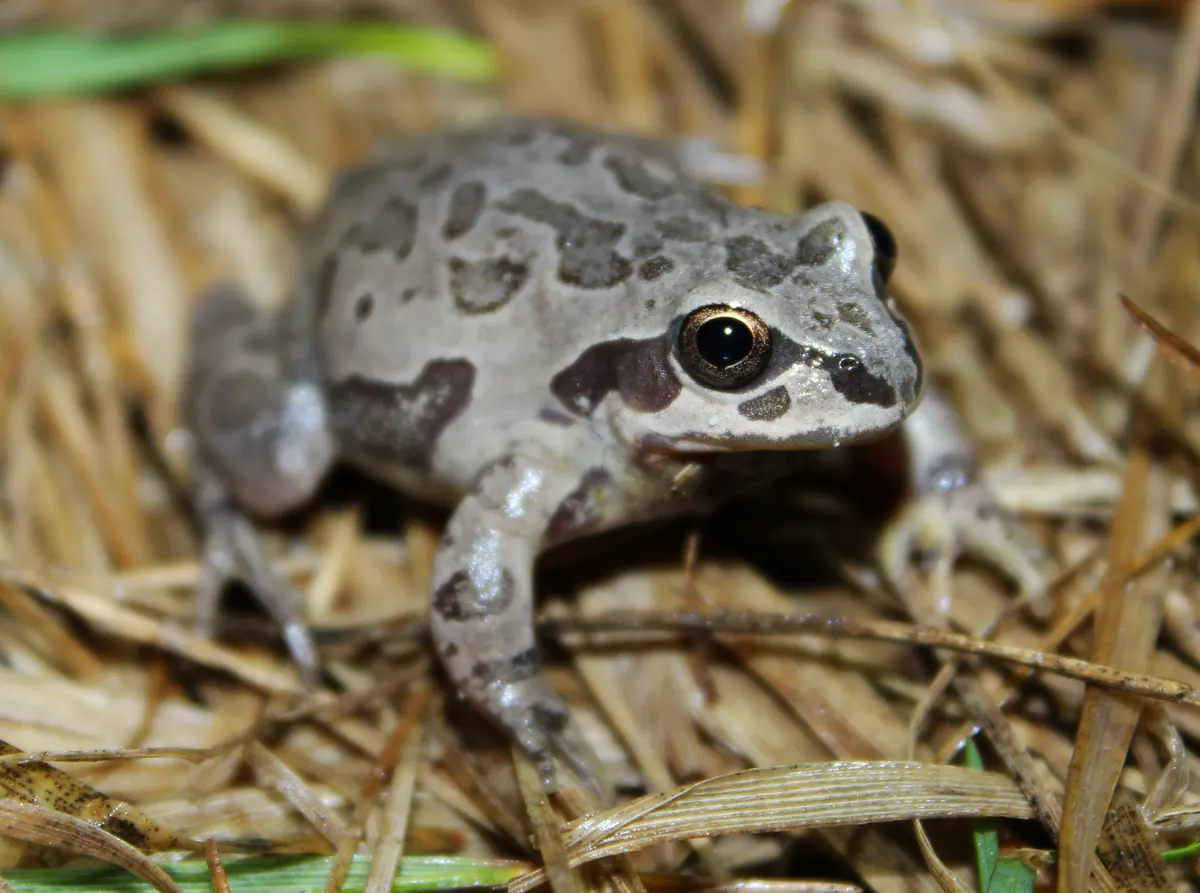
Cajun chorus frog
Late winter into spring, on wet nights; also by day early in the season · Most of the state, in roadside ditches, flooded fields and shallow pools
The Herps of Arkansas atlas lists the Cajun chorus frog as the most widespread of its group in the state. The atlas likens its rising call to a fingernail raked across a pocket comb. Oklahoma’s wildlife department notes that early in the breeding season the frogs may chorus by day as well as at night; across the line in southeastern Missouri they have been heard from February into early April, with the peak in March.
-
Spring peeper
Late winter into spring, after warm rains · Fishless woodland pools nearly statewide, scarce in much of the Delta
An inch-long tan frog marked with a darker cross, calling a clear, rising “peep” roughly once a second. Herps of Arkansas finds it nearly everywhere except large parts of the Mississippi Alluvial Plain. The Missouri guide calls it one of the first frogs to call each year, and a full chorus sounds like hundreds of small sleigh bells.
-
Strecker’s chorus frog
Late winter · Farmed bottomlands along the Arkansas River Valley
A rare, stout little frog that the Game and Fish Commission lists as a species of greatest conservation need. Its call is a metallic “tink,” quickly repeated. Oklahoma’s field guide puts it among the first frogs to breed in late winter and says it digs forward into sand with its strong front legs, unlike the toads that back into the ground.
-
Illinois chorus frog
Late February into early April, after rain · Extreme eastern Clay County only
Arkansas holds one tiny piece of this frog’s range: the old sand prairies of eastern Clay County, now almost entirely row-crop fields. The frog is small, 1 to 1½ inches in Missouri’s field guide, and spends most of the year buried in sand; in winter it must burrow more than 10 inches deep to escape the frost. It surfaces to breed in pools that form in fields and ditches, and its call is a quick run of high, birdlike whistles. The U.S. Fish and Wildlife Service decided in 2023 that federal listing was not warranted, and a conservation group sued over that decision in March 2026, arguing that the Arkansas population in particular is close to disappearing. Listen only from public roads; the breeding pools are on private farmland.
The best frog night is the first mild evening after a soaking rain. Drive slowly with the windows down, stop where the sound is loudest, and note the date and air temperature on your map of sounds.
When do snow geese leave Arkansas?
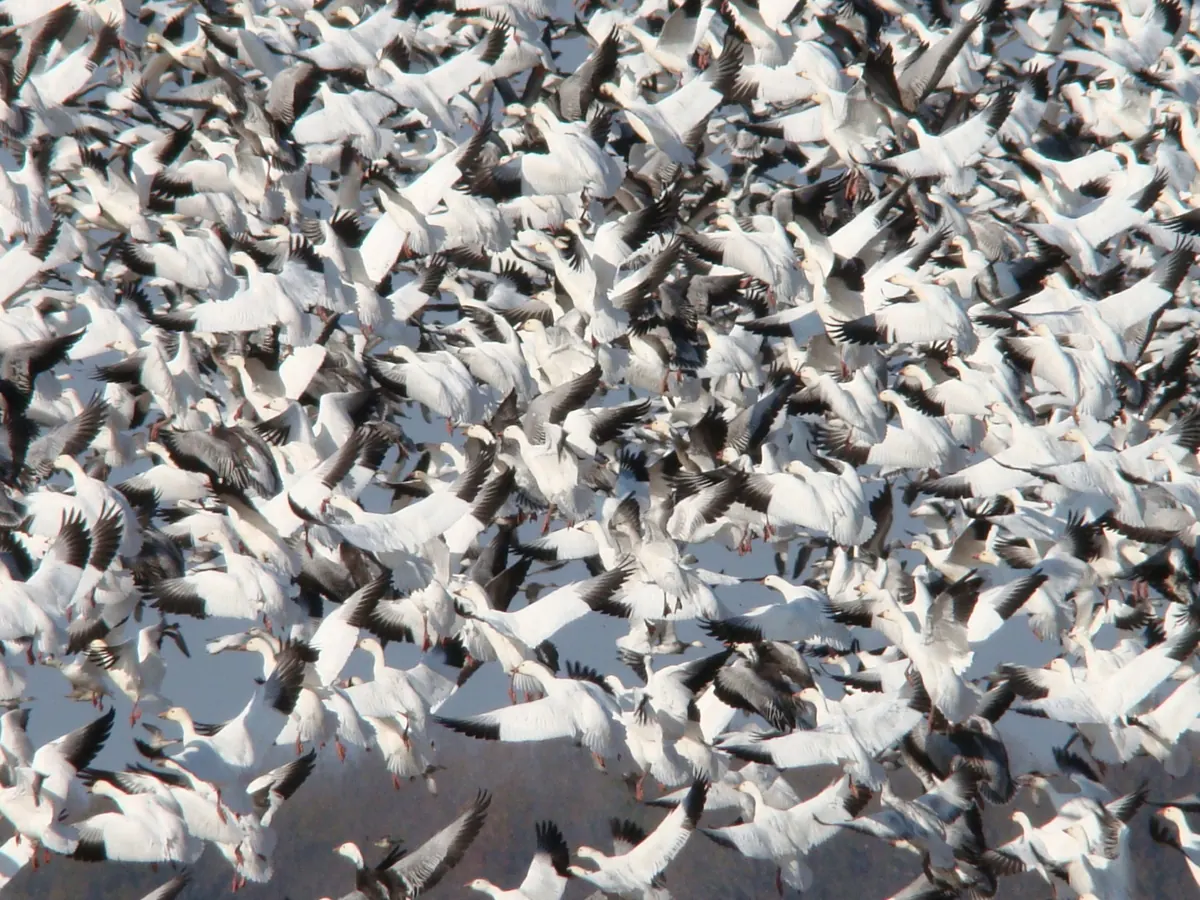
Mostly from February into early March. The light geese (snow geese, their dark “blue” form, and the smaller Ross’s goose) that spent the winter in the Delta and farther south begin working north through Arkansas’s rice country, and the white flocks are the spectacle of the month: long, wavering lines overhead, and fields that look snow-covered until the whole flock lifts at once.
Those numbers are a problem as well as a sight. Game and Fish explains that light geese grew so abundant that they began eating themselves out of house and home on the sub-Arctic and Arctic tundra, damaging nesting grounds they share with other birds. Congress responded in 1999 with the Arctic Tundra Habitat Emergency Conservation Act, which allows a spring Light Goose Conservation Order once the regular season closes. In Arkansas, the Commission says most of the conservation order action typically comes in February and early March, which is also when the birds are moving.
Food along the way matters. Flooded rice fields are estimated to provide 11 percent of all the food energy available to ducks such as mallards and pintails in the Delta, and the Commission’s WRICE program pays farmers to leave rice stubble standing and flood it during migration rather than plowing the waste grain under.
-
The 2027 conservation order
February 1–5 and February 8 to April 25, 2027 · Statewide, mostly in the Delta and Grand Prairie
During the order there is no daily or possession limit on light geese, hunters may use electronic calls and unplugged shotguns, and legal hours run from a half hour ahead of sunrise to a half hour beyond sunset. Hunters need a free snow goose registration permit from the Commission, plus a valid Arkansas hunting license and Waterfowl Stamp (youths 15 and younger excepted).
-
Bald Knob reopens March 1
Closed through February 28 · Bald Knob National Wildlife Refuge, White County
The waterfowl sanctuary at Bald Knob stays closed to all public use from November 15 through the last day of February. Watch from open roads this month; when the sanctuary reopens, many of the wintering flocks will already have moved on.
For the winter counts of ducks and geese across the Delta, see the January page. In your journal, record the hour and direction of every goose line you see this month; by early March most will be heading north or northwest.
When do purple martins come back to Arkansas?
The first ones usually appear in February. The Purple Martin Conservation Association calls these early arrivals scouts: the very first martins seen back at a colony each year. They are the oldest birds in the population, male or female, and they migrate as early as the weather allows. The old belief that scouts fly ahead to choose a site and then go back to lead the colony north is a myth; martins travel and arrive independently. Purple martins winter in the rainforests of Brazil, and east of the Rockies nearly all of them now nest in houses and gourds that people put up.
The association’s Scout-Arrival Study collects first-arrival reports from martin hosts. In Arkansas the earliest reports of recent years have come from the south and east, from places such as Wheatley in St. Francis County and Warren in Bradley County, while hosts around Rogers, Siloam Springs and Harrison have mostly logged their first birds in March.
-
Get the housing ready
Early February in the south; late February in the Ozarks · Open yards, ponds and farmsteads
The association advises putting housing up with the entrances closed, then opening it when adults are due in your area, using its scout map to judge the timing.
| Year | Earliest report | Town | Next earliest |
|---|---|---|---|
| 2022 | Feb 10 | Hardy | Feb 14, Lake City |
| 2023 | Feb 10 | Emerson and Warren | Feb 15, Warren and Bluff City |
| 2024 | Feb 4 | Wheatley | Feb 6, Hermitage |
| 2025 | Jan 30 | Sheridan | Feb 2, Brookland |
| 2026 | Feb 12 | Austin | Feb 18, DeWitt |
The purple martin is North America’s largest swallow, and adult males are glossy blue-black all over. If one turns up in February, note the date and weather in your daily field log.
What is the first thing to bloom in Arkansas in late winter?
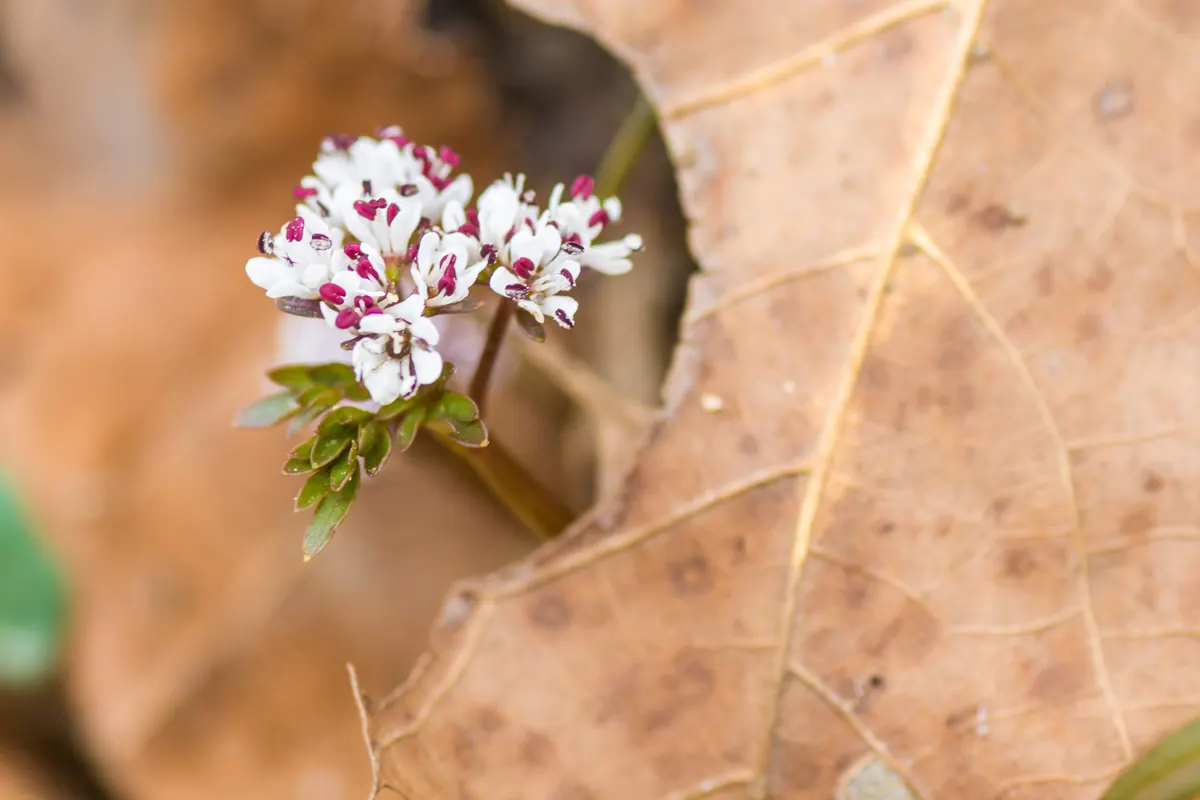
The trees go first. Silver maple flowers before almost anything else, and on the forest floor a tiny plant called harbinger of spring opens its first clusters while the leaf litter is still brown. Spring beauties follow in lawns about the time the garden crocuses bloom.
-
Harbinger of spring
Blooms January to April; look in February · Rich, moist woods in ravines, valleys and wooded slopes along streams
A plant of the carrot family only a few inches tall at first, with clusters of tiny white flowers whose dark reddish-brown anthers earn it the name pepper and salt. The Missouri guide says it opens the spring flowering season, and can bloom as early as January. The feathery leaves often come up after the first flowers.
-
Silver maple
Flowers January to April · Stream banks, river bottoms and town streets
The earliest of the maples to flower. The clusters have no petals and appear on bare twigs, so a tree in bloom just looks faintly red or yellow-green against the sky. Winged seeds up to two inches long follow in spring and feed songbirds and squirrels. Fast-growing and soft-wooded, it helps hold creek banks together.
-
Red maple
Mostly March and April; on warm February days · Bottomlands, swamps and upland woods statewide
Red flowers, red twigs and red seeds, and among the earliest trees to bloom. The Missouri guide notes that red maple may start flowering on warm days in February, and that squirrels nip off the buds and flowers and lick the sweet sap oozing from the twigs. The Wildflower Center rates the flowers of special value to native bees and honey bees.
-
Spring beauty
Late winter into spring · Sunny lawns, old fields and open woods
The University of Arkansas extension describes flowers about the size of a dime, five equal petals veined in pink, above narrow, slightly succulent leaves. Each plant grows from a corm about the size of a peanut two to three inches underground.
Ozark witch hazel along rocky creeks keeps flowering into March; see the December page for where to find it. Sketch the first flower you find each February and in a few years you will have your own spring calendar.
Which Arkansas birds are already nesting in February?
The big owls and hawks. Long before the songbirds build, the raptors are paired, settled and, in some cases, already feeding young.
-
Great horned owlets
Hatching from late February into March · Old hawk and squirrel nests in woodlots, bottomlands and town parks
The Missouri Department of Conservation puts great horned owl breeding in late January or early February, with two eggs on average and about a month of incubation, so in many nests the first downy owlets should hatch in late February or March. Scan big stick nests in bare trees for the tips of two feathered horns poking above the edge.
-
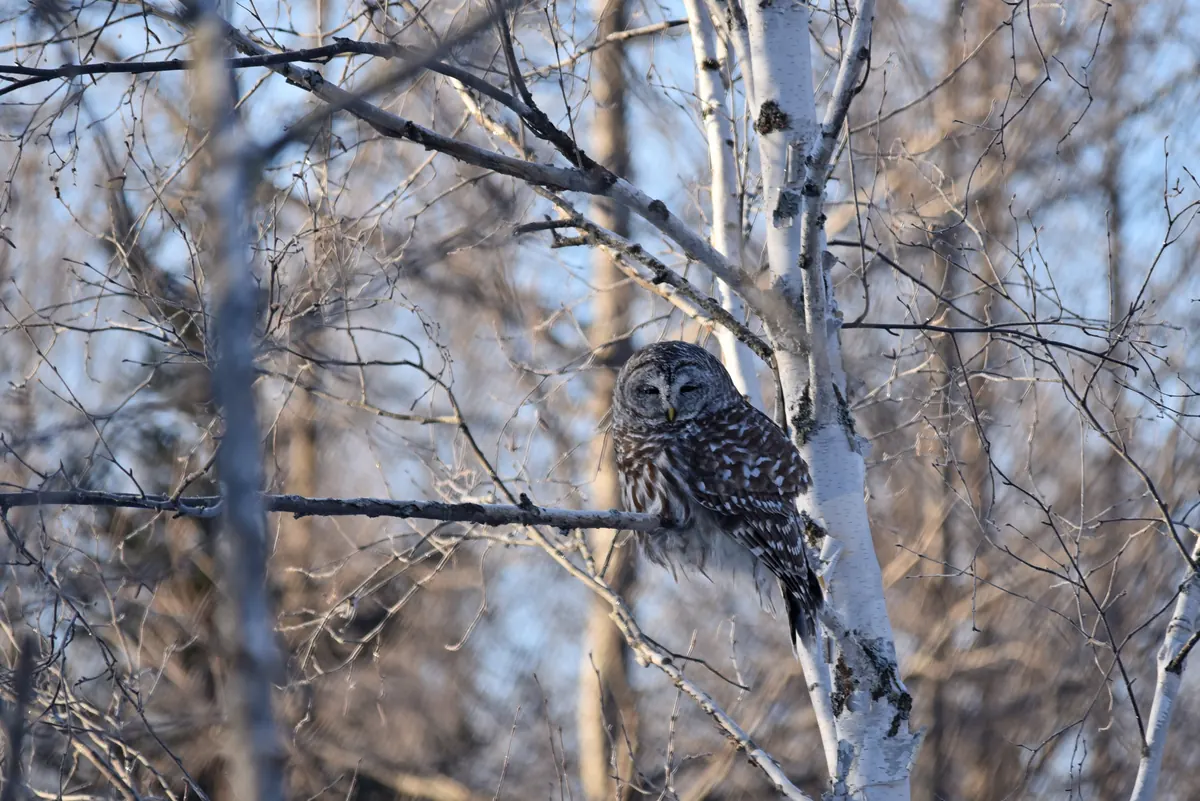
Barred owls courting
February and March · Big timber along rivers, lakes and swamps
In bottomland timber the barred owl’s eight-note hooting, often written as the question of who will do the cooking, carries far, along with a varied run of hoots and screams that is hard to pin to one tree. Missouri’s guide gives February through March for courtship and breeding, 28 days of incubation, and a nest usually in a tree cavity 20 to 40 feet up.
-
Red-tailed hawks on territory
All month; nesting usually by mid-March · Fencerows, highway edges and farm woodlots
Red-tail pairs may hold the same territory for years, and they nest earlier than any other hawk in Missouri, around mid-March. In February, watch for a pair perched near each other along the same woodlot edge day after day, and for an old stick nest that may already stand three feet tall from years of additions.
Any nest you find this month deserves distance: a disturbed owl or hawk may leave eggs to chill. Mark it on your nest observed page and come back with binoculars in April to see what hatched.
Does it snow in Arkansas in February, and what will a strong El Niño mean?
It can, and sometimes more than in any other month. Normal February snowfall in the NOAA 1991–2020 normals is 1.6 inches at Little Rock and 2.4 at Drake Field in Fayetteville, a little more than in January at both, but only 0.6 at Fort Smith. Averages hide the big years. In mid-February 2021, a piece of the polar vortex broke south and two snowstorms crossed Arkansas within four days. The National Weather Service in Little Rock measured 8.4 inches there on the 14th and 15th, and another 11.8 on the 17th and 18th. Over the two storms Sheridan picked up about 15 inches. February 2021 ended with 20.3 inches at Little Rock, more than in any other month on record. On the morning of the 16th Fayetteville hit 20 below zero and Little Rock fell to −1 °F, its lowest reading since December 1989.
February is also a month for warm-air outbreaks. On February 5, 2008, the Super Tuesday outbreak killed 14 Arkansans, and one tornado stayed on the ground for 122 miles from near Atkins past Clinton, the longest track on record in the state since 1950. The day before, Little Rock had reached a record 78 °F.
The odds this time are lopsided: NOAA’s ENSO forecasters wrote on September 10, 2026, that a peak in El Niño’s top category over the cool season was more than 90 percent likely. The Little Rock forecast office has looked back at moderate and strong El Niño winters since the early 1980s: December through February came out wetter than normal statewide in four of five, by more than two inches in three of them, and warmer than normal in four. The exception was 2009–10, when a long stretch of the negative Arctic Oscillation drove one cold blast after another and the winter ran more than four degrees cold. In its outlook for the strong El Niño winter of 2023–24, the office explained that this pattern tends to mean fewer rounds of cold air rather than mildness all season, along with more big slugs of moisture, which can turn wintry whenever cold air is in place. For the official outlook for February and the months after, check the latest maps among NOAA’s 90-day outlooks, which are updated each month.
| Winter | Precipitation | Departure | Average temperature | Departure |
|---|---|---|---|---|
| 1982–83 | 16.97 in | +4.85 in | 42.8 °F | +1.5 °F |
| 1991–92 | 11.86 in | −0.26 in | 44.8 °F | +3.5 °F |
| 1997–98 | 15.17 in | +3.05 in | 43.7 °F | +2.4 °F |
| 2009–10 | 14.22 in | +2.10 in | 37.0 °F | −4.3 °F |
| 2015–16 | 12.89 in | +0.77 in | 45.5 °F | +4.2 °F |
February’s normal highs run from about 51 °F at Harrison and Jonesboro to 55 at Little Rock and 60 at El Dorado, so a single week can swing from frog weather to ice. Look at the forecast and radar before any drive into the hills, and gardeners can check the last spring frost dates for their town before setting out tender plants.
How much daylight does Arkansas gain in February?
Close to an hour, and faster every week. From February 1 to February 28 the cities below each add 50 to 57 minutes, which works out to roughly two extra minutes of light per day, and the pace quickens as March nears. Fayetteville and Harrison in the north gain the most and El Dorado in the south the least, because the change is always larger farther from the equator.
Punxsutawney Phil makes his call on Tuesday, February 2. Astronomically, winter is half over a day or two after that, on February 3–4, when the Earth is midway in its orbit between the solstice and the spring equinox. The groundhog’s shadow predicts nothing; the stretching afternoons are the honest sign.
| City | Feb 1 | Feb 28 | Gained | Per day |
|---|---|---|---|---|
| Fayetteville | 10 h 26 m | 11 h 23 m | 57 min | 2.1 min |
| Harrison | 10 h 25 m | 11 h 22 m | 57 min | 2.1 min |
| Jonesboro | 10 h 27 m | 11 h 23 m | 56 min | 2.1 min |
| Fort Smith | 10 h 29 m | 11 h 23 m | 54 min | 2.0 min |
| Little Rock | 10 h 30 m | 11 h 24 m | 54 min | 2.0 min |
| Hot Springs | 10 h 32 m | 11 h 24 m | 52 min | 1.9 min |
| Pine Bluff | 10 h 33 m | 11 h 25 m | 52 min | 1.9 min |
| El Dorado | 10 h 37 m | 11 h 27 m | 50 min | 1.9 min |
Sunset creeps north along the skyline all month. Look up the minute the sun rises and sets over your own town with the sunrise and sunset tables.
What can you see in the Arkansas night sky in February?
Two planets at opposition, a full moon with a faint eclipse, and Mercury at its best evening showing of the winter, while Saturn sinks into the western twilight and Venus rules the dawn. Times are Central Standard Time.
-
Mercury in the evening
Late January to about February 10; farthest from the Sun on February 2–3 · Low in the west-southwest, 30 to 45 minutes after sunset
The innermost planet stands about 18 degrees from the Sun at midnight between February 2 and 3, its widest evening separation of this winter. On Sunday the 7th a crescent barely a day old sits next to Mercury low in the evening glow. A clear, flat western horizon is essential.
-
Jupiter at opposition
Wednesday, February 10, and all month · Rising in the east at sunset, high in the south around midnight, in Leo
Jupiter is opposite the Sun at 6:21 p.m. on the 10th, about 405 million miles from Earth and at magnitude −2.5, brighter than any star. It is up all night. Late on Friday the 19th and into early Saturday, the almost-full Moon slides right past it.
-
Mars at opposition
Friday, February 19; closest to Earth February 20 · Rising in the east at dusk, also in Leo
Mars reaches opposition on the morning of the 19th and its closest point, about 63 million miles away, the next day. This is a small, distant opposition, and the planet appears only 13.8 arcseconds across, so even in a telescope the disk is tiny. To the eye it is a steady orange-red point at magnitude −1.2, a striking color match for Jupiter’s cream-white glow nearby.
-
The Snow Moon and a faint eclipse
Saturday, February 20, from moonrise to about 7:13 p.m. · Low in the east around sunset
The Moon is full at 5:23 p.m. on the 20th, and a penumbral eclipse is under way, with the Moon passing through the Earth’s pale outer shadow. The greatest eclipse comes at 5:13 p.m., before the Moon rises in Arkansas, and the event ends at 7:13 p.m. A sharp-eyed watcher might catch a slight smoky shading along one side of the rising Moon; most people will see nothing unusual. The real show that evening is the gathering in Leo: the full Moon, Jupiter, the star Regulus and Mars, a day past opposition, all in the same part of the sky. Some almanacs count this as a supermoon, others do not.
| Phase | Date | Time |
|---|---|---|
| New moon | Saturday, Feb 6 | 9:56 a.m. CST |
| First quarter | Sunday, Feb 14 | 1:58 a.m. CST |
| Full moon, the Snow Moon | Saturday, Feb 20 | 5:23 p.m. CST (penumbral eclipse in progress at moonrise) |
| Last quarter | Saturday, Feb 27 | 11:16 p.m. CST |
The first ten days or so of the month have dark, moon-free evenings, ideal for Mercury and for faint stars. Today’s sky shows when the clouds will part between fronts, and the moon phase calendar lists rise and set times.
What can Arkansas families do outdoors in February?
- Evenings of February 2–10: find Mercury. A low, clear western horizon and binoculars help. Never sweep binoculars toward the sun before it has set.
- Wednesday, February 10: Jupiter at opposition. Let children count Jupiter’s moons with binoculars and draw their positions, then look again the next night.
- February 12–15, Friday through Presidents’ Day: Great Backyard Bird Count. Fifteen minutes on any of the four days counts; report at birdcount.org.
- Any calm evening: a woodcock watch. Bring warm coats and a thermos to the edge of a brushy field at sunset. The Northwest Arkansas Audubon Society has led woodcock evenings at Wedington in mid- to late February in recent years; check its site for any 2027 trip.
- The first mild, rainy night: a frog drive. Roll the windows down near flooded fields and ditches and count how many kinds you hear.
- Eagle tours on the lakes. Arkansas State Parks offers interpreter-led winter eagle watches, such as the cruises at DeGray Lake; check the parks event calendar for February dates before you go.
- Saturday, February 20: Snow Moon night. Watch the full Moon rise and find Jupiter, Mars and Regulus around it.
- All month: Project FeederWatch. The season runs to April 30, so a family can still sign up and count at the feeder through spring.
Ice or high water can cancel park programs, so confirm the day before. Arkansas’s other months and the rest of the country are linked from the nature pages; pack the Naturalist’s Field Journal to record what you find.
Safety notes for February in Arkansas
- Late-season hunting. The regular duck and goose seasons close January 31, but the youth waterfowl hunt and the hunt for active-duty military and veterans both fall on Saturday and Sunday, February 6–7, and the Light Goose Conservation Order runs February 1–5 and February 8 to April 25. Archery deer season stays open through February 28. Squirrel and rabbit seasons run to February 28, bobwhite quail on private land to February 7, and crow season to February 21 on Thursdays through Mondays only.
- Furbearers. Bobcat, fox, mink, muskrat and river otter may be hunted until February 28, and coyote, raccoon and opossum year-round. Furbearer trapping closes at sunset February 28, but beaver, nutria and coyote trapping continues through March 31, so leash dogs anywhere near beaver ponds and creek bottoms.
- Hunter orange. The AGFC’s safety-color rule (a hat plus 400 square inches on the upper body, in orange, chartreuse or blaze camo, for every hunter and companion) applies where a modern gun or alternative firearms hunt for deer, bear or elk is under way. With only archery deer season running in February, the rule generally does not apply this month, but bright clothing on public land and an orange vest on your dog are still wise while bowhunters and goose hunters are out.
- Ice and snow. February 2021 was Little Rock’s snowiest month on record. When freezing rain or snow is forecast, stay off the roads, and stay away from trees and power lines loaded with ice.
- Tornadoes and flash floods. A warm, humid February day can turn violent, as on February 5, 2008. In a wet El Niño winter, low-water crossings in the Ozarks and Ouachitas can flood quickly; never drive into moving water.
- Cold nights and cold water. A frog drive or woodcock walk can start near 60 °F and end below freezing. Dress in layers, and wear a life jacket in any boat, since the lakes are still winter-cold.
Sources
- Missouri Department of Conservation field guide: American woodcock
- U.S. Fish and Wildlife Service: January 2025 Bird of the Month, American woodcock
- Long and Locher, American Woodcocks’ use of pine plantation habitat during spring in central Arkansas, Wilson Journal of Ornithology 125(2), 2013 (University of Arkansas at Monticello)
- Northwest Arkansas Audubon Society: field trips (Woodcocks at Wedington)
- Herps of Arkansas: Cajun chorus frog complex
- Herps of Arkansas: spring peeper
- Herps of Arkansas: Strecker’s and Illinois chorus frogs
- Oklahoma Department of Wildlife Conservation field guide: Cajun chorus frog
- Oklahoma Department of Wildlife Conservation field guide: Strecker’s chorus frog
- Missouri Department of Conservation field guide: Cajun chorus frog
- Missouri Department of Conservation field guide: spring peeper
- Missouri Department of Conservation field guide: Illinois chorus frog
- U.S. Fish and Wildlife Service: Illinois chorus frog populations found stable, not warranted for listing (July 2023)
- Center for Biological Diversity: lawsuit seeks Endangered Species Act protections for Illinois chorus frog (March 18, 2026)
- Arkansas Game and Fish Commission: Light Goose Conservation Order (2027 dates and rules)
- Arkansas Game and Fish Commission: goose hunters look forward to continued spring “snowstorms” (February 2021)
- Arkansas Game and Fish Commission: Arkansas Waterfowl Rice Incentive Conservation Enhancement (WRICE) program
- Arkansas Game and Fish Commission: 2026–27 waterfowl season dates, youth and veterans hunts
- U.S. Fish and Wildlife Service: Bald Knob National Wildlife Refuge (sanctuary closure)
- Purple Martin Conservation Association: Scout-Arrival Study
- Purple Martin Conservation Association: Scout-Arrival Study reports from Arkansas, 2022–2026
- Purple Martin Conservation Association: housing timing
- Missouri Department of Conservation field guide: harbinger of spring
- Lady Bird Johnson Wildflower Center: harbinger of spring (Erigenia bulbosa)
- Missouri Department of Conservation field guide: silver maple
- Missouri Department of Conservation field guide: red maple
- Lady Bird Johnson Wildflower Center: red maple (Acer rubrum)
- University of Arkansas Cooperative Extension Service: spring beauty, plant of the week
- Missouri Department of Conservation field guide: great horned owl
- Missouri Department of Conservation field guide: barred owl
- Missouri Department of Conservation field guide: red-tailed hawk
- NOAA NCEI: 1991–2020 monthly normals for Arkansas stations (data API)
- National Weather Service Little Rock: two heavy snows and Arctic cold, February 14–20, 2021
- National Weather Service Little Rock: severe weather of February 5, 2008
- National Weather Service Little Rock: winter outlook, December 2023 to February 2024 (Arkansas in past El Niño winters)
- Climate Prediction Center: ENSO diagnostic discussion, September 10, 2026
- Climate Prediction Center: 90-day seasonal outlooks
- U.S. Naval Observatory: moon phases from December 30, 2026
- U.S. Naval Observatory: Earth’s seasons, 2027 (solstice and equinox for the midpoint of winter)
- NOAA Global Monitoring Laboratory: solar calculator (equations used for the day-length table)
- Fred Espenak: Sky Event Almanac 2027 (Mercury, Jupiter and Mars oppositions, Moon pairings)
- NASA Goddard: lunar eclipses of 2021–2030 (penumbral eclipse of February 20, 2027)
- EarthSky: Jupiter at opposition
- Sea and Sky: astronomy calendar of celestial events, 2027
- National Audubon Society: Great Backyard Bird Count (2027 dates)
- Birds Canada: Great Backyard Bird Count, February 12–15, 2027
- Great Backyard Bird Count
- Project FeederWatch: how to participate
- Arkansas State Parks: park events calendar
- Arkansas Game and Fish Commission: 2026–27 deer seasons and limits by zone
- Arkansas Game and Fish Commission: deer-specific hunting regulations (hunter orange)
- Arkansas Game and Fish Commission: 2026–27 squirrel season
- Arkansas Game and Fish Commission: 2026–27 rabbit season
- Arkansas Game and Fish Commission: 2026–27 quail season
- Arkansas Game and Fish Commission: 2026–27 crow season
- Arkansas Game and Fish Commission: 2026–27 furbearer hunting seasons
- Arkansas Game and Fish Commission: 2026–27 furbearer trapping seasons
- Photos via Wikimedia Commons; licenses and photographers are credited under each picture
