What to look for in nature in Arkansas this January
Arkansas reaches the midpoint of meteorological winter in January, and by the averages it is the state’s coldest month. It is also one of the richest months of the year for wintering birds. Bald eagles from the north line the reservoirs and big rivers, Game and Fish biologists fly the Delta to count ducks and geese by the hundred thousand, and DeGray Lake throws a three-day festival for the eagles. In the Ozarks the Boxley Valley elk graze open pastures in daylight during cold snaps, and in Hot Springs the thermal water keeps flowing at 143 °F no matter what the thermometer says. Out of sight, mother black bears are giving birth in winter dens, and great horned owls are settling onto eggs. The days are already lengthening, the Quadrantid meteors open the year, and the Wolf Moon on January 22 is the year’s nearest full moon. Below are the places, dates and dark-sky nights to plan around.
Other months in Arkansas: October, November, December, February.
Start here
- An eagle weekend at DeGray. The 48th Eagles Et Cetera festival runs Friday through Sunday, January 22–24, 2027, at DeGray Lake Resort State Park near Bismarck. Admission is free. Walk the Green Heron Trail to the wildlife viewing station, scan the open water for white heads, and stay for the live raptor shows.
- Quadrantids before dawn. The Quadrantids, Arkansas’s first meteors of 2027, are best from Sunday night, January 3, until Monday’s sunrise. Only a thin crescent moon rises before dawn, so from a dark spot you may see dozens of meteors an hour in the last dark hours before sunrise on Monday. Dress for a freeze.
- Hot water on a cold morning. On the first frosty morning of the month, visit the Hot Water Cascade at the back of Arlington Lawn in Hot Springs National Park. Water that fell as rain thousands of years ago comes out of the mountain at about 143 °F, and in cold air it smokes like a kettle.
For the Naturalist’s Field Journal: start the year with a fresh birds I have seen page and an eagle tally from the reservoirs; sketch a sycamore for a tree through the seasons and come back to it in April; give the Quadrantid morning and the Wolf Moon each a dusk and dawn watch; and if snow falls, fill the tracks to know plate before it melts.
Regions used below: The Ozarks and the Buffalo River; Arkansas River Valley; Ouachita Mountains; Central Arkansas and Little Rock; The Delta and Crowley’s Ridge; South Arkansas and the Timberlands.
Where are the most bald eagles in Arkansas in January?
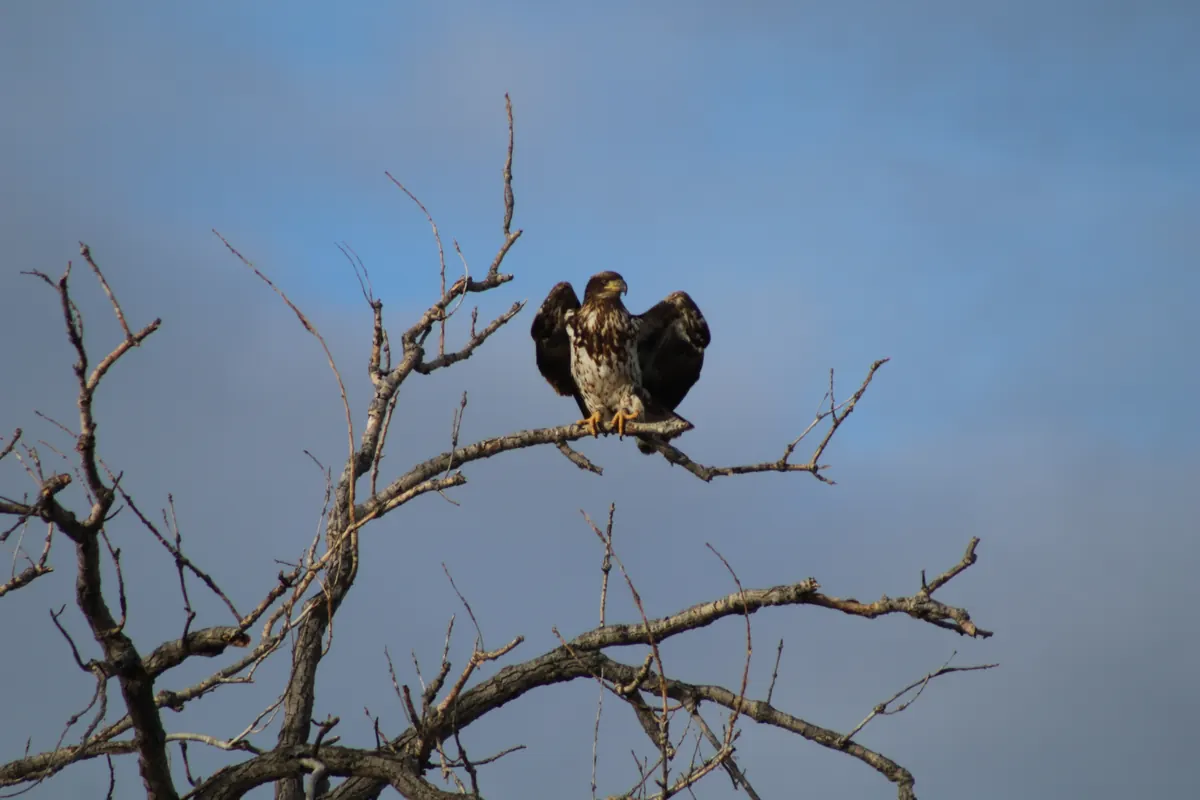
On the large reservoirs and big rivers, especially the White and Cache in the Delta, where open water keeps fish and ducks within reach. January is the heart of eagle season here. The Arkansas Game and Fish Commission’s nongame bird coordinator estimated in January 2025 that 150 to 160 pairs nest in the state, though the Commission no longer runs a formal count, and northern birds fleeing frozen lakes join them for the winter. She points eagle seekers toward the Corps of Engineers reservoirs, seasonally flooded rice fields, the Delta’s big rivers, Holla Bend refuge in the River Valley, and DeGray Lake.
Arkansas’s resident pairs are a separate story from the winter visitors. Once the bald eagle came off the federal endangered list, the money that had paid for monitoring nests was moved to birds still in steep decline, so the Commission relies on birders to tell it where active nests are. If you find an active nest with a breeding pair, the coordinator asks for exact GPS coordinates. Watch any nest from a long way off.
January is also when the eagles get counted. The National Midwinter Bald Eagle Survey began in 1979 under the National Wildlife Federation and passed to the U.S. Geological Survey in 1992; since 1984 volunteers have driven or boated the same standard routes each year. It falls in the first two weeks of January: in 2026 counters could go out any day from January 7 through 21, and January 9–10 was the weekend everyone aimed for. As of early October 2026, no 2027 dates had appeared.
-
Eagles Et Cetera, 48th year
Friday to Sunday, January 22–24, 2027 · DeGray Lake Resort State Park, Bismarck, Hot Spring and Clark counties
The park’s long-running winter festival celebrates the national bird and the other raptors and waterbirds that share the lake, with outings for people willing to bundle up and live birds of prey shows at the lodge’s convention center. Admission is free. Arkansas State Parks says the full schedule will be posted on the park’s event page closer to the date, so check there before you plan the weekend. The festival lands on the same weekend as the Wolf Moon.
-
Green Heron Trail
Any winter morning · Starts at the DeGray Lake visitor information center
A loop of three-quarters of a mile that the park’s own trail guide calls one of its best for bird watchers. Partway along, a wildlife viewing station looks out over the water, a good place to sit with binoculars and wait for an eagle to pass or a raft of ducks to drift into view.
-
Eagle cruises
Winter weekends in past seasons; check for 2027 dates · DeGray Lake marina
A park interpreter takes visitors out for an hour on the lake looking for wintering eagles, ospreys, loons, herons, grebes and ducks, with a limited number of loaner binoculars. No 2027 sailings were listed when this page was written. In past seasons reservations opened at noon the day before at the lodge front desk, (501) 865-5851. The park warns that the lake is colder and windier than the shore, so pack more layers than seem necessary.
When you see an eagle, write down whether it is an adult with a white head and tail or a mottled brown youngster, what it was doing, and how far it sat from open water. Run the same drive each January and you will have a midwinter survey of your own.
How many ducks and geese winter in Arkansas in January?
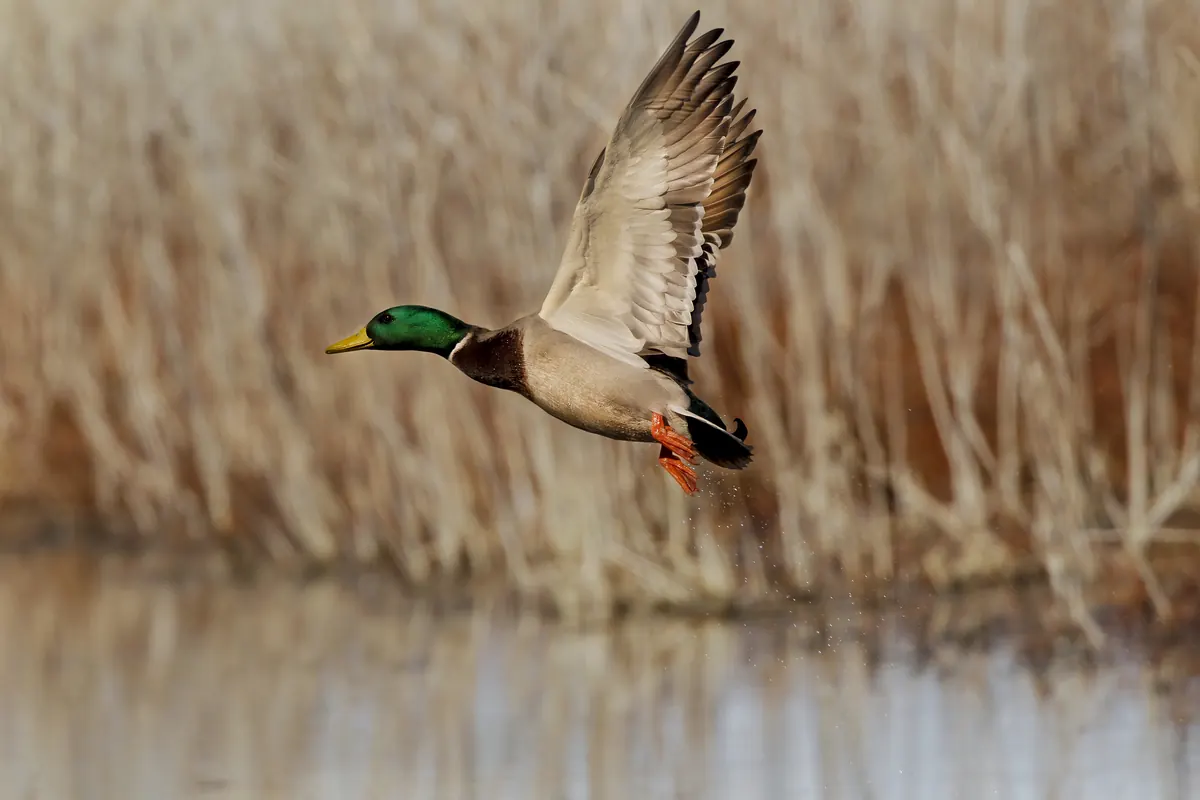
Hundreds of thousands of ducks, and in the six surveys in the table below between about 770,000 and 2.3 million light and white-fronted geese, in the Delta alone; the numbers rise and fall with rain. The Arkansas Game and Fish Commission flies two aerial surveys this month. The annual midwinter survey comes in the first half of January, and the late-January survey closes out the season. Biologists fly random transect lines across the Delta and turn what they see into estimates for each survey zone.
Water is the whole story. During the January 1–5, 2023 survey a storm dumped more than six inches of rain on parts of the southeast, including nearly eight inches at a gauge on George H. Dunklin Jr. Bayou Meto Wildlife Management Area, and the Delta total topped 1.5 million ducks for the first time in any survey since December 2011. A year later, in drought, the January 1–4, 2024 count of 269,693 mallards was the lowest midwinter estimate since transect surveys began. Winter 2025–26 was dry again, with many parts of the state having their second or third driest December in records going back to 1893; the early-January estimate came in 427,502 mallards under the long-term average. More than 140,000 of those mallards were packed into the Bayou Meto–Lower Arkansas zone, 43 percent of the Delta total.
Geese do not follow the duck pattern. While the ducks were scarce in January 2026, the same surveys estimated around 1.4 to 1.5 million light geese (snow and Ross’s) over the Delta.
-
Afternoons on the wildlife management areas
January 1–30 · AGFC wildlife management areas statewide
Duck and goose seasons run through Sunday, January 31. Through January 30, waterfowl hunting on WMAs stops at noon and hunters must be off the water by 1 p.m., or by noon on Bayou Meto and Dave Donaldson Black River WMAs; on the last day, January 31, shooting runs to sunset. A levee walk in the afternoon is the quiet time to watch ducks drop into the timber.
-
A refuge sanctuary closed to everyone
November 15 to February 28 · Bald Knob National Wildlife Refuge, White County
The waterfowl sanctuary on this refuge along the Little Red River is closed to all public use through the winter so that large flocks of ducks and geese can rest undisturbed. Watch from roads and areas that remain open and let the birds have the rest.
-
The peak at Big Lake
January and February · Big Lake National Wildlife Refuge, Mississippi County
The northeastern refuge reaches its wintering waterfowl peak in these two months, when numbers can exceed 200,000 birds, so January is the time to drive out to Manila. Pick a calm morning, when the flocks are easier to see and the sound carries across the water.
| January survey | Mallards | All ducks | Light geese (snow and Ross’s) | White-fronted geese |
|---|---|---|---|---|
| Midwinter, Jan 1–5, 2023 | 929,248 | 1,743,324 | 1,693,343 | 618,925 |
| Midwinter, Jan 1–4, 2024 | 269,693 | 682,089 | 645,607 | 189,406 |
| Midwinter, Jan 6–14, 2025 | 452,017 | 924,545 | 615,756 | 189,166 |
| Late January, Jan 20–24, 2025 | 458,682 | 793,742 | 542,591 | 223,132 |
| Midwinter, Jan 5–13, 2026 | 334,110 | 544,705 | 1,409,809 | 466,550 |
| Late January, Jan 19–23, 2026 | 337,479 | 694,286 | 1,478,989 | 246,472 |
The late-January 2026 flights were cut short by a major winter storm, and observers never reached the Little River Ditches zone. For the December numbers and the snow geese arriving, see the December page.
Can you see the Boxley Valley elk in winter?
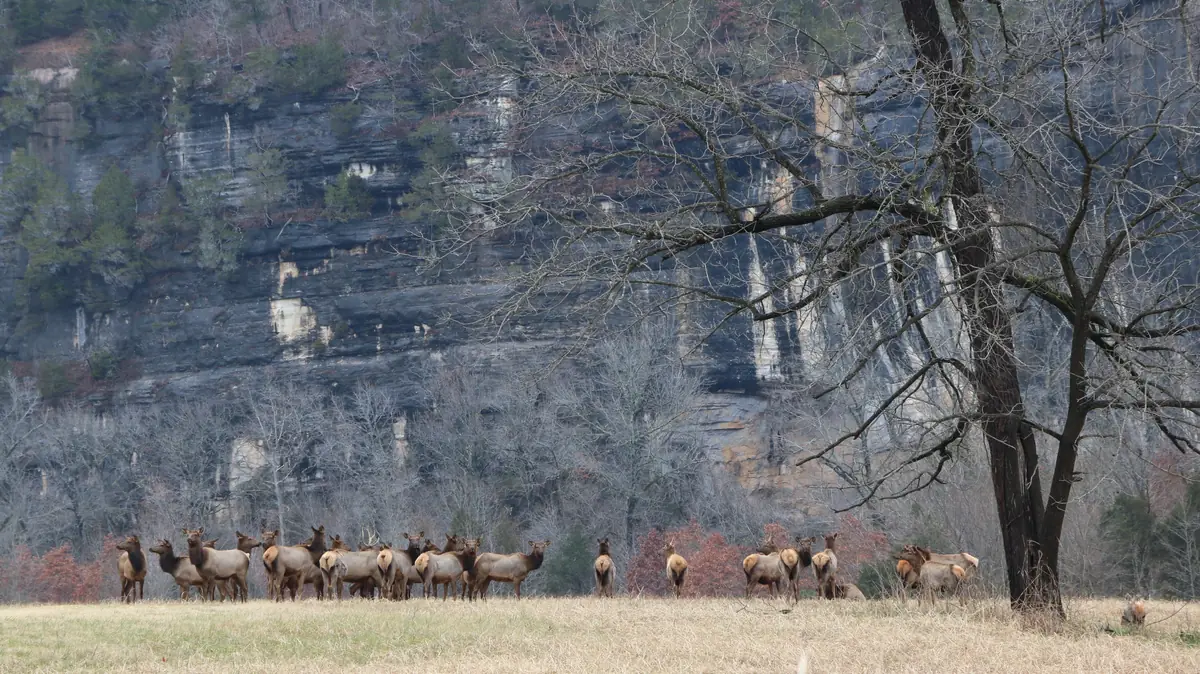
Yes, and sometimes in broad daylight. Elk vanished from Arkansas long ago. Their return began in 1981, when the Game and Fish Commission, working with Colorado, started releasing animals along the Buffalo River; over four years 112 elk from Colorado and Nebraska went into Newton County. The National Park Service says the herd numbers nearly 500 (its page was last updated in 2021); the animals range in and around the Commission’s core elk zone of Boone, Carroll, Madison, Newton and Searcy counties.
In summer the elk lie up in shade and come out to feed only at the edges of the day. Winter changes that. The Buffalo National River staff note that cold spells can bring elk out in daytime, and with the rut long over, look for groups of them out on the valley’s open pastures.
-
The Boxley Valley drive
Early morning, late afternoon, and midday during cold snaps · About six miles of Arkansas Highways 43 and 21, Boxley Valley, Newton County
This is the park’s most reliable elk viewing. Pull completely off the road before you stop, stay in or beside the car, and let the elk set the distance. The rule the park uses is simple: if the animal changes what it is doing because of you, you are too close.
-
Steel Creek in winter
Dawn, dusk and cold-spell middays · Steel Creek, upper Buffalo National River, near Ponca
The Park Service says elk can be seen at several places in and near the river, not only Boxley Valley. The open meadow below the bluffs at Steel Creek gives a long view across the field, and with the trees bare, the big pale rumps of elk would stand out against it. Go at the edges of the day, and treat a cold spell as a reason to look at midday.
Elk tracks are rounder and much bigger than a deer’s, and a herd crossing a muddy pasture leaves a churned trail you can follow with your eyes. After a snow, sketch a set on the tracks page and measure it against your palm.
Why do the hot springs steam on a January morning?
Because the water comes out of Hot Springs Mountain at an average of 143 °F, and the colder the air, the more visible the vapor rising from it. Hot Springs National Park protects 47 springs. The park says it goes through about 700,000 gallons of the water a day. The park says this rain fell on the Ouachita Mountains more than 4,000 years ago, about when the pyramids of Egypt were going up, and soaked down 4,500 to 7,500 feet through cracks in the rock before rising again along a fault at the foot of the mountain.
There is no volcano. The rock simply gets warmer with depth, by about 4 °F for every 300 feet according to the park, a process called the geothermal gradient, and the slowly sinking water heats with it. On the way it dissolves silica, calcium, magnesium and potassium. When it reaches the cool surface, calcium carbonate comes out of solution and builds the spongy gray rock called tufa that you can see around the display springs.

-
Where to see and touch the springs
Any cold morning, best at first light · Bathhouse Row, Hot Springs National Park, Garland County
The park lists four places to see a spring: inside the Fordyce Bathhouse basement, outdoors behind the Fordyce, at the Hot Water Cascade at the back of Arlington Lawn, and on the Grand Promenade behind the Quapaw. The water is too hot to soak in where it emerges; the Quapaw and the Buckstaff are the two bathhouses that still offer baths.
Note the air temperature and how high the steam climbs above the Cascade. On a still morning below freezing it can hang over the lawn; on a windy one it is torn away almost at once.
What are Arkansas bears, owls and frogs doing in January?
Starting families. Midwinter is when some of the state’s animals begin the next generation, out of sight in dens, old nests and woodland pools.
-
Bear cubs born in the den
January and February · Ozark and Ouachita mountains and the big river bottoms
Black bears mate in early summer, but the fertilized egg floats free and does not implant until late fall, so the true pregnancy lasts only a couple of months. A University of Arkansas extension fact sheet describes newborns as roughly 12 ounces and 8 inches long, blind and nearly helpless. A 150-pound mother outweighs her cub about 200 times over; a human mother is only about 19 times heavier than her baby. The cubs nurse in the den until spring. Leave any rock crevice, hollow tree or brush pile you suspect of holding a bear well alone.
-
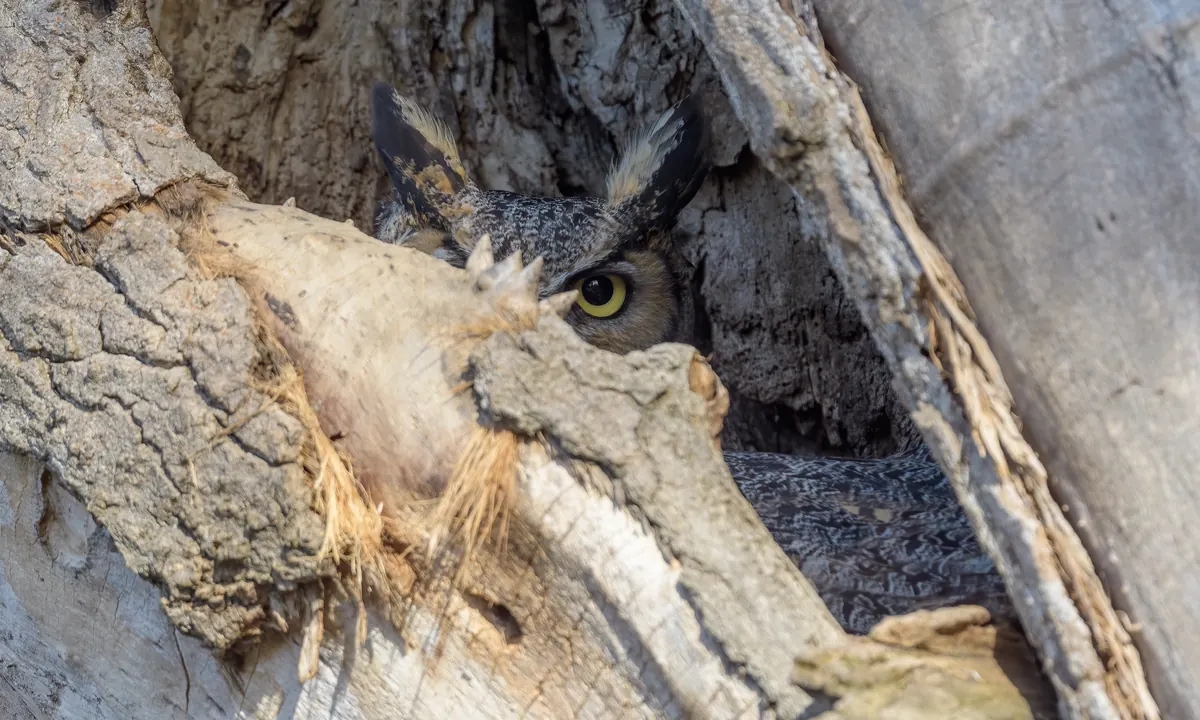
Great horned owls on eggs
Late January into February · Woodlots, river bottoms, farm shelterbelts and town parks statewide
The Missouri Department of Conservation’s field guide says great horned owls breed in late January or early February after a few months of hooting, often taking over an old hawk or squirrel nest rather than building their own. Two eggs is typical, with about a month of incubation. At dusk, listen for a pair trading deep, soft hoots from the same stand of trees. Barred owls court a little later; in Missouri the same guide puts their breeding in February and March.
-
The first frogs of the year
Warm, rainy nights in mid to late winter · Fishless woodland pools in the Ozarks and Boston Mountains
The wood frog in Arkansas lives in the Ozark Highlands and Boston Mountains and nowhere south of the Arkansas River; the Game and Fish Commission lists it as a species of greatest conservation need. The Encyclopedia of Arkansas describes its breeding as timed to heavy mid- to late-winter rains, when hundreds or thousands may pour into a pond for a few frantic nights. The call is a quiet, hoarse quack. Missouri biologists say the frogs need a heavy, warm rain and air of at least 50 °F to start, so watch for that combination in a January thaw.
Snow, when Arkansas gets it, turns the woods into a guest book. Follow a line of fox prints to a mouse hole, find where a rabbit sat under a cedar, and draw them on the journal page for reading the signs.
How can you identify Arkansas trees in winter?
By bark, by fruit that hangs on, and by the odd leaves that refuse to fall. With the canopy bare, January is the best month to learn the shapes and skins of trees you walk past all summer without seeing.
-
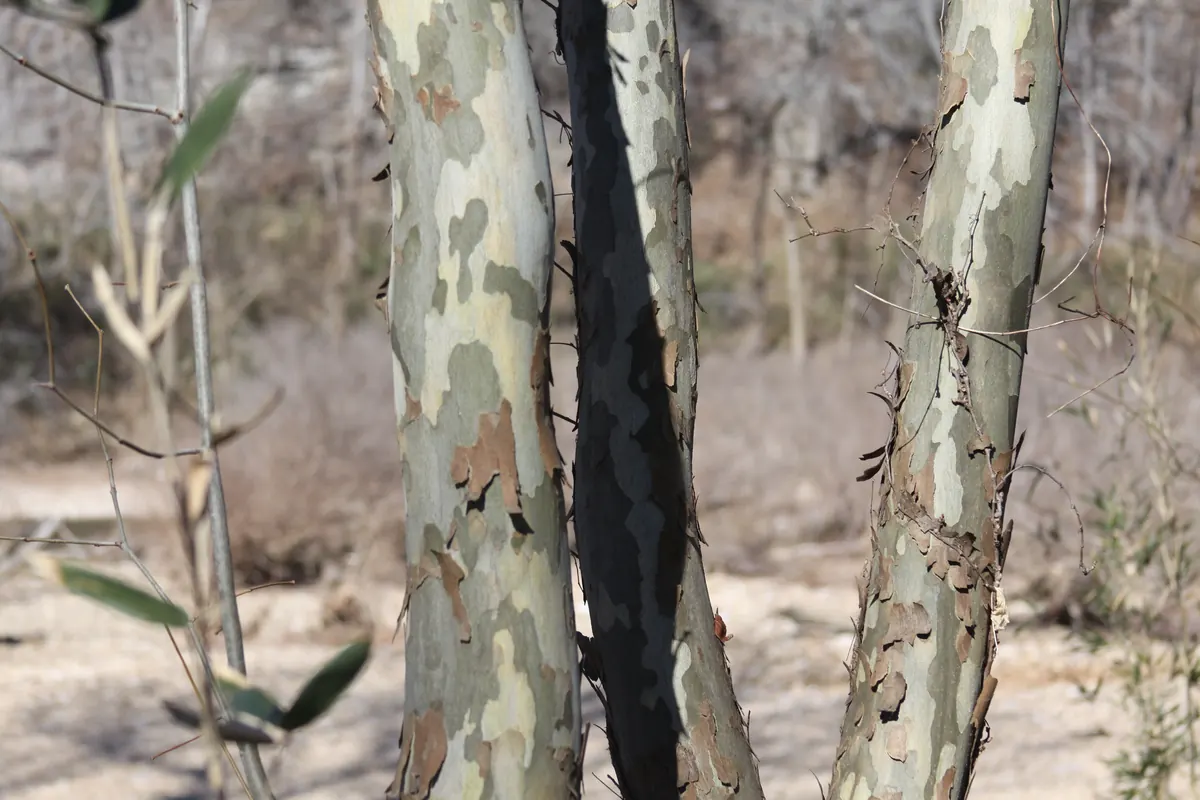
Sycamore
All winter · Creek and river banks statewide
The tall white limbs along a stream are sycamore. Sycamore bark, in the Lady Bird Johnson Wildflower Center’s account, flakes off in scales and plates to leave a smooth, whitish inner layer, and the round seed balls often stay on into winter. No native hardwood grows a thicker trunk.
-
American beech
All winter · Moist, rich slopes and shaded ravines
Smooth, light gray bark that stays smooth even on old trees, and papery copper leaves that cling to the branches most of the winter. The nuts feed squirrels, raccoons, bears and game birds.
-
Sweetgum
Seed balls through January · Bottomlands, old fields and yards statewide
Its spiky, woody fruit balls, roughly an inch wide, hang from long stems, and the Wildflower Center says they stay on the tree through January.
-
Shagbark hickory and Christmas fern
All winter · Upland woods; shady, well-drained slopes
Shagbark hickory bark comes away in long, tough curls, like a tree that needs a haircut. Below it, look for Christmas fern, a leathery, once-divided fern that keeps glossy green fronds right through the cold months and is one of the few green things on a January forest floor.
Pick one tree near home, draw its outline and a patch of bark for your tree through the seasons page, then return to the same spot in April, July and October.
Is January the coldest month in Arkansas, and what will El Niño bring?
Yes. At each of the eight Arkansas airport stations we checked in NOAA’s 1991–2020 normals, January has a lower average high and a lower average low than December or February. Normal January highs run from 46.8 °F at Jonesboro and 46.9 °F at Harrison to 50.5 °F at Little Rock and 55.9 °F at El Dorado; the coldest normal low is 25.1 °F at Fayetteville’s Drake Field. Snow is modest: the January normal is 1.1 inches at Little Rock, 1.4 at Fort Smith and 1.5 at Drake Field. February actually carries the larger snow normal at Little Rock (1.6 inches) and Drake Field (2.4), so winter is not done with Arkansas when January ends.
January also has history. The National Weather Service in Little Rock records the largest tornado outbreak in Arkansas, 56 tornadoes, in January 1999, and a devastating ice storm across the north in January 2009. Both came in La Niña winters.
This winter is the opposite case, and the odds look lopsided. In their September 10 update, federal forecasters put the odds above 90 percent that the Pacific warming reaches very strong status, the top tier, by the time Arkansas is deep in winter. The National Weather Service in Jackson, Mississippi, says El Niño generally makes winter and spring wetter and cooler across the Deep South, because the jet stream shifts south and pulls in more Gulf moisture. The same office cites a study of the 15 biggest tornado outbreaks, those with 40 or more tornadoes, in which only one came during El Niño, against six in La Niña years and eight in neutral years. For Arkansas in particular, a meteorologist with the Arkansas Weather Network told the Division of Agriculture in August that El Niño tends to bring a busier storm track in the cool season, but that if sharp shots of cold air arrive in January and February, rain may be harder to come by, with wetness possibly returning in March as El Niño fades. NOAA issues its winter outlook on October 15 and revises it monthly; Arkansas readers will find the current January–March temperature and rain maps among the 90-day outlooks at NOAA.
Before a trip to the Ozarks, check the current weather and radar, since a road that is wet in Little Rock may be glazed at Jasper. Gardeners already counting down to spring can look up their town on the Arkansas frost dates page.
How much daylight does Arkansas gain in January?
A little over half an hour, depending on latitude. The solstice is behind us, and by January 31 each listed city has gained between 35 and 40 minutes, with Harrison, in the north, gaining most and El Dorado, in the south, least. Because Earth’s tilt and its oval orbit combine to shift local noon, the gains come unevenly: sunset moves later through the whole month, while the latest sunrises of the year fall in the first half of January, so mornings barely brighten until the second half of the month.
The oval orbit has a milestone of its own. Earth reaches perihelion, its closest point to the Sun for the year, at 8:33 p.m. Central on Saturday, January 2, about 91.4 million miles away. The Northern Hemisphere is coldest while Earth is nearest the Sun because the tilt, not the distance, sets the seasons.
| City | Jan 1 | Jan 31 | Gained | Per day |
|---|---|---|---|---|
| Fayetteville | 9 h 46 m | 10 h 24 m | 38 min | 1.3 min |
| Harrison | 9 h 44 m | 10 h 24 m | 40 min | 1.3 min |
| Jonesboro | 9 h 47 m | 10 h 25 m | 38 min | 1.3 min |
| Fort Smith | 9 h 49 m | 10 h 27 m | 38 min | 1.3 min |
| Little Rock | 9 h 52 m | 10 h 29 m | 37 min | 1.2 min |
| Hot Springs | 9 h 54 m | 10 h 30 m | 36 min | 1.2 min |
| Pine Bluff | 9 h 55 m | 10 h 31 m | 36 min | 1.2 min |
| El Dorado | 10 h 00 m | 10 h 35 m | 35 min | 1.2 min |
Mark the sunset on the same day each week and you will see it slide north along the horizon again. For your exact town, the sunrise and sunset almanac gives the minute.
What can you see in the Arkansas night sky in January?
A strong meteor shower, the brightest morning planet, and the biggest full moon of 2027. Times here are Central Standard Time.
-
The Quadrantids
Active December 28 to January 12; best on the night of Sunday, January 3, into Monday, January 4 · Face north and east, away from town lights
The Quadrantid maximum is brief, a matter of hours. Predictions differ: the American Meteor Society says roughly 9:30 p.m. Central on Sunday the 3rd, and EarthSky says roughly 11:47 p.m. Either way, the radiant, in the northern sky between Boötes and Draco, starts the night near the horizon and rises toward morning, so the hours before Monday’s dawn are the ones to give up sleep for. A waning crescent rises only a few hours before the Sun, so moonlight is minor. Under a truly dark Ozark or Ouachita sky, counting several dozen in an hour would make it a fine year.
-
Venus at its greatest distance from the Sun
Sunday, January 3, and all month before dawn · Low in the southeast before sunrise
Venus reaches greatest western elongation on the 3rd, standing 47 degrees from the Sun, and blazes as the morning star all month. Through a backyard telescope this week it shows a half-lit disk.
-
The Wolf Moon, a supermoon
Night of Thursday, January 21, into Friday, January 22 · Rising in the east-northeast at dusk on the 21st
The Moon is exactly full at 6:17 a.m. Central on Friday, January 22, less than a day after perigee, making it the closest full moon of 2027 at about 222,229 miles. Watch it rise on Thursday evening and set near sunrise Friday; it still looks full on Friday night, the opening night of Eagles Et Cetera.
-
Planets in the evening
All month · Saturn in the southwest; Jupiter in the east; Mercury low in the west-southwest late in the month
Saturn, low in the southwest once darkness falls, slips closer to the trees as the weeks pass. Jupiter rises in the evening and brightens toward its opposition on February 10, and Mars follows to opposition on February 19. Espenak’s almanac pairs the Moon, one day past full, with Jupiter on Saturday evening, January 23, and Regulus is close by too. Mercury joins the evening show as January closes: scan just above the west-southwest skyline thirty minutes or so after the sun goes down.
| Phase | Date | Time |
|---|---|---|
| New moon | Thursday, Jan 7 | 2:24 p.m. CST |
| First quarter | Friday, Jan 15 | 2:34 p.m. CST |
| Full moon, the Wolf Moon (supermoon) | Friday, Jan 22 | 6:17 a.m. CST (looks fullest the night of Jan 21) |
| Last quarter | Friday, Jan 29 | 4:55 a.m. CST |
The darkest evenings fall around the January 7 new moon, roughly January 3 to 12. Check Today’s sky for a clear night between fronts, and look up your local moonrise on the moon phases page.
What can Arkansas families do outdoors in January?
- Friday, January 1: First Day Hikes. Arkansas State Parks has held ranger-led New Year’s Day hikes statewide since 2014, part of a national program in all 50 state park systems. For 2025 there were 46 guided hikes at 36 parks, plus self-guided hiking during New Year Week and a free sticker for finishers. Look for the 2027 list on the state parks site in late December.
- What’s for Lunch? At Lake Dardanelle State Park in Russellville, staff feed live food to the fish in 8,000 gallons of aquariums stocked with Lake Dardanelle species, 11:30 a.m. to noon, free. The park’s listing shows feedings on Tuesdays and Saturdays through early November; January dates were not posted yet, so check before you go.
- Sunday night, January 3: set an alarm for the Quadrantids before dawn on Monday.
- Last chance for a Christmas Bird Count, until Tuesday, January 5. The 127th count season ends on the 5th; Audubon’s map shows any Arkansas circle still to be run and the compiler to contact.
- Thursday, January 21: watch the Wolf Moon rise and see whether the children can spot it looking bigger near the horizon.
- Friday to Sunday, January 22–24: Eagles Et Cetera at DeGray Lake Resort State Park, free.
- All month: Project FeederWatch counts at the kitchen window, a winter tree hunt in the nearest park, and track hunting after any snow.
- February preview: Arkansas backyards can join the Great Backyard Bird Count, February 12–15, 2027, the dates Audubon lists; details are on birdcount.org.
Park programs can change with ice and snow, so confirm on the park’s own listing the day before. Every state and month is gathered on the nature hub, and any outing on this list deserves its own entry in the Naturalist’s Field Journal.
Safety notes for January in Arkansas
- Waterfowl and the youth deer hunt. Duck, coot, merganser and goose seasons run through Sunday, January 31, so expect early-morning shooting in the Delta, on the Arkansas River and around the big reservoirs. The youth modern gun deer hunt is open in every zone on Saturday and Sunday, January 2–3. Archery deer season continues through February 28.
- Small game and furbearers. Squirrel and rabbit seasons are open statewide through February 28, and bobwhite quail through February 7 on private land, with different rules on some WMAs. Crows may be hunted Thursdays through Mondays until February 21. Hunting seasons for bobcat, fox, mink and river otter run to February 28, and furbearer trapping to the same date; beaver, nutria and coyote trapping continues to March 31.
- Hunter orange. Where a deer, bear or elk season for modern guns or alternative firearms is under way, AGFC rules put every hunter and companion in a hat and an upper-body garment of hunter orange, chartreuse or blaze camouflage, totaling at least 400 square inches of color above the waist. Migratory bird hunters do not need it. In January that applies chiefly to the youth hunt weekend, but bright colors on public land are wise all winter, for you and your dog.
- Ice, on ponds and on roads. Arkansas ponds rarely freeze thick enough to bear weight, so keep children and dogs off them. Freezing rain is the state’s signature winter hazard: it snaps limbs, drops power lines and glazes bridges first. When an ice storm is forecast, stay home and stay out from under loaded trees.
- Cold and wind. Even with highs near 50 °F, nights below freezing are normal, and wind on an open lake or a Delta levee makes it feel much colder. Wear layers, a hat and gloves, and carry a dry change of socks.
- Short days and closed areas. Daylight is still under eleven hours everywhere in the state, so start hikes early and pack a headlamp. Refuge sanctuaries such as the one at Bald Knob stay closed until the end of February.
- Winter tornadoes. Arkansas’s largest tornado outbreak came in January. Keep a way to receive warnings at night, even when it feels like winter outside.
Sources
- Arkansas Game and Fish Commission: eagles inspire awe, appreciation for conservation efforts (January 29, 2025)
- U.S. Army Corps of Engineers Bird Initiative: National Midwinter Bald Eagle Survey (history and 2026 dates)
- Arkansas State Parks: 48th Annual Eagles Et Cetera Festival, January 22–24, 2027
- Arkansas State Parks: DeGray Lake Resort State Park information brochure 2026 (Green Heron Trail, Eagles Et Cetera)
- Arkansas State Parks: park events calendar (January 2027 listings)
- Arkansas Game and Fish Commission: waterfowl surveys and reports
- Arkansas Game and Fish Commission: Aerial Waterfowl Survey Report, January 1–5, 2023 (midwinter)
- Arkansas Game and Fish Commission: Aerial Waterfowl Survey Report, January 1–4, 2024
- Arkansas Game and Fish Commission: Aerial Waterfowl Survey Report, January 6–14, 2025
- Arkansas Game and Fish Commission: Aerial Waterfowl Survey Report, January 20–24, 2025
- Arkansas Game and Fish Commission: Aerial Waterfowl Survey Report, January 5–13, 2026
- Arkansas Game and Fish Commission: Aerial Waterfowl Survey Report, January 19–23, 2026
- Arkansas Game and Fish Commission: 2026–27 waterfowl season dates and WMA shooting hours
- U.S. Fish and Wildlife Service: Bald Knob National Wildlife Refuge (sanctuary closure)
- U.S. Fish and Wildlife Service: Big Lake National Wildlife Refuge
- U.S. Fish and Wildlife Service: Holla Bend National Wildlife Refuge
- National Park Service, Buffalo National River: elk
- Arkansas Game and Fish Commission: elk (restoration history and core elk zone)
- National Park Service, Hot Springs National Park: the hot springs
- National Park Service, Hot Springs National Park: common frequently asked questions
- University of Arkansas Cooperative Extension Service: Arkansas Black Bears, Biology and Habits (FSA9086)
- Missouri Department of Conservation field guide: great horned owl
- Missouri Department of Conservation field guide: barred owl
- Missouri Department of Conservation field guide: wood frog
- CALS Encyclopedia of Arkansas: amphibians
- Herps of Arkansas: wood frog
- Lady Bird Johnson Wildflower Center: American sycamore
- Lady Bird Johnson Wildflower Center: American beech
- Lady Bird Johnson Wildflower Center: sweetgum
- Lady Bird Johnson Wildflower Center: shagbark hickory
- Lady Bird Johnson Wildflower Center: Christmas fern
- NOAA NCEI: 1991–2020 monthly normals for Arkansas stations (data API)
- National Weather Service Little Rock: Winter Weather Awareness (January 1999 tornado outbreak, January 2009 ice storm)
- Climate Prediction Center: ENSO diagnostic discussion, September 10, 2026
- Climate Prediction Center: 90-day seasonal outlooks
- National Weather Service Jackson, Mississippi: El Niño and the Deep South
- University of Arkansas System Division of Agriculture: will El Niño bring winter precipitation? (August 17, 2026)
- U.S. Naval Observatory: moon phases from December 30, 2026
- U.S. Naval Observatory: Earth’s seasons and perihelion, 2027
- NOAA Global Monitoring Laboratory: solar calculator (equations used for the day-length table)
- American Meteor Society: meteor shower calendar (Quadrantids)
- EarthSky: Quadrantid meteor shower
- EarthSky: what is a supermoon? (full supermoons of 2027)
- Fred Espenak: Sky Event Almanac 2027 (planets, perihelion, Moon–Jupiter pairing)
- Arkansas Tourism: begin a new year with First Day Hikes at Arkansas State Parks
- Arkansas State Parks: What’s for Lunch?, Lake Dardanelle State Park
- National Audubon Society: Christmas Bird Count
- Project FeederWatch: how to participate
- Great Backyard Bird Count
- Arkansas Game and Fish Commission: 2026–27 deer seasons and limits by zone
- Arkansas Game and Fish Commission: deer-specific hunting regulations (hunter orange)
- Arkansas Game and Fish Commission: 2026–27 squirrel season
- Arkansas Game and Fish Commission: 2026–27 rabbit season
- Arkansas Game and Fish Commission: 2026–27 quail season
- Arkansas Game and Fish Commission: 2026–27 crow season
- Arkansas Game and Fish Commission: 2026–27 furbearer hunting seasons
- Arkansas Game and Fish Commission: 2026–27 furbearer trapping seasons
- Photos via Wikimedia Commons; licenses and photographers are credited under each picture
