What to look for in nature in Colorado this April
April in Colorado is a month of weather whiplash and quiet arrivals. On the foothills the first pasqueflowers open while snow is still on the shady slopes, the grouse leks of the sagebrush and the Gunnison basin reach their busiest weeks, and the plains fill with the songs of meadowlarks and the first nests of mountain plovers. Medano Creek begins to creep back toward the dunes, the hummingbirds start to return at the end of the month, and a late snowstorm can still undo any of it. What follows covers the month from first week to last. For the previous month, see Colorado in March.
Other months in Colorado: October, November, December, January, February, March.
Start here
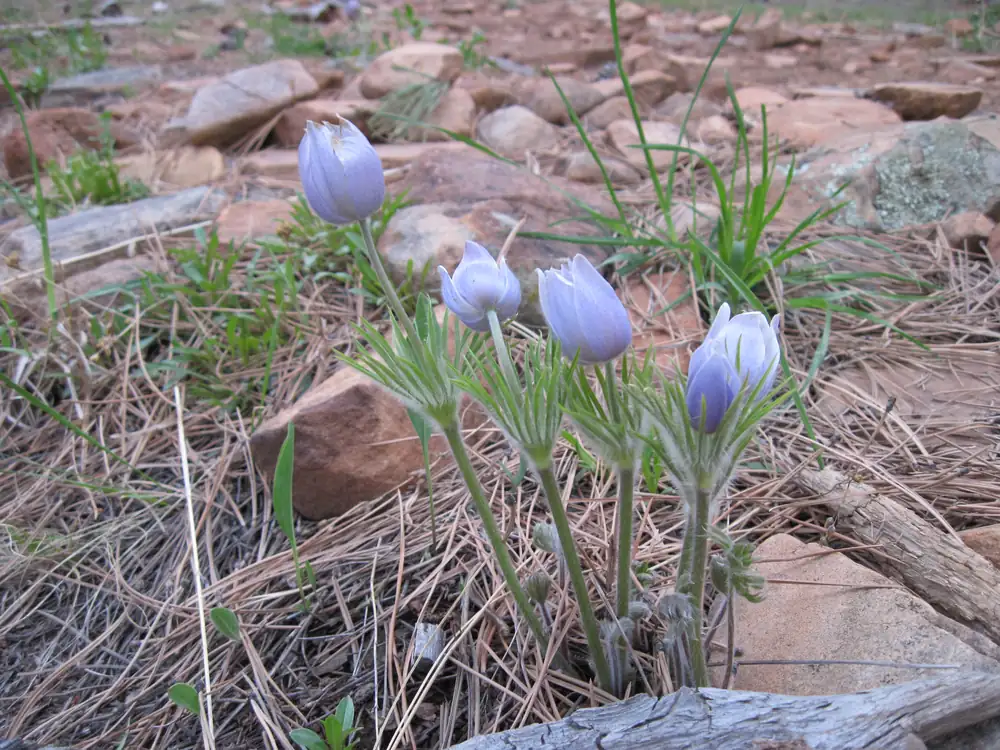
- Kneel beside a pasqueflower. On a sunny foothill slope or open meadow, look for a hairy plant with lavender, bowl-shaped flowers close to the ground. It is one of the first perennials to bloom and often opens around Easter.
- Spend a dawn at a lek. Stay in the car near a grouse strutting ground an hour before sunrise. The Gunnison sage-grouse site at Waunita is open on set days in April; check with CPW for the 2027 schedule first.
- Listen for the first broad-tailed hummingbird. Toward the end of the month, watch streamside meadows and feeders in the foothills and mountains, and report your first date to Journey North.
Plates in the Naturalist's Field Journal that fit April: "birds I have seen" for the first meadowlark, warbler and hummingbird; "seeds pods and cones" for a pasqueflower's feathery seed heads; and "a map of sounds" for frogs and meadowlarks around one pond.
Regions used below: Front Range and the Denver metro; Eastern Plains; Northern Mountains and Rocky Mountain National Park; Central Mountains and the high parks; San Luis Valley; Western Slope and the Four Corners.
What wildflowers and blossoms open in Colorado in April?
April is the month the ground itself changes. On sunny foothill slopes and open prairie, the first perennials push up through last year's grass, often while a snowstorm is still possible. The Colorado Native Plant Society notes that early flowers have to tolerate freezing and warm sun in the same day, and that violets set hidden, closed flowers under their leaves as insurance when pollinators are scarce. That toughness is why a pasqueflower can be found with snow on the ground nearby. March's earliest bloomers, the Easter daisy among them, are covered in Colorado in March; this month belongs to the next wave.
Elevation sets the calendar. A flower that opens on the Front Range in April may not reach a subalpine meadow until June or July, so a drive up a canyon takes you back through the season.
-
Pasqueflower
April to June at lower elevations; later higher up · Meadows, open slopes and open forest from the foothills to the subalpine zone; Castlewood Canyon is one place the Front Range chapter of Wild Ones names
Pasqueflower is a low, hairy plant with lavender to white petal-like sepals around a ring of yellow stamens. A Colorado wildflower guide gives its range as roughly 5,400 to 13,000 feet. The common name refers to Easter, since it flowers around that time in much of its range, and after the bloom it forms feathery, tailed seed heads that are worth a second look. Kneel to see it; the plant is small, from 2 to 16 inches tall.
-
Star lily
April to June · Sunny, open ground; William F. Hayden Green Mountain Park in Lakewood is named by Wild Ones
Star lily forms a flat rosette of grasslike leaves with white, starry flowers sitting close to the ground, and it likes full sun. Look for it among the grasses on dry hillsides rather than in shade.
-
Blue flax
Starting in April, and some plants keep blooming far into the season · Roadsides, trails and open ground; Wild Ones lists the E-470 bike trail
Wild Ones describes blue flax as a wispy plant up to two feet tall with bright blue flowers that start in April.
-
Grand Valley orchard bloom
Usually April; the date moves with the weather, so ask local growers · Palisade and the Grand Valley on the Western Slope
Peach trees in the Grand Valley bloom in spring, and the flowers are an event in their own right. Colorado State University's agricultural sciences college quotes David Sterle of the Western Colorado Research Center at Orchard Mesa saying that "from bloom on they're quite susceptible to frost risk at 26 degrees" and that growers are "not out of the woods until the middle of May." In 2026 a warm spell brought bloom about three weeks earlier than normal, which shows how much the timing can slide. The freeze table below puts the typical last freeze at the Grand Junction airport on April 28, and by May 14 nine springs in ten are clear. Check with local growers the week before a blossom drive.
Note the date each flower opens in the Naturalist's Field Journal; next year the entry will show whether spring runs early or late.
Where can I see grouse displaying in Colorado in April?
Two kinds of grouse that are seldom seen in March are at their best now, and one of them lives almost nowhere else in the world. The strutting grounds are called leks. Birds gather before dawn and display until the morning is well along, and the viewing is done from a parked car, never on foot. For the greater sage-grouse of the northwest, CPW reports that males gather on leks from early March, that females arrive one to two weeks later, and that breeding peaks from late March through May. Most nests hatch in May and June.
Sites and tours change from year to year, and no 2027 schedules had been posted when we wrote this. Treat every date below as a pattern to check with the managing agency.
-
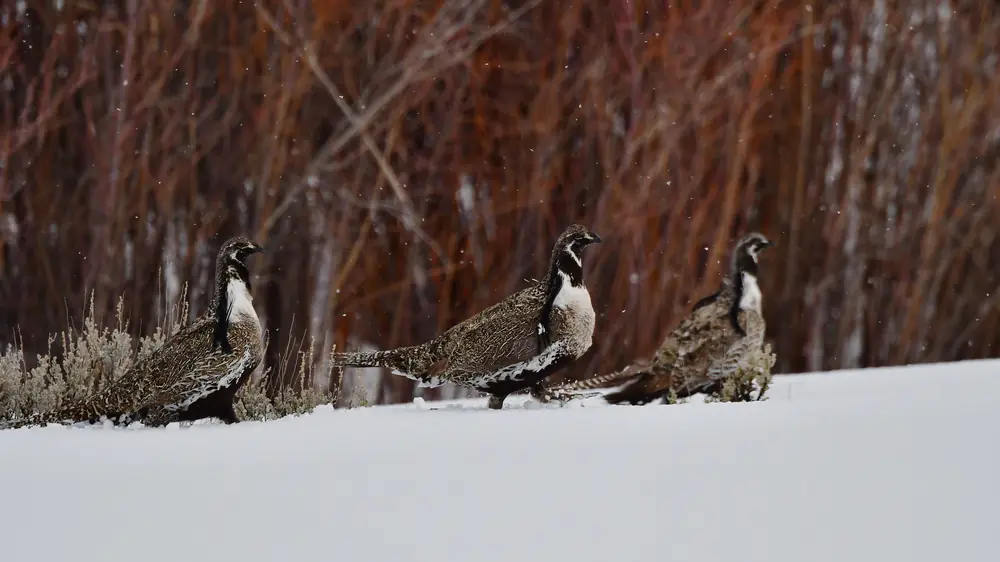
Gunnison sage-grouse at Waunita
Mating runs from early April through early May; the public site has been open only on set days, so confirm before you drive · Waunita Watchable Wildlife Site, about 19 miles east of Gunnison, off U.S. 50 on Gunnison County Road 887
CPW says almost all Gunnison sage-grouse live in Colorado, in seven separate populations south of the Colorado River, with about 3,500 breeding birds in total. The species is federally threatened. The one public place to see a lek is the Waunita site run with the nonprofit Sisk-a-Dee. The schedule we found, which was for 2024, had it open April 1 to 13, closed April 14 to 20, open April 21 to 30, and closed from May 1. Ask CPW's Gunnison office for the 2027 dates. Be there at least an hour before sunrise, switch off the engine and every light, stay inside until the birds leave, and bring a spotting scope, because the lek has moved farther from the road. A valid Colorado fishing or hunting license or a State Wildlife Area pass is required.
-
Greater sage-grouse near Walden
Usually mid to late April; the Birding Trail's calendar listed April 6 to 24 in 2026 · North Park, around Walden
The Colorado Birding Trail's calendar listed guided greater sage-grouse viewing trips at Walden from April 6 to 24, 2026, run by CPW and limited to 20 people a day. Nothing for 2027 had been listed. Ask CPW about 2027 well ahead, since the tours are limited.
-
Sharp-tailed grouse near Hayden
Males start displaying in late March or April; the Birding Trail listed guided tours April 15 to May 15 in 2025 · Hayden, in Routt County, and the Yampa Valley
CPW says the sharp-tailed grouse of northwest Colorado are doing well, even though the species has disappeared from many Western Slope counties. Males stomp and circle on ridge-top leks, showing orange eye-combs and purple air sacs, and CPW notes they can be seen displaying with the ground completely covered in snow. The Birding Trail's Hayden lek page says county roads there are not maintained in winter and snowbanks can limit access until late April. The land there is private, so view from the road.
The prairie-chicken leks near Wray, which also run in April, are described in Colorado in March; ask the Wray Chamber of Commerce and CPW for current tour information.
What nests on the eastern plains in April: mountain plovers, meadowlarks and prairie dog towns?
By April the plains have gone from arrivals to nesting. Mountain plovers, which CPW says reach their Colorado breeding grounds in March, lay eggs on bare ground in April and May. The plover has little to do with mountains. CPW describes it as a bird of shortgrass prairie that likes ground grazed short by prairie dogs, bison and cattle, and the Pawnee National Grassland is one of its main Colorado breeding areas. The plover is a state species of special concern, and CPW notes that its numbers may have fallen by 38 to 70 percent over three decades.
-
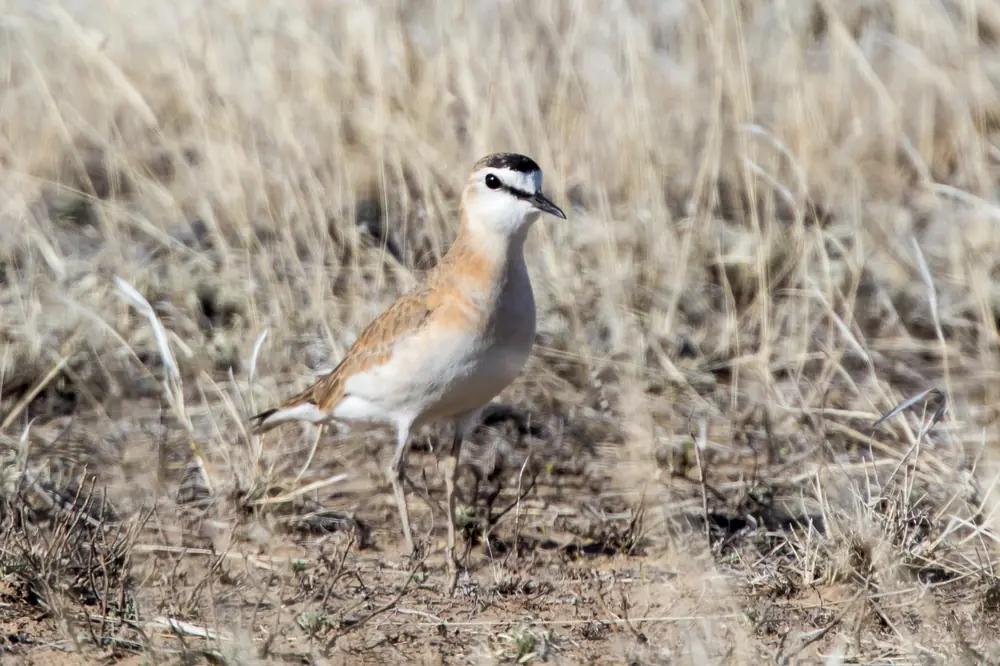
Mountain plover nests
April and May · Shortgrass prairie, bare hilltops and dry swales; Pawnee National Grassland and the plains near Karval
Plovers are sandy brown with a pale face and a dark cap, and the nest is a scrape on open ground, so the birds look like part of the soil. CPW says they perform a falling-leaf flight and a slow-winged butterfly display in courtship. Watch from the road or a car, and do not walk toward a bird that crouches or runs from you. Bird Conservancy of the Rockies staff, quoted by KUNC, name prairie dog towns, burn scars and grazed land as ideal habitat.
-
The Karval Mountain Plover Festival
Held every April; the 2026 festival ran April 24 to 26, and 2027 dates had not been announced · Karval, on the eastern plains, with tours on private ranches
The festival's own website showed a countdown to April 24, 2026 and no mention of 2027. It offers two days of tours and one night tour on private land that is normally closed to visitors, and it is organized by the Karval Community Alliance. Its website said all tickets for 2026 had sold out, so if you want to go in 2027, check the site early in the year. KUNC reports that ranchers have helped protect plover habitat and have become part of the festival's success.
-
Prairie dog towns and the wait for pups
Pups are born underground and emerge in May and early June · Rocky Mountain Arsenal National Wildlife Refuge near Denver, and other prairie dog towns
The National Park Service says black-tailed prairie dog pups are born underground about four to five weeks after breeding and come out during May and early June, so April is mostly adults watching the sky. The park service also notes that burrowing owls and meadowlarks use prairie dog towns. At Rocky Mountain Arsenal, which is free to enter, the U.S. Fish and Wildlife Service lists an 11-mile wildlife drive, and visitors are asked to stay in their vehicles when viewing bison. The refuge's hours and the visitor center schedule change, so check its page before you go.
For the burrowing owls that move into those burrows, see Colorado in March; they are settling in now.
Which songbirds come back to Colorado in April?
The first songs of the year are coming from open ground. National Audubon's Rockies office lists five birds that migrate into Colorado, Wyoming and Utah as spring winds build: spotted towhee, Say's phoebe, cinnamon teal, western meadowlark and yellow warbler. The phoebe and the teal are covered in the March page. This section follows the other three, plus the ospreys that reach the big lakes.
-
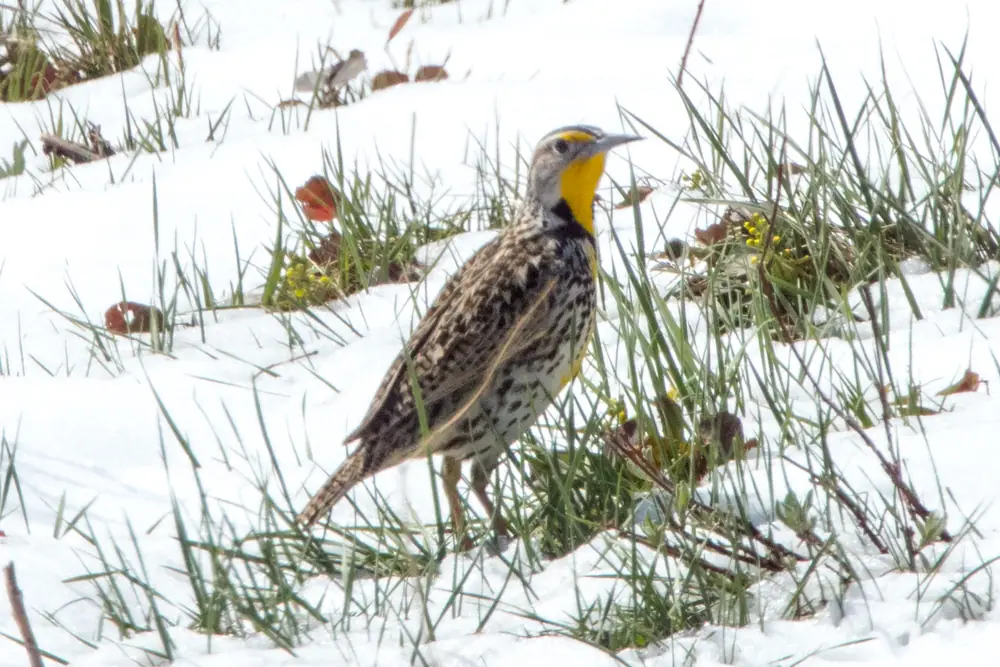
Western meadowlark
April, with the song carrying across the plains · Open grassland, fence posts and pastures across the state
Audubon describes the meadowlark's song as "larger-than-life." Its bright yellow belly with a black necklace is the field mark. Meadowlarks nest on the ground, so the same advice as for plovers applies: keep dogs leashed and stay on trails.
-
Spotted towhee and yellow warbler
April, with more arriving in May · Towhees in shrubby thickets and oak brush; yellow warblers in streamside willows and cottonwoods
Audubon describes the towhee as a round-bodied, dark-hooded sparrow with white spots on its wings and chestnut sides, and the yellow warbler as canary yellow underneath, preferring mature vegetation next to streams and wetlands. A creek lined with willows is the place to practice listening for the first warbler songs.
-
Ospreys on the lakes
March to April, according to Visit Estes Park · Lake Estes Trail and Sprague Lake near Estes Park
Visit Estes Park, summarizing spring migration around Rocky Mountain National Park, lists ospreys returning in March and April and names the Lake Estes Trail and Sprague Lake as places to watch them fish. The park hosts more than 270 bird species.
Keep a ledger of first dates in the Naturalist's Field Journal; it has a plate for birds you have seen.
When do warblers and hummingbirds reach Colorado?
The big spring wave of songbirds peaks in May, but April is when the scouts show up. Yellow-rumped warblers are among the early warblers on Visit Estes Park's migration list, and the first broad-tailed hummingbirds appear toward the end of the month. Higher elevations see these arrivals later than the plains and foothills.
-
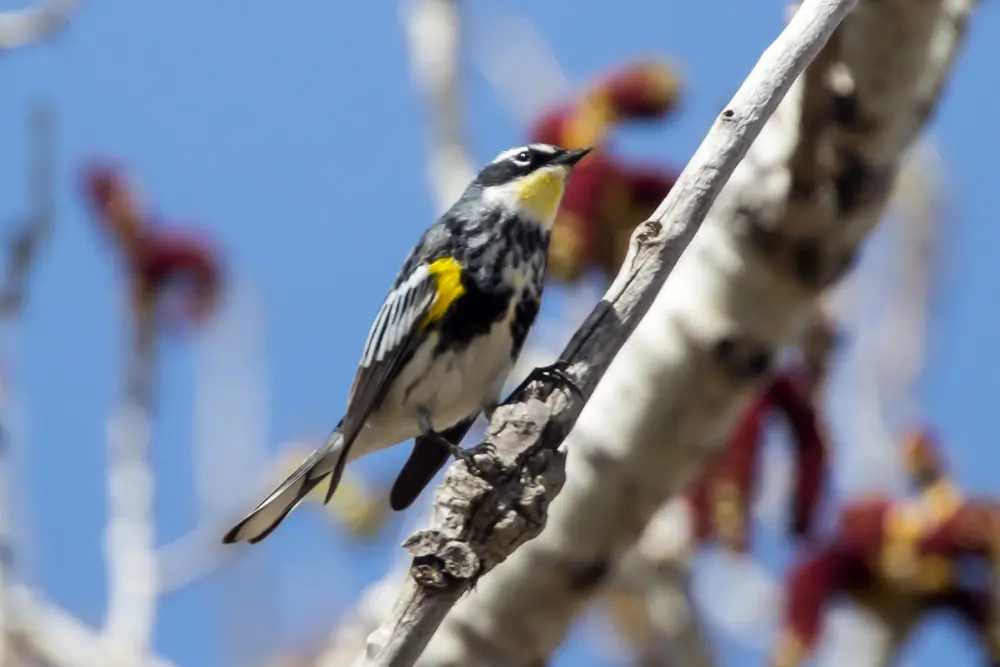
Yellow-rumped warblers
April and May · Wetlands and wooded streams; Visit Estes Park names Lily Lake and Old Fall River Road
The name gives away the field mark, a yellow patch on the rump. Look for them near water and wherever leaf buds are opening, and compare with the photo above.
-
Broad-tailed hummingbirds
Late April and May · Lily Lake and Wild Basin, according to Visit Estes Park; foothill and mountain meadows
Visit Estes Park lists late April through May for these hummingbirds to arrive from Mexico and Central America. The National Park Service says they arrive in April and that females build two-inch nests along streams and rivers near meadows. Researchers at the Rocky Mountain Biological Laboratory in Gothic, using three decades of data, found no change over time in when broad-tailed hummingbirds arrive there, even though plants have been flowering earlier. If you hang a feeder, CPW advises securing it where bears cannot reach it. Journey North takes hummingbird sightings from across the continent and publishes maps of the northward movement, and its reporting form is open to anyone.
What happens along Colorado's streams and ponds in April?
April is when water returns to the landscape, first as a trickle and then as a rush. At low elevations snow is melting and ponds are thawing, and toward month's end the creeks draining the mountains are rising. The big flows come later, but the sounds of the season start now.
-
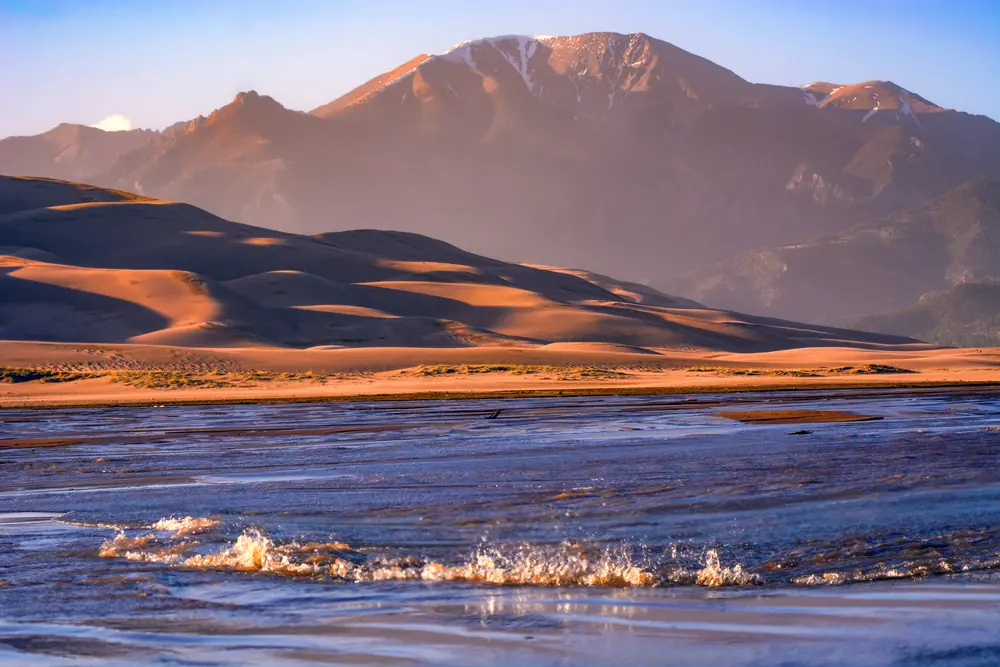
Medano Creek returns to the dunes
The creek usually reaches the Dunes Parking Area sometime in April, at first as a trickle; the surge-flow waves come in late May and early June · Great Sand Dunes National Park and Preserve, in the San Luis Valley
The National Park Service says Medano Creek usually arrives at the Dunes Parking Area sometime in April, at first just a trickle. Peak flow typically comes in late May or early June at about 40 cubic feet per second, and late May and early June are the best chance for surge flow, where waves of water ripple across the sand. If you visit in April, you are early for the waves, but the creek is still shallow. Check the park's Medano Creek page for the latest flow.
-
Chorus frogs
Lowlands mostly April to June; mountains mostly May to June · Ponds, marshes, wet meadows and lakes, nearly statewide
CPW describes the boreal chorus frog's call as a stuttering "preeep" that rises in pitch, and it says the frog is scarce or absent in most of southeastern Colorado.
-
Tiger salamanders
Active at night in wet weather · Ponds, reservoirs, burrows and wet ground, statewide
The tiger salamander is Colorado's state amphibian. CPW says it spends much of its life in rodent burrows and is most active at night in wet conditions, and it breeds in ponds and reservoirs in spring or summer. A damp night is the time to watch for one on a trail or road. Do not pick one up, and be aware that Colorado requires a license to keep one.
-
Runoff
Snowmelt runs April through June, with the biggest flows usually in late May and June · Creeks and rivers statewide
The National Weather Service in Pueblo says spring runoff typically comes from April through June, with peaks in late May or even well into June on the main stem of the river. CPW gives late May and early June as the time when melted snow is usually highest. Rivers do not have to be flooding to be dangerous in April, because they are already cold and fast.
What is April weather like in Colorado, and what should I watch for?
April swings. Denver's 1991 to 2020 April mean temperature is 47.8 °F, according to the Weather Service's Boulder office, with the normal high near 60 °F and the low around 31 to 32 °F early in the month, rising to a high near 65 °F and a low near 38 °F by the end. That record also lists the extremes: a high of 90 °F on April 30, 1992, a low of -2 °F on April 2, 1975, and the greatest April snowfall, 23.0 inches on April 23, 1885. A late storm is always possible.
In the mountains, Colorado State University's climate center notes that snowpack reaches its seasonal peak somewhat after April 1 in the high country and the north, so April is still a month of building snow there. The table shows how much snow April brings at each station: under 2 inches at Grand Junction and Lamar, and more than a foot at Boulder, Estes Park, Steamboat Springs, Telluride and Crested Butte.
-
Hail season starts to build
Increases from late April; peaks in early to mid-June · Front Range and the eastern plains
Colorado State University's news service, reporting data from the university's climate center, says hail storms intensify toward the end of April and early May, peak in early to mid-June, and fade by mid-August.
| Station | April precipitation | April snow | April high | April low |
|---|---|---|---|---|
| Fort Collins | 2.10 | 6.2 | 62.5 | 35.4 |
| Boulder | 3.05 | 14.7 | 62.8 | 34.5 |
| Estes Park 3 SSE | 2.26 | 19.3 | 51.5 | 26.1 |
| Colorado Springs Municipal Airport | 1.45 | 5.5 | 61.0 | 34.0 |
| Pueblo Memorial Airport | 1.57 | 3.4 | 67.3 | 35.3 |
| Lamar | 1.46 | 1.7 | 68.4 | 36.1 |
| Grand Junction Walker Field | 0.98 | 0.9 | 65.8 | 38.1 |
| Durango | 1.25 | 3.8 | 62.8 | 30.0 |
| Alamosa San Luis Valley Airport | 0.57 | 3.5 | 60.2 | 25.0 |
| Gunnison 3SW | 0.74 | 3.5 | 56.0 | 22.7 |
| Steamboat Springs | 2.54 | 13.2 | 54.4 | 26.7 |
| Telluride 4WNW | 1.71 | 13.1 | 50.8 | 22.0 |
| Crested Butte | 2.01 | 19.4 | 46.9 | 19.1 |
NOAA's Climate Prediction Center posts new 90-day outlooks monthly, around the middle of the month, and the current set is posted at the CPC 90-day page. Our weather guide and cloud guide help with the days just ahead.
When is the last spring freeze in Colorado, and is it safe to plant in April?
Not yet, for most of the state. At the main station for each region, the typical last 32 °F reading comes between late April and early June, according to NOAA's 1991 to 2020 normals. The Grand Valley is the earliest, with a median of April 28. Front Range and plains towns sit around the first days of May. Durango, the San Luis Valley and the Yampa Valley do not see their median last freeze until June. The right-hand column is the useful one for planting: by that date nine springs in ten are done with frost.
| Station | One year in ten | Median | Nine years in ten |
|---|---|---|---|
| Fort Collins (northern Front Range) | Apr 18 | May 2 | May 14 |
| Denver International Airport | Apr 23 | May 5 | May 19 |
| Colorado Springs Municipal Airport | Apr 22 | May 3 | May 15 |
| Pueblo Memorial Airport (Arkansas Valley) | Apr 18 | Apr 30 | May 12 |
| Lamar Municipal Airport (southeast plains) | Apr 19 | May 2 | May 17 |
| Grand Junction Walker Field (Grand Valley) | Apr 11 | Apr 28 | May 14 |
| Durango La Plata County Airport (Four Corners) | May 17 | Jun 1 | Jun 15 |
| Alamosa San Luis Airport (San Luis Valley) | May 24 | Jun 7 | Jun 24 |
| Steamboat Springs (Yampa Valley) | May 25 | Jun 9 | Jun 24 |
To look up your own town among many more Colorado stations, open our Colorado frost tables. Tender crops belong after the late column; hardy ones can go in sooner.
How much daylight does Colorado gain in April?
Denver goes from about 12 hours 40 minutes of daylight on April 1 to about 13 hours 51 minutes on April 30. Days are already longer than nights, and the gain slows a little from March's pace but still adds well over an hour across the month. Clocks changed on March 14, so every sunrise and sunset time this month is daylight time. Use the daylight calculator for your own trailhead.
| City | Apr 1 | Apr 30 | Gained | Per day |
|---|---|---|---|---|
| Fort Collins | 12 h 40 m | 13 h 55 m | 75 min | 2.5 min |
| Steamboat Springs | 12 h 40 m | 13 h 55 m | 75 min | 2.5 min |
| Denver | 12 h 40 m | 13 h 51 m | 71 min | 2.4 min |
| Grand Junction | 12 h 40 m | 13 h 50 m | 70 min | 2.3 min |
| Colorado Springs | 12 h 40 m | 13 h 48 m | 68 min | 2.3 min |
| Pueblo | 12 h 40 m | 13 h 46 m | 66 min | 2.2 min |
| Alamosa | 12 h 40 m | 13 h 45 m | 65 min | 2.2 min |
| Durango | 12 h 40 m | 13 h 45 m | 65 min | 2.2 min |
Northern towns still gain a little more than southern ones. The day length table counts total hours of sun, so it is not affected by the clock change.
What is in the Colorado night sky in April 2027?
April's headline is the evening pairing of Jupiter and Mars with the waxing Moon, and a Lyrid meteor shower that the Moon spoils. Clock times below are Mountain Daylight Time. There are no eclipses this month, and Saturn, lost near the Sun, is not back in the morning sky until about the start of May.
-
The Moon between Jupiter and Mars
Evenings of Wednesday, April 14, and Thursday, April 15 · High in the south and southwest after dark
On those nights the Moon, roughly two thirds lit, sits beside Jupiter. By our own calculation the two are 0.9 degrees apart at their closest, at 8:19 a.m. on April 15 (in daytime), so the evenings of April 14 and 15 are the ones to watch. The Moon is also about 3 degrees from Mars on April 15 (closest at 4:44 p.m., before dark). Jupiter, in Leo and Cancer, sets about 9 hours after the Sun on April 1.
-
The Pink Moon
Full at 4:27 p.m. on Tuesday, April 20 · Rising in the east soon after sunset
The Pink Moon is the traditional name for April's full moon. Because the full instant comes before the Moon rises over Colorado, the evening of April 20 is the best one to watch it come up. Moonrise in Denver that evening is about 7:58 p.m. It is not a supermoon.
-
Lyrid meteors, a poor year
Active about April 14 to 30; peak Thursday, April 22 · Look east to northeast in the early evening
The International Meteor Organization places the Lyrid maximum at 7:41 p.m. Mountain Daylight Time on April 22, while the sky is still bright. The Moon, three days past full, rises in Denver around 10:13 p.m. and will wash out most of the shower. Only the early-evening hours are dark, when the constellation Lyra is low in the east and northeast. Expect only a few meteors an hour.
-
Venus in the dawn
All month · Low in the east before sunrise
Venus is the brilliant morning star, about 34 degrees from the Sun on April 1, rising roughly 75 minutes before sunrise. A slim crescent Moon, only 9 percent lit, passes close to Venus at dawn on April 3 and 4.
-
The Milky Way's core before dawn
Mornings of April 1 to 14 and April 28 to 30, when the Moon is out of the way · Low in the southeast to south, in the hours before dawn, from a dark site
By our own calculation (no almanac publishes these windows), at about 40 degrees north those dates give up to roughly 2 hours before dawn with the Milky Way's bright core well up and no Moon in the sky, centered on the April 6 new moon. Choose a dark site away from the Front Range glow.
| Phase | Date | Time |
|---|---|---|
| New moon | Tuesday, Apr 6 | 5:51 p.m. MDT |
| First quarter | Tuesday, Apr 13 | 4:56 p.m. MDT |
| Full moon, the Pink Moon | Tuesday, Apr 20 | 4:27 p.m. MDT |
| Last quarter | Wednesday, Apr 28 | 2:18 p.m. MDT |
Each night's moon rise and set are on the moon phase pages. Cloud cover decides many sky nights in April; the cloud guide can help you read it.
What can families do outdoors in Colorado in April 2027?
- Plant a tree on Arbor Day. Colorado's Arbor Day is the third Friday in April, according to the Colorado State Forest Service, which falls on April 16, 2027. Earth Day is April 22.
- Join the City Nature Challenge. The worldwide challenge's website lists April 30 to May 3, 2027 for photographing wildlife, then May 4 to 16 for identifying it, with results on May 20. It did not say whether Colorado cities take part, so look for a local iNaturalist project in spring.
- Count something small. Tally chorus frog calls at one pond for five minutes each week, noting the temperature.
- Go to the grouse or the plovers. A pre-dawn drive is a family adventure of its own, especially to the Gunnison basin or Karval.
- Look for the first of everything. Keep a card with the date of the first pasqueflower, meadowlark, warbler and hummingbird.
- Visit a prairie dog town. Rocky Mountain Arsenal is free; go again in May to see the pups.
In May the songbird wave peaks and the high-country snow begins to melt in earnest. Our nature guides cover every month; the one just before this is Colorado in March.
Safety notes for April in Colorado
- Rattlesnakes. CPW says prairie rattlesnakes usually resume activity in late March or early April, below roughly 7,500 to 9,500 feet, and are most active in late afternoon and evening. Wear sturdy footwear, look before you reach near rocks and logs, and call 911 for any bite.
- Ticks. The National Library of Medicine says Colorado tick fever, carried by the Rocky Mountain wood tick, mostly occurs in April, May and June. Wear closed-toe shoes, tuck pants into socks, and check yourself and pets.
- Cold, fast water. CPW calls anything under 70 degrees cold water and says even strong swimmers can be in trouble within a minute. Wear a life jacket and keep children and dogs away from high streams. Never drive through a flooded road.
- Winter in the high country. Visit Estes Park says the highest points on Trail Ridge Road run 20 to 30 degrees cooler than Estes Park, with snow possible in any month. For snowy terrain, the Colorado Avalanche Information Center posts a backcountry forecast each day.
- Young wildlife. CPW says young animals that look alone are usually not abandoned, and that picking them up can cause a mother to reject her baby. In Rocky Mountain National Park, the minimum distance is 75 feet for elk and sheep and 120 feet for bears and moose. Feeding wildlife is illegal.
- Bears and food. CPW traces most conflicts to human food, garbage, pet food and bird seed. Keep trash indoors and secure feeders, including hummingbird feeders.
- Spring turkey. The 2026 CPW turkey brochure listed an over-the-counter spring season of April 11 to May 31, with licenses on sale March 1 and legal hours of half an hour before sunrise to sunset. The 2026 limit was two bearded turkeys. We found no 2027 brochure yet, so confirm the 2027 dates, units and rules on CPW's turkey page before the season. The brochure we read did not mention a fluorescent orange requirement for spring turkey.
Sources (47)
- National Park Service, Great Sand Dunes: Medano Creek
- Sisk-a-Dee: Waunita Watchable Wildlife Site (Gunnison sage-grouse viewing)
- Colorado Birding Trail: Gunnison Sage-Grouse lek
- Colorado Parks and Wildlife: Gunnison sage-grouse
- Colorado Parks and Wildlife: greater sage-grouse
- Colorado Parks and Wildlife: Columbian sharp-tailed grouse
- Colorado Birding Trail: Hayden grouse leks
- Colorado Birding Trail: events calendar
- Colorado Parks and Wildlife: mountain plover
- Karval Mountain Plover Festival
- KUNC: why bird lovers head to eastern Colorado for the mountain plover (April 22, 2026)
- Colorado Birding Trail: Pawnee National Grassland, western section
- National Park Service: black-tailed prairie dogs
- U.S. Fish and Wildlife Service: Rocky Mountain Arsenal National Wildlife Refuge
- National Audubon Society, Rockies: five birds that migrate to the Rockies
- Visit Estes Park: spring bird migration in Estes Park and Rocky Mountain National Park
- National Park Service, Rocky Mountain: what's humming in the park
- CU Boulder: broad-tailed hummingbirds and the Rocky Mountain Biological Laboratory data
- Journey North: hummingbirds
- Wild Ones Front Range: Colorado native wildflowers, favorite early spring bloomers
- Colorado Native Plant Society: challenges of being a wildflower in early spring
- Colorado Wild Buds: pasqueflower
- Colorado State University College of Agricultural Sciences: April 6, 2026 (Western Slope bloom and frost risk)
- Colorado Parks and Wildlife: boreal chorus frog
- Colorado Parks and Wildlife: tiger salamander
- Colorado Parks and Wildlife: prairie rattlesnake
- MedlinePlus: Colorado tick fever
- NWS Denver/Boulder: April climate records for Denver
- NOAA NCEI: monthly 1991–2020 normals for the Colorado stations in the April table (data access)
- Colorado State University: when is hail season in Colorado
- Colorado Climate Center: mountain snowpack should be peaking around now (April 2, 2026)
- National Weather Service Pueblo: spring runoff
- Colorado Parks and Wildlife: water safety
- Climate Prediction Center: 90-day outlooks
- U.S. Naval Observatory: moon phases from April 2027 (data API)
- Colorado State Forest Service: Colorado Arbor Day
- Colorado State Forest Service: Happy Colorado Arbor Day
- Earth Day Network
- City Nature Challenge
- National Park Service, Rocky Mountain: wildlife viewing
- Colorado Parks and Wildlife: not abandoned, just growing (leave young wildlife alone)
- Colorado Parks and Wildlife: living with bears
- Visit Estes Park: rolling up Trail Ridge Road
- Colorado Avalanche Information Center: forecasts
- Colorado Parks and Wildlife: turkey hunting
- Colorado Parks and Wildlife: 2026 Colorado Turkey brochure (PDF, state publications library)
- Photos via Wikimedia Commons; licenses and photographers are credited under each picture