What to look for in nature in Colorado this January
January is the heart of meteorological winter, and in Colorado it is the month when the cold stops being a novelty. Reservoirs on the plains lock up except for a few dark holes, the high valleys sit under inversions that hold the night air near zero, and the snowpack in the mountains is deep enough to hide a whole world of voles and the martens that hunt them. Yet this is also the month the new year’s families begin. Bald eagles tidy their nests, coyotes and foxes pair off, and great horned owls may already be sitting on eggs. Here is what to look for from New Year’s Day to the end of the month, plains to peaks; for the weeks before, see Colorado in December.
Other months in Colorado: October, November, December, February.
Start here

- Find an eagle over open water. Pick a reservoir with a patch of unfrozen water and big cottonwoods nearby, such as Barr Lake, the lakes at Rocky Mountain Arsenal or John Martin Reservoir, and go in the first hours after sunrise. Scan the treetops and the ice edge for a dark bird with a white head.
- Stand by a mountain creek. Wherever fast water stays open, wait a few minutes for a small gray bird that bobs on a rock, then walks straight into the current. That is the American dipper, and it feeds this way all winter.
- Quadrantids, then the year’s biggest full moon. Watch for Quadrantid meteors between Sunday evening, January 3, and first light on Monday the 4th; moonlight will not interfere until a thin crescent rises near dawn. The Wolf Moon turns full at 5:17 a.m. MST on Friday, January 22, the closest full moon of 2027.
Write it down: in the Naturalist’s Field Journal, list each eagle, dipper and rosy-finch you find under “birds I have seen”, then copy a lion or fox print from new snow onto “tracks to know”. Sketch a scarred aspen trunk for “reading the signs”, and if foxes scream or owls duet near your house, map where the sounds came from on “a map of sounds”.
Regions used below: Front Range and the Denver metro; Eastern Plains; Northern Mountains and Rocky Mountain National Park; Central Mountains and the high parks; San Luis Valley; Western Slope and the Four Corners.
Where can I see bald eagles in Colorado in January?
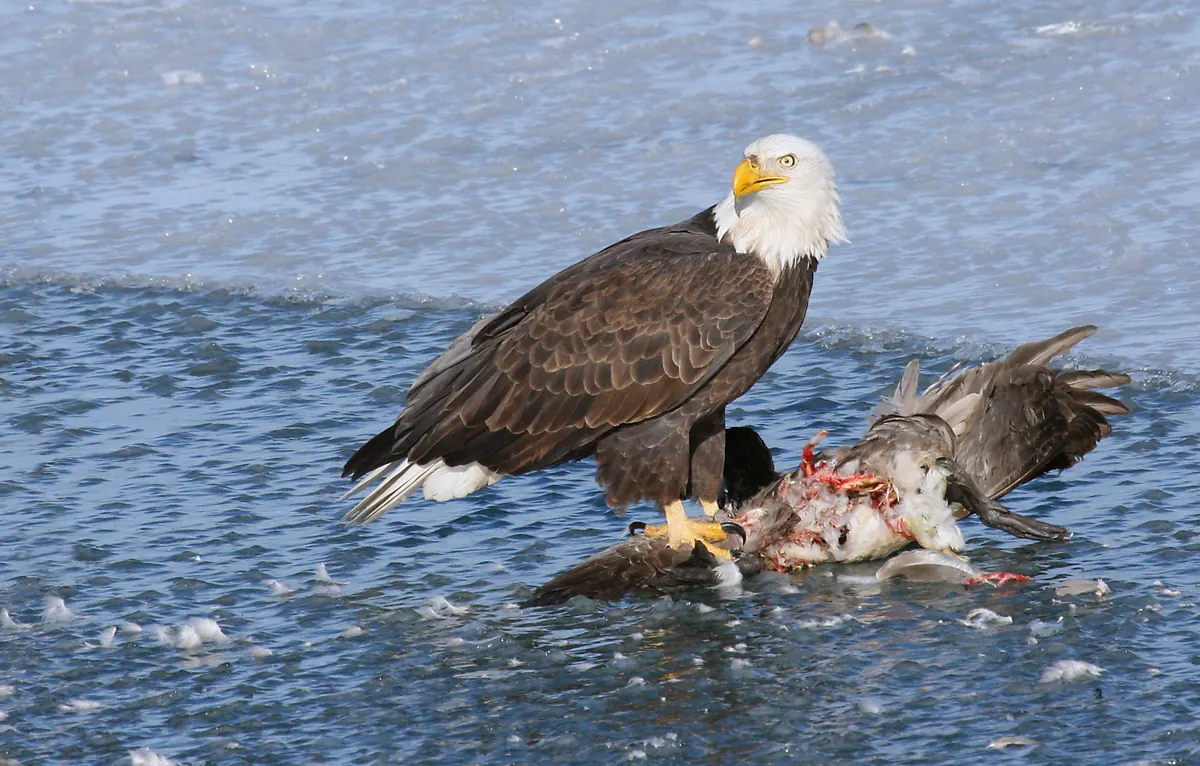
Eagles that drifted in from the north in November are now settled, and January is the month when the open water decides where they gather. As reservoirs and ponds freeze, the birds crowd onto the spillways, river stretches and ice edges that stay open, where fish, sick ducks and geese are easiest to catch. Colorado Parks and Wildlife describes wintering eagles roosting together at night in large trees, which give some shelter and warmth, and eating fish, waterfowl, prairie dogs, rabbits and carrion. At Rocky Mountain Arsenal, the U.S. Fish and Wildlife Service says eagles from the north spend their nights in the big cottonwoods along the refuge lakes, while snow on the open prairie makes its cottontails and black-tailed prairie dogs easy for raptors to spot.
The resident eagles are on a different schedule. CPW’s magazine reported in 2018 that biologists were tracking nearly 200 active bald eagle nests in the state, compared with just ten nesting pairs four decades earlier, and that Colorado pairs usually lay eggs around Valentine’s Day. For those resident pairs, then, January is the run-up to egg laying, and a pair perched together near a big stick nest is worth a long look.
-
The midwinter eagle count
Early to mid-January; the 2027 window is set by the national coordinators · Routes and reservoirs statewide, including John Martin Reservoir near Hasty
Since 1979 volunteers have counted eagles along the same routes each January for the National Midwinter Bald Eagle Survey, now coordinated with the U.S. Geological Survey and the Army Corps of Engineers. The 2026 count ran from January 7 to 21, and January 9 and 10 were the days organizers aimed for; the 2027 window had not been posted when we wrote this. At John Martin Reservoir, the Corps and CPW host an annual early-morning count that welcomes beginners. Counters tallied 78 eagles there in January 2024, 65 bald and 13 golden, but only 44 bald eagles in January 2025, a drop a park ranger suggested might reflect less ice on the reservoir, with more open water around for the birds to spread out on. The Corps has announced past counts on the reservoir’s Facebook page, so look there in December for the 2027 date.
-
Barr Lake and the Arsenal
All month; the first two hours after sunrise are best · Barr Lake State Park near Brighton; Rocky Mountain Arsenal National Wildlife Refuge in Commerce City
Since 1986 at least one eagle pair has been logged at Barr Lake each year, and a communal roost of wintering eagles uses the cottonwoods until that pair settles down to lay. Look for perched birds in the cottonwoods over the water rather than flying ones. At the Arsenal, scan the prairie dog towns along the wildlife drive as well as the lakeside trees, since the refuge’s winter raptors hunt its prairie dogs and rabbits against the snow. A spotting scope helps at both places, and a thermos helps more.
-
The Colorado River roost in Rocky Mountain National Park
Closure in force November 15 to March 15 · West side of the park, near Grand Lake
Every winter, eagles return to a communal roost near the Colorado River on national forest land beside the park. To protect it, Rocky Mountain National Park and the Forest Service close the river and a band 300 yards wide on each side, plus parts of the East Shore Trail and Columbine Bay, from mid-November to mid-March. The Ranger Meadows loop, outside the closure, stays open. Watch from legal ground and you may see birds flying into the roost at dusk.
Bird Conservancy of the Rockies has run its Bald Eagle Watch since 1988, and its volunteers now follow nests that account for 81 percent of Colorado’s known breeding pairs; last season’s required training was a Zoom session on January 24. If you live near a Front Range nest and can visit it regularly through spring, that is a way to turn eagle watching into data.
Why are coyotes, foxes and owls so noisy in a Colorado January?
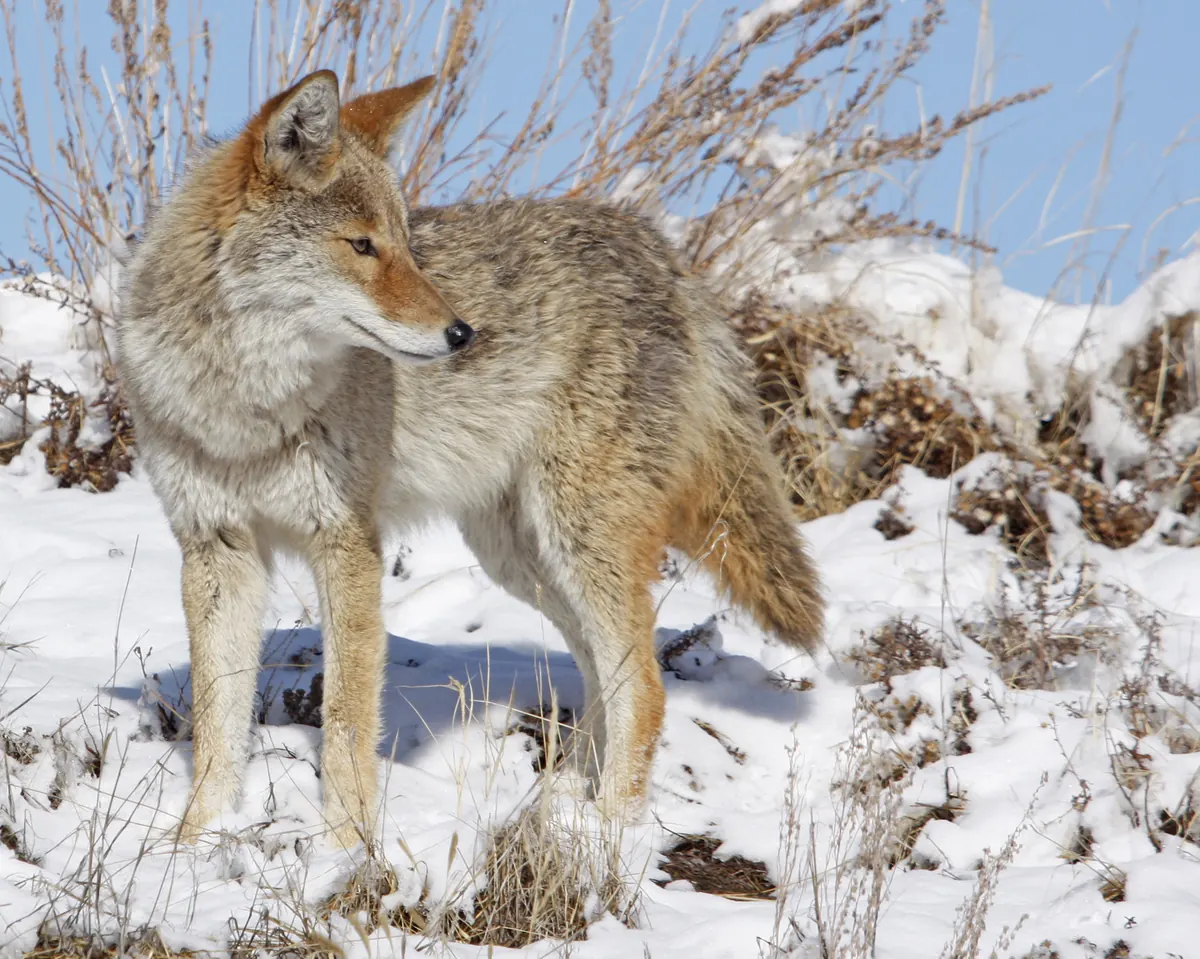
Midwinter is mating season for several of Colorado’s predators, timed so the young are born into spring’s plenty. Colorado Parks and Wildlife says female coyotes breed once a year, between January and March, and give birth to about six pups after nine weeks. Red foxes mate in mid to late winter and pick a natal den late in the season, with kits born in early spring after 53 days. The night air carries all of it.
-
Coyote choruses
Dusk, the middle of the night and just before dawn · Open space and prairie edges all along the Front Range; Rocky Mountain Arsenal; the plains and high parks
Coyotes are mostly active at dawn and dusk, CPW notes, and are highly vocal, with yips and howls that keep neighboring coyotes informed. In January you may also notice two coyotes traveling together where you usually see one. Stand outside on a still, cold evening near open country and listen: the chorus often starts with one voice and spreads.
-
Red foxes screaming
Mostly after dark, January into February · Most of the state, including towns, golf courses and open space
CPW warns that the fox’s screeching yowl is the sound most often mistaken for a cat fight or even a mountain lion. If you hear it from the edge of a park or a field, it is very likely a fox calling for a mate. By day, watch a fox hunting in a snowy field: it pauses, listens, then pounces on a mouse or vole it has heard moving under the surface.
-
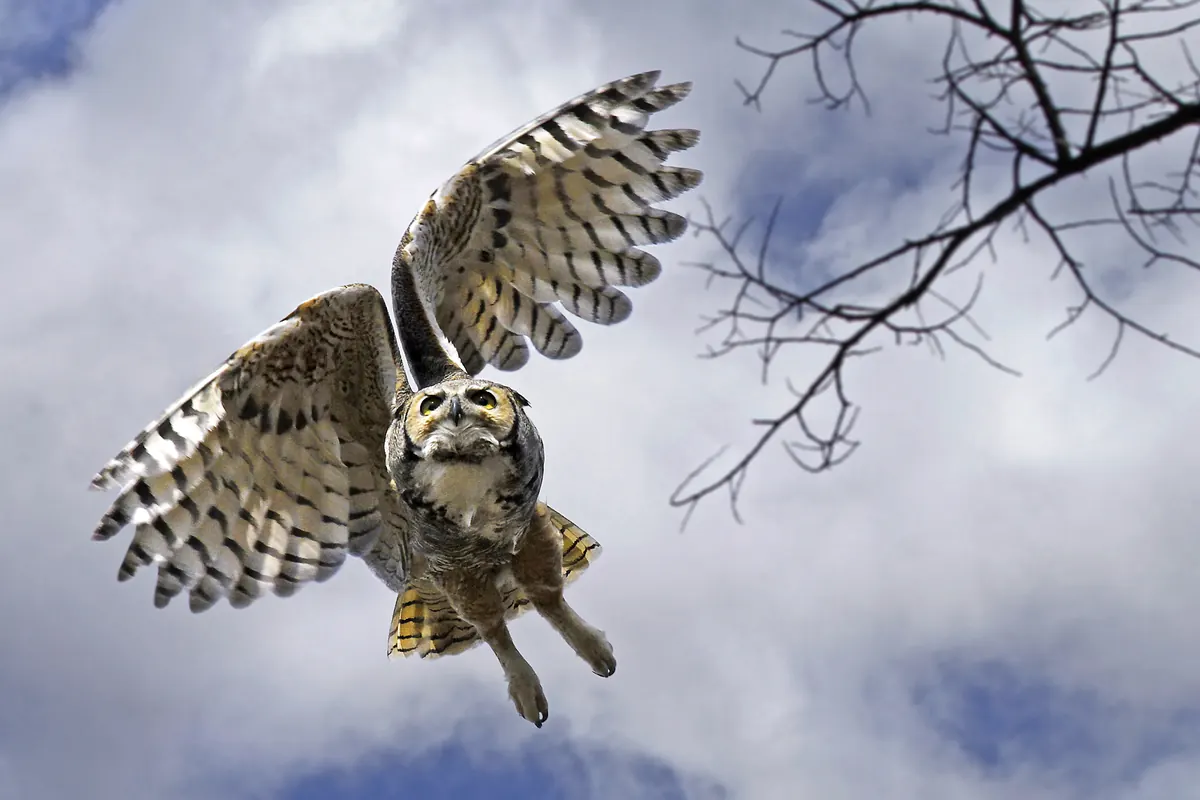
Great horned owls settling on nests
Some lay eggs in January; most Colorado pairs in February and March · Cottonwood groves, windbreaks, cliff ledges and old hawk nests statewide
The hooting duets of December lead quickly to nesting. A Louisville nest followed by the Colorado Avian Research and Rehabilitation Institute shows the pattern: the institute calls the species one of the earliest-nesting birds in North America and says it is common to find great horned owls on nests in January, though many Colorado pairs wait until February or March. Incubation takes about 35 days, almost all of it by the female. Look for a pair of ear tufts poking over the rim of an old stick nest. If you find one, watch from a long way back and keep the spot to yourself, because a female flushed off her eggs on a frigid night leaves them exposed.
Which birds tough out a Colorado January in the mountains?
Plenty of birds leave the high country for the winter, but a few make a living there in the cold, and January is a good time to look for them because there is so little else moving.
-
The American dipper
All winter, wherever streams stay open · Fast, clear mountain creeks and rivers, especially in narrow canyons; Rocky Mountain National Park features it on its bird page
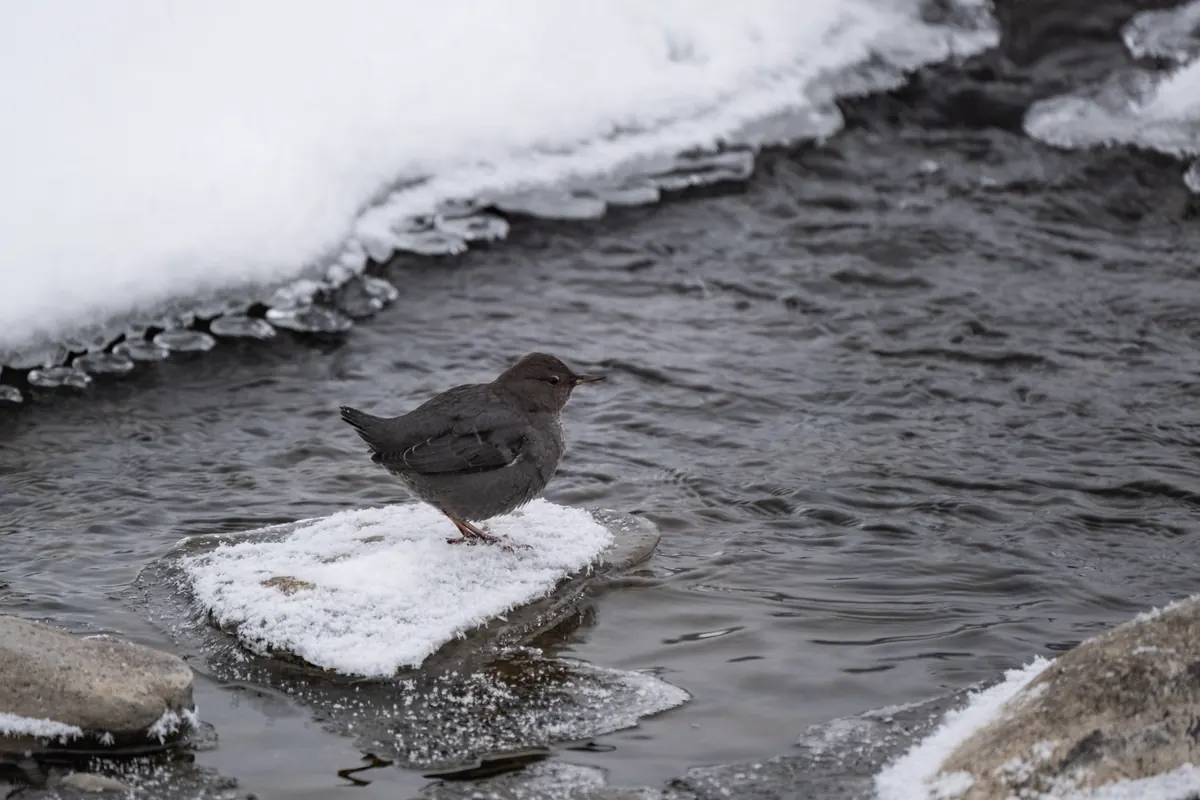
Audubon’s field guide describes how the dipper feeds: it walks into rushing water with only its head under, or dives and “flies” underwater, walking on the bottom and probing under stones. Yellowstone’s biologists credit thick down and oil from a preen gland for keeping it dry. Some dippers move a little downslope in winter, but they stay as long as the current stays open, and they keep singing a loud, bubbling song that carries over the noise of the water. Stand quietly by a riffle and watch for a slate-gray bird bobbing up and down on a rock.
-
Rosy-finch flocks
Mid-winter, especially after storms · Wind-scoured ridges, open roadsides and feeders in mountain towns
Colorado’s own rosy-finch, the brown-capped, nests on high cliffs and snowfields and comes down when snow and ice cover its food, then heads back upslope after feeding. A CPW study from 2018 to 2020 estimated between about 116,000 and 149,000 of them across Colorado’s mountain ranges, a healthy number for a bird with such a small world, though the agency worries that a warming climate will shrink the snow patches it depends on in summer. From mid-November to early February, the Colorado Avian Research and Rehabilitation Institute finds the flocks made up mostly of gray-crowned and black rosy-finches from farther north, with a few brown-capped birds among them. Report sightings to CPW; the species is on the state’s highest-priority conservation list largely because so little is known about it.
Why do aspens have black scars, and what are elk and moose eating in deep snow?
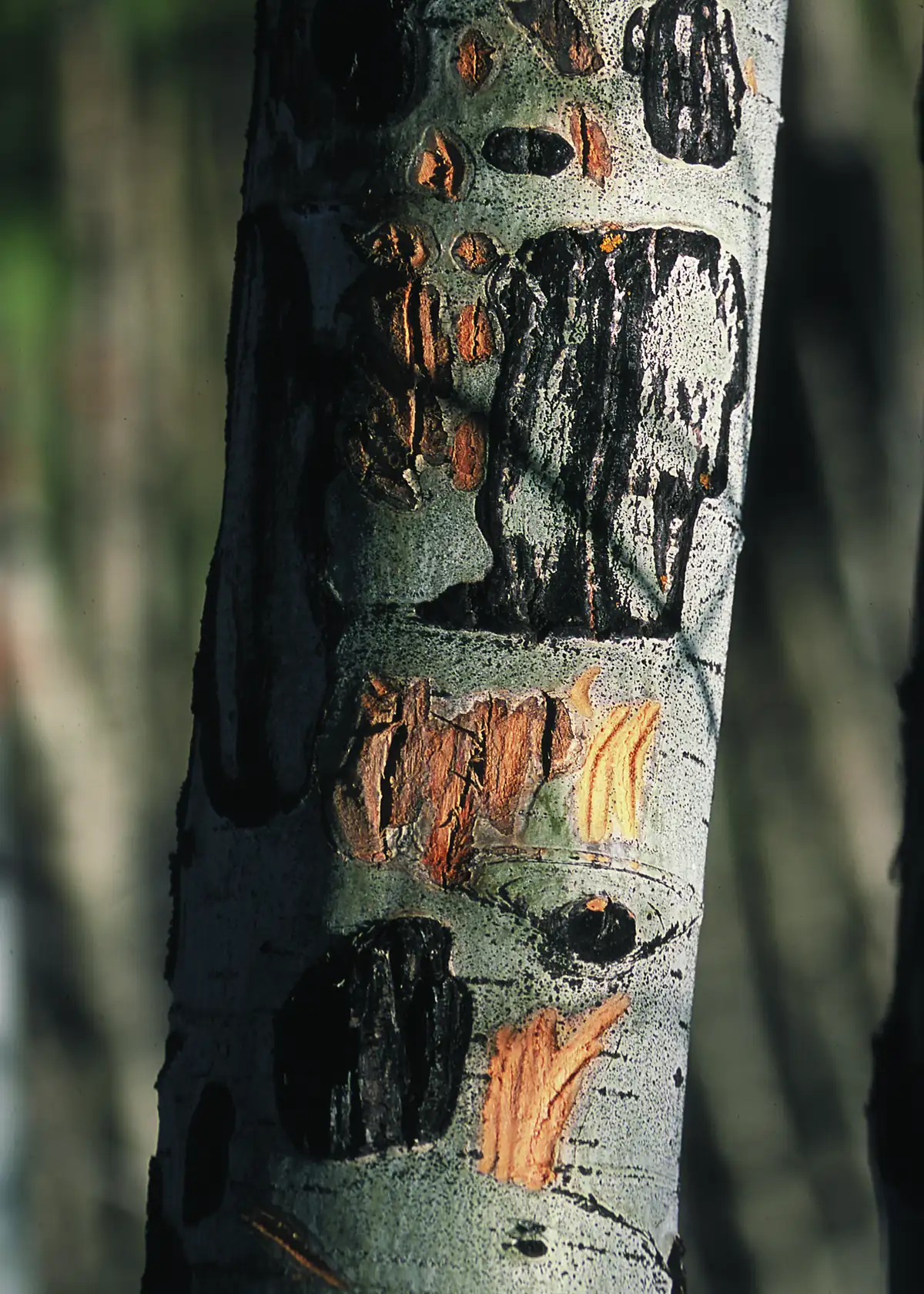
Under the chalky white skin of an aspen is a thin green layer that photosynthesizes. Bryce Canyon National Park, which shares the species with Colorado, explains that this layer lets the tree make sugar and keep growing in winter when other leafless trees are dormant, and that it makes the bark a survival food for elk and deer in hard winters. When snow buries the grass, elk gnaw the bark off. Rocky Mountain National Park points to tooth marks on its aspens that are exactly the size of elk teeth, and to trunks left scarred by elk feeding.
-
Reading an aspen grove
Any winter walk; fresh gnawing is pale and moist · Aspen groves in the foothills and mountains, especially near elk winter range around Estes Park and Rocky Mountain National Park
Look at the bark between knee and head height. Fresh feeding shows as pale grooves where the green layer has been scraped away; older damage turns black and rough, sometimes around much of the trunk. Not every black mark means elk, though: Bryce Canyon’s rangers point out that aspens also scar where lower branches drop off naturally, and those marks sit where a branch used to be. Count how many trunks in a grove carry feeding scars, and you have a rough measure of how hard the elk have leaned on it in past winters.
-
Moose in the willows
All winter; moose stay put for days when food is good · North Park around Walden, the Kawuneeche Valley along Highway 34 in Rocky Mountain National Park, Grand Mesa and other willow bottoms
Colorado now has more than 3,000 moose, descended mainly from 24 animals moved from Utah and Wyoming to North Park in 1978. In winter, CPW says, they live on willows, which also give them shelter, and they rarely leave their home range. Rocky Mountain National Park has seen some moose return to the same willow patch on nearly the same winter date each year. The park adds that bulls begin dropping their antlers in late fall to save energy, so many January bulls are bare-headed. Moose in deep snow will use packed trails and ski tracks and will not step aside: CPW asks people to go around or wait, and to keep dogs leashed, because a moose treats a dog like a wolf.
What tracks turn up in Colorado snow in January, and how do you know a mountain lion’s?
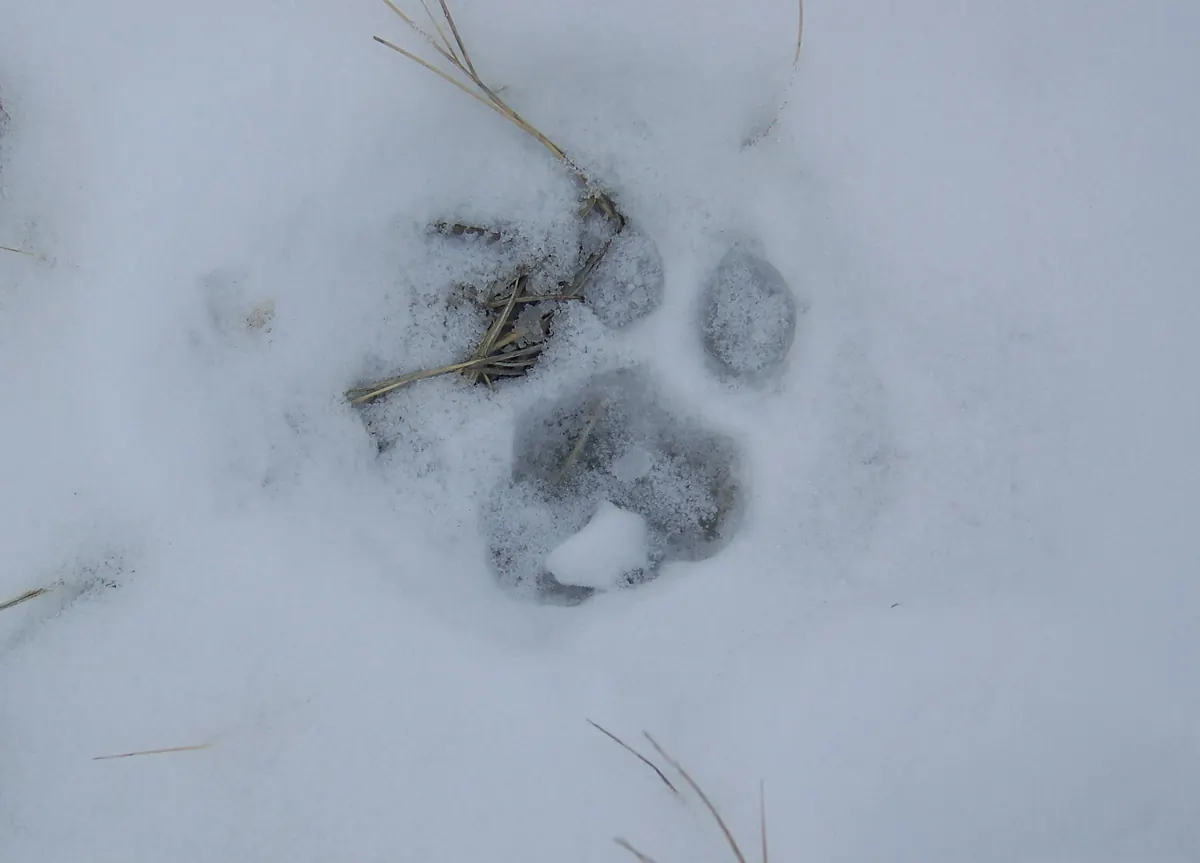
After a light, fresh snow almost any trail in the foothills shows who passed in the night. It is also the best time to learn the big cat’s sign. CPW’s magazine cites an extrapolated range of 4,000 to 5,500 independent mountain lions in Colorado, a projection rather than a census, and says they are most common in the foothills and mountains where deer and elk are plentiful. Few people ever see one; many more find the tracks.
-
Mountain lion
Mornings after new snow · Foothill canyons, ridgelines and deer winter range from the Front Range to the Western Slope
A lion print runs about 3 inches across for a female and up to 5 for a male, with four toes and, usually, no claw marks, because a lion’s claws retract. The stride is long, 30 to 40 inches for a female and 40 to 50 for a male according to CPW, much longer than a bobcat’s or a lynx’s. A round print with no claws and a long, purposeful line of them heading along a ridge or canyon bottom is worth photographing next to a glove or a ruler for scale. If you find fresh lion tracks while out with children, keep them close and head back.
-
Tracks under the snow
All winter · Subalpine forest and meadows where the snow is deep
Much of winter life in the mountains happens out of sight. Voles and mice keep busy in runways beneath the snowpack, insulated from the bitter air above, and their hunters come looking for them. CPW notes that the marten, a slim weasel of old spruce, fir and lodgepole forest, takes red-backed voles on the ground and stays active all winter, denning in a tree hole or a squirrel’s nest in the coldest snaps. Look for small holes where a trail of paired prints disappears into the snow and comes back out a few yards later. Snowshoe hare and weasel tracks were in our December guide; this month, try following a fox line until it ends in a pounce mark.
How cold does Colorado get in January, and where is the snow deepest?
For most of the state, January is the coldest month of the year. The National Weather Service in Boulder gives Denver a January average temperature of 31.7 °F for 1991–2020. Its all-time low, −29 °F, came on January 9, 1875, and the office’s list of every reading of 20 below or colder since 1872 runs to 30 entries, the latest −24 °F on December 22, 2022. But Denver is mild compared with the mountain basins. Cold air drains into the San Luis Valley, the Gunnison basin and the valley around Fraser and pools there on still nights, so in NOAA’s normals the average January low at Gunnison and Crested Butte is below zero, while Boulder’s stays above 20.
| Station | Snowfall | Average high | Average low |
|---|---|---|---|
| Fort Collins | 6.7 | 45.0 | 18.3 |
| Boulder | 11.3 | 47.0 | 21.5 |
| Colorado Springs Municipal Airport | 4.9 | 45.0 | 18.5 |
| Pueblo Memorial Airport | 4.9 | 48.4 | 15.4 |
| Lamar | 6.3 | 45.1 | 13.7 |
| Grand Junction Walker Field | 4.5 | 38.1 | 17.3 |
| Alamosa San Luis Valley Airport | 4.5 | 34.8 | -1.1 |
| Gunnison 3SW | 11.1 | 26.1 | -6.4 |
| Fraser | 24.7 | 30.8 | -0.9 |
| Steamboat Springs | 46.6 | 29.2 | 4.6 |
| Crested Butte | 42.2 | 25.8 | -6.5 |
| Climax (Fremont Pass) | 44.5 | 26.7 | 2.9 |
| Telluride 4WNW | 23.6 | 36.2 | 0.3 |
Two things stand out. The plains and the Western Slope valleys get only 4 to 7 inches of snow in a normal January, while Steamboat Springs, Crested Butte and Climax average more than 40, which is why the reservoirs that supply the Front Range depend on the high country. And the coldest towns are not the highest ones: Alamosa, at about 7,500 feet, has a lower average low than Climax at more than 11,000, because the valley traps cold air under a lid of warmer air above. For how frost and freeze dates run town by town, our Colorado frost tables hold the station medians.
Does a strong El Niño mean a colder January in Colorado?
It nudges things a little, mostly on temperature. Colorado heads into this winter with a heavyweight in the Pacific. When federal forecasters last looked, on September 10, they put better than nine chances in ten on a very strong El Niño through Colorado’s snow season. The Colorado Climate Center at Colorado State University, looking at the state’s record, finds that El Niño’s clearest winter fingerprint here is cooler than average temperatures across the whole state, while winter precipitation shows no consistent signal at all. The big Front Range blizzards of some El Niño winters are memorable, the center notes, but not regular enough to count on.
Its September review of the three earlier super El Niños adds a caution: 1982–83 brought huge snow, but 1997–98 and 2015–16 ended up near normal. The surest El Niño effect it finds is wetter fall and spring weather and bigger spring storms east of the mountains, which would matter more in March than in January. In the San Juans and the Rio Grande basin there is a weak tendency toward deeper snowpack; elsewhere, the link to peak snowpack is weak. A warmer climate also means some of the extra moisture may fall as rain at low elevations.
NOAA refreshes its seasonal outlooks every month, and the latest are on its 90-day outlook page. For today’s wind and pressure across the state, see our weather page.
When does the sun start setting after 5 p.m. in Colorado?
The afternoons are already lengthening by New Year’s Day, but the mornings lag. The latest sunrises of the year come in the first days of January, so the gain at first is almost all at the end of the day. In Denver the first 5:00 p.m. sunset of the new year comes on January 15. By the 31st, every city in the table has gained roughly three-quarters of an hour of daylight, and the daily gain keeps growing into February and March.
| City | Jan 1 | Jan 31 | Gained | Per day |
|---|---|---|---|---|
| Fort Collins | 9 h 20 m | 10 h 06 m | 46 min | 1.5 min |
| Steamboat Springs | 9 h 20 m | 10 h 06 m | 46 min | 1.5 min |
| Denver | 9 h 25 m | 10 h 09 m | 44 min | 1.5 min |
| Grand Junction | 9 h 29 m | 10 h 12 m | 43 min | 1.4 min |
| Colorado Springs | 9 h 30 m | 10 h 14 m | 44 min | 1.5 min |
| Pueblo | 9 h 34 m | 10 h 16 m | 42 min | 1.4 min |
| Alamosa | 9 h 38 m | 10 h 19 m | 41 min | 1.4 min |
| Durango | 9 h 39 m | 10 h 20 m | 41 min | 1.4 min |
Canyon floors and north-facing valleys lose direct sun far earlier than these official times. For a trailhead or a backyard, the daylight calculator gives exact sunrise and sunset for any date.
What is in the Colorado night sky in January 2027?
Cold, dry January air is the clearest of the year over the high valleys, and the nights are still long. The darkest evenings come in the week or so around the new moon of January 7, when no Moon spoils the evening sky. Dress for well below freezing even on the Front Range, and let your eyes adjust for twenty minutes before deciding what you can see.
-
The Quadrantids
Night of Sunday, January 3, into Monday, January 4; best before dawn Monday · Any dark site away from town lights; meteors appear all over the sky
The Quadrantids are a brief, sharp shower, with a peak only about six hours long, and 2027 sets them up well. Predictions put the peak on Sunday evening in Mountain time, around 8:30 p.m. according to the American Meteor Society, with another forecast a couple of hours later. The radiant, the point the meteors seem to come from, starts out low after dark and gains height hour by hour, which means the best rates in Colorado should come in the dark hours before dawn on Monday. Moonlight barely matters, because the waning sliver does not clear the horizon until the last hours of the night. Away from town lights, dozens an hour is a realistic hope.
-
Perihelion and Venus at its best
Saturday, January 2, 7:33 p.m. MST; Venus all month before dawn · Venus in the southeast before sunrise
Our planet passes perihelion, its nearest point to the Sun, on the evening of January 2, about 91.4 million miles out: proof, if anyone needs it, that seasons come from the tilt of Earth’s axis and not from how far away the Sun is. The next morning, January 3, Venus swings farthest west of the Sun in our sky, 47 degrees, and blazes in the southeast before dawn; a small telescope shows it half lit.
-
The Wolf Moon, the closest full moon of 2027
Full at 5:17 a.m. MST, Friday, January 22 · Rising in the east around sunset on the 21st
The Moon reaches full before sunrise Friday, which makes Thursday night, January 21, the best time to watch it ride high across the sky; it still looks full on Friday evening. Perigee, its closest point in this orbit, comes roughly 14 hours ahead of the full phase, so this is the nearest and largest full moon of the year, about 222,200 miles away. On the evening of Saturday, January 23, the Moon sits close to bright Jupiter, which reaches opposition on February 10.
-
Planets and northern lights
All month · Saturn in the southwest after dark; Mercury low in the west-southwest at month’s end
Saturn is low in the southwest in the early evening and sinking. Late in the month Mercury starts its best evening appearance of the winter, low in the west-southwest about 30 to 45 minutes after sunset. Jupiter, the brightest point in the evening east, is up for most of the night. Solar activity has eased since the 11-year cycle peaked in 2024, but the Sun is still lively, and a strong geomagnetic storm could paint aurora low in the northern sky over Colorado; check the NOAA Space Weather Prediction Center if one is forecast.
| Phase | Date | Time |
|---|---|---|
| New moon | Thursday, Jan 7 | 1:24 p.m. |
| First quarter | Friday, Jan 15 | 1:34 p.m. |
| Full moon, the Wolf Moon | Friday, Jan 22 | 5:17 a.m. |
| Last quarter | Friday, Jan 29 | 3:55 a.m. |
Before a long drive to a dark Colorado site, see whether skies will clear on the cloud and sky page; moonrise and moonset times for every night of the month sit in our calendar of Moon phases.
What can families do outdoors in Colorado in January 2027?
- New Year’s Day hikes, Friday, January 1. Colorado state parks hold guided hikes every New Year’s Day; on January 1, 2026, Barr Lake’s 11 a.m. walk promised eagles, with Eventbrite registration and a park pass. Look for the 2027 list on CPW’s event calendar in December.
- Catch the last Christmas Bird Counts. The season runs through Tuesday, January 5, 2027. Last season several southern counts went out in January, including Black Forest, the Spanish Peaks and Great Sand Dunes on January 3 and the Air Force Academy on January 5; register through Audubon’s circle map.
- Join an eagle outing. Bird Conservancy of the Rockies has led a three-hour eagle walk at Barr Lake in early January (the last one was Saturday, January 3, 2026, $7 plus a park pass, binoculars provided). Check its events page for a 2027 date before you go.
- Count birds at home. Project FeederWatch runs through April 30; a child can keep the tally of the biggest flock of each kind seen at once, and a snowy morning at the feeder may bring rosy-finches in mountain towns.
- Go on a track hunt. After a light snow, take a ruler and a phone to a local open space. Measure a print, count the toes, check for claw marks and follow the trail to see where it leads.
- Ask a ranger. Rocky Mountain National Park posts its winter ranger programs on the park calendar and at visitor centers; programs can be canceled in bad weather, so call ahead.
- Keep a light log. Note the sunset time every few days and mark the first evening the sun sets after 5 p.m.; jot it in the Naturalist’s Field Journal each weekend and the turning of the year shows up on the page.
Our nature guides by month pick up in February with eagles on eggs and the first signs of spring on the plains.
Safety notes for January in Colorado
- Several seasons stay open all month. CPW’s season structure keeps the plains archery elk season east of I-25 open through January 31, late rifle elk hunts in some units within November 23 to January 31, and private-land-only deer and elk licenses valid to January 31. Lion hunters with regular licenses can be out from November 23, 2026, until March 31, 2027. Duck seasons run to January 31 in every zone except the Pacific Flyway’s Eastern Zone (Routt, Grand, Summit, Eagle and Pitkin counties and nearby areas), which closes January 15, and regular goose seasons east of the Divide run to February 14. Pheasant and quail seasons end January 3 or January 31 depending on the area. Exact zones are in CPW’s 2026 small game and waterfowl brochure.
- Orange or pink is the rule for big game. Firearm hunters after deer, elk, pronghorn, moose or bear must have 500 square inches or more of solid daylight fluorescent orange or pink on an outer garment above the waist, and an orange or pink head covering that shows from all sides; orange or pink camo does not qualify. It is a good idea for anyone walking on state wildlife areas or national forest in January to wear something bright, and to put a vest on the dog.
- Ice is never uniform. CPW says four inches of good ice holds a person on foot and six inches a snowmobile or ATV. Carry ice picks on a cord and 50 feet of rope, and remember that river ice, inlets and the open holes where eagles feed are thin even in a cold snap.
- Avalanches. Midwinter weak layers buried under new snow are a classic Colorado problem. Read the Colorado Avalanche Information Center forecast for your zone before any trip near or under steep slopes, including snowshoe routes; the CAIC counts an average of 27 avalanche deaths per winter nationwide across the past decade.
- Cold and wind. Valley mornings below zero and wind on the ridges can cause frostbite in minutes. Layer up, keep a dry spare pair of gloves and socks, and turn around early; the sun still sets around 5 p.m.
- Wildlife in deep snow. Give moose and elk a wide berth on packed trails, keep dogs leashed, and never chase animals off a trail to pass; every unnecessary run burns fat they need until spring.
Sources
- Colorado Parks and Wildlife: bald eagle
- Colorado Outdoors (CPW): bald eagles, a majestic mystery (2018)
- Colorado Outdoors (CPW): studying bald eagles along the Front Range (2021)
- U.S. Army Corps of Engineers: National Midwinter Bald Eagle Survey
- U.S. Army: volunteers spot 80 eagles at five Albuquerque District lakes, including John Martin Reservoir (February 2025)
- U.S. Fish and Wildlife Service: Rocky Mountain Arsenal wildlife (winter eagle roost, prairie prey)
- U.S. Fish and Wildlife Service: Rocky Mountain Arsenal National Wildlife Refuge
- National Park Service, Rocky Mountain: raptor and bald eagle closures
- Colorado Trail Explorer: bald eagle closure, Rocky Mountain National Park
- Bird Conservancy of the Rockies: volunteer, including Bald Eagle Watch
- Bird Conservancy of the Rockies: Bald Eagle Outing at Barr Lake (January 3, 2026)
- Colorado Parks and Wildlife: coyote
- Colorado Parks and Wildlife: red fox
- Colorado Parks and Wildlife: great horned owl
- Colorado Avian Research and Rehabilitation Institute: Louisville great horned owl
- National Audubon Society: American dipper field guide
- National Park Service, Yellowstone: American dipper
- National Park Service, Rocky Mountain: birds
- Colorado Avian Research and Rehabilitation Institute: rosy-finch research
- The Prowers Journal: John Martin Reservoir’s midwinter eagle survey (2021)
- Colorado Outdoors (CPW): winter wanderers, brown-capped rosy-finches (December 2025)
- National Park Service, Bryce Canyon: quaking aspen
- National Park Service, Rocky Mountain: aspen bark and elk
- National Park Service, Rocky Mountain: scarred aspen trees
- Colorado Parks and Wildlife: moose
- Colorado Parks and Wildlife: living with moose
- National Park Service, Rocky Mountain: moose
- Colorado Outdoors (CPW): living with mountain lions (January 2026)
- Colorado Parks and Wildlife: marten
- NWS Denver/Boulder: January climate records for Denver
- NWS Denver/Boulder: Denver’s low temperatures of 20 below or colder since 1872
- NOAA NCEI: U.S. Climate Normals, 1991–2020 (monthly normals data service)
- Climate Prediction Center: ENSO diagnostic discussion, September 10, 2026
- Climate Prediction Center: 90-day outlooks
- Colorado Climate Center: ENSO and Colorado
- Colorado Climate Center: what a super El Niño means for Colorado (September 3, 2026)
- U.S. Naval Observatory: moon phases from December 30, 2026 (data API)
- U.S. Naval Observatory: Earth’s seasons and perihelion, 2027
- American Meteor Society: meteor shower calendar
- Fred Espenak: Sky Event Almanac 2027
- EarthSky: what is a supermoon?
- NOAA Space Weather Prediction Center: aurora dashboard
- Colorado Parks and Wildlife: start the new year with a First Day Hike (December 29, 2025)
- Colorado Parks and Wildlife: First Day Hike at Barr Lake State Park (January 1, 2026)
- National Audubon Society: Christmas Bird Count
- Colorado Public Radio: Christmas Bird Counts in southern Colorado (2025–26 dates)
- Project FeederWatch (Cornell Lab and Birds Canada)
- National Park Service, Rocky Mountain: ranger-led programs
- Colorado Parks and Wildlife: 2025–2029 big game season structure (PDF)
- Colorado Parks and Wildlife: 2026 small game and waterfowl brochure
- Colorado Parks and Wildlife: deer in the field, fluorescent orange and pink
- Colorado Parks and Wildlife: ice fishing and ice safety
- Colorado Avalanche Information Center: forecasts
- Colorado Avalanche Information Center: accident statistics
- Photos via Wikimedia Commons; licenses and photographers are credited under each picture
.jpg)