What to look for in nature in Colorado this March
Of all the months, March is the one when Colorado's seasons overlap most. In the San Luis Valley the sandhill cranes are at their highest numbers and dancing in the barley fields, on the plains the first grouse are already on their strutting grounds, and the earliest migrants, mountain bluebirds and burrowing owls among them, are returning while snow can still arrive overnight. Denver is just about to jump an hour ahead on the clock. The notes below run through the whole month; to catch up on the previous month, read Colorado in February.
Other months in Colorado: October, November, December, January, February, April.
Start here

- Watch the cranes at Monte Vista. Be at a Highway 15 pullout at the refuge near sunrise, or the last hour of light. Refuge managers say the best viewing comes around the first week of March.
- Look for a mountain bluebird on a fence. March through early April brings the earliest bluebirds to open meadows, often with snow still on the ground. Moraine Park near Estes Park is one of the places the park's visitor guide names.
- Find an Easter daisy. On a sunny south-facing foothill slope, such as Green Mountain in Lakewood, look for a low mound with a white-to-pink flower close to the ground.
In your Naturalist's Field Journal, the "birds I have seen" plate suits the first bluebird, phoebe and crane of the year, "dusk and dawn watch" for a lek or crane flight at first light, "a tree through the seasons" for a cottonwood near home as buds swell, and "reading the signs" for the snow, wind and cloud changes of a fast-moving March.
Regions used below: Front Range and the Denver metro; Eastern Plains; Northern Mountains and Rocky Mountain National Park; Central Mountains and the high parks; San Luis Valley; Western Slope and the Four Corners.
Is March the best time to see sandhill cranes in the San Luis Valley?
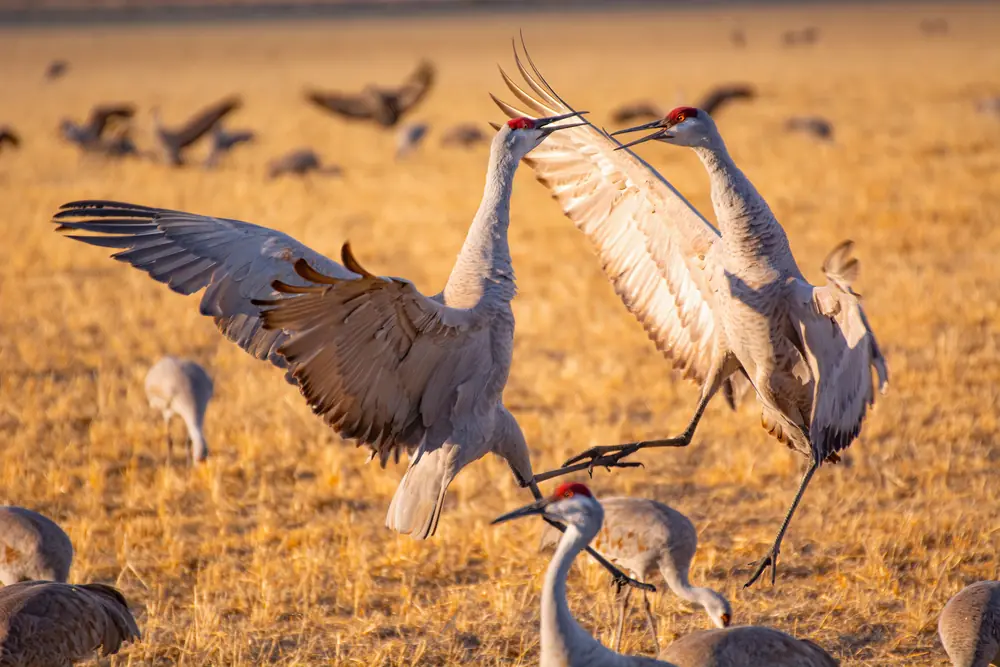
For most visitors, yes. At Monte Vista National Wildlife Refuge, federal wildlife managers put the sweet spot for crane watching near the first week of March. In spring the refuge holds roughly 95 percent of the Rocky Mountain flock of greater sandhills, somewhere between 18,000 and 21,000 birds, alongside 5,000 to 6,000 of the smaller lesser sandhills. Great Sand Dunes National Park and Preserve adds that the birds start arriving in early February and leave for the northern states and Canada by late March, so the window is short. After that the valley goes quiet until the fall passage covered in our October page.
What makes March special is behavior, not just numbers. The park describes pairs renewing lifelong bonds with dancing, bowing, chortling and tossing tufts of grass into the air. A pair that leaps in the middle of a barley field is not startled; it is courting.
-
The refuge pullouts
Daylight hours; the refuge opens its drive and trails one hour before sunrise and closes one hour after sunset · Monte Vista National Wildlife Refuge, south of Monte Vista on Highway 15
The refuge's own viewing report names four dependable spots: the pullouts along Highway 15, the 8S pullout on County Road 8S, the 7S pullout on County Road 7S, and Spring Creek Pond at the south end of the Wildlife Drive. In a recent report on its website, the fields at 8S held 5,000 to 7,000 cranes and more than 2,000 Canada geese, with elk nearby, while the wet areas along the highway were where birds rested by day. Call the refuge office at 719-589-4021 for current conditions before you drive out.
-
Staying on the road
All spring · Farm fields around Monte Vista
The park service reminds visitors that cranes feed on barley fields and wetland invertebrates, and that much of that farmland is private. Watch from the road, pull fully off it, and stay in your car if the birds are close.
-
The Monte Vista Crane Festival
Friday to Sunday, March 5 to 7, 2027 · Monte Vista, with talks at the Ski Hi complex and guided field trips
The festival's own website lists March 5 to 7, 2027. A Festival Pass covers the talks, workshops, keynote and Friday night movie, and children 15 and under attend free. The guided "Into the Field" outings are sold separately, have limited seats, and require the pass. The Craft and Nature Fair is free and open to the public.
Where can I see grouse dancing on their leks in Colorado in March?
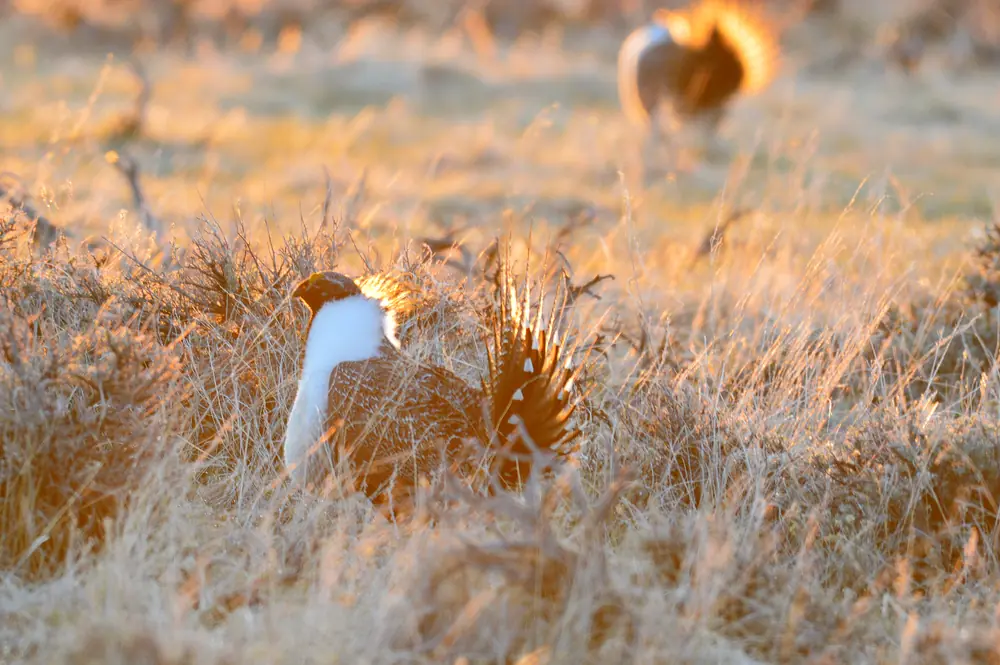
The grouse dancing season starts in March and builds into April and May. Colorado Parks and Wildlife (CPW) says male greater sage-grouse begin gathering on their traditional strutting grounds, called leks, in early March, with females arriving one to two weeks later; the full courtship display, with its swishes, pops and growls, runs from late March through May. Greater prairie-chickens follow almost the same calendar: CPW says their breeding displays take place in March and April, with hens beginning to visit leks in mid-March.
March is the quiet start of the show, and the most dependable viewing comes later, so treat what follows as a way to plan.
-
Greater sage-grouse in the northwest
Early March for the first males; display peaks later in spring · North Park, Middle Park, the Parachute-Piceance-Roan area and other sagebrush country in northwestern Colorado
CPW counts more than 500 known leks in northwestern Colorado, spread across seven populations. The species is listed as State Special Concern. CPW's species page does not publish a public viewing schedule, and the leks themselves are off-limits to casual visitors because a car, a headlight or a dog can scatter the birds. If you want to watch, ask CPW whether any guided or reserved viewing is offered.
-
Greater prairie-chickens near Wray
Leks active March and April; tours and the best viewing mostly April and May · Sandsage prairie in Yuma County, northeastern Colorado
CPW notes that prairie-chickens live in the sandhills of northern and central Yuma County, extreme eastern Washington County and extreme southern Phillips County, and that they came back from a low of about 600 birds in 1973 through habitat work. The Colorado Birding Trail says every reliable lek is on private land, so tours are your best shot and the roads north of Wray are better for listening than seeing. Its calendar listed the Wray tours as running March 20 to April 19 in 2026; the 2027 schedule had not been posted, so check with the Wray Chamber of Commerce at 970-332-3484. The Birding Trail's listing quotes $120 to $135 per person with a motel room, and reservations are required.
-
Lek manners
Before dawn through mid-morning · Any grouse lek
The Birding Trail's advice to roadside listeners is blunt: no matter how close the birds sound, do not leave the road. View from your vehicle, park on the shoulder only, and keep engines and doors quiet.
Which birds come back to Colorado in March?
March is when the first migrants arrive, often before the snow has gone. Rocky Mountain National Park's visitor guide calls the mountain bluebird the earliest spring migrant, arriving March through early April "while snow still lingers", with ospreys returning from March into April. National Audubon's Rockies office lists the Say's phoebe among the earliest arrivals and the cinnamon teal as one of the first waterfowl treats, and the western meadowlark's song soon follows from fence posts and utility poles on the plains.
-
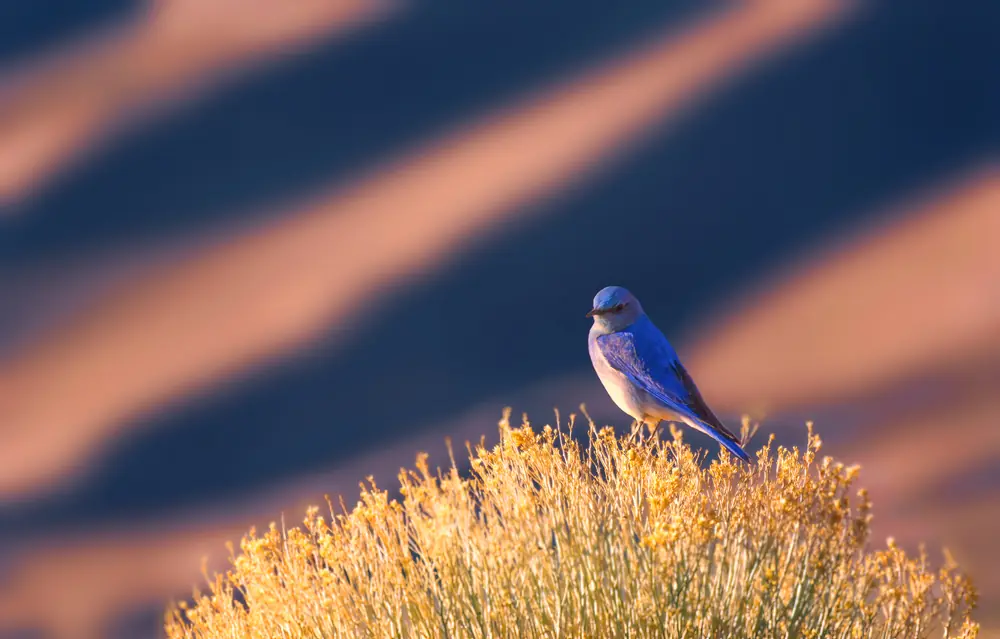
Mountain bluebirds
March through early April · Open meadows and fence lines; Moraine Park, Horseshoe Park and Upper Beaver Meadows near Estes Park
A male mountain bluebird is a clean, sky-colored blue with no orange at all. CPW says flocks come up from the south as the spring snows retreat, though its page puts the typical sighting season at early May through summer, so a March bluebird is an early scout. They nest in aspen cavities and readily take to nest boxes, returning to the kind of cavity where they were raised. A box mounted on a fence post in open country is the easiest way to invite one.
-
Say's phoebe and cinnamon teal
March into April · Rangelands, ranch buildings and shallow marshes
Audubon describes the Say's phoebe as a brownish-gray flycatcher with a long black tail and buff belly that dives from low perches for insects. The male cinnamon teal, reddish-cinnamon with a red eye, favors shallow marshy wetlands as it passes through. Look for the phoebe on a fence wire and the teal in the first open water at the edge of a marsh.
-
Dinosaur Ridge Hawkwatch
Spring season; the Birding Trail's calendar listed March 1 to May 10 in 2026 · Dakota Ridge hogback at Dinosaur Ridge, Morrison
Volunteers and researchers from Bird Conservancy of the Rockies help visitors search the sky above the hogback for hawks, eagles and vultures and explain why the birds follow this route. The event listing mentions a short but steep hike up the ridge. No 2027 schedule had been published when we looked, so confirm on the Birding Trail's events calendar before you set out.
When do burrowing owls and mountain plovers return to the eastern plains?
Both are birds of prairie dog country, and both come back to Colorado in the spring. CPW says burrowing owls arrive between March and May and leave again between August and October. Mountain plovers, by CPW's account, reach their Colorado breeding grounds in March. Neither bird is common, and each is a species the state tracks closely.
-
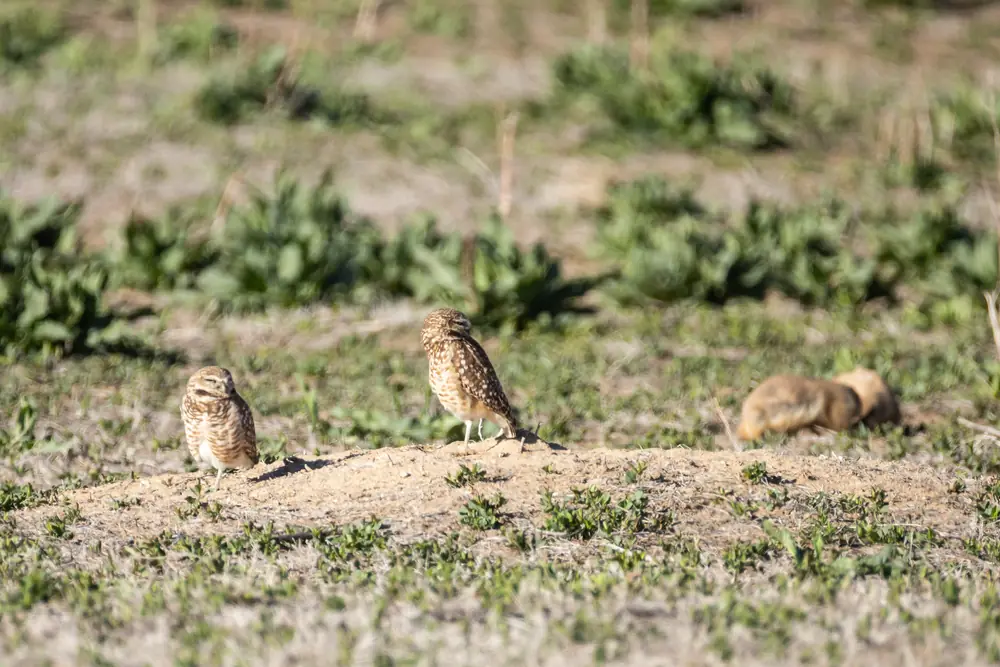
Burrowing owls
Arrivals from March to May; look for them on sunny days · Prairie dog towns, grasslands and rangeland, including Rocky Mountain Arsenal National Wildlife Refuge
A burrowing owl is a small, long-legged owl with white eyebrows, yellow eyes and no ear tufts, and it hunts in daylight. It nests in burrows dug by prairie dogs and other small mammals. CPW lists it as State Threatened and notes that ongoing research looks at how prairie dog colony management affects owl nesting. The Arsenal refuge near Denver is free, open sunrise to sunset in spring, and has an 11-mile Wildlife Drive; visitors are asked to watch bison from their vehicles and stay on designated trails. Its visitor center is open Wednesday through Sunday, 9 a.m. to 4 p.m., but call 303-289-0930 for current hours.
-
Mountain plovers
Arrivals in March; courtship flights soon after · Shortgrass prairie, especially the Pawnee National Grassland
This plover is a sandy-brown bird of dry, grazed prairie rather than shorelines. CPW describes the male's courtship display as a "falling leaf" drop from 15 to 30 feet with wings held in a V. The species is listed as State Special Concern, and CPW cites a possible decline of 38 to 70 percent over 31 years, tied to prairie conversion and the loss of prairie dog colonies. Check access and road conditions with the grassland's managers before you go.
What happens at Colorado's eagle and owl nests in March?
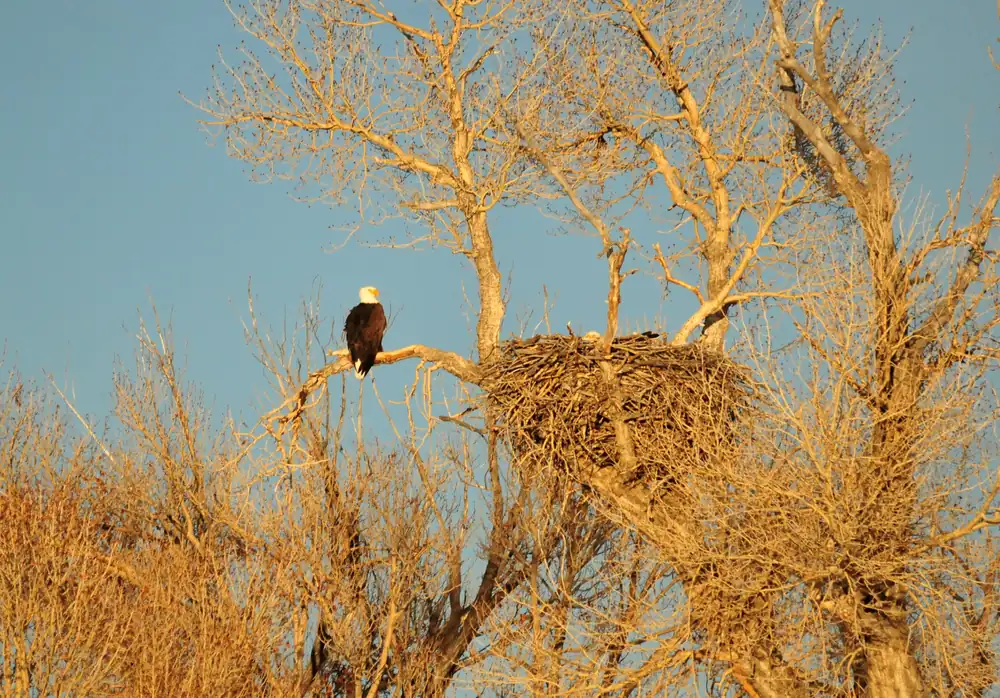
Spring changes the meaning of every nest you have been watching all winter. CPW says bald eagles incubate their one to three eggs for 35 to 40 days, with both parents sharing the work, and that the young stay in the nest 10 to 12 weeks. For a pair that laid in mid-February, hatching therefore falls somewhere in the second half of March, though individual nests vary. The Colorado birds that began calling in December are on the same schedule: CPW says great horned owls reuse old nests of hawks, eagles, herons and crows, raise two to three eggs for about a month, and owlets spend six to seven weeks on the nest after hatching.
-
Watching without disturbing
All month · Barr Lake State Park, Rocky Mountain Arsenal, and cottonwood stretches along the Front Range rivers
CPW says spring at Barr Lake brings eagles, pelicans, double-crested cormorants, blue herons and grebes, and that an easy 1.3-mile walk from the nature center reaches the Gazebo Boardwalk, where a spotting scope shows the rookery. The park opens daily at 5 a.m. Use binoculars, stay on the boardwalk, and keep away from the base of a nest tree.
-
The Rocky Mountain National Park eagle closure
Closed November 15 to March 15 · The Colorado River and a zone 300 yards wide on both sides, on the west side of the park near Grand Lake
The park service closes that stretch to protect wintering bald eagles. It reopens after March 15, and the park says it may still close other areas if it finds new raptor nests. To report a nest, call the information office at 970-586-1206.
-
The antler closure continues
Through April 30 · Public land west of I-25
CPW's rule against collecting shed antlers and horns on public land west of I-25 runs January 1 through April 30, and each violation costs $137 and five points against the offender's license. Five game management units (54, 55, 66, 67 and 551) add a nighttime ban from legal sunset to 10 a.m. on May 1 through 15. Elk and deer are still thin in March. Enjoy them from a distance and keep dogs leashed.
What wakes up in Colorado in March: frogs, butterflies, bears and the first flowers?
The first warm afternoons bring out the animals and plants built for freezing nights. Great Sand Dunes says chorus frogs are usually the first amphibians to appear in spring, calling loudly even while snow is still falling in March and April; the call is a dry rasp, something like a thumbnail dragged along a comb, from a frog about an inch long. The park adds that chorus frogs and tiger salamanders can freeze solid in winter and thaw back to life.
-
Chorus frogs and tiger salamanders
First mild nights near open water, even in March snow · Shallow ponds, ditches and flooded fields
Stand quietly near a seasonal pond at dusk and listen for the comb-like trill. One tiger salamander on a road or trail can be nudged along the way it was facing, using wet hands; otherwise leave it be.
-
Milbert's tortoiseshell and other overwintering butterflies
Late February onward on mild days · Streamsides, wet meadows, foothills
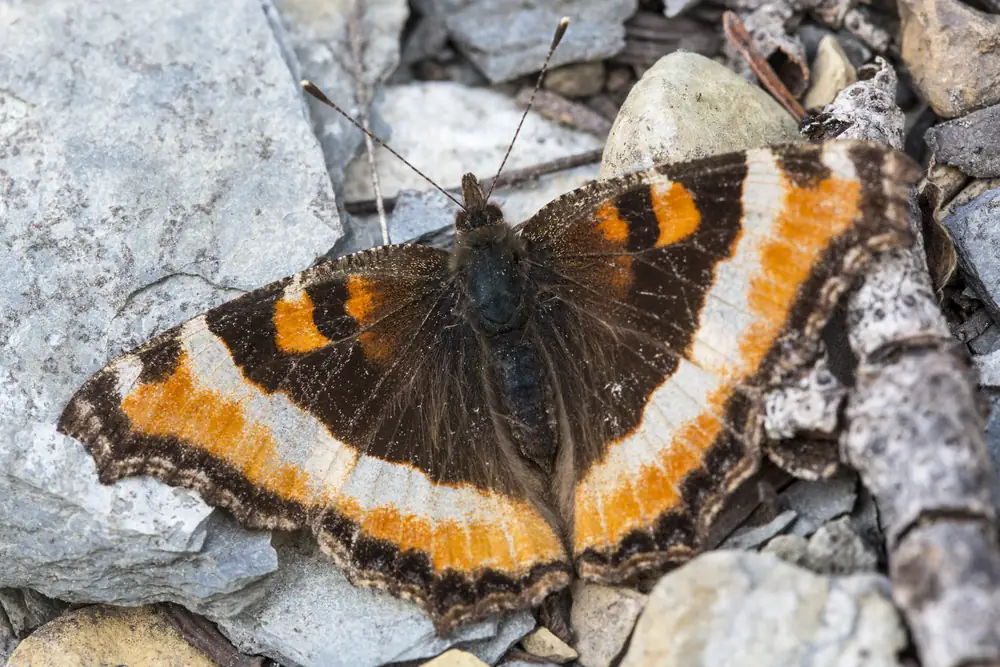
Boulder County Nature Association's butterfly guide says Milbert's tortoiseshell winters as an adult and emerges in February or March. It is dark brown with a wide yellow-orange band near the wing edge, and its flight period runs from late February to mid-September.
-
Easter daisies and violets
March on south-facing slopes · William F. Hayden Green Mountain Park in Lakewood and other sunny foothill slopes
The Front Range chapter of Wild Ones calls the Easter daisy the earliest March option, a nearly stemless white-to-pink flower in a low mound that holds heat on cold nights. The Colorado Native Plant Society adds that Easter daisies, Nuttall's violets and dandelions can all make seed without being pollinated, which helps when pollinators are scarce. Pasqueflowers and star lilies usually wait for April to June, so a March pasqueflower would be a pleasant surprise.
-
Bears on the move
Active from mid-March through early November · Foothills and mountain towns
CPW says Colorado bears are active mid-March through early November, even though mother bears and cubs typically do not leave their dens until early or mid-May. Leaving trash cans or bird feeders (hummingbird, suet and seed) where a bear can reach them is a violation of state law. Take feeders down at dusk and keep garbage inside until pickup morning.
Is March really Colorado's snowiest month?
For Denver and the Front Range, usually. Denver7 reports that March typically brings about 20 percent of Denver's annual snowfall. The National Weather Service office in Boulder lists Denver's 1991 to 2020 March mean temperature at 41.6 °F, with the normal high climbing from 50 °F early in the month to 60 °F at the end and the normal low from 23 °F to 31 °F. The same table shows how wild it can run: a record low of −11 °F on March 28, 1886, and a record high of 87 °F on March 25, 2026. The most famous March storm was March 17 to 19, 2003, which the Weather Service reports dropped 31.8 inches of snow at the former Stapleton airport.
March snow is wet and heavy, melts quickly on the plains, and often arrives with a warm day on either side. NOAA's Physical Sciences Laboratory says Boulder's last snow of the season averages April 27 (1949 to 2014 records), ranging from March 22 in 1992 to June 7 in 1993. Its tally of Boulder windstorms with gusts of 70 mph or more (1966 to 2022) shows March well behind midwinter, with 23 of the 262 events. In the mountains, Colorado State University's Colorado Climate Center notes that snowpack typically peaks a bit later than April 1 at higher elevations and in the north of the state.
| Station | March precipitation | March snow | March high | March low |
|---|---|---|---|---|
| Fort Collins | 1.31 | 9.4 | 56.4 | 28.5 |
| Boulder | 1.99 | 15.7 | 57.0 | 29.0 |
| Estes Park 3 SSE | 1.58 | 18.8 | 45.0 | 21.2 |
| Colorado Springs Municipal Airport | 0.79 | 5.7 | 54.9 | 27.3 |
| Pueblo Memorial Airport | 0.82 | 4.5 | 60.6 | 27.1 |
| Lamar | 0.72 | 4.7 | 60.2 | 26.3 |
| Grand Junction Walker Field | 0.80 | 1.8 | 58.3 | 31.7 |
| Durango | 1.32 | 5.3 | 54.1 | 25.1 |
| Alamosa San Luis Valley Airport | 0.54 | 4.3 | 52.7 | 17.6 |
| Gunnison 3SW | 0.51 | 4.4 | 44.1 | 14.0 |
| Steamboat Springs | 1.58 | 19.5 | 44.8 | 17.6 |
| Telluride 4WNW | 1.61 | 22.7 | 43.7 | 12.9 |
| Crested Butte | 2.09 | 29.1 | 37.9 | 7.0 |
Look at the extremes in the table: Alamosa and Gunnison get about half an inch of precipitation or less, while Boulder gets nearly two. The latest official 90-day outlook sits on the Climate Prediction Center page, which NOAA refreshes monthly; we leave its contents to NOAA. Current pressure and wind are on the weather map.
When is the last spring freeze in Colorado, and is it safe to plant?
Not in March, almost anywhere. The table shows the last 32 °F reading in a typical spring at the main station for each region, based on NOAA's 1991 to 2020 normals. The Front Range and plains towns usually see their last freeze around the first week of May, the Grand Valley about three weeks earlier, and the high valleys of the San Luis Valley and Yampa Valley not until June. Planting tender seedlings in March is a gamble on the weather.
| Station | One year in ten | Median | Nine years in ten |
|---|---|---|---|
| Steamboat Springs | May 25 | Jun 9 | Jun 24 |
| Denver | Apr 23 | May 5 | May 19 |
| Grand Junction | Apr 1 | Apr 14 | Apr 28 |
| Colorado Springs | Apr 22 | May 3 | May 15 |
| Pueblo | Apr 18 | Apr 30 | May 12 |
| Alamosa | May 24 | Jun 7 | Jun 24 |
| Durango | May 7 | May 21 | Jun 7 |
For your own town, with many other Colorado stations, use our Colorado frost tables. The "one year in ten" column shows how early an unusually mild spring can finish, and the "nine years in ten" column how late a cold one can drag on.
How much daylight does Colorado gain in March?
The gain is at its largest in the whole year. Denver goes from 11 hours 19 minutes of daylight on March 1 to 12 hours 37 minutes on March 31, a gain of 78 minutes, or about 2.6 minutes a day. The March equinox falls on Saturday the 20th, at 2:25 p.m. Mountain Daylight Time, the moment the Sun crosses the equator heading north. The clock change adds a second jolt: clocks go forward on Sunday, March 14, and Denver's sunset jumps from 6:05 p.m. Mountain Standard Time on March 13 to 7:06 p.m. Mountain Daylight Time on March 14. The day-length table below is not affected, since it counts hours of sunlight.
| City | Mar 1 | Mar 31 | Gained | Per day |
|---|---|---|---|---|
| Fort Collins | 11 h 18 m | 12 h 38 m | 80 min | 2.7 min |
| Steamboat Springs | 11 h 18 m | 12 h 38 m | 80 min | 2.7 min |
| Denver | 11 h 19 m | 12 h 37 m | 78 min | 2.6 min |
| Grand Junction | 11 h 20 m | 12 h 37 m | 77 min | 2.6 min |
| Colorado Springs | 11 h 20 m | 12 h 36 m | 76 min | 2.5 min |
| Pueblo | 11 h 22 m | 12 h 36 m | 74 min | 2.5 min |
| Alamosa | 11 h 22 m | 12 h 34 m | 72 min | 2.4 min |
| Durango | 11 h 22 m | 12 h 34 m | 72 min | 2.4 min |
Northern towns gain a little more than southern ones, so Fort Collins and Steamboat Springs catch up on Durango and Alamosa by month end. For your own trailhead's sunrise and sunset, plug it into the daylight calculator.
What is in the Colorado night sky in March 2027?
Planets carry the March sky: Jupiter and Mars ride high after dark, and Mercury pops up before dawn. The new moon on March 8 gives dark evenings for roughly the first ten days. There are no eclipses this month. Clock times below are Mountain time: standard time for March 8 and daylight time after the change on March 14.
-
Mercury in the morning
Best from about March 8 to 25; farthest from the Sun on the night of March 16 · Low in the east-southeast, about an hour before sunrise
Mercury's widest morning separation from the Sun, 27.6 degrees, arrives at 10:20 p.m. Mountain Daylight Time on Tuesday, March 16, while it is still night in Colorado. Through the first half of March it comes up roughly an hour ahead of sunrise, shining between magnitude +1.0 and +0.3. Springtime mornings put Mercury on a shallow path from our latitudes, so find an unobstructed eastern view, such as a mesa edge or open plain. Brilliant Venus is higher in the same part of the sky and helps you find the way.
-
Jupiter and the Moon
Evenings of March 18 and 19 · High in the southeast to south after dark
By our calculation a bright, nearly full Moon sweeps to within 0.9 degrees of Jupiter, closest at 3:26 a.m. Mountain Daylight Time on March 19, which makes the evenings of March 18 and 19 the ones to watch. Jupiter is in the evening sky all spring, in Leo and Cancer, and sets a long time after the Sun.
-
Mars and Jupiter side by side
Evening of Tuesday, March 30 · High in the sky around 8 p.m.
By our calculation Mars and Jupiter are 4.3 degrees apart that evening, a wide but easy pairing, both well above 50 degrees up. Mars, still near magnitude −1.1 at the start of the month, is dimming week by week after its February opposition.
-
Saturn's last evening views, and Venus at dawn
Saturn early March; Venus all month · Saturn low in the west after dusk; Venus low in the southeast before sunrise
Saturn hangs low in the west right after dusk and is sinking into the sunset glow; by April 1 it is down within minutes of sunset, with Saturn's conjunction with the Sun a week after that. By our calculation a razor-thin crescent Moon hangs near Venus, the brilliant morning star (about magnitude −4.1), in the dawn sky of March 4 and 5.
-
The Worm Moon
Full at 4:44 a.m. Mountain Daylight Time on Monday, March 22 · Rising in the east around sunset on Sunday, March 21
The full Moon comes before dawn on March 22, so the evening of March 21 is the best one to watch it rise: moonrise in Denver is about 6:46 p.m. Worm Moon is one of the traditional names for March's full moon, and in our own computation it falls short of a supermoon.
| Phase | Date | Time |
|---|---|---|
| New moon | Monday, Mar 8 | 2:29 a.m. MST |
| First quarter | Monday, Mar 15 | 10:25 a.m. MDT |
| Full moon, the Worm Moon | Monday, Mar 22 | 4:44 a.m. MDT |
| Last quarter | Monday, Mar 29 | 6:54 p.m. MDT |
Each night's moon rise and set are listed on the moon phase pages, and the cloud guide can save you a wasted drive to a dark site.
What can families do outdoors in Colorado in March 2027?
- Go see the cranes. The Monte Vista Crane Festival runs March 5 to 7, 2027 per its website. If you cannot go that weekend, the refuge pullouts are open any day, and the park service says the birds have mostly gone by late March. Ask the children to count a small group and estimate the whole field.
- Collect frog calls. On a mild evening near a pond, stand still for five minutes and count the comb-like trills. Note the date and temperature; it is the kind of record that is useful years later.
- Put up a bluebird box. CPW says young bluebirds return to the kind of cavity where they were raised, so a clean box on a fence post in open country can become a yearly nest site. Cornell's NestWatch lets anyone report what happens inside, in three steps.
- Join a weather network. CoCoRaHS, the Community Collaborative Rain, Hail and Snow Network, began at Colorado State University in 1998 and welcomes volunteers of any age who measure precipitation with simple gauges. March snowfall is a good first assignment.
- Track the arrivals. Journey North lets you report sightings of migrants such as hummingbirds, and your own list of first dates for killdeer, bluebirds, phoebes and ospreys is a great ledger to keep in the Naturalist's Field Journal.
- Find the grouse tours. If you want a once-in-a-lifetime sunrise, call the Wray Chamber of Commerce about prairie-chicken tours, and ask CPW about sage-grouse viewing. Nothing for 2027 had been announced when we wrote this.
In April the migration grows louder and the wildflowers open on the foothills. See our nature guides for every month, and for the month before this one, Colorado in February.
Safety notes for March in Colorado
- Spring storms. A 60 °F afternoon can turn into a foot of wet snow overnight, and the 2003 blizzard dropped 31.8 inches of snow at Denver's former Stapleton airport. Keep water, a warm layer and a blanket in the vehicle, and read the forecast before any mountain drive.
- Avalanches. The Colorado Avalanche Information Center publishes daily backcountry forecasts. Check them before skiing, snowshoeing, or walking beneath steep slopes, and give wet slopes extra space on warm afternoons.
- Thin and rotten ice. CPW says clear blue ice is strongest, white or gray ice is much weaker, snow cover insulates thin spots, and four inches is its minimum for a person on foot. Ice thins as the weather warms, so recheck it rather than trusting last week's reading.
- Hunting seasons. The mountain lion season runs through March 31, 2027, according to CPW's 2026 to 2027 brochure, and lion hunters are not required to wear fluorescent orange or pink, although CPW says they may wish to consider it. CPW's turkey page lists over-the-counter spring licenses among the options, its small game page says spring over-the-counter turkey licenses go on sale in early March, and the season dates and units are in CPW's turkey brochure (we found no 2027 dates yet). CPW's small game and waterfowl brochure also covers the light goose conservation order on the eastern plains; read it for dates and areas. Hikers and dogs are easier to see in a bright hat or vest.
- Bears and food. Bears are already active from mid-March. Take feeders down at dusk and lock trash away.
- Wildlife young and weak. Elk and deer are still thin from winter. Give nests, leks and burrows wide space, and keep dogs leashed around prairie dog towns and nests.
Sources (45)
- Monte Vista Crane Festival (March 5–7, 2027)
- U.S. Fish and Wildlife Service: Monte Vista National Wildlife Refuge
- National Park Service, Great Sand Dunes: sandhill crane migration
- National Park Service, Great Sand Dunes: amphibians
- Colorado Parks and Wildlife: greater sage-grouse
- Colorado Parks and Wildlife: greater prairie-chicken
- Colorado Birding Trail: greater prairie-chicken areas
- Colorado Birding Trail: prairie chicken watching tours with Colorado Parks and Wildlife
- City of Wray: the Sandhill Dancers (prairie chicken tours)
- Colorado Birding Trail: events calendar
- Colorado Birding Trail: Dinosaur Ridge Hawkwatch
- Visit Estes Park: spring bird migration in Estes Park and Rocky Mountain National Park
- National Audubon Society, Rockies: five birds that migrate to the Rockies
- Colorado Parks and Wildlife: mountain bluebird
- Colorado Parks and Wildlife: burrowing owl
- Colorado Parks and Wildlife: mountain plover
- U.S. Fish and Wildlife Service: Rocky Mountain Arsenal National Wildlife Refuge
- Colorado Parks and Wildlife: bald eagle
- Colorado Parks and Wildlife: great horned owl
- Colorado Parks and Wildlife: Barr Lake State Park highlights
- National Park Service, Rocky Mountain: raptor and bald eagle closures
- Colorado Parks and Wildlife: shed antler and horn collection
- Colorado Parks and Wildlife: living with bears
- Boulder County Nature Association, Colorado Front Range Butterflies: Milbert's tortoiseshell
- Wild Ones Front Range: Colorado native wildflowers, favorite early spring bloomers
- Colorado Native Plant Society: challenges of being a wildflower in early spring
- NWS Denver/Boulder: March climate records for Denver
- Denver7: Denver's snowiest month is March
- NOAA Physical Sciences Laboratory: Boulder last snow of the season
- NOAA Physical Sciences Laboratory: Boulder windstorms of 70 mph or more
- Colorado Climate Center: mountain snowpack should be peaking around now (April 2, 2026)
- NOAA NCEI: monthly normals for the Colorado stations in the March table (data access)
- Climate Prediction Center: 90-day outlooks
- U.S. Naval Observatory: moon phases from March 2027 (data API)
- U.S. Naval Observatory: Earth's seasons, 2027
- NIST: daylight saving time
- Colorado Avalanche Information Center: forecasts
- Colorado Parks and Wildlife: ice fishing and ice safety
- Colorado Parks and Wildlife: turkey hunting
- Colorado Parks and Wildlife: small game hunting
- Colorado Parks and Wildlife: 2026–2027 mountain lion brochure (PDF, state publications library)
- CoCoRaHS: about the network
- Cornell Lab of Ornithology: NestWatch
- Journey North
- Photos via Wikimedia Commons; licenses and photographers are credited under each picture
.jpg)