What to look for in nature in Colorado this December
Meteorological winter, the stretch of December, January and February that averages coldest, starts on the 1st, and Colorado eases into it unevenly: a foot of powder in Steamboat, bare brown grass and a 50-degree afternoon in Pueblo. The animals have made their choices by now. Elk crowd the low meadows, ptarmigan and weasels have gone white, pikas live off the hay they stacked in August, and great horned owls start their winter duets. It is counting season too. Here is what to look for through New Year’s Eve, from the plains to the San Juans; for the season before, see Colorado in November.
Other months in Colorado: October, November.
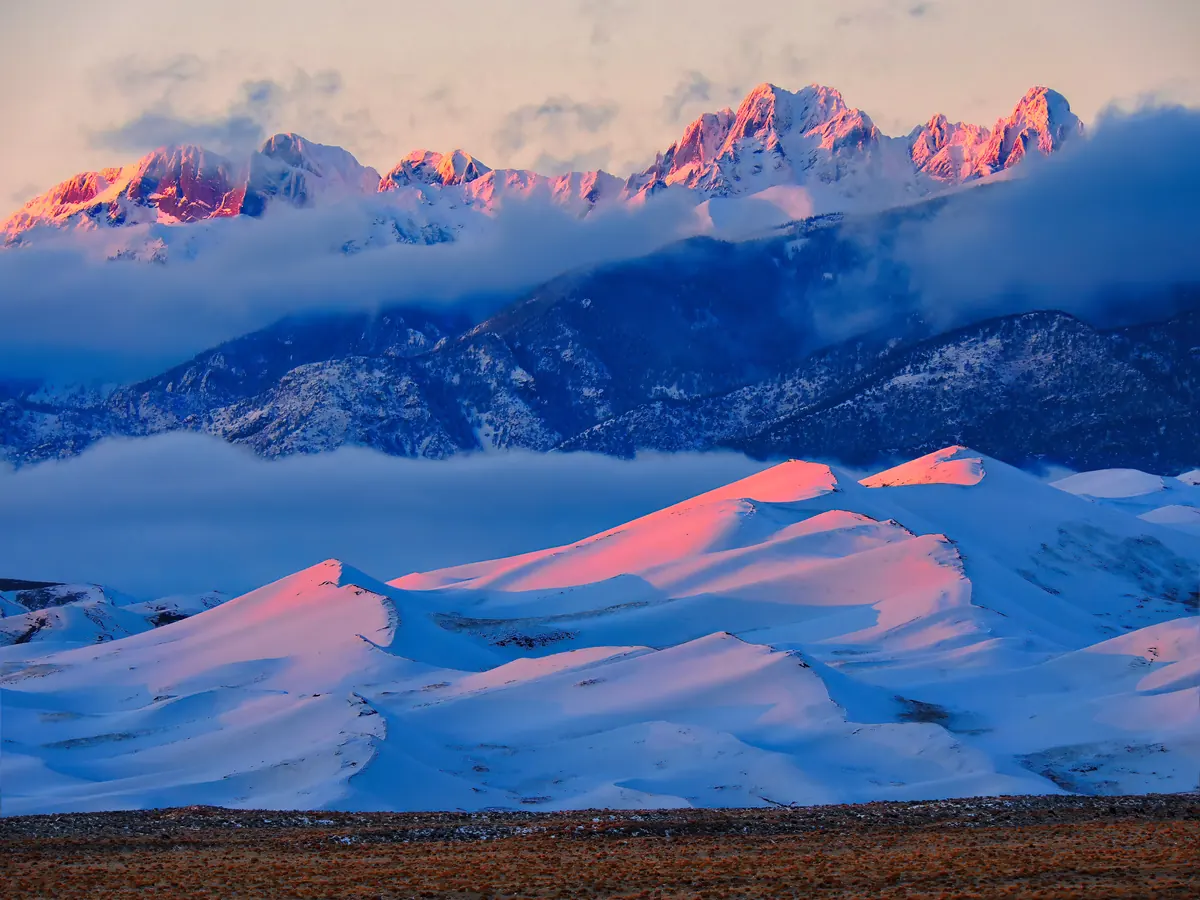
Start here

- Join a bird count. Every Christmas Bird Count in the state happens on one day between December 14, 2026, and January 5, 2027. Pick the circle nearest you on Audubon’s map and write to the compiler; beginners are paired with experienced birders, and some counts take feeder reports from home.
- Listen for owls after dark. Great horned owls pair up in early winter. On a still evening near cottonwoods or a quiet park, listen for two voices trading deep hoots, the female’s a little higher than the male’s.
- Geminids, then the closest full moon of 2026. Sunday night, December 13, is Geminid night, running into the small hours of Monday, with only a thin crescent Moon that sets early in the evening. Colorado’s Cold Moon comes due at 6:28 p.m. MST on Wednesday, December 23, the closest of all the year’s full moons.
Write it down: a count day fills the Naturalist’s Field Journal plate called “birds I have seen”, and “tracks to know” earns its place after the first snow that lasts. Draw a spruce, a fir and a pine cone together on the “seeds, pods and cones” page, and give the dusk and dawn watch page to whatever owl answers back on these long nights.
Regions used below: Front Range and the Denver metro; Eastern Plains; Northern Mountains and Rocky Mountain National Park; Central Mountains and the high parks; San Luis Valley; Western Slope and the Four Corners.
When is the Christmas Bird Count in Colorado, and how do I join?
The count started on Christmas Day 1900 as an alternative to holiday bird shoots, with birders at 25 places tallying instead of hunting. Today every circle, 15 miles in diameter, is surveyed on one day its compiler picks inside this season’s span, December 14 through the following January 5. Colorado runs about fifty, from Denver and Fort Collins to the Arkansas Valley reservoirs and the Western Slope.
No expertise is needed: each team has a leader who knows the birds, and a newcomer can keep the tally or drive. Boulder County Audubon, which has run the Boulder count since 1975, sends out roughly 30 teams across city, plains and foothills; that circle’s first count was on Christmas Eve 1910.
-
How to find a count
Count days fall between Dec 14, 2026, and Jan 5, 2027; most dates are posted in November · Audubon’s online circle map; local Audubon chapters and bird clubs
Open Audubon’s map, click the circle nearest you, and contact the compiler listed there; Denver Audubon notes that green and yellow circles still have room. Dates shift from year to year. Last season, Boulder counted on Sunday, December 14, and Denver and Colorado Springs on Saturday, December 20, while southern counts such as Great Sand Dunes and the Spanish Peaks went out in early January. If you live inside a circle, ask about a feeder count: you watch the yard on count day and send in the biggest group of each kind you saw together.
-
What a Colorado count turns up
Count day, dawn to dusk; owling teams start before dawn · Pueblo Reservoir, John Martin Reservoir, Crook and the other plains circles lead the state
The Pueblo Reservoir circle has had the state’s longest species list four winters running. The biggest raw totals come from the northeastern and southeastern plains, where tens of thousands of snow geese can sit on a single reservoir: in the 2020–21 season the Crook count alone tallied 41,890 snow geese and 2,525 Ross’s geese. Mountain counts are smaller but bring rosy-finches; that same season, counts statewide logged 900 gray-crowned, 46 black and 571 brown-capped rosy-finches.
| Season | Counts held | Species found | Most species | Most birds |
|---|---|---|---|---|
| 2020–21 (121st) | 49 | 199 | Pueblo Reservoir, 121 | John Martin Reservoir, 65,878 |
| 2021–22 (122nd) | 53 | 204 | Pueblo Reservoir, 130 | Crook, 106,563 |
| 2022–23 (123rd) | 51 | 197 | Pueblo Reservoir, 128 | John Martin Reservoir, 75,325 |
| 2023–24 (124th) | 51 | 217 | Pueblo Reservoir, 129 | Crook, 111,274 |
The 2023–24 jump to 217 species followed a warm November that held many birds in the state, including a record 109 Say’s phoebes on 23 counts. Patterns like that only show up across many years of counts, which is why the data feed federal reports on the state of the nation’s birds. Our month-by-month nature guides follow the rest of the year in every state.
Why are owls hooting in Colorado in December?
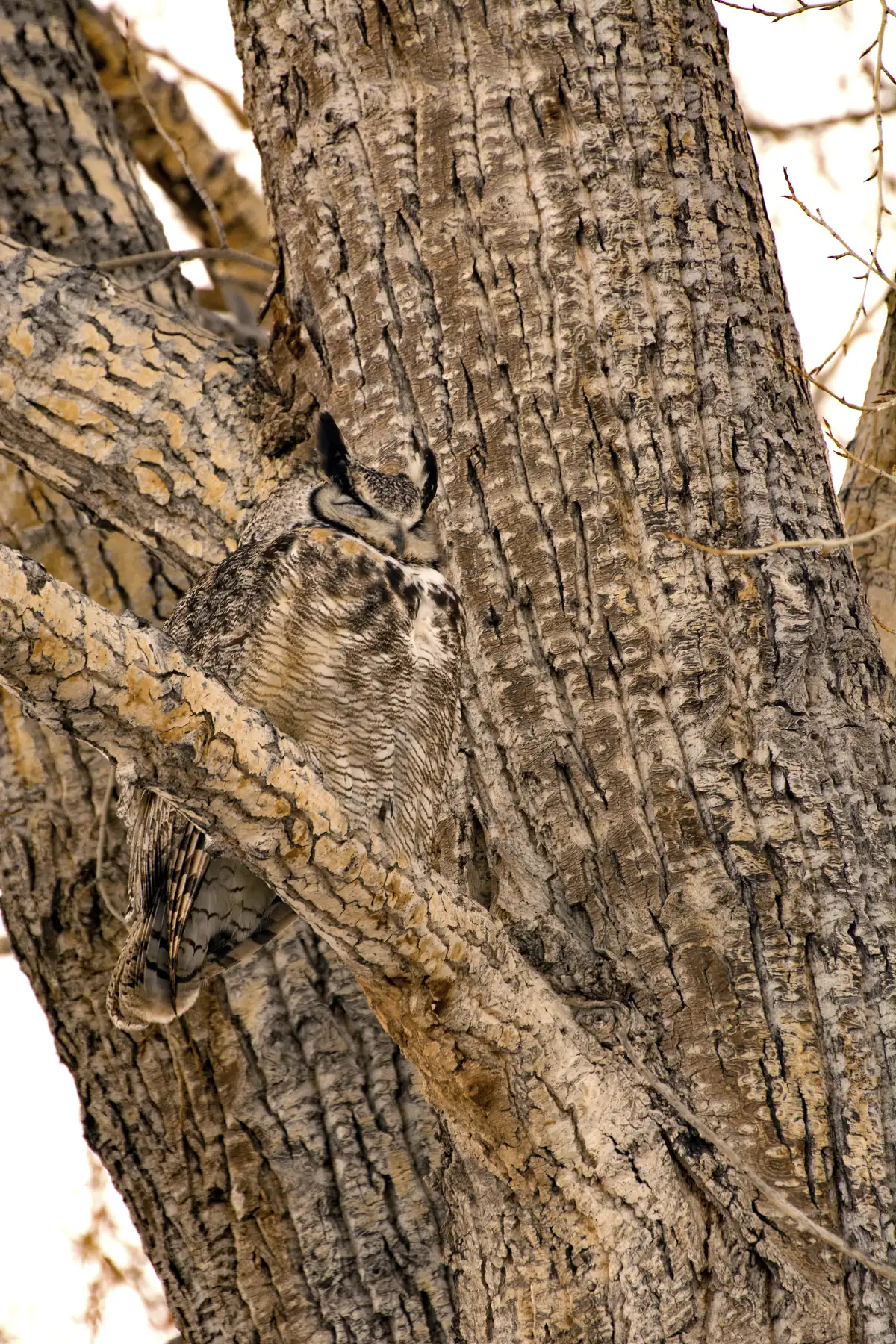
Most birds wait for spring, but the great horned owl starts its breeding year in the dark of winter. Colorado Parks and Wildlife says the males begin calling for mates as early as December and January, and pairs often duet, the female’s voice pitched higher than the male’s. It lives all over the state, in forest, mountains, desert and suburbs alike, and it does not build its own nest: it takes over an old red-tailed hawk, crow, heron or even eagle nest, typically 15 to 70 feet up. The female lays one to six eggs, most often two or three, and sits on them for about a month; the owlets stay in the nest six or seven weeks and fly at ten to twelve weeks.
-
Great horned owl duets
Dusk and the first hours after dark; also before dawn · Cottonwood corridors along the South Platte, Cherry Creek and the Arkansas; city parks and open space; Great Sand Dunes
Stand still on a calm night and listen for the soft, low “hoo, hoo-hoo, hoo, hoo.” By day, scan the trunk side of big cottonwoods for a thick, bark-colored shape with ear tufts; the owl often sits pressed against the trunk and is easy to walk past. Keep well back from any owl you find, especially near a likely nest, and skip the flash and recorded calls.
-
Short-eared owls on the open ground
Late afternoon to dusk, through the winter · Grasslands and marsh edges, from Boulder County’s open space to the eastern plains; the San Luis Valley
Boulder County Audubon describes the short-eared owl as a bird of dim light that hunts on the wing low over grass, listening for voles. In Colorado it nests mainly in the San Luis Valley, with fewer pairs on the plains, and winter numbers rise and fall with prey farther north. Boulder Reservoir and Boulder Valley Ranch still produce the odd winter sighting. Look for a buoyant, moth-like flight and pale wings with dark wrist patches as the light goes. Great Sand Dunes alone lists eight owl species, so a Christmas Bird Count owling team before dawn rarely comes home empty.
Where do elk and bighorn sheep spend the winter in Colorado?
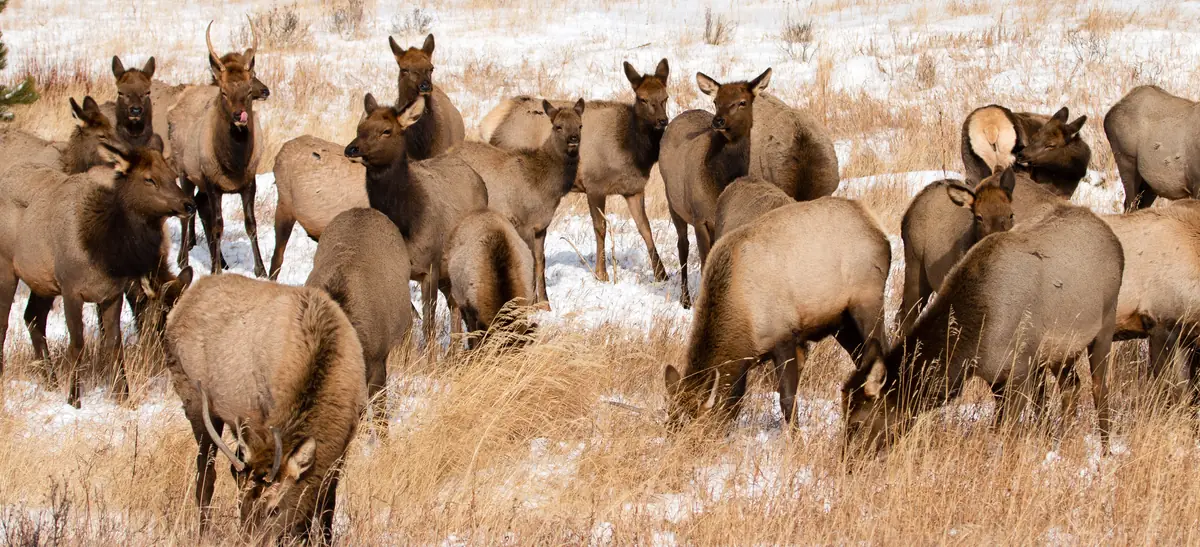
In December the rut is over and survival takes over. Bull elk come out of the breeding season thin and worn, having barely eaten for weeks, and the herds drift down out of the deep snow to the low valleys of the Front Range and the Western Slope. Rocky Mountain National Park says it now aims for a population of roughly 600 to 800 elk in its low-elevation valleys through the winter, and many more spend the season around Estes Park and in the foothills outside the boundary. Each bull sheds his antlers during the winter and starts a new set in spring.
-
Elk in the park meadows
All month; most active early and late in the day · Moraine Park, Horseshoe Park and Upper Beaver Meadows in Rocky Mountain National Park; Estes Park
The park’s east side stays open in winter even with Trail Ridge Road closed for the season; check its road status page before you go. Herds paw through thin snow for dry grass on the wind-cleared meadows and bed down in the open at midday. Stay 75 feet away, which is about the length of two buses, and do not leave the road to get closer: every unnecessary run in the cold costs an elk fat it will need in March.
-
Bighorns at their peak
Rut peaks in early December · Georgetown Bighorn Sheep Viewing Station on I-70; Waterton Canyon southwest of Littleton
Colorado Parks and Wildlife puts the height of the bighorn rut in the first part of December, after the November buildup. On the cliffs above Georgetown, rams that were sizing each other up a month ago are now clashing and following ewes closely. Look on sunny, south-facing slopes where snow melts off quickly. A spotting scope from the viewing station turns specks on the cliff into head-butting rams; in Waterton Canyon the resident herd is often close to the road, but remember that Denver Water bans dogs there.
How do ptarmigan and pikas survive winter above treeline?
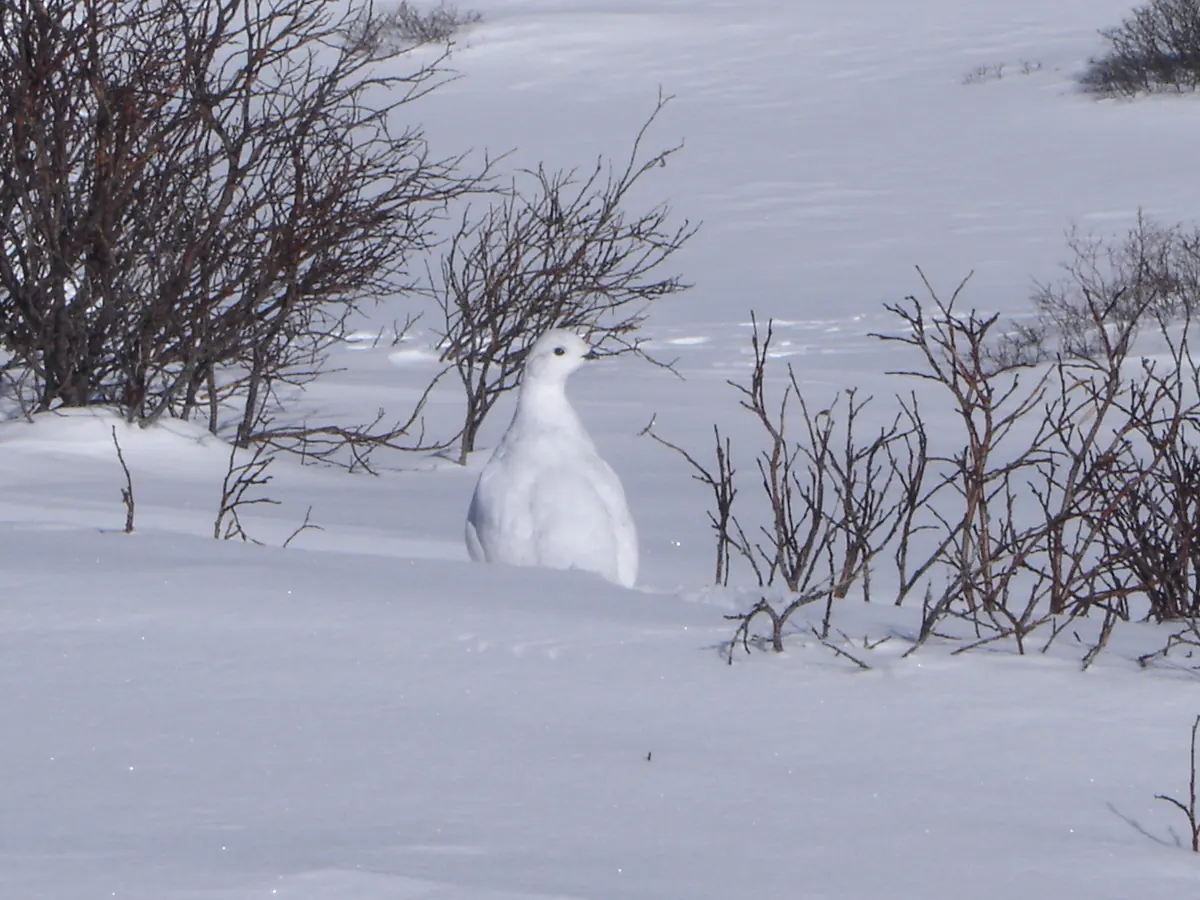
The white-tailed ptarmigan is the only bird in North America that lives its whole life on alpine tundra above timberline, and it does not leave in winter. By December it has molted into all-white plumage, broken only by its black bill and eyes. Feathered legs and feet act like snowshoes. When the wind picks up or the temperature crashes, a ptarmigan burrows up to a foot into soft snow and waits it out in a snow roost. Its winter diet is almost entirely the buds of willows that poke above the drifts, so the birds gather where willow meets snow near treeline.
-
Ptarmigan at Guanella Pass
Winter; the summit road closes the week after Thanksgiving · Guanella Pass, south of Georgetown, about 11,500 feet
Colorado Parks and Wildlife counts Guanella Pass among the largest known wintering grounds for white-tailed ptarmigan in the state, and its biologists survey the willow flats there to see whether winter recreation is pushing birds out. Clear Creek County gates the road at the Naylor Lake turnoff, 0.8 mile below the summit, and plows it from Georgetown to the gate a day or two after each storm. From the parking area, snowshoe or ski slowly and scan the willow tops: a ptarmigan sitting still is often given away only by a dark eye, or by tracks leading to a white lump.
-
Pikas under the snow
All winter, out of sight · Talus slopes and rock fields in the high country
The pika, a small round relative of rabbits, never hibernates. Instead, it spends summer cutting grasses and wildflowers and stacking them as haypiles among the rocks, then lives through the long alpine winter on those stores. The National Park Service notes that pikas count on a deep, insulating blanket of snow over the talus to survive the cold, which is why a thin snow year worries the scientists who watch them. You will not see one in December, but the haypiles you noticed in August are its pantry.
What tracks can you find in Colorado snow, and are wolves and lynx out there?
After a fresh snow the mountains keep a record of the night before. Go early, before wind and sun soften the edges, and follow a trail forward along creek banks, forest openings and fence lines to see what the animal was up to.
-
Snowshoe hare and long-tailed weasel
Any morning after new snow · Subalpine forest and willow thickets in most mountain ranges; weasels down to the valley grasslands
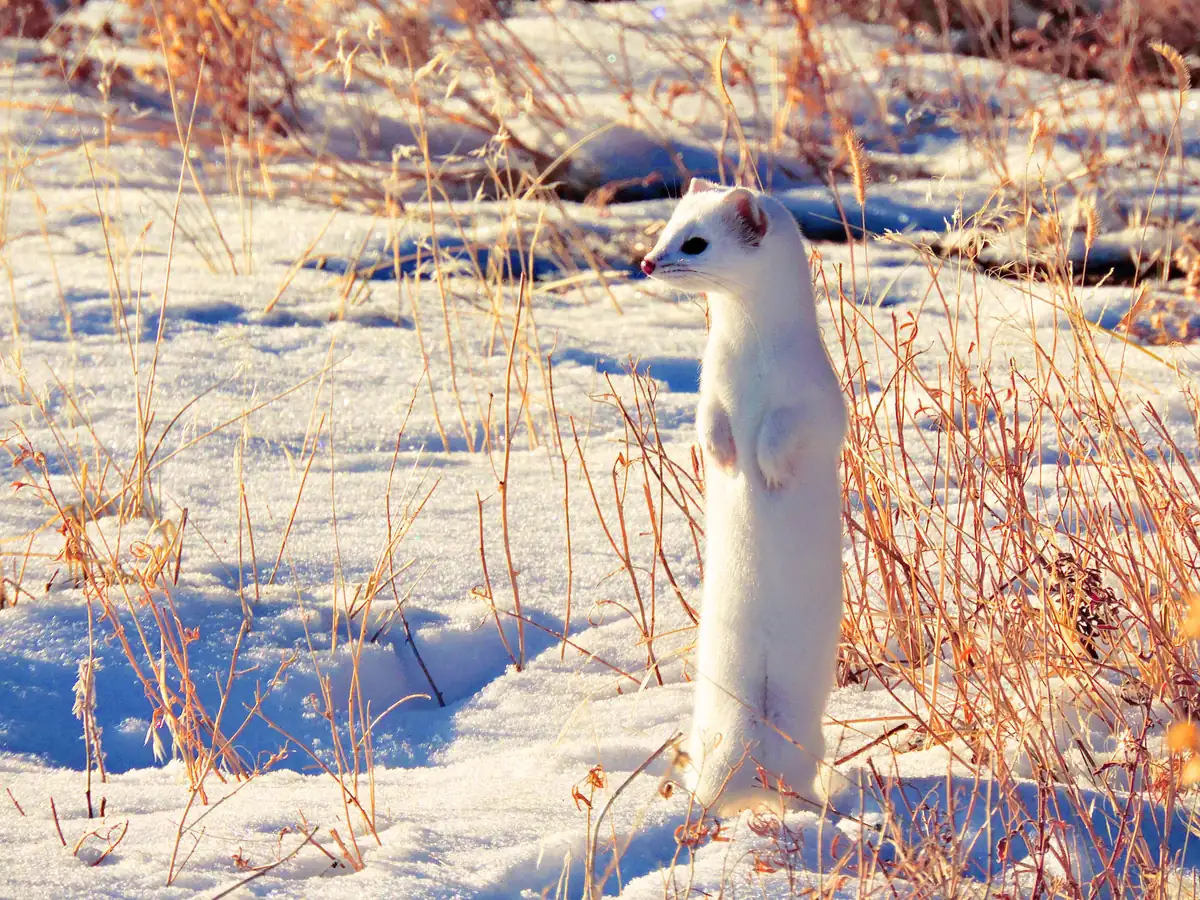
Colorado Parks and Wildlife describes the snowshoe hare’s coat turning bright white in winter and its hind feet, close to 5 or 6 inches long, spreading wide to stay on top of deep snow. Its prints come in sets of four, two large hind feet landing ahead of the small front pair. The hare lives in most of the state’s mountains, though not on Pikes Peak or in the Sangre de Cristos, and it eats twigs and bark through the winter. Its small hunter, the long-tailed weasel, also turns white except for a black tail tip; in December 2018, staff at Great Sand Dunes photographed one in full winter coat near the visitor center. Weasel tracks are small paired prints in a bounding line, often diving into a hole in the snow and reappearing yards away.
-
Canada lynx
All winter; breeding begins late in the season · High subalpine forest with deep snow, especially in the San Juans and central mountains
Colorado began bringing lynx from Canada and Alaska in 1999, releasing 96 near Creede and north of Durango in the first two years and more after that; the first kittens were found in 2003. Colorado Parks and Wildlife now puts the population at roughly 75 to 100 animals. A lynx’s hind feet are more than 8 inches across in snow, so its round, toeless-looking tracks are much larger than a bobcat’s, and they usually follow snowshoe hare country, since hares are nearly all it eats.
-
Gray wolves
All year · Northern and central mountains; the first releases were in Grand and Summit counties
The first five wolves were released in Grand County on December 18, 2023, and five more in Summit County a few days later. As of September 24, 2026, Colorado Parks and Wildlife counted 45 wolves in the state, including 20 pups born this year, in four reproducing packs, a fifth group of four traveling siblings, and some lone animals. Collared wolves roam widely: Denver7 reported that the agency’s movement map for late October to late November 2025 showed at least one exploring central Boulder County and northern Jefferson County. Rocky Mountain National Park asks people to stay at least 300 feet from any wolf; if you see one or its tracks, report it to the agency with a photo and the location.
How do you tell Colorado’s evergreens apart, and where can you cut a Christmas tree?
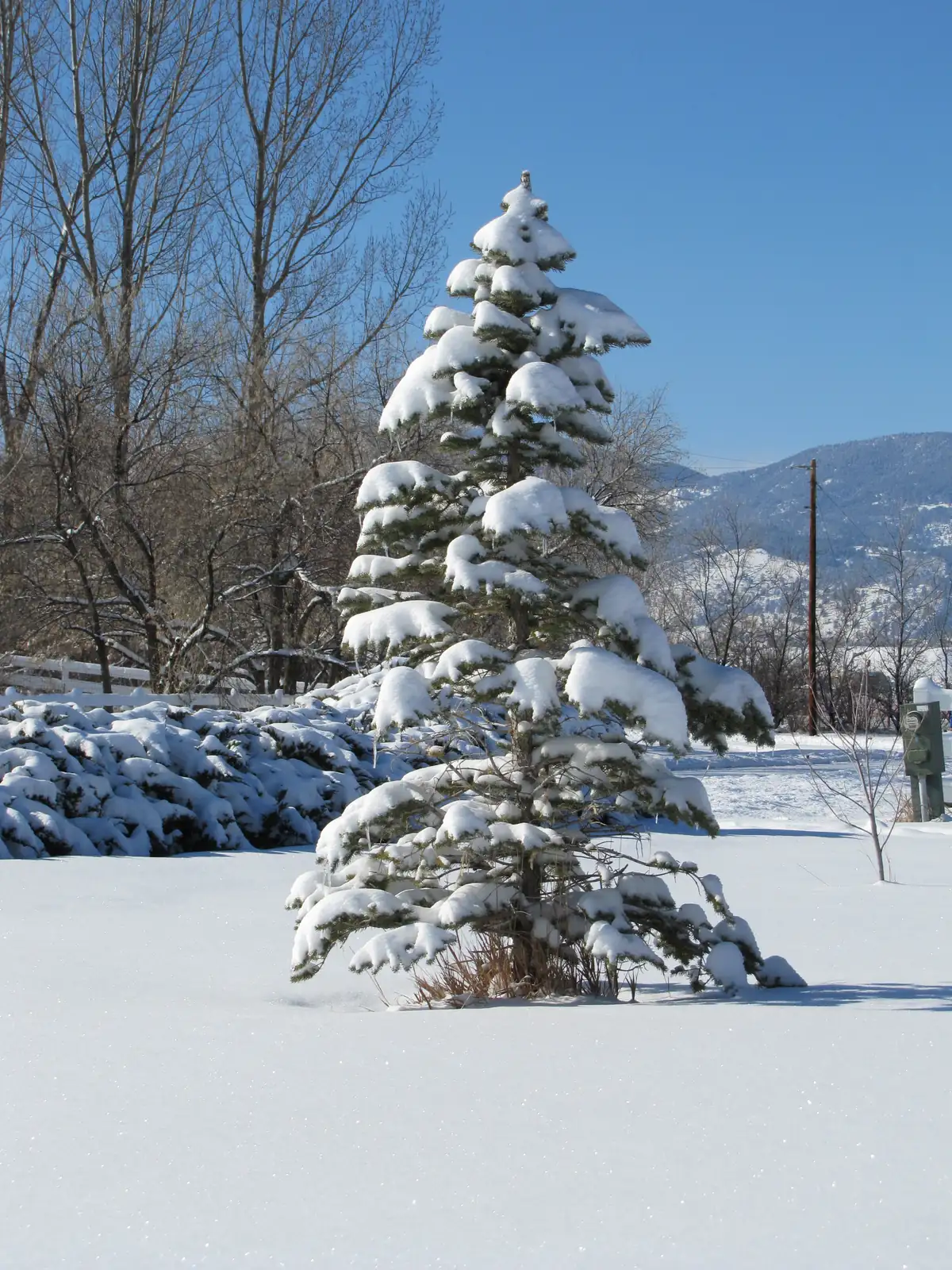
With the aspens and cottonwoods bare, December is the month to learn the conifers. Colorado’s state tree, the blue spruce, was first discovered on Pikes Peak in 1862, according to the state legislature’s guide to state symbols; it grows along streams and in moist valleys, from about 6,700 to 11,500 feet according to the Colorado State Forest Service. Engelmann spruce and subalpine fir make up the dark forest near treeline, lodgepole pine takes over after fires at middle elevations, and ponderosa pine, pinyon and Rocky Mountain juniper cover the warmer, drier slopes lower down.
-
Four quick tests
Any winter walk · Foothills to treeline
- Pines hold needles in bundles. Ponderosa has three to a bundle and bark that turns orange and plated with age; lodgepole has two; limber and bristlecone pines have five, and bristlecone needles are flecked with white resin dots.
- Spruce needles are single, sharp and square. Roll one between your fingers and it turns easily; grab a branch and it pricks. Spruce cones hang down and fall whole.
- Fir needles are single, flat and soft. They will not roll, and the branches feel friendly. True fir cones stand upright near the top of the tree and fall apart in place, which is why intact fir cones are a rare find under the tree.
- Douglas-fir is not a true fir. Its hanging cones have three-pointed papery bracts poking out between the scales, often compared to the hind legs and tail of a mouse diving in.
-
Cutting your own tree
Permits usually go on sale in November; cutting runs into December or early January, depending on the forest · National forests statewide
Colorado’s national forests sell Christmas tree permits online through Recreation.gov, typically $10 to $20 a tree with a limit per household. Rules differ from district to district: last season Arapaho and Roosevelt limited trunks to 6 inches in diameter, required cutting within 6 inches of the ground, and kept cutters 75 feet from roads and trails, while Pike and San Isabel allowed only hand saws or axes. A child in fourth grade holding an Every Kid Outdoors pass qualifies for a free permit (Recreation.gov adds a small fee). Check this year’s dates and maps for your forest before you go.
How much snow does Colorado get in December, and will it be a white Christmas?
Far less than people expect on the plains, and far more than people expect in the high valleys. NOAA’s 1991–2020 normals give Colorado Springs and Pueblo only about 4 to 5 inches of snow in an average December, and Grand Junction and Alamosa about the same, while Steamboat Springs and Crested Butte average around 35 inches and Climax, near the top of Fremont Pass, more than 38. The real contrast is temperature: Alamosa, Gunnison and Crested Butte sit in cold-air basins where the typical December night falls to around zero or below, while Boulder’s average low stays above 20 °F.
| Station | Snowfall | Average high | Average low |
|---|---|---|---|
| Fort Collins | 7.5 | 44.0 | 18.3 |
| Boulder | 13.0 | 46.3 | 21.1 |
| Colorado Springs Municipal Airport | 4.1 | 44.6 | 18.7 |
| Pueblo Memorial Airport | 4.6 | 47.5 | 15.9 |
| Lamar | 5.9 | 45.5 | 14.4 |
| Grand Junction Walker Field | 5.2 | 38.8 | 18.0 |
| Alamosa San Luis Valley Airport | 4.6 | 35.4 | 0.8 |
| Gunnison 3SW | 10.3 | 28.5 | -2.9 |
| Steamboat Springs | 35.8 | 30.4 | 6.3 |
| Crested Butte | 35.1 | 26.8 | -4.2 |
| Climax (Fremont Pass) | 38.5 | 26.5 | 3.2 |
On the Front Range, the odds of a white Christmas are lower than many newcomers assume. The Weather Service office in Boulder figures that Denver has had at least an inch of snow on the ground on Christmas morning in about 37 percent of years since 1900, and measurable snow actually falling on Christmas Day in only about 14 percent. Christmas Eve 2025 set Denver’s warm record for the date at 71 °F. The opposite extreme came in 1982, when a Christmas Eve blizzard dropped 23.6 inches on the city and left 24 inches on the ground the next morning, the deepest Christmas snow cover in Denver’s record. For the trend in your own town, compare these numbers with our Colorado frost and freeze tables, which show how the growing season ends station by station.
Will a strong El Niño bring Colorado a snowy winter?
Maybe, but history says do not bet the ski pass on it. Odds of an exceptionally powerful Pacific warm event holding all winter stood above nine in ten in mid-September, per the federal forecast office in College Park (CPC, September 10). Colorado has lived through three earlier events of that size, and the Colorado Climate Center’s September 3 review of them is a useful reality check: 1982–83 buried the state in snow (Denver’s Christmas Eve blizzard came that December), but 1997–98 and 2015–16 both ended up close to ordinary. One huge winter out of three is not a forecast.
Some signals are steadier. The climate center sees a loose tie between El Niño and deeper snowpack in the southern basins, the San Juans and the upper Rio Grande, and a lean toward wetter falls and springs, with more big, wet spring storms on the Front Range and Eastern Plains. In the northern and central mountains the link to peak snowpack is weak. It also cautions that a warmer Colorado may get some of that moisture as rain at lower elevations, and that many outcomes remain possible.
NOAA’s three-month winter maps had not been released when we wrote this (their release is set for mid-October); look under CPC’s 90-day outlooks. Day to day, our current conditions track Colorado’s wind and pressure.
When is the earliest sunset in Colorado, and how short is the shortest day?
The winter solstice arrives at 1:50 p.m. Mountain Standard Time on Monday, December 21, when the sun stands lowest at noon all year. But the earliest sunset is not on the solstice. Because Earth’s tilt and its slightly oval orbit push solar noon later through December, Colorado’s evenings bottom out in the first third of the month, about two weeks before the shortest day. Denver’s sun sets at 4:35 p.m. every evening from December 4 to 10, so the table gives the middle of that run, December 7; Durango holds at 4:54 p.m. from November 30 to December 12, and Steamboat Springs at 4:40 p.m. from December 6 to 9. From then on the afternoons gain a little while the mornings go on darkening until early January, when the latest sunrise arrives. On the solstice, Denver gets 9 hours and 21 minutes of daylight, and Fort Collins, the farthest north of these cities, about 20 minutes less than Durango.
| City | Dec 1 | Dec 21 | Dec 31 | Earliest sunset |
|---|---|---|---|---|
| Fort Collins | 9 h 29 m | 9 h 16 m | 9 h 19 m | 4:33 p.m., Dec 8 |
| Steamboat Springs | 9 h 30 m | 9 h 17 m | 9 h 19 m | 4:40 p.m., Dec 8 |
| Denver | 9 h 34 m | 9 h 21 m | 9 h 24 m | 4:35 p.m., Dec 7 |
| Grand Junction | 9 h 38 m | 9 h 25 m | 9 h 29 m | 4:51 p.m., Dec 7 |
| Colorado Springs | 9 h 39 m | 9 h 27 m | 9 h 29 m | 4:37 p.m., Dec 7 |
| Pueblo | 9 h 42 m | 9 h 30 m | 9 h 33 m | 4:38 p.m., Dec 6 |
| Alamosa | 9 h 47 m | 9 h 35 m | 9 h 37 m | 4:45 p.m., Dec 6 |
| Durango | 9 h 47 m | 9 h 36 m | 9 h 39 m | 4:54 p.m., Dec 6 |
By New Year’s Eve each of these towns has regained a few minutes of afternoon light. The sunrise and sunset calculator handles any trailhead; a deep canyon can lose direct sun an hour or more before the official time.
What is in the Colorado night sky in December 2026?
December gives Colorado the longest nights of the year, often with the dry, clear air that makes the high valleys superb for stargazing. Great Sand Dunes holds gold-tier International Dark Sky Park status, and the park suggests starting at least an hour and a half after sunset, using only red light. Dress for single digits on the valley floors and let your night vision settle for a good twenty minutes.
-
The Geminids
Sunday night, December 13, through dawn Monday, December 14; best around 2 a.m. · Anywhere dark; the radiant in Gemini climbs all night
The Geminids are usually December’s best show, and 2026 sets them up well. The International Meteor Organization gives an ideal-sky rate of about 150 an hour at the peak, and the only Moon is a slim crescent that is down by mid-evening. Rates climb with the radiant and top out around 2 a.m., when Gemini is highest; town lights or haze will cut the numbers a good deal. The shower runs from December 4 to 20, so the nights around the peak are worth a look too.
-
The Cold Moon, the closest full moon of 2026
Full at 6:28 p.m. MST, Wednesday, December 23 · Rising in the east around sunset
In Colorado the Moon turns exactly full in the early evening, a couple of hours after it rises, so Wednesday night shows it at its roundest, with Christmas Eve close behind. Perigee, the Moon’s closest approach, follows only about seven hours after full, so no full moon in 2026 comes nearer to Earth or looks larger: roughly 221,700 miles away. On the solstice evening, two nights before, the bright gibbous Moon slides near the Pleiades.
-
Planets and a dawn pairing
All month; crescent Moon with Spica and Venus at dawn on December 4 and 5 · Saturn in the south and southwest after dark; Venus, Jupiter and Mars before sunrise
Venus blazes in the southeast before sunrise, outshining everything but the Moon. Before dawn on the 4th the waning crescent sits with Spica between it and Venus; a morning later it has slipped closer to Venus. Jupiter, bright and cream-colored, rises during the evening by late December and is well up before dawn, and fainter, reddish Mars is in the morning sky too, brightening as the month goes on. Saturn is the lone evening planet, sinking toward the southwest by mid-evening.
| Phase | Date | Time |
|---|---|---|
| New moon | Tuesday, Dec 8 | 5:52 p.m. |
| First quarter | Wednesday, Dec 16 | 10:42 p.m. |
| Full moon, the Cold Moon | Wednesday, Dec 23 | 6:28 p.m. |
| Last quarter | Wednesday, Dec 30 | 11:59 a.m. |
In Mountain time, November’s second last quarter fell late on November 30, so December has only one, on the 30th. Rise and set times for your town are on our Moon page, and our sky and cloud page shows whether the dunes will be clear.
What can families do outdoors in Colorado in December 2026?
- Join a Christmas Bird Count (December 14 to January 5). Many Colorado circles welcome children on a team or as feeder watchers; ask the compiler when you sign up through Audubon’s map.
- Bear Creek by Candlelight, Friday, December 4, 5 p.m. An evening program at El Paso County’s Bear Creek Nature Center in Colorado Springs. Pre-registration and payment are required for most of the county’s special events.
- Nature Hikes with Santa, Saturday, December 12. Fountain Creek Nature Center, south of Colorado Springs, runs two short guided walks, 10 to 11:30 a.m. and 1 to 2:30 p.m.; register ahead.
- Stay up for the Geminids on Sunday, December 13. It is a school night, but an hour in a dark backyard after supper should still catch a few bright ones.
- Cut a tree together. A fourth grader with an Every Kid Outdoors pass gets a free national forest Christmas tree permit, and choosing between a spruce and a fir is a good botany lesson.
- Plan a First Day Hike for January 1, 2027. Colorado state parks join the national First Day Hikes every New Year’s Day; last year about two dozen parks took part, from Barr Lake and Chatfield to Mueller and Trinidad Lake. The hikes are free with a park pass, and the 2027 list should appear on CPW’s event calendar in December.
- Keep a winter journal. Log the time of sunset every few days through the month and watch it stall in the first ten days, then start creeping later; a page a week in the Naturalist’s Field Journal is plenty.
Safety notes for December in Colorado
- Hunting continues all month. According to CPW’s season structure for 2026, late plains rifle deer season runs December 1 to 14, plains rifle elk east of I-25 stays open through January 31, and late rifle elk hunts in selected units can run from November 23 through January 31. Plains archery deer reopens after the late rifle season in many units, and the regular mountain lion season runs from November 23 into March. Waterfowl seasons are open in parts of the state; dates by zone are in CPW’s 2026–27 small game and waterfowl brochure.
- Bright clothing. Anyone hunting deer, elk, pronghorn, moose or bear with a firearm in Colorado must wear a solid fluorescent orange or pink outer layer above the waist of at least 500 square inches, and a fluorescent orange or pink hat visible from all sides; orange or pink camouflage patterns do not qualify. Walkers on state wildlife areas and public land should borrow the idea and dress a dog in a bright vest.
- New ice is not safe ice. CPW says to stay off ice 2 inches thick or less and to trust no less than 4 inches of good, clear ice for a person on foot; white or gray ice is far weaker. Test with an auger or chisel at least every 30 feet, and carry ice picks and a throw rope. Moving water, inlets and spots near reeds stay thin longest.
- Avalanche season starts with the first real snowpack. Early-season layers are often weak. Before any backcountry trip, read the zone forecast from the Colorado Avalanche Information Center, which also runs Avalanche Aware, a free starting course. Across the country an average of 27 people a winter have died in avalanches over the last ten years.
- Cold and short days. High valleys often dip below zero overnight. Start hikes early, pack a headlamp, extra layers and traction devices, and tell someone your plan; with sunset near 4:35 p.m. on the Front Range, darkness comes quickly in the canyons.
- Roads. Check CDOT conditions and chain laws before the I-70 passes, and carry a winter kit in the car.
Sources
- U.S. Fish and Wildlife Service: ’tis the season for the Christmas Bird Count
- Audubon: Christmas Bird Count circle map
- Audubon: the 121st Christmas Bird Count in Colorado
- Audubon: the 122nd Christmas Bird Count in Colorado
- Audubon: the 123rd Christmas Bird Count in Colorado
- Audubon: the 124th Christmas Bird Count in Colorado
- Boulder County Audubon: 2025 Boulder Christmas Bird Count
- Denver Audubon: what is the Christmas Bird Count?
- Colorado Public Radio: Christmas Bird Counts in southern Colorado (2025–26 dates)
- Colorado Parks and Wildlife: great horned owl
- Colorado Outdoors (CPW): what to see now, great horned owls
- Boulder County Audubon: short-eared owls, silent hunters of the marsh
- National Park Service, Great Sand Dunes: experience the night
- National Park Service, Rocky Mountain: elk
- National Park Service, Rocky Mountain: current conditions and Trail Ridge Road status
- Colorado Parks and Wildlife: Rocky Mountain bighorn sheep
- Denver Water: Waterton Canyon and Strontia Springs Reservoir
- Colorado Outdoors (CPW): ptarmigan pressure, winter surveys at Guanella Pass
- National Park Service, Rocky Mountain: Rocky’s elusive ptarmigan
- Colorado State Publications Library: Colorado’s white-tailed ptarmigan
- Clear Creek County: Guanella Pass winter closure
- National Park Service: pikas resource brief
- Colorado Parks and Wildlife: snowshoe hare
- Colorado Parks and Wildlife: lynx
- Colorado Parks and Wildlife: gray wolf survival rates and current count (September 30, 2026)
- Denver7: wolf activity maps reach Boulder County and Jefferson County
- Colorado State Publications Library: two decades of lynx reintroduction in Colorado
- Colorado Parks and Wildlife: living with bears
- National Park Service, Rocky Mountain: frequently asked questions about gray wolves
- Colorado State Forest Service: Colorado’s major tree species
- Friends of Staunton State Park: conifer identification training (Native Plant Master)
- Colorado General Assembly: Colorado state symbols and emblems (PDF)
- USDA Forest Service, Arapaho and Roosevelt National Forests: Christmas tree permits
- USDA Forest Service, Pike and San Isabel National Forests: Christmas tree permits
- NOAA NCEI: U.S. Climate Normals, 1991–2020 (monthly normals data service)
- NWS Denver/Boulder: Christmas climatology for Denver
- NWS Denver/Boulder: Denver’s Christmas Eve climate
- Climate Prediction Center: ENSO diagnostic discussion, September 10, 2026
- Climate Prediction Center: 90-day outlooks (winter outlook issued October 15, 2026)
- Colorado Climate Center: what a super El Niño means for Colorado (September 3, 2026)
- Colorado Climate Center: ENSO and Colorado
- U.S. Naval Observatory: moon phases from November 2026 (data API)
- U.S. Naval Observatory: Earth’s seasons, 2026
- International Meteor Organization: 2026 meteor shower calendar (PDF)
- EarthSky: what is a supermoon? (2026 full supermoons)
- NASA JPL Horizons: planetary ephemerides
- Royal Astronomical Society of Canada: 2026 lunar occultations (PDF)
- El Paso County Parks: nature center special events (Bear Creek by Candlelight, Nature Hikes with Santa)
- Colorado Parks and Wildlife: First Day Hikes at Colorado state parks (January 1, 2026)
- Colorado Parks and Wildlife: start the new year with a First Day Hike (December 29, 2025)
- Colorado Parks and Wildlife: 2025–2029 big game season structure, with 2026 dates (PDF)
- Colorado Parks and Wildlife: deer in the field, fluorescent orange and pink
- Colorado Parks and Wildlife: ice fishing and ice safety
- Colorado Avalanche Information Center: forecasts and Avalanche Aware
- Colorado Avalanche Information Center: accident statistics
- Photos via Wikimedia Commons; licenses and photographers are credited under each picture
