What to look for in nature in Colorado this October
October in Colorado runs on two clocks. In the high country the aspens have mostly dropped, the bulls are hoarse, and snow can close the passes; on the plains and in the Grand Valley it is still harvest weather, with the first freeze only now arriving. After the driest snow year on record, the drought shapes this fall too. Here is what to watch, and when, from the Eastern Plains to the Four Corners.
Start here
- Cranes over the San Luis Valley. The Monte Vista refuge puts its fall crane peak around the second week of October. Go at sunrise or sunset, when family groups of sandhills fly between the roosts and the stubble fields, and listen for the rattling call before you find the birds.
- The last bugles. The elk rut is winding down but not over. Rocky Mountain National Park keeps its evening-and-morning meadow closures through October 31, and bulls still bugle at dusk in Moraine Park and Horseshoe Park and on the golf courses of Estes Park.
- Jupiter behind the Moon, then the Hunter’s Moon. Before dawn on Tuesday, October 6, Jupiter slides out from behind the thin crescent Moon at about 3:11 a.m. along the Front Range, very low in the east-northeast. The full Hunter’s Moon comes at 10:12 p.m. Mountain time on Sunday, October 25.
Write it down: bugles and crane flights belong on the Naturalist’s Field Journal’s dusk and dawn watch page, a tree-through-the-seasons plate for one aspen or cottonwood, and a map of sounds page for whatever calls near camp after dark, bull elk or great horned owl. Colorado’s wide October swings also suit the “colours of the day” page.
Regions used below: Front Range and the Denver metro; Eastern Plains; Northern Mountains and Rocky Mountain National Park; Central Mountains and the high parks; San Luis Valley; Western Slope and the Four Corners.
When is the elk rut in Colorado, and where can I hear bugling in October?
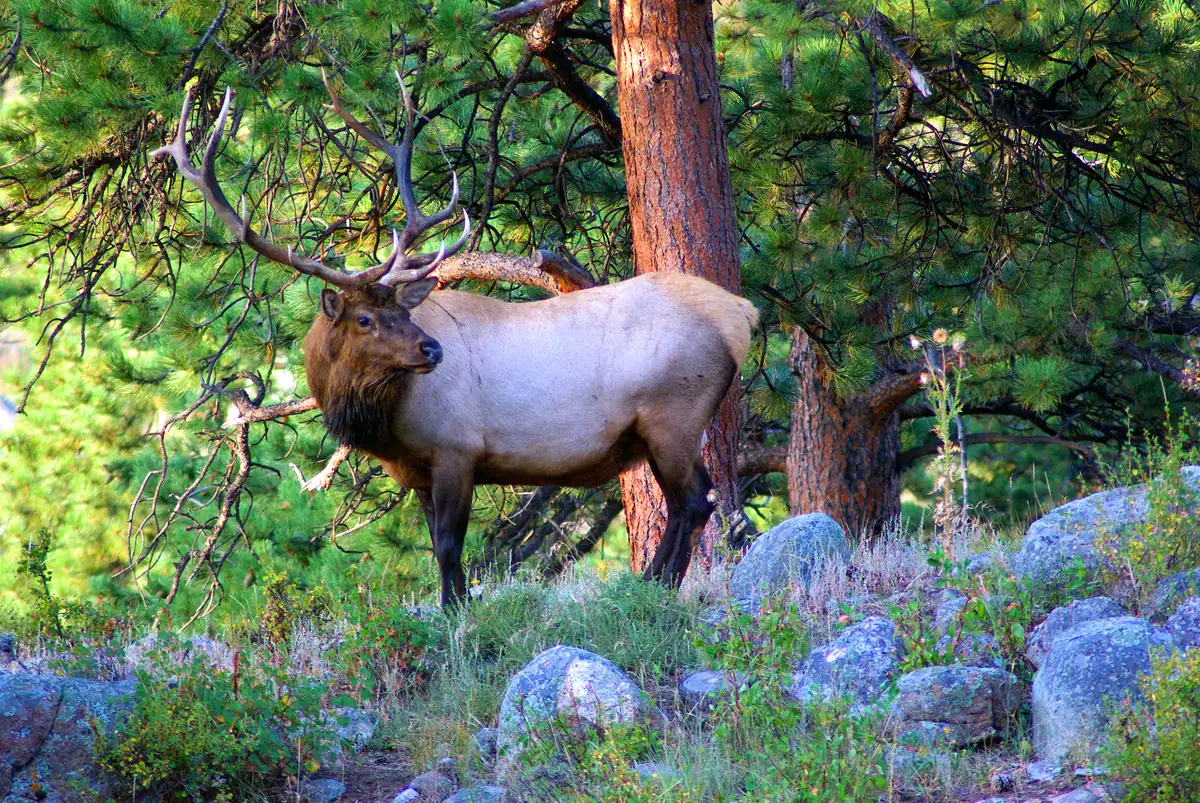
Every autumn elk come down from the high country to the montane meadows to breed, and the bull’s bugle, in the Park Service’s description, climbs from deep tones to a high squeal before breaking into grunts. The loudest weeks are in September, but October still has plenty: bulls hold cows late into the month, younger bulls keep testing them, and the valleys around Estes Park stay busy. Watch the edges, where grass meets timber, in the first and last hour of light.
-
Rocky Mountain National Park meadows
Closures daily, 5 p.m. to 10 a.m., through Oct 31 · Moraine Park, Horseshoe Park, Upper Beaver Meadows, Harbison and Holzwarth meadows
Each fall the park closes these five meadows to off-trail foot and horse travel in the evening and morning so the elk can breed undisturbed. You can watch from roads, pullouts and designated trails. Fishing through the closed meadows on the Fall, Thompson and Colorado rivers is off limits from 5 p.m. to 7 a.m. Calling elk and using spotlights or headlights to find wildlife are both prohibited. The closure is an annual one; check the park’s current conditions page before you go.
-
Keep 75 feet back
All month · Anywhere elk gather, including town
The park asks for at least 75 feet, about two bus lengths. The quick check: hold out your arm with your thumb up, close one eye, and back away until your thumb covers the whole animal. A rutting bull does not care that you are standing next to your car.
-
Elk Fest in Estes Park
Saturday–Sunday, October 3–4 · Bond Park and the Estes Park Events Complex
A free weekend of wildlife talks, live bugling demonstrations, Native American music and storytelling, and vendors. It runs 10 a.m. to 5 p.m. Saturday and 9 a.m. to 4 p.m. Sunday. The elk themselves are usually a short walk away.
When do the aspens turn in Colorado, and why is 2026 early?
The Colorado State Forest Service puts the main mountain show in September and early October, starting with the highest and most northern stands. Aspens respond to shortening days; the brightest years follow a wet summer and a dry, sunny, frost-free fall. This was not that year. The winter of 2025–26 was the worst for Colorado snowpack in the record: on April 1 the statewide snow water equivalent was 22 percent of the 30-year median, and the Colorado Climate Center found that 60 of 64 long-term snow courses were at or tied for their lowest ever. Stressed trees tend to shut down sooner, and by mid-September forecasters were telling leaf-peepers to move their plans up about a week.
What that likely means for October: in the highest stands, much of the gold may already be down by the first weekend. The lower stands, the foothills and the river valleys are where October color lives this year.
-
Low aspen and the foothills
Late September into the first half of October · Front Range foothills, the Pikes Peak region, lower San Juans
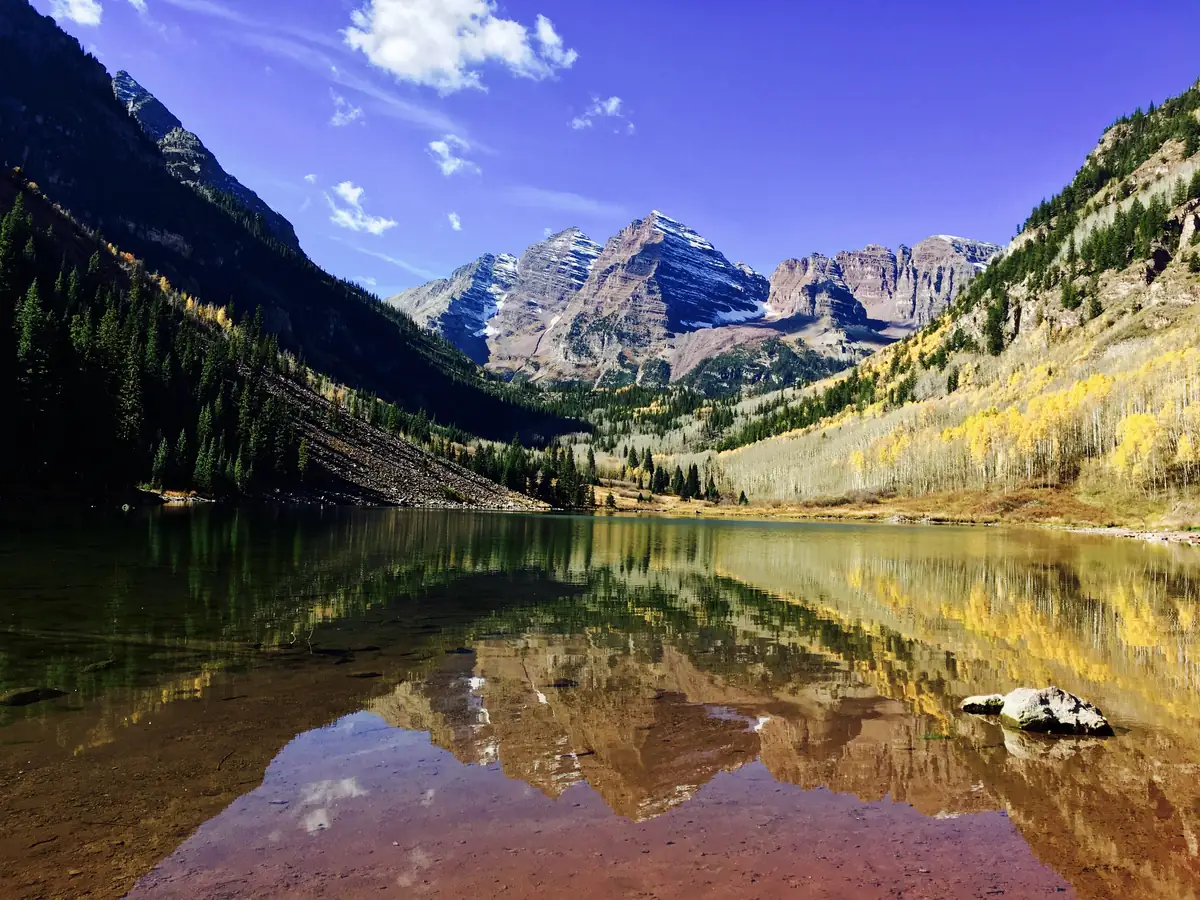
Lower valleys hold their green longer than the high stands, so the color works downhill as the month begins. CBS Colorado’s 2026 guide gave the Pikes Peak area and the mountains west of Colorado Springs a window of about September 23 to October 3. If a drive to a famous pass disappoints, drop 1,500 feet.
-
Cottonwoods
Early to late October · The South Platte, the Arkansas, the Colorado and the Rio Grande; Medano Creek at the dunes
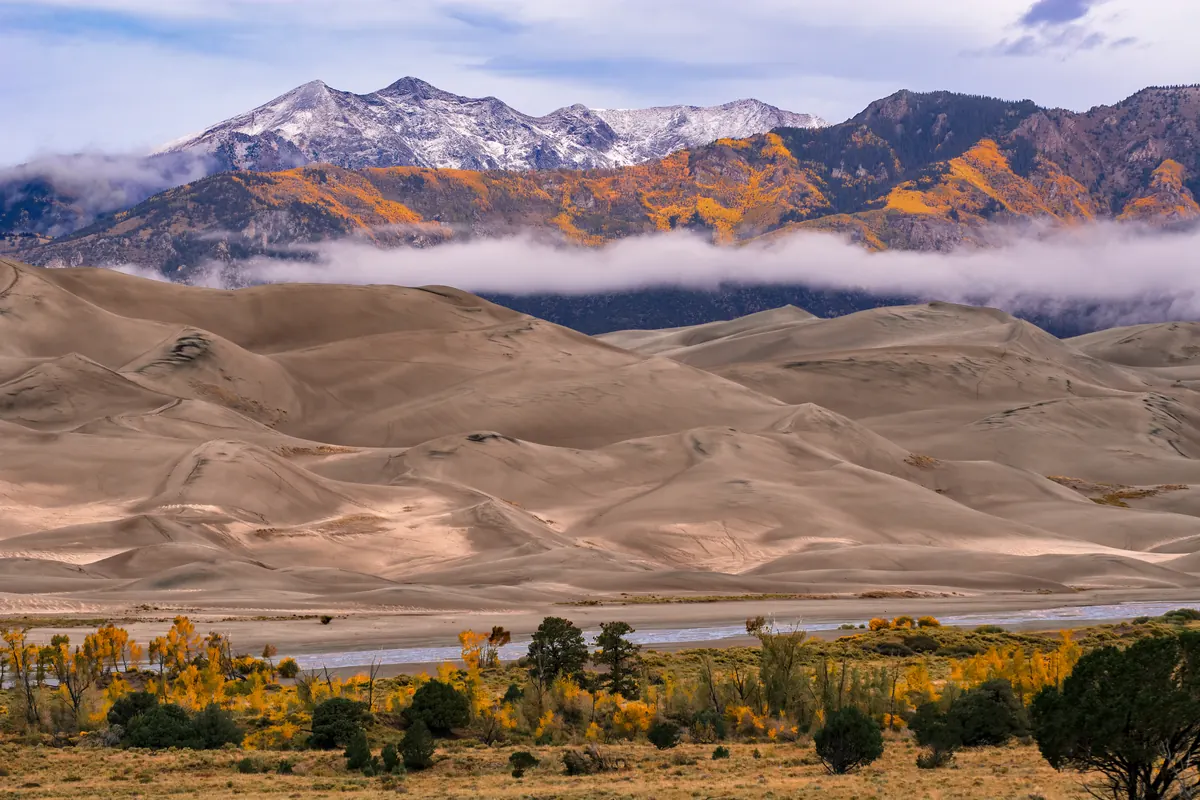
Plains and valley cottonwoods are the last big yellow of the Colorado year. Great Sand Dunes has photographed gold cottonwoods along Medano Creek with fresh snow on the Sangre de Cristos behind them in the first days of October, one of the best pairings in the state.
-
Gambel oak and scrub
October · Foothills and mesas of southern and western Colorado
Gambel oak grows from about 4,000 to 8,500 feet in southwestern Colorado, turning rust and bronze on the hillsides, and many of its dead leaves hang on into winter. Its acorns ripen in late summer and fall by October, which is why bears and wild turkeys work the oak brush now.
When do sandhill cranes come through the San Luis Valley in fall?
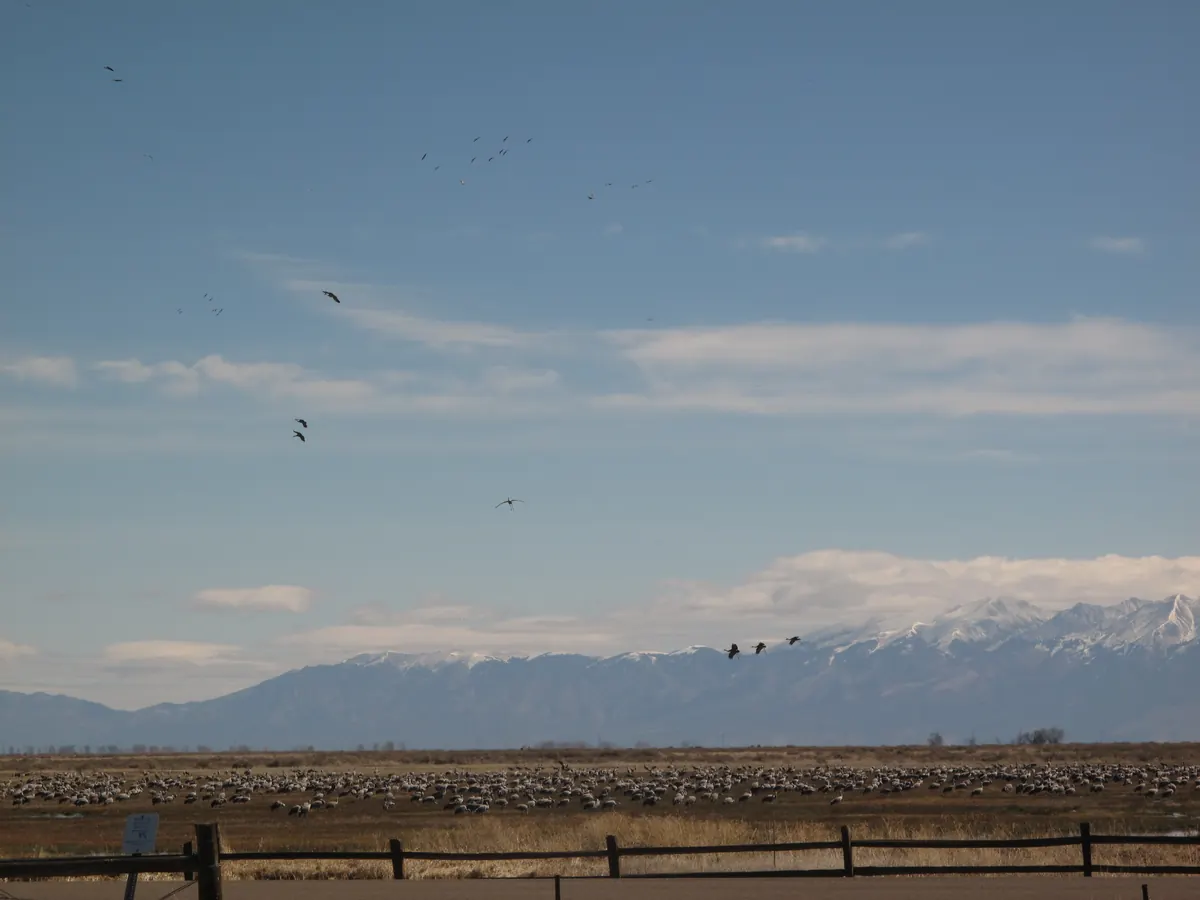
About 23,000 to 27,000 sandhill cranes stop in the San Luis Valley each spring and fall. In autumn they typically arrive in mid-September and leave by mid-November, and the U.S. Fish and Wildlife Service puts the peak in early October, around the second week at Monte Vista National Wildlife Refuge. Nearly all of the Rocky Mountain population of greater sandhills, which nests around Yellowstone and in northern Colorado, uses the valley to refuel on its way to the middle Rio Grande in New Mexico.
Fall is quieter than the famous March gathering. The birds come in family groups, two adults and one rust-tinged juvenile, and spread out over the harvested barley fields. There is no fall festival, which some visitors count as a feature.
-
When to watch
Sunrise to mid-morning, and late afternoon to sunset · Monte Vista refuge tour route; Highway 15 pullouts; County Roads 7S and 2E
Cranes feed in the fields early and late, loaf in wet meadows in the middle of the day, and fly to shallow-water roosts at dusk. The roosts are mostly closed, but the flights in and out at sunset and sunrise are the show. The refuge’s tour route and trails open an hour before sunrise and close an hour after sunset. Stay in or beside your car and keep quiet.
-
Other birds on the move
Through October · Barr Lake and Chatfield state parks; plains reservoirs
October is the changeover month on the Front Range reservoirs: the last warblers and flycatchers leave, waterfowl build, and the first winter birds from the north appear. Chatfield State Park holds the longest bird list of any single place in Colorado, and Barr Lake, northeast of Denver, has a bird banding station run by Bird Conservancy of the Rockies where you can watch migrants measured and released.
Where can you watch kokanee salmon spawn in Colorado?
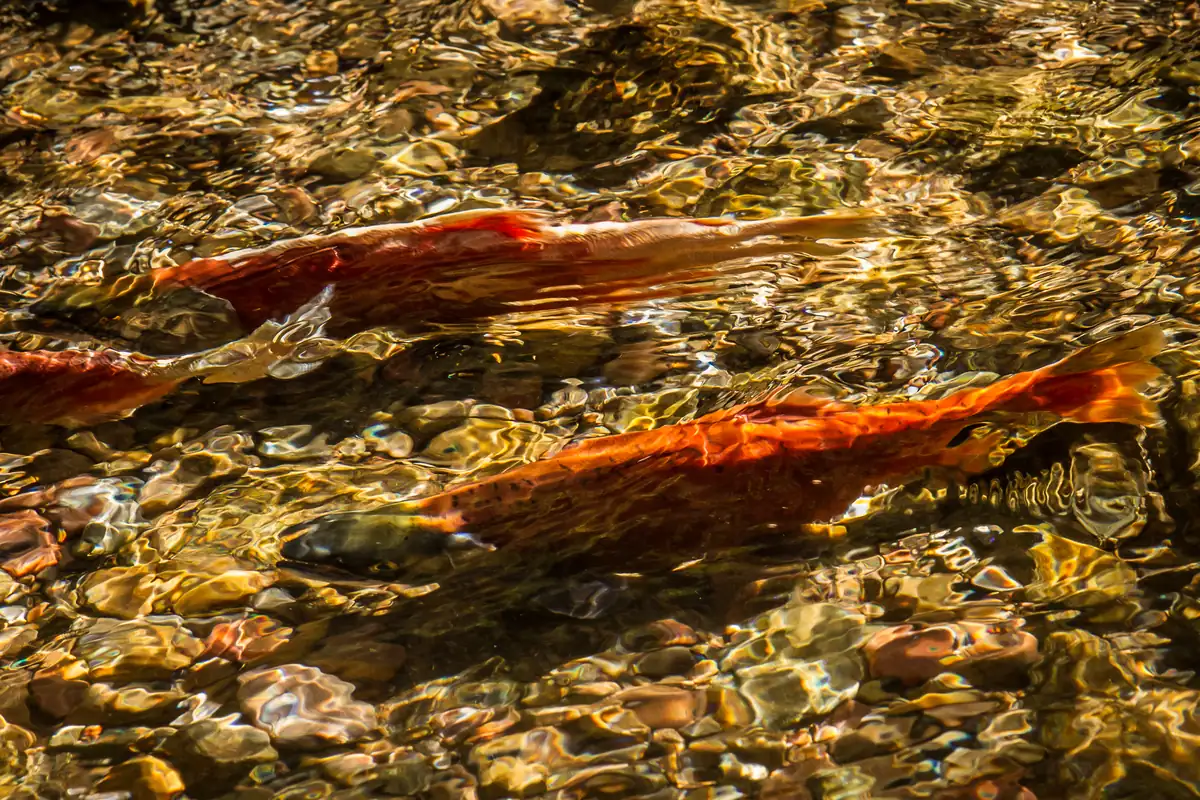
Kokanee are landlocked sockeye salmon, stocked into Colorado reservoirs, and each fall they turn from silver to red, grow a humped back, and head up the tributaries to spawn and die. The biggest run in the state leaves Blue Mesa Reservoir and climbs to the Roaring Judy State Fish Hatchery near Almont, north of Gunnison, where Colorado Parks and Wildlife collects an average of 7.2 million eggs a year to stock lakes across Colorado. The hatchery says visitors can watch adults swimming upstream near its fishing ponds in September and October.
Look for the males’ hooked jaws, called kype. If you plan to fish the East River during the run, check the current fishing regulations first, since spawning water is often protected. A bright red fish crowding a mountain stream below a reservoir in October is very likely a kokanee.
What are bears, tarantulas and other animals doing in October?
-
Black bears eating around the clock
Through October; most den by early November · Foothills, mountain towns, oak brush and orchards
In fall bears enter what Colorado Parks and Wildlife calls hyperphagia, feeding up to 22 hours a day to take in the 20,000 calories a day they need before hibernation. Colorado bears are active from mid-March to early November. In a drought year, when berries and acorns are thin, more of them come looking for trash, bird seed, pet food and fruit trees. Keep trash inside overnight, lock cars, and take down every bird feeder in bear country, hummingbird and suet feeders included.
-
The last of the tarantulas
Dusk on warm days, mid-September into October · Comanche National Grassland south of La Junta
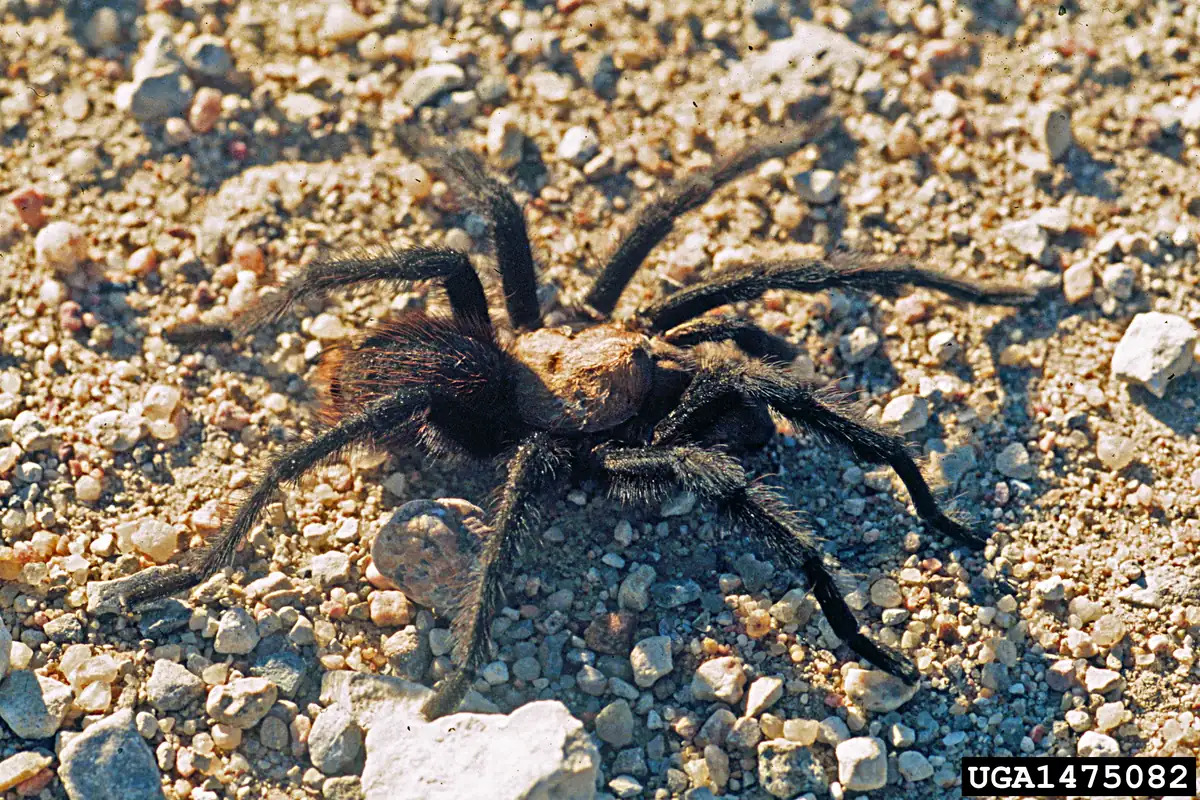
Mature male tarantulas leave their burrows on the southeastern plains to wander in search of females, and people drive out at sunset to watch them cross the roads. The peak is late September; by mid-October it has thinned to stragglers on warm evenings. They are harmless to people if left alone. Drive slowly and let them cross.
-
Bison and deer on the edge of Denver
Sunrise to sunset · Rocky Mountain Arsenal National Wildlife Refuge, Commerce City
A free refuge ten miles from downtown with bison, deer, coyotes, prairie dogs and, as the weather cools, eagles. Stay in your vehicle in the bison pasture. Prescribed burns begin Monday, October 19, and continue for several weeks as the weather allows, so expect smoke and possible closures.
-
Moose, pikas and the high country
Before the snow · North Park, the Never Summer Range, talus slopes above treeline
Colorado Parks and Wildlife gives the moose breeding season as late September through November, when bulls can turn aggressive and territorial; a moose treats a dog much as it would a wolf, so leash yours or leave it home. Up on the talus, pikas do not hibernate and spend the warm months haying, carrying plants to piles under the rocks; in autumn both sexes call to hold territory, so listen for a short, nasal bleat. Once Trail Ridge Road, which tops out at 12,183 feet, closes for the winter, most of that world is out of reach until spring.
When is the first freeze and first snow in Colorado?
Elevation decides almost everything. The high valleys have frozen long ago: Alamosa’s median first freeze is September 15 and Steamboat Springs’ is September 12. The Front Range cities and the plains usually get theirs in the first ten days of October. The warm corner is the Grand Valley, where the orchards around Palisade have a median first freeze of October 26, and that one fact explains why peaches grow there.
Snow follows close behind. The Weather Service’s Denver record puts the average first measurable snow on October 19, and NOAA’s long Boulder record gives October 17 as the average and October 20 as the median, with first snows as early as September and as late as mid-November or even December. After a hot, dry summer, do not bet on either side of those dates.
| Station | One year in ten | Median | Nine years in ten |
|---|---|---|---|
| Fort Collins (northern Front Range) | Sep 24 | Oct 7 | Oct 20 |
| Denver International Airport | Sep 27 | Oct 9 | Oct 20 |
| Colorado Springs Municipal Airport | Sep 26 | Oct 8 | Oct 19 |
| Pueblo Mem Airport (Arkansas Valley) | Sep 27 | Oct 9 | Oct 21 |
| Lamar Municipal Airport (southeast plains) | Sep 28 | Oct 7 | Oct 19 |
| Grand Junction Walker Field (Grand Valley) | Oct 3 | Oct 16 | Oct 29 |
| Durango La Plata County Airport (Four Corners) | Sep 15 | Sep 27 | Oct 9 |
| Alamosa San Luis Airport (San Luis Valley) | Sep 4 | Sep 15 | Sep 26 |
| Steamboat Springs (Yampa Valley) | Aug 31 | Sep 12 | Sep 24 |
All 210 Colorado stations are on the Colorado first and last frost dates page, mountain valleys and plains towns alike. On the Front Range, October is when to pull the last tomatoes and plant garlic; in Grand Junction there is still time to pick.
How much daylight does Colorado lose in October?
Between 67 and 76 minutes: about 2.5 minutes a day in Fort Collins and Steamboat, 2.2 in Durango. In Denver the sun rises at 6:56 a.m. on October 1 and 7:28 a.m. on October 31, and sets at 6:42 p.m. and 5:59 p.m. Standard time returns when clocks fall back at 2 a.m. Sunday, November 1, and the dark evenings arrive an hour earlier.
| City | Oct 1 | Oct 31 | Lost | Per day |
|---|---|---|---|---|
| Fort Collins | 11 h 45 m | 10 h 29 m | 76 min | 2.5 min |
| Steamboat Springs | 11 h 45 m | 10 h 29 m | 76 min | 2.5 min |
| Denver | 11 h 46 m | 10 h 31 m | 75 min | 2.5 min |
| Grand Junction | 11 h 47 m | 10 h 33 m | 74 min | 2.5 min |
| Colorado Springs | 11 h 47 m | 10 h 35 m | 72 min | 2.4 min |
| Pueblo | 11 h 47 m | 10 h 36 m | 71 min | 2.4 min |
| Alamosa | 11 h 47 m | 10 h 39 m | 68 min | 2.3 min |
| Durango | 11 h 47 m | 10 h 40 m | 67 min | 2.2 min |
Mountain towns in deep valleys lose the direct sun well before the official sunset. For the exact sunrise, sunset and twilight at your own spot, and the minutes going this week, open the Field almanac.
Will El Niño bring Colorado a snowy winter?
Maybe, and the honest answer is less exciting than the headlines. The Climate Prediction Center’s September 10 discussion rated a very strong El Niño for fall and winter 2026–27 as better than nine chances in ten. Colorado sits near the middle of El Niño’s usual pattern, between the wetter Southwest and the drier Northwest, so the signal here is mixed. The Colorado Climate Center’s September review found the state tends to run wetter in El Niño falls and springs, with the Front Range and plains more prone to big spring snowstorms, and a loose link to better snowpack in the San Juan and Rio Grande basins. The Denver–Boulder Weather Service office describes the same shape: better odds of above-normal precipitation in northeast Colorado from November through April, as storms from the Four Corners push moist upslope air against the foothills, while the northern and central mountains run near or slightly below normal. The clearest statewide signal is a cooler winter.
The three strongest past events split: 1982–83 buried Colorado in snow, while 1997–98 and 2015–16 came out close to average. The link to peak snowpack is weak overall, and October itself shows little dependable effect. NOAA’s winter outlook comes out in mid-October. Whatever it says, hydrologists expect the drought to take more than one good winter to erase, with reservoirs such as Blue Mesa about a quarter full this fall.
Meanwhile October brings its own weather: warm, dry, windy days, then a fast cold front and the first upslope snow on the Front Range, then sun again. Check the pressure and wind for your town on Weather now before you head up high.
What can you see in the Colorado sky this October?
-
The Moon uncovers Jupiter
About 3:11 a.m. MDT, Tuesday, October 6 · East-northeast, very low; needs a flat eastern horizon
The crescent, 17 percent lit, clears the horizon at 2:35 a.m. in Denver with Jupiter already hidden behind it. At about 3:11 a.m. the planet pops back out from the dark limb, in the International Occultation Timing Association’s predictions for Denver, Colorado Springs, Pueblo and Durango alike, with the Moon only three to six degrees up (the lowest in Durango, where the mountains will block it for most people). That is low enough that you need a flat eastern horizon, which the plains have and mountain valleys do not. Binoculars help. It is worth the alarm if you live east of the foothills.
-
Saturn at opposition
October 4; Moon nearby Oct 23–24 · Rising in the east at dusk, up all night
On October 4 Saturn reaches opposition, at its nearest and brightest of the year and opposite the sun in our sky, so it comes up in the east at sundown and sets at dawn. It is a steady, yellowish point in a thin part of the sky, and any small telescope shows the rings. The waxing Moon, nearly full, keeps it company on October 23 and 24.
-
Morning and evening planets
Venus only in the first days; Jupiter and Mars before dawn · Low west after sunset; east before sunrise
Venus is a low glint in the west-southwest just after sunset for the first few evenings of the month, then sinks from view; on October 23 it slips past the sun on the near side. Before dawn, Jupiter is the bright light in the east, and Mars crosses the Beehive star cluster before sunrise on October 11; binoculars show the scatter of faint stars around it.
-
Draconid meteors
Evening of Thursday, October 8 · Look high in the north after dark
A modest shower, usually a handful an hour, but it peaks in the evening instead of the small hours, and two days before new moon there is no moonlight at all. Good for children who cannot stay up until 4 a.m.
-
Orionid meteors
Active Oct 2 – Nov 7; best pre-dawn Oct 21–22 · Anywhere dark; face east or south
The peak is broad, around October 21 and 22, with perhaps 10 to 20 an hour under dark sky. The waxing Moon sets in Denver at 2:18 a.m. on the 21st and 3:23 a.m. on the 22nd, leaving dark sky until dawn begins to brighten around 5:45. At Colorado’s altitude and away from the city glow, you will see more than the lowland averages suggest.
-
The Hunter’s Moon
Rises 5:35 p.m. Oct 25 and 6:08 p.m. Oct 26 in Denver · Low in the east around sunset
Full at 10:12 p.m. on the 25th, so it looks full both evenings. It is not a supermoon. Watching it come up over the plains, or catching it lighting the snow on the high peaks, is the October picture.
| Phase | Date | Time |
|---|---|---|
| Last quarter | Saturday, Oct 3 | 7:25 a.m. |
| New moon | Saturday, Oct 10 | 9:50 a.m. |
| First quarter | Sunday, Oct 18 | 10:12 a.m. |
| Full moon, the Hunter’s Moon | Sunday, Oct 25 | 10:12 p.m. (looks full Oct 25 and 26) |
| Last quarter | Sunday, Nov 1 | 1:28 p.m. MST |
Before a late night out, check cloud cover on Today’s sky; moonrise and moonset where you are is on the Moon phases page.
What can families do outdoors in Colorado in October 2026?
- Go to Elk Fest, October 3–4, in Estes Park, then drive into the park for the evening bugling from a pullout.
- Watch birds banded at Barr Lake. Bird Conservancy of the Rockies runs its public banding station into late October, six mornings a week; registration is required and there is a small fee, so check this year’s dates and times before you go. Barr Lake State Park also has a volunteer-led birding hike on Saturday, October 10, 9 to 11 a.m. (register ahead, park pass needed), and the Friends of Barr Lake have listed their free Harvest Festival for Saturday, October 3; confirm with the organizers.
- Join a star party. The Northern Colorado Astro Society sets up telescopes at Jackson Lake State Park on Saturday, October 10, 7 to 11 p.m., the night of the new moon; it is free with a park pass. On the Western Slope, Highline Lake State Park near Loma runs a ranger-led moonlight hike on Friday, October 30, 6:30 to 7:30 p.m.
- Do a Big Sit, October 10–11. Pick a circle 17 feet across, sit in it for as much of a day as you can manage, and count every bird species you see or hear; it is free and results go to eBird.
- Measure precipitation. CoCoRaHS, the volunteer rain and snow network, started at the Colorado Climate Center in 1998 after the 1997 Fort Collins flood. A plastic gauge and five minutes a morning make your yard part of the record, and October’s first snow is a good day to start. Project FeederWatch begins November 1, if you have a feeder somewhere bears are not a problem.
Safety notes for October in Colorado
- Weather turns fast above treeline. Carry layers, turn back early, and expect ice on shaded trails after the first storms. Mountain roads and passes can close with little notice; Trail Ridge Road closes for the winter once snow sets in.
- After the 2026 drought, fire danger stays high until real snow falls. Check county fire restrictions before any campfire.
- Give elk 75 feet and moose more; if a moose reacts to you, you are too close. Keep dogs leashed in moose country.
- Bears are feeding hard until early November: no food in cars or tents, no bird feeders in bear country.
- Hunting seasons (Colorado Parks and Wildlife, 2026): rifle moose October 1–14; rifle pronghorn October 3–11 and October 17–25; plains muzzleloader deer October 10–18; first rifle elk October 14–18; second rifle deer and elk October 24 to November 1; plains rifle deer October 24 to November 3; third rifle November 7–15 and fourth November 18–22. Hunters with a firearm license for deer, elk, pronghorn, moose or bear must wear at least 500 square inches of solid fluorescent orange or fluorescent pink above the waist, plus an orange or pink hat visible from all directions. The rule does not bind hikers, but during the rifle seasons a bright hat and jacket for you, and a bright vest for your dog, are cheap insurance on national forest and BLM land.
Sources
- National Park Service: elk in Rocky Mountain National Park
- National Park Service: annual meadow closures for the elk rut
- Visit Estes Park: Elk Fest, October 3–4, 2026
- Colorado State Forest Service: aspen fall colors
- CBS Colorado: fall colors could arrive early in 2026
- Colorado Climate Center: 2026 mountain snowpack almost gone (April 2, 2026)
- Colorado Climate Center: where the drought stands (June 18, 2026)
- National Park Service: Great Sand Dunes, gold aspens and cottonwoods (October 2022 photo)
- USDA Forest Service Fire Effects Information System: Gambel oak
- U.S. Fish and Wildlife Service: San Luis Valley sandhill crane viewing (PDF)
- U.S. Fish and Wildlife Service: Monte Vista National Wildlife Refuge
- Colorado Parks and Wildlife: Chatfield State Park
- Colorado Birding Trail: Chatfield State Park
- Bird Conservancy of the Rockies: Barr Lake banding station
- Colorado Parks and Wildlife: Roaring Judy Hatchery
- Colorado Parks and Wildlife: Roaring Judy State Fish Hatchery (PDF)
- Colorado Parks and Wildlife: living with bears
- Colorado Parks and Wildlife: living with moose
- Visit La Junta: tarantula season on the Comanche National Grassland
- Wikipedia: American pika (haying and autumn calls)
- U.S. Fish and Wildlife Service: Rocky Mountain Arsenal National Wildlife Refuge (prescribed burns from October 19)
- National Park Service: Trail Ridge Road
- NOAA NCEI: U.S. climate normals, 1991–2020
- NWS Denver/Boulder: Denver fall and winter statistics
- NOAA Physical Sciences Laboratory: Boulder first snow of the season
- U.S. Naval Observatory: sunrise, sunset, moonrise and moonset (data API)
- U.S. Naval Observatory: moon phases 2026 (data API)
- Climate Prediction Center: ENSO diagnostic discussion, September 10, 2026
- Colorado Climate Center: what a super El Niño means for Colorado (September 3, 2026)
- Colorado Climate Center: ENSO and Colorado
- NWS Denver/Boulder: El Niño and the winter precipitation outlook
- Colorado Public Radio: Colorado’s 2026 winter outlook and the drought (September 17, 2026)
- International Occultation Timing Association: lunar occultation of Jupiter, October 6, 2026
- EarthSky: meteor shower guide; Saturn at opposition; visible planets
- American Meteor Society: 2026 meteor shower calendar
- Fred Espenak: full moons at perigee, 2001–2100
- NIST: daylight saving time
- Colorado Parks and Wildlife: Jackson Lake star party, October 10, 2026
- Colorado Parks and Wildlife: Barr Lake birding hike, October 10, 2026
- Colorado Parks and Wildlife: Highline Lake moonlight hike, October 30, 2026
- Eventbrite: 14th Annual Harvest Festival at Barr Lake
- The Big Sit!: October 10–11, 2026
- CoCoRaHS: about the network
- Project FeederWatch: project overview
- Colorado Parks and Wildlife: 2025–2029 big game season structure, with 2026 dates (PDF)
- Colorado Parks and Wildlife: big game hunting and the 2026 brochure
- Colorado Parks and Wildlife: deer in the field, fluorescent orange and pink
- Photos via Wikimedia Commons; licenses and photographers are credited under each picture
.jpg)
