What to look for in nature in Colorado this February
Meteorological winter ends with February, and in Colorado the month carries winter and spring side by side. On the plains, cottonwoods hold incubating eagles, the reservoirs near Lamar turn white with geese, and on a warm afternoon a dark butterfly may flutter out from a woodpile. In the San Luis Valley the first sandhill cranes are gliding in from New Mexico, while on the Western Slope and in the high country the snow is still piling up and deer and elk are at their thinnest. Here is what to look for from Groundhog Day to the last day of the month; for the weeks before, see Colorado in January.
Other months in Colorado: October, November, December, January.
Start here
- Find an eagle on its nest. Walk to the boardwalk gazebo at Barr Lake State Park on a calm morning and scan the nest baskets in the big cottonwoods. A dark lump that never moves is probably an eagle sitting on eggs.
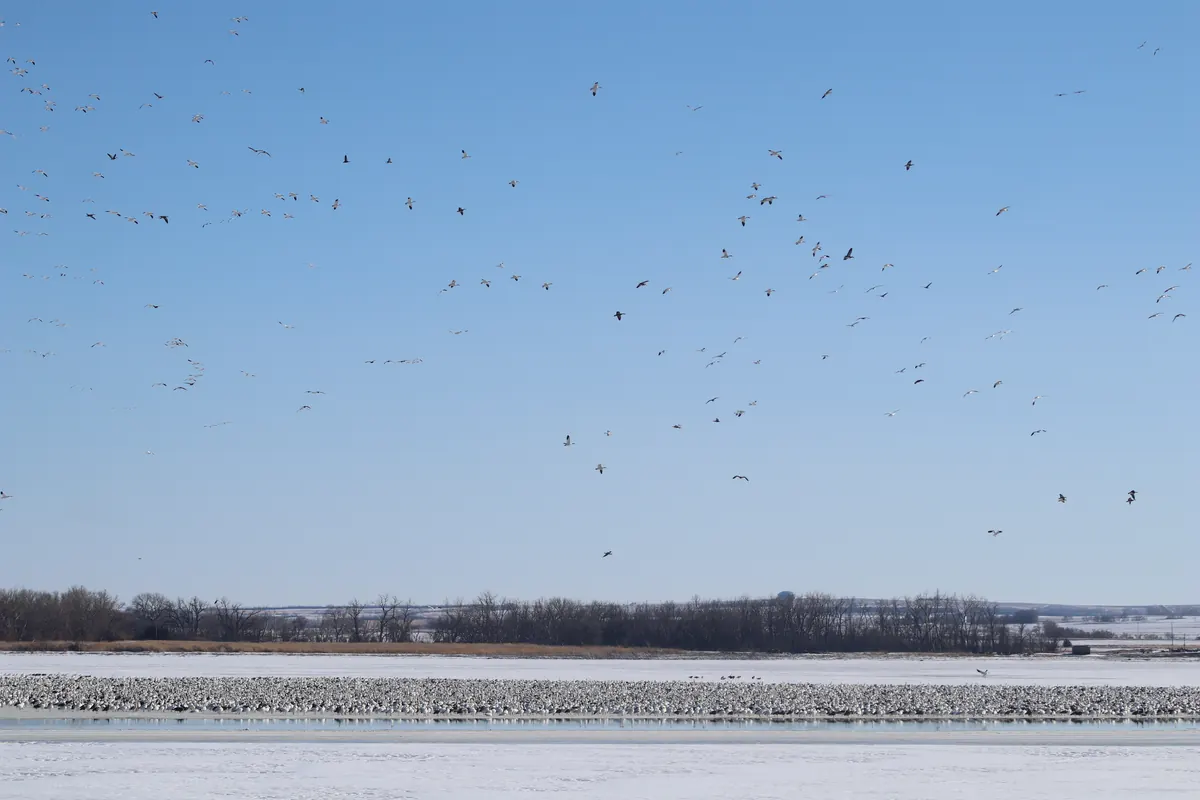
- Watch the geese lift off. Be at a Queens reservoir north of Lamar, or at John Martin Reservoir, at sunrise. When tens of thousands of snow geese take off at once, you hear it before you see it.
- Two planets at opposition. Jupiter is opposite the Sun on February 10, Mars on the 19th. On the evening of February 20, look east for the Snow Moon with Jupiter, Mars and the star Regulus nearby.
Record it in your Naturalist’s Field Journal: turn to “nest observed” for any eagle or owl nest close enough to revisit weekly, add snow geese and cranes to “birds I have seen”, and begin “a tree through the seasons” using a leafless cottonwood near home. On the first warm day, note the first butterfly and the first blackbird song on your “daily field log”.
Regions used below: Front Range and the Denver metro; Eastern Plains; Northern Mountains and Rocky Mountain National Park; Central Mountains and the high parks; San Luis Valley; Western Slope and the Four Corners.
When do bald eagles lay eggs in Colorado, and where can I watch a nest?
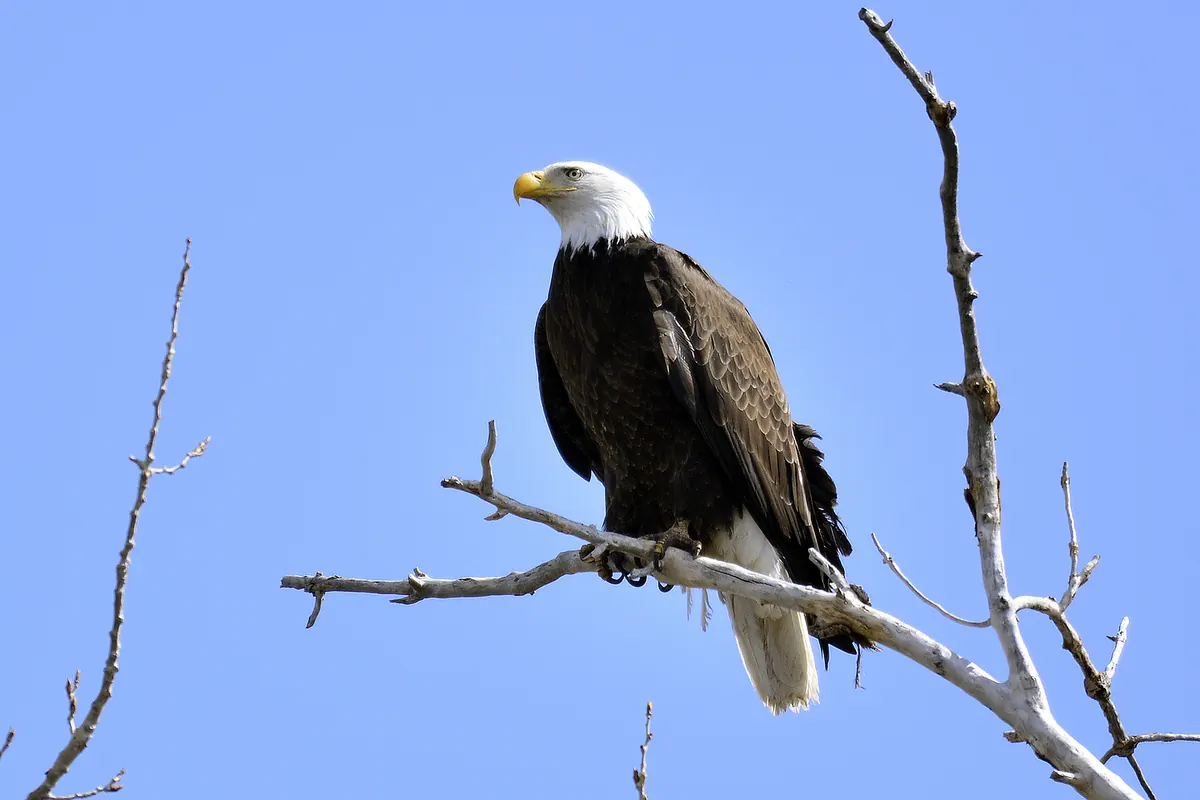
In January the story was eagles crowding onto open water. In February the resident pairs turn to the nest. A 2018 story in CPW’s magazine noted that Colorado pairs usually lay their eggs around Valentine’s Day, so by the middle of the month many Front Range nests have a bird lying flat in the bowl of sticks, sometimes with only a white head showing over the rim. Colorado Parks and Wildlife says a female lays one to three dull white eggs, that the male and female take turns keeping them warm for 35 to 40 days, and that the young leave the nest at 10 to 12 weeks. The arithmetic says February eggs hatch in late March and the eaglets fly in June.
Meanwhile the wintering birds from the north have not left yet. On a February morning you can see both kinds of eagle at once: a pair trading shifts on a nest, and loafing adults and brown juveniles standing on the ice nearby. CPW explains that young bald eagles stay dark brown until their head and tail turn mostly white in their fourth or fifth year.
-
Barr Lake’s nest baskets
All month; mornings are calmest · Barr Lake State Park, near Brighton
Eagles have been recorded at Barr Lake every year since 1986, and Bird Conservancy of the Rockies started its Bald Eagle Watch there two years later to keep an eye on them. CPW’s magazine reports that by 2021 the lake’s pairs had fledged 59 young. The big cottonwoods are vulnerable, though: the April 5, 2021, windstorm toppled the tree holding the active nest, with two eggs in it. Park staff responded by putting up three new nest baskets near the boardwalk gazebo, and at the time two pairs were resident at the lake with a third about a mile away. Walk out to the gazebo with binoculars, find the baskets, and look for a still, dark shape on top: that is an eagle incubating.
-
The Barr Lake eagle festival
An annual Saturday in early February · Barr Lake State Park
Barr Lake holds an annual Bald Eagle Festival. The 2026 edition filled Saturday, February 7, from 10 a.m. to 2 p.m., with live raptor programs from Nature’s Educators, crafts, guided walks toward the refuge side of the lake and shuttles to the boardwalk; a park pass was needed, and CPW’s listing pointed to Eventbrite for sign-up. The 2027 date had not been announced when we wrote this, so check CPW’s event calendar in January.
-
Giving a nest room
February through summer · Any nest you find
A sitting eagle flushed off its eggs leaves them to chill. Watch any nest from far enough away that the bird never lifts its head to stare at you, and keep the location off social media. On the west side of Rocky Mountain National Park, the winter roost closure along the Colorado River near Grand Lake stays in force until March 15.
Where can I see huge flocks of snow geese in Colorado in February?
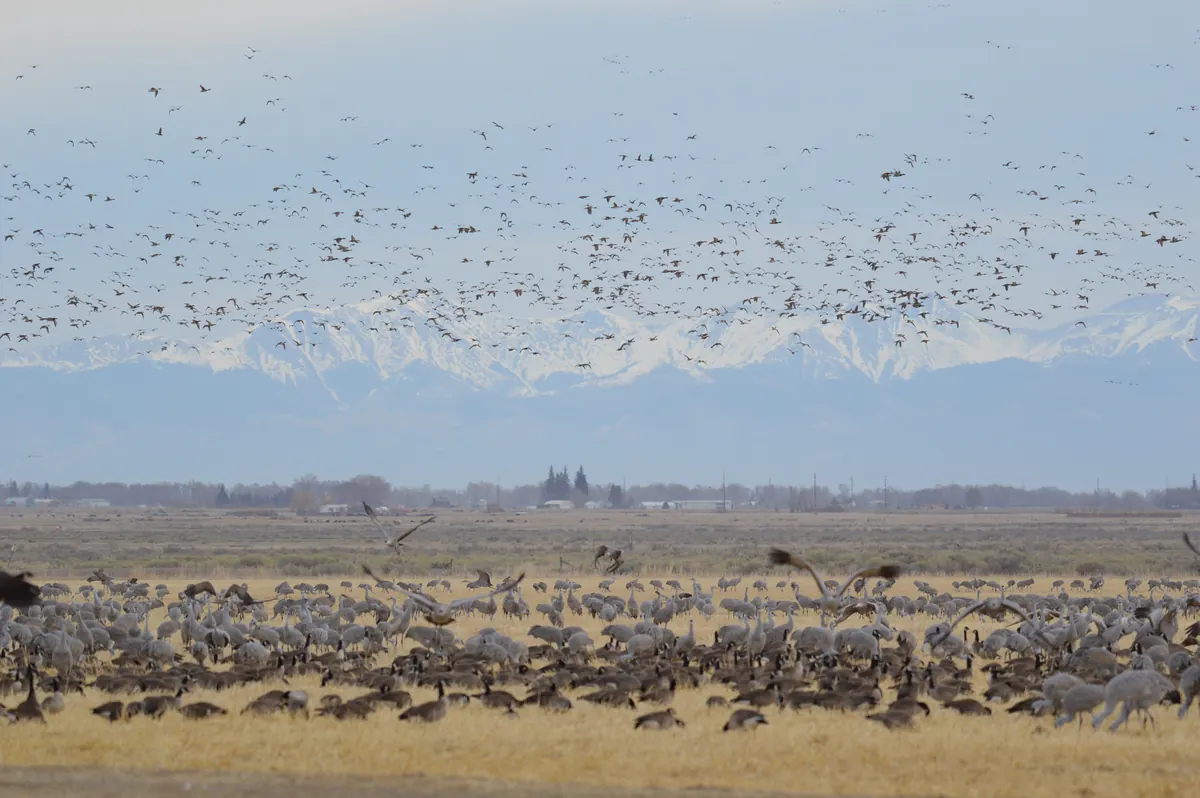
In November the white geese were arriving. By February the flocks in the southeast corner of the state are at their most impressive, and the first ones are starting to turn north. The Colorado Birding Trail’s Snow Goose route describes tens of thousands of snow and Ross’s geese spending the winter on the reservoirs of the Queens State Wildlife Area near Eads and around Lamar. They roost on the water at night and fly out to graze leftover grain in the fields by day, so the show comes twice: at sunrise, when the flocks lift off with a roar of calls, and late in the afternoon, when they stream back.
-
Queens reservoirs and John Martin
All month; first and last hours of daylight · Nee Noshe, Nee Gronde, Neeskah and Nee So Pah reservoirs north of Lamar; John Martin Reservoir State Park near Hasty
The Birding Trail calls Nee Noshe the largest of the Queens reservoirs and singles out Nee Gronde as especially good in winter. A Kiowa County Press piece on the festival also named John Martin Reservoir and other lakes in the region as winter roosts. Look through the white rafts for Ross’s geese, smaller and rounder-headed with short bills that lack the black edging snow geese show, and for dark “blue” snow geese mixed in. A bald eagle cruising low over the water is often what sends a whole flock into the air.
-
The High Plains Snow Goose Festival
Usually the first or second weekend of February · Lamar and nearby reservoirs
Lamar has celebrated the flocks with the High Plains Snow Goose Festival for more than two decades; the 2026 festival ran Thursday to Sunday, February 5 to 8, and the Kiowa County Press counted 2019’s as the 17th. Past festivals have offered tours to Two Buttes Reservoir, Picture Canyon and Carrizo Canyon as well as the goose reservoirs. The festival site had not posted 2027 dates when we checked, so look at highplainssnowgoose.com before you plan the drive. The organizers also remind visitors that state wildlife areas require a pass for each person, separate from registering your car for the festival.
A practical note: from February 15 the light goose conservation order opens east of I-25 (see the safety notes below), so expect hunters in the fields and on some reservoirs. Watching from roads and public pullouts keeps you out of their way.
When do the sandhill cranes come back to the San Luis Valley?
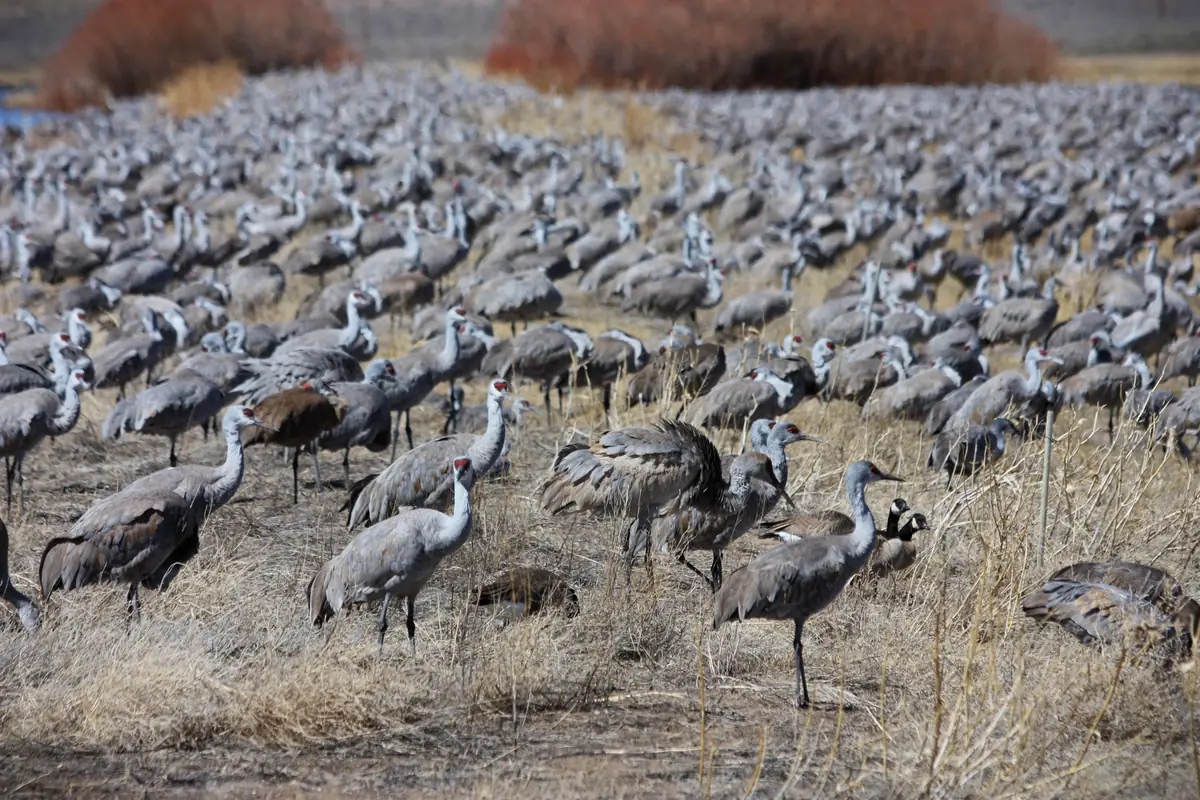
February is when the cranes return. Great Sand Dunes National Park and Preserve says greater sandhill cranes begin arriving in the San Luis Valley in early February, coming up from wintering grounds in New Mexico, and that more than 20,000, mostly greater sandhills, take part before they head north by late March. The fall passage, the subject of our October page, is a quieter affair. In spring the birds are pairing up for the breeding season, so they dance: the park describes a courtship ritual of dancing, bowing, chortling and throwing tufts of grass into the air.
-
Monte Vista National Wildlife Refuge
First arrivals in February; the U.S. Fish and Wildlife Service puts the peak around the first week of March · Monte Vista National Wildlife Refuge, south of Monte Vista on Highway 15
The refuge says that in spring it hosts about 95 percent of the Rocky Mountain population of greater sandhill cranes, 18,000 to 21,000 birds, plus another 5,000 to 6,000 lesser sandhills. In late February the numbers are still building, which makes it a good time to visit before the crowds. The Wildlife Drive and the pullouts along Highway 15 and County Roads 7S and 8S are open daily from one hour ahead of sunrise until an hour past sunset. Spring Creek Pond on the drive is a favorite spot.
-
Dawn and dusk flights
Sunrise and the half hour after sunset · San Luis Lakes State Wildlife Area and Rio Grande State Wildlife Area, as well as the refuge
The national park explains the daily rhythm: cranes spend the day feeding on waste barley in the fields and on invertebrates in the wetlands, then fly to shallow water to spend the night, so the flights in and out are the moments to be there. Valley mornings can be below zero; dress for it, switch off the engine and listen for the rolling, rattling calls.
-
The Monte Vista Crane Festival
Friday to Sunday, March 5 to 7, 2027 · Ski Hi Complex, Monte Vista, with tours on the valley’s three national wildlife refuges
The 44th festival is already on the calendar for early March, just after this month ends. Its organizers list talks, a keynote, painting and printmaking classes, bus tours and a waterfowl tour, with free admission to included programs for children 15 and under; guided field trips need separate tickets.
What is happening in Colorado’s dens and nests in February?
Some of February’s biggest wildlife news happens out of sight. A few of Colorado’s animals start families in the depth of winter, timing births so the young are ready to grow when spring food arrives.
-
Black bear cubs
Born mid-winter; out of the den in May · Dens in the foothills and mountains statewide
Colorado Parks and Wildlife says one to three tiny cubs are born in mid-winter while the mother is still in her den. The cubs feed on her milk for the rest of the denning season and weigh 10 to 15 pounds when they follow her out in early or mid-May. If you ever stumble on a den in the snow, leave quietly.
-
Great horned owlets
Hatching from about February into spring · Old hawk and magpie nests, cottonwoods, cliff ledges and even ledges on buildings
CPW says males begin hooting for partners in December or January, both parents incubate the eggs for about a month, and the young stay in the nest for six to seven weeks. Owls that laid in January can therefore have fluffy white chicks by late February. Look for a gray downy head beside the adult in a nest you have been watching, and stay well back.
Why is shed antler hunting closed in Colorado in February?
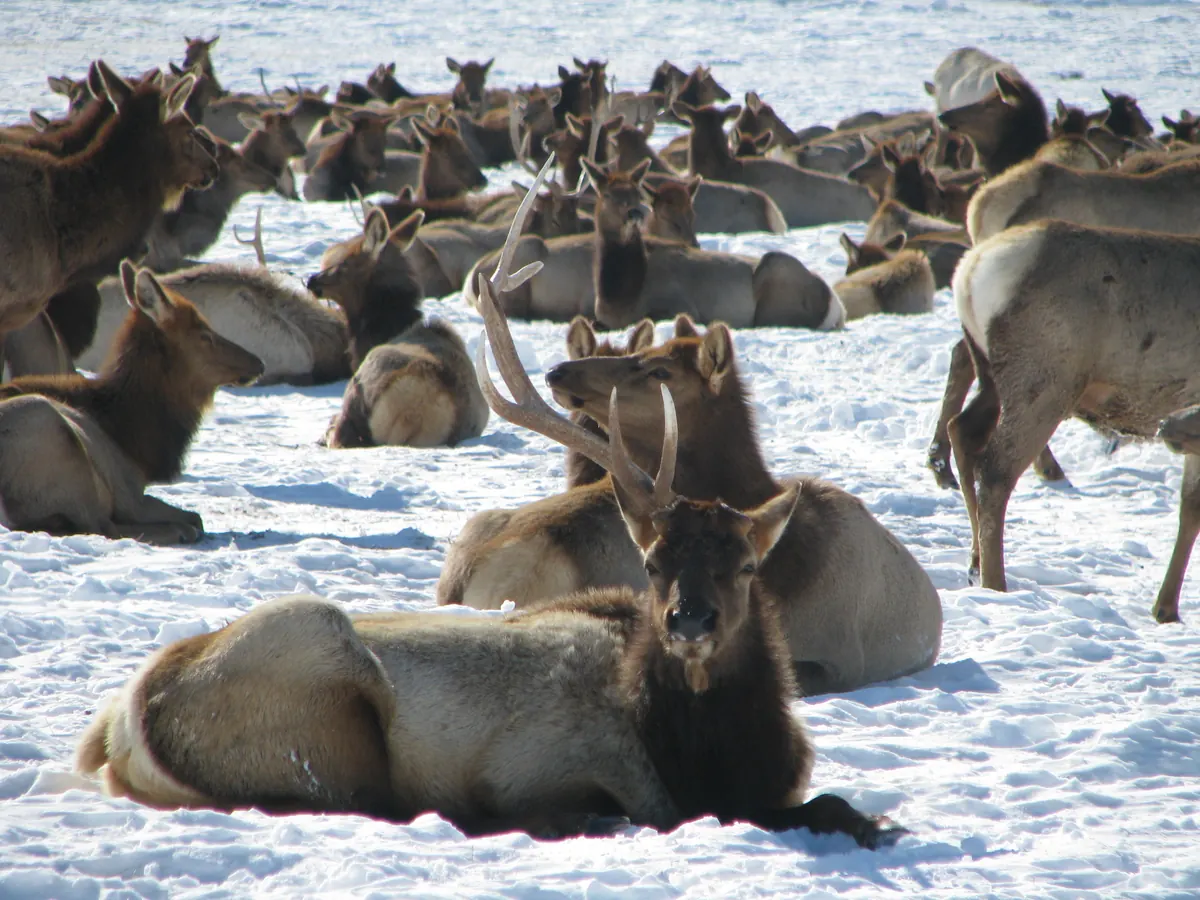
Late winter is the hardest stretch of the year for deer and elk. They have been living on fat and poor browse since December, and every unnecessary run uses energy they cannot replace until green-up. This is also when they drop their antlers. CPW says deer shed from mid-January through March, elk may start in February and keep going into April, and moose have usually dropped theirs between November and January.
-
The January to April closure
January 1 through April 30, every year · All public land west of I-25
To protect wintering herds, CPW bans shed antler and horn collection on every acre of public land west of I-25 from January 1 to April 30. Each violation carries a $137 fine and five license suspension points, and each antler possessed counts as a separate violation. CPW also asks you to leave an antler where it lies if you happen to find one during the closure, because an officer has no way to tell you from someone who came to collect. One of the agency’s area wildlife managers summed up the reasoning: after the worst of winter, these animals need every last calorie to survive.
-
Watching instead of chasing
Mornings and evenings · Elk and deer winter range in the foothills, along I-70 and in the high valleys
A herd of elk bedded on a sunny south slope is doing exactly what it should be doing: saving energy. Enjoy them from a road or a trail without stepping off toward them, and keep dogs on a leash. CPW has reported seeing people chase deer, elk and moose until their antlers fell off; if you see anything like that, report it to the agency. A bull elk carrying just one antler, lopsided for a day or two, is a sign that shedding season is under way.
Are there any signs of spring in Colorado in February?
Yes, though you have to look closely, and a blizzard can bury them the next day. Groundhog Day falls on Tuesday, February 2, yet winter’s true astronomical halfway mark, counted between solstice and equinox, lands on February 3 to 4. On the plains and along the Front Range, the last weeks of meteorological winter usually bring the first warm afternoons, and a few animals and plants are ready to take advantage.
-
Mourning cloak butterflies
Warm, sunny afternoons · Cottonwood and willow bottoms, foothill trails and sunny walls
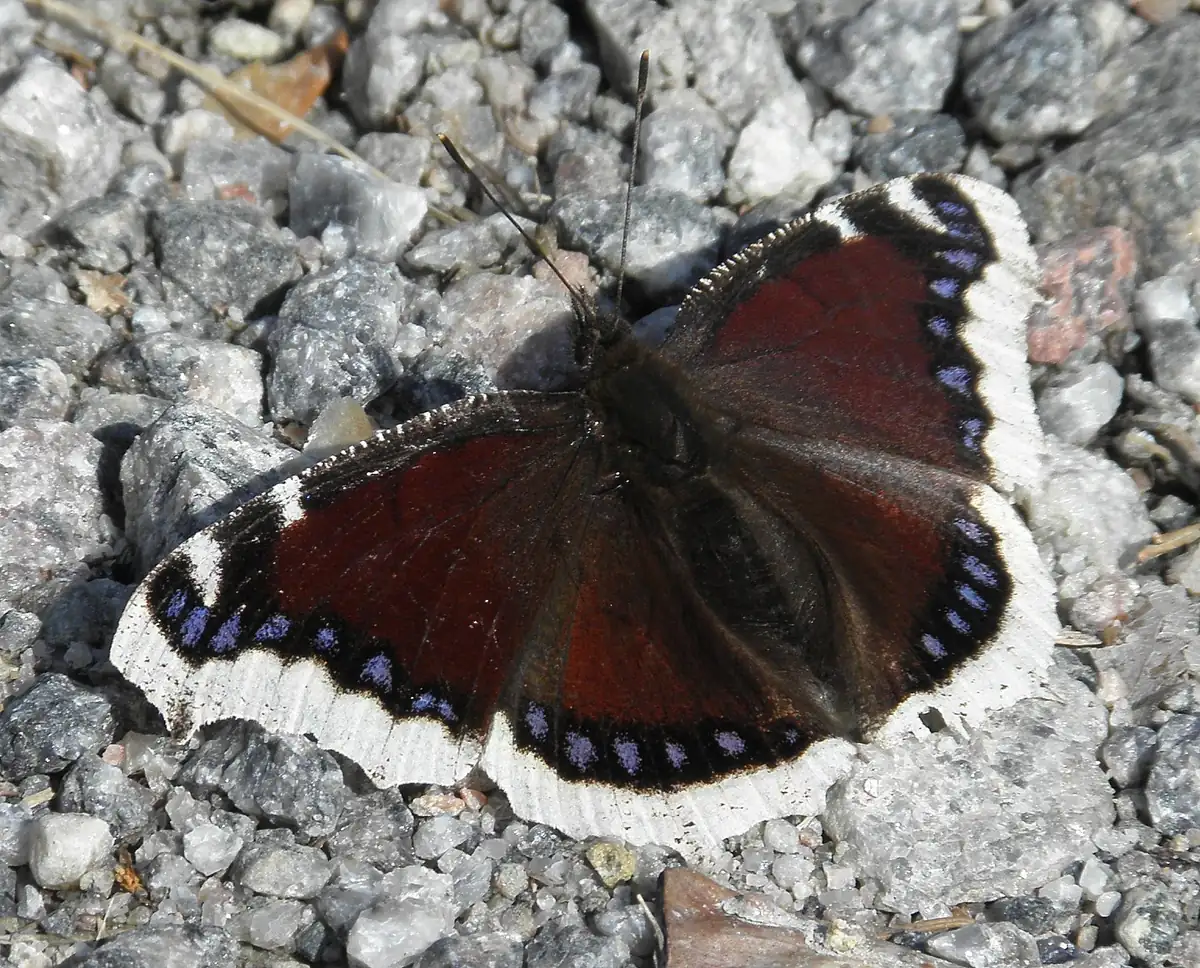
The Boulder County Nature Association’s guide to Front Range butterflies explains that the mourning cloak spends the winter as an adult, tucked into a crack in bark or a woodpile, and that although it normally flies from March to mid-September, it can turn up in any month during a warm snap, including January and February. Look for rusty-brown wings with a broad yellow border and a row of blue spots; a dark butterfly basking on a sunny February afternoon is very likely this one.
-
Red-winged blackbirds tuning up
Late in the month · Cattail marshes, ditches and lake edges on the plains and in the Denver metro
Some red-winged blackbirds spend the winter in Colorado in flocks, and Audubon’s field guide notes that in spring the males arrive on their territories before the females. Late in February, listen at a cattail marsh for the first gurgling song and watch for a male hunching on a stalk with his red shoulder patches flared. It is one of the earliest bird songs of the year on the Front Range.
-
Easter daisies getting ready
Buds in late winter; flowers usually in March · South-facing slopes on the hogbacks and mesas along the base of the Front Range
The Easter daisy (Townsendia hookeri) is one of the first native wildflowers of the year along the Front Range. It grows as a tight, low mound, and the Colorado Native Plant Society notes that it can set seed without pollination, an advantage when few insects are flying. February is too early for most flowers, but on a sunny south slope you may find the gray-green cushions with fat buds tucked in the middle.
Is February the snowiest month in Colorado?
It depends which side of the Continental Divide you live on. The National Weather Service office in Boulder notes that Denver’s snowiest month is March, not anything in midwinter, and its February records show how variable the month can be: a mean temperature of 32.7 °F for 1991–2020, but a record low of −25 °F (on February 8, 1936, and again on February 1, 1951) and a record high of 80 °F on February 10, 2017. In the western and southern mountains, by contrast, February is still deep in the main snow season.
| Station | February snow | March snow | February high | February low |
|---|---|---|---|---|
| Fort Collins | 7.6 | 9.4 | 46.8 | 20.7 |
| Boulder | 15.0 | 15.7 | 48.3 | 22.3 |
| Estes Park 3 SSE | 13.3 | 18.8 | 37.5 | 15.8 |
| Colorado Springs Municipal Airport | 4.6 | 5.7 | 46.5 | 20.2 |
| Pueblo Memorial Airport | 4.7 | 4.5 | 51.1 | 19.0 |
| Lamar | 5.4 | 4.7 | 49.2 | 17.0 |
| Grand Junction Walker Field | 2.9 | 1.8 | 46.4 | 24.1 |
| Durango | 15.4 | 5.3 | 45.0 | 18.6 |
| Alamosa San Luis Valley Airport | 4.1 | 4.3 | 41.2 | 7.4 |
| Gunnison 3SW | 9.0 | 4.4 | 30.4 | 0.7 |
| Fraser | 24.7 | 19.4 | 34.4 | 2.0 |
| Steamboat Springs | 35.7 | 19.5 | 34.3 | 7.9 |
| Crested Butte | 35.2 | 29.1 | 29.4 | -2.1 |
| Climax (Fremont Pass) | 40.5 | 42.5 | 28.7 | 3.4 |
| Telluride 4WNW | 22.0 | 22.7 | 37.6 | 5.3 |
The pattern is clear in the normals. At Fort Collins, Boulder and especially Estes Park, March brings more snow than February, because spring storms that push moist air up against the foothills from the east, the classic upslope storm, are a late-season specialty. On the Western Slope the opposite holds: Steamboat Springs and Durango both average far more snow in February than in March. And February is still cold where cold air pools: Crested Butte’s average February low is below zero. If you are wondering whether your garden is out of danger, it is not yet; our Colorado frost tables list the usual last spring freeze for each town, and for most of the state it is still a long way off.
Will El Niño make late winter snowier along the Front Range?
It tilts the odds toward a wetter end of the season east of the mountains, but it is no promise. In its September 10 ENSO discussion, NOAA’s Climate Prediction Center said the chances of a very strong El Niño sticking around through the 2026–27 cold season topped 90 percent. In a September 2026 post on what such an event means for the state, Colorado State University’s Colorado Climate Center said El Niño years are generally wetter, especially in fall and spring, and that the Front Range and Eastern Plains are more prone to big spring snowstorms and see fewer dry, windy spring days. The center’s long-term analysis finds the clearest winter signal is in temperature, with the whole state tending to run cooler than average.
For snowpack the story is weaker. The same post describes only a loose positive link between El Niño and peak snowpack in the southern basins (San Juan, Rio Grande) and little link elsewhere, and it warns that even if the storms come, a warmer climate may turn more of the moisture into rain at lower elevations. An older NWS Boulder outlook made a related point for the northern and central mountains, which in El Niño winters can end up near or slightly below average because the northwest flow that feeds them is weaker. So late February in a strong El Niño might bring heavy, wet snow to Denver and Colorado Springs while Steamboat waits.
For the official three-month outlook, which NOAA refreshes once a month, go to the CPC seasonal outlook page. For what the wind and pressure are doing right now, our live weather map covers the state.
How much daylight does Colorado gain in February?
More than in any month so far this winter, and the daily gain grows all month, peaking near the March equinox. Denver goes from 10 hours 12 minutes of daylight on February 1 to 11 hours 16 minutes on February 28, a gain of 64 minutes. Sunrise in Denver moves from about 7:08 a.m. to 6:35 a.m., and sunset from about 5:20 p.m. to 5:51 p.m. (Mountain Standard Time; daylight saving time begins March 14).
| City | Feb 1 | Feb 28 | Gained | Per day |
|---|---|---|---|---|
| Fort Collins | 10 h 08 m | 11 h 14 m | 66 min | 2.4 min |
| Steamboat Springs | 10 h 08 m | 11 h 15 m | 67 min | 2.5 min |
| Denver | 10 h 12 m | 11 h 16 m | 64 min | 2.4 min |
| Grand Junction | 10 h 14 m | 11 h 18 m | 64 min | 2.4 min |
| Colorado Springs | 10 h 16 m | 11 h 18 m | 62 min | 2.3 min |
| Pueblo | 10 h 18 m | 11 h 19 m | 61 min | 2.3 min |
| Alamosa | 10 h 21 m | 11 h 20 m | 59 min | 2.2 min |
| Durango | 10 h 21 m | 11 h 20 m | 59 min | 2.2 min |
Northern towns gain fastest, which is why Fort Collins and Steamboat Springs catch up with Durango by the equinox. For a sunrise and sunset time at your own trailhead, try the sunrise and sunset calculator.
What is in the Colorado night sky in February 2027?
February 2027 has an unusual pairing: Jupiter and Mars both reach opposition, the point where Earth passes between them and the Sun, within nine days of each other and in the same constellation, Leo. With the new moon on February 6, evenings stay dark from roughly the 2nd through the 11th. There is also an eclipse of the Sun on February 6, but it is an annular “ring” eclipse whose path crosses Chile, Argentina and the ocean beyond, and none of it is visible from Colorado or anywhere else in the United States.
-
Mercury’s best evening show of the winter
Late January to about February 10; farthest from the Sun on the evening of February 2 · Low in the west-southwest, 30 to 45 minutes after sunset
Mercury is never easy, but this is the best chance of the season. Find a clear western horizon, such as a mesa top or the edge of the plains, and look low in the glow after sunset. On Sunday the 7th, a Moon barely a day past new hangs beside Mercury in the dusk; binoculars help.
-
Jupiter at opposition
Wednesday, February 10 · Rising in the east at sunset, highest around midnight
Jupiter is at opposition late on the afternoon of February 10, Mountain time, and stays above the horizon all night, outshining every star. Binoculars braced on a fence post reveal Jupiter’s four big moons as pinpricks in a row; a small telescope adds the cloud belts. On the night of February 19 to 20, the Moon, one night shy of full, slides just past Jupiter.
-
Mars at opposition
Friday, February 19; closest to Earth on the 20th · East after dark, in Leo near the star Regulus
Mars comes to opposition during the morning of Friday, February 19, and makes its nearest pass the following day at a distance of about 63 million miles. Because Mars is close to aphelion, its outermost point from the Sun, this pass is a modest one: expect a steady orange point, still bright at magnitude −1.2, rather than an impressive disk in a small telescope. On the evening of the Snow Moon, the full Moon, Jupiter, Mars and Regulus are all gathered in the same part of the sky.
-
The Snow Moon and a penumbral eclipse that misses us
Full at 4:23 p.m. MST, Saturday, February 20 · Rising in the east around sunset
The Moon is technically full in the late afternoon on February 20, before it rises in Colorado; that evening and the evenings on either side, it looks full. Some almanacs call it a supermoon, though by stricter definitions it falls just short. The same evening a faint penumbral lunar eclipse, the kind that at best adds a slight gray shading to one edge of the Moon, is under way, but it ends at 6:13 p.m. MST, only about half an hour after the Moon rises in Denver at 5:44 p.m., and it is effectively invisible from Colorado. Viewers in the eastern half of the country have a slightly better, though still marginal, chance.
-
Venus, Saturn and the aurora
All month · Venus in the southeast before dawn; Saturn low in the southwest after dark
Venus blazes in the southeast before sunrise. Saturn is slipping into the evening twilight in the southwest. Solar activity is easing off from its 2024 maximum, yet big eruptions still happen, and one could push a red glow into Colorado’s northern sky; watch NOAA’s space weather forecasts.
| Phase | Date | Time |
|---|---|---|
| New moon | Saturday, Feb 6 | 8:56 a.m. |
| First quarter | Sunday, Feb 14 | 12:58 a.m. |
| Full moon, the Snow Moon | Saturday, Feb 20 | 4:23 p.m. |
| Last quarter | Saturday, Feb 27 | 10:16 p.m. |
Moonrise and moonset for every night are on our lunar calendar. Before driving out to a dark site, a glance at the cloud guide can save a wasted trip.
What can families do outdoors in Colorado in February 2027?
- The Great Backyard Bird Count, Friday to Monday, February 12 to 15, 2027. National Audubon, one of the count’s organizers, lists the 30th count for those dates; check birdcount.org for details. Watch for at least 15 minutes on any day, anywhere, and enter what you see with the Merlin or eBird apps. A feeder, a park pond or the boardwalk at Barr Lake all count.
- Go see the eagles. Barr Lake’s annual eagle festival is usually on a Saturday in early February; watch CPW’s event calendar for the 2027 date.
- Plan a goose trip. A weekend drive to Lamar during the High Plains Snow Goose Festival, usually in the first half of February, or any sunrise at the Queens reservoirs, gives children a sight they will not forget.
- Count cranes before the festival. A late-February visit to Monte Vista National Wildlife Refuge is quiet compared with festival weekend (March 5 to 7, 2027). Ask children to count cranes in one small group, then estimate the whole field.
- Start a spring list. Write down the first mourning cloak butterfly, the first red-winged blackbird song and the first Easter daisy bud, with the date.
- Track the light. Mark the sunset time on a calendar every Sunday and watch it creep later. Jot each weekend’s walk on its own page of the Naturalist’s Field Journal, and the changes become easy to compare.
In March the cranes peak and the first wildflowers open; the nature guides for every month pick up the story. For the previous month, see Colorado in January.
Safety notes for February in Colorado
- What is open to hunting. The deer and elk rifle seasons are over by February, but lion hunters with valid licenses can be out until March 31, 2027, depending on the unit. CPW’s small game and waterfowl rules for 2026–27 list cottontail, snowshoe hare, jackrabbit, fox and pine squirrel, furbearers, bobcat and crow seasons through the end of February, and coyote all year. Regular dark and light goose seasons on the eastern plains close February 14, as do light goose seasons in North Park, South Park and the San Luis Valley, and the light goose conservation order runs east of I-25 from February 15 to April 30, 2027, with unlimited bag limits.
- Bright clothing. CPW’s orange-or-pink rule (at least 500 square inches of solid daylight fluorescent orange or pink, plus a head covering) applies to firearm hunters after deer, elk, pronghorn, moose and bear; small game and waterfowl hunters are not required to wear it, though CPW encourages them to. With rabbit, predator and goose hunters still in the field, a bright hat or vest is a sensible choice for anyone walking state wildlife areas or national forest this month, and for their dogs.
- Late-season ice. CPW reminds anglers that new ice is stronger than old, that clear blue ice is the strongest and white or gray ice much weaker, and that snow on top insulates and hides thin spots. CPW’s minimum for walking is four inches of solid ice. By late February, sunny afternoons rot the ice along shorelines and inlets, so be most cautious then. Carry ice picks on a cord and a rope.
- Avalanches. Big February storms on top of a weak, faceted snowpack are a common recipe for slides. Read the CAIC’s daily zone forecast before skiing, snowshoeing or even hiking beneath steep slopes.
- Sudden storms. A 60-degree afternoon can turn into a blizzard by evening, especially east of the mountains. Carry a warm layer, water and a light even on a short walk, and in the car, a blanket and a shovel.
- Animals at their weakest. Keep dogs leashed around deer, elk and moose, and give eagle and owl nests a wide margin.
Sources
- Colorado Parks and Wildlife: bald eagle
- Colorado Outdoors (CPW): bald eagles, a majestic mystery (2018)
- Colorado Outdoors (CPW): Barr Lake State Park installs three bald eagle nests (2021)
- Colorado Parks and Wildlife: Annual Bald Eagle Festival at Barr Lake (February 7, 2026)
- Bird Conservancy of the Rockies: volunteer, including Bald Eagle Watch
- National Park Service, Rocky Mountain: raptor and bald eagle closures
- Colorado Birding Trail: Snow Goose trail
- Colorado Birding Trail: High Plains Snow Goose Festival
- High Plains Snow Goose Festival, Lamar
- Kiowa County Press: High Plains Snow Goose Festival celebrates winter roost of migratory geese (2019)
- National Park Service, Great Sand Dunes: sandhill crane migration
- U.S. Fish and Wildlife Service: Monte Vista National Wildlife Refuge
- Monte Vista Crane Festival (March 5–7, 2027)
- Colorado Parks and Wildlife: black bear
- Colorado Parks and Wildlife: great horned owl
- Colorado Parks and Wildlife: lynx
- Colorado Parks and Wildlife: shed antler and horn collection
- Colorado Parks and Wildlife: shed antler collection restriction runs through end of April (March 13, 2023)
- Boulder County Nature Association, Colorado Front Range Butterflies: mourning cloak
- National Audubon Society: red-winged blackbird field guide
- Colorado Native Plant Society: challenges of being a wildflower in early spring
- NWS Denver/Boulder: February climate records for Denver
- NOAA NCEI: U.S. Climate Normals, 1991–2020 (monthly normals data service)
- NOAA NCEI: monthly normals for the Colorado stations in the snowfall table (data access)
- NWS Denver/Boulder: El Niño winter outlook (2018)
- Climate Prediction Center: ENSO diagnostic discussion, September 10, 2026
- Climate Prediction Center: 90-day outlooks
- Colorado Climate Center: ENSO and Colorado
- Colorado Climate Center: what a super El Niño means for Colorado (September 3, 2026)
- U.S. Naval Observatory: moon phases from December 30, 2026 (data API)
- U.S. Naval Observatory: Earth’s seasons, 2027
- U.S. Naval Observatory: sun and moon rise and set, Denver, February 20, 2027
- Fred Espenak: Sky Event Almanac 2027
- NASA: lunar eclipses, 2021–2030
- NASA: solar eclipses, 2021–2030
- Old Farmer’s Almanac: eclipses
- EarthSky: what is a supermoon?
- Sea and Sky: astronomy calendar 2027
- SEDS: Mars in 2027
- NOAA Space Weather Prediction Center: aurora dashboard
- National Audubon Society: Great Backyard Bird Count
- Great Backyard Bird Count
- Colorado Parks and Wildlife: 2026 small game and waterfowl brochure
- Colorado Parks and Wildlife: 2026–2027 mountain lion brochure (PDF, state publications library)
- Colorado Parks and Wildlife: deer in the field, fluorescent orange and pink
- Colorado Parks and Wildlife: ice fishing and ice safety
- Colorado Avalanche Information Center: forecasts
- Photos via Wikimedia Commons; licenses and photographers are credited under each picture
.jpg)