What to look for in nature in Connecticut this March
March is the month Connecticut stops holding its breath. Snow can still arrive, and the ground in the hills stays hard well into the month, but every mild, rainy night now sends frogs and salamanders across the roads toward the nearest woodland pool, and every clear dusk finds a woodcock spiraling over an old field. The first ospreys and piping plovers come in toward the end of the month, woodchucks and black bears leave their dens, and the day gains about three minutes of light every twenty-four hours. This guide follows those changes from the Northwest Hills to the shore, with the dates that are firm and honest notes about the ones that depend on the weather.
Other months in Connecticut: October, November, December, January, February, April.
Start here
- Stand at a field edge at dusk. From mid-March into April, male American woodcocks perform over open, brushy ground just after sunset. A buzzy peent comes from the ground first; then the bird climbs in a twittering spiral and drops back. Stand still at the edge of the field.
- Go out on the first mild rainy night. When the ground has thawed and a warm rain falls after dark, wood frogs head for woodland pools and spotted salamanders follow. Drive slowly on back roads, and take a flashlight to the nearest vernal pool.
- Visit a sugarhouse for Maple Weekend. The Maple Syrup Producers Association of Connecticut names March 20 and 21, 2027, as the weekend many sugarhouses open to visitors. Phone first, because boiling follows the sap.
March is a month of firsts, and most of them fit the Naturalist’s Field Journal. Log the night of your first chorus of wood frogs, and the date of the first phoebe, on the daily field log. Every new arrival, from the first osprey to the first killdeer, earns a line on “birds I have seen.” A sap bucket or a swelling red-maple bud suits “a tree through the seasons,” fox and woodchuck prints in the last mud and snow belong on “tracks to know,” and a woodcock at dusk is a perfect entry for “dusk and dawn watch.” Write the peepers and the first red-winged blackbird into “a map of sounds,” and photograph one pond edge on the first and last day of March as an early entry for “the same place twice.”
Regions used below: Northwest Hills and Litchfield County; Hartford and the Connecticut River Valley; The Quiet Corner (northeast); Fairfield County and the southwest; New Haven and the central shoreline; Southeast and the lower Connecticut River.
When is Maple Weekend in Connecticut in 2027?
The producers’ association has posted March 20 and 21, 2027 as the dates, a Saturday and a Sunday, and says many sugarhouses around the state will open for tours and sell their products. That weekend lands near the back end of the season, which the association describes as running from early February until late March, depending greatly on the weather. By the time you visit, the boiling may be in its last good days.
-
How the run ends
Late March, when nights stop freezing · Sugar maple woods across the state
The association explains that sugaring stops when the nightly freeze no longer happens and the sap stops flowing, or when the trees start forming buds for their leaves. Once tapping starts, the run lasts about six to eight weeks. Fresh sap is a thin liquid; the state agriculture department puts its natural sugar at 2 to 4 percent, and the association says it has to be boiled to 67 percent to count as syrup. That is why a mild March can finish the season early, and a cold one can stretch it.
-
Maple Weekend
March 20 and 21, 2027 (a Saturday and a Sunday) · Participating sugarhouses statewide, listed on the association’s map
The association’s page gives the dates but not individual hours or which houses will take part, so build your plan around a phone call. The state’s commissioner of agriculture says on the association’s map page that more than 200 sugar-makers work in Connecticut during the busy weeks of February and March, and he asks visitors to call before they go. The department’s 2020 release, using 2018 figures, counted about 73,000 taps and roughly 18,000 gallons of syrup.
-
A nature-center sugarhouse
Late February and early March weekends, in a typical year · Flanders Nature Center, Woodbury, among others
Nature centers explain the process better than most shops do. In 2024, Flanders Nature Center and Land Trust ran its sugarhouse demonstrations over three weekends from late February into early March, in half-hour slots from 1 to 4 p.m., with a small suggested donation. No 2027 schedule was online when we checked, so ask the center, and expect any program to follow the sap.
If sap has already stopped by Maple Weekend, many sugarhouses still sell the season’s syrup from the door, and the dates in the association’s listing are worth treating as an invitation rather than a promise of steam.
When do wood frogs, spring peepers and spotted salamanders start moving?
On the first mild, rainy nights after the ground thaws, which in a typical year means somewhere in March. In a 2013 post, UConn’s climate office wrote that wood frogs leave their winter hiding places for vernal pools on the first warmish, rainy night around early March, and that spring peepers begin about ten days after the wood frogs. The state’s own wildlife pages place the spotted salamander migration in March and April. No date can be given in advance: the weather sets the schedule.
-
Wood frogs, the quackers
The first thawed, rainy nights of March · Woodland pools and flooded hollows
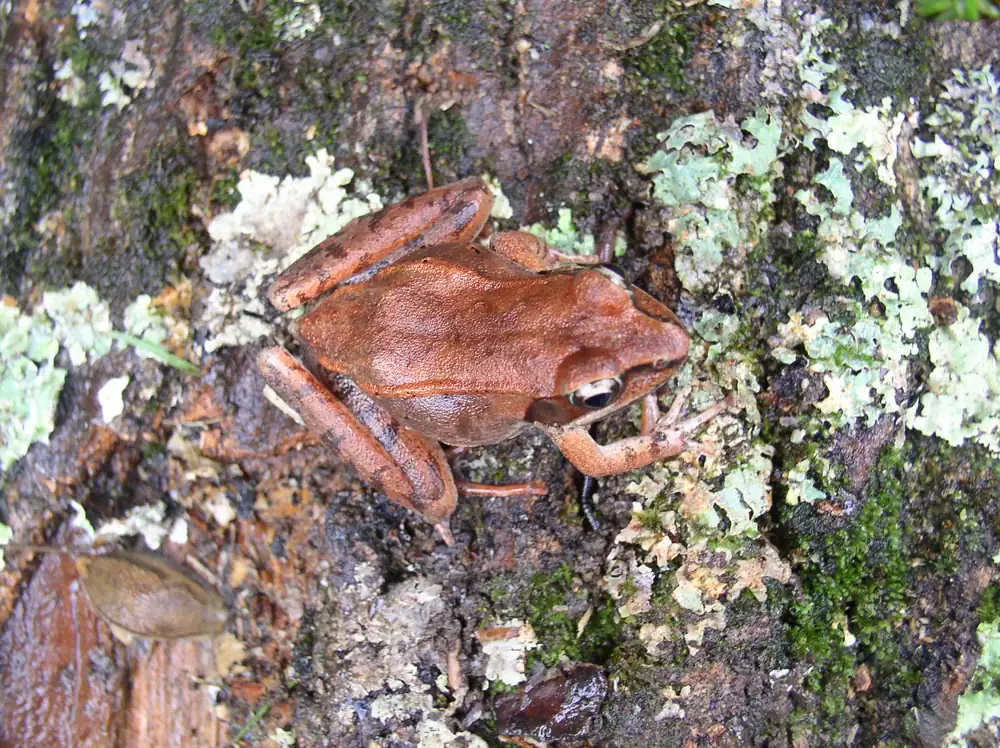
A wood frog is a brown frog about two and a half inches long with a dark mask like a raccoon’s. The Connecticut Wildlife Division describes the male’s call as sounding just like a quacking duck, and a pool full of them is a sudden roar of clucks and quacks. UConn’s writer notes that the animals carry antifreeze-like compounds that let them survive being frozen and thawed, which explains how they can be first out of all the amphibians. Their chorus is short, about ten days, before the peepers drown it out.
-
Spring peepers
Roughly ten days after the wood frogs begin · The same pools and wetlands, in the evening
The peeper is a tiny frog with a loud, rising whistle, and the sound of a whole marsh calling is one of the surest signs that warm spring nights are close. The UConn account treats it as the guarantee that the season has turned. Stand still near water at dusk on a mild evening and wait out the first silence: the frogs stop when they sense you, and start again within a few minutes.
-
Spotted salamanders
The first warm, rainy night in late March, and into April · Forests around vernal pools, crossing roads to reach them
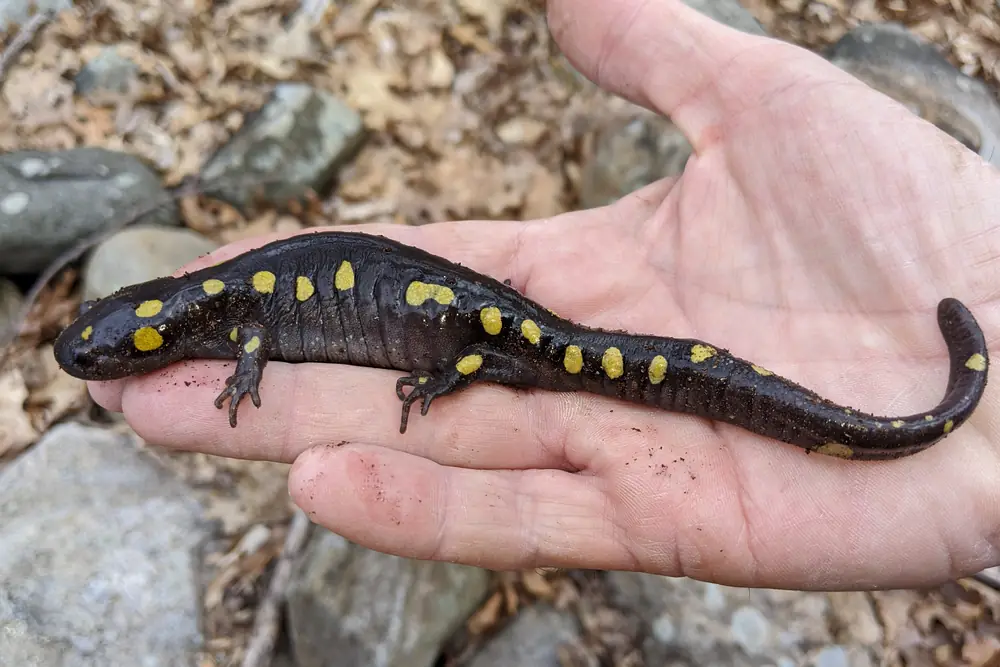
A black salamander with yellow spots, spending most of its life underground, comes out only on rainy nights. According to the state’s species account, the males arrive at the pool first and leave packets of sperm on submerged plants; the females follow on the next rainy night and attach about a hundred eggs to sticks, forming a fist-sized, jelly-like mass that hatches in roughly 30 days. The Wildlife Division adds that the animals need a forested buffer, ideally 500 feet or more, around the pool, and that they are declining because of habitat loss and road deaths.
-
Other salamanders and the vernal pool itself
Very early spring for Jefferson salamanders; fall for marbled salamanders · Vernal pools, which fill in winter and dry out in summer
A vernal pool is a low spot that fills with water and dries up again within a few months, which keeps fish out and protects the eggs. The Colebrook Land Conservancy describes twelve salamander species in the state, among them the Jefferson salamander, which breeds in very early spring, and the marbled salamander, which breeds in fall. Look, don’t touch: skin oils and sunscreen harm amphibians.
-
Crossing the road
Any rainy night above freezing in March and April · Roads between woods and pools, especially near wetlands
The Sierra Club’s Connecticut chapter points out that large numbers of animals cross roads on these nights and urges drivers to slow down in wet spring weather; it also asks people to learn where vernal pools are near them and speak up for them. If you stop to move an amphibian, carry it across in the direction it was heading, with wet hands, and pull completely off the road first.
For the plain dates of the season, keep a note: the first night you hear a wood frog is a good thing to write on the daily field log, as is the night peepers take over. See also our February guide for what comes before the frogs.
Which birds return to Connecticut in March, and where can you see the woodcock’s sky dance?
The returns come in a stream, starting with the hardy early birds and thickening by the end of the month. The U.S. Fish and Wildlife Service lists big numbers of robins feeding on open ground as a harbinger of spring, and the woodcock as a bird that risks harsh weather to claim the best breeding ground. In Connecticut, a few of the first arrivals are worth planning around.
-
American woodcock
Arriving mid-March to early April; displays at dusk · Old fields, pasture edges, young brush and alder swales
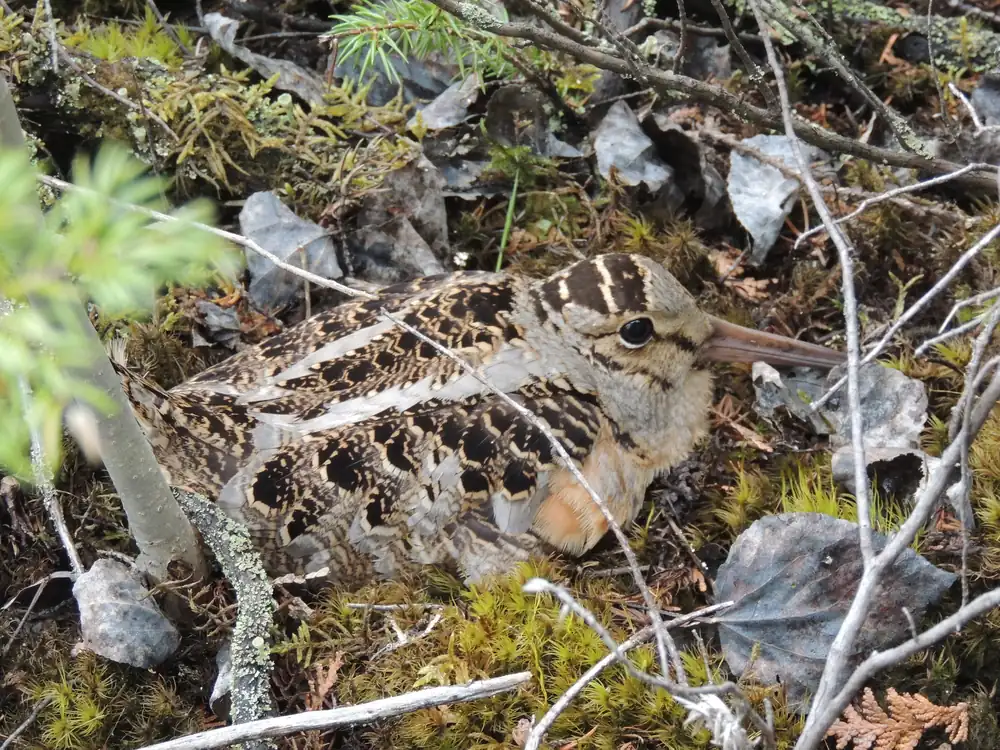
DEEP says woodcock start north in late winter, and that arrival in the Northeast runs from mid-March into early April, when courtship and breeding begin. At dusk, in a forest opening, the male calls from the ground, rises in a spiral, then drops: 10 to 20 displays in an evening that lasts 30 to 60 minutes. Its preferred stage is open ground with scattered brush, small trees and shrubs, sometimes a grazed pasture. Nesting follows in April and May on young hardwood ground nearby. Bring a flashlight you will not use, wear dark clothes, and stand at the edge of the habitat rather than in the middle. Ask nature centers and bird clubs about guided evening walks.
-
Eastern phoebe
Among the first songbirds back, from March · Bridges, barns, porches and woodland streams
Connecticut Audubon calls the Eastern Phoebe one of the earliest songbirds to return and the only flycatcher in the state in March and April. It wags its tail, has a two-part rough whistle, and builds nests on small ledges under overhangs and bridges. A few spend the winter near unfrozen water. The first brood is often lost to cowbird parasitism, and the pair usually raises a second.
-
Ospreys
From late March into early April · Coastal marshes, estuaries and rivers, on poles and platforms
DEEP says ospreys come back from their southern wintering grounds in late March, and Connecticut Audubon says they arrive from March into early April. Egg laying, usually three eggs, comes in April. The state notes that the population fell to just nine active nests in 1974 before recovering; the Audubon account credits the DDT ban of 1972 and now warns about discarded fishing line. Keep at least 300 feet from a nest during the breeding season: state and federal law prohibit disturbing it.
-
Eastern bluebirds
Pairs form in March; boxes are cleaned in March · Open yards, fields and golf courses with nest boxes
Bluebirds winter in flocks in woods and swamps, feeding on berries, and split into pairs in spring. Connecticut Audubon advises cleaning nest boxes in March rather than earlier, because mice may be using them in winter, and warns that European house sparrows are the main threat to bluebirds. The Audubon page names Bafflin Sanctuary in Pomfret, Deer Pond Farm in Sherman and Smith Richardson Preserve in Westport as places to find them.
-
Great horned owls on the nest
By late March, downy heads show above the nest rim · Old stick nests in woodlots, swamps, orchards and suburbs
Great horned owls start nesting while snow is still on the ground. Connecticut Audubon notes that you may see the downy heads of chicks over the edge of their stick nests by late March, and asks watchers to give the birds space and not to post exact locations, so crowds do not stress them.
-
Peregrine falcons
Pairs hold territories by late March; eggs late April and May · City buildings and cliffs, including Hartford
The state wildlife account says peregrines establish territories by late March and lay their eggs in late April and May. The best-known nesting site is the Travelers Tower in Hartford, where peregrines nested again in 1997 after about half a century. Volunteers and Wildlife Division staff monitor sites each year.
The Journey North program lets you report sightings of migrating species and see the maps of others’ reports; its site is a good way to see how your date compares with other places.
What is happening on the Connecticut shore and river in March?
The coast is in transition: winter seals and sea ducks are still in the Sound, bald eagles are on their nests along the rivers, and the first piping plovers are returning to the beaches that will be fenced for them.
-
Piping plovers
Arriving late March; eggs by late April · Sandy beaches such as Milford Point
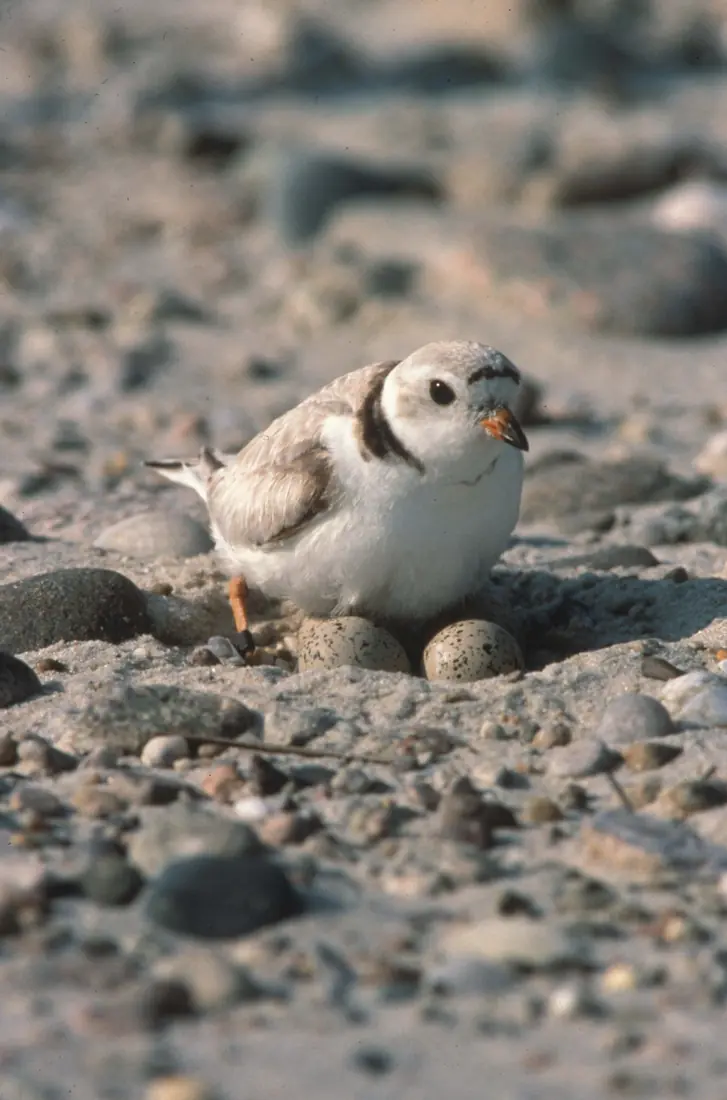
DEEP says these small shorebirds arrive at Connecticut beaches in late March to nest, and lay four eggs in a shallow scrape in the sand by late April; the eggs hatch in about 27 days. The state marks nesting areas with wooden stakes and twine and, on some beaches, wire cages around nests. In 2024, Connecticut Audubon reported, 16 pairs at Milford Point, the most successful of roughly 17 Connecticut breeding beaches, fledged a record 33 chicks. The state prohibits dogs on beaches in the breeding season, and kites and drones near nesting areas, since the birds read them as hawks.
-
Seals on the Sound
Winter cruises in 2026 ran January 10 through March · Long Island Sound, from Norwalk
The Maritime Aquarium at Norwalk ran its seal-spotting and birding cruises on most weekends from January 10 through March in 2026, looking for harbor and gray seals as well as buffleheads, mergansers, long-tailed ducks and loons; departure times followed the tides. The aquarium had not announced 2027 cruises when we checked, so look for its schedule before you plan. NOAA Fisheries advises staying at least 50 yards from seals and watching for 30 minutes or less, since the Marine Mammal Protection Act covers every harbor seal.
-
Bald eagles at the nest
Egg laying in February and March; Shepaug season ran December 21 to March 15 in 2025-26 · Lower Connecticut River, the Shepaug Dam in Southbury and nest sites across the state
DEEP states that Connecticut’s bald eagle breeding season begins in January and most pairs lay in February and March; incubation lasts about 35 days, and the young are flying at about 12 weeks. Disturbance can make a pair abandon a nest, even one with eggs, so watch from a distance. FirstLight’s free Shepaug observatory in Southbury, open Wednesdays, Saturdays and Sundays by reservation in the 2025-26 season, ran until March 15; call 860-895-6468 to confirm that the viewing area is open. The Connecticut River Museum’s RiverQuest eagle cruises ran February 13 to March 18 in 2026 for passengers 10 and older. Neither organization had posted 2027 dates when we looked.
Which Connecticut mammals wake up in March?
Three animals that are asleep or hidden in February are on the move by the end of March, and one of them is not a good neighbor for a bird feeder.
-
Woodchucks
Emerging during March · Fields, hedgerows and roadsides across the state
The state wildlife account says woodchucks come out of hibernation slowly during March, with males first, in search of mates. Young are born in April or May, two to six to a litter, blind and hairless. They are weaned and foraging at five to six weeks.
-
Black bears
Leaving dens from mid-March, and sometimes earlier in a mild winter · Mostly the northwest quarter of the state, spreading east
DEEP says bears den from late November to mid-March and emerge in March and April, and that males can become active earlier in mild winters. The state estimates about 1,200 resident bears, mostly in the northwest quarter but expanding eastward. Cubs are born in the den in late December or early January and stay with their mother until their second spring. DEEP advises skipping bird feeders altogether where bears are regular visitors, and treats December through February as the feeder window elsewhere, so March is the time to bring them in.
-
Red fox kits
Born in March and April · Burrows, often reused woodchuck holes, and crawl spaces under decks and sheds
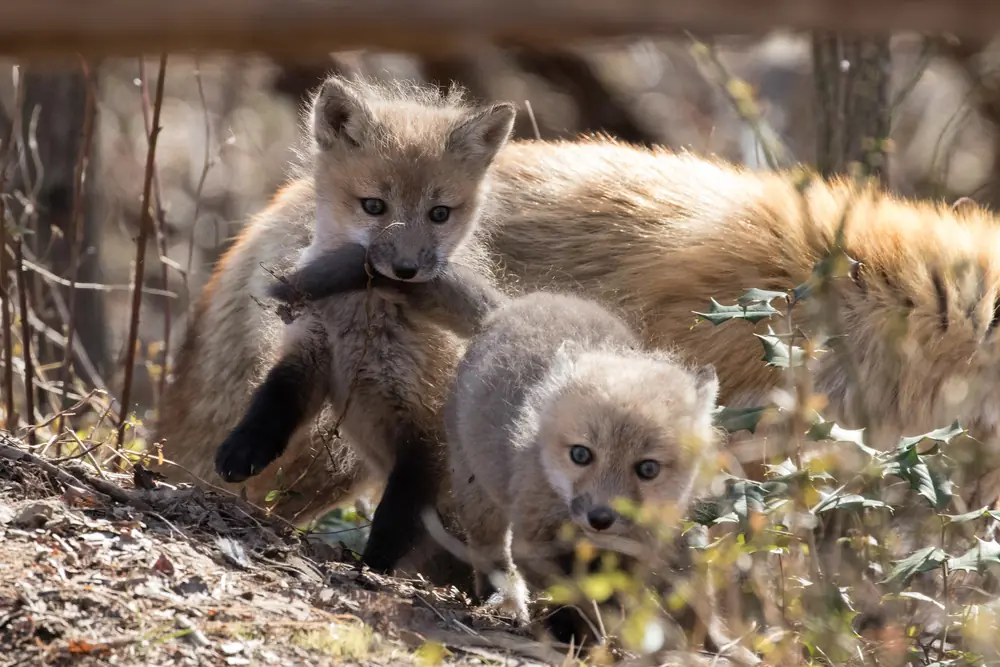
The breeding season of the red fox runs from January through March, and after 51 to 53 days of pregnancy the female bears a litter averaging four or five pups. The young stay underground for four to five weeks before coming out to play at the den entrance, and both parents bring food. DEEP says a den near a house can be discouraged by closing off crawl spaces in spring, and that young foxes can catch sarcoptic mange, a mite infection.
A fox kit or a baby woodchuck at a den entrance is almost never abandoned; its parent is nearby. Leave the area quietly.
What blooms in Connecticut in March?
Very little, compared with April, and the earliest bloomers are modest. If February was the month of the skunk cabbage (see our February guide), March adds the first catkins, the red haze of swelling maple buds and one yellow flower that is better admired than planted.
-
Pussy willow
Late winter into early spring, before the leaves · Wet meadows, stream and pond margins, swamps
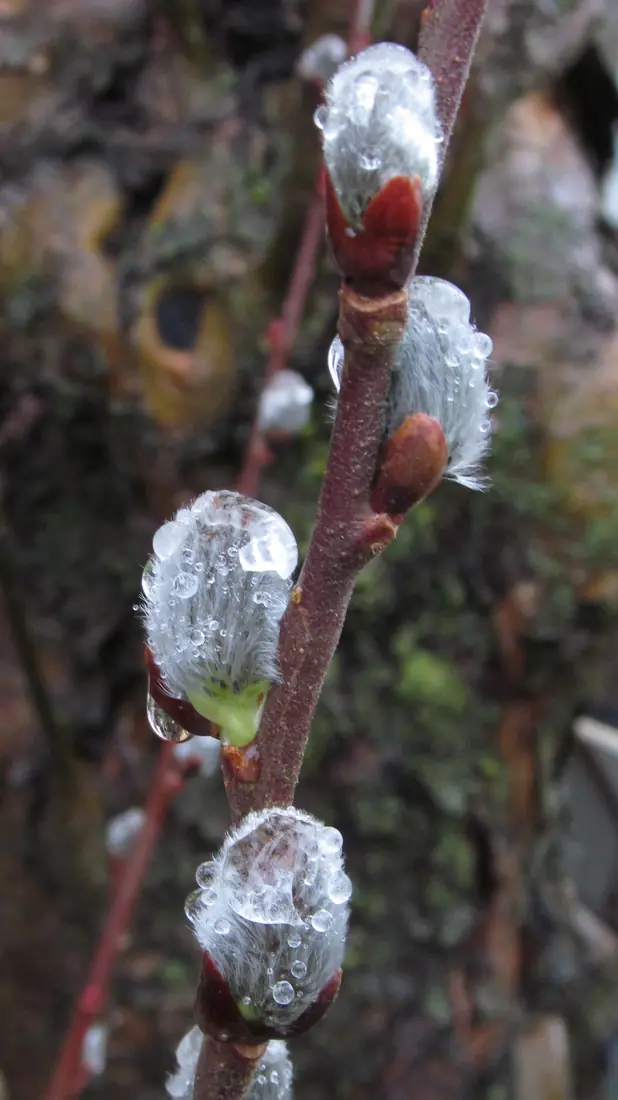
The Native Plant Trust describes male pussy willows bearing silver, velvety, upright catkins on leafless stems, and notes that the shrub blooms before its leaves develop. It grows in meadows and at the edges of lakes, rivers and wetlands. The shrub is brittle and hard to grow, and only male plants bear the showy catkins.
-
Red maple buds
Buds swell and redden as the weather warms · Swamps, wetland edges and forests statewide
The Native Plant Trust says red maple grows largest in and near swamps, and that its reddish buds swell in spring, as its red leaf stalks and fall color follow later. From a distance, a wetland full of red maples takes on a faint red cast before any green appears.
-
Coltsfoot
Flowers appear before the leaves · Roadsides, stream banks, trail edges and disturbed ground
Coltsfoot produces yellow, dandelion-like flower heads on separate stalks before its heart-shaped leaves appear. Brought from Europe as a medicinal plant, it is listed by the Native Plant Trust as invasive and prohibited in Connecticut. Enjoy it, photograph it, and do not dig it up or plant it.
How much daylight does Connecticut gain in March, and when do the clocks change?
Day length climbs by about 2.8 minutes a day through the month (see the table), and the March equinox arrives that Saturday, the 20th, at 4:25 p.m. EDT (U.S. Naval Observatory). Then the clocks jump: under federal law they move ahead at 2 a.m. local time on the second Sunday of March, which falls on the 14th in 2027. All clock times below carry their zone.
| City | Mar 1 | Mar 31 | Gained | Per day |
|---|---|---|---|---|
| Torrington | 11 h 15 m | 12 h 40 m | 85 min | 2.8 min |
| Hartford | 11 h 15 m | 12 h 39 m | 84 min | 2.8 min |
| Putnam | 11 h 15 m | 12 h 40 m | 85 min | 2.8 min |
| Waterbury | 11 h 16 m | 12 h 39 m | 83 min | 2.8 min |
| Danbury | 11 h 15 m | 12 h 39 m | 84 min | 2.8 min |
| New London | 11 h 16 m | 12 h 39 m | 83 min | 2.8 min |
| New Haven | 11 h 16 m | 12 h 39 m | 83 min | 2.8 min |
| Stamford | 11 h 16 m | 12 h 39 m | 83 min | 2.8 min |
In Hartford, the sun rises at 6:06 a.m. EST and sets at 5:55 p.m. EST on Saturday, March 13. The next morning, after the clocks jump, it rises at 7:05 a.m. EDT and sets at 6:56 p.m. EDT. On March 21 the clock reads 6:53 a.m. for sunrise and 7:04 p.m. for sunset, both EDT. Any statement such as “the sun sets after 7” holds only from the 14th on, and only because of the clock change. The same jump pushes the morning the other way: sunrise goes from 6:06 a.m. on the 13th to 7:05 a.m. on the 14th, so early commutes are dark again. See the daylight page for other dates.
When is the last spring freeze in Connecticut?
Later than the first warm day suggests. At the main weather stations in the state, the median last freeze falls between early April on the shore and early May in the hills, and at the station with the earliest dates, Bridgeport, only one spring in ten has its last freeze before March 25. A warm week in March is a tease, because buds and early insects are still exposed to the next hard freeze.
| Station | One year in ten | Median | Nine years in ten |
|---|---|---|---|
| Hartford | Apr 8 | Apr 21 | May 6 |
| Danbury | Apr 7 | Apr 20 | May 6 |
| New Haven | Apr 2 | Apr 17 | May 1 |
| Stamford | Apr 3 | Apr 17 | May 2 |
Bridgeport’s median last freeze is April 5, Hartford Bradley’s April 21 and Norfolk’s May 3, a month apart within one small state. For other towns, see the Connecticut frost dates page. Gardeners often wait for the nine-in-ten date before setting out tender plants.
How cold and snowy is March in Connecticut, and what weather should you watch?
March is still a winter month in the hills and a cool one on the shore. At Hartford’s Bradley airport the 1991–2020 normals from NOAA give March an average high of 47.3 °F and a low of 28.2 °F, and the month averages 9.4 inches of snow; up at Norfolk the high is 40.4 °F and snow averages 14.9 inches. Bridgeport on the coast has a high of 47.4 °F, a low of 32.3 °F and 7.0 inches.
| Station | Average high | Average low | Precipitation | March snowfall | April snowfall |
|---|---|---|---|---|---|
| Norfolk 2 SW (Northwest Hills) | 40.4 °F | 22.8 °F | 4.21 in | 14.9 in | 3.9 in |
| W Thompson Lake (Quiet Corner) | 45.5 °F | 24.4 °F | 4.45 in | 7.2 in | 1.5 in |
| Hartford Bradley International Airport (Windsor Locks) | 47.3 °F | 28.2 °F | 3.81 in | 9.4 in | 1.1 in |
| Storrs (Mansfield) | 44.8 °F | 27.8 °F | 4.38 in | 6.3 in | 1.7 in |
| Danbury Municipal Airport (western hills) | 46.7 °F | 27.2 °F | 3.89 in | no normal | no normal |
| Norwich Public Utility Plant (southeast) | 47.8 °F | 29.4 °F | 5.09 in | 5.0 in | 0.8 in |
| New Haven Tweed Airport (central shoreline) | 47.0 °F | 30.1 °F | 3.66 in | no normal | no normal |
| Bridgeport Sikorsky Memorial Airport (Stratford) | 47.4 °F | 32.3 °F | 4.09 in | 7.0 in | 0.9 in |
Snow normals in the table run from 5.0 inches at Norwich to 14.9 at Norfolk, and Norwich is also the wettest station at 5.09 inches of precipitation. Watch for three things. The first is a coastal storm: NOAA’s state climate summary notes that Connecticut’s position makes it vulnerable to nor’easters and winter storms. The second is brush fire, since DEEP puts the spring season from mid-March to mid-May, and municipal burn permits are suspended automatically when the Daily Forest Fire Danger Index is High, Very High or Extreme. The third is a hard freeze after a warm spell. The federal Climate Prediction Center issues its three-month outlook around the middle of each month; you can see the latest maps on its seasonal outlook page. For the next several days, use our weather page.
What can you see in Connecticut’s night sky in March 2027?
The Worm Moon, the equinox and a pair of bright evening planets, with Mercury and Venus in the dawn. There is no eclipse or major meteor shower this month. Times are Eastern Standard Time for the March 8 new moon and Eastern Daylight Time after the clocks change on March 14.
-
The Worm Moon, full at dawn on March 22
Full at 6:44 a.m. EDT, Monday, March 22 · Rising in the east on the evening of Sunday, March 21
March’s full moon is called the Worm Moon, a name the astronomy calendar at Sea and Sky ties to the softening of the ground and the return of earthworms. Full arrives before sunrise on the 22nd, so the best moonrise to watch is the 21st, with the 22nd nearly as good. In Hartford the moon rises at 6:31 p.m. on the 21st, thirty-three minutes before the 7:04 p.m. sunset, and is 99 percent lit.
-
Jupiter, Mars and the Moon in the evening
The Moon is closest to Jupiter on March 19; Mars passes Jupiter on March 30 to 31 · High in the east to southeast after dark, in Leo
Jupiter, which was opposite the Sun in February, shines around magnitude minus 2.5 early in the month, in Leo. Look for the Moon beside it after dark on March 18 and again on the 19th; Espenak’s almanac lists their conjunction, with the Moon 0.9 degrees from Jupiter, at 12:31 a.m. EDT on the 19th, so the evenings either side are the ones to watch. A few nights later, Mars, fainter and orange, stands about four degrees from Jupiter at about 2 a.m. EDT on the 31st, which makes the evening of March 30 the one to watch. Both set close to daybreak on March 1 and a little earlier each night after that.
-
Mercury and Venus before sunrise
Mercury is farthest from the Sun on Wednesday, March 17 · Low in the east and east-southeast before sunrise
Mercury’s best morning showing peaks on Wednesday, March 17, when it is 27.6 degrees from the Sun (both Sea and Sky and Espenak list this). It is a morning object, visible best in the days around the elongation, and rises roughly an hour before the sun early in the month. A morning look in spring is shallow at this latitude, so find a clear eastern horizon and use binoculars. Venus, far brighter, rises well before Mercury and holds the morning sky all month. After the clock change on the 14th, “before sunrise” means a later clock time, so the same view shifts from about 5 a.m. to about 6 a.m. on the clock.
| Phase | Date | Time |
|---|---|---|
| New moon | Monday, Mar 8 | 4:29 a.m. EST |
| First quarter | Monday, Mar 15 | 12:25 p.m. EDT |
| Full moon, the Worm Moon | Monday, Mar 22 | 6:44 a.m. EDT |
| Last quarter | Monday, Mar 29 | 8:54 p.m. EDT |
The moon phases page has the full cycle, and the clouds page helps with sky-watching forecasts.
What can families do outdoors in Connecticut in March?
- Wednesday, March 3: Stratford Shore and Great Meadows. The New Haven Bird Club’s monthly Wednesday outing, led by Frank Mantlik, 8 to 11 a.m., meeting at 60 Access Road, Frash Pond, in Stratford.
- Sunday, March 14: clocks spring forward. Clocks go ahead at 2 a.m., which hands you an extra hour of evening light for an after-dinner walk.
- March 20 and 21, Saturday and Sunday: Maple Weekend. Sugarhouses across the state open for tours and sales; call ahead.
- Saturday, March 20: equinox. It arrives at 4:25 p.m. EDT, so there is time for a walk beforehand.
- Sunday, March 21: Cheshire Hotspots. A New Haven Bird Club field trip led by Melissa Baston, 8 to 11 a.m., starting at 894 South Meriden Road. That evening, watch the Worm Moon rise at about 6:31 p.m. in Hartford.
- Saturday, March 27: Edgewood Park, New Haven. A club field trip led by DeWitt Allen, 8 to 11 a.m.; the club also lists a virtual-only talk on Thursday, March 11, at 7 p.m.
- Any mild rainy night: a vernal pool visit. Go with a flashlight, stay on the edge and leave the animals alone.
- Citizen science. Report migrants to Journey North, add records to the state wildlife division’s Discover Outdoor Connecticut project on iNaturalist, and, if you have a martin house or a chimney, ask DEEP about its purple martin colony and chimney swift programs. Connecticut-registered vehicles enter state parks and forests with no parking fee through Passport to the Parks.
These listings come from each organizer’s own site as of October 7, 2026. Field trips shift with the weather, so confirm the day before.
A word on fishing, for a different kind of family trip. from March 1 until 6 a.m. on the second Saturday of April, trout fishing in rivers and streams is catch and release only, outside tidal and sea-run waters, according to DEEP. By that rule, harvest opens April 10, 2027, and a minimum length of 9 inches applied under the regulations that took effect January 1, 2026. Rules are revised, so read the current ones before you go. DEEP lists Trout Parks, among them Kent Falls State Park, Macedonia Brook, Wolfe Park in Monroe and the Natchaug River in Eastford, which are stocked about every 10 days in spring. Trout Management Areas carry their own rules, so read the entry for the exact water before you fish.
Safety notes for March in Connecticut
- Hunting seasons that overlap March. Spring turkey hunting begins after March (in 2026 it ran April 29 to May 30; the 2027 dates are not yet published). Crow hunting is allowed Monday through Saturday until March 20, 2027, and the snow goose season in the 2026–27 migratory bird guide runs February 16 to March 10. Hunting of migratory birds, including crows and geese, is banned on Sundays. In the 2026 guide, coyote hunting has no closed season and woodchuck hunting began March 15; confirm 2027 dates on DEEP’s site when the new guide appears.
- Blaze orange. The fluorescent orange requirement of 400 square inches above the waist applies from September 1 through February 28, so March has no general requirement. Turkey hunters are exempt, as are crow hunters in a stationary position. Hikers still do well to wear a bright hat or vest where hunters may be out.
- Trapping. In the 2026 guide, most furbearer seasons ended March 15 and the beaver season ended March 31. Keep dogs leashed near wetlands and stream edges until the end of the month, and check the 2027 guide for this year’s dates.
- Ticks. The Centers for Disease Control and Prevention notes that adult blacklegged ticks may be out looking for a host any time winter temperatures are above freezing. The Connecticut Agricultural Experiment Station’s 2024 surveillance found Lyme bacteria in 54 percent of adult and 23 percent of nymph blacklegged ticks it tested, and it recommends staying on trails, wearing light-colored long sleeves and pants, tucking pants into socks and checking yourself after being outdoors.
- Brush fires. DEEP says spring brush fire season runs from mid-March to mid-May and the large majority of fires start from human actions such as debris burning and unattended campfires. In 2024, it reported, Connecticut had 605 wildfires covering 510 acres. Check the daily Forest Fire Danger Report before burning; keep flammable debris at least 30 feet from your house, never leave a fire unattended and put ashes in a metal bucket of water.
- Thin ice. DEEP’s guidance sets the safe minimum for one person on foot at four inches of newly formed clear ice, and warns that thick but old, partly melted ice can fail anyway; snow on top adds load. In March, treat all ice as suspect. If someone breaks through, reach or throw a line and call 911 instead of going in after them.
- Bears. Bears are waking. Take down feeders in bear country, keep garbage and grills shut up and stay clear of a bear that seems dazed or unresponsive; DEEP notes that breeding males in the following months may act strangely.
- Roads on rainy nights. Amphibians cross in large numbers, and so do skunks and turtles later on. Slow down on wet back roads.
- Nests and young. Stay 300 feet from osprey nests, give eagle nests plenty of room, keep dogs out of fenced plover areas on the beach and at least 50 yards from seals, and do not post the locations of owl nests.
- High, cold water. March streams run high and cold from rain and snowmelt, and banks are soft and undercut. Keep back from the edge and watch children near brooks and ponds.
Sources (60)
- Maple Syrup Producers Association of Connecticut: Maple Weekend 2027 (March 20 and 21, 2027)
- Maple Syrup Producers Association of Connecticut: how do you make maple syrup? (season timing, sugar content, tree size)
- Maple Syrup Producers Association of Connecticut: sugarhouses open to the public (map and call-ahead note)
- Maple Syrup Producers Association of Connecticut: Flanders Nature Center sugarhouse demonstrations (2024 schedule)
- Connecticut Department of Agriculture: maple sugaring season kicks off (taps, syrup output, sap sugar)
- UConn Climate System Research Center: Of witch hazel and wood frogs (March 28, 2013)
- CT DEEP, Connecticut Wildlife, March/April 2000: Vernal pools, now you see them, now you don’t (PDF; wood frog call, first warm rainy night)
- CT DEEP: spotted salamander fact sheet (migration, egg masses, forest buffer)
- Colebrook Land Conservancy: A who’s who of Connecticut salamanders
- Sierra Club Connecticut Chapter: vernal pools and amphibians
- CT DEEP: American woodcock fact sheet (arrival, singing grounds, nesting)
- U.S. Fish and Wildlife Service: birds that offer early signs of spring
- Connecticut Audubon Society: Daily bird, eastern phoebe
- Connecticut Audubon Society: Daily bird, osprey
- CT DEEP: osprey fact sheet (return, eggs, 300-foot distance)
- Connecticut Audubon Society: Daily bird, eastern bluebird
- Connecticut Audubon Society: Daily bird, great horned owl
- CT DEEP: peregrine falcon fact sheet
- CT DEEP: purple martin fact sheet
- Journey North: spring migration citizen science
- CT DEEP: piping plover fact sheet (arrival, fencing, dogs and drones)
- Connecticut Public: good news about a federally threatened shorebird along Connecticut’s coast (November 8, 2024)
- Connecticut Audubon Center at Pomfret: Bafflin Sanctuary
- Maritime Aquarium at Norwalk: seal-spotting and birding cruises (2026 season)
- NOAA Fisheries: harbor seal (viewing distance, Marine Mammal Protection Act)
- CT DEEP: bald eagle fact sheet (egg laying, incubation, disturbance)
- FirstLight: Shepaug Recreational Area and Bald Eagle Observatory (2025-26 season)
- Connecticut River Museum, RiverQuest: Winter Wildlife Eagle Cruises (2026 season)
- CT DEEP: woodchuck fact sheet (emergence, mating, young)
- CT DEEP: black bear fact sheet (denning, emergence, feeders, population)
- CT DEEP: red fox fact sheet (breeding, pups, dens, mange)
- Native Plant Trust, Go Botany: Salix discolor (pussy willow)
- Native Plant Trust, Go Botany: Acer rubrum (red maple)
- Native Plant Trust, Go Botany: Tussilago farfara (coltsfoot)
- NOAA NCEI: U.S. climate normals 1991–2020, monthly, Connecticut stations
- NOAA NCEI: about the U.S. climate normals (1991–2020)
- NOAA and partners: State climate summary for Connecticut
- Climate Prediction Center: seasonal (90-day) outlooks
- CT DEEP: spring brush fire season news release (2025)
- U.S. Naval Observatory: moon phases from March 1, 2027
- U.S. Naval Observatory: sunrise and sunset, Hartford, March 13, 2027 (standard time)
- U.S. Naval Observatory: sunrise and sunset, Hartford, March 14, 2027 (daylight time)
- U.S. Naval Observatory: sun and moon rise and set, Hartford, March 21, 2027
- U.S. Naval Observatory: Earth’s seasons, 2027 (March equinox)
- Sea and Sky: astronomy calendar 2027 (Worm Moon, Mercury elongation, equinox)
- Fred Espenak: Sky Event Almanac 2027 (Mercury, Moon and Jupiter, Mars)
- 15 U.S.C. 260a: daylight saving time (begins second Sunday in March)
- New Haven Bird Club: events calendar, March 2027
- CT DEEP: community science and volunteer opportunities, Wildlife Division
- CT DEEP: Passport to the Parks
- CT DEEP: river and stream trout regulations (catch and release until the second Saturday of April)
- CT DEEP: Trout Parks (stocking every 10 days or so in spring)
- CT DEEP: hunting season date summary from the 2026 Connecticut Hunting and Trapping Guide (PDF)
- CT DEEP: August 2026 to March 2027 Migratory Bird Hunting Guide (PDF; crow and snow goose seasons)
- CT DEEP: 2026 hunting laws and regulations (fluorescent orange, Sunday hunting)
- CT DEEP: 2026 furbearer trapping seasons
- CT DEEP: ice safety
- Connecticut Agricultural Experiment Station: 2024 statewide tick surveillance results (press release, March 24, 2025)
- Centers for Disease Control and Prevention: where ticks live
- Photos via Wikimedia Commons; licenses and photographers are credited under each picture