What to look for in nature in Connecticut this February
Connecticut’s February closes out the three months that forecasters count as winter, and it is when the season begins to fray. The first warm afternoons after hard-frozen nights set maple sap dripping into buckets, the earliest wildflower of the year pushes up through the swamp ice, and noisy flocks of red-winged blackbirds and grackles drift back up the river valleys. Bald eagles are still crowded onto the open water of the lower Connecticut River while the state’s own pairs settle onto eggs, and the evenings stay light past half past five by the end of the month. This guide follows those changes across the state, week by week.
Other months in Connecticut: October, November, December, January.
Start here
- Count birds for a long weekend. Over Presidents’ Day weekend, February 12 to 15, people everywhere tally birds for the Great Backyard Bird Count. A single quarter hour of watching, from a kitchen window or a park bench, counts.
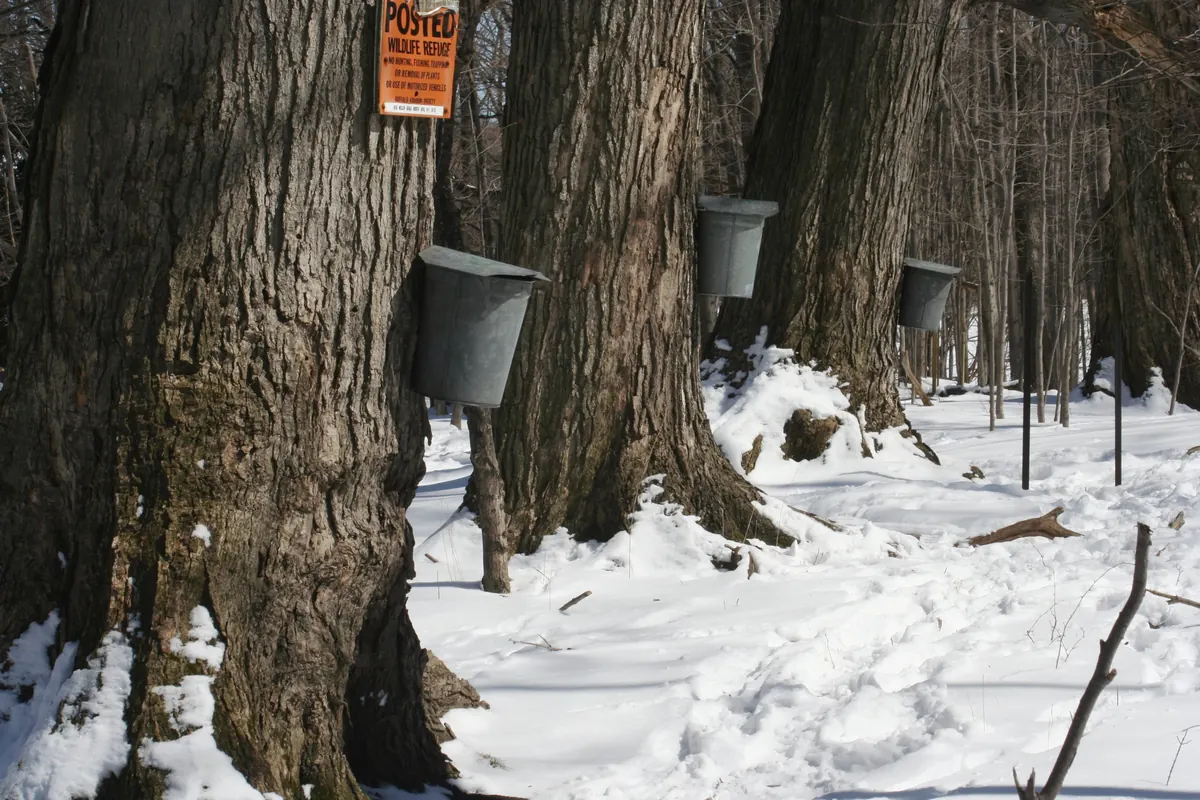
- Watch a sap bucket fill. Connecticut’s sugaring season usually opens in February, whenever freezing nights meet days above freezing. Nature centers and farm sugarhouses boil on weekends from late in the month; check the producers’ association map.
- Find Jupiter and Mars at their best. Jupiter is opposite the sun on the evening of Wednesday, February 10, and Mars follows on the 19th. Both rise in the east around sunset and shine all night in Leo.
February fills the Naturalist’s Field Journal with first signs. Every species from your count weekend goes on “birds I have seen,” and the date you hear the first red-winged blackbird belongs on the daily field log. A sugar maple with a tap in it is a natural page for “a tree through the seasons”; a skunk cabbage hood melting through the snow is worth a sketch on “reading the signs”; and the drumming woodpeckers and singing cardinals of a still morning fill “a map of sounds.” Note on “dusk and dawn watch” the first evening the sun sets after 5:30.
Regions used below: Northwest Hills and Litchfield County; Hartford and the Connecticut River Valley; The Quiet Corner (northeast); Fairfield County and the southwest; New Haven and the central shoreline; Southeast and the lower Connecticut River.
When does maple sugaring season start in Connecticut?
Usually in February. The Connecticut Department of Agriculture and the Maple Syrup Producers Association of Connecticut both put the traditional season at early February to late March, with the exact start left to the weather. Sap only runs when a night well below freezing is followed by a sunny day above it, so a cold snap can stall the season and a mild spell can open it early.
-
The first sap runs
From early February in a typical year, through late March · Sugar maple stands statewide, most on cool, deep-soiled slopes in the hills
On a freeze-thaw day the sap that collects in a tap hole is clear and watery and only faintly sweet, about 2 percent sugar according to the state’s producers. Boiled down until it reaches 67 percent sugar, it becomes syrup, and the state agriculture department’s rule of thumb is 40 gallons of sap for every gallon of syrup. Producers say a tree needs to be about 11 inches across, roughly 40 years old, before it can be tapped safely. The season lasts six to eight weeks and ends when the nights stop freezing and the buds begin to swell, which turns the flavor off.
-
Sugarhouses with the steam rising
Boiling days in late February and March · Farm sugarhouses, nature centers and the UConn Forest in Storrs
Connecticut’s syrup makers range from backyard hobbyists with a few buckets to farms running thousands of taps on plastic tubing. When you see a plume of steam from a sugarhouse roof on a cold afternoon, they are boiling. UConn’s forestry students have run a wood-fired sugarhouse in the university forest for more than 30 years, tapping their sugar bush in late February. The producers’ association keeps a map of sugarhouses open to the public, and many sell syrup from the door; call ahead, since boiling depends on the sap.
-
Maple Weekend, the season’s open house
Saturday and Sunday, March 20 and 21, 2027 · Participating sugarhouses statewide
The producers’ association has already posted the dates of its 2027 Maple Weekend, when sugarhouses across the state open their doors for tours and tastings. It falls just after February ends, but the planning starts now: the association’s page lists each sugarhouse with its own hours.
You can watch for sap at home, too. On a sunny late-February afternoon after a hard frost, look for wet streaks or tiny icicles of frozen sap hanging under broken or pruned twigs of sugar and red maples.
Where can you see bald eagles on the Connecticut River in February?
The lower Connecticut River, from Haddam down to Old Saybrook, holds wintering bald eagles right up to early March, which is DEEP’s end date for the season when up to 100 of them winter in the state. February also brings a change of stage: the visitors from the north are still here, but Connecticut’s own pairs are laying eggs.
-
Winter wildlife eagle cruises from Essex
Usually mid-February to mid-March; Fridays, weekends and some Wednesdays · Departing the Connecticut River Museum, Essex, aboard RiverQuest
The Connecticut River Museum’s boat, RiverQuest, runs two-hour naturalist cruises on the lower river each late winter. With no leaves on the trees and almost no other boats about, eagles perched along the banks are easy to pick out, and the crew lists a record of 41 eagles on one trip, along with grebes, three kinds of mergansers, loons, swans, seals and the odd golden eagle. Last season’s cruises ran from February 13 to March 18, 2026; the 2027 schedule was not yet online in early October 2026, so check the museum’s RiverQuest pages before planning a trip. The cabin is heated but the views are on deck, and children under 10 are not booked on these trips.
-
Shepaug, in its final weeks
Wednesdays, Saturdays and Sundays in recent seasons, into mid-March · Housatonic River below the Shepaug Dam, Southbury
FirstLight’s free eagle observatory, covered in our January guide, has stayed open right through February in past winters; during 2025–26 the doors were open December 21 through March 15. The utility had not posted 2026–27 dates in early October, so check its page, book a free slot, and phone 860-895-6468 on doubtful-weather days.
-
Connecticut pairs on eggs
Most clutches laid in February and March · Big trees near rivers, reservoirs, lakes and the coast
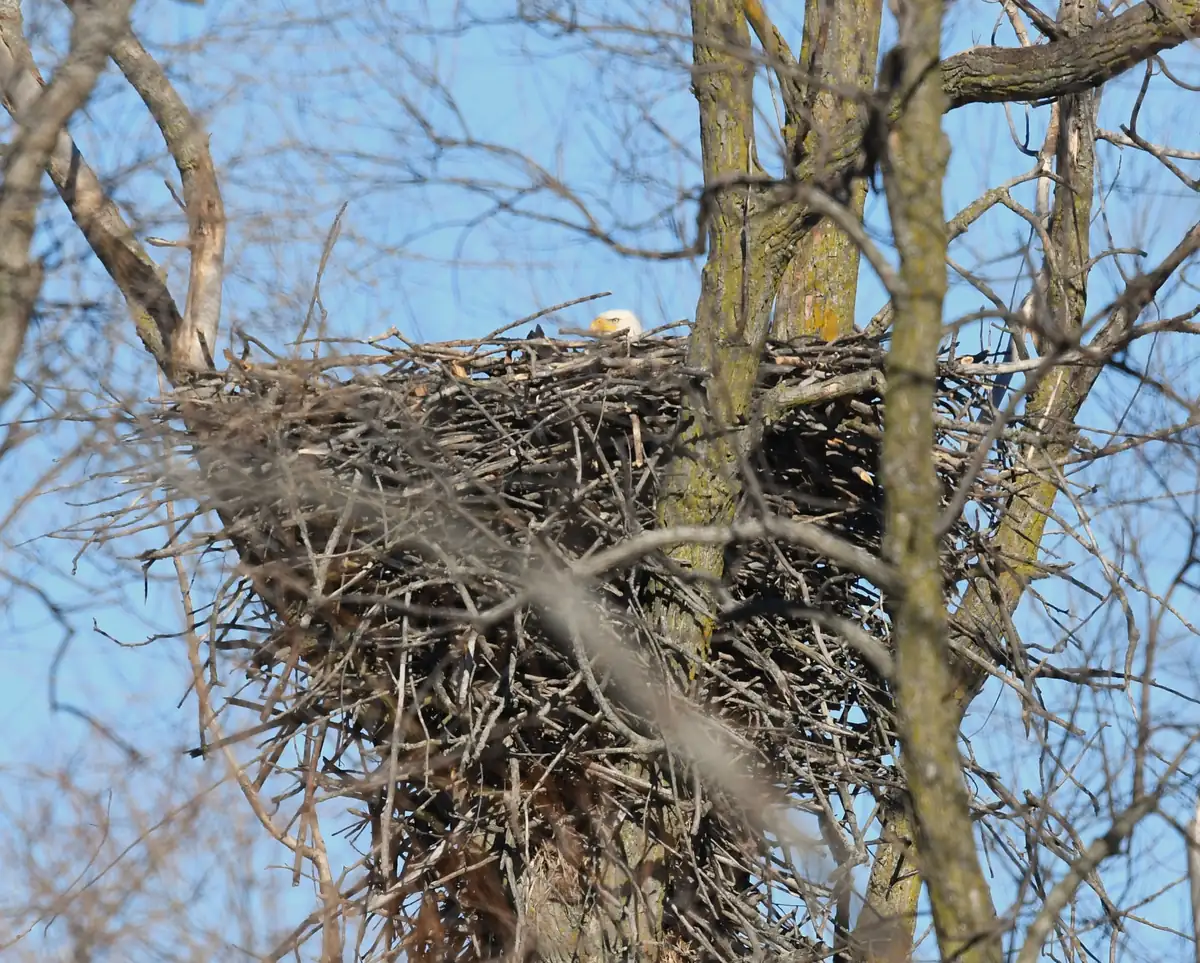
DEEP says most of the state’s pairs lay their eggs in February and March, usually two dull white eggs, sometimes one or three. Both adults take turns on the nest for about 35 days, so a nest that held a pair of birds standing on the rim in January may now show only a white head and a hooked bill just above the sticks. That low profile means the eggs are being kept warm, and DEEP warns that disturbance at a nest can cause the birds to abandon it, even with eggs inside. Watch from well away, from a car or across water, and leave if the bird stands up or calls.
Eagles from northern lakes start drifting back north as the ice breaks up, so a raw, frozen February often keeps them here longer than a mild one.
When do red-winged blackbirds come back to Connecticut?
In February, as long as the ground lets them. Red-winged blackbirds winter mostly to the south of Connecticut and are among the very first songbirds to come back, with the timing set partly by the weather: Connecticut Audubon notes that a solidly frozen landscape holds them back.
-
Blackbird flocks in the stubble fields
February into March, earlier in mild years · The coast and the big river valleys first, then open country statewide
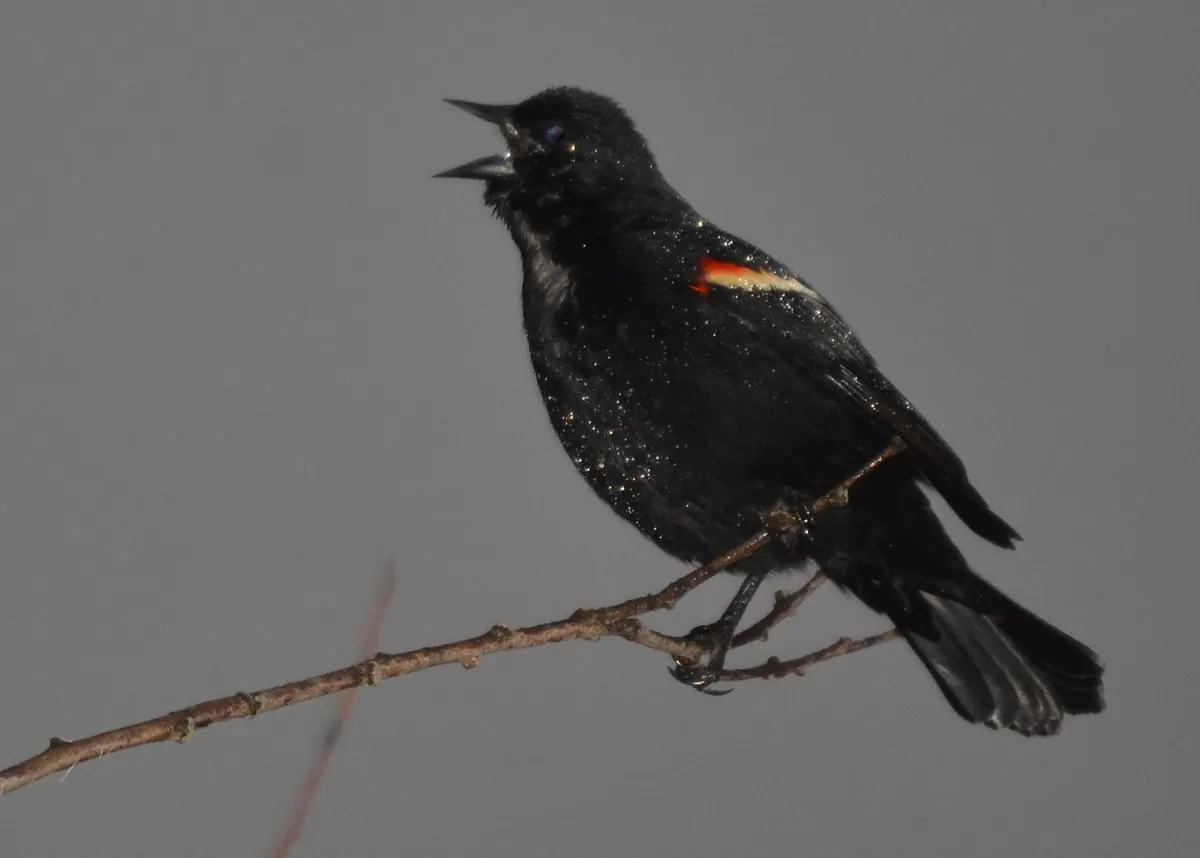
Connecticut Audubon counts the spread of blackbird flocks, sometimes huge ones, among the first noticeable signs of spring in February. They show up along the shore and the major valleys before fanning out across the state. Most are a mix of red-winged blackbirds, common grackles and brown-headed cowbirds, in proportions that change from flock to flock; corn stubble is a favorite feeding ground, with the birds resting in tall trees nearby. You often hear a flock before you see it, as a dull, distant din. Scan for the odd rusty blackbird in wooded swamps.
-
Hawks courting, woodpeckers drumming
Sunny days from midwinter on · Over fields and highway edges (hawks); woodlots and yards (woodpeckers)
The U.S. Fish and Wildlife Service lists red-tailed and red-shouldered hawks among the birds that begin courting and nest building in midwinter, with high circling flights, steep dives and screaming calls. Woodpeckers announce their territories by drumming on resonant dead limbs, gutters and even chimney flashing, a rapid rattle that carries across a quiet neighborhood on a February morning.
-
The first songs from the feeder birds
Calm, bright mornings · Backyards, parks and woodland edges
Northern cardinals, black-capped chickadees and tufted titmice that have only called all winter begin to sing in earnest as the days lengthen. The chickadee’s clear two-note “fee-bee” and the titmouse’s “peter, peter, peter” are easy to learn, and both carry far on a still morning.
-
Woodcock, still on the way
Arriving mid-March to early April · Brushy clearings and old fields at dusk
American woodcock leave their southern wintering grounds in late January and February, but DEEP says they reach the Northeast from mid-March to early April. Their dusk sky dances are a March event in Connecticut; scout an overgrown field now so you know where to stand.
What is the first wildflower to bloom in Connecticut?
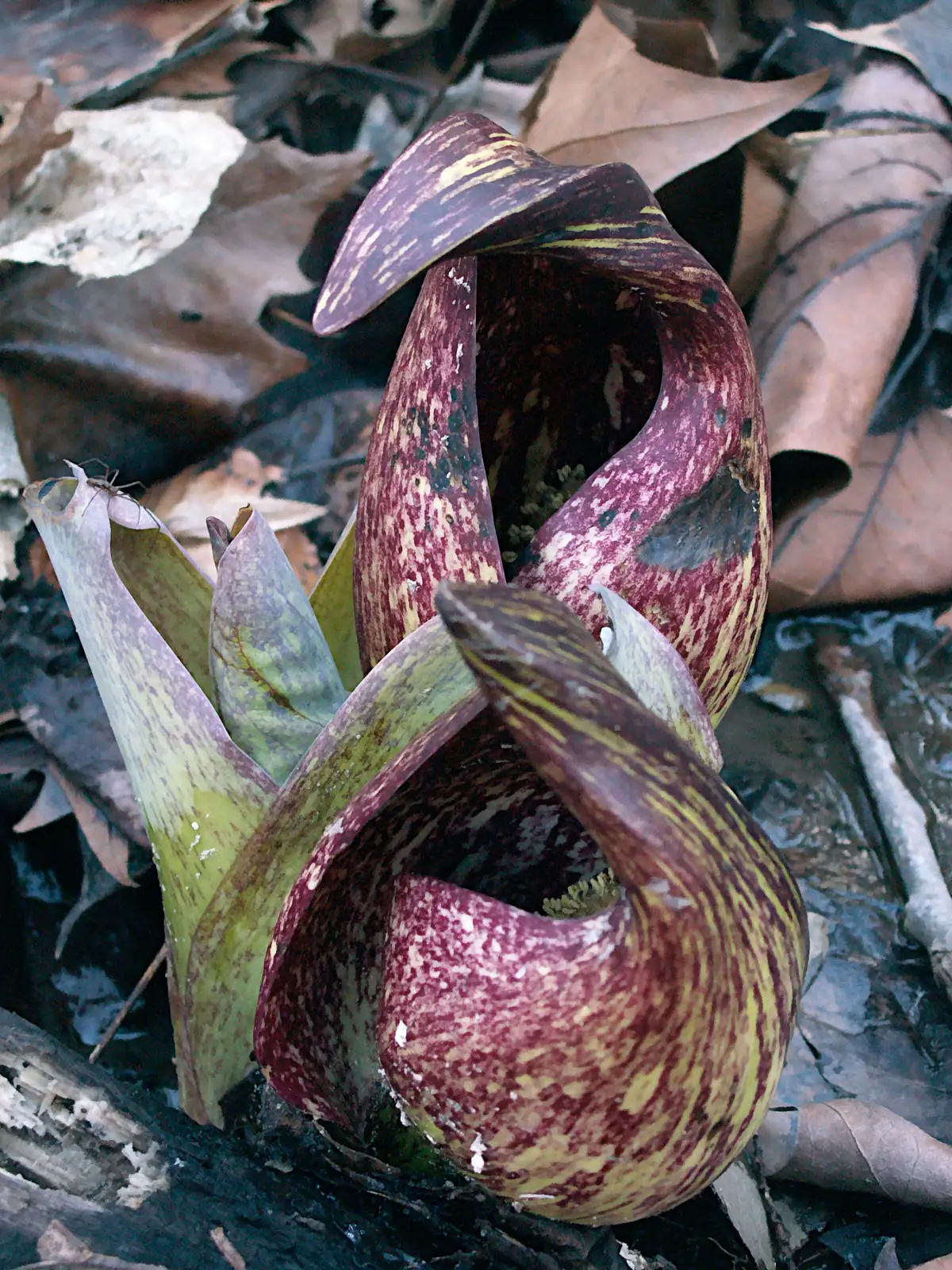
By most accounts it is skunk cabbage, which does not wait for spring. Native Plant Trust calls it one of the earliest wildflowers of the year, and it grows in wetlands in every part of Connecticut, often on ground that is still frozen or under snow.
-
Skunk cabbage in bloom
From February in mild spells, into March · Swamps, wet woods, seeps, stream banks and floodplains statewide
What you see is not a leaf but a hood, a mottled shell of maroon, purple and yellowish green four to six inches tall, wrapped around a knob studded with tiny flowers. Look along a wooded stream or at the edge of a red maple swamp, where the hoods poke up singly or in loose groups out of mud and melting snow. The broad, cabbage-like leaves come later, after the flowering is over.
-
A plant that makes its own heat
During flowering, day and night · Inside the hood
The knob of flowers inside the hood burns stored starch so fast that, by the University of Illinois Extension’s account, it uses about as much oxygen as a mammal of the same size, and it runs 15 to 35 degrees Fahrenheit warmer than the air around it, sometimes more. That warmth melts a ring in the snow and helps spread the plant’s faintly rotten smell, which draws flies, gnats and beetles, the likely pollinators, out on a cold day.
-
How to look without harm
Any thawed afternoon · From the edge of the wetland
Skunk cabbage has deep roots that contract and pull the plant further into the mud as it ages, so leave it in place; dug plants rarely survive. The smell only comes out if you bruise it. A phone photo of an early hood, with the date, is a useful record on iNaturalist.
When is the Great Backyard Bird Count in 2027?
Over four days, February 12 to 15, 2027, ending on Presidents’ Day itself. The count is run by the Cornell Lab of Ornithology and the National Audubon Society with Birds Canada, and anyone anywhere can join.
-
The Great Backyard Bird Count
February 12 to 15, 2027 · Anywhere: a yard, a park, a beach, a feeder
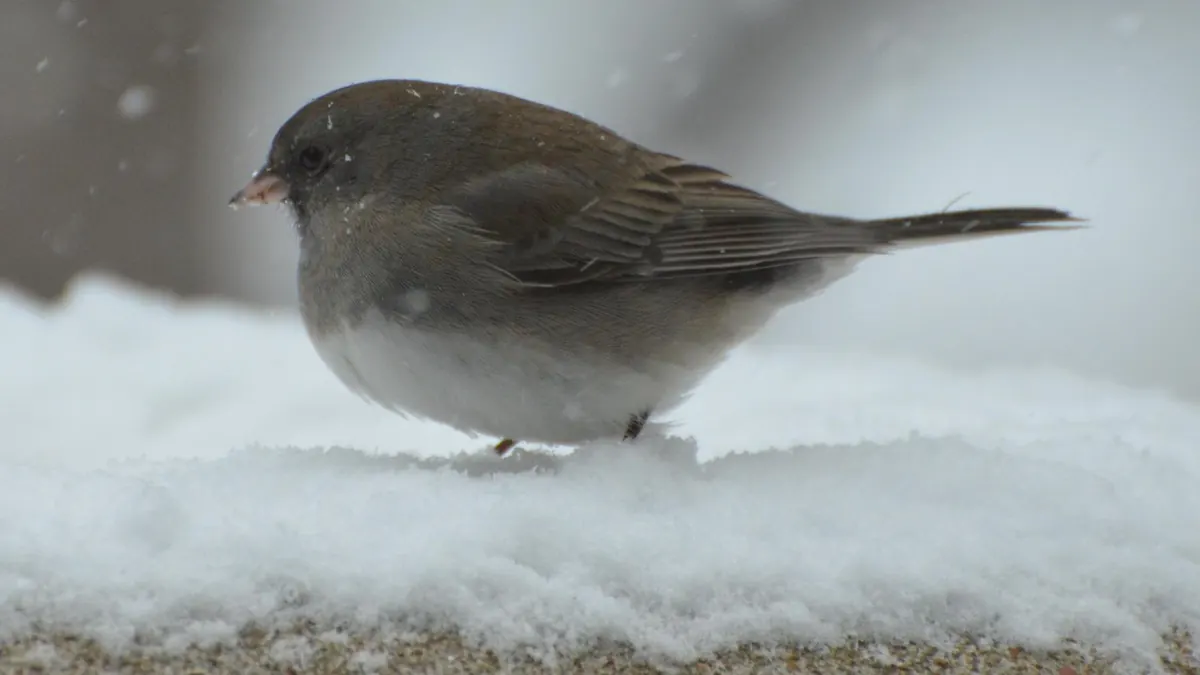
The rule is simple: watch birds for at least 15 minutes, at least once during the four days, and report what you see. You can enter counts through eBird or the Merlin app. Connecticut’s February list is a good mix: feeder birds such as juncos and white-throated sparrows, eagles and sea ducks on the water, and early blackbirds if the ground has thawed. Repeat counts from the same spot on several days are the most useful to scientists.
-
The Mega Bowl of Birding
Saturday, February 6, 2027 · Teams birding in their own areas all over Connecticut
This friendly one-day contest, organized through the New Haven Bird Club, sends birders out alone or in teams of up to five to find as many species as they can within a town, a county or a circle with a five-mile radius, with more points for rarer birds. Beginners are welcome, and registration with the organizer is required. In 2021, the event’s fifth year, 60 birders found 130 species statewide. A compilation dinner follows from 5 to 7 p.m. on Sunday, February 7, at the Kellogg Environmental Center in Derby.
-
Project FeederWatch
Through April 30 · Your own feeders
If a weekend count leaves you wanting more, FeederWatch asks for two-day counts at the same feeders through the end of April. Late winter is when hungry birds lean on feeders the most, so February counts matter.
Every month’s guide, for each state, is listed on the nature guide index, and a printed Naturalist’s Field Journal gives count-day lists somewhere to live.
Which Connecticut animals start moving again in February?
Several of the state’s mammals sit out the worst of winter in dens and come out to look for mates as February wears on. Tracks in late snow, and a whiff of skunk on a mild night, are the first clues.
-
Striped skunks looking for mates
Mating late February and early March · Field edges, suburbs, stone walls, under sheds and decks
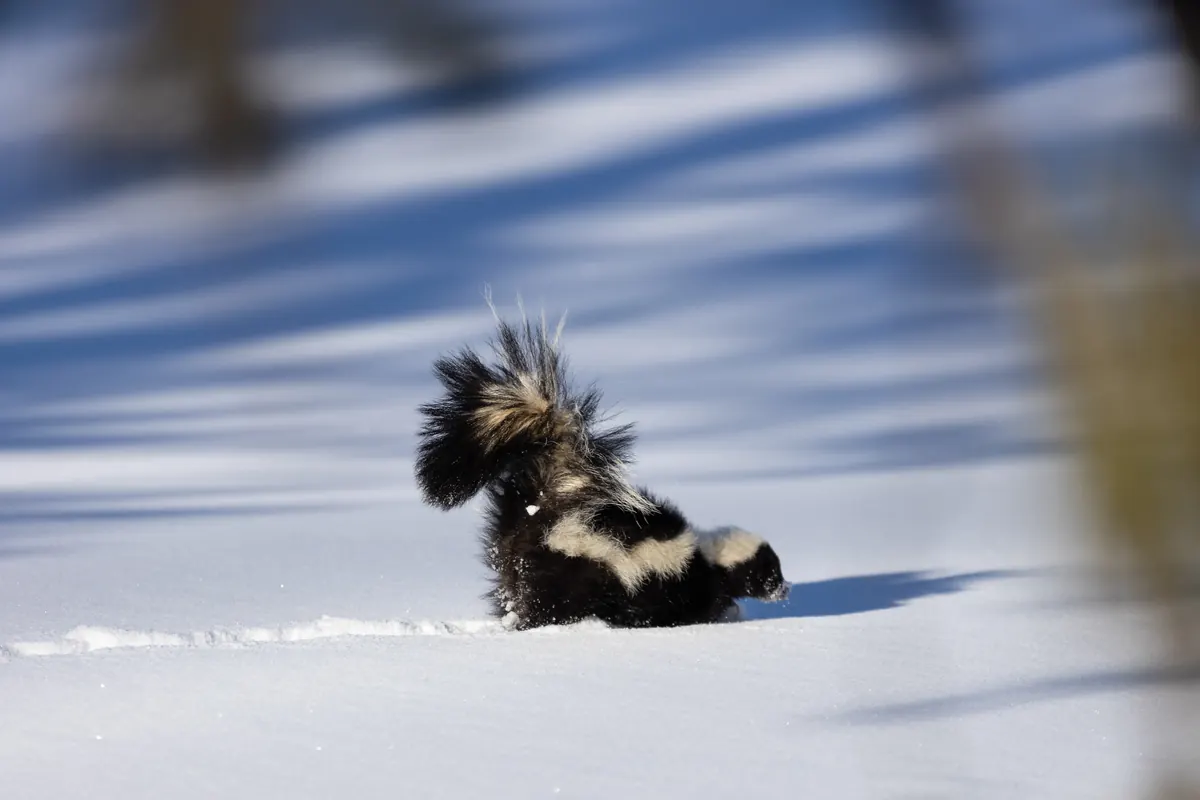
DEEP says skunk mating takes place in late February and early March. Males, solitary the rest of the year, wander far at night to find females, which is why the smell of skunk on a February evening grows more common at this time of year. About six young are born from late April to early June. A skunk that stamps its front feet and raises its tail is giving fair warning; back away slowly and quietly.
-
Raccoons on warm nights
Out during thaws; breeding late winter and early spring · Woods near water, neighborhoods, barns and attics
Raccoons den up through the coldest spells without truly hibernating, and DEEP notes that they wander out whenever it warms. They breed in late winter or early spring, and their handlike tracks, hind prints longer than the front, appear in mud and snow along streams after any mild night. Young are born in April or May, sometimes in a chimney or an attic, so check and cap yours now.
-
Woodchucks, still underground
Until March · Burrows below the frost line
Tuesday, February 2, is Groundhog Day, yet Connecticut’s woodchucks will not be keeping the appointment. DEEP says they rise slowly from hibernation during March, males first, and spend the winter on their fat with heartbeat and breathing turned far down. Any groundhog you see on February 2 has been woken up for the cameras.
How much daylight does Connecticut gain in February?
More than an hour. Days that are about ten hours long on February 1 stretch past eleven by February 28, and the daily gain is quicker at the end of the month than at the start. The sun also starts to rise earlier at last: Hartford’s sunrise moves from 7:03 a.m. on February 1 to 6:27 a.m. on the 28th, while sunset slides from 5:06 to 5:40 p.m.
| City | Feb 1 | Feb 28 | Gained | Per day |
|---|---|---|---|---|
| Torrington | 10 h 03 m | 11 h 12 m | 69 min | 2.6 min |
| Hartford | 10 h 03 m | 11 h 13 m | 70 min | 2.6 min |
| Putnam | 10 h 03 m | 11 h 12 m | 69 min | 2.6 min |
| Waterbury | 10 h 04 m | 11 h 12 m | 68 min | 2.5 min |
| Danbury | 10 h 05 m | 11 h 13 m | 68 min | 2.5 min |
| New London | 10 h 05 m | 11 h 13 m | 68 min | 2.5 min |
| New Haven | 10 h 05 m | 11 h 13 m | 68 min | 2.5 min |
| Stamford | 10 h 06 m | 11 h 14 m | 68 min | 2.5 min |
The astronomical middle of winter, the moment equally far from the solstice and the equinox, lands on February 3 or 4 this year depending on how it is reckoned, a day or two after Groundhog Day. Clocks spring forward on Sunday, March 14, and Hartford’s sunset jumps to 6:56 p.m. that evening, by the Naval Observatory’s tables. To see sunrise and sunset for your own street, try the daylight calculator, and when gardening plans start to stir, the Connecticut frost dates show how many weeks of freezing nights are still ahead.
Is February Connecticut’s snowiest month, and what could El Niño bring?
At several stations, yes, by a small margin. NOAA’s 1991–2020 normals give Bradley International Airport 14.8 inches of snow in February against 14.2 in January, and Storrs and Bridgeport also show more in February. In the northwest hills and the southeast, January stays slightly ahead. February is also the shortest month, so its snow falls in fewer days, and it is a little milder: average highs are two to three degrees warmer than January’s.
| Station | Average high | Average low | Precipitation | February snowfall | January snowfall |
|---|---|---|---|---|---|
| Norfolk 2 SW (Northwest Hills) | 32.3 °F | 15.4 °F | 3.33 in | 17.5 in | 17.8 in |
| W Thompson Lake (Quiet Corner) | 37.7 °F | 16.5 °F | 3.53 in | 11.6 in | 10.6 in |
| Hartford Bradley International Airport (Windsor Locks) | 38.5 °F | 20.7 °F | 3.13 in | 14.8 in | 14.2 in |
| Storrs (Mansfield) | 37.2 °F | 20.4 °F | 2.99 in | 14.1 in | 8.3 in |
| Danbury Municipal Airport (western hills) | 38.7 °F | 19.7 °F | 2.69 in | no normal | no normal |
| Norwich Public Utility Plant (southeast) | 40.5 °F | 22.9 °F | 3.75 in | 7.1 in | 9.0 in |
| New Haven Tweed Airport (central shoreline) | 40.2 °F | 23.9 °F | 2.84 in | no normal | no normal |
| Bridgeport Sikorsky Memorial Airport (Stratford) | 40.5 °F | 25.7 °F | 3.12 in | 10.7 in | 8.5 in |
Snow normals bounce around far more than temperature normals, since a single big storm can make or break a month, and that is why this winter’s Pacific matters. In its September 10 update, the federal ENSO team put the probability of a very strong event this fall and winter above 90 percent. A NOAA regional report written with the Northeast Regional Climate Center sums up the usual setup: a polar jet stream displaced to the north, a busy southern branch, and, in research the report cites, roughly two extra nor’easters per winter on the classic track out of the waters off the Carolinas, most of all when El Niño is strong. Among the storms it ties to El Niño years are the Blizzard of ’58 and the Presidents’ Day Storm of February 2003. The report also stresses that no two events behave alike. In 2015–16, the record event, the whole region was warmer than normal while snowfall across New England fell below normal, and the report points to 1965–66, when the North Atlantic Oscillation (a swing in pressure over the ocean that nobody can forecast months out) smothered the wet El Niño signal. The odds of one or two heavy coastal storms rise, but neither is certain. The Climate Prediction Center refreshes its three-month outlook maps every month, and the weather page covers the next few days.
What can you see in Connecticut’s night sky in February 2027?
Jupiter and Mars come to opposition just over a week apart, and on the 20th the full moon rises while it slips through the faint outer shadow of the Earth. All times are Eastern Standard Time.
-
Mercury at dusk
Best from late January to about February 10; farthest from the sun February 3 · Low in the west-southwest, 30 to 45 minutes after sunset
This is the best evening view of Mercury this winter. On February 3 it stands about 18 degrees from the sun, and from a spot with a clear, flat western horizon, such as a shoreline beach or a hilltop field, it shows as a small, steady point low in the twilight. A day after new moon, on Sunday evening the 7th, look for the thinnest sliver of moon just beside Mercury; binoculars help.
-
Jupiter at opposition
Evening of Wednesday, February 10 (7:21 p.m.) · Rising in the east at sunset, high in the south around midnight, in Leo
Opposite the sun and closest to Earth, about 405 million miles away, Jupiter reaches magnitude −2.5 and outshines Sirius and every other star. Even steadily held binoculars show its four largest moons as tiny points strung out in a line beside it, and the pattern they make changes every evening.
-
Mars at opposition
Friday, February 19; closest to Earth February 20 · East at dusk, near Jupiter and the star Regulus in Leo
Opposition for Mars comes on the 19th, and a day later the planet is at its least distance from us this time around, some 63 million miles. With Mars near the far end of its oval path around the sun, this opposition is a modest one and the disk stays small even in a telescope, though without optics you will see an unblinking orange-red spark. Overnight from Friday the 19th into Saturday, the almost-round moon brushes right up against Jupiter; then on Saturday evening, the full moon, Jupiter, Regulus and Mars are all gathered together in Leo.
-
The Snow Moon and a faint eclipse
Full at 6:23 p.m. Saturday, February 20; eclipse deepest at 6:13 p.m. · Rising in the east around 5:20 to 5:30 p.m., near sunset
February’s full moon, the Snow Moon, rises already inside the Earth’s penumbra, the pale outer edge of its shadow. In Hartford the moon comes up at 5:26 p.m., four minutes before the sun sets, and maximum eclipse comes at 6:13 p.m., with the moon barely clear of the horizon haze in a bright twilight. A penumbral eclipse never darkens the moon the way a total one does; at best you might notice a slight gray dimming on one side. It ends at 8:13 p.m. Whether it qualifies as a supermoon depends on whose definition you use; it falls near perigee, though not as near as January’s. Nothing of the February 6 annular eclipse of the sun can be seen from the U.S.; the ring of fire is confined to Chile, Argentina and a track across the ocean that ends at the coast of West Africa.
| Phase | Date | Time |
|---|---|---|
| New moon | Saturday, Feb 6 | 10:56 a.m. EST |
| First quarter | Sunday, Feb 14 | 2:58 a.m. EST |
| Full moon, the Snow Moon (penumbral eclipse) | Saturday, Feb 20 | 6:23 p.m. EST |
| Last quarter | Sunday, Feb 28 | 12:16 a.m. EST |
Moonless evenings, good for picking out faint stars from a dark Litchfield County or Quiet Corner field, run from about February 2 to 11. The sun has passed the busiest part of its 11-year cycle, yet a strong outburst could still bring a faint aurora low in the north on a rare night, usually at short notice. For tonight’s cloud cover, look at our cloud forecast page, and for moonrise times all month, open the moon phase calendar.
What can families do outdoors in Connecticut in February?
- Wednesday, February 3: Hammonasset, Madison. A First Wednesday Walk with the New Haven Bird Club along the state park’s shore, 8 to 11 a.m.
- Saturday, February 6: the Mega Bowl of Birding. A one-day species hunt for teams of any skill, with a compilation dinner on Sunday the 7th in Derby; details on the New Haven Bird Club calendar.
- February 12 to 15, Presidents’ Day weekend: Great Backyard Bird Count. A quarter hour of counting anywhere qualifies.
- Saturday, February 20: White Memorial, Litchfield. A New Haven Bird Club morning of birding and tracking on the foundation’s 4,000 acres, 8 to 11 a.m. That evening, watch the Snow Moon rise in the east just before sunset.
- Mid-February into March: eagle cruises from Essex. Usually Fridays and weekends on RiverQuest from the Connecticut River Museum; check the 2027 schedule, and note the minimum age of 10.
- All month, in a typical season: eagles at Shepaug. The free Southbury observatory has opened Wednesdays, Saturdays and Sundays by reservation; confirm this winter’s dates with FirstLight.
- Weekends: seal cruises from Norwalk. The Maritime Aquarium’s winter cruises ran through March last season; confirm 2027 departures on its site.
- Late February and March weekends: sugarhouse demonstrations. Flanders Nature Center in Woodbury and other nature centers boil sap for visitors in a typical year; check each host’s schedule, since sap sets the calendar. Maple Weekend follows on March 20 and 21.
- Citizen science. Log skunk cabbage, first blackbirds and tracks on iNaturalist, keep up FeederWatch counts, and park free at state parks with Connecticut plates under Passport to the Parks.
We checked these dates on each organizer’s website on October 2, 2026. Snow and ice cancel winter programs, so check again the day before.
Safety notes for February in Connecticut
- Hunting seasons. Deer and turkey seasons are closed in February. DEEP’s guide runs by calendar year. In the 2026 edition, pheasant, gray squirrel, cottontail, snowshoe hare and both foxes were open from January 1 to February 28, and coyote has no closed season; the 2027 guide, which sets this winter’s January and February dates, had not appeared by early October 2026, so confirm on DEEP’s site. Crows may be hunted Monday through Saturday until March 20, 2027. Under the 2026–27 migratory bird guide, Canada goose seasons end on February 13, and a snow goose season runs from February 16 to March 10. Sunday hunting of geese, crows and other migratory birds is banned.
- Blaze orange. Until February ends, state rules put every hunter in fluorescent orange, a minimum of 400 square inches of it worn above the belt and seen from all around; exemptions include waterfowl hunters in boats or blinds and crow hunters in a blind. On March 1 the requirement lapses. Hikers in woods and fields where small game is hunted are wise to wear a bright hat or vest, and to put one on the dog.
- Sundays and trails. On Sundays, hunting is allowed on private land but not within 40 yards of a blazed trail open to the public, and from October 1, 2026, small game hunters need a landowner’s permission, spoken is enough, to hunt on Sundays.
- Traps. In the 2026 guide, trapping for otter, mink, muskrat, weasel, foxes, coyote, raccoon, opossum and skunk ran from January 1 to March 15, and for beaver to March 31; check the 2027 guide for this winter’s dates. Traps are often set at the water’s edge, so keep dogs on a leash near streams and ponds.
- Late-season ice. February ice can look solid and be rotten. DEEP’s guidance is that 4 inches of new, clear ice will hold a person on foot, while a foot or more of old, partly thawed ice may not, and snow both insulates ice from freezing and weighs it down. Stay off ice over streams, springs, culverts and near bridges. Driving a car or truck on the ice is illegal in Connecticut. If you go through, turn back the way you came, get your arms onto the unbroken ice, kick, and roll away from the hole.
- Nor’easters and heavy snow. Big coastal storms are likelier than usual in a strong El Niño winter. Wet snow brings down limbs and power lines and loads flat roofs; stay out of the woods in high winds and just after an ice storm.
- Wildlife. Skunks, raccoons and foxes are on the move. Give any animal acting tame, confused or aggressive a wide berth, keep pets’ rabies shots current, and report odd behavior to your town’s animal control officer.
Sources
- Maple Syrup Producers Association of Connecticut: how do you make maple syrup? (season, sap sugar content, tree size)
- Maple Syrup Producers Association of Connecticut: Maple Weekend 2027 (March 20 and 21, 2027)
- Maple Syrup Producers Association of Connecticut: sugarhouses open to the public (map)
- Maple Syrup Producers Association of Connecticut: Flanders Nature Center sugarhouse demonstrations
- Connecticut Department of Agriculture: maple sugaring season kicks off (season timing, 40 to 1 ratio)
- UConn Today: Golden goodness, turning sap into syrup in the UConn Forest
- UConn Extension: maple syrup articles
- Connecticut River Museum, RiverQuest: Winter Wildlife Eagle Cruises (2026 season)
- Connecticut River Museum, RiverQuest: cruises and 2025 Connecticut eagle nest update
- CT DEEP: bald eagle fact sheet (egg laying, incubation, wintering numbers, disturbance)
- FirstLight: Shepaug Recreational Area and Bald Eagle Observatory
- Connecticut Audubon Society: Daily birds, blackbirds (February flocks)
- U.S. Fish and Wildlife Service: birds that offer early signs of spring
- CT DEEP: American woodcock fact sheet (migration and arrival, singing grounds)
- Native Plant Trust, Go Botany: Symplocarpus foetidus (skunk cabbage)
- University of Illinois Extension: Skunk cabbage, spring’s earliest and hottest native plant (February 6, 2026)
- Brooklyn Botanic Garden: What can we learn from the charismatic skunk cabbage?
- Birds Canada: Great Backyard Bird Count (February 12–15, 2027; 15-minute rule)
- Great Backyard Bird Count (Cornell Lab of Ornithology, National Audubon Society, Birds Canada)
- New Haven Bird Club: events calendar, February 2027 (field trips)
- New Haven Bird Club: The Annual Mega Bowl of Birding in Connecticut, February 6, 2027
- Connecticut Ornithological Association: Mega Bowl of Birding in CT, 2021 summary
- Project FeederWatch: how to participate
- CT DEEP: Eastern striped skunk fact sheet (archived copy)
- CT DEEP: raccoon fact sheet (winter dens, breeding)
- CT DEEP: woodchuck fact sheet (hibernation and emergence)
- NOAA NCEI: U.S. climate normals 1991–2020, monthly, Connecticut stations
- Climate Prediction Center: ENSO diagnostic discussion, September 10, 2026
- Climate Prediction Center: seasonal (90-day) outlooks
- NOAA and Northeast Regional Climate Center: El Niño impacts and outlook, Northeast region (October 2018)
- U.S. Naval Observatory: moon phases from December 30, 2026
- U.S. Naval Observatory: sunrise and sunset, Hartford, March 14, 2027 (daylight time)
- U.S. Naval Observatory: sun and moon rise and set, Hartford, February 20, 2027
- U.S. Naval Observatory: Earth’s seasons, 2027
- Fred Espenak: Sky Event Almanac 2027 (Mercury, Jupiter, Mars, Moon)
- NASA Goddard: lunar eclipses 2021–2030
- NASA Goddard: solar eclipses 2021–2030
- Old Farmer’s Almanac: eclipses (February 20, 2027, visibility)
- EarthSky: Jupiter at opposition
- SEDS: Mars opposition 2027
- Sea and Sky: astronomy calendar 2027 (Snow Moon, oppositions)
- NOAA Space Weather Prediction Center: solar cycle progression
- 15 U.S.C. 260a: daylight saving time (begins second Sunday in March)
- Maritime Aquarium at Norwalk: seal-spotting and birding cruises (winter 2026 release)
- CT DEEP: Passport to the Parks
- CT DEEP: hunting season date summary from the 2026 Connecticut Hunting and Trapping Guide (PDF)
- CT DEEP: 2026–2027 Connecticut Migratory Bird Hunting Guide (PDF; goose and crow seasons)
- CT DEEP: 2026 hunting laws and regulations (fluorescent orange, Sunday hunting, landowner permission)
- CT DEEP: 2026 furbearer trapping seasons
- CT DEEP: ice safety
- Photos via Wikimedia Commons; licenses and photographers are credited under each picture
