What to look for in nature in Connecticut this January
January is the core of Connecticut’s winter. The coldest days of the year, on average, fall in its third week, lakes freeze over in the hills, and the open water left below dams and along tidal rivers draws bald eagles from all over the Northeast. Great horned owls are settling onto nests, foxes and coyotes are pairing up, eagles are rebuilding nests, and northern finches may turn up in the pines. Every evening the sun sets a little later, and by the last week it reaches 5 p.m. again in much of the state. This guide covers what to watch for across the state this month.
Other months in Connecticut: October, November, December, February.
Start here
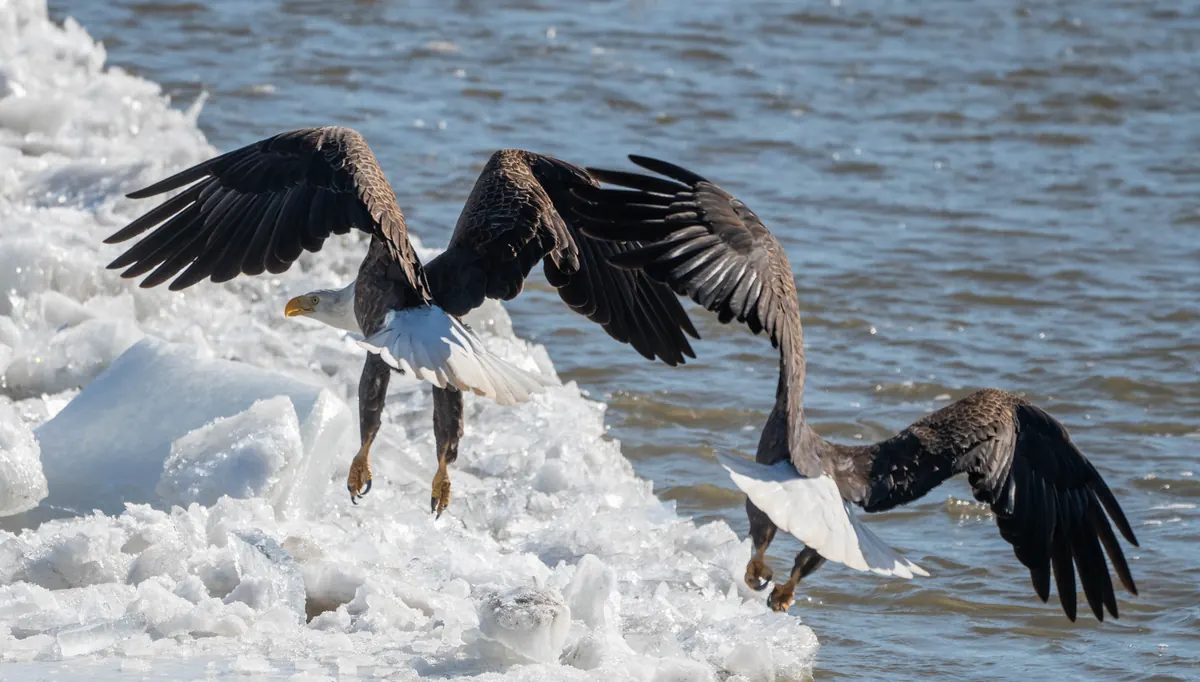
- Book a morning with the eagles. The blind below the Shepaug Dam in Southbury opens three days a week in winter, free with a reservation. Turbines keep the Housatonic flowing, and on a cold day a dozen or more eagles may fish within sight.
- Walk on New Year’s Day. DEEP’s First Day Hikes on Friday, January 1, are short, free and led by guides at state parks and forests around Connecticut. Watch DEEP’s pages in late December for this year’s sites.
- Stay up for the Quadrantids. The Quadrantids, a short and intense shower, should be at their best overnight, Sunday into Monday the 4th. Moonlight is minimal, so set an alarm for the hours before sunrise.
January’s quiet makes room for patient pages in the Naturalist’s Field Journal. A clean line of footprints belongs on “tracks to know”; a beech, hickory or maple sketched by its bark and buds goes on “a tree through the seasons”; the owls you hear at dusk and the fox that screams at midnight fill “a map of sounds”; and any eagle, siskin or crossbill joins “birds I have seen.” On the daily field log, write down the date when sunset first reaches 5 p.m.
Regions used below: Northwest Hills and Litchfield County; Hartford and the Connecticut River Valley; The Quiet Corner (northeast); Fairfield County and the southwest; New Haven and the central shoreline; Southeast and the lower Connecticut River.
Where can you see the most bald eagles in Connecticut in January?
By January the lakes of northern New England and Quebec are locked in ice, and the only easy fishing left is where a dam, a tide or a current keeps water moving. DEEP’s Wildlife Division puts the number of bald eagles wintering in the state at up to 100, from December into early March, and each cold snap crowds them onto fewer open stretches, which makes them easier to find.
-
The blind at Shepaug Dam, Southbury
Last winter Wednesdays, Saturdays and Sundays, December 21 to March 15, by free reservation; 2026–27 days not yet posted · Housatonic River below FirstLight’s Shepaug hydro station
Water spilling through the turbines keeps the Housatonic below the dam from freezing, and FirstLight’s site manager told WSHU in 2025 that this is the whole secret: when the plant generates, the river moves, and the eagles always have open water. The utility says a good day brings 20 or more eagles, and WSHU reported a single-day high of 32 two winters earlier. Last season the observatory ran from December 21 to March 15; FirstLight has not yet posted 2026–27 dates, so check its Shepaug page and book a slot online before you drive. If snow threatens, phone 860-895-6468 first.
-
Nesting pairs at work
Courtship and nest repair from January; eggs mostly in February and March · Big trees near rivers, reservoirs and the coast, in nearly every county
While visitors from the north fish the open water, Connecticut’s own eagles are already starting a family. DEEP says the breeding season here begins in January, and pairs return to the same territory year after year, often with the same mate. The nest is a flat platform of sticks that can reach 7 to 8 feet across, lined with grasses or moss. The state’s Council on Environmental Quality counted 91 active territories in 2025, far above the state recovery goal of 10 nests. Admire any nest from far back; an adult chased off its eggs in hard frost can lose the clutch.
-
The Midwinter Eagle Survey
Early January, one coordinated day · Rivers, lakes and reservoirs statewide
Each January, volunteers fan out to assigned rivers and lakes on the same day and in the same hours, noting every eagle they see, whether it is a white-headed adult or a mottled brown immature, and what it is doing. DEEP runs the Connecticut count as part of a national survey that began in 1979, and it welcomes volunteers; email the Wildlife Division at deep.ctwildlife@ct.gov to ask about a route. The Last Green Valley has fielded teams on the Quiet Corner’s rivers and ponds for well over a decade.
| Year | Eagles counted | What the report says |
|---|---|---|
| 2022 | 176 | Observations have increased significantly since 1979 |
| 2023 | 185 | Up 5 percent on 2022 and about 20 percent above the previous ten-year average |
| 2024 | 137 | Down 26 percent; one-day counts swing with weather and volunteer numbers |
| 2025 | 203 | Up 48 percent on 2024 and about 26 percent above the ten-year average of 161 |
A survey morning after a hard freeze herds birds onto a few open rivers where they are easy to tally, while a mild January scatters them, so single years jump around; the long trend points steeply up. Our December guide covers the eagles’ arrival.
How can you start the new year outdoors in Connecticut?
The first week of January is the busiest of the winter for organized outings.
-
First Day Hikes
Friday, January 1, 2027 · State parks and forests across Connecticut
The custom of a guided walk on New Year’s Day started at the Blue Hills Reservation outside Boston more than 25 years ago and spread to state parks across the country. For a recent New Year’s Day, DEEP listed 16 locations, from Peoples State Forest in Barkhamsted and Sessions Woods in Burlington to Dinosaur State Park in Rocky Hill, Fort Griswold in Groton and Sherwood Island in Westport. The walks are free, and most cover only one to two miles. As of early October, DEEP had not named its 2027 hike sites; the CT Parks event calendar is the place to find them once announced.
-
The last Christmas Bird Counts
Through Tuesday, January 5, 2027 · Mostly the shoreline circles
Audubon’s count window always closes on January 5, and in Connecticut several shoreline circles traditionally use the first days of the new year. Last season Guilford–Long Island Sound and New London counted on January 3 and Old Lyme–Saybrook on January 4. Compilers set new dates every season, so look for this winter’s schedule on the Connecticut Ornithological Association’s CBC page.
When do great horned owls lay eggs in Connecticut?
Sooner than almost any other bird. In January, when the ground is frozen and the woods are silent, the state’s largest common owl may already be sitting tight on a nest.
-
Great horned owls on eggs
Eggs from mid- to late winter; incubation into February · Woodlots, swamps, parks and big suburban trees statewide
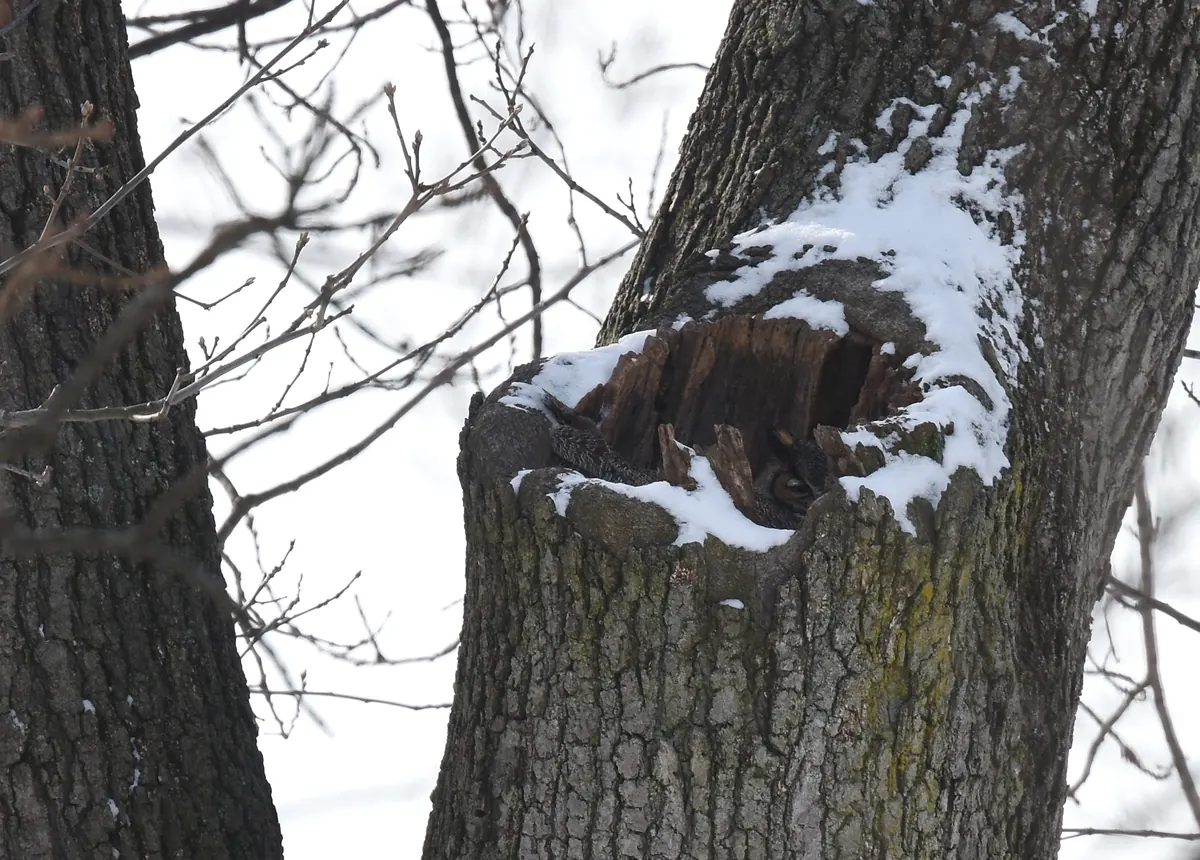
Menunkatuck Audubon Society in Guilford calls the great horned owl the earliest breeding raptor in the area, with nesting under way while snow still lies on the ground. A mated pair holds the same territory year after year and does no building of its own; it moves into an old stick nest left by a red-tailed hawk, a crow or even a squirrel. Connecticut Audubon notes that by late March you may see fuzzy owlet heads poking above the rim of the nest.
-
Listen for the duet
The hour after sunset on still, cold evenings · Edges of woods beside fields, cemeteries and golf courses
The deep, soft “hoo, hoo-hoo, hoo, hoo” carries a surprisingly long way on a windless January night. Connecticut Audubon points out that the male’s voice is a touch lower than the female’s, so when a pair calls back and forth you can sometimes tell the two apart.
-
Finding a nest without disturbing it
Late January into March · Old hawk nests in tall trees, often near open ground
Check old hawk nests for two feathered ear tufts showing over the edge, or a tail jutting from one side. Menunkatuck’s advice is simple: if you happen on a nest, leave it be, since the adults are keeping their eggs warm against the cold. One look through binoculars from the trail is enough.
Will winter finches come to Connecticut this year?
The Finch Research Network reads the boreal forest’s seed crops each fall to predict where northern finches will winter. Tyler Hoar’s forecast for 2026–27, published on September 25, describes a split year: rich cone and seed crops in the eastern boreal and again in the far Northwest, but a thin crop across the huge middle of the boreal. Finches leaving that empty middle are likely to drift east and south toward our part of the continent, but with good conifer seed in northern New England they may stop short or stay deep in the woods rather than visiting feeders.
-
Pine siskins and purple finches
Siskins possible from January on · White pines, hemlocks and cedars; some feeders
The forecast calls the eastern white pine crop very good, and siskins love pine, hemlock and cedar seed. It expects a big movement of pine siskins into the Northeast, staying mostly in forests; the last time the white pine crop was this rich, siskins were common from January into spring. Purple finches, after two straight winters of flights, are expected to settle into the Northeast’s well-stocked woods rather than push farther south, so look for them where the cones are. Look for streaky brown siskins with flashes of yellow in the wings, hanging upside down from pine cones, and listen for their rising, buzzy “zreeee.”
-
Red crossbills in the pines
Anytime this winter · Stands of white pine, spruce and hemlock
Hoar expects plenty of red crossbills in the Northeast, as wandering Type 2 birds join the local Type 12s. A crossbill’s crossed bill tips pry open closed cones, and a flock working a pine stand sounds like soft, steady “kip-kip” calls with bits of cone falling below.
-
Evening grosbeaks, maybe
A possible small flight · Feeders with black-oil sunflower seed, more likely in the northern hills
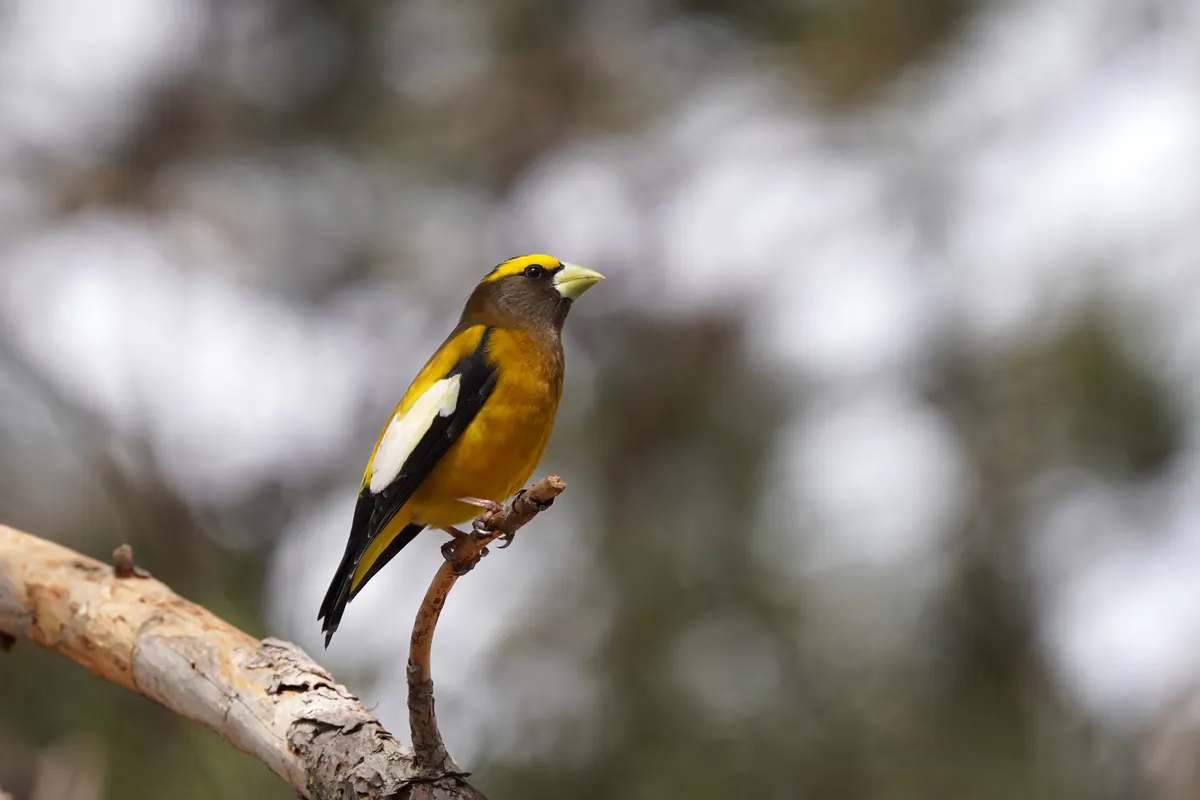
Hoar describes a small to moderate southward movement of evening grosbeaks as possible but not certain, with flocks expected in their usual haunts in southeastern Canada and the Northeast. Big yellow-and-black finches with pale bills, they descend on feeders in noisy groups. The forecast expects good birch crops in Quebec and the Maritimes to hold most common redpolls north of the border, with at most a small push into the northern fringe of the Northeast, and little or no flight of pine grosbeaks or Bohemian waxwings, so any of those would be a real find in Connecticut.
If finches do show up, report them to eBird with counts, and in the Naturalist’s Field Journal list them with the tree they were feeding in.
Where can you see seals and sea ducks on the Connecticut coast in January?
The Sound is at its winter fullest in January. Harbor seals that arrived in December are hauling out on bare rocks, gray seals turn up among them, and loons and sea ducks ride the swells just offshore.
-
Seals on the Norwalk Islands
Weekends from about mid-January to March, timed to low tide · Maritime Aquarium at Norwalk, aboard the R/V Sound Explorer
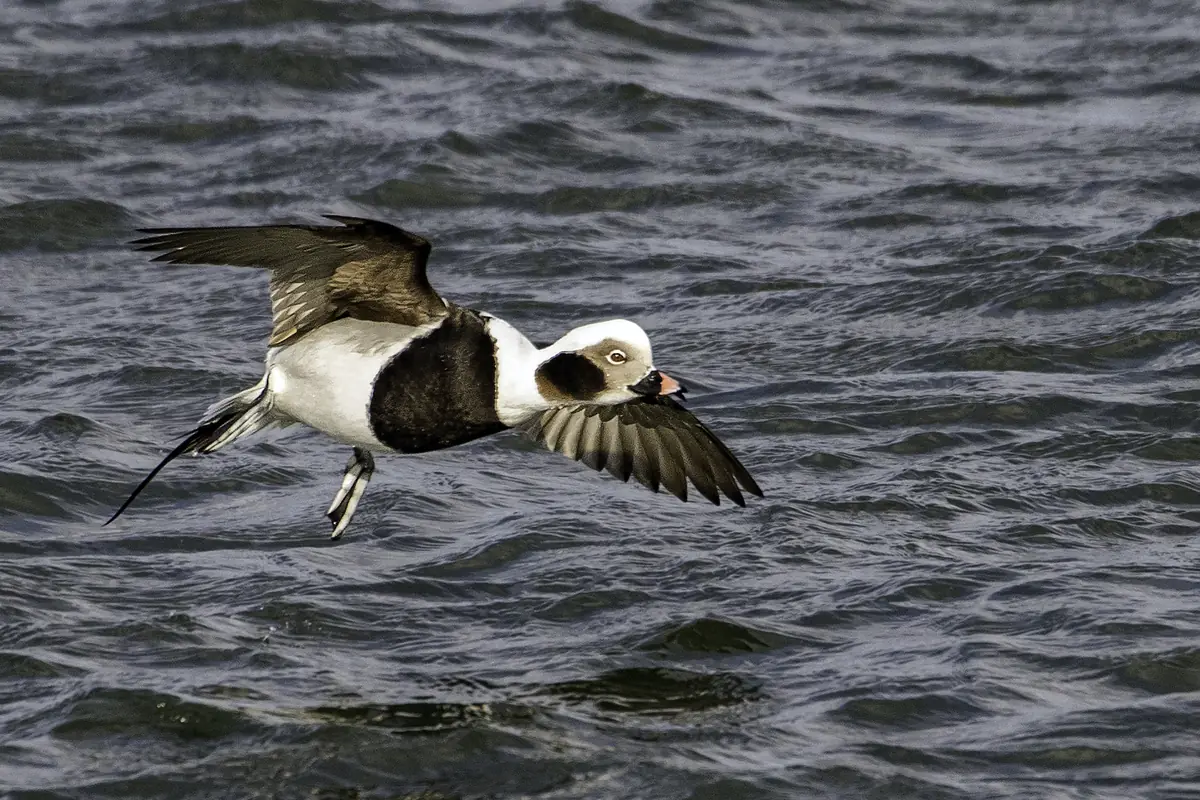
The Maritime Aquarium runs two-hour seal-spotting and birding cruises through the Norwalk Islands each winter, looking for harbor and gray seals hauled out on the low rocks between the islands, plus buffleheads, mergansers, long-tailed ducks and loons. Last winter the cruises began on January 10 and ran most weekends through March, with departure times set by the tides; the aquarium had not posted its 2027 schedule when this guide was written, so check its site.
-
Watching seals from shore
Two hours either side of low tide · Rocky points along the central and eastern shore; Falkner Island seals on Menunkatuck’s live video feed
Menunkatuck Audubon says harbor seals have wintered along the Connecticut shore in growing numbers over the past decade or so, staying until March. Seals rest on rocks that the falling tide exposes, so a tide table matters more than the time of day. NOAA Fisheries’ viewing guidelines set a distance of 50 yards, half a football field, from any seal; a seal that lifts its head and stares at you is already disturbed.
What are Connecticut’s mammals doing in the January snow?
Midwinter is mating season for several of the state’s predators, and fresh snow records their travels.
-
Red foxes calling and pairing
January through March · Field edges, suburbs, stone walls and woodlots statewide
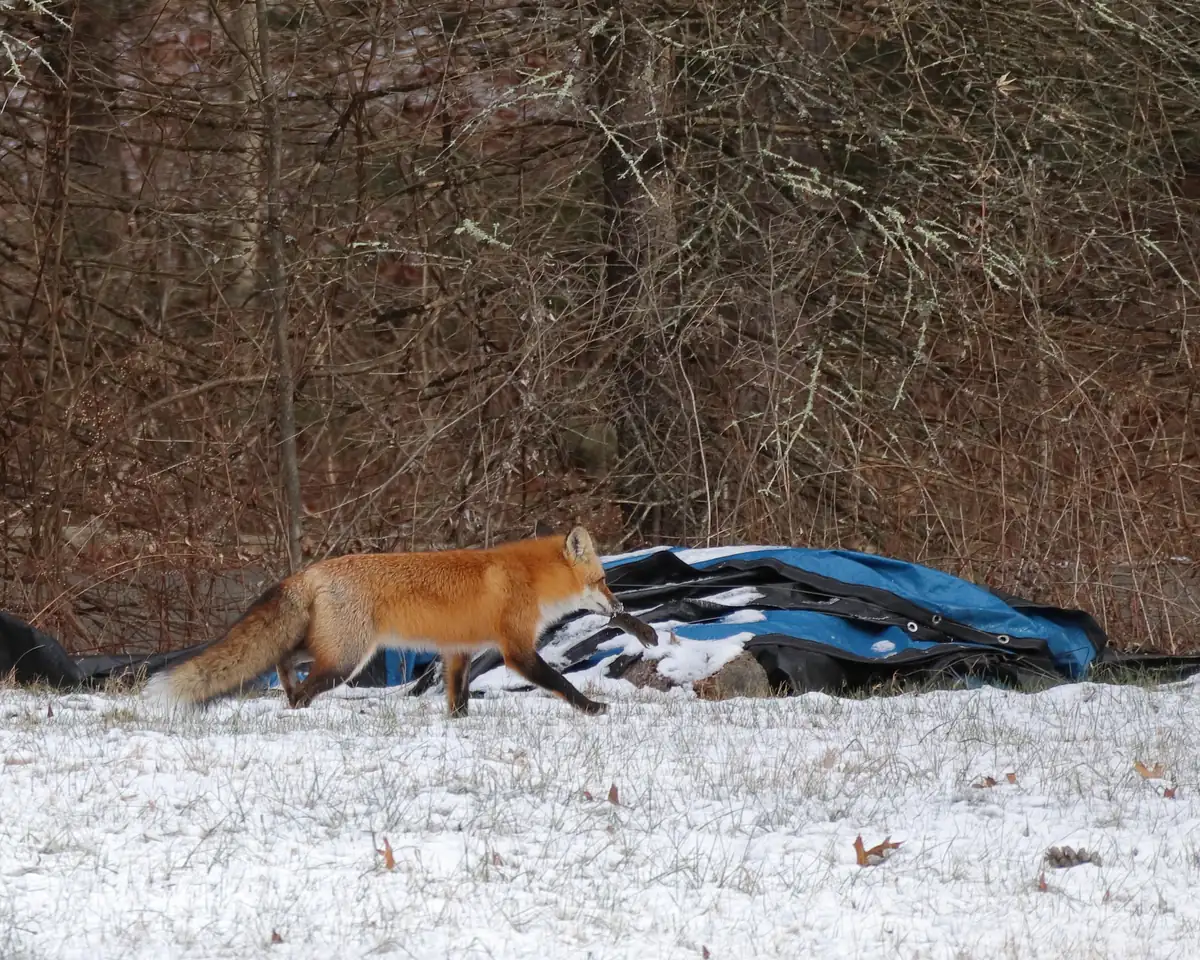
DEEP says red foxes breed from January through March, and that a common sound is a raspy, single-syllable scream or bark repeated every 3 to 10 seconds; on a cold January night it can be unnerving if you do not know what it is. Fox tracks in snow run in a nearly straight line, each hind foot landing in the print of the front, a sign of a careful, economical walker.
-
Coyotes on the move
Breeding January to March · Everywhere, from big forests to the suburbs
In Connecticut, coyotes breed from January to March, and pups arrive in April or the first half of May, according to DEEP. Family groups break up in fall and early winter as young coyotes leave to find their own territories, so a lone coyote may turn up almost anywhere in winter, even crossing a field in daylight. Howls and yips carry most at dawn and dusk. DEEP warns that small dogs under about 25 pounds and outdoor cats left unsupervised are at risk, so keep pets close.
-
Beavers under the ice
All winter, while ponds are frozen · Beaver ponds and flowages
A beaver colony spends the frozen months in its lodge with an adult pair, two to four kits and two to four yearlings, DEEP says, swimming out under the ice to a cache of branches anchored in the mud in the fall. Beavers also mate in midwinter, and kits are born in May or early June. Keep off the ice near a lodge, where the animals’ comings and goings keep it thin.
-
Fisher and otter tracks
The morning after a snowfall · Conifer and mixed forests (fisher); stream banks and pond edges (otter)
The fisher, a large forest weasel that came back to Connecticut after being wiped out by the early 1900s, leaves five-toed prints with a C-shaped palm pad and visible claws, often in pairs as it bounds. River otters slide: on snow or ice, an otter throws itself forward on its belly with its legs tucked back, leaving a smooth trough between bounding prints, often down a bank toward open water.
Sketch any good set of prints on the “tracks to know” page, with the snow depth and how old the snow was.
How can you tell Connecticut trees apart in winter?
Without leaves, trees still give themselves away by their bark, their buds and the way their twigs branch.
-
American beech
All winter · Rich upland woods statewide
Go Botany describes beech bark as exceptionally smooth and light gray, which makes the tree stand out in any forest. Young beeches hold their papery, golden-brown leaves well into winter, so a whole understory can glow copper and tan in January light. The long, pointed buds have many overlapping scales, like a closed cigar.
-
Shagbark hickory
All winter · Dry slopes, field edges and old pastures
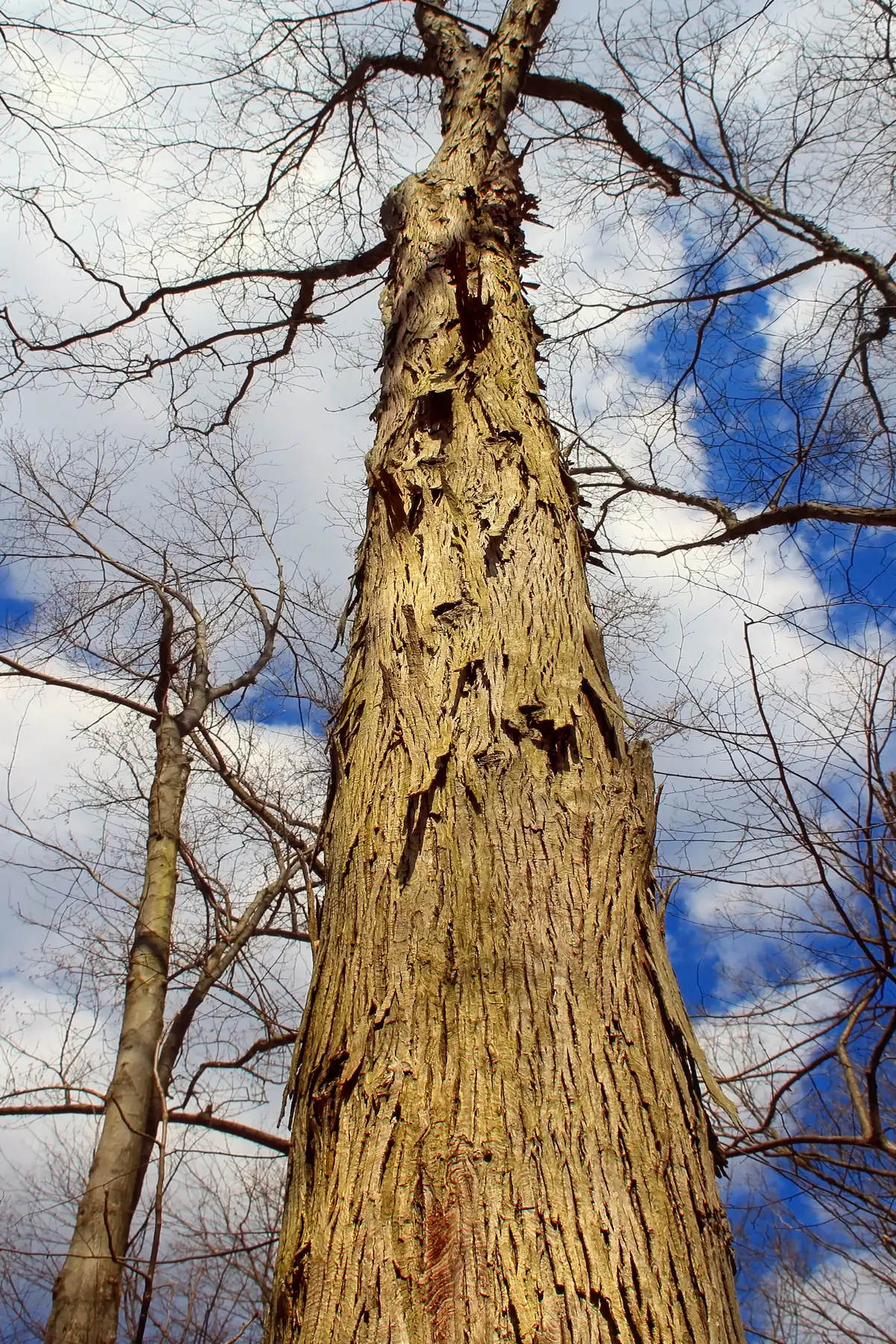
No other Connecticut tree looks like it: Go Botany notes the gray bark comes away in long, curling strips that hang loose from the trunk.
-
Tuliptree and red maple
All winter · Tuliptree in the valleys and the southwest; red maple everywhere, especially wet ground
A tuliptree’s winter bud is flattened, with just two scales that meet at their edges like a duck’s bill, and the tall, straight trunks are often still topped with upright, cone-like seed heads. Red maple names itself in winter: the buds are reddish and the twigs gray to red. Maple branches grow in opposite pairs, unlike beech, hickory or tuliptree, which alternate, so checking how the buds line up is the quickest first step in any winter key.
Choose one tree near home and add a winter sketch of its twig and bark to the “a tree through the seasons” page; you can match the buds to the leaves when they open in spring.
When do Connecticut sunsets get back to 5 p.m.?
Late in January. Days lengthen by well under a minute on New Year’s Day but by about two minutes a day at month’s end, and every town gains roughly three-quarters of an hour of daylight. Mornings lag behind: sunrise stays near its latest through the first week or so of January, so most of the month’s gain arrives at the end of the afternoon.
| City | Jan 1 | Jan 31 | Gained | Per day |
|---|---|---|---|---|
| Torrington | 9 h 12 m | 10 h 00 m | 48 min | 1.6 min |
| Hartford | 9 h 13 m | 10 h 01 m | 48 min | 1.6 min |
| Putnam | 9 h 12 m | 10 h 00 m | 48 min | 1.6 min |
| Waterbury | 9 h 14 m | 10 h 02 m | 48 min | 1.6 min |
| Danbury | 9 h 15 m | 10 h 03 m | 48 min | 1.6 min |
| New London | 9 h 16 m | 10 h 02 m | 46 min | 1.5 min |
| New Haven | 9 h 15 m | 10 h 03 m | 48 min | 1.6 min |
| Stamford | 9 h 17 m | 10 h 04 m | 47 min | 1.6 min |
New York City sees its first sunset at 5 p.m. or later on January 21, and Boston not until February 3, and Connecticut’s towns cross that line in between, during the last week or so of January, Fairfield County first and the Quiet Corner last. For the exact minute in your own town use the daylight calculator. The frost dates for Connecticut show how far off the last spring freeze still is.
How cold and snowy is January in Connecticut, and what might El Niño do?
Statewide, no month is colder than January. NOAA’s 1991–2020 daily normals for Bradley International Airport in Windsor Locks show the average daily temperature bottoming out at 26.4 °F from January 20 to 24, with an average low of 18 °F. Snow normals climb too: Bradley averages about 14 inches in January, against roughly 10 in December.
| Station | Average high | Average low | Precipitation | Snowfall |
|---|---|---|---|---|
| Norfolk 2 SW (Northwest Hills) | 29.8 °F | 14.1 °F | 3.97 in | 17.8 in |
| W Thompson Lake (Quiet Corner) | 34.7 °F | 15.1 °F | 3.78 in | 10.6 in |
| Hartford Bradley International Airport (Windsor Locks) | 35.3 °F | 18.8 °F | 3.28 in | 14.2 in |
| Storrs (Mansfield) | 35.0 °F | 18.8 °F | 3.65 in | 8.3 in |
| Danbury Municipal Airport (western hills) | 35.9 °F | 18.1 °F | 3.06 in | no normal |
| Norwich Public Utility Plant (southeast) | 37.7 °F | 21.2 °F | 3.89 in | 9.0 in |
| New Haven Tweed Airport (central shoreline) | 38.1 °F | 23.0 °F | 2.72 in | no normal |
| Bridgeport Sikorsky Memorial Airport (Stratford) | 38.4 °F | 24.4 °F | 3.18 in | 8.5 in |
Norfolk’s average January high stays below freezing, so snow there tends to last, while Bridgeport’s average high is above freezing and a snowfall on the coast may be gone in days.
This winter may not be average at all. Federal ENSO forecasters wrote on September 10 that the warm Pacific event now building has better than nine-in-ten odds of reaching the very strong category during fall and winter. A NOAA regional summary prepared with the Northeast Regional Climate Center describes the usual pattern. Studies it cites find nor’easters more frequent in El Niño winters, roughly two more per season on the classic coastal track up from the Southeast, and strong events show the effect most; the January 2016 blizzard struck during one of the strongest events on record. In areas near the coast, winter snow totals in El Niño years have come in up to 6 inches higher than usual, yet in the record 2015–16 event the whole Northeast ran warm, with New England, New York and northern Pennsylvania all short of their usual snow. One big coastal storm is a real possibility, though the winter could still be mild or snowy. NOAA’s seasonal outlooks, updated monthly from mid-October, are posted on NOAA’s seasonal outlook maps, while the local weather page is for this week.
What can you see in Connecticut’s night sky in January 2027?
January opens with a fine meteor shower under a dark sky and peaks with the closest full moon of 2027. Times below are Eastern Standard Time.
-
The Quadrantid meteor shower
Night of Sunday, January 3, into the dawn of Monday, January 4 · Look northeast, then high overhead, after midnight
The Quadrantids have a short, sharp peak of only a few hours, so timing is everything. The American Meteor Society puts the 2027 maximum near 10:30 p.m. on January 3, and EarthSky a little later, near 12:47 a.m. on the 4th; either way it falls in Connecticut’s night. Their radiant, beyond the tip of the Dipper’s handle, sits near the northern horizon at nightfall and rises as the night goes on, which favors the dark hours just before dawn on Monday the 4th. Only a thin crescent moon, rising late, will interfere. From a dark spot in Litchfield County or the Quiet Corner, expect perhaps a few dozen in the best hour.
-
Venus, brilliant at dawn
All month; farthest from the sun on Sunday, January 3 · Southeast before sunrise
Venus pulls farthest from the sun on the morning side, 47 degrees, on January 3, and nothing in the dawn sky outshines it; telescope users will find it half lit. By January’s final days Mercury is climbing out of the evening twilight in the west-southwest; it puts on its best evening show of the season in the first days of February. Saturn is in the southwest after dark, lower each week.
-
Perihelion
Saturday, January 2, 9:33 p.m. · No equipment needed
On Saturday evening, January 2, our planet reaches perihelion, the nearest point of its orbit, about 91.4 million miles from the sun. Being closest in the depth of a Connecticut winter shows that the tilt of the axis, not distance, makes the seasons.
-
The Wolf Moon, a supermoon
Full at 7:17 a.m. Friday, January 22 · Rising in the east-northeast at dusk on January 21, setting in the west-northwest near dawn
The January full moon arrives about 14 hours after perigee, the moon’s closest point in its orbit, so no full moon this year comes nearer: about 222,000 miles away. Because the exact moment of full falls just after Friday’s sunrise, Thursday the 21st is your night: up around sundown, the moon rides across the sky until morning. It will still seem full on Friday evening, and on Saturday the 23rd, look for bright Jupiter close beside the moon in the eastern evening sky.
| Phase | Date | Time |
|---|---|---|
| New moon | Thursday, Jan 7 | 3:24 p.m. EST |
| First quarter | Friday, Jan 15 | 3:34 p.m. EST |
| Full moon, the Wolf Moon (a supermoon) | Friday, Jan 22 | 7:17 a.m. EST |
| Last quarter | Friday, Jan 29 | 5:55 a.m. EST |
There is no eclipse visible from Connecticut in January. Moonless evenings, the best for faint stars and the Milky Way, run roughly January 3 to 12 on either side of new moon. Solar activity is easing off its 2024 maximum without having gone quiet, and a strong geomagnetic storm could still paint a dim red or green glow along the northern horizon; such storms give only a day or two of warning. Before heading out, check cloud cover on our sky conditions page; the moon calendar lists when the moon clears the horizon wherever you live.
What can families do outdoors in Connecticut in January?
- Friday, January 1: First Day Hikes. Free, short guided walks at state parks and forests; watch DEEP’s site for the 2027 list.
- To January 5: final Christmas Bird Count circles. Shoreline circles often count in the first days of January; see the Connecticut Ornithological Association’s CBC page for this season’s dates.
- Early January: the Midwinter Eagle Survey. A one-day volunteer count organized by DEEP; families can join a team on a river or lake.
- Wednesday, January 6: Sherwood Island State Park, Westport. A three-hour morning bird walk with the New Haven Bird Club, starting at 8.
- Saturday, January 9: Shawangunk Owls. A Connecticut Audubon EcoTravel day trip, noon to 8 p.m., to Shawangunk Grasslands National Wildlife Refuge in New York to look for wintering owls.
- Saturday, January 16: Milford Hotspots in Winter. A New Haven Bird Club field trip, 8 a.m. to noon.
- Eagles at Shepaug. Free, by reservation through FirstLight; last winter the blind opened Wednesdays, Saturdays and Sundays from December 21, and the 2026–27 days had not been posted on October 2, so check with FirstLight.
- Weekends from mid-January: seal cruises. The Maritime Aquarium at Norwalk ran them last winter; check its calendar for 2027 departures.
- Citizen science. Keep up Project FeederWatch counts through April 30, add finch and owl sightings to eBird, and photograph tracks for iNaturalist. With Passport to the Parks, cars with Connecticut plates park free at state parks.
We took these dates from each host’s calendar on October 2, 2026. Weather cancels winter programs, so confirm the day before. More state-by-state guides are on the nature guide hub.
Safety notes for January in Connecticut
- Hunting seasons and orange. The fall deer and turkey seasons end on December 31. DEEP’s 2026 guide covers the calendar year, so its January dates are last January’s, and the 2027 guide was not out when this was written; confirm on DEEP’s site. Under that guide, bowhunters could take deer and turkey on private land in deer management Zones 11 and 12 from January 1 to 31, and state rules carry the fall pheasant, gray squirrel, cottontail and red and gray fox seasons through the last day of February, with raccoon and opossum to January 17 and coyote open all year. Crow hunting, already set for this winter, runs Mondays through Saturdays from December 21, 2026, to March 20, 2027. On the water, the late duck season runs to January 9 north of Interstate 95 and to January 19 south of it, brant close on the same dates, and Canada goose seasons in most of the state run until February 13, with a late season from January 15 in the eastern South Zone. DEEP’s rules keep hunters, from the first of September until February ends, in a blaze-orange garment of 400 square inches or more above the waist, showing from every direction; bowhunters after deer in January are excused. Hikers in hunted woods should wear some orange themselves, and dress the dog in it too.
- Traps. Furbearer trapping seasons that open in late fall carry on into March; DEEP’s 2026 guide listed January 1 to March 15 for most species, including otter, mink, muskrat, fox, coyote and raccoon, and to March 31 for beaver, and the 2027 dates should appear in the next guide. Sets are often along stream banks and pond edges. Keep dogs leashed near water.
- Sundays. Hunting on private land is now allowed on Sundays for most species, provided deer and turkey hunters carry the owner’s written consent (small game hunters need only verbal permission), and Sunday hunters must keep 40 yards back from any blazed trail open to the public. Ducks, geese and other migratory birds stay off limits every Sunday.
- Ice. DEEP’s rule of thumb is to stay off ice under 4 inches thick; 4 inches will hold a person on foot. Cloudy white ice formed from snow has roughly half the strength of clear black ice, ice near shore can be weaker than ice farther out, and ice over moving water, inlets and outlets is often treacherous. Carry ice picks, a rope and a whistle, wear a float coat, and never go out alone. If someone breaks through, shout to them, reach or throw them something from shore, and call 911 rather than going out yourself.
- Cold and wind. Wind on an open ridge or beach in the coldest week of the year chills fast. Dress in layers, and head back if anyone is shivering hard or slurring words.
- Short days. Until late January the sun is down before five. Start hikes early and pack a headlamp.
- Storms. A nor’easter’s wet, heavy snow snaps limbs and drops wires. Avoid the woods during and just after an ice storm.
Sources
- CT DEEP: bald eagle fact sheet (wintering eagles, breeding season, nests, Midwinter Eagle Survey)
- CT DEEP: community science volunteer opportunities (Midwinter Eagle Survey in early January)
- Connecticut Council on Environmental Quality, 2025 annual report: raptors (2025 Midwinter Eagle Survey, 91 territories)
- Connecticut Council on Environmental Quality, 2024 annual report: raptors (2024 survey)
- Connecticut Council on Environmental Quality, 2023 annual report: raptors (2023 survey)
- Connecticut Council on Environmental Quality, 2022 annual report: raptors rebound (2022 survey)
- FirstLight: Shepaug Recreational Area and Bald Eagle Observatory
- WSHU: Now’s a great time to spot wintering bald eagles in CT (February 13, 2025)
- The Last Green Valley: Bald eagles love The Last Green Valley (Midwinter Eagle Survey teams)
- CT DEEP: Connecticut celebrates the new year with First Day Hikes (2024 release)
- National Audubon Society: Join the Christmas Bird Count (December 14 to January 5)
- Connecticut Ornithological Association: Christmas Bird Counts 2025–2026 schedule
- New Haven Bird Club: events calendar, January 2027
- Connecticut Audubon Society: EcoTravel day trips (January 2027)
- Menunkatuck Audubon Society: Great horned owl is early nester
- Connecticut Audubon Society: Daily bird, great horned owl
- Finch Research Network: Winter Finch Forecast 2026–2027 (Tyler Hoar, September 25, 2026)
- Maritime Aquarium at Norwalk: seal-spotting and birding cruises (winter 2026 release)
- Menunkatuck Audubon Society: Seals visit Long Island Sound in winter
- NOAA Fisheries: marine life viewing guidelines (50 yards from seals)
- CT DEEP: red fox fact sheet (breeding season, calls, dens)
- CT DEEP: coyote fact sheet (breeding season, dispersal, pets)
- CT DEEP: beaver fact sheet (winter colony, food cache, breeding)
- CT DEEP: fisher fact sheet (tracks, recolonization)
- CT DEEP: river otter fact sheet (sliding on snow and ice)
- Native Plant Trust, Go Botany: Fagus grandifolia (American beech)
- Native Plant Trust, Go Botany: Carya ovata (shagbark hickory)
- Native Plant Trust, Go Botany: Liriodendron tulipifera (tuliptree)
- Native Plant Trust, Go Botany: Acer rubrum (red maple)
- NOAA NCEI: U.S. climate normals 1991–2020, monthly, Connecticut stations
- NOAA NCEI: daily climate normals 1991–2020, Hartford Bradley International Airport
- Climate Prediction Center: ENSO diagnostic discussion, September 10, 2026
- Climate Prediction Center: seasonal (90-day) outlooks
- NOAA and Northeast Regional Climate Center: El Niño impacts and outlook, Northeast region (October 2018)
- U.S. Naval Observatory: moon phases from December 30, 2026
- U.S. Naval Observatory: Earth’s seasons and perihelion, 2027
- Fred Espenak: Sky Event Almanac 2027 (Venus, Mercury, Moon and Jupiter)
- American Meteor Society: meteor shower calendar (Quadrantids)
- EarthSky: Quadrantid meteor shower
- EarthSky: what is a supermoon (2027 list)
- Fred Espenak, AstroPixels: full moons at perigee
- EarthSky: Venus at greatest western elongation
- NOAA Space Weather Prediction Center: solar cycle progression
- Project FeederWatch: how to participate
- CT DEEP: Passport to the Parks
- CT DEEP: hunting season date summary from the 2026 Connecticut Hunting and Trapping Guide (PDF)
- Connecticut regulations, sections 26-48a-1 and 26-66-3 as amended in 2016 (pheasant, rabbit, gray squirrel and fox seasons run through the last day of February)
- CT DEEP: 2026 hunting laws and regulations (fluorescent orange, Sunday hunting)
- CT DEEP: 2026–2027 Connecticut Migratory Bird Hunting Guide (PDF; duck, brant and late goose seasons)
- CT DEEP: 2026 furbearer trapping seasons
- CT DEEP: ice safety
- Photos via Wikimedia Commons; licenses and photographers are credited under each picture
