What to look for in nature in Connecticut this December
Forecasters count December 1 as the first day of winter, since December, January and February form the coldest quarter of the year on average; the astronomers’ solstice trails by three weeks. In Connecticut it is a month of arrivals rather than departures: bald eagles drift down from frozen lakes in Maine and Canada to the open water below the dams, harbor seals haul out on the rocks of the Sound, and great horned owls start hooting over their nest sites. Volunteers will count every bird in nearly twenty count circles across the state, and the sun sets before half past four. These are the things to look for, with places and dates.
Other months in Connecticut: October, November.
Start here
- Join a Christmas Bird Count. New Haven’s count, in its 127th year, goes out on Saturday, December 19, and Hartford Audubon’s circle around the Old State House follows on Sunday the 20th. Beginners can help for an hour, or count from a backyard inside the circle.
- Eagles where the water stays open. DEEP says up to 100 bald eagles winter in Connecticut, on big rivers and reservoirs from December into early March. Below the Shepaug Dam in Southbury, turbines keep the Housatonic open and several eagles often fish at once.
- The year’s closest full moon. The Cold Moon is full at 8:28 p.m. Eastern on Wednesday, December 23, hours from perigee, the nearest full moon of 2026. Ten nights earlier the Geminids, the best shower of the year, fall under a dark sky.
December gives the Naturalist’s Field Journal some of its best pages. Every species you tally on count day goes on “birds I have seen”; prints in the first snow belong on “tracks to know”; a winterberry or hemlock you already followed through the fall finishes its year on “a tree through the seasons”; and the solstice dusk, with sunset before 4:30, is a natural “dusk and dawn watch.” Note the first morning the pond is skimmed with ice on the daily field log.
Regions used below: Northwest Hills and Litchfield County; Hartford and the Connecticut River Valley; The Quiet Corner (northeast); Fairfield County and the southwest; New Haven and the central shoreline; Southeast and the lower Connecticut River.
When is the Christmas Bird Count in Connecticut in 2026?
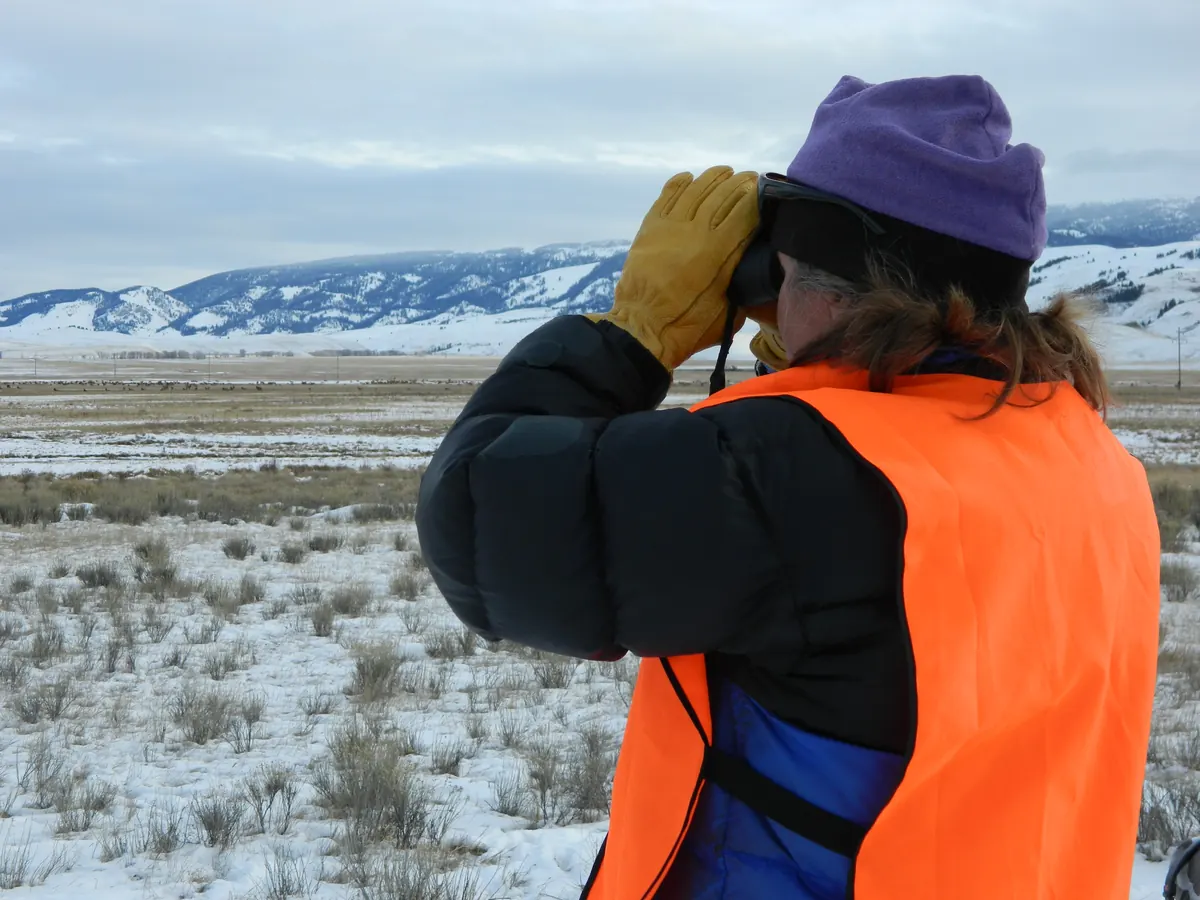
Audubon’s 127th Christmas Bird Count opens on Monday, December 14, and closes on Tuesday, January 5. Each count picks one day in that span and tries to record every bird inside a circle 15 miles wide. The count began in 1900 as a conservation-minded alternative to the old holiday custom of competitive bird shooting, and it is now one of the longest-running community science projects anywhere. Connecticut, for a small state, fields a lot of circles: the Connecticut Ornithological Association listed 18 for last winter, spread from Greenwich-Stamford and Lakeville-Sharon to Napatree Point on the Rhode Island line.
-
New Haven, the 127th count
Saturday, December 19 · The New Haven circle, including Hamden
The New Haven Bird Club calls this year’s effort its 127th annual count, which makes it one of the oldest in the country. Chris Loscalzo compiles it, and the club welcomes people who can give a few hours in the field or who live inside the circle and want to report what visits the yard. Everyone is invited to the compilation dinner at 5 p.m. at the Whitney Center in Hamden, where the day’s species list is read out. For the history first, the club’s December 10 meeting at 7 p.m. is a talk by Steve Broker on the count’s long record.
-
Hartford, centered on the Old State House
Sunday, December 20 · A circle with a 7.5-mile radius around downtown Hartford
Hartford Audubon counts the next day, with Jay Kaplan organizing area captains for each slice of a circle that takes in river meadows, reservoirs and suburban feeders as well as the city. Give it an hour or the whole day; reach the organizer through the Connecticut Ornithological Association’s calendar listing.
-
The rest of the state’s circles
Dates set by each compiler, December 14 to January 5 · From Greenwich to Napatree, Barkhamsted to Old Lyme
Last season the state’s counts were spread over seven days, from mid-December weekends to the first Sunday in January. The 2026–27 schedule was not yet posted when this guide was written; the Connecticut Ornithological Association’s CBC page lists every circle with its date and compiler once the compilers set them, so pick the one nearest home.
Where can you see bald eagles in Connecticut in December?
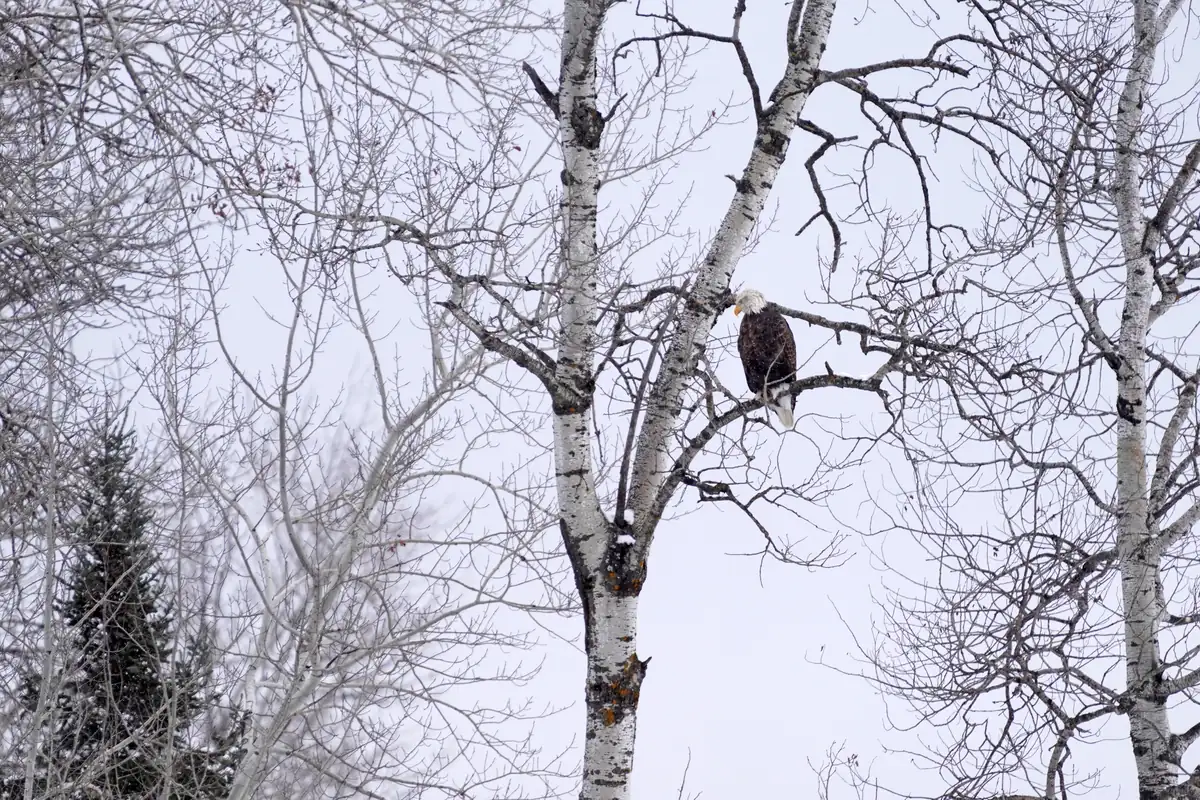
Wherever the water stays open. DEEP’s Wildlife Division says up to 100 bald eagles winter in Connecticut, from December to early March, on the major rivers and at large reservoirs; they come for fish when the lakes and rivers of Maine and Canada lock up with ice. December is the month they start to arrive, and more tend to come as the freeze spreads up north. At night many gather at shared roost trees, sometimes a dozen miles or more from where they fed during the day.
-
Shepaug Dam, Southbury
Usually from the second half of December to mid-March · Housatonic River below the Shepaug hydro station
FirstLight, which operates the dam, describes the site as possibly the largest concentration of wintering eagles in New England, and visitors have seen 20 or more in a single day. The turbines keep the water below the dam moving and ice-free, so fish are always within reach. Viewing is from a blind with spotting scopes and volunteers, on Wednesdays, Saturdays and Sundays; admission is free, but you must book ahead online. Last winter the season opened December 21, and one recent season it did not open until December 28; FirstLight posts each year’s dates when reservations open, and it asks visitors to call 860-895-6468 in doubtful weather to check whether the blind is open.
-
The lower Connecticut River
December through early March · Essex, Deep River, Haddam and the river towns; Long Island Sound coves
Along the tidal lower river, eagles sit in tall trees on the banks between fishing flights; scan the dead treetops and the edges of any ice. WSHU, reporting in 2025, put Connecticut’s breeding population at 86 pairs as of 2023, so resident eagles and northern visitors share the river in winter.
Eagles in Connecticut nest early. DEEP says the breeding season begins in January, with most eggs laid in February and March, so pairs you see sitting close together on a December branch may already be planning a nest nearby. Give any nest you find a wide berth.
What winter wildlife arrives on the Connecticut shore in December?
The Sound gets busier as the land gets quieter. Harbor seals return, sea ducks and loons that arrived in November settle into their winter waters, and some years an Arctic owl sits on the dunes.
-
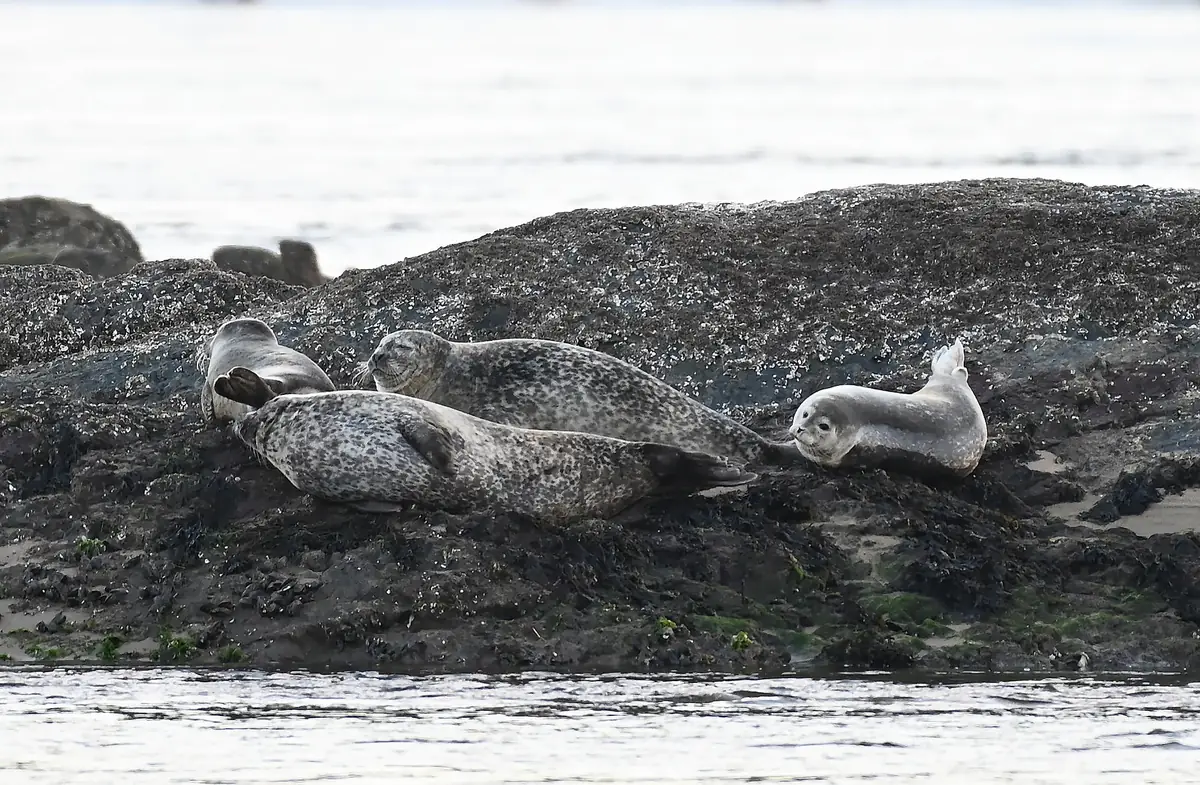
Harbor seals on the rocks
December to March · Exposed rocks at low tide; Falkner Island off Guilford; the eastern Sound
Menunkatuck Audubon Society in Guilford says harbor seals arrive along Connecticut’s shore in December and stay until March. Five to six feet long, gray or silver with dark spots, they haul out together on bare rocks as the tide drops; look from a headland at low tide with binoculars. Seals are protected by the federal Marine Mammal Protection Act, so keep well back. If one on a beach looks sick or hurt, call the Mystic Aquarium or the Maritime Aquarium at Norwalk rather than approach it.
-
Snowy owls, some years
From late November in flight years · Milford Point, Stratford’s marshes and Sikorsky airport, other wide beaches
Snowy owls hunt open, flat ground that looks like tundra, which on the Connecticut coast means beaches, marshes and airfields. In the big flight of 2013, Connecticut Audubon reported birds at its Milford Point Coastal Center and around Sikorsky airport in Stratford by the day before Thanksgiving. Other winters bring none at all. If one turns up, watch from far enough away that it keeps its eyes half closed; an owl that keeps flushing burns energy it needs to survive the winter.
-
Sea ducks, loons and the winter beach
All month · Hammonasset Beach State Park, Sherwood Island State Park, Lighthouse Point
The scoters, long-tailed ducks and red-breasted mergansers that arrived in November are now settled for the winter, with common loons in plain gray winter dress among them. A calm, gray morning is best for scanning. The New Haven Bird Club’s first-Wednesday walks at Hammonasset on December 2 and Sherwood Island on January 6 are an easy way to learn them with experienced leaders.
For what came before, including the November arrival of the sea ducks and the last hawks at Lighthouse Point, see our Connecticut November guide.
Why do you hear owls hooting in Connecticut in December?
Because December is the start of their breeding year. While most birds are simply getting through the winter, Connecticut’s great horned owls are setting up housekeeping.
-
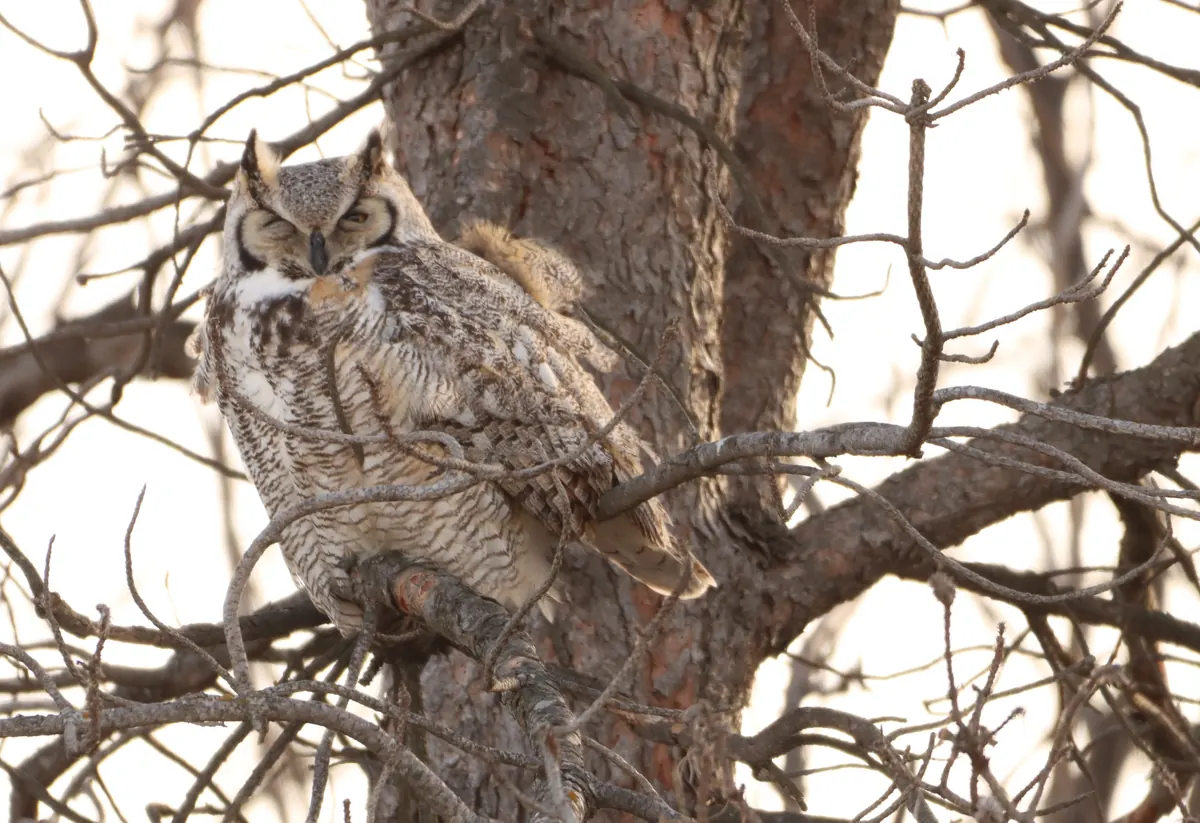
Great horned owls claiming territory
Dusk and the first hours of darkness, December into February · Mature woods with clearings and edges, most commonly in the western and central parts of the state
Writing in DEEP’s Connecticut Wildlife magazine, Paul Fusco of the Wildlife Division described the classic “hoot-owl” call as a deep series of three to seven hoots, made as males lay claim to territories and as courtship moves toward nesting. Neighboring males answer from their own perches, so on a still evening you may hear two or three. Territories and nest sites are claimed by early winter, and nesting follows shortly after. The owls do not build their own nests; they borrow old ones made by hawks, crows, ospreys or herons. One or two eggs hatch in mid- to late winter, often while snow is still on the ground.
-
How to find one
Just after sunset · Forest edges, treetops at the edge of a field
Fusco suggests dusk as the best time to see one, when the owl leaves its daytime hiding place for a high perch to scan for prey. By day, a crowd of crows mobbing one spot in the woods often gives a roosting owl away.
-
Barred and screech-owls too
Calm nights · Swamps and river woods (barred); suburban yards and old trees (eastern screech-owl)
The barred owl’s rhythmic “who cooks for you” carries across wet woods, and the little eastern screech-owl’s descending whinny can come from any big old tree in a suburban yard. Please don’t play recordings over and over to call an owl in; it pulls the bird away from hunting at a hard time of year.
How do Connecticut’s animals get through the winter?
Every animal you met in October has a different plan for the cold. Some sleep, some slow down, some freeze, and some simply keep eating. December is when those plans take over.
-
Bears in their dens, cubs on the way
Denned from late November; cubs born late December into early January · Statewide, most in the northwest
DEEP says most Connecticut bears den from late November through mid-March, under fallen trees, in brush piles and rock ledges and sometimes under a deck. They are not true hibernators: body temperature drops and the heart slows, but they can rouse on mild, snowless days. Cubs are born in the den around the turn of the year, blind and toothless. Because bears are least active from mid-December through February, DEEP allows bird feeders in that window only where no bears are around.
-
Woodchucks fast asleep
From late October until March · Burrows below the frost line
The woodchuck is Connecticut’s textbook hibernator. DEEP’s fact sheet says most have begun their winter sleep by the end of October, curled up in grass-lined nests below the frost line, with heart rate, breathing and metabolism greatly reduced as they live off stored fat. They wake slowly in March.
-
Wood frogs, frozen solid
All winter · A few centimeters under the leaf litter near woodland pools
Wood frogs do not dig deep. A Yale School of the Environment study at Yale-Myers Forest in Tolland County notes that they overwinter only 2 to 10 centimeters below the soil surface and can survive with up to 70 percent of their body water turned to ice. Ice forms around the cells, not inside them; the heart stops beating until the frog warms. In late winter they revive and head for the vernal pools in late winter, among the first frogs to call.
-
Bucks dropping antlers
Mid-December to late January · Woods, field edges and trails
DEEP says white-tailed deer shed their antlers from mid-December to late January, after the rut winds down, and that in winter they browse hardwood twigs and buds and the needles of white pine and hemlock. Rodents gnaw dropped antlers for the calcium, so a fresh, unchewed one is a lucky find.
-
Tracks in the first snow
The morning after any snowfall · Trail edges, stone walls, stream banks
A fresh inch of snow records the night’s traffic. Look along stone walls for the neat single-file line of a red fox and the paired bounds of a gray squirrel, and along streams for mink and raccoon. Draw one print and the pattern of four on the tracks plate of the Naturalist’s Field Journal, with the age of the snow. Riverbank mud works on snowless days.
Which trees and shrubs stay green or bright in a Connecticut winter?
With the oaks and maples bare, the woods show what is evergreen and what carries fruit into the cold. This is the easiest time of year to learn a few plants by sight.
-
Mountain laurel, the state flower
Leaves green all winter · Rocky hillsides and dry oak woods statewide, especially in the hills
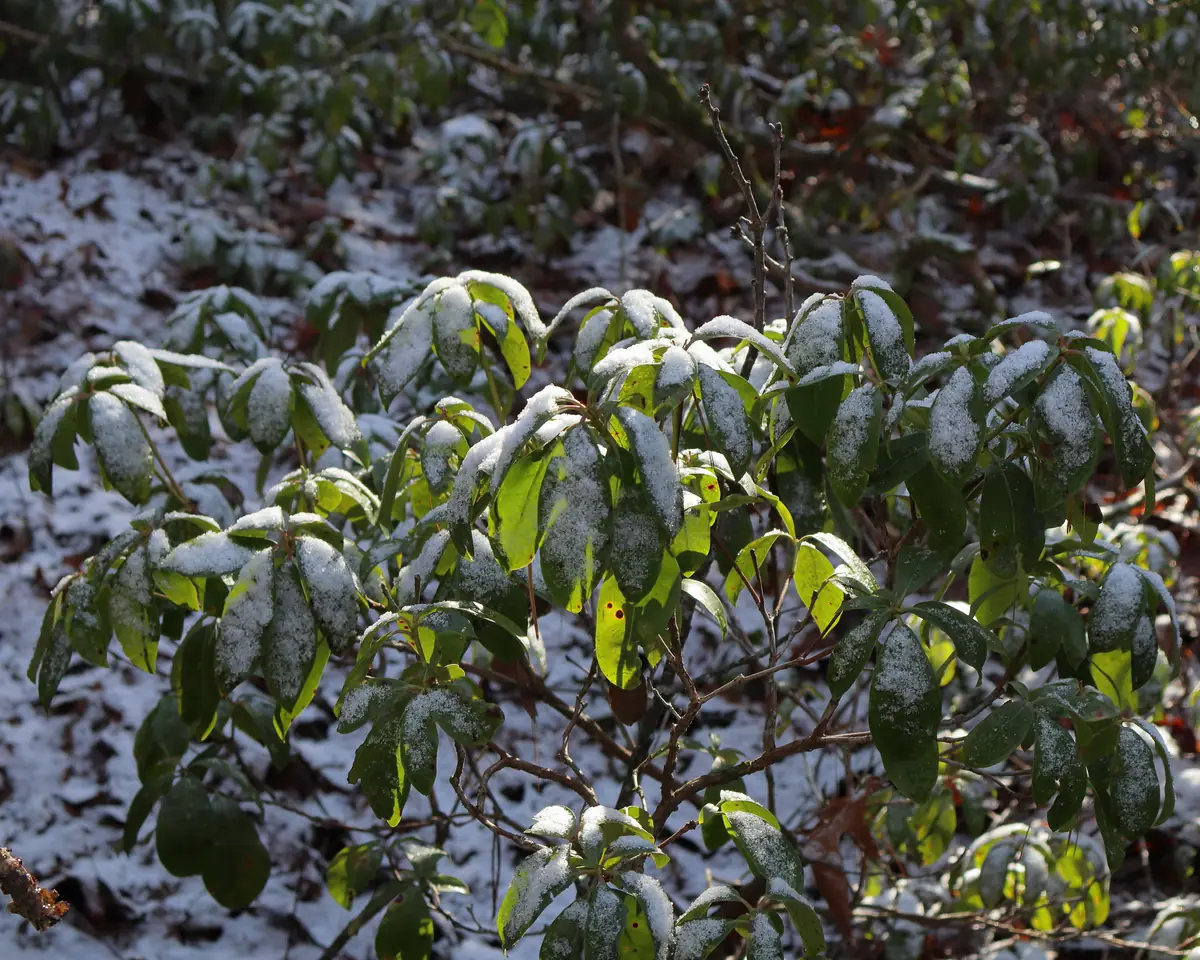
The General Assembly made mountain laurel Connecticut’s state flower in 1907. In June it is all pink and white; in December it is the thicket of glossy, leathery, oval leaves that keeps a hillside green under bare oaks. Go Botany notes that its leaves stay green all winter, and in the gray months a laurel slope is often the brightest green in sight. Snow piles on the broad leaves and bends whole shrubs to the ground, then they spring back as it melts.
-
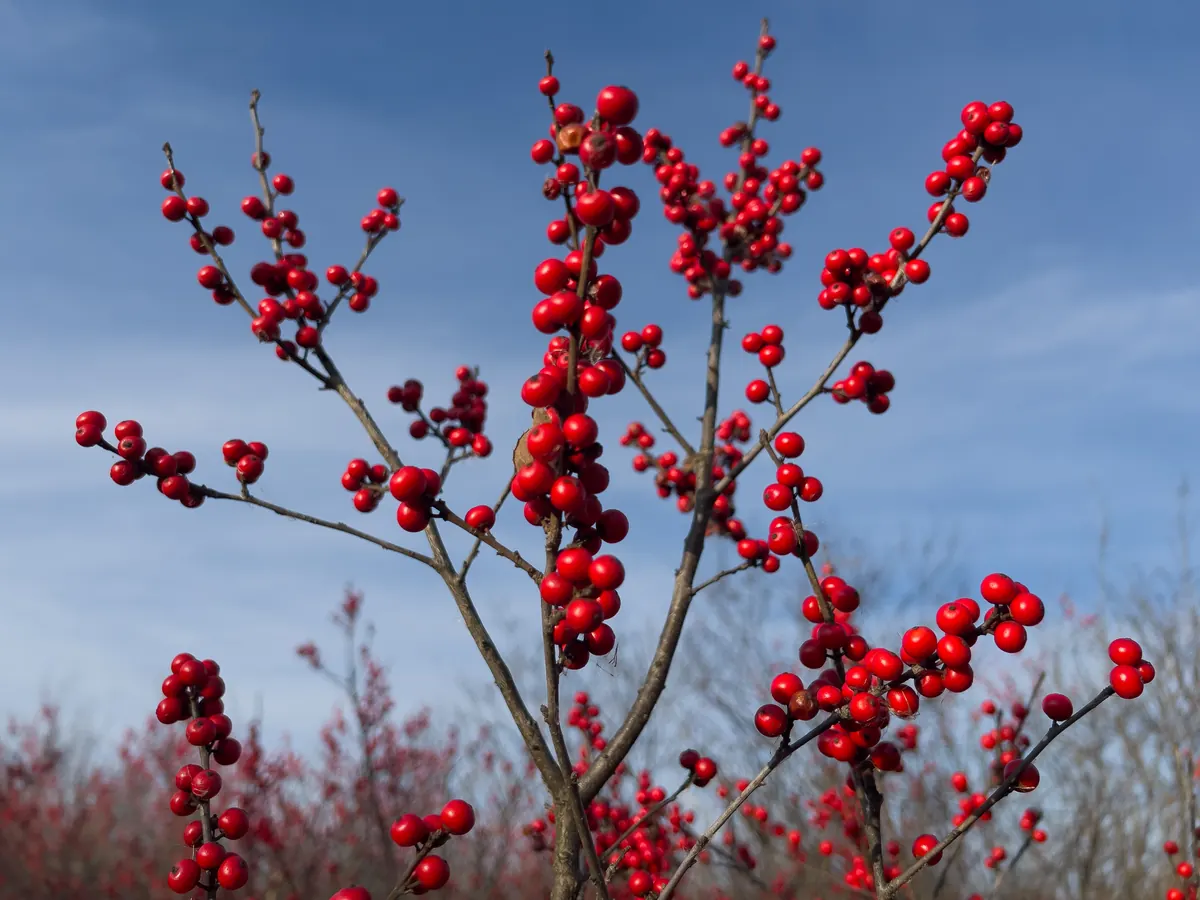
Winterberry, the native holly that drops its leaves
Red fruit from fall into midwinter · Swamp edges, pond shores and wet thickets
Winterberry loses its leaves in autumn but keeps its bright red berries, which glow along wetland margins all winter. Only female plants carry fruit, and Connecticut Audubon notes that over 48 species of birds eat the berries, among them robins, cedar waxwings, bluebirds and mockingbirds. The fruit often hangs on until a flock of robins strips a whole shrub in an afternoon, so check one patch each week and note when the berries go.
-
Eastern hemlock, and the woolly adelgid
All year; adelgid wool most visible March to May · Cool ravines and north-facing slopes
Hemlock is the soft, flat-needled evergreen of shaded stream valleys, with two white lines under each needle. The hemlock woolly adelgid, a tiny sap-feeding insect first reported to the Connecticut Agricultural Experiment Station in New Haven in 1985, has weakened stands across the state. DEEP says its white woolly egg sacs are easiest to spot from March to May, and that severe cold can kill enough adelgids for the trees to recover the next spring, so a bitter December is, in that one sense, good news for hemlocks.
When is the earliest sunset in Connecticut?
Not on the shortest day. Hartford’s sunset bottoms out at 4:20 p.m. around December 8 and sits on that same minute from December 3 to 13, while sunrise keeps creeping later until early January. When the solstice arrives at 3:50 p.m. Eastern on Monday, December 21, and the sun turns north, sunset has already slipped back to 4:23 p.m.; the sun rises at 7:15 a.m., for 9 hours 8 minutes of daylight. On New Year’s Eve Hartford’s sun sets at 4:30 p.m. and the day has grown back to 9 hours 12 minutes, though sunrise, at 7:18 a.m., is still at its latest. Earth’s tilted axis and slightly oval orbit together make solar noon drift later through December, which is why the two ends of the day don’t move in step.
| City | Dec 1 | Dec 21 | Dec 31 | Earliest sunset |
|---|---|---|---|---|
| Torrington | 9 h 23 m | 9 h 08 m | 9 h 11 m | 4:22 p.m., Dec 9 |
| Hartford | 9 h 22 m | 9 h 08 m | 9 h 12 m | 4:20 p.m., Dec 8 |
| Putnam | 9 h 21 m | 9 h 08 m | 9 h 11 m | 4:16 p.m., Dec 9 |
| Waterbury | 9 h 24 m | 9 h 10 m | 9 h 13 m | 4:22 p.m., Dec 8 |
| Danbury | 9 h 24 m | 9 h 10 m | 9 h 14 m | 4:24 p.m., Dec 8 |
| New London | 9 h 25 m | 9 h 11 m | 9 h 15 m | 4:19 p.m., Dec 8 |
| New Haven | 9 h 25 m | 9 h 12 m | 9 h 15 m | 4:22 p.m., Dec 8 |
| Stamford | 9 h 26 m | 9 h 13 m | 9 h 16 m | 4:26 p.m., Dec 8 |
Because the low point is so flat, each date in the table is the middle of a week or more when sunset holds on its earliest minute; for every town listed, that middle falls on December 8 or 9. For your own address, the Field almanac gives daily sunrise and sunset times and the length of twilight. The Connecticut frost dates page, meanwhile, already looks ahead to the last spring freeze.
How cold and snowy is December in Connecticut, and what could El Niño mean this winter?
December is the first true winter month here, and the gap between the hills and the shore is wide. NOAA’s 1991–2020 normals give Norfolk, at 408 meters in the Northwest Hills, an average December high of just 34.6 °F, a low of 21.1 °F and 15 inches of snow. Bradley airport in the Connecticut River Valley averages 40.6 °F and 24.6 °F with about 10 inches, while Bridgeport on the Sound stays several degrees milder with 5.5 inches, and much of the month’s precipitation there falls as rain. The table shows the spread.
| Station | Average high | Average low | Precipitation | Snowfall |
|---|---|---|---|---|
| Norfolk 2 SW (Northwest Hills) | 34.6 °F | 21.1 °F | 4.86 in | 15.0 in |
| W Thompson Lake (Quiet Corner) | 40.4 °F | 21.6 °F | 4.72 in | 6.5 in |
| Hartford Bradley International Airport (Windsor Locks) | 40.6 °F | 24.6 °F | 4.08 in | 10.1 in |
| Storrs (Mansfield) | 40.1 °F | 25.3 °F | 4.50 in | 7.2 in |
| Danbury Municipal Airport (western hills) | 40.8 °F | 23.9 °F | 4.24 in | no normal |
| Norwich Public Utility Plant (southeast) | 43.2 °F | 27.0 °F | 4.97 in | 5.6 in |
| New Haven Tweed Airport (central shoreline) | 43.7 °F | 28.9 °F | 3.53 in | no normal |
| Bridgeport Sikorsky Memorial Airport (Stratford) | 43.8 °F | 30.2 °F | 3.98 in | 5.5 in |
Snow is only half the story: a coastal storm that brings a foot to Norfolk can bring cold rain to Bridgeport. Bradley’s normal snowfall climbs to about 14 inches in each of January and February, so December is the warm-up.
This winter has an unusual driver. A Pacific warm event is building toward the top of the scale: in mid-September, federal ENSO forecasters judged a very strong event by midwinter to be over 90 percent likely. NOAA’s Climate.gov, in a 2023 analysis of snowfall in past El Niño winters by Michelle L’Heureux and Brian Brettschneider, found that interior New England has tended to get less snow than normal in those winters, and that the pattern sharpens in moderate and strong events, though single winters vary a great deal. For Connecticut that tilts the odds toward mixed storms, with rain reaching farther inland and the snow line mattering more than the number of storms. The government’s seasonal outlook for winter is due on October 15; find it, rather than any guess, at the Climate Prediction Center’s outlook maps, and check Weather now before a long walk.
What is in Connecticut’s night sky in December 2026?
Long nights and a moon that cooperates for the big meteor shower make this one of the year’s best sky months. All times are Eastern Standard Time.
-
The Geminids, under a dark sky
Night of Sunday, December 13, into Monday, December 14 · Anywhere dark; the radiant near Castor and Pollux is high after midnight
Under a perfect sky the Geminids could deliver around 150 meteors an hour at their December 14 maximum, by the International Meteor Organization’s figures, which makes them the richest shower of the year. Real skies with some light pollution give far fewer, but a few dozen an hour from a dark field in the Northwest Hills or the Quiet Corner is realistic. A thin crescent moon goes down in the evening and leaves the sky moonless; meteors pick up through the night and peak around 2 a.m., with Gemini high overhead. Dress very warmly and lie back on a pad.
-
The Cold Moon, the closest of 2026
Full at 8:28 p.m. Wednesday, December 23 · Rising in the east-northeast near sunset
Full moon and perigee, the moon’s closest approach, fall roughly seven hours apart this time, so EarthSky and BBC Sky at Night both rank this as the nearest full supermoon of 2026, about 356,700 km from Earth. It looks full on Christmas Eve too. Catch it rising over the Sound or a frozen reservoir, and on the evening of December 21 look for the bright gibbous moon near the Pleiades.
-
Venus at dawn, Saturn at dusk
All month · Venus southeast before sunrise; Saturn south and southwest after dark
Venus is a dazzling morning star, climbing higher each week toward its greatest distance from the sun in early January; at dawn on December 4 and 5 the crescent moon passes close to it and the star Spica. Mars and Jupiter are morning planets in Leo, with Jupiter rising by mid-evening late in the month. In early evening Saturn is the bright planet on show, lower in the southwest each week.
-
The solstice, and a look ahead
Monday, December 21, 3:50 p.m.; Quadrantids night of January 3 · Sunset point on the southwest horizon
At the solstice the sun sets at its farthest point south along the horizon; mark it against a tree or rooftop and check again in March. The Ursids, around December 22, are washed out by the nearly full moon, but the Quadrantids peak late on January 3, 2027, near new moon, and Comet Encke should reach binocular brightness in late January. With the solar cycle now declining but still lively, a faint aurora low in the north is possible on a long December night, though none can be forecast this far ahead.
| Phase | Date | Time |
|---|---|---|
| Last quarter | Tuesday, Dec 1 | 1:08 a.m. EST |
| New moon | Tuesday, Dec 8 | 7:52 p.m. EST |
| First quarter | Thursday, Dec 17 | 12:42 a.m. EST |
| Full moon, the Cold Moon (a supermoon) | Wednesday, Dec 23 | 8:28 p.m. EST |
| Last quarter | Wednesday, Dec 30 | 1:59 p.m. EST |
No eclipse can be seen from Connecticut this month. Before the Geminid night, see whether clouds will cooperate on Today’s sky; our moon phases page lists each evening’s moonrise for your own town.
What can Connecticut families do outdoors in December?
- Wednesday, December 2: Hammonasset Beach State Park, Madison. The New Haven Bird Club’s first-Wednesday walk, 8 to 11 a.m., meeting at the Shoreline Greenway Trail parking area on the Boston Post Road. Waterfowl, raptors and winter songbirds.
- Saturday and Sunday, December 5 and 6: evergreen crafts in Mystic. The Denison Pequotsepos Nature Center runs an Evergreen Gnomes session (1 to 4 p.m.) and wreath making (5 to 8 p.m.) on Saturday and an open evergreen workshop on Sunday afternoon.
- Wednesday, December 9: Coastal Birding Holiday, a Connecticut Audubon EcoTravel day trip along the Connecticut and Rhode Island shore, 11 a.m. to 7 p.m.; book through Connecticut Audubon.
- Thursday, December 10: the story of the New Haven count, a New Haven Bird Club meeting at 7 p.m.
- Sunday night, December 13: the Geminids.
- Saturday, December 19, and Sunday, December 20: Christmas Bird Counts in New Haven and Hartford. Families inside the New Haven circle can even count from the kitchen window.
- Monday, December 21: solstice sunset.
- Wednesday, December 23: Cold Moon night. Watch the year’s biggest full moon come up at dusk.
- Late December: eagles at Shepaug. The Southbury blind has opened in the second half of December lately; check FirstLight for 2026–27 dates and book a free slot.
- Friday, January 1, 2027: First Day Hikes. DEEP has offered free New Year’s Day hikes at about 16 state parks and forests in recent years, at places such as Sleeping Giant, Gillette Castle and Hammonasset, with no registration required. Check DEEP’s site for the 2027 locations.
- Wednesday, January 6: Sherwood Island State Park, the New Haven Bird Club’s winter walk for sea ducks and snow buntings, 8 to 11 a.m.
- Citizen science. Count for a CBC circle, report weekly to Project FeederWatch (open to April 30, feeders optional), and log winter walks in eBird. Under Passport to the Parks, state park parking costs nothing for cars registered in Connecticut.
These listings come from the organizers’ calendars as of October 2; many programs need registration and winter weather can cancel them, so confirm before setting out. The nature hub collects the rest of our state-by-state guides.
Safety notes for December in Connecticut
- Hunting seasons and orange. The firearms deer season on private land and the no-lottery shotgun season on state land run through Tuesday, December 8. Muzzleloader deer season follows, December 9–31 on private land and December 9–22 on state land. On private land, bowhunters may take deer and turkey until December 31; state land reopens to archery December 23–31, and landowner deer hunting runs to the end of the month. Pheasant, rabbit, gray squirrel and fox stay open through December 31, snowshoe hare since November 21. On the water, the late duck season lasts until January 9 north of Interstate 95 and January 19 south of it, and brant open December 7 in the North Zone and December 16 in the South Zone. Connecticut’s orange rule applies from September 1 until the last day of February: hunters need 400 square inches or more of it on the upper body, showing all the way around; bowhunters may skip it through December 31 only in a stand at least 10 feet up. Anyone walking in a state forest or wildlife management area this month should put on orange as well, dogs included.
- Sundays. On private land, most species may now be hunted on Sundays; deer and turkey hunters need the owner’s written consent, and a blazed public trail gets a 40-yard no-hunting buffer. Migratory birds, including ducks and geese, may not be hunted on Sundays, and state land stays closed to Sunday hunting.
- Thin ice. DEEP says to stay off new, clear ice less than 4 inches thick, and that white “snow ice” is only about half as strong. December ice is almost always thinner than it looks, especially over moving water, near inlets and around river bends. Never walk out to rescue a dog; call 911 and reach or throw something from shore.
- Short days and cold. With sunset around 4:20, start winter hikes by early afternoon, carry a headlamp and a spare layer, and tell someone your route. Wet clothing and wind on an exposed ridge can bring on hypothermia even above freezing.
- Storms and power. Heavy wet snow can bring down limbs and lines; keep flashlights charged and never run a generator indoors.
- Bears on warm days. Denned bears can wake in a mild spell. If a bear visits a feeder, take it down for the season and report problem bears to DEEP at 860-424-3333.
Sources
- National Audubon Society: Christmas Bird Count (dates and history)
- National Audubon Society: Join the Christmas Bird Count (127th count, December 14, 2026 to January 5, 2027)
- Connecticut Ornithological Association: New Haven Bird Club Christmas Bird Count, December 19, 2026
- Connecticut Ornithological Association: Hartford Audubon Christmas Bird Count, December 20, 2026
- Connecticut Ornithological Association: Christmas Bird Counts 2025–2026 schedule (18 circles)
- New Haven Bird Club: events calendar, December 2026
- CT DEEP: bald eagle fact sheet (wintering eagles, roosts, nesting season)
- FirstLight: Shepaug Recreational Area and Bald Eagle Observatory
- FirstLight: Shepaug Bald Eagle Observatory opens for the winter (2023 season)
- WSHU: Now’s a great time to spot wintering bald eagles in CT (February 13, 2025)
- Menunkatuck Audubon Society: Seals visit Long Island Sound in winter
- Connecticut Audubon Society: Snowy Owls in Milford and Stratford (November 28, 2013)
- National Audubon Society: Birding in Connecticut (Hammonasset, Sherwood Island)
- CT DEEP, Connecticut Wildlife, March/April 2011: Connecticut’s tiger of the night, the great horned owl (Paul Fusco)
- CT DEEP: black bear fact sheet (denning, cubs, bird feeders)
- CT DEEP: woodchuck fact sheet (hibernation)
- Yale School of the Environment: freeze tolerance of wood frogs at Yale-Myers Forest (Yara Alshwairikh, 2021)
- CT DEEP: white-tailed deer fact sheet (antler shedding, winter diet)
- State of Connecticut: the state flower (mountain laurel, 1907)
- Native Plant Trust, Go Botany: Kalmia latifolia (mountain laurel)
- Connecticut Audubon Society: Winterberry, native holly (December 2022)
- Native Plant Trust, Go Botany: Polystichum acrostichoides (Christmas fern)
- Native Plant Trust, Go Botany: Ilex verticillata (common winterberry)
- CT DEEP: hemlock woolly adelgid
- U.S. Naval Observatory: Earth’s seasons, 2026 (December solstice)
- U.S. Naval Observatory: sunrise and sunset, Hartford, December 8, 2026
- U.S. Naval Observatory: moon phases from November 2026
- NOAA NCEI: U.S. climate normals 1991–2020, monthly, Connecticut stations
- Climate Prediction Center: ENSO diagnostic discussion, September 10, 2026
- Climate Prediction Center: seasonal (90-day) outlooks
- NOAA Climate.gov: S(no)w pain, s(no)w gain, how does El Niño affect snowfall over North America? (October 26, 2023)
- International Meteor Organization: 2026 meteor shower calendar (Geminids, Ursids)
- International Meteor Organization: 2027 meteor shower calendar (Quadrantids)
- EarthSky: what is a supermoon (2026 list)
- BBC Sky at Night Magazine: supermoons in 2026
- EarthSky: Venus at greatest western elongation
- RASC Observer’s Handbook 2026: lunar occultations (the Pleiades, December 21)
- NOAA Space Weather Prediction Center: solar cycle progression
- Star Walk: Comet Encke in 2027
- NASA: lunar and solar eclipses of 2026
- Denison Pequotsepos Nature Center: events, December 2026
- Connecticut Audubon Society: EcoTravel day trips (Coastal Birding Holiday, December 9, 2026)
- CT DEEP: Connecticut celebrates the new year with First Day Hikes (2024 release)
- Project FeederWatch: how to participate
- CT DEEP: Passport to the Parks
- CT DEEP: hunting season date summary from the 2026 Connecticut Hunting and Trapping Guide (PDF)
- CT DEEP: 2026 hunting laws and regulations (fluorescent orange, Sunday hunting)
- CT DEEP: 2026–2027 Connecticut Migratory Bird Hunting Guide (PDF; duck and brant seasons)
- CT DEEP: ice safety
- Photos via Wikimedia Commons; licenses and photographers are credited under each picture
