What to look for in nature in Delaware this April
April is the month when Delaware turns green and loud. The first wave of horseshoe crabs and shorebirds starts to gather on the bayshore beaches, piping plovers are back on the sand at Cape Henlopen and Fowler Beach, and shad push up the Nanticoke and Brandywine to spawn. The early warblers show up along the swamps, purple martins return to their gourds, and the woodland pools are in full voice. Bluebells, trillium and dogwood bloom under trees that are only beginning to leaf out. Wild turkeys gobble from the field edges, spring turkey season opens on April 10, and Arbor Day falls on Friday, April 30. The Pink Moon turns full on the evening of April 20.
Other months in Delaware: October, November, December, January, February, March.
Start here
- Walk a bay beach at high tide. Late April is the early edge of the horseshoe crab season in Kent County, and the first shorebirds are on the flats. Pick a beach such as Slaughter Beach or Kitts Hummock, go around a high tide, and watch from the beach access without stepping on the eggs.
- Spend an evening at a pool edge. Bombay Hook lists the peeper and wood frog choruses as in full voice in April. Go after dark on a mild night, stand still at the edge of a pond or flooded wood, and count how many kinds of calls you can separate.
- Look under the trees for the ephemerals. Bluebells, trout lily, bloodroot and spring beauty carpet the Piedmont woods in April, before the leaf canopy closes. Walk a park trail in the Brandywine or White Clay valleys, and keep to the path.
Keep a record: the first horseshoe crab on the beach and the first shorebird flocks belong in a daily field log or a dusk and dawn watch entry; the date a purple martin returns to a gourd and the first ruby-throated hummingbird at a feeder fit a nest-observed page and a birds-I-have-seen list; each frog or toad you can name by voice goes on a map of sounds; a flowering dogwood or a red maple in leaf makes a good tree through the seasons; and a shed turkey feather or a plover track in wet sand suits the feather found and tracks to know plates.
Regions used below: Piedmont: Wilmington, Hockessin and the Brandywine valley; Newark and White Clay Creek; Upper Bayshore and the C&D Canal: Blackbird Creek, Lums Pond; Dover, Kent County and Bombay Hook; Western Sussex: Seaford, Laurel, Trap Pond and the Great Cypress Swamp; Cape Region: Lewes, Milton, Cape Henlopen and Prime Hook; Rehoboth, the Inland Bays and Fenwick Island.
When do horseshoe crabs and shorebirds arrive on Delaware Bay?
The Delaware Bay shore hosts one of the great spring gatherings of the Atlantic coast, but most of it belongs to May. DNREC says that hundreds of thousands of horseshoe crabs come ashore each spring to spawn on the bayshore beaches, with the peak in May, and a Delaware tourism page puts the season at late April to mid-June. April is the opening act: a few crabs at the tideline, the first flocks on the mudflats, and quiet beaches.
-
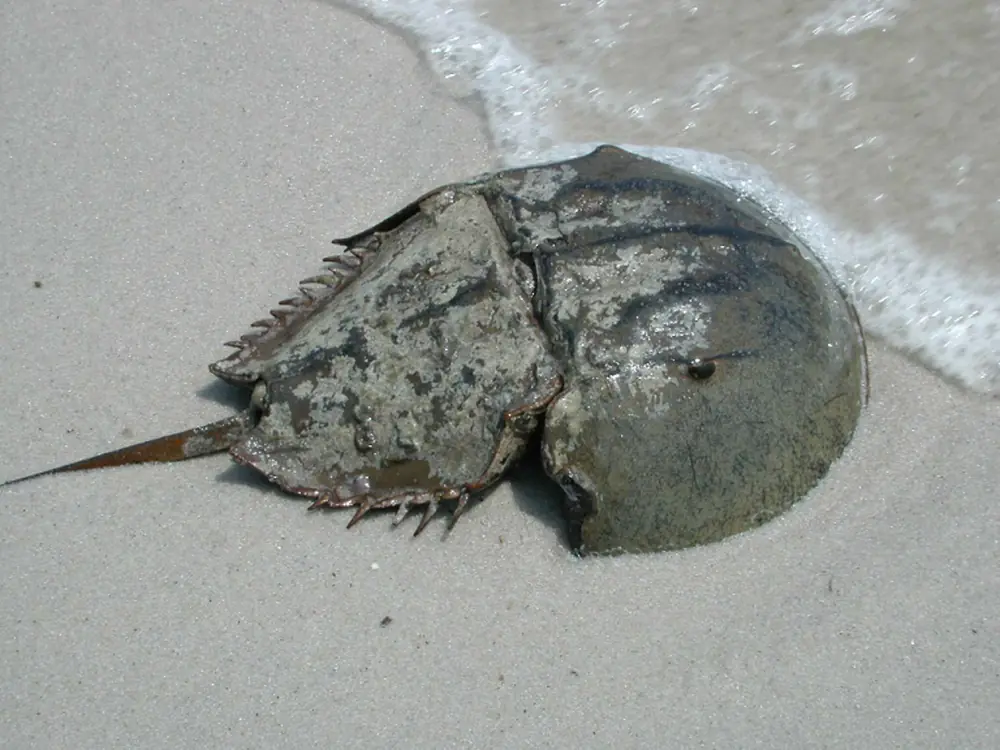
Horseshoe crabs
Arriving from late April; peak spawning in May, on the new and full moon high tides · Mispillion Harbor, Slaughter Beach, Kitts Hummock, Pickering Beach and Bowers Beach, on the Kent County bayshore
The Chesapeake Bay Program describes a horseshoe crab as up to two feet long, a kind of living fossil that has been around for more than 300 million years. DNREC says a female lays clusters of about 4,000 eggs several times a night, and that it takes about nine years for a crab to mature. Tides run highest around the new and full moons, which fall on April 6 and April 20 this month, so the beaches at the top of a spring tide are the places to start. DNREC calls Mispillion Harbor ideal for spawning because it is shallow, calm and sandy.
-
The first shorebirds
Late April through early June; peak from early May · Bay beaches and the Mispillion Harbor flats
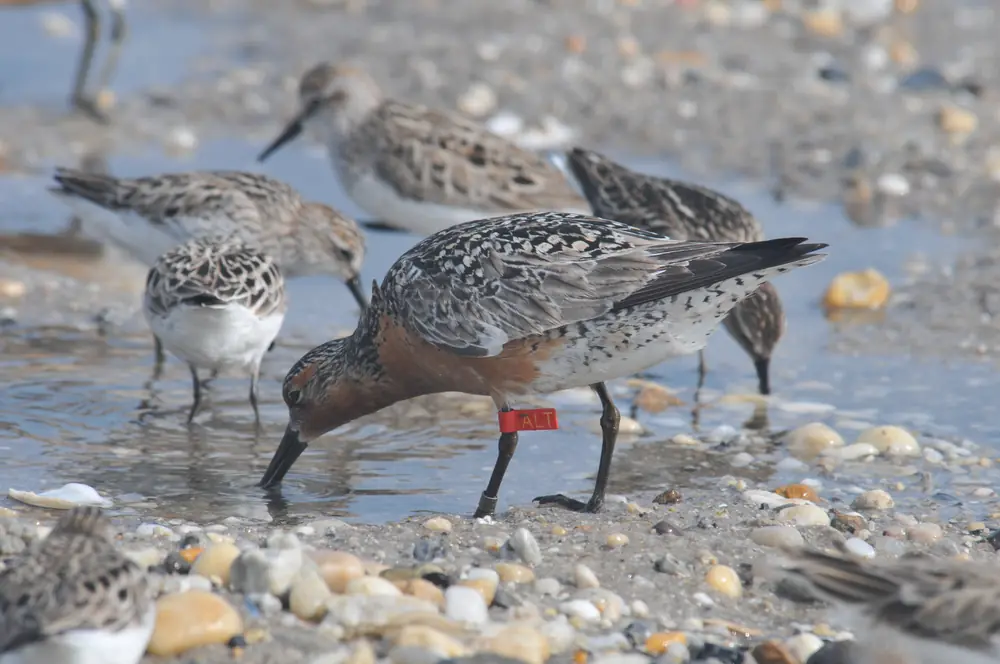
DNREC says that as many as 30 shorebird species visit the bay in May, including red knots, ruddy turnstones, semipalmated sandpipers, sanderlings and dunlins. The Delaware tourism page gives late April as the start of the show and early May through the end of the month as the busiest stretch. If you go in April, expect smaller flocks than the ones in the photographs, and be glad of the elbow room.
-
Why the eggs matter to red knots
The stopover lasts about two weeks in May · The same beaches
DNREC says that more than 90 percent of a red knot’s diet on the bay is horseshoe crab eggs, and that the birds can double their weight in about two weeks before flying on to the Arctic. Nearly 100,000 red knots once made the stopover, and only about 40,000 visited in 2019, according to the state’s shorebird program, so a flock that is disturbed loses something real.
DNREC asks visitors to follow the access rules at each beach, and its shorebird program advises staying at least 400 feet from feeding birds, keeping dogs on a leash and never chasing a flock. If you see a horseshoe crab stranded on its back, the Delaware tourism page says to turn it over gently by the edge of the shell and never by the tail. The DuPont Nature Center at Mispillion Harbor, which DNREC lists as a viewing site, has an observation deck and a live camera. If you cannot get to the shore, watch the camera from home and note the date the first crabs show up.
Where are the piping plovers nesting in Delaware in April?
Two months after the closure at The Point began, the sand there is a nursery. DNREC says piping plovers begin arriving and nesting on Delaware’s beaches in March and generally head south by September. Cape Henlopen State Park has historically been the main site, and Fowler Beach in Prime Hook National Wildlife Refuge has hosted nesters since 2016. April is when pairs scrape their nests and the first eggs appear, so the fenced and posted areas matter most now.
-
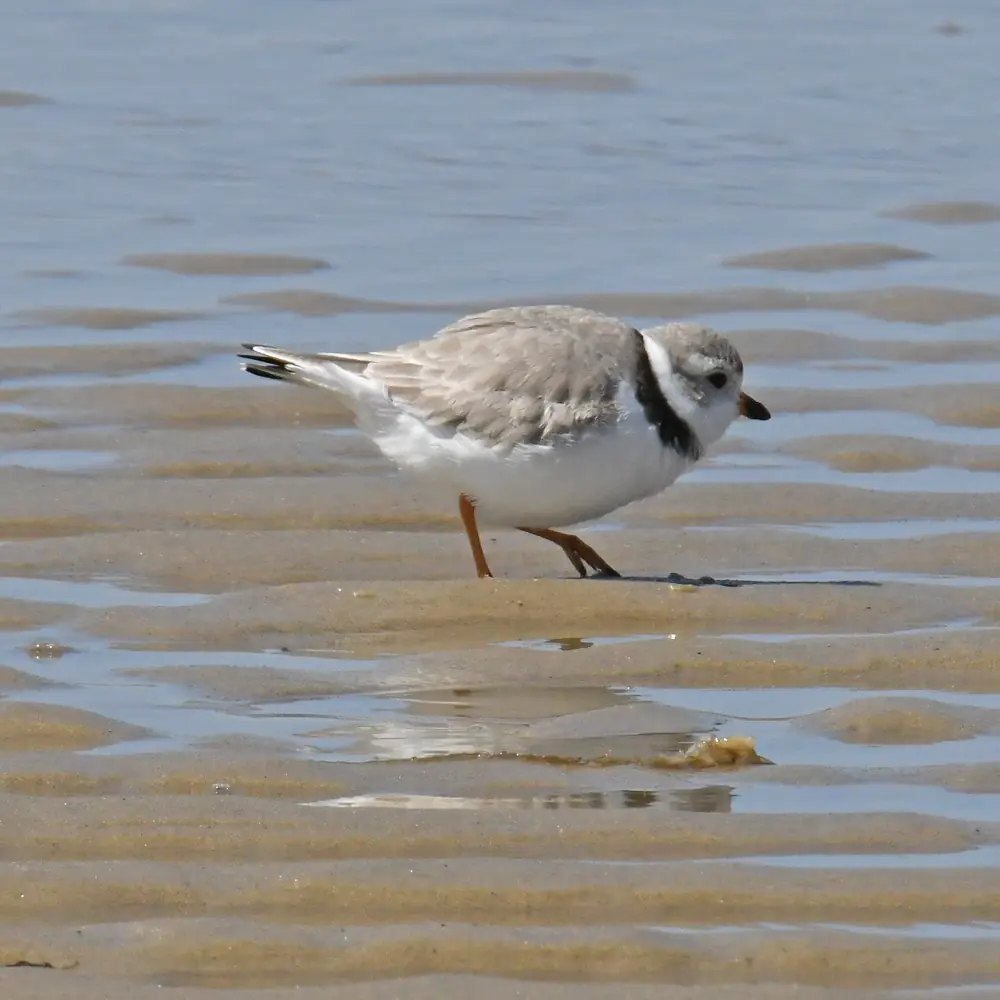
Piping plovers
Pairs on territory in April; nests through the summer · The Point at Cape Henlopen State Park, Lewes; Fowler Beach at Prime Hook National Wildlife Refuge, Milton
The piping plover is a small, pale shorebird with a single dark neck band and orange legs, and it is federally threatened. DNREC counted 30 breeding pairs in Delaware in 2025, with 27 fledglings, or 0.90 fledglings per pair. The agency closes the suitable nesting habitat so that the birds have a place free of disturbance, and it asks visitors to stay out of closed areas. A bird that runs ahead of you or drags a wing is leading you away from a nest. Back off.
-
Oystercatchers and least terns
Arriving and settling in April and May · The same closed beaches and nearby bars
DNREC says the closure at The Point also protects American oystercatchers and least terns, along with the red knots that stop there. Prime Hook’s refuge page said that Fowler Beach was closed through September 30, 2026, to protect nesting piping plovers and least terns, so expect a similar closure this year and check the refuge for the dates.
The beach-nesting bird biologist at DNREC, Shawn Sullivan, takes questions at deshorebirds@delaware.gov or 302-255-1970, and the agency runs a volunteer program for people who want to learn why the closures matter. The Delaware Valley Ornithological Club lists loons, gannets, terns and piping plovers at Cape Henlopen in April, along with brown-headed nuthatches at the visitor center feeders.
Are shad running in Delaware’s rivers in April?
Yes. The Chesapeake Bay Program says adult American shad leave the ocean in spring to spawn in the river where they were born, and that pollution, overfishing and dams had cut their numbers sharply. Delaware has two shad stories, and both are about repair: a hatchery on the Nanticoke River in Sussex County, and a long campaign to open the Brandywine at Wilmington.
-
The Nanticoke Shad Hatchery
Adults collected from mid-March through April · Near Bethel, on the Nanticoke River, Sussex County
Every spring DNREC biologists collect adult shad from the Nanticoke and hold them in a spawning tank at the hatchery. Most of the adults go back into the river afterward. DNREC says it has stocked more than 11.4 million shad into the Nanticoke since 2000. The Chesapeake Bay Program’s photo essay reports that the facility stocked about 558,000 fish in spring 2013 and marked them with a chemical tag to measure survival.
-
Shad on the Brandywine
Spring runs; in 2020 juveniles were confirmed in July · The Brandywine at Wilmington, below and above the former West Street Dam
The City of Wilmington removed the West Street Dam in fall 2019. The Brandywine Conservancy reported shad caught in downtown Wilmington under the I-95 bridge the following spring, and the Delaware Nature Society said that a University of Delaware professor confirmed adult shad and hundreds of juveniles upstream of the old dam in July 2020. The society described eleven low dams in under twelve miles of the Delaware stretch, with the others slated for fish passage. Check the Brandywine Shad 2020 coalition for how far the project has come.
Fishing rules for shad and river herring are set by DNREC, and the Chesapeake Bay Program says commercial harvest is restricted across much of the region, so read the current Delaware fishing guide before you cast a line for either. For most people the better plan is to watch from a bridge or bank in the early morning, and to tell the Delaware Nature Society or DNREC what you saw.
Which birds arrive in Delaware in April?
The Delaware Ornithological Society’s president wrote that April is the beginning of the bird storm of spring migration, and that the birds arrive in full breeding colors with the males often singing. The society says Delaware has 15 breeding warbler species and another 20 that can pass through, and that May is the peak. April belongs to the early ones, the residents that are building nests, and a few beloved returnees.
-
Early warblers along the swamps
Early to mid-April; prothonotary warblers by the start of May · Nanticoke River (Cherry Walk), Trap Pond State Park, Blackbird State Forest, Bombay Hook
The Delaware Valley Ornithological Club recommends the Cherry Walk on the Nanticoke River for early migrants such as blue-gray gnatcatcher, yellow-throated, pine, palm and black-and-white warblers, Louisiana waterthrush and ovenbird. DNREC’s spring guide shows a prothonotary warbler photographed at Trap Pond State Park, home of the northernmost natural stand of baldcypress in the country. A Delaware Ornithological Society field trip on May 1 in 2022 went to the Nanticoke Wildlife Area to look for recently arrived prothonotary and other warblers, which gives you a sense of when to go.
-
Purple martins
April · Martin houses and gourd racks near open water and fields
The Bombay Hook wildlife calendar lists purple martins returning in April. A martin house should be ready before the scouts arrive.
-
Ruby-throated hummingbirds
First reports can come in the second week of April; they vary with the weather · Gardens, woodland edges and feeders statewide
Journey North’s update of April 8, 2025 said that Delaware had two reports of ruby-throated hummingbirds by then. A fresh feeder in early April gives you a chance to be among the first to report one.
-
The wading bird colony on Pea Patch Island
Nest building in April · Pea Patch Island, off Delaware City
The Delaware Valley Ornithological Club says heron numbers on Pea Patch Island increase dramatically in April as the birds build nests, and that great blue and little blue herons, three kinds of white egret, both night-herons and glossy ibis nest there. The Delaware Ornithological Society calls it one of the largest heron and egret colonies in the mid-Atlantic, and DNREC’s parks division runs an evening census of the birds.
Bald eagle eggs hatch this month, according to the Bombay Hook calendar, so the adult at the nest may now be feeding chicks. Keep your distance. For the rest of the nesting calendar, including the ospreys that returned in March, see our March in Delaware page.
When do wild turkeys gobble in Delaware, and when is turkey season?
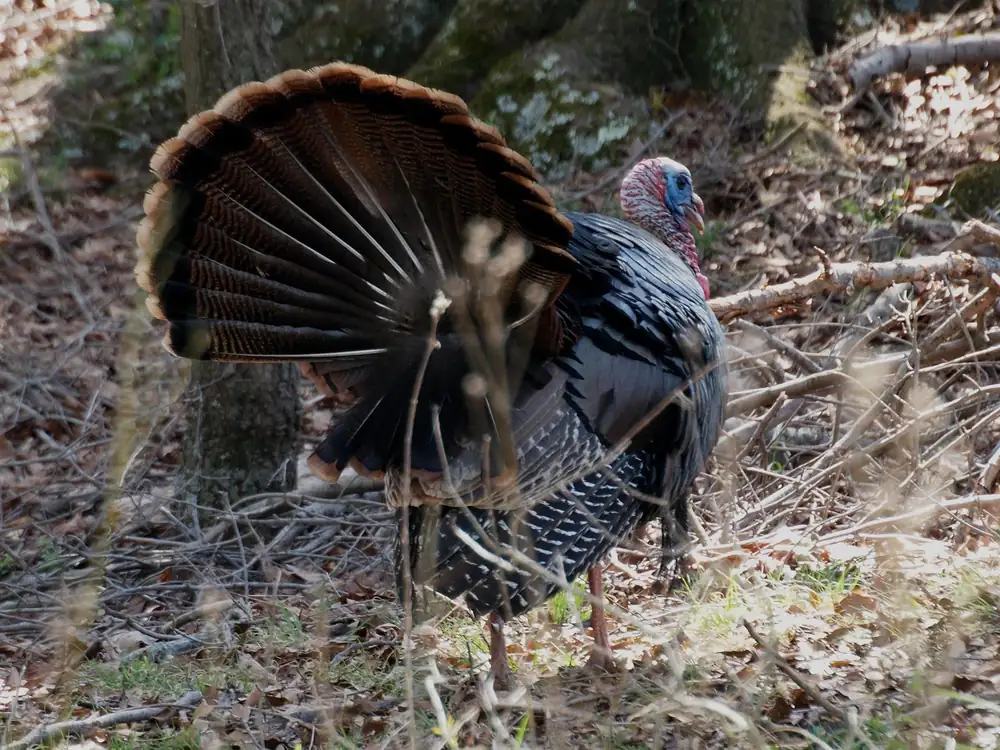
Early spring is the breeding season for the wild turkey, and April is the month when the males gobble, fan their tails and strut in the open. The Chesapeake Bay Program says that females begin laying one egg a day in mid-April, laying about twelve eggs in all, and that the eggs usually hatch around the first week of June. Delaware’s spring turkey season opened in 1991, and the Chesapeake Bay Program says that state programs that trapped birds and moved them helped rebuild the population across the region.
-
Gobblers at dawn
Through April and into May; most active early in the morning · Field edges, pastures, orchards, open woods and marsh edges in all three counties
The Chesapeake Bay Program says that males can stand three feet tall and weigh up to 25 pounds, and that wild turkeys favor open woods, fields, pastures, orchards and marsh edges. Field edges at first light are the easy places to see them. A strutting tom spreads his tail into a dark fan while he gobbles.
-
The spring season
Youth and non-ambulatory hunter weekend April 3 and 4 (check the agency page); regular season April 10 through May 9, 2027 · Private land statewide; state wildlife areas and national wildlife refuges by permit
The Delaware hunting guide lists the 2027 season as April 10 through May 9, with shooting hours from half an hour before sunrise to 1 p.m. and a limit of one bearded turkey a season. DNREC’s turkey page gives the youth weekend as April 3 and 5, while the guide says April 3 and 4, so confirm with the agency. Hunting on state wildlife areas and refuges needs a permit, and applications must be postmarked by January 8, 2027. DNREC’s turkey page reports that hunters took 816 turkeys in the 2026 spring season, the most since the season began in 1991.
If you walk a state wildlife area in April, expect hunters at dawn. The guide makes it illegal for turkey hunters to wear any visible garment in red, white or blue, so the people you meet may be in camouflage. If you hike in turkey woods in April, a piece of blaze orange is a sensible precaution, and the safety notes below cover the rest.
Which frogs and toads are calling in Delaware in April?
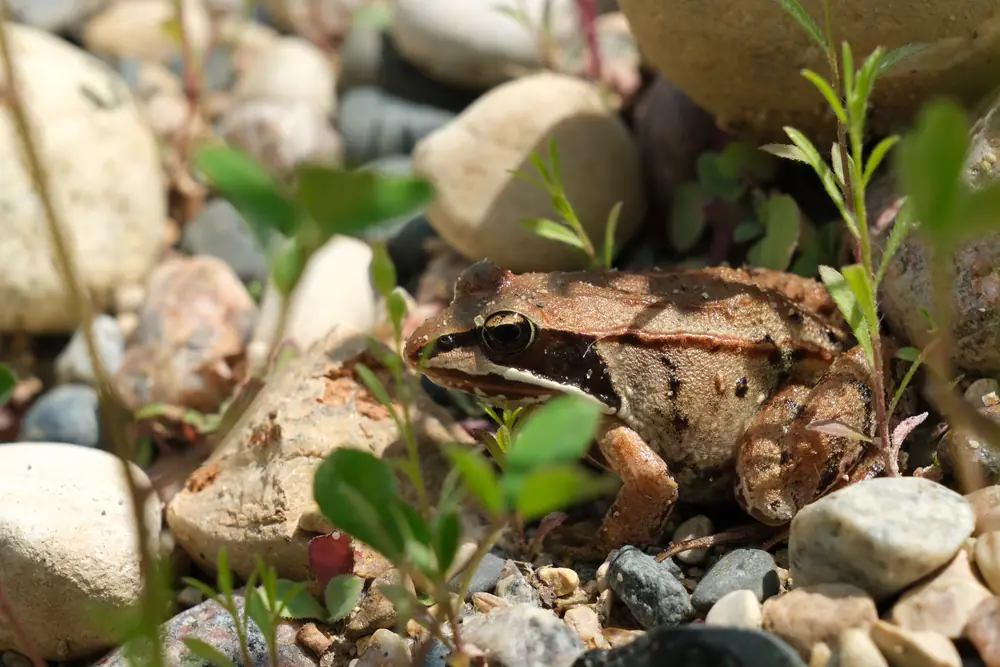
April is when the choruses fill out. The Bombay Hook wildlife calendar says the spring peeper and wood frog choruses are in full voice this month, with bullfrogs and green frogs joining the swamp chorus in May. The Delaware Nature Society’s frog guide lists the peeper, wood frog, American toad and pickerel frog together as callers of March and April in the Piedmont. March’s first notes have become a nightly roar.
-
Peepers, wood frogs, toads and pickerel frogs
March and April; the loudest nights are mild and damp · Pools, flooded woods and pond edges in Brandywine Creek and White Clay Creek State Parks and Ashland Nature Center
The society describes the peeper’s call as high-pitched and loud, the wood frog’s as a quacking, the American toad’s as a long, soft musical trill and the pickerel frog’s as a low snore.
-
The coastal plain callers
Spring into early summer · Abbott’s Mill Nature Center near Milford, and wet woods and ditches in Kent and Sussex
The same guide lists two frogs of the coastal plain: the New Jersey chorus frog, whose call the society spells “ccrreeek,” and the southern leopard frog, which has a chuckling call. Abbott’s Mill is the place the society names for both.
The Atlantic Coast leopard frog, whose clacking call the society describes, can be heard along the Jack A. Markell Trail at the DuPont Environmental Education Center. Walk slowly, carry a flashlight with a soft beam, and stand still when the chorus goes quiet; it starts again in a few minutes. Stay out of breeding pools, where egg masses and tadpoles are easily harmed. For the Delaware Amphibian Monitoring Program, which sends trained listeners along fixed routes, ask DNREC’s Division of Fish and Wildlife how to volunteer.
What blooms in Delaware in April, and when do the trees leaf out?
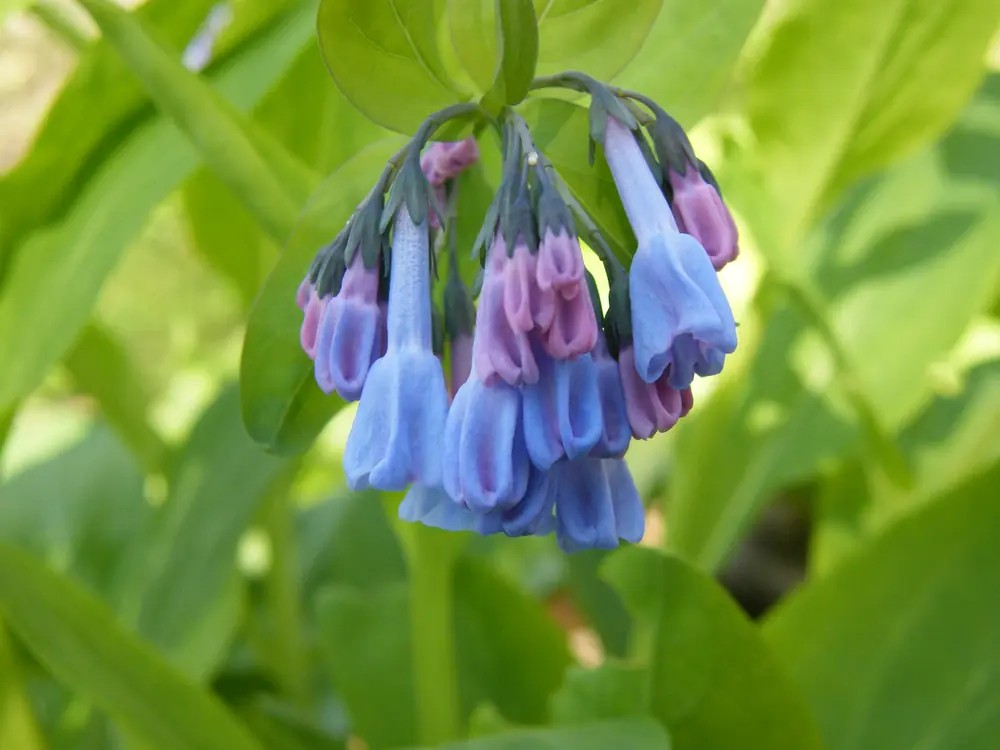
April is the month of the spring ephemerals: native woodland plants that flower and set seed before the trees overhead close the canopy. The Delaware Nature Society’s guide lists bloodroot, cut-leaved toothwort, Dutchman’s breeches, trillium, hepatica, rue anemone, showy orchis, spring beauty, trout lily, Virginia bluebells, wild geranium and wild ginger, and says that by mid-May much of the show will be over. Overhead, the red maples that flowered in March are setting seed (the Chesapeake Bay Program says their winged fruits mature between April and June), and the flowering trees are in bloom.
-
Virginia bluebells
Mostly April; photographed in Delaware from March through May · Brandywine Creek State Park, White Clay Creek State Park, Ashland Nature Center and Middle Run Valley Natural Area
The Delaware Wildflowers site calls the Virginia bluebell an uncommon native and lists those places among its Delaware records. The nodding clusters open pink in bud and blue in bloom.
-
Flowering dogwood and the other flowering trees
Mid-March to mid-May for dogwood, with April the high point · Woodland edges, yards and parks statewide, and the cherry trees of Brandywine Park in Wilmington
The Chesapeake Bay Program gives the dogwood’s flowering time as mid-March to mid-May. The showy white parts are bracts, not petals. At least 36 kinds of birds eat the red fruits later in the year. DNREC points visitors to the Japanese cherry trees of Brandywine Park, which bloom every spring, and to the gardens at Bellevue State Park.
-
What Winterthur showed in one early April
A report from April 5, 2022, as an example of the sequence, not a prediction · Winterthur Museum, Garden and Library, near Wilmington
That week’s bloom report listed cherries at peak, glory-of-the-snow carpeting Azalea Woods, forsythia, saucer magnolias and Virginia bluebells. Warm or cold springs shift the sequence by a week or more, so check the garden’s own bloom reports.
-
Baldcypress at Trap Pond
New needles in spring · Trap Pond State Park near Laurel
The National Park Service says the park holds the northernmost natural stand of baldcypress in the country, on a pond of about 90 acres in a park of nearly 4,000 acres. The trees drop their needles in autumn and feather out in fresh green in spring. A paddle among the knees is the way to see it.
The Pink Moon takes its name, according to Sea and Sky, from an early wildflower, the moss pink or wild ground phlox. In a wildflower wood, stay on the path, because the Delaware Nature Society’s guide says careless feet damage the plants and the ground around them. Under a 1961 state law Delaware keeps Arbor Day on the last Friday of April, so in 2027 it lands on April 30. The Delaware Forest Service holds a school poster contest for the day.
What is April weather like in Delaware, and when is the last freeze?
April is the month the thermometer finally commits. NOAA’s 1991–2020 normals put the typical April high at 64.2 °F at the Wilmington airport, 66.0 °F at Dover, 66.3 °F at Georgetown and 66.2 °F at Lewes, with the warmest of the stations at the Newark farm at 66.9 °F and the coolest at Wilmington. Lows run from 42.1 °F at the Newark farm to 46.4 °F at Lewes. The Wilmington airport’s daily normal high rises from 58.5 °F on April 1 to 69.3 °F on April 30, and Lewes goes from 60.8 to 70.9 °F. Normal lows climb from 38.6 to 48.3 °F at Wilmington and from 41.5 to 51.3 °F at Lewes.
Frost is possible but fading. The normal count of freezing nights (32 °F or colder) in April is 2.0 at the Wilmington airport, 3.5 at the Newark farm, 3.5 at Greenwood, 2.1 at Georgetown, 1.2 at Dover and 0.8 at Lewes. Rainfall averages from 3.29 inches at Georgetown to 3.72 inches at Dover, and snow is nearly a memory, with a normal of 0.1 inch at the Wilmington airport and 0.2 inch at Greenwood.
| Station | One year in ten | Median | Nine years in ten |
|---|---|---|---|
| Wilmington New Castle County Airport | Mar 26 | Apr 7 | Apr 21 |
| Newark Ag Farm | Mar 26 | Apr 7 | Apr 21 |
| Dover | Mar 22 | Apr 4 | Apr 17 |
| Greenwood 2 NE (Kent–Sussex line) | Mar 29 | Apr 11 | Apr 28 |
| Georgetown Sussex County Airport | Mar 22 | Apr 4 | Apr 16 |
| Lewes | Mar 13 | Mar 29 | Apr 9 |
The table is a planning aid: a freeze after the right-hand date is possible but happens in only about one spring in ten, so wait until after the right-hand date for tender plants unless you can cover them on a cold night. The hazards of April are wind, fire and storms. The state says the peak wildfire season is from mid-April to the beginning of May, while the grass and leaf litter are still dry and the canopy has not leafed out. Ask your fire company about burning rules and never leave a fire alone. Thunderstorms begin to build as the air warms. The University of Delaware’s state climate office says tornadoes are not common in Delaware, with years of four or more in 1966, 1975, 1992 and 2020 in its 1954–2021 record, and that the state typically sees two or three large-hail reports a year. When a storm is near, go indoors and follow the National Weather Service’s Mount Holly office. For the latest 90-day outlook, which the Climate Prediction Center updates near the middle of each month, see the agency’s outlook maps. The forecast page here takes you to the week ahead, and Delaware frost dates lists more towns.
How much daylight does Delaware gain in April?
Between 68 and 72 minutes. Statewide the day lasts 12 hours 38 to 40 minutes on April 1 and 13 hours 46 to 51 minutes on April 30, a gain of 2.3 to 2.5 minutes each day, a hair slower than in March. At Dover, the Naval Observatory gives sunrise at 6:47 a.m. and sunset at 7:26 p.m. Eastern Daylight Time on April 1, and sunrise at 6:05 a.m. and sunset at 7:54 p.m. on April 30. The sun rises at 6:18 a.m. and sets at 7:44 p.m. on April 20, the evening of the Pink Moon, and civil twilight ends at 8:12 p.m. With daylight time in force since the middle of March, evening frog walks fit in after supper.
| City | Apr 1 | Apr 30 | Gained | Per day |
|---|---|---|---|---|
| Wilmington | 12 h 39 m | 13 h 51 m | 72 min | 2.5 min |
| Newark | 12 h 40 m | 13 h 51 m | 71 min | 2.4 min |
| Dover | 12 h 39 m | 13 h 49 m | 70 min | 2.4 min |
| Milford | 12 h 38 m | 13 h 48 m | 70 min | 2.4 min |
| Georgetown | 12 h 38 m | 13 h 47 m | 69 min | 2.4 min |
| Seaford | 12 h 38 m | 13 h 46 m | 68 min | 2.3 min |
| Lewes | 12 h 38 m | 13 h 48 m | 70 min | 2.4 min |
| Fenwick Island | 12 h 38 m | 13 h 46 m | 68 min | 2.3 min |
Times for Dover come from the U.S. Naval Observatory; for any other address, try the sunrise and sunset calculator on this site. Set an alarm: the early birds are the best ones.
What is in the night sky over Delaware in April 2027?
All times below are Eastern Daylight Time. April brings a bright full Moon, a meteor shower that the Moon will spoil, and a bright evening planet. Venus is a brilliant morning star, low in the east before sunrise, and it keeps sinking toward the Sun through the spring.
-
The Pink Moon
Full at 6:27 p.m. on Tuesday, April 20; best on the evening of April 20 · Moonrise at Dover is 7:53 p.m., nine minutes after sunset at 7:44 p.m.
Full Moon comes some ninety minutes before moonrise in Delaware, so the evening of April 20 is the evening to watch, with the Moon coming up red-orange over the eastern horizon. The name comes from a spring wildflower, not from the Moon’s color.
-
The Lyrids, a poor year
Peak the evening of Thursday, April 22 (about 9:41 p.m. by one timing); active about April 14 to 30 · Low in the east and northeast, in the early evening, before moonrise
Sea and Sky puts the peak on the night of April 22 into the morning of April 23. The maximum is timed for about 9:41 p.m. Eastern time on April 22, and our own check puts it about fourteen minutes later. On April 22 the Moon, still about 95 percent lit, clears the horizon at Dover at 10:08 p.m., so only the first hours of the night are dark. Sea and Sky gives the shower as average, at about 20 an hour at best, so expect only a few an hour, if that.
-
Jupiter, and the Moon beside it
The Moon near Jupiter on the evenings of April 14 and 15; closest on April 15 · High in the south and west after dark; Jupiter is the brighter of the pair
Jupiter stays in the evening sky through spring; on April 1 it does not set until about nine hours after the Sun. By our own calculation the Moon passes within about a degree of it on April 15, closest at 10:19 a.m. in daylight, so the evenings on either side are the ones to see. On April 15 the Moon is also about three degrees from Mars, which is fainter and orange.
| Phase | Date | Time |
|---|---|---|
| New moon | Tuesday, Apr 6 | 7:51 p.m. EDT |
| First quarter | Tuesday, Apr 13 | 6:56 p.m. EDT |
| Full moon, the Pink Moon | Tuesday, Apr 20 | 6:27 p.m. EDT |
| Last quarter | Wednesday, Apr 28 | 4:18 p.m. EDT |
| New moon | Thursday, May 6 | 6:58 a.m. EDT |
The Eta Aquariids are active from about April 19 and peak next month, on a dark, moonless night. Clouds are the likeliest spoiler, so look at the cloud cover maps before heading out. For nightly moonrise and moonset, open the moon phase calendar.
What can families do outdoors in Delaware in April 2027?
- Be the first to report the first. Pick one spring arrival (a purple martin, a ruby-throated hummingbird or a calling toad) and write the date in a notebook. Journey North takes hummingbird sightings, and Cornell’s NestWatch lets you follow a nest through the season.
- Go on an evening frog walk. Visit a pond edge near home on a mild, damp evening and try to sort out the calls. The Delaware Nature Society’s frog guide suggests dressing for mud and bringing a bright light.
- Watch the first bay shorebirds. Try a Kent County bay beach near high tide in the last week of April. Remember the 400-foot rule for feeding birds.
- Join the City Nature Challenge. The global event runs from April 30 to May 3, 2027 for photos, with identifications through May 16. We did not find a Delaware project, so check the iNaturalist site for the nearest region; you can also just photograph what you see.
- Plant a tree on Arbor Day. Arbor Day in Delaware is April 30 this year, and Earth Day is Thursday, April 22.
- Walk a refuge. Prime Hook’s events page lists a free bird walk on the first Saturday of each month with the Sussex Bird Club (registration required) and evening walks for woodcock and bats; call 302-684-8419 for 2027 dates.
The Delaware Nature Society and the Delaware Ornithological Society had not posted April 2027 programs when this was written, so look at the organizers’ own calendars. For the month before, see March in Delaware, or browse our seasonal nature guides.
Safety notes for April in Delaware
- Spring turkey season is open. The 2027 season runs April 10 through May 9, with shooting hours from 30 minutes before sunrise to 1 p.m., and Sunday hunting is now allowed. The youth and non-ambulatory weekend is April 3 and 4 in the hunting guide. If you walk a wildlife area early in the morning, stay on the trails, wear a piece of blaze orange, and speak up if you hear a caller nearby. The statewide blaze orange rule (400 square inches) covers the weeks of the firearm deer seasons, and on state wildlife areas the guide asks small game hunters to wear it at all times. Groundhogs can be hunted year-round, so you may meet a hunter in a field.
- Trout openers. According to DNREC, designated trout streams open for the spring on the first Saturday in April for young anglers only, and for everyone else the next day. It also says designated streams are closed to fishing for two weeks before opening day. Applying that rule would give April 3, but 2027 dates were not yet posted at the time of writing, so confirm on the agency’s trout page. Adult anglers need a license and a trout stamp, and youth ages 12 to 15 need a young angler trout stamp. The daily limit is six, with four in the fly-fishing-only sections.
- Ticks. DNREC says ticks are active year-round and peak from spring into summer, so April hikes are not tick free. Wear long pants tucked into socks and light colors, use repellent, and check yourself, your children and your pets after every walk. Remove an attached tick promptly with tweezers.
- Wildfire. The peak fire season is mid-April to early May. Do not toss cigarettes, and follow local burn rules.
- Beaches and birds. Stay out of closed nesting areas at The Point and Fowler Beach, keep 400 feet from feeding shorebirds, keep dogs leashed, and keep 150 feet from seals.
- Storms and cold water. April thunderstorms can arrive fast. Creek banks are soft after rain and the water is still cold, so never wade a swollen stream.
Sources (54)
- U.S. Fish and Wildlife Service: Bombay Hook wildlife calendar (April and May)
- DNREC: horseshoe crabs and shorebirds at the DuPont Nature Center (timing, viewing places)
- DNREC: horseshoe crabs in Delaware Bay (spawning, Mispillion Harbor)
- DNREC: shorebird and horseshoe crab ecology of Delaware Bay (species, red knot numbers, egg dependence)
- DNREC: Delaware Shorebird Project (history, public viewing distance, red knot counts)
- Visit Central Delaware: why millions of shorebirds depend on one Delaware beach (season timing, flipping a crab)
- Chesapeake Bay Program field guide: horseshoe crab
- DNREC: piping plovers in Delaware (arrival, 2025 counts, closures)
- U.S. Fish and Wildlife Service: Prime Hook National Wildlife Refuge (Fowler Beach closure, trails, wildlife)
- U.S. Fish and Wildlife Service: Prime Hook events (bird walks, evening walks)
- Delaware Valley Ornithological Club: April birding recommendations
- DNREC: Nanticoke Shad Hatchery (collection, stocking totals)
- Chesapeake Bay Program: scientists restock American shad to a Delaware waterway
- Chesapeake Bay Program field guide: American shad
- Delaware Nature Society: the comeback fish (Brandywine dams and shad)
- Brandywine Conservancy: the nation’s founding fish returns to the Brandywine
- Delaware Ornithological Society newsletter, April 2022 (spring migration, Bird-a-Thon, field trips)
- Delaware Ornithological Society newsletter, May 2022 (warbler species in Delaware)
- Delaware Ornithological Society: events calendar for April 2027
- Delaware Ornithological Society: Pea Patch Island heron survey
- Journey North: East Coast hummingbird sightings reach New Jersey and Delaware (April 8, 2025)
- Journey North
- Chesapeake Bay Program field guide: ruby-throated hummingbird
- Chesapeake Bay Program field guide: wild turkey
- Delaware Hunting and Trapping Guide 2026–27: spring turkey season 2027
- Delaware Hunting and Trapping Guide 2026–27: deer hunting and the hunter orange rule
- Delaware Hunting and Trapping Guide 2026–27: small game hunting and hunter orange on State Wildlife Areas
- DNREC: wild turkey hunting (2027 season, registration, public land)
- State of Delaware news, May 21, 2025: record deer and turkey harvests
- Delaware Nature Society blog: springtime is frog time
- Delaware Nature Society blog: now or never, observing spring ephemeral wildflowers
- Delaware Nature Society: April 2027 events calendar (not yet posted)
- Delaware Wildflowers: Virginia bluebells in Delaware
- Chesapeake Bay Program field guide: flowering dogwood
- Chesapeake Bay Program field guide: red maple
- Winterthur: bloom report, April 5, 2022
- DNREC: Outdoor Delaware in spring (parks, Brandywine Park cherries, Trap Pond)
- National Park Service: exploring cypresses at Trap Pond State Park
- Delaware Forest Service: Arbor Day in Delaware
- City Nature Challenge 2027
- Cornell Lab of Ornithology: NestWatch
- DNREC: freshwater trout fishing (season timing, stream closure rule, limits)
- DNREC: upstate trout season in New Castle County streams, 2026 (as a guide to the pattern)
- State of Delaware news, June 2022: DNREC and Division of Public Health tips about ticks
- State of Delaware news, March 11, 2025: Delaware’s weather ignites wildfire concerns
- Delaware State Climate Office: Delaware severe weather
- National Weather Service Mount Holly (Philadelphia)
- Climate Prediction Center: seasonal outlooks (issued monthly near mid-month)
- NOAA NCEI: monthly normals data service, Delaware stations (April temperature, precipitation, freeze-night counts)
- NOAA NCEI: daily normals data service, Wilmington and Lewes (April 1 and April 30 highs and lows)
- U.S. Naval Observatory: moon phases (data API)
- U.S. Naval Observatory: sun and moon rise and set, Dover, April 2027
- Sea and Sky: astronomy calendar 2027 (Pink Moon, Lyrids, Eta Aquariids)
- Photos via Wikimedia Commons; licenses and photographers are credited under each picture
