What to look for in nature in Delaware this February
By the numbers, February closes out Delaware’s meteorological winter as its snowiest month. Yet underneath the cold the year is already turning. Bald eagles lie low in their huge nests, warming eggs through sleet and wind. On the first warm, rainy night, endangered tiger salamanders crawl out of the forest floor in southern New Castle County and slip into icy seasonal ponds to breed. Pintails pour into the Bombay Hook pools, killdeer start calling over thawing fields, and by the end of the month male woodcock may be spiraling up into the dusk. The evenings run noticeably later, Jupiter and Mars both reach opposition, and on February 20 a full moon comes up with Earth’s faint outer shadow across it.
Other months in Delaware: October, November, December, January.
Start here

- Count birds for four days. This year’s Great Backyard Bird Count covers four days, February 12 to 15, 2027. Watch any spot for 15 minutes or longer, list every bird you see, and send the list in with eBird or the Merlin app. On the Saturday morning, the Delaware Nature Society runs a guided count at Ashland Nature Center that ends with donuts by the feeders.
- Wait for the first warm rain. When a February night stays above about 40 °F and rain is falling, Delaware’s salamanders and earliest frogs start moving toward the woodland ponds where they breed. Drive slowly on wooded back roads in southern New Castle and northern Kent counties on nights like that, and watch the wet pavement for small dark shapes.
- Find Jupiter, then Mars. Wednesday evening, February 10, brings Jupiter to opposition: it climbs out of the east at sunset, brighter than any star. Mars follows on Friday, February 19, a fainter orange spark in the same patch of sky, and the next evening the full Snow Moon joins them both.
Keep a record: an eagle sitting low on its nest, checked from the same pull-off once a week, is a ready-made nest-observed page in the Naturalist’s Field Journal; the first killdeer or red-winged blackbird you hear belongs on your map of sounds; a woodcock’s peent at dusk makes a fine dusk-and-dawn watch; and a February snowfall, measured and dated, can open a daily field log.
Regions used below: Piedmont: Wilmington, Hockessin and the Brandywine valley; Newark and White Clay Creek; Upper Bayshore and the C&D Canal: Blackbird Creek, Lums Pond; Dover, Kent County and Bombay Hook; Western Sussex: Seaford, Laurel, Trap Pond and the Great Cypress Swamp; Cape Region: Lewes, Milton, Cape Henlopen and Prime Hook; Rehoboth, the Inland Bays and Fenwick Island.
When do bald eagles lay eggs in Delaware?
Mostly in February. The wildlife calendar kept by Bombay Hook National Wildlife Refuge gives this month a single line for eagles: eggs are laid and incubation begins. The nest repairs and courtship flights of December and January are over, and pairs settle into the long, quiet job of keeping one to three eggs warm in whatever weather the month brings.
-
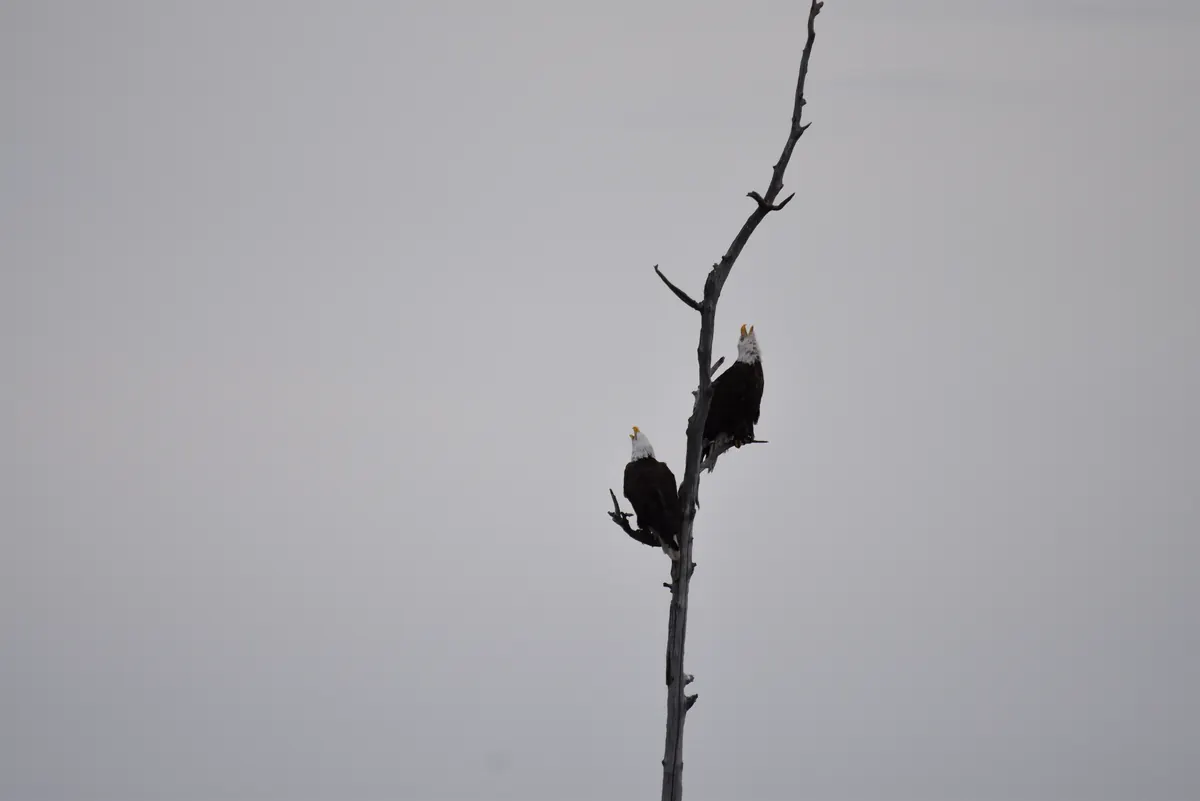
Bald eagles incubating
Eggs mostly in February; hatching by April · Tall trees near rivers, marshes and ponds in all three counties; Bombay Hook, Prime Hook, the Nanticoke and the C&D Canal
The Chesapeake Bay Program’s field guide says females in the region lay one to three eggs, usually two, between January and March, and that incubation takes five to six weeks, with chicks hatching a day or two apart. An incubating bird lies so flat in the bowl of sticks that often only the white head shows above the rim, and sometimes nothing at all. Bombay Hook’s calendar says the eggs have hatched by April. At Blackwater refuge, just over the Maryland line, the calendar notes new eaglets in February, so an early Delaware pair could be feeding chicks before the month ends.
-
Great horned owls already sitting
Incubating in February; owlets hatch in early spring · Woodlots, farm hedgerows and parks statewide, often in an old hawk or heron nest
The owls that were hooting duets in January are now quiet on their nests. On a large stick nest high in a bare tree, two feathered tufts showing above the edge give her away. The Chesapeake Bay Program notes that while the female incubates, the male hunts for both of them and carries food to the nest. Incubation lasts roughly a month, so the first fuzzy white owlets can appear before winter officially ends.
An eagle pushed off its eggs on a frosty morning leaves them to chill, so watch from the car or a public road with binoculars and never walk beneath a nest tree. Sketch the nest you are watching and note the date and the weather each visit; by April you will have a record of the whole incubation. If you find a nest that may be new, DNREC asks that it be reported through its online form so it can be checked on the next survey. For a guided day out, the Delaware Nature Society’s Owls and Other Winter Raptors trip on Sunday, February 14, searches by van for all eight owl species that can turn up in the area in winter, along with eagles, red-tailed hawks and kestrels (9 a.m. to 6 p.m., $50, adults 18 and up, bring lunch).
When do salamanders and frogs start breeding in Delaware?
Sooner than most people expect: some begin in February. Delaware’s seasonal ponds, shallow woodland pools and Delmarva bays that fill over the winter and dry out by late summer, hold no fish, which makes them safe nurseries for amphibian eggs. The state’s wildlife action plan says the Blackbird-Millington corridor, straddling the Maryland line, has the largest concentration of these Coastal Plain ponds on the Delmarva Peninsula and is the most significant rare-amphibian hotspot in the Maryland, Delaware and New Jersey region.
-
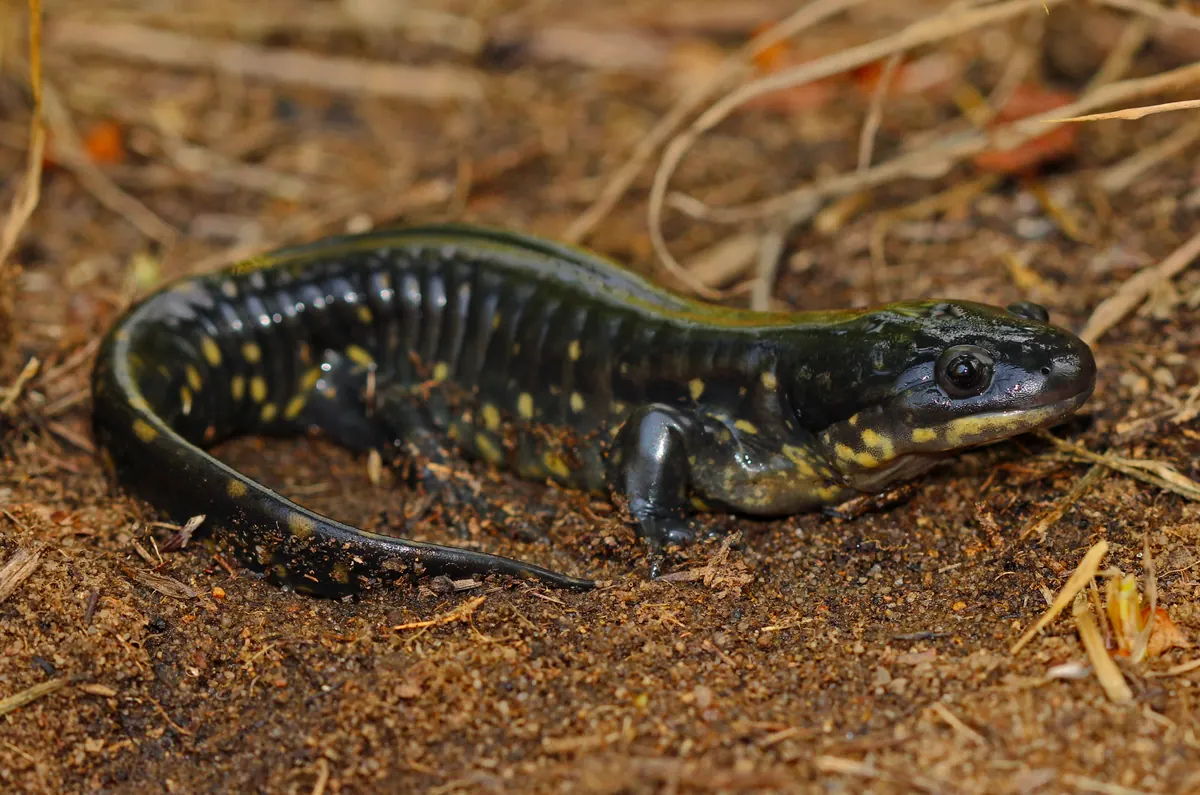
Eastern tiger salamanders
Warm, rainy nights from late winter; February is survey season · Seasonal ponds in Blackbird State Forest and the surrounding forest of southern New Castle County
This is one of Delaware’s rarest amphibians and Delaware lists it as endangered. It is also the biggest salamander that lives on land in North America, usually seven to eight and a half inches long, thick-bodied, dark brown or black with irregular yellow blotches. DNREC’s wetland program describes biologists wading a Blackbird State Forest pond on a rainy but fairly warm February morning and finding 100 tiger salamanders in that one pond, and several hundred across the ponds checked that day. Each is measured, sexed and photographed so its spot pattern can be matched with earlier years. The program explains that tiger salamanders are the first species to leave their winter shelter in the woods, that warm rain in late winter triggers the move, and that they may stay in the water only a week or two before heading back to the forest.
-
Spotted salamanders
End of winter, after the ground thaws, on the first spring rains · Woodland pools across the state, including the Piedmont valleys
Gray, black or bluish, marked down the back by a double row of yellow or orange spots, spotted salamanders run six to nine inches long and can live 20 to 30 years. A female leaves 100 to 300 eggs a year in jelly-coated clusters fastened to sticks and stems under the water.
-
Wood frogs and the first chorus
Possible in the last days of February on a mild rain; more often March · The same seasonal ponds; Piedmont woods in New Castle County
Wood frogs are small, one and a half to three inches, tan to brown with a dark robber’s mask across the eyes. Through the winter this frog can survive with close to half of its body frozen, which is how it can be first to the ponds. The Chesapeake Bay Program puts its mating season at March through May, and a Delaware Nature Society naturalist lists its call, a duck-like quacking, among the frog sounds of March and April. Spring peepers follow, and the same Delaware Nature Society piece lists their high, loud peeping among the frog calls of March and April.
On a rainy night, if you see salamanders or frogs on a road, carry them, with wet hands, to the side they were heading for, and only where you can stand well clear of traffic. Do not dip nets or wade into breeding ponds, where egg masses are easily crushed. The Delaware Amphibian Monitoring Program, the state’s part of a national frog-call survey, has trained volunteers to drive set routes after dark and identify the state’s 16 frog species by call, and in past years its first listening period began in late February; ask DNREC’s Division of Fish and Wildlife whether routes are open this year.
When do the ducks and swans start leaving Delaware?
Not yet, for most of them. February is a month of shuffling rather than departure on the bayshore: some birds arrive from farther south as the first thaws come, while the big wintering flocks stay put until March, when, as Bombay Hook’s calendar puts it, the spring waterfowl migration peaks.
-
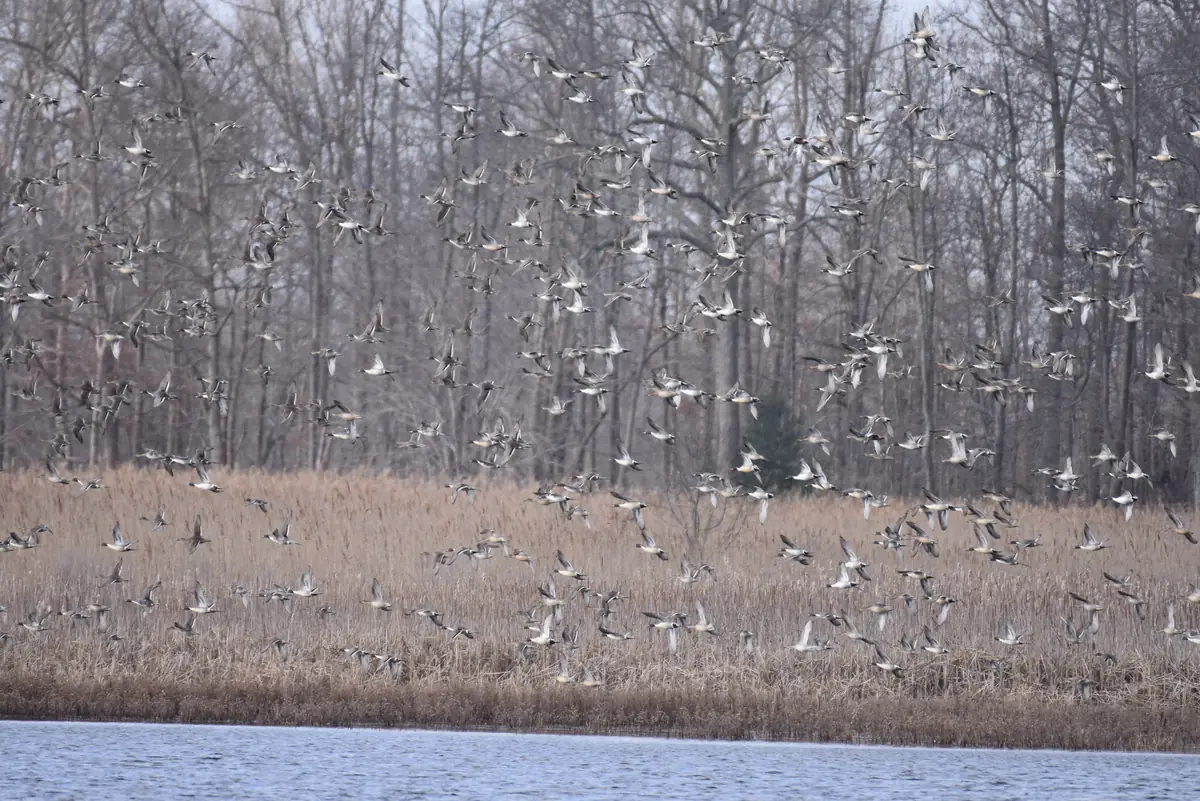
Northern pintails
Large flocks with the first mild weather of February · Bombay Hook’s Raymond, Shearness and Bear Swamp pools; Little Creek; Prime Hook
The refuge calendar singles out pintails as the February arrivals. Males are elegant: a chocolate-brown head with a narrow white stripe running up the side of the neck, a white breast, gray flanks and long, needle-pointed tail feathers. Females are a plain mottled brown with a tan head, but share the long neck and slim shape. At 26 to 30 inches, pintails are large dabbling ducks; watch for them tipping up to reach seeds and plants in the shallows.
-
Tundra swans getting restless
Still here in February; most leave in early spring · Bombay Hook, Trap Pond, wet fields and winter wheat in Kent and Sussex
Swans spend the cold months around the Chesapeake and Delaware bays and fly north to the Arctic tundra of Canada and Alaska in early spring. They travel in big V-shaped or ribbon-like flocks, so in late February keep an ear out for their high, soft calls overhead; the gray-brown young of last summer fly with their parents.
-
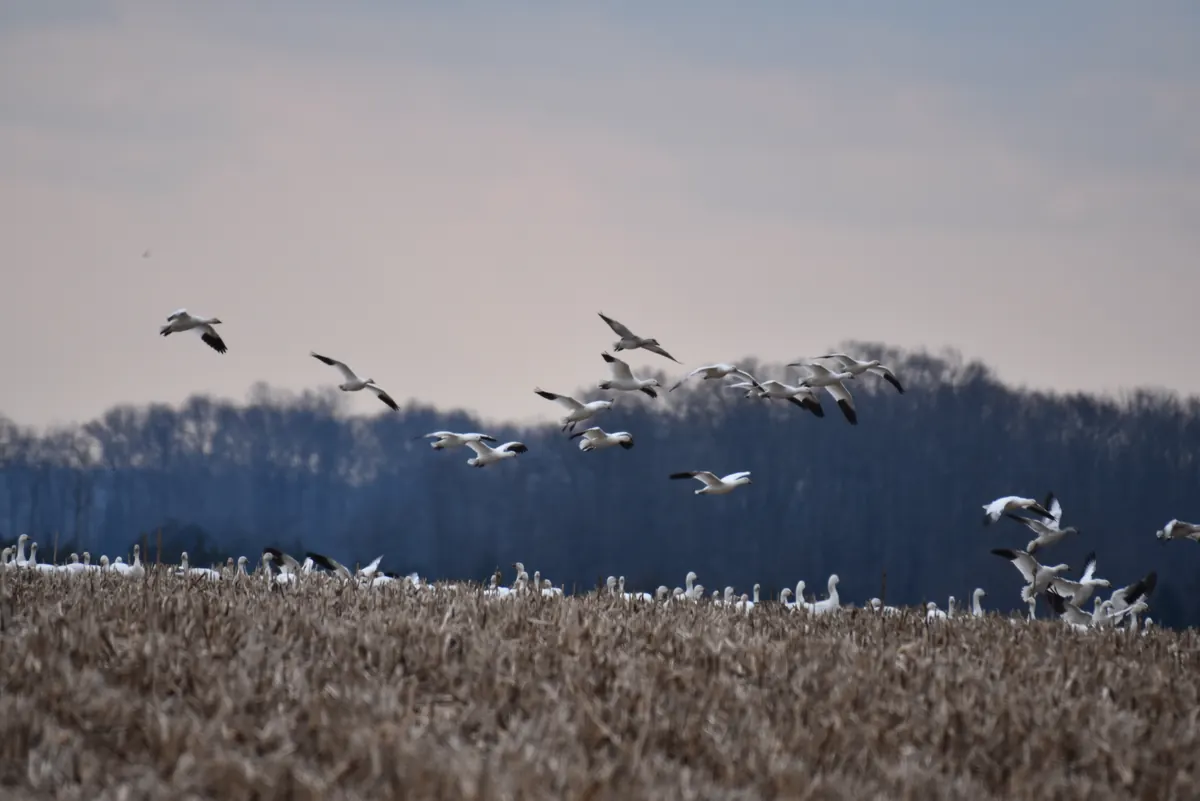
Snow geese on the move
All month; snow goose hunting is open February 1 to March 10 · Fields and marsh along the bayshore, from Port Penn to Prime Hook
The white flocks still shuttle between marsh roosts and feeding fields. With hunting back on in February they turn warier and lift in a roar at the slightest disturbance. DNREC has said there will be no conservation order for snow geese in 2027.
The refuge’s Wildlife Drive opens 30 minutes ahead of sunrise and closes 30 minutes after sunset; each car needs an entrance pass. A February visit on the first mild afternoon after a cold snap is often the liveliest of the winter.
Which birds come back to Delaware first in spring?
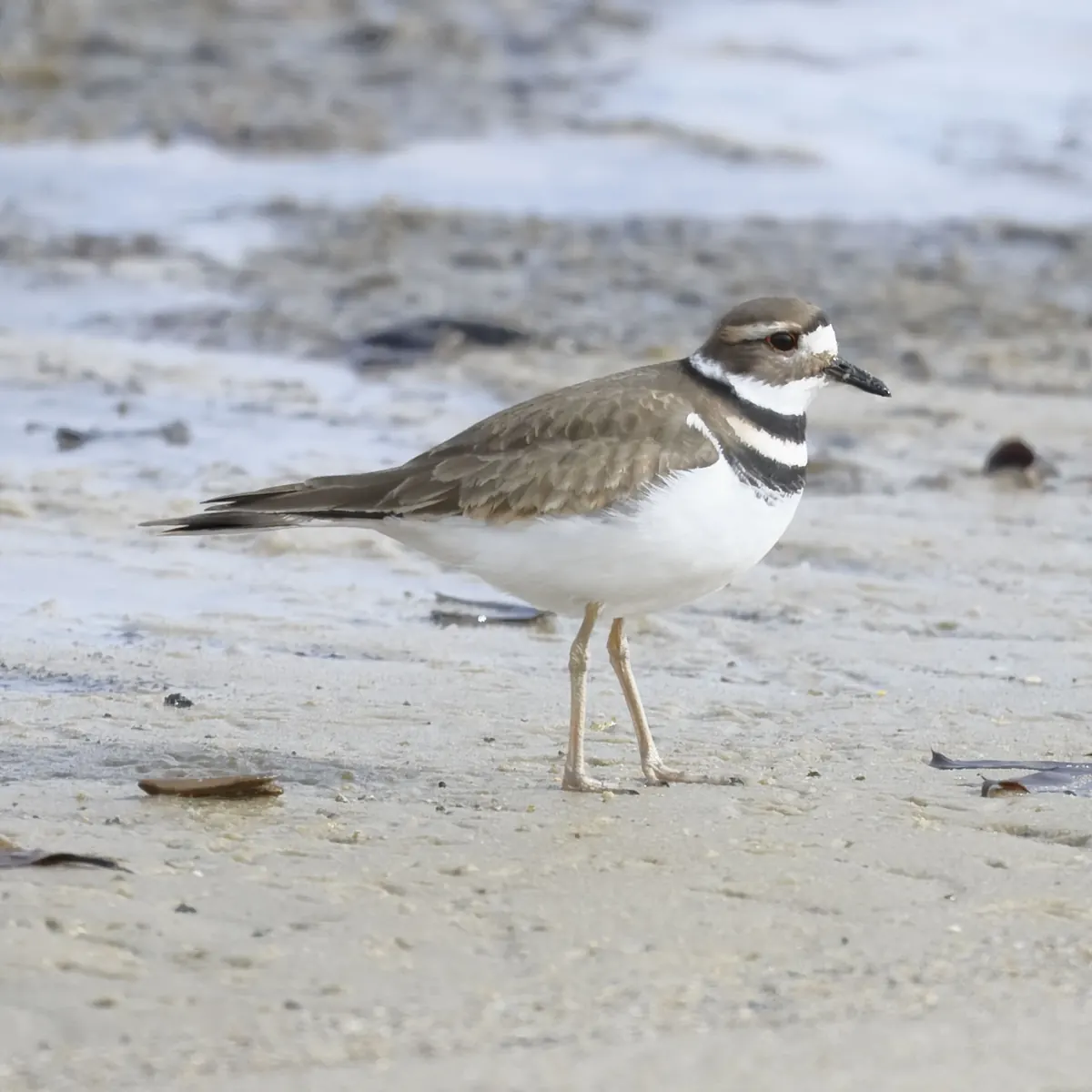
Killdeer, robins, bluebirds and red-winged blackbirds lead the way, before winter is officially over. The wildlife calendar at Blackwater National Wildlife Refuge, on the Maryland side of the Delmarva Peninsula, says the first northbound migrants appear late in February: killdeer, robins and bluebirds. Many robins and bluebirds winter in Delaware anyway, so watch for a change in behavior: flocks breaking up, singing, birds claiming ground.
-
Killdeer
Late February into March · Plowed fields, wet pastures, school grounds and gravel lots, especially in Kent and Sussex
A slim brown plover with two black bands across a white breast and a ringing, repeated kill-deer call. The voice usually gives one away before you see it: listen over open, thawing farmland on a mild afternoon. Killdeer feed on insects and worms, so they move north as the ground softens.
-
Red-winged blackbirds
Males singing from late winter; big flocks moving through in March · Cattail marsh, ditches and wet roadsides; winter flocks in corn and wheat stubble
Red-winged blackbirds winter in Delaware in mixed flocks with grackles and cowbirds, feeding in farm fields. The sign of spring is the song: a male perched on a cattail, glossy black with red shoulder patches edged in yellow, flaring them out as he calls konk-la-ree. Blackwater’s calendar says masses of them pass through in March and some stay to nest. Females, brown and heavily streaked, come back a little later.
Write down the date of your first killdeer and first singing red-winged blackbird this year. Kept over several years in the same notebook, those two dates make one of the simplest records of how the season is shifting.
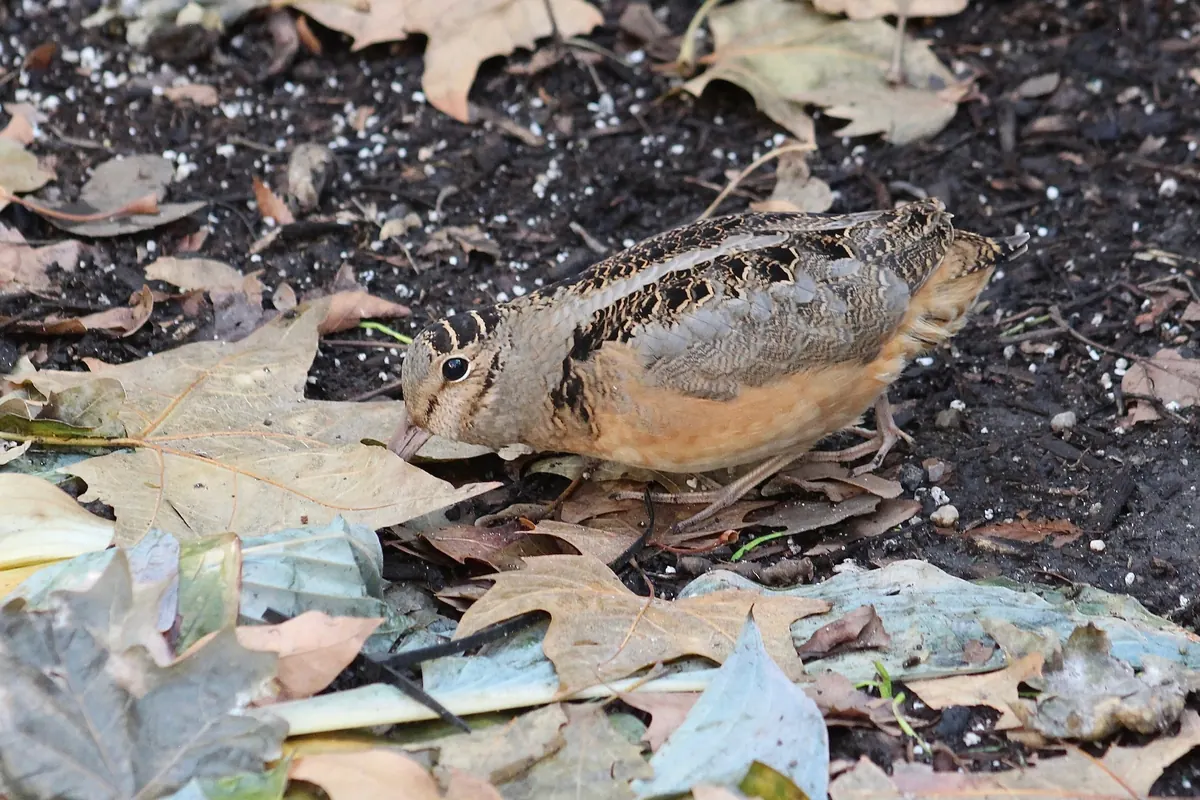
When does the woodcock sky dance start in Delaware?
As early as mid-February, but more reliably in March. The Alliance for the Chesapeake Bay writes that in the southern parts of the bay’s watershed, which take in much of Delaware, woodcock courtship can begin by mid-February. Bombay Hook’s own calendar lists woodcock courtship flights under March. Since the two sources disagree, start listening on calm evenings in the last week of February and expect the display to be in full swing by the middle of March.
-
The peent and the spiral
At dusk, and again in the half-light before dawn · Open patches of at least a quarter acre next to young woods or brush: old fields, clearcuts, power line cuts
The male American woodcock, a plump, short-legged shorebird of the woods with a bill about a third as long as its body, starts on the ground with a nasal, buzzy peent repeated every few seconds. Then he launches, climbing in widening circles as air rushing through his outer wing feathers makes a twittering whistle, up to about 300 feet. At the top comes a liquid, chirping song as he tumbles and zigzags back down, landing close to where he took off.
-
How to watch
Calm, mild evenings · Field edges on state wildlife areas and the bayshore refuges
Arrive before sunset, stand still at the edge of an opening, and listen. When the peents stop, the bird has gone up: look for a small dark shape against the last light. Leave flashlights off and dogs at home. Woodcock probe soft, wet soil for earthworms, so a hard freeze can delay the start.
The woodcock display makes a lovely dusk-and-dawn watch in your field journal: note the sunset time, the minutes until the first peent, and how many flights you hear before full dark.
When is the Great Backyard Bird Count in 2027?
It falls on the four days from February 12 to February 15, 2027, ending on Presidents’ Day. The National Audubon Society, which runs the count with the Cornell Lab and Birds Canada, has posted those dates. It is free and open to anyone, anywhere in the world.
-
How to take part
Any day of the four, for 15 minutes or more · A backyard, a balcony, a park, a refuge pull-off
Count for at least 15 minutes, list every bird you can identify, and submit it through eBird or the Merlin Bird ID app. Count once or many times, in one place or several; every list adds to a worldwide picture of birds in mid-February, just as many begin moving north.
-
A guided count at Ashland, Saturday, February 13
9 to 11 a.m. · Ashland Nature Center, Hockessin
The Delaware Nature Society’s Birds, Data and Donuts program counts birds around the Ashland trails for the Great Backyard Bird Count, then warms up indoors with coffee, donuts and a view of the feeders ($20 for one adult with one child, ages 5 and up, register ahead).
For anyone hooked by then, Project FeederWatch keeps going through April.
Is February Delaware’s snowiest month?
On average, yes. In NOAA’s 1991–2020 normals, February carries the highest average snowfall of any month at all four Delaware stations that keep a snowfall normal: 7.8 inches at the Wilmington airport against 6.1 in January, and 6.5 inches at Lewes against 2.0. The catch is in the medians. Half of all Februaries bring Lewes an inch or less, and Wilmington five inches or less, because a single big storm in some years pulls the average up. February also starts thawing: the typical high at the Wilmington airport climbs from about 42 °F on February 1 to about 47 °F by February 28, and from February 16 on, the normal low at Lewes sits just above freezing.
| Station | High | Low | Nights ≤ 32 °F | Nights ≤ 10 °F | Precipitation | Snowfall, average | Snowfall, median |
|---|---|---|---|---|---|---|---|
| Wilmington New Castle County Airport | 44.1 | 27.0 | 21.2 | 1.0 | 2.83 | 7.8 | 5.0 |
| Newark Ag Farm | 45.6 | 25.4 | 21.0 | 1.8 | 2.91 | – | – |
| Dover | 47.4 | 29.0 | 18.7 | 0.6 | 3.08 | 5.9 | 2.5 |
| Greenwood 2 NE | 45.7 | 26.3 | 21.5 | 0.4 | 2.91 | 5.9 | 1.7 |
| Georgetown Sussex County Airport | 47.8 | 30.0 | 19.5 | 0.4 | 2.58 | – | – |
| Lewes | 48.1 | 31.9 | 15.1 | 0.2 | 3.17 | 6.5 | 1.0 |
The month that set the standard was February 2010. The University of Delaware’s state climate office recalls that the storm of February 5 and 6 left 25.8 inches at the Wilmington airport, still its biggest single snowfall, with close to 20 inches over most of the state; another 12.8 inches fell there on February 9 and 10, and a third storm late in the month added four to five inches in northern New Castle County. That winter ended with 72.7 inches at Wilmington, nearly four times its normal. Nobody can say yet whether 2027 will bring anything like it. El Niño is all but certain to shape this winter (September’s federal ENSO discussion rated a very strong, winter-long episode better than 90 percent likely), and a NOAA fact sheet prepared with the Northeast Regional Climate Center notes studies that counted about two additional storms in El Niño winters following the classic nor’easter path from south of Cape Hatteras, with strong events most tied to the increase. The February 2003 Presidents’ Day storm, it adds, came during El Niño conditions; the sheet also cautions that each El Niño differs and that Atlantic patterns can mute its effect. For NOAA’s official seasonal maps, first published October 15 and redrawn every month, go at the Climate Prediction Center. Our forecast page covers the coming week, and gardeners starting seeds indoors can look up each station’s usual final frost of spring on the Delaware frost dates page.
How much daylight does Delaware gain in February?
A little more than an hour. Across the state, the day runs between 10 hours 12 minutes and 10 hours 16 minutes on February 1 and between 11 hours 16 minutes and 11 hours 18 minutes by February 28, a gain of 62 to 64 minutes. The daily gain keeps growing too, averaging well over two minutes a day. Sunset at Dover moves from 5:23 p.m. on February 1 to 5:53 p.m. on February 28. The groundhog gets his day on Tuesday, February 2; astronomically, though, winter is half over on February 3 and 4, the halfway mark between solstice and equinox.
| City | Feb 1 | Feb 28 | Gained | Per day |
|---|---|---|---|---|
| Wilmington | 10 h 12 m | 11 h 16 m | 64 min | 2.4 min |
| Newark | 10 h 12 m | 11 h 16 m | 64 min | 2.4 min |
| Dover | 10 h 14 m | 11 h 17 m | 63 min | 2.3 min |
| Milford | 10 h 15 m | 11 h 17 m | 62 min | 2.3 min |
| Georgetown | 10 h 16 m | 11 h 18 m | 62 min | 2.3 min |
| Seaford | 10 h 16 m | 11 h 18 m | 62 min | 2.3 min |
| Lewes | 10 h 15 m | 11 h 17 m | 62 min | 2.3 min |
| Fenwick Island | 10 h 16 m | 11 h 18 m | 62 min | 2.3 min |
Clocks spring forward on Sunday, March 14, which will push sunset past 7 p.m. overnight. Until then, our sunrise and sunset calculator will tell you how much light remains for a late-afternoon walk on any February day.
What is in the night sky over Delaware in February 2027?
Times below are Eastern Standard Time. Jupiter and Mars each come to opposition this month, a little over a week apart and side by side in Leo, and the full moon grazes Earth’s outer shadow. The annular eclipse of the Sun on February 6 belongs to South America, the South Atlantic and Africa; nothing of it can be seen from Delaware or any other part of the country.
-
Jupiter at opposition
Wednesday, February 10, 7:21 p.m.; good all month · Rising in the east at sunset, high in the south around midnight
At opposition Earth passes between the Sun and Jupiter, so it rises around sunset, is in view all night, and shines its brightest of 2027, near magnitude −2.5. It is about 405 million miles away. Even steadied binoculars show its four big moons as tiny points in a line, changing position from night to night; a small telescope adds the cloud belts. The Moon is new on February 6, so the evenings around opposition are dark.
-
Mars at opposition
Friday, February 19, about 10 a.m.; nearest Earth on February 20 · In Leo, near Jupiter, rising in the east at sunset
A modest showing this time. Mars sits close to aphelion, its greatest distance from the Sun, so even at its nearest it is about 63 million miles from us and reaches only about magnitude −1.2: a strong orange point, but well behind Jupiter. A backyard telescope shows just a small disk. On the evening of February 20, the full Moon, Jupiter, Mars and the bright star Regulus all share the same corner of the sky in Leo.
-
The Snow Moon and a faint penumbral eclipse
Full at 6:23 p.m. on Saturday, February 20 · Rising in the east at 5:41 p.m. at Dover, four minutes before sunset
The Moon comes up into the twilight already inside the outer, partial shadow of Earth. Greatest eclipse is at 6:13 p.m., when the Moon is still very low, and the eclipse ends at 8:13 p.m. A penumbral eclipse this shallow may leave nothing more than a faint smoky tint on part of the lunar disk, and many people will not notice anything, but a clear eastern horizon over the bay or a field gives the best chance. Some almanacs call this full moon a supermoon, but by stricter definitions it is only close to one. Late on February 19 and into the 20th, the nearly full Moon also passes very close to Jupiter.
-
Mercury, Saturn and Venus
Mercury best in the first ten days of February; a crescent Moon beside it on Sunday, February 7 · Mercury and Saturn low in the west-southwest after sunset; Venus in the southeast before dawn
Mercury’s best evening apparition peaks with its greatest elongation early on February 3, and the planet is easiest to catch 30 to 45 minutes after sunset through about February 10, low in the west-southwest. On the evening of February 7, a hair-thin crescent Moon about a day old sits close to it. Saturn is sinking into the evening twilight, and before dawn, dazzling Venus keeps its post low in the southeast. Evenings from roughly February 2 to 11 have no Moon at all, the best stretch for faint stars.
| Phase | Date | Time |
|---|---|---|
| New moon | Saturday, Feb 6 | 10:56 a.m. (annular solar eclipse, not visible from the U.S.) |
| First quarter | Sunday, Feb 14 | 2:58 a.m. |
| Full moon, the Snow Moon | Saturday, Feb 20 | 6:23 p.m. (faint penumbral lunar eclipse at moonrise) |
| Last quarter | Sunday, Feb 28 | 12:16 a.m. |
| New moon | Monday, Mar 8 | 4:29 a.m. |
Clouds can erase an opposition or a low eclipse, so look over our cloud cover maps that afternoon; the moon phase calendar lists each night’s moonrise and moonset.
What can families do outdoors in Delaware in February 2027?
- Count birds for the GBBC on February 12 to 15. Count for 15 minutes from a window or a park and send the list through eBird or Merlin. The Delaware Nature Society’s Birds, Data and Donuts count at Ashland is on Saturday, February 13, 9 to 11 a.m. ($20 for an adult and a child, ages 5 and up).
- Winter seed sowing, Sunday, February 7. At Ashland Nature Center, 10 to 11:30 a.m. ($20 per family), learn how to start native plant seeds outdoors in winter, using the cold to prepare them for spring, for a garden that feeds birds and butterflies.
- Free afternoons at the marsh. Meet Marsh Animals, at the DuPont center beside the Russell W. Peterson refuge in Wilmington, happens each Saturday at 1:45 p.m. (February 6, 13, 20 and 27), and Storytime at the Marsh is on Wednesdays at 10:45 a.m. (February 3, 10, 17 and 24). Both are free. On Saturday, February 20, the center also hosts a free Black History Celebration: Sankofa Sowing Workshop from 1 to 3 p.m.
- Preschool mornings. Knee High Naturalists programs for ages three to five with a grown-up run 10 to 11:30 a.m. on Fridays ($15): Cozy Animal Homes at Coverdale Farm Preserve on February 5, Nighttime Sky at Ashland on February 12, Soft Fluffy Wool at Coverdale on February 19, and Nature’s Shapes at Ashland on February 26.
- A school-holiday day camp, Monday, February 15. On Presidents’ Day, Ashland offers two full-day School Day Off programs, Animals of Ashland and an Ultimate Scavenger Hunt, 8:30 a.m. to 5 p.m.; check the society’s listing for ages and price.
- Buds and lichens, Saturday, February 27. Abbott’s Mill Nature Center near Milford repeats its winter tree identification walk, 12:30 to 2:30 p.m., after a morning introduction to lichens, 10 a.m. to noon ($15 each, all ages).
Spots for Delaware Nature Society programs are limited and must be reserved online; dates and prices can change, so look again before you go. For the months ahead, browse our seasonal nature guides, or look back at January in Delaware.
Safety notes for February in Delaware
- No deer gun season, but hunting goes on. Delaware’s 2026–27 deer seasons all close by January 31, so February has no firearm deer days. Still open, according to the 2026–27 Delaware Hunting and Trapping Guide: snow geese every day from February 1 to March 10, including Sunday, February 7, which the guide lists separately; cottontail rabbit, gray squirrel, male pheasant and pen-raised quail through February 28; raccoon, opossum and red fox hunting through February 28; crows on Fridays, Saturdays and Sundays through March 26; and coyotes and groundhogs year-round. Hunting on Sundays is legal this season for all game, where landowners allow it and on designated public lands, but state parks stay closed to it on Sundays.
- Hunter orange. The statewide rule requiring 400 square inches of hunter orange, divided among head, chest and back, applies only while deer may be taken with a firearm, so it is not in force in February. Small game hunters on State Wildlife Areas, however, must wear that same amount of orange at all times. Hikers sharing a wildlife area with rabbit hunters will be easier to spot in an orange cap.
- Traps in the marsh. Trapping for muskrat, mink, otter, raccoon, opossum, red fox and coyote continues to March 10, and for beaver to March 20. Keep dogs on a leash along marsh ditches and wildlife area trails.
- Snow, ice and nor’easters. February storms can drop heavy, wet snow inland and drive tides over the bayshore and beach roads at the same time. Low roads to the bay beaches flood first; before a trip there, read the coastal flood statements and tide predictions, and turn around rather than drive into water. Thin ice on farm ponds and millponds rarely holds a person here; stay off it.
- Raw wind. A gusty northwest wind across open marsh can make a 35 °F afternoon feel more like the low 20s. Wear a hat, gloves and layers that block wind.
- Night walks for amphibians. Wear reflective clothing, carry a bright light, walk facing traffic, and never stop a car in a travel lane to watch a salamander.
Sources
- U.S. Fish and Wildlife Service: Bombay Hook wildlife calendar (February eagle eggs and pintails; March waterfowl peak and woodcock flights)
- U.S. Fish and Wildlife Service: Bombay Hook rules and policies (Wildlife Drive hours, entrance pass)
- U.S. Fish and Wildlife Service: Blackwater National Wildlife Refuge wildlife calendar (February eaglets and first migrants; March blackbirds)
- Chesapeake Bay Program field guide: bald eagle
- DNREC: bald eagles soar in Delaware as survey reveals population growth (2023 aerial nest survey)
- Chesapeake Bay Program field guide: great horned owl
- Delaware Nature Society: Owls and Other Winter Raptors (February 14)
- DNREC Wetland Monitoring and Assessment Program blog, March 17, 2022: tiger salamanders and forested buffers
- DNREC Delaware Wildlife Action Plan: amphibians and reptiles of conservation need (Blackbird-Millington corridor, Coastal Plain seasonal ponds)
- Delaware Naturally: what vernal pools are and why they matter
- Chesapeake Bay Program field guide: eastern tiger salamander
- Chesapeake Bay Program field guide: spotted salamander
- Chesapeake Bay Program field guide: wood frog
- Delaware Nature Society blog: springtime is frog time
- University of Delaware UDaily, April 2013: seasonal symphony of frog calls returns to Delaware (Delaware Amphibian Monitoring Program)
- Chesapeake Bay Program field guide: northern pintail
- Chesapeake Bay Program field guide: tundra swan
- DNREC: snow goose conservation order (none in 2027)
- Chesapeake Bay Program field guide: red-winged blackbird
- Alliance for the Chesapeake Bay, February 2020: big romantic gestures from the little American woodcock
- National Audubon Society: Great Backyard Bird Count (February 12–15, 2027)
- Great Backyard Bird Count
- Delaware Nature Society: Birds, Data and Donuts (February 13)
- eBird
- Project FeederWatch: how to participate
- NOAA NCEI: U.S. climate normals 1991–2020
- NOAA NCEI: monthly normals data service, Delaware stations (February temperature, cold nights, precipitation, snowfall and medians)
- NOAA NCEI: daily normals data service, Wilmington and Lewes (February highs and lows)
- Delaware State Climate Office, University of Delaware, February 21, 2020: ten years since Delaware’s Snowmageddon
- Climate Prediction Center: ENSO diagnostic discussion, September 10, 2026
- Climate Prediction Center: seasonal outlooks (winter outlook issued October 15, 2026, updated monthly)
- NOAA and Northeast Regional Climate Center: El Niño impacts and outlook, Northeast region (nor’easters, 2015–16 snowfall)
- U.S. Naval Observatory: moon phases (data API)
- U.S. Naval Observatory: sun and moon rise and set, Dover, February 20, 2027
- U.S. Naval Observatory: Earth’s seasons 2027 (solstice and equinox times)
- Fred Espenak, Sky Event Almanac 2027 (oppositions, Mercury, Moon pairings)
- NASA eclipse website: lunar eclipses of 2021–2030 (February 20, 2027 penumbral)
- NASA eclipse website: solar eclipses of 2021–2030 (February 6, 2027 annular)
- EarthSky: Jupiter at opposition
- SEDS: Mars opposition of 2027
- Sea and Sky: astronomy calendar 2027 (Snow Moon, oppositions)
- Old Farmer’s Almanac: eclipses (February 20, 2027 penumbral eclipse visibility)
- Delaware Nature Society: February 2027 events calendar
- Delaware Nature Society: Winter Seed Sowing for Families (February 7)
- Delaware Nature Society: Knee High Naturalists, Nighttime Sky (February 12)
- Delaware Nature Society: Winter Tree Identification, Abbott’s Mill (February 27)
- Delaware Nature Society: An Introduction to Lichen Diversity, Abbott’s Mill (February 27)
- Delaware Hunting and Trapping Guide 2026–27: deer seasons
- Delaware Hunting and Trapping Guide 2026–27: deer hunting (hunter orange)
- Delaware Hunting and Trapping Guide 2026–27: migratory bird seasons
- Delaware Hunting and Trapping Guide 2026–27: small game seasons and hunter orange on State Wildlife Areas
- Delaware Hunting and Trapping Guide 2026–27: furbearer trapping and hunting seasons
- State of Delaware news, August 26, 2026: 2026–27 hunting season, Sunday hunting for all game
- Delaware State Parks: hunting rules (no Sunday hunting in state parks)
- National Weather Service Duluth: winter hazards awareness (ice thickness guidance)
- Photos via Wikimedia Commons; licenses and photographers are credited under each picture
