What to look for in nature in Delaware this March
March is when Delaware’s year changes gear. The big flocks of snow geese lift off the bayshore fields for the Arctic, ospreys return to their platforms, and at dusk the male woodcock starts his spiraling flight over damp old fields. Red maples turn whole swamps rust-red, woodchucks and turtles come out of hibernation, and on the first mild, rainy nights the pools begin to quack and peep. The sand at the tip of Cape Henlopen closes to people so plovers and terns can nest, the clocks jump forward on March 14, and the equinox follows on March 20. Two days later the Worm Moon turns full at sunrise.
Other months in Delaware: October, November, December, January, February, April.
Start here

- Stand at a field edge at dusk. Pick a mild evening in the second half of March and an open, brushy field beside young woods. Be there before sunset and wait. A nasal buzz from the ground, followed by a twittering climb into the dusk, is a male woodcock at work.
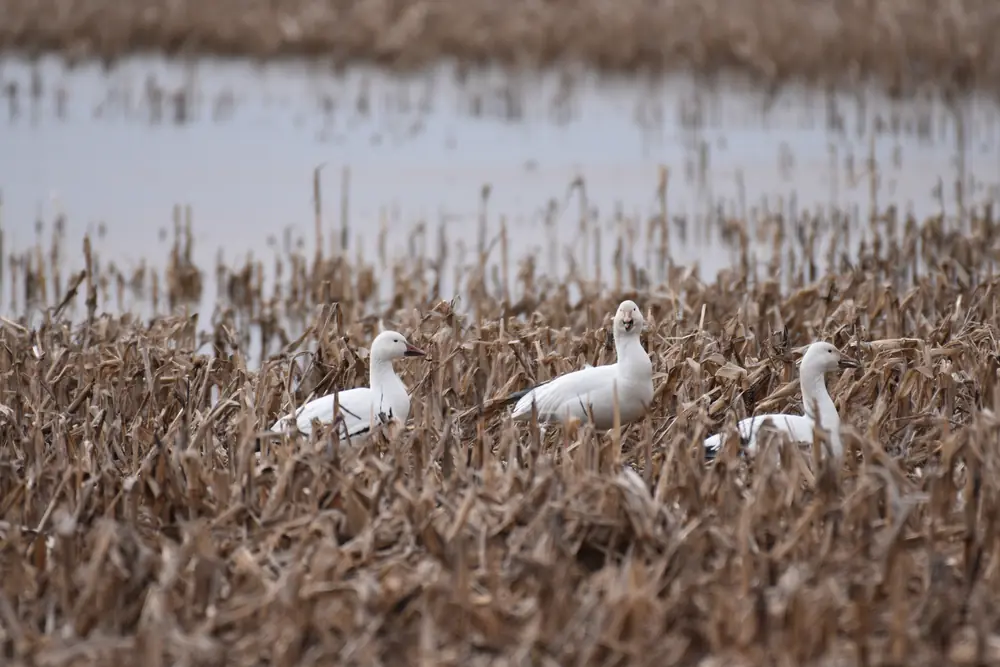
- Visit the geese before they go. Bombay Hook’s calendar says the spring waterfowl migration peaks in March, and snow geese leave Delmarva in early March. A trip along the Wildlife Drive in the first half of the month may be your last look at the flocks until fall.
- Go out on the first warm rain. After dark, once rain is falling and the air is still mild, head for a woodland pool with boots and a flashlight. Wood frogs quack first and spring peepers join in, and salamanders may be crossing the road.
Keep a record: a woodcock’s dusk flights, with the sunset time and the minutes to the first peent, make a fine dusk-and-dawn watch in the Naturalist’s Field Journal; the date of the first osprey on a nearby platform belongs on a nest-observed page; the first peepers and wood frogs make an entry on your map of sounds; and the red-maple flowers and the first woodchuck are fine candidates for a tree through the seasons and a mammal watch.
Regions used below: Piedmont: Wilmington, Hockessin and the Brandywine valley; Newark and White Clay Creek; Upper Bayshore and the C&D Canal: Blackbird Creek, Lums Pond; Dover, Kent County and Bombay Hook; Western Sussex: Seaford, Laurel, Trap Pond and the Great Cypress Swamp; Cape Region: Lewes, Milton, Cape Henlopen and Prime Hook; Rehoboth, the Inland Bays and Fenwick Island.
When does the woodcock sky dance start in Delaware?
March is the month to be outdoors at dusk with a coat on and your ears open. Bombay Hook National Wildlife Refuge lists woodcock courtship flights in its March calendar, and the Chesapeake Bay Program’s field guide dates the males’ aerial displays from mid-March to early April. A mild, damp evening is better than a freezing clear one, because the birds need soft ground for the earthworms that make up much of their diet.
-
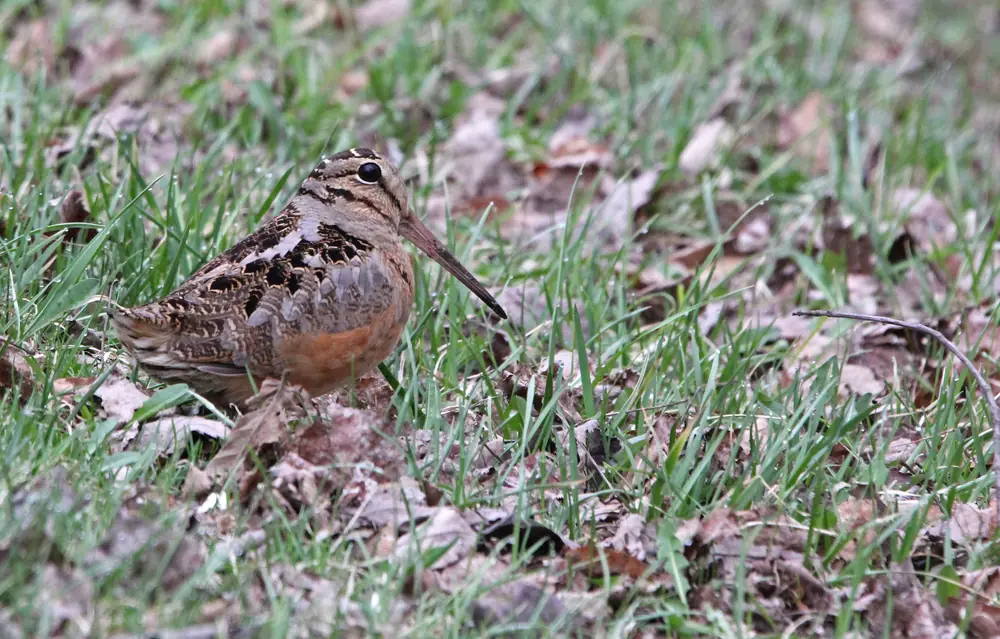
American woodcock courtship flights
Dusk, from about the second week of March into early April; check again at first light · Brushy old fields, young woods bordering open ground, power line cuts and the edges of state wildlife areas in all three counties
The woodcock is a stocky, round-bodied bird of the forest floor, ten to twelve inches long, patterned in black and brown on the back with a faintly orange belly, and it probes the soil with a long bill. Each male claims a small clearing, buzzes his call at the ground, and then rises in a widening spiral before dropping back in a zigzag, with a whistle coming from his wings. Stand quietly at the edge of the opening: you will hear the display far more often than you see it.
-
What happens after the dancing
Eggs in the weeks after pairing; chicks independent within about a month · Thickets and young forest with moist soil
According to the field guide, a female lays four or five eggs that hatch after 19 to 22 days, and the young are independent about a month later. The nest is a shallow scrape on the leaf litter, so a woodcock that bursts from underfoot in late March may be sitting on eggs. Step back and go around.
-
An evening with the experts
Tuesday, March 9, 5:30 to 8 p.m. · Coverdale Farm Preserve, 543 Way Road, Greenville
The Delaware Nature Society’s Woodcocks and Wine program is listed on its calendar for ages 21 and up at $45. It pairs a guided look at the woodcock’s sights, sounds and night behavior with a charcuterie spread and wine. Reserve online, and check the organizer’s page before planning around it.
Whether you join a program or go alone, write down the sunset time and the minutes that pass before the first call. At Dover on Sunday, March 21, the Naval Observatory gives sunset as 7:15 p.m. Eastern Daylight Time and the end of civil twilight as 7:42 p.m.; the display tends to start soon after the sun is down. Leave the flashlight off, and leave dogs on a leash or at home.
When do the snow geese and ducks leave Delaware?
This is the month when the big flocks pack up. Bombay Hook’s wildlife calendar says the spring waterfowl migration peaks in March, with ducks, snow geese and Canada geese abundant. The Chesapeake Bay Program adds that snow geese reach the Delmarva Peninsula in late November and leave in early March. Put the two together and March is a month of both abundance and goodbyes, and the numbers drop as the weeks go by.
-
Snow geese, last chance
Early March; stragglers may linger · Fields and marshes along the bayshore, from Port Penn south to Prime Hook
A snow goose is about 38 inches long with a 59-inch wingspan, and the flocks can number in the thousands. They eat roots, marsh grasses and waste grain, so you find them either in a muddy field or shoving their bills into the marsh edge. On a good morning the whole flock lifts at once with a roar that you feel more than hear. Each trip north takes them through New England and Canada to the Arctic.
-
Ducks and Canada geese
Peak through March, thinning by April · Impoundments at Bombay Hook and Prime Hook, farm ponds, millponds, the Nanticoke and the C&D Canal
Ducks that wintered in the pools are ready to move on. The refuge calendar for April lists the beginning of the early songbird migration, so late March is the time when waterfowl and the first songbirds share the same marsh edge.
-
Tundra swans heading north
Departures through March · Open water, wet fields and wheat stubble in Kent and Sussex
Swans that wintered around the Chesapeake and Delaware bays head for the Arctic. Listen for their soft, high calls overhead.
At Bombay Hook, the Wildlife Drive and trails keep hours that run 30 minutes either side of sunrise and sunset, and the refuge requires an entrance pass. Dogs must be on a leash no longer than ten feet. Snow goose hunting runs through Wednesday, March 10 in the state’s 2026–27 hunting guide, subject to federal approval, so until then the flocks lift at the slightest disturbance. After the middle of the month, a count of what is still on the pools makes a good entry for your eBird list.
When do spring peepers and wood frogs call in Delaware?
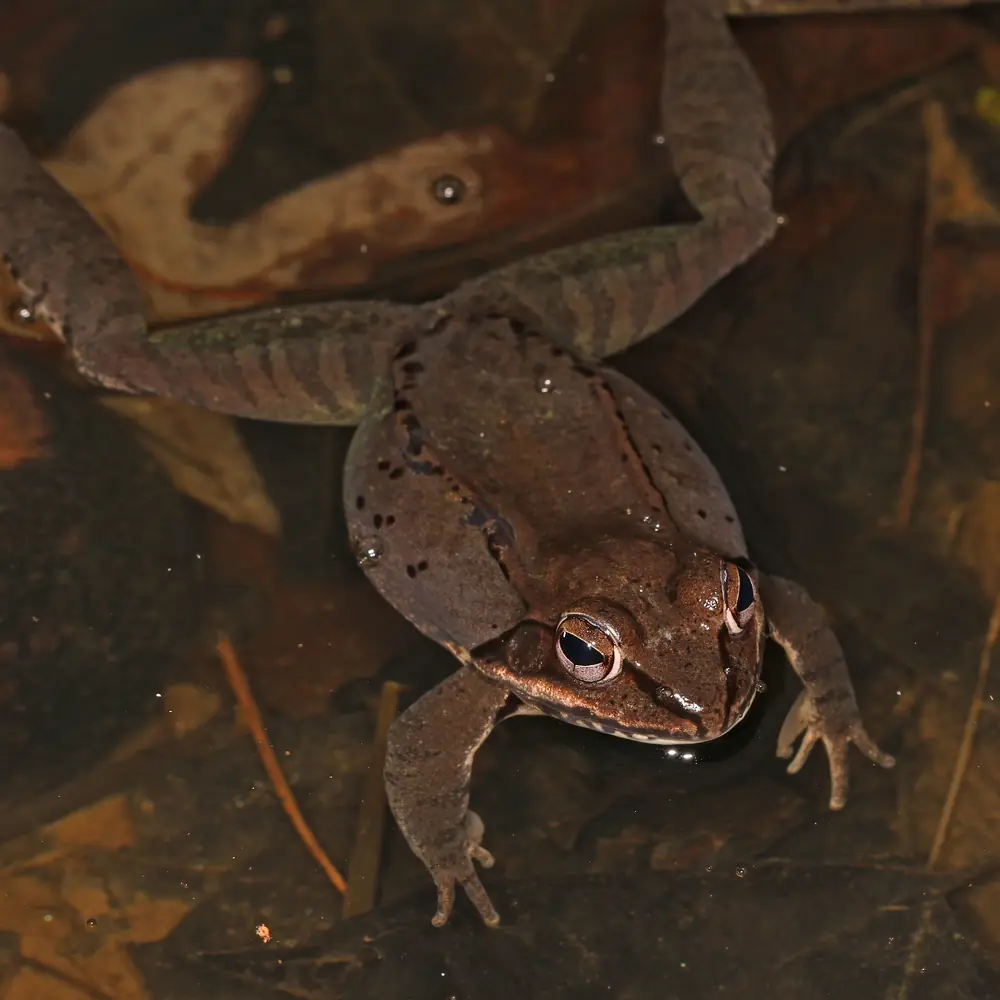
Delaware’s answer is that it depends on the rain and the night temperature. The Delaware Nature Society’s naturalists list the loud, high-pitched peeping of the spring peeper and the duck-like quacking of the wood frog among the sounds of March and April, along with the long, soft trill of the American toad, the low snore of the pickerel frog and the clacking of the Atlantic Coast leopard frog. Bombay Hook’s calendar places the full chorus of peepers and wood frogs in April, which means March is the month of the first notes: a few quacks from a woodland pool, then peeps from one wet corner at dusk, and then, on a mild night after rain, a roar.
-
Spring peepers and wood frogs
First calls on mild, wet evenings; full chorus in April · Pools, flooded woods, ditches and pond edges, especially in Piedmont parks such as Ashland, Brandywine Creek and White Clay Creek
The naturalist who wrote the society’s frog guide recommends Ashland Nature Center, Brandywine Creek State Park, White Clay Creek State Park and Abbott’s Mill Nature Center, and says to bring rubber boots, rain gear and a bright flashlight. Walk slowly at the edge of a pool. The chorus quiets when you come close, and starts again if you stand still for a few minutes.
-
The vernal pools of the Delmarva
Fill in late fall and winter, dry by late summer · Southwestern New Castle and northwestern Kent counties
Delaware Naturally describes vernal pools as shallow freshwater depressions with no stream flowing in or out, which keeps fish out and makes the pool safe for eggs. An estimated 1,500 to 2,500 of them are scattered across the Delmarva Peninsula, with concentrations in the two counties above. Spotted salamanders and wood frogs depend on them, and so do fairy shrimp, whose drought-resistant eggs wait through the dry months.
-
Tiger salamanders after the main rush
Late winter into early spring on warm rain; one to two weeks in the water · Seasonal ponds in Blackbird State Forest and forests nearby
DNREC’s wetland program explains that the endangered eastern tiger salamander emerges on warm rain and may spend only a week or two in a breeding pond before it heads back into the upland forest. Its blog asks property owners who have a seasonal pond to keep a wide forested buffer around it and to leave fallen logs where they lie, because logs are the animals’ shelter on land.
When a rainy night brings animals across a road, stop only where you can pull fully off, wear reflective clothing and carry a light. Pick up a crossing frog or salamander with wet hands and put it down on the side it was heading for. Do not net or wade into breeding pools, where the jelly-like egg masses are easily crushed. If you enjoy listening, ask the Division of Fish and Wildlife about volunteering for the Delaware Amphibian Monitoring Program, which relies on trained people to listen for frog calls along set routes.
Which birds are back and nesting in Delaware in March?
The breeding calendar has already started. DNREC defines the osprey breeding season in Delaware as March 1 through September 30, and the Delaware Estuary Program says ospreys come back every March, with nesting getting underway in April. The Chesapeake Bay Program’s field guide says they arrive in early March. Meanwhile resident birds have been at it for weeks.
-
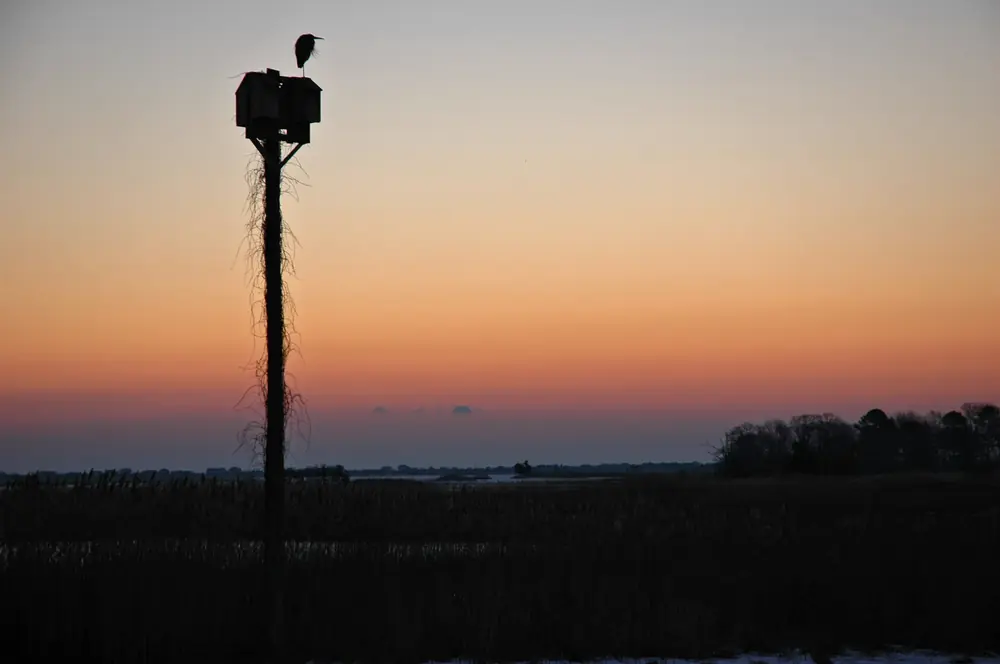
Ospreys return
March; nesting in April; incubation about 40 days · Tall dead trees, utility poles, channel markers and platforms near water: the bayshore, the Inland Bays, the Nanticoke, tidal creeks
An osprey is up to two feet long with a wingspan that can reach six feet, and it plunges feet first into the water for fish. Pairs reuse and add to the same nest every year. Once the eggs are laid, DNREC says, incubation takes about 40 days and the young stay in the nest 50 to 55 days. Watch from a distance: the agency’s rule of thumb is that if an osprey calls or flies from the nest because of you, you are too close.
-
Bald eagles still on eggs
Incubating; eggs hatch by April · Tall trees near Bombay Hook, Prime Hook, the Nanticoke River and the DuPont Nature Center area in Milford
DNREC’s 2023 survey counted 121 confirmed bald eagle nests in Delaware, 82 of them active, compared with four active nests in 1987. March is a quiet time at the nests, with one adult low in the bowl and the other perched nearby. Bombay Hook’s calendar puts hatching in April. If you find a nest you think is new, report it through DNREC’s online page.
-
Great blue herons building rookeries
Eggs from mid-March · Wooded swamps and small islands around the bays and rivers
These herons nest in colonies high in the treetops. The field guide says females lay three to seven eggs from mid-March through mid-June, both parents sit for about 28 days, and often only one or two chicks survive. Look from a distance with binoculars and never walk under a rookery.
-
Eastern bluebirds and tree swallows
Bluebirds begin nesting; swallows and phoebes arrive in the second half of March · Fields with nest boxes, orchards, golf course edges and lake shores
A bluebird female lays three to seven pale blue eggs and may raise two or three broods in a year, according to the field guide. The Delaware Ornithological Society’s March newsletter, written in 2022, notes that eastern phoebes and tree swallows arrive later in the month, before flying insects are abundant, and that tree swallows return early to compete for cavities. That arrival will vary with the weather; a cold snap can send them south again.
If you put up a nest box, clean it out before the birds come. The Cornell Lab’s free NestWatch program asks participants to record each nest they follow, and DNREC asks volunteers to log osprey nest observations on OspreyWatch, the international reporting site it uses for its own monitoring group.
What blooms in Delaware in March?
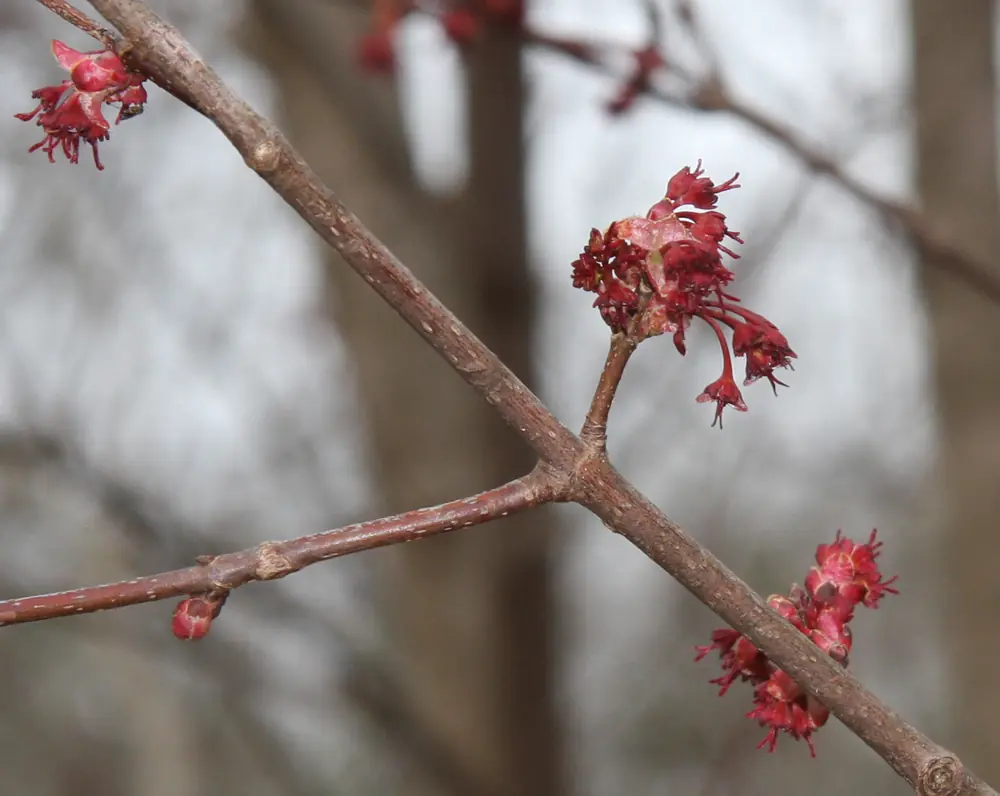
The first flowers in Delaware are not the ones people picture. Bombay Hook’s calendar says alders and red maples flower in March, and the Chesapeake Bay Program’s field guide gives red maple flowering as March and April, in drooping pinkish-red clusters. From a distance a red-maple swamp looks as if it has been dusted in rust. The woodland wildflowers follow, and the garden bulbs are already out.
-
Red maples and alders
March into April · Wet woods, floodplains, swamp edges and streamsides statewide
The flowers open before the leaves, so the trees look bare and red at once.
-
The March Bank at Winterthur
Many bloom in March; daffodils start late March and April · Winterthur Museum, Garden and Library, near Wilmington
Winterthur’s plant guide lists snowdrops (January to March), Amur adonis, winter aconite, glory-of-the-snow, squills, spring snowflake, crocus and cornelian-cherry as March bloomers on the March Bank, and puts the early daffodils in March and April.
-
Spring ephemerals begin
Late March and April; the show is mostly over by mid-May · Woodlands of Brandywine Creek State Park, White Clay Creek State Park, Ashland Nature Center and Middle Run Valley Park
Spring ephemerals are native woodland plants that bloom before the trees above them leaf out. The Delaware Nature Society’s guide shows bloodroot, spring beauty and others, and warns visitors not to disturb the plants or the soil around them.
For a sweet interlude, the Delaware Nature Society’s Maple Sugar Festival at Ashland Nature Center in Hockessin is listed on Saturday, March 13, with a pancake breakfast, live music, maple crafts and a lesson in turning sap into syrup (entry times at 9 and 11 a.m., $20, rain or shine). Registration is online.
Why is The Point at Cape Henlopen closed, and where are the seals?
The sandy tip of Cape Henlopen State Park closes to people every year on March 1, and it stays closed on the ocean side until September 1 and on the bay side until October 1. DNREC has run the closure since 1993 for piping plovers, American oystercatchers, least terns and red knots, which nest or stop to rest there. The dunes are off-limits at all times, marked by a symbolic fence at the edge of the beach.
-
Birds that need the beach
March 1 to September 1 (ocean side) and October 1 (bay side) · The Point, Cape Henlopen State Park, Lewes
Expect to see the closure signs and to hear terns and plovers from beyond them. Check the park’s own notices for what else is open; the closure covers only the tip.
-
Harbor seals before they head north
Present from late fall into early spring, with the peak from November through April · Ocean and bay beaches and inlets along the Delaware coast
The Cape Current describes four species in Delaware (harbor, gray, harp and hooded) and says seals typically arrive in late fall and stay through early spring, with the peak from November through April.
Harassing any of the four seal species is illegal under the Marine Mammal Protection Act. Keep 150 feet away, hold your dog on a leash, and call the MERR Institute’s hotline at 302-228-5029 if a seal is hauled out and appears injured. A resting seal is not abandoned; it needs rest, and a nursing mother can go for weeks without eating.
What wakes up on land in Delaware in March?
Bombay Hook’s March calendar has three short lines about animals that start moving as the ground thaws: woodchucks and turtles emerge from hibernation, and deer ticks emerge as well.
-
Woodchucks and turtles
On the first run of mild days · Field edges, hedgerows, culverts, millponds and the marsh pools of the refuges
A woodchuck out of its burrow in March is hungry and may be easiest to see on a sunny bank. Turtles come out slowly, and the first sign is often one on a log in the sun. Both go back to cover if the weather turns.
-
Deer ticks
Active on mild days · Leaf litter, brush and tall grass at field and trail edges
The CDC says ticks wait on vegetation with their front legs outstretched and climb onto whatever brushes past. A walk in March is not safe from them: the refuge lists them as active this month. After every walk, check your skin, your clothing and any pets, and shower soon. If you feel unwell in the weeks after a bite, tell a doctor about it.
The first woodchuck on a favorite hillside and the first turtle on a log are worth dating in a notebook.
What is March weather like in Delaware, and when is the last freeze?
Expect a seesaw. NOAA’s 1991–2020 normals give the typical March high as 52.5 °F at the Wilmington airport, 54.5 °F at Dover and 55.2 °F at both Georgetown and Lewes, with March lows from 32.8 °F at the Newark farm to 37.5 °F at Lewes. Over the month the Wilmington airport’s typical high climbs from 47.6 °F on March 1 to 58.1 °F on March 31, and at Lewes from 50.8 to 60.4 °F. The coast stays milder because the bay and ocean are slow to warm, so an inland freeze can leave the beach town above 32 °F.
Freezing nights are still common inland: the normal is 14.2 nights at or below 32 °F at the Wilmington airport, 15.5 at the Newark farm, 15.1 at Greenwood, 12.0 at Dover, 12.5 at Georgetown and 8.0 at Lewes. Precipitation averages between 3.86 inches at Georgetown and 4.27 at Newark. Average snowfall is 3.1 inches at Wilmington (the median is 1.2, so half of all Marches bring less) and 1.0 at Lewes (median zero).
| Station | One year in ten | Median | Nine years in ten |
|---|---|---|---|
| Wilmington New Castle County Airport | Mar 26 | Apr 7 | Apr 21 |
| Newark Ag Farm | Mar 26 | Apr 7 | Apr 21 |
| Dover | Mar 22 | Apr 4 | Apr 17 |
| Greenwood 2 NE (Kent–Sussex line) | Mar 29 | Apr 11 | Apr 28 |
| Georgetown Sussex County Airport | Mar 22 | Apr 4 | Apr 16 |
| Lewes | Mar 13 | Mar 29 | Apr 9 |
The table counts as a planning aid, not a promise: in the right-hand column, only about one spring in ten brings a freeze later than the date shown. The hazards of March in Delaware are mostly about the ground and the water. Heavy rain on frozen soil can flood low roads and creeks. A nor’easter can push tides over bayshore and beach roads, so read the coastal flood statements from the National Weather Service in Mount Holly before heading to the shore. Dry grass and leaf litter that has not yet greened up can burn easily: the Delaware Forest Service says peak wildfire season is from mid-April to early May, and by March 11, 2025, a drought spring, its crews had already responded to four fires that month, so ask your fire company about burn rules and never leave a fire unattended. The Climate Prediction Center posts new 90-day outlooks each month near mid-month on its seasonal outlook page; look there for the latest. Our forecast page covers the next week, and the Delaware frost dates page lists the dates for more towns.
How much daylight does Delaware gain in March?
Between 75 and 79 minutes. Across the state, the day runs between 11 hours 18 minutes and 11 hours 20 minutes on March 1 and between 12 hours 35 minutes and 12 hours 37 minutes by March 31, about two and a half minutes more each day. Clocks jump ahead an hour in the small hours of Sunday, March 14, which pushes every sunrise and sunset after that an hour later on the face of the clock. At Dover, sunrise is at 6:35 a.m. and sunset at 5:54 p.m. Eastern Standard Time on March 1, and on Saturday, March 13 it is 6:17 a.m. and 6:07 p.m. standard time. The next day, Sunday, March 14, sunrise is at 7:15 a.m. and sunset at 7:08 p.m. Eastern Daylight Time. By March 31 they are 6:48 a.m. and 7:25 p.m. daylight time. The March equinox arrives at 4:25 p.m. Eastern Daylight Time on Saturday, March 20, and Delaware’s day that Saturday runs a little over 12 hours.
| City | Mar 1 | Mar 31 | Gained | Per day |
|---|---|---|---|---|
| Wilmington | 11 h 18 m | 12 h 37 m | 79 min | 2.6 min |
| Newark | 11 h 19 m | 12 h 37 m | 78 min | 2.6 min |
| Dover | 11 h 19 m | 12 h 37 m | 78 min | 2.6 min |
| Milford | 11 h 20 m | 12 h 36 m | 76 min | 2.5 min |
| Georgetown | 11 h 20 m | 12 h 36 m | 76 min | 2.5 min |
| Seaford | 11 h 20 m | 12 h 36 m | 76 min | 2.5 min |
| Lewes | 11 h 20 m | 12 h 36 m | 76 min | 2.5 min |
| Fenwick Island | 11 h 20 m | 12 h 35 m | 75 min | 2.5 min |
Sunrise and sunset times in this section come from the U.S. Naval Observatory. If you want exact times for your own street, use our sunrise and sunset calculator. After the clocks change, the dusk walks and the woodcock watch are possible after supper, and the morning commute is darker for a few weeks.
What is in the night sky over Delaware in March 2027?
Times below are Eastern Standard Time on March 8 and Eastern Daylight Time after the clock change. March is a quiet month in the sky except for one bright morning planet and two evening ones. The full Moon is the Worm Moon, named for the softening ground that lets earthworms and the birds that eat them return to the surface. Sea and Sky lists Crow Moon and Sap Moon among its other names for it.
-
The Worm Moon
Best on Sunday evening, March 21; exactly full at 6:44 a.m. on Monday, March 22 · Moonrise at Dover is 6:43 p.m. EDT, about 30 minutes before the sun sets
The best view comes on Sunday evening, when the Moon clears the eastern horizon less than half a day before it turns full and sunset is at 7:15 p.m. The exact moment of full, 6:44 a.m. Monday, comes when the Moon is low in the west near sunrise. A Moon near the horizon often looks amber.
-
Mercury in the morning
Farthest from the Sun, 27.6 degrees west, early on Wednesday, March 17; best viewing runs roughly March 8 to 25 · Just above the east-southeast horizon, about 60 minutes before sunrise
A spring morning showing is a shallow one for the Northern Hemisphere, so choose a spot with a flat, open view to the east-southeast. Brilliant Venus sits well above it, and Mercury is the fainter spark below. Both Sea and Sky and Fred Espenak’s almanac give March 17 for the greatest elongation.
-
Moon and Jupiter, then Mars and Jupiter
The Moon beside Jupiter on March 18 and 19; Mars passing Jupiter on March 30 · Overhead after dark; Jupiter is the brighter of the pair
Jupiter, at opposition in February, is still high after dark and brighter than any star. The Moon comes within about a degree of it, closest on March 19. Near the end of the month Mars slides by about 4.3 degrees to its side, a gap of roughly eight Moon widths, and both planets are easy to see without a telescope.
| Phase | Date | Time |
|---|---|---|
| New moon | Monday, Mar 8 | 4:29 a.m. EST |
| First quarter | Monday, Mar 15 | 12:25 p.m. EDT |
| Full moon, the Worm Moon | Monday, Mar 22 | 6:44 a.m. EDT |
| Last quarter | Monday, Mar 29 | 8:54 p.m. EDT |
| New moon | Tuesday, Apr 6 | 7:51 p.m. EDT |
Cloud cover is the usual obstacle. Check our cloud cover maps that afternoon, and see the moon phase calendar for nightly moonrise and moonset times.
What can families do outdoors in Delaware in March 2027?
- Listen for the first frogs. Find a pool near home and visit it on a mild, rainy evening. The Delaware Nature Society’s Meet Marsh Animals program at the DuPont center in Wilmington is free on Saturdays at 1:45 p.m. on March 6, 13, 20 and 27, and Storytime at the Marsh is free on Wednesdays at 10:45 a.m. on March 3, 10, 17, 24 and 31.
- Build a birdhouse, Saturday, March 6. Abbott’s Mill Nature Center near Milford runs it from 10 a.m. to noon ($25, all ages).
- Maple Sugar Festival, Saturday, March 13. Ashland Nature Center offers a pancake breakfast, music, crafts and a look at turning sap into syrup, with entries at 9 and 11 a.m. ($20).
- Little naturalists. The society’s Knee High Naturalists mornings, mostly for children two to five, include World Wildlife Day on March 3, What Will the Wind Blow on March 10, Mammal Moves on March 12 at Ashland, Hot or Cold on March 19 at Coverdale and Birds, Eggs, and Nests on March 24 (prices $15; ages vary by program).
- Join a count. Project FeederWatch counts run from November 1 through April 30, so you can still sign up. Cornell’s NestWatch is free to join, and you can send osprey nest reports to DNREC through OspreyWatch. Journey North takes sighting reports for hummingbirds and monarchs as they head north later in the spring.
Delaware Nature Society programs need advance registration, and dates, prices and cancellations can change, so look at the listing before you go. For the months around March, see February in Delaware or browse our seasonal nature guides.
Safety notes for March in Delaware
- Hunting is winding down. The 2026–27 hunting guide ends snow goose season on Wednesday, March 10, keeps the crow season open on Fridays, Saturdays and Sundays into late March (check the guide for the closing date), and groundhogs and coyotes can be hunted year-round. Trapping for muskrat, mink, otter, raccoon, opossum, nutria, red fox and coyote ends March 10, beaver trapping ends March 20, and some trapping on New Castle County’s embanked meadows runs to the same day. Raccoon and opossum are chase-only, with hounds and no killing, from March 1 to March 31. Keep dogs on a leash near marsh ditches.
- Spring turkey is next month. The guide lists the 2027 spring turkey season as April 10 to May 9, with a youth and non-ambulatory hunter weekend on April 3 and 4, so there are no turkey hunters afield in March. Sunday hunting is allowed in season on private land at the landowner’s discretion and on public lands the agency designates, but not for migratory birds.
- Blaze orange. The statewide orange rule (400 square inches) is tied to firearm deer seasons, none of which are open in March. The guide also requires small game hunters on State Wildlife Areas to wear that much orange at all times.
- Trout waters. DNREC says it stocks rainbow, brown and some other trout every April in selected New Castle County streams and in one pond each in Kent and Sussex counties. Designated trout waters have their own opening dates and closed periods, so check the agency’s trout page for the 2027 dates before you fish or walk the banks.
- Seals and shorebirds. Keep 150 feet from seals and out of the closed area at The Point. Call MERR at 302-228-5029 for an injured or stranded marine animal.
- Cold water. Stream banks are soft and March water is dangerously cold. Never drive into flooded roads.
Sources (47)
- U.S. Fish and Wildlife Service: Bombay Hook wildlife calendar (February to April)
- U.S. Fish and Wildlife Service: Bombay Hook rules and policies (Wildlife Drive hours, entrance pass, leashes)
- DNREC: osprey monitoring (breeding season, incubation, nest disturbance, OspreyWatch)
- Delaware Estuary Program: it’s nesting season for osprey in the Delaware Estuary
- DNREC: bald eagles in Delaware (2023 survey, reporting a nest, viewing places)
- Chesapeake Bay Program field guide: osprey
- Chesapeake Bay Program field guide: American woodcock
- Chesapeake Bay Program field guide: snow goose
- Chesapeake Bay Program field guide: great blue heron
- Chesapeake Bay Program field guide: eastern bluebird
- Chesapeake Bay Program field guide: red maple
- Delaware Nature Society: Woodcocks and Wine (March 9, 2027)
- Delaware Nature Society: Maple Sugar Festival (March 13, 2027)
- Delaware Nature Society: March 2027 events calendar
- Delaware Nature Society blog: springtime is frog time
- Delaware Nature Society blog: now or never, observing spring ephemeral wildflowers
- Delaware Naturally: what vernal pools are and why they matter
- DNREC Wetland Monitoring and Assessment Program blog, March 17, 2022: tiger salamanders and forested buffers
- WHYY: Delaware environmental department in need of frog call monitors
- Delaware Ornithological Society newsletter, March 2022 (March arrivals: phoebes and tree swallows)
- Winterthur: March Bank plant guide
- Delaware Public Radio, March 1, 2026: the annual closure at The Point, Cape Henlopen State Park
- The Cape Current: seal season, Delaware’s shoreline stars
- MERR Institute: marine mammal and sea turtle response (hotline)
- CDC: about ticks and tickborne disease
- NOAA NCEI: U.S. climate normals 1991–2020
- NOAA NCEI: monthly normals data service, Delaware stations (March temperature, cold nights, precipitation, snowfall and medians)
- NOAA NCEI: daily normals data service, Wilmington and Lewes (March 1 and March 31 highs and lows)
- Delaware State Climate Office, University of Delaware
- State of Delaware news, March 11, 2025: Delaware’s weather ignites wildfire concerns
- National Weather Service Mount Holly (Philadelphia): Delaware forecasts, coastal flood and marine pages
- Climate Prediction Center: seasonal outlooks (issued monthly near mid-month)
- U.S. Naval Observatory: moon phases (data API)
- U.S. Naval Observatory: sun and moon rise and set, Dover, March 2027
- U.S. Naval Observatory: Earth’s seasons 2027 (March equinox)
- Fred Espenak, Sky Event Almanac 2027 (Mercury elongation, Moon and Jupiter, Mars and Jupiter)
- Sea and Sky: astronomy calendar 2027 (March events and full moon names)
- Delaware Hunting and Trapping Guide 2026–27: migratory bird seasons
- Delaware Hunting and Trapping Guide 2026–27: furbearer trapping and hunting seasons
- Delaware Hunting and Trapping Guide 2026–27: small game seasons and hunter orange on State Wildlife Areas
- Delaware Hunting and Trapping Guide 2026–27: spring turkey season 2027
- DNREC: upstate trout season in New Castle County streams, 2026 (stocking, stream closure)
- DNREC: freshwater trout fishing (season timing, pond seasons, stream closure rule)
- Cornell Lab of Ornithology: NestWatch
- Project FeederWatch: how to participate
- Journey North
- Photos via Wikimedia Commons; licenses and photographers are credited under each picture
