What to look for in nature in Delaware this November
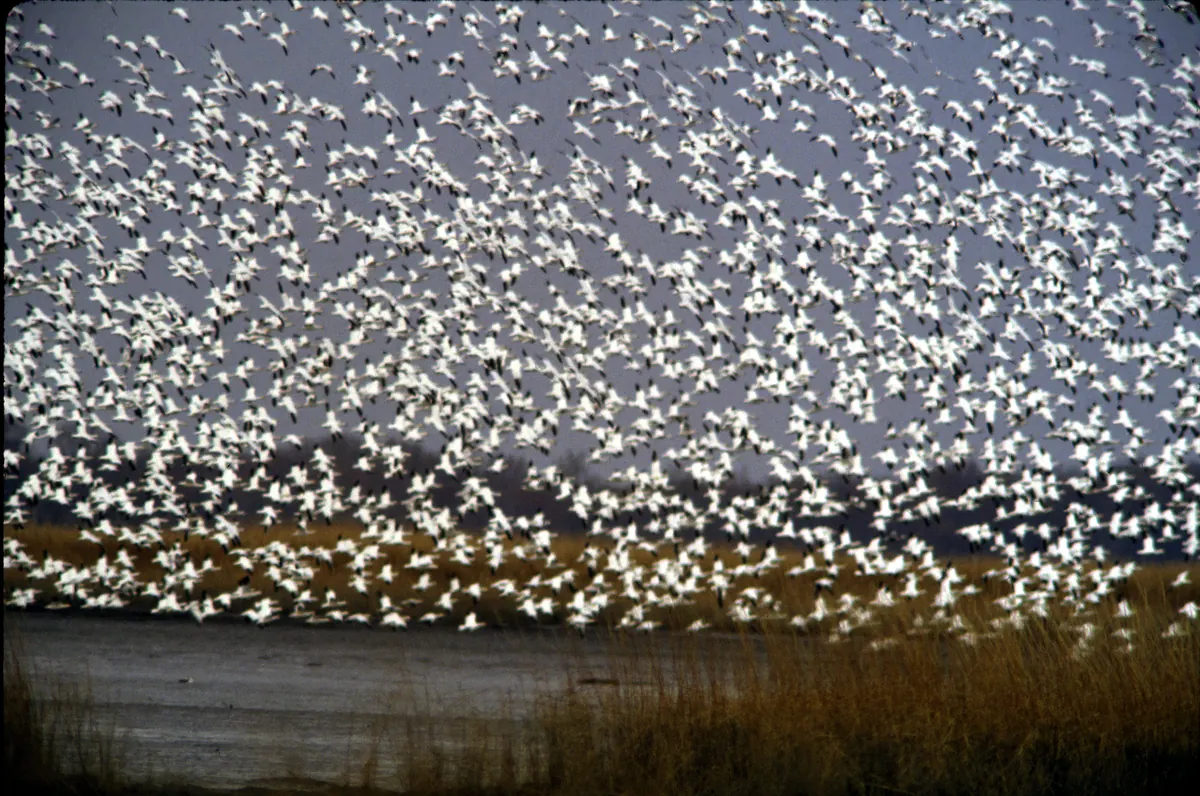
November is the month Delaware turns from a migration corridor into a winter address. Bombay Hook’s own calendar puts the peak of the fall duck and goose flight here, and by the last week the white clouds of snow geese settle over the bayshore while tundra swans drop into the ponds of Sussex County. The last big hawks, red-tails, red-shoulders and the odd golden eagle, ride the cold fronts past Hockessin, and scoters and brant gather at Indian River Inlet. On land, the deer rut reaches its height during a firearm season shaped this year by the state’s first cases of chronic wasting disease. Here is what to look for, county by county, with dates to plan around.
Other months in Delaware: October, December.
Start here
- Ducks and geese at their November peak. Drive the Bombay Hook wildlife loop on a cold, clear morning: the refuge lists November as the high point of its fall waterfowl flight, with pintails, wigeon, shovelers, teal and both color forms of snow goose. The roads and trails close on Friday, November 13, for a refuge hunt, so pick another day.
- The last big raptor flight. Red-tailed and red-shouldered hawks, vultures and Delaware’s few migrating golden eagles all pass the Ashland Hawk Watch in Hockessin mostly in November. The counter is on the hill from 9 a.m. to 4 p.m. daily until November 30, and visiting is free. A sunny day after a cold front, with a northwest wind, is the one to choose.
- A supermoon and a pair of morning planets. The Beaver Moon reaches full at 9:53 a.m. on Tuesday, November 24; Monday and Tuesday evenings both show a round disk, and it qualifies, barely, as a supermoon. On the dark mornings of November 15 and 16, reddish Mars and bright Jupiter stand barely more than a degree from each other in Leo, and Venus blazes lower down in the east.
Keep a record: a morning on the Bombay Hook loop belongs in the Naturalist’s Field Journal under “birds I have seen”, a golden eagle or red-tail on Hawk Watch Hill earns a line in the daily field log, a dropped goose or swan feather belongs on the feather-found plate, and deer rubs and scrapes in the woods are exactly what the reading-the-signs page asks you to notice.
Regions used below: Piedmont: Wilmington, Hockessin and the Brandywine valley; Newark and White Clay Creek; Upper Bayshore and the C&D Canal: Blackbird Creek, Lums Pond; Dover, Kent County and Bombay Hook; Western Sussex: Seaford, Laurel, Trap Pond and the Great Cypress Swamp; Cape Region: Lewes, Milton, Cape Henlopen and Prime Hook; Rehoboth, the Inland Bays and Fenwick Island.
When do the snow geese and tundra swans reach Delaware?
The Fish and Wildlife Service’s seasonal calendar for Bombay Hook National Wildlife Refuge, east of Smyrna, names November as the peak of the fall waterfowl migration and lists the birds to expect: Canada geese, snow geese in both their white and blue forms, gadwall, mallards, black ducks, pintails, wigeon, wood ducks, shovelers, both kinds of teal, scaup, buffleheads, ruddy ducks and two mergansers. By December the refuge expects high numbers of wintering waterfowl, staying all month unless a hard freeze pushes them south.
-
Snow geese settle in for the winter
Building through the month; the big flocks from late November · Bombay Hook, Prime Hook and the farm fields of Kent and Sussex
Most snow geese reach the Delmarva Peninsula in the second half of November, according to the Chesapeake Bay Program. These are plump white geese with black wingtips, a pink bill marked with a dark “grin patch,” and red legs; the darker “blue geese” mixed in are the same species, a genetic color form once thought to be a separate bird. They dig roots out of marsh grasses with serrated bills and graze in fields for grain and clover, which is why a flock can lift off a cornfield as easily as off the marsh.
-
Tundra swans
Late autumn through early spring · Trap Pond and the ponds and fields of Sussex County; tidal shallows along the bay
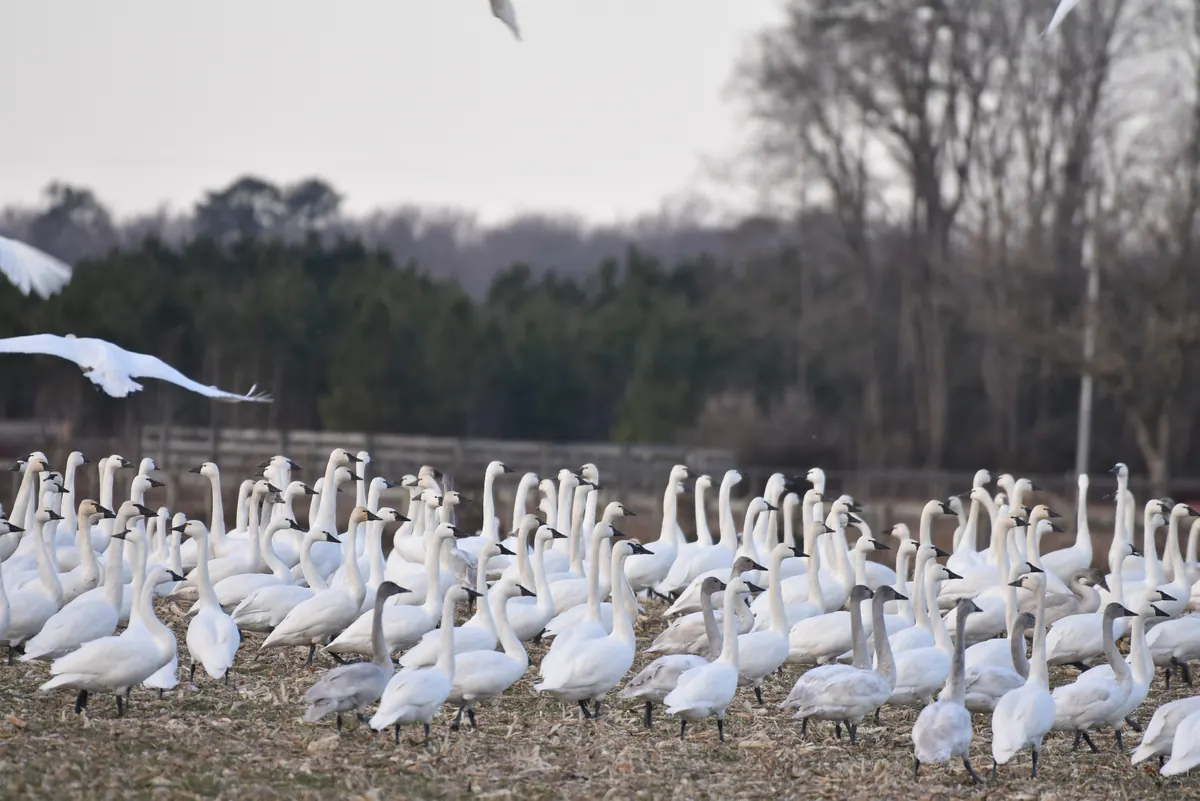
Delaware State Parks says waterfowl and tundra swans are abundant at Trap Pond in the winter months. The Chesapeake Bay Program describes the tundra swan as about four and a half feet long with a wingspan over five feet, a black bill often with a small yellow spot near the eye, and a neck held straight. That straight neck and black bill separate it from the orange-billed mute swan, which lives here all year and curves its neck. Families travel together, and the cygnets are as big as their parents but brownish gray. Flocks are often heard first, a soft, high whooping overhead.
-
Diving ducks on the ponds
From November on · Mill ponds, Lums Pond, the Inland Bays, Bombay Hook’s pools
Buffleheads, small black-and-white divers that spring straight up off the water, and hooded mergansers, whose males raise a white fan of a crest, settle on ponds and tidal shallows from autumn to spring, says the Chesapeake Bay Program. Any Sussex mill pond is worth a stop.
Plan around the refuge’s hunt day: on Friday, November 13, every road and trail at Bombay Hook is closed, though the visitor center and restrooms stay open. Regular duck season runs October 31 to November 7 and again November 25 to 29, and the regular snow goose season opens November 25, so expect shooting in the marshes outside the refuge on those days. Tundra swans may be taken only under a special permit, from November 8.
Which hawks and eagles fly over Delaware in November?
Delaware’s two fall hawk counts keep going to the last day of November, and the cast changes completely from early autumn. The broad-wings and most sharp-shins are gone; what is left are the big, late buteos and the vultures. At Ashland Nature Center in Hockessin, HawkCount’s site profile shows the record days for red-tailed hawks, golden eagles, black vultures and turkey vultures all falling in the first week of November or later.
-
Red-tailed and red-shouldered hawks
Late October through November · Ashland Hawk Watch, Hockessin
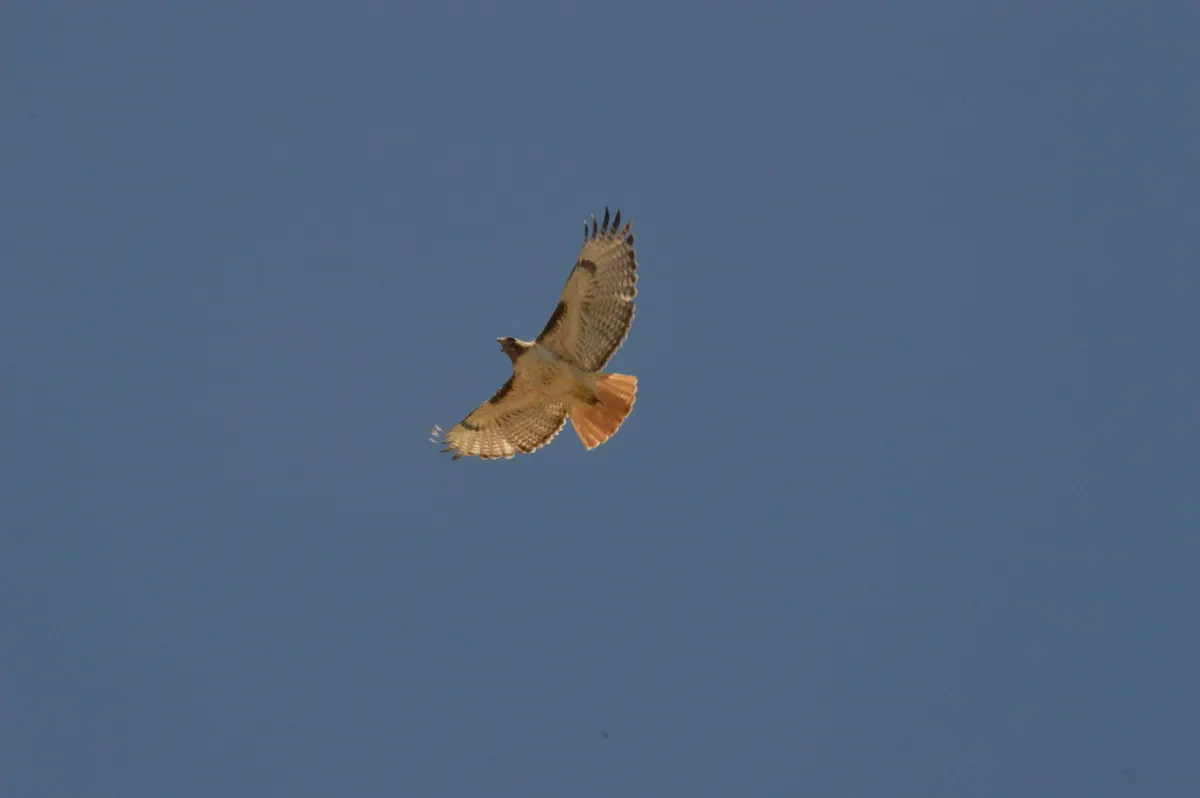
Ashland averages 805 red-tails a season; its best single day was 620 on November 4, 2012. Red-shouldered hawks average 497, and the site’s record day for them came only last year, 275 on November 20, 2025. Red-tails are chunky, broad-winged buteos with a dark band across a pale belly; red-shoulders show translucent crescents near the wingtips and a banded black-and-white tail.
-
Golden eagles
Late October and November · Ashland; occasionally Cape Henlopen
Only about 11 golden eagles pass Ashland in an average season, and the three best days on record were all between November 2 and 4. Cape Henlopen’s average is seven. Look for a big, dark eagle with a golden nape, holding its wings in a slight V; immature birds flash white at the tail base and in the middle of each wing. The counter on the hill is the person to ask.
-
Vultures and bald eagles
All month · Both hawk watches; bayshore marshes
Turkey vultures average 2,282 a season at Ashland, with the top day, 556, on November 3, 2023. Black vultures have their best days there in November too. Bald eagles move all autumn, with a season average of 436 at Ashland; by December, the Bombay Hook calendar says, they are often seen perched on bare branches over the marsh.
The Delaware Nature Society runs the Ashland count every day, 9 a.m. to 4 p.m., free for ages 8 and up. If you would rather draw than count, its Nature Journaling: Raptor Migration session climbs to the hill on Saturday, November 7, at 10 a.m. ($30). Daily totals are posted on HawkCount each evening.
What winter birds arrive on the Delaware coast in November?
-
Sea ducks and purple sandpipers at Indian River Inlet
Late fall into early spring · Delaware Seashore State Park, north and south sides of the inlet
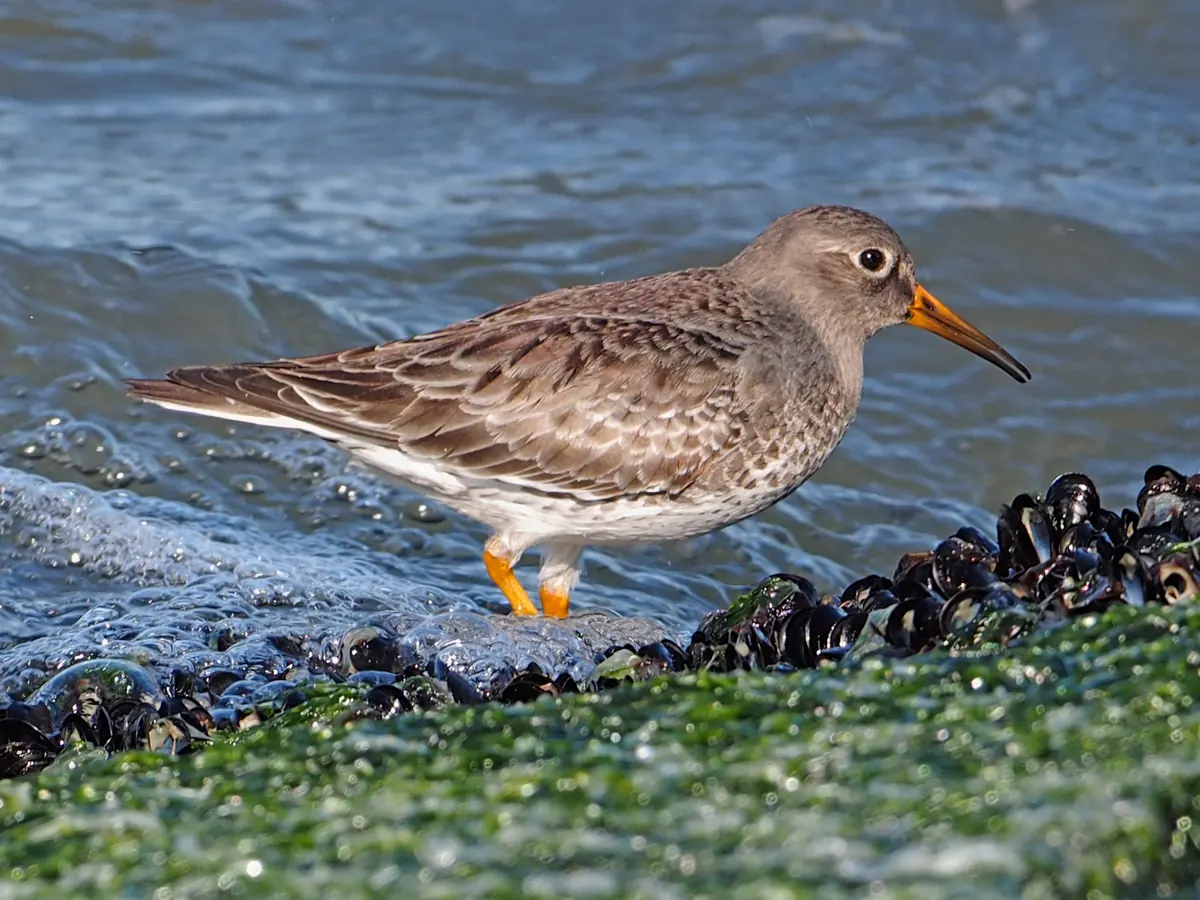
State Parks calls Indian River Inlet the best place to begin for purple sandpipers, stocky gray shorebirds that feed on the wet rocks of the jetties from late fall to early spring, and for winter rafts of scoters and common eiders, with now and then a harlequin duck. The Delaware Ornithological Society holds a free Sea Watch there on Sunday, November 8, 8 a.m. to noon, meeting at the South Inlet parking area; bring a scope if you have one and dress for wind.
-
Brant on the Inland Bays
Winter · Rehoboth, Indian River and Little Assawoman bays; marsh edges and lawns near the water
Brant are small, dark geese with a white “necklace” that breed farther north than any other goose and winter in coastal lagoons behind barrier beaches, says the Chesapeake Bay Program. They travel and stay together as families inside the larger flock and feed on eelgrass, sedges and algae, and since the eelgrass die-off of the 1930s they have learned to graze on grass ashore as well. Delaware’s Inland Bays, shallow lagoons behind the barrier beach, are that kind of place. Their low, rolling calls carry a long way across the water.
-
Gannets and loons off the Point
Fall migration into winter · The Point and Herring Point, Cape Henlopen State Park
State Parks recommends both overlooks in autumn for passing gannets, loons and sea ducks, and again in winter for gulls and waterbirds resting offshore. Gannets are the big white seabirds with black wingtips that fold up and plunge from height; a calm morning with the light behind you makes them easy to follow.
-
Learn the surf, or walk the bridge
November 5, 12, 14 and 19 · Delaware Seashore State Park
The park’s Intro to Surf Fishing class, 9 a.m. to noon on November 5, 14 and 19 ($25, ages 12 and up, gear and bait provided), covers fish identification and casting. On Thursday evenings, November 5 and 12, a guided 5 p.m. walk over the Indian River Inlet Bridge ($6) explains how the inlet has shifted over two centuries. Register at 302-227-6991, and confirm the dates with the park, since programs change.
What is happening with Delaware’s deer in November?
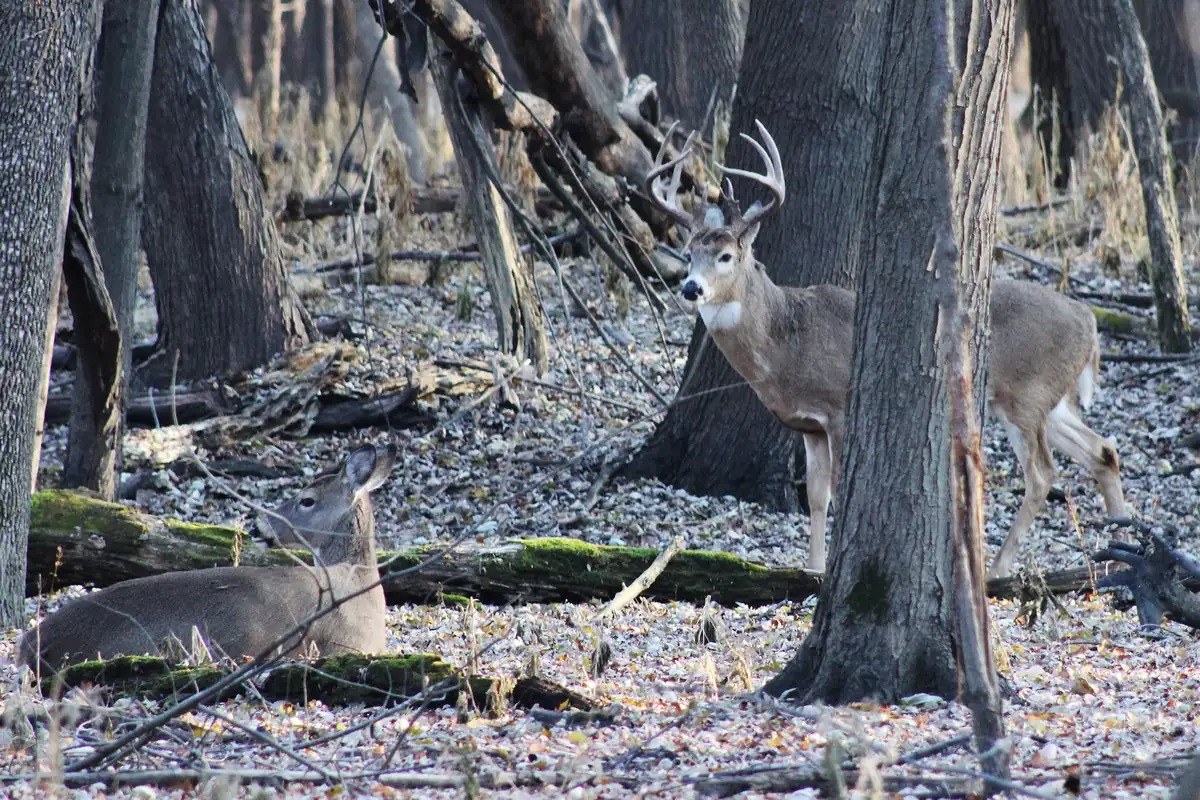
November is the height of the white-tailed deer rut. The Chesapeake Bay Program places the breeding season from late September into February with its peak this month, when bucks spar with their antlers and travel far more than usual. That means rubs, where bucks have scraped bark off saplings, and pawed bare scrapes under low branches along woodland edges; it also means deer crossing roads at dawn and dusk, often one after another.
-
Chronic wasting disease reaches Delaware
First confirmed April 21, 2026 · Central and southern Sussex County
This is the first firearm season since the disease was found in the state. DNREC announced Delaware’s first case of chronic wasting disease, in a hunter-harvested deer from Sussex County, on April 21, 2026; a third case, just east of the Jones Crossroads Landfill near Georgetown, followed on September 16. The disease is a fatal, untreatable illness of the brain and nervous system of deer and their relatives, spread through saliva, urine, feces and blood, directly or through contaminated ground. Health officials know of no case of it passing to people, though the CDC advises testing harvested deer before eating them.
-
What the management zone means
Emergency rules in effect since August 17 · Wildlife Management Zones 11, 14 and 16, including Midlands Wildlife Area and Trap Pond State Park
Inside the zone it is now illegal to bait or feed deer, and fawns found there may not be rehabilitated and moved. Statewide, buck lures made from natural deer urine are banned. Deer taken in the original management zone during the November 13–22 firearm season must be checked in at the Jones Crossroads Landfill near Georgetown or the Gumboro Service Center (Zone 11 joined the zone in September, so hunters there should confirm the current rules with DNREC); free testing is open to hunters statewide.
-
If you see a sick deer
Any time · Anywhere in the state
DNREC lists the late signs as dramatic weight loss, stumbling, a drooping head and ears, heavy drooling and a loss of fear of people. Do not touch or move the animal; report it through DNREC’s sick and injured wildlife reporting form. Never feed wild deer, wherever you live.
Will winter finches visit Delaware feeders this year?
Probably not in great numbers, at least early on. The Finch Research Network’s Winter Finch Forecast 2026–2027, published September 25, finds very good white pine and white cedar crops and fair to good hemlock and spruce crops across the Northeast, so northern finches that leave the poor central boreal forest are likely to find plenty to eat well before they reach the mid-Atlantic.
-
Purple finch and pine siskin
Late fall and winter, if at all · Feeders with black-oil sunflower and nyjer; sweetgum and tulip-tree seed heads
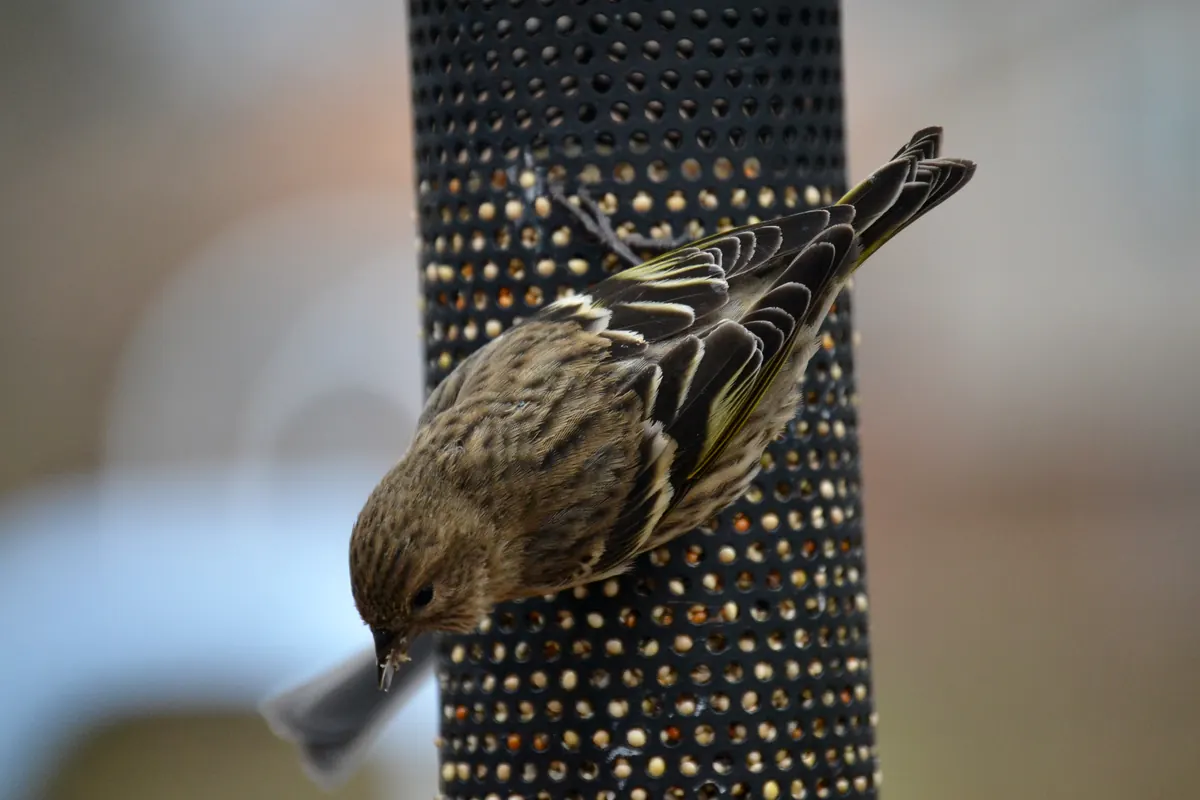
The forecast expects a late-developing small flight of purple finches into the mid-Atlantic at best, and a small to moderate siskin flight toward the southeastern states. Male purple finches look dipped in raspberry; siskins are streaky brown finches with yellow edging on wings and tail, and they love sweetgum balls.
-
Red crossbills, maybe, late in the winter
Late winter · Pines along the coast
The one Delaware mention in this year’s forecast: Type 2 red crossbills, which are moving east, could drift down the coast to Long Island, Cape May, Delaware and beyond in late winter as cone supplies run low. Check the loblolly and pitch pines at Cape Henlopen and the Inland Bays, and listen for a sharp, repeated “kip.” Red-breasted nuthatches, which pushed far south last year, are expected to stay north this time.
-
Project FeederWatch begins November 1
November 1 through April 30 · Your yard, balcony or schoolyard
Count on any two days in a row, up to weekly, noting for each species the most birds you saw together at one moment; Cornell says even one count in the whole season is useful, and a yard without a feeder qualifies. It is the easiest way to find out whether this really is a quiet finch winter.
What is left on Delaware’s trees in November?
-
The baldcypress drop their needles
November · Trap Pond State Park and the Great Cypress Swamp
After going golden brown, the baldcypress at Trap Pond let their needles fall; the tree is a conifer that sheds its foliage each year, so the water trails open up to the sky. Without leaves overhead, the knees rising from the water stand out, and so do the tundra swans and wood ducks that winter on the pond.
-
Holly berries and pine cones
Holly fruit ripens September to December · Coastal woods, Cape Henlopen, Redden State Forest, older yards
American holly is the evergreen with spiny, leathery leaves; only female trees carry the red berries, which hang on all winter and feed birds, squirrels and deer, according to the Chesapeake Bay Program. Loblolly pine, the tall coastal pine with needles in bundles of three, carries prickly brown cones that take until their second October to mature.
-
Oaks are the last to let go
Through November and beyond · Piedmont woods and Sussex forests
White oaks, with their seven to nine rounded lobes, turn red late in the season, and their acorns germinate in autumn soon after they fall. Many oaks, and young beeches especially, often hold dry brown leaves well into winter, so a November woods is a mix of bare maples and tulip trees and rattling oaks.
If you sketched a tree in October, draw it again now, bare or not, on the seasonal tree page of the Naturalist’s Field Journal.
Has Delaware usually had its first freeze by November?
In most of the state, yes, or it is about to. The 1991–2020 medians put the first 32 °F night before November begins only at Greenwood, on the open farmland where Kent meets Sussex (October 30). Inland stations follow in the first week: November 1 at the New Castle County Airport, November 2 at Newark, November 4 at Dover and at Wilmington’s Porter station, November 6 at Georgetown. Lewes, warmed by the bay and the ocean on two sides, is the holdout, with a median of November 14, and one year in ten it is still frost-free on December 1. By the last week of November every station has frozen in nine years of ten except Lewes.
| Station | One year in ten | Median | Nine years in ten |
|---|---|---|---|
| Greenwood 2 NE (Kent–Sussex line) | Oct 14 | Oct 30 | Nov 13 |
| Wilmington New Castle County Airport | Oct 19 | Nov 1 | Nov 15 |
| Newark Ag Farm | Oct 19 | Nov 2 | Nov 17 |
| Wilmington Porter Rsch (north Wilmington) | Oct 21 | Nov 4 | Nov 19 |
| Dover | Oct 23 | Nov 4 | Nov 18 |
| Georgetown Sussex County Airport | Oct 23 | Nov 6 | Nov 22 |
| Lewes | Nov 1 | Nov 14 | Dec 1 |
So gardeners in New Castle and Kent should count on a freeze early in the month, while those near Lewes and Rehoboth often keep tender plants going until mid-November. Snow is rare: the normal November total at the Wilmington airport is two-tenths of an inch, and Dover and Lewes average none. Our frost dates for Delaware show these stations on a map, along with the last freeze of spring.
How much daylight does Delaware lose in November?
Between 51 and 54 minutes over the month, a little under two minutes a day, with Wilmington and Newark losing slightly more than the Sussex towns. The bigger shock is the clock. On Sunday, November 1, the first day of standard time, the Wilmington sun rises at 6:31 a.m. and sets at 5:00 p.m.; by November 30 it is up at 7:03 and down at 4:38, and Lewes sees sunset at 4:39. The month ends with 9 h 35 m of daylight in Wilmington and 9 h 40 m in Lewes, and the year’s earliest sunsets do not arrive until the first half of December.
| City | Nov 1 | Nov 30 | Lost | Per day |
|---|---|---|---|---|
| Wilmington | 10 h 29 m | 9 h 35 m | 54 min | 1.9 min |
| Newark | 10 h 29 m | 9 h 35 m | 54 min | 1.9 min |
| Dover | 10 h 31 m | 9 h 39 m | 52 min | 1.8 min |
| Milford | 10 h 32 m | 9 h 40 m | 52 min | 1.8 min |
| Georgetown | 10 h 33 m | 9 h 41 m | 52 min | 1.8 min |
| Seaford | 10 h 33 m | 9 h 42 m | 51 min | 1.8 min |
| Lewes | 10 h 32 m | 9 h 40 m | 52 min | 1.8 min |
| Fenwick Island | 10 h 33 m | 9 h 42 m | 51 min | 1.8 min |
For sunrise, sunset and twilight on any date, at any spot you pick on the map, try the daylight calculator.
How cold is a Delaware November, and what will El Niño do to the winter?
November is the month the heating comes on. Afternoons average in the mid- to upper 50s across the state, nights in the upper 30s inland and about 42 °F at Lewes, and rain totals run a little over three inches, a bit less than October’s.
| Station | High | Low | Precipitation | Snowfall |
|---|---|---|---|---|
| Wilmington New Castle County Airport | 55.9 | 37.4 | 3.06 | 0.2 |
| Newark Ag Farm | 56.9 | 35.9 | 3.36 | – |
| Dover | 58.0 | 39.3 | 3.36 | 0.0 |
| Greenwood 2 NE | 57.3 | 37.2 | 3.19 | 0.0 |
| Georgetown Sussex County Airport | 58.7 | 39.6 | 3.19 | – |
| Lewes | 58.7 | 42.2 | 3.59 | 0.0 |
Beyond November, the question is El Niño, which keeps building, and the Climate Prediction Center’s bulletin of September 10 treats a very strong event this winter as close to a sure thing, with odds above 90 percent. For Delaware that matters less than you might expect. NOAA’s ENSO bloggers point out that past El Niño winters, averaged together, tilt a little toward more snow from the mid-Atlantic to New England, but the tilt does not pass a test of statistical significance. Snow along this stretch of the coast turns more on the North Atlantic Oscillation, the seesaw in pressure between Iceland and the Azores, which governs whether Arctic air is already sitting over Delaware when a coastal storm rolls up. The record next door shows how mixed the results are: of the seven strong El Niño events since 1950 that the Baltimore/Washington Weather Service office studied, four left that region snowy and three left it nearly bare. The real guide will be NOAA’s official winter outlook, due October 15, which will appear among the three-month outlooks once released. For this week’s rain, wind and cold, see our local forecast.
What is in the night sky over Delaware in November 2026?
From November 1 Delaware is back on standard time, and every clock time in this section is EST.
-
The Beaver Moon, a supermoon
Evenings of Monday, November 23, and Tuesday, November 24 · Rising in the east-northeast around sunset
Perigee, the Moon’s closest approach, follows the full phase by roughly a day and a quarter, which makes this a small supermoon; December’s Cold Moon, full on the 23rd, swings closer. On the night of the 23rd the full Moon passes close to or over the Pleiades, though its glare drowns the cluster. White Clay Creek State Park’s naturalist leads a Full Moon Friday evening hike on November 20, 6 to 7:30 p.m., from the Carpenter Recreation Area; register at 302-368-6900.
-
Leonid meteors
Best from after moonset to dawn, morning of Wednesday, November 18 · Look high in the east and south before dawn
The International Meteor Organization’s calendar expects the Leonids to peak on the evening of November 17 (6:45 p.m. EST), with a rate near 15 an hour under dark skies and nothing unusual forecast for 2026. Over Delaware the half-lit Moon goes down around half past midnight local time, and the radiant in Leo climbs until dawn, so the hours before first light on the 18th are best, with the 17th and 19th worth a look too. Leonids are fast, and the bright ones leave trains.
-
Taurid fireballs
Southern Taurids peak November 5; Northern Taurids November 12 · Anywhere dark, most of the night
Only five to ten an hour, but slow and sometimes very bright. Between the two peaks the Moon is new (November 9), so the sky is dark. The Taurids are crumbs of Comet Encke, which will itself brighten into binocular range early next year.
-
Venus, Mars, Jupiter and Mercury before dawn
All month; Mars and Jupiter closest November 15–16 · East and southeast before sunrise
Venus, now a morning object, rises earlier each day, reaching its greatest brilliancy in the last week of November. Look for it beside Spica, the brightest star of Virgo, before dawn on November 9, only about a degree apart. In Leo, Mars and Jupiter pass within about 1.2 degrees of each other before dawn on the 15th and 16th, and the best mornings for Mercury, just above the east-southeast horizon in twilight, run from roughly the 18th to the 25th.
-
Saturn and Uranus in the evening
All month; Uranus at opposition November 25 · South and southwest after dark
After dark, Saturn has the evening sky to itself among the bright planets, shining without a twinkle in the faint stars of Pisces. Uranus reaches opposition on November 25, near the Pleiades in Taurus, a faint green-blue dot for binoculars with a star chart.
| Phase | Date | Time |
|---|---|---|
| Last quarter | Sunday, Nov 1 | 3:28 p.m. |
| New moon | Monday, Nov 9 | 2:02 a.m. |
| First quarter | Tuesday, Nov 17 | 6:48 a.m. |
| Full moon, the Beaver Moon | Tuesday, Nov 24 | 9:53 a.m. (looks full the evenings of Nov 23 and 24) |
| Last quarter | Tuesday, Dec 1 | 1:08 a.m. |
Cloud cover is the real forecast for meteors; our sky-cover map shows it hour by hour for your town, and the Moon calendar gives rise and set times.
What can families do outdoors in Delaware in November 2026?
- Start FeederWatch, Sunday, November 1. The Cornell Lab’s winter count opens the day the clocks change; any window that looks onto a few bushes will do.
- Wagon rides and a campfire at Brandywine Creek. Public fall wagon rides, 45 minutes through the meadows followed by a campfire with marshmallows, run on November 1, 7 and 8 at several afternoon times ($10 a ticket, register a day ahead; 302-655-5740).
- Woolly bears for the youngest, Friday, November 6. Ashland Nature Center’s Knee High Naturalists session, 10 a.m. ($15, ages 3–5), looks at how the caterpillars survive the winter. Abbott’s Mill’s series for ages 2–5 covers hibernation on November 4 and squirrels on November 18.
- Plant trees or sketch hawks, Saturday, November 7. The Middle Run tree planting starts at 9 a.m.; Ashland’s Raptor Migration journaling session is at 10.
- A day off school at Ashland, Wednesday, November 11. Full-day programs for grades PK–3 and 3–6 ($85).
- Feathers up close, Wednesday, November 18. The ornithological society’s free meeting, 7 p.m., Delaware Museum of Nature and Science in Greenville, in person only, with museum specimens: an engineer explains how feathers make color, warmth, waterproofing and silent owl flight.
- Marsh animals in the city, Saturdays. At the DuPont Environmental Education Center on the Wilmington riverfront, the half-hour Meet Marsh Animals program at 1:45 p.m. on November 14, 21 and 28; the center’s marsh restoration Day of Service is November 21 at 10 a.m.
- Talkin’ Turkey, Wednesday, November 25. Wild turkeys and a centerpiece craft at Ashland, 9:30 a.m. ($25).
- Black Friday, November 27. Delaware State Parks has made the day after Thanksgiving a free-entry day for #OptOutside since 2015, by its own account; the 2026 offer had not been announced when we checked, so confirm with State Parks. Fee season ends November 30.
Programs fill and times change; check with the organizer before you go. Every state’s monthly guide is listed on our nature index.
Safety notes for November in Delaware
- Firearm deer season, November 13–22. Shotguns, muzzleloaders, handguns, straight-walled pistol-caliber rifles and bows may all be used. The youth and non-ambulatory deer hunt is November 7–8, and archery and crossbow seasons run all month. Since this season, all game may be hunted on Sundays, on private land if the owner agrees and on public land where designated; there is no hunting of any kind in Delaware State Parks on Sundays. During gun seasons some trails close on weekdays and Saturdays at White Clay Creek, Lums Pond, Cape Henlopen, Delaware Seashore and Trap Pond, and reopen to everyone on Sundays.
- Other seasons this month: regular duck and sea duck seasons October 31 to November 7 and November 25–29; migratory Canada goose November 25–29; snow goose from November 25; woodcock from November 23; rabbit, pheasant and pen-raised quail from November 23; gray squirrel continues, except during the November firearm deer season; rails close November 9.
- Hunter orange. Whenever deer may legally be taken with a firearm, every hunter except those after migratory birds must show hunter orange on head, chest and back adding up to no less than 400 square inches; on State Wildlife Areas, small-game hunters must wear it year round. The rule binds hunters, not hikers, but on November 7–8 and 13–22 an orange hat and vest is cheap insurance on wildlife areas, state forests and trails next to them.
- Bombay Hook is closed on Friday, November 13, for a refuge hunt; the visitor center stays open.
- Deer on the roads. Rutting bucks chase does across highways at dawn and dusk, the same hours as the evening commute once the clocks change. Slow down near woods and fields, and remember that where one deer crosses, another usually follows.
- Early dark and cold water. After November 1 the sun sets around 5 p.m. or earlier; carry a light on any afternoon walk. Ponds and the bay are cold enough now to make a capsized kayak dangerous, so paddle with a life jacket on, not stowed.
- Ticks stay active on mild days all winter; check yourself after walks in grass and leaf litter.
Sources
- U.S. Fish and Wildlife Service: Bombay Hook wildlife calendar (November waterfowl peak, December eagles)
- U.S. Fish and Wildlife Service: Bombay Hook National Wildlife Refuge (2026 hunt closures October 9, November 13, December 16)
- U.S. Fish and Wildlife Service: Prime Hook National Wildlife Refuge
- Chesapeake Bay Program field guide: snow goose
- Chesapeake Bay Program field guide: tundra swan
- Chesapeake Bay Program field guide: bufflehead
- Chesapeake Bay Program field guide: hooded merganser
- Chesapeake Bay Program field guide: brant
- Chesapeake Bay Program field guide: white-tailed deer (rut peaks in November)
- Chesapeake Bay Program field guide: American holly
- Chesapeake Bay Program field guide: loblolly pine
- Chesapeake Bay Program field guide: white oak
- Delaware State Parks: birding by park (Trap Pond tundra swans, Indian River Inlet, Cape Henlopen)
- Delaware State Parks: November 2026 program calendar (surf fishing, inlet bridge hikes, wagon rides)
- Delaware State Parks: Full Moon Friday, White Clay Creek, November 20, 2026
- State of Delaware news, February 24, 2026: fee season March 1 to November 30
- State of Delaware news, November 22, 2021: parks and zoo waive fees on Black Friday, as every year since 2015
- HawkCount: Ashland Nature Center site profile (averages and record days)
- HawkCount: Cape Henlopen site profile
- Delaware Ornithological Society: hawk watches
- Delaware Nature Society: November 2026 events calendar (Hawk Watch, Middle Run tree planting, raptor journaling, Knee High Naturalists, DuPont Environmental Education Center)
- Delaware Ornithological Society: November 2026 calendar
- Delaware Ornithological Society: Sea Watch at Indian River Inlet, November 8, 2026
- Delaware Ornithological Society: November 18, 2026 meeting, Birds Up Close
- State of Delaware news, April 21, 2026: Delaware confirms first case of chronic wasting disease in wild deer
- State of Delaware news, August 17, 2026: emergency deer hunting regulations for CWD (check stations, bait and urine lure bans)
- State of Delaware news, September 16, 2026: third case of chronic wasting disease confirmed
- DNREC: chronic wasting disease (management zones, signs, reporting sick deer)
- Finch Research Network: Winter Finch Forecast 2026–2027
- Project FeederWatch: how to participate (season November 1 to April 30)
- NOAA NCEI: U.S. climate normals 1991–2020 (freeze dates and November normals)
- NOAA NCEI: monthly normals data service, Delaware stations
- Climate Prediction Center: ENSO diagnostic discussion, September 10, 2026
- Climate Prediction Center: seasonal outlooks (winter outlook due October 15, 2026)
- NOAA Climate.gov ENSO blog: United States El Niño impacts
- NWS Baltimore/Washington: El Niño and Washington–Baltimore winters (seven strong events since 1950)
- U.S. Naval Observatory: moon phases (data API)
- International Meteor Organization: 2026 meteor shower calendar
- EarthSky: what is a supermoon (2026 full supermoons)
- EarthSky: Uranus at opposition
- EarthSky: Mercury at greatest western elongation
- In-The-Sky.org: Venus at greatest brightness, November 2026
- NASA JPL Horizons: planetary and lunar positions
- Delaware Hunting and Trapping Guide 2026–27: deer seasons
- Delaware Hunting and Trapping Guide 2026–27: deer hunting (hunter orange, Sunday hunting)
- Delaware Hunting and Trapping Guide 2026–27: migratory bird seasons
- Delaware Hunting and Trapping Guide 2026–27: small game seasons and orange on wildlife areas
- DNREC: information for hunters (hunter orange)
- State of Delaware news, August 26, 2026: 2026–27 hunting season, Sunday hunting for all game
- Delaware State Parks: hunting in state parks (no Sunday hunting)
- CDC: preventing tick bites
- Photos via Wikimedia Commons; licenses and photographers are credited under each picture
