What to look for in nature in Florida this April
April is when Florida's spring turns busy. Loggerhead sea turtles, the state's most numerous nesters, begin their season, and the first nests appear on Gulf and Panhandle beaches. Songbirds that crossed the Gulf of Mexico drop into coastal oaks and onto the Dry Tortugas, swallow-tailed kites circle over cypress and pine, and sandhill cranes lead their young through wet pastures. In the Panhandle, pitcher plants stand in the bogs and the white tupelo along the Apalachicola River comes into bloom. Alligators begin to court as the Everglades dry season winds down. Overhead, the Pink Moon fills on April 20, and two nights later the Lyrids peak under a bright Moon. Below you will find where to look, what the weather tends to bring, and how to stay safe.
Other months in Florida: October, November, December, January, February, March.
Start here
- Walk a coastal oak grove after a front. On a morning after rain and a north wind, check live oaks and sea grape near the Gulf shore or the Keys. Tired songbirds that crossed the water often rest low and close. Stay on the path and keep the binoculars steady.
- Find a pitcher plant. In the western and central Panhandle, scan wet roadside ditches and open savannas for tall, tube-shaped green or yellow-green plants with nodding flowers. Look from the shoulder or a boardwalk and leave every plant where it grows.
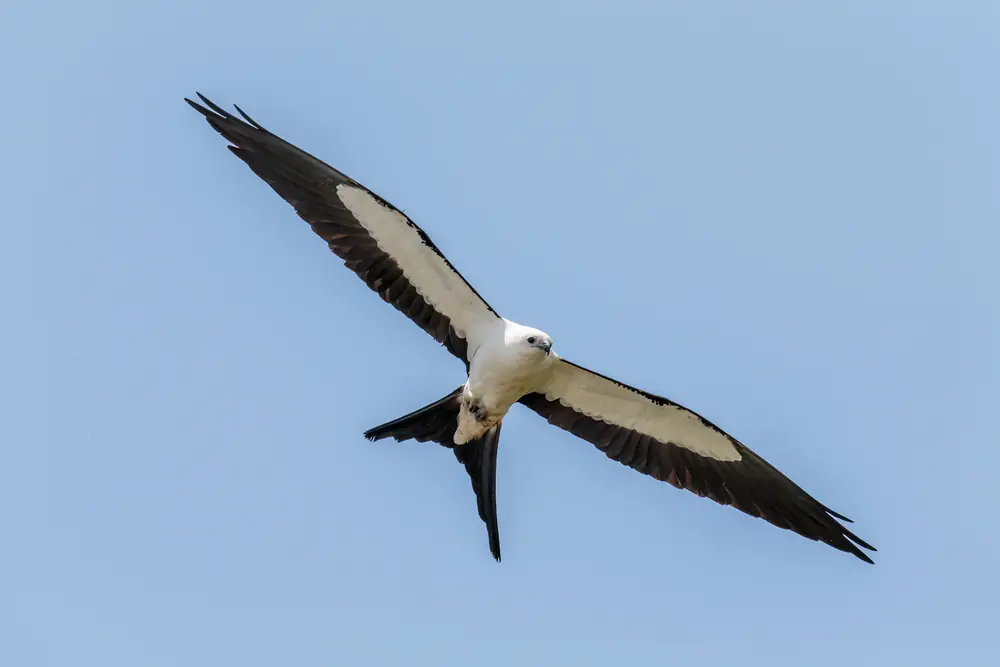
- Watch the sky over a cypress swamp. Swallow-tailed kites have a white body, black wings and a long forked tail. Pick a clear, warm midmorning, face the treetops and watch for one gliding without a wingbeat.
Record it: a migrant at the coast, a kite overhead or a crane family in a pasture belongs in “birds I have seen” and in the daily field log. Give a nesting osprey or sandhill crane its own “nest observed” page, keep a “tracks to know” entry for a turtle crawl you find, and give the Pink Moon a line on “dusk and dawn watch”.
Regions used below: Panhandle; North Florida; Central Florida; Southwest Florida; Southeast Florida; The Keys.
Are sea turtles nesting on Florida's beaches in April?
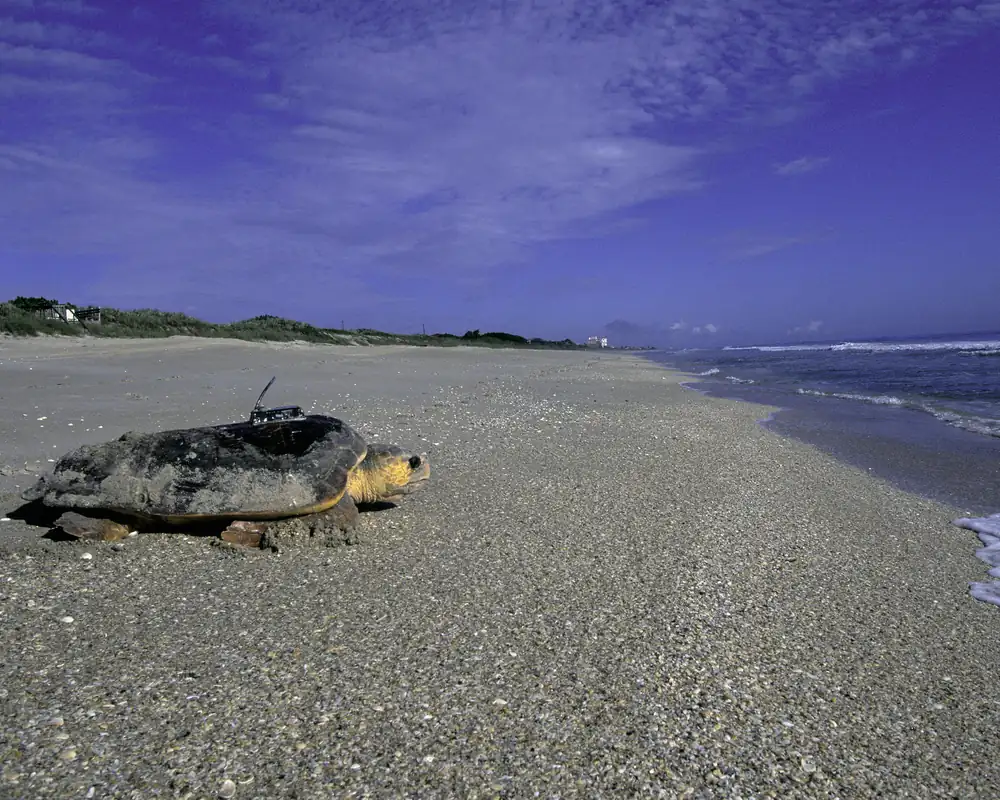
April is the month the loggerhead season opens. Florida's wildlife agency, the Fish and Wildlife Conservation Commission (FWC), gives the loggerhead nesting season as April through September. A female returns every two or more years, 2.7 on average, and in a good season lays about four clutches, one roughly every 14 days. The average nest holds 114 eggs. An adult weighs 200 to 350 pounds and has a reddish-brown shell and a big, blocky head.
Where you stand decides what you may see. The agency's spring reminder says nesting starts in March on the southeast Atlantic coast, while Gulf Coast and north Florida beaches usually see the first nests in April or May. So an early April walk on the Panhandle or the Tampa Bay beaches may turn up the first crawl of the year, while the Atlantic side is already well along.
-
Loggerheads, the season opener
April through September; the first nests are usually dug in April or May on Gulf and north Florida beaches · All of Florida's sandy beaches, with the heaviest nesting on five Atlantic counties running south from Brevard to Palm Beach
A loggerhead crawl is a wide, scuffed track that runs from the water up to the dune and back, and a nest shows as a patch of disturbed sand near the vegetation. Do not mark it, dig it or dress it up. Volunteer permit holders and local turtle groups monitor and mark nests, so if you find fresh signs, tell them rather than the beach crowd.
-
How close is too close?
Every night of the season, especially the hours after dark · Any dark beach, public or private
FWC's seasonal advice is to stay at least 50 feet from a turtle on the sand, because a nesting female that is disturbed may abandon the nest. Flash photography, flashlights and phone screens count as disturbance. Beachfront homes and hotels are asked to turn off lights that reach the sand, or shield them so they are long in wavelength, low and pointed down. Before dusk, flatten any sandcastles and fill the holes you dug, and take chairs, toys and umbrellas home. For a turtle in trouble, the FWC Wildlife Alert Hotline is 888-404-FWCC (3922).
Is April the peak of spring bird migration in Florida?
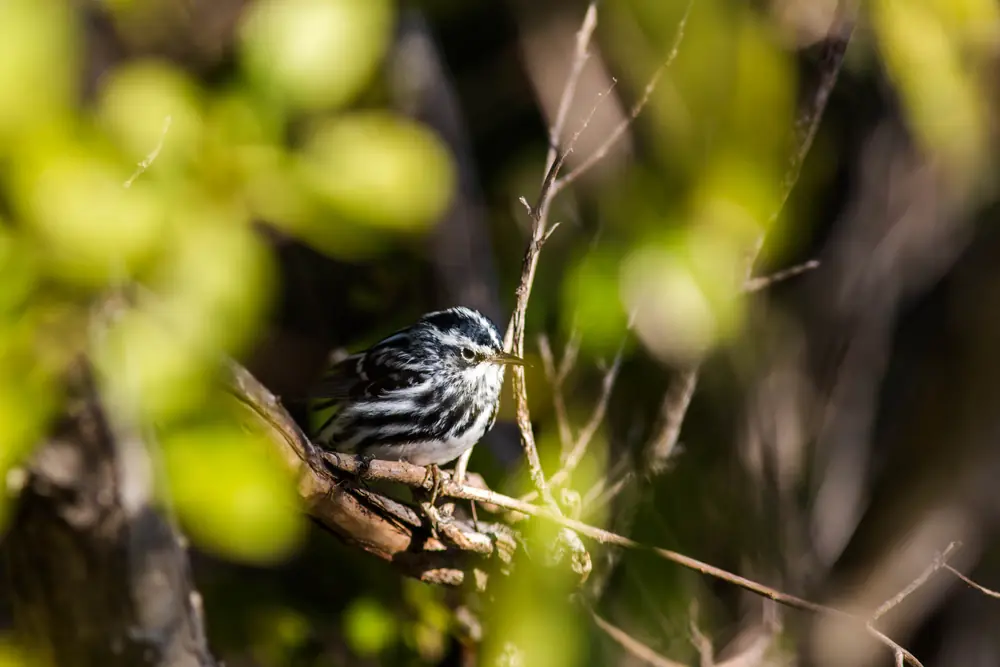
Across most of the state, yes. The National Park Service (NPS) reports that at the Dry Tortugas the flow of northbound birds swells during March and is at its height from April into mid-May, when over 200 species move through. The park's bird page makes a point that surprises beginners: the largest numbers appear in the roughest weather, when gales, rain and chill force travelers down onto the islands. The same principle works on the mainland: a strong front in April followed by a clear morning is the classic recipe for a fallout, a day when tired birds crowd the first trees they find after crossing the Gulf.
You do not need a boat to join the show. Coastal parks from the Panhandle to Tampa Bay act as landing strips, and a quiet hour at dawn can be enough to see a handful of warblers, vireos and tanagers in a single oak.
-
Dry Tortugas National Park
Early April to mid-May is the peak, according to NPS and Audubon · Garden Key and Fort Jefferson, west of Key West; reach it by ferry, seaplane or private boat
Audubon names hooded warblers, yellow-throated vireos and summer tanagers among the April arrivals, along with rarities such as white-tailed tropicbirds. It also puts the breeding colony of sooty terns on Bush Key at about 80,000 birds. NPS says the terns nest from late January through early July, and that part of Bush Key is closed to people seasonally to shelter them. Seats on the ferry and seaplane can sell out months ahead, so reserve early and check the park's operating hours.
-
St. George Island State Park
Spring migration, with the best days after a front · Franklin County in the Panhandle; open 8 a.m. to sunset, with an entrance fee
The trail's own page describes oaks and pines that shelter migrants fresh from crossing the Gulf, and counts more than 30 warbler species on the park's list, among them cerulean and Cape May. Indigo buntings are a common sight. It calls the number of songbirds in a fallout spectacular, and notes that snowy plovers, least terns and American oystercatchers nest on the beaches.
-
Honeymoon Island and Fort De Soto
Migration weeks of April, plus osprey and plover nesting · Pinellas County, on the Tampa Bay side of the Gulf
The trail's page on Honeymoon Island State Park lists warblers, vireos, flycatchers, and indigo and painted buntings among the migrants, and calls the Osprey Trail probably the best place in the world to see ospreys nesting. Snowy and Wilson's plovers nest on the beach there, and closed areas must be respected. Nearby Fort De Soto Park has more than 330 recorded species and posted nesting areas that are off-limits to people.
Which Florida birds are raising young in April?
Nest season is in full swing, and some of the most distinctive families of the year are on view. The common thread is distance: watch from the road, a car window or a long lens, and give every nest room.
-
Swallow-tailed kites
Arrivals run from late February through April; nesting is March through June · Tall pines and cypress across Florida
Audubon Florida says these raptors return from South America and nest in loose colonies, laying two or three eggs, with both parents helping to raise the young. Its account counts the round trip at 10,000 miles a year, and notes the species was listed as vulnerable in 2019 after its range shrank from 21 states to seven. Kites are protected by the Migratory Bird Treaty Act. If you find an injured one or a fallen chick, call a licensed wildlife rehabilitator; Audubon lists the Center for Birds of Prey in Maitland at 407-644-0190 for central Florida.
-
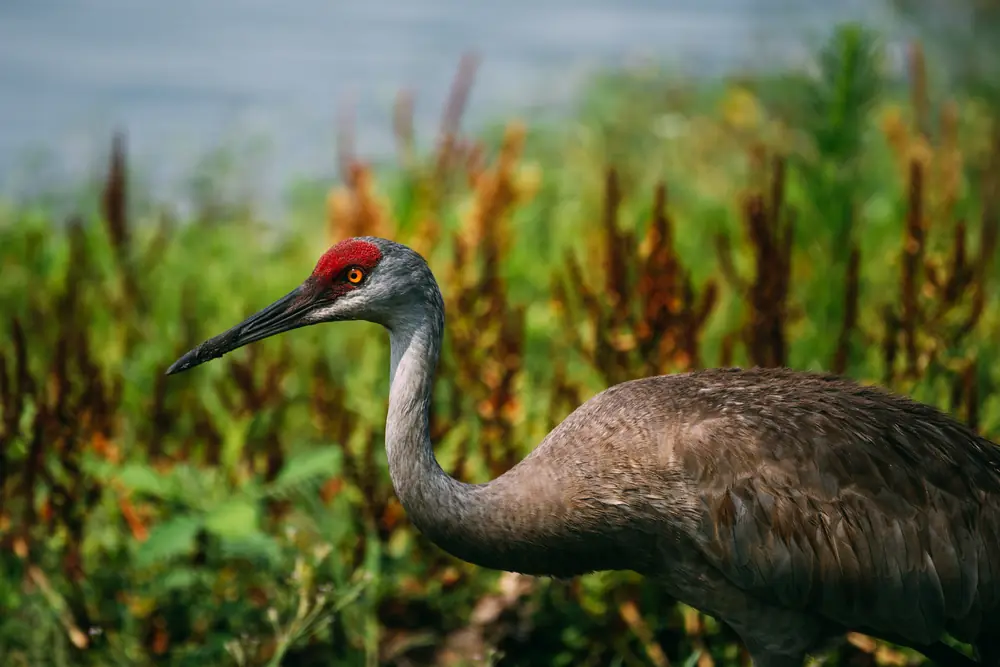
Florida sandhill cranes
Late winter and spring nesting; eggs hatch after about 32 days · Wet pastures, prairies and the edges of marshes in the peninsula
FWC says the resident Florida sandhill crane builds its nest as a floating platform of vegetation roughly two feet wide, set in shallow water. Chicks, called colts, can follow their parents away from the nest within 24 hours of hatching. The state lists the species as threatened. FWC estimates 4,000 to 5,000 resident cranes, plus roughly 25,000 migratory greater sandhill cranes in winter. If a pair crosses a road with young, slow down and wait.
-
Scrub-jay and burrowing owl families
Scrub-jays breed March to June; burrowing owls February 15 to July 10 · Scrub preserves for the jays; open prairies, pastures, airports and golf courses for the owls
This is the stage after the nest-building you could watch in March. FWC says scrub-jay eggs are incubated about 18 days and nestlings fledge about 18 days after hatching, and that young birds from earlier years stay in the family territory as helpers. Burrowing owl chicks stay underground for roughly two weeks after hatching, begin trying to fly at about four weeks, and are competent fliers by six. Both species are state-listed and protected, so watch from a respectful distance.
-
Beach-nesting birds
Spring through summer · Posted beaches, spoil islands and dunes
FWC lists four state-threatened beach nesters: the American oystercatcher, snowy plover, black skimmer and least tern. The agency's advice is simple: do not enter posted areas, keep dogs leashed and away from the colonies, keep cats indoors, do not fly kites near nests, and carry out your trash. One dog passing near a seabird colony can cause the whole colony to panic. A good rule is that if the birds are agitated, you are too close.
What are alligators and wading birds doing as the dry season ends?
NPS defines the Everglades dry season as November through April, the time of lower temperatures, fewer mosquitoes and abundant wildlife. As water recedes, prey is trapped in ever-shallower pools, and Audubon Florida explains that this makes it easier for wading birds to feed their growing chicks, provided that rain and water management arrive at the right times. The dry season ends as April does, so late-season visits catch the last of the concentrations.
-
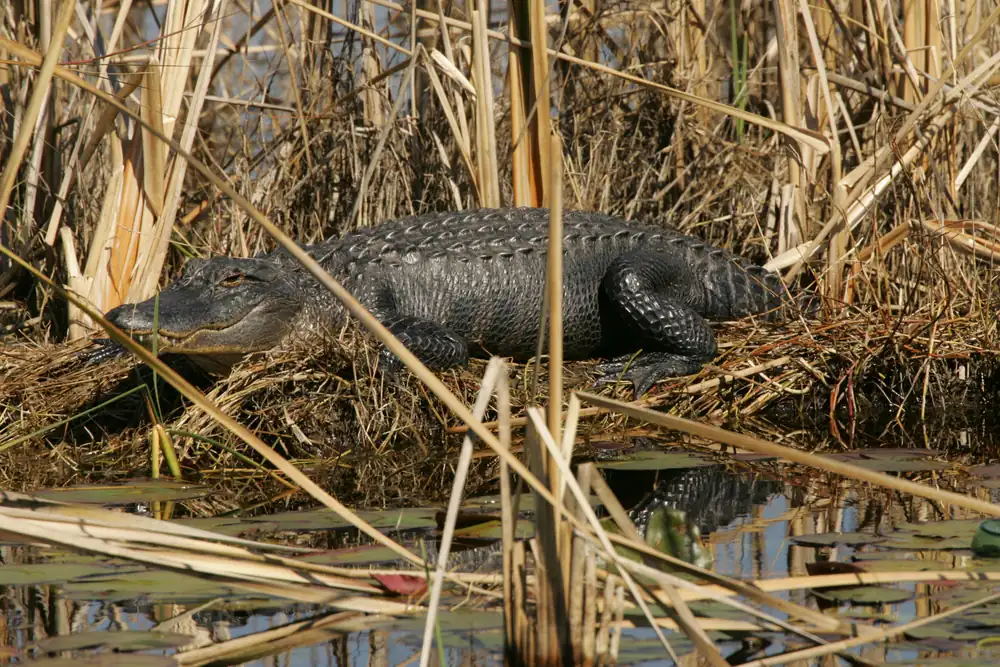
Alligator courtship
FWC says courtship begins in early April, with mating in May or June · Lakes, canals, marshes and slow rivers statewide
Males bellow and slap the water, and a still evening on a lake can produce a low rumble you feel as much as hear. Nesting follows later: FWC says females lay about 32 to 46 eggs in late June or early July, the average clutch is 35, and incubation lasts roughly 60 to 65 days. The state's record is a 14-foot, 3.5-inch male. Female alligators typically stay under 10 feet long. Keep your distance and your pets away from the water's edge.
-
Wading birds of the Everglades
The tail end of the dry-season feeding bonanza · Everglades National Park and its trails and ponds
NPS counts 16 wading bird species in the park and more than 360 bird species overall. The white ibis is the most common wader, and the wood stork, which finds fish by touch, was moved from endangered to threatened in 2014. The park's page on roseate spoonbills says the spoonbills nest from November through March on islands in Florida Bay, with more than 200 breeding pairs, so that nesting season is over by April. Check the park for current trail conditions.
What is blooming in Florida in April?
The Panhandle's wet pinelands put on their best display now, while wildflowers elsewhere start to show along roadsides and prairie edges. Use the Florida Wildflower Foundation's What's in Bloom explorer to see how wildflowers change by season across the state.
-
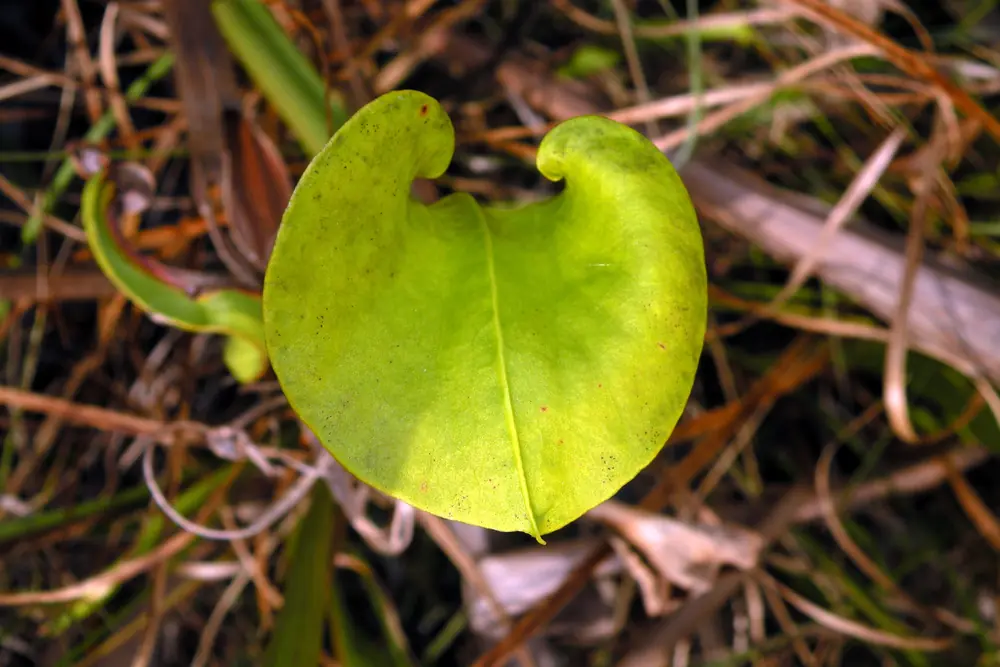
Pitcher plants
Late March through April, according to FWC · Wet savannas and flatwoods in the Panhandle, including Blackwater River State Forest and Apalachicola National Forest
FWC describes bogs full of pitcher plants in bloom, with yellow, purple or red dangling flowers, and says some can be seen from roadsides. The pitchers can reach nearly three feet and are colored yellow-green, reddish with white splotches, or purple; the tubes are really specialized leaves. A WFSU report on the Apalachicola National Forest describes at least five species there. Many carnivorous plants are endangered and protected, so stay on boardwalks and trails, and if you buy one for your yard, choose a nursery-grown plant.
-
White tupelo bloom
Typically mid-April to the end of May; the Riverkeeper says it begins around the second week of April · The Apalachicola River floodplain, Dead Lakes and nearby wetlands
The tupelo gum, or Nyssa ogeche, supports one of the most famous honeys in the country. UF/IFAS Extension in Franklin County describes the bloom as running from about mid-April to the end of May, and the Apalachicola Riverkeeper says it begins around the second week of April. Beekeepers hope for foggy mornings, daytime highs around 70 to 75 °F, nights above 60 °F and winds from the west or southwest; heavy rain keeps bees in the hive. The Riverkeeper adds that the trees are in decline because altered river flows have affected the floodplain. Dates shift with the weather, so treat these as typical.
-
Coreopsis, the state wildflower
Spring is the main bloom, though some species flower much of the year · Roadsides, flatwoods, prairies and sandhills
Florida adopted coreopsis as its state wildflower in 1991. Alachua County counts 15 species in the state, 12 of them native, and mows only a narrow strip beside the pavement between Valentine's Day and Memorial Day to let flowers go to seed. The Florida Native Plant Society says Leavenworth's tickseed, a yellow annual 1.5 to 3 feet tall, flowers all year in moist flatwoods and prairies. Never pick wildflowers on public roadsides.
-
Live oaks changing their leaves
Leaf drop peaks in late winter and early spring; at Florida State University it was expected to last through March · Tallahassee and across north and central Florida
The old leaves are hardly the sign of trouble that some people think. FSU facilities staff describe live oaks as semi-evergreen trees whose leaves last no more than a year, and they say some trees shed all their leaves before new growth appears, while others change gradually as buds form at the base of the leaf stem. New leaves and yellow-green catkins arrive together, and the wind-borne pollen can trigger allergies. By April most trees are finishing the change.
What is running in Florida's waters in April: tarpon, snook and manatees?
Fishing seasons and animal movements overlap along the coast, and a few dates in April matter if you plan to be on the water.
-
Tarpon
FWC's Tarpon Genetic Recapture Study describes the spawning season as April through July · Coastal passes, bays and nearshore Gulf and Atlantic waters
FWC's research newsletter says the peak fishing season for large tarpon in most of Florida usually matches the spawning season. The fish is catch-and-release only in Florida, with a single tag available per person per year for anglers pursuing a state or world record. Tarpon longer than 40 inches must stay in the water. If you are a spectator rather than an angler, the large silver fish rolling at the surface of a pass at dawn are a worthwhile sight.
-
Snook, open on the Atlantic and closing on the Gulf
Atlantic regions are open all April; Gulf regions close on May 1 · Mangrove shorelines, inlets and passes
FWC lists the Atlantic closures as December 15 to January 31 and June 1 to August 31, and the Gulf closures as December 1 to the end of February and May 1 to August 31. In Charlotte Harbor and southwest Florida the second closure runs May 1 to September 30. The bag limit is one fish, the slot is 28 to 33 inches on the Gulf side and 28 to 32 inches on the Atlantic side, You also need a snook permit and a fishing license, and because rules change, confirm them with FWC first.
-
The manatee center closes for the season
Open daily November 1 through April 15, 10 a.m. to 5 p.m. · Tampa Electric Manatee Viewing Center, Apollo Beach
Tampa Electric's viewing center is free, with trails that close at 4 p.m. It shuts for the season on April 15 each year. By then warmer water has drawn most manatees away from the discharge canal. Confirm the hours before you drive: 813-228-4289.
What is April weather like in Florida, and what are the hazards?
April is warm statewide and the last cool nights are rare. NOAA's 1991–2020 normals put average highs from 77.6 °F at Pensacola to 83.6 °F at Orlando and Miami, and average lows from 54.4 °F at Tallahassee to 73.1 °F at Key West. Pensacola has the most rain of the eight stations, 5.52 inches, and Key West the least, 2.07. Miami's 3.36 inches is already above its March figure, a hint of the wetter months ahead in the south. Tallahassee averages 0.2 nights at or below freezing in April and 2.4 nights at or below 40 °F.
Severe storms. The Florida Climate Center at Florida State University, the state climatologist's office, says Florida has more tornadoes per 10,000 square miles than any other state, with the strongest ones striking in spring and June the busiest month. Two of its examples are in April: an EF4 on April 4, 1966, near Clearwater and Tampa Bay that killed 11 people, and an EF3 near Madison on April 19, 1988, that destroyed 17 homes. Keep alerts on after dark and know where you will shelter.
Wildfire. The Florida Department of Agriculture and Consumer Services says wildfire danger in Florida is greatest in April, May and June, and the Florida Climate Center's drought-index forecasts for the Southeast cover January through July. In an average year the Florida Forest Service issues about 88,000 authorizations to burn on more than 2.1 million acres, so smoke from prescribed burns is routine in forests and refuges. Check local burn rules before burning yard waste.
Lightning and rip currents. The National Weather Service says lightning strikes the United States about 25 million times a year, and that rip currents sometimes appear on calm, sunny days, so a lifeguarded beach is the safest place to swim.
The Climate Prediction Center issues new 90-day outlook maps once a month, near mid-month; find the current set on its 90-day outlook page. For the days just ahead, see our weather page.
| Station | Average high | Average low | Rain | Nights 32 °F or colder | Nights 40 °F or colder |
|---|---|---|---|---|---|
| Pensacola | 77.6 | 59.0 | 5.52 | 0.0 | 0.3 |
| Tallahassee | 80.2 | 54.4 | 3.53 | 0.2 | 2.4 |
| Jacksonville | 79.8 | 56.4 | 2.93 | 0.0 | 1.0 |
| Gainesville | 81.5 | 55.5 | 2.74 | 0.0 | 0.9 |
| Orlando | 83.6 | 60.7 | 2.58 | 0.0 | 0.0 |
| Tampa | 83.0 | 64.8 | 2.55 | 0.0 | 0.0 |
| Miami | 83.6 | 69.8 | 3.36 | 0.0 | 0.0 |
| Key West | 82.6 | 73.1 | 2.07 | 0.0 | 0.0 |
Is the last freeze over in Florida by April?
Almost everywhere, yes. The normals say the final freeze of the season is over by April in nine springs out of ten at every station in this table, except the inland western Panhandle. At Crestview, in Okaloosa County, the late date is April 9, and the median is March 21. Tallahassee's late date is March 30, and Gainesville's is March 26. Farther south the last freeze comes in January or February, and in Orlando and Tampa the one-year-in-ten dates are in December or January, so in the mildest tenth of years the final freeze arrived before New Year's Day.
South Florida's Miami and Key West are not in the table because our frost data has no station for them. To check your own town, use the frost-date finder.
| Station | One year in ten | Median | Nine years in ten |
|---|---|---|---|
| Crestview | Feb 26 | Mar 21 | Apr 9 |
| Tallahassee | Feb 18 | Mar 11 | Mar 30 |
| Pensacola | Jan 21 | Feb 14 | Mar 11 |
| Jacksonville | Jan 22 | Feb 25 | Mar 19 |
| Gainesville | Feb 1 | Mar 3 | Mar 23 |
| Orlando | Dec 30 | Jan 25 | Feb 26 |
| Tampa | Dec 27 | Jan 20 | Feb 10 |
These are long-run normals, not promises. A cold front in early April is unusual but not impossible in the north.
How much longer are Florida's days by the end of April?
Every city adds roughly 40 to 50 minutes of daylight over the month. The north gains fastest, about 1.7 to 1.8 minutes a day, and the Keys slowest, about 1.3 minutes a day. By April 30, Pensacola and Jacksonville have 13 hours and 20 minutes of daylight, and Key West has just over 13 hours. The pace is slowing, and the gain keeps easing until the June solstice.
Clock times stay on daylight time all month, so the table is unaffected. The daylight calculator has the clock times for your own town.
| City | Apr 1 | Apr 30 | Gained | Per day |
|---|---|---|---|---|
| Pensacola | 12 h 30 m | 13 h 20 m | 50 min | 1.7 min |
| Tallahassee | 12 h 30 m | 13 h 19 m | 49 min | 1.7 min |
| Jacksonville | 12 h 29 m | 13 h 20 m | 51 min | 1.8 min |
| Gainesville | 12 h 29 m | 13 h 17 m | 48 min | 1.7 min |
| Orlando | 12 h 27 m | 13 h 14 m | 47 min | 1.6 min |
| Tampa | 12 h 27 m | 13 h 13 m | 46 min | 1.6 min |
| Miami | 12 h 25 m | 13 h 06 m | 41 min | 1.4 min |
| Key West | 12 h 24 m | 13 h 03 m | 39 min | 1.3 min |
What can you see in the night sky over Florida in April 2027?
April's sky is mostly about the Moon, with two bright planets in the evening and two in the morning twilight. Times are Eastern daylight time unless noted; the western Panhandle is an hour earlier.
-
The Pink Moon
Full on Tuesday, April 20, at 6:27 p.m. EDT (5:27 p.m. CDT); best viewing that evening · Rising in the east around sunset
The name comes from early spring wildflowers, and the Sea and Sky astronomy calendar lists Sprouting Grass and Fish Moon as other names. In Miami the Moon rises at 7:48 p.m. on April 20, after the full moment has already passed, so it rises full that evening, low and golden over the horizon.
-
The Lyrid meteor shower, in a poor year
Peak around 9:41 p.m. EDT Thursday, April 22 (8:41 p.m. CDT); active about April 14 to 30 · Anywhere with a wide view of the sky and little light
The shower usually yields about 20 meteors an hour at best, according to Sea and Sky, but this year the Moon, 95 percent lit and three days past full, rises near 10 p.m. (Miami: 9:49 p.m.). The brief dark window after evening twilight and before moonrise is the best bet, and you should expect only a few meteors an hour. Lyrids sometimes produce short bright bursts, which cannot be predicted.
-
Venus and Mercury in the morning, Saturn out of sight
Venus all month; Mercury early in the month only; Saturn is at conjunction with the Sun on April 7 · Low in the east before sunrise
Venus still outshines everything else before dawn, yet it slips closer to the Sun, rising roughly 75 minutes ahead of it on April 1 and about an hour ahead by May 1 in our central-U.S. calculation. On April 3 and 4 a slim old Moon hangs close to Venus. Mercury shows up about 40 minutes before sunrise early in April and only about 20 minutes before it by the middle of the month, so it is lost in the glow. Saturn is lost in the Sun's glare around its April 7 conjunction and reappears before dawn late in the month.
-
Jupiter and Mars in the evening
The Moon passes the pair on the evenings of April 14 and 15 · High in the south to southwest after dark, in or near Leo
Jupiter stays bright through the evening, setting nine hours after the Sun on April 1, close to dawn. On April 15 the Moon, about 68 percent lit, passes within a degree of the planet. Mars is fading, at about magnitude 0.0 by mid-month, and the Moon is roughly three degrees from it that same night.
-
A Milky Way window before dawn
Roughly the first half of April and the last few days of the month, in the hours before dawn · Dark sites away from town lights, looking south
The Milky Way's bright core is a low object from Florida in spring. Computed for 30 degrees north, the window is April 1 to 15 and April 27 to 30, around the April 6 new moon, with roughly two hours of true darkness at best while the core is above the horizon. The peninsula sees it slightly higher than the Panhandle.
| Phase | Date | Time |
|---|---|---|
| New moon | Tuesday, Apr 6 | 7:51 p.m. EDT (6:51 p.m. CDT) |
| First quarter | Tuesday, Apr 13 | 6:56 p.m. EDT (5:56 p.m. CDT) |
| Full moon, the Pink Moon | Tuesday, Apr 20 | 6:27 p.m. EDT (5:27 p.m. CDT) |
| Last quarter | Wednesday, Apr 28 | 4:18 p.m. EDT (3:18 p.m. CDT) |
Our moon-phase calendar has moonrise times for your town, and the cloud forecast shows whether clouds will get in the way.
What can families do outdoors in Florida in April 2027?
- Join the City Nature Challenge. The organizers' site lists the 2027 observation period as April 30 to May 3, with identifications through May 16. Check whether your area is registered.
- Mark Earth Day. It is Thursday, April 22, and the organizers have named the 2027 theme “Food for Our Planet.” Plan a short outing at a park or beach cleanup.
- Know which Arbor Day you are celebrating. The national holiday is the last Friday of April, which lands on April 30 this year, but Florida's own Arbor Day is the third Friday in January, when planting is easiest on young trees.
- Count frogs and toads. FrogWatch USA volunteers listen on evenings from February through August; find a local chapter at the Akron Zoo's FrogWatch page.
- Adopt a nest. Through NestWatch, a Cornell Lab of Ornithology project, anyone can find a nest, observe it and log what happens.
- Finish the FeederWatch season. Project FeederWatch counts run through April 30.
- Report a hummingbird. Journey North's maps show hummingbirds' progress north in spring, and anyone can report a sighting.
- Go birding at a migrant trap. Pick a coastal park at dawn after a front; Honeymoon Island and St. George Island are good candidates.
- See the Pink Moon rise on Tuesday evening, April 20, and look for meteors on April 22.
Keep your notes in a Naturalist's Field Journal. The month before this one has its own guide, Florida in March, and the nature index lists every other state and month.
Safety notes for April in Florida
- Spring turkey season (FWC). For 2027 the general season south of State Road 70 is March 6 through April 11, while the zone north of the road is open March 20 through April 25. The youth hunts are over. FWC's guide for the 2026 season gave a limit of two bearded turkeys or gobblers for the whole spring and shooting hours of one-half hour before sunrise to sunset outside wildlife management areas; hunters need a license and turkey permit, and each management area sets its own rules, so check the current rules before you go.
- Blaze orange. FWC's fluorescent orange rule covers deer hunters on public land, so it does not apply to turkey hunting. If you hike on a management area during turkey season, choose bright colors and avoid camouflage and turkey-colored gear.
- Other seasons. The quail, bobcat and otter seasons on FWC's season-dates page all end before April. Check that page for anything else that is open before you head into the woods.
- Snook. Gulf-coast regions close on May 1, and the Atlantic stays open through April. Check the slot and permit rules at FWC.
- Tarpon. Catch and release only. Keep fish longer than 40 inches in the water.
- Alligators. Courtship is under way, so give them more room than usual, never feed one (it is illegal), and keep pets away from the water's edge. FWC's Nuisance Alligator Hotline is 866-FWC-GATOR (866-392-4286).
- Snakes. UF/IFAS Extension lists six venomous species in Florida: five pit vipers and the coral snake. Do not try to capture or harass any snake. After a bite, call Poison Control at 1-800-222-1222.
- Beaches. Swim near a lifeguard, give nesting turtles 50 feet, keep lights off the sand at night, and stay out of posted bird areas.
- Storms and smoke. Keep weather alerts on, go indoors when you hear thunder, and expect smoke near prescribed burns.
- Dry Tortugas. Bush Key is closed seasonally for nesting terns. Read the park's rules and book transport early.
Sources (54)
- FWC: loggerhead nesting in Florida (April to September, 114 eggs per nest)
- FWC news release: sea turtle nesting season in Florida (Gulf Coast starts in April or May, 50 feet, lights)
- FWC: 2026-27 season dates (spring turkey, other seasons)
- FWC: spring turkey hunt guide (2026 limits and hours)
- FWC: general hunting regulations, including the fluorescent orange rule
- FWC: snook (regional seasons, slot, bag limit)
- FWC: tarpon (catch and release, 40-inch rule)
- FWC: Tarpon Genetic Recapture Study newsletter 2011 (spawning season April through July)
- National Park Service: birds of Dry Tortugas National Park (migration peak, Bush Key)
- Audubon: birding bucket list, Dry Tortugas National Park (April arrivals, sooty terns)
- Great Florida Birding and Wildlife Trail: St. George Island State Park
- Great Florida Birding and Wildlife Trail: Honeymoon Island State Park
- Great Florida Birding and Wildlife Trail: Fort De Soto Park
- Audubon Florida: swallow-tailed kites returning to Florida
- FWC: sandhill crane (nesting, population, threatened status)
- FWC: Florida scrub-jay species profile (breeding March to June)
- FWC: burrowing owl species profile (February 15 to July 10)
- FWC: living with beach-nesting shorebirds
- FWC news release: help conserve beach-nesting birds (300 feet, dogs)
- National Park Service: Everglades dry season (November through April)
- National Park Service: Everglades birds (360 species, wood stork status)
- National Park Service: roseate spoonbill (nesting November through March)
- Audubon Florida: 2019 wading bird season (water and prey)
- FWC: American alligator profile (courtship early April, eggs, size)
- FWC: alligator management program (hotline, feeding illegal)
- FWC: bug-eating bog plants (pitcher plants late March through April)
- WFSU: hunting wildflowers in the Apalachicola National Forest
- UF/IFAS Extension Franklin County: tupelo honey (bloom mid-April to end of May)
- Apalachicola Riverkeeper: the Apalachicola's golden nectar (tupelo bloom, weather)
- Alachua County: spring into wildflowers (coreopsis state wildflower)
- Florida Wildflower Foundation: What's in Bloom explorer
- Florida Native Plant Society: Leavenworth's tickseed
- Florida State University Facilities: late winter leaf drop of campus live oaks
- Tampa Electric: Manatee Viewing Center (November 1 to April 15)
- NOAA NCEI: 1991–2020 monthly normals for eight Florida stations (data API)
- Florida Climate Center (state climatologist): tornadoes in Florida
- Florida Climate Center: wildfire risk (drought index, January through July)
- Florida Department of Agriculture and Consumer Services: wildfire conditions (peak April, May, June)
- Florida Forest Service: prescribed fire (88,000 authorizations, 2.1 million acres)
- National Weather Service: rip currents
- National Weather Service: lightning safety
- UF/IFAS Extension: recognizing Florida's venomous snakes
- Climate Prediction Center: official 90-day outlooks
- U.S. Naval Observatory: moon phases, April 2027 (data API)
- Sea and Sky: astronomy calendar of celestial events 2027
- City Nature Challenge (2027 dates)
- Earth Day Network: Earth Day 2027
- Arbor Day Foundation: national Arbor Day, last Friday in April
- UF/IFAS: celebrate Florida Arbor Day (third Friday in January)
- FrogWatch USA (Akron Zoo): volunteers listen February through August
- NestWatch (Cornell Lab of Ornithology)
- Project FeederWatch: how to participate (November 1 through April 30)
- Journey North: hummingbird migration project
- Photos via Wikimedia Commons; licenses and photographers are credited under each picture