What to look for in nature in Florida this February
February is the month Florida tips from winter into spring, weeks ahead of the rest of the country. Somewhere over the southern peninsula, the first swallow-tailed kites sail in from South America, and ospreys that laid eggs in winter begin feeding chicks. Wood storks and roseate spoonbills crowd their nesting islands while the Everglades dries down, resident sandhill cranes sit on eggs as the visiting flocks get restless, and American shad push up the St. Johns River to spawn. Chickasaw plums and redbuds bloom on bare branches across North Florida. Overhead, Jupiter and Mars both come to opposition, nine days apart. This guide runs from Pensacola to Key West.
Other months in Florida: October, November, December, January.
Start here
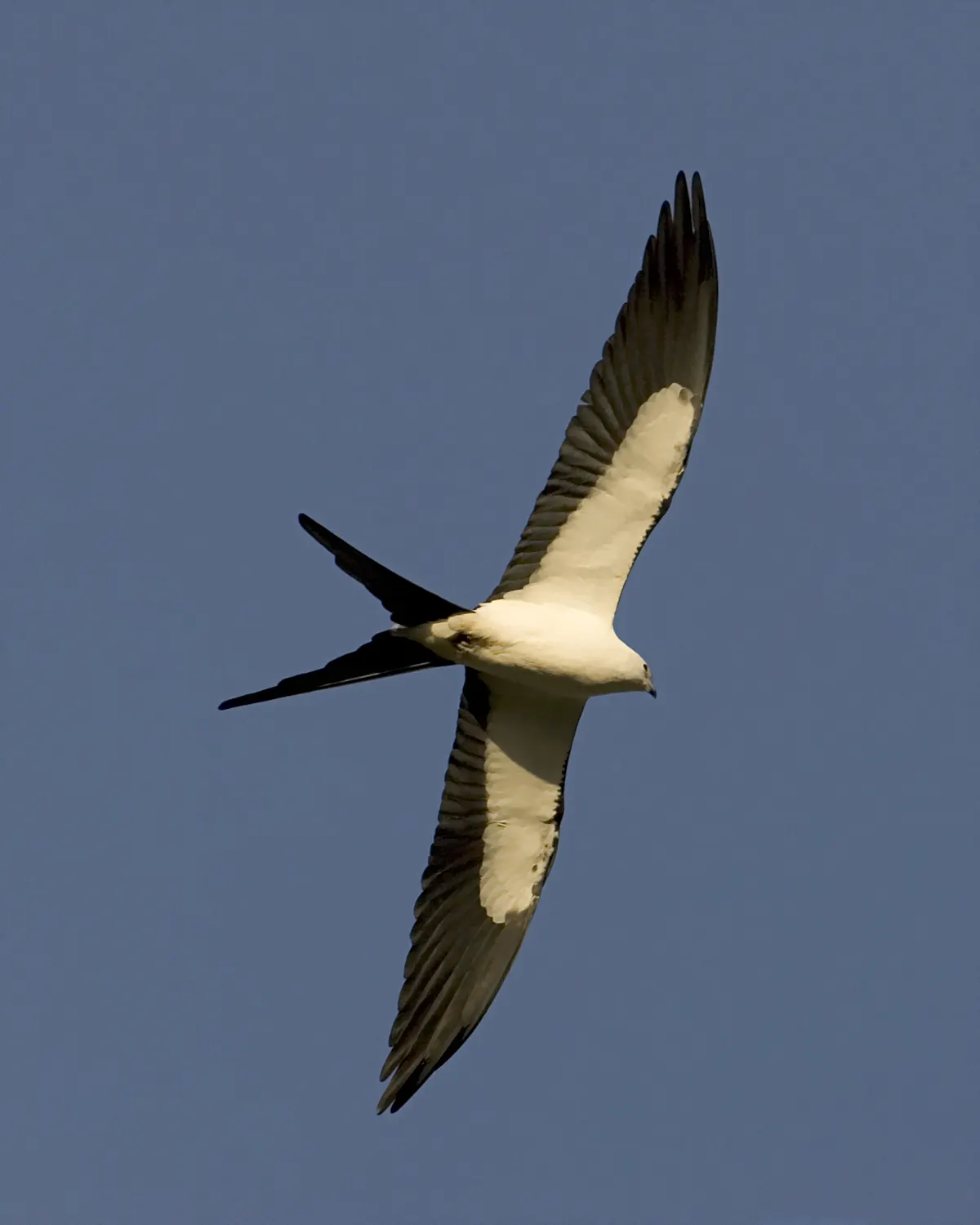
- Look up for the first kite. Swallow-tailed kites begin reaching South Florida in mid-February, and the Panhandle a week or two later. A black-and-white raptor with a long, deeply forked tail, gliding low over pines or a cypress strand, is unmistakable. Note the date and send it to the Avian Research and Conservation Institute.
- Watch a nest without disturbing it. Osprey nests on channel markers, light poles and dead pines are busy now, and on Sanibel the first chick of last season was confirmed on February 23. Pick one nest you pass often and check it every few days from a respectful distance.
- See two planets at their best. On Wednesday evening, February 10, Jupiter sits opposite the Sun, up from dusk to dawn. Mars follows on Friday, February 19. Both stand in Leo, so one look to the east after dark catches the pair.
Record it: the day your first swallow-tailed kite sails over belongs in the daily field log, and an osprey or eagle nest you check each week deserves a “nest observed” page. A blooming Chickasaw plum can start “a tree through the seasons”, with its fruit to follow in late spring, and the honking of cranes passing overhead suits “a map of sounds”.
Regions used below: Panhandle; North Florida; Central Florida; Southwest Florida; Southeast Florida; The Keys.
When do swallow-tailed kites come back to Florida?
Few birds announce spring in Florida like this one. Swallow-tailed kites spend the northern winter in South America, and Audubon Florida writes that they begin arriving in South Florida from Brazil and Argentina in mid-February, then move north to the Panhandle within one to two weeks. UF/IFAS Extension in Escambia County puts their return to the western Panhandle in late February and March, and notes that the birds are common on the peninsula but uncommon in the far west. So February sightings come mostly from the peninsula's southern end, and the odds improve each week.
The Avian Research and Conservation Institute (ARCI) in Gainesville follows kites carrying GPS tags, and its birds show how late many arrive: two tagged Florida kites left the Yucatán on March 2 and 3, 2025, and in mid-March 2026 tagged birds were still landing on their territories. Mid-February is the start of the season, not its peak.
-
How to know one
From mid-February in South Florida; late February and March farther north · Over pine flatwoods, cypress strands, river swamps and wet prairies, mostly near water and open ground
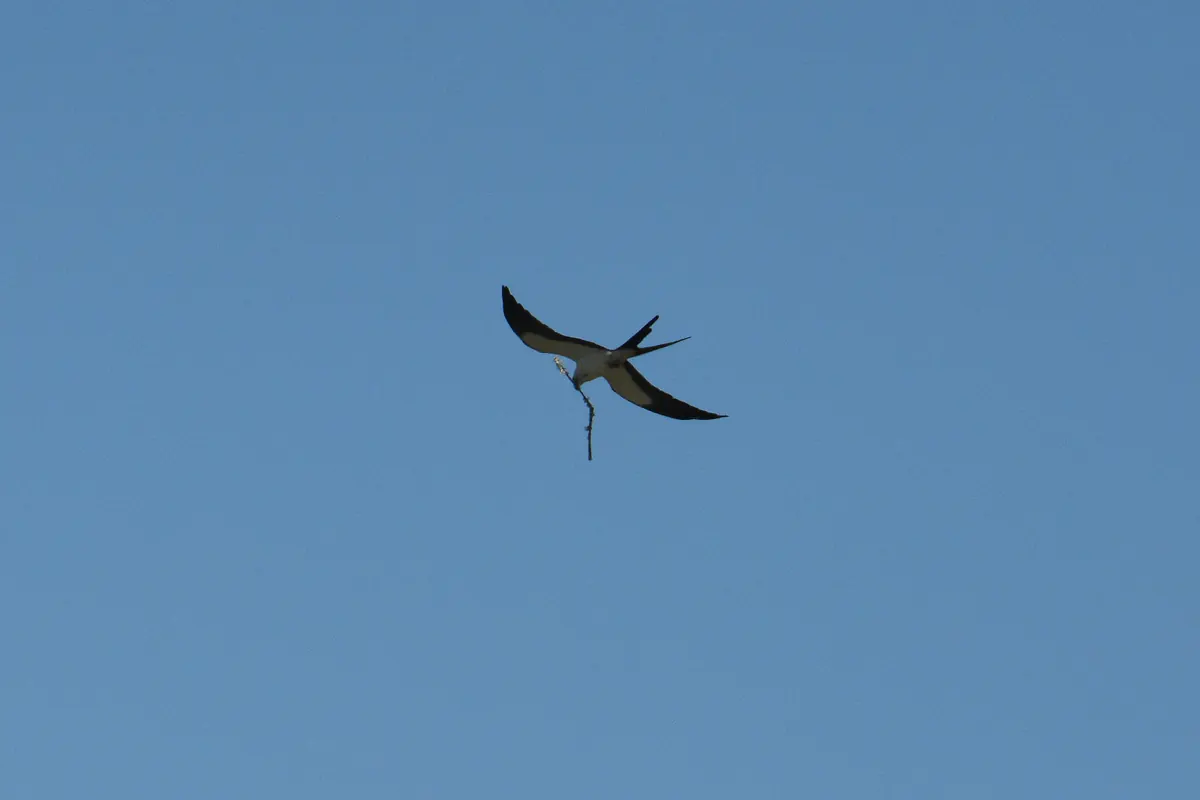
Bright white below, glossy black above, with a forked tail as long as the body, the kite rarely flaps; it glides and turns on the wind, often low over the treetops. It plucks insects, tree frogs, lizards and small snakes from the treetops on the wing. Pairs build a new nest each year, usually near the top of a tall pine close to water or open ground, and often in the same area as before.
-
Report your sighting
Any time from first arrival through summer · arcinst.org, under report sightings
ARCI asks the public for swallow-tailed kite sightings, and it is especially keen on nests and evening roosts, which are hard for researchers to find. Its Eyes on Kites program trains volunteers to monitor nests through the season, and nest locations are kept confidential.
Which Florida birds have eggs or chicks in February?
February is a crowded month in Florida's treetops. Birds that started nesting in winter now have young to feed, and others are just laying. Four to watch, always from a distance that does not make the adults leave the nest:
-
Ospreys
Nesting from December in South Florida to late February in North Florida · Coasts, lakes and rivers statewide; stick nests on dead trees, channel markers, light poles and platforms
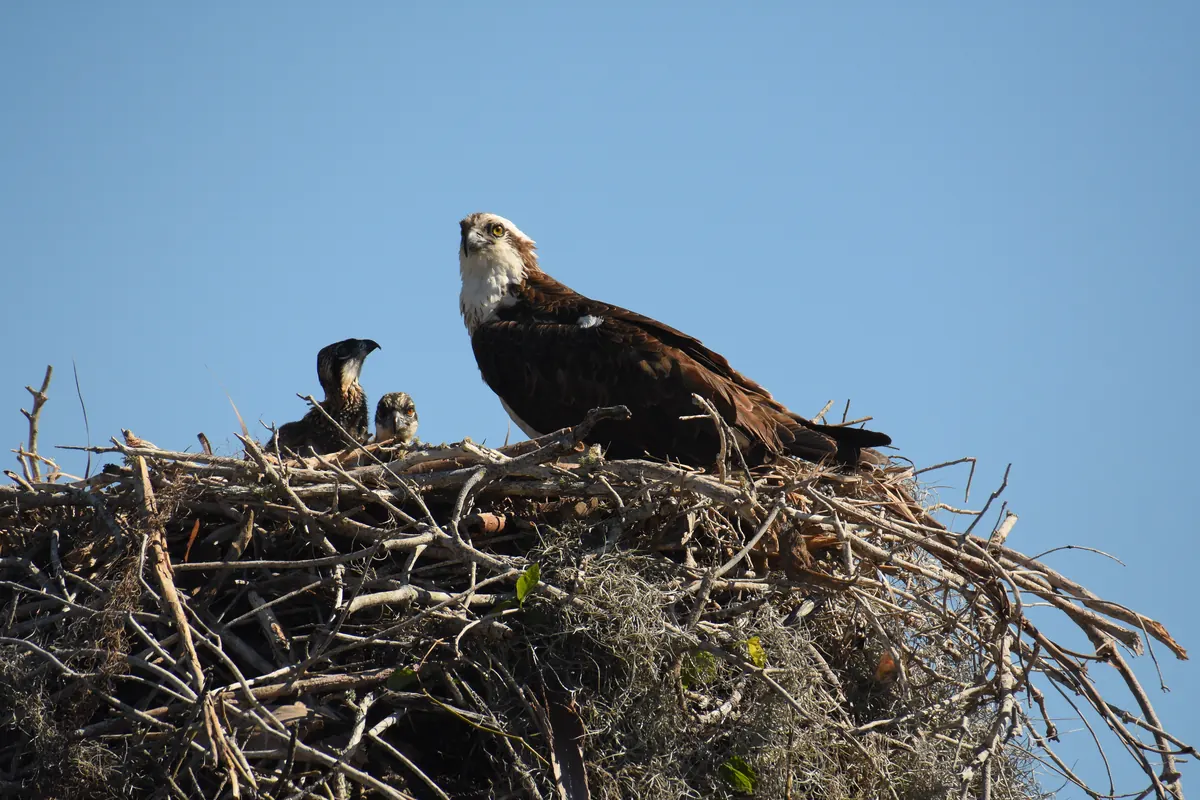
According to the FWC, Florida's ospreys begin nesting in December in the south and as late as late February in the north. A female lays two to four eggs and incubates them for about 32 days, so South Florida nests turn from quiet incubation to noisy feeding during February, while birds in the Panhandle are still carrying sticks. On Sanibel, Captiva, Fort Myers Beach and Pine Island, volunteers with the Sanibel-Captiva Conservation Foundation confirmed the first chick of the 2026 season on February 23. Young ospreys first fly about 55 days after hatching, and the parents keep feeding them until they are roughly 100 days old.
-
Eaglets nearly grown
Most nests hold large young in February; the earliest begin to fly · Tall pines and towers near water statewide
The tiny gray chicks of January are now big, dark and hungry. Nestlings in Florida first fly at about 11 weeks of age, the FWC says, so the earliest broods begin hopping onto branches and making short flights this month, while later nests still have weeks to go. Young eagles stay near the nest with their parents for another 4 to 11 weeks after that. Audubon EagleWatch still welcomes reports of unlisted nests.
-
Great horned owlets
Hatching late January into February · Old hawk, crow and heron nests and tree cavities in hammocks, flatwoods and parks
The owls that were sitting on eggs in January now have fluffy white chicks, since incubation takes about a month. The young stay in the nest for several weeks and often clamber out onto nearby branches before they can fly.
-
Florida sandhill cranes on eggs
Late winter and spring · Shallow marshes, wet prairies, pasture ponds and retention ponds in Central and North Florida
Florida's resident cranes nest in late winter and spring, the FWC explains, building a mat of grass, moss and sticks about two feet across in shallow water. Both parents build it, the female lays two eggs, and incubation takes 32 days. Within a day of hatching, the chicks, called colts, can walk away from the nest behind their parents. Pairs sometimes nest in suburban ponds and even stormwater basins; give them room, and keep dogs leashed nearby.
Where do wood storks and roseate spoonbills nest in Florida?
South Florida's big wading birds nest in the dry season, and they time it to falling water. As the Everglades and the cypress swamps slowly dry out after the summer rains, fish crowd into the shrinking pools, and the parents can catch enough to feed hungry chicks. That makes February one of the best months to see a busy colony, and also a month when the weather matters a great deal to the birds.
-
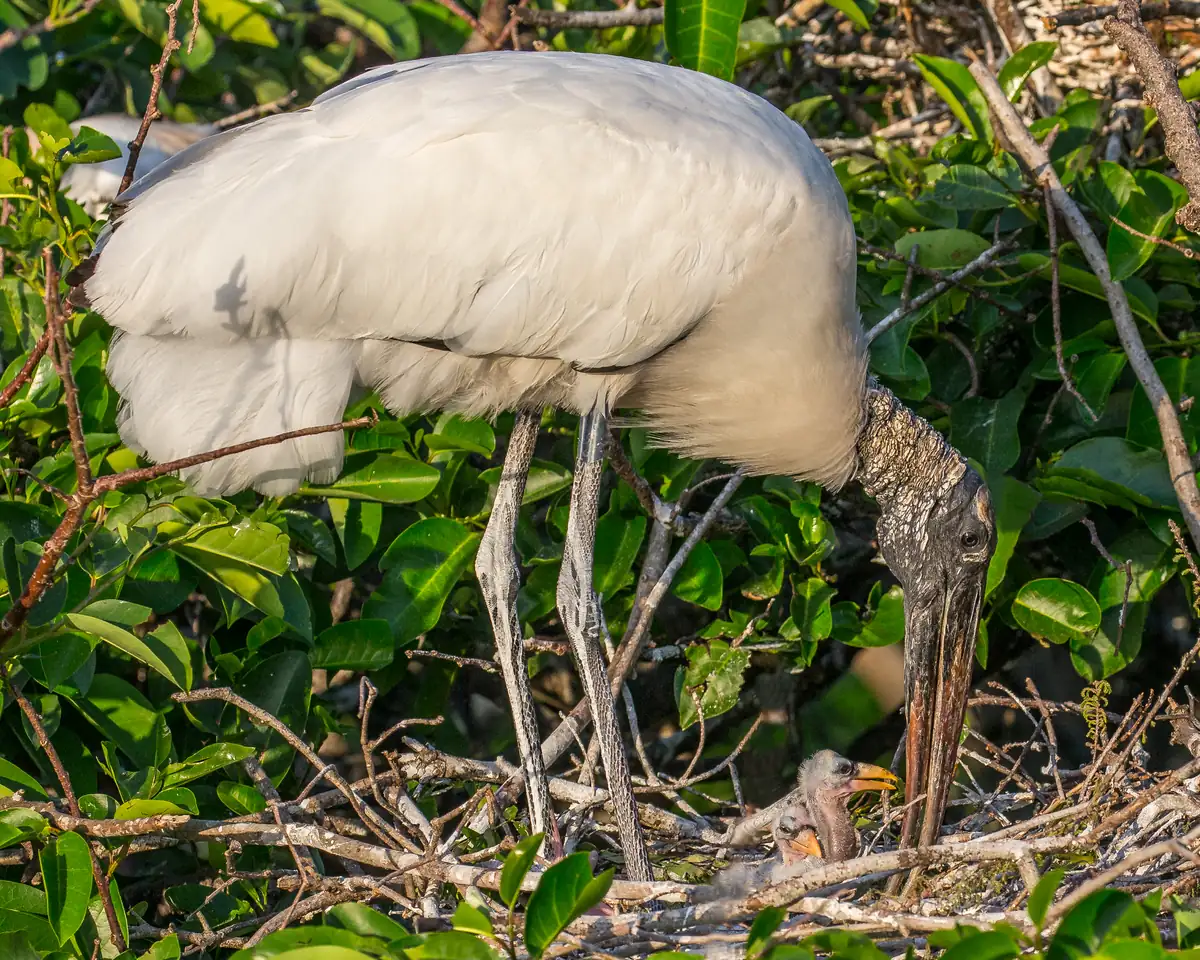
Wood storks
Colonies form from about January; eggs and chicks February to May · Corkscrew Swamp Sanctuary near Naples, Everglades National Park, and other cypress and mangrove colonies
The wood stork, a big white bird with a bare gray head and black flight feathers, came off the federal list of endangered and threatened wildlife on March 12, 2026, after its U.S. breeding numbers more than doubled. Audubon calls it the Goldilocks of wading birds because it needs water levels that are just right: wet enough in summer to grow fish, then a steady drawdown in winter. Corkscrew Swamp once hosted thousands of nests a year, but nesting there has become unpredictable. In January 2017, after a two-year gap, an aerial survey found 40 to 50 active nests in the bald cypress; in 2021, after unusual winter rain, the first nests appeared only in the first week of March, and the colony fledged just 25 chicks from 13 successful nests. Storks incubate their eggs for 30 days and fledge young about two months after hatching, so a late start leaves little time before the summer rains scatter the fish.
-
Roseate spoonbills
Nesting from November through March · Islands in Florida Bay such as Sandy Key, Tern Key and Joe Key; feeding birds turn up in shallow marshes and lagoons on both coasts
Everglades National Park reports more than 200 pairs of spoonbills nesting on islands in Florida Bay from November through March. By February many nests hold chicks, which the park describes as an ugly gray before they grow into pink copies of their parents. The nesting islands are closed to visitors, but feeding spoonbills, pink even at a distance, are easy to pick out in shallow coastal water.
-
Watching a colony the right way
Through the nesting season, which can last into May or June · Paurotis Pond in Everglades National Park; the boardwalk at Corkscrew Swamp
Everglades National Park has closed Paurotis Pond and the area beyond its parking lot in past nesting seasons to keep people away from the wood storks, egrets, ibises, spoonbills, herons and anhingas nesting there, but the parking area stays open for birdwatching. Stay behind the closures: a startled parent leaves its eggs or chicks open to sun and predators.
When do the wintering sandhill cranes leave Florida?
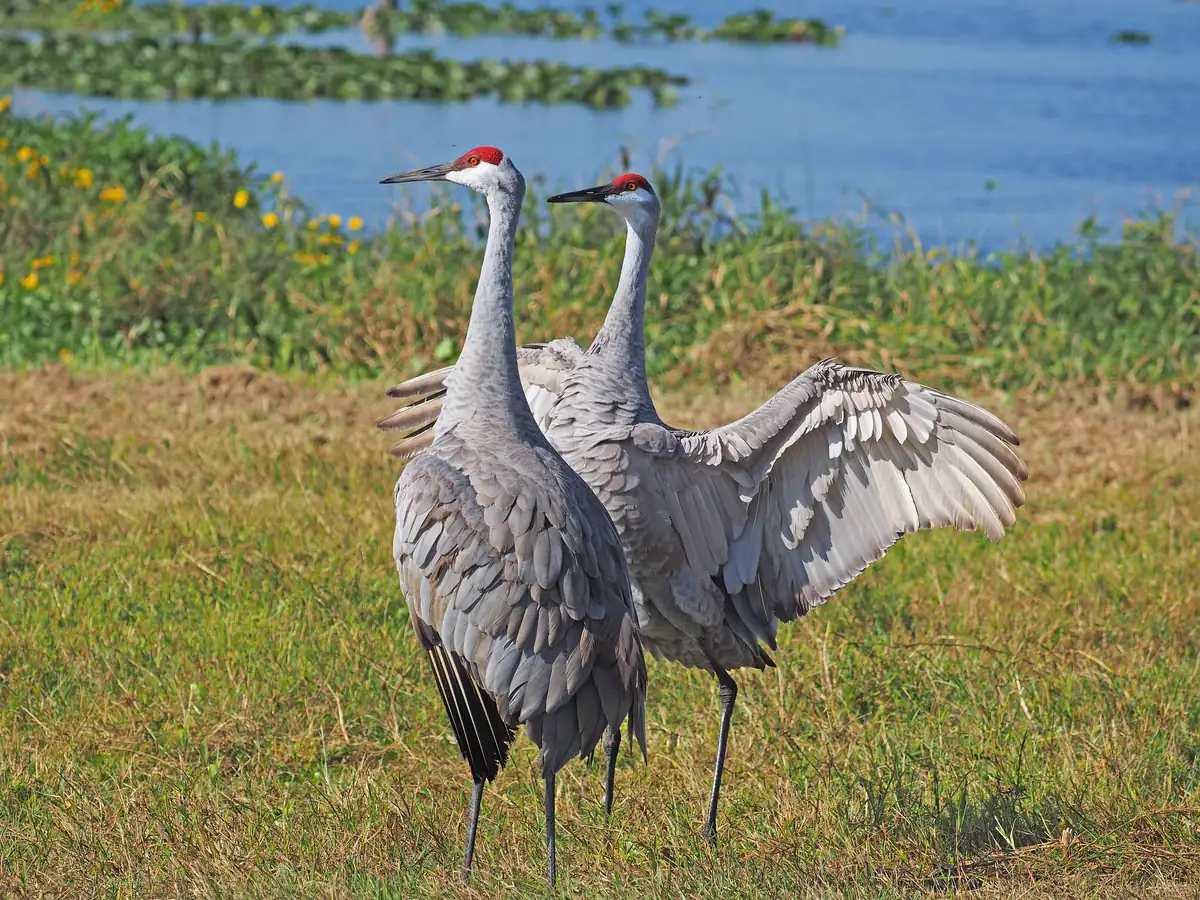
Florida's wintering crane flocks, roughly 25,000 birds from the Great Lakes region by the FWC's count, start to stir in February. The FWC says the northern flocks leave during March and April. Observers around Paynes Prairie in Alachua County, the best-known gathering place, describe migration out of North Central Florida beginning in February, and a WCJB report from February 2026 quoted a Gainesville birder on the sound of hundreds of cranes calling as the flocks rise. Expect the first restless groups to lift off on warm, south-wind days in late February, and most of the visitors to be gone by April.
Two ways to tell the visitors from the residents: wintering cranes travel in big flocks that roost together in shallow water, while Florida's own cranes are usually in pairs or family groups of three now, many of them guarding a nest. And when a flock spirals high on a thermal and slides away to the north, those are migrants. The Florida sandhill crane, a resident subspecies of just 4,000 to 5,000 birds, is a State-designated Threatened species.
-
Other winter visitors winding down
Late February and into March · Springs, coasts and refuges statewide
The manatee season at Crystal River National Wildlife Refuge runs to March 31, and February cold snaps can still pack the springs, but on warm afternoons more of the animals drift out to feed. Right whale mothers and calves remain off the northeast coast through February; NOAA Fisheries dates the calving season to mid-April, after which the pairs head north. Florida's duck hunting seasons closed on January 31.
What is spawning in Florida's rivers and lakes in February?
Two fish runs make February a good month to watch the water.
-
American shad on the St. Johns
The FWC monitors the run from January through March, sometimes into April · The upper St. Johns River, from Lake Monroe and Lake Harney south through Puzzle Lake toward the Tosohatchee Wildlife Management Area
The St. Johns River holds the southernmost spawning run of American shad on the Atlantic coast, a range that reaches north into Canada. Silvery, herring-like shad come in from the ocean and travel far up the north-flowing river, past Jacksonville and Palatka, to spawn in the shallow, winding marsh stretches near its headwaters. Unlike shad in northern rivers, which survive to spawn again, Florida's shad die after spawning. FWC biologists track the run each winter by sampling the river between Lake Monroe, Lake Harney and Puzzle Lake and by talking with anglers at the boat ramps, and they sample the young fish downstream between Blue Spring and Astor.
-
Bass on their beds
From January in extreme South Florida to May in the Panhandle; March and April are the peak · Shallow, sandy or hard-bottomed shorelines of lakes and canals statewide
Florida bass, now recognized as a species separate from the northern largemouth, spawn earlier here than anywhere else in the country. FWC biologists say spawning can start as early as January at the southern tip of the state and as late as May in the Panhandle, with the peak in March and April, and that the preferred spawning range is 62 to 75 °F. The male fans a shallow, round bed clear of debris, and once the eggs are laid he guards them and then the school of tiny fry. On a sunny February day in Central or South Florida, look for pale circles in clear shallow water with a dark fish hovering over each one. The state record is 17.27 pounds, and the FWC's TrophyCatch program rewards anglers who photograph and release bass of 8 pounds or more.
What is blooming in Florida in February?
North Florida's woods are still mostly bare in February, which is exactly why the first flowering trees stand out. Red maples have moved on from flowers to red winged seeds, and Carolina jessamine is still trailing yellow through the fencerows. Three native trees to look for this month:
-
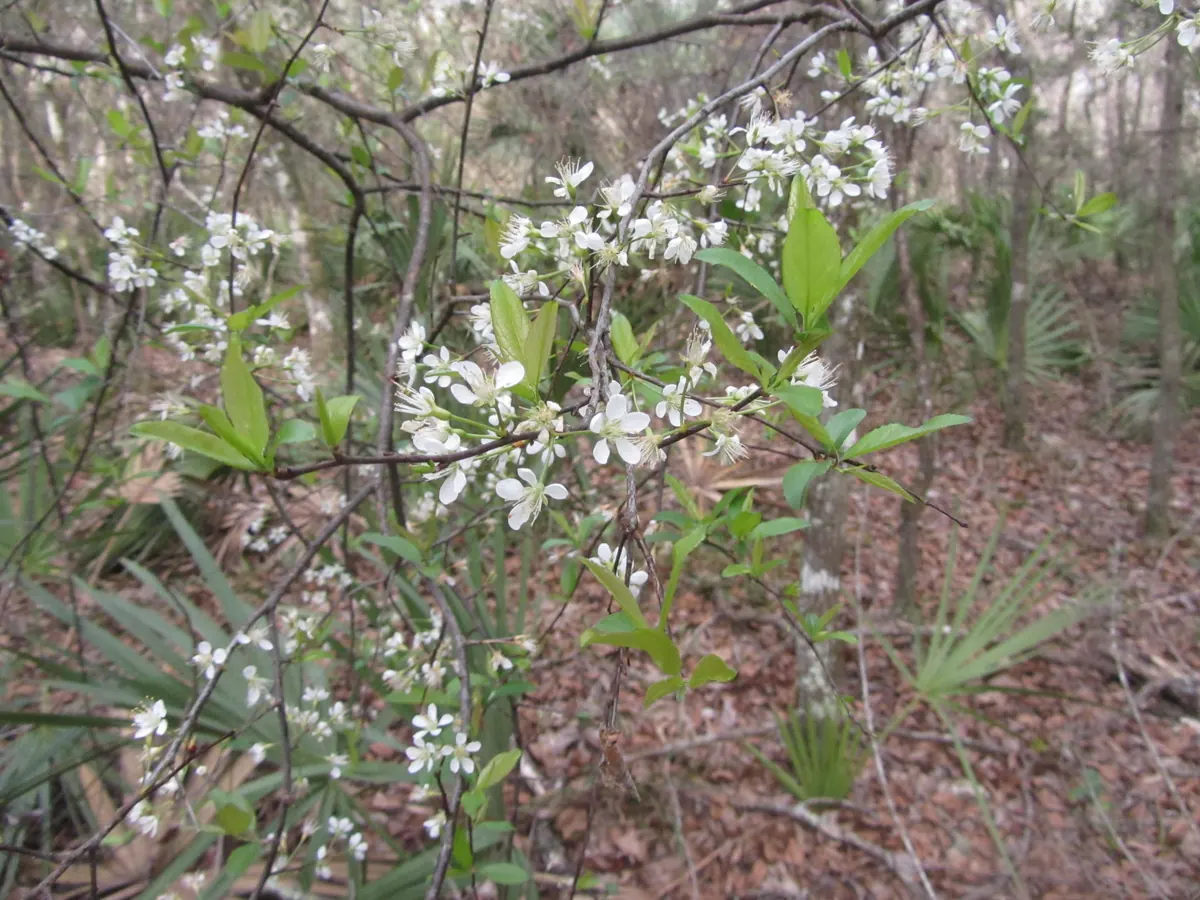
Chickasaw plum
Late winter to early spring, before the leaves · Woodland edges, old fields, fencerows and sandy roadsides in North and Central Florida
A small, thicket-forming tree that covers its bare twigs in small, fragrant white flowers before the leaves emerge, according to UF/IFAS. Because it sprouts from the base of the trunk, a single plant often becomes a cloud of white along a field edge. Half-inch red fruits that ripen to yellow follow later in spring, and birds and people both eat them.
-
Eastern redbud
Late winter into spring · Hardwood hammocks, slopes and bluffs in North Florida and the Panhandle; planted farther south
Clusters of small pink flowers line the bare branches before the heart-shaped leaves appear. The Florida Native Plant Society notes that at the southern end of its range the tree may not bloom well, so the best shows are in North Florida.
-
Flowering dogwood
February in North and Central Florida, by UF/IFAS; often into March · Upland hardwood forests and acidic, well-drained hillsides in North Florida
What look like four broad white petals are really bracts; the true flowers are the small yellow-green cluster in the middle. UF/IFAS lists dogwood among Florida's February-flowering trees, while the Florida Native Plant Society simply calls it a spring bloomer, so the first trees may open in late February and most in March, depending on the year and on how far north you are. Fringetree, with drooping ribbons of lightly fragrant white flowers, follows in late winter or early spring.
What is February weather like in Florida, and what does a strong El Niño bring?
February warms quickly from the south. By NOAA's 1991–2020 normals, Key West's average February low is about 67 °F and Miami's about 63 °F, while Tallahassee still averages a low near 44 °F and around five nights at or below freezing. In Orlando and Tampa a freezing February night is now a rarity, averaging well under one a year, though a single cold outbreak can still bring one. It is also the heart of the dry season on the peninsula: Key West averages about 1.5 inches of rain, and Orlando and Miami only about 2, compared with more than 4 inches in Pensacola and Tallahassee.
| Station | Average high | Average low | Rain | Nights 32 °F or colder | Nights 40 °F or colder |
|---|---|---|---|---|---|
| Pensacola | 66.4 | 47.2 | 4.77 | 2.1 | 8.2 |
| Tallahassee | 67.8 | 43.5 | 4.28 | 5.2 | 11.6 |
| Jacksonville | 68.9 | 46.1 | 2.86 | 2.7 | 9.1 |
| Gainesville | 70.9 | 45.9 | 2.67 | 2.8 | 9.0 |
| Orlando | 74.9 | 52.4 | 2.04 | 0.2 | 2.4 |
| Tampa | 74.0 | 55.5 | 2.62 | 0.1 | 1.5 |
| Miami | 78.2 | 63.2 | 2.15 | 0.0 | 0.2 |
| Key West | 77.4 | 67.1 | 1.54 | 0.0 | 0.0 |
A strong El Niño can upend those dry-season numbers. Forecasters at the Climate Prediction Center rated it better than nine in ten, in their September 10, 2026 discussion, that the warm Pacific event building now will be among the most intense, peaking this winter. In such winters, the weather service office in Melbourne explains, storminess over Florida and the Gulf rises sharply, bringing well above average rain and sometimes widespread flooding; in the most extreme events a fairly strong low passes over the state about every three days. In the record-setting El Niño of 1997–98, February rainfall across Florida ran far above normal. The Tallahassee office finds that Florida's river flooding tends to peak in late February and early March in El Niño years, and that the same wet pattern lowers the risk of wildfire. Severe storms are part of the package: during the night of February 22–23, 1998, seven tornadoes tore through east Central Florida between about 11 p.m. and 2:30 a.m., killing 42 people, the deadliest tornado event in the state's history.
A wet winter matters to wildlife too. Audubon Florida has seen unusual winter rain delay wood stork nesting at Corkscrew Swamp and cut the number of young raised, so watch how the colonies fare this year. The latest seasonal maps are on the CPC's 90-day outlook page, updated each month; for the next few days, open our Florida weather forecast, and before you put out tender plants, see when the last freeze usually comes in your part of the state.
How much longer are Florida's days by the end of February?
February is when the extra light finally becomes obvious. Pensacola gains 46 minutes over the month, Jacksonville 45 and Tallahassee 44, going from about 10 hours 45 minutes on February 1 to more than 11 and a half hours on the 28th. The gains shrink toward the tropics: Miami adds 38 minutes and Key West 34, because the farther south you are, the smaller the swing in day length over the year. Key West is the only city in the table that starts the month above 11 hours, and by the end of February every Florida city has passed that mark.
The pace keeps quickening too. In the Panhandle and North Florida the days now stretch by a minute and a half or more each day, roughly a minute faster than at New Year's; even Miami, with the slowest change on the mainland, goes from about 1.2 minutes a day at the start of the month to about 1.5 at the end. The fastest gains of the year come around the March equinox, and on March 14 daylight saving time moves an hour of that light from the morning to the evening.
| City | Feb 1 | Feb 28 | Gained | Per day |
|---|---|---|---|---|
| Pensacola | 10 h 45 m | 11 h 31 m | 46 min | 1.7 min |
| Tallahassee | 10 h 46 m | 11 h 30 m | 44 min | 1.6 min |
| Jacksonville | 10 h 46 m | 11 h 31 m | 45 min | 1.7 min |
| Gainesville | 10 h 48 m | 11 h 32 m | 44 min | 1.6 min |
| Orlando | 10 h 51 m | 11 h 33 m | 42 min | 1.6 min |
| Tampa | 10 h 53 m | 11 h 34 m | 41 min | 1.5 min |
| Miami | 10 h 59 m | 11 h 37 m | 38 min | 1.4 min |
| Key West | 11 h 04 m | 11 h 38 m | 34 min | 1.3 min |
Our daylight calculator works out the exact light for any Florida town, twilight included.
What can you see in the night sky over Florida in February 2027?
-
Jupiter at opposition
Evening of Wednesday, February 10 (7:21 p.m. EST, 6:21 p.m. CST) · Rising in the east at sunset; high in the south around midnight
At opposition Earth passes between Jupiter and the Sun, so the planet comes up at sundown and is visible until dawn. It shines at magnitude −2.5 in Leo, brighter than any star, and on February 10 it is about 405 million miles away, the closest it comes this year.
-
Mars at opposition
Friday, February 19; closest to Earth on February 20 · Rising in the east at dusk, in Leo, a little to the east of Jupiter
Mars reaches opposition on the morning of February 19 and comes closest the next day, at about 63 million miles. With Mars close to aphelion, the outermost point of its path, this pass is a far one: the planet glows a modest magnitude −1.2 and looks small even in a telescope. Its color is the giveaway: a steady orange-red light, noticeably warmer than Jupiter's. Its next opposition comes in 2029.
-
The Snow Moon and a faint penumbral eclipse
Saturday, February 20; full at 6:23 p.m. EST (5:23 p.m. CST) · Rising in the east around sunset
The full moon comes up almost exactly as it turns full, and it is already sliding through the outer, paler part of Earth's shadow. This penumbral eclipse is greatest at 6:13 p.m. EST (5:13 p.m. CST) and ends at 8:13 p.m. EST (7:13 p.m. CST). By U.S. Naval Observatory times the Moon rises at 6:14 p.m. in Miami, 6:16 in Jacksonville and 6:22 in Tampa, and at 5:39 p.m. CST in Pensacola, so the whole state sees it rise just after the deepest point, low in bright twilight. Expect at most a faint grayish shading on one edge, and most people will not notice anything. Some almanacs count it as a supermoon; others do not. The bigger show that night is the gathering in Leo: the Moon with Jupiter, the bright star Regulus and Mars, one day past opposition. A night earlier, on February 19–20, the almost-full Moon slides just past Jupiter.
-
Mercury's best evening show of the winter
Greatest elongation February 3; visible until about February 10 · Low in the west-southwest, 30 to 45 minutes after sunset
On February 3 the innermost planet swings 18 degrees east of the Sun, as far out as it gets on this evening appearance. A flat western horizon, such as a Gulf beach, helps. On Sunday, February 7, a hairline crescent Moon only a day old keeps Mercury company low in the twilight; finding it is a nice binocular challenge.
-
Venus, Saturn and the dark evenings
All month; moonless evenings about February 2 to 11 · Venus in the southeast before dawn; Saturn low in the west after dusk
Before sunrise, dazzling Venus hangs in the southeast. Saturn is sinking into the evening twilight in the west and will be gone by spring. The new moon on February 6 is also the day of an annular solar eclipse, but it is visible only from South America, the South Atlantic and parts of Africa, not from anywhere in the United States. With no moonlight in the evenings around it, that week suits faint-star watching, far from town lights.
| Phase | Date | Time |
|---|---|---|
| New moon | Saturday, Feb 6 | 10:56 a.m. EST (9:56 a.m. CST) |
| First quarter | Sunday, Feb 14 | 2:58 a.m. EST (1:58 a.m. CST) |
| Full moon, the Snow Moon | Saturday, Feb 20 | 6:23 p.m. EST (5:23 p.m. CST) |
| Last quarter | Sunday, Feb 28 (Saturday, Feb 27, in Central time) | 12:16 a.m. EST (11:16 p.m. CST on Feb 27) |
Our moon calendar gives moonrise times for any Florida town, while Today's sky tells you if clouds will hide the Snow Moon's rise.
What can families do outdoors in Florida in February 2027?
- Join the Great Backyard Bird Count over Presidents' Day weekend, February 12–15, 2027. Birds Canada, one of the count's organizers, lists those dates; confirm on birdcount.org. A quarter hour of watching on any of the four days counts; then enter what you saw online or in a free birding app.
- Mark the true middle of winter on February 3–4. Groundhog Day, Tuesday, February 2, comes a day or two early; the real halfway point between the solstice and the equinox falls on the night of February 3–4.
- Hold a kite watch. Pick a spot with open sky near pines or cypress, and when the first swallow-tailed kite appears, report it to ARCI.
- Adopt an osprey nest near your school or a boat ramp, and keep a weekly note of what the adults are doing. Around Sanibel and Fort Myers Beach, the Sanibel-Captiva Conservation Foundation relies on about 40 volunteers to watch its nests.
- Look at Jupiter on February 10 with binoculars braced on a car roof or fence post, and count its moons. Look again a few nights later; they will have moved.
- See the Snow Moon come up on Saturday evening, February 20, from a beach or lake with a clear view to the east, and see whether you can spot any shading on its edge.
- Walk a boardwalk in nesting season. Corkscrew Swamp Sanctuary and the Anhinga Trail in Everglades National Park put families within easy view of wading birds; check each site's hours before you go.
- Look for ranger programs on the Florida State Parks events calendar, which lists guided walks, bird programs and star parties by park.
Project FeederWatch counts continue to April 30. Keep the month's notes in the Naturalist's Field Journal, compare them with January in Florida, or browse other states in our seasonal nature guides.
Safety notes for February in Florida
- Hunting seasons (FWC, 2026–27). General gun season for deer stays open through Sunday, February 21, in Zone B (Central and much of North Florida) and Zone D (the western Panhandle); Zone D then has a muzzleloading season from February 22 to 28. Zones A and C, and every fall turkey season, closed in January. A youth spring turkey hunt runs February 26 to March 1 south of State Road 70. Statewide, quail stay open through March 7 and snipe through February 15; bobcat season runs to March 31 and otter to March 1, and wild hogs are open year round. Ducks, coots, geese, doves and woodcock closed at the end of January, apart from special waterfowl days for veterans and active military on February 6–7 and for youth on February 13. Wildlife management areas set their own dates.
- Blaze orange. FWC rules require deer hunters on public land, and the people with them, to wear daylight fluorescent orange on the outside, above the belt, adding up to no less than 500 square inches (a hat may be part of it), except in archery-only seasons and on private land. Hikers are not covered, yet a bright vest or jacket is wise on any wildlife management area open to gun hunting until February 21.
- Tornadoes in the dark. The deadliest outbreak in Florida's history struck late at night in February 1998, ahead of an El Niño cold front. Leave emergency alerts switched on at bedtime, and pick a sturdy shelter in advance if you are camping.
- Rising rivers. Flooding on Florida rivers tends to peak in late February and early March in El Niño years. Check river levels before paddling, and never drive into flooded roads.
- Late freezes. A hard freeze can still reach North and Central Florida in February. Cover tender plants and bring pets inside on cold nights.
- Nesting birds. Stay well back from eagle, osprey and crane nests and from posted rookeries. If an adult flushes, calls in alarm or circles overhead, you are too close.
- Fire season. The Florida Forest Service says the state's wildfire season peaks in April, May and June, and dry weather in late winter builds toward it. Check local burn bans, and be ready to see prescribed fires and smoke in state forests and refuges.
- Longer evenings. Days pass 11 hours everywhere in Florida in February, but shaded hammock trails still darken before sunset; carry a light on late walks.
Sources
- Audubon Florida: swallow-tailed kites at Corkscrew Swamp Sanctuary (arrival in mid-February)
- UF/IFAS Extension Escambia County: the swallow-tailed kites are back
- Avian Research and Conservation Institute: two GPS-tracked swallow-tailed kites arrive in Florida (March 2025)
- Avian Research and Conservation Institute: GPS-tracked kites arrive on breeding grounds (March 16, 2026)
- Avian Research and Conservation Institute: swallow-tailed kites fly in, and how to report sightings
- Avian Research and Conservation Institute: Eyes on Kites nest monitoring
- FWC: osprey species profile (nesting season, incubation, fledging)
- Sanibel-Captiva Conservation Foundation: first osprey chicks of the 2026 nesting season confirmed (February 23, 2026)
- Sanibel-Captiva Conservation Foundation: osprey monitoring
- FWC: bald eagle biology (nesting season, fledging at about 11 weeks)
- Audubon Florida: EagleWatch
- FWC: great horned owl species profile
- National Park Service, Fort Matanzas National Monument: great horned owl
- FWC: sandhill crane species profile (nesting, migrant numbers and departure)
- WCJB: sandhill crane flocks migrating from North Central Florida (February 20, 2026)
- Great Florida Birding and Wildlife Trail: Paynes Prairie Preserve State Park
- Audubon: after a two-year absence, wood storks are nesting at Corkscrew Swamp again (2017)
- Audubon Florida: Corkscrew Swamp Sanctuary continues to attract wood storks (2021 nesting season)
- Everglades National Park: Paurotis Pond closed for nesting season
- Everglades National Park: roseate spoonbill species profile
- U.S. Fish and Wildlife Service: Crystal River National Wildlife Refuge (manatee season to March 31)
- NOAA Fisheries: North Atlantic right whale (calving season mid-November to mid-April)
- FWC: American shad research on the St. Johns River
- FWC: black bass fishing (spawning months by region)
- FWC: temperature and fishing (bass spawning range)
- FWC: Florida bass and largemouth bass profile (nests, state record, TrophyCatch)
- UF/IFAS: Prunus angustifolia, Chickasaw plum (ST504)
- UF/IFAS Gardening Solutions: winter-flowering trees and shrubs
- Florida Native Plant Society: eastern redbud (Cercis canadensis)
- Florida Native Plant Society: flowering dogwood (Cornus florida)
- Florida Native Plant Society: Chickasaw plum (Prunus angustifolia)
- NOAA NCEI: 1991–2020 monthly normals for eight Florida stations (data API)
- NWS Melbourne: ENSO and Florida rainfall
- NWS Melbourne: El Niño and Florida dry-season storminess
- NWS Tallahassee: El Niño and its effect on the Southeast (flooding peak, wildfire risk)
- NWS service assessment: Central Florida tornado outbreak, February 22–23, 1998
- Climate Prediction Center: ENSO diagnostic discussion, September 10, 2026
- Climate Prediction Center: official 90-day outlooks
- Florida Department of Agriculture and Consumer Services: Florida Forest Service wildfire conditions (season peaks April to June)
- U.S. Naval Observatory: moon phases, December 2026 to 2027 (data API)
- U.S. Naval Observatory: moonrise in Miami on February 20, 2027 (data API)
- U.S. Naval Observatory: moonrise in Pensacola on February 20, 2027 (data API)
- NASA eclipse website: lunar eclipses of 2021–2030
- NASA eclipse website: solar eclipses of 2021–2030
- Fred Espenak: Sky Event Almanac 2027 (oppositions, elongations, conjunctions)
- EarthSky: Jupiter at opposition
- Sea and Sky: astronomy calendar of celestial events 2027
- Birds Canada: Great Backyard Bird Count, February 12–15, 2027
- Great Backyard Bird Count (Cornell Lab, Audubon and Birds Canada)
- Project FeederWatch: how to participate
- Florida State Parks: events calendar
- FWC: 2026–2027 hunting season dates
- FWC: 2026–2027 migratory bird hunting season dates
- FWC: general hunting regulations, including the hunter orange rule
- Federal Register: removal of the Southeast U.S. distinct population segment of the wood stork from the federal list (February 10, 2026; effective March 12, 2026)
- Photos via Wikimedia Commons; licenses and photographers are credited under each picture
