What to look for in nature in Florida this May
May is the month Florida's seasons tip. Leatherback sea turtles, the largest of all, are at their nesting peak, and the first hatchlings of the year begin to scramble down the sand after dark. In the marshes, endangered snail kites sit on nests over the water while alligators begin to mate. On dry sandy ground, gopher tortoises are laying eggs, and on Big Pine Key, spotted Key deer fawns hide in the brush. By the end of the month the afternoon thunderstorms of the rainy season are rolling in across the peninsula. Overhead, the Eta Aquariid meteors fall in a dark, moonless sky in the first week, and the Flower Moon, a seasonal Blue Moon, fills on May 20. The sections that follow cover where to look, the weather, daylight, the sky, and how to stay safe.
Other months in Florida: October, November, December, January, February, March, April.
Start here
- Sit still on a beach after dark with the lights off. On a nesting beach in late spring, a quiet, dark evening is the best chance of seeing a hatchling reach the water. Stay well back, keep every light off, and never touch a turtle or a nest.
- Watch a marsh edge from a boardwalk. Pick a shallow freshwater marsh such as Paynes Prairie or the Lake Okeechobee shore and look for a hawk with a down-curved bill gliding low over the water. Use binoculars and keep your distance.
- Find a gopher tortoise burrow. Walk a sandy trail or an open pine woodland and look for a half-moon burrow with a sand apron. Photograph it from a distance and leave it exactly as it is.
Record it: a turtle track, a hatchling's path to the sea or a fawn in the brush goes in the daily field log, and a nesting snail kite earns a “nest observed” page. Also, list a gopher tortoise burrow under “tracks to know,” add a bat at dusk to “dusk and dawn watch,” and file the Flower Moon's rise on May 19 there too.
Regions used below: Panhandle; North Florida; Central Florida; Southwest Florida; Southeast Florida; The Keys.
Are baby sea turtles hatching on Florida's beaches in May?
May is the month when the two halves of the sea turtle year meet. Leatherback nesting is at its peak, and the first hatchlings of the season begin to dig out of the sand. Florida's wildlife agency (FWC, the Fish and Wildlife Conservation Commission) reports that leatherbacks nest from late February and peak in May, mostly on the Atlantic coast, and that their eggs hatch about 59 to 75 days after they are laid. A nest dug in the last days of February therefore opens sometime between late April and mid-May, which is simple arithmetic from those two figures. FWC also says that the eggs of sea turtles in general take about two months to incubate.
Nothing here is a schedule to plan a night around, because nobody can say which beach or which night.
-
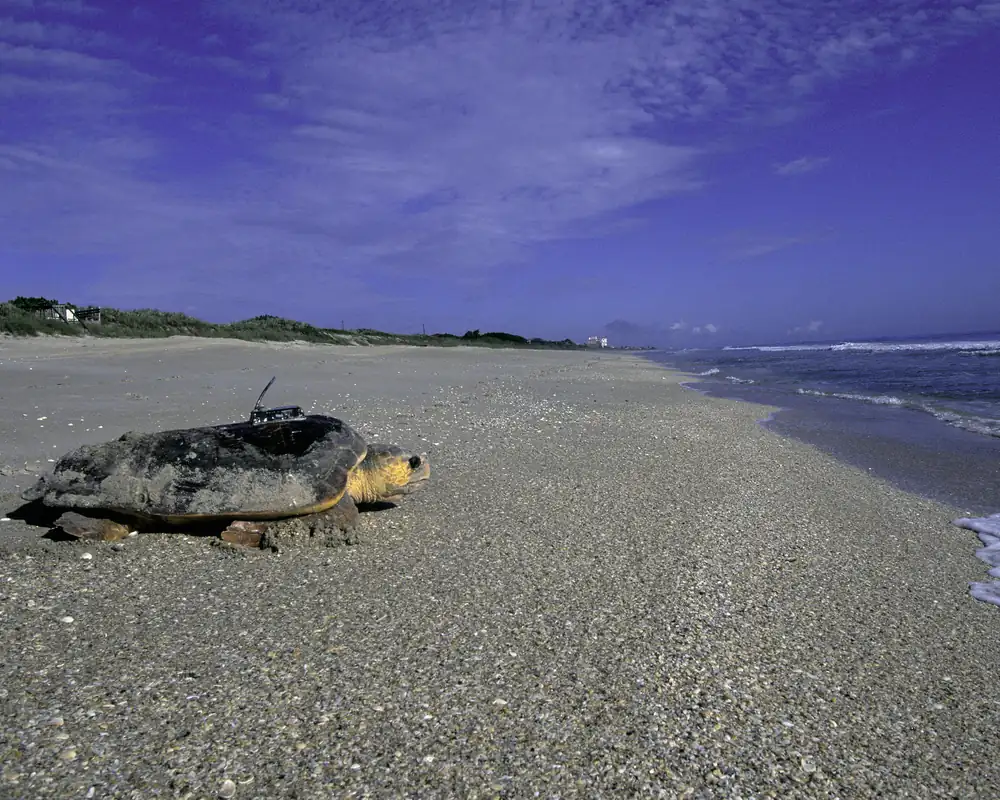
Leatherbacks at their peak
Nesting runs from late February and peaks in May; some nests are laid as late as August · Sandy beaches, mostly on the Atlantic coast
The leatherback is the giant of the group. FWC puts the average adult at about six feet long and 500 to 1,500 pounds, and lists it as endangered under federal law. If you find a fresh crawl, do not follow it, mark it or sit beside it. Report it to local turtle volunteers or to FWC.
-
The first hatchlings
Late spring onward; after dark; a nest may take several days to empty · Any nesting beach, with the earliest nests on the Atlantic side
FWC's turtle FAQ describes the scene plainly. Hatchlings dig out together, leave the nest at night, and head directly for the sea. The agency's advice for a lucky observer is to watch from a distance, let them crawl to the water on their own, leave any that are still in the nest alone, and keep every light off. Lights from buildings along the beach distract and confuse hatchlings as well as nesting females. Hatchlings wandering on a road, in a parking lot or away from the water should be reported to FWC's wildlife hotline, 888-404-FWCC (3922).
-
Holiday-weekend beach manners
Memorial Day is Monday, May 31, 2027; the advice holds all season · Every Florida beach
FWC's Memorial Day release lists habits worth copying: stay well back from a nesting turtle (getting within 50 feet can make her leave the beach before she finishes), take chairs, umbrellas and trash off the sand before sunset, fill in holes, and skip flashlights, phone lights and flash photos after dark. Keep dogs leashed and out of marked areas. Food scraps attract raccoons and crows that prey on eggs and hatchlings.
Check FWC's sea turtle pages and local turtle groups for how the season is going.
When does Florida's rainy season start in May?
The rainy season does not arrive on one date, and it does not arrive everywhere at once. The offices of the National Weather Service (NWS) and the National Park Service describe the change differently depending on where they sit, so here are the numbers each one gives. The normals in the weather section show the contrast in May rain: 6.32 inches at Miami, 2.60 at Tampa.
-
Miami and the southeast
Median start May 21 in a study of 1956 to 1997; the actual start varies each year · South Florida, measured at Miami International Airport
NWS Miami's study of the summer season used daily dew point, minimum temperature and 24-hour rainfall. It found a median start of May 21 and a median end of October 17, with an average length of 152 days and 69 percent of the year's rain falling in that stretch. Treat May 21 as a midpoint, not a promise.
-
West central and southwest Florida
May 15 to October 15 for the southwest; May 25 to October 10 for the rest of west central Florida (NWS Tampa Bay) · The Gulf coast from the Tampa Bay area south
NWS Tampa Bay gives those two ranges and adds that the beginning of the rainy season is usually a transition period rather than a single date. It puts the peak of the rainy season in July through early September, and says late May through June is the period when severe storms are most likely.
-
The Everglades wakes up wet
May through November is the wet season, according to Everglades National Park · Everglades National Park and the surrounding marshes
The National Park Service says to expect storms most afternoons, usually heavy but fast. As water levels rise, animals disperse and wildlife viewing gets more challenging, and mosquitoes and biting flies can be abundant, so bring repellent or netting.
Watch the sky by early afternoon: towers of cloud building inland usually come before the downpour. The cloud page shows how to read them, and the weather page has forecasts for your town.
Are snail kites and wading birds nesting in Florida's marshes in May?
The Everglade snail kite is an endangered raptor, and its nesting season runs right through the month. FWC says peak nesting is March through June, although the birds can nest in wetlands at any time of year, with clutches of one to five eggs. Unlike many Florida birds, snail kites do not migrate. They move from wetland to wetland as water levels shift, following their food.
-
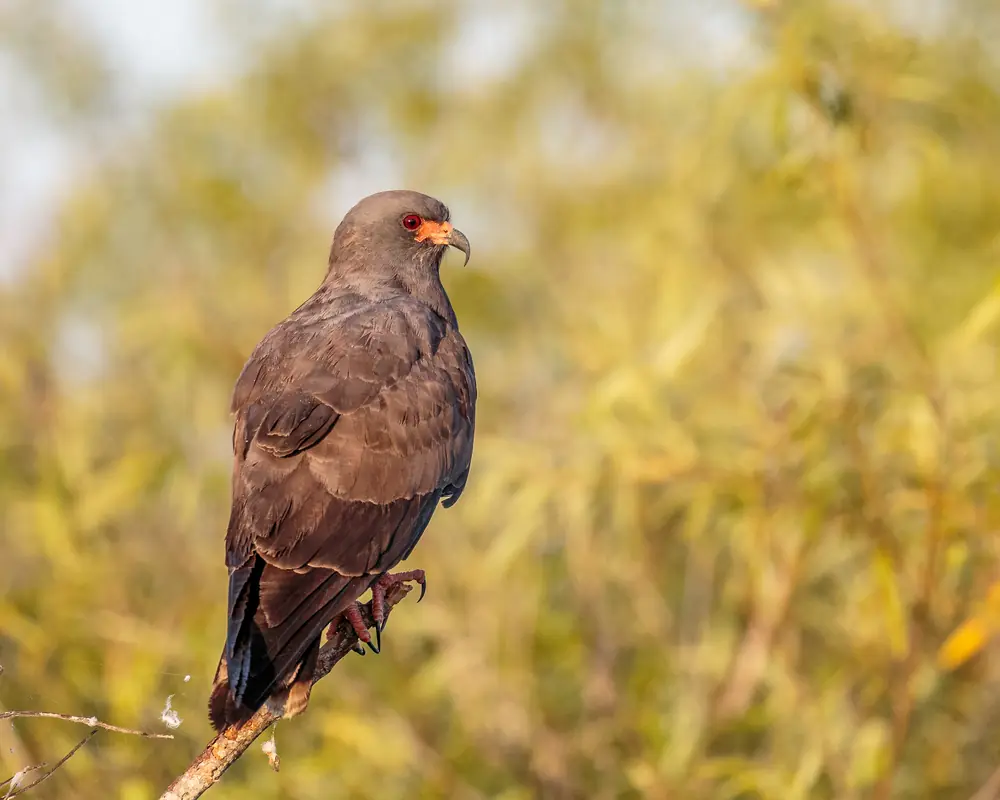
Snail kites
Peak nesting March through June; a pair may raise more than one brood in a year · Paynes Prairie Preserve, the St. Johns River headwaters, the Kissimmee River valley, Lake Okeechobee, Loxahatchee National Wildlife Refuge and parts of Everglades National Park (FWC)
The kite is a medium-sized hawk with a sharply hooked bill that eats almost nothing but apple snails. FWC says the birds hunt in open, clear places where they can spot snails and build nests over water, in cattails, sawgrass, bulrush, willow, pond apple and wax myrtle. The species is endangered at both the federal and the state level. FWC says the U.S. Fish and Wildlife Service recommends staying at least 500 feet from active nests, so use a spotting scope from a dike or boardwalk.
-
Why water matters to a kite
The wet season refills the marsh just as chicks are growing · Any shallow freshwater marsh
FWC lists disrupted natural flooding and drying cycles among the threats to snail kites. A marsh that fills too early or too late can sink a nest or hide the snails. This is one reason the first days of rain are worth noticing, even for people who only watch from the road.
-
The wading birds scatter
As the marsh rises through May and June · The Everglades and other marshes
The National Park Service says rising water makes animals disperse. Birds that were easy to find in one place can be spread over a much wider area, so expect scattered sightings, not crowds, and a wet roadside field may hold a lone egret.
Distance is the best help you can give a nesting kite.
Which reptiles are mating and nesting in Florida in May?
Two of Florida's most familiar reptiles are doing something important in the heat of May, and both are easy to disturb by accident.
-
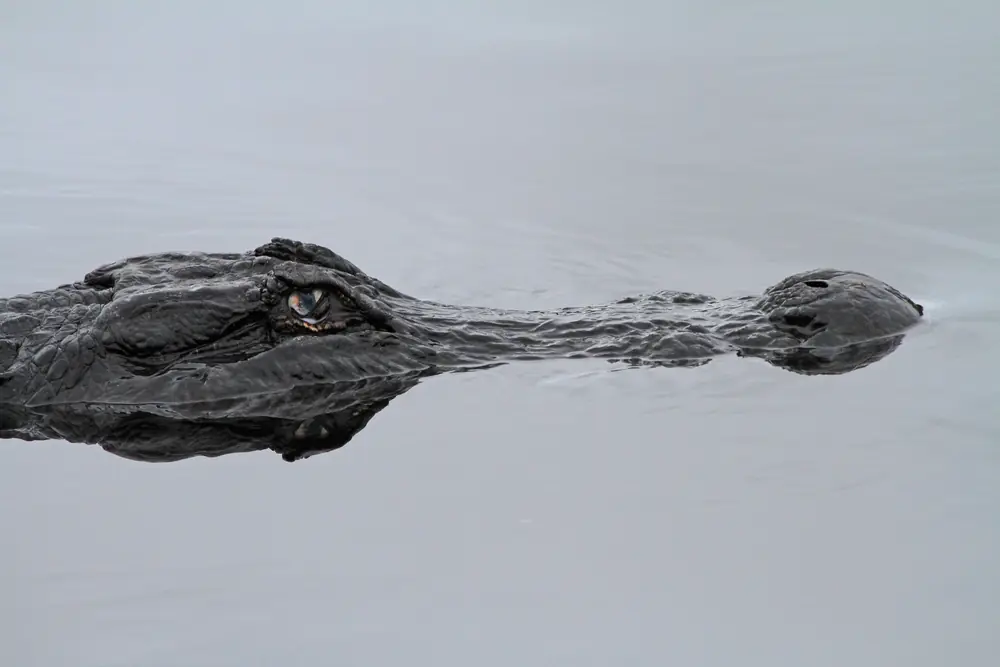
American alligators
Mating occurs in May or June; egg-laying in late June or early July (FWC) · Lakes, rivers, canals and marshes statewide
FWC says courtship begins in early April and that mating occurs in May or June. The female builds a mound nest of soil, vegetation or debris and lays her eggs, a few dozen, in late June or early July. Hatching follows in late August or early September. A large alligator near a path or a canal bank in May is not unusual. Give them room, never feed one, and keep dogs back from the water's edge.
-
Gopher tortoises
Eggs are laid from May through July; hatchlings usually emerge from August through November (FWC) · Dry sandy ground: scrub, sandhills, pine flatwoods, roadsides and yards
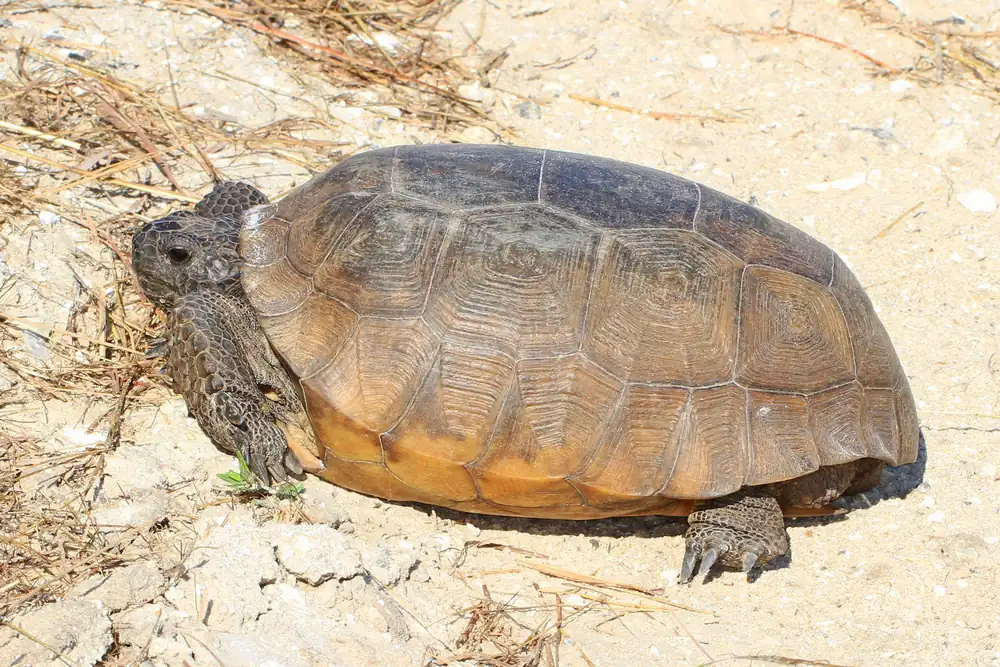
The state-threatened gopher tortoise nests in open, sunny spots, often in the sand mound at the burrow entrance. A female lays one clutch of 5 to 9 eggs, about the size of ping pong balls, and provides no care. Incubation takes 80 to 110 days. The burrows shelter more than 350 other species. Handling or relocating a tortoise is illegal without an FWC permit. If one is crossing a road and it is safe to help, FWC says you may move it across in the direction it was already heading, and no farther.
Most routine lawn care near a burrow needs no permit, as long as you do not collapse it or harm a tortoise.
Which young animals are out in Florida in May, and what should you do?
Spring births and fledging fill May with young animals that look lost and rarely are. Each of these is best enjoyed from a distance, with pets under control.
-
Key deer fawns
May and June are the peak fawning months; fawns are still born in July and August (U.S. Fish and Wildlife Service) · Big Pine Key and No Name Key, with deer across the lower Keys
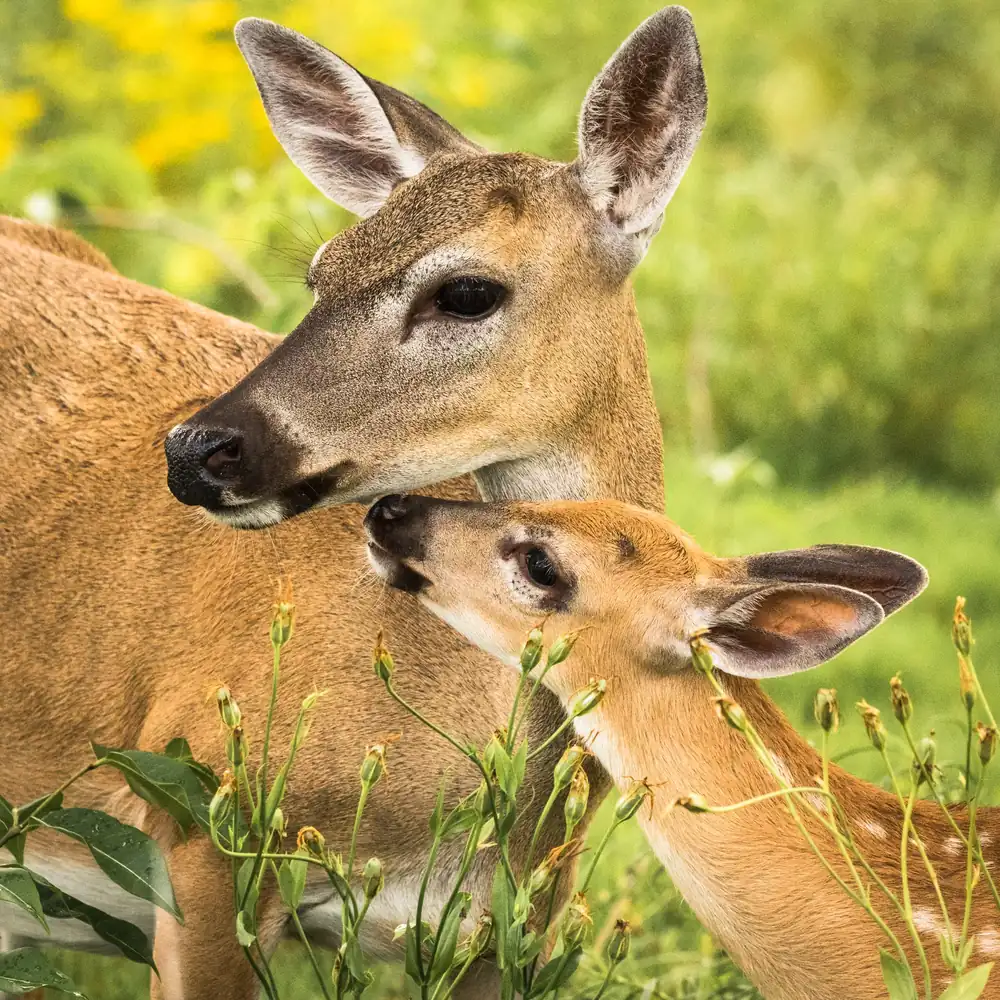
The refuge says fawns still have spots in May and June. The endangered Key deer, a small subspecies, lives mostly on Big Pine and No Name Keys. The refuge asks visitors not to feed them, because feeding has conditioned many deer to approach people, and to drive carefully from Big Pine Key west to Lower Sugarloaf Keys, especially at night. Report a dead or seriously injured deer to the FWC wildlife hotline, 888-404-FWCC (3922), option 1. The refuge's Nature Center on Big Pine Key is the place to start; check its hours.
-
Black bears with cubs
Spring and summer, when bears roam more for food · Forests, and neighborhoods near forests, wherever Florida black bears live
FWC says bears move more in spring, mothers teach cubs where to find food, and bears cross roadways more often. A mother with cubs is more likely to act defensively, especially if a dog is present. FWC's BearWise advice is to store garbage in a shed or garage until pickup morning, feed pets indoors, secure or remove bird feeders, clean grills, and never feed or approach a bear. About 250 bears are killed by vehicles in Florida each year, so slow down on rural roads at dawn and dusk. Before letting a dog out at night, flip the porch light and bang on the door.
-
Fledglings on the ground
Spring and summer · Backyards, parks and trails
Audubon says that wandering from the nest is exactly what healthy fledglings are supposed to do. A feathered, hopping bird is probably being watched by its parents, so the best help is to walk away. Intervene only if it is hurt, cannot stand or hop normally, has damp feathers when it has not rained, or is surrounded by flies; if a cat or foot traffic threatens it, set it in a nearby bush. Do not feed it.
-
Bat pups
Pups are usually born from mid-April through July and begin to fly at 3 to 6 weeks (FWC) · Palm fronds, bridges, buildings and bat houses
FWC says Florida has 13 resident bat species, and that all of them are insect eaters, taking beetles, mosquitoes, moths and other pests. The state's maternity season runs from April 16 through August 14, and during that time it is illegal to block bats from a roost, because flightless young can be trapped inside and die. Exclusion devices may be used only from August 15 through April 15. You can help by leaving dead palm fronds up, putting up a bat house, and reporting sick or dead bats at MyFWC.com/BatMortality.
-
Fireflies at dusk
Different species flash on different nights; UF/IFAS describes them as summer insects, so May may bring only a few · Woods, wetlands, grassy edges and mangroves
The University of Florida's Institute of Food and Agricultural Sciences (UF/IFAS) says 56 firefly species live in Florida. They appear at dusk or nightfall; some stay in treetops, some in shrubs and others over open grass, and one, the Florida intertidal firefly, lives in mangroves, salt marshes and tidal flats. Homeowners are asked to turn off outdoor lights, limit pesticides and let yard edges grow shrubby.
What is blooming in Florida in May?
The great wildflower months are behind most of the state, but May still has color, and one famous tree is just beginning.
-
Goldenmane tickseed
The Florida Wildflower Foundation's bloom report from another year said stands were starting to bloom and should continue well into May · Fields and roadsides from the Ocala area northward
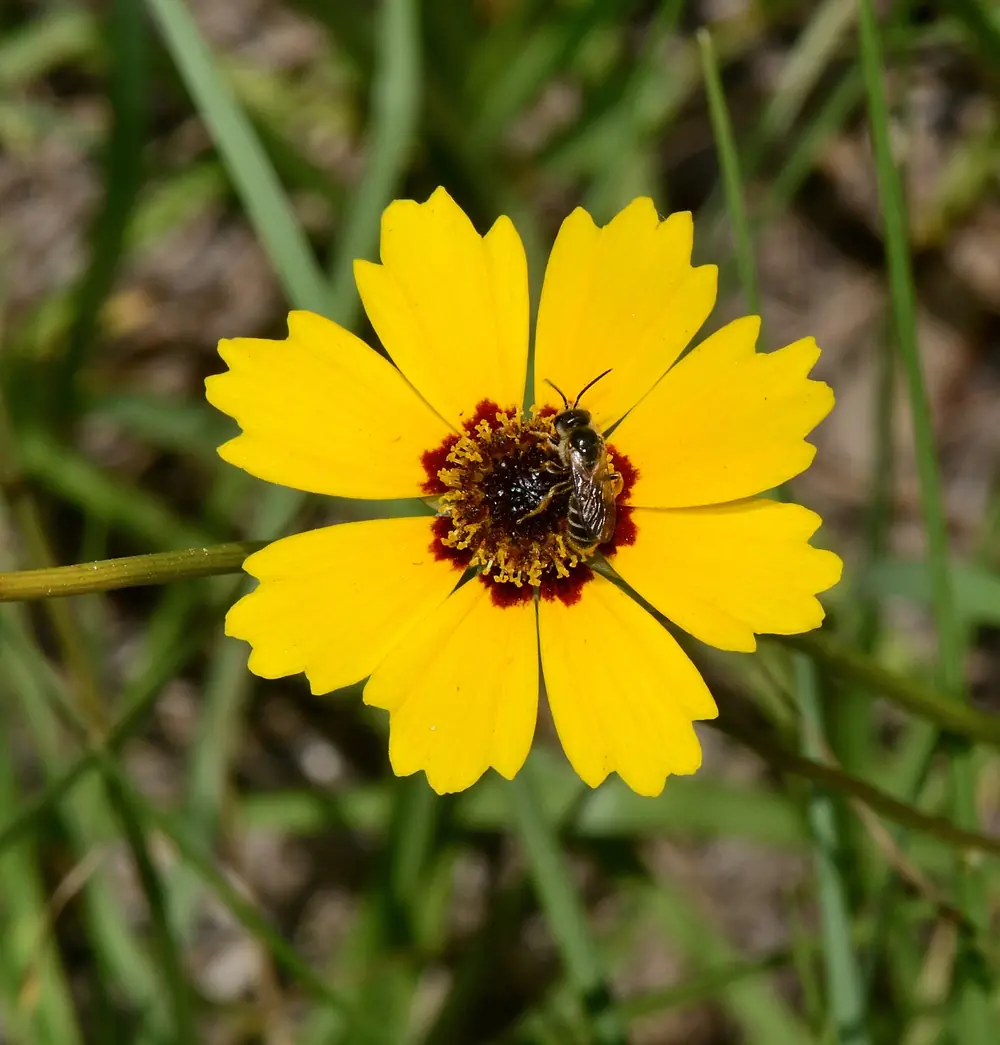
Goldenmane tickseed (Coreopsis basalis) is a yellow, daisy-like flower with a dark red center. The foundation's report describes large yellow stands in North Florida in a spring when the bloom ran into May. The timing is not a promise, because bloom dates shift with the weather.
-
Southern magnolia
The Florida Native Plant Society says it blooms late spring into summer · Upland hardwood forests and slope forests, mostly in North Florida, and in many yards
The Native Plant Society's plant page lists the southern magnolia as an evergreen that blooms from late spring into summer, with white flowers pollinated mainly by beetles. Squirrels, opossums and birds, including quail and turkey, eat and spread its fruit. Look for the blossoms among the glossy leaves, and for fallen petals on the ground below.
-
Hold off on the mower
Mid- to late May, when most spring species have stopped flowering · Lawns, ditches and roadsides
The foundation suggests waiting until mid- to late May, when most spring wildflowers have stopped blooming, before mowing, which keeps seed and nectar available for pollinators. Check with your county or neighborhood association first about any mowing rules.
Note the date of the first flower you see in your journal.
What is May weather like in Florida, and what are the hazards?
May is hot across Florida, but the humid, wet pattern of summer has barely started. The National Oceanic and Atmospheric Administration (NOAA) 1991 to 2020 normals put average highs from 85.1 °F at Pensacola to 88.4 °F at Orlando, and average lows from 62.6 °F at Gainesville to 76.4 °F at Key West. Miami leads the eight stations in rain with 6.32 inches, and Tampa trails at 2.60. Not one of the eight averages even a single night at or below 40 °F in May. Orlando averages 13.6 days with a high of 90 °F or hotter, Tallahassee 12.9 and Key West just 0.5.
Thunderstorms and lightning. The state agriculture department calls Florida the lightning capital of the United States. NWS Key West says areas of west central Florida have more thunderstorms per year, on average, than anywhere else in the country, and that lightning can strike up to 10 miles from rainfall. A hard-topped vehicle is far safer than being outside. Rubber tires and shoe soles offer no protection.
Wildfire. The state agriculture department's guidance says dry conditions, high temperatures and thunderstorms have the potential to spark wildfires, and that humans are the leading cause. Create defensible space around your house, burn yard waste only within the rules, and report smoke by calling 911 or your Florida Forest Service dispatch office.
Tropical weather. The Atlantic hurricane season runs from June 1 to November 30, according to the National Hurricane Center, so May is the month to check supplies, not to watch maps. NOAA issues its May outlook before the season starts (the 2026 one was issued on May 21), and says it is not a landfall forecast. The latest long-range outlooks are posted on the Climate Prediction Center site, and we do not summarize them here.
| Station | Average high | Average low | Rain | Days 90 °F or hotter |
|---|---|---|---|---|
| Pensacola | 85.1 | 66.9 | 3.90 | 3.5 |
| Tallahassee | 87.4 | 63.0 | 3.36 | 12.9 |
| Jacksonville | 85.9 | 63.9 | 3.42 | 8.4 |
| Gainesville | 87.4 | 62.6 | 3.08 | 11.4 |
| Orlando | 88.4 | 66.3 | 4.02 | 13.6 |
| Tampa | 88.3 | 70.6 | 2.60 | 9.6 |
| Miami | 86.7 | 73.4 | 6.32 | 6.0 |
| Key West | 85.9 | 76.4 | 3.12 | 0.5 |
Is there any chance of a freeze in Florida in May?
No. In the normals for every station in this table, by April 9 at the latest, nine springs in ten have seen their last freeze, and that date belongs to Crestview, in the western Panhandle. Tallahassee's late date is March 30, Gainesville's is March 23, and Jacksonville's is March 19. In Orlando and Tampa the late dates are in February, and the one-year-in-ten dates are in December. The eight stations in the weather table average zero nights at or below 32 °F in May.
For your own town, the frost-date finder has the dates.
| Station | One year in ten | Median | Nine years in ten |
|---|---|---|---|
| Crestview | Feb 26 | Mar 21 | Apr 9 |
| Tallahassee | Feb 18 | Mar 11 | Mar 30 |
| Pensacola | Jan 21 | Feb 14 | Mar 11 |
| Jacksonville | Jan 22 | Feb 25 | Mar 19 |
| Gainesville | Feb 1 | Mar 3 | Mar 23 |
| Orlando | Dec 30 | Jan 25 | Feb 26 |
| Tampa | Dec 27 | Jan 20 | Feb 10 |
Normals are long-run averages, not guarantees, but a freeze in May would be far outside anything these records describe.
How much longer are Florida's days by the end of May?
The gain keeps shrinking as the solstice approaches. Every city adds roughly half an hour of daylight over the month, 28 to 37 minutes depending on latitude, with the Panhandle gaining fastest, about 1.2 minutes a day, and Key West slowest, under a minute a day. By May 31, the Panhandle and north Florida have close to 14 hours of daylight. Clocks stay on daylight time all month, which does not change these figures. Sunrise and sunset times for your town are on the daylight page.
| City | May 1 | May 31 | Gained | Per day |
|---|---|---|---|---|
| Pensacola | 13 h 21 m | 13 h 58 m | 37 min | 1.2 min |
| Tallahassee | 13 h 21 m | 13 h 58 m | 37 min | 1.2 min |
| Jacksonville | 13 h 21 m | 13 h 57 m | 36 min | 1.2 min |
| Gainesville | 13 h 19 m | 13 h 54 m | 35 min | 1.2 min |
| Orlando | 13 h 16 m | 13 h 50 m | 34 min | 1.1 min |
| Tampa | 13 h 14 m | 13 h 47 m | 33 min | 1.1 min |
| Miami | 13 h 08 m | 13 h 38 m | 30 min | 1.0 min |
| Key West | 13 h 05 m | 13 h 33 m | 28 min | 0.9 min |
What can you see in the night sky over Florida in May 2027?
May brings an unusual full Moon, a meteor shower that suits southern latitudes, and the best evening look at Mercury of the year. Times below are Eastern daylight time unless noted, and the western Panhandle runs an hour behind.
-
The Eta Aquariid meteors
Peak night May 5 to 6 per the American Meteor Society, or May 6 to 7 per the Sea and Sky calendar; best before dawn on May 5, 6 and 7 · Look toward the east and up, away from lights
With the new Moon on May 6, no moonlight interferes, so the Sea and Sky calendar rates this an excellent year. The American Meteor Society expects medium rates of 10 to 30 meteors an hour from the equator northward, strongest from the southern tropics, which gives Florida's low latitude an edge over the northern states. The radiant, in Aquarius, climbs only late in the night, and rates fall off farther north, so head out well before dawn.
-
The Flower Moon, and a seasonal Blue Moon
Full on Thursday, May 20, at 6:59 a.m. EDT (5:59 a.m. CDT); best view the evening of Wednesday, May 19 · Rising in the east around sunset
Full comes just before sunrise on May 20, so the Moon appears full at moonrise on May 19 and again on May 20. In Miami it rises at 7:37 p.m. on May 19. Of the four full Moons in astronomical spring, this is the third, which the Sea and Sky calendar names a seasonal Blue Moon. By the modern calendar-month definition there is no Blue Moon in 2027.
-
Mercury in the evening
Greatest eastern elongation Friday, May 28, at 9:14 a.m. EDT; the evenings of May 27 and 28 are both close to best · Low in the west-northwest, 45 to 90 minutes after sunset
Mercury reaches about 23 degrees east of the Sun, its widest angle this time around, and, by our calculation for 40 degrees north, stays up 97 minutes after sunset on May 15. The window in which it is easy to find runs from about May 12 to June 5. A flat horizon over the Gulf or the Atlantic helps. Those timings were computed for the central U.S., so Florida's may differ by a few minutes.
-
Jupiter and Mars after dark
All month, in the western sky; the Moon passes near each · High in the southwest at dusk
By our calculation, Jupiter, in the evening sky all spring, is still up about seven hours after sunset on May 1; Mars goes down at about the same time, near 2 a.m. The Moon passes closest to Jupiter on May 12 (about 1.2 degrees apart, at 5:52 p.m. EDT, in daylight, per the same calculation), so the evening of May 12 shows a nearly first-quarter Moon beside the planet. On May 13 the Moon and Mars are roughly 3 degrees apart.
-
Venus and Saturn at dawn
Closest on Friday, May 7; the mornings of May 6 and 8 are about 1 degree apart · Very low in the east before sunrise
By our calculation Venus and Saturn pass 0.6 degrees apart on May 7, but half an hour before sunrise they sit barely above the east-southeast skyline. This is a hard sight that needs a flat eastern horizon and binoculars. Venus is far the brighter of the two.
-
A Milky Way window
May 1 to 14 and May 25 to 31, around the new Moon · A dark site with a clear southern horizon
The core of the Milky Way lies low in the south from the United States. These windows, computed for 40 degrees north, count the nights when the core is at least 10 degrees up, the sky is fully dark and the Moon is down. Florida, farther south, sees the core higher.
| Phase | Date | Time |
|---|---|---|
| New moon | Thursday, May 6 | 6:58 a.m. EDT (5:58 a.m. CDT) |
| First quarter | Thursday, May 13 | 12:44 a.m. EDT (11:44 p.m. CDT on Wednesday, May 12) |
| Full moon, the Flower Moon | Thursday, May 20 | 6:59 a.m. EDT (5:59 a.m. CDT) |
| Last quarter | Friday, May 28 | 9:58 a.m. EDT (8:58 a.m. CDT) |
Moonrise times for your town are on the moon page, and the cloud page can tell you whether a storm will spoil the view.
What can families do outdoors in Florida in May 2027?
- Join the City Nature Challenge. The organizers post two phases: photographing and recording from April 30 to May 3, and identifying what you found from May 4 to 16. Results come out May 20. Check whether your area is registered.
- Mark World Migratory Bird Day. The organizers' site shows the 2026 dates and has not posted a 2027 date, so check with them. Count the birds in one park.
- Become a frog listener. The Akron Zoo's FrogWatch USA trains volunteers to report calls on evenings from February through August.
- Log a nest. Anyone who finds one can report it through NestWatch, a project of Cornell's bird lab.
- Join a guided turtle program. Local nonprofit groups run turtle walks; check with them for dates.
- Watch for snail kites from a boardwalk. Paynes Prairie Preserve is one of FWC's listed places.
- Look for a gopher tortoise burrow. Note its apron and leave it alone.
- Keep the porch light off. It helps fireflies, bats, and turtles alike.
- Watch the Eta Aquariids in the pre-dawn dark of May 5, 6 or 7, and the rise of the Flower Moon on May 19.
Safety notes for May in Florida
- Spring turkey season is over. FWC's season-dates page shows the 2027 spring season ending April 11 south of State Road 70 and April 25 north of it, and no other deer, turkey, quail, bobcat or otter season overlaps May. Gray squirrels, rabbits, wild hogs and a few other species may be taken year round. Individual management areas may hold hog hunts; FWC's hunt calendar for DuPuis lists a wild hog (still) season from May 8 to 16, 2027, so check the calendar for any area before you hike.
- Snook. FWC closes recreational snook harvest on May 1 in all six Gulf coast regions: Panhandle, Big Bend, Tampa Bay and Sarasota Bay reopen September 1, and Charlotte Harbor and the Southwest region reopen October 1. The Atlantic regions stay open through May 31 and close June 1. A snook permit and a fishing license are required, and the daily limit is one fish per person.
- Lightning. Move indoors at the first thunder. Lightning kills about 20 people in the United States each year, according to the National Weather Service.
- Rip currents. The National Weather Service warns that a calm, sunny beach can still have rip currents. Choose a lifeguarded beach and ask the guard about conditions before you wade in.
- Mosquitoes. Florida health officials urge residents to protect themselves as the weather gets hotter and wetter: wear shoes, socks, long pants and long sleeves, use repellent as directed, and empty and clean birdbaths and pet bowls at least twice a week.
- Alligators, bears, tortoises and fawns. Give every animal room, keep pets leashed, and never feed any of them.
Sources (38)
- FWC: leatherback sea turtle (nesting late February, peak May, 59 to 75 days)
- FWC: sea turtle FAQ (two-month incubation, hatchlings leave at night)
- FWC news release: share the shore with sea turtles and shorebirds (Memorial Day advice)
- National Weather Service Miami: duration of the summer season in South Florida
- National Weather Service Tampa Bay: Florida thunderstorm season
- National Park Service: the wet season in Everglades National Park
- FWC: Everglade snail kite (peak nesting March through June, 500 feet)
- FWC: American alligator (mating May or June, nesting)
- FWC: gopher tortoise (eggs May through July, permits)
- U.S. Fish and Wildlife Service: National Key Deer Refuge (fawning season)
- FWC news release: BearWise tips for spring
- Audubon: when you should and should not rescue baby birds
- FWC news release: bat maternity season and exclusion dates
- FWC: bats of Florida (13 resident species, pups mid-April through July)
- UF/IFAS Gardening Solutions: fireflies (56 Florida species)
- Florida Wildflower Foundation: 2023 spring bloom report (goldenmane tickseed, mowing)
- Florida Native Plant Society: southern magnolia (blooms late spring into summer)
- NOAA NCEI: 1991–2020 monthly normals for eight Florida stations (data API)
- National Weather Service Key West: thunderstorm hazards (thunderstorm counts, lightning)
- National Weather Service: lightning safety (about 20 deaths a year)
- National Weather Service: rip currents
- Florida Department of Agriculture and Consumer Services: be wildfire ready (lightning capital)
- National Hurricane Center: climatology (season June 1 to November 30)
- Climate Prediction Center: May 2026 Atlantic hurricane outlook (issue date, not a landfall forecast)
- Climate Prediction Center: seasonal outlooks
- Florida Department of Health in Miami-Dade County: fight the bite (mosquito tips)
- FWC: species season dates and bag limits (spring turkey, year-round species)
- FWC: DuPuis wildlife management area hunt calendar
- FWC: snook (regions, closures, slot, permit)
- FWC news release: snook harvest closes May 1 on the west coast
- U.S. Naval Observatory: moon phases, 2027 (data API)
- Sea and Sky: astronomy calendar 2027 (Eta Aquariids, Flower Moon, Mercury)
- American Meteor Society: meteor shower calendar (Eta Aquariids 2027)
- City Nature Challenge (2027 dates)
- World Migratory Bird Day (organizers' site; 2026 dates)
- FrogWatch USA (Akron Zoo): volunteers listen February through August
- NestWatch (Cornell Lab of Ornithology)
- Photos via Wikimedia Commons; licenses and photographers are credited under each picture