What to look for in nature in Florida this November
Florida's winter residents check in during November. The first real cold fronts push manatees out of the cooling bays and into warm springs and power-plant canals, right whale mothers swim down the Atlantic coast to give birth, bald eagles settle onto eggs, and flocks of sandhill cranes from the Great Lakes drop onto the prairies. Hurricane season closes on November 30, the dry season takes hold, and the Panhandle may see its first frost. Here is what to look for this month, region by region, with dates and sources.
Other months in Florida: October, December.
Start here
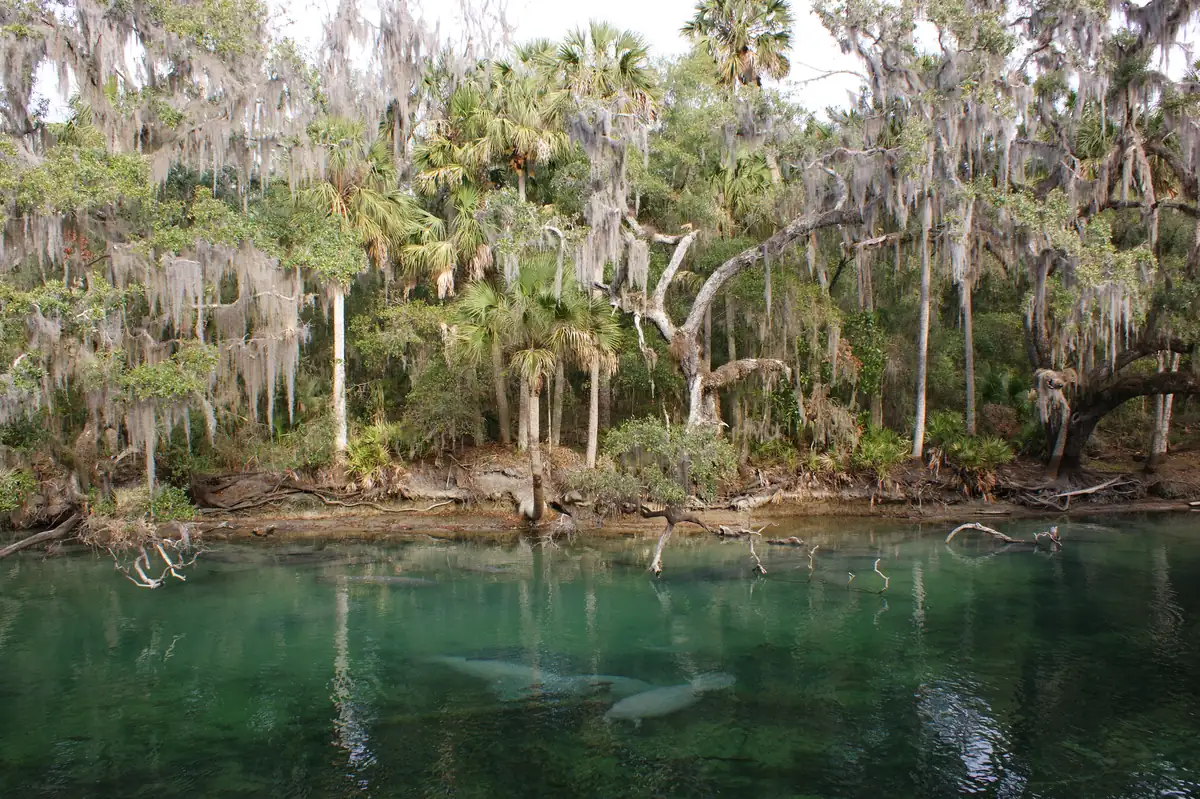
- Manatees head for warm water. When a November front chills Florida's bays, manatees gather by the dozens and then hundreds at springs and power-plant outflows. Tampa Electric's free Manatee Viewing Center at Apollo Beach reopens November 1, and Crystal River refuge starts its daily Three Sisters Springs programs on November 15, which is also when many seasonal slow-speed manatee zones take effect.
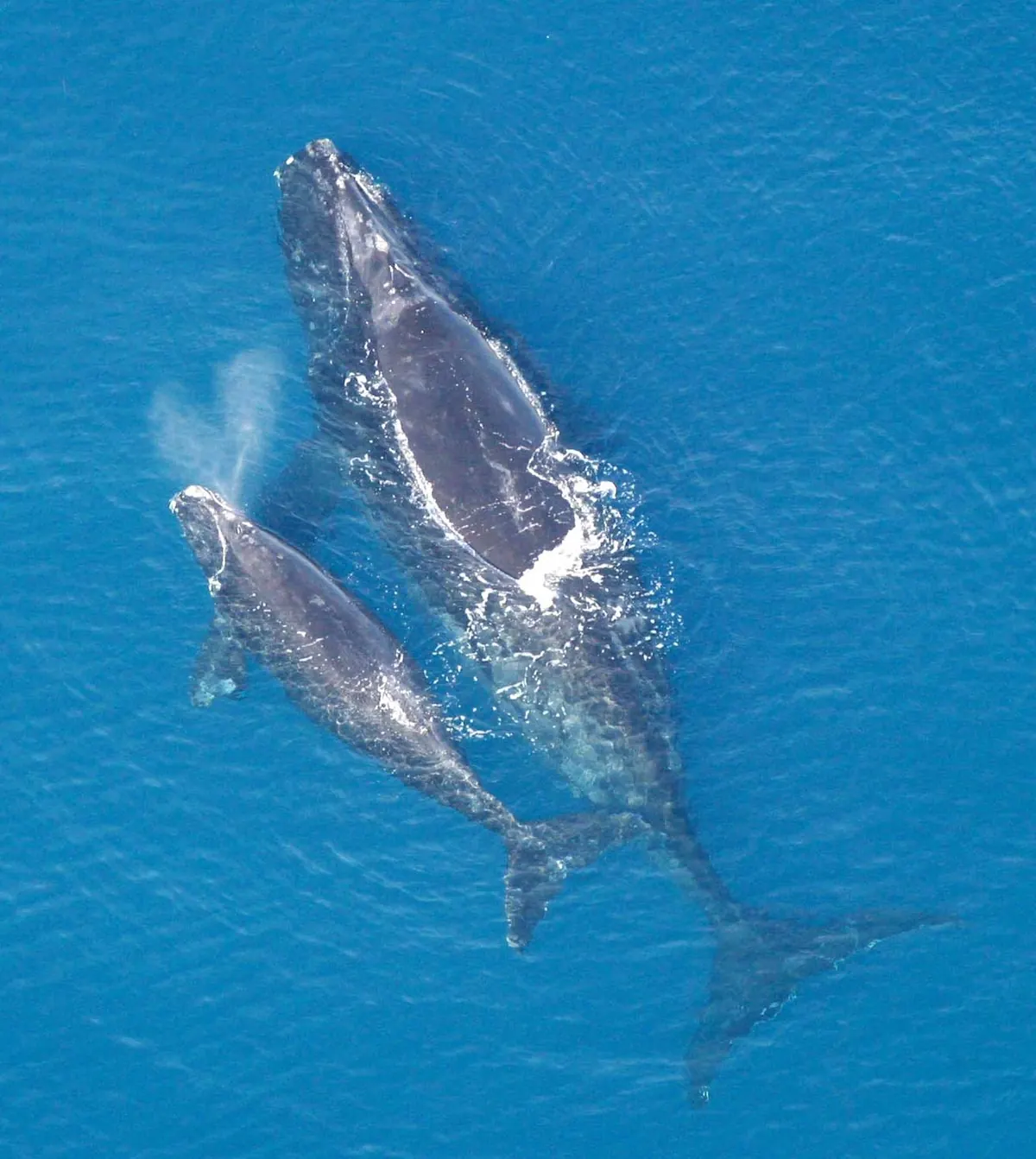
- Right whales return to calve. North Atlantic right whales give birth off the Southeast coast from mid-November to mid-April. Last season produced 23 calves, the most since 2009. The free Right Whale Festival fills Main Beach Park in Fernandina Beach on November 7 and 8.
- Mars and Jupiter side by side. Before dawn on November 15 and 16, Mars sits just over a degree from Jupiter, high in the southeastern sky over Florida. Venus is blazing lower in the east, close to its brightest of the year, and Mercury joins them low in the dawn from about November 18.
For the journal this month: the mammal watch plate for a morning of manatee counts at the spring, the same-place-twice pages for one cypress pond on November 1 and again on November 30, and a feather-found page for whatever the cranes leave on the prairie. Add a line to the daily field log on the morning after each cold front.
Regions used below: Panhandle; North Florida; Central Florida; Southwest Florida; Southeast Florida; The Keys.
When do manatees gather in Florida's springs and warm-water canals?
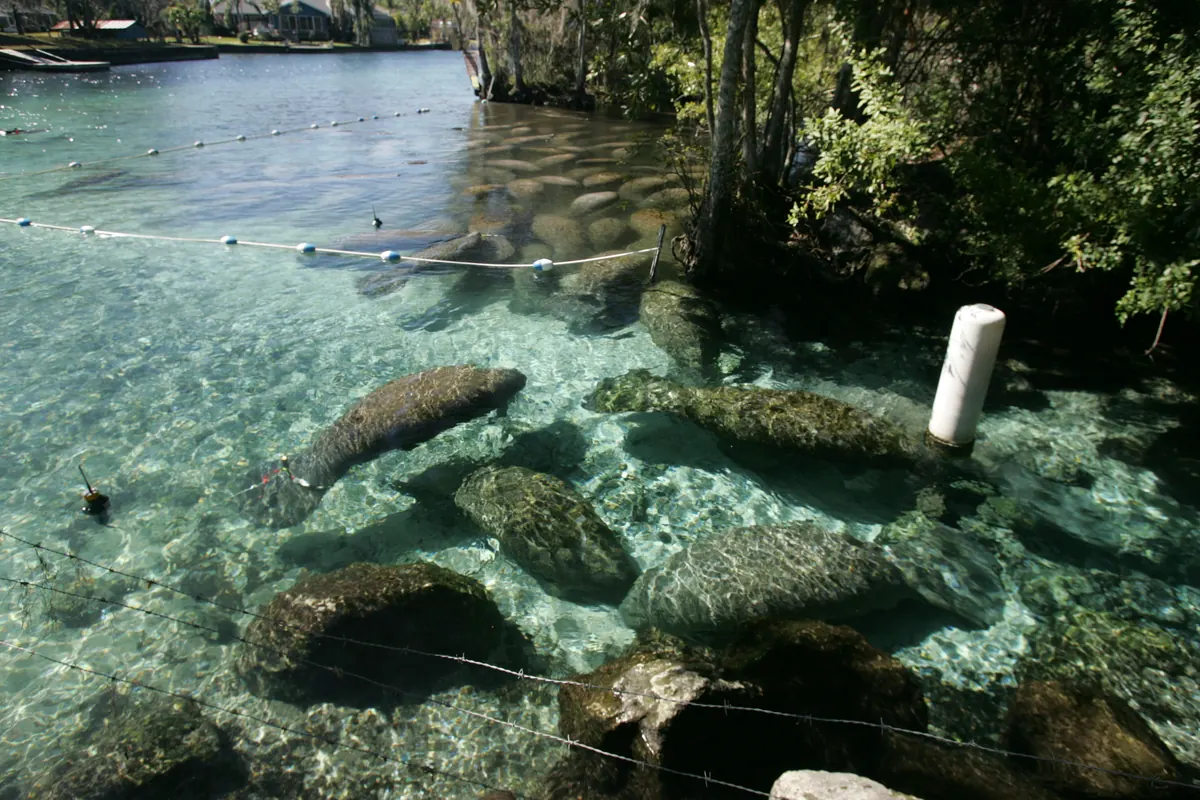
Florida's manatees, at least 8,350 of them by the FWC's count, spread out across rivers, bays and canals through the warm months. As the water cools in November they come together at the few places that stay warm all winter: the big artesian springs, which flow at nearly the same temperature year round, and the outflow canals of coastal power plants. A manatee left too long in cold water can suffer cold stress, which can kill it, so these sites matter far more than their size suggests.
The move happens fast, and it follows the fronts. At Blue Spring State Park on the St. Johns River in 2024, Save the Manatee Club researchers watched a mid-November front lift the count from 9 manatees on a Thursday to 43 on Friday, 130 on Saturday and more than 300 by Sunday, November 24, with the water at 69 °F. Numbers keep building into the coldest weeks: during a hard freeze in early February 2026, with overnight lows of 23 °F, the club tallied 859 manatees at Blue Spring in a single day, which it called a record count. The FWC's list of public viewing sites runs from the Panhandle to Palm Beach County:
| Site | Region | Warm water | What to know |
|---|---|---|---|
| Wakulla Springs State Park, south of Tallahassee | Panhandle | Spring | Watch from the diving platform or the river boat tours; park and boat fees |
| Manatee Springs State Park, Chiefland; Fanning Springs State Park | North Florida (Suwannee River) | Springs | Look in the spring and spring run in winter; entrance fees |
| Three Sisters Springs, Crystal River National Wildlife Refuge | Central Florida (Gulf side, Kings Bay) | Springs | Daily programs November 15 to March 31; boardwalk viewing on a limited schedule |
| Blue Spring State Park, Orange City | Central Florida (St. Johns River) | Spring run | Seasonal manatee programs while the animals are in the run; entrance fee |
| Manatee Viewing Center, Apollo Beach | Tampa Bay | Power-plant discharge canal | Free; open daily November 1 to April 15, 10 a.m. to 5 p.m. |
| Lee County Manatee Park, Fort Myers | Southwest Florida | Power-plant discharge canal on the Orange River | Hundreds visit in winter; parking fee; gates close at sunset |
| Manatee Lagoon, Riviera Beach | Southeast Florida (Lake Worth Lagoon) | Power-plant outflow | Free observation deck and education center |
| Haulover Canal, Merritt Island National Wildlife Refuge | Space Coast | Canal between the Indian River and Mosquito Lagoon | Viewing platform; entrance fee |
The best visit is the first cold, clear morning after a front, when the animals lie in rows along the bottom and their breath shows as small swirls at the surface. Save the Manatee Club streams its underwater cameras at Blue Spring on ManaTV.org, so you can check before you drive. Blue Spring closes its spring run to swimmers and boats for the manatee season beginning in mid-November; confirm the date with the park. On the water, look for the "Slow Speed, Manatee Area, November 15th to March 31st" signs that mark seasonal protection zones, and report an injured or dead manatee to the FWC at 888-404-3922.
When do right whales come to Florida to give birth?
The shallow coastal waters off Florida, Georgia and the Carolinas are the only place North Atlantic right whales are known to calve. NOAA Fisheries dates the calving season from mid-November to mid-April, so the first mothers can show up off northeast Florida this month after swimming down from New England and Canada. It is one of the rarest large animals on Earth: NOAA puts the population at about 380, roughly 20 more than in 2020 after three years of slow growth.
The 2026 season gave reason for hope. Survey teams documented 23 calves, the highest total since 2009, and 20 of their mothers had calved before. One pair wandered far off the usual route, around the peninsula and into the Gulf, and was last confirmed on February 4, 2026, near Key West National Wildlife Refuge.
-
How to spot one
Mid-November through mid-April · Close to the beach along the northeast coast; high dunes, piers and condo balconies
Right whales have no dorsal fin, so look for a broad black back rolling at the surface and a V-shaped blow, often within a mile or two of shore. A mother and calf may rest at the surface for long periods. Report any sighting to the Southeast right whale hotline, 877-942-5343; survey teams use the calls to find and identify new pairs.
-
Give them room
Always · Boats, kayaks, paddleboards, surfboards and drones
Federal rules require boats, aircraft and drones, and also people on surfboards, kayaks and personal watercraft, to stay at least 500 yards from a right whale, and to leave slowly if they find themselves closer. Large vessels 65 feet and longer must hold to 10 knots or less in seasonal management areas along the East Coast. Collisions and fishing gear entanglement are the two biggest threats to the species.
-
The Right Whale Festival
Saturday and Sunday, November 7 and 8, 2026 · Main Beach Park, 32 N. Fletcher Ave., Fernandina Beach
Free admission, 10 a.m. to 6 p.m. on Saturday and 10 a.m. to 3 p.m. on Sunday, with exhibits on right whale conservation, live music, art and food trucks. Keep watching the ocean between exhibits.
When do Florida's bald eagles lay their eggs?
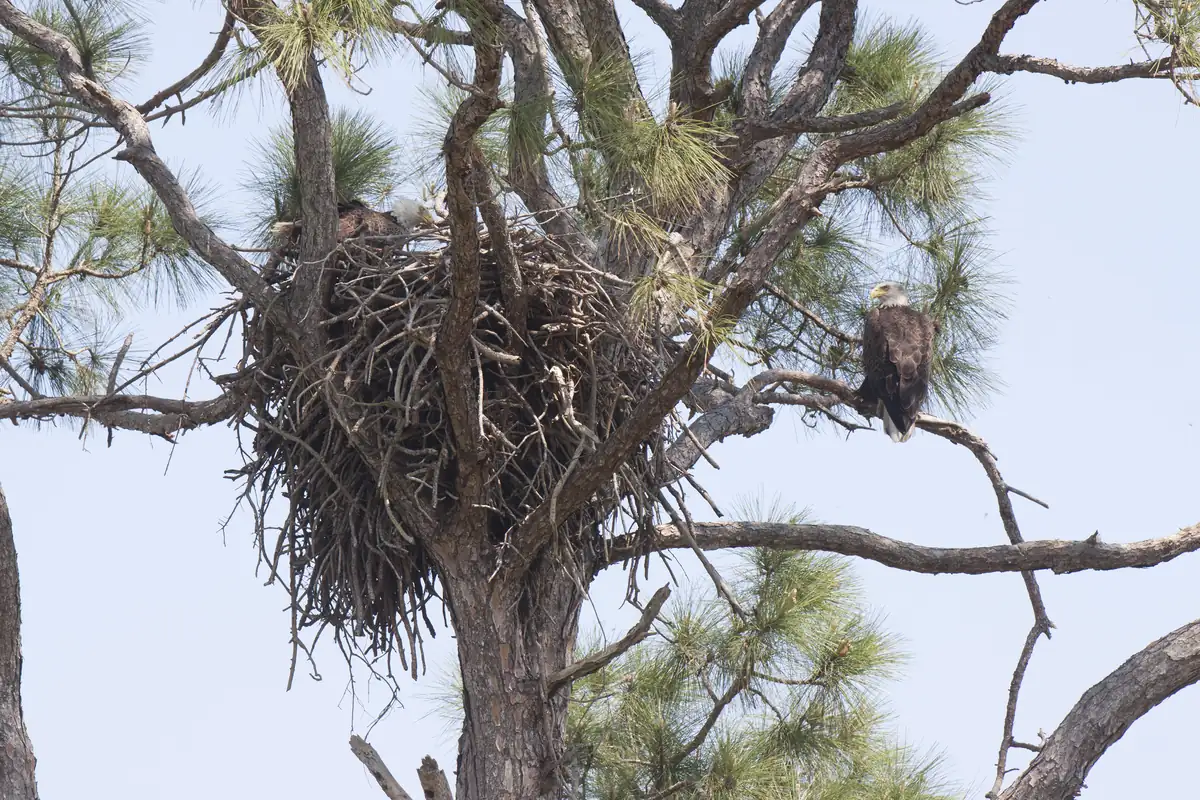
Bald eagles in Florida nest in the cool half of the year, which turns the northern calendar upside down. The FWC defines the state's eagle nesting season as October 1 to May 15. Eggs can appear any time from October to April, but most clutches are laid between December and early January, so November is when many of the roughly 1,500 nesting pairs are rebuilding nests in tall pines and a few early pairs are already sitting. Incubation takes about 35 days, and the young first fly at around 11 weeks.
The easiest nest to watch is the Southwest Florida Eagle Cam in North Fort Myers, which goes live each season on October 1, the first day of nesting season. The resident pair, known to viewers as M15 and F23, laid early in each of the last two seasons: the first egg came on November 8 in 2024 and in mid-November in 2025. The cam's founder says eggs there usually arrive on or just before Thanksgiving. Both adults recovered from avian influenza in early 2025, although the two eaglets of that season died.
-
Eagles arriving from the north
Through late December · Lakes, rivers, coasts and landfills statewide
Many of Florida's adult eagles stay year round, but young birds and non-breeders leave in spring and summer. The FWC says they drift north between April and August and come south again from late July through late December, so the number of eagles in the state keeps climbing this month.
-
Watch from a distance
All season · Any active nest
An eagle that flushes from its eggs on a cool morning leaves them exposed, so use binoculars or a spotting scope, stay well back and leave if the birds call or fly. Audubon's Center for Birds of Prey in Maitland runs EagleWatch, whose volunteers monitor nests around the state and welcome reports of new ones.
Which winter birds arrive in Florida in November?
-
Sandhill cranes from the Great Lakes
Migrants arrive in November and December and leave in March and April · Paynes Prairie near Gainesville, the Kissimmee prairies, pastures across the peninsula
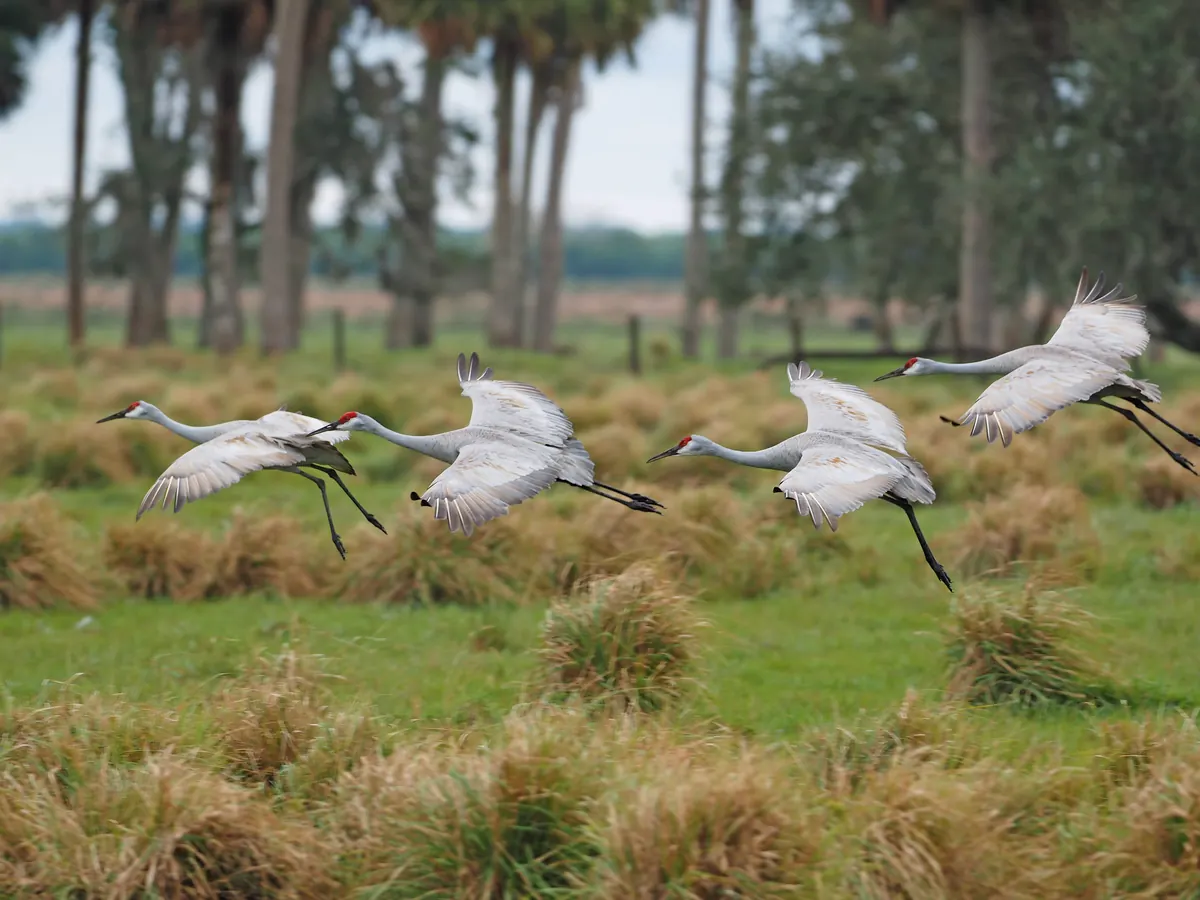
Florida's own sandhill cranes, 4,000 to 5,000 birds, stay put all year. In November about 25,000 migratory greater sandhill cranes begin to join them, roughly doubling the number in the state. At Paynes Prairie Preserve State Park the visitors stay from November into March, and the La Chua Trail runs out into their wet prairie; the Great Florida Birding and Wildlife Trail notes that whooping cranes are sometimes present there in winter as well. Listen for the rolling calls of flocks passing high overhead on clear mornings after a front.
-
Ducks on the refuges
Numbers build after each front · Merritt Island, St. Marks, Lake Apopka
Most of Florida's wintering ducks come in with the November cold fronts. At Merritt Island National Wildlife Refuge the 7-mile Black Point Wildlife Drive is at its best in fall and winter; drive it slowly and scan the impoundments. At St. Marks the lighthouse pond holds wintering ducks, canvasbacks among them, and red-throated loons turn up offshore every year. Near Orlando, the free 11-mile Lake Apopka Wildlife Drive is open from sunrise to sunset on Fridays, Saturdays, Sundays and federal holidays, which this month include Veterans Day, Wednesday, November 11, and Thanksgiving; more than 250 species have been recorded along it, soras among the winter birds.
-
Tree swallows over the marshes
Late fall through winter · Coastal marshes and the wax myrtle thickets beside them
Tree swallows spend the winter in Florida in big wheeling flocks over marshes and dunes. They are the one swallow that can live on fruit when insects are scarce, and Audubon notes that berries, mostly bayberries, can make up a fifth of the year's diet, eaten mostly in winter. In Florida that usually means wax myrtle, a bayberry, so a fruiting thicket near a marsh is the place to stand.
-
Painted buntings at the feeder
Fall through early spring · Brushy edges, gardens and feeders, especially near the coasts
The male painted bunting, blue, green and red, is the bird Florida backyard birders hope for in winter; Audubon says lucky Floridians may get one at the feeder. The visitor center feeders at Merritt Island are a reliable place to see them. They are also in trouble: the FWC reports that Florida breeding and winter surveys show the population falling 4 to 6 percent a year. Project FeederWatch opens its 2026–27 season on November 1, and a Florida feeder list with buntings on it is useful data.
What are bears, alligators and panthers doing in November?
-
Black bears, still eating
All month · Ocala, Apalachicola, Osceola, Big Cypress and the neighborhoods beside them
Florida's roughly 4,050 black bears keep feeding hard into late fall, and about 80 percent of what they eat is plant food: acorns, saw palmetto fruit and other nuts and berries. A big male weighs 250 to 350 pounds, a female 130 to 180. With the acorn crop on the ground, bears that find unsecured trash or bird seed near homes return to it, so lock garbage away until collection morning and take feeders in at night. Watch road shoulders at dusk, when bears cross.
-
Alligators slow down
After each cold front · Lakes, canals and marshes statewide
Alligators run on outside heat. The FWC says they quit feeding once air temperatures fall below about 70 °F and become dormant below about 55 °F, sheltering in dens dug into banks beside the water. In November that means quiet days after a front and gators hauled out in the sun on the first warm afternoon that follows.
-
Florida panthers
All year · Mostly south of Lake Okeechobee: Big Cypress, Fakahatchee, Florida Panther refuge
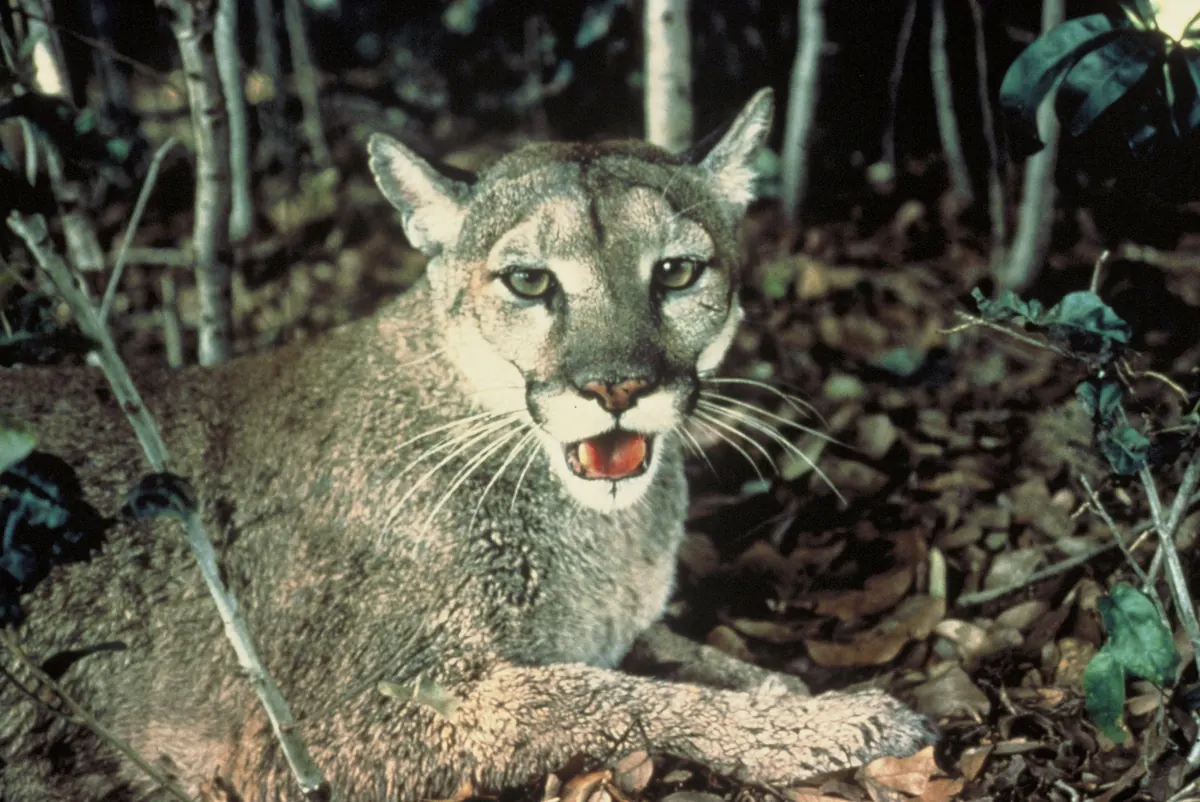
Between 120 and 230 adult panthers survive in Florida, most of them south of Lake Okeechobee, and collisions with cars and trucks are among the biggest threats they face. Slow down after dark on roads through Collier, Hendry and Lee counties, and report a sighting or a dead panther to the FWC at 888-404-3922 or through its online panther sightings form. The Florida Panther Festival is at Naples Zoo on Saturday, November 7, 9 a.m. to 1 p.m.; Collier County residents get in free that day.
Is hurricane season over, and what will a strong El Niño mean for Florida's winter?
The Atlantic hurricane season officially ends on November 30, and November landfalls are rare. On the Hurricane Research Division's record of U.S. landfalls back to 1851, only two November hurricanes hit Florida: a Category 2 on the southeast coast in 1935 and Kate, a Category 2 in the Panhandle in 1985. Nicole's center also reached the Atlantic coast in November 2022, but the record lists only tropical storm winds on land. Late-season storms still form now and then, so keep an eye on the National Hurricane Center until the end of the month.
The bigger change is the arrival of the dry season. Everglades National Park dates it from about December to mid-May, with lows in the 50s, highs in the 70s and low humidity, and November is the transition: the afternoon thunderstorms are gone, and each front brings a few days of crisp, clear air. In NOAA's 1991–2020 normals November brings only 1.40 inches of rain to Tampa and 1.79 to Orlando, though the Atlantic coast stays wetter, with 3.53 inches at Miami.
This winter may break that pattern. The Pacific is heading for a very strong El Niño, one the Climate Prediction Center's September 10 discussion gave better than nine-in-ten odds of lasting through Florida's dry months. For Florida, a strong El Niño tilts the dry season wet and stormy. The Tallahassee weather office counts an average of 20 tornado events a year in Florida in strong El Niño years, and notes a lower wildfire risk in El Niño conditions. The record holder is 1997–98: NOAA's climate center found that Florida's December-through-February rainfall that winter came to 19.28 inches, 222 percent of normal and the wettest on record at the time, with 15.57 inches in Tampa in December 1997 alone, and on the night of February 22–23, 1998, tornadoes across central Florida killed 42 people. Every El Niño plays out differently, and Florida forecasters caution that no single tornado outbreak can be pinned on one. NOAA's official winter outlook is due October 15 and will appear on the Climate Prediction Center's seasonal outlooks page, and our weather page will track Florida's winter as it unfolds.
Which parts of Florida usually see a freeze by the end of November?
Only one station below normally freezes during November: Tallahassee, where half of years have reached 32 °F by November 21 and one year in ten by November 3. Pensacola, Jacksonville and Gainesville have their one-in-ten dates in the middle of the month (November 15, 17 and 10), so a freeze there by Thanksgiving happens but is the exception; their medians fall in early December. Orlando and Tampa normally wait until January, while Miami and Key West have no 32 °F date in the normals at all, so Miami's row shows 36 °F, the point where tender tropical plants start to suffer.
| Station | One year in ten | Median | Nine years in ten |
|---|---|---|---|
| Pensacola | Nov 15 | Dec 9 | Jan 12 |
| Tallahassee | Nov 3 | Nov 21 | Dec 14 |
| Jacksonville | Nov 17 | Dec 7 | Jan 10 |
| Gainesville | Nov 10 | Dec 4 | Jan 6 |
| Orlando | Dec 18 | Jan 9 | Feb 6 |
| Tampa | Dec 23 | Jan 12 | Feb 5 |
| Miami (36 °F, not 32) | Dec 22 | Jan 7 | Jan 27 |
| Key West | No date | No date | No date |
Look up your own town on our Florida frost dates page. When a freeze is forecast, UF/IFAS advises watering small citrus trees thoroughly at least a day ahead and using covers that reach all the way to the ground. Cool-season vegetables, broccoli, cabbage, kale and lettuce among them, go in now in North and Central Florida, and irrigation systems can be turned off and run only as needed. UF/IFAS also suggests piling garden trimmings into a small brush pile at the back of the yard for wintering birds.
How early does it get dark in Florida in November?
Daylight saving time ends early Sunday, November 1, and Orlando's sunset that evening is at 5:40 p.m. By the end of the month it sets at 5:28, and in Pensacola, on Central time, at 4:48 p.m. Florida's earliest sunsets of the whole year come not at the winter solstice but around Thanksgiving and the first days of December: Miami's earliest is 5:29 p.m. on November 29, and its sunsets stay within that same minute from November 25 to December 4. After that the evenings slowly lengthen even as mornings keep getting darker into January. Day length keeps shrinking all month, by 37 minutes in the Panhandle and 29 minutes in Key West, a little over a minute a day:
| City | Nov 1 | Nov 30 | Lost | Per day |
|---|---|---|---|---|
| Pensacola | 10 h 58 m | 10 h 21 m | 37 min | 1.3 min |
| Tallahassee | 10 h 57 m | 10 h 20 m | 37 min | 1.3 min |
| Jacksonville | 10 h 58 m | 10 h 21 m | 37 min | 1.3 min |
| Gainesville | 11 h 00 m | 10 h 24 m | 36 min | 1.2 min |
| Orlando | 11 h 03 m | 10 h 28 m | 35 min | 1.2 min |
| Tampa | 11 h 04 m | 10 h 31 m | 33 min | 1.1 min |
| Miami | 11 h 10 m | 10 h 39 m | 31 min | 1.1 min |
| Key West | 11 h 13 m | 10 h 44 m | 29 min | 1.0 min |
Our Field almanac works for any spot from Pensacola to Key West: enter an address for its sun times, twilight and weekly change.
What can you see in Florida's night sky in November?
-
Mars beside Jupiter
Before dawn on Sunday, November 15, and Monday, November 16 · High in the southeast, in Leo
Jupiter, the brighter of the two, and reddish Mars pass about 1.2 degrees apart, closest on the evening of the 15th, when both are below the horizon, so the mornings either side are the time to look. Both rise around midnight this month and stand high by first light. Earlier, at dawn on November 2, the nearly half-lit Moon sits about 2 degrees from Mars with Jupiter a few degrees off.
-
Venus at its most brilliant
Every morning; brightest around November 24 to 27 · Low in the east-southeast before sunrise, climbing higher each week
After slipping between Earth and the sun around October 24, Venus climbs quickly into Florida's dawn sky, shining at magnitude −4.9 around Thanksgiving week. At dawn on November 9, Spica, Virgo's leading star, sits roughly one degree from it. Mercury has its best morning appearance around November 20; try roughly the 18th to the 25th, low in the east-southeast and well beneath Venus.
-
The Leonids
Best before dawn on Wednesday, November 18 · Anywhere dark; the radiant in Leo rises around midnight
Active from November 6 to 30, the Leonids crest on November 17; from a dark Florida site expect perhaps 15 an hour, and forecasters see no outburst in 2026. From Jacksonville to the Keys, the first-quarter Moon drops out of the sky around 12:30 a.m., which leaves Wednesday’s predawn sky, with Leo standing high in the southeast, as the Florida window. Big Cypress and the Kissimmee Prairie have some of Florida's darkest skies.
-
Taurid fireballs
Southern Taurids peak around November 5; Northern Taurids around November 12 · Most of the night, in the east and overhead
The Taurids are thin, five to ten an hour at best, yet slow, and every so often one lights up as a fireball; with the November 9 new moon between their two peaks, moonlight is no problem. They are debris from Comet Encke, which itself begins to brighten again in December.
-
The Beaver supermoon
Full at 9:53 a.m. EST on Tuesday, November 24 · Rising in the east around sunset on the 23rd and 24th
November's full moon falls about 30 hours before the Moon's closest approach of the month, enough for it to count as a modest supermoon. Toward dawn on Tuesday the 24th it passes very close to the Pleiades star cluster, covering some of its stars as seen from parts of the globe, though the cluster's faint stars mostly vanish in the glare. There are no eclipses this month.
-
Saturn and Uranus in the evening
All month; Uranus at opposition November 25 · Saturn in the south after dusk; Uranus in Taurus near the Pleiades
After dusk, look south for Saturn, a steady yellowish point among the dim stars of Pisces and the lone bright planet of Florida's November evenings. Uranus, at opposition on November 25, stays above the horizon from dusk to dawn; binoculars and a chart show it as a small greenish disk close to the Pleiades.
| Phase | Date | Time |
|---|---|---|
| Last quarter | Sunday, Nov 1 | 3:28 p.m. EST |
| New moon | Monday, Nov 9 | 2:02 a.m. EST (1:02 a.m. CST) |
| First quarter | Tuesday, Nov 17 | 6:48 a.m. EST |
| Full moon, the Beaver Moon | Tuesday, Nov 24 | 9:53 a.m. EST (8:53 a.m. CST); looks full the evenings of Nov 23 and 24 |
| Last quarter | Tuesday, Dec 1 | 1:08 a.m. EST (12:08 a.m. CST) |
Moon times for Tallahassee, Tampa, Miami or anywhere else in the state are on the moon phases page, and tonight's cloud forecast for your town is on Today's sky.
What changes color, blooms and fruits in Florida in November?
-
Bald cypress turns
November in North Florida; later down the peninsula · River swamps, lake edges and cypress domes
Florida's best fall color is in the swamps. The Florida Native Plant Society lists bald cypress for its fall color: the feathery needles turn orange-brown before they drop, and a cypress dome seen from a trail or a canoe can glow for a couple of weeks.
-
Red maple and sweetgum
Late fall · Wet woods, swamp edges, yards in North Florida
Red maple and sweetgum are the other two native trees the society notes for fall color. The maple also puts on a second show soon after: tiny red flowers in January, then bright red winged seeds.
-
Climbing aster
Late summer well into fall; through the winter in South Florida · Pond edges, ditches and wet thickets
Climbing aster scrambles up to 10 feet over shrubs at the water's edge and covers itself in pink to lavender daisies just as most other wildflowers quit. In South Florida it keeps flowering through the winter, so watch it for late butterflies and bees.
-
Holly berries
Ripe in fall, holding into winter · Hammocks, coastal scrub, swamp edges and yards
Yaupon and dahoon hollies, both native evergreens, carry red berries that ripen in fall and hang on into winter, food for wintering birds once insects grow scarce. Only the female plants bear fruit.
What can families do outdoors in Florida this November?
- Start a FeederWatch count on November 1. Pick two back-to-back days, up to once a week, and note the biggest group of each kind you see together.
- Visit Tampa Electric's Manatee Viewing Center at Apollo Beach (open daily from November 1; no charge), and go back after the first big cold front to see how the numbers change.
- Go to the Right Whale Festival in Fernandina Beach, November 7–8, or the Florida Panther Festival at Naples Zoo, November 7, 9 a.m. to 1 p.m.
- St. Marks Monarch Festival: one Tallahassee events calendar shows Saturday, November 7, from 10 in the morning until 2, with the regular $5 entry per car. On October 2 the refuge’s own event page still showed the 2025 festival, so phone 850-925-6121 before driving down.
- Use Veterans Day, Wednesday, November 11, for a fee-free visit to Everglades National Park or Canaveral National Seashore; this year the free entry applies only to U.S. citizens and residents. Lake Apopka's Wildlife Drive is open that day too.
- Walk the Three Sisters Springs boardwalk once the refuge's manatee programs start on November 15.
- Set an alarm for the Leonids before dawn on November 18, and for Mars beside Jupiter on the 15th or 16th.
- Watch the eagle cam over Thanksgiving week, when the North Fort Myers pair usually has eggs, and keep a daily log of who is sitting.
Florida State Parks post ranger-led walks, paddles and campfire programs on their online events calendar; check the park nearest you, especially for manatee programs at Blue Spring.
Safety notes for November in Florida
- Hunting seasons (FWC, 2026–27). Zone A, the south end of the peninsula, reopens general gun deer and fall turkey seasons on November 21, running to January 3. Zone B: archery through November 15, crossbow through November 20, muzzleloading November 21 to December 4, and a youth deer weekend November 28–29. Zone C, much of north and central Florida: muzzleloading through November 6, then general gun and fall turkey from November 7. Zone D, the western Panhandle: archery through November 25, with general gun and fall turkey over the Thanksgiving weekend, November 26–29. Statewide, quail opens November 14, doves November 14 to December 6, and ducks, coots, mergansers and geese November 21–29.
- Blaze orange. On public lands anyone hunting deer, or going along with a deer hunter, needs an outer garment of daylight fluorescent orange, 500 square inches or more, worn above the waist. Archery-only seasons and private land are exempt. Hikers are not bound by the rule; still, wear an orange cap or vest when you walk a wildlife management area while guns are allowed, and look up its hunt dates first.
- Cold snaps and cold water. A strong front can drop North Florida into the 30s overnight after days in the 70s. Pack layers, and remember that paddlers who capsize in cooling springs and rivers lose heat quickly.
- Short days. With Florida sunsets falling between about 4:50 and 5:50 p.m. local time this month, plan hikes and paddles to end before dark, and carry a light.
- Storms. Hurricane season runs through November 30, and in an El Niño winter the fronts can bring strong thunderstorms; keep weather alerts switched on.
- Wildlife. Give manatees, whales and nesting eagles room, never feed alligators or bears, and slow down at dusk on rural roads.
Sources
- FWC: manatee program, population and seasonal protection zones
- FWC: where can I see manatees in Florida? (public viewing sites)
- Save the Manatee Club: manatee season has started at Blue Spring (November 2024 counts)
- Save the Manatee Club: manatee sightings update, April 2026 (2025–26 season at Blue Spring)
- U.S. Fish and Wildlife Service: Crystal River National Wildlife Refuge (Three Sisters Springs programs)
- Tampa Electric: Manatee Viewing Center, reopening November 1, 2026
- NOAA Fisheries: North Atlantic right whale species page
- NOAA Fisheries: by the numbers, the 2026 North Atlantic right whale calving season
- FWC: North Atlantic right whales in Florida
- Right Whale Festival, Fernandina Beach, November 7–8, 2026
- FWC: bald eagle (nesting pairs)
- FWC: bald eagle biology (nesting season, egg dates, migration)
- WGCU: the Southwest Florida Eagle Cam is back for 2025–26
- Cape Coral Breeze: SWFL Eagle Cam focused on egg watch (November 12, 2025)
- Audubon Center for Birds of Prey: EagleWatch and volunteering
- FWC: sandhill crane
- Great Florida Birding and Wildlife Trail: Paynes Prairie Preserve State Park
- Great Florida Birding and Wildlife Trail: Merritt Island National Wildlife Refuge (Black Point Wildlife Drive, painted buntings)
- Great Florida Birding and Wildlife Trail: St. Marks National Wildlife Refuge
- Great Florida Birding and Wildlife Trail: Lake Apopka North Shore and Wildlife Drive
- St. Johns River Water Management District: Lake Apopka Wildlife Drive
- Audubon Guide to North American Birds: tree swallow
- Audubon Guide to North American Birds: painted bunting
- FWC: painted bunting
- Project FeederWatch: how to participate (November 1 to April 30)
- FWC: Florida black bear facts
- FWC: alligator facts (feeding and dormancy temperatures)
- FWC: Florida panther (population, range, sighting reports)
- Florida Panther Festival, Naples Zoo, November 7, 2026
- NOAA Hurricane Research Division: continental U.S. hurricane impacts and landfalls, 1851–2025
- National Hurricane Center: tropical cyclone climatology
- Everglades National Park: weather and the dry season
- NOAA NCEI: 1991–2020 monthly precipitation normals (data API)
- Climate Prediction Center: ENSO diagnostic discussion, September 10, 2026
- Climate Prediction Center: official 90-day outlooks (winter outlook issued October 15, 2026)
- NWS Tallahassee: ENSO impacts on Florida (tornadoes, wildfire)
- NOAA NCDC technical report 98-02: the El Niño winter of 1997–98 (PDF)
- Florida Public Radio Emergency Network: building super El Niño to shape Florida's winter
- NOAA NCEI: 1991–2020 first-freeze probability normals (data API)
- UF/IFAS: North Florida gardening calendar (EP451)
- UF/IFAS: Central Florida gardening calendar (EP450)
- U.S. Naval Observatory: moon phases (data API)
- International Meteor Organization: 2026 meteor shower calendar (PDF)
- NASA JPL Horizons: planetary and lunar ephemerides
- EarthSky: what is a supermoon? (2026 list)
- EarthSky: Uranus at opposition
- EarthSky: Mercury before sunrise, greatest western elongation
- NASA eclipse site: eclipses of 2026
- Florida Native Plant Society: bald cypress, red maple, sweetgum, climbing aster, yaupon and dahoon holly (plant database)
- Florida Native Plant Society: climbing aster (Symphyotrichum carolinianum)
- National Park Service: 2026 fee-free days
- Fun 4 Tally Kids: St. Marks Monarch Festival, November 7, 2026 listing
- FWC: 2026–2027 hunting season dates
- FWC: 2026–2027 migratory bird season dates
- FWC: general hunting regulations, including the fluorescent orange rule
- Photos via Wikimedia Commons; licenses and photographers are credited under each picture
