What to look for in nature in Georgia this April
April is when Georgia fills up. The big push of songbirds reaches its crest in the third and fourth weeks, alligators leave the cover of the swamp to court in open water, the first Vidalia onions come out of the ground, and the pine pollen paints cars and porches yellow. It is also the month the National Weather Service names as the likeliest for Georgia's strongest tornadoes, so enjoy the outdoors with a weather radio nearby. Each event below gets a typical window and the source for it, and where agencies disagree we say so.
Other months in Georgia: October, November, December, January, February, March.
Start here
- Pick a morning in the third week. Bird Watcher’s Digest puts the crest of the spring landbird migration around Atlanta at about April 20 to 26. Go out in the first two hours after sunrise to a park with tall trees and water, and listen before you look.
- Find a trillium, then leave it be. White trilliums bloom in the north Georgia mountains from April into early June, according to one regional guide. Photograph them where they grow; the plants take years to reach flowering size.
- Mark April 10 for the tortoise. The Gopher Tortoise Council marks April 10 each year as Gopher Tortoise Day. In the southern half of the state, look for a burrow in sandy pine country, and keep a respectful distance.
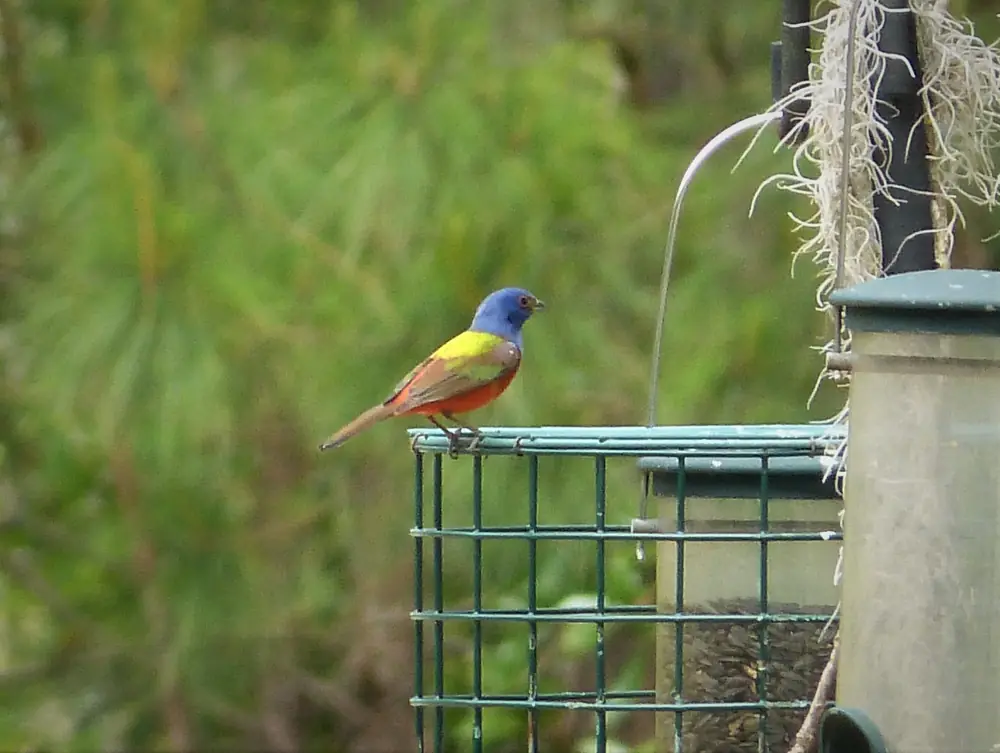
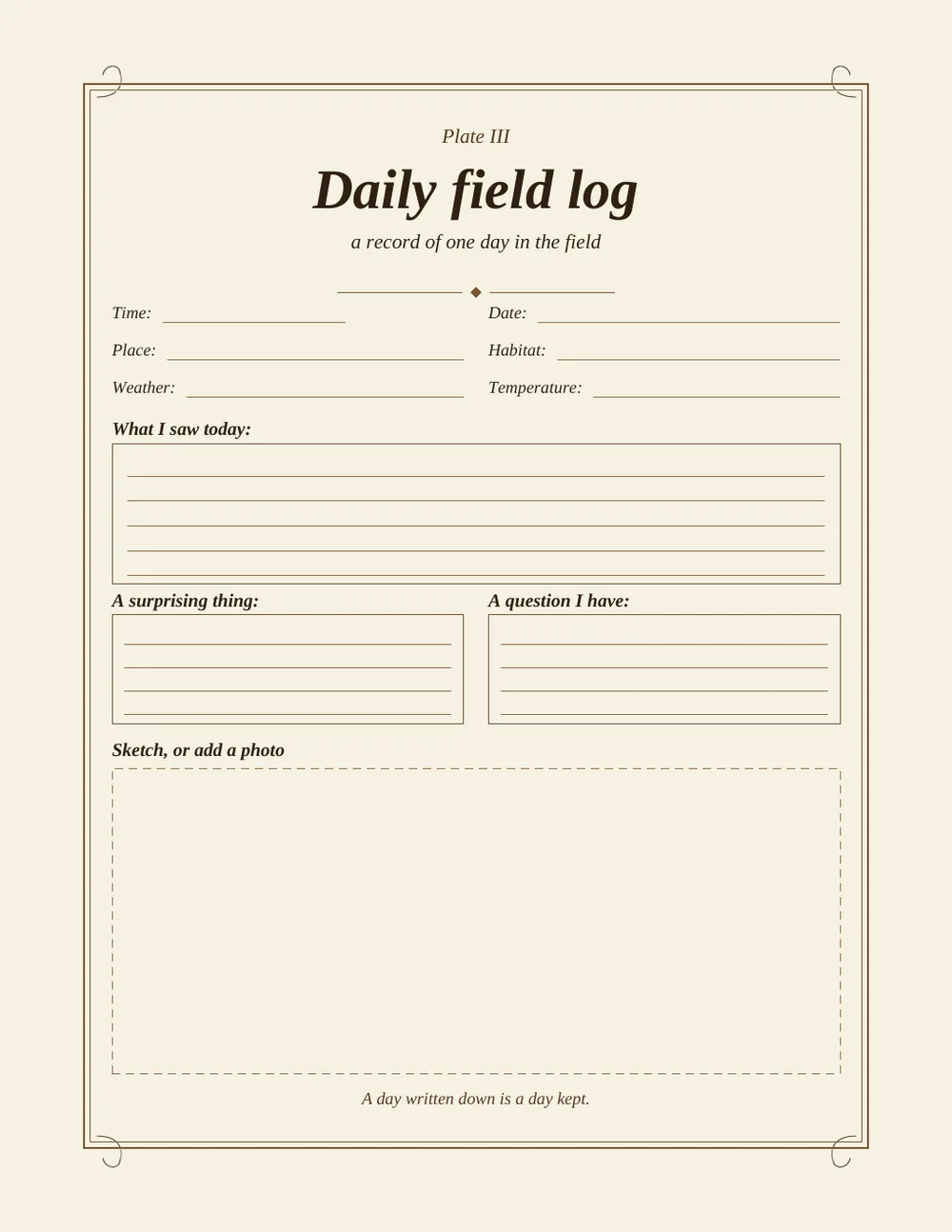
In the Naturalist’s Field Journal, put the day you first hear a wood thrush or see a painted bunting on the birds I have seen plate, record each tree’s leaf-out on a tree through the seasons plate, note the day and the weather of every frog night on the map of sounds, sketch a trillium on the daily field log, and write down the Pink Moon and Lyrid night on the dusk and dawn watch plate.
Regions used below: Mountains (Blue Ridge and Ridge and Valley); Piedmont and Metro Atlanta; Coastal Plain; Coast and Barrier Islands; Southwest Georgia.
When does spring bird migration peak in Georgia in April?
Late in the month, and a little later the farther north you go. Bird Watcher’s Digest says April is when migration “really breaks loose” across Georgia, with a peak of about the 20th to the 26th around Atlanta and the last days of April or early May in the north Georgia mountains. About 35 species of warblers can be seen in the state, it adds, and most have arrived by April 20. Not all of them stay: many are headed for northern forests.
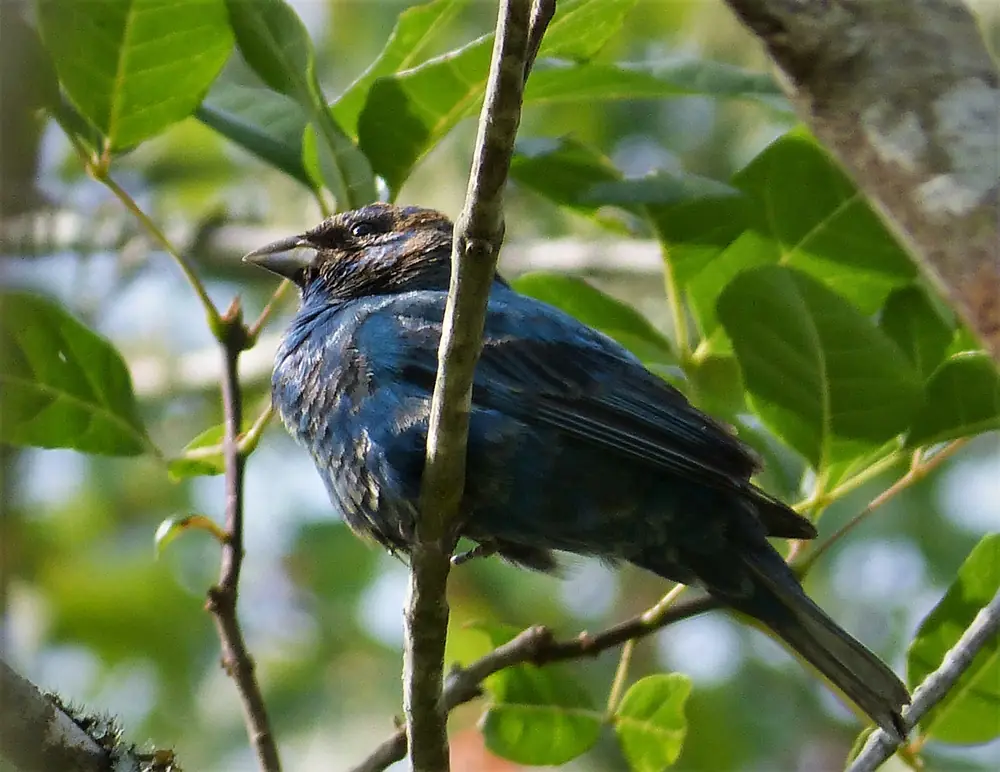
Georgia’s own summer birds come first. Among the early arrivals the magazine lists great crested flycatcher, red-eyed vireo, wood thrush, prothonotary warbler, hooded warbler, summer tanager and indigo bunting. By month’s end most of the permanent residents have already built nests and laid eggs, so April mornings are loud.
-
Ruby-throated hummingbirds
Most people see their first in the first two weeks of April · Yards and woodland edges statewide
Georgia DNR’s Out My Backdoor column says South Georgia’s first ruby-throats arrive around March 11 and Middle Georgia’s around March 21, while north Georgia may not see one until the first of April. Its writer reports that most people do not see their first of the year until the first two weeks of April. Males come ahead; the females follow about a week later. If your feeder is not up, put it out now with a plain sugar-and-water mix. You can add your sighting to the migration maps at Journey North.
-
Great crested flycatcher
Heard from a cool April morning onward · Tops of tall trees; wooded lots and edges
The DNR column calls it a bird that is “more often heard than seen,” with a loud, harsh call from the very top of tall trees. It nests in cavities, often 10 to 20 feet up, and the writer found a shed snakeskin in every nest he examined. Listen for the call early and late in the day.
-
Falcons on the coast
April · Barrier islands and marsh edges
Bird Watcher’s Digest notes three falcon species migrating north along the coast: American kestrel, merlin and peregrine falcon. Winter residents are leaving as summer waterbirds such as anhinga, white ibis and cattle egret settle in.
Write each first-of-year bird into the Naturalist’s Field Journal, and see Georgia’s March page for the early arrivals that come before this rush.
What is happening on Georgia’s coast in April?
The coast is a month ahead of the mountains and is already in its summer routine. Painted buntings settle into the maritime thickets, wood storks nest in a colony on a refuge pond, the winter whale watch ends, and the first sea turtle nests are only a few weeks off.
-
Painted buntings
Breeding season on Sapelo Island ran late April to early August in a USGS study; a UGA field project set its season to begin April 14 · Maritime shrub and pine-oak forest on the barrier islands; Little St. Simons Island and the Wormsloe area near Savannah
The male painted bunting is among the most colorful songbirds in the state. A USGS study of breeding birds on Sapelo Island described the season as late April through early August, and a University of Georgia project on the coast posted its 2025 field season as April 14 to June 20, flexible. The New Georgia Encyclopedia reports that the bird’s numbers in Georgia fell by more than 50 percent from 1966 to 2000. Harris Neck National Wildlife Refuge lists the painted bunting as one of its signature species. Scan the edges of thickets with binoculars; they sing from exposed perches.
-
Wood storks at Harris Neck
Nesting season · Woody Pond, Harris Neck National Wildlife Refuge
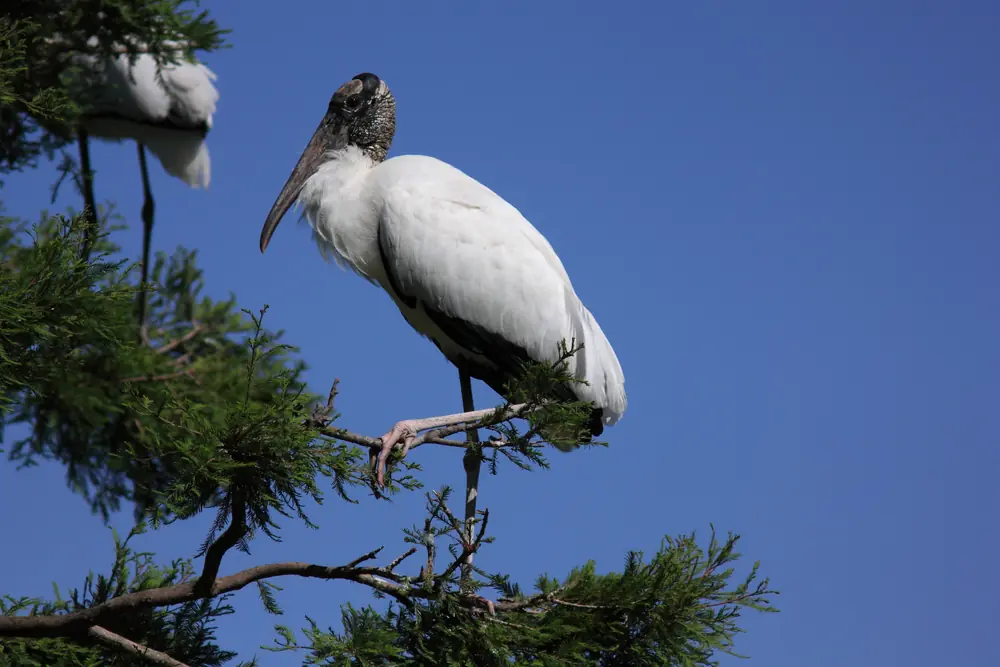
The refuge says threatened wood storks nest in a large colony on Woody Pond, and counts nearly 350 species of birds in all. It is open from sunrise to sunset, and dogs are not allowed on refuge land. The visitor contact station was closed until further notice when we last checked, so confirm road and drive conditions with the refuge before you go.
-
The right whale speed rule ends
April 15 south of Sapelo Island; April 30 north of it · Nearshore waters off the barrier islands
Georgia DNR lists two end dates for the speed limit that protects right whales: ships over 65 feet go no faster than 10 knots in the management areas until April 15 south of Sapelo Island, and until April 30 to the north. Boaters should still watch for whales through the end of the season.
-
Sea turtle nesting is about to begin
First nest usually in the first week of May; nesting runs into late summer · Barrier island beaches
Georgia DNR’s program page says nesting runs from late May to mid-August, while a DNR bulletin on the 2025 season says it lasts from about May through September and that the first nest found that year was on Jekyll Island on May 1. The program coordinator was quoted as saying a first nest comes during the first week of May “like clockwork.” The loggerhead is the only species that regularly nests on the state’s barrier islands. Georgia has recorded about 2,000 nests a season since 2011, according to the program page, with counts of 4,071 in 2022, 3,431 in 2023 and 2,490 in 2024. Visitors in late April can help by closing curtains and turning off or shielding lights that face the beach before the season starts.
Light is the clock on the beach; the daylight page can tell you when the sun goes down on any given date.
Which wildflowers and trees bloom in Georgia in April, and what is the yellow dust?
April is the heart of the wildflower season, which Georgia DNR’s columnist says begins before the official start of spring and runs well into May. By now the early trout lilies are fading in the Piedmont: the Atlanta Journal-Constitution’s naturalist columnist put the trout lily bloom at mid-February onward, with the wider wildflower show peaking between March and April, and the Shirley Miller Wildflower Trail at Pigeon Mountain, in Walker County, at its best about three weeks after that article’s March 7 date. In April the show moves up the mountains and into the shaded coves.
-
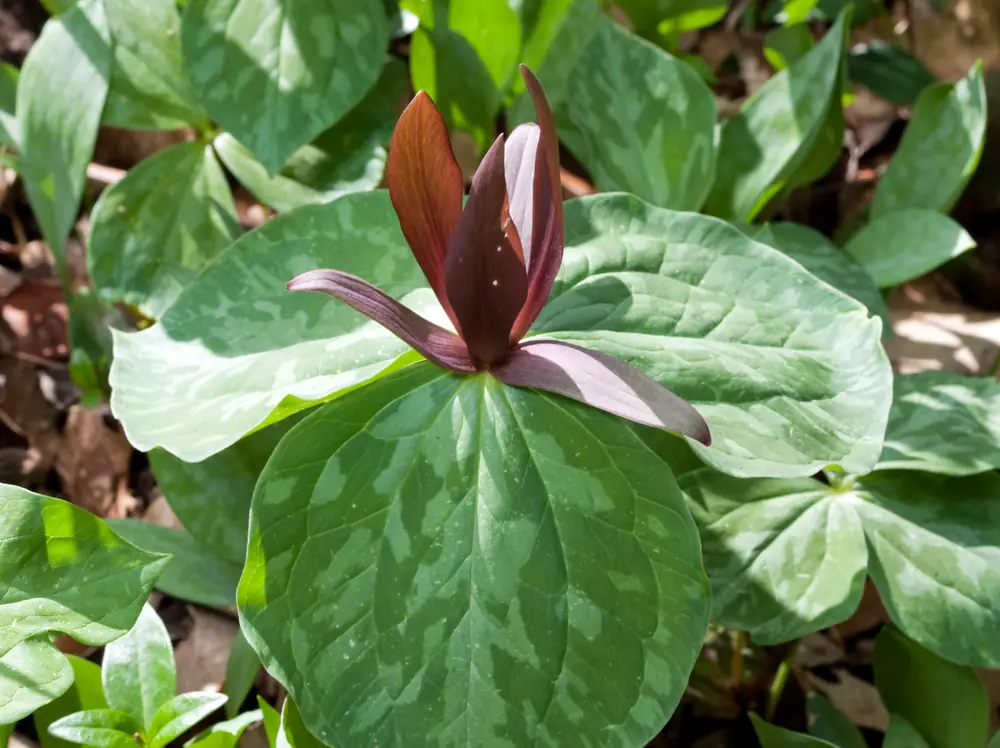
Trilliums
White trillium April into early June in the north Georgia mountains, per one regional guide · Sosebee Cove near Blairsville; Anna Ruby Falls trail near Helen
The same guide lists Sosebee Cove, near Blairsville, for Dutchman’s breeches, white trillium and jack-in-the-pulpit, and the Anna Ruby Falls trail near Helen for violets and trilliums in April. The Georgia Native Plant Society describes toadshade trillium as a plant of moist, shady coves, slopes and stream banks; its seeds take two years to produce a single leaf and five to seven years before the plant flowers, which is a good reason never to pick or dig one.
-
Azaleas
Piedmont azalea blooms as the leaves come out; flame azalea April to June · Streamsides and swamp margins for Piedmont azalea; dry mountain woods for flame azalea
The Georgia Native Plant Society says Piedmont azalea flowers “just about time the leaves come out,” with fragrant pink or white-pink blooms that draw hummingbirds and butterflies. The Appalachian Trail Conservancy gives April to June for flame azalea, which grows from New York to Georgia, and lists painted trillium, fire pink, mayapple and pink lady’s slipper among the spring bloomers of the Appalachians.
-
More of the ephemerals
Bloodroot mid-March through April; foam flower April to July; mouse-ear coreopsis April and May in the mountains · North Georgia trails
These spring ephemerals bloom before the tree canopy closes and go dormant by early summer. If you want to see them, early April suits the lower slopes, and late April suits higher ground.
-
The yellow dust
Heavy pine pollen through April; a 1996 UGA article put the worst count of that spring at mid-April · Statewide, thickest in pine country
The yellow powder on cars is mostly pine pollen. A UGA extension story from 1996 said the worst north Georgia count that spring was on April 16, with more than 3,400 particles per cubic meter, and that pine pollen is more visible but less of an allergy problem than oak pollen. Counts vary enormously from year to year.
One tree watched from bud to full leaf makes a good project for the Naturalist’s Field Journal.
What can you see in the Okefenokee in April?
The Okefenokee National Wildlife Refuge covers more than 630 square miles of southeast Georgia and protects about 90 percent of the swamp. The refuge’s brochure describes alligators basking while white ibis, wood storks and sandhill cranes forage in shallow water, and the pine islands holding gopher tortoises, red-cockaded woodpeckers and indigo snakes. The refuge says each season is quite different, with wildflowers in the wet prairies and the upland forests.
-
Alligator courtship
April to May, according to Georgia DNR · Open water in swamps, rivers, ponds and lakes
Georgia DNR’s alligator fact sheet says courtship and breeding take place in April and May and that gators prefer open water then. The state has roughly 200,000 to 250,000 alligators, and from 1980 to July 2023 only nine attacks on people were reported, six of them after someone stepped on a submerged animal. The refuge rule is to stay at least 20 feet away, never feed or harass a gator, and not to swim or paddleboard.
-
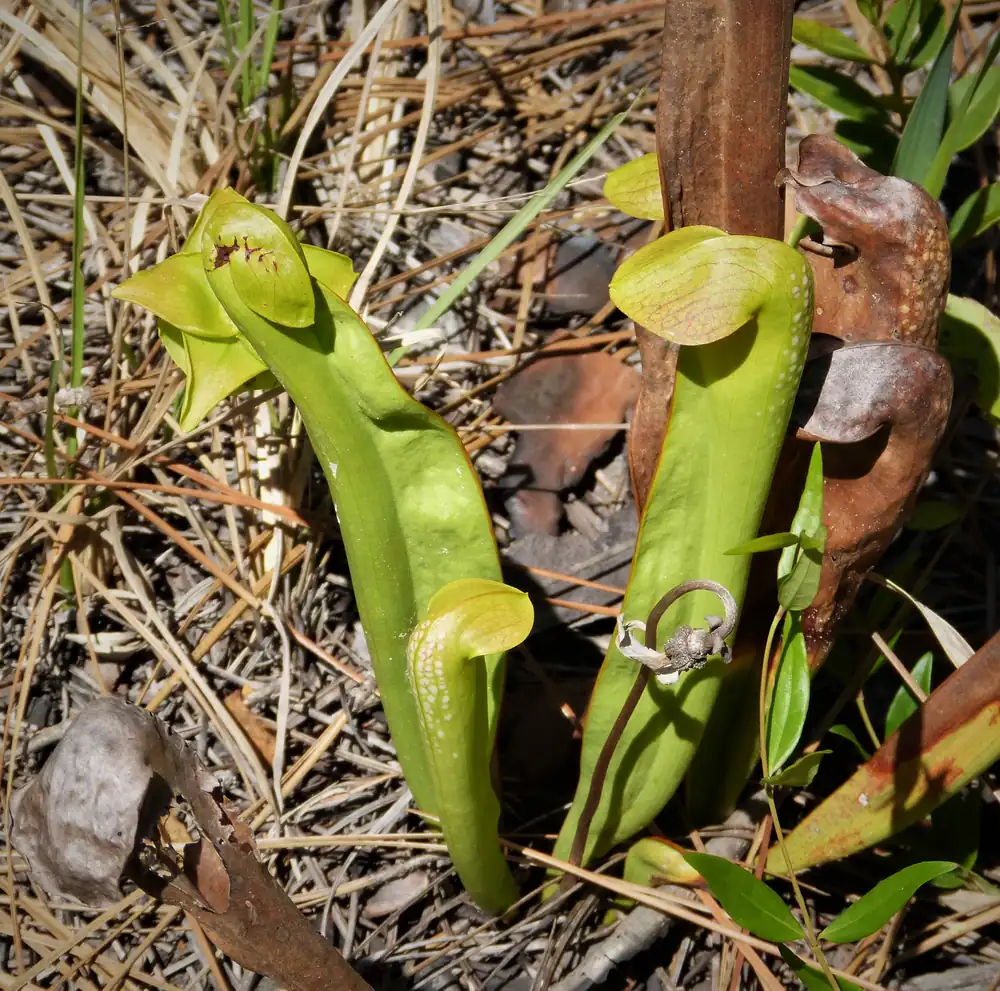
Hooded pitcher plants
Spring, in the wet prairies and pine openings · Boggy openings among pines
The Botanical Society of America describes the hooded pitcher plant as a species of boggy openings among pines in the Carolinas, Georgia and Florida. Its hood has translucent white patches that let in light, and an insect that mistakes them for sky flies into the wall of the pitcher. The flowers hang downward and are yellow. Look from the boardwalk and never reach in.
-
Hours and boats
March 1 to October 31 · Suwannee Canal Recreation Area (main entrance)
Through October the gates stay open from 30 minutes before dawn until 7:30 in the evening, and boats must be off the water by 6:00 p.m. Swamp Island Drive is a 7.2-mile loop, and the Chesser Island Boardwalk is a 1.3-mile round trip. For fire notices or closures, call the Richard S. Bolt Visitor Center at 912-496-7836.
The refuge’s events page lists no April 2027 dates yet; call before you plan a trip around a program.
Which frogs, tortoises and snakes are active in Georgia in April?
Almost all of them. The DNR and Adopt-A-Stream call guide counts 32 frog species in Georgia, two of them introduced, which puts the state third in the country. The winter callers such as spring peepers have mostly finished, but the treefrogs and toads of warm weather are moving in.
-
Green treefrog
The breeding season runs March to October, per the UGA Savannah River Ecology Laboratory · Swamps, weedy ponds and lake margins, mostly in the Coastal Plain
This is Georgia’s state amphibian. The DNR guide describes its call as nasal and duck-like, and the laboratory’s page renders it as a loud “reeenk, reeenk, reeenk.” Males call from emergent plants and from perches along the water.
-
Barking treefrog and Fowler’s toad
Barking treefrog breeds March to August with peak calling in early summer; Fowler’s toad breeds from spring through early summer · Fishless Coastal Plain wetlands for the treefrog; the Piedmont and lower mountains for the toad
The barking treefrog sounds, in the guide’s words, like a pack of hunting hounds in the distance. Fowler’s toad gives a nasal bleat like a sheep and is the one you meet on sidewalks and parking lots at night. Wetland edges after a warm rain are the best place to listen.
-
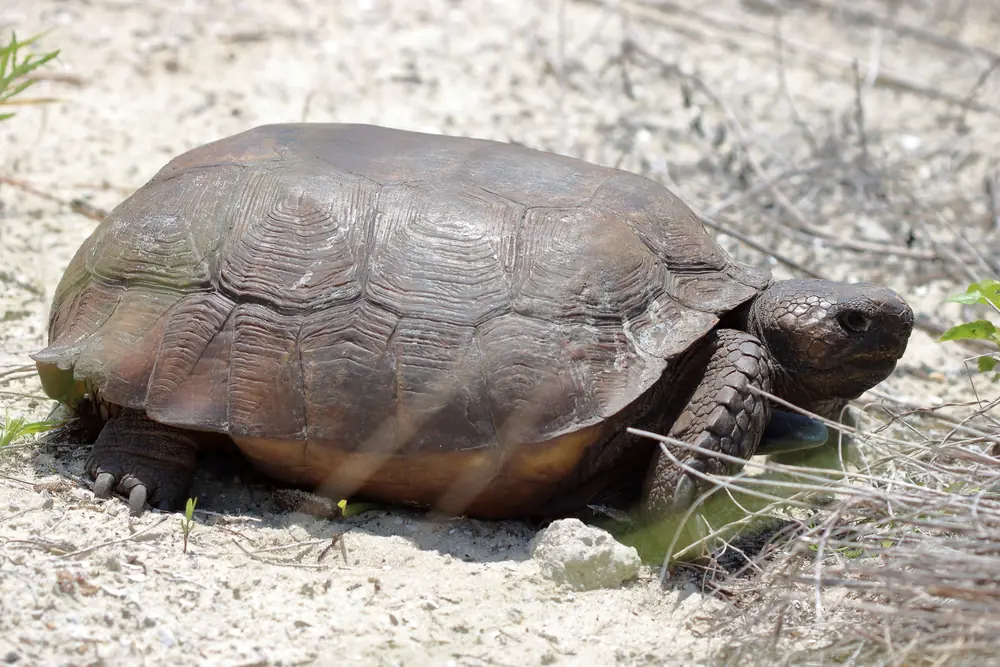
Gopher tortoises
Courtship mainly April to early June; nests late April to mid-July, peaking mid-June to mid-July (U.S. Forest Service review) · Sandy uplands and longleaf pine in the Coastal Plain
The review says activity peaks from April through October, especially April to June, in the northern part of the range. The Gopher Tortoise Council says females lay 3 to 15 eggs in May and June, and that incubation takes more than 100 days in Georgia and Alabama. The tortoise is threatened in Georgia, and state law prohibits deliberately harming one or maliciously damaging its burrow. If you find one crossing a road, the council advises helping it across in the direction it was headed. To report a problem, the council lists Georgia DNR at 229-289-8896.
-
Snakes
Warm days through the month · Everywhere from the mountains to the barrier islands
Georgia has 47 native snake species, and only seven are venomous: copperhead, two cottonmouths, eastern coral snake, eastern diamondback, pigmy rattlesnake and timber rattlesnake. DNR says encounters are relatively infrequent, and snakes are not under every rock. Watch your footing and your hands.
Note the nights you hear calls on the map of sounds plate; our cloud guide will help you tell a warm, rain-bearing evening from a dry one.
When do Vidalia onions come out in April?
Around the middle of the month, but only after an official pack date. Georgia’s Department of Agriculture says Vidalia onions are harvested and packed for sale only after that date, and that the Vidalia Onion Advisory Panel studies soil and weather conditions during the growing season before voting on a recommendation for the commissioner. Vidalia onions come from a 20-county region in South Georgia under Federal Marketing Order No. 955, and are sold from April through early September.
The date moves with the weather. The pack date was April 15 in 2025 and April 13 in 2026. No 2027 date has been announced, so expect it to be around mid-April and check the Georgia Department of Agriculture.
-
The 2025 and 2026 seasons
Pack dates April 15, 2025 and April 13, 2026 · 20 South Georgia counties
Growers planted about 10,000 acres in 2025 and about 10,200 acres in 2026, according to the Department of Agriculture and the Vidalia Onion Committee.
-
Vidalia Onion Festival
Annual, held in April; the organizer’s page showed no 2027 dates when we looked · Vidalia
The festival’s own site lists its 2026 events, including a golf tournament, chalk walk, cooking demonstrations and an air show, and gives no 2027 dates. Check with the organizer for this year’s dates before you travel.
Buy from the label that says Vidalia and read the packing date on the bag; the rule is the same for every Georgia grower in the region.
How warm is April in Georgia, and how risky are the storms?
April is summer-warm in the afternoon and still cool at dawn. By the 1991–2020 normals from NOAA, a typical afternoon peaks near 74 °F in Atlanta and Athens and 78 °F in Savannah, Augusta and Macon, and the average low runs from 41 °F in Blairsville to 55 °F in Savannah. Frost is rare outside the mountains: a typical April brings Blairsville 5.5 freezing nights and Atlanta only 0.2.
April 2026 was warm and dry in north and central Georgia. The forecast office in Peachtree City reported temperatures 3 to 4 degrees above normal and rainfall about 1.5 inches below normal, with Macon reaching 91 °F on April 17 and Atlanta 90 °F that day. Individual months vary a lot, so use this table as a guide and not a promise.
| Station | Average high | Average low | Rain and melted snow | Freezing nights |
|---|---|---|---|---|
| Blairsville | 69.2 °F | 40.9 °F | 5.15 in | 5.5 |
| Athens | 74.8 °F | 49.8 °F | 3.52 in | 0.3 |
| Atlanta | 73.8 °F | 52.5 °F | 3.81 in | 0.2 |
| Augusta | 78.5 °F | 50.6 °F | 2.92 in | 0.6 |
| Macon | 77.9 °F | 51.0 °F | 3.62 in | 0.3 |
| Columbus | 77.7 °F | 54.0 °F | 4.03 in | 0.0 |
| Savannah | 78.2 °F | 55.2 °F | 3.39 in | 0.1 |
The Peachtree City forecast office says tornadoes of F2 or stronger are more likely in April than in any other month in north and central Georgia, and hail is likeliest in April too; the usual window is mid-afternoon to early evening. The office counts about 6 tornado days a year. Its summary of the Easter outbreak on April 12 and 13, 2020, lists 21 tornadoes in its forecast area, including EF-3 tornadoes in Catoosa, Upson and Lamar, and Monroe counties; an EF-2 in Murray County killed seven people, the Catoosa tornado killed three and a Bartow County EF-1 killed one. Many came after dark, between 8:15 p.m. and 4:31 a.m. For the latest temperature and rain outlook, see the Climate Prediction Center’s three-month maps, updated monthly. Our weather page links to the local forecast.
When is Georgia’s last spring freeze?
Long past in the south, but still a risk in the mountains until nearly May. The table below uses NOAA’s 1991–2020 normals at each city’s main station. Read the middle column as the date when the last 32 °F night has passed in a typical spring. Blairsville’s median is April 26, with nine springs in ten done by May 11, while Savannah’s is March 2 and Atlanta’s March 26. A cold snap after the trees leaf out is the usual way a warm April turns costly.
-
Metro Atlanta and the Piedmont
Median March 23 to April 1; nine in ten done by April 10 to April 19 · Atlanta, Athens, Rome
A freeze after April 13 in Atlanta, or April 19 in Rome, happens only about one spring in ten.
| Station | One year in ten | Median | Nine years in ten |
|---|---|---|---|
| Blairsville | Apr 8 | Apr 26 | May 11 |
| Rome | Mar 13 | Apr 1 | Apr 19 |
| Atlanta | Mar 4 | Mar 26 | Apr 13 |
| Athens | Mar 2 | Mar 23 | Apr 10 |
| Macon | Feb 28 | Mar 21 | Apr 7 |
| Columbus | Feb 11 | Mar 5 | Mar 24 |
| Savannah | Feb 4 | Mar 2 | Mar 25 |
| Valdosta | Feb 15 | Mar 10 | Mar 31 |
Our Georgia frost date tables cover far more towns than these eight.
How much daylight does Georgia gain in April?
Close to an hour over the month, at about two minutes a day, a little slower than March’s gain. Atlanta’s day grows from 12 hours 33 minutes on April 1 to 13 hours 30 minutes on April 30, a gain of 57 minutes. The most is gained in the mountains (Blairsville 60 minutes) and the least in the far south (Valdosta 51), as the table lists. All of Georgia is on Eastern Daylight Time this month. In Atlanta the sun rises at 7:25 a.m. and sets at 7:58 p.m. on April 1, and rises at 6:50 a.m. and sets at 8:20 p.m. on April 30, according to the U.S. Naval Observatory. In Savannah the same days run 7:13 a.m. to 7:44 p.m., and 6:39 a.m. to 8:04 p.m.
| City | Apr 1 | Apr 30 | Gained | Per day |
|---|---|---|---|---|
| Blairsville | 12 h 34 m | 13 h 34 m | 60 min | 2.1 min |
| Rome | 12 h 33 m | 13 h 32 m | 59 min | 2.0 min |
| Atlanta | 12 h 33 m | 13 h 30 m | 57 min | 2.0 min |
| Athens | 12 h 33 m | 13 h 30 m | 57 min | 2.0 min |
| Macon | 12 h 32 m | 13 h 28 m | 56 min | 1.9 min |
| Columbus | 12 h 32 m | 13 h 26 m | 54 min | 1.9 min |
| Savannah | 12 h 31 m | 13 h 25 m | 54 min | 1.9 min |
| Valdosta | 12 h 30 m | 13 h 21 m | 51 min | 1.8 min |
Type any date and your town into the daylight calculator for exact times.
What can you see in Georgia’s night sky in April 2027?
A full Pink Moon on the 20th, the Lyrid meteors on a moonlit night, Jupiter and Mars in the evening, and Venus in the morning. Georgia is on Eastern Daylight Time all month, so every time below is EDT.
-
The Pink Moon
Full at 6:27 p.m. EDT, Tuesday, April 20 · Rising in the east after sunset
The full moon comes before moonrise in Georgia, so the Moon rises already full, low in the east-southeast. In Atlanta the U.S. Naval Observatory lists sunset at 8:12 p.m. and moonrise at 8:20 p.m. on the 20th, so the Moon appears just as the sky is darkening. Best viewing is that evening, and the Moon still looks full the evening before and after. Sea and Sky notes that the name Pink Moon refers to the early spring flowers.
-
The Lyrid meteors, in a poor year
Active about April 14 to 30; peak near 9:41 p.m. EDT on Thursday, April 22 · Look low in the northeast and overhead early in the evening
The International Meteor Organization’s calendar excerpt gives a peak at 01:41 UT on April 23, which is 9:41 p.m. EDT on the 22nd. The Moon, 95 to 97 percent lit, comes up in Atlanta near 10:30 p.m., so only the early part of the evening, after twilight fades and before moonrise, is dark. The calendar at Sea and Sky quotes roughly 20 meteors an hour at best but warns that moonlight drowns the fainter streaks, so a few per hour is a fair guess. The Lyrids can also surprise with short bursts, but those cannot be predicted.
-
Jupiter and Mars in the evening
All month; the Moon passes near both on the evenings of April 14 and 15 · High in the south at dusk, in Leo
Jupiter, in Leo, stays up past midnight in early April and sets earlier as the month goes on. Mars, also in Leo, fades to about magnitude 0.0 by April 15. The waxing Moon, about 68 percent lit, passes within 1 degree of Jupiter on April 15 by our own calculation (the closest approach comes in the morning, so judge it on the evenings of the 14th and 15th) and about 3 degrees from Mars that evening.
-
Venus in the morning
Mornings of April 3 and 4 for the crescent Moon nearby · Low in the east before sunrise
Venus rises about 75 minutes before sunrise on April 1 and is slowly sinking toward the Sun. A thin crescent Moon, about 9 percent lit, sits about 3 degrees from it on those mornings. Saturn passes behind the Sun on April 7, Mercury sits too low to be practical, and there are no eclipses.
| Phase | Date | Time |
|---|---|---|
| New moon | Tuesday, Apr 6 | 7:51 p.m. |
| First quarter | Tuesday, Apr 13 | 6:56 p.m. |
| Full moon (Pink Moon) | Tuesday, Apr 20 | 6:27 p.m. |
| Last quarter | Wednesday, Apr 28 | 4:18 p.m. |
The Eta Aquariid meteors begin about April 19 and peak in early May; see Georgia’s May page when it is posted. Our moon phases page shows any night.
What can Georgia families do outside in April 2027?
- Hold a bird morning. Pick a morning in the third or fourth week, bring binoculars, and write down every bird you hear.
- Celebrate Gopher Tortoise Day on Saturday, April 10. It falls on a Saturday in 2027. The Gopher Tortoise Council suggests educating others and hosting a community event. Look for a burrow in sandy pine country and keep your distance.
- Join Earth Day on Thursday, April 22. Pick up trash on a creek bank or plant native flowers.
- Learn the local wildlife at Unicoi. The state park calendar lists Wildlife of Unicoi at the visitor center at noon on April 3, 10, 17 and 24, 2027. Confirm with the park before you go.
- Go fishing at Victoria Bryant State Park. The calendar lists a Junior Fishing Rodeo for ages 15 and under on April 17 and a Senior Fishing Rodeo for ages 55 and up on April 24, both from 8:30 a.m. to noon.
- Report a hummingbird or a monarch. The Journey North maps track their progress north. Monarchs leaving Mexico lay eggs in late March and April on their way north, per MonarchNet, so milkweed in the ground helps.
Annual events such as the Vidalia Onion Festival and Tallulah Gorge’s water-release days have no 2027 dates posted by the organizers we checked; Georgia State Parks lists only 2026 releases. Check with them before planning around either one.
Wet weather can cancel a program, so call ahead. Other months and other states are in our nature guides.
Safety notes for April in Georgia
- Spring turkey season is under way. Private land has been open since March 27. Public hunting areas, meaning WMAs, VPAs and national forest land, open April 3, and the season on all of them ends May 15, 2027, per the state’s regulations. Only bearded gobblers may be taken, with a bag of one a day and two a season. Each hunter needs a harvest record and must report a kill to Georgia Game Check inside 24 hours. The state’s blaze-orange requirement names deer, bear and hog hunters in gun and primitive-weapon seasons; turkey is absent from that list. Hikers on public land in April should still wear something bright.
- Tornadoes. Switch on wireless emergency alerts, keep a weather radio charged, and pick your shelter spot before the sky turns. Storms come mostly from mid-afternoon to early evening but can arrive at night.
- Ticks. Per the CDC, tick activity runs strongest April through September. The agency recommends an EPA-registered repellent, permethrin on boots and clothing, a full body check, and a prompt shower.
- Baby animals. Georgia DNR advises that if you find a fawn, baby bird or rabbit, move away and leave it for 24 to 48 hours, because the parent is usually nearby. Georgia law prohibits possessing most wildlife without a permit; for general questions call 706-557-3333.
- Alligators and snakes. The Okefenokee refuge asks visitors to stay 20 feet from any alligator and never to feed one. Dogs and shorelines do not mix in April. On warm days look before you reach or step.
- Burning. The Georgia Forestry Commission says burning is banned from May 1 to September 30 in 54 north Georgia counties, and a permit is required for agricultural, land-clearing and machine-piled burns (not for hand-piled yard debris), valid only the day it is issued: 1-800-GA-TREES (428-7337).
- Trout streams. Stocking continues from late March through October on up to 160 streams, per DNR. Fishing and trout licenses are both required from age 16. Mountain streams run fast and cold after storms.
Sources (58)
- Bird Watcher’s Digest: Georgia birding by season, spring
- Georgia DNR, Out My Backdoor: the great crested flycatcher
- Georgia DNR, Out My Backdoor: the first day of spring (hummingbird arrival dates)
- Journey North: report a hummingbird sighting
- New Georgia Encyclopedia: painted bunting
- U.S. Geological Survey: home range and survival of breeding painted buntings on Sapelo Island, Georgia
- University of Georgia Warnell School: painted bunting field technician, Georgia coast (2025 field season)
- U.S. Fish and Wildlife Service: Harris Neck National Wildlife Refuge
- Georgia DNR: North Atlantic right whales (vessel speed rule dates)
- Georgia DNR: sea turtle program
- Georgia DNR: first loggerhead sea turtle nest of 2025 found on Jekyll Island
- Georgia DNR, Out My Backdoor: redbuds are on parade
- Atlanta Journal-Constitution: the trout lily and the start of Georgia’s wildflower season (March 2026)
- Blue Ridge Mountains Travel Guide: where to see north Georgia wildflowers
- Georgia Native Plant Society: toadshade trillium
- Georgia Native Plant Society: Piedmont azalea
- Appalachian Trail Conservancy: Appalachian Trail wildflowers
- UGA College of Agricultural and Environmental Sciences: spring brings yellow clouds of misery (1996)
- U.S. Fish and Wildlife Service: Okefenokee NWR, visit us (hours and boating)
- U.S. Fish and Wildlife Service: Okefenokee NWR general brochure (April 2025)
- U.S. Fish and Wildlife Service: Okefenokee NWR events
- Georgia DNR: alligator fact sheet (revised August 2023)
- Botanical Society of America: Sarracenia minor, the hooded pitcher plant
- Georgia DNR and Adopt-A-Stream: Froggin’ by ear, Georgia frog calls and notes (PDF)
- UGA Savannah River Ecology Laboratory: green treefrog
- UGA Savannah River Ecology Laboratory: barking treefrog
- UGA Savannah River Ecology Laboratory: Fowler’s toad
- Gopher Tortoise Council: frequently asked questions (Gopher Tortoise Day)
- U.S. Forest Service, Fire Effects Information System: gopher tortoise
- Georgia DNR: snakes of Georgia
- Georgia Department of Agriculture: April 13, 2026 official Vidalia onion pack date
- Georgia Department of Agriculture: April 15, 2025 official Vidalia onion pack date
- Vidalia Onion Festival: festival events
- NOAA NCEI: 1991–2020 monthly normals for Georgia stations (data API)
- NWS Peachtree City: April 2026 climate summary for north and central Georgia
- NWS Peachtree City: severe weather climatology (tornadoes, hail and wind)
- NWS Peachtree City: the April 12–13, 2020 Easter severe weather outbreak
- Climate Prediction Center: three-month outlooks
- U.S. Naval Observatory: moon phases for 2027 (data API)
- U.S. Naval Observatory: sun and moon data for Atlanta, April 1, 2027
- U.S. Naval Observatory: sun and moon data for Atlanta, April 20, 2027
- U.S. Naval Observatory: sun and moon data for Atlanta, April 22, 2027
- U.S. Naval Observatory: sun and moon data for Atlanta, April 30, 2027
- U.S. Naval Observatory: sun and moon data for Savannah, April 1, 2027
- U.S. Naval Observatory: sun and moon data for Savannah, April 30, 2027
- Sea and Sky: astronomy calendar of celestial events, 2027
- Georgia DNR hunting regulations: big game seasons, dates and limits (spring turkey 2027)
- Georgia DNR hunting regulations: bear, turkey, feral hog, alligator and small game
- Georgia DNR hunting regulations: hunter orange and blaze pink
- Georgia DNR: wildlife belongs in the wild, leave wildlife where found
- Georgia DNR: trout fishing and stocking
- Georgia Forestry Commission: burn permits and notifications
- CDC: preventing tick bites
- Georgia State Parks: events calendar, April 2027
- Georgia State Parks: Tallulah Gorge water releases and gorge floor access
- MonarchNet: spring migration ecology
- Monarchs Across Georgia, Environmental Education Alliance
- Photos via Wikimedia Commons; licenses and photographers are credited under each picture