What to look for in nature in Georgia this February
Meteorological winter ends with February, but Georgia feels spring creeping up from the Florida line well before then. The first purple martins swoop around backyard gourds, high flocks of sandhill cranes bugle their way north, woodcocks spiral over damp fields at dusk, and yellow jessamine climbs the pines along south Georgia roads. Ice storms are still possible in the north. What follows gives each event its usual window, region by region, with a named source for every date.
Other months in Georgia: October, November, December, January.
Start here
- Open the martin house. Georgia DNR says the first purple martins usually reach middle Georgia by about February 1 and most of the state by mid-month. Clean last year’s nests out of gourds or compartments now and listen at dawn for a low, gurgling chirp overhead.
- Look up when you hear cranes. Sandhill cranes that wintered in Florida and the Okefenokee start back north in February, often so high that only the rolling calls give them away. Note the date, time and direction and add the flock to eBird.
- See Jupiter at its best. On Wednesday evening, February 10, Jupiter is opposite the sun: up in the east at sundown and visible until dawn. Steady binoculars, propped on a car roof, reveal its brightest moons as pinpricks strung in a row.
For the Naturalist’s Field Journal: write your first martin, first jessamine flower and first crane flock of the year on the daily field log, sketch a bloodroot leaf on reading the signs, add every bird from your Great Backyard Bird Count to birds I have seen, mark the woodcock’s peent and twitter on the map of sounds, and give Jupiter and the Snow Moon their own entries under dusk and dawn watch.
Regions used below: Mountains (Blue Ridge and Ridge and Valley); Piedmont and Metro Atlanta; Coastal Plain; Coast and Barrier Islands; Southwest Georgia.
When do purple martins come back to Georgia?
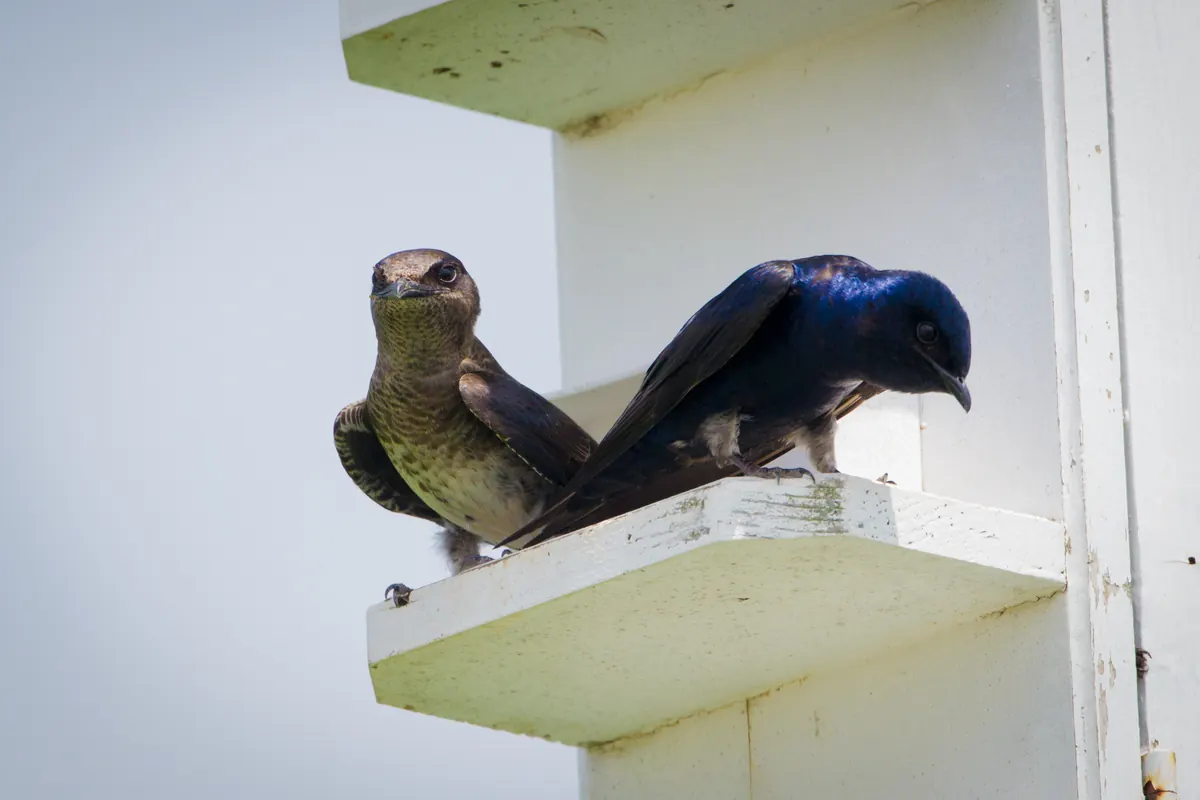
Earlier than most people expect. Purple martins, North America’s largest swallows, spend the winter in South America’s Amazon Basin, and the first ones back in Georgia often appear while the nights are still frosty. In his Out My Backdoor column for Georgia DNR, a retired nongame program manager lays out the usual sequence: a few in south Georgia during January, middle Georgia by around February 1, nearly all of the state by February 15, and the northeastern corner by about March 1.
-
The scouts
January in the far south; most of the state in February · Martin houses and gourd racks near open water and lawns
Old folklore says the first arrivals “scout” for the flock and lead it back. The DNR column sets that straight: these birds are simply the earliest migrants, they are usually males though females turn up too, and their common trait is age. Scouts are the oldest martins in the population, returning to the same colony they used the year before. The column adds that a scout’s date can swing by 30 days or more from year to year, depending on weather, food and conditions on the wintering grounds.
Arrivals often follow the passage of a low-pressure system. Listen at first light for the deep, gurgling chirrup, and check the house several times a day; after a cold front, a gentle tap on the pole may flush a bird hiding inside.
-
Last year’s young
Weeks after the scouts · The same colonies
Martins that hatched last summer arrive well after the adults. The DNR column puts the gap at four to six weeks, while the Purple Martin Conservation Association gives a wider range of four to twelve weeks. Because colony members are not necessarily related and migrate on their own schedules, a whole colony can take three or four months to fill up. The association notes that martins may begin nesting as late as the end of June, so a house that is empty in February is not a lost cause.
| Part of Georgia | First scouts usually seen |
|---|---|
| South Georgia | As early as January |
| Middle Georgia | By about February 1 |
| Most of the rest of the state | By about February 15 |
| Northeast Georgia | By about March 1 |
The martin association suggests putting housing up with the entrances closed shortly before adults are due, then opening it as they arrive, which keeps starlings and house sparrows from moving in first. Its scout arrival map shows when the first birds have been reported near you.
When do sandhill cranes fly north over Georgia?
The return trip starts in February. The cranes that rode south over the Piedmont in late fall have spent the winter on Florida’s prairies and in the Okefenokee, and as the days lengthen they begin heading back toward the Great Lakes. They belong to the eastern population of greater sandhill cranes, and a Georgia DNR column notes that practically every bird in that population passes over the state at some point.
-
Northbound flocks
From February, often on warm, clear afternoons with a south wind · Statewide; frequently heard over Atlanta, Macon and Athens
The DNR column describes hearing the first northbound flock on a remarkably warm February 13 afternoon, the birds so high that they stayed invisible while their karoo calls carried to the ground. It counts the eastern population at only about 24,000 to 26,000 birds, nesting from Hudson Bay south to Michigan and Wisconsin. To tell a crane flock from geese, watch the legs, which trail far behind the short tail, and the shape of the V, whose arms ripple and bend while a goose formation holds steady.
-
Leaving the swamp
Mid to late February · Chesser and Grand prairies, Okefenokee National Wildlife Refuge
A refuge ranger who spent years listening to the cranes wrote that the Okefenokee’s wintering birds, an estimated 3,000 to 5,000 of them, usually depart from the middle to the end of February. An early-February sunrise at the Chesser Island Boardwalk tower is the last good chance to hear them in numbers.
-
Ducks on the move
Late February · Lakes, reservoirs and coastal impoundments
Bird Watcher’s Digest’s calendar for Georgia names waterfowl movement across the state, especially near the end of the month, as February’s first hint of spring.
When you hear cranes, write down the time, the direction they were heading and a rough count, then enter the sighting in eBird. Those scattered backyard reports are what map the spring passage across the state.
Where can you see a woodcock sky dance in Georgia?
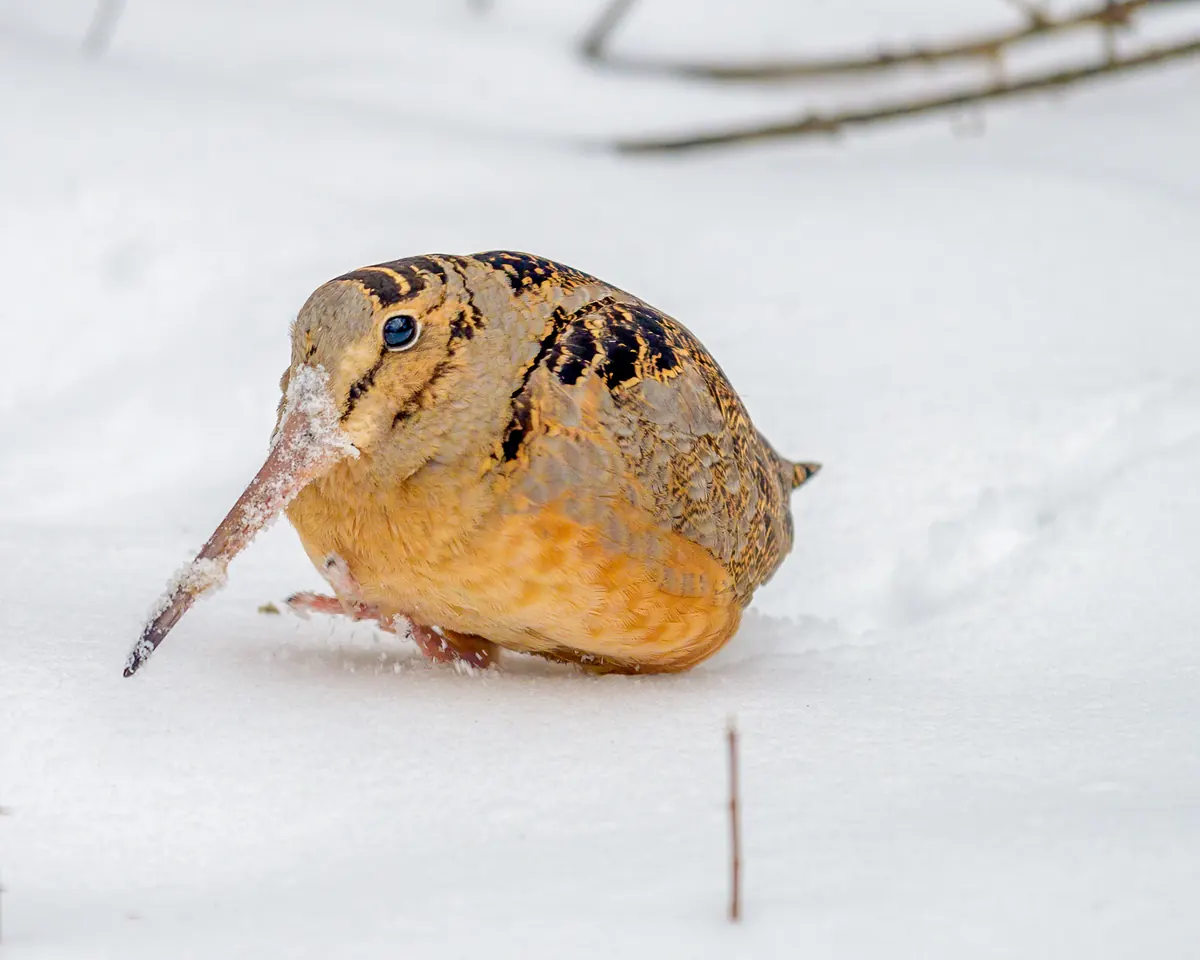
On the edge of almost any damp, brushy field at dusk. The American woodcock, a stocky sandpiper with a very long bill that hides in thickets rather than on the shore, performs one of the strangest courtship flights of any North American bird. Bird Watcher’s Digest’s Georgia calendar lists its dawn and dusk display flights among February’s signs of spring, as the first ducks start heading north.
-
The peent, the climb and the fall
Starts roughly 15 to 20 minutes after sunset; also before dawn · Old fields, pastures, clearcuts and power-line cuts beside wet young woods
The male begins on the ground with a buzzy, nasal “peent.” Then he flies up in widening spirals while air through his wing feathers makes a thin twittering whistle, and from the top of the climb he zigzags back down with a liquid, chirping warble, landing close to where he started. A National Audubon Society article gives the start as 15 to 20 minutes after sunset, with the performance running for more than half an hour on a good evening. In February, sunset in Atlanta falls at about 6:10 to 6:30 p.m., so plan to be in place by twenty to seven.
-
How to watch without disturbing
Calm, mild evenings · Public fields such as wildlife management areas and large parks
Stand on the eastern edge of the opening so the bird is silhouetted against the brighter western sky, keep still and let your ears find the peent first. Audubon’s writer stresses keeping to the edge of the singing ground and not walking into it; woodcock numbers have been slipping for decades. Georgia’s woodcock hunting season closed on January 18, so displaying birds are left in peace.
Timing in Georgia depends on the weather, and the sky dance continues into March and beyond farther north. If a mild evening in February is silent, try again in a week.
When do wood storks start nesting on the Georgia coast?
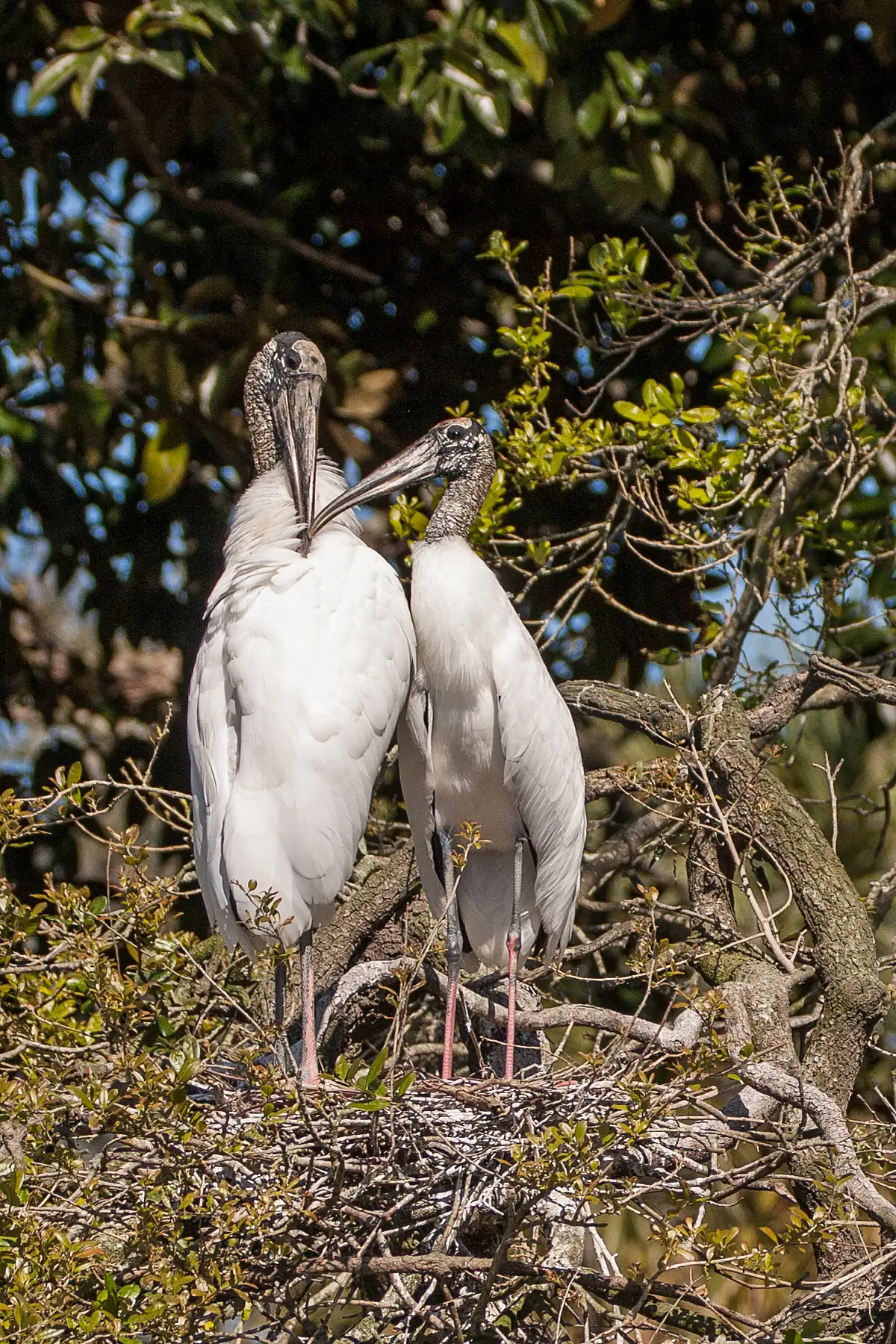
Late February into early March. The Georgia Birding Trails guide, published by DNR, says the nesting season for wading birds at Harris Neck National Wildlife Refuge begins then, and Harris Neck holds the largest wood stork colony in the state, on a cypress pond called Woody Pond.
-
Wood storks back on the pond
Arriving and building from late February · Woody Pond, Harris Neck National Wildlife Refuge, near Townsend
A wood stork is a tall white wading bird with a bare, scaly gray head, a heavy downcurved bill and black flight feathers that show in a broad band when it soars. The birds build bulky stick nests in the pond’s trees and on nesting platforms set out over the water. Egrets, herons and night-herons join the colony, and the Birding Trails guide recommends a spotting scope for watching the nests.
-
A record count and a recovery
Survey results from the 2025 season · Colonies across the Coastal Plain and coast
DNR says the first wood stork nests in Georgia were documented in 1965. In its report on fiscal year 2025, DNR’s Wildlife Conservation Section says its aerial survey found 2,988 nests in 29 colonies, a state record that edged past the 2,950 counted in 2014, and that Georgia now holds more than 20 percent of the wood storks nesting in the United States. Nationally the species was listed as endangered in 1984 and moved down to threatened in 2014. On February 9, 2026, the U.S. Fish and Wildlife Service announced its recovery, and the final delisting rule, printed in the Federal Register the next day, took effect on March 12, 2026.
Harris Neck is open from sunrise to sunset, and the refuge’s visitor station has been closed because of staffing. Stay on the road and dikes around the pond; storks and egrets that are flushed off new nests can abandon them.
When do American shad run up Georgia’s rivers?
In late winter and spring. American shad are ocean fish, relatives of herring, that come back into fresh water to spawn, and Georgia’s big coastal rivers still carry a run.
-
The run on the Altamaha
Spawning detected from late February into May · Altamaha River and its Oconee and Ocmulgee branches; also the Savannah
Researchers from Georgia Southern University, working with NOAA and the U.S. Fish and Wildlife Service, sampled the Altamaha system every two weeks for shad eggs and larvae. They first found them on February 23 in 2023 and on February 29 in 2024, and kept finding them into May. Georgia DNR electrofishes the Savannah and Ogeechee rivers from February into May or June and tags adult shad on the Altamaha.
-
A smaller fishery than it once was
Season set each year by DNR · Commercial fishing only on the Altamaha and Savannah
DNR estimates that the state’s shad harvest fell by about 85 percent between 1908 and 1981. The Altamaha and Savannah are now the only Georgia rivers open to commercial shad fishing, and the Altamaha remains the best, with commercial landings averaging more than 60,000 pounds a year from 1982 through 2017.
Anglers who want to try for shad should check the current DNR freshwater fishing regulations for the season, creel limits and which river stretches are open before heading out.
What wildflowers bloom first in Georgia in February?
Yellow jessamine leads in the south, and the first woodland wildflowers follow in rich, shaded ravines. Each plant below has a profile from the Georgia Native Plant Society. A warm spell can push any of them ahead by a week or two, and a hard freeze can brown open flowers overnight.
-
Carolina jessamine
February in south Georgia; later farther north · Fencerows, roadside pines and woodland edges statewide
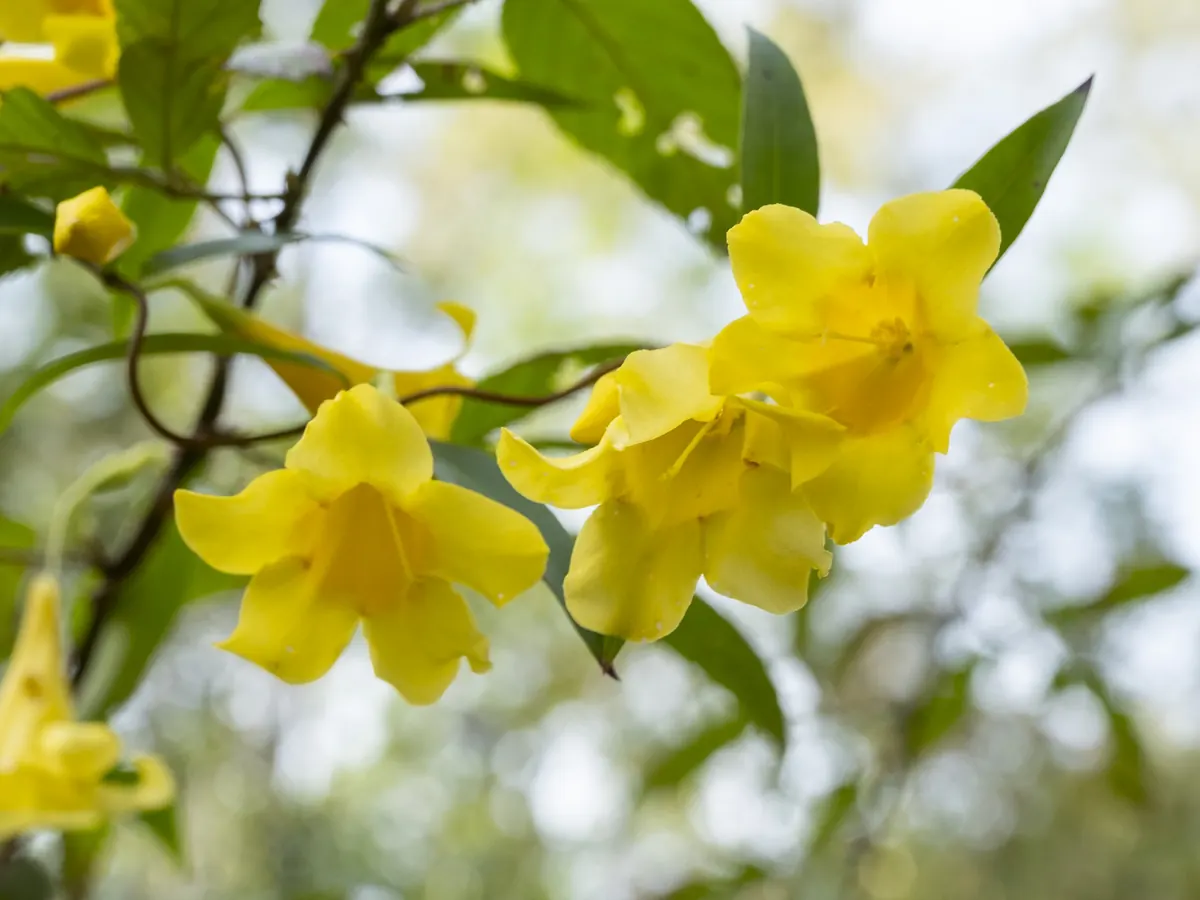
An evergreen vine that twines 20 feet or so into shrubs and trees, with small glossy leaves in pairs and lightly fragrant yellow trumpets about an inch and a half long. GNPS notes it blooms earliest in south Georgia, in February. Every part is poisonous if eaten, so enjoy it with your eyes and keep it out of reach of small children and pets.
-
Dimpled trout lily
Leaves from early February; flowers February into spring · Rich, sometimes rocky woods from the mountains to the Florida line
GNPS describes the thick, rubbery, mottled leaves spearing up through the dead leaves in early February. Only plants with two leaves flower; single leaves belong to young plants. The nodding yellow flower has six swept-back petals and usually purple anthers, and the name comes from a small dimple at the tip of the seed capsule.
-
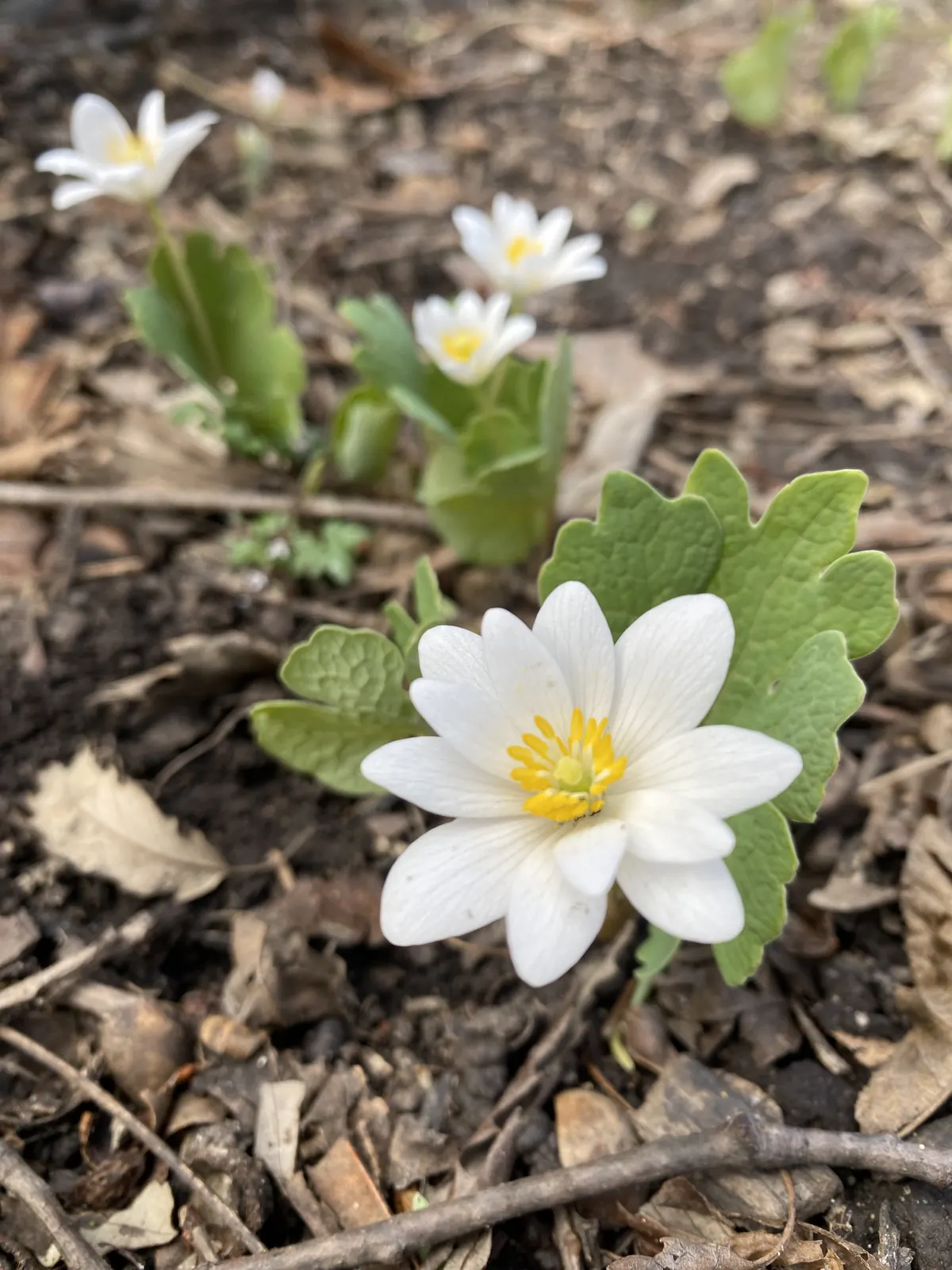
Bloodroot
Late winter to early spring · Shady, moist woods, often near streams
A single gray-green, deeply scalloped leaf wraps around the stem as the flower opens: a white star about two inches across with eight to sixteen petals and a center of yellow stamens. Each flower lasts only a few days. Break a stem and it bleeds red-orange sap, which is toxic. Ants carry the seeds off for their fatty tips and plant them in the process.
Note the date of your first jessamine or trout lily flower every year in the same place. A few years of first-bloom dates from one patch of woods tells you more about your own spring than any regional average.
What are Georgia’s backyard birds doing in February, and when is the Great Backyard Bird Count?
Pairing up and claiming nest sites. Lengthening days start the breeding season for birds that live in Georgia all year, so February mornings get noisier: cardinals sing full songs, woodpeckers drum on gutters, and bluebirds start inspecting boxes. The Great Backyard Bird Count catches this moment every year.
-
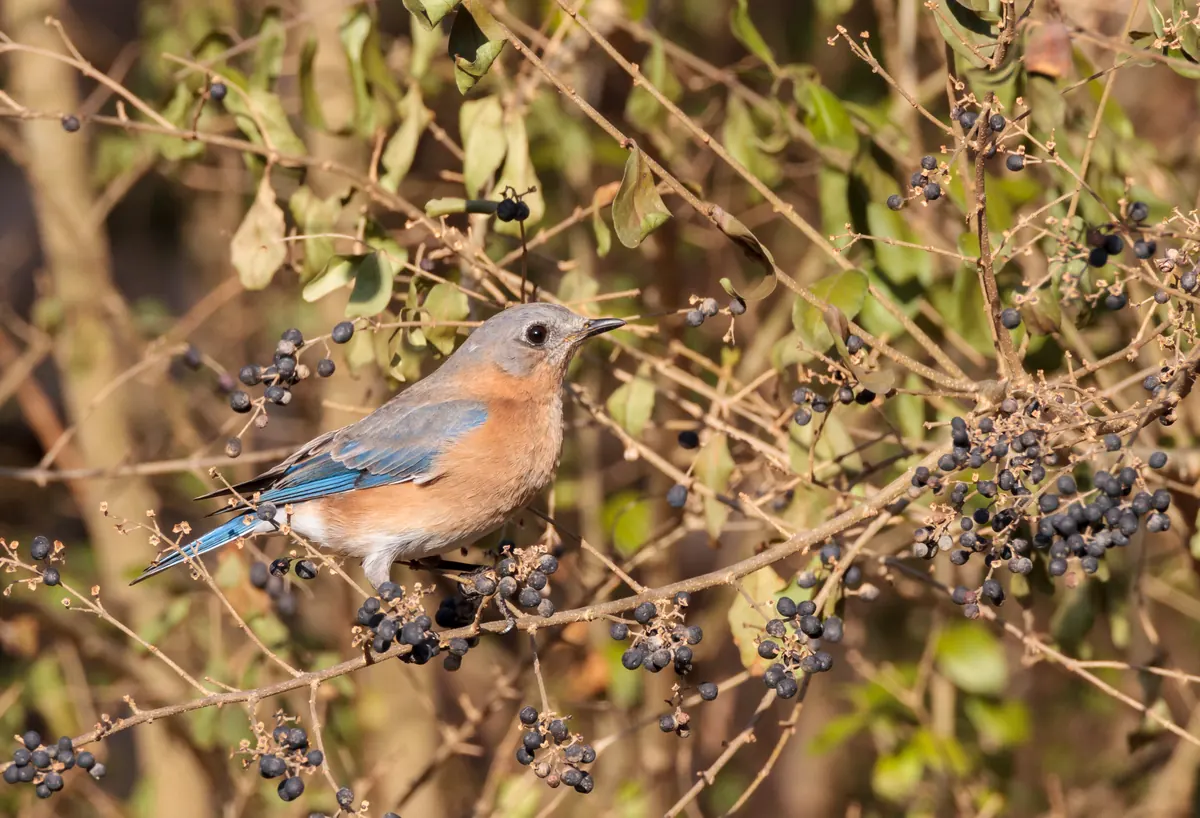
Eastern bluebirds
Pairs check boxes on mild late-winter days; two or three broods a year · Open lawns, pastures, golf courses and fence lines
Georgia DNR’s Out My Backdoor column says bluebirds in the state nest two or three times a year, usually laying four or five eggs and sometimes as many as seven, and that nest building normally takes four or five days. If you have a box, clean out old nesting material now. DNR’s nest box guide asks for an entrance exactly an inch and a half across, no perch, a mounting height of four to 15 feet on a pole such as three-quarter-inch electrical conduit with a predator guard, and boxes at least 100 yards apart. Boxes left up all winter serve as roosts on cold nights.
-
The Great Backyard Bird Count
Friday, February 12, through Monday, February 15, 2027 · Anywhere: a yard, a park, a balcony
According to the National Audubon Society, a partner in running it, the 30th count is set for Friday through Monday, February 12 to 15, 2027. A single quarter hour of watching on any of those days is enough, and lists go in at birdcount.org.
-
Hawks and owls nesting early
From midwinter · Neighborhood woods, parks and river corridors
Raptors do not wait for spring. Federal wildlife biologists note that red-tailed and red-shouldered hawks start courting and carrying sticks to their nests in midwinter, so a pair wheeling over a wooded creek with dives and sharp, piercing calls is a sign that a nest is nearby. They add that great horned owl courtship is well underway by late January and some are already nesting; listen for their deep, soft hooting in the hour after sunset.
Project FeederWatch keeps going until April 30, so a February count adds to the winter record. Last month’s guide, January in Georgia, covers the winter hummingbirds and the finch outlook.
Is February still winter in Georgia, and what might El Niño do?
Yes, though it warms quickly. In NOAA’s 1991–2020 normals, afternoons in February average about 58 °F in Atlanta and Athens and 65 °F in Savannah, four degrees or so warmer than January. Atlanta averages almost eight nights at or below freezing in February and Savannah about four, while Blairsville in the mountains still averages more than 19. Normal snowfall is small everywhere: 0.4 inch at Atlanta and Blairsville, 0.3 at Augusta and none at Savannah or Columbus. At Blairsville, March’s normal snowfall of 1.0 inch is actually higher than February’s.
The last spring freeze is still ahead for much of the state, especially inland and in the north. Check your own town’s odds on the Georgia frost date tables before setting out tender plants.
February can still deliver a crippling ice storm. On February 11 to 13, 2014, the Peachtree City forecast office recorded 2 to 5 inches of snow north of a line from Rome to Gainesville, then a second round as cold air wedged in from South Carolina: a quarter to over half an inch of ice near Atlanta and more than three-quarters of an inch along I-20 toward Augusta, amounts the office said had not been seen there in decades.
| Station | Average high | Average low | Rain and melted snow | Freezing nights | Snowfall |
|---|---|---|---|---|---|
| Blairsville | 53.2 °F | 27.7 °F | 4.76 in | 19.4 | 0.4 in |
| Athens | 58.9 °F | 36.9 °F | 4.36 in | 9.4 | – |
| Atlanta | 58.2 °F | 38.9 °F | 4.55 in | 7.7 | 0.4 in |
| Augusta | 63.5 °F | 38.1 °F | 3.67 in | 10.4 | 0.3 in |
| Macon | 63.4 °F | 39.1 °F | 4.17 in | 8.3 | – |
| Columbus | 63.2 °F | 41.5 °F | 4.46 in | 5.5 | 0.0 in |
| Savannah | 65.1 °F | 42.9 °F | 2.80 in | 4.2 | 0.0 in |
This winter comes with an unusually loud signal from the Pacific. Georgia heads into it with a very strong El Niño all but certain: in its September 10, 2026, update NOAA rated the chance at over nine in ten for fall and winter. For late winter in particular, the Tallahassee forecast office, which serves southwest Georgia, points to two things. El Niño pushes storm tracks farther south, bringing more cloud, rain and severe weather to the Southeast, and the region’s rivers tend to peak in flooding in late February and early March, with most river floods in El Niño years coming during strong episodes. The Peachtree City office expects north and central Georgia to lean wetter and cooler than normal in El Niño winters, while noting that statewide spring tornado counts have averaged lower in El Niño years than in others.
NOAA’s official seasonal outlooks are refreshed every month; look up the current temperature and precipitation maps for late winter at NOAA’s seasonal outlooks. For this week’s forecast in your town, open our weather page.
How much daylight does Georgia gain in February?
Close to an hour, and noticeably faster than in January. Atlanta’s day stretches from 10 hours 34 minutes on February 1 to 11 hours 26 minutes on February 28, a gain of 52 minutes, and both ends of the day now move: sunrise slips earlier while sunset gets later. Atlanta’s sun sets at 6:09 p.m. on Groundhog Day and at 6:26 p.m. on February 20. The mountains gain the most, south Georgia the least, as the table shows.
Groundhog Day, Tuesday, February 2, falls a day or two before winter’s true astronomical midpoint, which comes on February 3 to 4 depending on how it is measured. Georgia’s own forecaster, General Beauregard Lee, now lives at Dauset Trails Nature Center in Butts County; check with the nature center for this year’s plans. Daylight saving time returns on Sunday, March 14.
| City | Feb 1 | Feb 28 | Gained | Per day |
|---|---|---|---|---|
| Blairsville | 10 h 31 m | 11 h 24 m | 53 min | 2.0 min |
| Rome | 10 h 33 m | 11 h 25 m | 52 min | 1.9 min |
| Atlanta | 10 h 34 m | 11 h 26 m | 52 min | 1.9 min |
| Athens | 10 h 33 m | 11 h 25 m | 52 min | 1.9 min |
| Macon | 10 h 37 m | 11 h 27 m | 50 min | 1.9 min |
| Columbus | 10 h 39 m | 11 h 28 m | 49 min | 1.8 min |
| Savannah | 10 h 40 m | 11 h 28 m | 48 min | 1.8 min |
| Valdosta | 10 h 44 m | 11 h 30 m | 46 min | 1.7 min |
To see exactly when the sun rises and sets over your street on any day, try the daylight calculator.
What can you see in Georgia’s night sky in February 2027?
Two bright planets at opposition in the same constellation, Mercury’s best evening show of the winter, a full moon that rises in the middle of a faint eclipse, and a solar eclipse that will not be visible from anywhere in the United States. All times are Eastern Standard Time.
-
Mercury after sunset
Late January to about February 10; widest from the sun February 3 · Low in the west-southwest, 30 to 45 minutes after sunset
Mercury swings 18 degrees out from the sun at 1 a.m. on February 3, so the evenings around February 2 and 3 are the best. Find a flat western horizon. Look again Sunday evening, February 7, when a whisker-thin Moon a day past new hangs near Mercury; in Atlanta it is only a percent or two lit and sets at 7:23 p.m., so use binoculars, and only after the sun is completely below the horizon.
-
Jupiter at opposition
Wednesday, February 10, 7:21 p.m. · East at dusk, high in the south around midnight, in Leo
With Earth lined up between Jupiter and the sun, the giant planet comes up at sunset, stays up all night and shines at magnitude −2.5, outshining every star. It is about 405 million miles away that day. A small telescope shows the cloud belts and the four big moons.
-
Mars at opposition
Friday, February 19, about 10 a.m.; closest on February 20 · Rising in the east at dusk, also in Leo
Mars follows Jupiter to opposition just nine days later. Mars is loitering near aphelion, so this meeting is a far-off one by Martian standards; the orange planet shines at about magnitude −1.2 and comes no nearer than roughly 63 million miles. Even so, it will not be closer until 2029, and it is a fine sight beside Jupiter.
-
The Snow Moon and a faint eclipse
Full at 6:23 p.m., Saturday, February 20 · Low in the east at moonrise
The Moon slides through Earth’s outer, pale shadow that afternoon in a penumbral eclipse: it begins at 4:12 p.m., is deepest at 6:13 p.m. and ends at 8:13 p.m. The Moon rises at 6:12 p.m. in Savannah, right at the deepest point, and at 6:24 p.m. in Atlanta, a few minutes after. At best you might see a faint gray shading on one edge of a Moon that is still low in bright twilight; most people will notice nothing. Some almanacs count this as a supermoon and others do not, so call it a near-supermoon. The same evening the Moon, Jupiter, Regulus and Mars gather in Leo, and on the night of the 19th the almost-full Moon slips just past Jupiter.
-
Venus and Saturn
All month · Venus in the southeast before dawn; Saturn low in the west after dusk
Venus blazes in the southeast before dawn all month. Saturn, by contrast, drops closer to the western horizon with every week of evening twilight.
| Phase | Date | Time |
|---|---|---|
| New moon | Saturday, Feb 6 | 10:56 a.m. |
| First quarter | Sunday, Feb 14 | 2:58 a.m. |
| Full moon (Snow Moon) | Saturday, Feb 20 | 6:23 p.m. |
| Last quarter | Sunday, Feb 28 | 12:16 a.m. |
| New moon | Monday, Mar 8 | 4:29 a.m. |
The new moon of February 6 brings an annular solar eclipse over South America, the South Atlantic and West Africa; none of it, not even a partial phase, can be seen from the United States. Instead, use the moonless evenings around that date, roughly February 2 to 11, for the darkest skies of the month. Our cloud forecast map shows whether a drive to dark skies is worth it, and the moon phase pages list moonrise and moonset.
What can Georgia families do outside in February 2027?
- Count birds for four days. The Great Backyard Bird Count runs February 12 to 15, 2027. Fifteen minutes at a window counts; let children keep the tally.
- Hold a martin watch. If a neighbor, school or park has a martin house or gourd rack, visit at sunrise in the middle of the month and listen for the first arrivals, then compare your date with the DNR’s regional timetable.
- Go out at dusk for woodcock. On a mild, still evening, wait at a wet field’s edge from sundown until full dark and listen for the peent. It is a perfect first night outing for older children.
- Build or clean a bluebird box. Georgia DNR publishes free box plans; a box with a 1½-inch hole on a greased metal pole is a simple weekend project.
- Look at Jupiter. On February 10 or any clear night that week, a steadily held pair of binoculars shows Jupiter’s moons, and their positions change from night to night. Draw them each evening for a week.
- Hunt for the first flowers. Take a walk along a shady creek in rich woods and look for trout lily leaves and bloodroot; on the way home, check fencerows for jessamine.
Georgia State Parks list only a few February programs this far ahead; most are added to the parks’ events calendar during the winter, so check it in January. Children can keep notes and sketches from every trip in the Naturalist’s Field Journal.
Plans change with the weather, so call ahead before any program. Our month-by-month nature guides cover every state, and the December guide for Georgia tells the story of the cranes’ fall arrival in the Okefenokee.
Safety notes for February in Georgia
- Small game seasons end on February 28. Under Georgia’s 2026–27 regulations, squirrel, rabbit, quail and grouse hunting stay open through the last day of the month, as do fox and bobcat hunting and trapping and the trapping of mink, muskrat, otter, skunk and weasel. Raccoon and opossum may be hunted on public land until February 28. Deer, bear and duck seasons are all closed.
- The orange rule is over for now. Georgia’s rule calling for at least 500 square inches of hunter orange or blaze pink, worn on the upper body, covers deer, bear and feral hog hunters, and those with them, during firearms and primitive weapons seasons, which ended in January. Rabbit and squirrel hunters are still in the woods, so a bright hat or jacket remains sensible on WMAs and national forest land.
- Ice and late snow. February ice storms have brought down trees and power lines across north and central Georgia, as in 2014. Stay off trails under ice-loaded pines and away from downed lines.
- High water. Rivers in the Southeast are most likely to flood in late February and early March, and an El Niño winter raises the odds. Never drive or walk into flooded roads, and check river levels before paddling.
- Storms can come early. Severe thunderstorms and tornadoes can strike Georgia in any month. Have warnings turned on for your phone or a NOAA weather radio, especially on warm, humid February days ahead of a cold front.
- Cold water. A 70-degree February afternoon does nothing for water temperature, which lags weeks behind the air. Paddlers should wear a life jacket every trip.
Sources
- Georgia DNR, Out My Backdoor: the scouts are here (purple martins)
- Purple Martin Conservation Association: timing and scout arrival map
- Georgia DNR, Out My Backdoor: harbingers of spring (northbound sandhill cranes)
- U.S. Fish and Wildlife Service: Okefenokee NWR, Sights and Sounds of Winter, by a refuge ranger (PDF)
- Bird Watcher’s Digest: Georgia birding by season, winter
- eBird: submit sightings
- National Audubon Society: go see the American woodcock’s sky dance
- Georgia DNR, Georgia Birding Trails: Harris Neck National Wildlife Refuge
- U.S. Fish and Wildlife Service: Harris Neck National Wildlife Refuge
- Georgia DNR Wildlife Conservation Section: Conserving Georgia’s Wildlife, fiscal year 2025 report (PDF)
- U.S. Fish and Wildlife Service: wood stork delisted (February 2026)
- Georgia DNR: American shad project
- NOAA Institutional Repository: determination of American shad spawning location in the Altamaha River system
- Georgia Native Plant Society: Carolina jessamine
- Georgia Native Plant Society: dimpled trout lily
- Georgia Native Plant Society: bloodroot
- Georgia DNR, Out My Backdoor: bluebird nesting
- Georgia DNR: creating the perfect home for bluebirds, nest box plans (PDF)
- National Audubon Society: Great Backyard Bird Count (February 12–15, 2027)
- Great Backyard Bird Count
- Project FeederWatch: how to participate
- NOAA NCEI: 1991–2020 monthly normals for Georgia stations (data API)
- NWS Charleston: first and last freeze dates, 1991–2020 (PDF)
- NWS Peachtree City: the February 11–13, 2014 winter storm
- NWS Peachtree City: El Niño influences in north and central Georgia
- NWS Tallahassee: El Niño and its effect on the Southeast U.S.
- Climate Prediction Center: ENSO diagnostic discussion, September 10, 2026
- Climate Prediction Center: three-month outlooks
- 11Alive: groundhog General Beauregard Lee gets a new home at Dauset Trails Nature Center
- U.S. Naval Observatory: moon phases from December 30, 2026
- U.S. Naval Observatory: Earth’s seasons, 2027
- U.S. Naval Observatory: sun and moon data for Atlanta, February 2, 2027
- U.S. Naval Observatory: sun and moon data for Atlanta, February 7, 2027
- U.S. Naval Observatory: sun and moon data for Atlanta, February 20, 2027
- U.S. Naval Observatory: sun and moon data for Savannah, February 20, 2027
- Fred Espenak, Sky Event Almanac 2027 (planet and moon events)
- Sea and Sky: astronomy calendar of celestial events, 2027
- SEDS: Mars opposition of 2027
- NASA eclipse website: lunar eclipses, 2021–2030
- NASA eclipse website: solar eclipses, 2021–2030
- Georgia State Parks: events calendar, February 2027
- Georgia DNR hunting regulations: small game and trapping seasons, 2026–27
- Georgia DNR hunting regulations: migratory bird seasons, 2026–27
- Georgia DNR hunting regulations: hunter orange and blaze pink
- U.S. Fish and Wildlife Service: birds offer early signs of spring (hawk and owl courtship in midwinter)
- Federal Register: removal of the Southeast U.S. distinct population segment of the wood stork from the federal list (February 10, 2026; effective March 12, 2026)
- Photos via Wikimedia Commons; licenses and photographers are credited under each picture
