What to look for in nature in Georgia this January
January is Georgia’s coldest month on average, and it is also a month of nests and newborns. Eaglets hatch in tall pines, great horned owls sit on eggs through frosty nights, right whale calves nurse off the barrier islands, and spotted salamanders walk to rain-filled pools. A rufous hummingbird may even turn up at a backyard feeder. This guide walks the state from mountains to marsh, giving each event its usual window and naming where every date comes from.
Other months in Georgia: October, November, December, February.
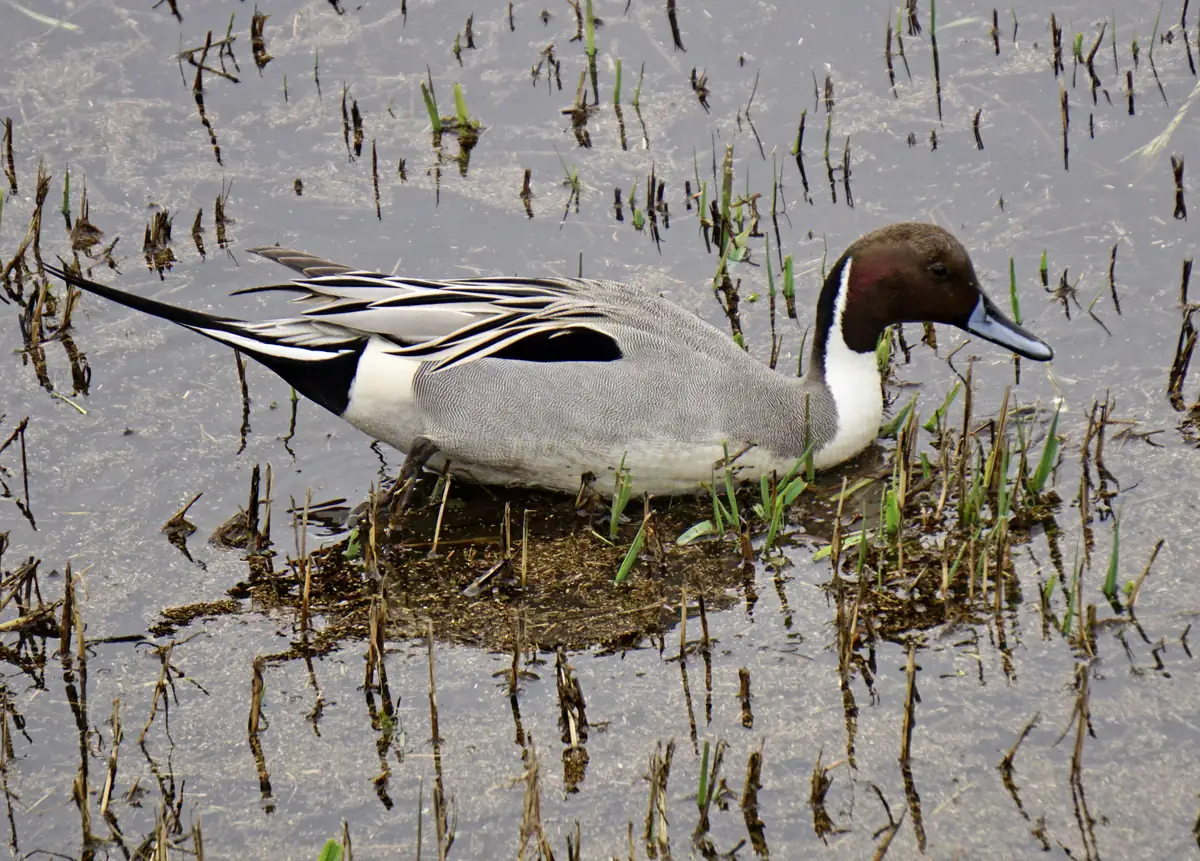
Start here
- Leave a feeder up for a winter hummingbird. Rufous hummingbirds from the West spend November to February in Georgia; in some years 75 to 100 are reported. Keep one nectar feeder half full and photograph any visitor.
- Catch the Quadrantids before dawn. The shower’s brief maximum falls in the night between January 3 and 4, and the thin crescent stays down in Atlanta until 5:16 a.m. on the 4th. Face northeast from the darkest spot you can reach.
- Find a cranefly orchid leaf. On any woodland walk, look for a single pleated, purple-spotted leaf flat on the leaf litter. It grows in every Georgia county and is easiest to spot in winter.
For the Naturalist’s Field Journal: log the Quadrantid count and the Wolf Moon on the dusk and dawn watch page, add any winter hummingbird or finch to birds I have seen, draw the cranefly orchid leaf on the reading the signs page, and if an eagle or owl nests near you, fill a nest observed page and return to the spot for the same place twice page as the young grow.
Regions used below: Mountains (Blue Ridge and Ridge and Valley); Piedmont and Metro Atlanta; Coastal Plain; Coast and Barrier Islands; Southwest Georgia.
When do bald eaglets hatch in Georgia, and how does the DNR count nests?
Eggs laid in late fall and December start to hatch now, and January is also when a state biologist takes to the air to see which nests are in use. Georgia DNR’s nesting calendar gives January and February as the hatching months, with each clutch hatching over several days.
-
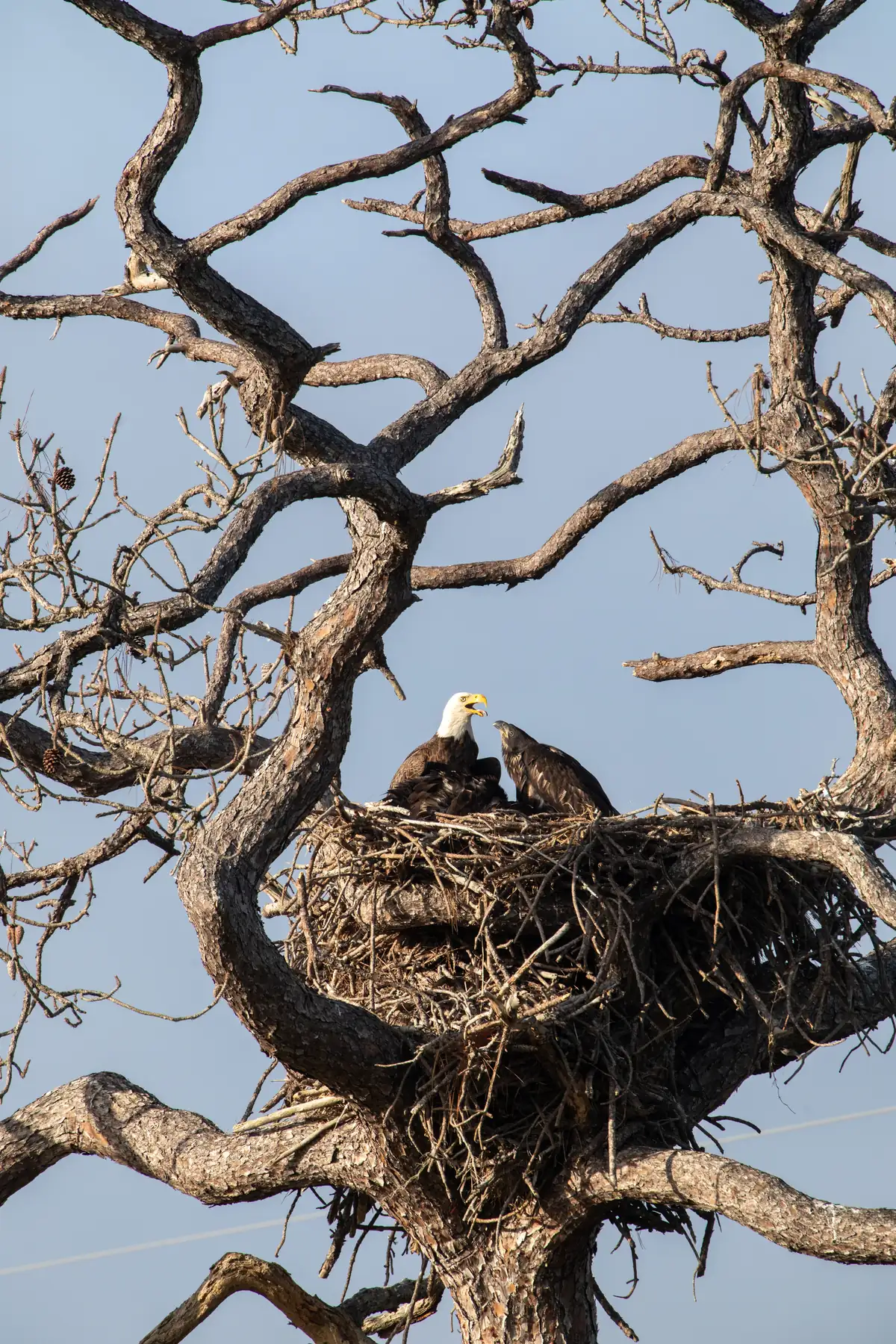
Eaglets in the nest
Hatching January and February; young leave the nest late March to early May · Tall pines near the coast, big reservoirs and the lower rivers
A nest with a chick in it looks different from one with eggs. The adult stands on the rim or perches close by instead of lying flat, and it flies in with food several times a day. Small gray heads do not show above the sticks for the first couple of weeks, so the first clue is usually a parent tearing food and bending low. The DNR says young fledge from late March to early May, and as late as June in the north Georgia mountains.
Stay at least 330 feet back, the distance in federal guidelines, and watch from a car or a public road with binoculars.
-
The midwinter helicopter survey
Flights in January and February, then again in March and April · Five survey regions; the coast is flown every year
The Wildlife Conservation Section splits Georgia into five parts and checks eagle territories by helicopter. Winter flights mark which nests are occupied; spring flights count the ones that fledged at least one young. The coast is covered every year, other regions at least every second year, and the whole state once every five years. In the 2026 season the team recorded 119 occupied territories in the areas it checked, 101 of them successful, with 170 eaglets raised, an 85 percent success rate. Georgia has held more than 200 nesting territories a year since 2015, against 55 a quarter century ago.
-
Great horned owls sitting tight
Eggs in the coldest weeks; owlets nearly full grown four weeks after hatching · Old hawk, crow and squirrel nests from downtown Atlanta to Sea Island
The owls you heard courting in December are now on eggs. A DNR naturalist’s column notes that the female alone incubates, rarely leaving because the eggs can freeze, and that she begins sitting with the first egg, so one owlet is noticeably bigger than the other. Newly hatched owlets are about the size of baby chickens. Look for a pair of ear tufts over the rim of a red-tailed hawk nest, often 40 to 70 feet up, and for gray-brown pellets three to four inches long on the ground below.
| Survey area | Occupied territories | Successful nests | Young fledged | New nests |
|---|---|---|---|---|
| Coast | 81 | 66 | 112 | 3 |
| Northeast and central Georgia | 22 | 20 | 31 | 4 |
| Nests checked outside the flights | 16 | 15 | 27 | 4 |
| All areas checked | 119 | 101 | 170 | 11 |
Found a nest the DNR may not know about? Its eagle page explains how to report one; public tips turn up roughly ten new nests a year.
Why is there a hummingbird at a Georgia feeder in January?
Because Georgia has a second hummingbird season. Ruby-throated hummingbirds leave in the fall, but a small number of western hummingbirds spend the winter here, and the DNR has been asking people to watch for them since 1989.
-
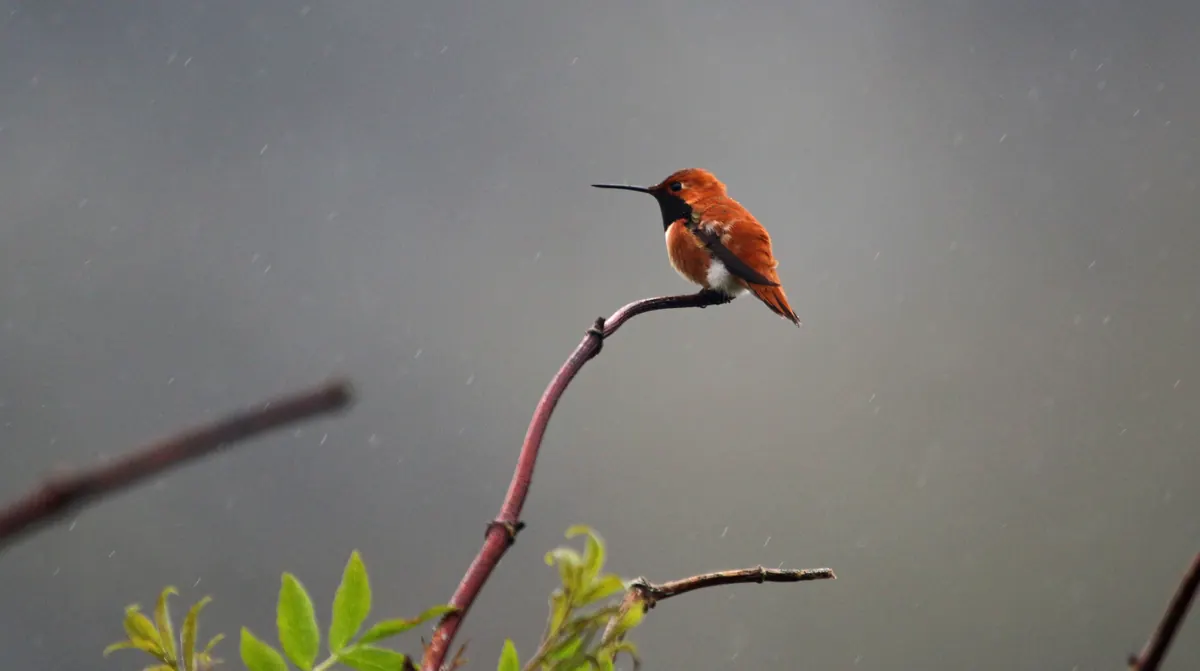
Rufous hummingbirds
November through February, some staying into March · Backyard feeders statewide, many reports from metro Atlanta
The rufous hummingbird is by far the most frequent winter hummer in the state, with 75 to 100 reported in some years, according to the DNR’s Out My Backdoor columns. Adult males glow orange-copper; females and young birds are greener with rusty flanks and a rusty base to the tail. They nest as far north as Alaska, and they handle frosty Georgia nights well as long as food is available.
The species is in trouble overall. A DNR column counts it among 70 North American birds that have lost at least half their numbers in the past 50 years, a decline of about 2 percent a year.
-
Rarer winter visitors
Any time in the cold months · Feeders and winter-blooming gardens
Twelve hummingbird species have been recorded in Georgia. Most winter records came only after the DNR’s Hummingbird Helper program asked homeowners to keep one feeder up all winter and report what came to it; before it, no more than half a dozen rufous hummingbirds were reported a year, and by 1995 the count passed 200.
To join in, hang one feeder only half full so the nectar is replaced before it spoils, keep it from freezing on the coldest nights, and photograph any visitor. Banders can often tell the species from a clear picture of the tail.
Will pine siskins and purple finches come to Georgia feeders this winter?
Probably only a few. Northern finches move south in the years when cone and seed crops fail in Canada’s forests. In its 2026–27 outlook, released September 25, the Finch Research Network found cone and seed crops strong across the eastern boreal and New England, and it says plainly that it expects no big finch irruptions in the Southeast this winter.
-
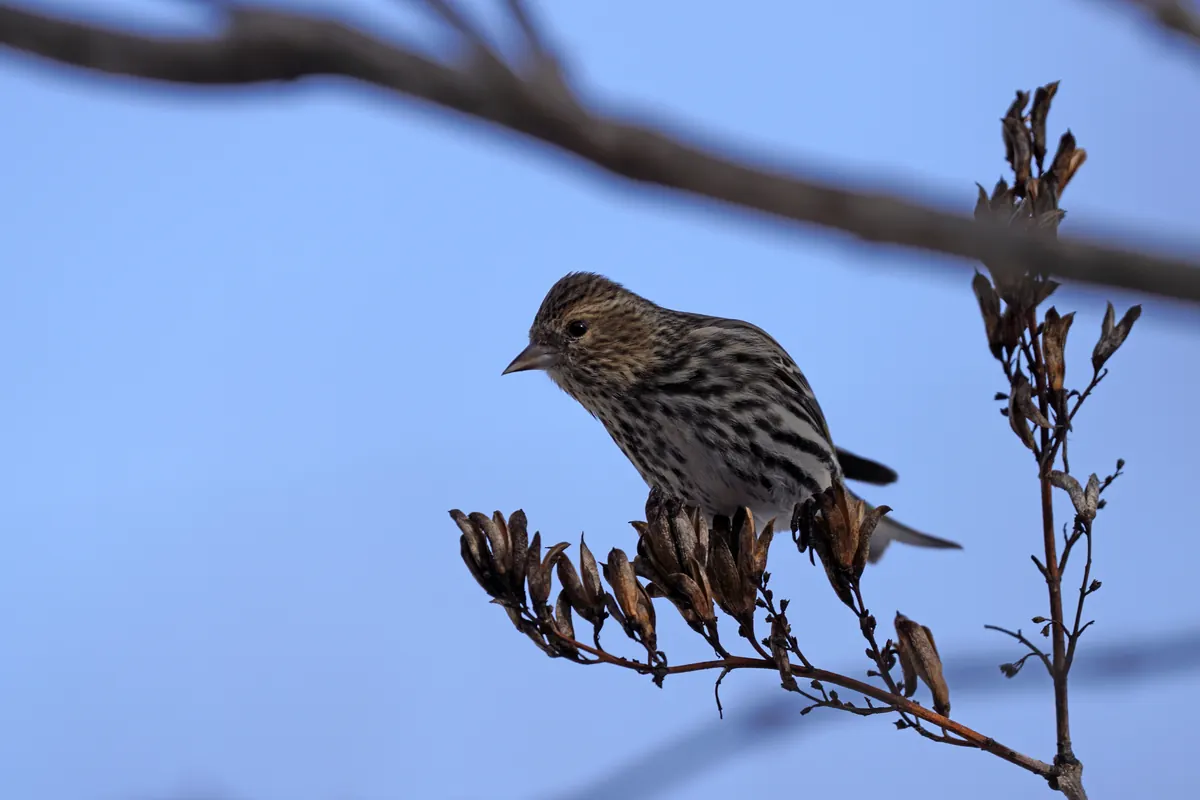
Pine siskins
A small to moderate flight is possible this winter · Thistle and sunflower feeders, sweetgum and pine seeds
Small, streaky brown finches with a sharp, slender bill and yellow edging that shows in the wings and tail. The forecast expects most to stay in the Northeast, but adds that a small to moderate flight could still reach the southeastern states. If siskins come, they often arrive in noisy flocks that empty a feeder in a morning.
-
Purple finches and red-breasted nuthatches
Few expected this year · Feeders near woods, especially in north Georgia
Last winter’s strong push of red-breasted nuthatches into the Southeast is not expected to repeat, and any purple finch movement will likely be small and late. Male purple finches look dipped in raspberry juice; the common house finch is streakier, with red mostly on the head and breast.
-
The everyday winter crowd
All month · Backyards statewide
Even in a quiet finch year, January feeders draw winter-only birds that bred far to the north: white-throated sparrows scratching under shrubs, dark-eyed juncos in the mountains and Piedmont, and yellow-rumped warblers at suet. Watch for a ruby-crowned kinglet flicking its wings in the shrubs.
Project FeederWatch runs from November 1 to April 30: choose any two back-to-back days, note the highest number of each kind in view together, and send in the tallies. A blank count still counts, because it shows a finch year that wasn’t.
Where can you see wintering ducks in Georgia in January?
Old rice fields and refuge ponds on the coast hold the most variety. January is the last full month of the duck season in Georgia (it closes on January 31), so check hunt days before visiting a wildlife management area.
-
Altamaha Waterfowl Management Area
Fall and winter for ducks; eagles winter into spring · Impoundments and viewing towers beside U.S. 17 near Darien
About 3,150 acres of managed impoundments on a former rice plantation, with viewing towers on both sides of the highway. The DNR’s birding trail guide names American black duck, pintail, green-winged teal and shoveler among the cold-season ducks, Wilson’s snipe probing the exposed mud, and bald eagles in winter and spring. A hunting or fishing license or a Georgia lands pass is needed to visit.
-
Harris Neck National Wildlife Refuge
Wintering waterfowl and sparrows · Four-mile Wildlife Drive near Townsend, McIntosh County
More than 2,700 acres of salt marsh, freshwater ponds, woods and fields where 342 bird species have been recorded. In winter the freshwater ponds collect ducks, and the edges of the fields hold sparrows. Woody Pond, quiet now, fills with nesting wood storks and egrets from late February.
A spotting scope helps, since ducks often rest in the far corners of an impoundment. Females are harder than the drakes, so learn the males first and look for pairs.
Are right whale mothers and calves still off Georgia in January?
Yes. NOAA Fisheries defines calving season as running mid-November through mid-April. Pairs born in December are still nursing in the warm, shallow water off the barrier islands through January, and late births keep coming.
-
Mother and calf pairs
All month; some new pairs are first seen in January · Roughly 7 to 40 miles out in the 2025 sightings, off Wassaw, Ossabaw, Blackbeard, St. Simons and Cumberland
Survey crews identified 23 calves in the 2026 season. Five of the mothers were first photographed with their calves off Georgia between December 17 and December 27, 2025, from about 7 miles off Blackbeard Island to 38 miles off Ossabaw. Some pairs turn up later: in January 2021 a mother called Magic was seen with a calf off Little Cumberland Island on January 4, and another female, No. 3720, off Wassaw Island.
A young calf stays pressed against its mother’s side, so a long dark back with a smaller hump beside it is the shape to watch for.
Federal law keeps everyone 500 yards from a right whale. Report any you see to 877-WHALE-HELP (877-942-5343); the mother’s white head markings let researchers tell who she is from a phone photo.
Which salamanders and frogs breed in Georgia’s January rains?
Several species time their breeding to winter, when shallow rain-filled pools hold no fish. A mild night with steady rain after a cold spell is the signal to look.
-
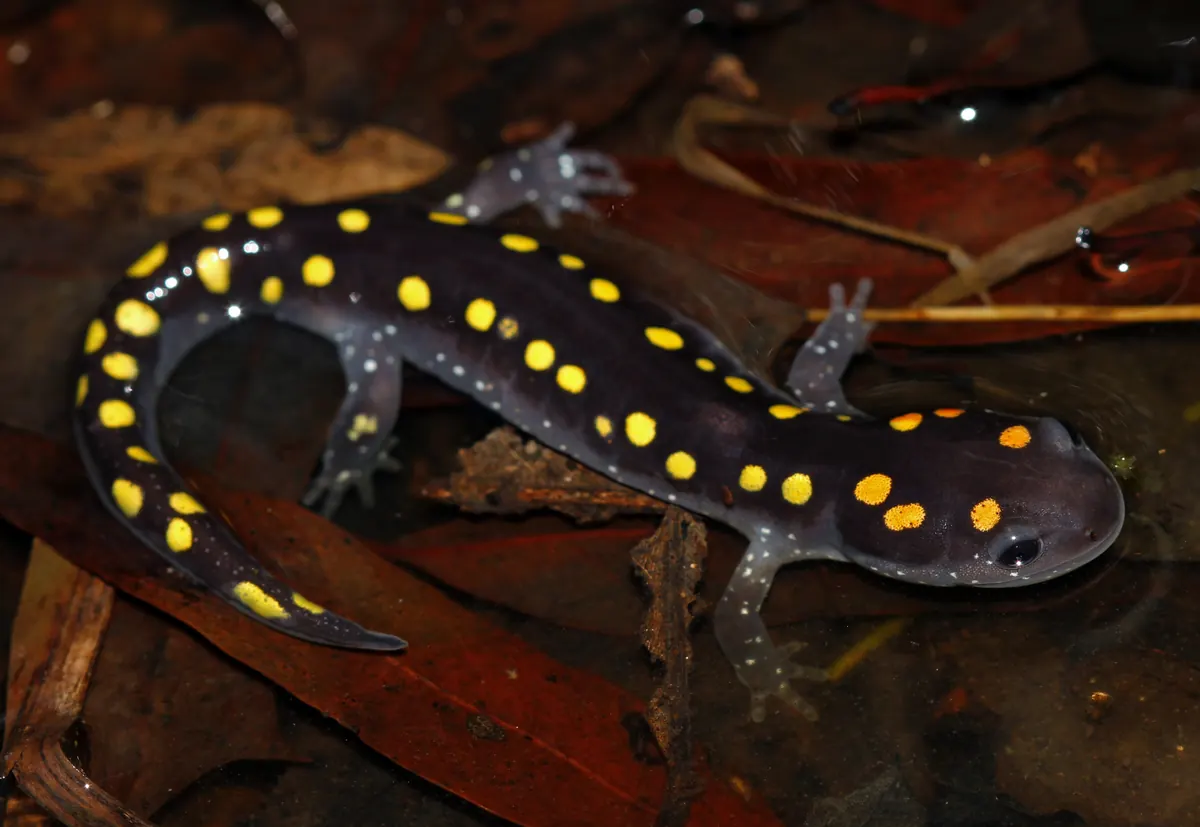
Spotted salamanders
Winter and early spring rains · Piedmont and mountains; scarce in the Coastal Plain and absent from the southeast
A black salamander six to nine inches long with two rows of yellow or orange spots, rarely seen except on the nights it walks from its burrow to a pool. The University of Georgia’s Savannah River Ecology Laboratory notes that females lay clumps of up to 200 eggs, often tinted green by algae that live inside the jelly, and that adults can live for two decades.
-
Ornate chorus frogs
November through March, before the peepers · Grassy, fishless ponds, Carolina bays and ditches of the Coastal Plain
A small frog that comes in gray, green or reddish brown, with a black stripe through the eye and yellow in the groin. The call is a sharp, metallic “tink” repeated fast, a little like a rapidly struck bell. It is secretive and rarely found away from its winter breeding pools.
-
Wood frogs
Late winter, often in the first warm rains · Vernal pools in the north Georgia mountains only
Tan frogs with a dark robber’s mask, at the very southern edge of a range that reaches above the Arctic Circle. Males gather for a few nights and give a short, duck-like quack; egg masses appear soon after.
-
Marbled salamander larvae
Hatched in fall pools; growing all winter · Shallow woodland pools across most of the state except the southeast
Marbled salamanders breed in autumn, and their larvae spend the winter in the pools that rain refilled. A slow look into clear shallow water with a flashlight may show small gilled larvae on the leaves.
Drive slowly on wooded back roads on rainy nights, never move animals to a new pool, and with wet hands carry any animal on a road to the side it was facing. A photo uploaded to iNaturalist adds a dated record.
What is green or blooming on the Georgia forest floor in January?
With the leaves down, plants that do their growing in winter show up against the brown litter. All four below appear in the Georgia Native Plant Society’s plant library.
-
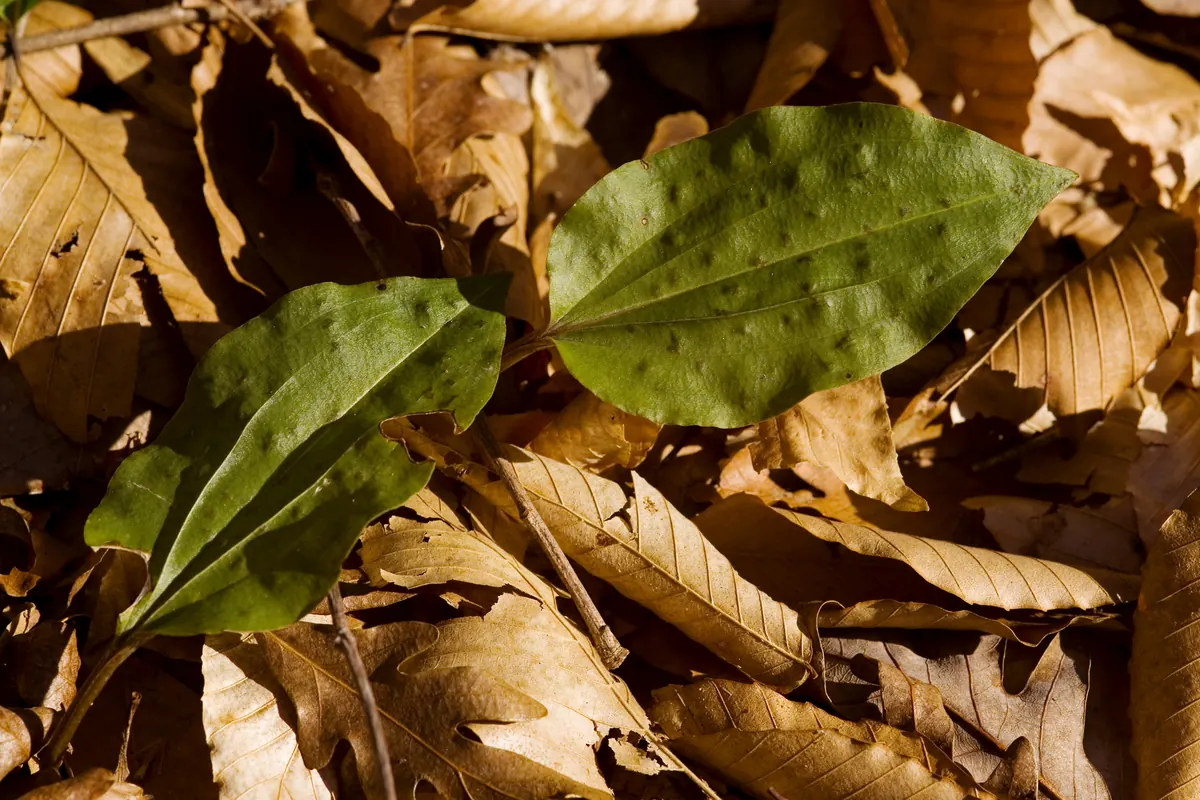
Cranefly orchid
Leaf visible from fall until it withers in summer · Hardwood and pine woods in every Georgia county
A single pleated leaf lying flat on the ground, dull green with purple blotches on top and purple underneath. The GNPS says a winter walk after leaf fall is the best time to find this orchid, which flowers in late summer, after the leaf has gone. Turn one gently and the purple underside gives it away.
-
Partridgeberry
Red berries persist through winter · Shady woods statewide, often under fallen leaves
A creeping evergreen with paired, round leaves marked by a pale midvein and single scarlet berries, each with two small dimples where the twin flowers fused. The berries can hang on until the plant blooms again in summer.
-
Round-lobe hepatica
Burgundy winter leaves; flowers late winter to early spring · Rich, rocky wooded slopes and ravines, mostly the Piedmont and mountains
Three-lobed evergreen leaves that turn burgundy brown in winter, and one of the very first wildflowers, with blue, lavender or white stars on hairy stems. Look on north-facing ravine banks in late January for fuzzy buds.
-
Red maple in flower
Late winter into early spring · Swamps, floodplains, lake edges and yards
Red maple flowers in small dense red clusters before the leaves, and the GNPS calls them somewhat showy in late winter. From a distance a tree in bloom gives a reddish haze to a bare wetland edge, and the paired winged seeds follow within weeks.
Sketching a twig, a bud and a patch of bark from the same tree each month is the surest way to learn your woods, and the journal’s a tree through the seasons spread is built for exactly that.
Is January Georgia’s coldest month, and could El Niño make it wetter?
Yes, on average it is the coldest. In NOAA’s 1991–2020 normals the typical January low is 35.6 °F at Atlanta’s airport, a few degrees colder than December, and 25.4 °F at Blairsville. Atlanta averages about 13 January nights at or below freezing, Augusta about 15, Savannah about 9 and Blairsville 22. Afternoons average 54 °F in Atlanta and a little over 61 °F in Savannah.
Snow is possible but never something to count on. Normal January snowfall is 1.0 inch at Atlanta, 0.5 at Blairsville and 0.4 at Augusta, while Savannah’s normal is zero. Rain and melted snow total 4.6 inches at Atlanta and nearly 5.9 at Blairsville. Your own town’s frost odds are on our Georgia frost dates page.
Last winter showed what a rare southern storm can do. On January 31 and February 1, 2026, low pressure off the Carolinas spread dry, fluffy snow across southeast Georgia, the Charleston forecast office reported: 2.8 inches near Hopeulikit in Bulloch County, 1.2 at Metter and half an inch at the Savannah airport and on Tybee Island, followed by hard cold.
The tropical Pacific is the wild card this winter. Federal ENSO forecasters judged on September 10 that an unusually powerful warm event had better than 90 percent odds of holding on through fall and winter. The Tallahassee forecast office, which covers southwest Georgia, explains that El Niño strengthens the subtropical jet stream, steering storms farther south. Along the Gulf Coast and in the Southeast the result is usually a cooler, wetter, cloudier winter, not from extra Arctic outbreaks (there tend to be fewer) but from more rain-bearing lows and more storms. Farther north, the Peachtree City office says El Niño winters often run wetter and cooler than usual over portions of north and central Georgia, with the clearest effect in the cold season.
NOAA’s seasonal forecasters publish their first look at winter in mid-October, then revise it monthly; see the latest maps at its three-month outlook page. Our weather forecast covers the coming days town by town.
How much daylight does Georgia gain in January?
About half an hour in most of the state. Sunrise stays late, around twenty to eight in Atlanta, through the whole month, so nearly all of the gain shows up in the evening. Atlanta’s sun already sets at 5:40 p.m. on New Year’s Day, and its day grows from 9 hours 58 minutes on January 1 to 10 hours 32 minutes on January 31. The table shows each city’s gain, which is largest in the mountains, where the days were shortest.
| City | Jan 1 | Jan 31 | Gained | Per day |
|---|---|---|---|---|
| Blairsville | 9 h 51 m | 10 h 29 m | 38 min | 1.3 min |
| Rome | 9 h 55 m | 10 h 31 m | 36 min | 1.2 min |
| Atlanta | 9 h 58 m | 10 h 32 m | 34 min | 1.1 min |
| Athens | 9 h 56 m | 10 h 32 m | 36 min | 1.2 min |
| Macon | 10 h 02 m | 10 h 36 m | 34 min | 1.1 min |
| Columbus | 10 h 04 m | 10 h 37 m | 33 min | 1.1 min |
| Savannah | 10 h 06 m | 10 h 38 m | 32 min | 1.1 min |
| Valdosta | 10 h 12 m | 10 h 43 m | 31 min | 1.0 min |
For sunrise and sunset on any date where you live, open the daylight calculator.
What can you see in Georgia’s night sky in January 2027?
A strong meteor shower with almost no moonlight, the year’s biggest full moon, and Venus at its best before dawn. Times are Eastern Standard.
-
The Quadrantids
Peak predicted Sunday night, January 3, into the early hours of Monday, January 4 · Look northeast; the radiant climbs through the night
Active from late December to January 12, but the peak lasts only about six hours. Two predictions differ: about 10:30 p.m. Sunday from the American Meteor Society, and 12:47 a.m. Monday from EarthSky. Either way the best window in Georgia is the dark hours before dawn on the 4th, when the radiant is high. On the morning of the 4th the waning crescent, under a fifth lit, stays below Atlanta’s horizon until 5:16 a.m. From a rural field you might count several dozen in an hour; suburbs show a fraction.
-
Venus at greatest elongation
Sunday, January 3, and all month · Southeast before sunrise
On January 3 Venus reaches its widest angle from the Sun, 47 degrees, blazing at about magnitude −4.3 above the dawn horizon; a backyard telescope shows a half-lit disk.
-
Earth closest to the Sun
Saturday, January 2, 9:33 p.m. · Everywhere
At perihelion the planet is roughly 91.4 million miles from the Sun, about three million miles nearer than in early July. Georgia’s cold comes from low sun angles and short days caused by the axial tilt.
-
The Wolf Moon, closest full moon of 2027
Full at 7:17 a.m., Friday, January 22 · East at dusk on the 21st; west at dawn on the 22nd
The Moon is full about 14 hours after perigee, at 222,229 miles, the nearest the Moon comes at full phase all year. In Atlanta it rises at 5:08 p.m. on Thursday the 21st and is still above the western horizon at the full instant, setting at 7:51 a.m.; on the evening of the 22nd it rises at 6:25 p.m., still looking round.
-
Moon, Jupiter and Regulus
Evening of Saturday, January 23 · East after moonrise
A day past full, the Moon rises in Atlanta at 7:40 p.m. and keeps company with Jupiter, the brightest point beside it, while Regulus in Leo trails not far off as the night goes on. Jupiter is heading for opposition on February 10.
-
Mercury and Saturn
Mercury from late January; Saturn all month · Low west-southwest after sunset; Saturn in the southwest
During January’s final week, Mercury appears as a small bright point low in the west-southwest in bright twilight, which is building toward a good evening appearance in early February. Saturn, pale and steady, hangs in the southwestern sky after dusk and sinks a little lower every week.
| Phase | Date | Time |
|---|---|---|
| New moon | Thursday, Jan 7 | 3:24 p.m. |
| First quarter | Friday, Jan 15 | 3:34 p.m. |
| Full moon (Wolf Moon, a supermoon) | Friday, Jan 22 | 7:17 a.m. |
| Last quarter | Friday, Jan 29 | 5:55 a.m. |
| New moon | Saturday, Feb 6 | 10:56 a.m. |
The moonless evenings around the new moon of January 7 are the darkest of the month. Before heading out, check tonight’s cloud cover on our cloud map, and plan moonrise and moonset with the moon phase calendar.
What can Georgia families do outside in January 2027?
- Hike on New Year’s Day. Georgia State Parks rangers lead dozens of free or low-cost guided First Day Hikes each January 1, with a sticker for everyone who finishes. One already posted for January 1 and 2, 2027, is at Pickett’s Mill Battlefield near Dallas: three groups leave at 9:30 a.m., one of them led by a historian, with free hot chocolate ($3 to $7 admission, 770-443-7850). The rest go up on the parks’ events calendar in December.
- Finish the Christmas Bird Count. The 127th count runs through Tuesday, January 5, 2027. If a circle near you counts in the first days of January, the Georgia Ornithological Society’s schedule names the compiler to contact.
- Keep a feeder count. Project FeederWatch runs all winter, and one half-filled nectar feeder could bring a rufous hummingbird worth reporting.
- Go owling. On a still evening, stand at the edge of a park woodland at dusk and listen for the deep five-note hoots of great horned owls, then come back by day to look for pellets under big pines.
- Look into a winter pool. After a rainy spell, visit a shallow woodland pool by day with a clear jar; salamander larvae and egg masses are easy to see and easy to put back.
- Get ready for February. Cornell Lab and Audubon normally hold the Great Backyard Bird Count across four days in mid-February; the 2027 dates will be posted on birdcount.org. Record what you find in the Naturalist’s Field Journal.
Programs depend on weather, so call the park first. Other states and months are listed in our seasonal nature guides; the Georgia December page covers the first whale calves and the start of eagle nesting.
Safety notes for January in Georgia
- Deer season winds down. Under the 2026–27 rules, firearms deer season has already closed on December 31 in the Yellow and Cyan zones, ends January 10, 2027, in the Orange and Green zones and runs to January 15 in the Magenta zone. Archery hunting continues to January 31 in the extended-archery counties, which include Chatham, Clarke, Cobb, DeKalb, Fulton and Gwinnett. In the zones still open, January 1 is an either-sex day. Northern Zone bear season with firearms also ends January 10.
- Ducks, geese and small game. Duck, coot and goose seasons run to January 31 and woodcock to January 18. Quail, rabbit, squirrel and grouse seasons, and trapping for furbearers, stay open through February 28.
- Wear orange or pink near hunters. During the firearms and primitive-weapons seasons for deer and bear, a hunter and any companion need an outer garment showing 500 square inches or more of fluorescent orange or blaze pink worn above the waist. Hikers are exempt; even so, a vivid cap or vest is cheap insurance on WMAs and in the Chattahoochee-Oconee National Forest until deer season closes.
- Ice and freezing rain. Even a light glaze makes mountain trails, bridges and waterfall overlooks treacherous, and north Georgia roads can ice over while the rest of the state just gets rain. Check the forecast before driving to a trailhead.
- Cold water and cold nights. On a sunny January afternoon it is easy to forget that lakes and rivers are near their coldest; wear a life jacket on the water, dress in layers and carry a light, since it is dark by about six.
- Stay off the edges. Give resting ducks and shorebirds room, and keep well back from eagle and owl nests; a parent flushed from eggs or small young in freezing weather can lose the brood.
Sources
- Georgia DNR: bald eagle nesting calendar, survey timing and viewing distance
- Georgia DNR Wildlife Resources blog: Another banner year for bald eagles (July 7, 2026)
- Georgia DNR Wildlife Resources blog: Survey, eagle nesting relatively steady (July 8, 2025)
- Georgia DNR, Out My Backdoor: great horned owls may be nesting in your yard
- Georgia DNR, Out My Backdoor: the Christmas hummingbird?
- Georgia DNR, Out My Backdoor: rufous hummingbirds declining
- Finch Research Network: Winter Finch Forecast 2026–2027 (September 25, 2026)
- Project FeederWatch: how to participate
- Georgia DNR, Georgia Birding Trails: Altamaha Waterfowl Management Area
- Georgia DNR, Georgia Birding Trails: Harris Neck National Wildlife Refuge
- NOAA Fisheries: North Atlantic right whale calving season 2026
- NOAA Fisheries: North Atlantic right whale calving seasons archive, 2021–2025
- Georgia DNR: North Atlantic right whales (500-yard rule, sighting hotline)
- UGA Savannah River Ecology Laboratory: spotted salamander
- UGA Savannah River Ecology Laboratory: ornate chorus frog
- UGA Savannah River Ecology Laboratory: wood frog
- UGA Savannah River Ecology Laboratory: marbled salamander
- Georgia DNR: amphibians in your backyard
- Georgia Native Plant Society: cranefly orchid
- Georgia Native Plant Society: partridgeberry
- Georgia Native Plant Society: round-lobe hepatica
- Georgia Native Plant Society: red maple
- NOAA NCEI: 1991–2020 monthly normals for Georgia stations (data API)
- NWS Charleston: winter storm of January 31 to February 1, 2026
- NWS Tallahassee: El Niño and its effect on the Southeast U.S.
- NWS Peachtree City: El Niño influences in north and central Georgia
- Climate Prediction Center: ENSO diagnostic discussion, September 10, 2026
- Climate Prediction Center: three-month outlooks
- U.S. Naval Observatory: moon phases from December 30, 2026
- U.S. Naval Observatory: Earth’s seasons and perihelion, 2027
- U.S. Naval Observatory: sun and moon data for Atlanta, January 3, 2027
- U.S. Naval Observatory: sun and moon data for Atlanta, January 4, 2027
- U.S. Naval Observatory: sun and moon data for Atlanta, January 21, 2027
- U.S. Naval Observatory: sun and moon data for Atlanta, January 22, 2027
- U.S. Naval Observatory: sun and moon data for Atlanta, January 23, 2027
- American Meteor Society: meteor shower calendar (Quadrantids)
- EarthSky: Quadrantid meteor shower
- EarthSky: what is a supermoon (closest full moons)
- EarthSky: Venus at greatest western elongation
- Fred Espenak, Sky Event Almanac 2027 (planet and moon events)
- Georgia State Parks: First Day Hikes
- Georgia State Parks: events calendar, January 2027
- Georgia State Parks: Upon These Grounds, a First Day Hike at Pickett’s Mill (January 1, 2027)
- National Audubon Society: join the Christmas Bird Count
- Georgia Ornithological Society: Christmas Bird Count schedule
- Great Backyard Bird Count
- Georgia DNR hunting regulations: deer seasons and either-sex days, 2026–27
- Georgia DNR hunting regulations: big game seasons (bear zones), 2026–27
- Georgia DNR hunting regulations: migratory bird seasons, 2026–27
- Georgia DNR hunting regulations: small game and trapping seasons, 2026–27
- Georgia DNR hunting regulations: hunter orange and blaze pink
- Photos via Wikimedia Commons; licenses and photographers are credited under each picture
