What to look for in nature in Georgia this December
Meteorological winter begins on December 1, yet in Georgia the month is full of beginnings. Newborn right whales surface beside their mothers off the barrier islands, bald eagles settle onto eggs in tall pines, great horned owls duet at dusk, and spring peepers call from rain-filled ditches while the mountains wait for snow. Below are the Georgia stories of the month, with typical timing by region and a source behind each date.
Other months in Georgia: October, November.
Start here
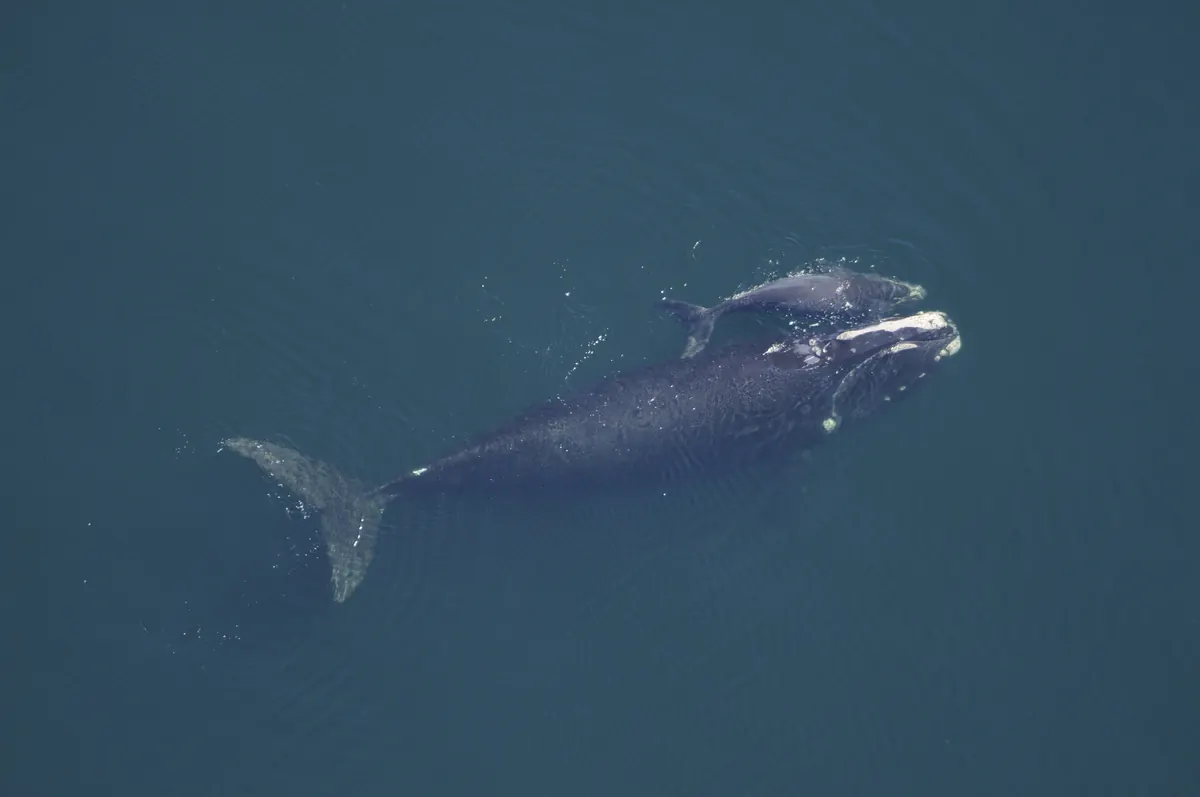
- Scan the sea for a newborn whale. In recent winters the first right whale calf of the season has been found off Georgia in the opening days of December: on December 1 in 2024, off Blackbeard Island, and on December 7 in 2022, off St. Catherines Sound. Any whale belongs to a species of about 385; call 877-WHALE-HELP and stay 500 yards away.
- Count birds for Audubon. Georgia birders fan out for the 127th Christmas Bird Count, which starts December 14 and wraps up January 5, 2027, in about 30 circles from Blue Ridge to Cumberland Island; in the 2024–25 count the Savannah team tallied 147 species. Anyone can join, free.
- Geminids, then the year’s closest full moon. Geminid meteors fly all night from Sunday, December 13, into Monday morning; in Atlanta the crescent Moon is down by 9:40 p.m. On Wednesday, December 23, the Cold Moon rises at 5:08 p.m. in Atlanta, full at 8:28 p.m. EST and nearer to Earth than any other full moon of 2026.
For the Naturalist’s Field Journal: put the owls’ dusk duet on the map-of-sounds page, list your Christmas Bird Count team’s species under birds I have seen, sketch a holly leaf or hemlock twig on seeds, pods and cones, and if eagles are incubating near you, start a nest-observed page and visit the same place twice, a month apart.
Regions used below: Mountains (Blue Ridge and Ridge and Valley); Piedmont and Metro Atlanta; Coastal Plain; Coast and Barrier Islands; Southwest Georgia.
When are right whale calves born off Georgia?
Mostly from December on, and each season’s first newborns tend to be found early in the month. The water off Georgia and northeast Florida is the only place the North Atlantic right whale is known to give birth, Georgia DNR says, and the species numbers about 385. Pregnant females arrive from November, and aerial survey teams watch the coast all winter.
-
The season’s first calves
Usually the first half of December · Often within about 15 miles of shore, off the barrier islands
The recent record is consistent. On December 1, 2024, an aerial team flying for Georgia DNR and NOAA Fisheries found right whale No. 2413, called Nauset, with her fifth documented calf about five nautical miles off Sapelo Island, near Blackbeard Island. On December 7, 2022, a 42-year-old female called Medusa turned up with her seventh calf roughly 13 miles off St. Catherines Sound, and a second pair the next day off Little St. Simons. In early December 2025 the season’s first pair, a mother called Champagne and her calf, was photographed off the coast near Savannah.
-
How to help from shore or a boat
Seasonal speed limits November 1 to April 30 north of Sapelo; November 15 to April 15 south of it · Sounds, inlets and nearshore water
It is the law to stay at least 500 yards from any right whale. Large vessels must slow to 10 knots or less in the seasonal zones, and the DNR asks small boats to slow down too, watch for a black back with no fin or a V-shaped blow, and idle if one appears. Report sightings to 877-WHALE-HELP (877-942-5343) or the Coast Guard on VHF channel 16.
Calm, clear mornings give the best odds from a pier or beach on Jekyll, St. Simons or Tybee.
When do Georgia’s eagles and great horned owls lay their eggs?
Now. Georgia’s two biggest predatory birds both nest in the dead of winter, months ahead of the songbirds, so that their young are learning to hunt when spring food is easiest to catch.
-
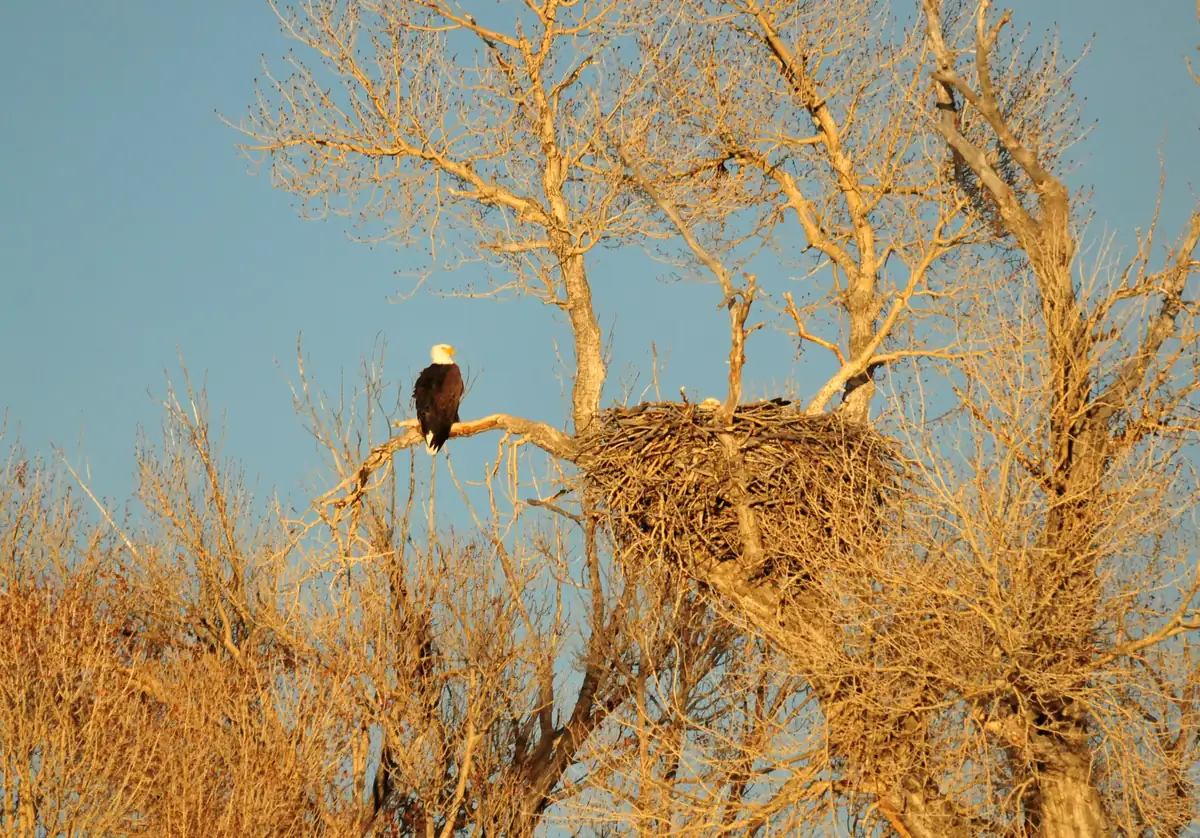
Bald eagles on eggs
Eggs November to February; about 35 days of incubation · Tall living pines near big water: the coast, the Savannah River and Middle Georgia lakes, the lower Flint and Chattahoochee
A pair usually lays two eggs, sometimes one or three, and starts sitting with the first, so one chick hatches a day or two ahead of the other. The DNR’s calendar gives about 35 days of incubation and hatching in January and February. A nest where you now see only a white head just above the sticks probably holds eggs. Federal guidelines ask you to keep at least 330 feet away; watch through binoculars and leave if an adult calls or flushes.
-
The Berry College eagle cam
December has been egg month here · Berry College campus, Mount Berry, near Rome
Northwest Georgia’s best-known eagle nest produced December eggs three winters running: December 5 and 8, 2021; December 13 and 16, 2022 (the first eaglet hatched January 21, 2023); and December 8 and 11, 2023, a clutch that failed before the pair laid again in February. The college’s log then reported no eggs the following winter, so whether a pair uses the nest this year is an open question.
-
Great horned owls duet
Courtship in December and early January · Woodlots, parks and suburbs statewide
Georgia DNR’s naturalist column puts the owls’ courtship “in December and early January,” so listen at dusk for the deep “hoo hoo hoooo hoo hoo,” often two birds answering each other. The owls build no nest; they move into one left by hawks, crows or squirrels, even eagles, and may reuse it for three or four years. The female usually lays two eggs about three days apart.
Write down the evening you first hear a pair calling back and forth, then check the same woods in late January for an ear-tufted head over the rim of an old nest.
How do you join a Christmas Bird Count in Georgia?
Find a circle and write to its compiler. Audubon’s 127th count season opens on December 14 and ends on January 5, 2027. Each count is one day inside a circle 15 miles across; it is free, and new birders go out with experienced teams. Feeder watchers inside a circle can take part from home if the compiler agrees. Georgia ran 30 circles in the season Audubon summarized most recently.
The Georgia Ornithological Society posts the state schedule and compilers; the 2026–27 dates were not yet up when this page was written. Last season’s show the rhythm: Richmond Hill on December 17, Harris Neck on December 19, eight counts on Saturday, December 20, among them Athens, Augusta, Dalton and Macon, and Savannah, Glynn County, Columbus and Intown Atlanta on January 3. Ogeechee Audubon runs the Savannah, Harris Neck and Richmond Hill counts and signs people up online.
| Count circle | Region | Counters | Species |
|---|---|---|---|
| Savannah | Coast and Barrier Islands | 62 | 147 |
| Glynn County | Coast and Barrier Islands | 24 | 143 |
| Cumberland Island | Coast and Barrier Islands | 21 | 143 |
| St. Catherines Island | Coast and Barrier Islands | 25 | 133 |
| Little St. Simons Island | Coast and Barrier Islands | 33 | 131 |
| Sapelo Island | Coast and Barrier Islands | 13 | 130 |
| Eufaula National Wildlife Refuge | Southwest Georgia | 14 | 130 |
| Harris Neck National Wildlife Refuge | Coast and Barrier Islands | 34 | 117 |
| Augusta | Piedmont | 15 | 115 |
| Richmond Hill | Coast and Barrier Islands | 40 | 112 |
Inland totals run lower; in the 2024–25 count Intown Atlanta sent out 46 people and found 92 species, Macon 103, and Blue Ridge, with four counters, 55. In 2022–23 Georgia’s counts together logged 216 species and a record 207 bald eagles.
What winter birds can you find on the Georgia coast and in the Okefenokee?
Birds that nested on Great Lakes beaches, Arctic rocks and Canadian sea cliffs spend the winter on Georgia’s sand and in its swamp. December is the first month they are all in place.
-
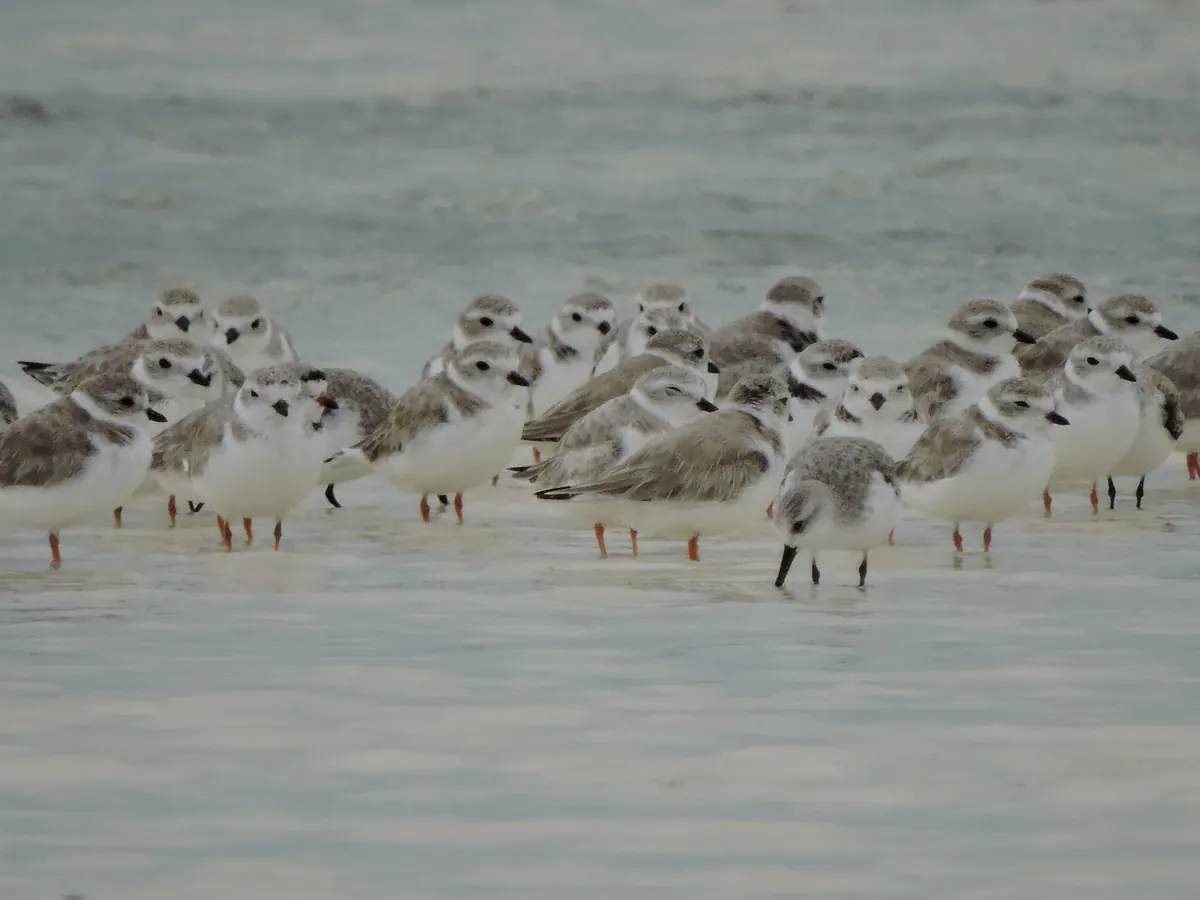
Piping plovers
Most arrive by October and stay into April · Island tips and sandbars: Little Tybee, Wassaw, Ossabaw, St. Catherines, Sapelo, Little St. Simons, Jekyll, Cumberland
A small, pale shorebird the color of dry sand, with orange legs and, in winter, only a hint of its black neck band. More than 200 use the Georgia coast each year, the Georgia Biodiversity Portal says. The mid-winter survey, run since 1996, found about 120 a winter by 2018 after a cold snap in 2010–11 cut the number to about 60; Little St. Simons and Cumberland hold the most.
-
Purple sandpipers and northern gannets at Tybee
December through winter, high tide for the sandpipers · Tybee Island North Beach, near the lighthouse
The DNR’s Georgia Birding Trails guide calls Tybee’s north end “the best place in Georgia to find purple sandpipers,” chunky gray shorebirds that feed on the rocks at high tide, and a prime spot to see northern gannets from shore. Gannets are large white seabirds with black wingtips that dive headfirst after fish; bring a scope.
-
Cranes settled into the swamp
December through February · Chesser and Grand prairies, Okefenokee National Wildlife Refuge
The sandhill cranes that passed overhead last month are now spread across the Okefenokee’s open prairies. The Chesser Island Boardwalk ends at an observation tower over the prairie, where their rattling calls carry at first light. Okefenokee State Park’s ranger-led paddles at sunset, on Fridays, December 4, 11 and 18, catch the hour when wading birds fly in to roost.
Walk around resting shorebirds, not through them; a flock flushed again and again on a cold day burns energy it needs for the night.
Why are frogs calling in Georgia in December?
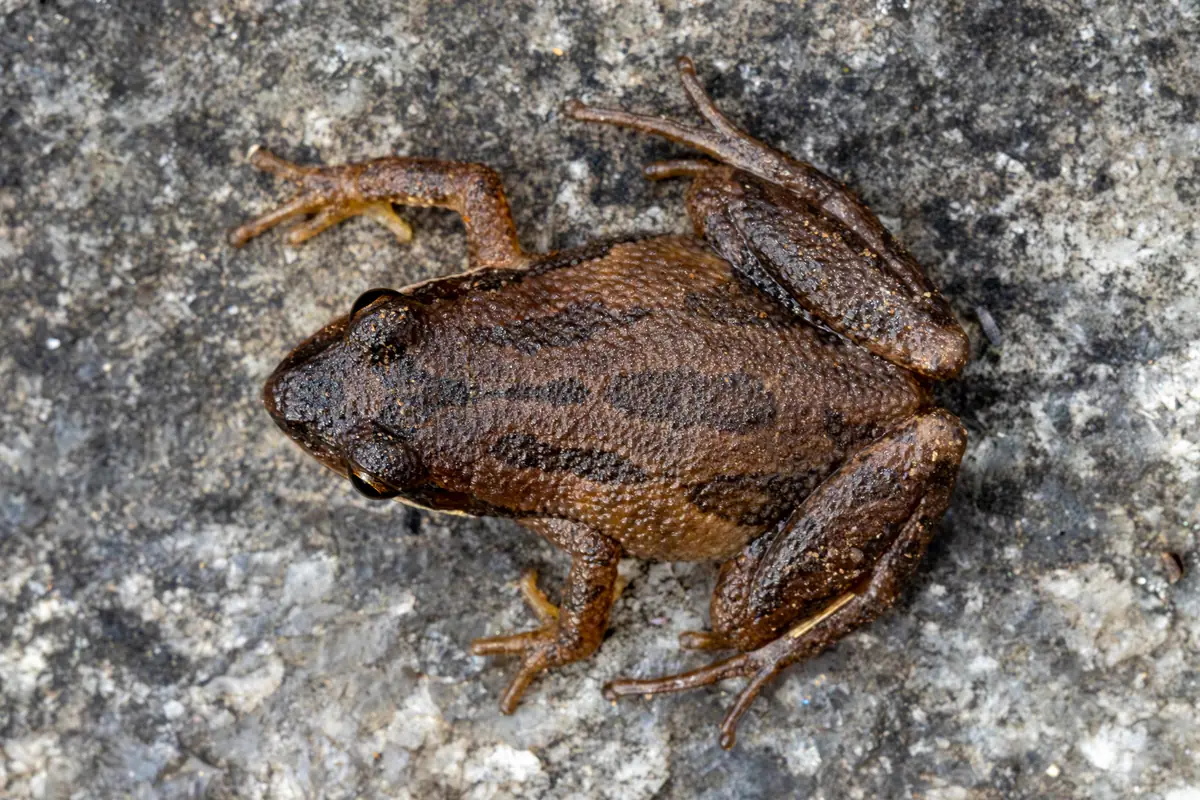
Because several of Georgia’s 32 frog species breed in winter, when rain fills ditches and woodland pools that hold no fish to eat the eggs. A Georgia DNR field sheet on frog calls notes that the spring peeper, a spring singer almost everywhere else, “breeds in the winter in GA.” So a frog chorus on a mild, rainy December night is no sign that something has gone wrong.
-
Spring peepers
Mild nights from December on · Statewide, in wooded wetlands and flooded ditches
A tiny tan treefrog with a dark X on its back and a voice far bigger than it is: high, rising peeps that blend in a crowd into a ringing jingle. Peepers call from grass and twigs at the water’s edge and fall silent when a light finds them, so stand still and wait.
-
Upland chorus frogs
Winter breeders; calling on warm winter days and nights · Rain-filled, fishless puddles and ditches
The DNR sheet likens the call to a fingernail run along the teeth of a comb, and notes that this secretive striped frog may call all day when a winter day turns warm. Look in temporary water in pastures, pine woods and roadside ditches.
-
Southern leopard frogs and American toads
Leopard frogs winter and spring; American toads late winter in the north · Leopard frogs statewide; American toads in the northern half of the state
The southern leopard frog, Georgia’s most widespread frog, is an early breeder that calls in winter and spring with a chuckling screech, likened to a finger rubbed across a balloon; look for two pale lines down the spotted back. In the northern half of the state, American toads trill in winter and early spring.
Record a minute of the chorus on your phone, note the temperature, and upload it to iNaturalist; a dated winter call from your own neighborhood is real data.
How do Georgia’s bears, bats and tortoises get through winter?
Most slow down rather than truly sleep, and the details differ by animal and region.
-
Black bears in their dens
Mid-November to January in; April or May out · North Georgia mountains above all; also the Ocmulgee and Okefenokee populations
Georgia’s bears do not truly hibernate; they enter torpor, a lighter winter sleep driven by temperature and food. A DNR bear biologist told a Pickens County paper that about 90 percent of collared females in north Georgia spend long periods denned, against about 40 percent of males, and that bears go in anywhere from mid-November to January. Dens are dug into slopes, tucked under rock ledges, in hollow trees and root balls, and now and then under a house.
-
Bats in the caves
Hibernating until insects return in spring · Caves and old mines in the northwest and the Blue Ridge
Tricolored, little brown and northern long-eared bats winter in Georgia caves, and they are the species hit hardest by white-nose syndrome, a cold-loving fungus first found in the state in February 2013, in Dade, Walker and Gilmer counties. It rouses bats too often and burns their fat; at sites the DNR has watched since 2013, numbers are down more than 90 percent on average. Stay out of caves in winter and report a bat flying on a freezing day to the DNR (706-557-3213).
-
Gopher tortoises underground
Mostly inactive through the cold months · Sandy longleaf and scrub uplands of the Coastal Plain
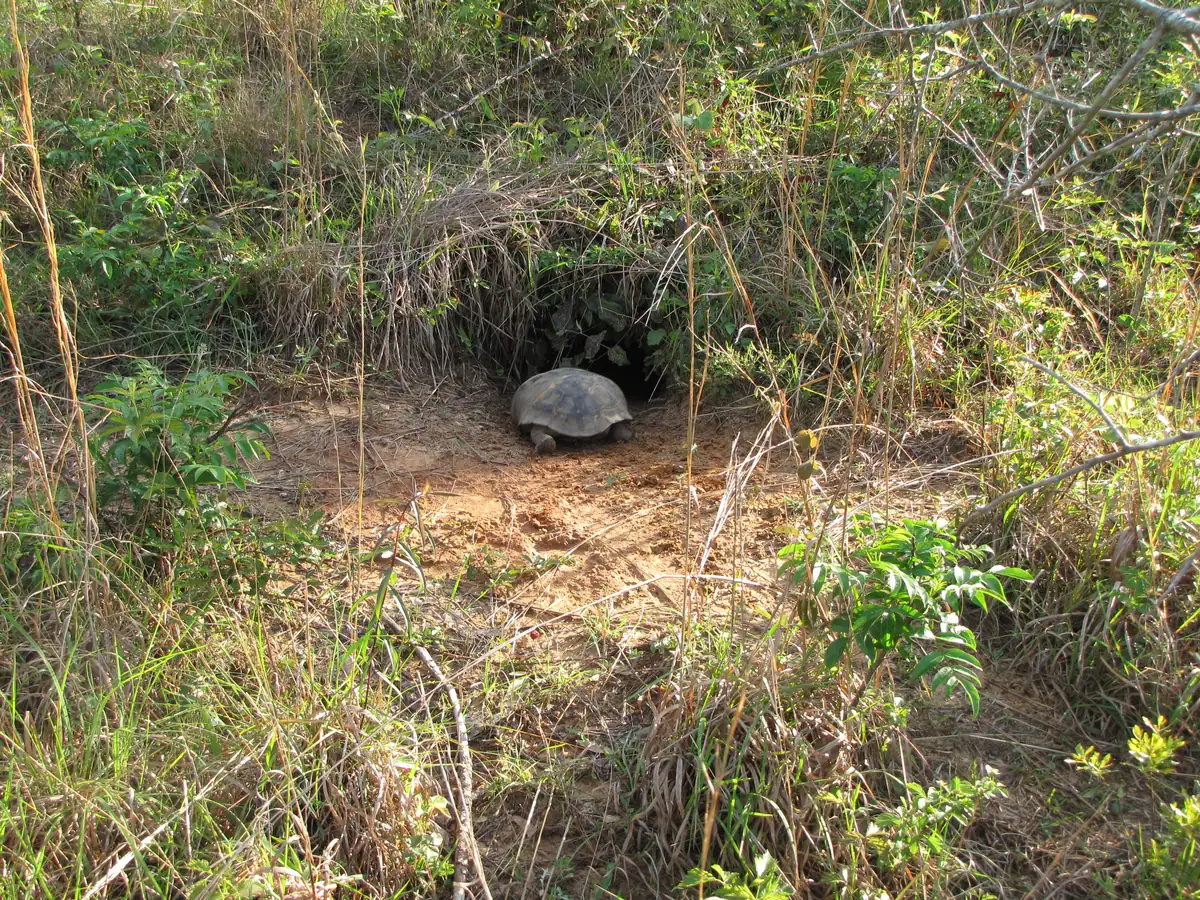
The U.S. Forest Service species review says a tortoise stays in when that chamber is below about 55 °F, and that in the northern part of the range they are inactive through most of the winter, though they bask at the burrow mouth on warm days. A half-moon-shaped hole with a sandy apron is the sign; never block one, since the species is protected in Georgia.
-
The last rut, in the far southwest
Peak week runs December 1 to 28 · Quitman, Early, Miller, Seminole, Decatur and Grady counties
The DNR and UGA Deer Lab rut map, built from deer collision records, shows the far southwest corner peaking last in Georgia, through nearly all of December. Around Bainbridge, Blakely and Cairo, expect bucks on the roads at dusk and dawn this month, two months after the coast’s rut.
Most of these animals are best left unseen. The signs are enough: fresh sand at a tortoise burrow, claw marks on a snag, a cave gate with a closure notice.
What stays green in Georgia’s winter woods?
Once the hardwoods drop their leaves, the evergreens stand out, and December is the easiest month to learn them.
-
American holly
Red berries from fall into winter · Moist woods and bottomlands across the state
Spiny, leathery leaves and, on female trees only, red berries; a holly without berries is a male, or a female with no male close enough to pollinate it. The Georgia Native Plant Society notes that the fruit hangs on into winter, feeding birds after other food runs short.
-
Mistletoe
Most visible once the host trees are bare · High in bare hardwood crowns
Look up for round green clumps in leafless crowns. UGA Extension names oak mistletoe as Georgia’s native species, a parasite that can grow on more than a hundred kinds of tree, with white berries that are poisonous to people. Birds carry the seeds to new branches. A few clumps do a healthy tree little harm.
-
Resurrection fern
Green after every soaking rain · On live oak limbs, especially on the coast
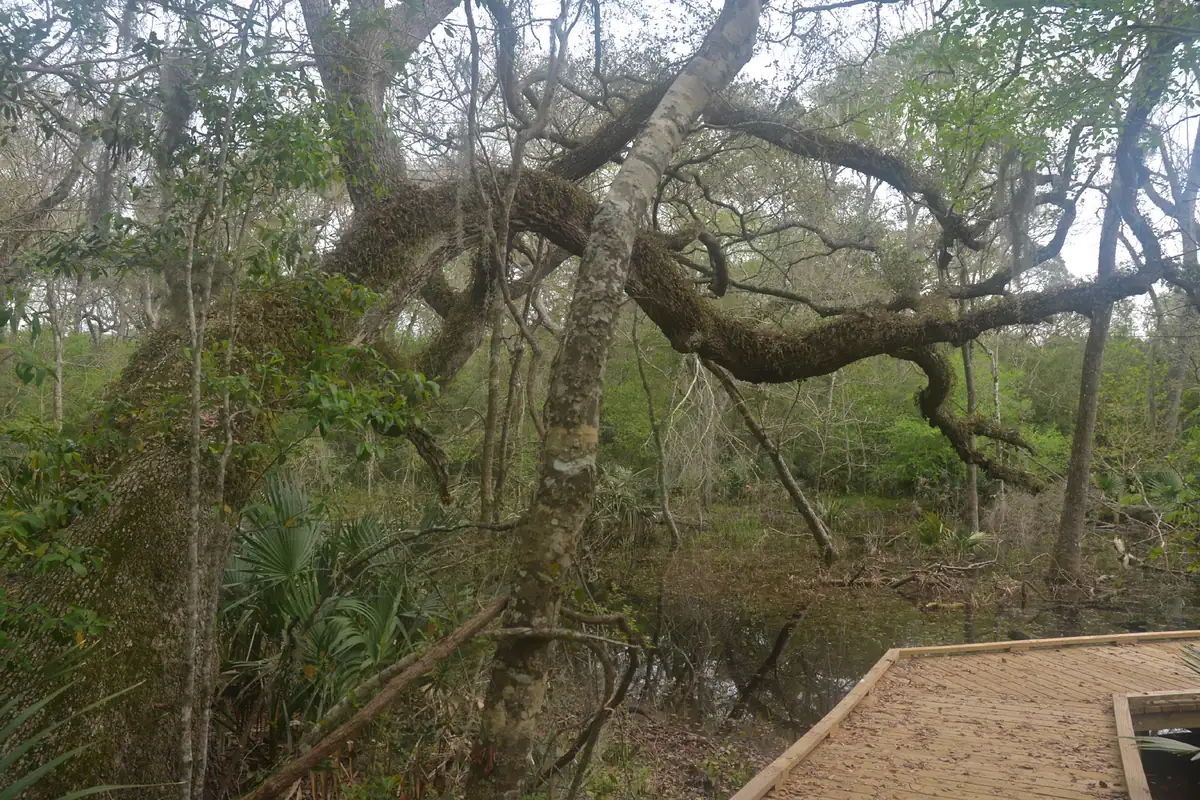
Gray-brown and shriveled in dry weather, the fern on live oak limbs turns green within a day of a good rain, the Jekyll Island Authority says; it can lose 97 percent of its water and recover, and it takes nothing from the tree. After a December storm, look up at the oaks in Savannah’s squares.
-
Hemlocks and their white wool
Woolly coating visible from fall through early summer · Cool coves and stream valleys in the mountains
Georgia’s two native hemlocks, eastern and Carolina, are both under attack by the hemlock woolly adelgid, a tiny invasive insect first found in the state in 2003 and present throughout its hemlock range by 2012, the Georgia Forestry Commission says. Now is when the adelgids show as white cottony dots at the base of the needles under the twigs. If a yard tree has them, call the commission (1-800-436-7442).
Amicalola Falls State Park leads a tree identification walk with guidebooks and sketching on Saturday, December 12, 2:30 to 3:30 p.m., a good way to practice on winter twigs.
When is Georgia’s earliest sunset, and how short is the shortest day?
Georgia’s darkest evenings arrive a few weeks ahead of its shortest day, which surprises most people. Atlanta’s sun goes down at 5:29 p.m. from November 27 into the second week of December, then sets a little later each evening, even while the days are still shortening, because sunrise keeps slipping later until early January. At the solstice, at 3:50 p.m. on Monday, December 21, Atlanta has 9 hours 55 minutes of daylight, Blairsville 9 hours 48 minutes and Valdosta 10 hours 9 minutes. Savannah, farthest east, has the table’s earliest sunset, 5:19 p.m.; Columbus, far to the west in the same time zone, keeps the light until 5:34.
| City | Dec 1 | Dec 21 | Dec 31 | Earliest sunset |
|---|---|---|---|---|
| Blairsville | 9 h 59 m | 9 h 48 m | 9 h 52 m | 5:24 p.m., Dec 5 |
| Rome | 10 h 02 m | 9 h 52 m | 9 h 54 m | 5:31 p.m., Dec 4 |
| Atlanta | 10 h 05 m | 9 h 55 m | 9 h 57 m | 5:29 p.m., Dec 4 |
| Athens | 10 h 03 m | 9 h 53 m | 9 h 56 m | 5:24 p.m., Dec 4 |
| Macon | 10 h 09 m | 9 h 59 m | 10 h 01 m | 5:28 p.m., Dec 4 |
| Columbus | 10 h 10 m | 10 h 01 m | 10 h 04 m | 5:34 p.m., Dec 4 |
| Savannah | 10 h 13 m | 10 h 03 m | 10 h 05 m | 5:19 p.m., Dec 3 |
| Valdosta | 10 h 18 m | 10 h 09 m | 10 h 11 m | 5:31 p.m., Dec 3 |
Before a late-afternoon walk, check how much light is left where you are in the Field almanac.
How cold and wet is December in Georgia, and what might El Niño bring?
Mild by most of the country’s standards, and wetter than autumn. In NOAA’s 1991–2020 normals, December brings 4.4 to 4.8 inches of rain and melted snow to Atlanta, Athens, Macon and Columbus, and nearly 5.5 inches to Blairsville, after the dry fall; Savannah and Augusta get about 3.2 and 3.9 inches. Afternoons average 56 to 57 °F in Atlanta and Athens and about 64 in Savannah. Blairsville averages almost 21 nights at or below freezing in December, Atlanta about nine and Savannah fewer than six.
Along the coast and the southern border, December is often when the first freeze arrives. Savannah’s median first fall freeze is November 30 and Valdosta’s November 27, but in one fall out of ten neither has frozen by December 28 and December 21. Columbus reaches nine falls in ten by December 1. The odds for your own town are on our Georgia frost calendar.
Snow is uncommon but not unheard of. Normal December snowfall is 1.2 inches at Blairsville and 0.4 at Atlanta’s airport, and nothing at all in Savannah. The exception was December 8 and 9, 2017, a storm the Peachtree City forecast office called “exceptionally rare for Georgia, especially in early December”: about 13 inches at Jasper, a foot at Hiram and more than 200,000 customers without power, while southeast of Atlanta little stuck.
| Station | Average high | Average low | Rain and melted snow | Freezing nights | Snowfall |
|---|---|---|---|---|---|
| Blairsville | 52.5 °F | 28.7 °F | 5.46 in | 20.8 | 1.2 in |
| Athens | 56.8 °F | 36.3 °F | 4.43 in | 11.9 | – |
| Atlanta | 56.2 °F | 38.4 °F | 4.57 in | 9.1 | 0.4 in |
| Augusta | 61.5 °F | 37.3 °F | 3.87 in | 12.3 | 0.1 in |
| Macon | 61.3 °F | 37.8 °F | 4.57 in | 11.7 | – |
| Columbus | 60.6 °F | 40.6 °F | 4.79 in | 7.3 | 0.3 in |
| Savannah | 63.7 °F | 42.6 °F | 3.21 in | 5.7 | 0.0 in |
This winter the tropical Pacific adds an unusual signal, and Georgians should plan for a powerful El Niño: NOAA’s ENSO team, writing on September 10, put a very strong episode through fall and winter at better than nine chances in ten. Ahead of the 2015–16 winter, the Peachtree City forecast office looked back at the five strongest El Niño events since 1950 and found most were wetter than normal in north and central Georgia, even into the following spring, while winter temperatures varied more; its El Niño page adds a lean toward above-normal rain and below-normal temperatures in parts of the state. Whether such a winter brings an ice storm, a snowstorm, flooding or severe storms is, in the release’s words, “all up for grabs.” NOAA issues its official winter outlook on October 15, with monthly updates, at the Climate Prediction Center. Our weather page has the coming days for Georgia towns.
Georgia’s Winter Weather Preparedness Week usually comes in the first week of December; in 2025 the state emergency management agency held it December 1 to 5.
What is in Georgia’s night sky this December?
With the longest nights of the year and full darkness by about 6 p.m., December is the easiest month to stargaze with children. Times are Eastern Standard.
-
The Geminids
Night of Sunday, December 13, to dawn on Monday, December 14 · Anywhere dark; the radiant in Gemini is high in the east by late evening
The year’s richest shower, and an easy one this time. The International Meteor Organization gives up to 150 an hour under a perfect sky (a suburban yard shows a fraction of that) and calls the 2026 maximum moon-free: in Atlanta the 18-percent crescent sets at 9:40 p.m. on the 13th. Watch from about 10 p.m. until dawn; rates are best around 2 a.m., when the radiant is highest. Geminids are slow and often bright.
-
The Cold Moon, the closest full moon of 2026
Full at 8:28 p.m. on Wednesday, December 23 · A low, open eastern horizon at sunset
In Atlanta the Moon rises at 5:08 p.m. on the 23rd, 26 minutes before sunset, and is full that evening, only hours from perigee, which makes it 2026’s largest full moon to the eye; it still looks round on Christmas Eve. Tallulah Gorge State Park’s Full Moon Hike that evening, 5:15 to 6:45 p.m., goes down 310 stairs to the suspension bridge to watch it rise ($10 plus parking; 706-754-7981).
-
Venus before dawn, Saturn after dusk
All month · Southeast before sunrise; south and southwest in the evening
Venus blazes in the southeast before sunrise all month, higher each week until it stands farthest from the Sun, 47 degrees, on January 3, 2027; on the morning of the 4th the crescent Moon hangs nearby, with the star Spica between them. Saturn, pale yellow and not twinkling, sits in the southwestern evening sky. Jupiter rises by mid-evening late in the month. On the evening of the solstice the Moon slides close to the Pleiades.
-
Looking ahead: the Quadrantids
Peak about 10:25 p.m. on Sunday, January 3, 2027 · Northeast after midnight
The first shower of 2027 peaks shortly before a new moon, so the dark sky helps; it is a short peak, best from late night until dawn on January 4. The Ursids around December 22 are weak and washed out this year by a nearly full Moon.
-
Stargazing with a ranger
Saturday, December 5, 8:30 to 9:30 p.m. · Okefenokee State Park, Fargo
The park, an International Dark Sky Park, sets up telescopes for its monthly Dark Skies Stargazing for the price of parking; bring a red light and a chair. It is canceled for storms or heavy cloud (912-637-5274).
| Phase | Date | Time |
|---|---|---|
| Last quarter | Tuesday, Dec 1 | 1:08 a.m. |
| New moon | Tuesday, Dec 8 | 7:52 p.m. |
| First quarter | Thursday, Dec 17 | 12:42 a.m. |
| Full moon (Cold Moon, a supermoon) | Wednesday, Dec 23 | 8:28 p.m. (nearly as round on Christmas Eve) |
| Last quarter | Wednesday, Dec 30 | 1:59 p.m. |
| New moon | Thursday, Jan 7, 2027 | 3:24 p.m. |
Cloud cover decides most of this; Today’s sky maps tonight’s cover, and each night’s moonrise is listed on the moon calendar.
What can Georgia families do outside in December 2026?
- Meet a hawk or an owl. Blue Ridge Raptors brings up to eight kinds of raptor to Amicalola Falls State Park on Saturdays, December 5 and 19, 1 to 2 p.m. in the lodge lobby ($3 plus parking), with time for photos afterward.
- Spend a Saturday sketching. Amicalola Falls has a free nature journaling session on Saturday, December 12, 10 to 11:30 a.m. (journals supplied), the tree walk that afternoon, and an iNaturalist identification walk from 1 to 2 p.m. Bring the pages home to our Naturalist’s Field Journal.
- Walk a mountain trail. Smithgall Woods near Helen leads a festive one-mile hike on the Chunanee Falls Trail on Saturday, December 12, 10 a.m. to noon; reservations are required (706-878-3087).
- Go out after dark. Unicoi State Park’s State Park After Dark walks a 2.2-mile loop at night on Fridays, December 4 and 18, 6:30 p.m. ($10, flashlights supplied). Add the Okefenokee stargazing on December 5 and the Tallulah Gorge full moon hike on December 23 (see the sky section).
- See the swamp at sunset. At Okefenokee State Park, a ranger leads canoe trips into the swamp at dusk on December 4, 11 and 18 (ages 10 and up; book by phone up to a week ahead, 912-637-5274), and boat cruises at sunset run Saturdays, December 5, 12 and 19.
- Count birds for science. Join a Christmas Bird Count team, count your feeder if you live inside a circle, and keep sending Project FeederWatch counts all winter.
- Start the new year on a trail. Georgia State Parks have run dozens of free guided First Day Hikes on New Year’s Day, with a sticker for finishers. One already listed for Friday, January 1, 2027, is a 9:30 a.m. hike at Pickett’s Mill Battlefield near Dallas with hot chocolate ($3 to $7); the full list appears on the parks’ events calendar in December.
Park programs fill up and change with the weather, so phone ahead. More months and states are in our nature guides, and the Georgia November guide covers the crane flights and the rut.
Safety notes for December in Georgia
- Deer and bear seasons are still open. Under the DNR’s 2026–27 regulations, firearms deer season runs through December in every zone except the archery-only one and closes on January 10, 2027 (January 15 in one zone). Either-sex days differ by zone, including January 1 in several and December 28 to January 10 in one; check the zone map on the DNR’s deer page. Northern Zone bear season stays open with firearms through January 10, and the Central Zone, around the Ocmulgee River, has a one-day firearms bear hunt on Saturday, December 19.
- Waterfowl and woodcock. The second duck and Canada goose season opens December 12 and runs to January 31, and woodcock season runs December 5 to January 18. Check refuge pages for hunt closures.
- Orange or pink. While deer or bear may be hunted with muzzleloaders or guns, the rules require hunters, and anyone with them, to show 500 square inches or more of daylight fluorescent orange or blaze pink above the waist. The rule does not cover hikers, yet a vivid cap or vest is a good idea on WMAs and in the national forest until mid-January.
- Cold water and short days. Lakes and rivers are cold now even on a sunny 60-degree afternoon, and a paddler who tips over can be in trouble quickly; always wear the life jacket. With early-December sunsets between about 5:20 and 5:35 p.m., start hikes early and carry a light.
- Ice in the mountains. Trails and steps near waterfalls, such as those at Amicalola and Tallulah Gorge, can glaze over on freezing mornings.
Sources
- Georgia DNR: North Atlantic right whales (calving grounds, 500-yard rule, speed zones, sighting hotline)
- Georgia DNR Wildlife Resources blog: And away we go, the first right whale calf of the 2024–25 season (December 3, 2024)
- The Current: first two right whale calves of the season spotted off the Georgia coast (December 8, 2022)
- Georgia Public Broadcasting: first North Atlantic right whale calf of the season spotted off coastal Georgia (December 5, 2025)
- Georgia DNR: bald eagle nesting calendar and viewing distance
- Berry College: eagle cam updates (egg and hatch dates by season)
- Georgia DNR, Out My Backdoor: great horned owls may be nesting in your yard
- National Audubon Society: join the Christmas Bird Count
- National Audubon Society: the 125th Christmas Bird Count summary (Georgia circles)
- National Audubon Society: the 123rd Christmas Bird Count in Georgia
- Georgia Ornithological Society: Christmas Bird Count schedule and 2024 results
- Ogeechee Audubon Society: Christmas Bird Count (Savannah, Harris Neck, Richmond Hill)
- Georgia Biodiversity Portal: piping plover
- Georgia DNR, Georgia Birding Trails: Tybee Island North Beach
- U.S. Fish and Wildlife Service: Okefenokee National Wildlife Refuge, visit us
- Georgia DNR and Adopt-A-Stream: Froggin’ by ear, Georgia frog calls and breeding notes (PDF)
- Pickens County Progress: bears do hibernate in north Georgia, with Georgia DNR denning data (December 1, 2021)
- Georgia DNR: white-nose syndrome in Georgia bats
- U.S. Forest Service, Fire Effects Information System: gopher tortoise species review
- Georgia DNR and UGA Deer Lab: peak deer movement in Georgia, the rut map (PDF)
- Georgia Native Plant Society: American holly
- UGA Extension, Madison County: managing mistletoe in trees
- Jekyll Island Authority: resurrection fern
- Georgia Native Plant Society: Christmas fern
- Georgia Forestry Commission: hemlock woolly adelgid in Georgia
- U.S. Naval Observatory: Earth’s seasons, 2026 (solstice time)
- U.S. Naval Observatory: moon phases from November 2026
- U.S. Naval Observatory: sun and moon data for Atlanta, December 13, 2026
- U.S. Naval Observatory: sun and moon data for Atlanta, December 23, 2026
- International Meteor Organization: 2026 meteor shower calendar (archived copy, PDF)
- EarthSky: what is a supermoon (2026 full supermoon distances)
- EarthSky: Venus at greatest western elongation, January 2027
- RASC Observer’s Handbook 2026: lunar occultations (Pleiades, December 21)
- NOAA NCEI: 1991–2020 monthly normals for Georgia stations (data API)
- NWS Charleston: first and last freeze dates, 1991–2020 (PDF)
- NWS Peachtree City: frost and freeze dates for north and central Georgia
- NWS Peachtree City: the December 8–9, 2017 heavy snow
- Climate Prediction Center: ENSO diagnostic discussion, September 10, 2026
- Climate Prediction Center: three-month outlooks
- NWS Peachtree City: El Niño influences in north and central Georgia
- UGA Extension climate blog: NWS Peachtree City press release on strong El Niño winters in Georgia (November 2015)
- Georgia Emergency Management and Homeland Security Agency: Winter Weather Preparedness Week begins December 1 (2025)
- Georgia State Parks: events calendar, December 2026
- Georgia State Parks: Full Moon Hike, Tallulah Gorge
- Georgia State Parks: Dark Skies Stargazing, Okefenokee State Park
- Georgia State Parks: Sunset on the Okefenokee swamp paddle
- Georgia State Parks: Birds of Prey, Amicalola Falls
- Georgia State Parks: Nature Journaling, Amicalola Falls
- Georgia State Parks: Iconic Trees of Amicalola Falls
- Georgia State Parks: Festive Hike, Smithgall Woods
- Georgia State Parks: State Park After Dark, Unicoi
- Georgia State Parks: First Day Hikes
- Georgia State Parks: Upon These Grounds, a First Day Hike at Pickett’s Mill (January 1, 2027)
- Project FeederWatch: how to participate
- Georgia DNR hunting regulations: deer seasons and either-sex days, 2026–27
- Georgia DNR hunting regulations: big game seasons (bear zones), 2026–27
- Georgia DNR hunting regulations: migratory bird seasons, 2026–27
- Georgia DNR hunting regulations: hunter orange and blaze pink
- Photos via Wikimedia Commons; licenses and photographers are credited under each picture
