What to look for in nature in Georgia this November
November is when the north finally reaches Georgia. Sandhill cranes call from so high they are hard to find, eagles carry sticks to nests in coastal pines, the deer rut climbs from Middle Georgia into the Blue Ridge, and the first right whales of the calving season swim down to the waters off Sapelo and Cumberland. With clocks back an hour, Atlanta's sun sets before 5:30 by the end of the month. Each region gets its own timing below, and every date comes with its source.
Other months in Georgia: October, December.
Start here
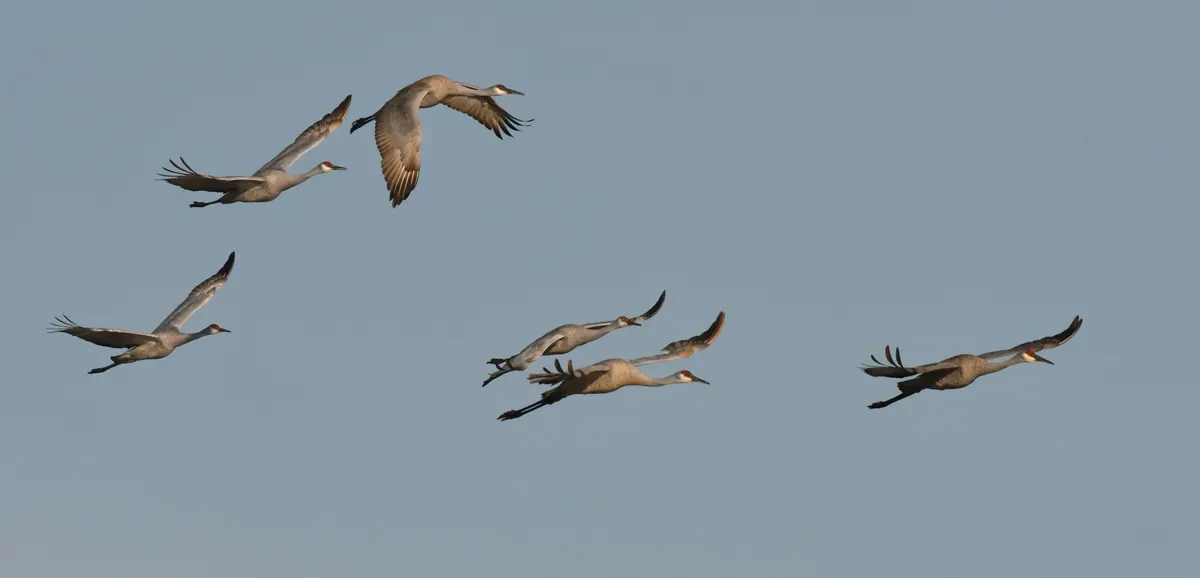
- Listen for cranes. Greater sandhill cranes pass over the state from late November into December, and an estimated 3,000 to 5,000 of them spend the winter in the Okefenokee. A rolling, trumpeting call from a clear sky is the clue; look straight up for a wavering line of long-necked birds.
- Eagles and whales on the coast. Georgia's bald eagles lay eggs from November into February, and coastal pairs start up to two months ahead of north Georgia. Offshore, right whale calving season begins on November 15, and the waters off Georgia and northeast Florida are the only place the species is known to give birth.
- A meteor morning and a supermoon. Leonid watchers in Atlanta get a moonless sky from 12:47 a.m. on Wednesday, November 18, until first light. Tuesday, November 24 brings the Beaver Moon, a mild supermoon (exactly full at 9:53 a.m. EST), rising a few minutes ahead of sunset.
Record it: put the cranes' bugling on the map-of-sounds plate in the Naturalist’s Field Journal, sketch a rub or a set of hoofprints on the tracks-to-know page, and if a pair of eagles is working on a nest near you, give it the nest-observed plate and go back each week. Early sunsets make the dusk-and-dawn watch an after-school job.
Regions used below: Mountains (Blue Ridge and Ridge and Valley); Piedmont and Metro Atlanta; Coastal Plain; Coast and Barrier Islands; Southwest Georgia.
When do sandhill cranes fly over Georgia?
Mostly in the last days of November and on into December. Bird Watcher’s Digest’s Georgia calendar puts “the obvious migration of sandhill cranes” at the end of November, continuing into December. These are greater sandhill cranes of the eastern population, which nest around the western Great Lakes, funnel through Indiana, Kentucky and Tennessee in fall and then fly on to Georgia and Florida. Many cross the Piedmont so high that you hear them long before you see them, and their bugling is sometimes taken for Canada geese until you notice that nothing honks.
-
Cranes over the Piedmont and Metro Atlanta
Late November through December, on clear days · Statewide; overhead in Atlanta, Athens, Macon and Columbus
Flocks travel in long, ragged lines and V’s that bend and re-form as the birds catch thermals. Most continue to central Florida. Birds Georgia names the state’s wintering spots: the Okefenokee, Grand Bay Wildlife Management Area near Valdosta and Eufaula National Wildlife Refuge on the Chattahoochee. The same profile notes that thousands now winter at Hiwassee Refuge on the Tennessee River, something they did not do before the 1990s, and that a few occasionally turn up on Atlanta’s Christmas Bird Count. If you see a flock, note the time and direction and enter it in eBird; those reports are how the passage is mapped.
-
Cranes settle into the Okefenokee
Arriving from mid-November; most leave by late February · Chesser and Grand prairies, eastern side of the swamp
A refuge ranger who spent years listening for them wrote that the migrants usually reach the swamp in the second half of November and stay until the second half of February, an estimated 3,000 to 5,000 birds across the refuge’s 700 square miles. The Okefenokee also keeps a small resident flock that never leaves. The open wet prairies on the east side, seen from the Chesser Island boardwalk near Folkston, are the best bet. The ranger described the call as a shrill, rolling “garooo-a-a-a,” and in the evening it mixes with frogs, herons and the odd alligator grunt.
Write down the date you hear your first flock; in a few Novembers you will know your own neighborhood’s crane week.
Which winter birds arrive in Georgia in November?
The whole winter cast. Bird Watcher’s Digest calls November “a mirror image” of the March departures, and by the end of the month the ducks, sparrows and eagles that will spend the winter here are in place.
-
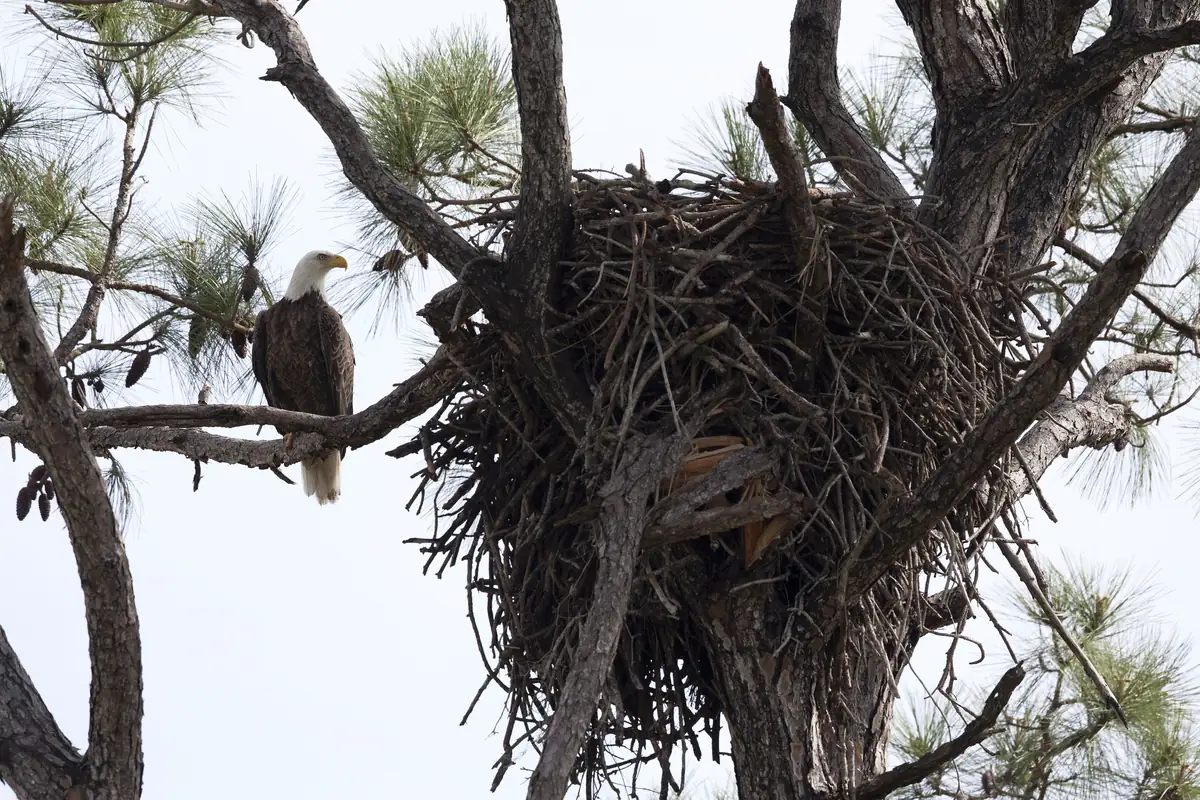
Bald eagles repair their nests
Nest work now; eggs November to February · Coast and barrier islands, Middle Georgia reservoirs, the Savannah River lakes, the lower Flint and Chattahoochee
Georgia DNR’s eagle page gives the calendar: eggs are laid from November through February, and coastal pairs can begin and finish as much as two months before pairs in north Georgia. About 95 percent of nests are in big living pines, built just under the top of the canopy. The DNR’s 2026 survey, reported in June, found 113 occupied territories in the areas flown, 101 of them successful, with 170 young fledged; the DNR thinks the statewide total has stayed above 200 nests a year since 2015, up from none known to succeed through most of the 1970s. About a third of the nests are in the six coastal counties. Watch from a distance, since disturbance can make a pair abandon the nest; an eagle carrying a branch in November is building.
-
Ducks and sea ducks come in
Building through the month · West Point Lake and the big reservoirs; Savannah NWR; Altamaha WMA; the sounds and beaches
Many waterfowl arrive in growing numbers now, Bird Watcher’s Digest says, and by late November even the hardy northern ones are here: common goldeneyes on big inland lakes, West Point above all, black scoters along the coast, and red-breasted mergansers. The Laurel Hill Wildlife Drive on Savannah National Wildlife Refuge, on the South Carolina side of the river, is open from sunrise to sunset all year and is an easy place to watch the refuge’s impoundments fill with ducks.
-
Sparrows and pipits in the fields
All month · Short-grass and harvested fields; the Coastal Plain for vesper sparrows
The winter sparrows are all present by November. Walk the edges of a cut hayfield or a harvested cotton or peanut field and look for Savannah sparrows, vesper sparrows (mostly in the south) and American pipits, which walk rather than hop and bob their tails. In the wet woods of north Georgia, rusty blackbirds turn over leaves in shallow water.
-
Winter finches: a quiet year forecast
If they come, late fall into winter · Feeders and pine woods statewide
Issued on September 25, this winter’s outlook from the Finch Research Network does not expect “any big irruptions” of finches in the Southeast this winter. It allows that pine siskins could make a small to moderate flight this far south, doubts a large red-breasted nuthatch movement after last winter’s, and expects any purple finch flight to be small and late. A siskin at a thistle feeder would be a good find, not a sure one.
-
Winter hummingbirds
Any time from fall through winter · Feeders statewide, more often in the south and on the coast
A hummingbird at a feeder in late November is almost never a ruby-throat. The DNR lists nine species seen in Georgia, and the rufous is by far the most frequent in winter: more than 100 were documented in one winter. Others, such as the calliope and black-chinned, appear a few times a year. Keep a clean feeder going, photograph the bird and phone the DNR’s Wildlife Conservation Section in Forsyth (478-994-1438) so it can be recorded.
-
Project FeederWatch starts
November 1 to April 30 · Any yard, balcony or schoolyard
The winter-long count run by the Cornell Lab and Birds Canada opens November 1. Count on any two consecutive days you like, no more than weekly; for each species, write down only the biggest number on view at a single moment, then submit. The organizers suggest five or more days off between count periods. A Georgia list in November should run to cardinals, chickadees, titmice, Carolina wrens, the first juncos in the north and yellow-rumped warblers almost everywhere.
Refuges and WMAs host hunts in November (see the safety notes), so check the managing agency’s page the day before you go.
When does the rut peak in metro Atlanta and the mountains?
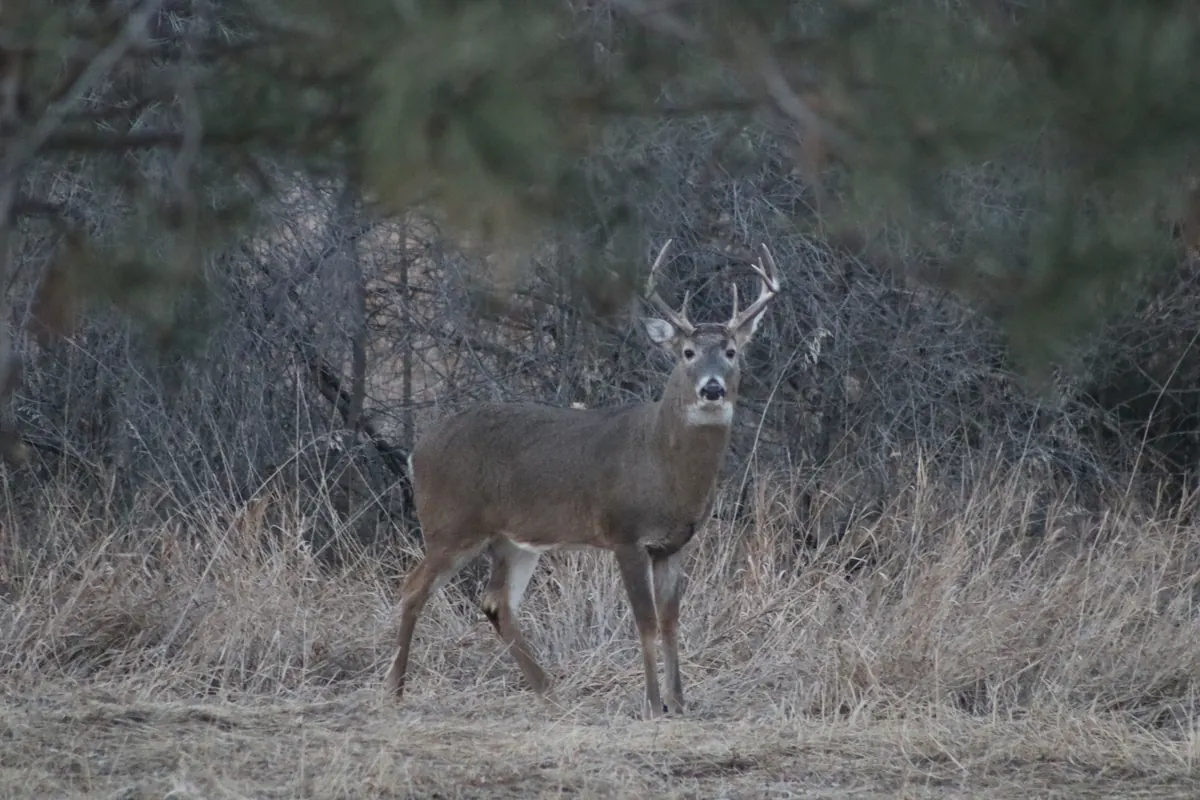
In November, for most of the state. The coast had its rut in October; now it is the inland counties’ turn. The rut map that Georgia DNR built with the University of Georgia Deer Lab, from deer collisions recorded by the state DOT, puts the peak week for Bibb, Houston, Cobb and DeKalb in the first full week of November, for Fulton, Gwinnett, Cherokee, Hall and Clarke the week after, for the Blue Ridge and much of south-central Georgia the third week, and for Rabun, Habersham and the Albany and Thomasville country the last week. The far southwestern corner is the exception and waits until December.
| Region | Sample counties | Peak week |
|---|---|---|
| Scattered counties, coast to Piedmont | Bacon, Echols, Lanier, Baldwin, Putnam, Hart | Oct 27 – Nov 2 |
| Middle Georgia and the south side of Atlanta | Bibb, Houston, Cobb, DeKalb, Henry, Floyd, Lowndes | Nov 3 – 9 |
| North metro Atlanta and the upper Piedmont | Fulton, Gwinnett, Cherokee, Forsyth, Hall, Clarke, Muscogee | Nov 10 – 16 |
| Blue Ridge and south-central Georgia | Union, Towns, Fannin; Tift, Colquitt, Lee, Worth | Nov 17 – 23 |
| Northeast mountains and southwest Georgia | Rabun, White, Habersham, Stephens; Dougherty, Thomas, Mitchell | Nov 24 – 30 |
| Far southwest corner (for comparison) | Quitman, Decatur, Grady, Early, Miller, Seminole | Dec 1 – 28 |
Signs to look for on a walk: cedar and pine saplings with bark scraped off between a person’s knee and belt, pawed bare patches under a low branch with a strong smell, and tracks with the hooves splayed where a buck has been running. In the suburbs north of Atlanta, the second and third weeks of November are when to brake for a deer at dusk and expect a second one behind it.
When do right whales come to the Georgia coast?
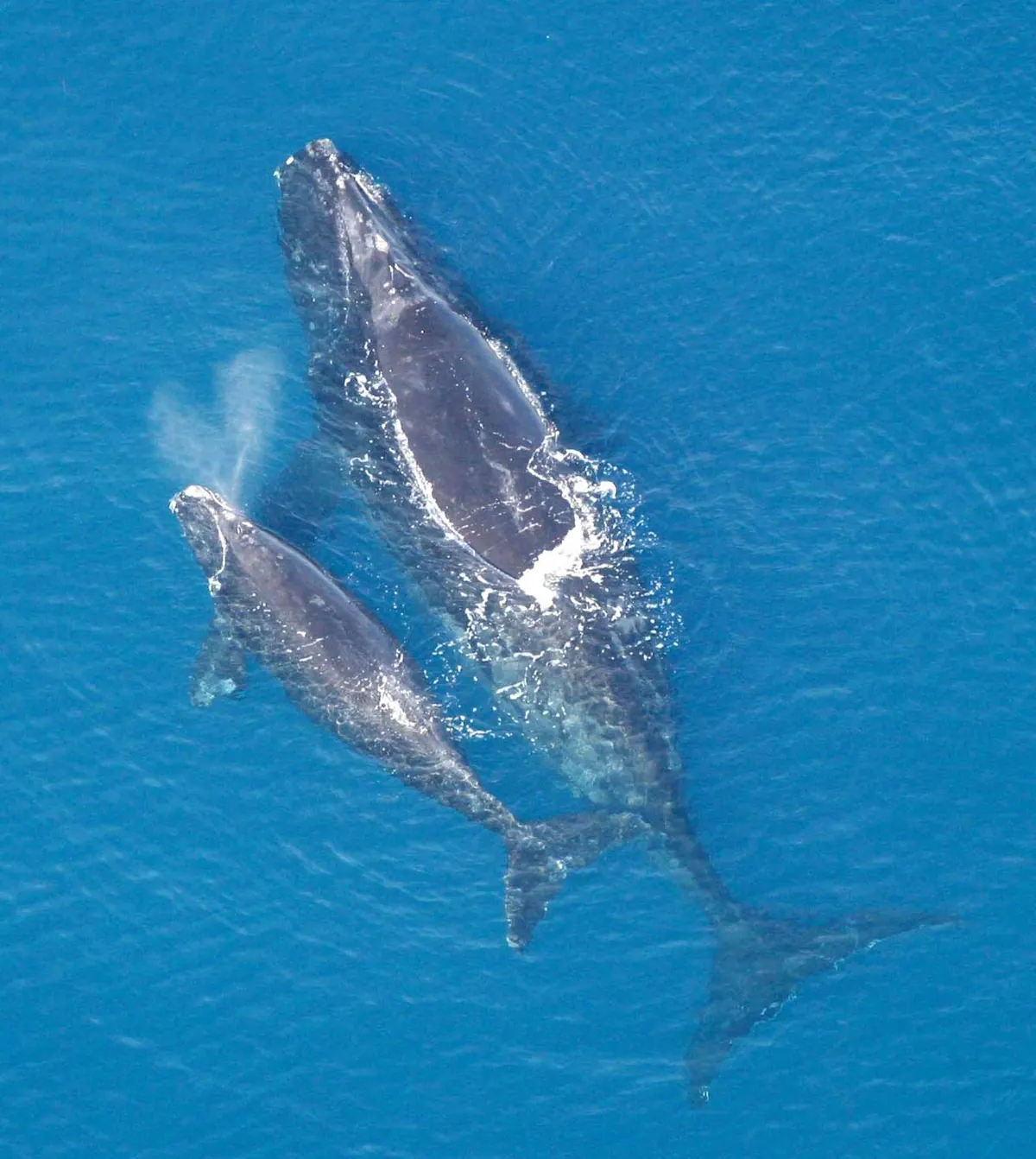
The calving season opens in mid-November. Georgia DNR calls the waters off coastal Georgia and northeast Florida the only known calving grounds of the North Atlantic right whale, one of the rarest large whales on Earth, with only about 385 left. Pregnant females swim down from New England and Canada to give birth in the winter, and ship-speed rules start on November 1 north of Sapelo Island and November 15 south of it, lasting until April 30 and April 15.
-
What last winter brought
Season runs mid-November to mid-April · Nearshore waters from the Savannah River to Cape Canaveral
NOAA Fisheries counted 23 calves in the 2026 season, the highest number since 2009, and about 500 sightings of 129 different right whales in the Southeast, more than a quarter of the population. Thirteen of the mothers had calved in 2021 or 2022, a gap close to the healthy three to four years and far shorter than the recent average. The first whales usually appear off Georgia in late November or early December.
-
How to recognize one
Calm mornings, December into March · From beaches, piers and boats
Right whales reach 50 feet but show little above the surface: a broad black back with no fin, big splashes, white water that keeps reappearing in the same place, and a V-shaped blow when they exhale. The DNR asks anyone who sees one to call 877-WHALE-HELP (877-942-5343) or radio the Coast Guard on VHF channel 16. By law, boats must keep at least 500 yards away.
Most sightings come from survey aircraft and boats; one seen from a beach is a rare piece of luck, so keep binoculars in the car on coastal trips this winter.
Why look for salamanders in a dry pond in November?
Because two of Georgia’s salamanders breed in fall, not spring, and they do it in wetlands that are still dry. Their eggs wait on land for the winter rains to fill the basin.
-
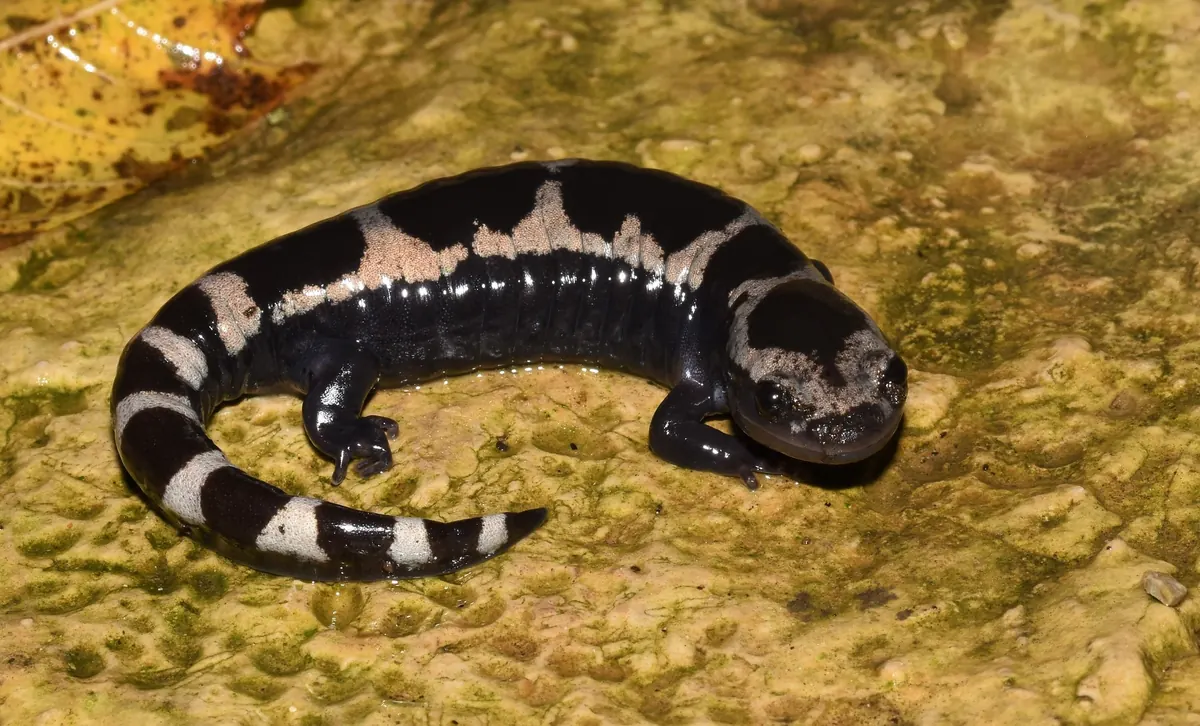
Marbled salamander
Breeding around Halloween; eggs wait into November and December · Upland hardwood forests with seasonal ponds, statewide
A stout black salamander with silver-white crossbands. The Amphibian Foundation in Atlanta says marbled salamanders breed “around Halloween” and lay their eggs on land along the upper edges of dry seasonal wetlands. Animal Diversity Web adds that the female stays with the clutch to keep it moist until water floods the nest, and the eggs hatch as soon as the rains do. In a dry year they can wait through the winter. In Atlanta they have become scarce: the foundation surveyed 110 sites inside I-285 and found them at only two, and it has since helped return them to restored pools at Clyde Shepherd Nature Preserve and the Atlanta History Center, which released 58 larvae into its Swan Woods pool in 2022.
-
Frosted flatwoods salamander
Rainy cold fronts, October to December · Longleaf pine flatwoods; one known Georgia site
Its fall movement is set off by rain-laden cold fronts, when adults walk at night to small, isolated wetlands in pine flatwoods, the Georgia Biodiversity Portal says. It was once known from 51 places in Georgia; in the past decade only one pond, on Fort Stewart, has produced larvae. It has been federally threatened since 1999, and the Amphibian Foundation runs the only captive breeding program in the hope of releasing young back into the wild. You will not see one, but the next rainy night in November is its night.
Turning a log beside a dry woodland pool might reveal a marbled salamander curled around her eggs. Photograph her, lower the log gently into its old position and walk on. Report it to iNaturalist or the Amphibian Foundation.
Where are the leaves still turning in November?
Below the mountains. By November the Blue Ridge is mostly past its best, and the color moves down into the Piedmont and on to the river bottoms of the Coastal Plain. Georgia State Parks’ Leaf Watch says F.D. Roosevelt State Park at Pine Mountain “often peaks during early November,” and the rest of the Piedmont generally follows in the first half of the month.
-
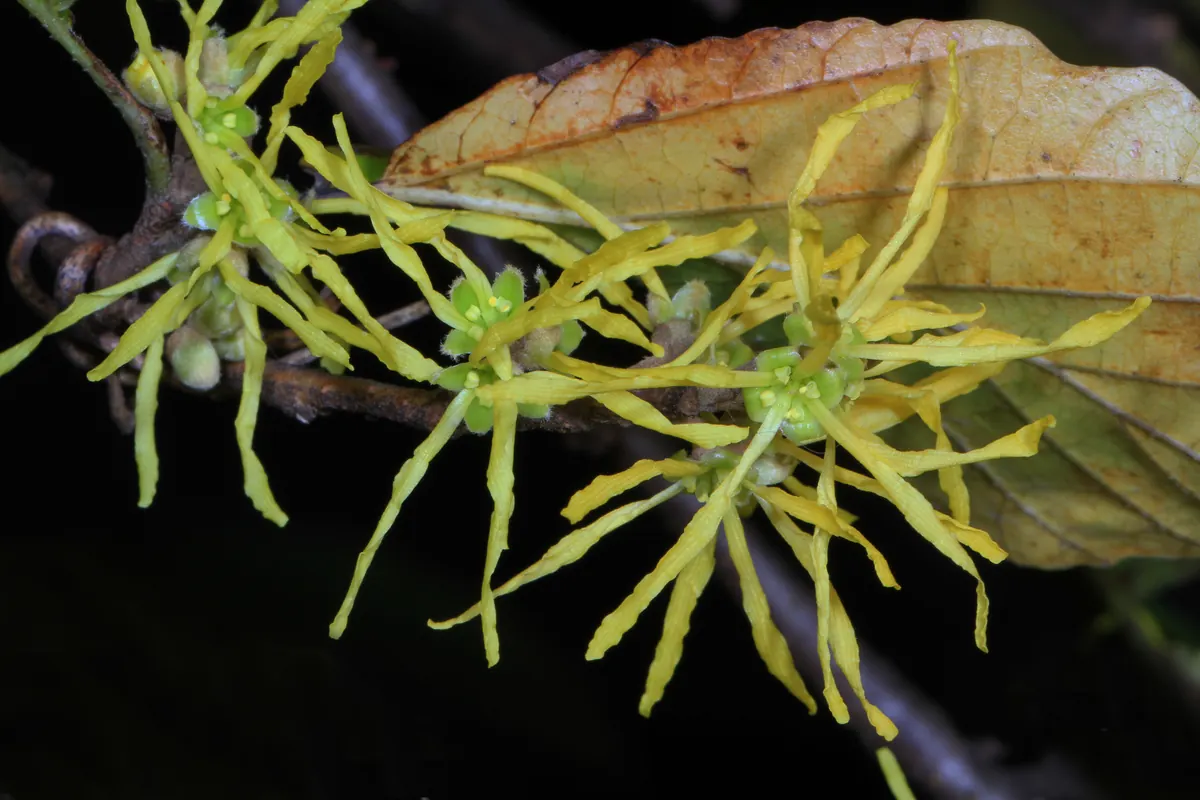
Witch hazel in flower
September to December; most noticeable after the leaves drop · Moist woods, streamsides and bottomland edges, north and central Georgia
Late in the year, an understory shrub with thin, crinkled yellow petals like strips of ribbon is witch hazel, a native the Lady Bird Johnson Wildflower Center lists as flowering from September into December. Last year’s seed capsules are on the same twigs; as they dry they split and can shoot their seeds about 30 feet.
-
Georgia aster, last flowers
Into November · Open oak-pine woods, roadsides where fire or mowing keeps the canopy open
The state’s own rare aster, violet with a yellow center, blooms through October and November, so the first half of the month still has flowers. Take pictures, log them on iNaturalist and leave the plants.
Victoria Bryant State Park near Royston runs leaf-watch hayrides on Saturday afternoons, November 7, 14, 21 and 28 ($5), and Amicalola Falls leads a guided autumn waterfall hike every morning from November 1 to 9. When you want to know how much afternoon light is left for a hike, the daylight and twilight times for your own town are the place to check.
Has Georgia had its first freeze yet?
In the mountains, almost certainly; in the middle of the state, probably during the first half of the month; on the coast and along the Florida line, usually not until the end of it. Blairsville’s median first freeze passed on October 19. Rome’s median is November 3, Atlanta’s November 6, Athens’ and Macon’s November 10 and Columbus’ November 11, so for the Ridge and Valley, the Piedmont and Middle Georgia, November is when the first white morning normally comes. Valdosta (November 27) and Savannah (November 30) are still waiting through most of the month, and in one autumn in ten Savannah has not frozen until December 28.
| Station | One year in ten | Median | Nine years in ten |
|---|---|---|---|
| Blairsville | Oct 7 | Oct 19 | Nov 1 |
| Rome | Oct 22 | Nov 3 | Nov 18 |
| Atlanta | Oct 25 | Nov 6 | Nov 24 |
| Athens | Oct 28 | Nov 10 | Nov 27 |
| Macon | Oct 29 | Nov 10 | Nov 29 |
| Columbus | Oct 31 | Nov 11 | Dec 1 |
| Savannah | Nov 11 | Nov 30 | Dec 28 |
| Valdosta | Nov 9 | Nov 27 | Dec 21 |
A freeze ends the season for tender plants and finally knocks back the mosquitoes, but cool-season greens, cabbage and onions keep going. The odds for your own address, including the last spring freeze, are on our Georgia frost calendar.
How early does it get dark in Georgia in November?
Suddenly early. When Georgia sets the clocks back an hour overnight into November 1, a Sunday, Atlanta’s sunset jumps from 6:46 p.m. on Halloween to 5:45 p.m. the next evening, and by November 30 it is 5:29. That is within a minute of the year’s earliest sunset, which in Atlanta comes on December 4. Over the month the day itself shrinks by 44 minutes in Blairsville and Athens and by 38 in Valdosta, 1.3 to 1.5 minutes a day; Atlanta goes from 10 hours 48 minutes of daylight to 10 hours 6.
| City | Nov 1 | Nov 30 | Lost | Per day |
|---|---|---|---|---|
| Blairsville | 10 h 45 m | 10 h 01 m | 44 min | 1.5 min |
| Rome | 10 h 46 m | 10 h 03 m | 43 min | 1.5 min |
| Atlanta | 10 h 48 m | 10 h 06 m | 42 min | 1.4 min |
| Athens | 10 h 48 m | 10 h 04 m | 44 min | 1.5 min |
| Macon | 10 h 51 m | 10 h 10 m | 41 min | 1.4 min |
| Columbus | 10 h 52 m | 10 h 11 m | 41 min | 1.4 min |
| Savannah | 10 h 53 m | 10 h 14 m | 39 min | 1.3 min |
| Valdosta | 10 h 57 m | 10 h 19 m | 38 min | 1.3 min |
The darker evenings are good for owls and stars and hard on after-work walks. For today’s sunrise, sunset and twilight anywhere in the state, see the Field almanac.
Is November wet or dry in Georgia, and what will El Niño bring this winter?
It depends where you are. In NOAA’s 1991–2020 normals, November brings 3.98 inches of rain to Atlanta, 3.96 to Columbus and 3.77 to Athens, a step up from October, while Savannah gets just 2.39 inches, its driest month of the year, and Augusta 2.66. Average highs run about 64 °F in Atlanta and Athens and 69 to 70 in Macon, Augusta and Savannah, with lows in the low 40s inland. The Atlantic hurricane season ends on November 30.
Then there is the winter ahead. Odds of better than nine in ten: that is how the Climate Prediction Center’s September 10 update scored the arrival of a very strong El Niño for Georgia’s fall and winter. Over the past century, wetter-than-normal winters along the Gulf Coast have come with more than 80 percent of El Niño events, NOAA’s Climate.gov says, and the season’s effect runs from October through March. The National Weather Service office in Tallahassee, which covers southwest Georgia, explains why: the subtropical jet stream and the storm track sit farther south, the flow across North America is more west-to-east, and Arctic outbreaks are fewer. The downside it lists is severe weather, with about 15 tornadoes a year in its area in El Niño winters, close to double the count in other years; the upside is a lower wildfire risk. Georgia Public Broadcasting’s summary of the forecast says the odds of above-normal precipitation in the Southeast top 60 percent by late fall and stay high into winter.
This page went up before October 15, the day NOAA releases its official winter outlook, so look for that on the Climate Prediction Center’s three-month outlook page. Our weather page covers the next few days in Georgia, town by town.
What is in Georgia’s night sky this November?
Early dark helps. With sunset near 5:30, the sky is fully dark by about 7 p.m., before most children are in bed.
-
The Leonids
Best before dawn on Wednesday, November 18 · Anywhere dark; face east to south after midnight
Expect an ordinary showing: the International Meteor Organization predicts no outburst and a rate near 15 an hour in a truly dark sky. The predicted peak, 6:45 p.m. EST on the 17th, comes before Leo has risen, so Georgia’s best chance is the following morning. In Atlanta the moon sets at 12:47 a.m. on the 18th and civil twilight starts at 6:46, which leaves a dark window of about five hours, best toward dawn when the radiant is highest. Tuesday and Thursday mornings bracket the best one and are worth an alarm too.
-
The Beaver Moon, a supermoon
Full at 9:53 a.m. EST, Tuesday, November 24 · A low eastern horizon at sunset
Since exact full falls on Tuesday morning, both Monday’s and Tuesday’s moonrises look round. On Tuesday it rises at 5:23 p.m. in Atlanta, seven minutes before sunset, and at 5:14 p.m. in Savannah, also seven minutes before the sun goes down. It is close to perigee, about 360,800 kilometers away, which makes it a modest supermoon, and the Cold Moon in December comes nearer still. Overnight from Monday into Tuesday the moon also passes over or very near the Pleiades, though its glare hides the cluster.
-
Taurid fireballs and a dark new moon
Southern Taurids peak November 5; Northern Taurids November 12; new moon November 9 · Anywhere dark, most of the night
Both Taurid streams are slow and sparse, 5 to 10 an hour at most, but they are known for bright fireballs. They are debris of Comet Encke, and the new moon on the 9th leaves the nights around it dark. Watch from late evening on, once Taurus is well up in the east.
-
A crowded morning sky
Before dawn all month · East and south before sunrise
Venus is the brilliant morning star, climbing higher each week and at its brightest around November 24 to 27; Spica sits about a degree from it on the 9th. In Leo, Mars closes on Jupiter until only 1.2 degrees separate them before dawn on the 15th and 16th. Low in the east-southeast, Mercury makes its best showing from about November 18 to 25. Around the middle of the month all four planets are up together before sunrise. After dusk the lone bright planet is Saturn, high in the south.
-
Dark-sky nights at Okefenokee State Park
Friday, November 6, 8:30 to 9:30 p.m. · Okefenokee State Park, Fargo
The park, formerly Stephen C. Foster and certified as an International Dark Sky Park, holds Dark Skies Stargazing on the evening of the 6th, with a waning crescent that will not rise until after 2 a.m. It costs only the parking fee and is canceled for storms or heavy cloud; call 912-637-5274. Bring a red flashlight and a chair or blanket.
| Phase | Date | Time |
|---|---|---|
| Last quarter | Sunday, Nov 1 | 3:28 p.m. |
| New moon | Monday, Nov 9 | 2:02 a.m. |
| First quarter | Tuesday, Nov 17 | 6:48 a.m. |
| Full moon, the Beaver Moon | Tuesday, Nov 24 | 9:53 a.m. (looks full the evenings of Nov 23 and 24) |
| Last quarter | Tuesday, Dec 1 | 1:08 a.m. |
Clouds decide most stargazing plans; Today’s sky shows tonight’s cloud forecast for your town, and our moon calendar gives moonrise and moonset for any night.
What can Georgia families do outside in November?
- Learn the birds. Crooked River State Park near St. Marys runs Birding Basics on Sunday, November 1, 9 to 10 a.m. (free with parking), and Amicalola Falls has a Birds of Prey program on Saturdays, November 7 and 21, 1 to 2 p.m. ($3). Birds Georgia leads a beginners’ bird walk at the Chattahoochee Nature Center in Roswell on Sunday, November 22, 8 to 10 a.m.; it is limited to 20 people and needs a reservation (free for members, otherwise with admission).
- Go out after dark. F.D. Roosevelt State Park’s Star Light, Star Bright is Saturday, November 7, 6 to 8 p.m., and A.H. Stephens State Park in Crawfordville holds Under the November Stars the same night, 8 to 10 p.m. ($5). Crooked River’s Creatures of the Night Hike is Friday, November 13, 7:30 p.m. ($5), and Okefenokee State Park’s stargazing is November 6 (see the sky section).
- Keep a nature journal. Amicalola Falls holds a free nature journaling session on Saturday, November 14, 10 to 11:30 a.m., followed by a nature ID walk and a program on the park’s notable trees. Hard Labor Creek near Rutledge has an introduction to mushrooms on Sunday, November 8, 1 p.m. ($3). Each of these has a matching page in our Naturalist’s Field Journal.
- Visit the swamp. Okefenokee National Wildlife Refuge holds Pioneer Day at the Chesser Island Homestead on Saturday, November 21, with cane grinding, cooking on wood stoves and bluegrass, in crane season. Okefenokee State Park’s guided sunset paddles go out on Fridays, November 6, 13, 20 and 27.
- Skip the stores on Black Friday. On Friday, November 27, Smithgall Woods near Helen holds its Gobble Wobble walk, 10 a.m. to noon ($5), and Okefenokee State Park’s sunset paddle leaves at 4:15 p.m.
- Count something. Sign up for Project FeederWatch (counts begin November 1), enter crane flocks in eBird, report any winter hummingbird to the DNR and any right whale to 877-WHALE-HELP. For more months and places, browse our nature guides by state.
State park programs charge a parking fee or ask for a ParkPass, and many need registration; times can change, so confirm with the park before you drive.
Safety notes for November in Georgia
- Hunting is at its busiest. Firearms deer season, open since October 17, runs through all of November and into January. The DNR splits the state into zones with different either-sex days (for example November 6 to 12, November 20 to 26, or Thanksgiving weekend, November 28 and 29), and one zone is archery-only; see the DNR’s deer season page for your zone. Northern Zone bear season is open with deer. The first duck season runs November 21 to 29, after youth, veterans and active-duty waterfowl days on November 14 and 15, and Canada geese and doves are open November 21 to 29 as well. Rabbit, quail and grouse open November 14, and squirrel is already open.
- Orange or pink. In primitive-weapons and firearms seasons for deer and bear, Georgia requires hunters and anyone with them to wear 500 square inches of fluorescent orange or fluorescent pink on the upper body, outside their other clothes; archery-only areas are exempt. Hikers are not required to, but on a wildlife management area or national forest in November, a bright hat and vest are the sensible choice.
- Check before you visit a refuge. Harris Neck holds a one-day shotgun deer hunt in November, and the archery season on the Okefenokee’s Pocket Unit runs to November 10; the refuges post dates and closures on their pages.
- Deer on the road. The rut peaks across the Piedmont and the mountains this month. Slow down at dusk and dawn, which now fall during the evening rush hour.
- Short days. With sunset at about 5:30, an afternoon hike can end in the dark. Start early, pack a headlamp and leave your route with a friend.
- Cold nights, warm days. A sunny 65-degree afternoon can drop to freezing in the mountains after dark. Pack a warm layer, and remember that cold water is dangerous for paddlers even when the air feels mild.
Sources
- Bird Watcher’s Digest: Georgia birding by season, winter (November)
- Atlanta Journal-Constitution: high-flying sandhill cranes migrating through Georgia (resident Okefenokee flock)
- Birds Georgia: species profile, sandhill crane
- U.S. Fish and Wildlife Service: Okefenokee NWR, Sights and Sounds of Winter, by a refuge ranger (PDF)
- U.S. Fish and Wildlife Service: Okefenokee National Wildlife Refuge events (Pioneer Day)
- U.S. Fish and Wildlife Service: Okefenokee NWR hunting, 2026–27
- U.S. Fish and Wildlife Service: Harris Neck NWR hunting
- U.S. Fish and Wildlife Service: Savannah National Wildlife Refuge, visit us
- eBird: submit sightings
- Georgia DNR: bald eagles in Georgia
- Georgia DNR: The Bald Eagle in Georgia, population history and study methods (PDF)
- WSB-TV: Georgia DNR 2026 bald eagle nest survey results (June 30, 2026)
- Finch Research Network: Winter Finch Forecast 2026–2027
- Georgia DNR: hummingbirds in your backyard (winter species)
- Project FeederWatch: how to participate
- Georgia DNR and UGA Deer Lab: peak deer movement in Georgia, the rut map (PDF)
- Georgia DNR: North Atlantic right whales
- NOAA Fisheries: by the numbers, 2026 right whale calving season
- NOAA Fisheries: North Atlantic right whale calving season 2026
- Amphibian Foundation: conservation research priorities (marbled salamanders in Atlanta)
- Atlanta History Center: the salamanders of Goizueta Gardens
- Animal Diversity Web: Ambystoma opacum, marbled salamander
- Georgia Biodiversity Portal: frosted flatwoods salamander
- Georgia DNR Wildlife Resources blog: “Frostys” are on thin ice
- Georgia State Parks: Leaf Watch
- Lady Bird Johnson Wildflower Center: witch hazel, Hamamelis virginiana
- Lady Bird Johnson Wildflower Center: Georgia aster (bloom time)
- NWS Peachtree City: frost and freeze dates for north and central Georgia
- NWS Charleston: first and last freeze dates, 1991–2020 (PDF)
- NOAA NCEI: 1991–2020 monthly normals for Georgia stations (data API)
- Climate Prediction Center: ENSO diagnostic discussion, September 10, 2026
- Climate Prediction Center: three-month outlooks (winter outlook issued October 15)
- NOAA Climate.gov: United States El Niño impacts
- NWS Tallahassee: El Niño and its effect on the Southeast U.S.
- Georgia Public Broadcasting: a super El Niño is predicted, what it means for Georgia (September 14, 2026)
- U.S. Naval Observatory: moon phases, November 2026 (data API)
- U.S. Naval Observatory: sun and moon rise and set, Atlanta, November 18, 2026 (data API)
- U.S. Naval Observatory: sun and moon rise and set, Atlanta, November 24, 2026 (data API)
- U.S. Naval Observatory: sun and moon rise and set, Savannah, November 24, 2026 (data API)
- U.S. Naval Observatory: Earth’s seasons and apsides, 2026
- International Meteor Organization: 2026 meteor shower calendar (PDF, archived copy)
- EarthSky: what is a supermoon (2026 list)
- Farmers’ Almanac: November’s full Beaver Moon
- NASA JPL Horizons: planetary and lunar ephemerides
- EarthSky: best stargazing of 2026 (Mars and Jupiter, November 16)
- Georgia State Parks: Dark Skies Stargazing at Okefenokee State Park
- Georgia State Parks: event calendar, November 2026
- Chattahoochee Nature Center: bird walk with Birds Georgia
- Georgia DNR hunting regulations: deer seasons and either-sex days, 2026–27
- Georgia DNR hunting regulations: big game seasons, 2026–27
- Georgia DNR hunting regulations: migratory bird seasons, 2026–27
- Georgia DNR hunting regulations: small game and trapping seasons, 2026–27
- Georgia DNR hunting regulations: hunting information, hunter orange and blaze pink
- Photos via Wikimedia Commons; licenses and photographers are credited under each picture
