What to look for in nature in Hawaii this April
April is the month Hawaii’s winter visitors get ready to leave and its resident birds are at their busiest. The kōlea on the lawns are in black and white and about to fly to Alaska, honeycreepers are nesting among the ʻōhiʻa blossoms, the first Hawaiian stilt chicks can appear on pond mudflats, and monk seal pups are being born through the peak of their season. The last humpbacks are heading north, the rainy season is ending on all but the windward slopes, and a ridge-top observatory on Mauna Loa is about to record the highest carbon dioxide of the year. April is also Tsunami Awareness Month, in memory of April 1, 1946. The sections below run from the shoreline to the summits.
Other months in Hawaii: October, November, December, January, February, March.
Start here
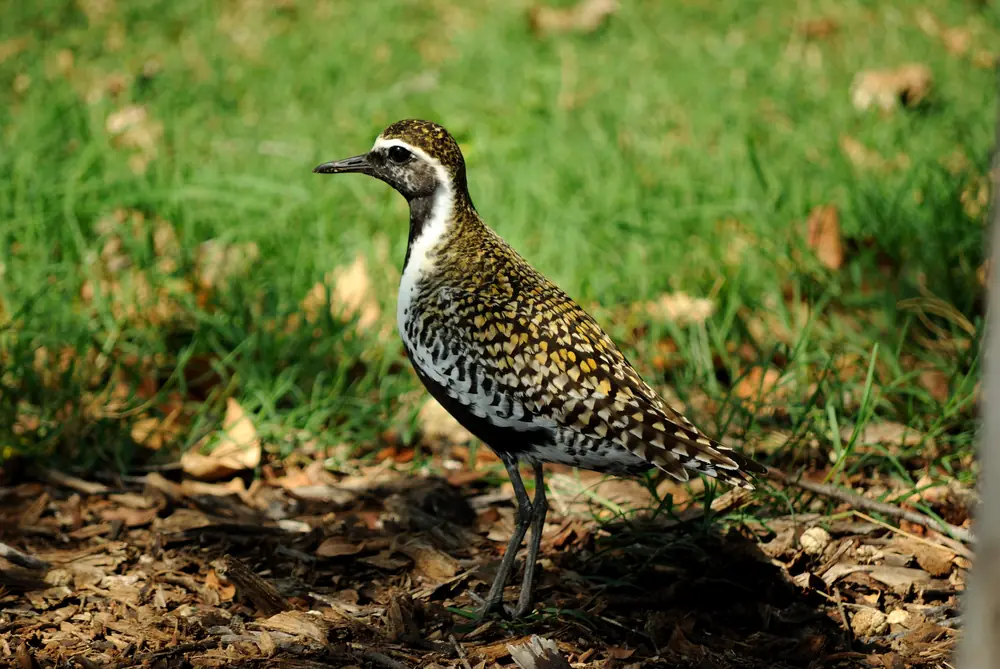
- Log a kōlea’s last day. Choose one plover on a lawn or ballfield and note when it disappears, probably between late April and early May. The Kōlea Count wants the date, place and number of birds.
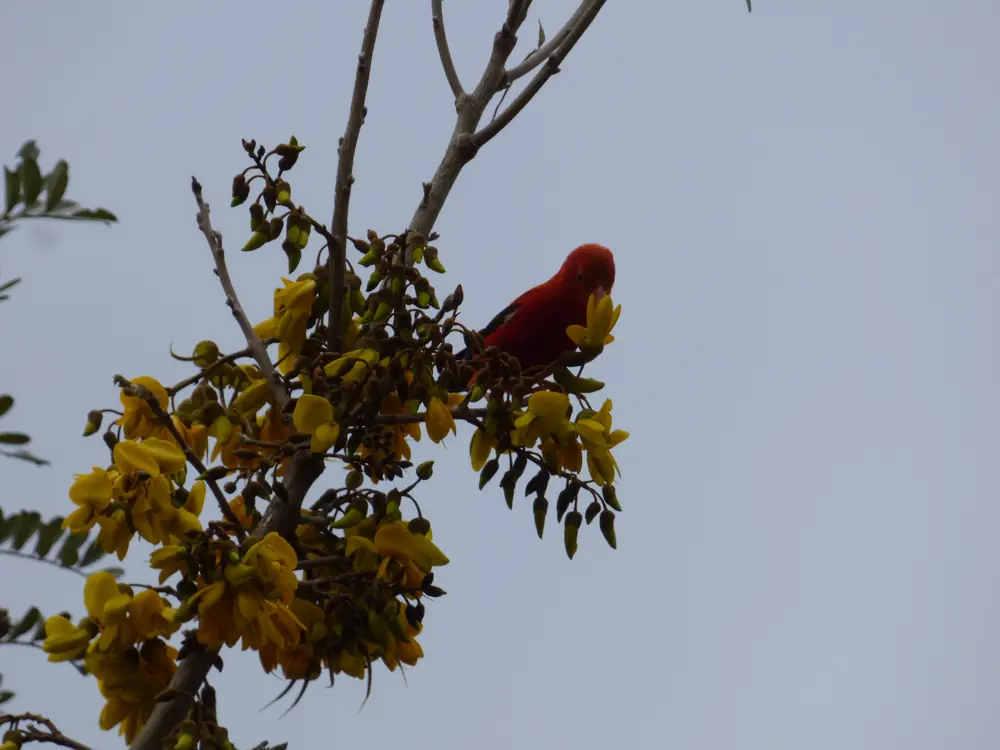
- Listen to the forest wake up. Go to a native forest trail before sunrise and listen for the ʻapapane. In April the honeycreepers are in the middle of their nesting season, and the dawn chorus is at its loudest. Clean your boots first.
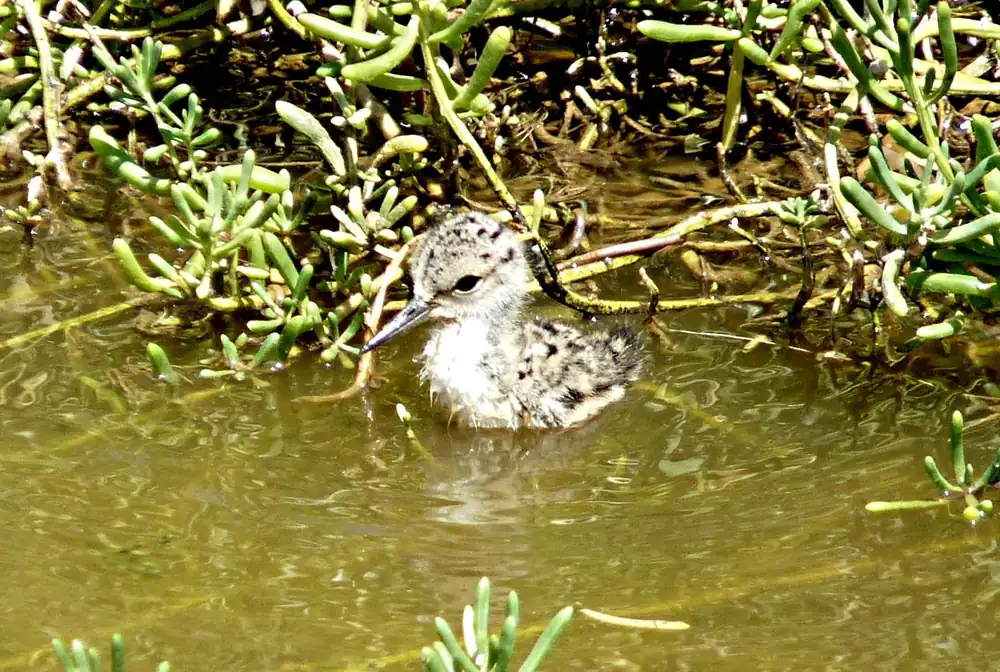
- Look for a stilt chick. Visit a pond edge such as the Keālia boardwalk on Maui or the Hanalei valley viewpoint, and watch for small, long-legged chicks beside an adult. Stay back if the adult calls.
Several Naturalist’s Field Journal plates suit April: use birds I have seen for stilts, honeycreepers and kōlea, nest observed for a pond or forest edge, a map of sounds for the dawn chorus, mammal watch for a monk seal pup, reading the signs for the trade winds as they steady, a second visit to one beach each season on the same place twice plate, and dusk and dawn watch for Venus, Jupiter and the Pink Moon.
Regions used below: Kauaʻi; Oʻahu; Maui, Molokaʻi and Lānaʻi; Hawaiʻi Island; The high summits: Maunakea, Mauna Loa and Haleakalā.
When do the kōlea leave Hawaii for Alaska?
Late April and early May is the usual answer. The Kōlea Count, a community project run with Hawaiʻi Audubon, treats April and May as the departure period and asks the public to report where the plovers gather before they go. Its guidelines give no single day, because the flocks do not leave all at once, and a bird on your lawn on April 30 may be gone by the first week of May. By then the birds have molted into the black-faced, white-edged breeding plumage.
The trip is long. The U.S. Geological Survey summary of the first radio-tracking study, which tagged plovers on their Hawaii wintering grounds in 1996 and found them again in Alaska, speaks of overwater flights of 4,000 kilometers or more. The Kōlea Count asks for arrival reports from July 1 through November 30, so the birds come back over several months. If one of your regulars vanishes this month, that is why.
-
Report the last day
April and May · Any lawn, ballfield, golf course or shoreline with a regular bird
The Kōlea Count’s guidelines ask for three things when you see departure activity: the place, the date and the number of birds. Reports go in through the project’s report tab, and you do not have to re-enter your details each time. A note that says “last seen Tuesday, April 27” is worth more than a guess.
-
Watch for gatherings
Late April · Open grass and wide beaches
The project’s departure question is about where the birds gather before they leave, so a flock of plovers in full black plumage on a field where you usually see one or two is exactly what to log. Stay back and let them feed, because they are building the fat they need for the flight.
If you kept a photo log in March, this is the month it pays off: compare the first picture with the last. The Hawaii March page follows the same birds through the color change.
What are the native forest birds doing in April?
Nesting. Hawaii’s honeycreepers do not wait for a warm spring, because their food does not follow a northern calendar. A U.S. Geological Survey study of the ʻākohekohe, or crested honeycreeper, in the Hanawī reserve on East Maui found a nesting season that ran from November to early June, so April sits well inside it. The same agency’s work on this species adds that ʻōhiʻa lehua trees flower all year with a peak in January, and that the timing of ʻākohekohe breeding tracked the abundance of ʻōhiʻa bloom. In short, the birds are busy with eggs and chicks while the trees are still well supplied with nectar. Those studies come from one species on one island, so treat the exact months as a guide for other honeycreepers rather than a rule.
You do not need a rare bird to feel it. The National Park Service calls the ʻapapane the most abundant honeycreeper and says it ranges widely in search of local patches of ʻōhiʻa bloom. At Kīpuka Kī in Hawaiʻi Volcanoes National Park, a park recording made before sunrise on a May morning in 2015 caught the forest going from silence to full song within minutes, led by dozens of ʻapapane. The ʻiʻiwi, the park says, usually stays above about 4,500 feet, where the mosquitoes that carry avian malaria and pox are fewer.
-
The dawn chorus at Kīpuka Kī
The half hour before and after sunrise · Kīpuka Kī, off Mauna Loa Road, Hawaiʻi Volcanoes National Park
The park’s recording shows the chorus starting abruptly and peaking about eighteen minutes in, with ʻapapane dominating, then fading near the half-hour mark as the birds disperse to feed. Plan to be on site before first light.
-
Hosmer Grove and Kalahaku Overlook
Morning · Haleakalā National Park, Maui
The park lists ʻapapane, ʻiʻiwi, Hawaiʻi ʻamakihi, ʻalauahio, kiwikiu and ʻākohekohe as its forest birds, and points to Hosmer Grove, Kalahaku Overlook and the Palikū Cabin area as places to look. It describes the ʻapapane’s whirring wingbeat as the easiest clue that one is passing overhead. The kiwikiu is critically rare, with about 500 left, so a sighting of that one is a gift rather than something to plan around.
-
A pueo over open country
Dawn, dusk and cloudy afternoons · Grassland, shrubland and parkland on every main island
DLNR says the pueo, the Hawaiian short-eared owl, is found on all the main islands and is often seen hovering or soaring over open ground. Nests have been found in every month, so there is no fixed season, but the nest itself is only a scrape in the grass and is easy to step on. DLNR lists rats, cats and mongooses among the threats to eggs and chicks, and notes vehicle strikes on Lānaʻi and Hawaiʻi Island. Drive slowly on open roads at dusk, and keep dogs on a leash in grassland.
-
Clean your boots for the ʻōhiʻa
Before and after every forest hike · Any forest trail
Rapid ʻŌhiʻa Death, a fungal disease, had killed hundreds of thousands of trees across more than 50,000 acres of forest as of DLNR’s 2020 update. The agency’s advice is to remove soil from boots, vehicles and gear and to spray them with a 70 percent alcohol solution, and to stay out of signed management zones. Hakalau Forest National Wildlife Refuge on Hawaiʻi Island was closed to self-guided visits for this reason as of early October 2026, with limited tours through permitted guides. Check the refuge page before planning a trip, since the closure could change by April.
Keep your hour’s bird list in a Naturalist’s Field Journal, and walking the same trail monthly fills its same place twice pages.
Can you see baby Hawaiian stilts in April?
Possibly the first of them. According to the state wildlife division, the Hawaiian stilt (aeʻo) breeds from March until August, busiest in May and June, and eggs hatch about 24 days after they are laid. A pair that starts in March can therefore have chicks by April, though the busiest weeks are still ahead. The state describes a clutch of three or four eggs laid on freshly exposed mudflats, and says the young are precocial, which means they are up and feeding within hours, and they stay dependent on their parents for several months. Both parents incubate and brood, and they defend the nest with loud calls and a broken-wing act.
DLNR names the places to look: Kahuku Point at James Campbell National Wildlife Refuge, the oyster ponds and the Nuʻupia ponds on Oʻahu, the river valleys at Hanalei and Wailua on Kauaʻi, and the Kanahā and Keālia wetlands on Maui. Keālia Pond National Wildlife Refuge, between Kīhei and Māʻalaea, is about 700 acres and the refuge calls it the largest lowland wetland left on Maui. It was established in 1992 for the stilt and for the Hawaiian coot (ʻalae keʻokeʻo).
-
Keālia Coastal Boardwalk
Daily; the visit page gives 6:30 a.m. to 7 p.m. · Maui Veterans Highway, near milepost 6, Kīhei
The refuge’s visit page gives those boardwalk hours, though another page of the same site says 6 a.m., so check the posted sign. The refuge bans pets, drones, collecting and handling wildlife, and it asks visitors not to jog, bicycle or fly kites, since those activities disturb the birds.
-
Visitor center on first Saturdays
The first Saturday of each month, 9 a.m. to 3 p.m., according to the refuge; check the date before you go · Keālia Pond National Wildlife Refuge
The refuge’s visit page gives the visitor center hours as Monday to Friday and the first Saturday of each month, 9 a.m. to 3 p.m., and says it is closed on federal holidays. Call 808-875-1582 to confirm the hours before you drive over.
-
Leave a defending stilt alone
Through August · Any pond edge
A stilt that calls, dives at you or drags a wing is telling you a nest or chick is close. Walk away slowly in the direction you came from. Dogs are never allowed at the refuge and should stay leashed at any other wetland.
Are the whales leaving, and when do the green turtles start nesting?
The humpbacks are finishing up. The sanctuary’s boating guide gives the season as generally November through May, peaking January through March, while its about page says November through April, so the end date depends on which page you read. April is therefore a month of stragglers. The rules stay the same as the numbers fall: a boat may not come nearer than 100 yards to a humpback, and inside 400 yards the sanctuary recommends no more than six knots. If you hit or find an injured whale, NOAA’s hotline, 888-256-9840, or VHF channel 16 will reach responders.
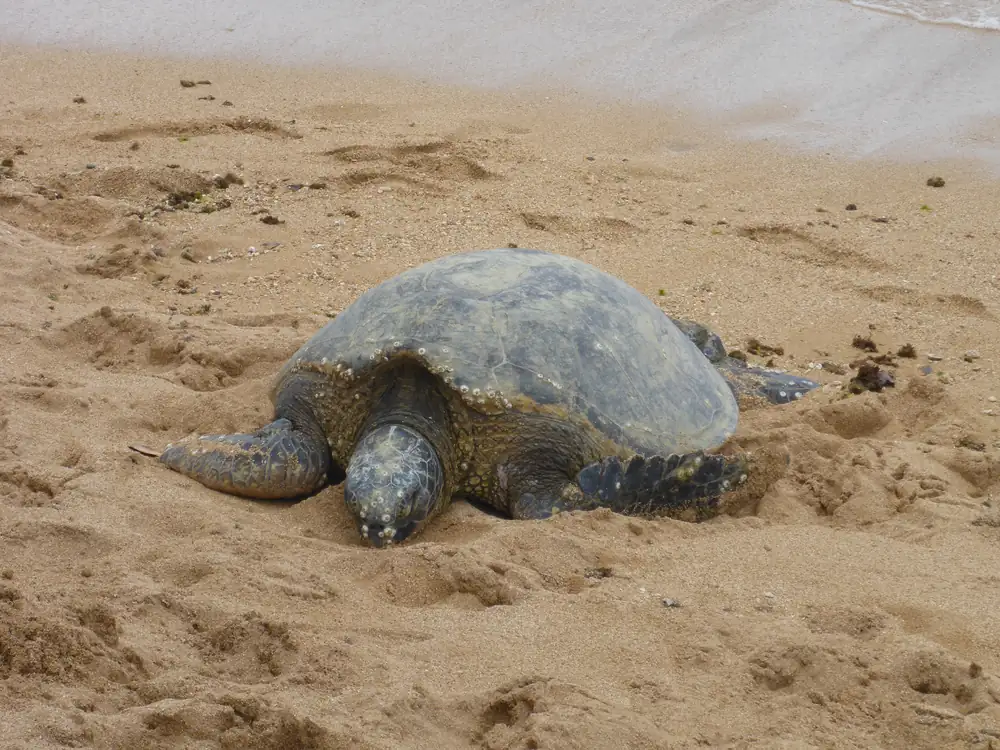
Green sea turtles, or honu, are a different story. The state’s Division of Aquatic Resources says nesting runs from late May to early October and that about 96 percent of the population nests at French Frigate Shoals in the Northwestern Hawaiian Islands so nesting on a main-island beach is uncommon. April is mostly about basking. The state calls the Hawaiian green the only sea turtle that regularly hauls out to rest on the beach.
-
Honu on the beach
Any sunny day · Beaches on all the main islands
Stay at least 10 feet away, as the state recommends, never touch or feed a turtle, and never block its path to the water. NOAA Fisheries’ general green turtle page advises 50 yards, so give a turtle more room than the state minimum whenever you can. Report an injured, entangled or dead turtle to the statewide hotline at 833-4-DA-NETS.
-
A good count, from a small base
Background for the season ahead · Nesting beaches in the Northwestern Hawaiian Islands
The state says nearly 500 females nest each year, compared with 67 in 1973, and NOAA says the number of nests has trended upward. That is the long recovery behind every basking honu you see this month.
Is April peak pupping season for monk seals?
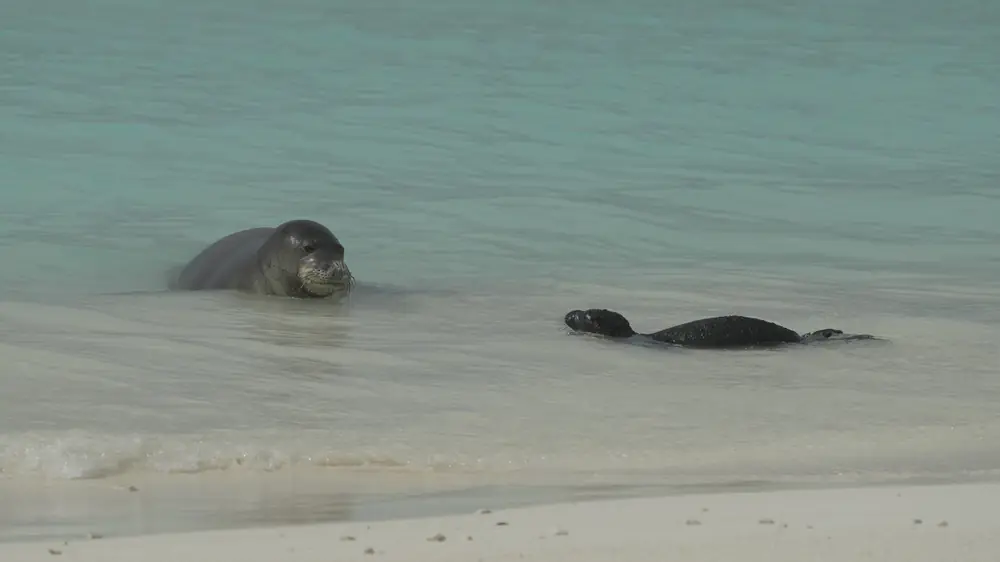
DLNR says so, and it issues the same reminder every April. Its April 17, 2026 release headlined the peak and repeated the guidance: monk seals pup in every month, but March through August is when most pups are born, and a mother nurses for five to seven weeks. In the state’s April 2, 2025 release, the main islands had counted three pups so far that year after 34 in 2024. NOAA Fisheries puts the species at about 1,600 seals, with roughly 400 in the main islands, and says the population has been increasing since 2013.
The distances are 150 feet from any mother with a pup, on land or in the water, and 50 feet from any other seal. DLNR also asks you to stay behind signs, cones and barriers, to keep dogs leashed and well back, and to avoid swimming near a mother and pup. A protective mother can be aggressive.
-
Call it in
Any time you find a new pup · Any beach
The NOAA Marine Wildlife Hotline is 888-256-9840. Give the island, the beach, the time, and whether the seal has a pup, and stay with your distance until responders arrive.
The March page covers the first weeks of the season on the Hawaii March page; April is when the beach rope and sign crews are most likely to be out.
Why does the air at Mauna Loa carry the most carbon dioxide in spring?
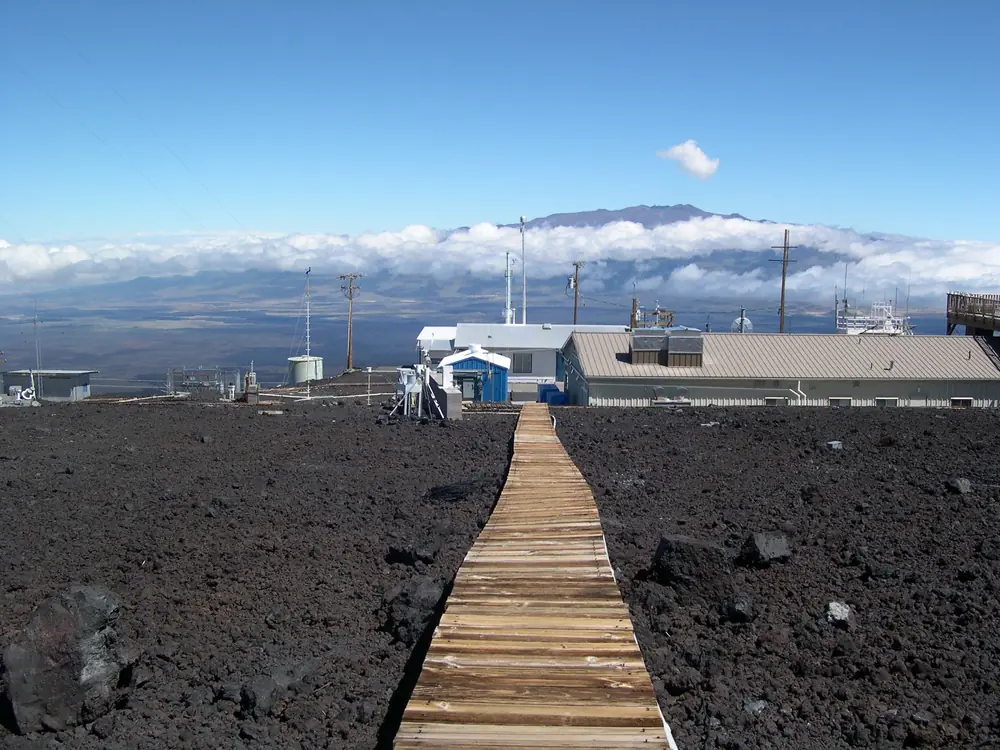
Because the Northern Hemisphere’s plants have not started their summer drawdown. The Mauna Loa carbon dioxide record, started by C. David Keeling of the Scripps Institution of Oceanography in March 1958, is the longest direct record of carbon dioxide in the atmosphere. NOAA’s Mauna Loa Observatory sits near the summit at 3,400 meters, a spot Keeling chose in 1957 because the air there represents a large region. According to NOAA’s Climate.gov, the seasonal wiggle is driven by Northern Hemisphere summer vegetation growth, which pulls carbon dioxide down, and winter decay, which sends it back up. At Mauna Loa the highest monthly value each year occurs in May.
The table shows the monthly means NOAA’s Global Monitoring Laboratory publishes for April, May and September in recent years, in parts per million of dry air. In each year shown, May is the highest of the three and September is lower than April.
| Year | April | May | September |
|---|---|---|---|
| 2022 | 420.19 | 420.97 | 415.91 |
| 2023 | 423.35 | 424.00 | 418.50 |
| 2024 | 426.51 | 426.90 | 422.03 |
| 2025 | 429.64 | 430.51 | 424.37 |
| 2026 | 431.12 | 432.34 | Not yet published |
The current figure is posted on the NOAA trends page, which in early October 2026 listed August as the latest month.
Why is April Tsunami Awareness Month in Hawaii?
Because of April 1, 1946. A great earthquake near Alaska’s Aleutian Islands sent a tsunami across the Pacific that killed more than 150 people in Hawaii and badly damaged Hilo. Accounts differ on the exact toll. The article adds that the state’s siren system was set up after that event, and Hawaii observes every April as Tsunami Awareness Month. The Hawaiʻi Emergency Management Agency says sirens normally sound on the first business day of each month at 11:45 a.m., a steady tone lasting one minute. April 1, 2027 is a Thursday, so expect the test then. If a siren sounds at any other time, the agency’s advice is to turn on a radio or television, or watch for a cellular alert, and follow the official instructions.
The Red Cross advice quoted in the 2025 news report was to learn your tsunami zone, pack a go-bag, and stock two weeks of food and water if you shelter in place. Hawaii County, Maui County, Honolulu and Kauaʻi each run their own emergency agency, and the same agency can tell you whether a siren in your neighborhood is working.
Find the evacuation zone for your hotel or campsite before you need it, and ask your county agency if you are unsure.
Is April the end of Hawaii’s rainy season?
Yes, by the usual definition. The Western Regional Climate Center says Hawaii’s winter season runs October through April and the summer season May through September, and that below 2,000 feet the winter is the wettest time except on the Kona coast. April is a transition month, with below-average rainfall in dry areas and continued winter-style rain on windward slopes. The center puts trade-wind frequency at 50 to 80 percent in winter and 80 to 95 percent in summer, so the winds are steadying but not yet at summer strength.
The table gives NOAA’s 1991 to 2020 April normals for eight stations. Compared with March, the leeward airports are drier and the windward side is still wet: Hilo averages 9.40 inches, with 17.2 days of at least 0.1 inch, while Keāhole, on the other side of the same island, averages 0.63 inch on 1.5 days. At 11,000 feet on Mauna Loa the normal April low is 36.5 °F, and nights at or below freezing average 3.6 for the month. For forecasts and how to read a satellite picture, see our weather guide and the cloud guide.
The Climate Prediction Center posts its three-month outlooks on its 90-day outlook page, near the middle of each month. This guide does not state what an outlook says.
-
A late Kona storm
Possible through April · All islands, especially leeward and southwest coasts
The climate center says Kona storms bring more widespread and prolonged rain than a cold front and that there are one or two in a typical year and sometimes four or five.
-
The last of the big surf
Through April · North- and west-facing shores
Hawaii’s ocean safety office treats November to April as winter, when many north and west beaches see extremely high surf, and May to October as summer, when the big swells shift to south shores. Swim at lifeguarded beaches and check the posted flags.
-
Check the volcano
Every day · Hawaiʻi Volcanoes National Park
The Hawaiian Volcano Observatory’s update of October 7, 2026 put Kīlauea at alert level Watch with aviation code orange, citing a shallow dike intrusion at the turn of September into October, and noted that the volcano no longer follows its earlier pattern. By April the situation will have changed in some way. The national park also warns of hazardous gas for sensitive groups, a summit construction project, and lots that fill by 10 a.m.
| Station | April rain | Days with 0.1 in or more | High / low | Nights at or below 32 °F |
|---|---|---|---|---|
| Līhuʻe airport, Kauaʻi | 2.03 in | 5.4 | 79.8 / 69.5 °F | 0 |
| Honolulu airport, Oʻahu | 0.77 in | 1.9 | 83.1 / 70.1 °F | 0 |
| Hoʻolehua airport, Molokaʻi | 1.54 in | 3.4 | 81.0 / 67.1 °F | 0 |
| Kahului airport, Maui | 1.32 in | 2.5 | 84.5 / 66.6 °F | 0 |
| Haleakalā ranger station, Maui (7,000 ft) | 2.75 in | 6.0 | 60.7 / 43.8 °F | 0.0 |
| Keāhole airport, Kona | 0.63 in | 1.5 | 83.2 / 71.1 °F | 0 |
| Hilo airport, Hawaiʻi Island | 9.40 in | 17.2 | 79.0 / 66.1 °F | 0 |
| Mauna Loa slope station (11,000 ft) | 0.87 in | 2.3 | 53.1 / 36.5 °F | 3.6 |
How much daylight does Hawaii gain in April?
About 33 minutes across the month in Honolulu, and between 30 and 34 minutes at the seven towns in the table. In the Naval Observatory’s Honolulu table, April 1 runs from a 6:24 a.m. sunrise to a 6:46 p.m. sunset, and April 30 from 6:01 a.m. to 6:56 p.m. Most of the gain comes at the morning end, since the sun comes up 23 minutes earlier over the month but sets only 10 minutes later. Other towns are on the day-length page.
Because the islands keep the same time all year, the sunrise and sunset columns move smoothly, and since March 14 the mainland has been an hour closer: New York is six hours ahead of Honolulu and California three, until the first Sunday of November. The northern towns gain a little more than the southern ones, which is why Līhuʻe ends the month with a longer day than Hilo.
| City | Apr 1 | Apr 30 | Gained | Per day |
|---|---|---|---|---|
| Lihue | 12 h 23 m | 12 h 57 m | 34 min | 1.2 min |
| Honolulu | 12 h 22 m | 12 h 55 m | 33 min | 1.1 min |
| Kaunakakai | 12 h 22 m | 12 h 55 m | 33 min | 1.1 min |
| Lanai City | 12 h 21 m | 12 h 54 m | 33 min | 1.1 min |
| Kahului | 12 h 22 m | 12 h 54 m | 32 min | 1.1 min |
| Kailua-Kona | 12 h 20 m | 12 h 51 m | 31 min | 1.1 min |
| Hilo | 12 h 21 m | 12 h 51 m | 30 min | 1.0 min |
What is in Hawaii’s night sky this April?
Every time below is Hawaii Standard Time, and Hawaii never changes its clocks. The darkest evenings of the month come in the first week, around the new moon on the afternoon of Tuesday, April 6. Two bright planets, Jupiter and Mars, stand in the evening sky in or near Leo, Venus rises ahead of the Sun, and the Pink Moon is full on April 20. Saturn is lost in the Sun’s glare, with its conjunction on April 7. Mercury is also lost in the glare, reaching superior conjunction on April 28.
-
Venus and a thin crescent
The mornings of Saturday, April 3 and Sunday, April 4 · Low in the east before sunrise
The Moon, a thin crescent about 9 percent lit, passes about three degrees from Venus. Venus rises roughly an hour or more before sunrise at the start of April (the time is worked out for the central United States and shifts a little in Hawaii), so go out by about 5:30 a.m. and pick a place with a clear eastern horizon.
-
The Moon passes Jupiter and Mars
The evenings of Wednesday, April 14 and Thursday, April 15 · High in the east and south after dark
The Moon’s closest approach to Jupiter comes in the small hours of April 15, between about 4 and 5 a.m. depending on the almanac, so the best viewing is the evenings on either side, when the Moon is about two-thirds lit. Around midday on the 15th the Moon also passes within about three degrees of Mars. Jupiter sets about nine hours after sunset on April 1, so it stays up through most of the night.
-
The Pink Moon
Full at 12:27 p.m. on Tuesday, April 20; best seen that evening · Rising in the east around sunset
The Naval Observatory has the Moon rising in Honolulu at 7:05 p.m. on April 20, about twelve minutes after the 6:53 p.m. sunset. In the almanacs, April’s full moon goes by the name Pink Moon.
-
A poor year for the Lyrids
Predicted peak about 3:41 p.m. on Thursday, April 22, in daylight here · Northeast, low, in the short dark window before moonrise
On April 22 the nearly full Moon climbs above Honolulu’s horizon about 9 p.m. Before that, once twilight has faded, the northeast sky is dark but Lyra, the constellation the Lyrids seem to come from, sits low there. Even the best hour may bring only a few shooting stars, since moonlight erases the faint ones. Forecast peak times can be off by hours, and the shower sometimes surprises.
| Phase | Date | Time |
|---|---|---|
| New moon | Tuesday, Apr 6 | 1:51 p.m. |
| First quarter | Tuesday, Apr 13 | 12:56 p.m. |
| Full moon, the Pink Moon | Tuesday, Apr 20 | 12:27 p.m. (rises 7:05 p.m. in Honolulu) |
| Last quarter | Wednesday, Apr 28 | 10:18 a.m. |
For phases in any month, the moon phase guide has the full calendar.
What can families do outside in Hawaii this April?
- Log a kōlea’s last day. Pick a lawn bird and note the date it is gone, then report it to the Kōlea Count.
- Join the City Nature Challenge. The global photo contest runs April 30 through May 3, 2027, with identification from May 4 to 16, according to the organizers. Check their list of participating cities, and use iNaturalist to record anything wild even where no city is signed up.
- Mark Earth Day on Thursday, April 22. Hawaii’s own Arbor Day is not in April: DLNR says it falls on the first Friday in November, when the rainy season begins, so April is a good month to scout where a tree might go.
- Stroll the Keālia boardwalk on Maui, scanning the mudflats for stilts, and ask at the visitor center, which the refuge says opens on the first Saturday of each month (check the date first).
- Listen to a dawn chorus on a forest trail, and brush your boots clean first.
- Watch the Pink Moon come up at dusk on April 20, then look for Jupiter high in the east.
A Naturalist’s Field Journal holds the tallies and sketches, and the nature guides for the other states follow the same calendar. Last month’s page is Hawaii in March.
Safety notes for April in Hawaii
- Hunting and blaze orange. DLNR’s 2027 Lānaʻi axis deer announcement puts the general rifle hunt on eleven weekends in a row, Friday to Sunday, from March 19 until May 30, in Hunting Units 1 and 2. That covers every April weekend: April 2 to 4, 9 to 11, 16 to 18, 23 to 25, and April 30 to May 2. It is a lottery hunt, DLNR says it may be modified or cancelled at any time, and the announcement requires blaze orange for youth hunters and their accompanying adults. Separately, the state’s game bird rule requires anyone hunting or accompanying a hunter where firearms are allowed to wear a blaze-orange outer garment, visible from front and back, with no orange camouflage, and carves out spring turkey hunting and designated archery areas. Anyone on a Lānaʻi trail at a weekend this month should wear something bright.
- Spring turkey. The rule chart on DLNR’s site, dated 2013, shows a spring turkey season for Hawaiʻi Island’s hunting units A, F and G, plus private lands, ending April 15 in that year, with a permit and tag required, no dogs, and three bearded turkeys per season. DLNR had posted no 2027 announcement as of early October 2026, so confirm the dates with the Hawaiʻi Island office at 808-974-4221.
- Box jellyfish. The state’s ocean safety office says box jellyfish arrive on south and leeward shores 9 to 10 days after a full moon, and a University of Hawaiʻi study gives 8 to 10 days. With the full moon on April 20, that points to about April 28 to 30, and the next window to the end of May. Stings can cause severe injury and scarring. Check the Waikīkī Aquarium’s calendar and the warning signs, and see a lifeguard if you are stung.
- Fishing closures. The state’s fishing regulations say spiny lobster and slipper lobster are closed May through August and Kona crab May through September, so April is the last open month for all three. Female spiny lobsters cannot be taken, and all three have minimum sizes.
- Tsunami and sirens. Know your zone, and treat any siren outside the monthly test as a cue to check official information.
- Flash floods. Streams can rise in minutes from rain miles uphill. Stay out of channels when it rains.
- Winter surf. April is the last month of the winter surf season on north and west shores, so use guarded beaches.
- Volcanic gas and summit conditions. Check air quality before visiting Hawaiʻi Volcanoes National Park, and dress warmly: on Haleakalā at 7,000 feet, the normal April low is about 44 °F.
Sources (52)
- DLNR news release: peak monk seal pupping season is underway, April 17, 2026
- DLNR news release: Hawaiian monk seal peak pupping season underway, April 2, 2025
- NOAA Fisheries: Hawaiian monk seal
- DLNR Division of Forestry and Wildlife: pueo
- DLNR Division of Forestry and Wildlife: aeʻo (Hawaiian stilt)
- U.S. Fish and Wildlife Service: Keālia Pond National Wildlife Refuge, visit us
- U.S. Fish and Wildlife Service: Keālia Pond National Wildlife Refuge, about us
- Hawaiʻi Audubon Society Kōlea Count: guidelines (departure in April and May, what to report)
- U.S. Geological Survey: migration by radio-tagged Pacific golden-plovers from Hawaii to Alaska
- U.S. Geological Survey: reproductive ecology and demography of the ʻĀkohekohe
- U.S. Geological Survey: ʻĀkohekohe response to flower availability, seasonal abundance, foraging, breeding and molt
- Hawaiʻi Volcanoes National Park: dawn chorus at Kīpuka Kī
- Hawaiʻi Volcanoes National Park: birds
- National Park Service: native Hawaiian forest birds of Hawaiʻi Volcanoes National Park (ʻapapane, ʻiʻiwi)
- Haleakalā National Park: native Hawaiian forest birds
- Haleakalā National Park: birds of the summit district
- U.S. Fish and Wildlife Service: Hakalau Forest National Wildlife Refuge
- DLNR news release: people returning to the forest urged to use best practices (Rapid ʻŌhiʻa Death, 2020)
- Hawaiian Islands Humpback Whale National Marine Sanctuary: boating guide
- Hawaiian Islands Humpback Whale National Marine Sanctuary: about the sanctuary
- Hawaiʻi Division of Aquatic Resources: green sea turtle (honu)
- NOAA Fisheries: green turtle
- NOAA Global Monitoring Laboratory: Mauna Loa CO2 monthly mean data file
- NOAA Global Monitoring Laboratory: trends in atmospheric carbon dioxide
- NOAA Global Monitoring Laboratory: carbon dioxide measurements at Mauna Loa
- NOAA Climate.gov: climate change, atmospheric carbon dioxide
- The Garden Island: April brings tsunami awareness and siren survey (2025)
- Hawaiʻi tsunami awareness and siren test, April 2026 (state release)
- Hawaiʻi Emergency Management Agency: monthly siren test
- Western Regional Climate Center: climate of Hawaii (seasons, trade winds, Kona storms, mountain snow)
- NOAA NCEI: 1991–2020 monthly normals for eight Hawaii stations (data API)
- Climate Prediction Center: 90-day outlooks
- Hawaiʻi Department of Health, Ocean Safety: Hawaii’s surf seasons
- Hawaiʻi Department of Health, Ocean Safety: understanding beach warning signs (box jellyfish)
- University of Hawaiʻi: lunar cycle triggers Hawaiian box jellyfish to spawn on Oʻahu shores (2022)
- University of Hawaiʻi: study links box jellyfish abundance and environmental variability (2013)
- USGS Hawaiian Volcano Observatory: Kīlauea updates (October 7, 2026)
- Hawaiʻi Volcanoes National Park: alerts and conditions
- U.S. Naval Observatory: Honolulu sun and moon times, April 1, 2027
- U.S. Naval Observatory: Honolulu sun and moon times, April 20, 2027
- U.S. Naval Observatory: Honolulu sun and moon times, April 22, 2027
- U.S. Naval Observatory: Honolulu sun and moon times, April 30, 2027
- U.S. Naval Observatory: moon phases from April 1, 2027 (data API)
- Fred Espenak: Sky Event Almanac 2027, April (planets, Moon conjunctions, Lyrids)
- City Nature Challenge: 2027 dates
- DLNR Arbor Day Hawaiʻi
- DLNR: 2027 Lānaʻi axis deer hunting season announcement (PDF)
- DLNR: hunting announcements
- DLNR: Hawaii Administrative Rules chapter 13-122, game birds (seasons chart, blaze orange)
- Hawaiʻi Division of Aquatic Resources: marine invertebrates and limu regulations
- Hawaiʻi Division of Aquatic Resources: new rules for uhu, manini, kole, kala and Kona crab
- Photos via Wikimedia Commons; licenses and photographers are credited under each picture
