What to look for in nature in Hawaii this December
December falls in the heart of Hoʻoilo, the rainy season of the old Hawaiian calendar. On the mainland it is the first month of meteorological winter; here it means Kona storms, rain on the windward slopes, big surf on the north shores and, now and then, snow on the tallest summits. Humpback males are singing in the channels, albatross are sitting on their single eggs, and birders fan out across the islands for the Christmas Bird Count. A very strong El Niño may turn the second half of the season dry. Below, island by island and date by date, is what to watch.
Other months in Hawaii: October, November.
Start here
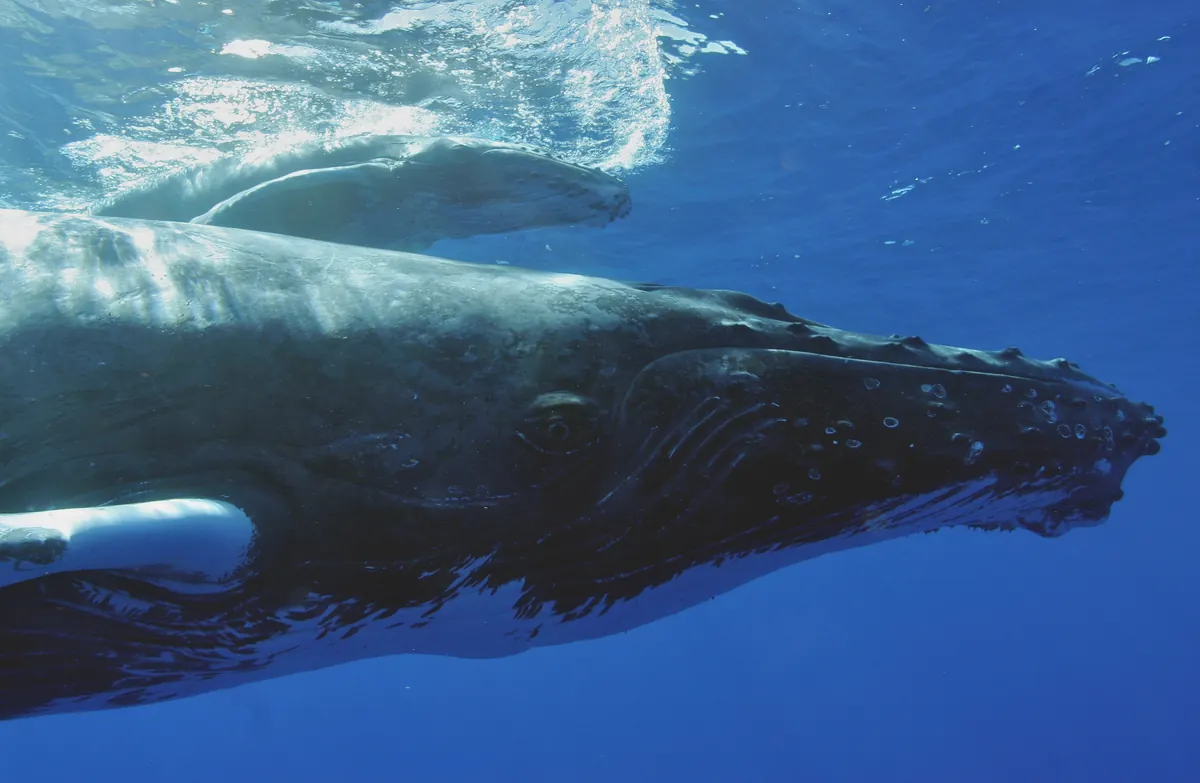
- Listen for the whales. From December to April, the songs of male humpbacks become the loudest natural sound under the sea around much of Hawaii, and they carry for miles. On a calm day in the Maui channels or off Kona, duck your head under and listen; from a high lookout, count blows instead.
- Geminids in the small hours. Peak Geminid hours land during Hawaii’s own night this year, from late Sunday, December 13, to dawn Monday. In Honolulu the crescent moon sets at 10:04 p.m., leaving about eight dark hours. Go somewhere dark after midnight, when the radiant in Gemini stands highest.
- Count something. Christmas Bird Count teams take to circles on six islands between December 14 and January 5, and the Kōlea Count’s winter tallies open December 1. One plover on one lawn, counted a few times before spring, is a real contribution.
Put it on paper: the Naturalist’s Field Journal has a map of sounds for the first whale song you hear underwater, a nest observed page for an albatross sitting tight through the holidays, birds I have seen for your Christmas count tally, the dusk and dawn watch for a Geminid night or the first sunrise of 2027, and a tree through the seasons for a māmane coming into yellow flower. Two or three lines a week build a winter record.
Regions used below: Kauaʻi; Oʻahu; Maui, Molokaʻi and Lānaʻi; Hawaiʻi Island; The high summits: Maunakea, Mauna Loa and Haleakalā.
Can you hear humpback whales singing in Hawaii in December?
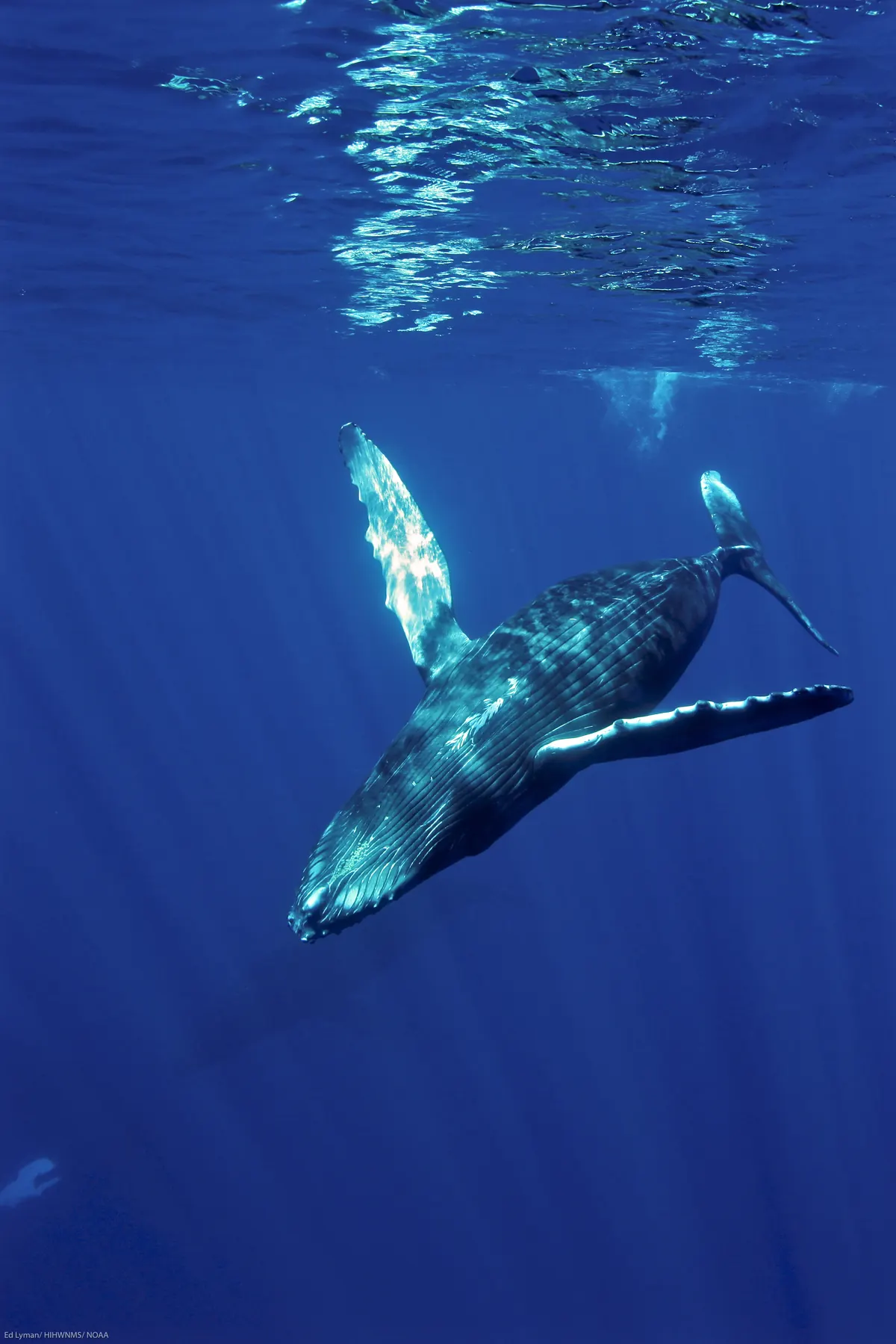
Yes, and December is when the chorus begins in earnest. NOAA’s humpback sanctuary for the islands says that from December through April the song of male humpbacks becomes the dominant background sound underwater in many parts of the islands, and that a single singer can be heard several miles away. The sanctuary uses that sound to track how many whales are around. Recorders at six sites off Maui put the loudest stretch in February and March, so December is the overture.
The whales come to breed, not to eat. NOAA Fisheries says the North Pacific animals build up blubber on their summer feeding grounds in Alaska and western Canada and live off it through the winter, and that some cover the 3,000 miles from Alaska to Hawaii in as few as 28 days. Calves are born here after a pregnancy of about 11 months, already 13 to 16 feet long, so a mother with a calf later this winter may well have mated in these same waters a year before.
-
Listen underwater
Calm days, December through April · Sheltered beaches facing the Maui Nui channels, the Kona and Kohala coasts, and leeward Oʻahu
Float with your ears under the surface and keep still. A distant singer sounds like moans, whoops and creaks repeating in a long, patterned sequence. Swim only where conditions are safe.
-
Counting blows from shore
Mornings, before the trade winds whip up whitecaps · Coastal lookouts and high headlands on every island
Pick a patch of sea and sweep it slowly. A blow is a short white column that lingers a second or two. Note the time and how many you see in fifteen minutes; doing it every week shows the season building toward its peak. In the water, on a board or in a boat, the law keeps everyone at least 100 yards from a humpback.
A puzzle for this winter: after the 2014–15 season, those Maui recorders picked up less than half as much song energy in the peak months, coinciding with a marine heat wave in the North Pacific and the strong El Niño that followed. The authors could not say whether fewer whales came, whether they arrived later, or whether they behaved differently. With another powerful El Niño building, the chorus is worth listening to closely.
When do albatross lay their eggs in Hawaii?
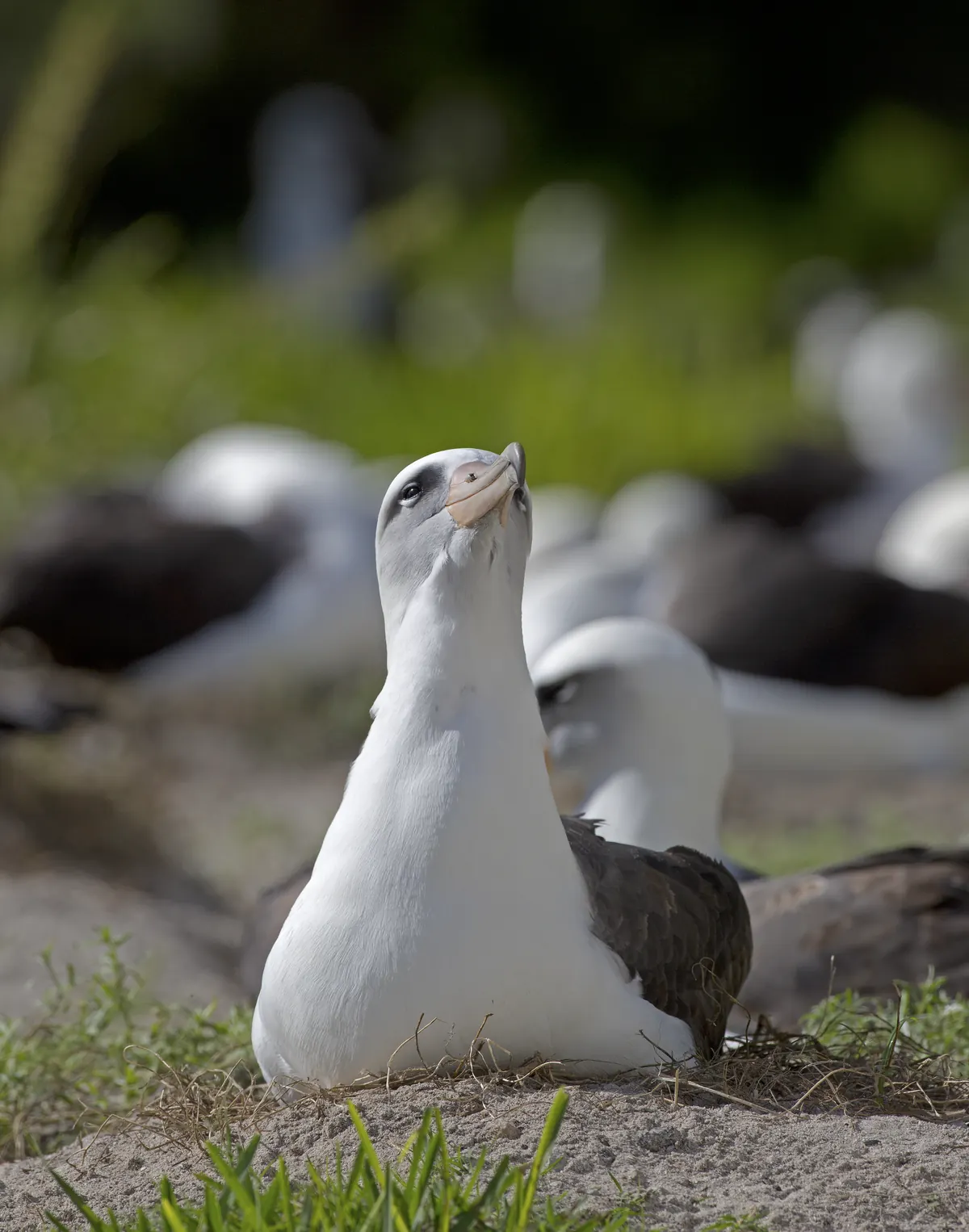
In November and December, so this is the month of sitting still. DLNR’s species account gives those two months for egg laying, a single egg per pair, and July for the chicks to leave. Audubon’s field guide puts incubation at an average of 64 to 65 days, shared by both parents, which means the eggs laid this month will start hatching around late January and February. While one bird sits, its mate may be away feeding at sea for days at a time, sometimes weeks; when it returns, the pair swap places and the hungry one heads out to feed.
Birds with eggs have mostly stopped dancing; the dancers still on the colony are largely young birds that have yet to breed.
-
Kaʻena Point, Oʻahu
Incubation through December and January · Kaʻena Point Natural Area Reserve, on foot from the ends of the road on the Mokulēʻia and Keawaʻula sides
Nesting birds sit low in scraped hollows among the naupaka and grass, often in the open. Watch from the trail with binoculars, keep voices down and pets at home, and remember the dune burrows collapse underfoot. There is no water or shade, and December rain can make the old road muddy.
-
Kīlauea Point, Kauaʻi: still closed
Until hurricane repairs are done · Kīlauea Point National Wildlife Refuge, Kauaʻi’s north shore
The refuge closed to visitors after Hurricane Lowell, with its Recreation.gov ticketing on hold, and gave no reopening date as of early October. Its own page notes that albatross nest there from early November and nēnē are a frequent sight, so check back before the holidays.
-
Wisdom, the oldest known wild bird
Usually back on her nest between late November and December · Midway Atoll National Wildlife Refuge, near the northwestern end of the Hawaiian chain
Wisdom was first banded in 1956 while sitting on an egg, so she is at least 75 years old. The Friends of Midway Atoll reported her back at her usual nest site in November 2025, with her mate arriving on November 26, and estimate that she has laid 50 to 60 eggs in her life. Whether she is back again is a small piece of news worth waiting for.
When is the Christmas Bird Count in Hawaii, and how can you join?
Counting opens Monday, December 14, and closes Tuesday, January 5, 2027. Every circle, 15 miles wide and fixed from year to year, gets one count day, when teams follow set routes and record every bird they see or hear. Hawaiʻi Audubon Society lists circles on Oʻahu, Hawaiʻi Island, Maui, Lānaʻi, Molokaʻi and Kauaʻi, and asks newcomers to sign up ahead of time with each circle’s compiler for a route and a day. Last season the Waipiʻo circle in central Oʻahu counted on December 14, 2025, and the Honolulu circle on January 4, 2026; the compilers usually announce this winter’s dates in late fall.
The results are surprisingly rich. In the 124th count, the Honolulu circle tallied 3,143 red-footed boobies and 169 white terns, the manu-o-Kū that nest in city trees; Kapaʻa on Kauaʻi found 351 Hawaiian ducks; North Kona logged an ʻiʻiwi; and a white wagtail turned up as a first record for the state. Two seasons earlier, Līhuʻe counted 148 nēnē, a record, and Midway reported 1,855 kōlea.
-
Christmas Bird Count circles
One day per circle, December 14, 2026 to January 5, 2027 · Past circles include Honolulu and Waipiʻo on Oʻahu; Kapaʻa, Līhuʻe and Waimea on Kauaʻi; ʻĪao on Maui; Molokaʻi; and Hilo, North Kona and Volcano on Hawaiʻi Island
Beginners can join a team led by experienced counters. Contact Hawaiʻi Audubon at events@hiaudubon.org or (808) 756-2980 to be put in touch with a compiler. On Kauaʻi, ask how hurricane closures will change the routes.
-
Kōlea winter counts open
December 1 to March 31 · Any lawn, park, campus or golf course
Arrival reports closed at the end of November. Now the Kōlea Count wants winter numbers: a Little Count, where you report your starting number for a yard or schoolyard and any changes through March, or a Big Count, where you survey a large park or cemetery three times before April. Note leg bands if you see them.
-
The last of the seabird fallout
Through December 15 · Lit roads and parking lots, especially on Oʻahu and Kauaʻi
DLNR’s fallout season ends in mid-December, and the late young ʻuaʻu kani still turn up under lights in the first two weeks. The moon is new on December 8, so the darkest nights come right around then. The same rescue steps apply: cover the bird with a cloth, box it, and call the island’s seabird contact.
Does it snow in Hawaii in December?
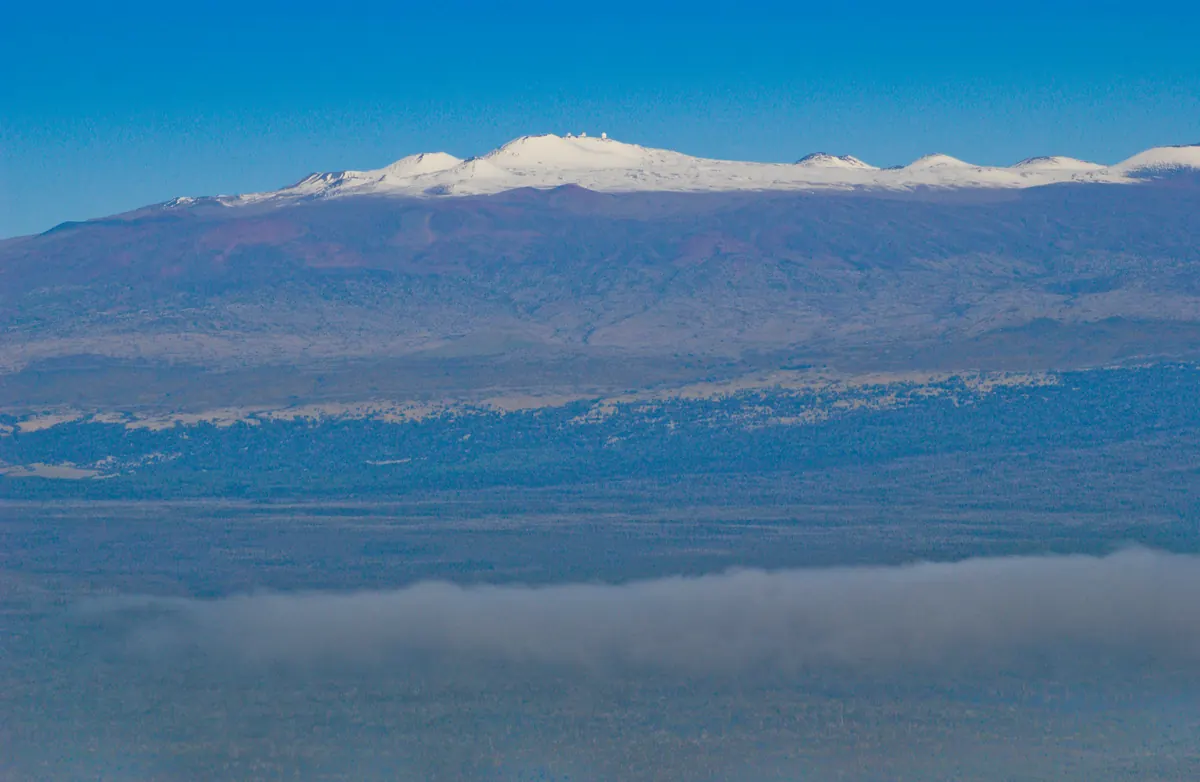
On the high summits, yes. The Center for Maunakea Stewardship at the University of Hawaiʻi at Hilo says it usually snows on Maunakea a few times a year. On January 5 and 6, 2026, a storm left 8 to 10 inches around the summit, and snow also showed on webcams on Mauna Loa; the road closed while crews brought out a snow blower, two plows and a loader. A December 21, 2022, storm was worse, with winds over 100 mph, sleet, freezing rain and more than 6 inches of snow that set into hard ice and drifts, closing the road for days.
The long-term numbers say how rare real cold is. At the Mauna Loa slope station near the observatory, about 11,000 feet up, the 1991–2020 normals give 4.4 nights in an average December at 32 °F or below, rising to 6.3 in January and 9.1 in February. The ranger station on Haleakalā, near 7,000 feet, averages none. The summits above both are colder still, and every station in the table below, from sea level to 7,000 feet, averages no freezing nights at all.
-
Seeing the snow
A clear morning after a winter storm · Looking up from Hilo, Waimea or the Saddle Road on Hawaiʻi Island; from upcountry Maui toward Haleakalā
The best view of a snowcapped Maunakea is often from below, once the cloud lifts. High-altitude sun melts it fast, so look within a day or two.
-
Maunakea road status
Check before every trip in winter · Visitor Information Station at 9,200 feet, and the summit road above it
The road above the station closes when snow, ice or freezing fog make it unsafe, and it can stay shut for days while crews clear it. The stewardship center warns that the summit is about two hours from emergency care, that cell service is unreliable, and that there is one public emergency phone at the top. The Maunakea Weather Center posts summit forecasts and conditions.
Maunakea is among the most sacred places in Hawaiʻi; the stewardship center asks visitors to treat it that way, snow or no snow.
How wet is December in Hawaii?
Very, on the windward side, and wetter than most visitors expect almost everywhere else. In a normal December Hilo gets about 12 inches, with a tenth of an inch or more falling on about 16 days. Līhuʻe and the Haleakalā ranger station get more rain in December than in November, and even dry Kahului and Kona pick up. Honolulu’s December normal is a modest 2.18 inches. Temperatures barely move: Honolulu airport averages about 82 °F by day and 69 °F at night.
The big rains of Hoʻoilo usually come with Kona lows, slow storms that pull moist southerly winds across the islands and soak the leeward sides that the trade winds leave dry, and with cold fronts that sweep in from the northwest with a band of heavy showers and a shift to cool northerly winds behind. The Western Regional Climate Center notes that the number of Kona storms varies widely from one winter to the next.
| Station | December rain | Days with 0.1 in or more | High / low | Nights at or below 32 °F |
|---|---|---|---|---|
| Līhuʻe airport, Kauaʻi | 4.64 in | 6.9 | 79.1 / 68.6 °F | 0 |
| Honolulu airport, Oʻahu | 2.18 in | 3.2 | 81.8 / 69.2 °F | 0 |
| Hoʻolehua airport, Molokaʻi | 2.87 in | 5.1 | 80.2 / 66.9 °F | 0 |
| Kahului airport, Maui | 2.80 in | 4.2 | 83.3 / 65.9 °F | 0 |
| Haleakalā ranger station, Maui (7,000 ft) | 5.28 in | 6.6 | 61.1 / 45.1 °F | 0 |
| Keāhole airport, Kona | 1.06 in | 1.6 | 82.3 / 70.0 °F | 0 |
| Hilo airport, Hawaiʻi Island | 12.07 in | 16.2 | 78.8 / 65.7 °F | 0 |
| Mauna Loa slope station (11,000 ft) | 1.32 in | 2.9 | 51.1 / 35.8 °F | 4.4 |
Our cloud forecast shows when a band of showers is due, and the current conditions page lets you watch the wind swing round and the pressure dip as a Kona low comes near.
Will El Niño make this winter dry in Hawaii?
It may well, though December itself is the least likely month to show it. The Climate Prediction Center’s mid-September update rated the chance of an exceptionally powerful El Niño lasting through the islands’ cool season at better than ninety percent. NOAA’s Pacific ENSO Applications Climate Center notes that these events tend to peak in December, which is how the name, the Spanish for the Christ Child, came about. For Hawaii it sums up the usual effect as more rain at the start of the wet season and then rapidly less, along with weaker trade winds that can turn westerly at times.
DLNR’s drought program puts the chance of drought during the wet season after an El Niño at about 70 percent, with below-normal rain common through the following winter and spring. When a strong event was building in 2023, the Honolulu forecast office’s wet-season outlook warned of rain-fed pasture and crops drying out, catchment tanks running low, brush fires out of their usual season, and a better chance of large north shore surf, especially in January and February. It also reminded readers that a single downpour can still bring a flash flood in a dry winter.
NOAA’s winter outlook is due out on October 15, and its maps for Hawaii will appear with the rest on the Climate Prediction Center’s 90-day outlook page. The Honolulu forecast office usually issues its own wet-season rainfall outlook for the state in mid-October as well.
Where can you see native forest birds and nēnē families in December?
On Haleakalā, the park’s free Forest Bird Hikes go on into December, on Tuesdays and Wednesdays, December 1, 2, 8, 9, 15 and 16, from 9 to 10 a.m. A park biologist leads each one from the picnic shelter at Hosmer Grove, near 7,000 feet, into the native shrubland and forest edge where ʻapapane, ʻiʻiwi and ʻamakihi feed. Come in a warm layer and a rain shell; December mornings up there average in the mid-40s.
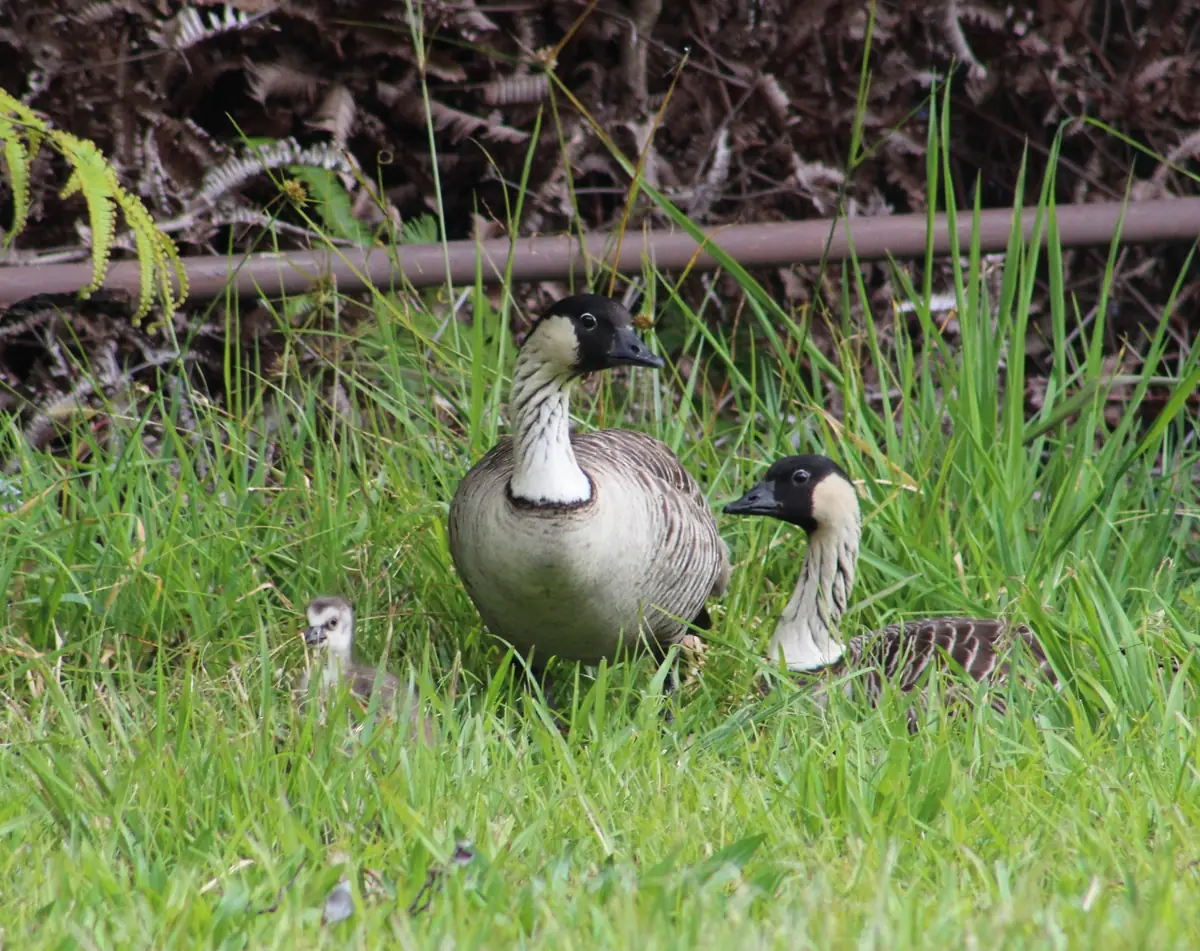
Nēnē are deep in their breeding season. DLNR says most clutches are laid between October and December and take about a month to hatch, so goslings hatch all through the winter. The national park on Kīlauea closes sensitive brooding areas to protect young families and says cars kill more adult nēnē in the park than anything else.
-
Goslings on the grass
Through the winter · Grassy road edges and open lawns in Hawaiʻi Volcanoes and Haleakalā national parks, and lowland refuges on Kauaʻi and Maui
Families walk together, parents in front and behind, and a pair with young will stand their ground. Give them room, never feed them, and slow right down wherever a goose-crossing sign appears.
-
Palila on Maunakea
All year; breeding depends on the māmane seed crop · Māmane forest on Maunakea’s western slope, roughly 6,500 to 9,400 feet
This gray-and-yellow finch-billed honeycreeper lives almost entirely on the green seeds of the māmane tree, which make up about 90 percent of its diet, and it survives in about a tenth of its old range. DLNR notes that pairs nest less, or not at all, in years when the trees set few seeds. Mouflon sheep browsing the forest, wildfire in invasive grasses, and rats and cats are its main threats.
Clean your boots before and after any native forest walk. Rapid ʻŌhiʻa Death spreads on soil and wood, and a quick brush and a spray of rubbing alcohol is how hikers help stop it.
What is flowering and fruiting in Hawaii in December?
Two very different plants stand out this month: a native tree the forest birds depend on, and an invasive shrub dressed like a holiday decoration.
-
Māmane in yellow flower
Winter into spring · Upland dry and mesic forest, from about 1,400 to 10,000 feet; Polipoli and Hosmer Grove on Maui, Maunakea’s slopes
DLNR’s plant page says this native legume blooms in winter and spring with clusters of bright yellow, pea-shaped flowers. ʻIʻiwi and other honeycreepers sip the nectar, and palila eat the seeds that follow. Hawaiians used the flowers in lei and medicine, and the hard wood for house posts, tools and the runners of hōlua sleds.
-
Christmas berry, the red berries to worry about
Red berry clusters, most noticeable in late fall and winter · Dry and mesic lowlands and pastures on every main island; upcountry Maui around Makawao and Kula
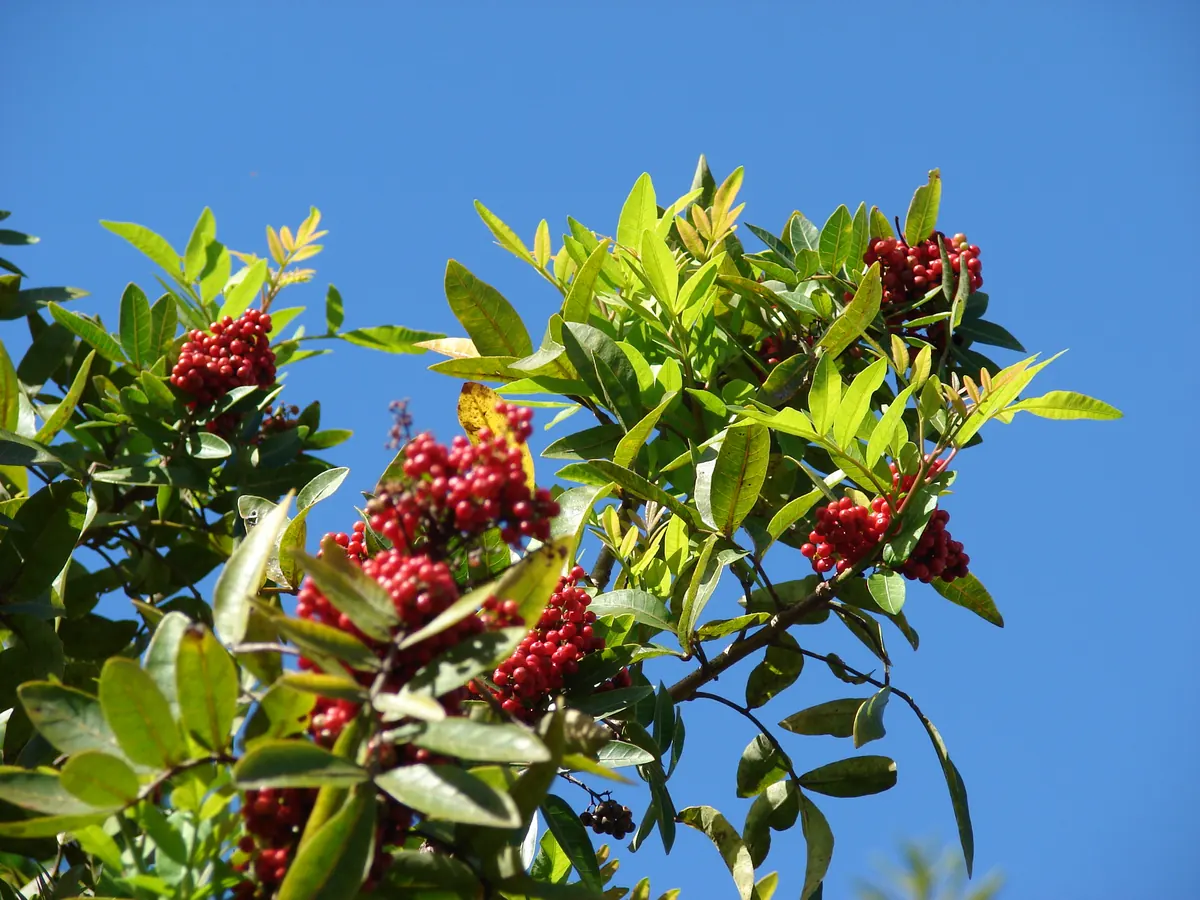
Also called wilelaiki or Brazilian pepper, this shrub has glossy leaves that smell of turpentine when crushed, and bunches of small red berries just in time for the holidays. The Maui Invasive Species Committee calls it one of the most significant threats to endangered plants: birds eat the fruit and drop the seeds far away, it grows in shade, tolerates drought, fire and flooding, and releases chemicals that hold back the plants around it. Admire it, then do not cut it for wreaths, which can carry ripe seed to new places.
How short are Hawaii’s days around the winter solstice?
Barely. Sitting between 19 and 22 degrees north, the islands have the longest winter days of any state: about 10 hours 48 minutes in Līhuʻe at the solstice and 10 hours 57 minutes in Hilo and Kona. From December 1 to the solstice, the cities in the table give up only four to six minutes, and by New Year’s Eve most have won back a minute or two.
The odd part is the timing. The earliest sunsets have already come and gone: Honolulu’s sun sets at 5:48 p.m. from about November 21 to December 1, with the true minimum around November 26, and by December 31 it sets at 6:01. The mornings go the other way, and Honolulu’s sunrise slips from 6:53 a.m. on December 1 to 7:09 on the last day of the year, reaching its latest, 7:12, in mid-January. So a December evening walk gets a little more light each week, while the walk to the school bus gets darker.
| City | Dec 1 | Dec 21 | Dec 31 | Earliest sunset |
|---|---|---|---|---|
| Lihue | 10 h 53 m | 10 h 48 m | 10 h 49 m | 5:53 p.m., Nov 26 |
| Honolulu | 10 h 55 m | 10 h 50 m | 10 h 52 m | 5:48 p.m., Nov 26 |
| Kaunakakai | 10 h 57 m | 10 h 51 m | 10 h 53 m | 5:45 p.m., Nov 26 |
| Lanai City | 10 h 58 m | 10 h 52 m | 10 h 54 m | 5:45 p.m., Nov 26 |
| Kahului | 10 h 58 m | 10 h 52 m | 10 h 54 m | 5:43 p.m., Nov 26 |
| Kailua-Kona | 11 h 02 m | 10 h 57 m | 10 h 58 m | 5:44 p.m., Nov 25 |
| Hilo | 11 h 01 m | 10 h 57 m | 10 h 57 m | 5:40 p.m., Nov 25 |
To find first and last light for your own beach, valley or lookout, drop a pin in the sunrise and sunset calculator.
What is in Hawaii’s night sky this December?
Times are Hawaii Standard Time. December brings the year’s best meteor shower with almost no moon in the way, and the biggest-looking full moon of 2026. The solstice, when the sun stands farthest south, comes at 10:50 a.m. on Monday, December 21.
-
The Geminids
Active December 4 to 20; best from late Sunday, December 13, until dawn Monday, December 14 · The darkest place you can reach, with a wide view of sky
The International Meteor Organization expects up to about 150 meteors an hour under a perfect sky at the peak, which it places around 4 a.m. on the 14th in Hawaii’s time; other forecasts put it earlier, on the evening of the 13th. Either way the islands are well placed. In Honolulu the thin crescent moon sets at 10:04 p.m. on the 13th, the radiant near the bright stars Castor and Pollux climbs highest around 2 a.m., and twilight does not start until about 6:35. Geminids tend to be bright and fairly slow, easy for children to spot.
-
The Cold Moon, closest of the year
Full at 3:28 p.m. on Wednesday, December 23; nearly as full on Christmas Eve · Low in the east-northeast at sunset
This is the nearest full moon of 2026, a supermoon in every sense, with the point of its orbit closest to Earth coming about seven hours after full. In Honolulu it rises at 5:52 p.m. on the 23rd, four minutes before the sun sets, so the two hang on opposite horizons together for a few minutes. Its glare will swamp the small Ursid shower, which peaks on the 22nd.
-
Venus at dawn, Saturn at dusk
All month · East-southeast before sunrise; south and southwest after dark
Venus blazes in the east before sunrise, a little higher each morning. On the 4th and 5th, before dawn, a waning crescent moon hangs near Venus and the star Spica. Jupiter, in Leo, comes up sooner every night and clears the eastern hills by mid-evening as the month ends, with fainter, reddish Mars rising after it. In the evening sky Saturn is the only bright planet, sliding lower in the south and west through December.
-
Makaliʻi high at midnight
All month; the gibbous moon nearby on the evening of December 21 · High in the east in the evening, overhead around midnight
The Pleiades, whose rising opened the Makahiki season in November, now ride high through the middle of the night. Comet Encke, whose debris gives the November Taurids, starts to brighten this month on its way to a February pass close to the sun; it should become a binocular object in evening twilight in late January and February.
| Phase | Date | Time |
|---|---|---|
| New moon | Tuesday, Dec 8 | 2:52 p.m. |
| First quarter | Wednesday, Dec 16 | 7:42 p.m. |
| Full moon, the Cold Moon | Wednesday, Dec 23 | 3:28 p.m. (rises just before sunset that evening) |
| Last quarter | Wednesday, Dec 30 | 8:59 a.m. |
| New moon | Thursday, Jan 7, 2027 | 10:24 a.m. |
Before you set an alarm for 2 a.m., check whether trade-wind showers will clear on the sky and cloud outlook, and look up rise and set times for your island on the moon phase calendar.
What can families do outside in Hawaii this December?
- Walk with a park biologist looking for honeycreepers at Haleakalā’s Hosmer Grove on December 1, 2, 8, 9, 15 or 16, 9 to 10 a.m. The hike itself is free; bring binoculars and a jacket.
- Pull weeds in the rainforest. Hawaiʻi Volcanoes National Park lists a volunteer restoration morning on Saturday, December 5, 8:45 a.m. to noon (check the park calendar for later Saturdays), meeting at the Kīlauea Visitor Center parking lot. Wear closed shoes, long pants and rain gear; the park provides tools and gloves, and volunteers under 18 come with a parent or guardian.
- See feathers become art. Every Wednesday in December (the 2nd, 9th, 16th, 23rd and 30th), Puʻukoholā Heiau National Historic Site on the Kohala coast offers a demonstration of hulu aliʻi, chiefly featherwork, at the visitor center from 10 a.m. to 1 p.m. A good way to talk with children about the forest birds whose feathers made royal cloaks.
- Watch a fishpond wall go up. At Kaloko-Honokōhau National Historical Park, stone-setter Benson Chong demonstrates traditional dry-stack wall building on Wednesday, December 16, 10 to 11 a.m.
- Visit Waimea Valley on a royal birthday. The valley marks Prince Lot Kapuāiwa’s birthday on Friday, December 11, and Princess Bernice Pauahi Bishop’s on Saturday, December 19, with half-price admission for kamaʻāina with a state ID, 9 a.m. to 4 p.m.
- Join a bird count. Ask Hawaiʻi Audubon to match your family with a Christmas Bird Count team, or start a Kōlea Count of your own yard on December 1.
- Stay up for the Geminids on December 13, or watch the Cold Moon rise at sunset on December 23.
- Greet 2027 at Makapuʻu. For years Hawaii State Parks has led a First Day Hike on the Makapuʻu Point Lighthouse Trail at Kaiwi State Scenic Shoreline on New Year’s Day, with the pū blown to the four directions, chant and taiko at sunrise; on January 1, 2026, gates opened at 5:30 a.m. for about a mile of paved trail to the overlook. Watch DLNR’s state parks announcements in December for the 2027 details, and bring a flashlight and a warm layer.
The Naturalist’s Field Journal is made for a family’s winter notes, and the index of month-by-month nature guides covers other states. Last month’s page for the islands is at November in Hawaii.
Safety notes for December in Hawaii
- Kauaʻi’s state parks. After Hurricane Lowell, DLNR reopened only a few Kauaʻi lands in late September. Waimea Canyon and Kōkeʻe state parks, Hāʻena and Polihale, and the Nā Pali Coast wilderness park with the Kalalau Trail remained closed with no reopening date, and Kōkeʻe Road was still shut. Check DLNR’s latest notices before planning any Kauaʻi hike.
- Ice and snow up high. Freezing fog, ice and snow can close the Maunakea summit road with little warning, and Haleakalā’s summit can drop below freezing on winter mornings. Go up with a full tank, warm clothes and gloves, and turn back if the weather turns. Altitude sickness is a real risk above 9,000 feet.
- Flash floods. A Kona low or a stalled front can turn a dry streambed into a torrent in minutes, even when it is not raining where you stand. Do not cross flowing water on foot or by car, and stay out of the ocean near stream mouths after heavy rain. Leptospirosis is a risk in fresh water, especially with cuts.
- Winter surf. North- and west-facing shores take the biggest swells of the year. Watch from well back, keep off wet rocks and ledges, swim only at guarded beaches, and believe the lifeguards’ signs.
- Kīlauea. As of October 1, Halemaʻumaʻu’s vents were still glowing and spattering after 54 fountaining episodes since December 2024, the alert level stood at WATCH, and the volcano observatory said a 55th episode could come. Read the daily update before you go, and avoid vog if you have heart or lung trouble.
- Short days. Most of the month the sun is down between about 5:40 and 6 p.m., earliest in Hilo, and twilight is brief this close to the tropics. Start long hikes early and pack a headlamp.
- Hunting seasons and blaze orange. Under the state’s game bird rules, the season runs from the first Saturday in November to the last Sunday in January, in 2026–27 from November 7 to January 31, mostly on weekends and state holidays; DLNR had not posted its unit-by-unit announcement for the season by early October. On Kauaʻi, bowhunters may take deer daily in Unit F, and on Saturdays, Sundays and state holidays in Units J and K, until the end of December, and in Unit D archery deer hunting runs alongside the regular pig season on weekends and holidays through December. Pig and goat hunting is open all year in many units statewide. Where firearms are allowed, hunters and anyone with them, guides, helpers and companions alike, must wear an outer shirt, vest, jacket or coat in commercially made blaze orange (solid fabric, or mesh with openings of an eighth of an inch or less) that can be seen from front and back; any orange camouflage pattern is banned. Hikers in hunting areas are wise to wear something bright too.
Sources
- Hawaiian Islands Humpback Whale National Marine Sanctuary: acoustic monitoring of humpback song
- Kugler et al., Endangered Species Research 43 (2020): fluctuations in Hawaii’s humpback whale population inferred from male song chorusing off Maui
- NOAA Fisheries: humpback whale species profile
- Hawaiian Islands Humpback Whale National Marine Sanctuary: responsible recreation (100-yard rule)
- DLNR Division of Forestry and Wildlife: mōlī (Laysan albatross)
- Audubon Guide to North American Birds: Laysan albatross (incubation)
- DLNR Natural Area Reserves: Kaʻena Point
- U.S. Fish and Wildlife Service: Kīlauea Point National Wildlife Refuge (closed for post-hurricane repairs)
- Friends of Midway Atoll: Wisdom returns to Kuaihelani (November 20, 2025)
- Hawaiʻi Audubon Society: Audubon Christmas Bird Count in Hawaiʻi (2025–26 dates and contacts)
- Hawaiʻi Audubon Society: ’Tis the season for bird counting (December 19, 2025)
- National Audubon Society: the 124th Christmas Bird Count in Hawaii and the Pacific Islands
- National Audubon Society: the 122nd Christmas Bird Count in the Hawaiʻi/Pacific region
- Hawaiʻi Audubon Society Kōlea Count: guidelines for winter Little and Big Counts
- DLNR: seabird fallout season and island contacts
- Spectrum News Hawaii: rare snowfall piles up on Maunakea (January 5, 2026)
- University of Hawaiʻi News: winter weather leaves unsafe road conditions on Maunakea (December 21, 2022)
- University of Hawaiʻi at Hilo, Center for Maunakea Stewardship: Visitor Information Station
- Maunakea Weather Center: summit forecasts and conditions
- Haleakalā National Park: weather
- NOAA NCEI: 1991–2020 monthly normals for eight Hawaii stations, rain, rainy days, temperatures and freezing nights (data API)
- Western Regional Climate Center: climate of Hawaii
- Climate Prediction Center: ENSO diagnostic discussion, September 10, 2026
- Climate Prediction Center: 90-day outlooks (NOAA winter outlook due October 15, 2026)
- NOAA Pacific ENSO Applications Climate Center: El Niño and its impacts on Hawaiʻi (PDF)
- DLNR: Hawaii drought forecasting (El Niño and drought odds)
- NWS Honolulu: wet season rainfall outlook for the State of Hawaiʻi (October 18, 2023, PDF)
- Haleakalā National Park: Forest Bird Hike, December 1 (also December 2, 8, 9, 15 and 16)
- DLNR Division of Forestry and Wildlife: nēnē
- Hawaiʻi Volcanoes National Park: nēnē
- DLNR Division of Forestry and Wildlife: palila
- DLNR Division of Forestry and Wildlife: māmane
- Maui Invasive Species Committee: Christmas berry’s unwelcome presence
- University of Hawaiʻi CTAHR: Rapid ʻŌhiʻa Death
- U.S. Naval Observatory: 2026 moon phases (data API)
- U.S. Naval Observatory: Honolulu sun and moon times, December 13, 2026
- U.S. Naval Observatory: Honolulu sun and moon times, December 23, 2026
- U.S. Naval Observatory: 2026 equinoxes and solstices (data API)
- International Meteor Organization: 2026 meteor shower calendar (PDF, archived copy)
- EarthSky: the Geminid meteor shower
- EarthSky: what is a supermoon? (2026 full supermoons)
- NASA JPL Horizons: planet and moon positions, December 2026
- Star Walk: Comet Encke in 2027
- Hawaiʻi Volcanoes National Park: Stewardship at the Summit, December 5
- Puʻukoholā Heiau National Historic Site: hulu aliʻi (chiefly featherwork) demonstrations, Wednesdays in December
- Kaloko-Honokōhau National Historical Park: Noʻeau Hoʻoniho stone-setting demonstration, December 16
- Waimea Valley: events (Prince Lot Kapuāiwa’s birthday, December 11; Princess Bernice Pauahi Bishop’s birthday, December 19)
- Spectrum News Hawaii: Oʻahu’s First Day Hike returns with sunrise ceremony (December 30, 2025)
- DLNR Division of State Parks: Makapuʻu Point Lighthouse Trail
- Kauaʻi Now: all state parks on Kauaʻi remain closed for the foreseeable future after Hurricane Lowell (September 17, 2026)
- DLNR: most lands reopen after Nolo, Kauaʻi exceptions (September 30, 2026)
- USGS Hawaiian Volcano Observatory: Kīlauea updates (October 1, 2026)
- Hawaii Department of Health: leptospirosis
- Hawaii Department of Health, Ocean Safety: Hawaii’s surf seasons
- DLNR: Hawaii Administrative Rules chapter 13-122, game birds (season dates, blaze orange)
- DLNR: Hawaii Administrative Rules chapter 13-123, game mammals (blaze orange)
- DLNR: 2026 black-tailed deer season on Kauaʻi (PDF)
- DLNR: hunting announcements (2026–27 game bird announcement not yet posted)
- Photos via Wikimedia Commons; licenses and photographers are credited under each picture
