What to look for in nature in Indiana this March
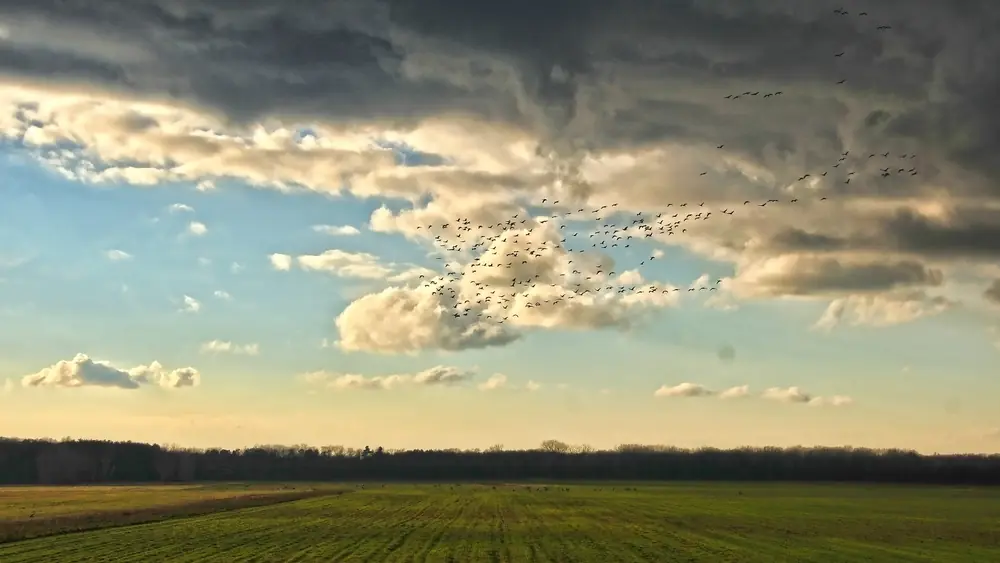
March is the month Indiana changes its mind about winter, sometimes twice in a week. A morning can start at 25 degrees with a skim of ice on the ditch and end with a 60-degree afternoon, and the wildlife follows the thermometer. Sandhill cranes are still funneling north over the marshes of the Kankakee and the White River country, while ducks, geese and swans drop into flooded fields. On the first soft, rainy night above about 40 degrees, spotted salamanders and wood frogs cross roads toward the fishless pools where they breed, and by dusk the woodcock are spiraling up over the brushy fields. Bald eagle eggs are a week or two from hatching, the maple sap is running down to its last days, and skunk cabbage is already pushing up in the wet woods. The clocks go ahead on March 14, and spring officially begins on March 20. Times below are Eastern time, which most of Indiana keeps, with Central time in parentheses for the twelve corner counties around Gary and Evansville; the March 8 new moon is on standard time, and everything after the clock change is daylight time.
Other months in Indiana: October, November, December, January, February, April.
Start here

- Stand at the edge of a brushy field at dusk. Choose an overgrown field or a young woodlot and be in place before the light is gone. Listen for a nasal, buzzing "peent" from the ground, and soon a woodcock will climb in a spiral, twittering, before dropping to the same spot.
- Go out on the first warm, rainy night. If it rains after dark and the air stays above about 40 degrees, take a flashlight to a quiet woodland edge near a pond. Wood frogs, chorus frogs and spotted salamanders may be heading for the water, so watch your feet.
- Watch the cranes leave a marsh. Pick a clear morning at Jasper-Pulaski or Goose Pond and arrive before sunrise. Flock after flock lifts from the marsh and strings out in long lines toward the north.
March is a good month to start the daily field log plate of the Naturalist's Field Journal, since something changes almost weekly. Use birds I have seen for cranes, ducks and geese, and the map of sounds for the first peepers and a woodcock's peent, with the time and the temperature. A skunk cabbage hood or a leaking maple tap fits a tree through the seasons, and an eagle nest watched from a safe distance goes on nest observed. Try a dusk and dawn watch on the evening of the Worm Moon. If you pick one spot to revisit in May, the same place twice will show how fast the woods change.
Regions used below: Northwest Indiana and the Dunes; Northern Indiana (South Bend, Fort Wayne); Central Indiana (Indianapolis, Lafayette, Terre Haute); South-central hills (Bloomington, Brown County, Hoosier National Forest); Southwest and the Ohio River (Evansville, Madison).
Are sandhill cranes and waterfowl still moving through Indiana in March?
Yes, and March is when the movement is easiest to catch in a short visit. At Jasper-Pulaski Fish & Wildlife Area, the Indiana Birding Trail lists February and March as the best months for birding, with spring crane watches of one to two hours at sunrise or sunset. Unlike the long autumn buildup, the spring birds are passing through, and the DNR says some stay to nest in the state's northern counties. Flocks during migration can reach the tens of thousands.
Farther south, Goose Pond Fish & Wildlife Area near Linton covers 9,098 acres of restored prairie and marsh. The DNR counts more than 300 bird species there, among them pelicans, cranes, shorebirds and swans. The Birding Trail says sandhill cranes and American white pelicans stage there each spring and fall, that the area is a stopover for the Eastern Migratory Population of whooping cranes, and that the best visits fall in the spring and fall migration periods. The Friends of Goose Pond hold their crane festival, Marsh Madness, in late winter, so check their page for the 2027 dates.
-
Jasper-Pulaski at sunrise
March mornings; arrive before first light · Crane viewing tower, a quarter mile west of the property office, near Medaryville
A paved trail leads to the platform, where scopes are mounted. The DNR gives the property as 8,179 acres, and spring cranes spread across all of it, so a still morning at the tower beats a long drive around the roads. Listen for the rolling call first.
-
Goose Pond in the afternoon
March; the visitor center keeps limited spring hours · 13540 W. 400 S., Linton, Greene County
Everyone must check in at the office or a self-service stand. The Birding Trail gives weekday-only visitor center hours in spring and the DNR gives longer office hours, so call 812-512-9185 first. Light goose hunters may use the units below County Road 200 South during the conservation order, so ask the staff which parts are quiet.
-
Ducks, geese and rails at Muscatatuck
March, when the refuge's seasons-of-wildlife page says migrant waterfowl, rails and bitterns arrive · Muscatatuck National Wildlife Refuge, near Seymour
The refuge is best known for nesting wood ducks, and the same page says wood ducks, Canada geese and mallards start nesting in spring as most other waterfowl depart. The Birding Trail calls late April and September the peak of songbird migration, so March is the waterfowl visit. Richart, Stanfield and Moss lakes are the named wetlands.
-
The light goose conservation order
In 2026 it ran February 16 to March 31; 2027 dates are set by the DNR · Statewide, with permits
When the regular goose season closes in mid-February, the DNR opens a special season on snow and Ross's geese. Its page gave only the 2026 dates, so check the DNR for 2027. Decoy spreads and gunfire on farm fields are normal in March, and the DNR warns hunters to be sure of their target because endangered whooping cranes are large and white.
When do frogs and salamanders move on rainy March nights in Indiana?
When the first warm rains fall on thawed ground, which in most years is March, and the night changes. According to the Indiana Herp Atlas, spring peepers may call now and then through fall and winter but do not begin breeding until the first warm rains of spring, as early as January or February in the south. Breeding generally lasts into April or May, in vernal pools, roadside ditches, flooded fields and marshes. Males perch on plants, shrubs and small trees to call; eggs hatch within about a week, and the tadpoles transform in June or July.
Vernal pools are shallow woodland ponds that fill with winter rain and dry up later in the year, and without fish they are safe nurseries. Look from the edge, because wading tramples the egg masses.
-
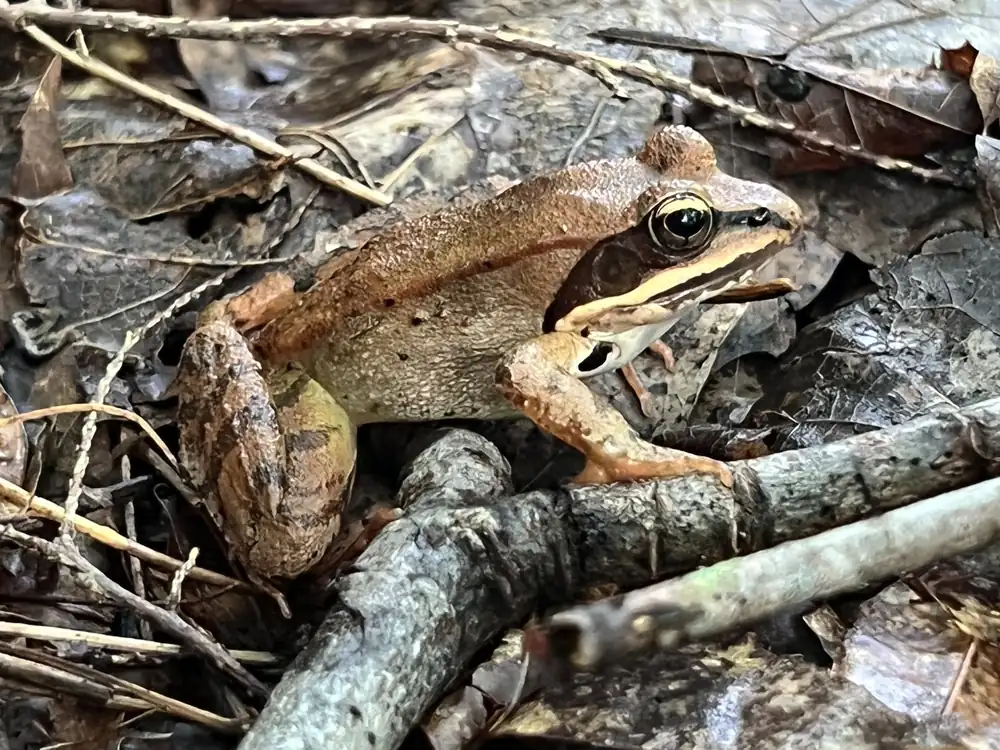
Wood frogs
Late February or early March in southern Indiana; late March or early April in the north · Fishless woodland pools, absent from the northwestern sand prairie region
The Herp Atlas says wood frogs move in large numbers to fishless pools to breed. The call is a quick series of clucks, often likened to a quacking duck, so ducks in a woodland with no stream usually mean wood frogs.
-
Spotted salamanders
Heavy rains concentrated around March · Mature deciduous woods, including bottomlands and well-drained uplands; absent from the northwestern sand prairies
The Atlas says they migrate to breeding ponds in large numbers and breed all at once. Their egg masses are firm and globular, and many look green because algae live in the jelly. They are slow and easily crushed where a road lies between the woods and the pool.
-
Western chorus frogs
Calling from February through April · Shallow, often temporary water in wet meadows and swamps
The Herp Atlas puts chorus frog breeding between February and late April. A Nature Conservancy writer at Kankakee Sands compared the rising trill to a thumbnail drawn over a comb and recommended rainy, foggy, humid nights for listening.
Purdue Extension publishes a 50-page guide, Frogs and Toads of Indiana, with recorded calls. Learn a few before you go, and handle amphibians as little as possible, with wet hands if you must.
How do I find a woodcock sky dance in Indiana?
Find an open, brushy or young-growth spot at dusk on a mild evening, and arrive early. The Indiana DNR's fact sheet says males typically return from the south between mid-February and early March, and that almost every night from March through May a male performs from a patch he defends year after year. These singing grounds are usually fallow fields, recent clearcuts or very young stands, from about an acre and a half to 100 acres. Purdue Extension adds that woodcock also display in city parks and residential neighborhoods.
-
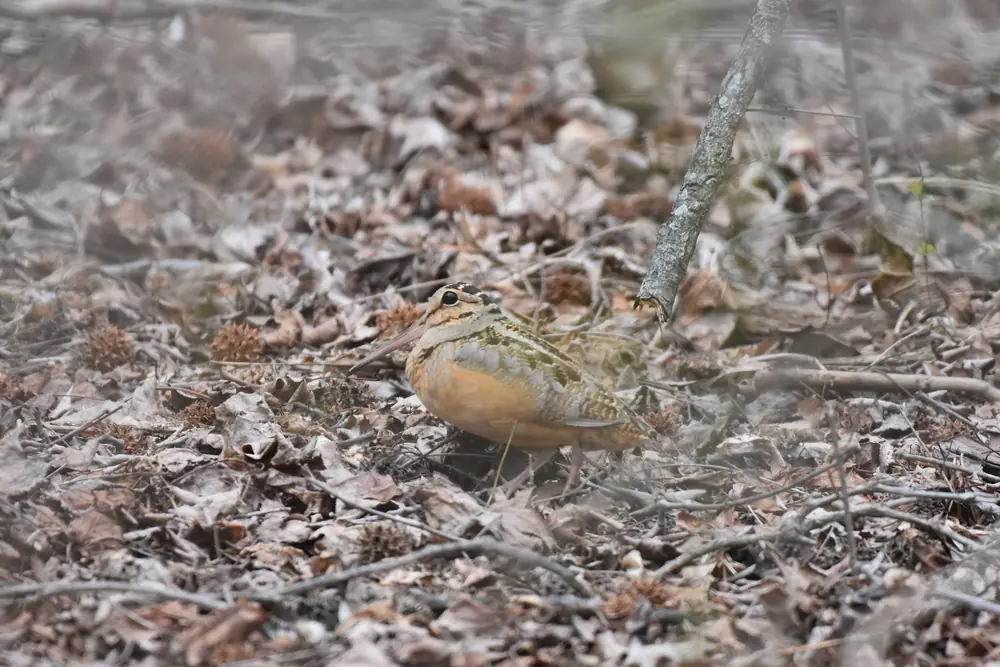
The sky dance
Starting shortly after sundown, for 40 to 50 minutes · Open fields, forest openings, young woodlots and park edges
He opens on the ground with a soft "tuko" and a buzzy "peent," pacing in circles. When the peents stop he takes off in a widening spiral, the DNR says, reaching about 300 feet before diving back, and the whistling and twittering are made by wind passing over the three slender outer wing primaries. The routine repeats for roughly 40 to 50 minutes, and on moonlit nights some males continue on and off until morning. Purdue says dusk is the best time, with some calling before sunrise. After the clocks change on March 14, the performance starts an hour later by the clock.
-
Screech-owls on the nest
Active nests in March and April · Tree cavities and nest boxes in woodlots and neighborhoods
Purdue Extension says eastern screech-owls breed later than the big owls, with active nests in March and April, while great horned owls begin in January and February.
-
Early flycatchers and swallows
The second half of March is the time to start watching · Phoebes near bridges and barns; tree swallows over ponds and at nest boxes
Audubon's field guide says the eastern phoebe migrates quite early compared with other flycatchers, tree swallows move north relatively early and claim nest cavities early, and purple martins return very early in the east, often in February in the southern states. None gives an Indiana date, so use Journey North to follow the front. Ruby-throated hummingbirds arrive around mid-April, according to Purdue, so hold off on feeders.
When do bald eagle eggs hatch in Indiana?
Late March into early April, for the earliest nests. The DNR gives 35 days of incubation and 11 to 12 weeks before the young fledge. The comeback is one of the state's great stories: eagles were gone by 1897, a program released 73 eaglets between 1985 and 1989, the first successful nests in the state after that absence came in 1991, and the DNR's 2020 tally was over 350 territories with nests.
-
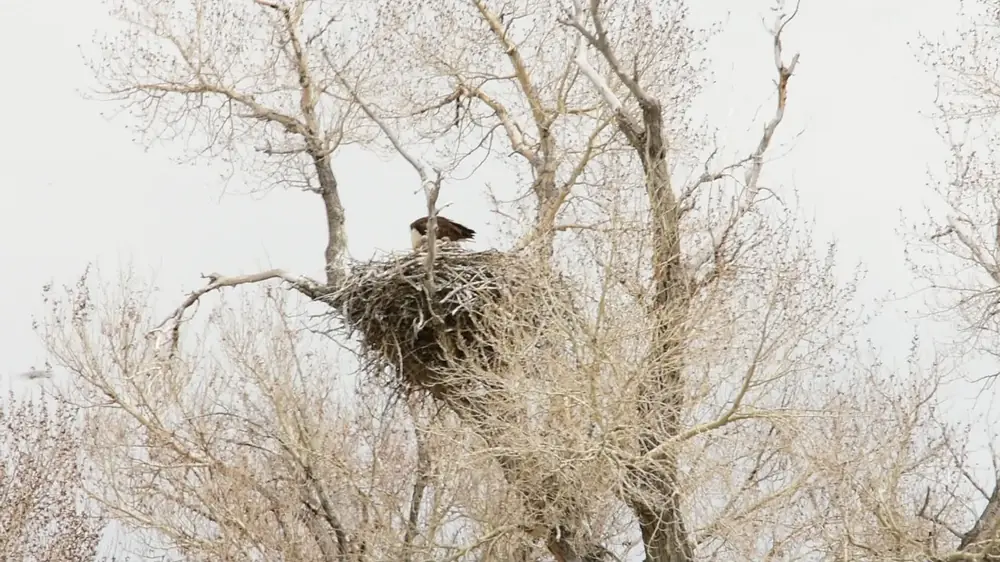
The Notre Dame eagle cameras
Eggs in late February; pipping in late March; hatching in early April · ND-LEEF, St. Patrick's County Park, South Bend; live online
The Environmental Change Initiative's timeline has the chicks pipping through their shells in late March after about 35 days and hatching in early April. Parents tear up prey for the first three weeks; by late April the eaglets are brown-feathered and picking at food, and the first flight is in mid-June. The nest camera dates from 2017 and was upgraded in 2021, and a wide-angle camera was added in 2026. The pair first took over a red-tailed hawk nest here in 2015.
-
Watching a nest from the ground
Throughout March · Any active nest
The DNR asks for 330 feet, about a football field. Use binoculars or a long lens, and leave if an adult stands up and stares at you, because eggs chill quickly on a cold morning.
Is it still maple syrup season in Indiana in March?
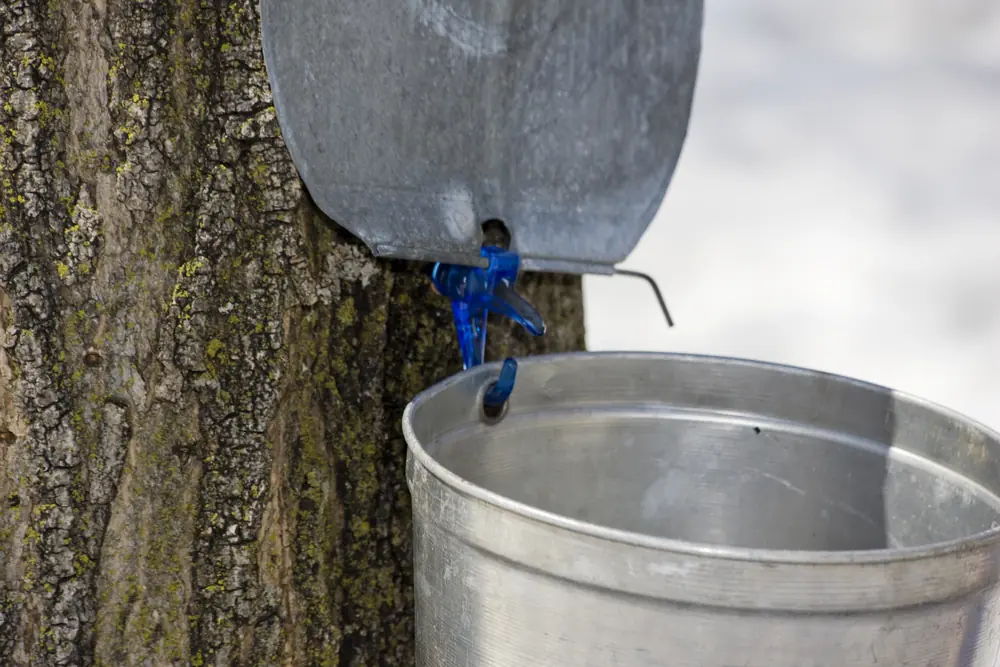
For a few more weeks. The DNR's kids' pages put the Indiana season between February and April. Sap runs when daytime highs reach about 40 degrees and stops near 45, when the enzyme that converts sugars stops working, and the season is over when leaf buds break open and the syrup turns bitter. March is the prime month to visit a sugarhouse, with the festivals clustered early in the month.
-
Indiana Maple Weekend
March 13 and 14, 2027 · Participating sugar camps around the state
The organizer already lists these dates and says visitors can tramp the woods, taste warm syrup off the fire and make maple candy. Confirm each camp's hours on the organizer's page.
-
Maple Sugar Time at Indiana Dunes National Park
Usually the first weekend of March; the park will post 2027 dates · Bailly/Chellberg area, on Mineral Springs Road between U.S. 20 and U.S. 12
A self-guided tour of the sugarbush, with rangers and volunteers at each stop, covers syrup-making from American Indian methods to modern ones; bottled syrup and a pancake breakfast are sold separately. The park will post 2027 dates on its calendar.
-
Maple Sugarbush Festival at Wesselman Woods
Held March 7 and 8 in 2026; 2027 not yet posted · Wesselman Woods Nature Preserve, Evansville
The festival offers a pancake breakfast, guided tapping hikes, a Sugar Shack and four miles of trails. Check the preserve's page for the 2027 date.
Tapping your own trees? Swelling buds and highs near 45 degrees mean it is nearly over, and a warm spell in late March can end it within a weekend.
What is blooming and turning green in Indiana in March?
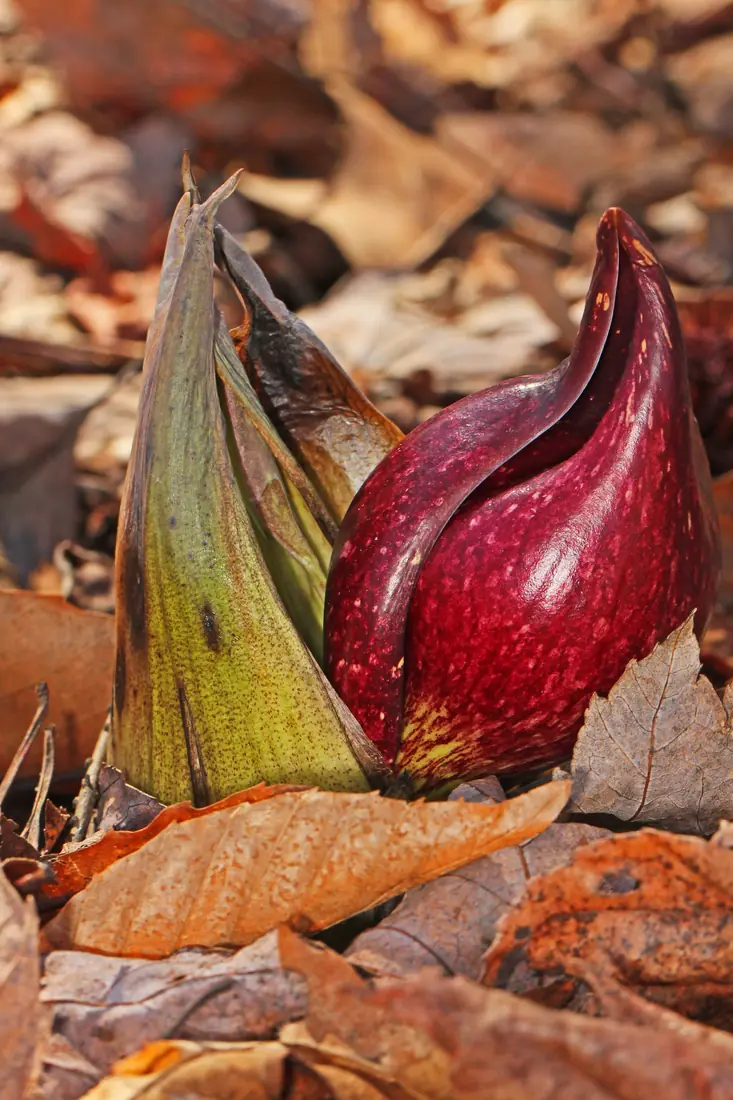
Less than you might hope in the north, and more each week in the south. The earliest bloom is not a showy one: skunk cabbage, which a Nature Conservancy writer for the Indiana Dunes visitor bureau calls one of Indiana's earliest native flowering plants, flowers from February through the first part of May in shaded wet woods, seeps, bogs, fens and swamps. It heats itself enough to melt snow, and the smell and warmth draw flies and gnats. The cabbage-like leaves, about 8 inches wide, open only as the flower fades.
Beyond that, March is about gradual change rather than a peak. Maple buds swell and break, and forest-floor wildflowers start in the warmest, most sheltered places without keeping a fixed calendar, so write down the date you first see each and compare it next year.
-
Kankakee Sands after a burn
March through April · Efroymson Restoration at Kankakee Sands, Newton County
The Nature Conservancy's 8,400 acres of restored prairie are free and open from sunrise to sunset every day. Its page lists migratory birds, wildflowers at Conrad Station Savanna and the intense greening of burned areas as spring attractions, and says fire releases nutrients, spurs seeds to germinate and holds back tree seedlings. More than 100 bison graze 1,100 acres, and the preserve counts over 240 bird species and 600 native plant species.
-
Dunes plants waiting to wake up
Late March · Indiana Dunes National Park
The park has about 1,100 native vascular plants, the National Park Service says, including populations of 30 percent of Indiana's listed rare plants and the federally threatened Pitcher's thistle. March is early for most, but good for scouting trails and the damp woods where skunk cabbage grows.
What is March weather like in Indiana, and what should I watch for?
Changeable, and quite different from north to south. NOAA's 1991 to 2020 normals put South Bend's March average high at 46.2 degrees and its low at 27.2, against 56.8 and 36.4 at Evansville. South Bend normally gets 6.8 inches of snow in March and has at least an inch lying on about 4.9 days; at Evansville the figures are 1.1 inches and 0.5 days. Evansville is the wettest of the four, at 4.60 inches.
The hazards are the usual spring ones: thunderstorms, flooding on swollen streams, and a cold snap that can still kill opened buds. Indiana observes Severe Weather Preparedness Week in March, March 9 to 15 in 2025 and March 8 to 14 in 2026, with a statewide tornado drill on its Tuesday at 10:15 a.m. Eastern (9:15 a.m. Central), moved to Wednesday if the weather is poor. Dates for 2027 are not posted yet, so watch the National Weather Service Indianapolis page. The Climate Prediction Center issues its 90-day outlooks once a month near mid-month, on its outlook page. For the days ahead, check our weather page.
| City | Average high | Average low | Precipitation | Snowfall | Days with snow on ground |
|---|---|---|---|---|---|
| South Bend | 46.2 °F | 27.2 °F | 2.35 in | 6.8 in | 4.9 |
| Fort Wayne | 47.8 °F | 29.4 °F | 2.81 in | 4.6 in | 3.6 |
| Indianapolis | 51.9 °F | 33.0 °F | 3.69 in | 3.2 in | 1.9 |
| Evansville | 56.8 °F | 36.4 °F | 4.60 in | 1.1 in | 0.5 |
When is the last spring freeze in Indiana?
Later than most people expect, and it depends on where you stand. The table gives NOAA's 1991 to 2020 normals for the last 32-degree reading of spring at nine stations. The median marks the middle year: in half of springs the last freeze is already past, and in half it comes later. Evansville's median is in early April, Indianapolis's in mid-April and South Bend's on May 1, while the Indiana Dunes lakeshore station is a little earlier than South Bend. By the last column, just one spring in ten is still waiting on a freeze, so it is the safer date to plant for tomatoes and peppers.
Purdue's Indiana State Climate Office publishes a map of the average last spring freeze and a freeze-probability tool, and our frost dates page lets you look up your own town.
| Station | One year in ten | Median | Nine years in ten |
|---|---|---|---|
| South Bend | Apr 16 | May 1 | May 17 |
| Indiana Dunes lakeshore | Apr 7 | Apr 22 | May 8 |
| Fort Wayne | Apr 10 | Apr 24 | May 10 |
| Lafayette | Apr 11 | Apr 26 | May 14 |
| Indianapolis | Apr 2 | Apr 15 | May 2 |
| Terre Haute | Apr 2 | Apr 16 | May 3 |
| Bloomington | Apr 3 | Apr 17 | May 5 |
| Evansville | Mar 22 | Apr 4 | Apr 19 |
| Madison | Mar 28 | Apr 11 | Apr 28 |
How much daylight does Indiana gain in March?
From 73 minutes at Evansville to 84 at South Bend, as the table shows, and the daily gain of roughly two and a half to nearly three minutes is among the fastest of the year. Every city listed has more than 12 hours 30 minutes of daylight by March 31. On Sunday, March 14, the clocks go ahead at 2 a.m., so sunrise and sunset both land an hour later on the clock from that morning, though the length of the day is unchanged. The equinox is Saturday, March 20, with day and night nearly matched. The Central-time counties around Gary in the northwest and Evansville in the southwest change clocks the same night.
| City | Mar 1 | Mar 31 | Gained | Per day |
|---|---|---|---|---|
| South Bend | 11 h 15 m | 12 h 39 m | 84 min | 2.8 min |
| Gary | 11 h 16 m | 12 h 39 m | 83 min | 2.8 min |
| Fort Wayne | 11 h 16 m | 12 h 38 m | 82 min | 2.7 min |
| Lafayette | 11 h 18 m | 12 h 38 m | 80 min | 2.7 min |
| Indianapolis | 11 h 19 m | 12 h 37 m | 78 min | 2.6 min |
| Terre Haute | 11 h 19 m | 12 h 36 m | 77 min | 2.6 min |
| Bloomington | 11 h 19 m | 12 h 37 m | 78 min | 2.6 min |
| Evansville | 11 h 22 m | 12 h 35 m | 73 min | 2.4 min |
Look up your own town's sunrise, sunset and twilight with our daylight calculator.
What is in the night sky over Indiana in March 2027?
A slim crescent near Venus at the start of the month, Mercury in the dawn, Jupiter and Mars in the evening, and the Worm Moon on the 22nd. There are no eclipses and no meteor showers worth planning around. Times are Eastern with Central in parentheses; March 8 is on standard time and later dates are on daylight time.
-
Moon beside Venus
Mornings of March 4 and 5 · Low in the east-southeast before sunrise
A waning crescent about 12 percent lit stands two degrees from brilliant Venus on the 4th. Venus is the brightest light in the dawn and rises well ahead of the sun all month.
-
Mercury's best morning
Greatest western elongation Wednesday, March 17, 12:20 a.m. EDT (11:20 p.m. CDT, March 16); best from about March 8 to 25 · Low in the east-southeast, about an hour before sunrise early in the month
At its farthest from the sun, Mercury sits 27.6 degrees west of it. Spring mornings give Northern Hemisphere viewers a shallow angle, so find a clear horizon and use Venus, well above it, as a guide.
-
The Moon near Jupiter, then Jupiter and Mars
Moon and Jupiter on the evenings of March 18 and 19; Mars and Jupiter 4.3 degrees apart on the evening of March 30 · High in the east and southeast in the evening
Near the 19th, a Moon that is 88 percent lit slides to within a degree of Jupiter. By the 30th, Mars and Jupiter hang 4.3 degrees from each other, high in the sky around 8 p.m.
-
Saturn's last evenings
Early March · Low in the west-southwest soon after sunset
Saturn is still setting a couple of hours after dusk as March opens, but it sinks lower each evening and is lost in the sun's glare before its April 7 conjunction.
-
The Milky Way before dawn
Around the March 8 new moon, roughly March 5 to 16 · Low in the south-southeast in the last dark hour or so before dawn, from dark rural sites
The Milky Way's bright core returns to the morning sky in March. Our own calculation for 40 degrees north allows at most about 85 minutes of moonless dark with the core up, a little more farther south. The darkest nights of the month surround the new moon.
-
The Worm Moon
Full Monday, March 22, 6:44 a.m. EDT (5:44 a.m. CDT); best evenings March 21 and 22 · Rising in the east around sunset
The full moment comes at dawn in Indiana, so the Moon looks full on both evenings. SeaSky says March's full moon is traditionally the Worm Moon, for the softening ground and returning earthworms, and has also been called the Crow, Crust, Sap or Lenten Moon. It is not a supermoon.
-
Equinox and the clock change
Clocks forward at 2 a.m. Sunday, March 14; equinox Saturday, March 20, at 4:25 p.m. EDT (3:25 p.m. CDT) · Everywhere
Every Indiana county observes daylight saving time. At the equinox the sun rises almost due east and sets almost due west. The northern lights can occasionally reach Indiana, and the weeks around the equinoxes are statistically busy; NOAA's Space Weather Prediction Center posts a short-term forecast.
| Phase | Date | Time |
|---|---|---|
| New moon | Mon, Mar 8 | 4:29 a.m. EST (3:29 a.m. CST) |
| First quarter | Mon, Mar 15 | 12:25 p.m. EDT (11:25 a.m. CDT) |
| Full moon, the Worm Moon | Mon, Mar 22 | 6:44 a.m. EDT (5:44 a.m. CDT) |
| Last quarter | Mon, Mar 29 | 8:54 p.m. EDT (7:54 p.m. CDT) |
The whole year of phases is on our moon phases page, and our clouds page helps with cloudy nights.
What can Indiana families do outdoors in March 2027?
- Sundays in March: turtle feeding at McCormick's Creek State Park. The DNR calendar lists March 7, 14, 21 and 28 at 10:30 a.m. in the Canyon Inn lobby; it was the only March event posted, so check for additions.
- All month: the Notre Dame eagle cameras. Note the day the first egg pips.
- March 13 and 14: Indiana Maple Weekend. Visit a sugar camp and taste syrup.
- Sunday, March 14: clocks forward. The extra evening light is a chance for a first woodcock walk.
- Saturday, March 20: equinox. Mark where the sun rises and sets from your yard, and compare in June.
- Sunday evening, March 21: the Worm Moon. Watch the moonrise and take a night-sound walk.
- A week in March: Severe Weather Preparedness Week. Practice your family's tornado plan.
- Through April: Project FeederWatch. The season runs November through April, and you can count weekly or just once.
- Anytime: NestWatch and Journey North. Both take your sightings: nests for one, first arrivals for the other.
- Looking ahead: City Nature Challenge, April 30 to May 3, 2027. The organizers have announced this observation period; ask a local nature center whether your area takes part.
Weather can cancel programs, so confirm first, and log what you see in our Naturalist's Field Journal.
Safety notes for March in Indiana
- Seasons open in March. According to the DNR's April 2026 to March 2027 season sheet, coyote and striped skunk hunting and trapping run to March 15, 2027, as do beaver hunting and trapping and river otter trapping (the otter season can close early if the statewide quota of 750 is reached). Hunting of eastern snapping turtles and softshell turtles is open to March 31, and green frog and bullfrog hunting to April 30. Crow season ended March 1. The light goose conservation order ran February 16 to March 31 in 2026 and is likely to be similar in 2027, but check the DNR. Trapping is legal beside creeks and fence lines, so keep dogs leashed.
- Spring turkey is not set yet. The DNR lists the 2027 dates as "to be published." In 2026 the youth weekend was April 18 and 19 and the main season ran April 22 to May 10. At Goose Pond, only checked-in turkey hunters and anglers may be in the field before 1 p.m. during that season.
- Hunter orange. The DNR's hunter orange guide lists deer, woodcock, rabbit, quail and pheasant, squirrel and fall turkey seasons. None of the seasons open in March is on that list, but wear something bright where hunting is allowed.
- Flooding and swollen streams. Rain on thawing ground sends creeks over their banks. Never drive through water over a road, and stay off muddy banks.
- Thunderstorms and tornadoes. Check the forecast and know where you would shelter.
- Roads on rainy nights. Frogs and salamanders cross; slow down near woods and pools.
- Ticks and mud. Stay in the middle of trails and check clothes and skin after walking through leaf litter or brush.
- Bats and caves. Hoosier National Forest closes its caves from August 16 through May 14 to protect hibernating bats from white-nose syndrome. Leave closed or gated caves alone.
- Nests and young. Give nesting eagles 330 feet, and leave any young bird or animal you find alone unless it is clearly in danger.
Sources (52)
- Indiana DNR: sandhill crane (migration stopovers at Goose Pond and Jasper-Pulaski)
- Indiana Birding Trail: Jasper-Pulaski Fish & Wildlife Area (best times, crane tower, watch length)
- Indiana DNR: Jasper-Pulaski Fish & Wildlife Area (acreage, viewing platform)
- Indiana Birding Trail: Goose Pond Fish & Wildlife Area and visitor center
- Indiana DNR: Goose Pond Fish & Wildlife Area (acreage, sign-in, spring turkey and light goose rules)
- Friends of Goose Pond: Marsh Madness and spring news
- Indiana Birding Trail: Muscatatuck National Wildlife Refuge
- U.S. Fish and Wildlife Service: Muscatatuck National Wildlife Refuge, seasons of wildlife
- U.S. Fish and Wildlife Service: Muscatatuck National Wildlife Refuge (visitor center hours)
- Indiana DNR: light goose conservation order (2026 dates)
- Indiana Herp Atlas: spring peeper
- Indiana Herp Atlas: wood frog
- Indiana Herp Atlas: spotted salamander
- Indiana Herp Atlas: chorus frogs
- Indiana Dunes blog: chorus frogs calling at Kankakee Sands (The Nature Conservancy)
- Purdue Extension: wildlife publications (Frogs and Toads of Indiana, hummingbirds)
- Indiana DNR: American woodcock fact sheet (PDF)
- Purdue Extension Got Nature?: it's timberdoodle time
- Purdue Extension: winter is a good time to bird (owl nesting)
- Audubon field guide: eastern phoebe
- Audubon field guide: tree swallow
- Audubon field guide: purple martin
- Indiana DNR: bald eagle (incubation, fledging, 330 feet, nest counts)
- University of Notre Dame Environmental Change Initiative: bald eagle timeline and live cameras at ND-LEEF
- Indiana DNR Kids: tasty maple syrup (season, temperatures, buds)
- Indiana Maple Syrup Weekend, March 13 to 14, 2027
- National Park Service: Maple Sugar Time, Indiana Dunes National Park
- Wesselman Woods: Maple Sugarbush Festival
- Indiana Dunes blog: skunk cabbage, the smell of spring (The Nature Conservancy)
- The Nature Conservancy: Kankakee Sands
- National Park Service: plants of Indiana Dunes National Park
- National Park Service: birds of Indiana Dunes National Park
- NOAA NCEI: 1991–2020 monthly normals for South Bend, Fort Wayne, Indianapolis and Evansville (data API)
- National Weather Service Indianapolis: Severe Weather and Flood Preparedness Week (2026)
- Purdue INPREPared: Indiana Severe Weather Preparedness Week, March 9 to 15, 2025
- Climate Prediction Center: 90-day outlooks (updated monthly)
- Indiana State Climate Office, Purdue University
- U.S. Naval Observatory: moon phases, 2027 (data API)
- U.S. Naval Observatory: Earth's seasons, 2027 (data API)
- SeaSky: astronomy calendar 2027
- NOAA Space Weather Prediction Center: aurora 30-minute forecast
- Code of Federal Regulations, 49 CFR 71.5: boundary line between Eastern and Central time in Indiana
- Indiana DNR events calendar, March 2027
- Journey North
- NestWatch (Cornell Lab of Ornithology)
- Project FeederWatch (Cornell Lab of Ornithology and Birds Canada): project overview
- City Nature Challenge
- Indiana DNR: hunting and trapping (2027 spring turkey dates to be published)
- Indiana DNR: hunting and trapping seasons, April 2026 to March 2027 (PDF)
- Indiana DNR: hunter orange requirements (PDF)
- Hoosier National Forest: climbing and caving (cave closure order, August 16 to May 14)
- Photos via Wikimedia Commons; licenses and photographers are credited under each picture
