What to look for in nature in Indiana this February
February closes out meteorological winter in Indiana, gray and raw and still capable of a foot of snow or a glaze of ice, yet it is the month the year turns. Bald eagles settle onto their eggs, and the first sandhill cranes come back north over the Wabash and the White River marshes, bugling. Red-winged blackbirds start singing from cattails, woodcock drift in to the brushy fields, and on a mild wet evening the first chorus frogs trill from a flooded ditch. In the wet woods of the north, skunk cabbage pushes up through frozen mud, and wherever a cold night is followed by a sunny afternoon, maple sap starts to drip. Overhead, Jupiter and Mars both reach opposition. All clock times below are standard time: Eastern across most of the state, with Central given in parentheses for the twelve counties around Gary and Evansville.
Other months in Indiana: October, November, December, January.
Start here

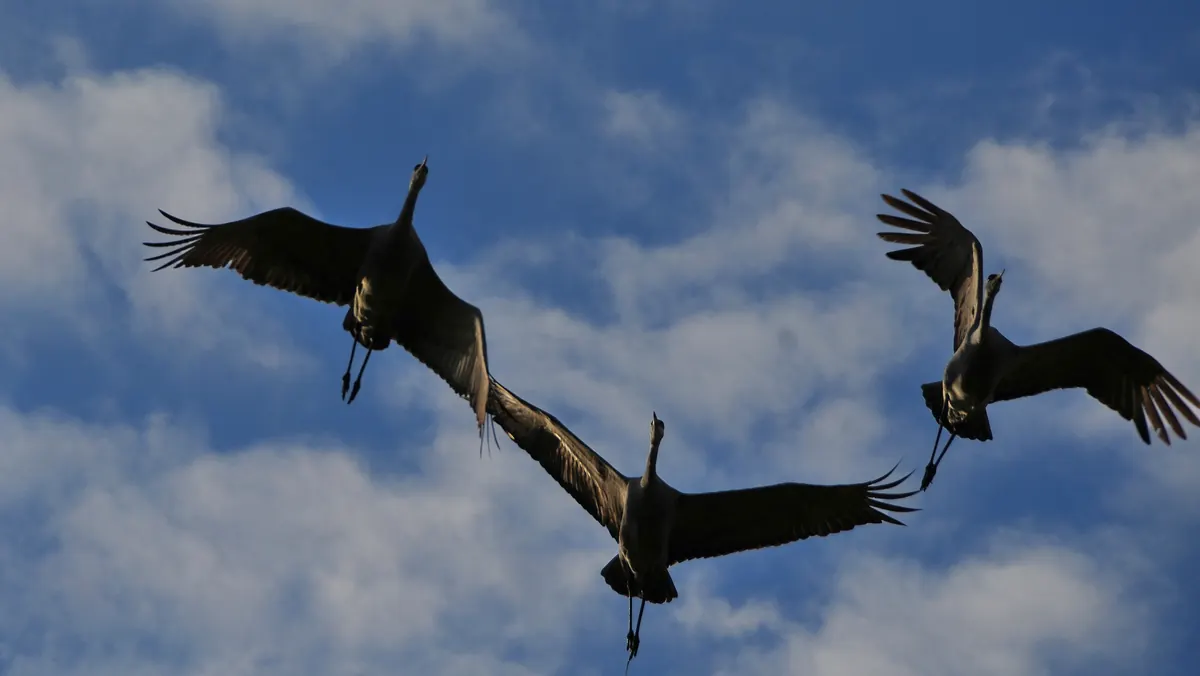
- Watch cranes come in to roost. Go to Goose Pond near Linton or the viewing tower at Jasper-Pulaski in the last hour before sunset on a calm February day, and listen before you look. Northbound sandhill cranes announce themselves with rolling, wooden calls long before the flocks drop into the marsh.
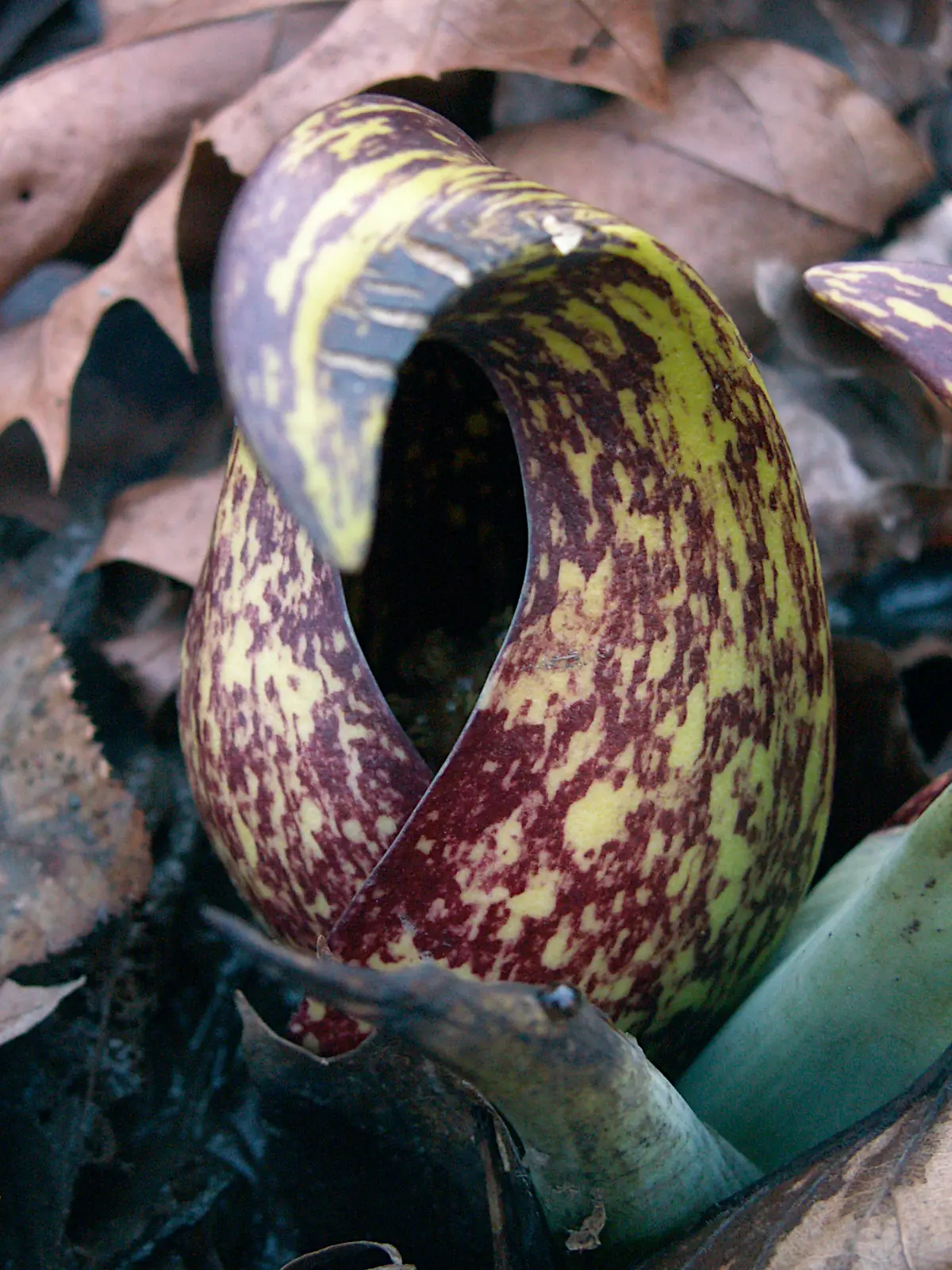
- Look for the first spring flower in the mud. Find a shaded seep or swampy woods in northern Indiana and look for mottled maroon hoods poking out of the muck. Skunk cabbage blooms as early as February and warms its own flower enough to melt the snow around it.
- Find Jupiter and Mars. On any clear evening around February 10, the brightest point of light rising in the east at dusk is Jupiter, opposite the sun. Mars follows it to opposition on the 19th, a smaller orange spark not far from it among the stars of Leo.
February gives the Naturalist's Field Journal a run of firsts. Write the date of the first red-winged blackbird song, the first chorus frog and the first turkey vulture overhead on reading the signs, and keep a tally of cranes and geese on birds I have seen. If you visit an eagle nest from a respectful distance, the nest observed plate is the place for what you saw: who was sitting, who brought sticks or food, and the weather. A hood of skunk cabbage, or a maple tap dripping into a bucket, can be the first entry on a tree through the seasons. And on the evening of the Snow Moon, try a dusk and dawn watch: what sang, what flew over and what the light did as the moon came up.
Regions used below: Northwest Indiana and the Dunes; Northern Indiana (South Bend, Fort Wayne); Central Indiana (Indianapolis, Lafayette, Terre Haute); South-central hills (Bloomington, Brown County, Hoosier National Forest); Southwest and the Ohio River (Evansville, Madison).
When do bald eagles lay eggs in Indiana?
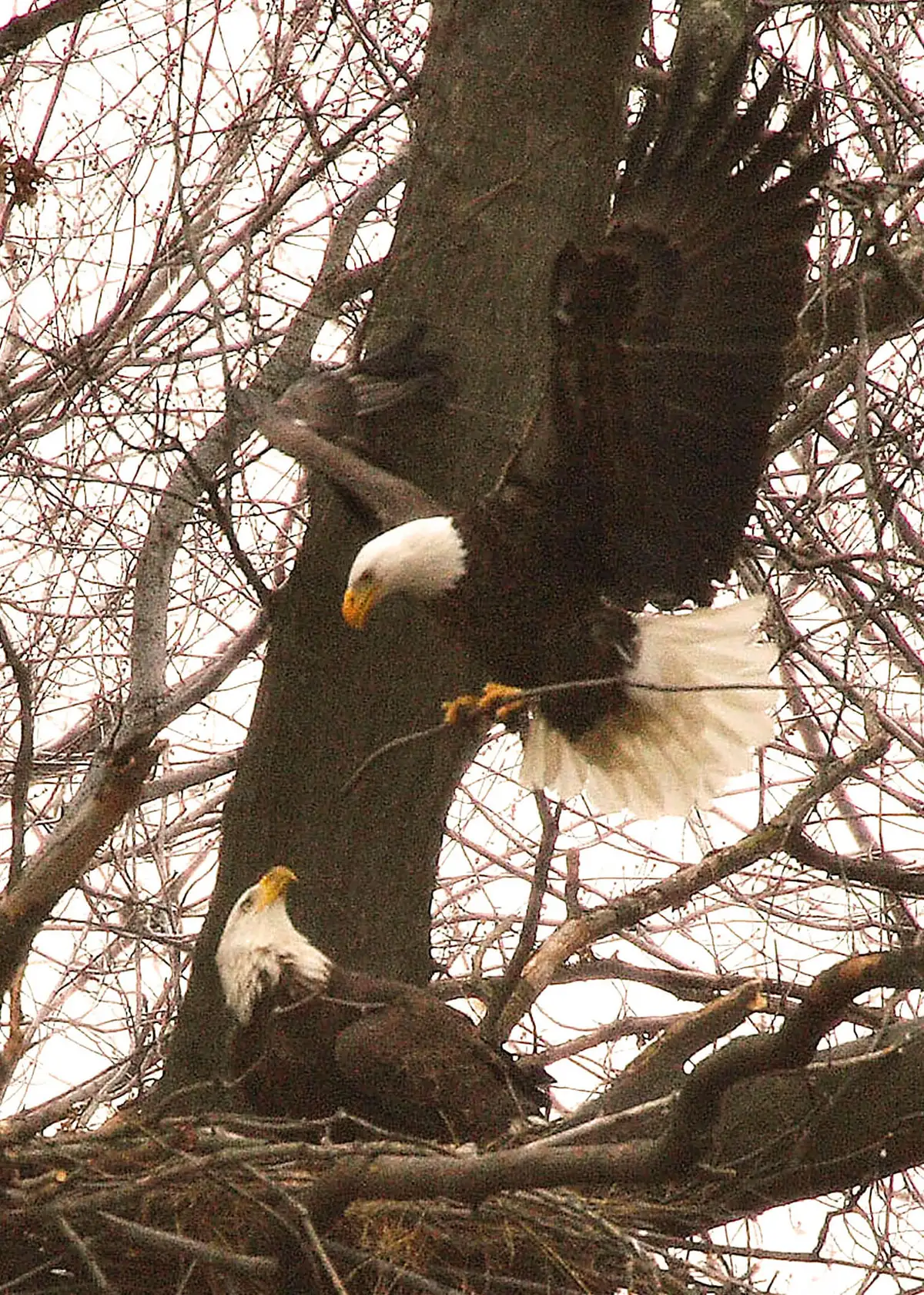
Mostly in February and early March, which surprises people who think of nesting as a spring event. Eagles in Indiana court, repair their nests and lay eggs in the depths of winter so that the eaglets, which spend 11 to 12 weeks in the nest before they fledge, can learn to fly and fish during the summer, when food is easy. The Indiana DNR gives an incubation period of 35 days, and its most recent statewide tally, from 2020, counted more than 350 nesting territories, a remarkable number for a bird that had only two successful nests in the state in 1991. A Purdue Extension educator in Whitley County, writing for Purdue's Got Nature? blog in February 2026, put it simply: winter is when bald eagles build nests, in big trees or snags close to rivers, streams and lakes.
-
The Notre Dame eagle nest
Eggs usually in late February; hatching in early April · Notre Dame Linked Experimental Ecosystem Facility (ND-LEEF), St. Patrick's County Park, South Bend
A pair of eagles arrived at this research site on the St. Joseph River in spring 2015, and their nest was the first successful bald eagle nest ever recorded in St. Joseph County. They have come back every year since. Notre Dame's Environmental Change Initiative runs two live cameras on the nest, one inside and one wide-angle, and its timeline lists eggs in late February, each about 3 inches long and weighing about 4 ounces, then pipping in late March, hatching in early April and fledging around mid-June. You can watch from home, or from the Morrison Education and Outreach Pavilion on the north side of the facility, reached from the Red Barn parking lot.
-
How close is too close
The whole nesting season · Any active nest
The DNR's rule of thumb is 330 feet, about a football field, from any nest or roost, with a telephoto lens for pictures. A parent flushed off the eggs on a 20-degree morning leaves them to chill, so if a bird stands up, calls or watches you steadily, you are too close.
-
Great horned owlets
Hatching from about February into March · Old hawk, crow and heron nests in woodlots and parks
The owls that began sitting on eggs in January and early February incubate for roughly a month, according to Purdue Extension, so the first fuzzy white owlets appear under their mothers this month.
When do sandhill cranes come back through Indiana in the spring?
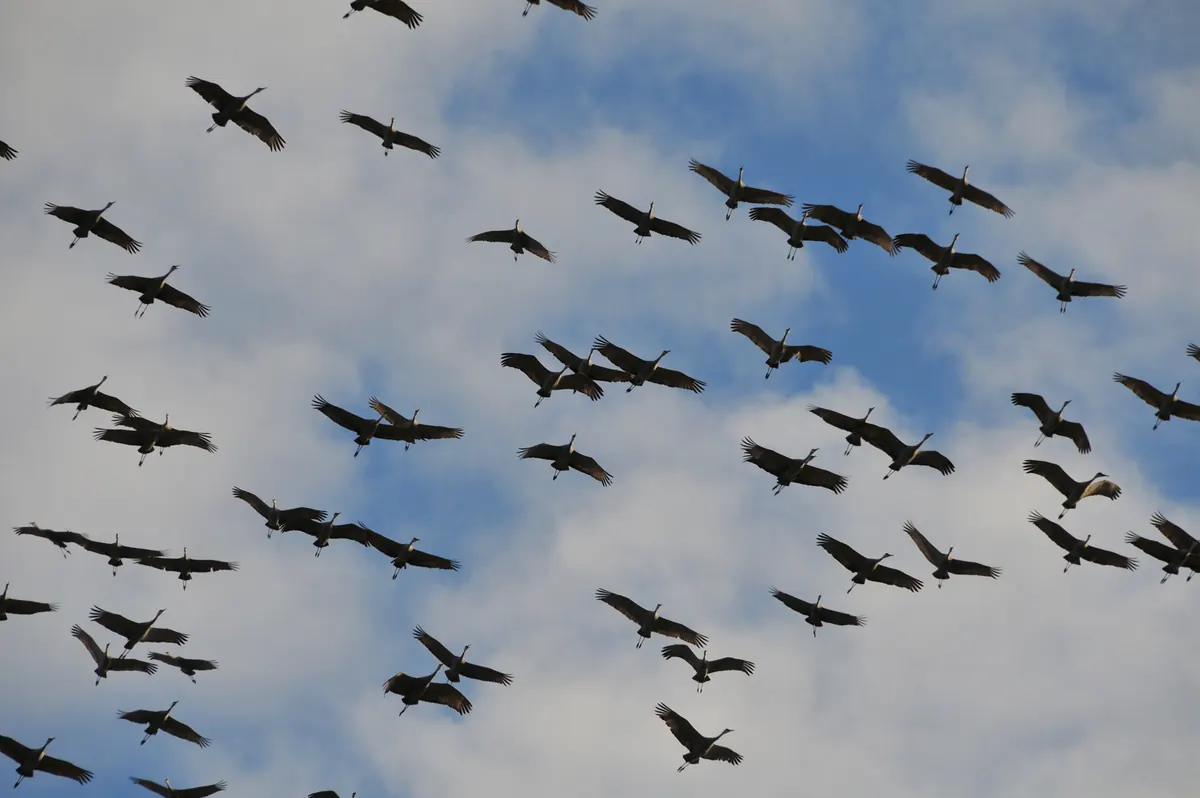
Starting in February. The cranes that left the Jasper-Pulaski marshes in December spent the winter farther south, and they begin moving back north through Indiana as early as the first mild spells of February. The Indiana Birding Trail names February and March as the spring window for crane watching at Jasper-Pulaski, and the spring passage is quicker and less predictable than the slow autumn buildup: birds stop for a few days, feed, and move on when a south wind gives them a lift. Jasper-Pulaski's property manager told ABC57 in March 2026 that a few pairs nest there, but most of the spring birds are on their way to Wisconsin, Minnesota, Michigan and southern Canada.
-
Goose Pond and Marsh Madness
Friday, February 19, and Saturday, February 20, 2027 · Goose Pond Fish & Wildlife Area and Linton, Greene County
The Friends of Goose Pond have already announced the 18th Marsh Madness Sandhill Crane Festival for February 19 and 20, 2027. It opens with a kickoff evening at the Knights of Columbus in Linton on Friday, with music, and on Saturday runs from 9 a.m. to 4 p.m. at the Roy Clark Building in Humphreys Park and from 8:30 a.m. to 4:30 p.m. at the Goose Pond visitors center, with wetland driving tours, exhibits, wildlife art and activities for children. The festival celebrates sandhill cranes, the endangered whooping cranes that sometimes travel with them, and the ducks and geese that crowd the property's shallow marshes on their way north. Check the Friends' page for tickets and the full schedule.
-
Jasper-Pulaski at sunrise and sunset
February and March; watches of 1 to 2 hours · Crane viewing tower, a quarter mile west of the property office, near Medaryville
The viewing tower has spotting scopes mounted on the platform, so you can watch without your own optics. The Indiana Birding Trail suggests coming at sunrise, when cranes lift off the roosting marshes to feed, or in the late afternoon as they return. Spring numbers swing from day to day with the weather; a calm, frosty evening after a run of south winds is a good bet.
-
Geese on the move
Mid to late February · Goose Pond's open units; flooded fields across the southwest and the Kankakee valley
Snow geese, white-fronted geese and Canada geese pass through on the same thaw-driven schedule as the cranes. Listen for the high, laughing calls of white-fronts and the nasal barking of snow geese, and scan big flocks for the smaller Ross's goose. Regular goose hunting closes February 14 in every zone, but the light goose conservation order usually follows it (in 2026 it opened February 16), and during the order Goose Pond's units south of County Road 200 South are open for self-service hunting until 3 p.m. each day.
Goose Pond asks everyone to sign in at the office or a self-service station, whatever you are doing on the property. For the cranes' autumn story, see the Indiana December guide.
Which birds come back to Indiana in February?
A handful of birds arrive well before spring does. Writing in 2011 for the Bird Alliance of Central Indiana (formerly the Amos Butler Audubon Society), the birder Don Gorney named American robins, red-winged blackbirds and American woodcock as species that return to Indiana in February, with the turkey vulture as a fourth. Some of each spend the winter here anyway, so the sign to watch for is a change in behavior: birds singing, displaying and spreading out across the state.
-
Red-winged blackbirds
Males singing from mid to late February · Cattail marshes, ditches and wet fields
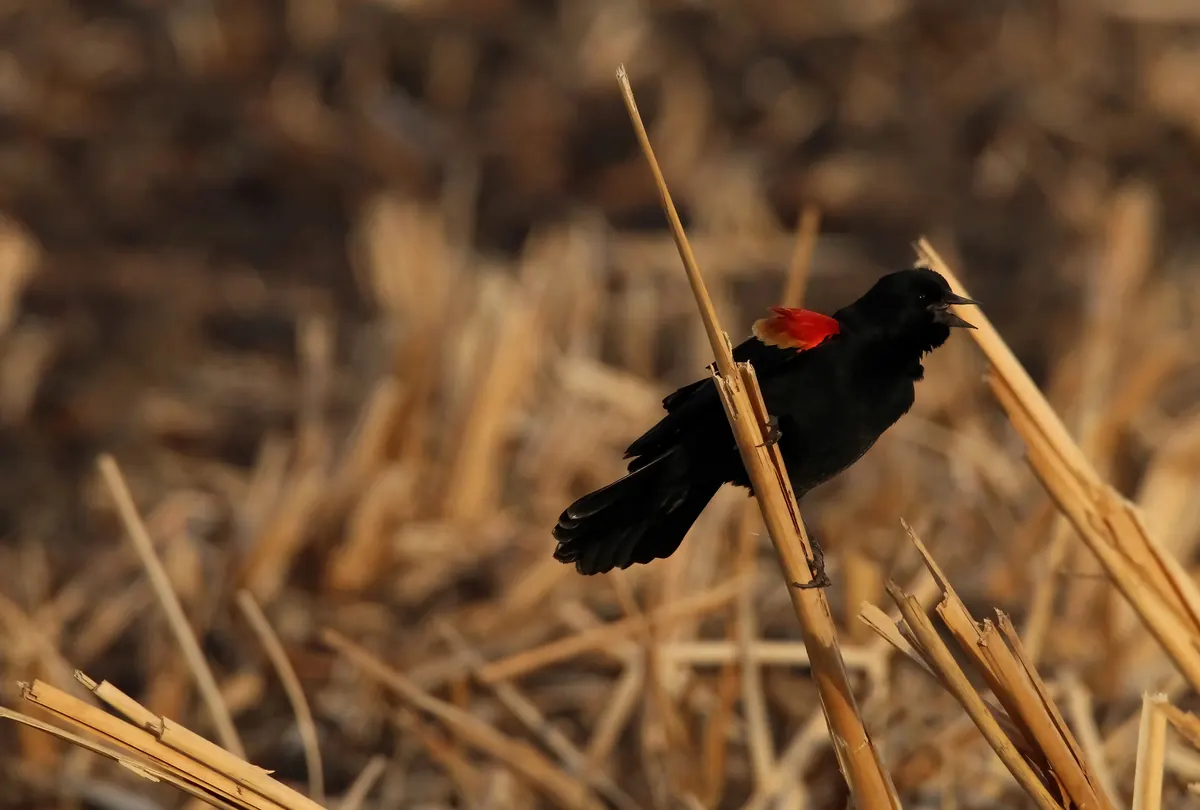
Red-winged blackbirds winter in southwest Indiana by the tens if not hundreds of thousands, according to Gorney, and as February goes on males fan out to claim marsh territories farther north. A male on a cattail stalk, red shoulder patches flared and calling a gurgling conk-la-ree, is one of the surest first signs of spring in the state.
-
American woodcock
Arriving typically mid-February to early March; displays mostly March through May · Fallow fields, young woods and brushy clearings
The DNR's woodcock fact sheet says these chunky, long-billed shorebirds of the uplands usually return from the southern states in mid-February, nudged north by lengthening days, and that a few even linger in southern Indiana through mild Decembers and Januarys. Males claim a singing ground and, at dusk, give a nasal peent before spiraling up about 300 feet and tumbling back down with twittering wings. The full show is a March to May event, but on a mild late-February evening it is worth standing at a field edge at sunset to listen.
-
Turkey vultures
Late February · Over river valleys and highways
Turkey vultures are uncommon in most of Indiana in winter, so the first one tilting over a river valley on a warm February afternoon is worth noting. Look for the two-toned wings held in a shallow V.
When is maple syrup season in Indiana?
It usually runs from February into April, according to the Indiana DNR, and it depends entirely on the weather. Sap moves when freezing nights alternate with days that warm to about 40 degrees, and the run stops once temperatures stay at about 45 degrees and above. Sugar maples have the sweetest sap, but even so the DNR reckons it takes about 10 gallons of sap to make one quart of syrup. Indiana has a long sugaring history: the Young family has tapped trees at Gray Woods Sugar Camp in Parke County every year since 1820, Outdoor Indiana magazine reported in 2024.
-
Tree-tapping talks in the state parks
February, dates for 2027 not yet posted · Potato Creek State Park near North Liberty, and other parks with naturalists
Park naturalists often show visitors how and why sap flows in February. In 2025, for example, Potato Creek's nature center held a free one-hour Sugar Maple Tree Tapping program on the first Saturday of February, covering the timing of sap runs and how to make syrup at home, for the price of park admission. Look on the DNR events calendar for 2027 programs near you.
-
Maple Sugar Time at Chellberg Farm
Usually the first weekend of March · Chellberg Farm, Indiana Dunes National Park, Mineral Springs Road near Porter
The Chellbergs, descendants of Swedish settlers who farmed here from the 1870s, started tapping their maples in the 1930s, and the National Park Service keeps the sugarbush going. Its annual festival, timed for the last freezing nights and the start of the sap flow, follows sugaring from American Indian methods to open kettles to the family's later setup. Watch the park's page for the 2027 date.
-
Sugar camps and festivals
Late February and March · Wesselman Woods in Evansville; private sugar camps statewide
Wesselman Woods Nature Preserve held its 48th Maple Sugarbush Festival, with a pancake breakfast and guided tapping hikes, in early March 2026; check its site for 2027. The Indiana Maple Syrup Association's open-house weekend, when producers across the state welcome visitors into their sugarhouses, is listed for March 13 and 14, 2027, on the association's Indiana Maple Weekend site.
What is the first wildflower to bloom in Indiana?
Skunk cabbage, and it can open in February with snow still on the ground. It is a member of the arum family, related to jack-in-the-pulpit, and its flower is a knob of tiny blossoms (the spadix) wrapped in a hooded, maroon-and-green spathe. The hood comes up first; the big cabbage-like leaves that give the plant its name do not unroll until spring.
-
A flower that makes its own heat
February through early May · Shaded, mucky ground: seeps, swamps, fens and wet woods, mainly in northern Indiana
As it grows, skunk cabbage gives off enough heat to melt the snow around it, one of very few plants that can warm themselves. A preserve coordinator at The Nature Conservancy's Efroymson Restoration at Kankakee Sands wrote, for the Indiana Dunes visitor bureau, that it is one of Indiana's earliest native flowers, blooming from February into early May, and she described a patch found on Conservancy land near Willow Slough. Crush a leaf later in spring and you will understand the name.
-
Where to look
On a mild day after a thaw · Wet woods, seeps, bogs, fens and swamps, mostly in the northern half of the state
The same writer advises searching wet woods, seeps, bogs, fens and swamps wherever the ground stays shaded and moist. Look along boardwalks and the edges of trails, and stay on them: the muck where skunk cabbage grows is soft, and fens are easily scarred by footprints.
Most other wildflowers wait for April, but the weeks until the last freeze are worth counting. Our Indiana frost dates give the typical last spring frost for towns around the state.
When do frogs start calling in Indiana?
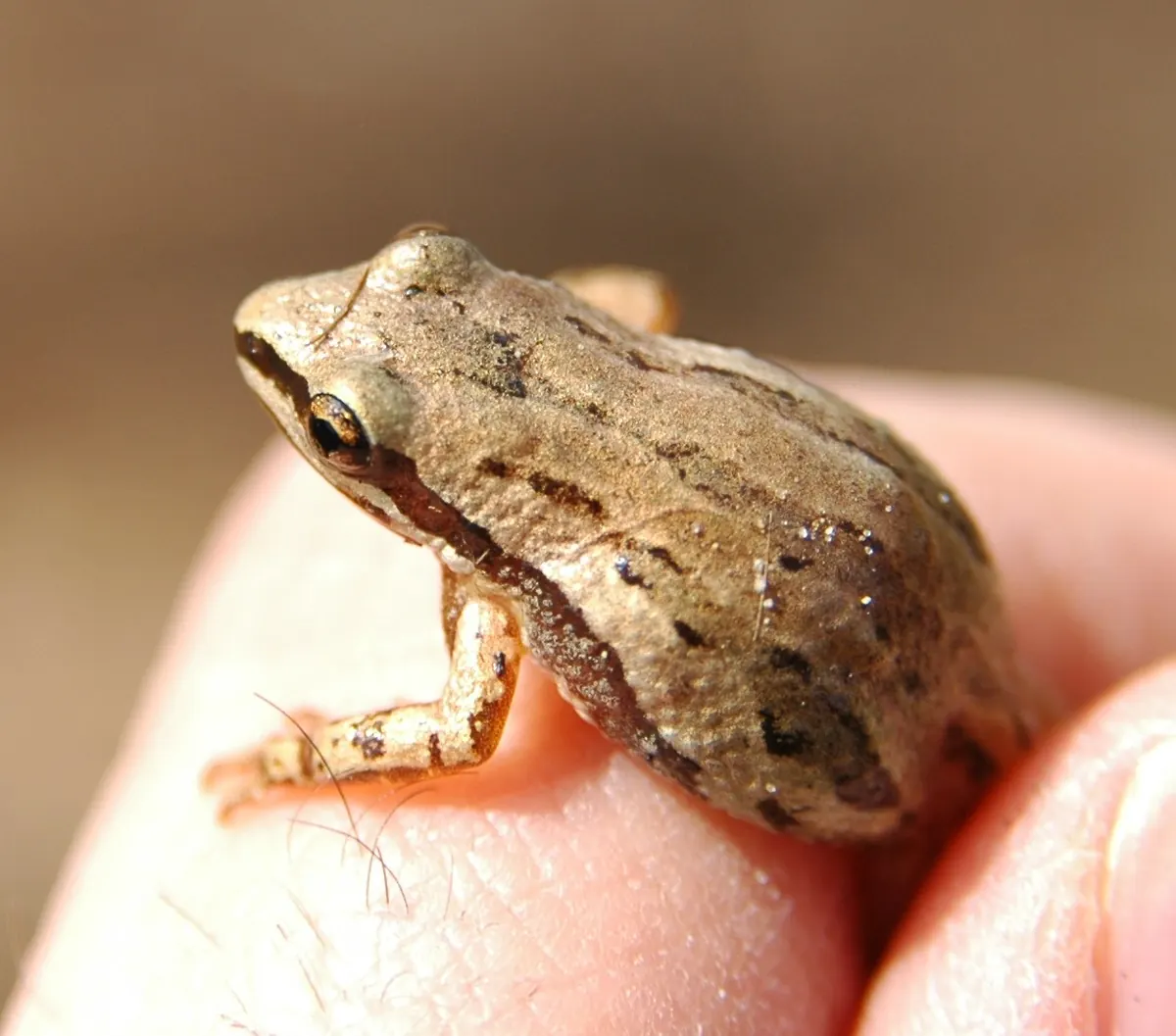
The first ones can be heard in February. A string of mild days, a soaking rain and a night that stays above about 40 degrees is all it takes for the earliest amphibians to head for the shallow, fishless pools where they breed.
-
Chorus frogs
Calling from February into April · Flooded fields, ditches and temporary ponds statewide
The Indiana Herp Atlas says chorus frogs begin calling in February and keep breeding until late April. The western chorus frog is found across the state; the boreal chorus frog probably only in the northwest and west. Their call sounds like a thumb running along the teeth of a comb. At Kankakee Sands, the Conservancy's preserve coordinator noted that a lone chorus frog often starts up as soon as the air reaches about 40 degrees, and that these tiny frogs survive winter with their hearts stopped and as much as 70 percent of the water in their bodies turned to ice.
-
Salamanders on rainy nights
Jefferson salamanders in winter rains; spotted salamanders mostly around March · Woodland vernal pools, especially in the southern hills
Jefferson salamanders, found in the hills and uplands of southern Indiana, may move to their breeding pools in cool rains anywhere from fall into January, and they breed earlier than spotted salamanders, whose mass migrations to the pools come with heavy late-winter and spring rains, concentrated around March, according to the Herp Atlas. A warm, rainy February night can start either species moving. Near woodland ponds on such nights, drive slowly; anyone who stops to move a salamander off the road should carry it the way it was heading.
Does Indiana get big snowstorms and ice storms in February?
Yes, and some of the worst on record. In NOAA's normals February averages a little milder and less snowy than January at all four airports in the table, but the storm track is still well south and the state sits where Gulf moisture meets Arctic air. A National Weather Service climatology of winter weather in northern and central Indiana from 1950 to 2006 picked out some memorable Februarys. A Pacific storm that swung through the Gulf of Mexico on February 24 and 25, 1965, left 12.5 inches of snow at Indianapolis and 11.5 at South Bend. An ice storm on February 4 and 5, 1976, was called the worst in memory in central Indiana, and one on February 14 and 15, 1990, the worst in northeast Indiana since. The same study counted 16 of its 77 significant lake-effect snow events in February, almost as many as in January.
| Station | Average high | Average low | Rain and melted snow | Snowfall | Snow-cover days | Nights below zero |
|---|---|---|---|---|---|---|
| South Bend | 34.9 °F | 19.3 °F | 2.31 in | 16.1 in | 13.8 | 1.5 |
| Fort Wayne | 36.5 °F | 21.0 °F | 2.06 in | 7.8 in | 11.0 | 1.7 |
| Indianapolis | 40.8 °F | 24.2 °F | 2.43 in | 6.0 in | 7.1 | 0.9 |
| Evansville | 46.7 °F | 28.4 °F | 3.22 in | 3.1 in | 2.1 | 0.2 |
Will El Niño mean less snow in Indiana this February?
It makes a thin late winter more likely, but it guarantees nothing. The Climate Prediction Center's ENSO discussion of September 10, 2026, put the chance that this winter's El Niño ends up very strong above 90 percent. NWS Indianapolis describes the usual Indiana result as a warmer and drier winter than average, adding that no two El Niños behave alike. The clearest numbers come from the Midwestern Climate Center, which in 1997 compared six strong El Niño winters since 1951 with every other winter. Indianapolis averaged 12 inches of snow in those six winters, against 27 in the rest, with a range of 7 to 20. Evansville averaged 8 inches against 15. South Bend, fed by Lake Michigan, held up better, at 61 inches against 77, with one of the six winters reaching 80.
For February, that history suggests fewer snow-cover days and more rain, mud and thaw than usual, and a mild February could bring cranes, blackbirds and chorus frogs on the early side. But El Niño cannot rule out a late cold blast or a February ice storm.
The first NOAA winter outlook comes out October 15, 2026, with monthly revisions after that; each month's update is posted on the Climate Prediction Center site. Before a crane trip or a maple outing, look at our weather page for the days ahead.
How much daylight does Indiana gain in February?
A little over an hour: from 62 minutes at Evansville to 69 at South Bend, as the table shows. The pace keeps quickening toward the March equinox, when days grow fastest. By February 28 every Indiana city in the table has more than 11 hours of daylight. In January the afternoons took nearly all of the gain; in February mornings share it, and sunrises come noticeably earlier week by week.
Hoosiers mark Groundhog Day on a Tuesday this year. By the calendar of sun and stars, though, the season's hinge (midway in time between December's solstice and March's equinox) arrives on February 3 to 4. Daylight saving time begins on March 14.
| City | Feb 1 | Feb 28 | Gained | Per day |
|---|---|---|---|---|
| South Bend | 10 h 03 m | 11 h 12 m | 69 min | 2.6 min |
| Gary | 10 h 04 m | 11 h 13 m | 69 min | 2.6 min |
| Fort Wayne | 10 h 05 m | 11 h 13 m | 68 min | 2.5 min |
| Lafayette | 10 h 09 m | 11 h 15 m | 66 min | 2.4 min |
| Indianapolis | 10 h 11 m | 11 h 16 m | 65 min | 2.4 min |
| Terre Haute | 10 h 13 m | 11 h 17 m | 64 min | 2.4 min |
| Bloomington | 10 h 14 m | 11 h 17 m | 63 min | 2.3 min |
| Evansville | 10 h 18 m | 11 h 20 m | 62 min | 2.3 min |
For sunrise, sunset and twilight times on any date in your own town, try our daylight calculator.
What is in the night sky over Indiana in February 2027?
Two of the bright planets reach opposition this month, and the full moon passes through Earth's outer shadow. Times are Eastern Standard Time, with Central Standard Time (one hour earlier) in parentheses for the six northwestern counties around Gary and the six southwestern counties around Evansville.
-
Mercury at its best this winter
Greatest elongation February 3; visible late January to about February 10 · Low in the west-southwest, 30 to 45 minutes after sunset
Mercury is hard to catch, but early February gives Indiana its best evening look of the winter. It stands 18 degrees from the sun on the 3rd. The evening of Sunday the 7th brings a hairline crescent moon, a day past new, right beside it; use binoculars and a clear western horizon.
-
Jupiter at opposition
Wednesday, February 10, 7:21 p.m. EST (6:21 p.m. CST) · Rising in the east at sunset, highest around midnight
Earth passes between the sun and Jupiter this evening, so the giant planet comes up at sunset and can be seen the whole night, shining at magnitude minus 2.5 in Leo, brighter than any star. It is closest to us that day, about 405 million miles away.
-
Mars at opposition
Friday, February 19; closest to Earth February 20 · Rising in the east at dusk, near Jupiter in Leo
Mars follows Jupiter nine days later, at about 10 a.m. EST on the 19th, and is nearest us the next day, some 63 million miles away. This year's meeting is a distant one, since Mars is close to the outermost point of its orbit; to the eye it is still an unmistakable orange point of magnitude minus 1.2. Its next approach this near falls in 2029.
-
The Snow Moon and a faint eclipse
Full Saturday, February 20, 6:23 p.m. EST (5:23 p.m. CST) · Rising in the east-northeast around sunset
February's full moon, the Snow Moon, is a near-supermoon that some almanacs count as a supermoon. It also slides through the pale outer part of Earth's shadow in a penumbral eclipse, from 4:12 to 8:13 p.m. EST (3:12 to 7:13 p.m. CST), deepest at 6:13 p.m. EST (5:13 p.m. CST). In Indiana the moon comes up around or just after that deepest moment, low in bright twilight, so at most you may notice a soft gray shading on one edge before it fades. Most people will see nothing unusual. Still, it is a fine evening for a moonrise walk, with the moon gathered in Leo beside Jupiter, Mars (a day after its opposition) and the bright star Regulus. The night before, late on February 19, an almost-full moon slides right up beside Jupiter.
-
Venus before dawn, Saturn at dusk
All month · Venus in the southeast before sunrise; Saturn low in the southwest after sunset
Venus remains the brilliant morning star. Saturn hangs in the southwestern twilight and slips a little lower every evening until the sun's glare swallows it.
-
Moonless evenings
Roughly February 2 to 11 · Dark rural skies
Around the new moon of February 6 the evenings are dark, the best stretch of the month for faint stars. Solar activity, though past its 11-year maximum, can still produce a strong geomagnetic storm that puts an aurora low in Indiana's northern sky; NOAA's Space Weather Prediction Center posts the forecast. The ring-of-fire solar eclipse on February 6 stays far south of Indiana, over South America and the South Atlantic, and cannot be seen from here at all.
| Phase | Date | Time |
|---|---|---|
| New moon | Sat, Feb 6 | 10:56 a.m. EST (9:56 a.m. CST) |
| First quarter | Sun, Feb 14 | 2:58 a.m. EST (1:58 a.m. CST) |
| Full moon, the Snow Moon | Sat, Feb 20 | 6:23 p.m. EST (5:23 p.m. CST) |
| Last quarter | Sun, Feb 28 (Sat, Feb 27 in Central time) | 12:16 a.m. EST (11:16 p.m. CST on Feb 27) |
Clouds decide everything on opposition night; check Today's sky before you set out, and our moon phase calendar gives local moonrise times.
What can Indiana families do outdoors in February 2027?
- Tuesday, February 2: Groundhog Day. Start a six-week family weather log and see whether the groundhog was right.
- All month: watch the Notre Dame eagle cam. Check the live nest cameras at ND-LEEF in South Bend and keep a chart of when the eggs appear in late February.
- Presidents' Day weekend bird count. The 30th Great Backyard Bird Count runs from Friday the 12th through Monday the 15th. Its partner organizations have announced these dates. Watch birds for as little as 15 minutes on one or more days, anywhere, and enter what you see at birdcount.org.
- Friday and Saturday, February 19 and 20: Marsh Madness at Goose Pond and Linton, with driving tours, exhibits and children's activities for the returning cranes (see the crane section).
- Saturday, February 20: Snow Moon rise. Watch the moon come up at dusk, in a faint eclipse, with Jupiter and Mars nearby.
- Maple programs. State park naturalists often lead February tree-tapping talks, and maple festivals follow in early March; check the DNR events calendar and each organizer for 2027 dates.
- All winter: Project FeederWatch runs through April 30; keep counting your feeder birds for the Cornell Lab and Birds Canada.
Winter weather cancels programs, so confirm before you drive. Jot down what you find in our Naturalist's Field Journal, look back at the Indiana January guide for eagles at the dams and shelf ice at the Dunes, and find other states and months on our nature guides page.
Safety notes for February in Indiana
- Hunting and trapping seasons still open. Deer seasons, including the deer reduction zones, closed on January 31, along with squirrel, raccoon, opossum, mink, muskrat, weasel and bobcat seasons. Still open in February: rabbit hunting and red and gray fox hunting to February 28; Canada, light and white-fronted geese and brant in all three zones to February 14; crow to March 1; and coyote, striped skunk and beaver hunting and trapping, plus river otter trapping, to March 15. The light goose conservation order follows the regular goose season (in 2026 it ran February 16 to March 31); the DNR posts each year's dates. The DNR's hunter orange guide lists rabbit season among the seasons when hunters must wear a solid fluorescent orange vest, coat, jacket, coveralls, hat or cap, so expect orange-clad rabbit hunters in brushy fields through February 28. Anywhere hunting is allowed, wear something bright yourself, and keep dogs on a leash beside creeks and fence lines, since trapping stays legal there into March.
- Late-winter ice. The DNR's minimums are 4 inches of clear ice to fish on and 5 inches under a snowmobile. It also warns that ice turns rotten after rain, that honeycombed, slushy or old ice is dangerous, and that wind, waterfowl, beavers and currents keep patches thin. February thaws make all of this worse. Its rule: when in doubt, don't go out. Stay off the Lake Michigan shelf ice entirely.
- Ice storms and snow. Freezing rain can coat roads and bring down limbs and power lines without much warning. Before a long drive to Goose Pond or Jasper-Pulaski, check the forecast and road conditions, and carry a winter kit.
- Cold rain and mud. A 38-degree rain chills you faster than dry cold; wear waterproof boots and a shell on marsh levees, and walk through trail mud rather than around it so paths do not widen.
- Bats in caves. Bats are still hibernating; Hoosier National Forest caves stay closed until May 14, and closed or gated caves anywhere should be left alone.
Sources
- Indiana DNR: bald eagle (incubation, fledging, nest counts, viewing distance)
- University of Notre Dame Environmental Change Initiative: live bald eagle cam at ND-LEEF
- Purdue Extension Got Nature?: have you seen a soaring eagle lately? (Whitley County, February 2026)
- Purdue Extension: winter is a good time to bird (great horned owl nesting)
- Indiana Birding Trail: Jasper-Pulaski Fish & Wildlife Area (crane seasons, viewing tower)
- ABC57: climate impacts sandhill crane spring migration (March 2026)
- Indiana DNR: sandhill crane migratory counts
- Friends of Goose Pond: Marsh Madness Sandhill Crane Festival, February 19 to 20, 2027
- Indiana DNR: Goose Pond Fish & Wildlife Area (acreage, sign-in, light goose units)
- Indiana DNR: light goose conservation order permits (2026 dates)
- Bird Alliance of Central Indiana: first sign of spring (Don Gorney)
- Indiana DNR: American woodcock fact sheet (PDF)
- Purdue Extension Got Nature?: it's timberdoodle time (woodcock)
- Indiana DNR Kids: tasty maple syrup (season, temperatures, sap to syrup)
- Outdoor Indiana, January/February 2024: Gray Woods Sugar Camp, Parke County
- Indiana DNR: Sugar Maple Tree Tapping, Potato Creek State Park (February 2025)
- Indiana DNR: events calendar, February 2027
- National Park Service: Maple Sugar Time, Indiana Dunes National Park
- Wesselman Woods: Maple Sugarbush Festival
- Indiana Maple Syrup Association: Indiana Maple Weekend, March 13 to 14, 2027
- Indiana Dunes (Porter County visitor bureau) blog: skunk cabbage, the smell of spring (Alyssa Nyberg, The Nature Conservancy)
- Indiana Herp Atlas: chorus frogs
- Indiana Dunes blog: chorus frogs calling at Kankakee Sands (Alyssa Nyberg, The Nature Conservancy)
- Indiana Herp Atlas: Jefferson's salamander
- Indiana Herp Atlas: spotted salamander
- National Weather Service: a winter weather climatology for northern and central Indiana (O'Hara, Adolphson and Pavlow)
- NOAA NCEI: 1991–2020 monthly normals for South Bend, Fort Wayne, Indianapolis and Evansville (data API)
- Climate Prediction Center: ENSO diagnostic discussion, September 10, 2026
- Climate Prediction Center: 90-day outlooks (winter outlook issued October 15, 2026, and updated monthly)
- NWS Indianapolis: El Niño and Indiana winters
- Midwestern Climate Center: El Niño may mean less snowfall in the Midwest this winter (September 29, 1997)
- U.S. Naval Observatory: moon phases (data API)
- U.S. Naval Observatory: Earth's seasons, 2027
- Fred Espenak: Sky Event Almanac 2027 (oppositions, Mercury, Moon-planet pairings)
- NASA: lunar eclipses 2021–2030 (penumbral eclipse of February 20, 2027)
- NASA: solar eclipses 2021–2030 (annular eclipse of February 6, 2027)
- Old Farmer's Almanac: eclipses (February 2027 visibility)
- EarthSky: Jupiter at opposition
- SEDS: Mars opposition 2027
- NOAA Space Weather Prediction Center: aurora forecast
- Wikipedia: time in Indiana (the twelve Central-time counties)
- Audubon: about the Great Backyard Bird Count (February 12 to 15, 2027)
- Birds Canada: Great Backyard Bird Count
- Great Backyard Bird Count
- Project FeederWatch (Cornell Lab of Ornithology and Birds Canada): project overview
- Indiana DNR: 2026–27 hunting and trapping seasons (PDF)
- Indiana DNR: hunter orange requirements (PDF)
- Indiana DNR: 2026–27 deer hunting seasons and hunter orange
- Indiana DNR: ice fishing safely
- National Park Service: shelf ice, Indiana Dunes National Park
- Hoosier National Forest: climbing and caving (cave closure order, August 16 to May 14)
- Photos via Wikimedia Commons; licenses and photographers are credited under each picture
