What to look for in nature in Indiana this May
May is the month Indiana turns green and loud. Warblers settle out of the darkness into the first trees they meet along the Lake Michigan shore, tanagers and cerulean warblers settle into the high canopy of the big forests, and Henslow's sparrows sing from the grasslands of the south. After warm rain, Fowler's toads, green frogs and the first bullfrogs take over from the spring peepers, while mayapples open their umbrellas and wild geraniums bloom on shaded slopes. Fawns lie hidden in the grass, box turtles cross the roads, and bats leave their caves for summer roosts. The sky offers a good Eta Aquariid year, a Flower Moon that is also a seasonal Blue Moon, and Mercury at its best at month's end. It is also hail and tornado season, so keep an eye on the forecast.
Other months in Indiana: October, November, December, January, February, March, April.
Start here
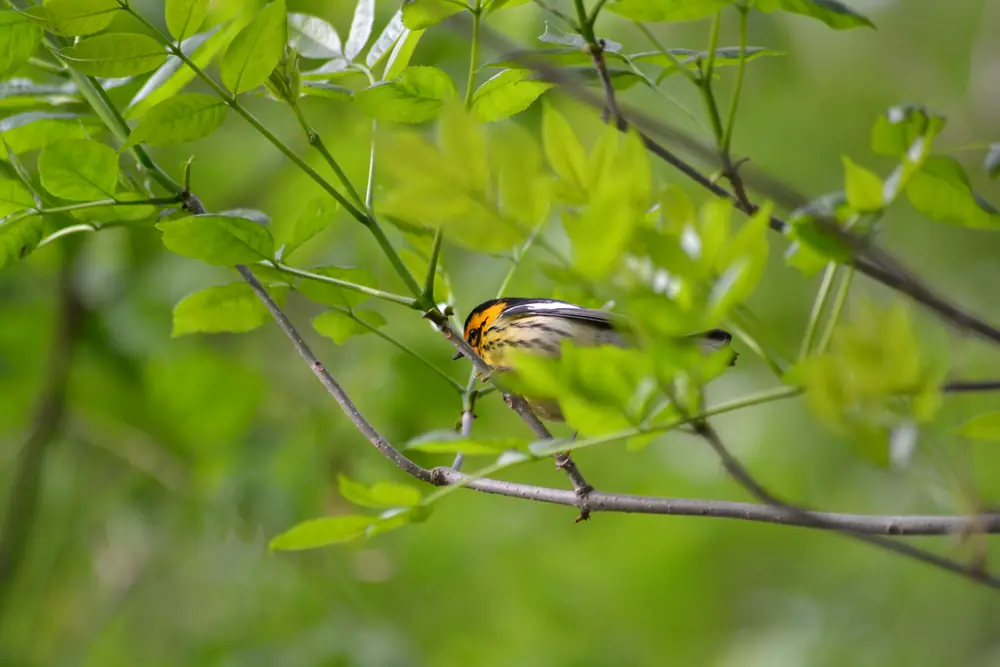
- Spend an early morning at the Longshore Tower. Go on a calm morning after a night of south wind, stand near the tower at Indiana Dunes State Park and look up into the treetops. In mid-May the warblers drop into the first trees they find, and the counters will tell you what has come in.
- Learn three songs before you go. A bullfrog's jug-o-rum, a green frog's banjo twang and a Fowler's toad's harsh trill are easy to tell apart. Stand by a pond after dusk and listen.
- Walk a wooded slope for mayapple and wild geranium. Choose a state park woodland trail and look low. Mayapples stand like small umbrellas, and wild geranium opens in early May. Leave every plant where it grows.
Two plates earn their keep in May. Birds I have seen takes every warbler, tanager and sparrow, with the date and the wind direction, and the map of sounds is made for a green frog's banjo twang or a bullfrog's jug-o-rum. If you keep an eye on a wren house or bluebird box from a distance, nest observed is the page for it. The daily field log records those swings from a chilly dawn to a hot afternoon, and a tree through the seasons suits an oak that is leafing out. For nights, the dusk and dawn watch plate suits a meteor morning or the rising Flower Moon.
Regions used below: Northwest Indiana and the Dunes; Northern Indiana (South Bend, Fort Wayne); Central Indiana (Indianapolis, Lafayette, Terre Haute); South-central hills (Bloomington, Brown County, Hoosier National Forest); Southwest and the Ohio River (Evansville, Madison).
When is the peak of warbler migration at the Indiana Dunes in May?
Mid-May is when the lakeshore flight turns from hawks and jays to warblers. Indiana Audubon's spring watch runs from early March through mid-May, with observers climbing the Longshore Tower each morning. The Indiana Birding Trail places the tower, which it calls the Dunes Birding Tower, near the West Lot of Indiana Dunes State Park, and it describes large flights on early mornings with south winds. The birds that reach Lake Michigan after a night of flying often stop in the first trees they find. The best mornings follow a night of warm south wind, when the treetops near the tower fill with songbirds that arrived in the dark.
-
A mid-May tower morning
Early to mid-May, from first light · The Longshore Tower at Indiana Dunes State Park, and the woods near the West Lot
Indiana Audubon's report from a five-hour watch on May 13, 2025, shows what a good morning looks like: 99 species and 1,081 individual birds, with 19 kinds of warblers including Cape May, Wilson's, Bay-breasted and Blackburnian. Tennessee Warblers sang in the treetops, a pair of cuckoos passed through, a late Rusty Blackbird called near the tower, and the counters noted that more warblers went unidentified than were named, a sign the warbler movement was near its crest. The wind turned from south to northeast during that watch, and the observers said it slowed the flow. One year is a single sample, so treat the second week of May as the likeliest stretch and let the weather decide.
-
Birds that pass in the dark
Overnight, during the same weeks · Over the tower and the dunes
Many songbirds migrate at night and are heard rather than seen. During the 2025 festival, Indiana Audubon placed a microphone at the tower for the first time that year to record nocturnal flight calls, and it picked up Swainson's Thrush, Indigo Bunting, Yellow-billed Cuckoo and American Bittern, along with a state-endangered Barn Owl calling as it flew over. Thin, high notes overhead after dark in May are probably the flight itself.
-
What stays to nest
Late May onward · Throughout Indiana Dunes National Park
More than 350 bird species have been confirmed at Indiana Dunes, the National Park Service says, which ranks the park among the top five for recorded species. Its 2014 to 2018 breeding bird surveys found Yellow Warbler, Common Yellowthroat, Gray Catbird, Red-eyed Vireo, Eastern Towhee and House Wren among the most common detections. These are survey detections, not nest counts.
-
The Indiana Dunes Birding Festival
Annual, in May; the National Park Service lists it as the third weekend of the month · Several sites around the Dunes
Indiana Audubon hosts a four-day festival with expert-led outings, a youth and family birding day and a gear marketplace. Its website listed a 2026 schedule and nothing yet for 2027, so watch that site for dates, field trip sites and registration.
The Indiana Birding Trail lists state park entry at $7 for in-state vehicles and $15 for out-of-state vehicles, so confirm the current fee. Keep your voice low near the tower, because the counters are working, and ask them what is moving before you start calling out birds yourself.
Which warblers and tanagers settle into Indiana's big forests in May?
After the lakeshore crowd moves on, the birds that stay are the ones that nest in Indiana. They are harder to see because they live high in the leaves, so learn their songs first and look second.
-
The songbird wave at Big Oaks
Around the second week of May, per the refuge · Big Oaks National Wildlife Refuge, a roughly 50,000-acre Globally Important Bird Area
The refuge reports that its main wave of songbirds peaks around the second week of May, and that white-tailed fawns are typically seen by the end of the month. A public access permit costs $3 a day or $15 a year, with some exemptions.
-
Cerulean warblers in the canopy
Males reach the nesting grounds around the middle of May · Tall, mature hardwood forest along streams and in river valleys
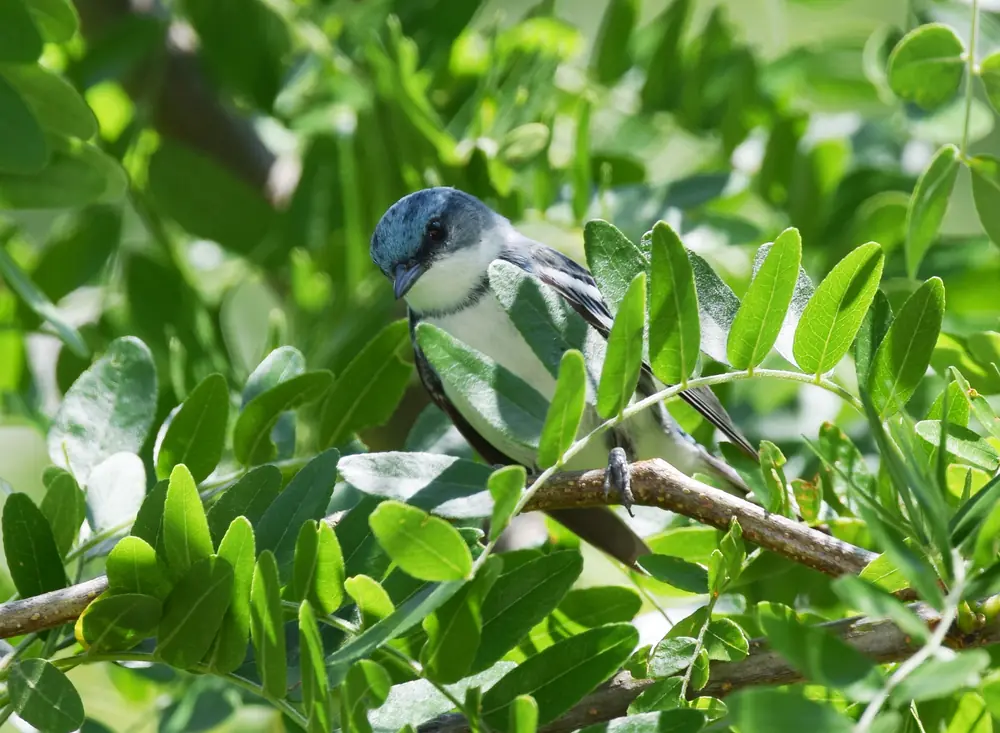
The sky-blue back of a male Cerulean Warbler is hard to see because he sings from the top of the leafy canopy. Audubon's field guide describes the song as a series of short buzzy notes ending in a higher buzz, lists the species as threatened with strongly declining numbers, and notes that nests fail more often in small forest patches, where cowbirds are more abundant.
-
Scarlet Tanagers in the oaks
Mid to late May · Large blocks of oak woodland
Audubon says Scarlet Tanagers cross the Gulf of Mexico at night and, after a cold snap, may feed in the open along roads and in gardens. The song is a hurried, burry, repetitive warble, somewhat like an American Robin's, and the call is an emphatic, nasal chip-bang. Males, the only brilliant red birds with black wings and tail, forage slowly in tall oaks.
-
Prothonotary Warblers on the boardwalk
Late spring and early summer, the nesting season · Indiana Dunes State Park, near the Trail 8 boardwalk, per the Indiana Birding Trail
This golden warbler nests in tree cavities over standing water, usually 5 to 10 feet up, according to Audubon, and the Indiana Birding Trail names the boardwalk on Trail 8 as a known place for them. The same page lists Prairie and Hooded Warblers, Worm-eating Warblers and Summer Tanagers among the breeding birds, and says Barred Owls and Whip-poor-wills call on the trails after dark.
Where can I hear Henslow's sparrows and see prairie birds in Indiana in May?
Not every May bird lives in a tree. The grasslands of the south and the sand prairies of the northwest carry a different set of voices, many of them short, dry and easy to miss.
-
Henslow's sparrows at Big Oaks
Spring and summer · The refuge's larger grasslands; a guided tour is the best way in
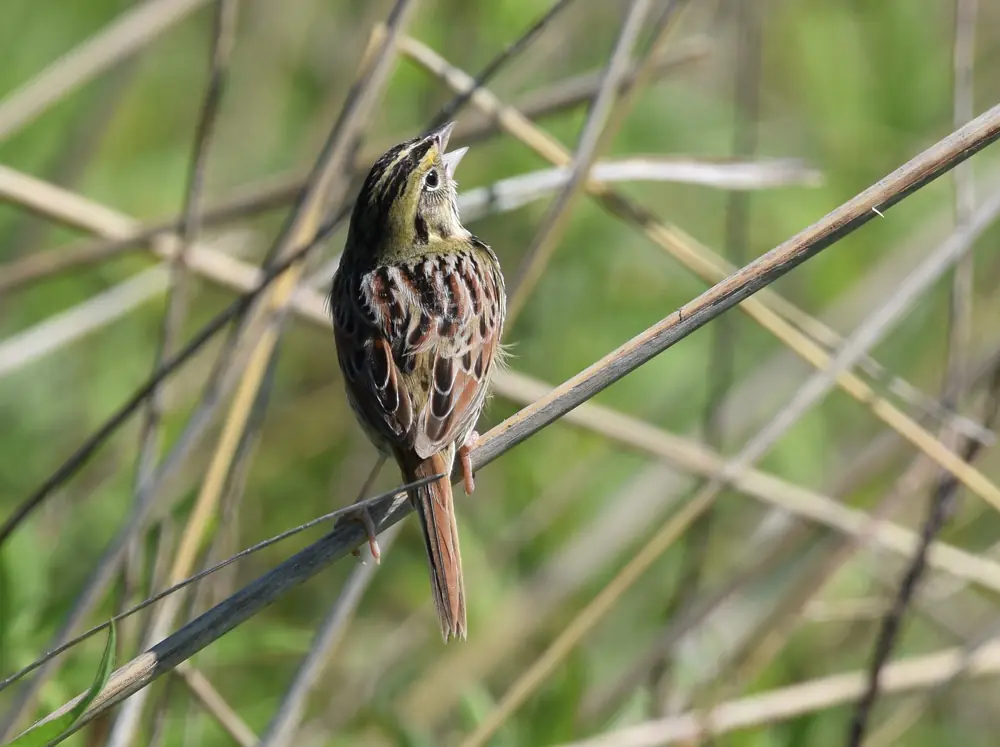
The refuge reports more than 400 pairs of Henslow's Sparrow, which it calls one of the world's largest populations. The refuge says the birds sing in its larger grasslands in spring and summer, and that a guided bird tour is the best way to see one. Ask the refuge office about tour dates; the refuge site named none.
-
Kankakee Sands
Spring for migrants and early flowers; summer for the prairie in full color · The welcome area on U.S. 41; free and open daily, sunrise to sunset
The Nature Conservancy describes 8,400 acres of restored prairie and wetland with more than 240 bird species recorded, including Henslow's Sparrow, Northern Harrier and Least Bittern, and it says the bison grazing keeps vegetation short enough to suit Upland Sandpipers. About 100 bison graze roughly 1,100 acres; stay out of the pasture and use the viewing area instead. The Meadowlark and Wet Prairie trails are closed while the bison are in the north pasture, so call the office on 219-285-2184 for current trail status.
Which frogs and toads call in Indiana in May?
The spring peepers have gone quiet, and the later callers take over. After warm rain in May, ponds, flooded fields and the edges of reservoirs carry a different chorus from the one that April had.
-
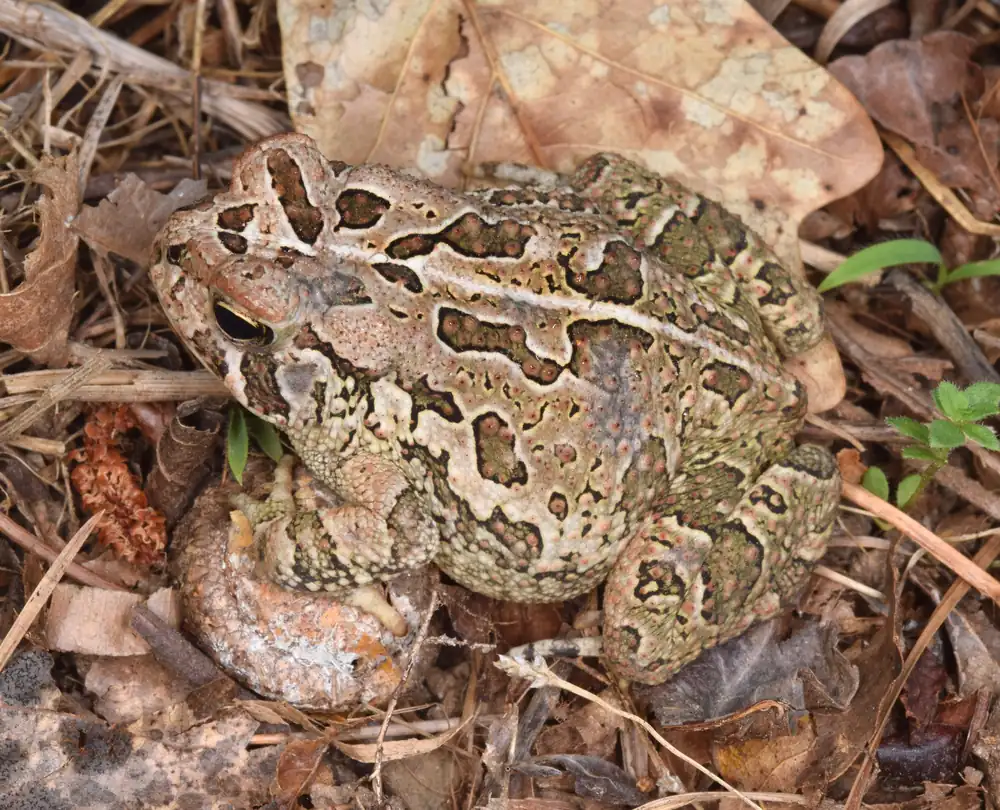
Fowler's toads
Calling begins in late April or early May and runs into early July, per the Indiana Herp Atlas · Sandy open ground, floodplains and temporary pools, most common in the southern half and the northwestern sand prairies
The call is a trill like the American Toad's but lower, nasal and harsher. Heavy rain filling a ditch or a field puddle can set off breeding at nearly any point in spring or early summer.
-
Green frogs
Males typically begin calling in May and breed sporadically through summer · Pond edges, creek pools and marshes
The Herp Atlas likens the single low note to a loose banjo string plucked at irregular intervals, so it sounds more like an instrument than an animal.
-
American bullfrogs
Breeding runs from late May to early August · Permanent water only, because the tadpoles take one to three years to develop
The deep, resonant "jug-o-rum" repeats at intervals of several minutes, and males defend territories by day and night. The Herp Atlas says one egg mass can hold up to 10,000 eggs.
The state's green frog and bullfrog harvest season, on the Indiana DNR season sheet for April 2026 to March 2027, runs from June 15, 2026 to April 30, 2027, so none is open in May. Watch for slow-moving toads on wet roads at night.
What wildflowers bloom in Indiana in May?
May is when the woodland floor shifts from the early ephemerals to the plants that carry on under a closing canopy. The Indiana DNR's spring wildflower brochure says that from late March through May the woodlands of state park properties are carpeted with flowers, and that all plants on DNR land are protected, so enjoy them with your eyes and camera instead of your hands.
-
Mayapple and wild geranium
Both open in early May, per the DNR brochure · Shaded woodland slopes in state parks
Mayapples first appear like small umbrellas, with a waxy six-to-nine-petaled flower hidden beneath the big lobed leaves. Wild geranium opens in early May with five petals, and its name refers to a seed case shaped like a crane's bill.
-
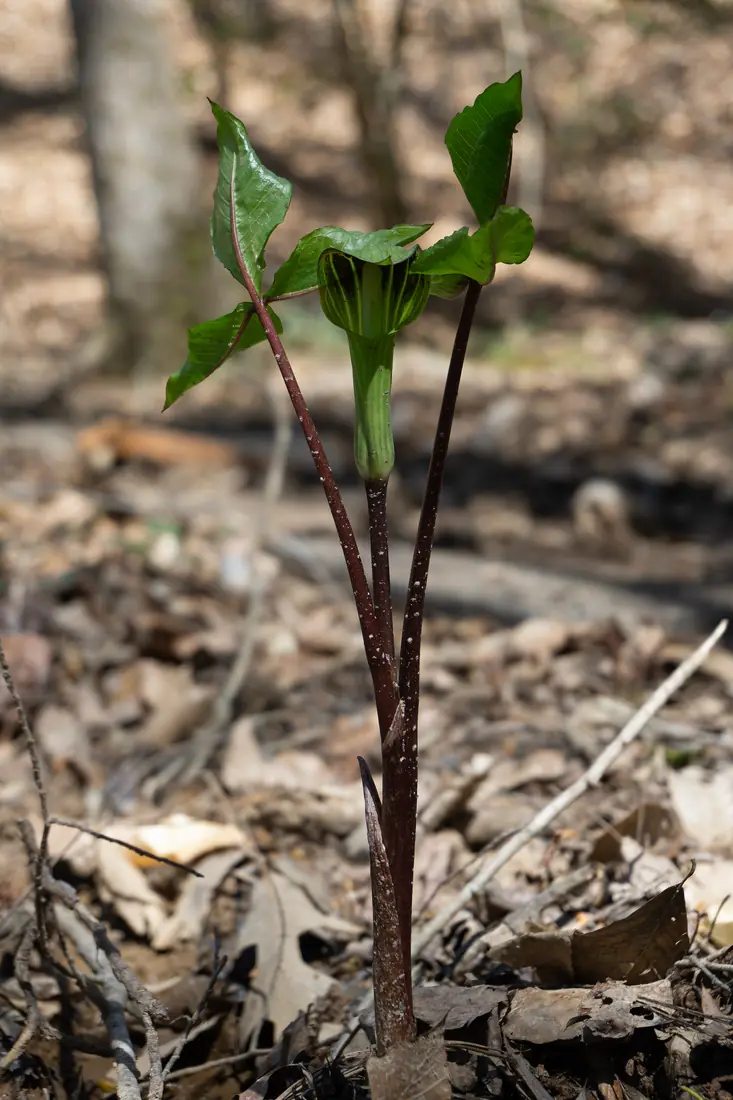
Wild columbine and Jack-in-the-pulpit
Spring, into May · Rocky slopes and cliffs for columbine; wooded areas for Jack-in-the-pulpit
Columbine's orange and yellow flowers hang from individual stalks and are pollinated by hummingbirds, moths and butterflies, according to the brochure. Jack-in-the-pulpit is easy to miss, a green hooded flower with a preacher inside, often with a single deeply divided leaf.
-
Lupine and the lost Karner blue
Late spring · Miller Woods and other sand ridges at Indiana Dunes National Park
The National Park Service shows wild lupine growing on a vegetated sand ridge under oaks in Miller Woods and says it is the only food of Karner blue caterpillars. That butterfly is federally endangered, and a federal species page calls the Indiana Dunes population likely extirpated, so a lupine bloom here is a plant to admire, not a butterfly to expect. The Dunes shelter some 1,100 native vascular plants, among them the federally threatened Pitcher's thistle. Stay on marked trails in the savanna, since clearing and prescribed burns can weaken oaks and leave dead limbs overhead.
-
Late-spring flowers at the Dunes
Late spring · Trail 3 at Indiana Dunes State Park
The state park's trail guide lists Trail 3 as a moderate three-quarter-mile walk for late-spring wildflowers, including prickly pear cactus. On the National Park Service side, the Heron Rookery Trail's wildflowers peak from late April through mid-May before the trees leaf out, and the herons that gave the trail its name have moved to new nesting grounds. Wild hyacinth in the Deam Wilderness blooms into early May.
What should I do if I find a fawn, a box turtle or a bat in May?
May brings young animals and returning ones. The kindest response is nearly always to keep your distance.
-
Fawns
Big Oaks says fawns are typically seen by the end of May · Fields and woodland edges statewide
The DNR says fawns often hide alone and stay still for their first few weeks while the mother feeds, and asks people to leave them alone. Signs of trouble include a mother known to be dead, an obvious injury, many insects on the fawn or frequent crying. In LaGrange, Steuben, Noble, Allen, Whitley or DeKalb counties, a fawn can go only to a permitted rehabilitator in those same counties because of chronic wasting disease rules.
-
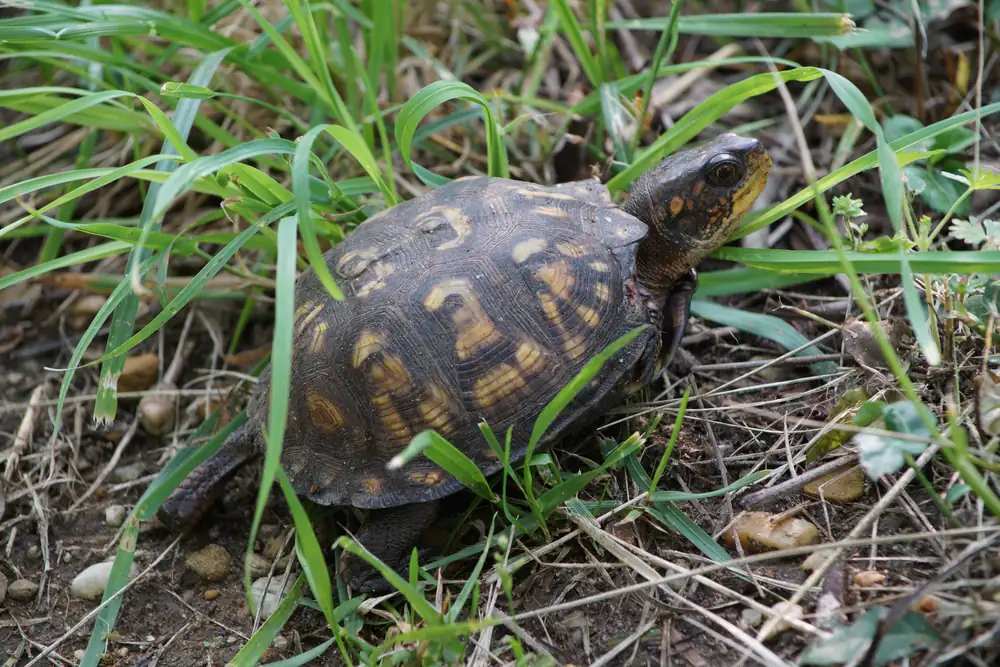
Eastern box turtles
Mating has been seen from late April through May and beyond · Woodlands, and unfortunately roads
The DNR lists the eastern box turtle as a species of special concern, with slow maturity, few young and road deaths all hurting its numbers; individuals can live more than 60 years. On a busy road, the DNR says you may move one to the other side, still facing its original heading. Taking wild box turtles has been illegal since 2004, and nests should be left alone.
-
Indiana bats
They leave their caves and spread to summer roosts in spring; pups come in midsummer · Behind loose bark of trees near streams and rivers
The DNR says females form maternity colonies of up to 100 bats and have a single pup in midsummer, which can fly within a month. White-nose syndrome has been found in 38 Indiana caves, and the DNR says the state's Indiana bat population has fallen 27 percent since it was first detected in 2010. The Forest Service's cave closure order for the Hoosier National Forest, which exists to protect hibernating bats, ends on May 14, so the caves open again on the 15th. If you find a sick or dead bat, report it and do not handle it.
What is May weather like in Indiana, and what should I watch for?
Warm days, a last chance of frost in the north, and some of the state's most damaging hail and tornado days. NOAA's 1991 to 2020 normals put the May average high at 70.1 degrees in South Bend and 77.3 in Evansville, with lows of 48.1 and 56.6. Freezing nights are nearly gone, averaging 0.6 a month at South Bend, 0.4 at Fort Wayne, 0.2 at Indianapolis and none at Evansville. May is wet, from 4.20 inches at South Bend to 5.12 at Evansville.
Weather history compiled by the National Weather Service in Indianapolis covers central Indiana in May. It records 27 degrees at Indianapolis on May 9, 2020, the coldest May morning on record there, with scattered crop damage in northern Indiana, and a latest spring freeze on May 27, 1961. On May 8, 1923, 0.9 inch of snow fell at Indianapolis, the latest measurable spring snowfall on record for the city. The list also holds May 18, 1927, when a tornado killed two boys and injured up to 200 people in the heart of Indianapolis; May 21, 1949, when two tornadoes killed 17 people, most at Shelburn; and May 30, 2004, one of the largest tornado outbreaks in Indiana history, with 23 tornadoes. On May 16, 1990, storms dropped up to 8 inches of rain in southern Indiana and flooded the White and Wabash rivers. Golf ball hail appears on the list again and again.
Decide in advance where you would shelter, turn around at flooded roads, and check the forecast before a long hike on a warm, windy afternoon. NOAA's Climate Prediction Center posts a new 90-day outlook monthly, near the middle of the month, at the seasonal outlook page. Purdue's Indiana State Climate Office hosts severe weather climatology and drought tools as well. Day-to-day conditions are on our weather page.
| City | Average high | Average low | Precipitation | Days with a low of 32 °F or colder |
|---|---|---|---|---|
| South Bend | 70.1 °F | 48.1 °F | 4.20 in | 0.6 |
| Fort Wayne | 72.2 °F | 50.4 °F | 4.58 in | 0.4 |
| Indianapolis | 73.4 °F | 53.7 °F | 4.75 in | 0.2 |
| Evansville | 77.3 °F | 56.6 °F | 5.12 in | 0.0 |
When is the last spring freeze in Indiana?
Late March near the Ohio River, mid-April in the middle of the state, and early May in the north. Nine Indiana stations appear in the table, using NOAA's 1991 to 2020 normals for spring's last 32-degree reading. Every median falls before May 1 except South Bend's, which lands on it. The final column is the cautious date, a choice for setting out tomatoes and peppers, because only a spring in ten freezes later; it stretches to May 17 at South Bend.
May is the month when a late cold snap does its harm, because plants are in leaf and bloom. For your own town, use our frost dates page.
| Station | One year in ten | Median | Nine years in ten |
|---|---|---|---|
| South Bend | Apr 16 | May 1 | May 17 |
| Indiana Dunes lakeshore | Apr 7 | Apr 22 | May 8 |
| Fort Wayne | Apr 10 | Apr 24 | May 10 |
| Lafayette | Apr 11 | Apr 26 | May 14 |
| Indianapolis | Apr 2 | Apr 15 | May 2 |
| Terre Haute | Apr 2 | Apr 16 | May 3 |
| Bloomington | Apr 3 | Apr 17 | May 5 |
| Evansville | Mar 22 | Apr 4 | Apr 19 |
| Madison | Mar 28 | Apr 11 | Apr 28 |
How much daylight does Indiana gain in May?
Evansville adds 49 minutes over the month and South Bend 57, a pace under two minutes a day that keeps slowing toward the June solstice. By May 31 each city in the table has passed 14 and a half hours between sunrise and sunset, and South Bend and Gary are within a couple of minutes of 15. No clock change falls in May. In the corner counties on Central time, the same sunrise reads an hour earlier on the clock than in Indianapolis.
| City | May 1 | May 31 | Gained | Per day |
|---|---|---|---|---|
| South Bend | 14 h 01 m | 14 h 58 m | 57 min | 1.9 min |
| Gary | 14 h 01 m | 14 h 58 m | 57 min | 1.9 min |
| Fort Wayne | 13 h 59 m | 14 h 55 m | 56 min | 1.9 min |
| Lafayette | 13 h 56 m | 14 h 51 m | 55 min | 1.8 min |
| Indianapolis | 13 h 54 m | 14 h 47 m | 53 min | 1.8 min |
| Terre Haute | 13 h 52 m | 14 h 45 m | 53 min | 1.8 min |
| Bloomington | 13 h 51 m | 14 h 44 m | 53 min | 1.8 min |
| Evansville | 13 h 47 m | 14 h 36 m | 49 min | 1.6 min |
For your own street's sunrise and sunset, use our daylight calculator.
What is in the night sky over Indiana in May 2027?
A meteor shower under a moonless sky on the 6th, a full moon that earns a second nickname on the 20th, and a low evening planet at the end of the month. No eclipse falls in May. Eastern times come first below, with the Central equivalent in parentheses for the corner counties.
-
The Eta Aquariid meteors, a good year
Peak night May 5 to 6; try predawn on May 5, 6 and 7 · In the eastern sky before sunrise
These meteors are grains shed by Halley's comet, and they trickle in from late April to late May. With the Moon a sliver on the 6th, the sky stays dark, and SeaSky rates 2027 an excellent year for the shower. The American Meteor Society puts typical rates at 10 to 30 per hour in the last stretch before dawn for observers from the equator northward. Indiana sits far enough north that the radiant, in Aquarius, comes up just one to two hours before the Sun, so the count here runs lower than in the Deep South.
-
Moon, Jupiter and Mars
Evenings of Wednesday, May 12 and Thursday, May 13 · In the south and southwest once the sky is dark
Our own sky calculations put a half-lit Moon a little over a degree from Jupiter on May 12, with Jupiter high in the south after dark. One night later the Moon has slid east, to roughly three degrees from reddish Mars. Both are evening planets all month, and Jupiter should set roughly seven hours past sundown in early May. Treat those figures as calculated rather than published.
-
Venus and Saturn at dawn
Mornings around May 7 · Very low in the east, just before sunrise, with a flat horizon
Our figures have the two planets about a degree apart on May 6 and again on May 8, and closest, at about six-tenths of a degree, during daylight on the 7th. Thirty minutes before sunrise both hang just a few degrees up. Bring binoculars and a flat eastern horizon, and treat it as a curiosity.
-
The Flower Moon, a seasonal Blue Moon
Full at 6:59 a.m. Eastern on Thursday, May 20 (5:59 a.m. Central); watch on the evening of May 19 · Rising low in the east around sunset
Because the Moon turns full just before sunrise on the 20th, the evening of the 19th shows it at its roundest, rising about when the Sun sets. SeaSky labels it a Blue Moon for an older seasonal reason: it ranks third among the four full moons of astronomical spring. By the newer rule, which wants two full moons within one calendar month, no Blue Moon occurs from March to September. It is not a supermoon.
-
Mercury at its best evening
Widest at May 28; a good view from mid-May to early June · Low in the west-northwest, within about 45 to 90 minutes of sunset
Mercury reaches its widest angle east of the Sun, 22.9 degrees per SeaSky, on May 28. For the northern United States it is the best evening appearance of the year, with the evenings of the 27th and 28th both close to the best. The 45-to-90-minute window is our own estimate, so allow extra time. Find an open western horizon and use binoculars as twilight fades.
-
The Milky Way before dawn
The first half of May and the last week · Low in the south in the small hours, from a dark site
At 40 degrees north, our own arithmetic finds as much as 3.8 hours when the Moon is down, the sky is fully dark and the galactic core sits above the horizon. May through August are the best months for the Milky Way.
| Phase | Date | Time |
|---|---|---|
| New moon | Thu, May 6 | 6:58 a.m. EDT (5:58 a.m. CDT) |
| First quarter | Thu, May 13 (Wed, May 12 CDT) | 12:44 a.m. EDT (11:44 p.m. CDT) |
| Full moon, the Flower Moon | Thu, May 20 | 6:59 a.m. EDT (5:59 a.m. CDT) |
| Last quarter | Fri, May 28 | 9:58 a.m. EDT (8:58 a.m. CDT) |
The full year of phases is on the moon phases page; if clouds spoil the view, see the clouds page.
What can Indiana families do outdoors in May 2027?
- Early to mid-May: the Longshore Tower. Indiana Audubon counts through mid-May; arrive at first light on a calm morning and ask what is passing.
- Sunday, May 9: Mother's Day. A walk from a nature center is an easy gift; the one at Indiana Dunes State Park keeps daily hours of 9 a.m. to 4 p.m. Central.
- May: the Indiana Dunes Birding Festival. It is annual, and the park service lists it for the third weekend of May; ask the organizers for the 2027 dates.
- May: World Migratory Bird Day. The organizers' site showed 2026 dates only, so look there for the 2027 date before planning a walk.
- A day at Kankakee Sands. The preserve is free and open daily, with a bison viewing area.
- May 5 to 7: Eta Aquariids. Set an alarm for the hour before dawn and lie back under a blanket.
- Wednesday, May 19: the Flower Moon. Watch it rise as the Sun sets.
- Monday, May 31: Memorial Day. Expect crowds at state parks and go early.
- All month: NestWatch and Journey North. NestWatch invites anyone to follow nests and enter observations, and Journey North collects first sightings of spring arrivals.
Confirm every outing before you leave, because rain and staffing change plans. The Naturalist's Field Journal has room for your sightings, the nature page links to other states and months, and Indiana's April edition covers the weeks before.
Safety notes for May in Indiana
- Spring turkey season. By the DNR's own description, spring turkey season starts on the first Wednesday after April 20, runs 18 days and follows a youth weekend, but the agency had not yet listed 2027 dates. Should the rule hold, hunting would wind up in the first half of May. A hunter may take one bearded or male turkey, and hunting on DNR fish and wildlife properties ends at 1 p.m. Eastern (noon Central).
- Hunter orange. The DNR's turkey page states no spring hunter orange rule. Turkey hunters wear camouflage, so wear bright colors when walking public land in the morning and make some noise.
- Severe weather. May is tornado and hail season. Know your shelter, and turn around at any flooded road.
- Lake Michigan. The lake stays cold in May. The National Park Service advises against swimming when rip current warnings are posted, says to swim parallel to shore if caught, and tells swimmers to check the beach E. coli monitoring page.
- Ticks. Purdue says peak tick season runs from early April into July, with American dog ticks reaching peak numbers in June, lone star ticks common in the south and black-legged ticks much more abundant in the northwest. Wear long sleeves and pants, use repellent, and check yourself after a walk.
- Poison ivy. The park service calls it abundant along many Dunes trails; stay on the path.
- Black bears. The DNR lists confirmed Indiana sightings in only four years (2015, 2016, 2018 and 2021), but its advice is to take down bird feeders from late March through November, clean grills, keep garbage in a garage or shed and never feed a bear. A bear that turns up is to be watched from a distance.
- Young animals. A still fawn is not abandoned. Leave it alone and keep dogs away.
- Box turtles on roads. If you move one, carry it to the far side, still pointed the way it was going.
- Caves. The Forest Service's closure of Hoosier National Forest caves lasts through May 14. Stay out of any gated cave.
Sources (47)
- Indiana Audubon: Lake Michigan surveys (Longshore Tower)
- Indiana Audubon: Sewing machines in the trees, cuckoos in the wind (May 13, 2025)
- Indiana Audubon: Echoes of the Night Sky joins the Longshore watch (May 15, 2025)
- Indiana Audubon: May 2025 blog posts
- Indiana Audubon: events
- Indiana Dunes Birding Festival
- National Park Service: Indiana Dunes programs and events
- National Park Service: Indiana Dunes calendar
- Indiana Birding Trail: Indiana Dunes State Park
- U.S. Fish and Wildlife Service: Big Oaks National Wildlife Refuge, seasons of wildlife
- U.S. Fish and Wildlife Service: Big Oaks National Wildlife Refuge
- Audubon field guide: cerulean warbler
- Audubon field guide: scarlet tanager
- Audubon field guide: prothonotary warbler
- National Park Service: birds of Indiana Dunes National Park
- National Park Service: plants of Indiana Dunes National Park
- National Park Service: black oak savannas, Indiana Dunes
- National Park Service: Heron Rookery Trail, Indiana Dunes
- National Park Service: safety at Indiana Dunes
- U.S. Fish and Wildlife Service: Karner blue butterfly
- Indiana DNR: Indiana Dunes State Park
- The Nature Conservancy: Kankakee Sands
- Indiana Herp Atlas: Fowler's toad
- Indiana Herp Atlas: American bullfrog
- Indiana Herp Atlas: green frog
- Indiana DNR: Spring wildflowers (state parks brochure)
- U.S. Forest Service: Charles C. Deam Wilderness wildflowers
- Indiana DNR: orphaned and injured animals
- Indiana DNR: eastern box turtle
- Indiana DNR: Indiana bat
- Indiana DNR: black bear
- Hoosier National Forest: climbing and caving (cave closure order, August 16 to May 14)
- Indiana DNR: wild turkey hunting biology and management (spring season rule)
- Indiana DNR: hunting and trapping seasons sheet, April 2026 to March 2027
- Purdue Extension Entomology: ticks in Indiana
- NOAA NCEI: 1991–2020 monthly normals for May at South Bend, Fort Wayne, Indianapolis and Evansville (data API)
- National Weather Service Indianapolis: Central Indiana weather history, May
- National Weather Service Indianapolis: Severe Weather and Flood Preparedness Week
- National Weather Service Indianapolis
- Indiana State Climate Office, Purdue University
- Climate Prediction Center: 90-day outlooks (updated monthly)
- U.S. Naval Observatory: moon phases, 2027 (data API)
- SeaSky: astronomy calendar 2027
- World Migratory Bird Day
- NestWatch (Cornell Lab of Ornithology)
- Journey North: monarchs
- Photos via Wikimedia Commons; licenses and photographers are credited under each picture
