What to look for in nature in Kansas this April
April is when Kansas fills with birds. Shorebirds and pelicans crowd the pools at Cheyenne Bottoms and Quivira, and the wetland staff expect the shorebird push to crest by the closing days of the month. Hummingbirds, hawks and the first warblers come in behind them, toads and cricket frogs start to sing after warm rains, and wild blue phlox, camas and prairie violets open in the east. The last of the Flint Hills burns blacken pastures that green up within weeks, bison calves arrive, and the last spring freeze falls in April at six of our seven stations. Days stretch by more than an hour, the Pink Moon rises full on the 20th, and tornado season picks up. A warm or cold spring can shift any bird or bloom by weeks, so each date here is a typical window tied to a named source.
Other months in Kansas: October, November, December, January, February, March.
Start here
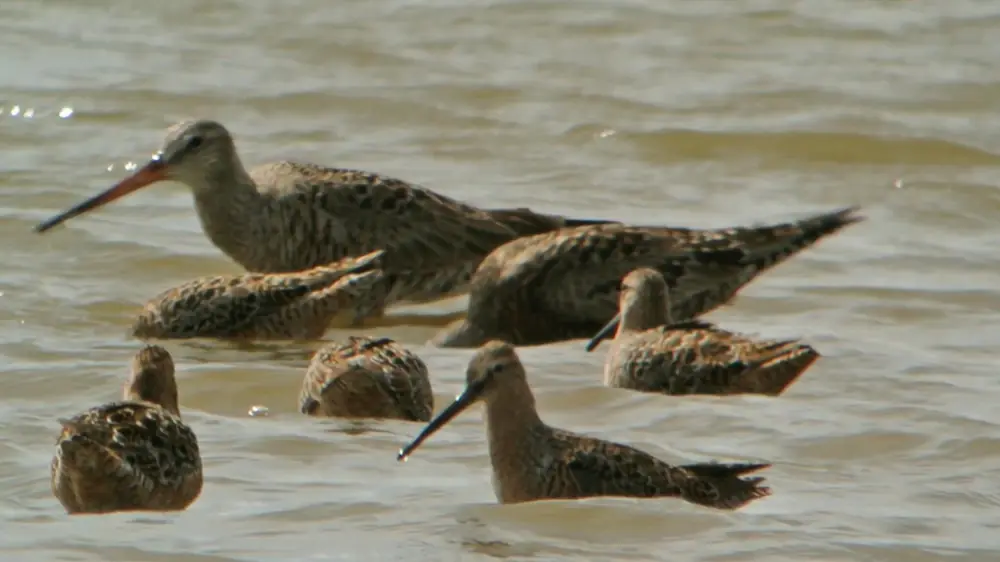
- Spend a morning at a shallow pool. Pick a day in the last two weeks of April, drive the roads around Cheyenne Bottoms or the auto tour at Quivira, and scan the muddy edges with binoculars for long-billed godwits, avocets and a dozen small sandpipers. Water level decides where the birds stand, so check the wetland center’s latest sightings post first.
- Listen for a toad after a warm rain. On a mild evening after a soaking rain, stand beside a floodplain slough or a ditch full of water and listen for a long, low, nasal wail. That is a male Woodhouse’s toad, and the Kansas Herpetofaunal Atlas welcomes your record.
- Find a wildflower on a woodland edge. In the eastern third of the state, walk a creek bank or the edge of the woods and look for clusters of blue wood phlox, with five notched lobes and a pale throat. Note the date of your first bloom and compare it with next year’s.
Write it down. “Birds I have seen” is the plate for every shorebird and the first hummingbird at your feeder, with the date and the pool’s water level. On “a map of sounds,” mark the evening the toads start and the temperature at dusk. “The same place twice” suits a burned pasture visited a week after the fire and again a month later. Following a single serviceberry from bud to leaf fits “a tree through the seasons,” while the “daily field log” can hold your town’s final freeze.
Regions used below: Northwest Kansas and the High Plains; Southwest Kansas; North-central Kansas and the Smoky Hills; Central Kansas and the Great Bend wetlands; South-central Kansas, Wichita and the Red Hills; The Flint Hills; Northeast Kansas, Topeka and Kansas City; Southeast Kansas.
When do shorebirds peak at Cheyenne Bottoms and Quivira in April?
Late April is the busiest stretch for shorebirds in central Kansas, and the staff at the Kansas Wetlands Education Center say so in their own sightings posts. Their April 12 post in a recent year said spring migration would typically crest near the month’s end, and another, from April 23, called it “the peak 2-3 weeks of shorebird migration.” The Quivira refuge says shorebirds start showing up as early as February and put on the biggest show by May, especially around the Big Salt Marsh. In the International Shorebird Survey count of 2022, which ran from March 15 to June 15, volunteers and scientists tallied more than 500,000 shorebirds at Cheyenne Bottoms, including more than 30 percent of the whole Hudsonian godwit population. That is a count from one year, not a record, and the numbers swing with water.
Water is the catch. The Bottoms is managed with pools that are filled and drawn down, and drought can leave it nearly dry. In 2023 the wetland staff wrote that Cheyenne Bottoms was dry while Quivira still held water in its salt marshes, and in 2026 they noted that shorebirds were concentrated wherever pools and edges remained. Read the latest post before you drive, and have Quivira as your plan B.
-
Hudsonian godwits, Baird’s sandpipers and dowitchers
Late April into early May is the usual peak · Shallow pools and mud at Cheyenne Bottoms
The Manomet scientists who coordinate the survey name these three as the birds that rest and feed on the invertebrates of the marsh before pushing on north. Godwits are large, with long upturned bills and a black-and-white wing pattern in flight; Baird’s sandpipers are small and buffy and often walk along the drier edges.
-
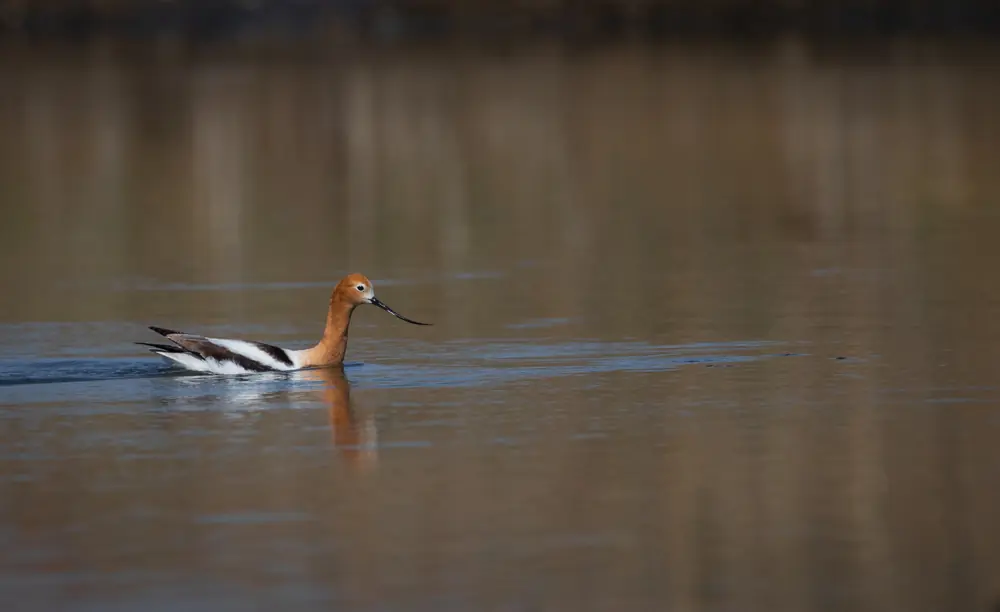
American avocets and black-necked stilts
Reported by the wetland center in mid April in different years · Pool edges at the Bottoms and the salt marshes at Quivira
Both are tall and easy to recognize: the avocet has a thin, upturned bill and a rusty head in breeding plumage, and the stilt has very long pink legs and a black back. Quivira says avocets, snowy plovers and interior least terns nest on the refuge in spring and summer.
-
Buff-breasted sandpipers and golden plovers on burned ground
A report from April 23 in one past year counted 110 buff-breasted sandpipers · Recently burned areas in the Bottoms, including one pool’s burned area
The wetland center’s post from that spring placed 110 buff-breasted sandpipers in a burned part of Pool 5 and said American golden plovers were in good numbers on recently burned fields. Fire clears the old cover, and the birds like the open ground. It is a pattern worth checking, not a guarantee.
-
Snowy plovers
Seen at the Bottoms by mid April in the wetland center’s posts · Salt flats at Quivira and shores at the Bottoms
Quivira lists the western snowy plover as a state-protected species that nests on the refuge. Keep your distance from any bird on the ground, and stay on roads and signed trails.
From April 1 the education center near Great Bend is open six days a week from nine to five, with Sunday afternoon hours of one to five. Quivira’s own page sets its daily visiting window around the Sun, starting well before dawn and ending well after dusk. Last month’s page, March in Kansas, covers the cranes and snow geese that are leaving as these birds arrive.
Which songbirds, hawks and hummingbirds arrive in Kansas in April?
The Kansas Wetlands Education Center says peak spring migration through central Kansas arrives from the last days of April into early May, and a 2024 Wichita public-radio piece gave the same window. Before then the changes are steady rather than sudden. The wetland center’s April 28 post in a recent year said spring migration was approaching its peak, with “first of season” birds arriving often and swallows, warblers, sparrows and orioles on the list, and a post from April 21, 2026 said many early migrants seemed to be two to three weeks ahead of schedule. So treat each date below as a window and watch your own yard.
-
Warblers and flycatchers
Late April into mid May · Wooded creeks and trails, such as the old landfill and Baker Wetlands in Lawrence
A Lawrence tourism guide says many wood warblers move through from late April to mid May, with Baker Wetlands best for waterfowl and shorebirds in late April and the old landfill best for warblers in May. Wichita Audubon’s Saturday, April 17 backroads trip in Chautauqua County is aimed at early spring warblers and other migrants.
-
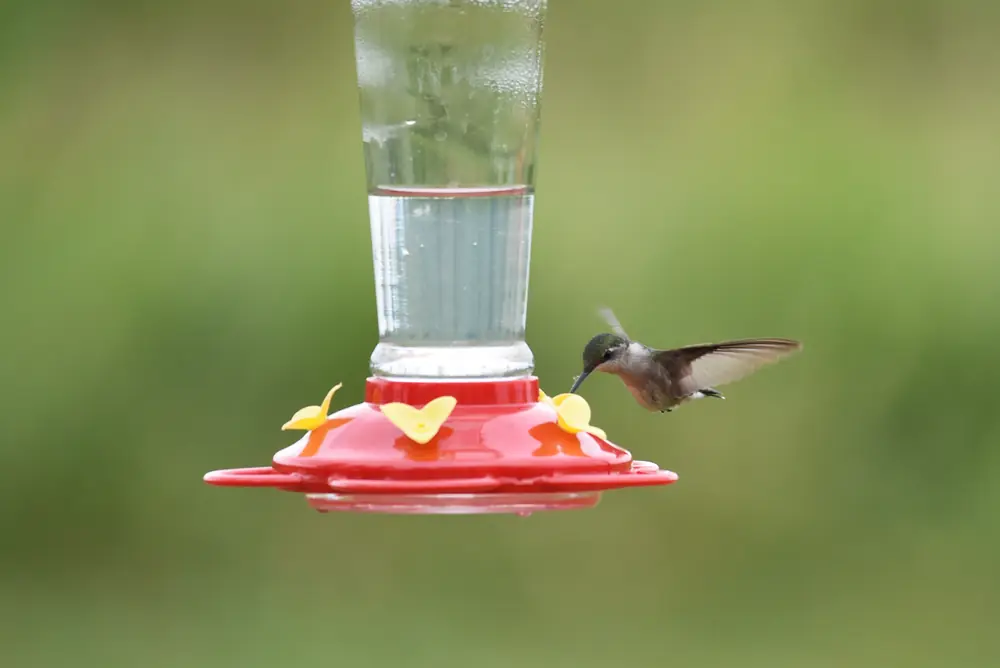
Ruby-throated hummingbirds
Usually mid April in the eastern half of the state · Feeders and flowers in eastern Kansas; rare in the far west
The Kansas Ornithological Society’s secretary, Chuck Otte, told a Topeka television station that he advises waiting until about mid April to put out feeders, and said most hummingbirds stay in the eastern half of the state, with western Kansas near the far edge of their range. For nectar he recommends four parts water to one part plain white sugar, with no dye or honey, and cleaning the feeder every two or three days. Journey North collects hummingbird first-sighting reports if you want to add yours.
-
Swainson’s hawks and other raptors
Reported in the wetland center’s mid April posts in several years · Open country, fence posts and shelterbelts around the wetlands
The wetland center’s April posts list Swainson’s hawks alongside northern harriers, red-tailed hawks, Cooper’s hawks, bald eagles, kestrels and peregrine falcons. Swainson’s hawks winter far to the south, so a first one is a sign the season has turned.
-
Burrowing owls on prairie dog towns
Two were reported in the April 23 post of one past year · Prairie dog colonies near the Bottoms
The wetland center noted two burrowing owls on a prairie dog town in that report. Ask at the visitor center where a colony can be viewed from the road, and never walk into a town.
Add each first-of-year bird to your Naturalist’s Field Journal with the date. Our forecast in plain words shows the warm south winds that tend to bring them.
Which frogs and toads call in Kansas in April?
According to the Fort Hays State atlas of Kansas reptiles and amphibians, a rainy night anywhere between February and September can start a chorus among some of Kansas’s 21 frog and toad species, and the singers are all males. In April the chorus shifts from the early peepers and chorus frogs to toads and the species that need warmer water. The atlas accounts below give the ranges of breeding dates that observers have recorded, so use them as guides and listen on the warm, wet nights.
-
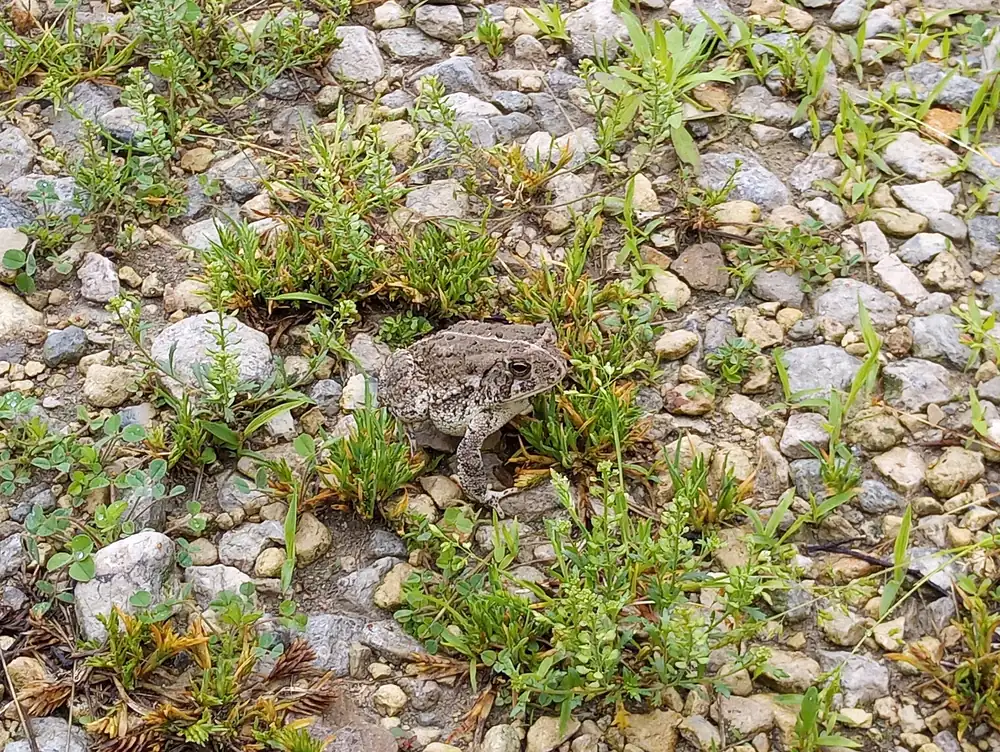
Woodhouse’s toad
Vocal from March through June; one Konza Prairie chorus noted late April through June · Floodplain sloughs and temporary pools across the state except the far southeast
The atlas describes the call as a low, nasal waaaaah, and one Allen County record has a male calling on April 28 when the air was 58 degrees. It lists the toad as common except in the extreme southeast, where Fowler’s toad replaces it.
-
Great Plains toad
Males can start in late March; breeding goes into early summer · Temporary upland pools in short and mixed-grass prairie, from western Kansas east to the Flint Hills
The atlas says the species spends the day underground and comes out on warm evenings, and that breeding is tied to rain. The best chance for a chorus is a warm night right after a hard rain.
-
Blanchard’s cricket frog
April to July; warm temperatures are needed to start a chorus · Muddy, sparsely vegetated banks of streams, ponds and reservoirs in the eastern two-thirds of the state
This tiny frog is abundant along streams in the eastern two-thirds of Kansas, according to the atlas. The chorus the atlas recorded at Cheyenne Bottoms ran from May 1 to June 5.
-
Plains spadefoot
Late April through September, after the first warm, heavy rain · Rain pools on floodplains and open prairie, from western Kansas to the edge of the Flint Hills
The atlas says breeding typically follows at least 3.5 inches of spring rain along with air temperatures of 52 degrees or more. When the rain does come, males chorus loudly in the new pools, often alongside Woodhouse’s toads.
Listening beats looking. Stand still, wait five minutes, and write the temperature and time in a Naturalist’s Field Journal. Our sky cover forecast helps pick a rainy night to try.
What blooms in Kansas in April?
April is the bridge month between the first woodland flowers and the big prairie bloom of May and June. The Kansas Wildflowers and Grasses database lists a bloom period and range for each plant, and the five below all show April. Several of the showiest prairie flowers come later: blue wild indigo and downy paintbrush are listed as May and June bloomers, and prairie phlox starts in May, so April walkers mostly find small, low flowers in the eastern third.
-
Blue wood phlox
April and May · Moist, open woods and thickets, principally the eastern third of the state
Clusters of bluish-violet flowers, each with five blunt lobes and a paler throat, rise from soft stems in partial shade. The database places it mostly in the east.
-
Atlantic camas, or wild hyacinth
April to June · Mesic tallgrass prairies, swales and glades in the eastern third
Pale blue to white flowers with six narrow petal-like parts open along a spike above grassy leaves. Look for it in damp swales and glades of the tallgrass.
-
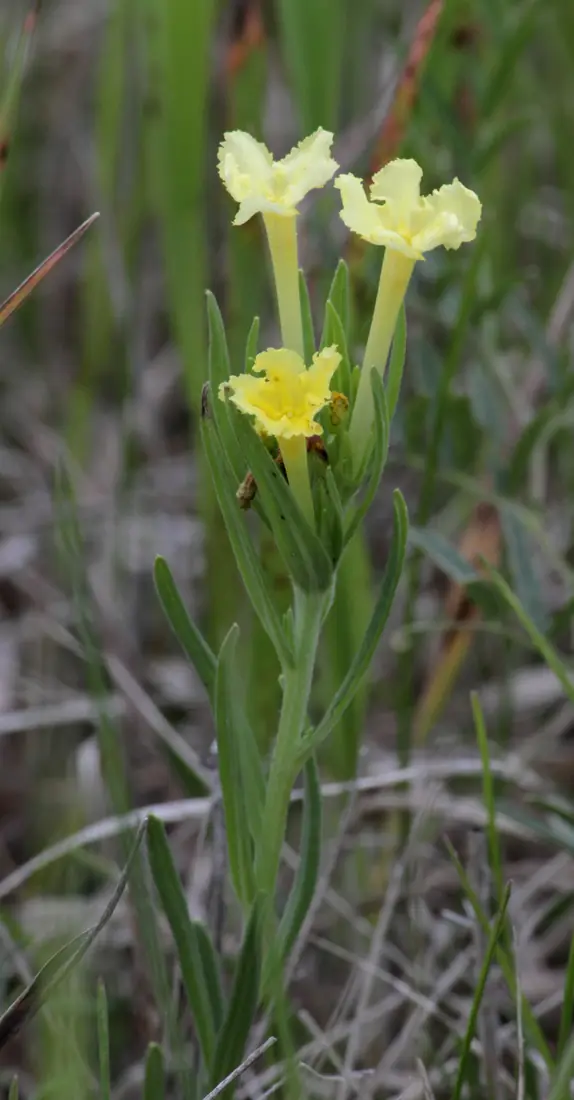
Fringed puccoon
April to June · Dry upland prairies, open woods and disturbed sites, found statewide
The yellow trumpet-shaped flowers have fringed edges, and the plant stands only 4 to 16 inches tall. The database notes that the early showy flowers cross-pollinate while later ones are small and self-pollinating, so look for the bright ones in spring.
-
Prairie violet
April and May · Prairies and open woods in the eastern two-fifths
Its leaves are deeply cut like a bird’s foot, and the violet flowers have white bases with dark veining on the lower three petals, a feature that helps separate it from the common violets.
-
Downy serviceberry and flowering dogwood
Serviceberry March and April; dogwood March through May · Serviceberry on rocky wooded slopes in the eastern quarter; dogwood only in the southeastern corner
The database lists flowering dogwood in Kansas only from Cherokee County. The database says serviceberry shows white clusters before most trees leaf out, on bluffs and rocky slopes, so an early spring can put it in flower at the start of April and a late one pushes it later.
Pick one shrub and write down the day its buds open, the day the flowers peak and the day the leaves are fully out.
What is happening on the Flint Hills prairie in April?
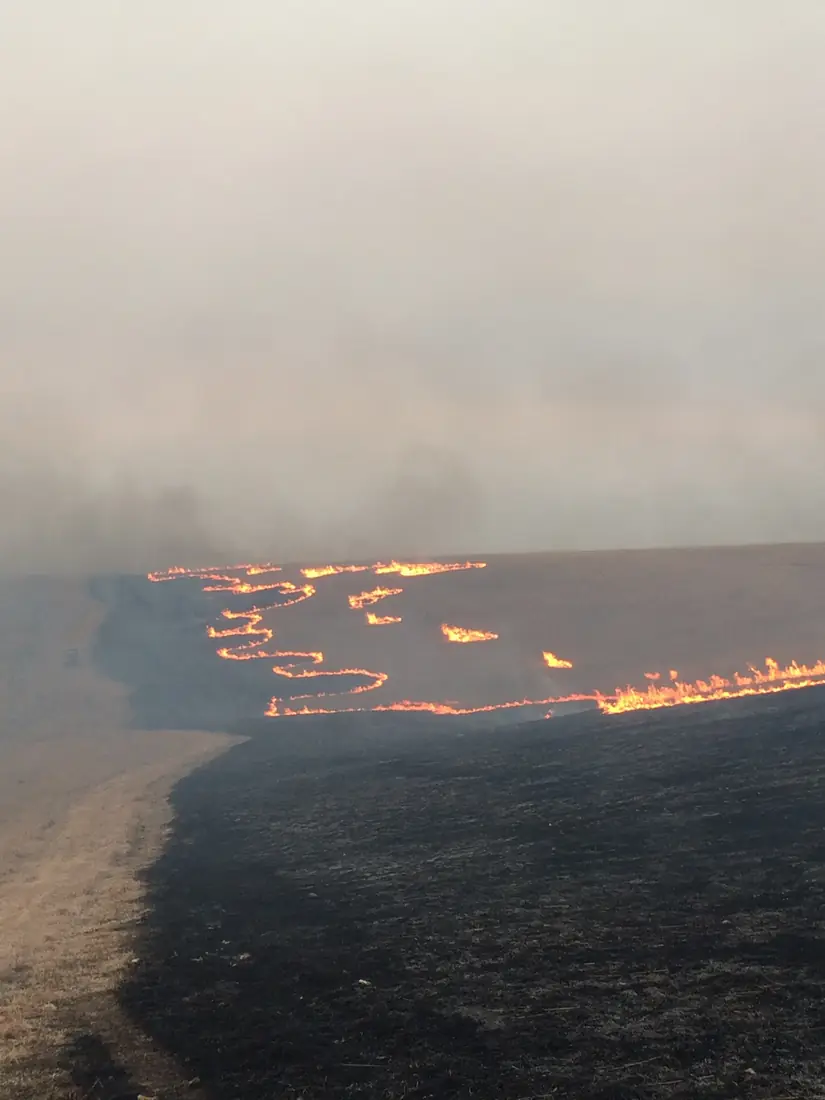
Three things overlap. The last prescribed burns go on, green-up spreads across the blackened ground, and the first bison calves appear. The National Park Service says early spring burns run from late February through April across the Kansas Flint Hills, and that bison calves drop in late spring, usually April and May. A burned pasture looks like a scar for days and then turns bright green, because, in the park’s words, the sun heats the dark soil and stimulates sleeping plants to sprout.
-
The April burning ban
Every April, in a list of Flint Hills counties · Sixteen counties named in state regulation K.A.R. 28-19-645a, among them Butler, Chase, Geary, Johnson, Riley, Sedgwick, Wabaunsee and Wyandotte
State regulation K.A.R. 28-19-645a, which the Kansas Interactive Fire site (ksfire.org) posts, bans burning of land-clearing debris, crop residue, construction material, firefighter-training burns and yard waste in those 16 counties during April, while burning of prairie and grassland for management and Conservation Reserve Program acres stays allowed, and residential burning at homes with five or fewer dwellings is exempt. A Lenexa city notice for April 2026 also describes the April burn ban as part of the state smoke management plan, and says backyard fire pits are still allowed when used safely. County rules can differ, so check with your county and the state’s smoke site, ksfire.org, before lighting anything.
-
Birds on burned ground
Mid to late April · Burned pastures and fields near wetlands
Cheyenne Bottoms staff reported buff-breasted sandpipers and golden plovers on burned fields one spring. After the grass is gone, birds can see the ground, and insects are easier to find.
-
Bison calves
April and May, per the National Park Service · Tallgrass Prairie National Preserve near Strong City and Maxwell Wildlife Refuge near Canton
Maxwell, in the Smoky Hills, describes itself through a state tourism article as home to 200 bison and 60 elk, and a writer who visited in April 2024 saw calves only hours old. Covered, open-air trailer tours put visitors within feet of the animals, and the refuge posts its tram schedule online, so look for the 2027 schedule.
-
Greater prairie-chickens, late in the season
Cheyenne Bottoms has run dawn lek tours through April in past years · Grassland leks, including the Flint Hills Tallgrass Prairie Preserve near Cassoday
A Great Bend Tribune article described Kansas Wetlands Education Center tours that met before dawn and watched from a trailer blind; it reported room for seven guests, ages 12 and up. Details change, so ask the center. The Nature Conservancy’s Flint Hills preserve, 2,188 acres open from sunrise to sunset, lists greater prairie-chickens and Henslow’s sparrows among its birds.
Keep dogs and children well back from bison, which are wild animals even where they graze beside a trail, and never stand downwind of a burn. Fire and wind forecasts are on our forecast page.
When does the white bass run start in Kansas rivers?
When is the last freeze of spring in Kansas?
For most of the state, April is the month of the last freeze. Across the seven stations in the table, the typical final freeze comes on April 7 at Pittsburg, April 11 or 12 at Wichita and Topeka, April 18 at Concordia and Salina, April 21 at Dodge City and May 2 at Colby. In the earliest tenth of springs, Pittsburg is finished with freezing by March 24, yet in nine springs out of ten Colby is not clear until May 15 and Dodge City until May 4.
The Kansas Mesonet, run from Kansas State University, offers a freeze monitor and a soil-temperature display that you can check for your own county. For your own town, open our Kansas frost page.
| Station | One year in ten | Median | Nine years in ten |
|---|---|---|---|
| Colby (northwest) | Apr 20 | May 2 | May 15 |
| Dodge City (southwest) | Apr 7 | Apr 21 | May 4 |
| Concordia (north-central) | Apr 3 | Apr 18 | May 2 |
| Salina (central) | Apr 3 | Apr 18 | May 1 |
| Wichita (south-central) | Mar 25 | Apr 11 | Apr 26 |
| Topeka (northeast) | Mar 29 | Apr 12 | Apr 27 |
| Pittsburg (southeast) | Mar 24 | Apr 7 | Apr 24 |
Plant by your town’s date, not the calendar, and keep a sheet or bucket handy for a late cold night.
How warm is a Kansas April, and what weather should you watch?
NOAA’s 1991 to 2020 normals for the five stations in the table put April afternoons at about 64 degrees at Goodland and Concordia and near 67 to 68.5 at Topeka, Wichita and Dodge City, while nights run from about 35 at Goodland to nearly 45 at Wichita. Precipitation ranges from 1.69 inches at Goodland to 3.81 at Topeka, which makes the northeast the wettest and the northwest the driest. Goodland still averages 3.2 inches of snow in April; elsewhere it is under an inch.
April also begins the heart of Kansas’s severe weather. The National Weather Service in Wichita says Kansas averages 81 tornadoes a year (1994 to 2023), that April through June accounts for about 74 percent of them, and that the peak runs from mid to late April into mid June, mostly between 2 and 10 p.m. A national summary of the state’s climate adds that spring thunderstorms can bring large hail and high winds. Late freezes, flash floods and grass fires on windy days are the other April hazards. The Climate Prediction Center posts new three-month temperature and rain maps once a month, near the middle of the month, on its 90-day outlook page.
| Station | Average high | Average low | Precipitation | Snowfall |
|---|---|---|---|---|
| Goodland (northwest) | 64.0 | 34.6 | 1.69 | 3.2 |
| Dodge City (southwest) | 68.5 | 40.1 | 1.99 | 0.8 |
| Concordia (north-central) | 64.9 | 41.2 | 2.53 | 0.4 |
| Wichita (south-central) | 68.3 | 44.8 | 3.10 | 0.2 |
| Topeka (northeast) | 67.0 | 43.9 | 3.81 | 0.1 |
When a line of storms is forecast, check radar, know where your shelter is, and compare with our plain-word forecast.
How much daylight does Kansas gain in April?
Days keep growing quickly in April but a little more slowly than in March. Between April 1 and April 30, each city in the table gains between 65 and 70 minutes of sunlight. The clocks have already changed, so in Wichita the sun rises at 7:15 a.m. and sets at 7:52 p.m. CDT on April 1, and rises at 6:35 a.m. and sets at 8:19 p.m. on April 30 (U.S. Naval Observatory). Civil twilight, the bright afterglow, ends at 8:19 p.m. on April 1 and 8:47 p.m. on April 30 in Wichita, and the sky is not truly dark until later. Clocks in the Mountain-time counties of Sherman, Wallace, Greeley and Hamilton read an hour earlier than these.
| City | Apr 1 | Apr 30 | Gained | Per day |
|---|---|---|---|---|
| Goodland | 12 h 40 m | 13 h 49 m | 69 min | 2.4 min |
| Liberal | 12 h 36 m | 13 h 41 m | 65 min | 2.2 min |
| Hays | 12 h 39 m | 13 h 48 m | 69 min | 2.4 min |
| Salina | 12 h 39 m | 13 h 48 m | 69 min | 2.4 min |
| Wichita | 12 h 37 m | 13 h 44 m | 67 min | 2.3 min |
| Manhattan | 12 h 39 m | 13 h 49 m | 70 min | 2.4 min |
| Overland Park | 12 h 39 m | 13 h 48 m | 69 min | 2.4 min |
| Pittsburg | 12 h 36 m | 13 h 43 m | 67 min | 2.3 min |
Our daylight calculator gives times for any Kansas town.
What can you see in the Kansas night sky in April?
Times below are Central daylight time; in the four Mountain-time counties subtract an hour. The new Moon on April 6 makes the evenings around then the darkest of the month for faint stars. Saturn lines up behind the Sun that week and cannot be seen until it re-emerges at dawn.
-
The Pink Moon
Full on Tuesday, April 20 at 5:27 p.m. CDT (4:27 p.m. MDT) · Rising in the east around dusk that evening
SeaSky’s calendar says the name Pink Moon comes from moss pink, or wild ground phlox, which blooms in early spring. The Moon is not actually pink. Full comes in the late afternoon, so the Moon looks full as it rises at dusk that evening and the evening after.
-
The Lyrid meteors, in a poor year
Predicted peak on the evening of Thursday, April 22, about 8:41 p.m. CDT; active roughly April 14 to 30 · Look toward Lyra, rising in the northeast, in the early evening
The Moon will be about 95 percent lit and comes up in the late evening, about 10 o’clock across most of the country, so just the early hours of darkness are Moon-free. SeaSky says the Lyrids usually produce about 20 meteors an hour at peak; this year, expect a few an hour. The shower can surprise with short bursts, but they are not predictable.
-
Venus and a thin crescent
Mornings of April 3 and 4 · Low in the east before sunrise
The old crescent Moon sits near brilliant Venus on those mornings, and a clear eastern horizon is a must because Venus climbs only a little ahead of the Sun.
-
Jupiter and Mars in the evening
The Moon passes Jupiter on the evenings of April 14 and 15; Mars is about 3 degrees from the Moon on April 15 · High in the south after dusk
Jupiter is the bright steady light in the evening sky all month and stays up late. Mars is fainter and orange, and it trails Jupiter, setting after midnight.
| Phase | Date | Time |
|---|---|---|
| New moon | Tuesday, Apr 6 | 6:51 p.m. CDT (5:51 p.m. MDT) |
| First quarter | Tuesday, Apr 13 | 5:56 p.m. CDT (4:56 p.m. MDT) |
| Full moon, the Pink Moon | Tuesday, Apr 20 | 5:27 p.m. CDT (4:27 p.m. MDT) |
| Last quarter | Wednesday, Apr 28 | 3:18 p.m. CDT (2:18 p.m. MDT) |
Our sky cover forecast shows which nights are clear, and the moon calendar lists moonrise for each date.
What nature events and programs are on in Kansas in April 2027?
Every dated entry here rests on the organizer’s own 2027 listing or on a state law. Storms and mud reschedule outdoor events, so confirm before driving.
- Saturday, April 3, 8 a.m.: Chaplin Nature Center bird walk near Arkansas City, a guided stroll that lasts roughly ninety minutes if the weather cooperates, starting at the visitor center (from Wichita Audubon’s 2026 to 2027 schedule).
- Saturday, April 10, 8 a.m.: second-Saturday bird walk in Chisholm Creek Park, Wichita. The walk starts in the Great Plains Nature Center parking lot, covers one to two miles of paved path in about 90 minutes, and needs no experience.
- Saturday, April 17, 6:30 a.m.: Chautauqua County backroads trip for early spring warblers and other migrants in the Cross Timbers country. Meet at the Dillon’s parking lot at Andover Road and US 400 and carpool (Wichita Audubon).
- Tuesday, April 20, 7 p.m.: Wichita Audubon program, “On the Trail to 5,000,” at the zoo’s Cargill Learning Center in Wichita.
- Thursday, April 22: Earth Day. The organizer’s site names “Food for Our Planet” as the theme for 2027.
- Friday, April 30: Arbor Day in Kansas. State law sets the last Friday in April, and Kansas State University’s news site repeats it.
- City Nature Challenge: the organizer’s observation window is April 30 through May 3 for photographing wildlife through iNaturalist, with identifications through May 16. Its page did not show which Kansas cities take part, so look at the challenge’s city list before you plan.
- Kansas Wetlands Education Center: summer hours begin April 1 (Monday to Saturday, 9 a.m. to 5 p.m., Sunday, 1 to 5 p.m.). Its sightings posts are the best guide to shorebirds.
- Wings and Wetlands Birding Festival: the center says it is held in odd-numbered years, in late April or early May. 2027 is an odd year, but the center’s page showed no 2027 date or plan when this page was written, so call 1-877-243-9268 to ask.
- Citizen science: log shorebirds in eBird, frog and toad records in the Kansas Herpetofaunal Atlas, and first sightings of hummingbirds and monarchs with Journey North. Monarch Watch, based at the University of Kansas in Lawrence, runs a tagging program and accepts milkweed seed donations.
Other states and months are listed under nature this month, and March in Kansas has the cranes and the first peepers.
Safety notes for April in Kansas
- Spring turkey season: the state wildlife agency’s When to Hunt page lists the 2027 youth and disability segment as April 1 to 13, archery only as April 5 to 13, and the regular season, with firearms or archery, as April 14 to May 31. Legal equipment includes shotguns with shot sizes 2 to 9 and bows; legal shooting time for turkey starts a half hour before sunrise and ends at sunset. The turkey page names no blaze-orange rule, so ask the agency, and expect hunters in the woods from the first day of the month. The agency’s own site refused our automated reading, so we read those dates on an archived copy of the page dated August 14, 2026, where the agency states the rule (youth from April 1, archery from the first Monday after the first Saturday in April, regular season from the second Wednesday after the first Saturday in April through May 31) and the dates for each year. Confirm them on the agency’s site before you go.
- Other seasons: hunters of light geese can still use the conservation order, which carries no daily limit, until April 30, 2027. Beaver trapping and the night-vision coyote segment closed on March 31.
- Ticks and rabies: the Kansas health and wildlife agencies say the American dog tick, the lone star tick and the blacklegged tick are the ones people meet most. They advise light clothing, repellent with 20 to 30 percent DEET on skin, and permethrin on clothes, never on skin, with a careful check afterward. The same page says skunks and bats are the most common rabies carriers in the state, and that a wild animal acting oddly tame is a warning sign.
- Bison, young animals and burns: stay back from bison, especially cows with calves; a fawn or a fledgling alone is usually not abandoned, so leave it where it is. Check your county’s burning rules in April, since a state ban covers a list of Flint Hills counties, and stay away from crews at work.
- Storms and water: April afternoons can turn into severe thunderstorms by evening, with the peak hours for tornadoes between 2 and 10 p.m. Creeks that run fast after rain can cut a low-water crossing in minutes, and a flooded road is never worth the gamble.
Sources (62)
- Manomet: banner year for migrating shorebirds in Kansas (2022 count)
- Kansas Wetlands Education Center: home page (summer hours from April 1)
- Kansas Wetlands Education Center: recent bird sightings, April 21, 2026
- Kansas Wetlands Education Center: recent bird sightings, April 25, 2023
- Kansas Wetlands Education Center: recent bird sightings, April 12, 2021
- Kansas Wetlands Education Center: recent bird sightings, April 28, 2020
- Kansas Wetlands Education Center: recent bird sightings, April 15, 2020
- Kansas Wetlands Education Center: recent bird sightings, April 23, 2018
- Kansas Wetlands Education Center: Wings and Wetlands Birding Festival
- Kansas Wetlands Education Center: bird watching
- U.S. Fish and Wildlife Service: Quivira National Wildlife Refuge
- U.S. Fish and Wildlife Service: Quivira refuge species
- KMUW Hidden Kansas: spring migration, the early birds have arrived
- Explore Lawrence: a seasonal guide to birding in Lawrence, spring
- KSNT: Kansas hummingbird migration map and arrival dates, 2026
- Journey North: monarch butterflies
- Journey North: home page
- Monarch Watch (University of Kansas)
- Kansas Herpetofaunal Atlas: chorusing phenology
- Center for North American Herpetology: Woodhouse’s toad in Kansas
- Center for North American Herpetology: Great Plains toad in Kansas
- Center for North American Herpetology: Blanchard’s cricket frog in Kansas
- Center for North American Herpetology: plains spadefoot in Kansas
- Kansas Wildflowers and Grasses: blue wood phlox
- Kansas Wildflowers and Grasses: Atlantic camas
- Kansas Wildflowers and Grasses: fringed puccoon
- Kansas Wildflowers and Grasses: prairie violet
- Kansas Wildflowers and Grasses: downy serviceberry
- Kansas Wildflowers and Grasses: flowering dogwood
- Kansas Wildflowers and Grasses: blue wild indigo
- Kansas Wildflowers and Grasses: downy paintbrush
- Kansas Wildflowers and Grasses: prairie phlox
- National Park Service: Tallgrass Prairie National Preserve, basic information
- National Park Service: fire and grazing in the prairie
- National Park Service: birds at Tallgrass Prairie
- Travel Kansas: Maxwell Wildlife Refuge
- The Nature Conservancy: Flint Hills Tallgrass Prairie Preserve
- Great Bend Tribune: lek tours at Cheyenne Bottoms
- Kansas Livestock Association: smoke problems avoided during onset of burning season
- City of Lenexa: April burn plan, what you need to know
- Kansas Flint Hills smoke management site
- Lawrence Journal-World: warming waters mean white bass runs (April 2005)
- NOAA NCEI: 1991-2020 monthly normals, five Kansas stations
- National Weather Service Wichita: Kansas tornado climatology
- National Weather Service Wichita: Kansas tornado facts
- NOAA state climate summaries: Kansas
- Kansas Mesonet (Kansas State University)
- NOAA Climate Prediction Center: 90-day outlooks
- Wichita Audubon Society: schedule of events 2026-2027
- City Nature Challenge 2027
- Earth Day
- Kansas State University: Arbor Day in Kansas
- Kansas Legislature: SB 133 designating Arbor Day
- U.S. Naval Observatory: moon phases, April 2027
- U.S. Naval Observatory: Wichita sunrise and sunset, April 1, 2027
- U.S. Naval Observatory: Wichita sunrise and sunset, April 30, 2027
- SeaSky: astronomy calendar 2027
- Kansas Department of Wildlife and Parks: when to hunt (archived copy, Aug. 14, 2026)
- Kansas Department of Wildlife and Parks: turkey (archived copy, Aug. 14, 2026)
- Kansas Department of Wildlife and Parks: outdoor health and safety (ticks, rabies)
- Kansas Interactive Fire: K.A.R. 28-19-645a, April burning restrictions
- Photos via Wikimedia Commons; licenses and photographers are credited under each picture
