What to look for in nature in Kansas this February
February closes out meteorological winter in Kansas, and it is a month of two minds. Snow is still likely, and at Goodland on the High Plains February averages more snow than December or January, yet the first spring traffic is already moving. Bald eagles that wintered on the open water have paired off, and most Kansas nesting pairs lay their eggs this month. At Cheyenne Bottoms and Quivira the first northbound snow geese, sandhill cranes and early ducks drop in during warm spells. Great horned owlets hatch in borrowed stick nests, coyotes howl through the cold nights of their breeding season, and on the first mild, rainy evening the chorus frogs start up in the roadside ditches. The days grow by about an hour over the month. Every date below comes with its source.
Other months in Kansas: October, November, December, January.
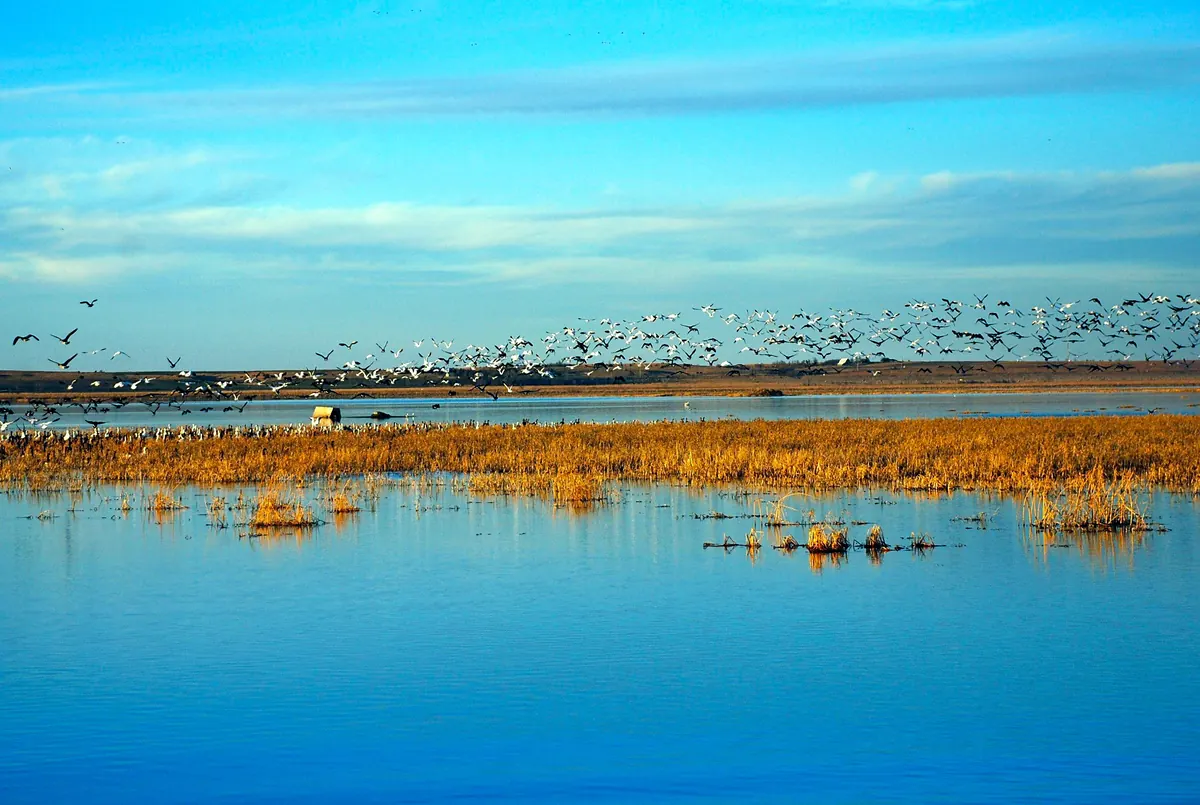
Start here
- Find an eagle sitting tight. An eagle that stays flat in a big stick nest in a riverside cottonwood all morning, its pale head just peeking over the sticks, is almost certainly on eggs. Watch from a road or a boat ramp well back, and note the date.
- Drive the wetlands after a thaw. When a warm southerly wind follows a cold snap in the last third of the month, take the roads around Cheyenne Bottoms or the Quivira wildlife drive and look for long white lines of snow geese and the first gray sandhill cranes heading north.
- Count birds for four days. Kansas families can join the worldwide Great Backyard Bird Count from February 12 to 15, 2027; a quarter hour at a kitchen window counts.
Keep a record of it: on the “nest observed” plate, give the eagle or owl nest you are watching its own page and date every visit, from the first day a bird sits low to the first downy head. The first night the chorus frogs call belongs on “a map of sounds,” with the temperature and whether it had rained. Snow geese and cranes go on “birds I have seen,” coyote trails on “tracks to know,” and the “dusk and dawn watch” plate can follow the sunset as it slides past six o’clock.
Regions used below: Northwest Kansas and the High Plains; Southwest Kansas; North-central Kansas and the Smoky Hills; Central Kansas and the Great Bend wetlands; South-central Kansas, Wichita and the Red Hills; The Flint Hills; Northeast Kansas, Topeka and Kansas City; Southeast Kansas.
When do bald eagles lay eggs in Kansas?
In January the eagle story in Kansas was about crowds at open water. February is when the resident pairs get down to business. Staff at Fort Riley, who monitor several pairs on and around the post, describe a calendar in which Kansas eagles work on their nests in December and January, lay their eggs in February, share about 35 days of incubation between male and female, and see their young leave the nest around June. A U.S. Fish and Wildlife Service biologist quoted by the Friends of the Kaw put it simply: most Kansas eggs are laid in February, usually two to a nest, though a clutch can be one to three.
-
Pairs on the nest
Most eggs laid in February; hatching about five weeks later, in March · Tall cottonwoods and sycamores along the Kansas, Smoky Hill and other rivers, and around large reservoirs
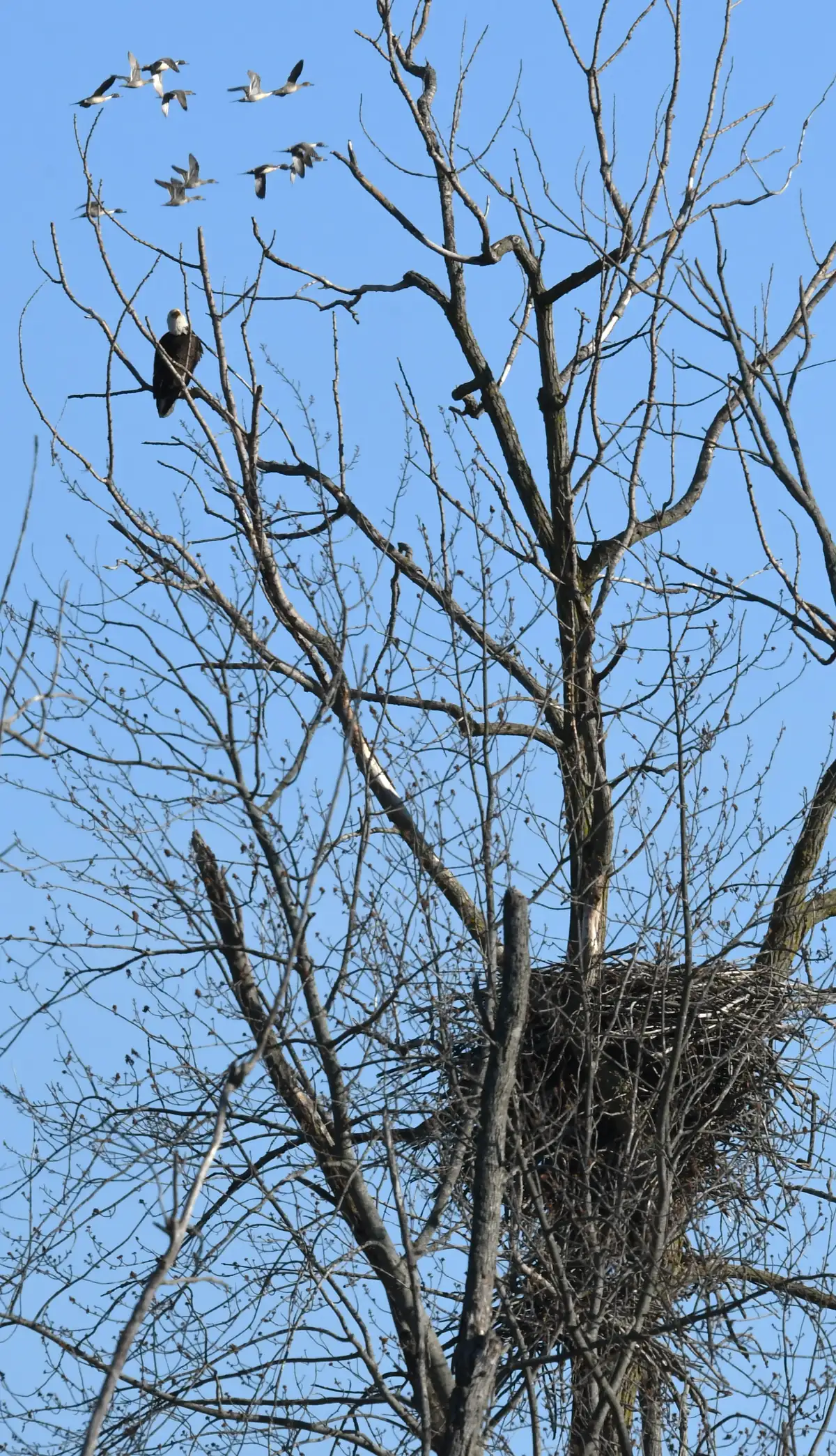
The nests are huge and reused year after year; the Fort Riley material gives a typical size of four to six feet wide and three feet deep, and a weight that can top half a ton. Once eggs are laid, one adult nearly always stays on them. What you see from the ground is a broad heap of sticks with a white head barely above the rim, or a mate perched on a branch nearby. A pair taking turns, with one flying in and the other leaving, is a sure sign of eggs.
-
How many nests Kansas has now
About 230 active nests in 2024 · Mostly the eastern two-thirds of the state
The first Kansas nest of modern times was found at Clinton Reservoir in 1989. By 2024 the Kansas Natural Heritage Inventory counted around 230 active nests, according to its information manager, speaking to the Lawrence Journal-World. The Kaw alone had 12 nesting territories between 1997 and 2010, which raised 122 young among them.
-
Winter eagles still on the river
Visitors leave mid to late March · Below the Bowersock Dam in Lawrence, the Lawrence 8th Street boat ramp, and the tailwaters of the big reservoirs
The northern eagles that came for the winter have not left yet. Friends of the Kaw says up to 3,000 bald eagles winter in Kansas, arriving in early November and heading north from the middle of March. A University of Kansas ornithologist, describing a hard freeze in February 2025, noted how they pack in right below the Lawrence dam when everything else ices over. On a frigid morning, white-headed adults and brown young may share the same few trees as the local breeding pair.
Bald eagles are protected by federal law, and repeated disturbance near a nest can make a pair abandon it. Stay in the car or well back on a public road, and never walk toward a nest tree to get a better look.
When does spring migration start at Cheyenne Bottoms and Quivira?
Earlier than most people expect. The great wetlands of central Kansas are on the Central Flyway, and the first northbound birds react to warm spells, not to the calendar. Two recent late-February bird reports from the wetlands center that Fort Hays State University runs beside Cheyenne Bottoms show the pattern.
-
Snow geese staging
Late February in mild years · Cheyenne Bottoms near Great Bend; Quivira National Wildlife Refuge in Stafford, Reno and Rice counties
On February 23, 2024, after a frigid January and a mild February, the center reported sandhill cranes, killdeer, many ducks and American white pelicans returning, with large numbers of snow geese lingering and starting to stage for their northward departure. On February 28, 2025, after a long, wintry spell, it wrote that the area had thawed quickly and that cranes, snow geese and waterfowl were pouring in. Its checklist from that fortnight also included Ross’s geese, white-fronted geese, northern pintails, green-winged teal, short-eared owls and red-winged blackbirds.
-
Sandhill cranes
First arrivals in late February · Over central Kansas wetlands and wheat fields
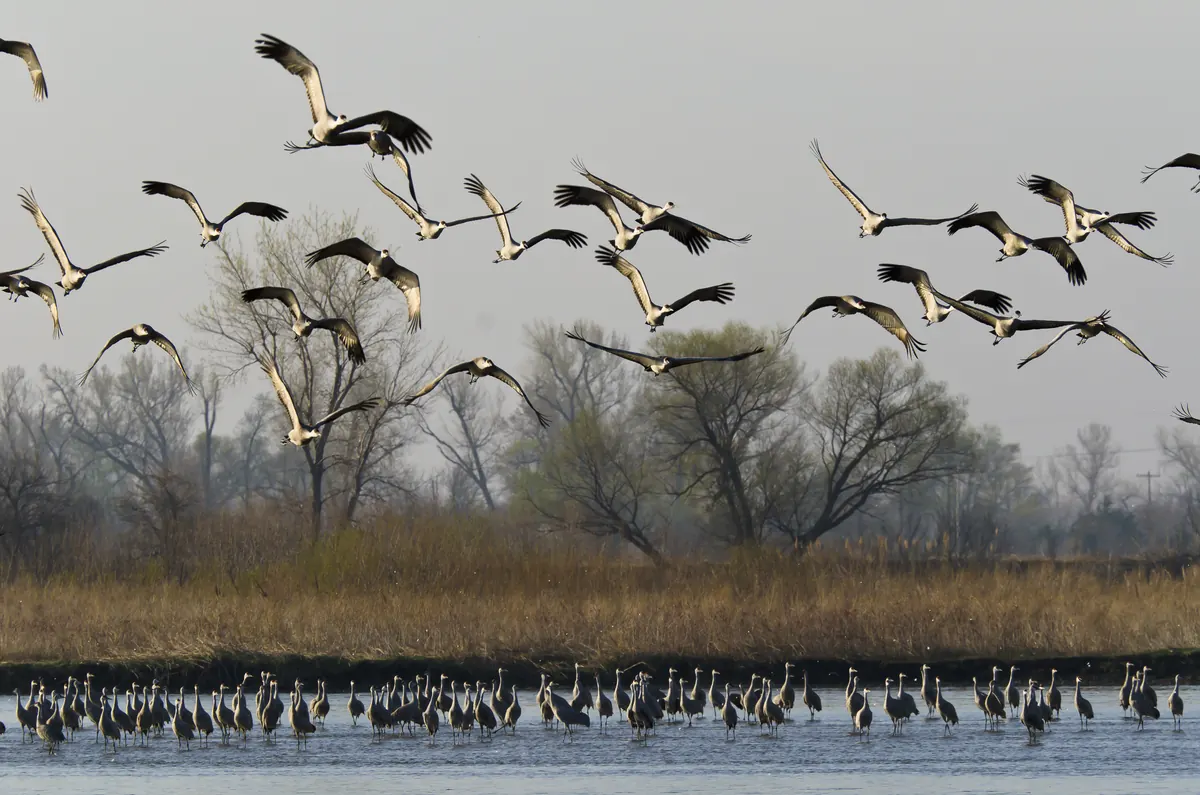
Listen before you look: a rolling, wooden bugle from far overhead usually means a line of cranes too high to see at first. The early birds in February are the leading edge; much larger numbers follow in March, and the center has warned in late February that whooping cranes could begin to show up within a couple of weeks.
-
The first shorebirds
As early as February · Quivira’s salt marshes and shallow pools
The Quivira refuge notes that shorebirds can appear in its wetlands as early as February on their way north, which makes a winter visit a chance to catch the very first killdeer and yellowlegs of the year. Gates are open daily from 90 minutes before sunrise until 90 minutes after sunset, and the 5-mile Wildlife Drive runs past the Big Salt Marsh.
Water levels decide everything. In both of those reports only a couple of pools at the Bottoms held much water, so check the center’s latest sightings post before you drive out. Snow geese are also the target of the light goose conservation order that opens February 15 (see the safety notes), so expect some shooting near the marshes.
When do great horned owl eggs hatch in Kansas?
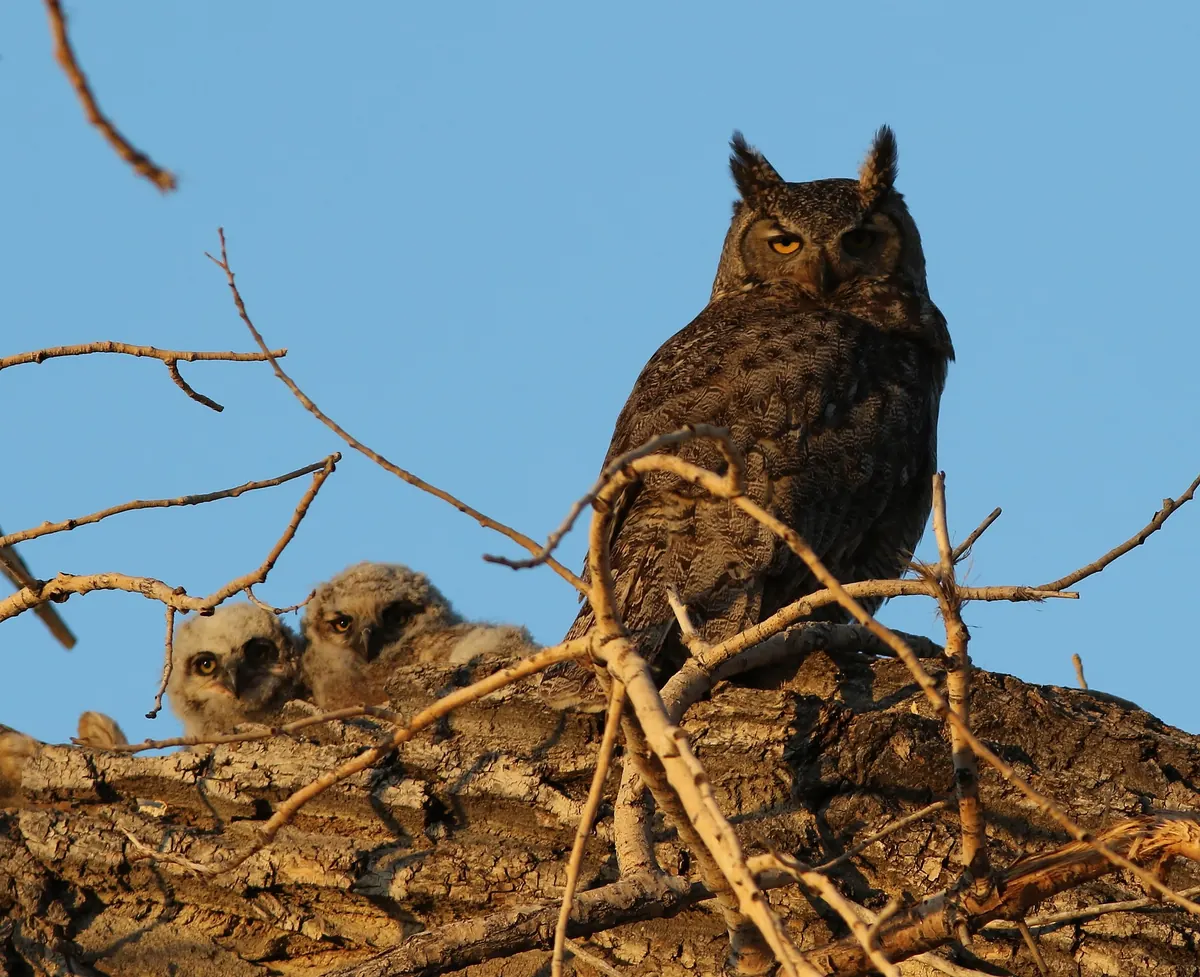
The owls that started sitting in late January reach their next stage this month. The Great Plains Nature Center in Wichita gives the timing: Kansas great horned owls can begin laying in late January, incubation runs about 28 days, and because the female begins sitting as soon as the first egg appears, the eggs hatch one after another. That puts the earliest owlets out of the shell in the last week of February.
-
Owlets in the nest
Earliest hatching in late February; leaving the nest at about five weeks · Old hawk and crow nests in cottonwoods, shelterbelts and town parks; sometimes on a ledge or in a hollow trunk
At first the female keeps the tiny chicks covered, so the nest still looks like a single owl sitting with her ear tufts up. Later, pale, fuzzy heads start to pop up beside her. The oldest chick has a head start of several days on the youngest. The nature center says owlets fledge at around five weeks old and that their parents may go on feeding them for five months, so a nest found now is a project that can run into summer.
-
Pellets and whitewash
All month · Under nest trees and daytime roosts
Splashes of white droppings on branches and the ground, plus gray, furry pellets packed with small bones, are the giveaway. The nature center lists large rodents and rabbits as the main prey, along with animals as big as skunks. A pellet pulled apart with tweezers on a paper plate makes a good indoor lesson on a cold afternoon.
Owls defend a nest with chicks fiercely. Keep a long distance, and leave before the adult starts clacking its bill or hooting at you.
When do frogs start calling in Kansas?
Kansas frogs are among the earliest signs of spring, and the first ones answer rain and warmth, not the date. The Kansas Herpetofaunal Atlas at Fort Hays State University tracks chorusing across the state and notes that frogs may call on any rainy night from February to September. The atlas names the spring peeper, found only in the far east, as the first to start each year; across most of the state, two small chorus frogs open the season.

-
Boreal chorus frog
Choruses recorded from mid-February; breeding mainly in March and April · Statewide except the far southwest corner: roadside ditches, flooded pastures, pond edges and floodplain pools
This is the frog behind the sound many Kansans take as the first sign of spring: a rising, insect-like trill, like a thumbnail drawn slowly along the teeth of a pocket comb. Adults are usually under an inch and a half long and very hard to spot, though the atlas holds more than 5,000 Kansas records of the species. A female may lay anywhere from 100 to 1,500 eggs, in small clusters fastened to underwater plant stems, and the tadpoles hatch in about two weeks.
-
Strecker’s chorus frog
Late February to May, after rain · Sandy country in south-central Kansas, especially Harper, Pratt and Kingman counties
A stockier relative with a very different voice: a series of clear, high, single-note whistles. In a full chorus, the atlas says, it sounds like a pulley wheel badly in need of grease. Choruses have been recorded in Harper County as early as February 21, and the frogs fall silent when the temperature drops to about 40 degrees. They need fishless, temporary pools, the kind that fill after a winter rain in a sand prairie.
To hear them, drive a quiet county road on the first evening above 50 degrees after a rain, turn off the engine by a flooded ditch, and wait. Do not walk into the water; the frogs go silent and the eggs are easy to trample.
Why do you hear more coyotes in Kansas in February?
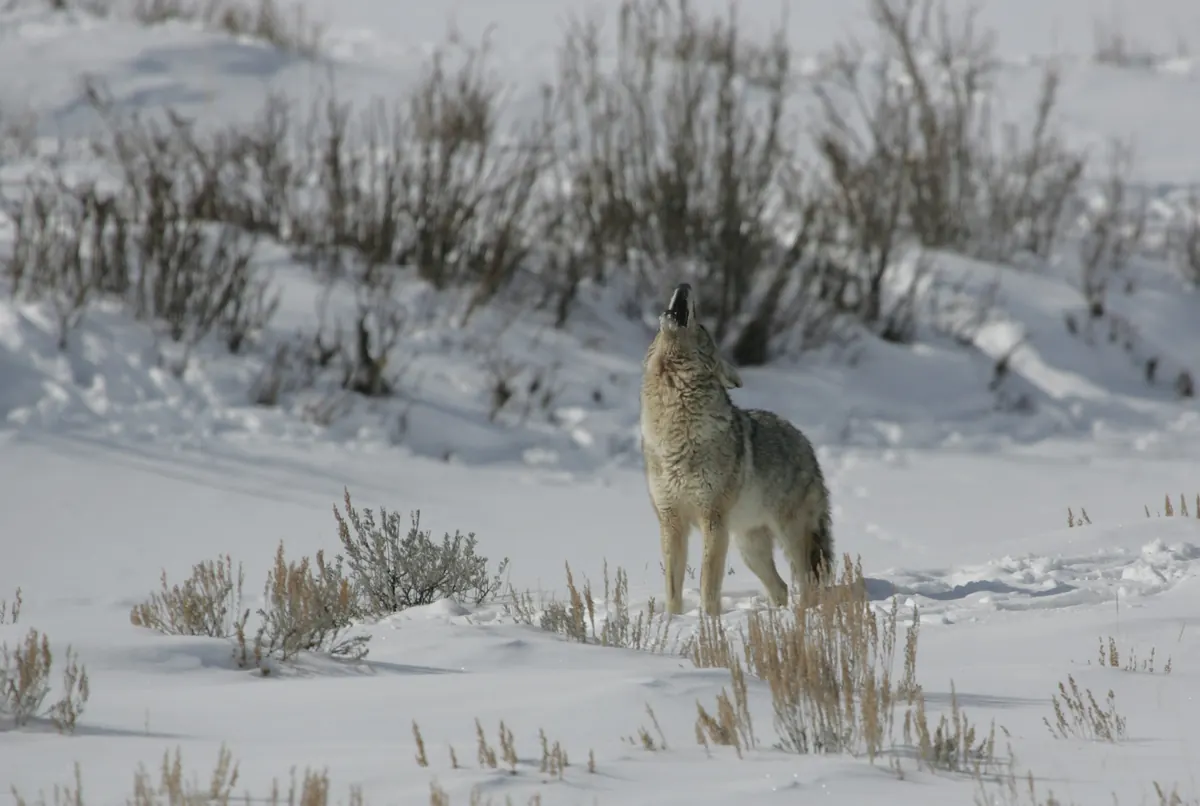
Because it is their breeding season. Coyotes live in every Kansas county, and late winter is when they are loudest and most visible.
-
Howling and pairing
Breeding season January to March; most females pregnant in February · Pastures, field edges, river breaks and the outskirts of towns
Drew Ricketts, the wildlife specialist with K-State Research and Extension, said in February 2026 that the breeding season runs from early January to about March, that Kansas coyotes become pregnant in February, and that people should expect more howling, yipping and barking while it lasts. The Kansas Mammal Atlas puts most matings between mid-February and mid-March and notes that coyotes, normally solitary, may travel and hunt in pairs now. Females are in heat for only two to five days a year.
-
Choosing a den
Pups born around April · Brushy hillsides, thickets, rock ledges and the old burrows of badgers or foxes
Gestation lasts about two months, so February matings mean pups in April. The atlas describes dens dug into rangeland and brushy slopes, often with more than one entrance and up to about 20 feet long. Two sets of tracks side by side in fresh snow, or a pair trotting along a terrace at dusk, are signs of a mated couple scouting.
Coyotes guarding territory can be bolder than usual. K-State advises keeping dogs leashed, never leaving small pets outside unattended, removing pet food and water from yards, and yelling and throwing something toward a coyote that starts to approach.
Is February snowy in Kansas, and what could El Niño bring?
February warms a little on the long-term averages: by NOAA’s 1991 to 2020 normals, afternoon highs at the five long-running stations below run from about 43 to 49 degrees and nights from 19 to 26. But it is also when winter storms carry more moisture. Average precipitation climbs at every station compared with January, and Goodland’s normal February snowfall of 6.3 inches is the highest in the table and more than that station averages in December, January or March. Concordia and Topeka each average a little over 5 inches. Late-winter sun works on snow quickly in the south and east, but on the High Plains wind can whip even old snow into ground blizzards.
A strong warm-water event in the Pacific will hang over the rest of this winter. In mid-September, NOAA’s outlook team put the odds of this Pacific warming staying very strong through a Kansas winter at better than 90 percent. As for what that usually means here, the Wichita Weather Service office lists these tendencies for Kansas: near to slightly above normal precipitation is favored across much of the state in winter, slightly warmer than normal temperatures are favored in the northeast, and there is generally a greater risk of unusually wet spells. That is a lean in the odds, not a promise, and single El Niño winters have broken the pattern before. NOAA issues new seasonal outlooks every month; you can find the newest temperature and precipitation maps on NOAA’s seasonal outlook page.
| Station | Average high | Average low | Precipitation | Snowfall |
|---|---|---|---|---|
| Goodland (northwest) | 45.8 | 18.9 | 0.47 | 6.3 |
| Dodge City (southwest) | 49.4 | 23.0 | 0.62 | 4.7 |
| Concordia (north-central) | 43.5 | 22.1 | 0.86 | 5.2 |
| Wichita (south-central) | 48.9 | 26.3 | 1.20 | 3.6 |
| Topeka (northeast) | 45.7 | 24.2 | 1.31 | 5.2 |
The last spring freeze is still weeks away for most of the state; our Kansas frost dates list the usual dates town by town. For the next storm, wind chill or warm spell, open our forecast in plain words.
How much daylight does Kansas gain in February?
February is when the returning light becomes impossible to miss. Between February 1 and February 28 every city in the table picks up roughly sixty minutes of sunlight, and the size of each day’s gain grows as the weeks pass; it will not peak until the equinox in March. Goodland gains the most, 64 minutes, and Liberal the least, 58, though Liberal still ends the month with the longest day in the table, 11 hours 21 minutes. In Wichita, Salina, Manhattan, Overland Park and Pittsburg the sun sets before 6 p.m. on February 1 and after it by February 28, and Goodland, on Mountain time, still sees the earliest clock sunsets in the state.
Two dates mark the turn. Groundhog Day is Tuesday, February 2, but the season’s real halfway point, the instant equally far from December’s solstice and March’s equinox, lands a day or two later: on the evening of the 3rd by the Sun’s position, or in the small hours of the 4th by the clock. Clocks spring forward for daylight saving time on Sunday, March 14, 2027, and sunsets will then jump an hour later.
| City | Feb 1 | Feb 28 | Gained | Per day |
|---|---|---|---|---|
| Goodland | 10 h 13 m | 11 h 17 m | 64 min | 2.4 min |
| Liberal | 10 h 23 m | 11 h 21 m | 58 min | 2.1 min |
| Hays | 10 h 15 m | 11 h 18 m | 63 min | 2.3 min |
| Salina | 10 h 15 m | 11 h 18 m | 63 min | 2.3 min |
| Wichita | 10 h 20 m | 11 h 20 m | 60 min | 2.2 min |
| Manhattan | 10 h 14 m | 11 h 17 m | 63 min | 2.3 min |
| Overland Park | 10 h 15 m | 11 h 17 m | 62 min | 2.3 min |
| Pittsburg | 10 h 21 m | 11 h 20 m | 59 min | 2.2 min |
Pick your own town in our daylight calculator to see each day’s sunrise, sunset and evening twilight.
What can you see in the Kansas night sky in February?
For planet watchers this is the month of 2027: the two brightest outer planets each reach opposition, Jupiter first and Mars nine days behind, and both stand in Leo. Times below are Central Standard Time; Sherman, Wallace, Greeley and Hamilton counties use Mountain time, so subtract an hour there. The new moon on February 6 leaves the evenings dark from about the 2nd through the 11th.
-
Mercury at its best for the winter
Late January to about February 10; farthest from the Sun the night of February 2 to 3 · Low in the west-southwest, 30 to 45 minutes after sunset
Mercury puts on its finest evening showing of the winter now. Find a flat western horizon, wait until the sky starts to darken, and look for a steady point of light just above the glow. The evening of the 7th adds a challenge: a sliver of Moon barely a day old sits just beside Mercury in the afterglow, best hunted with binoculars once the Sun is well down.
-
Jupiter at opposition
Wednesday, February 10, at 6:21 p.m. CST · Rising in the east at sunset, highest around midnight
Earth slips between the Sun and Jupiter on this date, so Jupiter sits on the far side of our sky from the Sun: up in the east at dusk, highest near midnight, down in the west at dawn, and outshining every star. Its closest approach brings it within roughly 405 million miles. With binoculars steadied on a car roof, Kansans can often pick out Jupiter’s four big moons as specks lined up on either side.
-
Mars at opposition
Friday, February 19; closest to Earth on the 20th · In Leo, east of Jupiter, rising at dusk
Mars shines as a bright orange-red point, but this is a small, distant opposition: at about 63 million miles, the planet looks tiny in a telescope since this pass happens when Mars is close to its greatest distance from the Sun. Even so, Jupiter and Mars blazing together in Leo, with the blue-white star Regulus nearby, make the February evening sky unusually rich.
-
The Snow Moon and a faint eclipse
Full at 5:23 p.m. CST, Saturday, February 20 · Rising in the east around sunset
Some almanacs count this Snow Moon as a supermoon, others do not; it is close to perigee but not as close as January’s. It rises in Kansas between about 6:00 and 6:30 p.m. CST (around 5:30 p.m. MST in Goodland), while a penumbral lunar eclipse is already in its fading half: the eclipse peaks at 5:13 p.m. CST and ends at 7:13 p.m. CST. A penumbral eclipse dims the Moon so gently that most people never notice it, and here the Moon will also be low in a bright sky, so a keen eye might catch one limb looking a shade grayer than the other in the first minutes after moonrise, and nothing more. The full Moon, Jupiter, Mars and Regulus share the same part of the sky that evening, and the night before, a Moon just short of full slides right past Jupiter. Kansans will miss the ring-shaped solar eclipse on the 6th entirely; its viewers are in South America, Antarctica and a slice of Africa.
| Phase | Date | Time |
|---|---|---|
| New moon | Saturday, Feb 6 | 9:56 a.m. CST (8:56 a.m. MST) |
| First quarter | Sunday, Feb 14 | 1:58 a.m. CST (12:58 a.m. MST) |
| Full moon, the Snow Moon | Saturday, Feb 20 | 5:23 p.m. CST (4:23 p.m. MST) |
| Last quarter | Saturday, Feb 27 | 11:16 p.m. CST (10:16 p.m. MST) |
Low in the west after dusk, Saturn sinks a little farther toward the Sun each week, while Venus rules the dawn. The Sun is a couple of years past its sunspot maximum, and Kansas skies only show aurora during the biggest storms, but those can still happen; the federal Space Weather Prediction Center issues the warnings. Whether a night will be clear is on our sky cover forecast; moonrise for each night is on our moon calendar.
What nature events and programs are on in Kansas in February 2027?
Each date below comes from an organizer’s own 2027 listing. Check details with the organizer before you go, since winter weather cancels outdoor walks.
- Wednesdays, February 3 and 10, 10 to 11 a.m.: Lil’ Tots on the Trail at Chaplin Nature Center near Arkansas City, a read-aloud nature story and a short hike for toddlers aged 18 months to 3; please RSVP.
- Saturday, February 6, 8 a.m.: two bird walks. Chaplin Nature Center’s monthly walk, about an hour and a half, starts at its visitor center. The same morning, Wichita Audubon heads to North Newton for the Kauffman Museum’s monthly bird walk at 8 a.m. in the museum parking lot, followed at 10 a.m. by a tour of the museum’s century-old collection of wildlife specimens (a modest entrance fee applies).
- The Great Backyard Bird Count, Presidents’ Day weekend, February 12 to 15. Spend 15 minutes or more watching birds anywhere, on any of the four days, and report what you saw through eBird or Merlin. It is free, and even a short list from a feeder helps.
- Saturday, February 13, 8 a.m.: Wichita Audubon’s second-Saturday walk in Chisholm Creek Park, about 90 minutes on paved paths; gather in the nature center’s lot. No experience is needed.
- Tuesday, February 16, 7 p.m.: Wichita Audubon program, “Antennae up! Why are birds and bugs disappearing?”, in the zoo’s Cargill Learning Center in Wichita.
- Saturday, February 20, 6:30 to 8 p.m.: Owl Prowl at Chaplin Nature Center, a short indoor talk and then a night hike to listen for owls, on the evening of the full Snow Moon.
- Kansas Wetlands Education Center: admission is free, and on its winter schedule (to March 31) the doors are open 9 to 5, Tuesdays through Saturdays. Its online sightings posts are the best guide to what has arrived at Cheyenne Bottoms.
- Topeka Audubon bird walks: Topeka Audubon leads a monthly bird walk, normally on the second Saturday, from McDonald Field on the Shunga Trail. Its starting hour moves with the seasons; check with the organizer on the society’s online calendar for February’s date and time.
- Citizen science: Project FeederWatch counts continue all winter, and any list from a walk can go into eBird. A note of the first evening you hear chorus frogs is worth keeping too.
Every state and month we have written is on the nature this month page, and January’s page for this state is here. For a notebook to carry on these walks, see our Naturalist’s Field Journal.
Safety notes for February in Kansas
- Elk firearm season (KDWP): the third firearm segment runs January 1 to March 15 everywhere elk may be hunted, which excludes Unit 1 and Subunit 2a on Fort Riley. No deer seasons are open in February; the extended antlerless deer seasons ended in January.
- Blaze orange: state regulation K.A.R. 115-4-4 requires anyone hunting elk during a firearm elk season, and anyone assisting, to wear a hat that is at least half bright orange, plus at least 100 square inches of orange on the front of the torso and 100 square inches on the back. Hikers on public land in elk country, or on walk-in hunting areas, are wise to wear orange too.
- Waterfowl and other seasons: the regular seasons for Canada, cackling and light geese, and the second white-fronted goose segment, all close on February 14. The light goose conservation order, with no daily bag limit, runs February 15 to April 30, so expect hunters and decoy spreads near the central wetlands. An extended falconry season runs February 24 to March 10 in the Low Plains. Squirrel season and the general furbearer season close February 28, beaver trapping continues to March 31, crows to March 10, and coyotes and rabbits are open all year. Dates are from KDWP’s 2026–27 season page; confirm before you go.
- Late-winter ice: thaws and sun weaken pond ice from above while springs and current eat it from below. Ice that held in January can be gray and honeycombed by late February. Stay off it when it looks dark, slushy or pulled away from shore.
- Grass fire weather: the Kansas State Fire Marshal and Kansas Forest Service describe mid-February to mid-April as the state’s highest-risk time for wildfires, when dry, dormant grass meets strong wind and low humidity. Heed red flag warnings, never toss a cigarette or park a hot vehicle on tall dry grass, and follow county burn bans.
- Storms and ground blizzards: a sunny 60-degree day can be followed by snow within 24 hours. On the High Plains, look at KanDrive before a long drive and pack a blanket, drinking water and a small shovel.
- Cold water: wetlands and rivers are near freezing. Keep children and dogs back from steep banks along swollen streams after a melt.
Sources
- Fort Riley Conservation Branch: Fort Riley nesting bald eagles poster (nesting calendar for Kansas)
- Friends of the Kaw: eagles on the Kansas River (egg laying, clutch size, winter numbers, nesting territories)
- Lawrence Journal-World: bald eagles concentrate on the Kaw in a deep freeze (February 22, 2025; active nests in Kansas)
- Winder and Watkins, Journal of Raptor Research: thirty years of bald eagle recovery in Kansas, 1989–2018
- Kansas Wetlands Education Center: recent bird sightings, February 23, 2024
- Kansas Wetlands Education Center: recent bird sightings, February 28, 2025
- Kansas Wetlands Education Center: about (winter hours November 1 to March 31, free admission)
- U.S. Fish and Wildlife Service: Quivira National Wildlife Refuge, species (shorebirds as early as February)
- U.S. Fish and Wildlife Service: Quivira National Wildlife Refuge, visiting (hours, Wildlife Drive)
- Great Plains Nature Center: great horned owl
- Kansas Herpetofaunal Atlas (Fort Hays State University): chorusing phenology
- Kansas Herpetofaunal Atlas: boreal chorus frog
- Kansas Herpetofaunal Atlas: Strecker’s chorus frog
- K-State Research and Extension: understanding coyote behavior (February 2026)
- Kansas Mammal Atlas (Fort Hays State University): coyote
- NOAA NCEI: monthly climate normals 1991–2020 for Goodland, Dodge City, Concordia, Wichita and Topeka (February)
- National Weather Service Wichita: El Niño and La Niña information (Kansas winter precipitation, temperature and wet extremes)
- Climate Prediction Center: ENSO diagnostic discussion, September 10, 2026
- Climate Prediction Center: 90-day seasonal outlooks
- U.S. Naval Observatory: moon phases (data API)
- U.S. Naval Observatory: moonrise and sunset for Kansas cities, February 20, 2027
- U.S. Naval Observatory: Earth’s seasons, 2027 (solstice and equinox)
- Fred Espenak: Sky Event Almanac 2027 (oppositions, Mercury elongation, Moon and planet pairings)
- NASA Eclipse Web Site: lunar eclipses 2021–2030 (penumbral eclipse of February 20, 2027)
- NASA Eclipse Web Site: solar eclipses 2021–2030 (annular eclipse of February 6, 2027)
- EarthSky: Jupiter at opposition
- SEDS: Mars opposition of 2027
- Sea and Sky: astronomy calendar of celestial events 2027 (Snow Moon, oppositions)
- Old Farmer’s Almanac: eclipses (February 20, 2027 penumbral eclipse visibility)
- NOAA Space Weather Prediction Center: aurora dashboard
- Cornell Law School, Legal Information Institute: 15 U.S.C. 260a (daylight saving time)
- Great Backyard Bird Count: February 12–15, 2027 (read from the September 19, 2026 archived copy)
- Wichita Audubon Society: schedule of events 2026–2027 (February walks, program and Chaplin Nature Center events)
- Topeka Audubon Society (second-Saturday bird walks)
- Project FeederWatch: how to participate
- eBird
- Kansas Department of Wildlife and Parks: when to hunt, 2026–27 season dates (live site blocks automated access; read from the August 14, 2026 archived copy)
- Kansas Department of Wildlife and Parks: elk hunting in Kansas (units; read from the July 8, 2026 archived copy)
- Kansas Administrative Regulations, K.A.R. 115-4-4: big game legal equipment and hunter orange (Legal Information Institute)
- Kansas State Fire Marshal and Kansas Forest Service: wildfire risk and mitigation workshop for the Kansas Corporation Commission (peak wildfire season)
- Kansas Department of Wildlife and Parks: frozen lakes require caution (ice safety)
- Kansas Department of Transportation: KanDrive road conditions
- Photos via Wikimedia Commons; licenses and photographers are credited under each picture
