What to look for in nature in Kansas this January
Midway through meteorological winter, January is the coldest month on the Kansas calendar by the long-term averages. Along with February, it is also the height of the bald eagle season. As ponds lock up, eagles gather at the open water below the big dams and along the rivers, perching in the bare shoreline trees. Great horned owls settle onto eggs, red foxes court, and Harris's sparrows and Lapland longspurs that nested in the far north work the fencerows and stubble. The days lengthen by 40 to 44 minutes over the month, and Kansas Day, January 29, gives families a reason to go and find the state tree and state bird in winter. Every date below comes with its source.
Other months in Kansas: October, November, December, February.
Start here
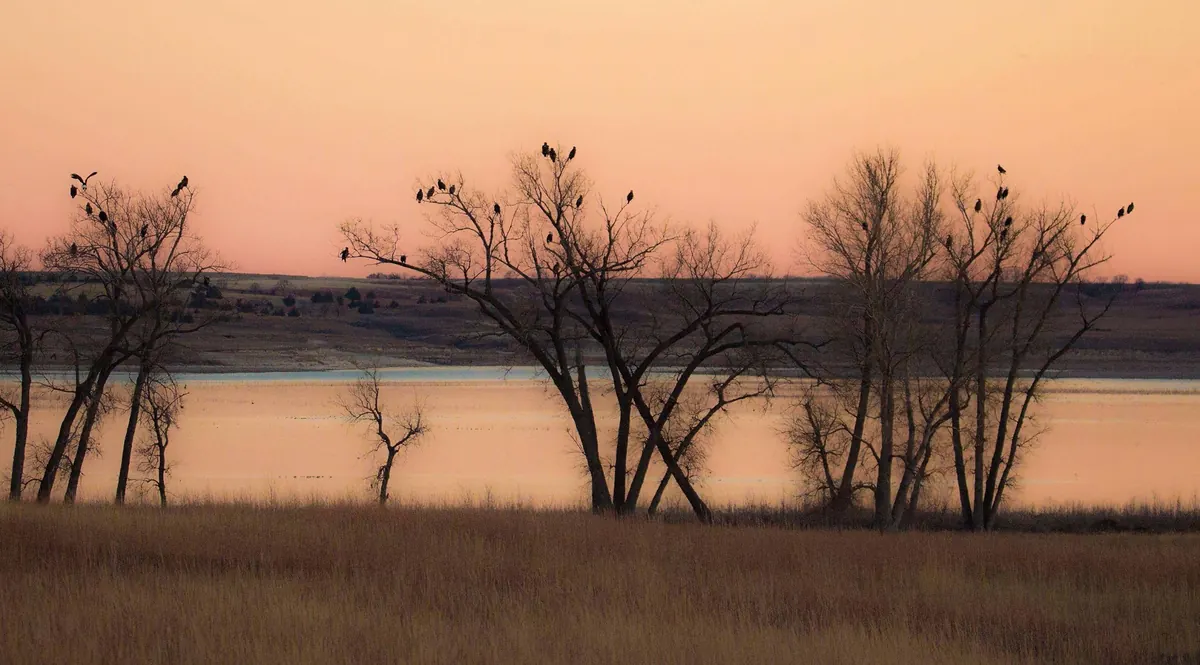
- Go eagle-watching below a dam. Choose a bright morning after several frigid nights, when the birds pile up wherever water is still unfrozen. The outlet areas below the big reservoirs, such as Tuttle Creek, Milford, Clinton and Kirwin, are classic spots. Stay near the car and count white heads perched in the leafless shoreline cottonwoods.
- Meet a winter sparrow from the Arctic edge. Harris's sparrow, a big sparrow with a pink bill and a black bib, nests where the northern forest meets the tundra and spends the winter mostly on the southern Great Plains, which puts Kansas in its heartland. Scatter millet under a brushy hedge and watch for it among the juncos.
- Wolf supermoon on January 22. The year's closest full moon comes at 6:17 a.m. CST (5:17 a.m. MST) on Friday, January 22. Watch it climb out of the east-northeast at dusk on Thursday the 21st, then set in the west near sunrise the next morning.
Keep a record of it: write each eagle you count below a dam into “birds I have seen,” along with the date, the temperature and how much open water there was. On the “tracks to know” plate, sketch a fox trail across fresh snow, and on “nest observed” mark the old hawk nest where an owl now sits. A cottonwood twig and an Osage orange husk gnawed open by squirrels both belong on “seeds, pods and cones,” and the “dusk and dawn watch” plate is the place to track how much later the sun sets each week.
Regions used below: Northwest Kansas and the High Plains; Southwest Kansas; North-central Kansas and the Smoky Hills; Central Kansas and the Great Bend wetlands; South-central Kansas, Wichita and the Red Hills; The Flint Hills; Northeast Kansas, Topeka and Kansas City; Southeast Kansas.
Where can you see bald eagles in Kansas in January?
Kansas has bald eagles all year now, but January and February are when the numbers swell. The Kansas Department of Wildlife and Parks (KDWP) notes that although some eagles nest in the state, numbers “often surge” in these two months, as ice and snow farther north push birds south to wherever fish and ducks can still be caught. In practice that means the tailwaters below dams, river stretches that stay open, and reservoirs before they freeze over completely.
-
Reservoir dams and tailwaters
Coldest spells of January into February · Below the dams at Tuttle Creek, Milford, Perry, Clinton and other large reservoirs; open stretches of the Kansas, Republican and Arkansas rivers
Eagles perch in bare cottonwoods and sycamores along the shore, drop to the water for fish stunned in the outlet, and loaf on the ice edge. Mornings are usually best. After a run of single-digit nights, when smaller lakes have frozen, the birds that remain are packed onto the few open patches, white-headed adults and mottled brown young together.
-
Kirwin National Wildlife Refuge
All winter; open 24 hours · Phillips County, northwest Kansas
The refuge’s own wildlife page sums up its winter briefly: as the lake freezes over, fewer birds may be found, except for bald eagles, numerous hawks and a few wintering western meadowlarks. At dusk eagles gather to roost in the dead and living trees around the reservoir edge, which makes the drive along the refuge roads in late afternoon worth the trip.
-
A recovery story
Documented since 1989; 137 nesting pairs by 2018 · River corridors and reservoirs, mostly in the eastern two-thirds of the state
In 1989 Kansas had a single known nesting pair. A study of 30 breeding seasons in the Journal of Raptor Research counted 137 documented nesting pairs in 2018, with the earliest pairs choosing sites near big artificial reservoirs and later ones spreading along rivers. By 2023 nearly 300 nesting territories had been reported since 1989, and KDWP had fitted solar GPS backpacks to nearly 30 eagles, including nestlings from Barton and Stafford counties east to Geary and Pottawatomie, to learn where Kansas-raised eagles go and how they use the landscape.
-
The Midwinter Bald Eagle Survey
Usually the first half of January · Standard routes nationwide, including Corps of Engineers lakes
Volunteers and agency staff have counted wintering eagles on fixed routes every January since 1979, now under the U.S. Geological Survey with the Army Corps of Engineers as a partner. The 2026 survey ran from January 7 to January 21, with target days of January 9 and 10. The 2027 dates were not posted at the time of writing; Corps lake offices can tell you whether a route near you needs help.
Eagles burn precious energy every time they flush. Watch from a vehicle or from a distance of a few hundred feet, and never walk out onto ice to get closer.
When do great horned owls nest in Kansas?
The hooting that carried across shelterbelts in December is now about real nests. January is when the state’s biggest resident owl moves from calling to sitting.
-
Great horned owl on eggs
Eggs as early as late January · Old hawk or crow nests, hollow trees, farm groves and big park trees statewide
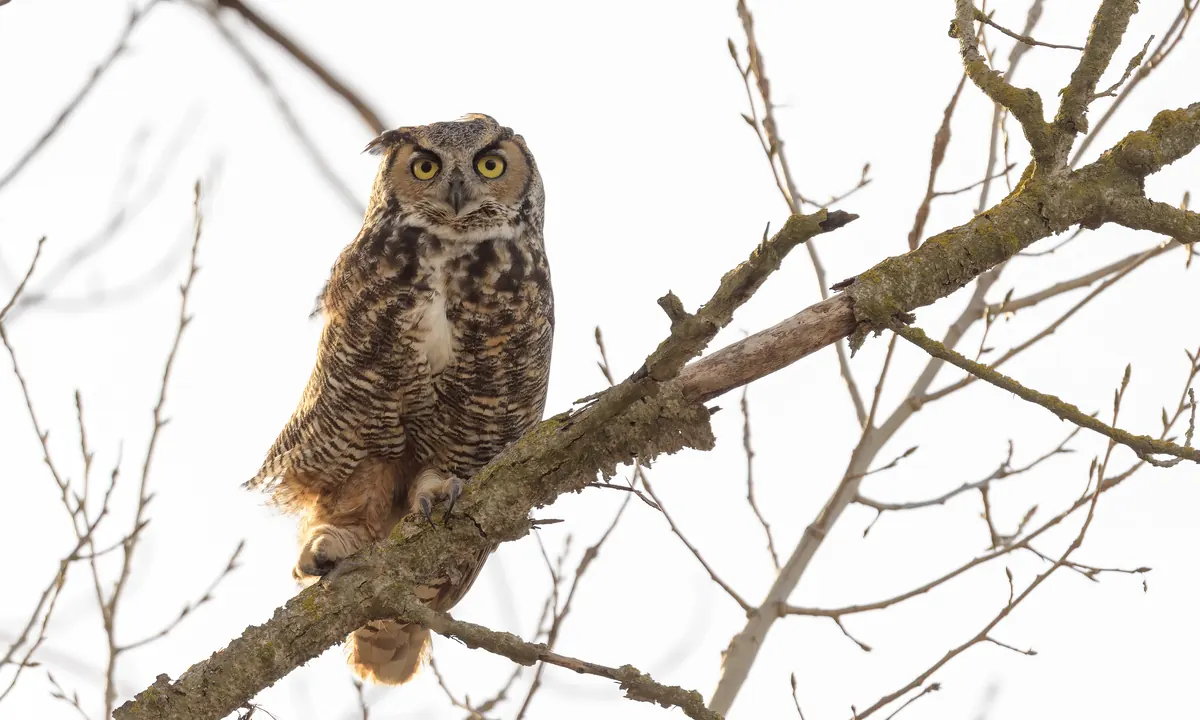
According to the Great Plains Nature Center in Wichita, Kansas great horned owls may begin laying in late January, usually two or three plain white eggs. Because a bare egg would freeze in a January night, the female starts incubating as soon as the first one is laid, and each takes about 28 days to hatch, so the owlets in one nest differ in age by days. The owl adds nothing to the nest it borrows; look for a big, untidy stick platform in a cottonwood with a pair of feathered “ears” poking above the rim.
-
Courtship duets at dusk
Most evenings in calm weather · Anywhere with large trees and open hunting ground nearby
According to the same nature center, winter is the peak hooting season, and the birds will often reply to a person’s imitation. If you hear two birds answering each other from the same grove night after night, a nest is likely close by. By the center’s figures, eggs laid in late January hatch about four weeks later and the young leave the nest at about 35 days old, so a nest found now can be followed into spring.
Eggs left uncovered on a bitter night chill fast, so watch from far back.
Which winter birds from the north are in Kansas in January?
Kansas is the far south for a handful of birds that breed on the tundra or in the far northern forest. They are here only in the cold months, and January is when they are most settled.
-
Harris's sparrow
Late fall to spring · Brushy hedgerows, thickets, open woods and backyard feeders
Audubon’s field guide calls it a bird of the heartland that nests in north-central Canada and winters mainly on the southern Great Plains. Adults show a black crown, face and bib, a pinkish bill and white underparts; first-winter birds lack the black throat but keep the size and pink bill. Flocks feed on the ground near cover and, when startled, fly up to perch on the tops of the thicket, giving sharp call notes. Few songbirds have a winter range so closely tied to the plains around Kansas.
-
Lapland longspurs and horned larks
Peak numbers after snow · Bare stubble, plowed fields, short grass and gravel roads
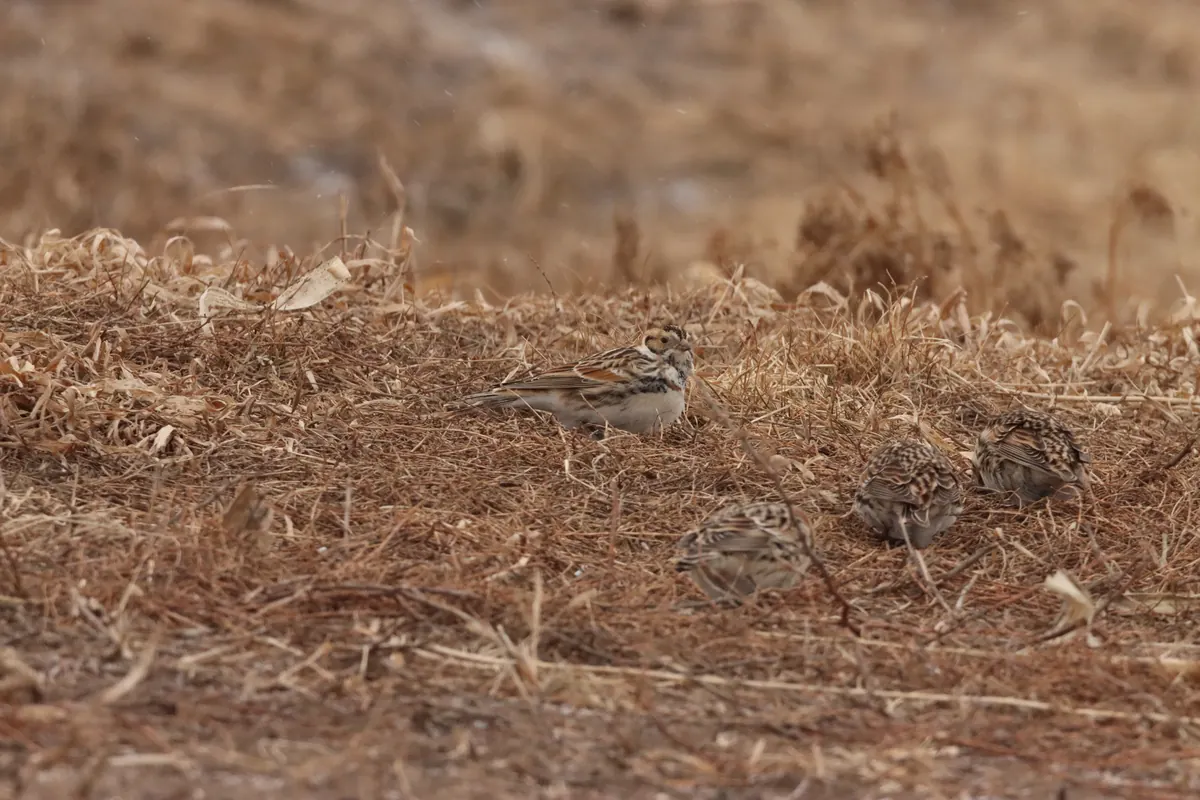
Lapland longspurs breed in the Arctic and winter on fields and prairies, where the Great Plains can hold thousands. They walk rather than hop, searching methodically for weed and grass seed and waste grain, often mixed with horned larks, which nest on the same bare ground very early in spring. U.S. Fish and Wildlife Service staff on the northern plains report wintering longspurs on fallow fields and gravel roads, often with horned larks; drive slowly on a county road after a snowfall and watch for small brown birds lifting off the gravel.
-
Rough-legged hawk
Winter visitor; numbers vary year to year · Open grassland, marsh edges and cropland
Feathers run all the way down to its toes, a sign of its Arctic summers. Audubon notes that numbers south of Canada swing widely from one winter to the next and that few go farther south than the central states. The best clue is behavior: a large hawk holding still in the wind above a field, hovering in one spot to watch for voles and mice below, is very likely a rough-leg.
-
Winter finches, not a big year
Possible late in the winter · Feeders with sunflower and nyjer seed
Published in late September 2026, this winter’s Finch Research Network outlook expects big northern cone and seed crops to keep most finches and red-breasted nuthatches up north this winter, with perhaps a small, late flight of purple finches southward. A pine siskin or purple finch at a Kansas feeder would be a bonus.
A feeder count on a snowy morning, entered on eBird, adds real data to how these winter visitors use the state.
Where do geese and ducks spend the winter in Kansas?
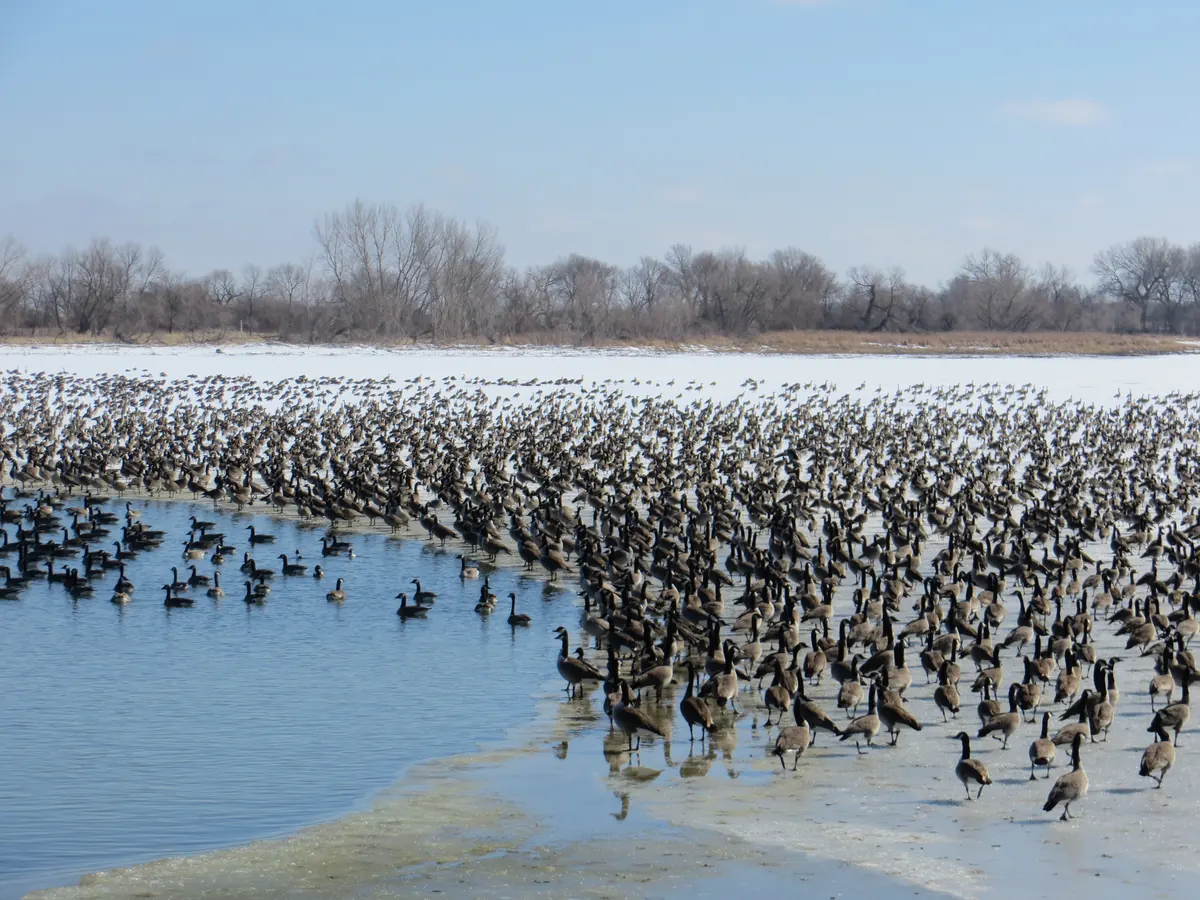
Ducks and geese stay as long as some water stays open, and a freeze packs them together.
-
City geese in Wichita and other towns
All winter · Park ponds, golf courses and business-park lakes
The Great Plains Nature Center reports that Wichita’s urban wintering flock of Canada geese grew from about 1,600 birds in 1983 to more than 21,000 by 2007. They like water with mowed grass beside it and a clear view between the two. Look closely at a loafing flock: the small, stubby-billed birds the size of a mallard are cackling geese, once counted as a Canada goose subspecies and now treated as a separate species.
-
Reservoir waterfowl
Until the lakes freeze over · Cheney, El Dorado, Milford, Perry, Clinton and other large lakes
On big lakes, diving ducks, mergansers and gulls rest far out in the middle. Wichita Audubon plans a winter-waterfowl trip to Cheney Reservoir on Sunday, January 24, 2027, meeting at 7 a.m. at the Dillons at 21st and Amidon to carpool, or at about 8:15 a.m. at the west-side boat launch near the dam; a Kansas parks vehicle permit is required, and the society’s schedule lists the leader’s contact details.
Waterfowl seasons are still running in parts of the state (see the safety notes), so wear orange or bright colors near hunted marshes and be courteous around blinds.
What are Kansas mammals doing in the middle of winter?
For some carnivores the coldest month opens the breeding year.
-
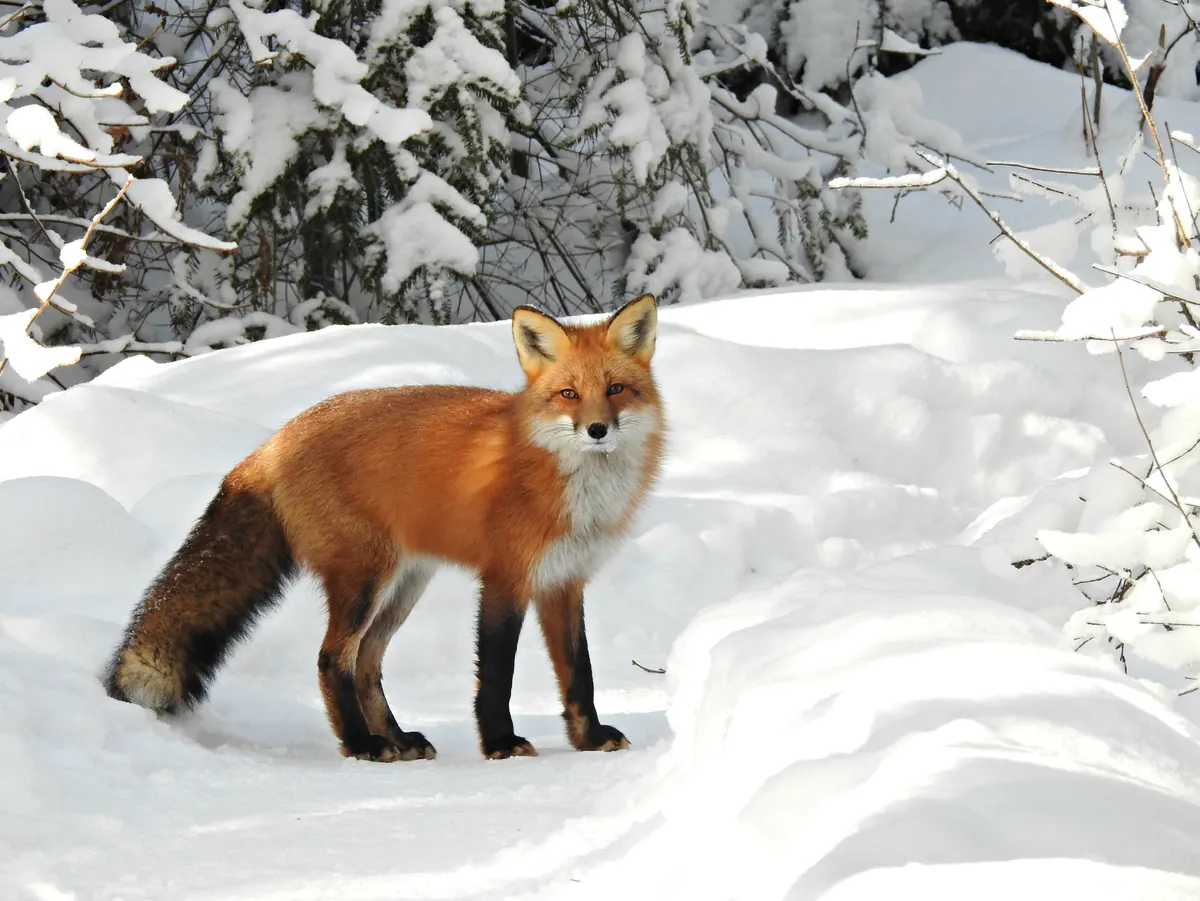
Red fox courtship
Most matings in January and February · Every county, often near farmsteads and town edges
The Kansas Mammal Atlas at Fort Hays State University says red foxes can breed from December to April but mostly mate in January and February, after which the female settles in a den dug into loose, well-drained soil, often on a brushy hillside. Late-winter home ranges are larger, presumably because food is scarcer, so foxes cover more ground now. Two sets of fox tracks traveling together in new snow are a good sign of a courting pair.
-
Striped skunks in shared dens
Dormant in severe cold; breeding begins in February · Under buildings, in old burrows, culverts and brush piles
Skunks do not truly hibernate, the atlas notes, but they stay in their dens through hard cold and live on autumn fat. In winter several females, sometimes with a single male, often share one den. On the first mild night after a cold snap they come out to forage, and the smell along a country road is a reliable January sign.
Follow a fresh trail backward, not forward, so you never chase an animal from its den.
How can you identify Kansas trees by their twigs in winter?
Bark gets most of the attention in winter, but twigs carry the surest clues: bud shape, thorns, leaf scars and the color of new growth. These five are common and easy, using the descriptions in the Kansas Wildflowers and Grasses guide.
-
Cottonwood, the state tree
Big tan buds all winter · Every county, along streams, river bottoms and lake shores
Twigs are olive-brown to yellowish and brittle, with large tan buds that come to a point, some longer than an inch. On a big tree the gray bark is cut by deep furrows between wide, flat ridges. Strong winds often snap its limbs, so a winter walk under cottonwoods turns up plenty of twigs to examine up close.
-
Osage orange
Spines and fallen fruit all winter · Old hedgerows, shelterbelts and fence lines throughout Kansas
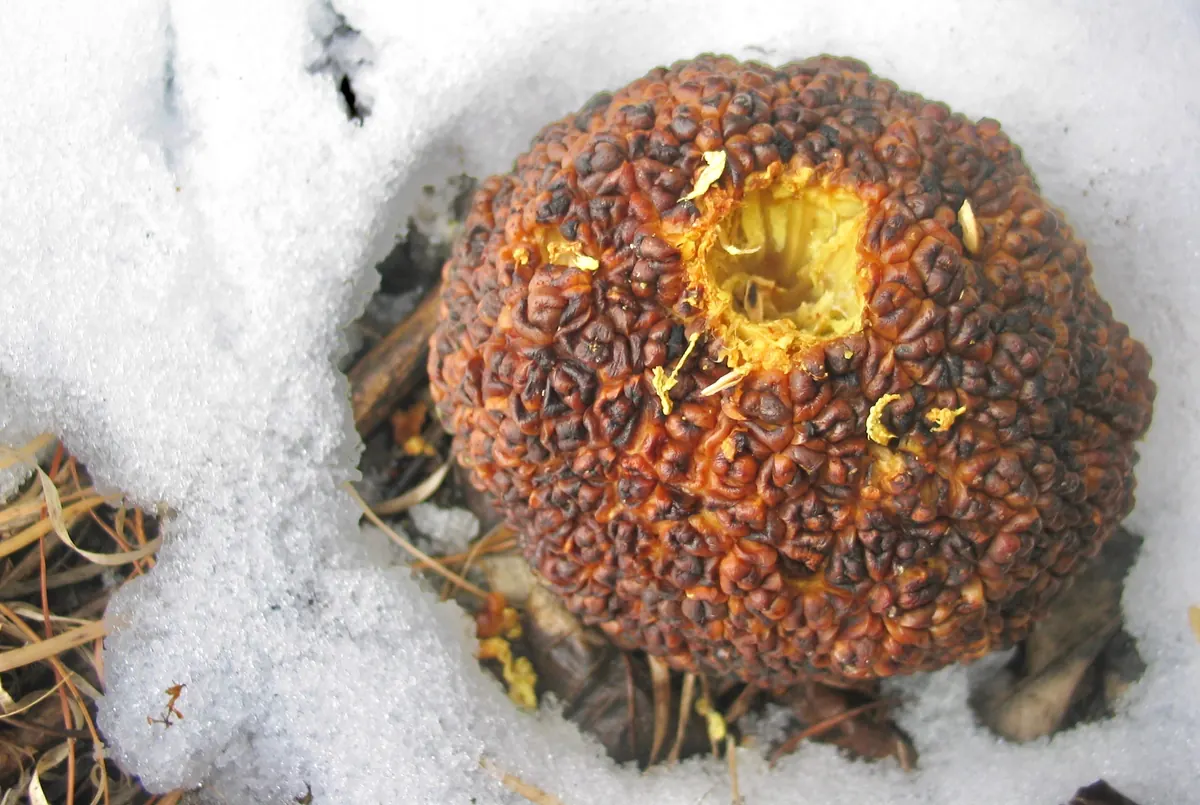
Zigzag twigs armed with straight spines up to an inch long, and orange-brown bark that peels in long strips, make this tree hard to miss. The lumpy green “hedge apples” that dropped in autumn lie under the trees all winter; seed-eaters chew them open, leaving pulpy husks on the snow. The guide notes it was often planted in windbreaks, and its bright orange wood is very hard.
-
Black walnut
Husks and nuts on the ground; buds all winter · Statewide, more common in the eastern two-thirds, on stream banks and bottomland
Look for stout gray-brown twigs with big leaf scars shaped like a shield or a three-lobed face, with the bundle scars grouped in three. The end bud is irregular and flattened. Blackened husks under the tree confirm it.
-
Bur oak
Corky branches and acorn cups all winter · Eastern and central Kansas, in bottomland woods and on prairie hillsides
Coarse, stiff twigs, often woolly, and smaller branches lined with corky ridges set it apart from other oaks. The acorn cups are deep, with a fringed rim, and often lie beneath the tree long after the nuts are eaten.
-
Eastern red cedar
Evergreen; berries through winter · Pastures, old fields, windbreaks and hillsides statewide
Its tiny scale-like leaves turn reddish-brown in cold weather. The waxy, berry-like fruits feed birds, deer and rodents through the winter, and songbirds and mourning doves nest in its dense branches. It also spreads aggressively into poorly managed grassland.
Snip nothing from someone else’s tree, but a twig snapped off by the wind is fair game. For a long-term project, our Naturalist’s Field Journal includes a tree-through-the-seasons page: draw the same cottonwood each month.
How can families celebrate Kansas Day outdoors on January 29?
Kansas Day, the yearly celebration of statehood, is a rare holiday that began in a classroom. The Kansas Historical Society traces it to Paola, where teacher Alexander LeGrande Copley’s pupils spent the afternoon of January 29, 1877, studying the state’s geography, history and resources. Several official state symbols can be found outdoors in January.
-
Cottonwood, named state tree in 1937
Any day · The nearest creek or river
The historical society notes it grows in every county. Find the biggest one you can and measure its girth with a string at chest height.
-
Western meadowlark, state bird since 1937
Winter flocks on mild days · Pastures, roadsides and refuges such as Kirwin
More than 121,000 Kansas schoolchildren voted to choose it. Some meadowlarks spend the winter here, feeding quietly in dead grass on pastures and roadsides.
-
Bison, state animal since 1955
Herds are visible year-round · Public and private herds across the state
Once reduced to a few hundred animals, bison now number in the hundreds of thousands, and the species is also the national mammal. A herd in shaggy winter coats against snow is a fine Kansas Day sight if one is within reach.
How cold is a Kansas January, and what could a strong El Niño mean?
NOAA’s 1991 to 2020 climate normals make January the coldest month at all five of the long-running Kansas stations below. Afternoons average about 39 to 46 degrees and nights 17 to 23, though single days swing far either side of those numbers. All five average less than an inch of precipitation in January, with roughly 3 to 5 inches of snow. Wind is what makes it feel colder; the National Weather Service points out that frostbite needs air below freezing, but once it is, wind takes heat from exposed skin far faster.
Kansans may hear a lot about El Niño this winter. Federal forecasters gave odds above nine in ten, back in September, that the warm Pacific event would be classed as very strong by the cold months. The Wichita Weather Forecast Office’s historical composites for El Niño winters show near to slightly above normal precipitation for much of Kansas, slightly warm temperatures in the northeast and near normal elsewhere, and a generally higher risk of extremely wet three-month periods. Its risk maps also show El Niño raising the odds of unusually cold three-month spells in Kansas outside late fall and early winter. Looking back over the past century, a Kansas analysis the Climate Prediction Center wrote in November 1997 reported January to March precipitation averaging more than 160 percent of normal over western Kansas in moderate and strong El Niño years, though that is a historical tendency, not a forecast. NOAA refreshes its official seasonal outlooks every month, and the newest maps for the rest of this winter are posted on the CPC three-month outlook page.
| Station | Average high | Average low | Precipitation | Snowfall |
|---|---|---|---|---|
| Goodland (northwest) | 43.4 | 16.9 | 0.32 | 4.7 |
| Dodge City (southwest) | 45.6 | 20.3 | 0.60 | 3.9 |
| Concordia (north-central) | 38.7 | 18.9 | 0.67 | 5.4 |
| Wichita (south-central) | 43.9 | 22.5 | 0.85 | 2.7 |
| Topeka (northeast) | 40.4 | 20.0 | 0.89 | 4.6 |
Hard freezes are a given now. To see how far off spring planting is, look up your town on our Kansas frost dates page. For wind chill and snow over the next few days, check the plain-language forecast.
How much daylight does Kansas gain in January?
The solstice is behind us and the light is returning faster each week. Between January 1 and January 31 every city in the table gains 40 to 44 minutes of daylight, an average of 1.3 to 1.5 minutes a day. The northern towns (Goodland, Manhattan and Overland Park) gain the most and Liberal and Pittsburg the least, yet the south keeps the longer days: on January 31 Liberal has 10 hours 21 minutes from sunrise to sunset, Goodland 10 hours 11 minutes.
At first nearly all of the gain is at the evening end. Sunrise holds close to its latest time through roughly the first ten days of January and only then starts to come earlier, so mornings stay dark at the bus stop well after the evenings have noticeably brightened. Goodland, on Mountain time, keeps the earliest clock sunsets in the state, and its sunset does not reach 5 p.m. until the last week of the month. The daily gain keeps speeding up all the way to the March equinox.
| City | Jan 1 | Jan 31 | Gained | Per day |
|---|---|---|---|---|
| Goodland | 9 h 27 m | 10 h 11 m | 44 min | 1.5 min |
| Liberal | 9 h 41 m | 10 h 21 m | 40 min | 1.3 min |
| Hays | 9 h 30 m | 10 h 13 m | 43 min | 1.4 min |
| Salina | 9 h 30 m | 10 h 13 m | 43 min | 1.4 min |
| Wichita | 9 h 36 m | 10 h 18 m | 42 min | 1.4 min |
| Manhattan | 9 h 28 m | 10 h 12 m | 44 min | 1.5 min |
| Overland Park | 9 h 29 m | 10 h 13 m | 44 min | 1.5 min |
| Pittsburg | 9 h 39 m | 10 h 19 m | 40 min | 1.3 min |
For the exact sunrise and sunset in your own town on any date, use our daylight and twilight calculator.
What can you see in the Kansas night sky in January?
Dry January air makes the stars sharp, so dress warmly and go out. All times here use CST; in Sherman, Wallace, Greeley and Hamilton counties, which keep Mountain time, read one hour earlier. With new moon on the 7th, evenings stay dark from roughly the 3rd through the 12th.
-
Quadrantid meteor shower
Night of Sunday, January 3, into Monday, January 4 · Northeast sky, rising higher toward dawn
Quadrantid rates spike for only a few hours. The American Meteor Society’s timing is close to 9:30 p.m. CST on Sunday the 3rd; EarthSky’s prediction is later, near 11:45 p.m. Either way it falls in the Kansas night, and the shower’s radiant climbs through the small hours, so the best rates usually come in the dark before dawn on the 4th. Moonlight is no problem this year: only a sliver, under a fifth lit, rises in the last hours of the night. From a dark country site, expect a few dozen meteors an hour at best.
-
Earth closest to the Sun, and Venus at its best
Perihelion Saturday, January 2, 8:33 p.m. CST; Venus farthest from the Sun on January 3 · Venus low in the southeast before sunrise
Earth reaches perihelion, about 91.4 million miles from the Sun, in the middle of the Kansas winter, a good reminder that the seasons come from the tilt of the axis, not distance. Venus, the dazzling morning star, reaches its greatest elongation on the 3rd (47 degrees, per the almanacs) and shines over the southeastern horizon every clear dawn.
-
The Wolf Moon, the closest full moon of 2027
Full at 6:17 a.m. CST, Friday, January 22 · Rising in the east-northeast at dusk on the 21st
The Moon passes perigee, its nearest point to Earth, about 14 and a half hours before it is full, which makes it 2027’s largest-looking full moon, though only by a small margin. Both the 21st and the 22nd give a round Moon in the evening. A night later, Saturday the 23rd, a slightly lopsided Moon parks beside Jupiter in Leo, Regulus glinting nearby.
-
Planets of the evening
All month; Mercury from late January · Saturn in the southwest; Jupiter and Mars in the east; Mercury low in the west-southwest
After dark, Saturn hangs in the southwest and loses height week by week. Jupiter and Mars, both in Leo, rise in the east during the evening and will both stand opposite the Sun next month, the giant planet first (February 10) and the red one nine days after it. By January 30 or so, Mercury can be glimpsed hugging the west-southwest horizon in bright twilight soon after sundown, on its way to a good February showing.
| Phase | Date | Time |
|---|---|---|
| New moon | Thursday, Jan 7 | 2:24 p.m. CST (1:24 p.m. MST) |
| First quarter | Friday, Jan 15 | 2:34 p.m. CST (1:34 p.m. MST) |
| Full moon, the Wolf Moon (supermoon) | Friday, Jan 22 | 6:17 a.m. CST (5:17 a.m. MST) |
| Last quarter | Friday, Jan 29 | 4:55 a.m. CST (3:55 a.m. MST) |
Solar activity has passed its 11-year maximum but has not gone quiet, and a big geomagnetic storm could still light the northern horizon; watch for alerts from NOAA’s Space Weather Prediction Center. Clouds decide everything on a sky night, so open our cloud cover forecast first, and the moon calendar gives each night’s moonrise.
What nature events and programs are on in Kansas in January 2027?
Dates below are given only where the organizer has already published them. For yearly events without a 2027 date yet, the usual timing is shown; confirm with the organizer before you go.
- Friday, January 1: First Day Hikes. Kansas State Parks take part every New Year’s Day in this national program from America’s State Parks, with guided walks at parks across the state. KDWP posts the 2027 list on its First Day Hikes page; a vehicle permit is needed unless a hike says otherwise.
- The last Christmas Bird Counts. Audubon’s count window closes on January 5, while the Kansas Ornithological Society keeps standard Kansas dates through January 12. Last season, counts at St. Marys, the Southeast Kansas mined lands, Dodge City, Pomona Lake, Syracuse and Blackwolf fell in early January; the society posts the new season’s counts and compilers on its site.
- Saturday, January 9, 8 a.m.: Wichita Audubon bird walk on the paved paths of Chisholm Creek Park, about 90 minutes and 1 to 2 miles; meet in the Great Plains Nature Center lot. No experience needed.
- Tuesday, January 19, 7 p.m.: Wichita Audubon program on breeding bird surveys in Kansas, at the Cargill Learning Center at the Sedgwick County Zoo.
- Sunday, January 24: Cheney Reservoir waterfowl trip with Wichita Audubon (details above).
- Eagle Days. Several January eagle events are run by local partners. Wyandotte County Lake’s Eagle Days, hosted by the Kansas City, Kansas, Public Library at the Schlagle Library and Davis Hall, has been held over a mid-January weekend (January 17 and 18 in 2026) with live raptors, children’s crafts and loaner binoculars. In past years the Corps of Engineers and partners have also held an early-January Eagle Day at Tuttle Creek Lake with bus tours below the dam. Check each organizer for 2027.
- Topeka Audubon leads a bird walk on the second Saturday of most months at McDonald Field on the Shunga Trail; a January walk is not yet posted, so check with the society before you go.
- Saturday, January 23, 10 a.m. to 3 p.m.: Eagle Watch on the River. The Wichita Audubon schedule lists this walk from the Chaplin Nature Center, west of Arkansas City, down to the river in search of wintering eagles.
- Kansas Wetlands Education Center, Cheyenne Bottoms: free, open from 9 to 5 on Tuesdays through Saturdays during the winter months and shut on New Year’s Day.
- Friday, January 29: Kansas Day. See the state-symbols hunt above.
- Citizen science: Project FeederWatch runs all winter, and any backyard list can go into eBird.
More states and months are on our nature this month index, and December’s Kansas page is at Kansas in December.
Safety notes for January in Kansas
- Extended antlerless deer seasons (KDWP): whitetail antlerless-only firearm seasons open January 1 and run to January 10 in Unit 3; to January 17 in Units 4, 5, 6, 7, 8, 9, 10 and 16; and to January 24 in Units 11, 12, 13, 14, 15 and 19. Units 1, 2, 17 and 18 have none. Fort Riley holds an antlerless firearm segment January 1 to 17 and Fort Leavenworth January 1 to 24, and Unit 19 and Fort Leavenworth add an antlerless archery season January 25 to 31. Elk firearm hunting runs January 1 to March 15 everywhere except Unit 1 and Fort Riley, which has its own January season.
- Orange: these January antlerless hunts are firearm deer seasons, so the state’s orange rule applies: a deer hunter, and anybody assisting, need an orange cap, and their jacket or vest must carry at least 200 square inches of orange in all, with no less than 100 of those showing to someone in front of them and 100 to someone behind. Walkers on public hunting land or walk-in areas in January should wear orange too.
- Other seasons running: pheasant, quail and greater prairie-chicken to January 31; ducks in every zone to January 3, with second segments January 22 to 31 in the High Plains, January 23 to 31 in the Low Plains Late Zone and January 16 to 31 in the Southeast Zone; Canada, cackling and light geese to February 14; white-fronted geese January 23 to February 14; sandhill cranes in the Central Zone to January 7; furbearers to February 28; coyotes and rabbits all year. Dates are from KDWP’s When to Hunt page for 2026–27; regulations can change, so check ksoutdoors.gov before heading out.
- Ice: KDWP’s minimum for walking is 4 inches of clear, solid ice, and Kansas ice is often thinner than it looks, especially near inlets, outlets and dam tailwaters. Stay off ice on rivers and on any water that eagles are fishing.
- Cold and wind: the coldest nights of the year are possible this month. Dress in layers, cover ears, face and fingers, and turn back if anyone starts shivering hard or goes quiet and clumsy.
- Blizzards and ground blizzards: on the High Plains even an old snowfall can blow across roads in a strong wind. Look at KanDrive before setting out, and keep blankets, water and a shovel in the trunk.
- Short days: even on January 31 Kansas gets only about 10 hours 11 minutes (Goodland) to 10 hours 21 minutes (Liberal) of daylight. Pack a headlamp and time walks to end well before sunset.
Sources
- Kansas Department of Wildlife and Parks: national symbol brightens Sunflower State winter (eagle numbers surge in January and February; Eagle Days), read from an archived copy
- U.S. Fish and Wildlife Service: Kirwin National Wildlife Refuge, species and seasons (bald eagles in winter)
- U.S. Fish and Wildlife Service: Kirwin National Wildlife Refuge
- Winder and Watkins, Journal of Raptor Research: thirty years of bald eagle population recovery and nesting ecology in Kansas, 1989–2018
- WIBW: bald eagle research in Kansas extended, now includes nearly 30 birds (October 5, 2023)
- U.S. Army Corps of Engineers: National Midwinter Bald Eagle Survey (2026 dates, history)
- Great Plains Nature Center: great horned owl
- Great Plains Nature Center: Canada goose (Wichita urban flock, cackling goose)
- National Audubon Society field guide: Harris's sparrow
- National Audubon Society field guide: Lapland longspur
- National Audubon Society field guide: horned lark
- National Audubon Society field guide: rough-legged hawk
- Finch Research Network: winter finch forecast 2026–2027 (September 25, 2026)
- Wichita Audubon Society: schedule of events 2026–2027 (January walk, program, Cheney Reservoir trip and Chaplin Nature Center Eagle Watch)
- Kansas Mammal Atlas (Fort Hays State University): red fox
- Kansas Mammal Atlas (Fort Hays State University): striped skunk
- Kansas Wildflowers and Grasses: cottonwood
- Kansas Wildflowers and Grasses: Osage orange
- Kansas Wildflowers and Grasses: black walnut
- Kansas Wildflowers and Grasses: bur oak
- Kansas Wildflowers and Grasses: eastern red cedar
- Kansas Historical Society, Kansapedia: Kansas Day
- Kansas Historical Society, Kansapedia: Kansas state symbols
- NOAA NCEI: monthly climate normals 1991–2020 for Goodland, Dodge City, Concordia, Wichita and Topeka (January)
- National Weather Service: wind chill chart and frostbite questions
- National Weather Service Wichita: El Niño and La Niña information for Kansas (composites, risk of extremes)
- Climate Prediction Center: the 1997 El Niño, potential effects in Kansas (January–March precipitation)
- Climate Prediction Center: ENSO diagnostic discussion, September 10, 2026
- Climate Prediction Center: 90-day seasonal outlooks
- U.S. Naval Observatory: moon phases (data API)
- U.S. Naval Observatory: Earth’s seasons and perihelion, 2027
- Fred Espenak: Sky Event Almanac 2027 (perigee, Venus elongation, Moon and Jupiter, oppositions)
- American Meteor Society: meteor shower calendar (Quadrantids)
- EarthSky: Quadrantid meteor shower
- EarthSky: what is a supermoon? (closest full moons)
- Sea and Sky: astronomy calendar of celestial events 2027 (Wolf Moon, Mercury)
- NOAA Space Weather Prediction Center: aurora dashboard
- Kansas Department of Wildlife and Parks: First Day Hikes (read from an archived copy)
- National Audubon Society: Christmas Bird Count (December 14 to January 5)
- Kansas Ornithological Society: 2025–2026 Kansas Christmas Bird Counts (standard dates December 12 to January 12)
- Kansas City, Kansas Public Library: 24th annual Eagle Days, January 17–18, 2026
- Kansas City, Kansas Public Library: 23rd annual Eagle Days, January 18–19, 2025
- KSAL: Tuttle Creek to host Eagle Day (U.S. Army Corps of Engineers, January 2020)
- Topeka Audubon Society (second-Saturday bird walks)
- Kansas Wetlands Education Center: about (winter hours, holiday closures)
- Project FeederWatch: how to participate
- eBird
- Kansas Department of Wildlife and Parks: when to hunt, 2026–27 season dates (live site blocks automated access; read from the August 14, 2026 archived copy)
- Kansas Department of Wildlife and Parks: deer hunting in Kansas (blaze orange required; read from the August 14, 2026 archived copy)
- Kansas Department of Wildlife and Parks: frozen lakes require caution (ice thickness)
- Kansas Department of Transportation: KanDrive road conditions
- Photos via Wikimedia Commons; licenses and photographers are credited under each picture
