What to look for in nature in Kansas this October
October is the month Kansas gets its big birds back. Whooping cranes drop into the marshes of the Great Bend region, sandhill cranes call overhead, and the grass of the Flint Hills goes from green to copper. Nearly every Kansas town records its first freeze before November, and out on the High Plains the first snow arrives by Halloween about as often as not. Below are the dates, the places and the sources for each, from the High Plains to the Ozark edge in the southeast corner.
Start here
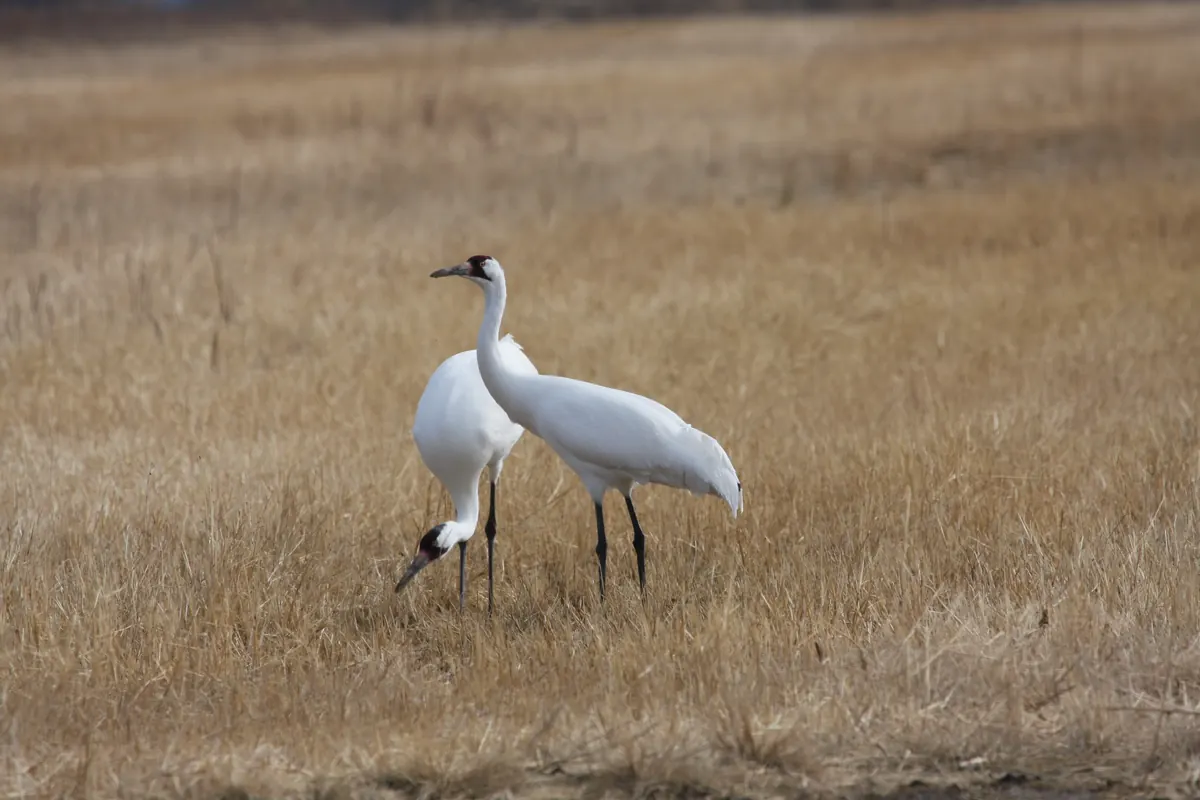
- Whooping cranes in the marshes. The Kansas Wetlands Education Center names the end of October through the first half of November as the prime window for whooping cranes at Cheyenne Bottoms and Quivira National Wildlife Refuge. Watch from the car, at least a quarter mile away, and bring a spotting scope.
- The first freeze. Across nearly all of Kansas the median first 32 °F night falls in October, from about October 9 at Colby to October 30 at Pittsburg. In the northwest, the first measurable snow has come by Halloween in more than half of recent years.
- The Moon covers Jupiter, then the Hunter’s Moon. Set an alarm for Tuesday, October 6: a slim crescent Moon rises in the small hours with Jupiter tucked behind it, and the planet slips back into view at about 4:13 a.m. in Wichita. The Hunter’s Moon is full at 11:12 p.m. Central on Sunday, October 25, and comes up close to sunset that evening and the next.
Keep a record of it: whooping cranes, if you are lucky enough to see them, go on the “birds I have seen” page with the date and the marsh. The “map of sounds” plate can hold sandhills rattling over after dark, the “seeds, pods and cones” plate a hedge apple and a sumac head, and “colours of the day” a Flint Hills slope as it goes from green to bronze. Put the night of the first frost on the daily field log.
Regions used below: Northwest Kansas and the High Plains; Southwest Kansas; North-central Kansas and the Smoky Hills; Central Kansas and the Great Bend wetlands; South-central Kansas, Wichita and the Red Hills; The Flint Hills; Northeast Kansas, Topeka and Kansas City; Southeast Kansas.
When do whooping cranes and sandhill cranes stop in Kansas?
Two wetlands in the middle of the state carry most of the story. Cheyenne Bottoms, just north of Great Bend, covers more than 41,000 acres in its basin, and the Kansas Wetlands Education Center calls it the largest wetland in the interior of the United States. Quivira National Wildlife Refuge, near Stafford, is a short drive south. Both sit squarely on the Central Flyway, and both are regular rest stops for the whooping cranes that travel about 2,500 miles between their nesting grounds in Canada and their winter marshes on the Texas coast.
The education center’s Whooper Watch page gives the timing plainly: fall migration begins in mid-September, the birds normally reach their winter grounds by early December, and the end of October through the first half of November is the best time to see them here. The Nature Conservancy counts fewer than 700 whooping cranes left in the wild and puts this migrating flock at about 500; the education center’s page gives roughly 300, so treat any single figure loosely. Look for small family groups: white adults with black wingtips, and young birds still mottled with cinnamon.
-
How to watch whooping cranes without disturbing them
Late October to mid-November · Cheyenne Bottoms Wildlife Area, Cheyenne Bottoms Preserve, Quivira NWR
The recommendation is to stay at least a quarter mile away, stay in the vehicle, and keep noise and movement down; nobody should walk toward the birds. At the Nature Conservancy’s preserve, visitors keep to public roads and off-road hiking is not allowed. Quivira’s auto-tour road around the Big Salt Marsh is the refuge’s standard viewing route, and the refuge is open from an hour and a half before sunrise to an hour and a half after sunset.
-
Sandhill cranes
Through October into November · Quivira, Cheyenne Bottoms, western reservoirs and fields
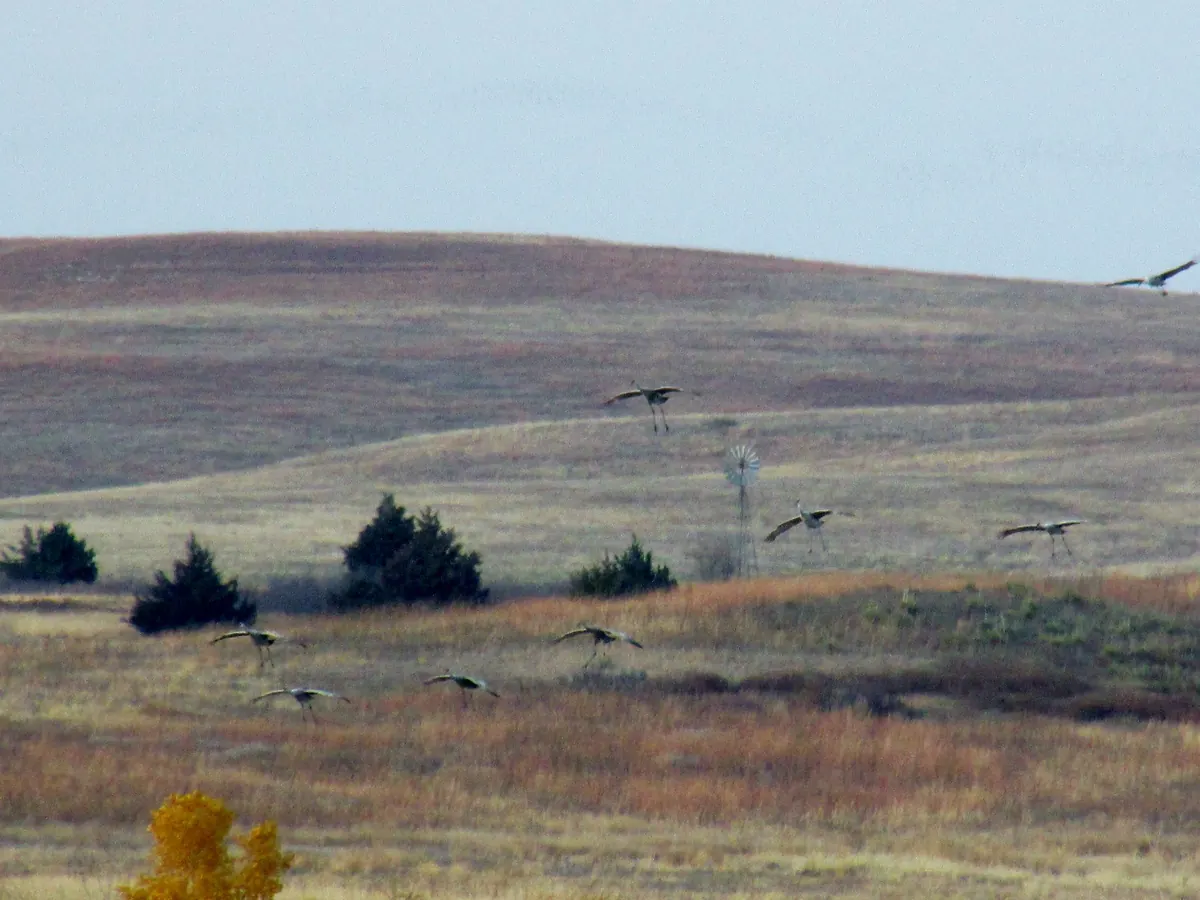
Quivira lists flocks of geese and sandhill cranes as the signature sight of migration, which there runs mostly from September to December. The cranes’ rolling, wooden call carries a long way, and a flock is often heard before it is found high overhead. Kansas opens its West Zone sandhill season on October 17, which is one small measure of when the birds are expected; the Central Zone waits until November 11.
-
Why a pool may suddenly close to hunters
Whenever whoopers are present · Cheyenne Bottoms
When whooping cranes settle in, the pool they are using closes to all hunting, and the goose zones close to crane and light-goose hunting. If you see closure signs go up in late October, that is often the best clue that the rarest birds in the basin are nearby.
A spotting scope from a roadside pullout is the right tool; a telephoto lens from inside the car is the right camera.
Which other birds move through the Kansas wetlands and prairies in October?
Of the 477 bird species documented in Kansas, the education center counts 352 at Cheyenne Bottoms, which the Ramsar Convention lists as a Wetland of International Importance and the Western Hemisphere Shorebird Reserve Network ranks as a site of hemispheric importance. October is when the fall show changes cast: shorebirds thin out and waterfowl build.
-
Late shorebirds
Tailing off through October · Cheyenne Bottoms mudflats, Quivira salt marshes
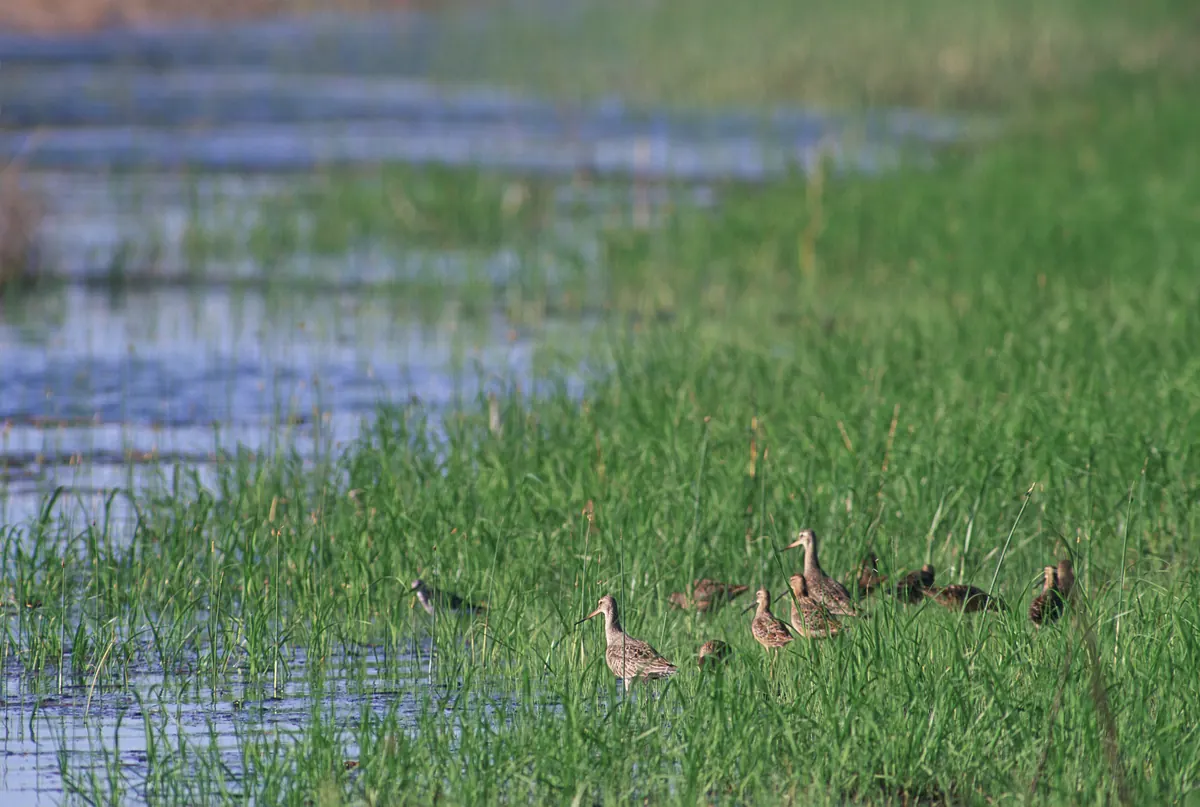
The Nature Conservancy describes fall shorebird passage at the Bottoms as long and drawn out, sometimes starting in July and running through October. Water levels decide everything: a pool with shallow edges and exposed mud is where the last ones will be feeding.
-
Ducks and geese building toward November
Growing all month; peak in November · Quivira NWR and Cheyenne Bottoms
Quivira calls fall its most spectacular season, with geese and ducks in the hundreds of thousands at the November peak. The education center says waterfowl numbers at the Bottoms can approach several hundred thousand. Every cold front in late October brings a new wave.
-
October Big Day
Saturday, October 10 · Anywhere: yard, park or marsh
eBird’s worldwide one-day count falls on October 10 this year. A checklist from a Wichita backyard counts just as much as one from the Big Salt Marsh, and a family can keep one in half an hour.
The Wetlands and Wildlife National Scenic Byway links the two marshes and is the natural route for a day of October birding. Both places are open to visitors every day, but the education center’s building has set hours, so check before you drive for a program.
Are monarchs still flying through Kansas in October?
Mostly not, and it helps to know why. Monarch Watch, the tagging program run from the University of Kansas in Lawrence, publishes peak-passage windows by latitude: September 14–26 at 39° N, the latitude of Topeka and Hays, and from September 19 through October 1 at 37° N, along the Oklahoma line. The Great Plains Nature Center in Wichita tells south-central Kansas to expect the main flight around the middle of September. By the first days of October the main flight has mostly moved on to the south.
What October does offer is stragglers, usually singles on the last asters and goldenrods on a warm afternoon, and they still count. Journey North takes sightings and roost reports all fall, and a late monarch seen in Kansas is exactly the kind of record that fills in the end of the migration. If you tagged monarchs in September, keep an eye on Monarch Watch’s recovery lists over the winter; a Kansas tag found in the Mexican forests is how the program learns which routes work.
When does the tallgrass prairie turn color in the Flint Hills?
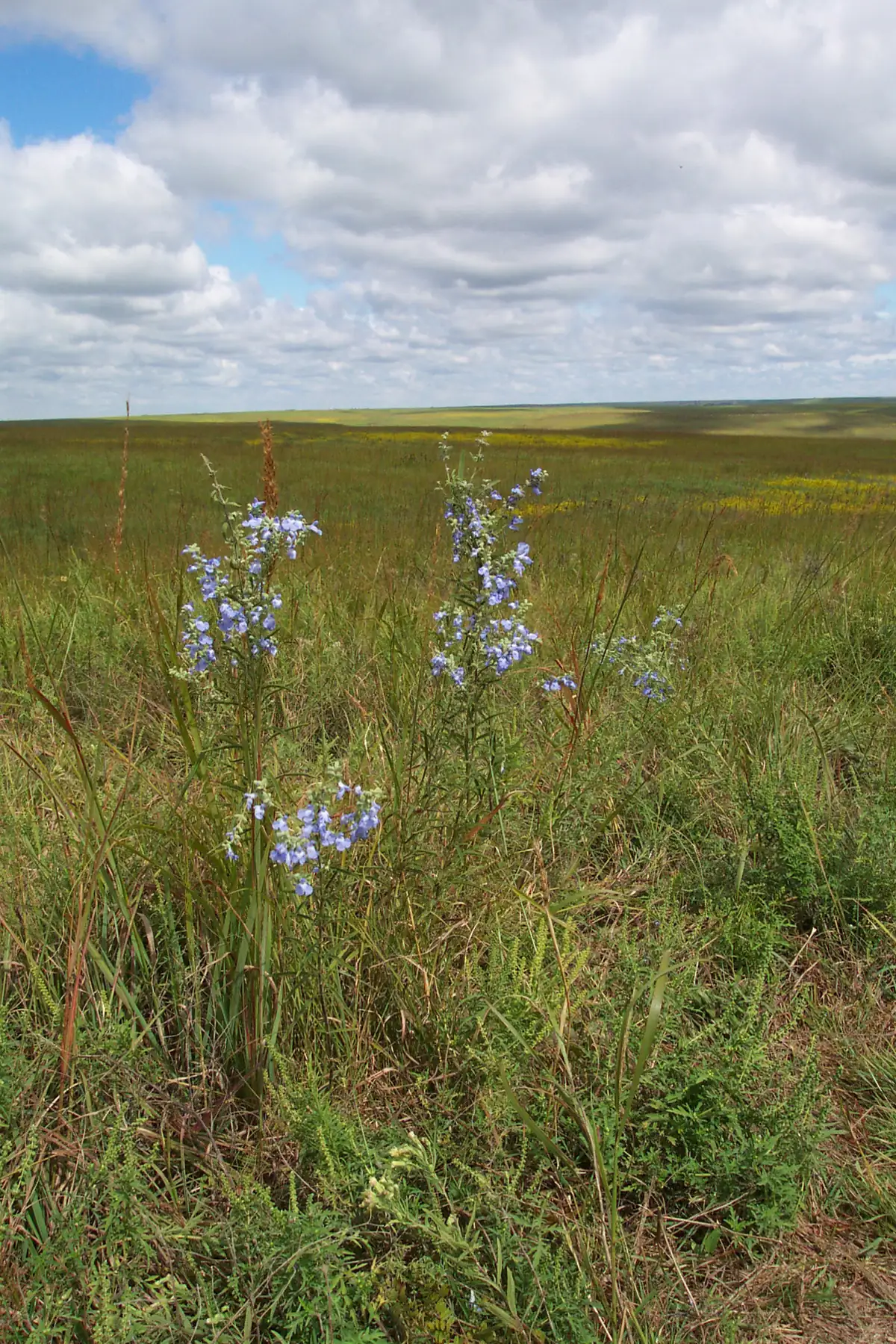
In much of Kansas, fall color means grass. Big bluestem, which the Kansas Wildflowers and Grasses guide calls the most abundant grass of the tallgrass region, finishes flowering in September, and its leaf blades take on a reddish cast after frost. Its stems stay standing through the winter, so the color holds long after the trees are bare. Indiangrass, which the same guide calls one of the state’s most important native tall grasses, stands beside it with its plume-like seed heads. On a low-sun afternoon a Flint Hills slope shows copper, wine and tan in bands.
-
Tallgrass Prairie National Preserve
Trails open 24 hours; main season ends October 31 · Near Strong City, Flint Hills
The preserve’s trails are open all day and all year, on foot only, and the backcountry routes lead up into the hills where the bison herd ranges. The park’s main tour season ends October 31. The bison rut is usually over by October, since the park dates it to August and September, but give the animals plenty of room regardless. Fall prescribed burns can come in October and November, and the park warns that trails may close with less than two hours’ notice and that smoke can drift across the region.
-
Konza Prairie
Nature trail open to the public · South of Manhattan
The Konza Prairie Biological Station covers 3,487 hectares, about 8,600 acres, of native tallgrass. It is owned jointly by The Nature Conservancy and Kansas State University, which runs it as a research station where prescribed fire is part of the long-term experiments. Its public nature trail is a good place to watch a prairie change from week to week.
-
Maxwell Wildlife Refuge bison
Tram tours through Saturday, October 17 · Near Canton, McPherson County
Maxwell protects 2,560 acres of tallgrass in the Smoky Hills with a bison herd. Its covered tram runs 45-minute tours at 10 a.m. on October 6, 10 and 17 (adults $15, children 4 to 11 $7.50, under 4 free, with reservations through the refuge), and then the refuge calendar shows it closed from October 18 into November to prepare for the bison auction. Call before you go.
-
Last wildflowers on the prairie
Through October · Upland prairie, especially the eastern third
Downy gentian, deep blue and bell-shaped, blooms in September and October in the eastern third of the state; its flowers open only in daylight, stay shut on heavy overcast days, can ride out an early frost, and are often among the very last in bloom. Aromatic aster keeps the same September–October schedule, and stiff goldenrod runs into October. Maximilian sunflower, the tall roadside sunflower of September, is usually finished by the time October arrives.
Take the same photograph of the same slope every week this month and the change becomes obvious: green through early October, then the reds arrive after the first frost. A page in the Naturalist’s Field Journal can hold the dates and a strip of color swatches.
What is falling from Kansas trees and hedgerows in October?
-
Hedge apples (Osage orange)
Autumn · Old hedgerows and shelterbelts statewide
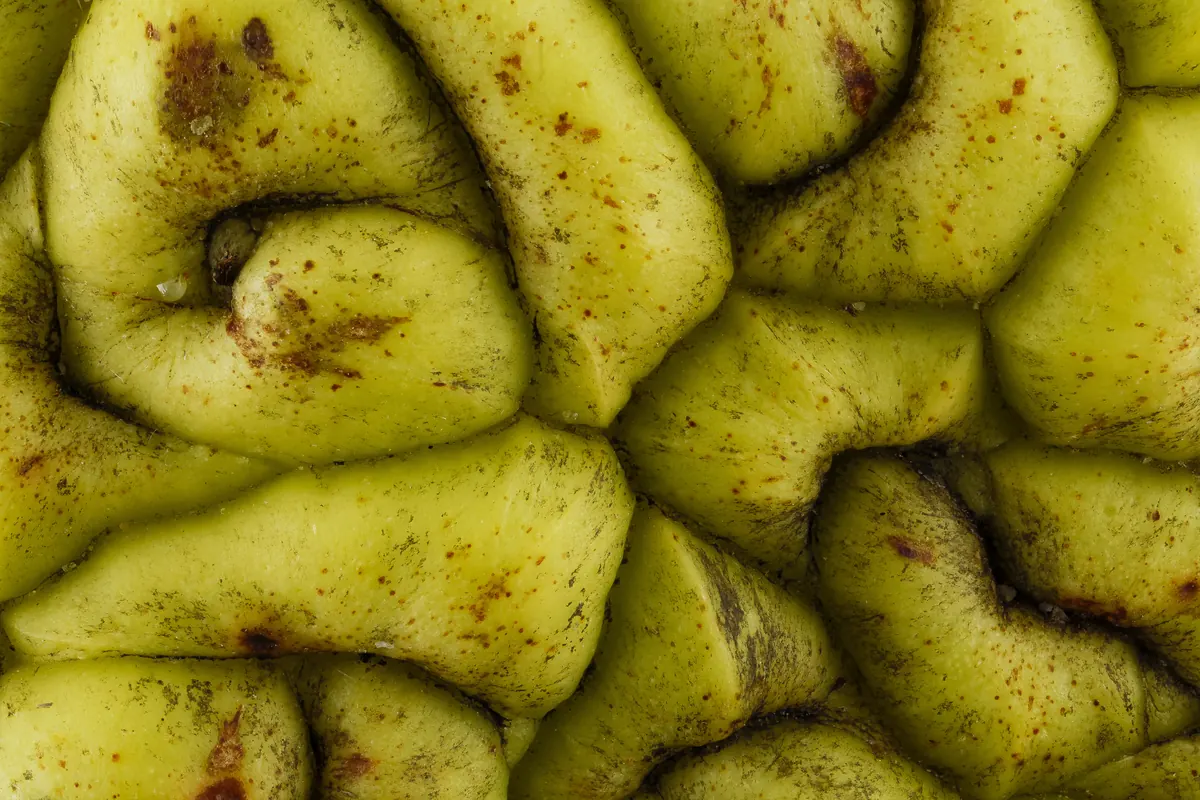
The heavy, lumpy green balls under the old fence-row trees are Osage orange fruit, two to six inches across and full of sticky milky juice. Kansas planted the tree in windbreaks, and its bright orange, hard, rot-resistant wood made generations of fence posts. The Kiowa made a yellow dye from the root bark, and the Comanche, Omaha, Pawnee and Ponca made bows from the branches; the French name bois d’arc means “bow wood.” Squirrels and rabbits pick out the seeds, so a shredded hedge apple is a sign to look for.
-
Smooth sumac
Leaves turn in autumn; berries hold all winter · Roadsides, prairie edges and woodland borders
Sumac is the brightest red in a Kansas October, a thicket-forming shrub whose leaves turn vivid red in autumn. Its upright clusters of fuzzy crimson berries appear in August and September and stay on through the winter, feeding birds when little else is left.
-
Cottonwood, the state tree
Leaves drop through fall · Every river and creek, and every farmstead
The Plains cottonwood is fast-growing and huge, reaching close to 90 feet, with triangular leaves that give it its Latin name. Its limbs break easily in strong wind, which is worth knowing when you park under one on a blustery October day.
For a nature table, a hedge apple, a sumac head and a handful of cottonwood leaves make a Kansas October in three objects. Wash your hands after handling the Osage orange sap.
When is the first freeze in Kansas?
In October, for almost the whole state. The medians in the table below run from October 9 in the northwest to October 30 in the southeast; the earliest median among the stations in NOAA’s normals is October 4, at Brewster 4 W in Thomas County, and the latest are November 1 at Coffeyville and Girard. The spread inside one region can be as large as the spread across the state: the two Hays stations, barely a mile apart, have medians of October 15 and October 22, a reminder that local terrain and exposure matter. In one year in ten the northwest has already frozen by late September.
| Station | One year in ten | Median | Nine years in ten |
|---|---|---|---|
| Colby 1 SW (northwest) | Sep 26 | Oct 9 | Oct 21 |
| Garden City Regional Airport (southwest) | Oct 1 | Oct 15 | Oct 27 |
| Dodge City (southwest) | Oct 4 | Oct 20 | Nov 1 |
| Concordia Municipal Airport (north-central) | Oct 3 | Oct 19 | Nov 1 |
| Salina Municipal Airport (central) | Oct 10 | Oct 23 | Nov 4 |
| Wichita (south-central) | Oct 15 | Oct 29 | Nov 10 |
| Topeka Municipal Airport (northeast) | Oct 8 | Oct 23 | Nov 4 |
| Olathe Johnson County Exec Airport (Kansas City area) | Oct 15 | Oct 29 | Nov 11 |
| Pittsburg (southeast) | Oct 17 | Oct 30 | Nov 10 |
All 176 Kansas stations are listed on our Kansas first and last frost dates page. West of Salina, get the tender plants in during the first week or two of October; in Wichita, Olathe and the southeast corner the tomatoes often last until the last week of the month. After the freeze, look again at the prairie grasses, since the frost is what brings out the reds in big bluestem.
Is October dry in Kansas, can it snow, and what might El Niño bring this winter?
October rain in Kansas follows the usual east–west slope. Averaged over 1991–2020, Topeka and Wichita each get about 2.9 inches in the month, Concordia and Dodge City about 2.0, and Goodland about 1.4. This year the month starts dry: on the U.S. Drought Monitor map for September 22, 77 percent of Kansas was abnormally dry or worse, 51 percent in moderate drought or worse and 29 percent in severe drought. Dry, curing grass plus a windy day is the setup for fast-moving grass fires, so watch for red flag warnings and county burn bans.
Snow in October is a northwest Kansas thing. Counting NOAA’s daily records for the 30 seasons from 1991 to 2020, Goodland had its first measurable snow (a tenth of an inch or more) by October 31 in 17 of them, and its median first snow date is October 29. Wichita had October snow in 6 of those 30 years. The extreme case is October 25, 1997, when 19.3 inches fell at Goodland in one day.
Then there is the winter ahead, and the tropical Pacific has a strong opinion about it. The Climate Prediction Center’s outlook of September 10 put the chance that this El Niño turns very strong over fall and winter 2026–27 at more than 90 percent. The Wichita weather office explains the usual pattern this way: a strong Pacific jet stream across the southern states favors extra precipitation in the South, while the polar jet retreats into Canada and the northern states lean warm. Kansas sits between those zones, so its signal is weaker than along the Gulf Coast or the northern border. We tallied NOAA station records for the three winters in which CPC’s Oceanic Niño Index has reached 2.0 or more since 1950 (1982–83, 1997–98 and 2015–16). December-through-February precipitation came to 3.8 inches at Wichita against 3.4 in a typical 1991–2020 winter, 4.3 against 3.7 at Topeka, 3.2 against 2.2 at Dodge City and 1.7 against 1.3 at Goodland, and on average those winters ran about 2 to 3 °F milder than normal (closer to 2 at Wichita and Dodge City). Snowfall showed no consistent pattern: a little less than usual at Topeka, about normal at Dodge City and Wichita. Three winters is a tiny sample, and as NOAA’s climate.gov writers stress, El Niño shifts the odds rather than setting the weather. October itself is only loosely tied to it. NOAA publishes its official winter outlook in mid-October; once it is out, this page will get a plain-language note on what it means for Kansas.
For the week ahead where you live, our weather page has the forecast in plain language.
How much daylight does Kansas lose in October?
A little over an hour everywhere in the state: from 69 minutes in Wichita, Dodge City and Pittsburg to 73 in Goodland, Hays and Salina, or about two and a third to two and a half minutes a day. Sunrise in Wichita moves from 7:25 to 7:54 a.m. and sunset from 7:12 to 6:32 p.m. between October 1 and October 31. On Sunday, November 1, at 2 a.m., clocks go back an hour in both the Central and Mountain parts of the state, and the evenings suddenly get darker.
| City | Oct 1 | Oct 31 | Lost | Per day |
|---|---|---|---|---|
| Goodland | 11 h 46 m | 10 h 33 m | 73 min | 2.4 min |
| Dodge City | 11 h 47 m | 10 h 38 m | 69 min | 2.3 min |
| Hays | 11 h 47 m | 10 h 34 m | 73 min | 2.4 min |
| Salina | 11 h 47 m | 10 h 34 m | 73 min | 2.4 min |
| Wichita | 11 h 47 m | 10 h 38 m | 69 min | 2.3 min |
| Topeka | 11 h 46 m | 10 h 34 m | 72 min | 2.4 min |
| Overland Park | 11 h 46 m | 10 h 34 m | 72 min | 2.4 min |
| Pittsburg | 11 h 48 m | 10 h 39 m | 69 min | 2.3 min |
Sunrise, sunset and twilight for any spot in Kansas, and how many minutes it is losing this week, are on our daylight calculator.
What is in the Kansas sky this October?
Kansas has a lot of sky and, away from the cities, a lot of dark. Most of the state keeps Central time; Sherman, Wallace, Greeley and Hamilton counties on the Colorado line keep Mountain time, an hour earlier, so both are given below.
-
The Moon hides Jupiter
Before dawn, Tuesday, October 6 · Low in the east; you need a flat, open horizon
The 17-percent crescent rises at 2:57 a.m. in Topeka and 3:07 in Wichita with Jupiter right beside it. In eastern Kansas the Moon’s bright edge slides over the planet at about 3:19 a.m. in Topeka and 3:20 at Leavenworth, near Kansas City, with the Moon only 3 degrees up; in Wichita it happens at 3:18 with the Moon barely a degree above the horizon, which is too low for most people to see. Farther west the pair come up with Jupiter already hidden. The easier event for everyone is the reappearance at the dark edge: 4:12 a.m. in Garden City (Moon 9 degrees up), 4:13 in Wichita and at Fort Riley near Manhattan (11 and 12 degrees), and 4:14 in Topeka and Leavenworth (13 and 14 degrees). In the Mountain-time counties expect it close to 3:11 a.m. MDT, an estimate from the times at Garden City and Denver. Binoculars make it easy; Jupiter pops back as a bright point beside the dark limb.
-
Saturn at its best
Opposition Sunday, October 4; Moon beside it October 23 and 24 · East at dusk, high in the south around midnight
On October 4 Earth passes between Saturn and the Sun. That puts the ringed planet in the east at sunset and in the west at dawn, so it can be seen all night, and it is brighter now than at any other time in 2026. No bright stars crowd it, so the steady, pale-gold point is easy to find, and even a small telescope shows the rings. On the nights of the 23rd and 24th the waxing gibbous Moon sits nearby.
-
Draconid meteors
Thursday evening, October 8 · Face north after dark
A small shower, often only a handful of meteors an hour, but one of the few that is best in the early evening rather than before dawn. The Moon is a 4-percent sliver that sets at 5:56 p.m. in Wichita, so the whole evening is dark. It suits a family on a blanket before bedtime.
-
Orionid meteors
Mornings of October 21 and 22 · Anywhere dark, after the Moon sets
The shower runs from October 2 to November 7 and peaks broadly around the 21st and 22nd, when a truly dark site may show roughly 10–20 an hour. In Wichita the waxing Moon sets at 2:50 a.m. on Wednesday the 21st and at 3:53 a.m. on Thursday (2:41 and 3:45 in Topeka; 2:05 and 3:10 a.m. Mountain time in Goodland), and after that the sky stays dark until morning twilight begins a little after six. On the 23rd the Moon holds on until nearly 5 a.m.
-
The Hunter’s Moon
Sunday, October 25, and Monday, October 26, at dusk · Open view to the east
October’s full moon, the one after the Harvest Moon, peaks at 11:12 p.m. Central on the 25th. Wichita sees it clear the horizon at 6:07 p.m., some 30 minutes ahead of the 6:39 sunset, and at 6:42 p.m. on the 26th, right with the 6:38 sunset. In Topeka the times are 5:58 and 6:32 p.m.; in Goodland, 5:22 and 5:56 p.m. Mountain time. This one is not a supermoon by any strict measure, and it does not need to be: coming up orange over a milo stubble field, it is the best moonrise of the fall.
-
Venus bows out; Jupiter and Mars take the dawn
Venus only in the first days of October; the others before dawn all month · West after sunset; east before sunrise
In the first few evenings of October, Venus hangs just above the western horizon in the afterglow; within days it sinks out of sight, and by October 23 it has swung around to sit almost directly between the Sun and Earth. The morning sky is the better show. Jupiter is by far the brightest thing in the east before sunrise, and fainter, orange-tinted Mars is close by. Aim binoculars at Mars on the morning of October 11 and you will see it sitting among the loose stars of the Beehive cluster.
| Phase | Date | Central | Mountain |
|---|---|---|---|
| Last quarter | Saturday, Oct 3 | 8:25 a.m. | 7:25 a.m. |
| New moon | Saturday, Oct 10 | 10:50 a.m. | 9:50 a.m. |
| First quarter | Sunday, Oct 18 | 11:12 a.m. | 10:12 a.m. |
| Full moon, the Hunter’s Moon | Sunday, Oct 25 | 11:12 p.m. (looks full the evenings of Oct 25 and 26) | 10:12 p.m. |
| Last quarter | Sunday, Nov 1 | 2:28 p.m. CST | 1:28 p.m. MST |
Check cloud cover before any early alarm on our sky and cloud forecast, and use the moon phase calendar for moonrise and moonset where you are.
What can Kansas families do outdoors in October?
- Friday, October 2, 10 to 11 a.m.: Turtle Tots at the Kansas Wetlands Education Center near Great Bend, a nature hour of stories, crafts and outdoor exploring for children 3 to 5 with a caregiver; this session is about skinks.
- Fridays, October 2 and 9, at the Flint Hills Discovery Center in Manhattan: “Nature Together: Fall Friends,” an outdoor-classroom program for children from 18 months to 3½ years and a parent, with registration required (the listing shows $60, or $50 for members).
- Tuesday, October 6, and Saturdays, October 10 and 17, 10 a.m.: bison tram tours at Maxwell Wildlife Refuge near Canton; reservations through the refuge.
- Friday, October 9, 8:30 to 10 p.m.: Stargazing with FHSU at the Kansas Wetlands Education Center. The Fort Hays State University astronomy club brings telescopes for Saturn, the Andromeda Galaxy and the Pleiades; it is free and open to everyone, and the sky will be moonless. Dress warmly.
- Saturday, October 10: October Big Day. Count the birds in your yard or at a marsh and submit an eBird checklist.
- Saturday, October 24: Perry State Park’s fall festival and free entrance day near Topeka. KDWP’s calendar said the schedule would be finalized late in the summer, so check the park’s page before you go; camping fees still apply.
- Late October, any day: drive the Quivira auto tour or the Cheyenne Bottoms roads with binoculars and look for the white cranes. Count sandhills, too.
- Any day: walk a trail at Tallgrass Prairie National Preserve or the Konza nature trail and pick one plant to visit every week.
- Citizen science: report late monarchs to Journey North, and sign up now for Project FeederWatch, which starts counting on November 1.
More months and states are collected on our nature this month page.
Safety notes for October in Kansas
- Hunting seasons this month (KDWP, 2026): archery deer all month (September 14 to December 31); the statewide pre-rut whitetail antlerless firearm season October 10–12, extended in Unit 12 through October 18; firearm pronghorn October 2–5 in the west; dove through November 29; woodcock from October 17; West Zone sandhill cranes from October 17; youth pheasant and quail November 7–8; the regular firearm deer season December 2–13. Duck seasons also open in October in several zones, but KDWP’s season pages still showed last year’s duck dates when we checked, so confirm your zone before you go out.
- Hunter orange: during any firearm or muzzleloader deer season, which in October means the October 10–12 weekend (to the 18th in Unit 12), all deer hunters and anyone assisting them must wear a blaze orange hat and at least 200 square inches of orange on the upper body, 100 visible from the front and 100 from the back. Camouflage orange that provides the required amount is legal. The rule does not bind hikers or birders, but on public land that weekend an orange cap and vest is simple good sense.
- Grass fire: with most of the state abnormally dry and the grass curing, a spark from a trailer chain or a tossed cigarette can start a fire that runs with the wind. Obey burn bans and do not park on tall dry grass, since a hot exhaust can ignite it.
- Prescribed burns and smoke: in the Flint Hills, fall burns can close trails on short notice and send smoke across highways. If you meet smoke on the road, slow down and turn on your lights.
- Deer on the roads: deer move most around dawn and dusk, which in October is also the commute. Slow down near creek crossings and shelterbelts.
- Early snow and cold in the northwest: a late-October storm can close roads on the High Plains. Carry a coat and water in the car for any trip west of Hays.
- Whooping cranes: keep at least a quarter mile away and stay in the vehicle; disturbing an endangered crane is illegal as well as unkind.
Sources
- Kansas Wetlands Education Center: Whooper Watch (timing, viewing distance, hunting closures)
- Kansas Wetlands Education Center: bird watching at Cheyenne Bottoms (size, species counts, Ramsar and WHSRN status)
- Kansas Wetlands Education Center: upcoming events (Turtle Tots, October 2, 2026)
- Kansas Wetlands Education Center: Stargazing with FHSU, October 9, 2026
- The Nature Conservancy: Cheyenne Bottoms Preserve (fall migration, whooping cranes, visitor rules)
- U.S. Fish and Wildlife Service: Quivira National Wildlife Refuge, visit us (hours, auto tour)
- U.S. Fish and Wildlife Service: Quivira National Wildlife Refuge, species (fall waterfowl peak)
- U.S. Fish and Wildlife Service: Quivira National Wildlife Refuge (migration season)
- Monarch Watch: peak migration dates by latitude
- Monarch Watch: tagging program and recoveries
- Great Plains Nature Center: monarch butterflies (timing in south-central Kansas)
- Journey North: monarch sightings and fall roost reports
- National Park Service: Tallgrass Prairie National Preserve, basic information (trails, season, bison rut, fall burns)
- Konza Prairie Biological Station, Kansas State University
- Maxwell Wildlife Refuge: events calendar (tram tours, fall closure)
- Kansas Wildflowers and Grasses: big bluestem
- Kansas Wildflowers and Grasses: Indiangrass
- Kansas Wildflowers and Grasses: downy gentian
- Kansas Wildflowers and Grasses: aromatic aster
- Kansas Wildflowers and Grasses: stiff goldenrod
- Kansas Wildflowers and Grasses: Maximilian sunflower
- Kansas Wildflowers and Grasses: Osage orange
- Kansas Wildflowers and Grasses: smooth sumac
- Kansas Wildflowers and Grasses: cottonwood, the state tree
- NOAA NCEI: U.S. Climate Normals 1991–2020 (freeze dates)
- NOAA Regional Climate Centers: SC-ACIS station data (October precipitation, first snow and El Niño winter tallies for Wichita, Topeka, Dodge City, Concordia and Goodland)
- U.S. Drought Monitor: Kansas statistics for September 22, 2026
- National Weather Service Wichita: El Niño and La Niña information
- Climate Prediction Center: ENSO diagnostic discussion, September 10, 2026
- Climate Prediction Center: Oceanic Niño Index data (strength of past El Niño events)
- NOAA Climate.gov: United States El Niño impacts
- U.S. Naval Observatory: sun and moon rise and set (data API; example for Wichita, October 25)
- U.S. Naval Observatory: moon phases 2026 (data API)
- International Occultation Timing Association: lunar occultation of Jupiter, October 6, 2026 (times and Moon altitudes for Kansas cities)
- American Meteor Society: 2026 meteor shower calendar
- EarthSky: visible planets (Saturn at opposition, Venus, Jupiter and Mars)
- Kansas Department of Wildlife and Parks: hunting seasons 2026–27
- Kansas Department of Wildlife and Parks: deer information and 2026–27 season dates
- Kansas Department of Wildlife and Parks: 2026 deer regulations summary (PDF; hunter orange requirements)
- Kansas Department of Wildlife and Parks: blaze orange required
- Kansas Department of Wildlife and Parks: Kansas outdoor events (Perry State Park, October 24, 2026)
- Flint Hills Discovery Center: Nature Together: Fall Friends, October 2, 2026
- Global Birding: October Big Day, October 10, 2026
- Project FeederWatch: how to participate (season starts November 1)
- Photos via Wikimedia Commons; licenses and photographers are credited under each picture
