What to look for in nature in Kansas this December
Meteorological winter opens on December 1, beginning the coldest quarter of the year, and in Kansas it is the month the landscape turns quiet and readable. The leaves are down, so bark, thorns and hanging pods name the trees. Christmas Bird Count teams spread across the state, the shelterbelts ring with owl calls at dusk, and a light snow shows who crossed the creek last night. The earliest sunsets come on December 6 and 7, and the longest night falls on December 21. Each date and number below carries its source, from the Colorado line to the Missouri border.
Other months in Kansas: October, November.
Start here
- Join a Christmas Bird Count. Kansas birders run more than 40 counts between mid-December and early January. Wichita’s is Saturday, December 19, starting at 7:30 a.m. in the nature center’s lot off 29th Street North, and beginners are welcome on almost every team if they let the compiler know ahead of time.
- Listen for owls after sunset. Great horned owls hoot more in winter than in any other season, because they are pairing up and claiming nest sites; Kansas pairs can be on eggs by late January. Stand outside on a still evening near a woodlot or shelterbelt and listen for the deep, soft five-note call.
- Geminids, then the Cold supermoon. Stay up late on Sunday, December 13: the Geminids, the year’s richest meteor shower, are at their best that night and into Monday, after a slim Moon goes down between about 9 and 9:30 p.m. Ten days later, at 7:28 p.m. CST on Wednesday the 23rd, comes the Cold Moon, 2026’s nearest full moon.
Keep a record of it: list every species from your Christmas Bird Count team, or from your own feeder that day, on the “birds I have seen” page. The “tracks to know” plate is for the prints you find in creek mud or new snow, and “reading the signs” for chewed cottonwood bark or a beaver’s cache. Draw a honey locust thorn and a coffeetree pod on the “seeds, pods and cones” plate, record the solstice sundown under “dusk and dawn watch,” and log the date skim ice first rims the stock pond.
Regions used below: Northwest Kansas and the High Plains; Southwest Kansas; North-central Kansas and the Smoky Hills; Central Kansas and the Great Bend wetlands; South-central Kansas, Wichita and the Red Hills; The Flint Hills; Northeast Kansas, Topeka and Kansas City; Southeast Kansas.
When is the Christmas Bird Count in Kansas, and how can you join?
Audubon’s national count season this winter is December 14 through January 5. A Kansas count is one calendar day spent inside a 15-mile-wide circle, logging every bird seen or heard. The Kansas Ornithological Society keeps the state’s master list. Its 2025–26 schedule had 47 counts, from Kanopolis Lake on December 12 to Blackwolf on January 10, including circles at Cheyenne Bottoms, Quivira National Wildlife Refuge, Tallgrass Prairie National Preserve, Garden City, Hays, Manhattan, Lawrence, Topeka and the Cimarron National Grassland. Kansas keeps a slightly wider window of its own: since 2018 the society’s standard dates have run from December 12 to January 12. Look for the 2026–27 list on its site, then write to the compiler of the count you want; newcomers are usually teamed with experienced counters.
Wichita Audubon has already published its dates for south-central Kansas. Each asks newcomers to tell the compiler first.
-
Wichita count
Saturday, December 19, 7:30 a.m. · Meet at the Great Plains Nature Center parking lot, Wichita
The biggest of the south-central counts, covering Chisholm Creek Park, the city’s rivers and the farmland around the edges. The nature center’s building is closed for repairs, but the park and its lot stay open.
-
El Dorado, Red Hills and Sedan counts
Tuesday, December 15; Wednesday, December 16; Thursday, December 17 · El Dorado (meet at the McDonald’s on Central, 7:30 a.m.); Medicine Lodge (Casey’s on South Iliff Street, 7:30 a.m.); Sedan (the Subway store on West Main, 8 a.m.)
Three very different circles on three weekdays: the reservoir and woodland around El Dorado, the cedar-dotted mesas and canyons of the Red Hills near the Oklahoma line and the wooded hills of Chautauqua County.
-
Winfield–Udall, Slate Creek, Arkansas City and Marion counts
Sunday, December 20; Tuesday, December 22; Sunday, December 27; Tuesday, December 29 · Winfield (Beech Student Center at Southwestern College, 7:30 a.m.); Slate Creek (Slate Valley Baptist Church, 7 miles south of Oxford, 8 a.m.); Arkansas City (Newman Park on Highway 77, 8 a.m.); Marion (Tabor College Welcome Center lot in Hillsboro, 8 a.m.)
Cowley and Sumner counties get three counts between them, along the Walnut and Arkansas rivers and the Slate Creek wetlands.
-
Counting from home
Any count day inside a circle · Your yard, if it sits within a count circle
Many compilers welcome feeder counts from people who live inside the circle: watch your feeders for part of the count day and report, for each species, the largest group in view at once. Ask the compiler first, since each count handles home reports a little differently.
Count day runs from before sunrise, when owling crews go out, until dusk. Dress in layers and pack lunch and something hot to drink.
Which owls and eagles can you find in Kansas in December?
Winter is courtship season for the biggest owl in the state, and the early darkness puts its calls right at suppertime. It is also when Kansas gains a set of daytime raptors from the north that hunt open fields.
-
Great horned owl
Hooting peaks in winter; eggs can come by late January · Statewide: shelterbelts, wooded creeks, farmsteads, city parks
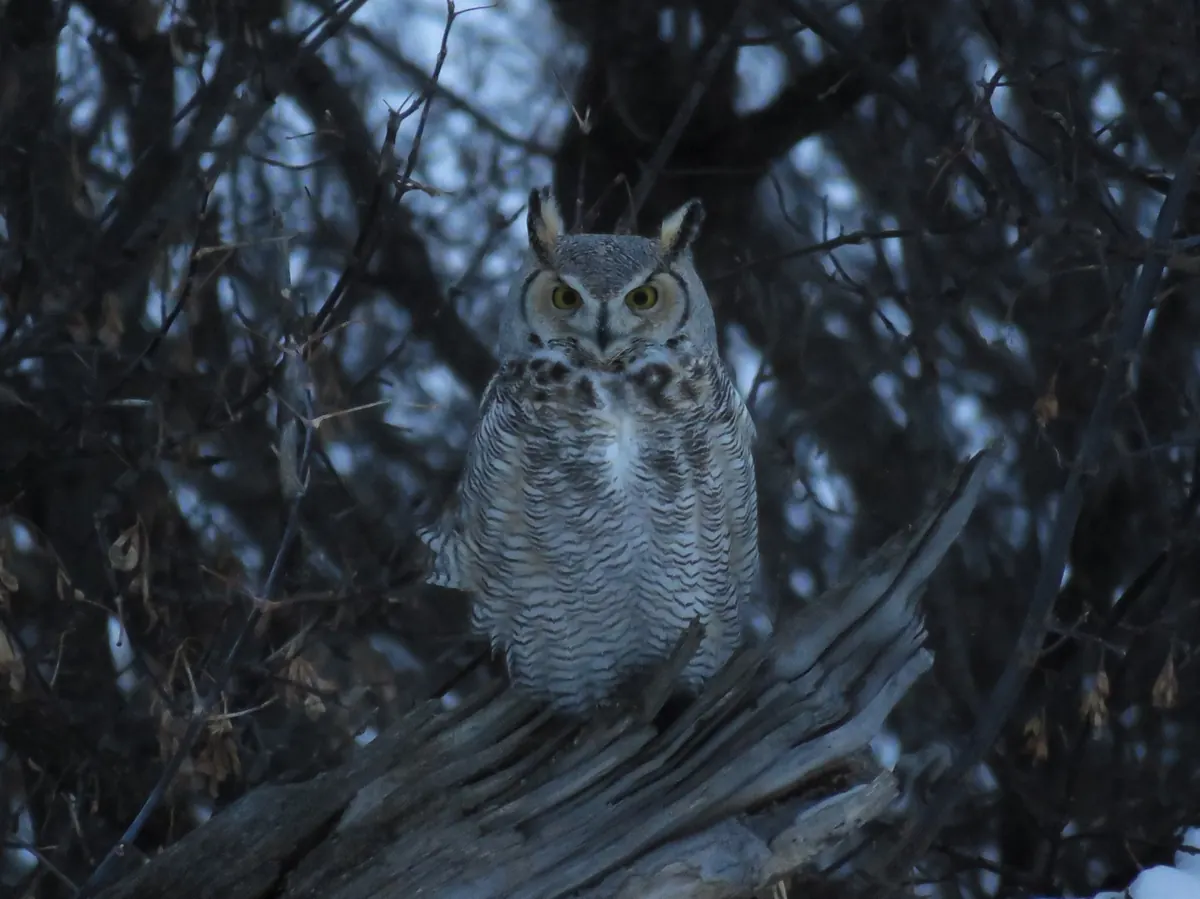
The Great Plains Nature Center says great horned owls hoot more in winter than at any other time, as pairs find each other and stake out territory, and that in Kansas they may lay eggs as early as late January. They do not build their own nests; they take over an old hawk or crow nest, or use a hollow tree. Their prey is mostly rabbits and big rodents, though they will kill a skunk. Look for a big, eared silhouette on a branch against the last light.
-
Short-eared owl
Winter visitor; dawn and dusk · Large grasslands, weedy fields and marsh edges
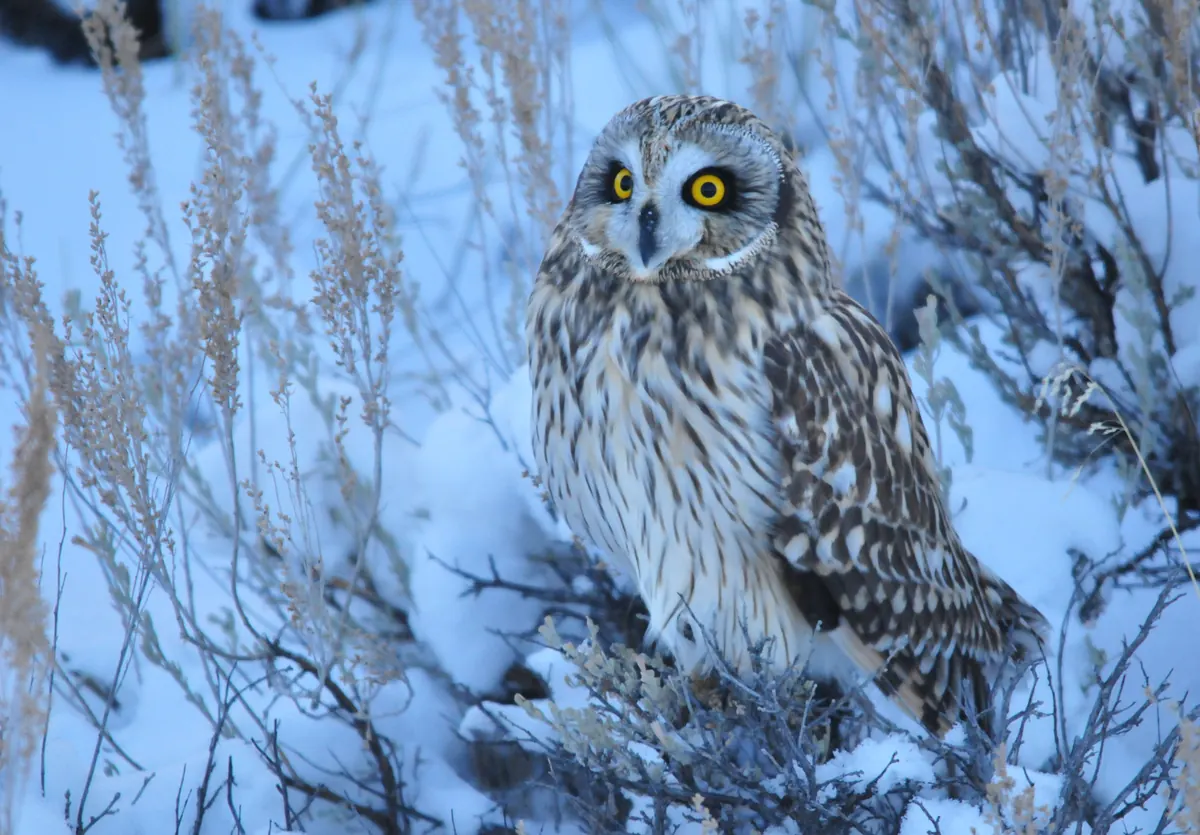
The Cornell Lab says that unless you live in the far north, winter is when to look for this owl, near dawn or dusk, over open fields, grassland or even airports. It flies low and buoyantly in long loops, sometimes coming back over the same patch, and it may sit right on the ground.
-
Bald eagles build toward their winter peak
December, rising into January and February · Reservoirs, dam outlets and refuges
Kansas Wildlife and Parks notes that eagle numbers in the state often surge in January and February; its Eagle Days programs have traditionally been held in January. December is the run-up: as the smaller ponds skim over with ice, the birds gather where water stays open and fish and ducks are easy to catch. Kirwin National Wildlife Refuge in Phillips County, which lists bald eagles among its featured wildlife, is open to visitors 24 hours a day; its boat closure from October 1 to April 1 keeps the reservoir quiet for resting waterfowl.
Listening beats looking: a flashlight on a roosting owl disturbs it, and any big stick nest in a woodlot deserves a wide berth from now on.
How do Kansas animals get through the winter?
There are three broad strategies: leave, sleep deeply, or stay active and live off stored food or fat. Kansas has good examples of all three, and December is when the sleepers settle in for the long haul.
-
Bats in caves, attics and the Red Hills
Hibernation through the cold months · Gypsum caves of the Red Hills (Barber and Comanche counties), mines, rock crevices and buildings statewide
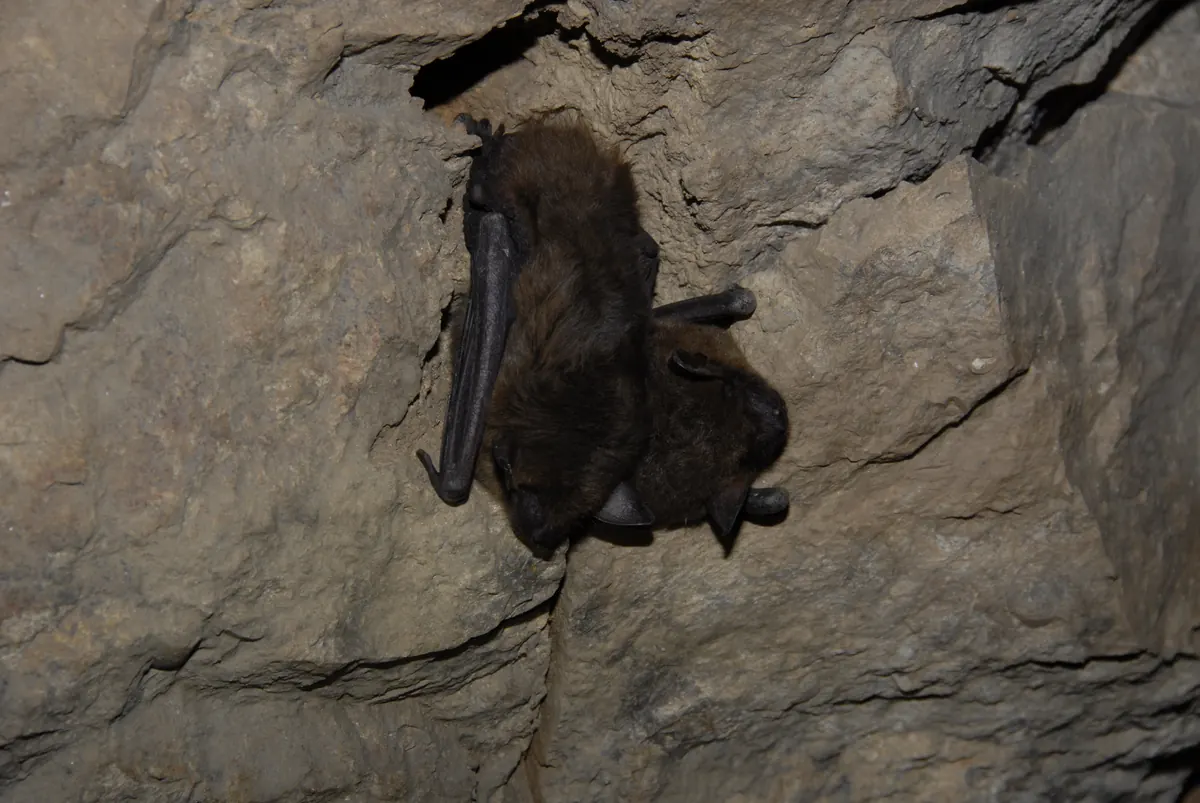
K-State Research and Extension’s guide to Kansas bats sorts them into migrants and hibernators. Red bats and evening bats head south for the winter; big brown bats, which the guide calls probably the most common bat in Kansas buildings, may hibernate in attics; cave myotis spend the winter in big colonies in caves and mines in south-central and southwestern Kansas. The western big-eared bat lives all year in the gypsum caves of the Red Hills and hibernates alone or in small clusters, and the guide calls it especially sensitive to disturbance. White-nose syndrome, the fungal disease that makes hibernating bats burn their fat too early, was confirmed in Kansas in 2018 in Barber, Cherokee, Comanche, Kiowa and Pratt counties, according to KDWP. If you find a cave in winter, stay out of it.
-
Thirteen-lined ground squirrel and woodchuck
Asleep from mid-autumn to about March · Ground squirrels in short grass, lawns and cemeteries statewide; woodchucks in the eastern part of the state
The Kansas Mammal Atlas describes the ground squirrel as a true hibernator: it plugs its burrow in mid-October or November, curls up below the frost line, and its breathing falls from about 150 breaths a minute to three or four, its heart from 200–300 beats a minute to as few as 15. It wakes briefly every two or three weeks and emerges in March or April, a third to a half lighter. Woodchucks, the largest members of the squirrel family in Kansas, hibernate in their dens for four to six months.
-
Ornate box turtle, the state reptile
Underground from late fall to spring · Statewide, especially grasslands of the west and south-central
The Kansas Herpetofaunal Atlas says this turtle, the state reptile since a sixth-grade class at Caldwell campaigned for it in 1986, is active only from April to October. As winter approaches it digs in, or borrows another animal’s burrow, going down as far as 18 inches in open grassland but only about 6 in woodland soil.
-
Prairie dogs and beavers, awake all winter
Active on mild days · Prairie dogs in the western half; beavers wherever there is water and trees
Black-tailed prairie dogs do not hibernate, the mammal atlas notes; they live off fat and stay underground in severe weather, then pop up on calm, sunny days. Beavers stay active from dusk to dawn all year. The Great Plains Nature Center explains that they stockpile branches underwater beside the den, so they can reach food even when the pond is iced over. A heap of cut sticks in the water near a bank is a winter larder.
A warm December afternoon can still coax out a few of summer’s sleepers, from a basking turtle to a confused moth.
What tracks and signs can you find in Kansas snow and mud?
Kansas snow rarely lasts, but the mud along a creek after a thaw holds prints just as well, and December’s bare ground makes signs easy to spot. The Great Plains Nature Center counts 88 kinds of mammals in Kansas, and its free pocket guide to the common ones ends with a page of track drawings worth keeping in the glove box.
-
Raccoon and opossum
Fresh prints after any night above freezing · Creek banks, pond edges, culverts, town parks
A raccoon’s print looks like a small human hand, five long fingers splayed; the animal forages alone at night, often within a square mile of its den in a hollow tree or under an old building. An opossum’s hind foot is the giveaway: four clawed toes and a thumb set off to the side, like a tiny hand reaching sideways.
-
Coyote, fox and bobcat
Night travel; trails show at dawn · Field edges, ranch roads, dry creek beds
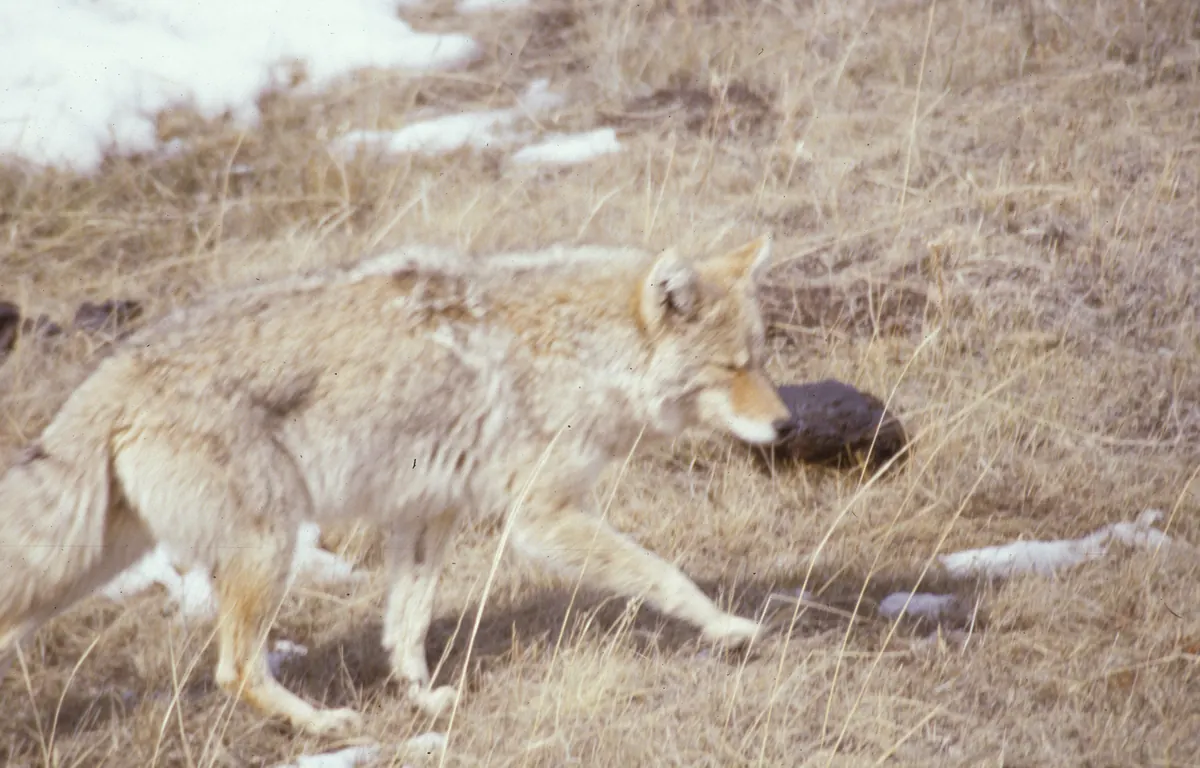
Coyotes hunt from dusk to dawn, and their tracks run in a straight, purposeful line, oval with claw marks showing. A bobcat’s round print usually shows no claws, because they are retracted. In December, listen too: coyotes often howl soon after dark to mark territory and keep in touch.
-
Porcupine bark work
Winter · Cottonwoods along streams in central and southwestern Kansas
Porcupines are a surprise to many Kansans, but the nature center’s guide places them in wooded areas of the central and southwestern parts of the state, where they climb high and strip the tender bark at the tops of cottonwoods. Pale, gnawed patches high in a cottonwood crown, with no sign of a beaver below, point to one.
Photograph a print beside a glove for scale and note which way the trail runs; it often leads to a den or to water.
How can you identify Kansas trees in winter?
Without leaves, trees fall back on bark, branching, thorns and the fruit some of them hold all winter. These four common ones, described in the Kansas Wildflowers and Grasses guide, are easy in December.
-
Hackberry
Fruit can hang on into midwinter · Throughout Kansas, along streams, in town and on rocky hillsides
Old hackberries have gray bark covered in corky warts and short ridges, unlike any other tree in the state. Its small purple-brown fruits, edible, often cling to the twigs until midwinter. Tangled knots of twigs, caused by disease, often show in its bare crown.
-
Sycamore
Seed balls hang through the winter · East half of Kansas, on creek and river bottoms
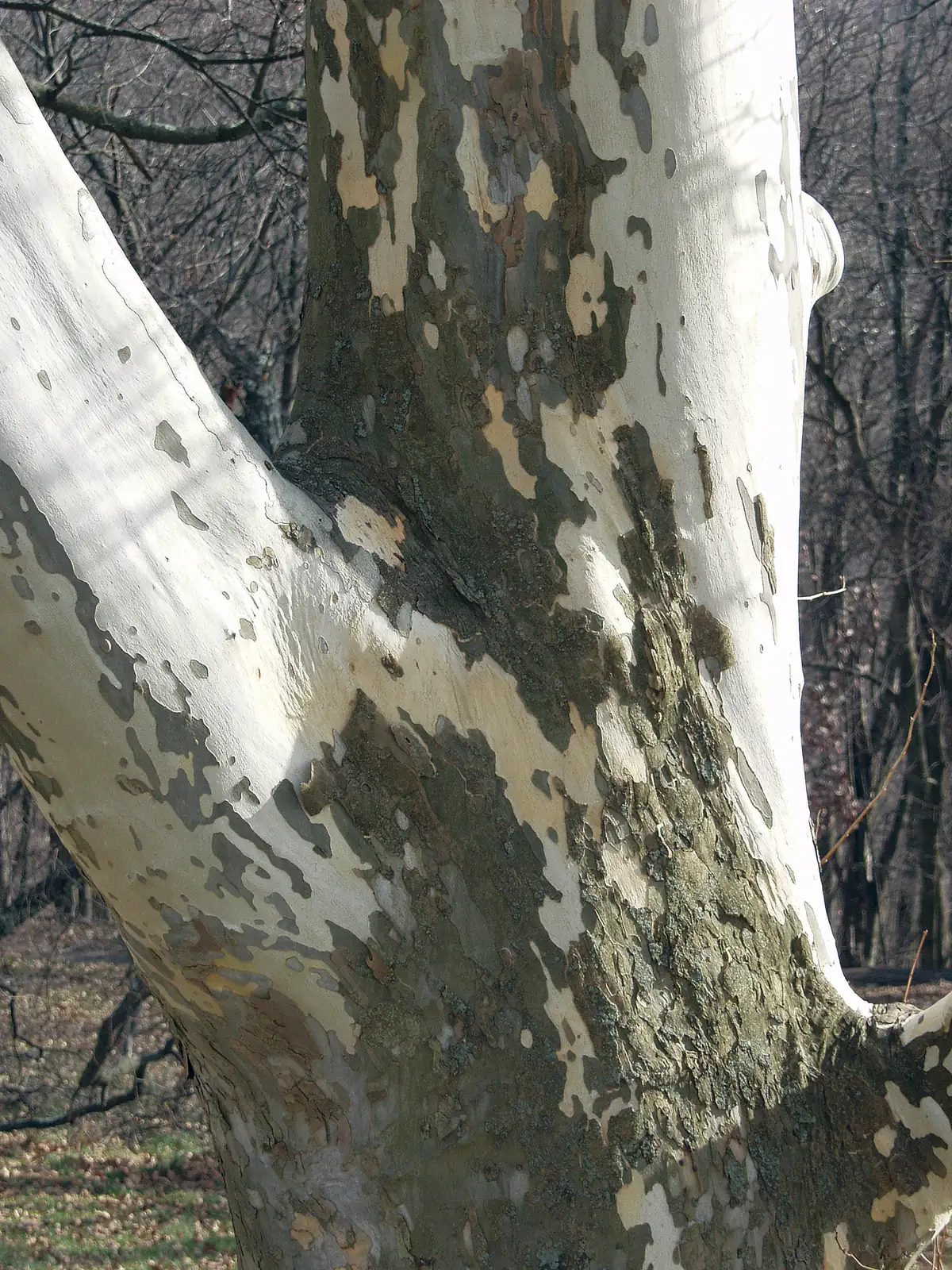
Look for the white limbs. Sycamore bark peels off in thin plates, exposing pale inner bark, so the upper branches gleam against a winter sky from half a mile away. Round seed heads about an inch across dangle on long stalks all winter. The guide counts it among the largest trees in Kansas.
-
Honey locust
Thorns all year; pods drop through the winter · Throughout Kansas: pastures, fencerows, woodland edges
Branched, shiny reddish-brown thorns as long as 8 inches grow right out of the trunk and limbs, which makes the tree unmistakable. Its long, flat, twisting pods, up to 14 inches or more, litter the ground beneath it; squirrels eat the seeds.
-
Kentucky coffeetree
Pods stay shut until winter · East half of Kansas, on moist bottoms and ravines
Its scientific name means “naked branch,” and in winter it is easy to see why: a few thick, stubby twigs with no fine branching. Its heavy pods, purplish-brown and up to 10 inches long, ripen in October but stay closed until winter. Native peoples roasted the seeds and used them as game counters; settlers further east roasted them as a coffee substitute.
Adopt one tree near home and check it weekly through the winter. Our Naturalist’s Field Journal has a page for following a single tree through the seasons.
How cold and snowy is a Kansas December, and what might El Niño bring?
Across Kansas in December, average afternoon highs are in the low to mid 40s, and nights drop into the teens in the northwest and the mid 20s in Wichita. It is a dry month: Goodland averages less than half an inch of precipitation, Topeka about an inch and a half. Snowfall averages run from about 3 inches in Wichita to about 5 in Goodland, though most of it melts within days.
Forecasters at the NWS office in Wichita put the city’s typical first snowfall big enough to measure (0.1 inch) on December 2 and its first inch on December 19; in nine years out of ten the first measurable snow has come by January 1. A white Christmas, an inch or more on the ground on December 25, is unusual there: the office counts only 13 since records began in 1888, about one year in ten, the most recent in 2013.
This winter has one big influence lining up. The federal Climate Prediction Center, in its September 10 update, judged the chance of this El Niño reaching very strong status over the 2026–27 cold season at better than nine in ten. For Kansas, the Wichita weather office’s historical composites lean slightly warm in the northeast, near normal elsewhere, and near to a bit wetter than normal across much of the state from November through March. A Climate Prediction Center review written during the strong 1997–98 event found that moderate and strong El Niños had brought above-normal precipitation to the whole state from November to March, averaging around 120 percent of normal in November and December. The signal is modest this far from the Gulf, and any single winter can break it. NOAA releases its official winter outlook on October 15, 2026; we have not seen it yet, and it will appear on the CPC seasonal outlook page.
| Station | Average high | Average low | Precipitation | Snowfall |
|---|---|---|---|---|
| Goodland (northwest) | 43.8 | 17.8 | 0.47 | 5.2 |
| Dodge City (southwest) | 45.9 | 22.0 | 0.96 | 4.0 |
| Concordia (north-central) | 41.1 | 21.9 | 1.04 | 4.5 |
| Wichita (south-central) | 45.8 | 25.4 | 1.22 | 3.1 |
| Topeka (northeast) | 43.8 | 24.0 | 1.49 | 4.1 |
Frost is now an everyday matter; for the long-term freeze dates by town, see our Kansas frost page. For snow, wind and wind chill in the days ahead, our weather forecast page puts it in plain words.
When is pond and lake ice safe in Kansas?
Rarely as early as people hope. Kansas swings between cold snaps and mild spells, and ice that looks solid after two frigid nights can be paper-thin a few yards out. KDWP’s rules of thumb are straightforward.
- Thickness: wait for at least 4 inches of clear, hard ice before walking on it, and 5 to 7 inches before driving an ATV or snowmobile onto it. Building safe ice usually takes several calm days with temperatures in the single digits.
- Color: new, clear ice is strongest; white, cloudy ice may be only about half as strong. Sunny, warm days rot the surface into a honeycomb.
- Hidden weak spots: currents, springs, snow cover and even roosting geese can thin the ice from below. Stay away from inlets, outlets and moving water.
- Check as you go: the only real test is drilling or chopping test holes as you move out. Ice-fishing holes on Kansas waters may be no more than 12 inches across.
- Carry and share: go with a friend, and bring ice picks, a rope and a throwable float. Cold water can overwhelm a person within minutes.
With children, admire the ice from shore, and leash dogs near any frozen pond.
When is the shortest day and the earliest sunset in Kansas?
The winter solstice comes at 2:50 p.m. CST (1:50 p.m. MST) on Monday, December 21. On that day Wichita gets 9 hours 33 minutes between sunrise and sunset and Goodland 9 hours 24 minutes. But the earliest sunsets come about two weeks before the solstice, around December 6 and 7, because of the tilt of Earth’s axis and its slightly oval orbit: Liberal, Wichita and Pittsburg reach theirs on December 6, and Hays, Salina, Manhattan, Overland Park and Goodland on December 7. Goodland, on Mountain time, has the earliest clock sunset in the table, 4:23 p.m. Mornings run the other way: sunrise keeps getting later until the first days of January, so the shortest day is not the darkest morning.
From December 1 to the solstice every city in the table loses another 11 or 12 minutes of daylight, and by New Year’s Eve has already won back 2 to 4 minutes, nearly all of it at the evening end.
| City | Dec 1 | Dec 21 | Dec 31 | Earliest sunset |
|---|---|---|---|---|
| Goodland | 9 h 36 m | 9 h 24 m | 9 h 26 m | 4:23 p.m., Dec 7 |
| Liberal | 9 h 48 m | 9 h 37 m | 9 h 40 m | 5:27 p.m., Dec 6 |
| Hays | 9 h 39 m | 9 h 27 m | 9 h 29 m | 5:15 p.m., Dec 7 |
| Salina | 9 h 39 m | 9 h 27 m | 9 h 29 m | 5:08 p.m., Dec 7 |
| Wichita | 9 h 45 m | 9 h 33 m | 9 h 37 m | 5:10 p.m., Dec 6 |
| Manhattan | 9 h 37 m | 9 h 25 m | 9 h 27 m | 5:03 p.m., Dec 7 |
| Overland Park | 9 h 38 m | 9 h 26 m | 9 h 29 m | 4:56 p.m., Dec 7 |
| Pittsburg | 9 h 46 m | 9 h 34 m | 9 h 38 m | 5:01 p.m., Dec 6 |
To see the sunrise, sunset and twilight times for your own town, day by day, open our daylight calculator.
What is in the Kansas night sky in December?
Long nights and dry air make December a good month for the sky, if you dress for it. Times here are Central Standard Time; in Sherman, Wallace, Greeley and Hamilton counties, on Mountain time, take off an hour.
-
The Geminid meteor shower
Night of Sunday, December 13, into Monday, December 14 · Anywhere dark; face any direction, with as much open sky as possible
At its peak, under a perfect sky, this shower can deliver about 150 meteors an hour by the International Meteor Organization’s reckoning, the best rate of any annual shower; under real Kansas skies, away from town lights, a few dozen an hour is a good night. In 2026 the Moon cooperates: a slim crescent, it sets between about 9 and 9:30 p.m., the radiant in Gemini is already up in the east by then, and the count builds until roughly 2 a.m., with Gemini at its highest. Unlike most showers, the Geminids are worth watching in the evening too.
-
The Cold Moon, the closest full moon of 2026
Full at 7:28 p.m. CST, Wednesday, December 23; nearly full on Christmas Eve · Rising in the east-northeast around sunset
Perigee, the Moon’s nearest point to Earth, comes roughly seven hours after December’s full moon, so of all 2026’s full moons this one looks largest, if only slightly. On the evening of the 23rd it is full almost as it clears the horizon, and it is still round on the 24th. Two nights earlier, on the evening of December 21, the gibbous Moon passes close by the little Pleiades cluster.
-
Venus at dawn, Saturn at dusk
All month: Venus before sunrise, Saturn after sunset · Southeast before dawn; south to southwest in the evening
Venus is now a brilliant morning star, the brightest thing in the sky after the Moon, and it gains altitude week by week until it reaches its farthest point west of the Sun on January 3. At dawn on December 4 and again on the 5th, the crescent Moon hangs close to it, and Spica, a blue-white star, sits between the two. Jupiter, in Leo, clears the eastern horizon by mid-evening as the month ends and stands high in the south at daybreak; orange Mars, growing brighter, is not far away. Evenings belong to Saturn alone among the bright planets; find it south to southwest, a little lower each week.
-
Ursids, then the Quadrantids
Ursids night of December 22; Quadrantids peak evening of Sunday, January 3 · Ursids from the north; Quadrantids from the northeast
The small Ursid shower peaks on December 22 under a nearly full Moon, so expect very little. Better is the Quadrantid shower: the meteor organization predicts its sharp peak for about 9:25 p.m. CST on January 3, close to new moon, so the dark hours either side of it are worth a try.
| Phase | Date | Time |
|---|---|---|
| Last quarter | Tuesday, Dec 1 (Monday, Nov 30 in Mountain time) | 12:08 a.m. CST (11:08 p.m. MST) |
| New moon | Tuesday, Dec 8 | 6:52 p.m. CST (5:52 p.m. MST) |
| First quarter | Wednesday, Dec 16 | 11:42 p.m. CST (10:42 p.m. MST) |
| Full moon, the Cold Moon | Wednesday, Dec 23 | 7:28 p.m. CST (6:28 p.m. MST) |
| Last quarter | Wednesday, Dec 30 | 12:59 p.m. CST (11:59 a.m. MST) |
A clear forecast matters more than anything else on a meteor night, so look at our cloud cover forecast before you set an alarm. Moonrise and moonset times for each night of the month are on the moon phase calendar.
What can Kansas families do outdoors in December?
- Tuesdays through Saturdays, 9 to 5: the Kansas Wetlands Education Center at Cheyenne Bottoms, free, on winter hours. It is closed Sundays, Mondays, Christmas Eve, Christmas Day and New Year’s Day.
- Saturday, December 12, 8 a.m.: a beginners’ bird walk led by Wichita Audubon on the paved trails of Chisholm Creek Park; meet at the nature center lot and allow about 90 minutes.
- Topeka Audubon: its second-Saturday walk on the Shunga Trail takes December off, but the society joins several local Christmas Bird Counts; its calendar and newsletter list the times and whom to contact.
- Christmas Bird Count season, December 14 through January 5. Older children who can walk quietly and stay warm make good spotters on a team. See the dates above, and contact the compiler.
- Saturday, December 19: Winter Solstice Celebration at Ernie Miller Park and Nature Center in Olathe, a guided luminary walk of about a mile along Little Cedar Creek, with live owls, fireside stories and marshmallows. Registration is required ($13 for Johnson County residents, $14 otherwise, in advance) and it usually sells out.
- Monday, December 21, and Tuesday, December 29, 8 a.m. to 4:30 p.m.: Camp Discover in Manhattan’s Flint Hills Discovery Center: school-break day camps for kindergarten through second grade: a winter solstice day of stories and crafts, and a “Winter Survival” day about animals that hibernate in the Flint Hills. Register through the center.
- Through December 31, 9 a.m. to 4 p.m.: the Lower Fox Creek School at Tallgrass Prairie National Preserve, the restored one-room schoolhouse, is open daily for its last weeks of the year; the preserve’s trails are open around the clock.
- Friday, January 1, 2027: First Day Hikes. Kansas State Parks led 24 free guided New Year’s Day hikes to start 2026, with a $5 daily vehicle permit; watch KDWP’s First Day Hikes page in December for the 2027 parks and times.
- Citizen science all month: keep counting for Project FeederWatch, and enter a backyard list on eBird on a snowy morning, when feeders are busiest.
Other states and months are gathered on our nature this month index, and last month’s Kansas page is at Kansas in November.
Safety notes for December in Kansas
- Firearm deer season, December 2–13 (KDWP): the statewide regular firearm season runs Wednesday, December 2, through Sunday, December 13, alongside the second firearm elk segment on the same dates. Fort Leavenworth holds firearm deer weekends December 5–6 and 12–13, and Fort Riley December 19–23 and 26–31. Archery deer and elk continue through December 31, and extended antlerless-only firearm seasons open in many units on January 1. Confirm the dates on KDWP’s season page before you go.
- Blaze orange: KDWP requires deer hunters, and anyone helping them, to wear an orange hat and an orange total of 200 square inches or more above the waist, split evenly front and back, whenever a firearm or muzzleloader season is running; camouflage orange is legal if it meets that total. Hikers and birders on public land or walk-in hunting areas in December should wear orange too.
- Other seasons open this month: pheasant, quail and greater prairie-chicken until the end of January; ducks in the High Plains, Late and Southeast zones through January 3, and in the Low Plains Early Zone until December 6, then reopening December 19 to January 3; Canada and light geese through February 14; white-fronted geese through January 3; sandhill cranes in the West Zone until December 13 and the Central Zone until January 7; snipe to December 16; the general furbearer season through February 28.
- Ice: nothing less than 4 inches of clear ice is safe to walk on. Stay off ice entirely over moving water.
- Cold and wind: Kansas wind makes 20 degrees feel much colder. Cover ears and fingers, and bring dry layers for children on a long count day.
- Short days: it is dark not long after five over most of Kansas, and before half past four in Goodland. Carry a headlamp, and plan hikes to finish an hour before sunset.
- Winter roads: on the High Plains even a light snow can drift across highways in a strong wind. Check KanDrive before a trip and keep a blanket, water and a phone charger in the car.
- Caves and bats: do not enter caves in winter; waking hibernating bats costs them fat they cannot replace.
Sources
- National Audubon Society: Christmas Bird Count (December 14 to January 5)
- Kansas Ornithological Society: 2025–2026 Kansas Christmas Bird Counts (standard dates, count list)
- Kansas Ornithological Society: what is a Christmas Bird Count?
- Wichita Audubon Society: schedule of events 2026–2027 (bird walks, Christmas Bird Counts)
- Topeka Audubon Society (monthly walks, no December walk; local Christmas Bird Counts)
- Great Plains Nature Center: great horned owl
- Cornell Lab of Ornithology, All About Birds: short-eared owl
- Kansas Department of Wildlife and Parks: national symbol brightens Sunflower State winter (eagle numbers, Eagle Days)
- U.S. Fish and Wildlife Service: Kirwin National Wildlife Refuge (hours, seasonal boat closure)
- K-State Research and Extension: Bats (L-855), Kansas species and winter habits
- Kansas Department of Wildlife and Parks: first cave myotis bat with white-nose syndrome found in Kansas (2018)
- Kansas Mammal Atlas (Fort Hays State University): thirteen-lined ground squirrel
- Kansas Mammal Atlas (Fort Hays State University): black-tailed prairie dog
- Kansas Herpetofaunal Atlas (Fort Hays State University): ornate box turtle
- Great Plains Nature Center: A Pocket Guide to Common Kansas Mammals, second edition (species accounts, mammal tracks)
- Kansas Wildflowers and Grasses: hackberry
- Kansas Wildflowers and Grasses: sycamore
- Kansas Wildflowers and Grasses: honey locust
- Kansas Wildflowers and Grasses: Kentucky coffee-tree
- NOAA NCEI: monthly climate normals 1991–2020 for Goodland, Dodge City, Concordia, Wichita and Topeka (December)
- NOAA NCEI: U.S. Climate Normals 1991–2020
- National Weather Service Wichita: when does Wichita typically receive its first snow?
- National Weather Service Wichita: Christmas climatology (white Christmases since 1888)
- National Weather Service Wichita: El Niño and La Niña impacts on Kansas
- Climate Prediction Center: Kansas El Niño discussion, November 1997 (moderate to strong El Niño precipitation)
- Climate Prediction Center: ENSO diagnostic discussion, September 10, 2026
- Climate Prediction Center: seasonal outlooks (official winter outlook due October 15, 2026)
- Kansas Department of Wildlife and Parks: frozen lakes require caution (ice thickness and safety rules)
- U.S. Naval Observatory: Earth’s seasons 2026 (December solstice)
- U.S. Naval Observatory: moon phases (data API)
- NASA: phases of the Moon 2001–2100 (Espenak)
- International Meteor Organization: 2026 meteor shower calendar (Geminids, Ursids, Quadrantids)
- NASA JPL Horizons: Moon and planet positions (perigee, Venus, Jupiter, Saturn, Pleiades pass)
- EarthSky: what is a supermoon? (2026 full supermoons)
- EarthSky: Venus at greatest western elongation
- BBC Sky at Night: supermoons 2026 (Cold Moon)
- Royal Astronomical Society of Canada: 2026 lunar occultations (Pleiades, December 21)
- Kansas Department of Wildlife and Parks: when to hunt, 2026–27 season dates (live site blocks automated access; read from the August 14, 2026 archived copy)
- Kansas Department of Wildlife and Parks: blaze orange required
- Kansas Wetlands Education Center: about (winter hours, holiday closures, free admission)
- Johnson County Park and Recreation District: Winter Solstice Celebration, December 19, 2026
- Flint Hills Discovery Center: Camp Discover, Winter Solstice, December 21, 2026
- Flint Hills Discovery Center: Camp Discover, Winter Survival, December 29, 2026
- National Park Service: Tallgrass Prairie National Preserve, basic information (trails, Lower Fox Creek School hours)
- Kansas Department of Wildlife and Parks: First Day Hikes
- KWCH: Kansas State Parks hosting community hikes on New Year’s Day (24 parks, January 1, 2026), December 10, 2025
- Project FeederWatch: how to participate
- KDWP: Deer hunting in Kansas (blaze orange rule)
- Photos via Wikimedia Commons; licenses and photographers are credited under each picture
