What to look for in nature in Kansas this May
May is when Kansas shifts from passing through to settling down. The wetland staff near Great Bend describe spring migration at Cheyenne Bottoms as past its peak by mid May in one recent year and wrapping up in the closing days of May in another, so the shorebird crowds thin while dickcissels, scissor-tailed flycatchers, orioles and buntings fill the fields and woodlots with song. Warm, wet nights bring Woodhouse’s toads, narrow-mouthed toads and bullfrogs to the water. Blue wild indigo, prairie phlox, spiderwort and Missouri evening primrose open in the east, downy paintbrush appears on the dry western slopes, and bison calves follow their mothers across the green Flint Hills. Even Colby is normally done with freezing by mid May. The Flower Moon of May 20 is a seasonal Blue Moon, the Eta Aquariid meteors peak in dark skies in the first week, and the heart of tornado season arrives. Weather can move any bird or bloom by weeks, so read each date below as a typical window, nothing more.
Other months in Kansas: October, November, December, January, February, March, April.
Start here
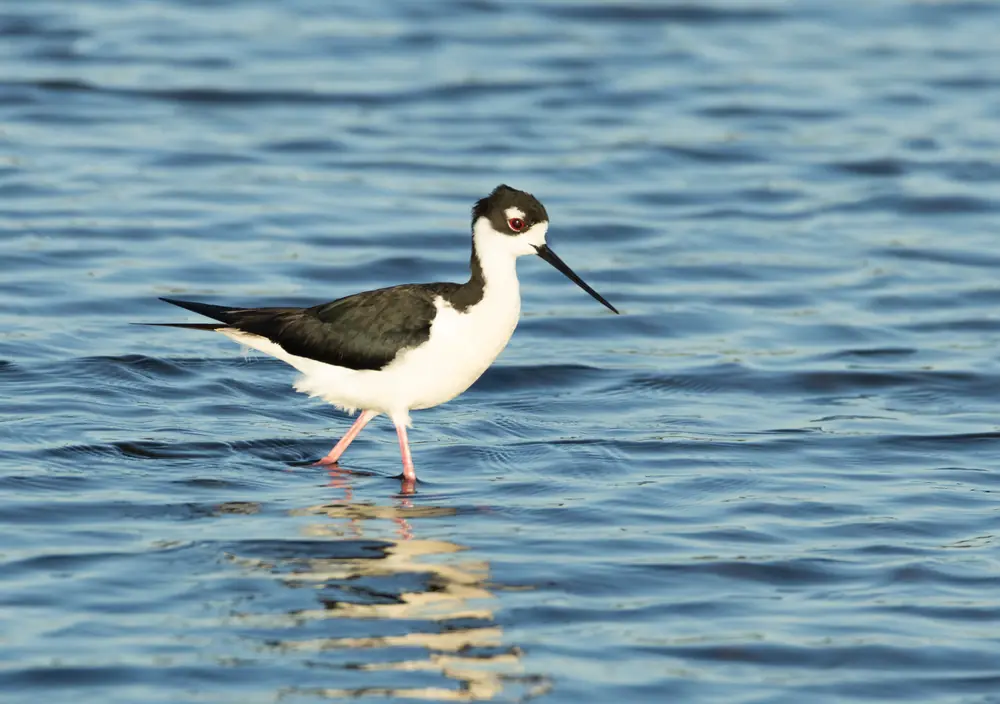
- Count what is left on the mud. Visit Cheyenne Bottoms or the Quivira auto tour in the first half of May, and read the wetland center’s latest sightings post before you go. Water decides where the birds stand, and in recent springs only one or two pools held much. Sort what you see into stilts, phalaropes, sandpipers and godwits, and write down the water level.
- Open the evening primrose. Find a rocky roadside or limestone hillside in the eastern three-quarters of the state and come back near sunset. Missouri evening primrose flowers open at dusk and close by the next mid-morning, so the same plant looks like two different plants in a day.
- Go out on a warm, rainy night. After a soaking rain, stand near a pond or floodplain slough with the lights off. Listen for the nasal wail of a Woodhouse’s toad, the sheep-like bleat of a narrow-mouthed toad and the deep “jug-o-rum” of a bullfrog, and write down the temperature.
Put it on paper. “Birds I have seen” holds the shorebirds that remain, the first dickcissel and the orioles at your orange slice, each with a date. “Nest observed” is the right plate for a killdeer or a purple martin box, kept from a distance. “Dusk and dawn watch” suits the toad chorus and the evening primrose, and “the same place twice” fits a pasture you saw burned in April and visit again in May. A “daily field log” can hold your town’s last freeze and the first night you hear toads.
Regions used below: Northwest Kansas and the High Plains; Southwest Kansas; North-central Kansas and the Smoky Hills; Central Kansas and the Great Bend wetlands; South-central Kansas, Wichita and the Red Hills; The Flint Hills; Northeast Kansas, Topeka and Kansas City; Southeast Kansas.
Is the shorebird migration still going at Cheyenne Bottoms in May?
Yes, but it is on the downslope. The Kansas Wetlands Education Center posts its own bird reports through the spring, and its May notes in recent years read like a farewell. A May 15, 2024 post said migration at the Bottoms was probably past its peak, that plenty of migrants should linger for a couple more weeks, and that most shorebirds are typically through by early June. A May 13, 2025 post called migration “winding down.” By May 30, 2025 the center wrote that shorebird numbers were way down while diversity was still decent. The Quivira refuge, by contrast, says shorebirds arrive from February and that by May thousands put on a spectacular show around the Big Salt Marsh, with more than 35 species recorded.
The catch is water. In 2024 the center reported that only one pool held significant water, four to six inches at most. In 2025 two pools held real water and the rest were dry or reduced to puddles, and then more than three inches of late-May rain added sheet water, with the state diverting river and creek flow into the marsh. Those are three single years, not a pattern, but they show why the sightings post matters more than the calendar. In 2024 Quivira still had surface water while the Bottoms was mostly dry, so keep it as your second stop.
-
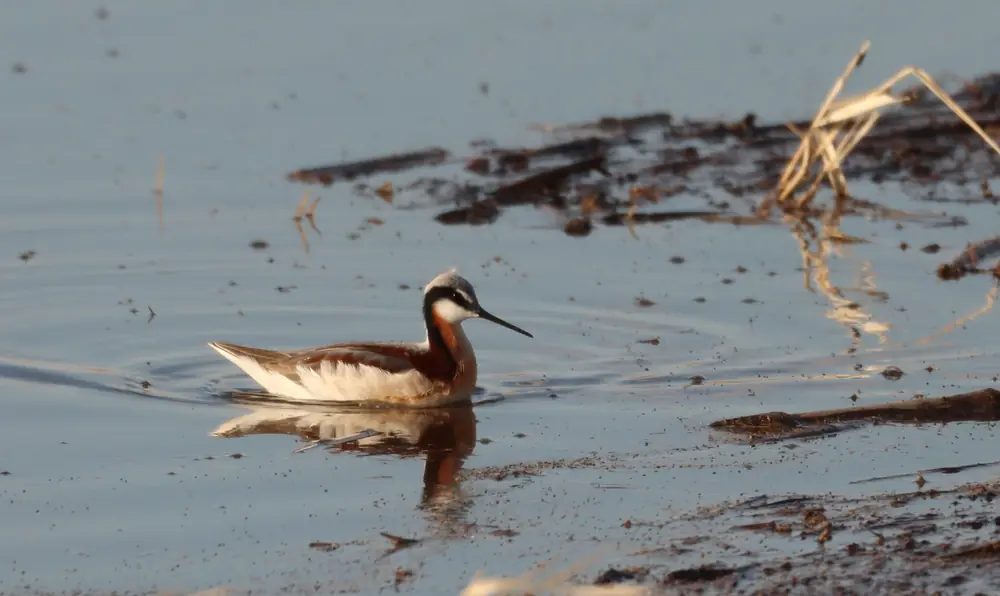
Wilson’s and red-necked phalaropes
Listed in the center’s mid May posts of 2024 and 2025 · Shallow, muddy pool edges at the Bottoms
Phalaropes are the sandpipers that swim, often spinning in tight circles to stir up insects. Wilson’s phalarope is on all three May lists, and the red-necked phalarope showed up in the May 15, 2024 and May 30, 2025 lists.
-
Black-necked stilts and American avocets
Present in every May post, and nesting on the refuge in spring and summer · Open mud and shallows at Quivira and the Bottoms
Both are tall, noisy and easy to pick out. Quivira lists stilts, avocets, snowy plovers and interior least terns as nesters on the refuge, so a bird that scolds you from the mud may be guarding a nest. Stay on the roads and signed trails.
-
Godwits, sandpipers and dowitchers
The May posts name Hudsonian and marbled godwits, Baird’s, white-rumped, pectoral and semipalmated sandpipers and both dowitchers · Mudflats and pool margins
This is the tail end of the long-distance group. The May 30, 2025 report still listed all of these, only in far smaller numbers. A scope helps with the small sandpipers; the godwits are big enough to see well in binoculars.
-
Herons, egrets, ibis and pelicans
Wading-bird numbers were called good in mid May 2025, and the center expects many to stay if water holds · Marsh edges, canals and open water
The reports list snowy, great and cattle egrets, great blue and black-crowned night herons, white-faced ibis, American bitterns and American white pelicans. As the shorebirds leave, these become the main show.
-
Black terns and least terns
Both appear in the May 30, 2025 report · Open water and sandbars
Black terns hover and dip over the marsh for insects, and the rare interior least tern nests on bare ground at Quivira. Both are a reminder that May is when the summer residents take the stage.
The education center near Great Bend asks visitors to submit sightings to eBird or by email, and its news pages are the best live guide. For the cranes and geese that left earlier, see March in Kansas, and for the peak of the shorebird push, April.
Which songbirds and summer birds arrive in Kansas in May?
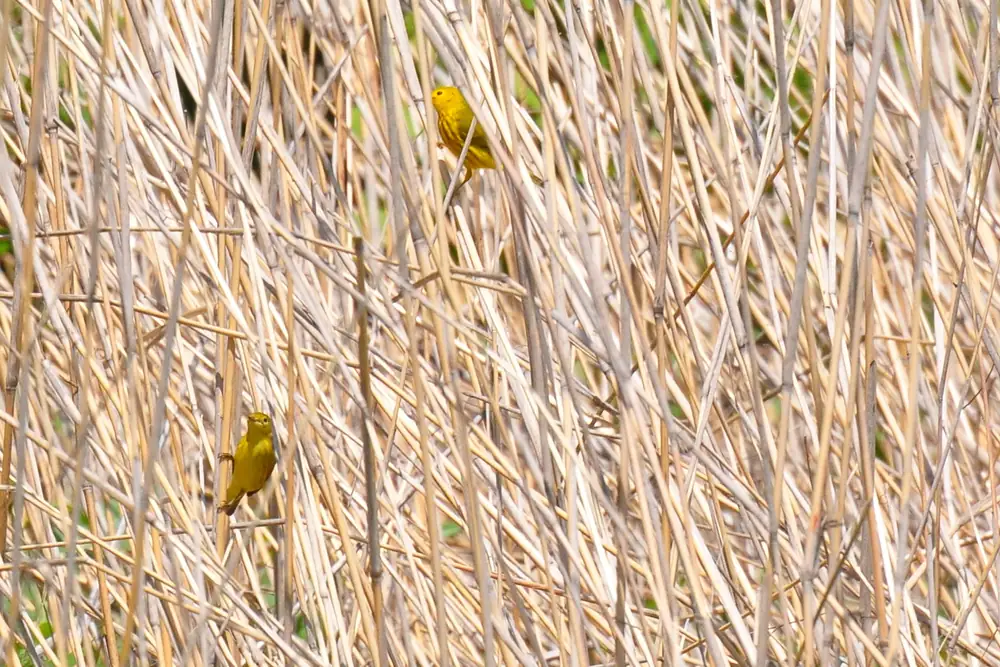
By May the question changes from who is passing through to who is staying. The National Park Service’s bird list for Tallgrass Prairie National Preserve marks 90 species as documented breeders, and it reads like a roll call of May arrivals. At Cheyenne Bottoms, the center’s May 15, 2024 report noted that summer-resident songbirds had arrived over the previous several weeks, and the May 30, 2025 report called them abundant. Migrants still come through in the first half of the month, but for warblers the Bottoms reports are modest: only yellow warblers, common yellowthroats and, in 2025, orange-crowned warblers made the list. A wooded creek in the east is a better place to look for more kinds.
-
Dickcissels
On the center’s May 15, 2024 and May 30, 2025 lists · Hayfields, roadside fence lines and tallgrass; also a documented breeder at Tallgrass Prairie National Preserve
The male perches on a wire or tall weed and repeats a short, buzzy song all day. Look for a yellow chest with a black bib and a rusty shoulder.
-
Scissor-tailed flycatchers and kingbirds
Scissor-tailed flycatcher, western kingbird and eastern kingbird are all on the May lists · Fence lines, utility wires and shelterbelts
The scissor-tail’s long, forked tail makes it one of the easiest Kansas birds to name from a car.
-
Orchard and Baltimore orioles
Both orioles appear in the May 15, 2024 and May 30, 2025 reports · Cottonwoods, mulberries and edges of towns
Baltimore orioles are bright orange and black; orchard orioles are a deeper chestnut. A cut orange or a little grape jelly at a feeder brings them in, and the male’s whistling song comes from high in the trees.
-
Painted buntings, blue grosbeaks and indigo buntings
All three are on the National Park Service’s list of documented breeders at Tallgrass Prairie · Brushy edges, thickets and shrubby fields in the Flint Hills
The preserve’s list marks these as breeding species, though it gives no dates for arrival. Treat late May as the time to look and listen along thickets, and check eBird for your own county’s first records.
-
Mississippi kites and Swainson’s hawks
Both were reported at Cheyenne Bottoms in the May 15, 2024 list · Open country and shelterbelts
Kites glide and twist like big swallows and feed on insects on the wing. The report does not describe nesting, so enjoy them for the show.
Log each first-of-year bird in a Naturalist’s Field Journal, and watch the southerly wind forecast for the nights migrants like.
What blooms in Kansas woods and prairies in May?
The state wildflower database gives every plant a bloom window and a range. Four of its May bloomers share the eastern half of the state, where moist prairies, rocky slopes and open woods start the long season of color. Many of the famous summer flowers wait: purple coneflower is listed for June and July, leadplant for June through August and butterfly milkweed for June through August, so May walks belong to the earlier, lower and often subtler flowers.
-
Prairie phlox
May through July · Meadows, prairies, roadsides and open slopes in the eastern quarter of the state
Trumpet-shaped pink to purple flowers gather in clusters of a dozen or more on stems 8 to 30 inches tall, each with five spreading lobes that are often spotted darker at the base.
-
Common spiderwort
May through August · Roadsides, meadows, thickets and prairies, mainly the eastern half
Three broad blue to lavender petals surround six stamens with bearded filaments, on bluish-green stems one to three feet tall with grassy leaves that clasp the stem.
-
Missouri evening primrose
May, June and July · Dry rocky prairies, limestone hillsides and road-cuts in the eastern three-quarters
The yellow flowers span three to six inches and open near sunset, closing by mid-morning, so look in the evening. The seed capsule has four conspicuous wings, which is how to recognize the plant when it is not in bloom.
-
Blue wild indigo
May and June · Rocky prairies, hillsides, open woods and roadsides, most abundant on limestone or clay soils in the eastern three-quarters
Indigo-blue to purple flowers about an inch long hang on loose spikes four to twenty inches long, above waxy stems one to four feet tall. The inflated brown to black pods that follow rattle in late summer.
Choose one patch and record the first open flower, the peak and the last. The same patch visited the following year shows how early or late the season ran.
What are bison calves and green-up like on the Flint Hills in May?
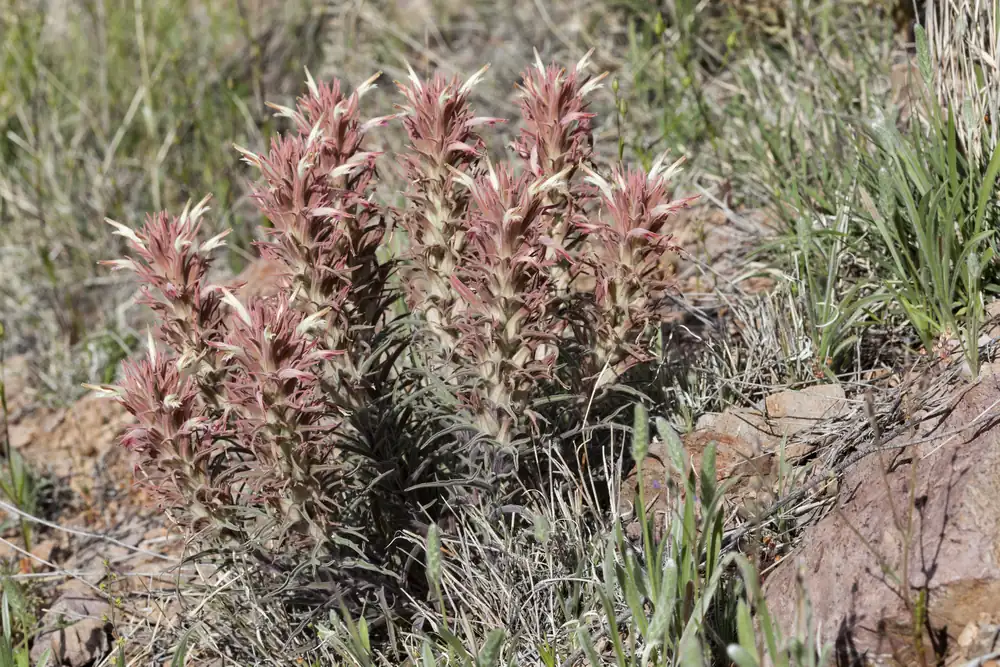
By May the burning season is over. The park service says the early-spring burns at Tallgrass Prairie National Preserve normally wrap up in April, which leaves a green, regrowing prairie by now. The same agency says calves are usually born in April or May, that they look reddish-tan next to the deep brown adults, and that cows are more protective of newborns. Down the ridge on dry western slopes the Kansas wildflower database lists downy paintbrush as a May and June flower, found in the western four-fifths of the state, which makes it a May find on rocky hills rather than in the tallgrass of the east.
-
Downy paintbrush
May and June · Dry prairies and rocky hillsides in the western four-fifths of the state
The flower spikes carry ten to twenty flowers, each backed by a green bract, in pale yellow, creamy white or pinkish purple on a plant only 4 to 12 inches tall. It is partly parasitic, drawing some of its food from the roots of neighboring plants.
-
Bison and calves at Tallgrass Prairie National Preserve
Calves are usually born in April or May · The backcountry trails near Strong City, open around the clock for walking
The preserve’s trails are open every day, all day, for walking only, and from May 1 the historic Lower Fox Creek schoolhouse on the grounds opens for visits each day. Keep well back from any bison, and especially from a cow with a calf.
-
Bison and elk at Maxwell Wildlife Refuge
Public tram tours were listed on the refuge’s site for Tuesdays and Saturdays at 10 a.m. · Maxwell, near Canton in the Smoky Hills
The refuge’s own site describes a 2,560-acre prairie with a free-roaming bison and elk herd. Its site lists adult tickets at $15 and children aged 4 to 11 at $7.50, with free cancellation up to 48 hours ahead, but fees and days change, so call the refuge at 620-628-4455 before driving.
-
Henslow’s sparrows and greater prairie-chickens
The Conservancy says both live on the preserve; Henslow’s is also a documented breeder at Tallgrass Prairie National Preserve · The Nature Conservancy’s Flint Hills Tallgrass Prairie Preserve near Cassoday
The 2,188-acre preserve is open from sunup to sundown all year, with trails of about half a mile, 2.5 miles and 4 miles. The Conservancy says both birds need large, healthy prairie, and that Topeka shiners, a small endangered minnow, live in its streams.
A pasture you saw blackened in April is a good “same place twice” page in the field journal. Our plain-word forecast shows wind and rain for planning a prairie walk.
Which frogs and toads call on warm May nights in Kansas?
The Fort Hays State atlas of Kansas amphibians and reptiles notes that frogs can chorus on any rainy night between February and September, that only males call, and that the spring peeper usually starts first each year. By May the early singers are quiet, and the late starters take over. The atlas species accounts give ranges of dates that observers have actually recorded, so treat them as typical windows, not schedules.
-
Woodhouse’s toad
March through August records; May is a peak month in the atlas · Sloughs and sandy lowlands across the state, usually the only toad on larger floodplains
Its call is written as a low, nasal “waaaaah.” The atlas records include 30 males calling at a sandpit lake in Cheyenne County on May 23, with tadpoles found there four days later, which shows how quickly this toad works once the water warms.
-
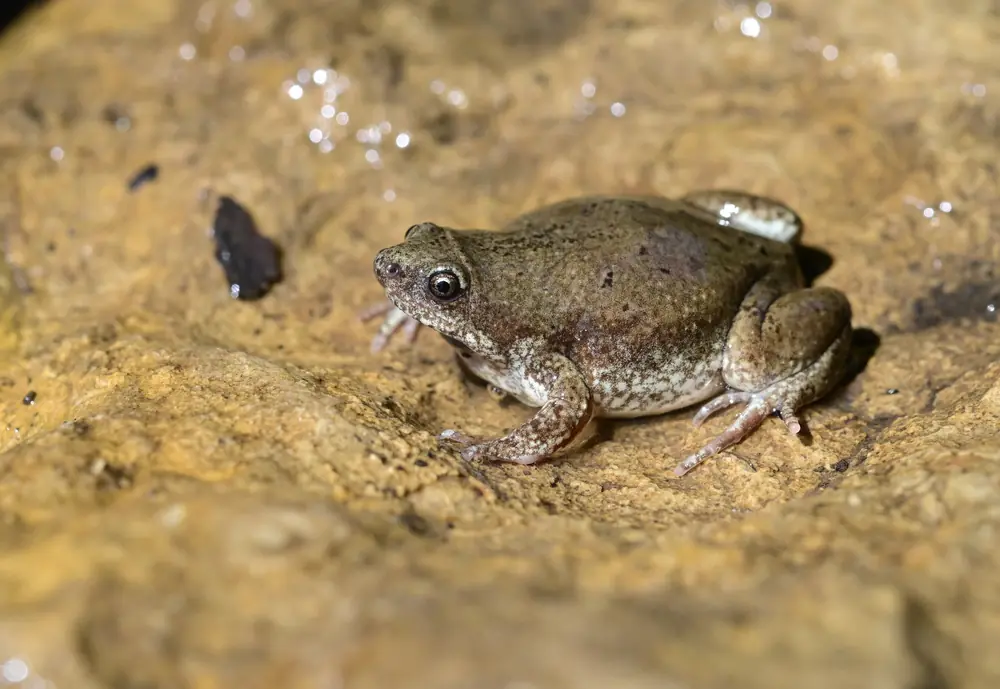
Great Plains narrow-mouthed toad
May through August, triggered by rain and warmth · Temporary pools in rocky uplands and open woodland edges across the eastern three-fourths of the state
The atlas says males chorus at night after rain with a call like the “metallic bleat of a sheep” that lasts one to five seconds. The toad hides under flat rocks by day and comes out mainly on humid or rainy nights when it is 62 to 77 degrees. Eggs hatch in about two days and tadpoles transform in 20 to 30 days.
-
American bullfrog
Breeding runs from late April to mid July · Permanent deep lakes, ponds, swamps and backwater sloughs; much less common in the western third
The call is a resonant, low “jug-o-rum,” heard day and night in late spring and summer. Tadpoles spend three to fourteen months in the water, so a pond that holds bullfrogs must hold water year round.
Record the date, the temperature and the weather in a Naturalist’s Field Journal. The sky cover forecast helps you pick a rainy, mild night to try.
Where can you help track monarchs and other pollinators in May?
May is when northbound monarchs arrive on the Great Plains, and the best way to follow them is to report what you see. Journey North collects volunteer reports of monarch eggs, caterpillars and adults, with a spring emphasis on first sightings, and posts them on a public map. Its page does not give a Kansas arrival date, so check the live map rather than any calendar. Monarch Watch, headquartered at the University of Kansas in Lawrence, offers a tagging program, advice on planting milkweed and nectar flowers as a waystation, and a drive to donate collected seed. The Quivira refuge’s species page also features the monarch as a pollinator with a long migration and recent declines.
For your own yard, the wildflower database lists butterfly milkweed as a June to August bloomer in the eastern two-thirds of the state, with a deep taproot that makes it hard to move but easy to start from seed. May is a good time to prepare the bed and order seed for the next season. The milkweed will not be in flower yet, but other May flowers such as spiderwort and evening primrose give early pollinators something to visit.
Is the last freeze of spring over in Kansas by May?
For nearly all of Kansas, yes. Look at the middle column: the typical final freeze arrived in April at six of the seven stations and on May 2 at Colby. Only the northwest and southwest tails reach deep into May: by May 15 at Colby, May 4 at Dodge City and May 2 at Concordia the last freeze has passed in all but one spring in ten, while Wichita, Topeka and Pittsburg reach that point between April 24 and 27. A freeze in the second half of May is therefore rare, but not unheard of in the High Plains.
Kansas State University’s Mesonet network posts a freeze monitor and daily rainfall totals for its stations. Freeze dates for your own town are on our Kansas frost page.
| Station | One year in ten | Median | Nine years in ten |
|---|---|---|---|
| Colby (northwest) | Apr 20 | May 2 | May 15 |
| Dodge City (southwest) | Apr 7 | Apr 21 | May 4 |
| Concordia (north-central) | Apr 3 | Apr 18 | May 2 |
| Salina (central) | Apr 3 | Apr 18 | May 1 |
| Wichita (south-central) | Mar 25 | Apr 11 | Apr 26 |
| Topeka (northeast) | Mar 29 | Apr 12 | Apr 27 |
| Pittsburg (southeast) | Mar 24 | Apr 7 | Apr 24 |
Tomatoes and peppers settle best after the “nine years in ten” date for your area. Keep a sheet or bucket ready if a clear, calm night follows a cold front in early May.
How warm is a Kansas May, and what weather should you watch?
NOAA’s 1991 to 2020 normals put May afternoons at about 74 to 78 degrees across five stations, with overnight lows from about 45 at Goodland to nearly 56 at Wichita. Rain is the story: Wichita and Topeka each average 5.17 inches in May, Concordia 4.34 inches, while Dodge City gets 2.99 and Goodland 2.81. Even Goodland still shows 0.3 inch of May snow in the normals, a reminder of the High Plains.
May is the center of Kansas severe weather. Forecasters at the Wichita weather office count an average of 81 Kansas tornadoes a year (1994 to 2023). Their longer records, which begin in 1950, put roughly 74 percent of the year’s tornadoes in April through June and about 85 percent between 2 and 10 p.m. Central Standard Time. Its tornado facts page, using records from 1950 to 2009, puts the peak of the year around May 22 and 23, with more than 160 tornadoes on those two dates in that period. That is a statement about the past, not a forecast. Large hail, damaging wind and flash floods go along with the storms. New 90-day temperature and rain maps from the Climate Prediction Center appear once a month, around mid month, on its outlook page.
| Station | Average high | Average low | Precipitation | Snowfall |
|---|---|---|---|---|
| Goodland (northwest) | 73.6 | 45.5 | 2.81 | 0.3 |
| Dodge City (southwest) | 78.3 | 51.2 | 2.99 | 0.0 |
| Concordia (north-central) | 74.8 | 52.2 | 4.34 | 0.0 |
| Wichita (south-central) | 77.5 | 55.9 | 5.17 | 0.0 |
| Topeka (northeast) | 76.4 | 55.0 | 5.17 | 0.0 |
When storms are forecast, know your shelter before the sky turns, and compare watches with our plain-word forecast.
How much daylight does Kansas gain in May?
Days still lengthen in May, though more slowly than in April. Between May 1 and May 31 the cities in the table gain between 47 and 53 minutes of sunlight, or about 1.6 to 1.8 minutes a day. Wichita’s sunrise on May 1 is at 6:34 a.m. CDT with sunset at 8:19 p.m.; by May 31 it is 6:10 a.m. and 8:45 p.m. (U.S. Naval Observatory). The bright afterglow, civil twilight, lasts until 8:48 p.m. on the first and 9:15 p.m. on the last day, and the sky is not fully dark until later. Four far-western counties (Sherman, Wallace, Greeley and Hamilton) follow Mountain time, an hour behind these.
| City | May 1 | May 31 | Gained | Per day |
|---|---|---|---|---|
| Goodland | 13 h 52 m | 14 h 44 m | 52 min | 1.7 min |
| Liberal | 13 h 44 m | 14 h 31 m | 47 min | 1.6 min |
| Hays | 13 h 50 m | 14 h 42 m | 52 min | 1.7 min |
| Salina | 13 h 50 m | 14 h 41 m | 51 min | 1.7 min |
| Wichita | 13 h 46 m | 14 h 35 m | 49 min | 1.6 min |
| Manhattan | 13 h 51 m | 14 h 44 m | 53 min | 1.8 min |
| Overland Park | 13 h 50 m | 14 h 43 m | 53 min | 1.8 min |
| Pittsburg | 13 h 45 m | 14 h 33 m | 48 min | 1.6 min |
For sunrise and sunset where you live, try our daylight calculator.
What can you see in the Kansas night sky in May?
Times below are Central daylight time, so subtract an hour in the four far-western counties that follow Mountain time. The new Moon on May 6 and the dark days around it are the best time for faint stars, and the calendar gives a rare extra: a full moon that earns a second name.
-
Eta Aquariid meteors, in an excellent year
Best on the mornings of May 5, 6 and 7 before dawn; the shower is active from about April 19 to May 28 · Look toward the east and southeast in the last two hours before the sky brightens
The American Meteor Society dates the peak to the night of May 5 to 6, with a thin 2 percent Moon that barely interferes. It expects roughly 10 to 30 shooting stars an hour in the last stretch before dawn anywhere north of the equator. SeaSky agrees that the showers are stronger in the Southern Hemisphere and says northern rates can reach about 30 an hour. Kansas sits well inside the northern range, so expect the lower end, perhaps one meteor every few minutes at best, in clear, dark conditions.
-
The Flower Moon, a seasonal Blue Moon
Full on Thursday, May 20 at 5:59 a.m. CDT (4:59 a.m. MDT); the evening of Wednesday, May 19 is the best one to watch · Rising in the east near dusk on May 19
Full Moon arrives at dawn on the 20th, which makes the evening of the 19th the best time to watch, since the Moon climbs up near sunset already looking full. Tradition calls May’s full Moon the Flower Moon. This one also earns a second name. Four full Moons fall inside astronomical spring this year, namely the 22nd of March, the 20th of April, the 20th of May and the 19th of June; by the older seasonal reckoning the third of those four takes the Blue Moon title. SeaSky lists it that way, while the newer rule, which wants a second full Moon inside a single calendar month, finds none this year. Either way, it will not look blue.
-
Mercury in the evening, then Venus and Saturn at dawn
Mercury is best from about May 12 to June 5, with greatest eastern elongation on Friday, May 28 (22.8 degrees from the Sun); Venus and Saturn pair up on the morning of May 7 · Mercury low in the west-northwest 45 to 90 minutes after sunset; Venus and Saturn very low in the east before sunrise
SeaSky advises looking low in the western sky just after sunset as Mercury reaches its greatest eastern elongation (about 23 degrees from the Sun) on May 28, and Mercury stays near that angle on May 27 as well. The 45-to-90-minute window is our own estimate. For the northern states it is the year’s best evening view of the planet. On the morning of May 7, Venus and Saturn pass within about a degree of one another in Pisces, hugging the eastern horizon. That pairing is our own computation, and it calls for a flat horizon and binoculars, so count it as a bonus and not a promise.
-
Jupiter and Mars with the Moon
The first-quarter Moon is near Jupiter on the evening of May 12 and near Mars on May 13 · High in the southwest to west in the evening
Jupiter is the bright steady light high in the evening sky, and Mars is fainter and orange. We worked these Moon positions out ourselves, so enjoy them as a pleasant evening pairing and not an event.
-
The Milky Way’s core before dawn
Roughly May 1 to 14 and May 25 to 31 in our computed windows for 40 degrees north · Low in the south before the sky begins to brighten
The brightest part of the Milky Way begins to be well placed in the dark pre-dawn hours around the new Moon of May 6. These windows come from our own calculation, not a published schedule: they mark nights when the core clears the horizon by a good margin in full darkness with no Moon in the sky. We ran them for a latitude a little north of Kansas, so allow a day either way.
| Phase | Date | Time |
|---|---|---|
| New moon | Thursday, May 6 | 5:58 a.m. CDT (4:58 a.m. MDT) |
| First quarter | Wednesday, May 12 | 11:44 p.m. CDT (10:44 p.m. MDT) |
| Full moon, the Flower Moon (a seasonal Blue Moon) | Thursday, May 20 | 5:59 a.m. CDT (4:59 a.m. MDT) |
| Last quarter | Friday, May 28 | 8:58 a.m. CDT (7:58 a.m. MDT) |
Clear nights show up on our sky cover forecast, and each date’s moonrise is on the moon calendar.
What nature events and programs are on in Kansas in May 2027?
Only a few spring events have posted 2027 dates yet, and storms reschedule outdoor programs, so confirm each with the organizer before you drive.
- City Nature Challenge: the organizer’s page lists April 30 through May 3 for photographing and recording wild plants and animals, May 4 through 16 for uploading and identifying, and May 20 for the results announcement. The page did not name any Kansas city as a participant, so check the challenge’s list of cities before you plan.
- World Migratory Bird Day: the organizer’s page showed only the 2026 dates (May 9 and October 10) and the 2026 theme, so look for the 2027 dates when they are posted and use the day for an eBird count anywhere.
- Memorial Day, Monday, May 31: the federal holiday falls on the last Monday of May, and many parks and refuges are busy, so go early.
- Kansas Wetlands Education Center: its bird-watching page says the center’s main season runs April 1 to October 31, and its Wings and Wetlands Birding Festival is “a biannual event, held in late April or early May.” The center’s page showed no 2027 date when we read it, so ask before planning a trip around the festival.
- Maxwell Wildlife Refuge tram tours: the refuge’s site listed public tours on Tuesdays and Saturdays at 10 a.m., with free cancellation up to 48 hours ahead; confirm the 2027 schedule.
- Monarch Watch and Journey North: volunteers report sightings, tag butterflies in the right season and collect milkweed seed (see the monarch section above).
- Citizen science: log your sightings in eBird, frog and toad records through the Kansas Herpetofaunal Atlas, and flowers and insects on iNaturalist.
The full list of states and months sits on the nature page, and April in Kansas covers the shorebird peak and the burning season.
Safety notes for May in Kansas
- Spring turkey season: the Kansas Department of Wildlife and Parks lists a projected 2027 regular spring turkey season of April 14 through May 31, with hunters in the woods at dawn. The agency’s own pages would not open for our automated reader, so we could not confirm that the dates are final or whether any hunter-orange rule applies; check the agency’s turkey page and regulations before you hike in the early morning, and wear bright clothing in wooded areas.
- Severe weather: May is the center of tornado season, and the National Weather Service in Wichita says the peak hours are 2 to 10 p.m. Fast-moving storms can also bring large hail, high wind and flash floods. Low-water crossings can fill fast, so turn around instead of testing a flooded road.
- Young animals: a fawn lying still in the grass or a fledgling hopping on the ground is usually not abandoned. Leave it alone, keep dogs back and do not move it. Killdeer, avocets, stilts and snowy plovers nest on open ground, so stay on roads and signed trails around wetlands.
- Bison: cows are protective of their calves, which are usually born in April or May. Keep far back, stay on the trail and never approach for a photograph.
- Ticks and mosquitoes: ticks are active in grass and brush by May, and mosquitoes are common after rain. Dress in light colors, apply an EPA-registered repellent to skin, treat clothing but never skin with permethrin, and look for ticks when you get home.
- Heat and sun: afternoons climb into the upper 70s on average and can run much hotter, with little shade on the prairie. Carry water and a hat.
Sources (43)
- Kansas Wetlands Education Center: bird sightings archive
- Kansas Wetlands Education Center: 2025 bird sightings
- Kansas Wetlands Education Center: 2024 bird sightings
- Kansas Wetlands Education Center: recent bird sightings, May 13, 2025
- Kansas Wetlands Education Center: recent bird sightings, May 30, 2025
- Kansas Wetlands Education Center: recent bird sightings, May 15, 2024
- Kansas Wetlands Education Center: bird watching
- U.S. Fish and Wildlife Service: Quivira National Wildlife Refuge
- U.S. Fish and Wildlife Service: Quivira refuge species
- U.S. Fish and Wildlife Service: Flint Hills National Wildlife Refuge
- National Park Service: Tallgrass Prairie National Preserve, basic information
- National Park Service: fire and grazing in the prairie
- National Park Service: birds at Tallgrass Prairie
- The Nature Conservancy: Flint Hills Tallgrass Prairie Preserve
- Maxwell Wildlife Refuge (tours, tickets, acreage)
- Kansas Wildflowers and Grasses: prairie phlox
- Kansas Wildflowers and Grasses: common spiderwort
- Kansas Wildflowers and Grasses: Missouri evening primrose
- Kansas Wildflowers and Grasses: blue wild indigo
- Kansas Wildflowers and Grasses: downy paintbrush
- Kansas Wildflowers and Grasses: purple coneflower
- Kansas Wildflowers and Grasses: leadplant
- Kansas Wildflowers and Grasses: butterfly milkweed
- Kansas Herpetofaunal Atlas: chorusing phenology
- Center for North American Herpetology: Woodhouse’s toad in Kansas
- Center for North American Herpetology: Great Plains narrow-mouthed toad in Kansas
- Center for North American Herpetology: American bullfrog in Kansas
- Journey North: monarch butterflies
- Monarch Watch (University of Kansas)
- Kansas Mesonet (Kansas State University)
- National Weather Service Wichita: Kansas tornado climatology
- National Weather Service Wichita: Kansas tornado facts
- NOAA NCEI: 1991-2020 monthly normals, five Kansas stations
- NOAA Climate Prediction Center: 90-day outlooks
- City Nature Challenge 2027
- World Migratory Bird Day
- U.S. Naval Observatory: moon phases, May 2027
- U.S. Naval Observatory: Wichita sunrise and sunset, May 1, 2027
- U.S. Naval Observatory: Wichita sunrise and sunset, May 31, 2027
- SeaSky: astronomy calendar 2027
- American Meteor Society: 2027 meteor shower calendar
- Kansas Department of Wildlife and Parks: spring turkey season dates (When to Hunt; projected 2027)
- Photos via Wikimedia Commons; licenses and photographers are credited under each picture