What to look for in nature in Kansas this March
March is the month Kansas changes its mind. Sandhill cranes stream north over the wheat fields early in the month, and the rare whooping cranes make brief stops at Cheyenne Bottoms and Quivira. Snow geese and ducks crowd the open pools, and toward the end of the month greater prairie-chickens begin to boom before dawn on the Flint Hills. The same hills are lit by prescribed burns, woodcocks sky-dance over park edges at dusk, and the first peepers, salamanders and wildflowers follow the rain. The day lengthens by about an hour and a quarter, clocks spring forward on the 14th, and the equinox arrives on the 20th. A freeze is still normal, so every date below comes with its source.
Other months in Kansas: October, November, December, January, February, April.
Start here
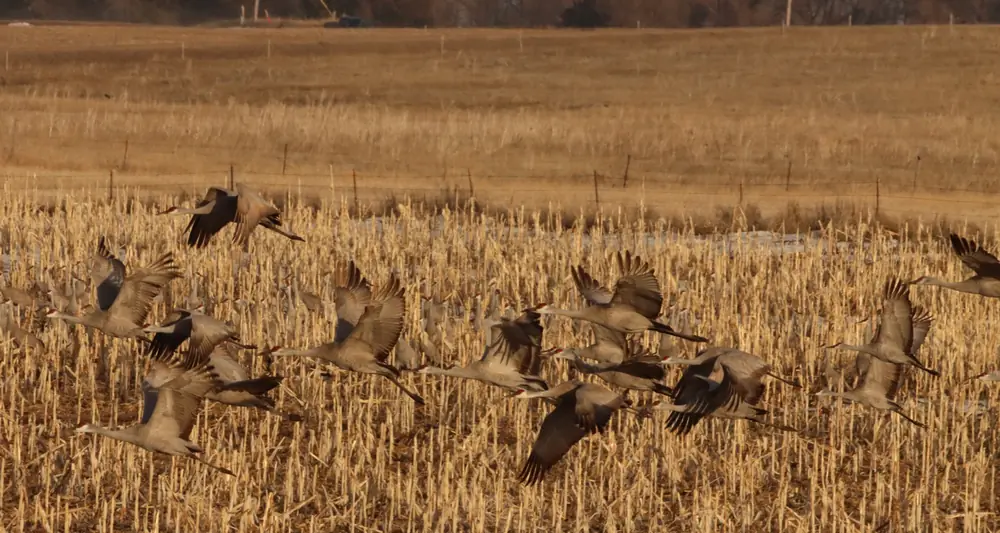
- Listen for cranes. On a calm, mild morning in the first half of March, stand beside a wheat field or wetland near Cheyenne Bottoms or Quivira and listen for a rolling, wooden bugle from high overhead. Then look up for long wavering lines of gray birds.
- Go to a woodcock walk at dusk. Wichita Audubon’s Wednesday, March 10 walk in Chisholm Creek Park meets at 6:30 p.m. Stand quietly at the edge of an open field as light fades and listen for a buzzy peent, then a twittering spiral above you.
- Find the first flower in the east. On a creek bank or woodland edge in eastern Kansas, look for the pale nodding blooms of a prairie fawn-lily or the white petals of a bloodroot, and note the date you find the first one.
Keep a record of it: on “birds I have seen,” log each crane, goose and shorebird with the date, and a first killdeer or meadowlark song. Put the night the peepers first sing, and the first woodcock buzz at dusk, on “a map of sounds,” noting the temperature and any rain. Use “the same place twice” for a prairie pasture before and after a burn, and the “daily field log” for the first flower and the last freeze of your own town.
Regions used below: Northwest Kansas and the High Plains; Southwest Kansas; North-central Kansas and the Smoky Hills; Central Kansas and the Great Bend wetlands; South-central Kansas, Wichita and the Red Hills; The Flint Hills; Northeast Kansas, Topeka and Kansas City; Southeast Kansas.
When do cranes, snow geese and other waterfowl pass through the Kansas wetlands in March?
March is when the biggest bird story of the Kansas year turns around. In fall the whooping cranes pass quietly in late October and November; in spring, the wetland staff at Cheyenne Bottoms call March the prime time to catch them. Sandhill cranes have been moving north since February, and by the second half of March their numbers thin while the rarer birds take their turn. Waterfowl dominate the central wetlands early in the month, and the same staff rate March among the best months to watch them. Cold snaps close the pools with ice and warm days open them again, so the mix changes by the week.
-
Sandhill cranes, thinning out
Large flocks in early March; fewer by the last third of the month · Fields and wetlands around Cheyenne Bottoms and Quivira
The center’s March 8, 2022 report described thousands of sandhills feeding most days in crop fields just north of Quivira. By March 22 the staff wrote that groups were still passing but numbers would begin to dwindle, and a March 21, 2024 report said most of that year’s sandhills had already gone north. Think of a window, not a date: the first half of March is the better bet, and a warm winter shifts everything earlier.
-
Whooping cranes, a short stop
Reported March 14 to 27 in recent springs · Cheyenne Bottoms pools and the salt marshes at Quivira
The center’s whooper-watch log shows a typical spring. In 2022, whooping cranes were in Pool 3B at Cheyenne Bottoms on March 17 and stayed several days, and a group of 19 stood along NE 170th Road at Quivira on March 26. In 2024, ten stopped in Pool 2 on March 14 and left early the next morning, and 16 were in the Little Salt Marsh at Quivira on March 27. Staff say these birds do not usually linger in spring, so a few days in one place is normal.
-
Snow geese heading out
Large numbers into early March; most gone by late March in an early year · Cheyenne Bottoms and Quivira
The center’s March 1, 2021 report said varying numbers of snow geese each day suggested birds were arriving and leaving at the same time. On March 22, 2022, they were still around but expected to leave soon. In 2024, with arrivals running two to three weeks early, most were gone by March 21. Ross’s, cackling and greater white-fronted geese travel in the same mixed flocks.
-
Ducks, pelicans and gulls
All month · Open pools at Cheyenne Bottoms, Quivira and reservoirs
In early March 2022, northern pintails outnumbered every other duck at the Bottoms. The 2021 report logged the first American white pelicans a few days before March 1, and the report written on March 2, 2026 said ducks were the main group present, with over 90 species logged in the previous couple of weeks.
-
The first shorebirds
From late winter; larger numbers in April and May · Mudflats and shallow pools
In 2022 the first killdeer turned up in the center’s parking lot on March 1, and greater yellowlegs were on the mudflats of Pool 1c within two weeks. Quivira says shorebirds begin appearing as early as February and that by May thousands crowd the Big Salt Marsh. The center’s 2022 reports expected the migration to build through April and peak around the end of April and early May.
Whooping cranes are federally endangered. Stay in the car, use binoculars or a scope, and keep your voice down. Check the center’s whooper-watch page and the refuge’s report before a long drive, and send your sighting to eBird. Water levels at the Bottoms change from year to year, and some spring reports described mostly dry pools, so read the newest sightings post first. The light goose conservation order in the safety section keeps hunters in the marshes through April 30.
When do greater prairie-chickens start booming in the Flint Hills?
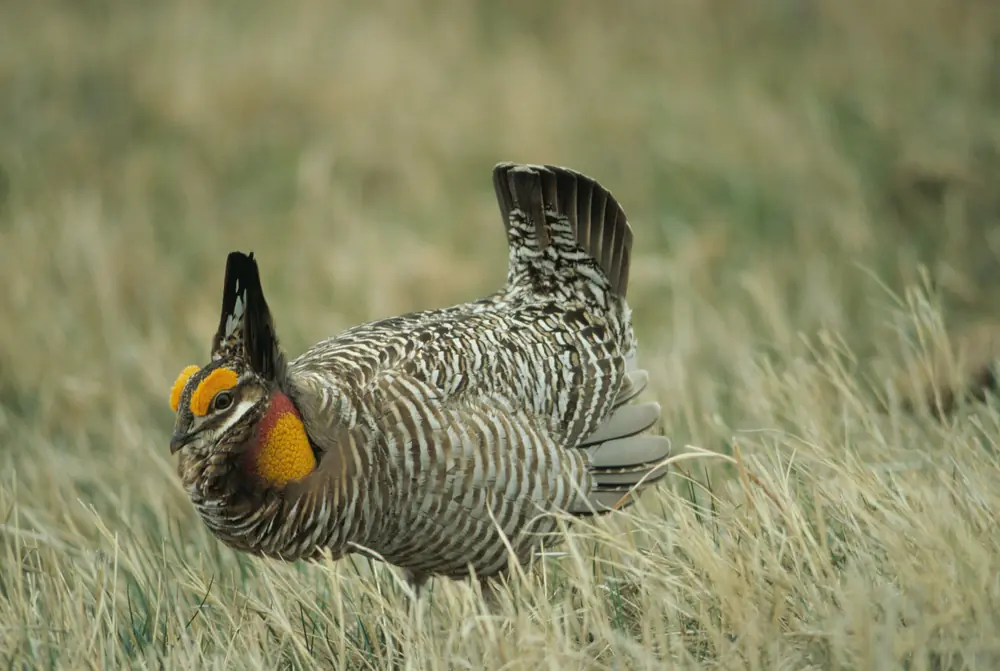
Near the end of March, before the sun is up, the tallgrass prairie begins to hum. Male greater prairie-chickens gather on short-grass booming grounds called leks, inflate orange throat sacs and stamp their feet. The Cornell Lab of Ornithology says leks of this species are booming from late March to early May. Tours in the Flint Hills and at Cheyenne Bottoms make this one of the easiest Kansas spectacles to join.
-
What you will see and hear
Starts before dawn; best in the first hours of light · Short, open ground on ridges and burned pastures
Cornell describes a chorus of males that sounds like wind through trees, even though no trees stand near the lek. Males begin booming in pre-dawn darkness, rush at one another, and run along invisible territorial lines. When females arrive, the males step up the show with flutter jumps several feet into the air, along with whoops, cackles and whines. Kansas organizers describe the same performance with words like gobbling, foot stomping, head bobbing and wing spreading.
-
Guided blinds
Annual programs; usually late March through April · Cheyenne Bottoms, Konza Prairie near Manhattan, and the Flint Hills Discovery Center
Most people watch from a blind with a guide, so the birds are not spooked. The Kansas Wetlands Education Center has run lek tours from a trailer blind, meeting before dawn, in past springs, and Konza Prairie has offered morning blind visits. Cornell’s 2022 article says the Flint Hills Discovery Center in Manhattan offers tours from mid-March through late April. Prices, days and reservation rules change. Ask each organizer for the 2027 schedule and book early.
Never walk up to a lek, and do not drive slowly past one at dawn with the engine running. A booming ground is a mating site, and a few disturbed mornings can push males off it for the season.
Which Kansas birds are nesting or displaying in March?
Spring does not wait for the migrants. Several of the state’s year-round birds and early arrivals are already busy by the middle of the month, and most of them are easier to find than a lek or a crane.
-
American woodcock
Early spring evenings, just after dark falls · Damp edges of parks, thickets and old fields
Wichita Audubon calls the woodcock’s courtship display unique and says it happens on early spring evenings. Its 2026 to 2027 schedule has a walk for Wednesday, March 10 at 6:30 p.m. in Chisholm Creek Park, timed to catch the birds just as it gets dark. Listen for a nasal buzz from the ground, then for wings twittering high above you.
-
Western meadowlark
Males singing from posts by mid-spring · Pastures, roadsides and hayfields
The Great Plains Nature Center says males sing from fence posts to hold a territory that averages about seven acres. The song is complex and abrupt, and the bird also gives short, buzzy calls. Schoolchildren chose it as the state bird in a vote the nature center dates to 1925.
-
Killdeer
Nest scrapes appear in spring · Gravel roads, parking lots and bare fields
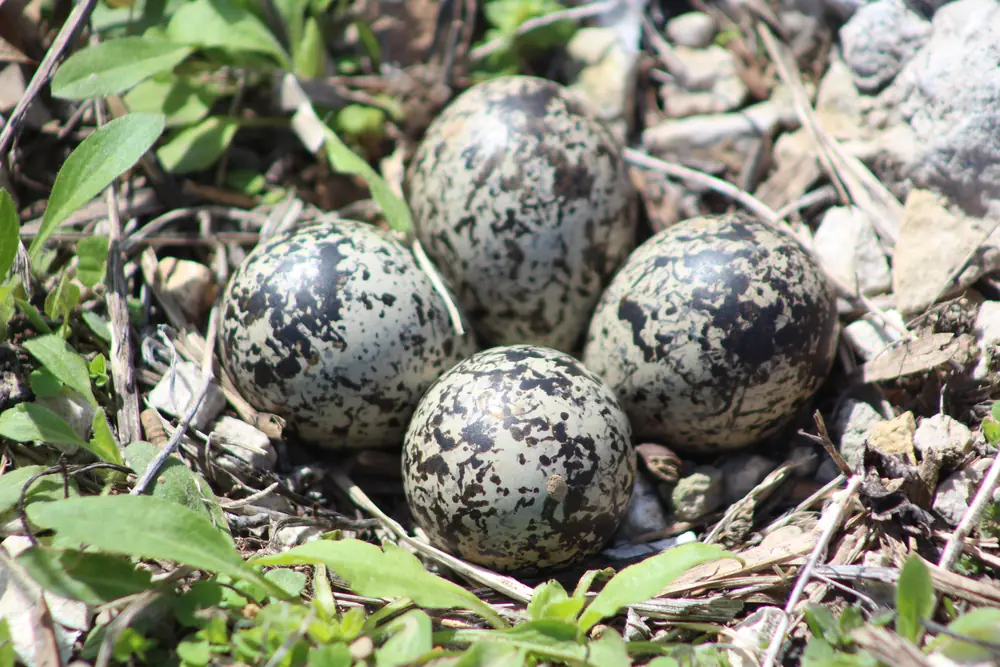
The nature center notes that killdeer prefer gravel for a nest and are often found nesting along roads. An adult that drags one wing and cries as you walk by is luring you away from a nest or chicks. Step back and go around.
-
Canada geese
Nest building from about mid-March · Ponds, lakes and golf courses
The nature center says nest building can begin as early as mid-March, with the female sitting on four to seven eggs for 25 to 30 days. The gander defends the nest hard until the goslings hatch, so give a pair on a mound a wide berth.
-
Bald eagles with eggs or young
Hatching from about mid-March into April, by the arithmetic of the sources · Cottonwoods and sycamores along rivers and reservoirs
Friends of the Kaw say most Kansas eggs are laid in February and that incubation takes slightly over a month, which by simple arithmetic puts hatching in the second half of March and early April. Northern eagles that wintered here start home in mid to late March.
-
Great horned owlets
Chicks in the nest all month · Old stick nests in cottonwoods and shelterbelts
The Great Plains Nature Center gives 28 days of incubation and about 35 days from hatching to leaving the nest. Eggs laid in late January hatch in late February, so by March owlets are big and fuzzy and start branching out as April nears.
Federal law protects eagles and owls, and a nest with young is the wrong place for a close-up. Observe from the roadside with binoculars, and back off the moment a parent begins calling or swoops low.
Which frogs and salamanders move on rainy March nights in Kansas?
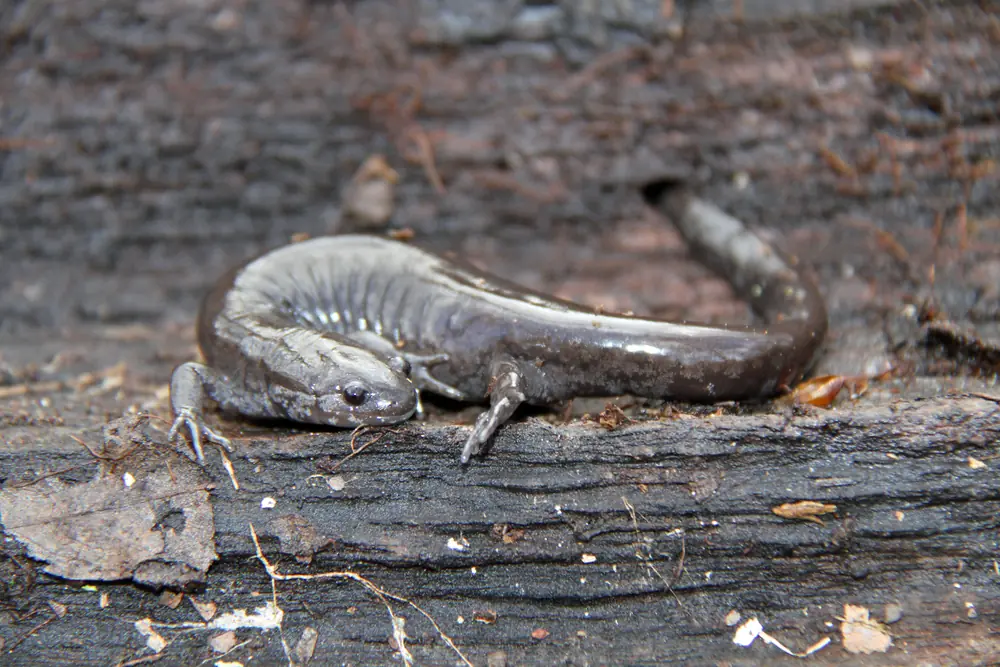
February’s trills belong to the chorus frogs. March brings a second wave of amphibians that need warmth and soaking rain more than a date. Fort Hays State University’s Kansas Herpetofaunal Atlas says any rainy night from February to September can set off a chorus in one or more of the state’s 21 frog species, and that only males call.
-
Spring peeper
Chorus records March 12 to May 1; most activity about March 2 to April 11 · Wet woods and small ponds in the far eastern counties
The atlas calls this tiny frog the first one heard in Kansas each year. In the state it is confined to the eastern border south of Johnson County, with records from Atchison, Bourbon, Cherokee, Crawford, Johnson, Leavenworth and Linn counties. Males sing a short, high peep from sedges and grass just above the water, and have been recorded calling at air temperatures from the low 50s to 67 degrees.
-
Small-mouthed salamander
Migration after rain from mid-January to early April · Bottomland woods and prairies from the Missouri River bluffs south and west through the Flint Hills
The atlas says these four-to-five-inch salamanders cross roads in large numbers on rainy spring nights on their way to breeding ponds, and counts 567 records in Douglas County alone. Most of the year they hide under logs, leaves and thatch, so a wet night is the time you are likely to see one.
-
Western tiger salamander
Breeding follows rain from December to March · Ponds, ditches and backwater pools, mostly west of the Flint Hills
The atlas calls this the only salamander in the western half of Kansas. Adults are 6 to 8½ inches long, spend much of their lives in burrows, and surface on rainy nights to hunt. Tallgrass Prairie National Preserve also lists a tiger salamander on its amphibian survey list.
-
Plains leopard frog
First records about March 9; breeding peaks April 14 to June 13 · Nearly any pond, creek or flooded ditch
Its call is two to four guttural notes, like a short, rough chuckle. The atlas shows records from March 9 through the end of August, so a leopard frog in the roadside water on a warm March afternoon is not a surprise.
On a wet road, slow down or choose another route. The atlas takes public sightings, and a note of the date, temperature and species is useful.
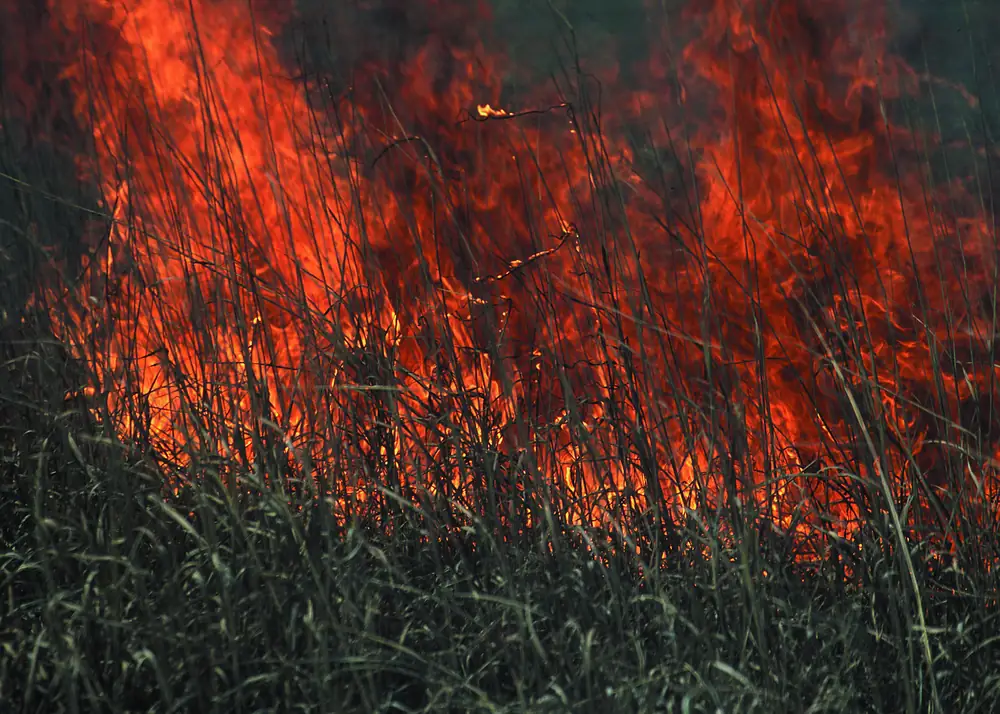
Why is the Flint Hills prairie on fire in March and April?
Because the burning is deliberate, and it is how the tallgrass prairie stays a prairie. The Kansas Department of Health and Environment calls March and April the peak of prescribed burning on Kansas rangeland, mostly in the Flint Hills. Ranchers and land managers use fire to hold the prairie together, push back eastern red cedar and other invaders, and grow better forage for cattle. The department puts the area burned in an average year at about 2.2 million acres across the Flint Hills of Kansas and Oklahoma.
-
What a burn does
Late winter through April, on days with the right wind · Pastures and prairie across the Flint Hills
The National Park Service explains the effect at Tallgrass Prairie National Preserve: fire turns dead plant material and tied-up nutrients to ash within seconds, the heat kills trees and shrubs with exposed stems, and the sun then warms the blackened ground and wakes dormant plants. A burned pasture looks like a black scar for a few days, then starts to turn green.
-
Smoke and air quality
Daily forecasts during the burning season · Downwind towns, including Wichita, Topeka and Kansas City
State air-quality staff switch on a smoke-modeling tool in early March. The state’s Flint Hills smoke website posts a daily forecast map and shows burners where smoke from a planned fire would travel. KDHE advises vulnerable people to stay indoors on heavy smoke days, healthy people to limit hard exercise outside, and everyone to keep windows closed and run filtered air.
-
Permits and the April rule
County by county · Every Kansas county
The state’s burn-information page says Kansas has no single statewide burn permit. Instead, counties require either a permit or a call to dispatch or emergency management before a fire, and several ban burning during red flag warnings or high-wind advisories. The same site lists an April burning-restrictions regulation and a plain-language FAQ, so anyone planning a debris or brush fire should read it and ask their county first.
If you drive through smoke, slow down, turn on your headlights and do not stop on the road. Where the burning happens in a given week depends on wind and humidity, so the pattern moves around the Hills from day to day.
What blooms in Kansas in March?
The first flowers are small, close to the ground and mostly in the eastern third of the state, where creek bottoms and woods warm earliest. The Kansas Wildflowers and Grasses database lists the months each plant flowers and where in the state it grows, and the plants below all show March in their bloom period. Plan on the earliest blooms in a warm spring and later ones in a cold one.
-
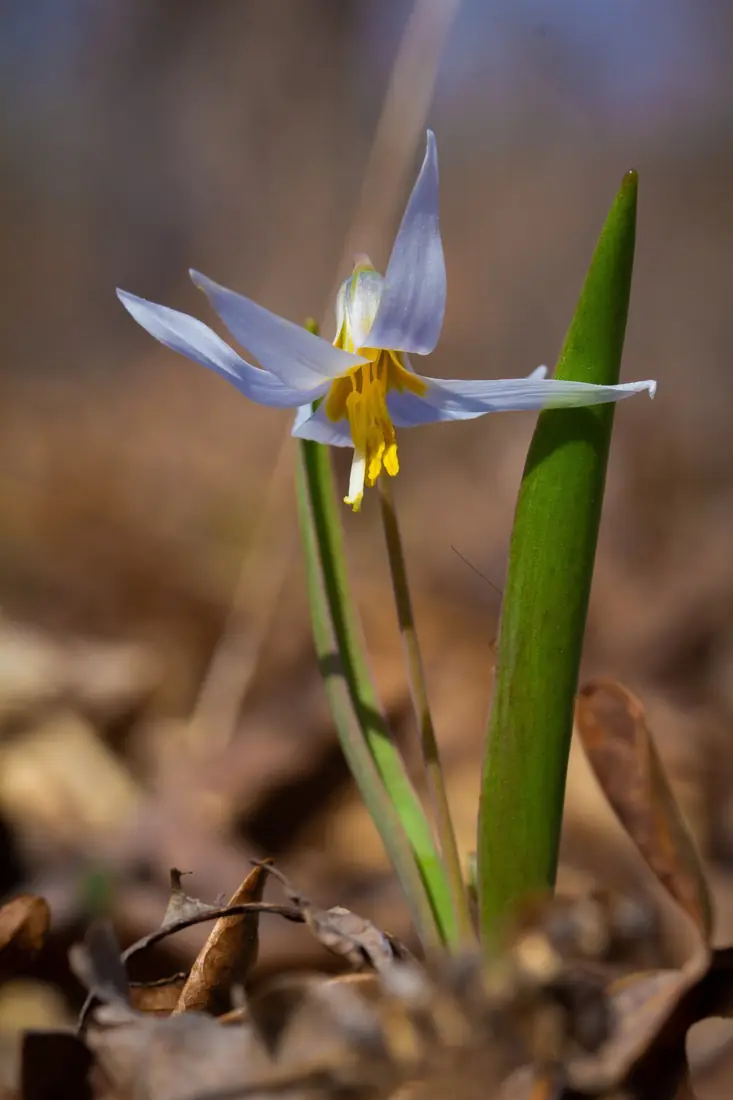
Prairie fawn-lily
Bloom listed as March and April · Tallgrass prairie and open oak-hickory woods, mainly the eastern third
A single white flower with six petal-like parts and a yellow spot at the base nods from a leafless stalk beside narrow, bluish-green leaves. The species name, Erythronium mesochoreum, alludes to its range in the middle of the continent. Look for it in prairie openings in the eastern counties.
-
Bloodroot
March and April · Rich forests and floodplain woods in the eastern third
Each leaf wraps around its flower bud and then lets it rise on a bare stalk. According to the database, the white flowers close at night and open again the next morning, so a late-morning visit finds them widest.
-
Virginia spring beauty
March to May · Moist, rich woods in the eastern half
In the database’s notes, this is among the first wildflowers to open each spring. White to rose flowers with pink or purple veins hang in a loose cluster above two narrow leaves, a few inches off the ground.
-
Eastern redbud
March and April · Stream banks, woodland borders and roadsides in the eastern half
Rose-pink flowers cover bare branches before the leaves unfold. The database notes that the Kiowa saw the blossoms as a sign of spring and put flowering branches in their homes to drive away winter.
-
American plum
March and April · Throughout Kansas, in thickets along fences and creeks
Wild plum forms dense thickets that turn white with blossom, and the sweet fruit follows in August or September.
Please leave these plants where they grow. Many take years to flower from seed, and picking a spring beauty or a fawn-lily usually kills the plant above ground for the year.
When is the last spring freeze in Kansas?
Later than the first warm days suggest. At the seven stations below, the median last freeze falls between April 7 and May 2, so a freeze in March is normal everywhere in the state, and a freeze in early April is normal over much of it. Southeast Kansas clears first, the High Plains last. In about one spring in ten, the last freeze comes as early as March 24 at Pittsburg or March 25 at Wichita, but in the other nine, a cold night remains possible well into April, and even into May near Colby.
For a vegetable garden, that is a reason to wait for your own town’s date and watch the forecast rather than the calendar. A tender seedling set out on a warm March afternoon can still meet a hard freeze.
| Station | One year in ten | Median | Nine years in ten |
|---|---|---|---|
| Colby (northwest) | Apr 20 | May 2 | May 15 |
| Dodge City (southwest) | Apr 7 | Apr 21 | May 4 |
| Concordia (north-central) | Apr 3 | Apr 18 | May 2 |
| Salina (central) | Apr 3 | Apr 18 | May 1 |
| Wichita (south-central) | Mar 25 | Apr 11 | Apr 26 |
| Topeka (northeast) | Mar 29 | Apr 12 | Apr 27 |
| Pittsburg (southeast) | Mar 24 | Apr 7 | Apr 24 |
Our Kansas frost dates page lists first and last freeze dates for far more towns than this table.
How warm is a Kansas March, and what weather should you watch?
March warms quickly. In NOAA’s 1991 to 2020 normals for five long-running stations, March afternoons average roughly 55 to 60 degrees, and nights range from the mid 20s at Goodland to the mid 30s at Wichita. Precipitation climbs at every station compared with February, with Wichita and Topeka averaging a little over two inches. Goodland is the driest at 0.88 inch but has the most snow, 4.8 inches; Concordia and Topeka average under 2 inches.
The month also swings hard. A published Kansas climate summary notes frequent severe thunderstorms when cold northern air meets warm Gulf moisture, and that from 1991 to 2010 the state averaged nearly 100 tornadoes a year. Kansas and Missouri hold a Severe Weather Preparedness Week in early March with a statewide tornado drill; in 2026 it ran March 2 to 6, though that year’s drill was cancelled for weather. The National Weather Service posts each year’s dates, and 2027’s were not out when this page was written. Strong wind over dry grass is the other worry: the winds that carry prescribed burns can also spread a wildfire. For the latest seasonal temperature and precipitation maps, see NOAA’s 90-day outlook page, updated monthly.
| Station | Average high | Average low | Precipitation | Snowfall |
|---|---|---|---|---|
| Goodland (northwest) | 56.3 | 26.5 | 0.88 | 4.8 |
| Dodge City (southwest) | 59.6 | 31.3 | 1.35 | 3.7 |
| Concordia (north-central) | 55.4 | 31.7 | 1.53 | 1.6 |
| Wichita (south-central) | 59.1 | 35.7 | 2.30 | 2.1 |
| Topeka (northeast) | 57.1 | 34.1 | 2.25 | 1.7 |
For the next storm or warm spell, our forecast in plain words is a quick check.
How much daylight does Kansas gain in March?
March has the fastest daylight gain of the year in Kansas. Between March 1 and March 31, each city in the table adds between 71 and 78 minutes of sunlight, or about two and a half minutes more every day. Goodland gains the most, 78 minutes, and Liberal the least, 71, though the order of the longest day flips along the way: Pittsburg and Liberal start the month with the most daylight, at 11 hours 23 minutes, and Goodland ends it with the most, at 12 hours 37 minutes. The equinox on Saturday, March 20 is the day the Sun is above the horizon for close to 12 hours everywhere.
The clock change is the bigger jolt. Kansas clocks leap from 2 a.m. to 3 a.m. on the morning of Sunday, March 14. In Wichita, the sun sets at 6:35 p.m. CST on Saturday, March 13, and at 7:36 p.m. CDT the next day; sunrise leaps from 6:44 a.m. CST to 7:42 a.m. CDT. So after the 14th, evening is bright an hour longer on the clock and the early morning is darker. Counties on Mountain time, including Sherman, Wallace, Greeley and Hamilton, follow the same change, and their clocks read an hour earlier than Central time throughout.
| City | Mar 1 | Mar 31 | Gained | Per day |
|---|---|---|---|---|
| Goodland | 11 h 19 m | 12 h 37 m | 78 min | 2.6 min |
| Liberal | 11 h 23 m | 12 h 34 m | 71 min | 2.4 min |
| Hays | 11 h 20 m | 12 h 36 m | 76 min | 2.5 min |
| Salina | 11 h 20 m | 12 h 36 m | 76 min | 2.5 min |
| Wichita | 11 h 22 m | 12 h 35 m | 73 min | 2.4 min |
| Manhattan | 11 h 20 m | 12 h 36 m | 76 min | 2.5 min |
| Overland Park | 11 h 20 m | 12 h 36 m | 76 min | 2.5 min |
| Pittsburg | 11 h 23 m | 12 h 35 m | 72 min | 2.4 min |
Our daylight calculator gives times for any town you type in.
What can you see in the Kansas night sky in March?
March is the month the evening sky stretches. Times below are Central. In the four Mountain-time counties (Sherman, Wallace, Greeley and Hamilton), take an hour off. The clock change falls on Sunday, March 14, so the March 8 new moon is listed in standard time and everything after it in daylight time. Moonless evenings around the 8th are the best of the month for faint stars.
-
The equinox and the Worm Moon
Equinox Saturday, March 20 at 3:25 p.m. CDT (2:25 p.m. MDT); Moon full at 5:44 a.m. CDT, Monday, March 22 · Moonrise in the east around dusk on Sunday, March 21
The Sun crosses the equator heading north on the afternoon of the 20th, which is the moment spring begins by the calendar of the seasons. The full Moon lands before dawn on the 22nd, so watch the evening before: at Wichita the Moon rises at 7:14 p.m. on March 21, about half an hour ahead of the 7:42 p.m. sunset. One almanac site says the Worm Moon is named for earthworms surfacing as the ground softens, and lists Crow Moon and Sap Moon as other names.
-
Mercury in the morning
Best from about March 8 to 25; farthest from the Sun on the night of March 16 to 17 · Low in the east-southeast before sunrise
Mercury reaches its greatest western elongation of 27.6 degrees on March 17 in Universal Time, equal to the late evening of the 16th in Kansas. A spring morning is a shallow angle for northern viewers, so the planet stays low; by planetarium-software calculations, you can expect it to clear the horizon roughly an hour ahead of sunrise through mid-March. Pick a flat eastern horizon and bring binoculars.
-
Venus and a thin crescent
Mornings of March 4 and 5 · Southeast, before dawn
Venus is still a brilliant morning star. On March 4 and 5, a thin waning crescent Moon passes about 2 degrees from it, an easy photograph with a phone braced on a post.
-
Jupiter and Mars in the evening
Moon beside Jupiter on March 18 and 19; Mars and Jupiter about 4 degrees apart on March 30 · High in the south and southwest after dark
Jupiter outshines every star in the evening sky and sits near the Leo and Cancer border. A Moon about 88 percent lit glides past it as the 18th turns into the 19th, so both evenings show the pair. On the evening of March 30, orange Mars stands 4.3 degrees from Jupiter, both high overhead at about 8 p.m. These positions come from our own calculations with standard astronomy software rather than an agency table, so treat the dates as approximate.
-
Saturn’s farewell
First days of March · Low in the west just after sunset
Saturn is lost in dusk light by mid-March, with its solar conjunction due April 7. Try the first few evenings of March, with binoculars and a clear western horizon.
| Phase | Date | Time |
|---|---|---|
| New moon | Monday, Mar 8 | 3:29 a.m. CST (2:29 a.m. MST) |
| First quarter | Monday, Mar 15 | 11:25 a.m. CDT (10:25 a.m. MDT) |
| Full moon, the Worm Moon | Monday, Mar 22 | 5:44 a.m. CDT (4:44 a.m. MDT) |
| Last quarter | Monday, Mar 29 | 7:54 p.m. CDT (6:54 p.m. MDT) |
For a clear-sky check, open the sky cover forecast; each night’s moonrise is on the moon calendar.
What nature events and programs are on in Kansas in March 2027?
The dated items below come from the organizer’s own 2027 listing. Check with the organizer before you go, because bad weather moves outdoor events.
- Saturday, March 6, 8 a.m.: Chaplin Nature Center’s monthly bird walk near Arkansas City, about an hour and a half, weather permitting, from the visitor center (Wichita Audubon’s 2026 to 2027 schedule).
- Wednesday, March 10, 6:30 p.m.: woodcocks in Chisholm Creek Park. Wichita Audubon meets in the Great Plains Nature Center lot in Wichita to watch the woodcock courtship display at dusk. The group scheduled this walk on a Wednesday to avoid weekend walkers in the park.
- Saturday, March 13, 8 a.m.: second-Saturday bird walk at Chisholm Creek Park, a gentle ninety-minute stroll on paved paths that starts at the Great Plains Nature Center. Beginners are welcome.
- Tuesday, March 16, 7 p.m.: Wichita Audubon program, “Birding in Ecuador,” in the Cargill Learning Center, part of the Sedgwick County Zoo.
- Kansas Wetlands Education Center: winter hours apply through March 31, and from April 1 the doors open Monday through Saturday at 9 a.m. and Sunday afternoons at 1 p.m., closing at 5 p.m. Its sightings posts and whooper-watch page are the best guide to the cranes.
- Prairie-chicken blinds: Cheyenne Bottoms, Konza Prairie and the Flint Hills Discovery Center have offered dawn tours in past springs; no 2027 schedule was posted when this page was written, so ask each one.
- Wings and Wetlands Birding Festival: the Great Bend festival is described as held in odd-numbered years, traditionally in late April or early May; the 2023 edition was cancelled for drought. Confirm 2027 plans with the Kansas Wetlands Education Center.
- Citizen science: the Kansas Wetlands Education Center asks visitors to log crane and shorebird sightings in eBird, the Kansas Herpetofaunal Atlas accepts frog and salamander records, and Journey North collects first sightings of migrating birds and insects.
For the month-by-month list, open nature this month; the previous month here is February in Kansas. Take notes on what you find in a Naturalist’s Field Journal.
Safety notes for March in Kansas
- Elk firearm season: the third segment runs January 1 to March 15 where elk may be hunted. Under K.A.R. 115-4-4, anyone hunting deer or elk in a firearm season, and anyone helping, must wear a hat or head covering that is at least half bright orange and show 100 square inches of orange on the chest and 100 on the back. Hikers in elk country before mid-March should wear orange too.
- Other seasons: crow hunting ends March 10, the extended falconry season ends March 10, beaver trapping runs through March 31, and the night-vision coyote segment runs through March 31. A light goose conservation order, with an unlimited daily bag, stays open from February 15 through April 30, 2027. Dates are from the state wildlife agency’s season page, read from its August 14, 2026 archived copy; confirm before you go.
- Spring turkey, just after March: the published 2027 dates are April 1 to 13 for youth and disabled hunters, April 5 to 13 archery only, and April 14 to May 31 for the regular season. That page names no blaze-orange rule for spring turkey, so ask KDWP, and expect hunters in the woods from April 1.
- Sick wild birds: the state says avian influenza is mostly seen in fall migration but that sick birds should never be handled. If you find five or more sick or dead birds, call a KDWP regional office, and keep dogs away from dead waterfowl.
- Ticks: KDWP and the state health department name the American dog tick, lone star tick and blacklegged tick as the ones most often met in Kansas. Light-colored long sleeves and pants, a repellent with 20 to 30 percent DEET, and a walk down the center of the trail all help, as does a body check every two hours or so.
- Fire and smoke: prescribed burns peak in March and April. Keep hot engines and exhausts off tall dry grass, call your county before lighting any outdoor fire, and stay clear of places where burn crews are at work.
- Storms, cold water and flooding: a warm afternoon can turn into a severe thunderstorm by evening, so know where you would shelter before you head out. Spring rain makes creeks run fast and cold; keep children and dogs back from slick banks, and never cross a flooded road.
Sources (55)
- Kansas Wetlands Education Center: home page (hours, winter schedule through March 31)
- Kansas Wetlands Education Center: recent bird sightings, March 2, 2026
- Kansas Wetlands Education Center: recent bird sightings, March 21, 2024
- Kansas Wetlands Education Center: recent bird sightings, March 22, 2022
- Kansas Wetlands Education Center: recent bird sightings, March 8, 2022
- Kansas Wetlands Education Center: recent bird sightings, March 1, 2021
- Kansas Wetlands Education Center: whooper watch (spring and fall whooping crane reports)
- Kansas Wetlands Education Center: bird watching at Cheyenne Bottoms
- Kansas Wetlands Education Center: Wings and Wetlands Birding Festival
- Kansas Wetlands Education Center: tours and trails
- U.S. Fish and Wildlife Service: Quivira National Wildlife Refuge, species (shorebirds)
- U.S. Fish and Wildlife Service: Quivira National Wildlife Refuge (spring and fall migration)
- Cornell Lab of Ornithology: Dancers of Spring, displaying grouse (March 2022; read from an October 2025 archived copy)
- Friends of the Kaw: eagles on the Kansas River (egg laying, incubation, winter departure)
- Great Plains Nature Center: great horned owl
- Great Plains Nature Center: killdeer
- Great Plains Nature Center: western meadowlark
- Great Plains Nature Center: Canada goose
- Kansas Herpetofaunal Atlas (Fort Hays State University): chorusing phenology
- Kansas Herpetofaunal Atlas: spring peeper
- Kansas Herpetofaunal Atlas: small-mouthed salamander
- Kansas Herpetofaunal Atlas: western tiger salamander
- Kansas Herpetofaunal Atlas: plains leopard frog
- National Park Service: Tallgrass Prairie National Preserve, amphibians
- National Park Service: Tallgrass Prairie National Preserve, fire and grazing in the prairie
- National Park Service: Tallgrass Prairie National Preserve, birds
- Kansas Department of Health and Environment: health advisory and safety tips for prescribed fire season in the Flint Hills (2025; PDF)
- Kansas Flint Hills Smoke Management (KS Fire): smoke model, April burning restrictions
- Kansas Flint Hills Smoke Management: burn permit and notification information by county
- Kansas Flint Hills Smoke Management: prescribed burning
- Kansas Wildflowers and Grasses: prairie fawn-lily (Erythronium mesochoreum)
- Kansas Wildflowers and Grasses: bloodroot
- Kansas Wildflowers and Grasses: Virginia spring beauty
- Kansas Wildflowers and Grasses: eastern redbud
- Kansas Wildflowers and Grasses: American plum
- Kansas Wildflowers and Grasses: downy shadbush
- NOAA NCEI: monthly climate normals 1991–2020 for Goodland, Wichita, Topeka, Dodge City and Concordia (March)
- NOAA: Kansas state climate summary (State Climate Summaries, tornadoes and spring temperatures)
- Climate Prediction Center: 90-day seasonal outlooks
- National Weather Service Kansas City: Kansas and Missouri Severe Weather Preparedness Week (2026 dates)
- Wichita Audubon Society: schedule of events 2026–2027 (March walks, program and Chaplin Nature Center walk)
- U.S. Naval Observatory: moon phases (data API, March 2027)
- U.S. Naval Observatory: Earth’s seasons, 2027 (March equinox)
- U.S. Naval Observatory: sunrise, sunset and moonrise for Wichita, March 21, 2027
- U.S. Naval Observatory: sunrise and sunset for Wichita, March 13, 2027 (before the clock change)
- U.S. Naval Observatory: sunrise and sunset for Wichita, March 14, 2027 (after the clock change)
- Sea and Sky: astronomy calendar of celestial events 2027 (new moon, Mercury elongation, equinox, Worm Moon)
- Kansas Department of Wildlife and Parks: when to hunt, 2026–27 season dates (live site blocks automated access; read from the August 14, 2026 archived copy)
- Kansas Department of Wildlife and Parks: turkey hunting (read from the August 14, 2026 archived copy)
- Kansas Department of Wildlife and Parks: avian influenza (read from an August 2026 archived copy)
- Kansas Department of Wildlife and Parks: outdoor health and safety, ticks (read from an August 2026 archived copy)
- Kansas Administrative Regulations, K.A.R. 115-4-4: big game legal equipment and hunter orange (Legal Information Institute)
- Cornell Law School, Legal Information Institute: 15 U.S.C. 260a (daylight saving time)
- Journey North: tracking wildlife migration and seasonal change
- Photos via Wikimedia Commons; licenses and photographers are credited under each picture