What to look for in nature in Kansas this November
November is goose month in Kansas. The salt marshes at Quivira and the basin at Cheyenne Bottoms fill to their yearly peak, the last whooping cranes of the fall pass through, and bald eagles take up their winter posts along the reservoirs. Bucks are in the rut, so the roads at dusk need extra care, and pheasant season opens on the second Saturday. The month usually brings the first snow to the High Plains, while Topeka and Wichita typically see theirs around the turn of the month. Below are the dates, the places and a source for each, from Goodland to the Missouri line.
Other months in Kansas: October, December.
Start here
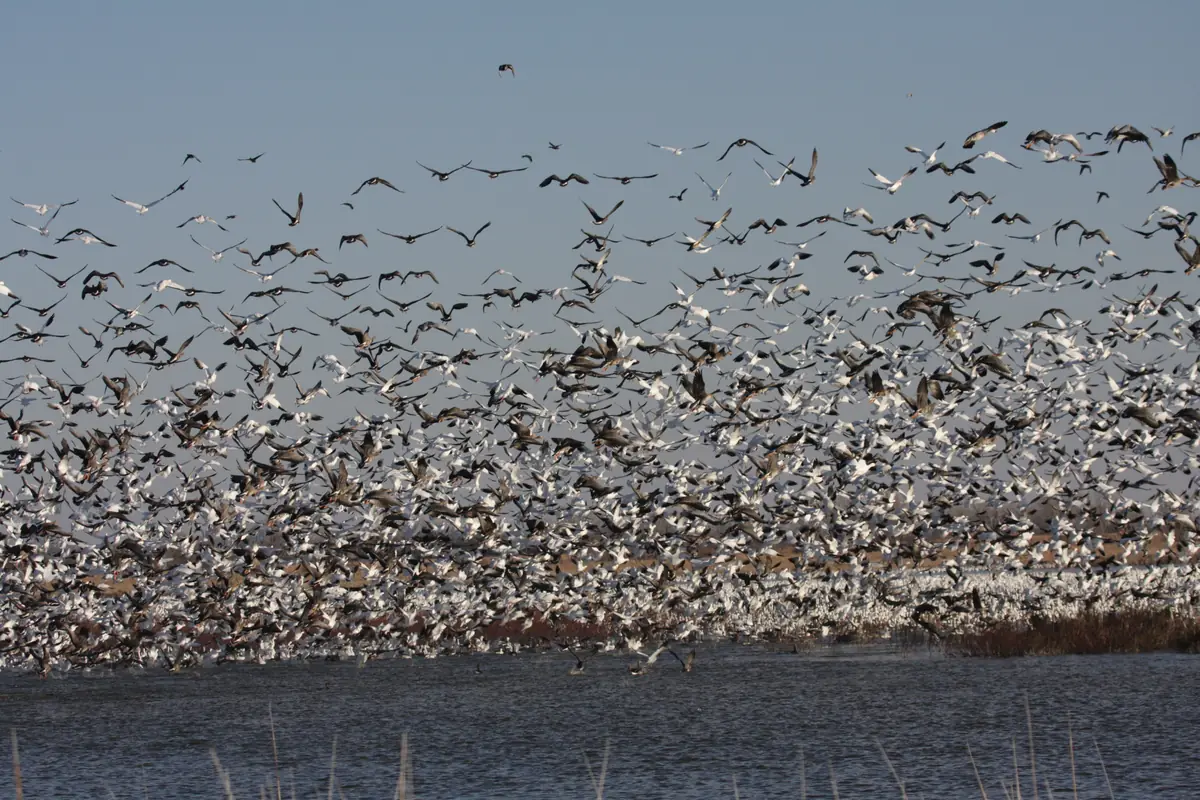
- Geese by the hundred thousand. Federal refuge staff describe November as the month when ducks and geese at Quivira National Wildlife Refuge reach their yearly peak, in the hundreds of thousands. Drive the refuge’s wildlife loop at sunrise or near sunset and listen before you look.
- Deer moving at dusk. The whitetail rut in Kansas peaks around the middle of the month, and KDWP says that is when crashes between cars and deer are most common. Standard time returns on November 1, which pulls sunset back to about 5 p.m. and puts the drive home in the deer’s busiest hour.
- Leonids, then a Beaver supermoon. The Leonid meteor shower is best in the hours before dawn on Wednesday, November 18, once the half-lit Moon has gone down. The Beaver Moon is full that next week, at 8:53 a.m. CST on Tuesday the 24th, and counts as one of 2026’s supermoons; watch it come up around sunset that evening.
Keep a record of it: count one flock of snow geese on the “birds I have seen” page and note how long it took to pass. Tape a coralberry twig or trace a bur oak acorn cup for the “seeds, pods and cones” plate. Turn to “mammal watch” for every deer you see crossing a road at dusk, with time and place, and the “dusk and dawn watch” plate for the Leonid morning. On the daily field log, write the date of your first snowflakes.
Regions used below: Northwest Kansas and the High Plains; Southwest Kansas; North-central Kansas and the Smoky Hills; Central Kansas and the Great Bend wetlands; South-central Kansas, Wichita and the Red Hills; The Flint Hills; Northeast Kansas, Topeka and Kansas City; Southeast Kansas.
When do the geese and ducks peak at Quivira and Cheyenne Bottoms?
In November. The refuge’s own species page says fall can be Quivira’s most spectacular season and that ducks and geese reach the hundreds of thousands at their November peak. Its activities page adds that at the height of migration the refuge can hold more than 750,000 geese, split about evenly among Canada geese, snow geese and greater white-fronted geese. A few miles north, the Kansas Wetlands Education Center says waterfowl at Cheyenne Bottoms can approach several hundred thousand.
Learn the three geese by ear. Canada geese honk. Snow geese, white with black wingtips (or the dark “blue” form with a white head), move in noisy, shifting flocks. White-fronted geese, gray-brown with orange legs, give a high, laughing call.
-
Quivira’s wildlife drive
Open daily, 90 minutes before sunrise to 90 minutes after sunset · Quivira National Wildlife Refuge, near Stafford
The auto tour follows about 15 miles of public road through the refuge, including a 5-mile wildlife drive close to the wetlands. Geese leave the marshes in the morning to feed in grain fields and come back in long lines before dark, so be parked with the engine off at either end of the day.
-
The last whooping cranes
Mostly the first half of November · Quivira NWR and Cheyenne Bottoms
The education center’s Whooper Watch page calls late October and the first half of November the best time to see them, and says the cranes usually reach the Texas coast by early December. Its sighting log shows what November can bring: an estimated 40 whooping cranes at Quivira on November 8, 2025, and 17 to 18 at Cheyenne Bottoms on November 12 and 13, 2024. Keep a quarter mile back and stay in your vehicle; these birds are endangered.
-
Sandhill cranes overhead
Through November · Central Kansas marshes and fields; western reservoirs
Sandhill cranes keep passing through central Kansas all month; KDWP opens the Central Zone sandhill season on Wednesday, November 11. Their rattling bugle carries so far that you will usually hear a flock well before you find it in the sky.
Hunting goes on at both wetlands in November, so check maps for closed areas and keep to public roads. The education center at Cheyenne Bottoms keeps winter hours from November 1, open Tuesdays to Saturdays from 9 to 5, with free admission.
When do bald eagles arrive in Kansas for the winter?
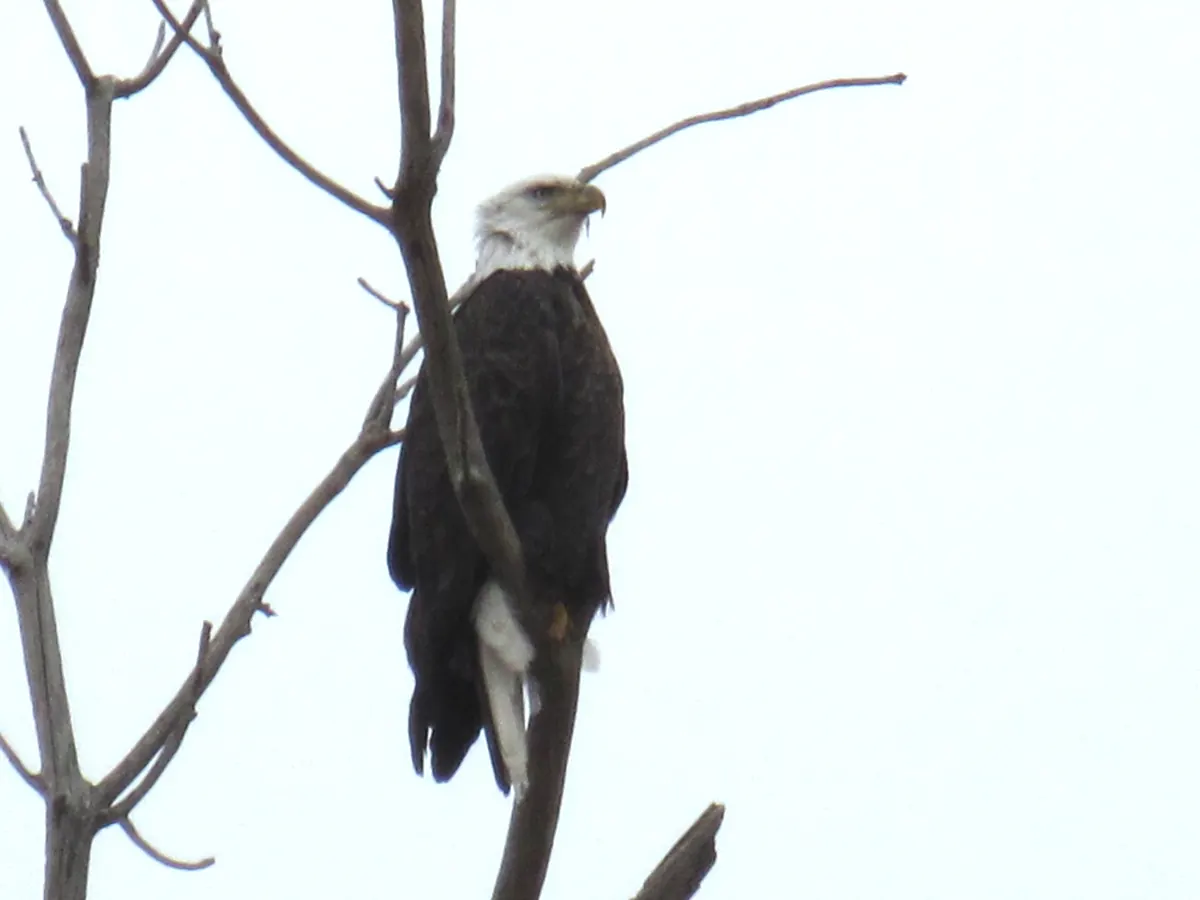
They start showing up in November and stay until about March, gathering where there is open water and fish. The U.S. Army Corps of Engineers says eagle viewing at Milford Lake, near Junction City, is excellent from November through March along the water’s edge. At Quivira, the Fish and Wildlife Service notes that bald eagles both winter on the refuge and nest there, and the big flocks of ducks and geese draw them in: an eagle will patrol a goose flock looking for a sick or injured bird.
-
Where to look
From November; best in the coldest weeks · Below dams and along shorelines of the big reservoirs: Milford, Tuttle Creek, Perry, Clinton, Cheney and others
Scan the tallest cottonwoods and dead snags along the shoreline, and the open water just below a dam, where fish are easiest to catch. Adults are unmistakable with white head and tail; immature birds wear blotchy brown plumage for several years and fool plenty of birders. Numbers build as lakes freeze, so November is the warm-up and January the main event.
-
Golden eagles and rough-legged hawks
Late fall into winter · Open country in western and central Kansas
On the High Plains and in the Red Hills, a big dark raptor on a fence post or bale may be a golden eagle, a hunter of rabbits and prairie dogs rather than fish. Rough-legged hawks from the Arctic also winter in the open country and often hover over a field. Both reward a slow drive west.
If a perched eagle turns to watch you, you are close enough; a scope from the car is the way to watch.
Which winter birds come to Kansas in November?
As the summer birds leave, a set of northern species arrives to spend the cold months here. Some come to backyard feeders; others stay out in the stubble fields and short grass, where you have to go looking for them.
-
Harris’s sparrow
Arrives in fall; stays through winter · Brushy edges, shelterbelts, hedgerows and feeders, mostly central and eastern Kansas
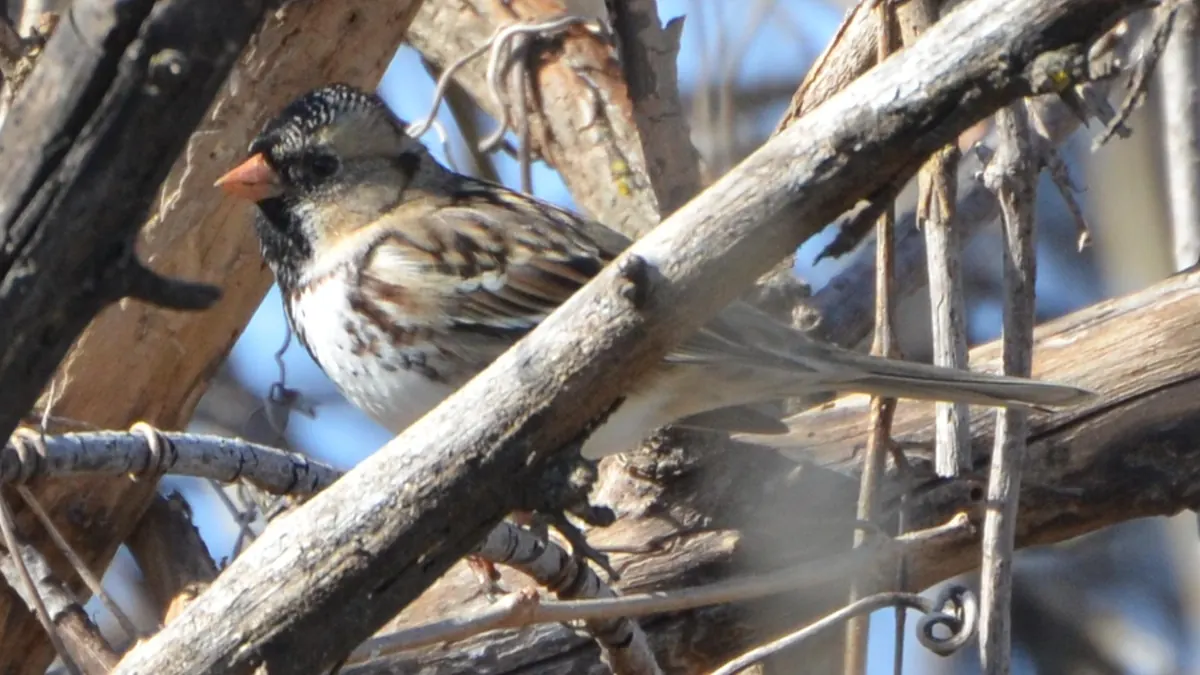
This is a Kansas specialty. The Cornell Lab calls it North America’s largest sparrow apart from the towhees, says it nests only in Canada, and places its winter home in the south-central Great Plains, where it is a backyard favorite. Look for a pink bill and a black face and bib. It feeds in the open more than most sparrows and takes black-oil sunflower seed from a ground or platform feeder. The oldest on record, nearly 12, was recaptured by bird banders in Kansas in 1983.
-
Smith’s longspur
Late fall and winter · Grassy fields in eastern Kansas, such as around Lyon State Fishing Lake
Longspurs are ground birds of open country that come down from the far north for the winter. The Wichita Audubon Society describes Lyon State Fishing Lake, near Reading, as a traditional place to find Smith’s longspurs and has scheduled a November 21 field trip there to look for them. They hide well in short grass and are usually seen only when they flush, calling as they go.
-
Northern finches
Possible, not likely, this winter · Feeders and conifer windbreaks
In its forecast for winter 2026–27, posted in late September, the Finch Research Network expects most finch movement to stay in eastern Canada, the Great Lakes and the Northeast, where cone and seed crops are good. That suggests a quiet winter in Kansas for red-breasted nuthatches, pine siskins and purple finches, though a few usually find the cedar windbreaks. The forecast says little about the Plains, so any Kansas sightings are worth reporting.
Juncos, the gray “snowbirds,” arrive with the first cold weeks too, along with white-crowned and American tree sparrows. Every one of them is welcome in Project FeederWatch, which the Cornell Lab runs with Birds Canada; its 2026–27 counting season goes from November 1 to April 30. Watchers choose a pair of back-to-back days and report, for each species, the biggest group in view at one moment.
When is the deer rut in Kansas, and why are the roads so risky?
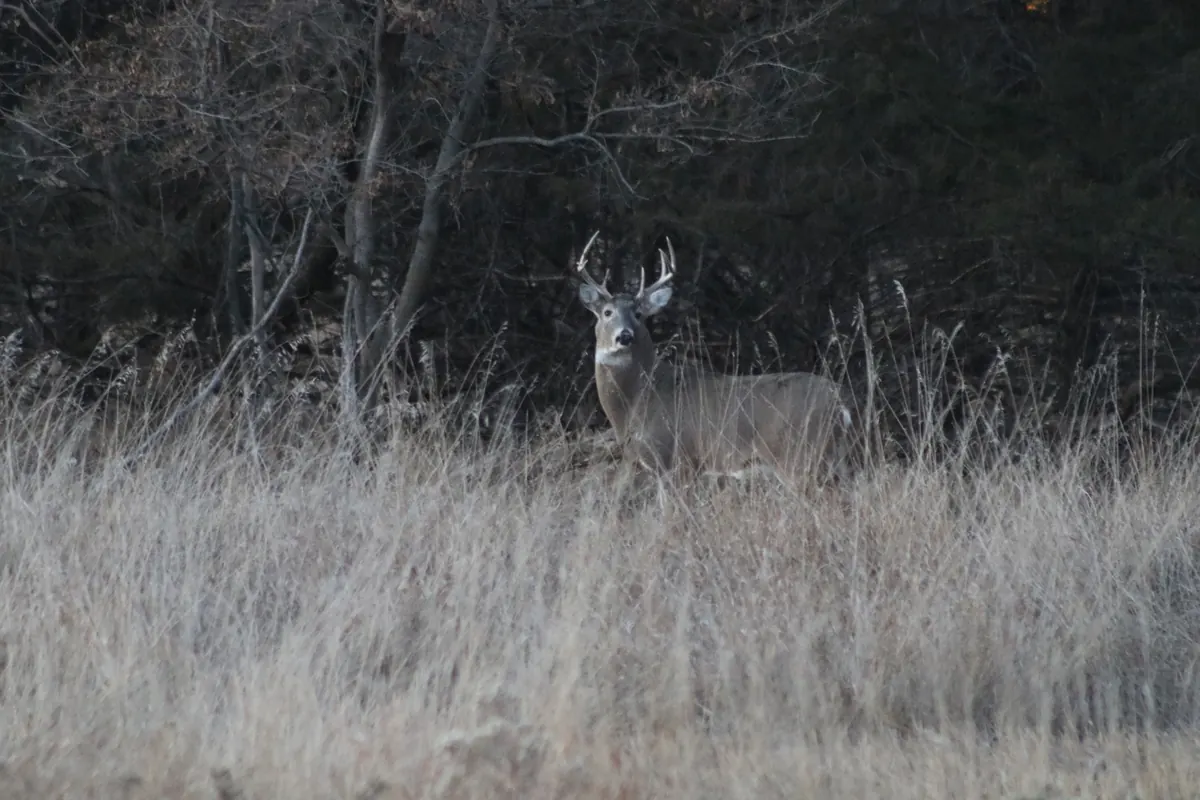
KDWP says the whitetail breeding season peaks in mid-November and that this is when collisions between deer and vehicles are most frequent. During the rut, deer cover more ground than usual and ignore traffic. The harvest has also removed the crops that hid them all summer, and bare trees offer less cover, so many are on the move to new places. The end of daylight saving time on November 1 then puts the evening commute right at dusk. The Kansas Department of Transportation reported that deer were involved in 39 percent of the state’s single-vehicle crashes in 2024, which injured 674 people and killed five.
-
Signs of the rut
Early to late November · Woodland edges, creek bottoms, shelterbelts
Rubs are saplings with the bark shredded by antlers; scrapes are patches of bare, pawed soil under a low limb.
-
What to do on the road
Dawn and dusk · Near creeks, wooded draws, parks and golf courses
KDWP’s advice: slow down near woods and water, use high beams when you can, and remember that deer seldom travel alone. Do not swerve; swerving into oncoming traffic or off the road causes the worst crashes. After hitting a deer, pull well off, turn on your hazard lights, and call *47 for the Highway Patrol (or 911). You need a salvage tag from a trooper, deputy or game warden before taking any part of the deer.
Note on the calendar: the regular firearm deer season does not start until Wednesday, December 2, so November deer hunting is mostly by bow. That makes November a quieter month in the woods than early December.
What is happening in the Flint Hills and on the prairie in November?
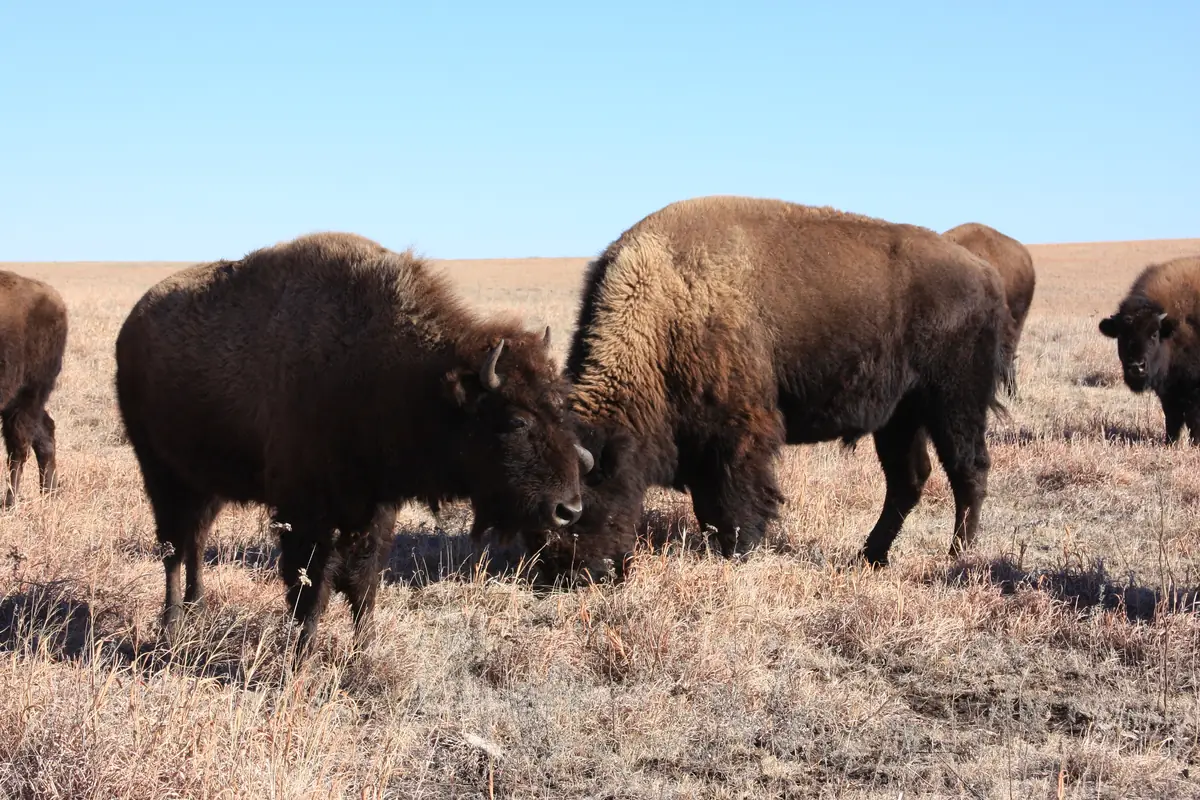
The tallgrass has finished its color show by now and stands tan and rust-red through the winter. The stems stay upright, which is why November is a good month to see the shape of the land: every ridge, draw and limestone ledge in the Flint Hills shows plainly under low light. It is also bison month.
-
KDWP bison auction at Maxwell
Wednesday, November 4, 11 a.m. to 3 p.m. (gates open 9 a.m.) · Maxwell Wildlife Refuge, near Canton, McPherson County
Maxwell, protected since 1944, keeps a herd of bison and elk on 2,560 acres of native grass. It is shut from October 18 through November 3 while staff prepare for the state’s bison sale on the 4th. Tram tours resume Saturday, November 7, and run Tuesdays and Saturdays at 10 a.m. (November 7, 10, 14, 21, 24 and 28; the 17th is sold out). Adults are $15 and children $7.50; very young children ride free.
-
National Bison Day
Saturday, November 7, 10 a.m. to 2 p.m. · Flint Hills Discovery Center, Manhattan
A drop-in morning at the Manhattan museum with a full-size bison robe and skull to handle, a look at how Plains nations made dozens of tools and items of clothing from the animal, plus stories and coloring pages for children. Regular admission covers it.
-
Tallgrass Prairie National Preserve
Trails open 24 hours a day, all year · Near Strong City, Chase County
The trails stay open after the main tour season ends, on foot only, and the one-room Lower Fox Creek School is open daily from 9 a.m. to 4 p.m. through December 31. The park warns that fall prescribed burns can happen in October and November, depend on the weather, and can close trails on less than two hours’ notice.
Smoke from a fall burn can drift over a highway; slow down and use headlights.
What berries, nuts and fruit are left for winter in Kansas?
With the leaves down, fruit left on the branches stands out, and quail, pheasants, robins and sparrows will live on it until spring. A fence line or woodland edge turns up most of these.
-
Coralberry (buckbrush)
Fruit ripens August to October and hangs on through winter · Statewide: pasture edges, woodland understory, fencerows
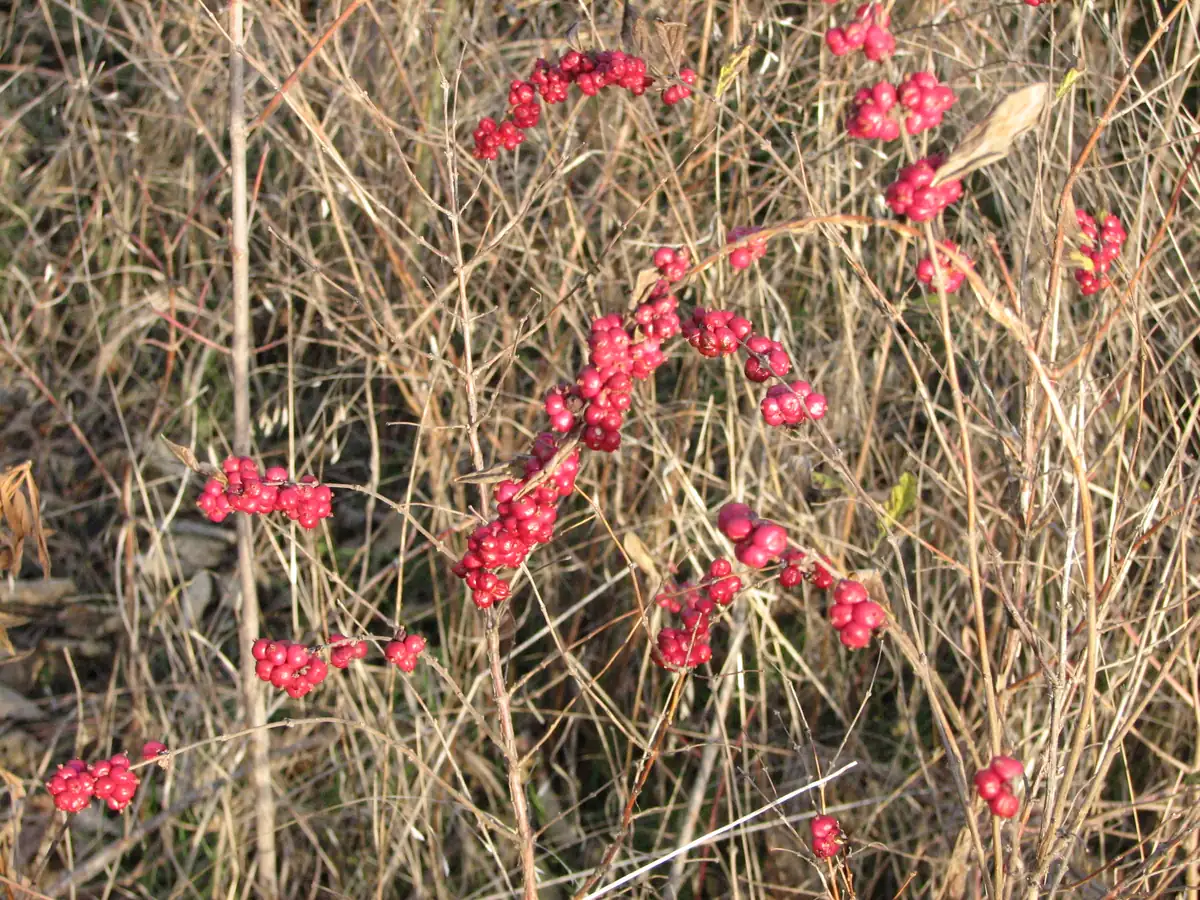
A knee- to waist-high shrub hung with small pink-red berries. The Kansas Wildflowers and Grasses guide notes that the fruit often stays on the twigs all winter and that pheasants, quail, prairie chickens and songbirds eat it, while deer browse the stems.
-
Possumhaw (deciduous holly)
Fruit October and November; often visible into winter · Southeast quarter of Kansas, along streams and rocky woods
A small tree that drops its leaves and keeps its berries, so in November a possumhaw by a creek can look like a spray of bright red or orange beads on bare gray twigs. In Kansas it grows only in the southeast quarter of the state.
-
Eastern red cedar
Bluish “berries” all winter · Statewide, especially pastures, windbreaks and hillsides
The red cedar’s fruit is actually a waxy, berry-like cone, blue-gray and about a quarter inch across, and its scale-like leaves often turn reddish brown in winter. Birds and deer eat the fruit, songbirds and mourning doves nest in it, and wild turkeys eat the leaves. It is also a problem plant: the same guide calls it a weedy species that spreads aggressively on poorly managed rangeland, and notes that fire controls it while the trees are small.
-
Bur oak acorns
Fall · East two-thirds of Kansas, along streams and on slopes
Bur oak acorns sit in big, shaggy cups with a fringed rim, the most distinctive acorn in the state. The tree is very hardy in the cold, and some Kansas bur oaks are thought to be 300 to 400 years old.
Planting for birds? These natives feed wildlife in exactly the months when little else does. Press a coralberry sprig or trace an acorn cup in the Naturalist’s Field Journal to keep the season on paper.
Has the first freeze come yet in Kansas by November?
For almost every part of the state, yes. In the long-term NOAA records below, every station’s median first 32 °F night comes before November begins, ranging from the second week of October in Colby to the last days of the month in Pittsburg. Northwest and southwest Kansas, the Smoky Hills and the Great Bend area are almost certainly past it by the start of the month. The places most likely to still be waiting are Wichita, the Kansas City suburbs and the southeast: in one year out of ten, Wichita and Pittsburg go until about November 10 and Olathe until November 11. Salina and Topeka have a one-in-ten chance of making it to November 4.
| Station | One year in ten | Median | Nine years in ten |
|---|---|---|---|
| Colby 1 SW (northwest) | Sep 26 | Oct 9 | Oct 21 |
| Garden City Regional Airport (southwest) | Oct 1 | Oct 15 | Oct 27 |
| Dodge City (southwest) | Oct 4 | Oct 20 | Nov 1 |
| Concordia Municipal Airport (north-central) | Oct 3 | Oct 19 | Nov 1 |
| Salina Municipal Airport (central) | Oct 10 | Oct 23 | Nov 4 |
| Wichita (south-central) | Oct 15 | Oct 29 | Nov 10 |
| Topeka Municipal Airport (northeast) | Oct 8 | Oct 23 | Nov 4 |
| Olathe Johnson County Exec Airport (Kansas City area) | Oct 15 | Oct 29 | Nov 11 |
| Pittsburg (southeast) | Oct 17 | Oct 30 | Nov 10 |
Whatever the date where you live, the first hard freeze finishes off the garden and silences the crickets. Every Kansas station with frost records is on our Kansas frost dates page.
Does it snow in Kansas in November, and what could El Niño mean this winter?
It depends almost entirely on which end of the state you are in. Under NOAA’s 1991–2020 normals, Goodland averages 3.3 inches of snow in November, Dodge City 1.4, Topeka 1.0 and Wichita 0.8. The National Weather Service offices that keep long snow records for these towns put the average first measurable snowfall (0.1 inch or more) at November 19 in Dodge City and November 28 in Topeka, while Wichita’s usually comes around December 2.
November is also much drier than the growing season. On the same normals, Topeka gets about 1.8 inches of precipitation in November, Wichita 1.4, Dodge City 0.8 and Goodland just over half an inch. Averaged over the whole month, Wichita’s afternoons reach about 57 °F and its nights fall to about 35 °F; at Goodland the figures are 54 °F and 26 °F, so frost there is the normal state of a November morning.
As for the winter beyond November: the federal ENSO team’s mid-September assessment (dated the 10th) rated a very strong Pacific warm event for the coming cold season as more than 90 percent likely. The Wichita office of the National Weather Service, looking at El Niño winters since 1950, says they tend to bring slightly warmer than normal temperatures to northeast Kansas, near-normal temperatures elsewhere, and near to slightly above normal precipitation across much of the state. The office stresses that these composites are not a forecast, and Kansas sits in the middle of the country, where the El Niño signal is weaker than along the southern tier of states.
Kansans get NOAA’s own December-to-February outlook in mid-October, on the 15th. Until it appears we will not guess at it; after that, the maps sit on the CPC 90-day outlook page.
For what the next few days hold in your corner of the state, see our plain-language weather forecast.
How much daylight does Kansas lose in November?
Less than in October, but it feels like more, because Kansas, in both its time zones, falls back an hour early on the first Sunday of the month, November 1. In Wichita, the sun goes down at 6:32 p.m. on Halloween and at 5:31 p.m. one day later; on November 30 it sets at 5:11. In Goodland, on Mountain time, the sun sets at 4:24 p.m. on November 30. Mornings get the hour back: Wichita’s sunrise jumps from 7:54 to 6:55 a.m. on November 1, then slides to 7:25 by the end of the month. Across the state, the days shorten by 49 to 53 minutes over the month, least in Liberal and most in Goodland, Manhattan and Overland Park.
| City | Nov 1 | Nov 30 | Lost | Per day |
|---|---|---|---|---|
| Goodland | 10 h 30 m | 9 h 37 m | 53 min | 1.8 min |
| Liberal | 10 h 38 m | 9 h 49 m | 49 min | 1.7 min |
| Hays | 10 h 32 m | 9 h 40 m | 52 min | 1.8 min |
| Salina | 10 h 32 m | 9 h 40 m | 52 min | 1.8 min |
| Wichita | 10 h 36 m | 9 h 46 m | 50 min | 1.7 min |
| Manhattan | 10 h 31 m | 9 h 38 m | 53 min | 1.8 min |
| Overland Park | 10 h 32 m | 9 h 39 m | 53 min | 1.8 min |
| Pittsburg | 10 h 37 m | 9 h 47 m | 50 min | 1.7 min |
For the exact minute the sun comes up and goes down in your part of Kansas, try the daylight calculator.
What can you see in the Kansas night sky in November?
With standard time back, it is dark by 6 p.m. Times below are Central; subtract an hour in the four westernmost counties along the Colorado border, which keep Mountain time.
-
The Leonid meteor shower
Best before dawn on Wednesday, November 18; also the mornings of the 17th and 19th · Anywhere dark, facing east to overhead
The International Meteor Organization predicts around 15 per hour under ideal dark skies, and nothing unusual is forecast for 2026. Moonset comes at roughly half past midnight, and Leo, the constellation the meteors seem to fly out of, rises around midnight and stands highest shortly before daybreak. An alarm for 3 or 4 a.m., warm clothes and 20 minutes for your eyes to adjust are all you need.
-
Taurid fireballs
Peaks around November 5 and November 12 · Most of the night; Taurus is well up in the east by late evening
Kansas watchers should expect few Taurids, perhaps five in a dark hour, yet a Taurid can be a slow, glowing fireball that crosses half the sky. With new moon on November 9, between the two maxima, the middle of the month is dark. The Taurids are dust shed by Comet Encke.
-
The Beaver Moon, a supermoon
Full at 8:53 a.m. CST on Tuesday, November 24; best on the evenings of November 23 and 24 · Rising in the east-northeast around sunset
November’s full moon falls near perigee, its closest point to Earth, which makes it a modest supermoon (December’s is closer). Kansans will see a round Moon on Monday the 23rd and Tuesday the 24th, and Tuesday is closer to the true moment. In the small hours of the 24th the Moon drifts over or right beside the Pleiades, and the little star cluster all but disappears in the glare.
-
Mars meets Jupiter before dawn
Mornings of November 15 and 16 · High in the southeast before sunrise
Jupiter, the brightest point in the morning sky after Venus, and fainter, orange Mars pass about 1.2 degrees apart, a little more than two full-Moon widths. Both are in Leo near its bright star Regulus. On those same mornings brilliant Venus is low in the east-southeast, and Mercury joins in later in the month, reaching its greatest distance from the Sun on November 20; look for it low in the east-southeast between about November 18 and 25.
-
Saturn in the evening, Venus at dawn
All month · South to southwest after dark; east before sunrise
After dusk the one bright planet on view is Saturn, a steady, pale-yellow point in the south. Venus now rises before the Sun, gains height every morning, and is at its most brilliant around November 24 to 27. Early on November 9, look for Virgo’s blue-white Spica roughly a degree away from it.
| Phase | Date | Time |
|---|---|---|
| Last quarter | Sunday, Nov 1 | 2:28 p.m. CST (1:28 p.m. MST) |
| New moon | Monday, Nov 9 | 1:02 a.m. CST (12:02 a.m. MST) |
| First quarter | Tuesday, Nov 17 | 5:48 a.m. CST (4:48 a.m. MST) |
| Full moon, the Beaver Moon | Tuesday, Nov 24 | 8:53 a.m. CST (7:53 a.m. MST) |
| Last quarter | Tuesday, Dec 1 (Monday, Nov 30 in Mountain time) | 12:08 a.m. CST (11:08 p.m. MST on Nov 30) |
Before a pre-dawn alarm, check the cloud forecast; for moonrise and moonset times in your own town, use the moon phases calendar.
What can families do outdoors in Kansas in November?
- Sunday, November 1: Project FeederWatch begins. Sign up through the Cornell Lab and pick two back-to-back days to count your feeder birds, up to once a week, until the end of April.
- Wednesday, November 4: KDWP bison auction at Maxwell Wildlife Refuge near Canton. Gates open at 9 a.m.; the sale runs 11 a.m. to 3 p.m., with bison burgers for sale.
- Saturday, November 7, from 10 a.m.: National Bison Day at the Flint Hills Discovery Center, a come-and-go program until 2 p.m. with a bison robe and skull to touch; included with admission.
- Tuesdays and Saturdays from November 7, 10 a.m.: Maxwell tram tours into the bison pasture. Book ahead; November 17 is full.
- Saturday, November 14, 8 a.m.: Wichita Audubon’s second-Saturday bird walk in Chisholm Creek Park, from the Great Plains Nature Center parking lot. Beginners welcome; about 90 minutes on paved paths.
- Saturday, November 14, 9 a.m. to noon: Fall Work Day at the Great Plains Nature Center, clearing debris and invasive plants, as posted on a Wichita events calendar. It is free with an RSVP to 316-683-5499 or volunteer@gpnc.org; call to confirm, since the center’s building is closed for foundation repairs while the park stays open.
- Saturday, November 14: Topeka Audubon’s monthly bird walk at McDonald Field on the Shunga Trail; start times change with the season, so check the society’s calendar.
- Tuesday, November 17, 7 p.m.: Wichita Audubon talk on bringing back Great Plains grassland birds by restoring native keystone species, at the Sedgwick County Zoo’s Cargill Learning Center.
- Saturday, November 21, 6:30 a.m.: Wichita Audubon field trip to Lyon State Fishing Lake and Melvern Reservoir for Smith’s longspurs, waterfowl, loons and gulls; carpools leave from the Dillons at Woodlawn and 37th Street North.
- Tuesday to Saturday, any week: stop at the free wetlands center at Cheyenne Bottoms, then circle the basin with binoculars and count geese.
- Thanksgiving weekend: the trails at Tallgrass Prairie National Preserve are open around the clock, every day of the year; go look for bison.
Every state and month we cover is listed on the nature this month index.
Safety notes for November in Kansas
- Hunting seasons this month (KDWP, 2026–27): archery deer and elk through December 31; youth and disability pheasant and quail November 7–8, then the regular pheasant and quail season from Saturday, November 14, to January 31; greater prairie-chicken through January 31. Ducks are open in the High Plains, the Low Plains Early Zone (to December 6) and the Late Zone, and the Southeast Zone opens November 7. Canada, cackling and light geese reopen November 4 after an October 31–November 1 opener; white-fronted geese run from October 31. Central Zone sandhill cranes open November 11. Dove closes November 29 and rail November 9; crow opens November 10 and the general furbearer season November 18. The statewide firearm deer season is December 2–13, although Fort Leavenworth and Fort Riley hold firearm deer hunts on some November weekends.
- Blaze orange: whenever a firearm or muzzleloader deer season is open, the rule for Kansas deer hunters, and for any person helping them, is an orange hat plus at least 200 square inches of orange above the waist, half of it visible from in front and half from behind; orange camouflage is fine if it supplies that much. The rule covers deer hunting only, but from the November 14 pheasant opener on, an orange cap and vest is wise for anyone on public land.
- Deer on the road: mid-November is the peak. Ease off the gas at twilight, assume more deer are following, and brake rather than swerve. A crash with injury or $1,000 or more in damage must be reported to police at once.
- Short days: after the time change, darkness comes soon after 5 p.m. in the east and before 4:45 p.m. in the Mountain-time counties. Start hikes early and pack a headlamp.
- First snow on the High Plains: Goodland averages more than 3 inches of snow in November. Before driving west of Hays, check KanDrive for road conditions and carry a blanket, water and a phone charger.
- Fall burns: Flint Hills fires can close trails at short notice and put smoke across roads.
- Cold water: reservoirs are chilling fast. Birders and hunters in boats or canoes should wear life jackets; cold water can incapacitate a swimmer within minutes.
Sources
- U.S. Fish and Wildlife Service: Quivira National Wildlife Refuge, species (November waterfowl peak)
- U.S. Fish and Wildlife Service: Quivira National Wildlife Refuge, activities (goose numbers, auto tour, hours)
- U.S. Fish and Wildlife Service: Quivira National Wildlife Refuge (migration months, wintering and nesting bald eagles)
- Kansas Wetlands Education Center: Whooper Watch (timing, recent counts, viewing distance)
- Kansas Wetlands Education Center: bird watching at Cheyenne Bottoms (waterfowl numbers)
- Kansas Wetlands Education Center: about (winter hours, free admission)
- U.S. Army Corps of Engineers, Kansas City District: Milford Lake (bald eagle viewing November through March)
- Cornell Lab of Ornithology, All About Birds: Harris’s sparrow
- Wichita Audubon Society: schedule of events 2026–2027 (bird walks, Lyon State Fishing Lake trip, programs, Christmas Bird Counts)
- Topeka Audubon Society (monthly bird walks)
- Finch Research Network: Winter Finch Forecast 2026–2027
- Project FeederWatch: how to participate (season November 1 to April 30)
- Kansas Department of Wildlife and Parks: wildlife vehicle crashes (rut timing, safety tips, salvage tags)
- Kansas Department of Transportation: motorists encouraged to be on the lookout for deer (2024 deer crash figures)
- WIBW: Kansas Department of Transportation warning on deer collisions (2024 crash figures), October 13, 2025
- Kansas Department of Wildlife and Parks: when to hunt, 2026–27 season dates (live site blocks automated access; checked against the August 14, 2026 archived copy)
- Kansas Department of Wildlife and Parks: blaze orange required
- Maxwell Wildlife Refuge (herd, history, tram tours)
- Maxwell Wildlife Refuge: events (bison auction, November tram tours, fall closure)
- Flint Hills Discovery Center: National Bison Day, November 7, 2026
- National Park Service: Tallgrass Prairie National Preserve, basic information (trails, schoolhouse hours, fall burns)
- Kansas Wildflowers and Grasses: coralberry
- Kansas Wildflowers and Grasses: deciduous holly (possumhaw)
- Kansas Wildflowers and Grasses: eastern red cedar
- Kansas Wildflowers and Grasses: persimmon
- Kansas Wildflowers and Grasses: bur oak
- Great Plains Nature Center (building closure, programs)
- Wichita by E.B.: Fall Work Day at the Great Plains Nature Center, November 14, 2026
- NOAA NCEI: U.S. Climate Normals 1991–2020 (freeze dates)
- NOAA NCEI: monthly climate normals 1991–2020 for Goodland, Dodge City, Wichita and Topeka (November snow, precipitation and temperature)
- National Weather Service Dodge City: Dodge City snow climatology (average first measurable snowfall)
- National Weather Service Topeka: first and last measurable snow, Topeka, 1888 to present (PDF)
- National Weather Service Wichita: when does Wichita typically receive its first snow?
- National Weather Service Wichita: El Niño and La Niña impacts on Kansas
- Climate Prediction Center: ENSO diagnostic discussion, September 10, 2026
- Climate Prediction Center: seasonal outlooks (official winter outlook due October 15, 2026)
- U.S. Naval Observatory: moon phases (data API)
- NASA: phases of the Moon 2001–2100 (Espenak)
- International Meteor Organization: 2026 meteor shower calendar (Leonids, Taurids)
- NASA JPL Horizons: planet and Moon positions (Mars–Jupiter conjunction, Mercury elongation, Venus near Spica)
- EarthSky: what is a supermoon? (2026 full supermoons)
- EarthSky: Mercury at greatest western elongation
- Farmers’ Almanac: the November full Beaver Moon
- Royal Astronomical Society of Canada: 2026 lunar occultations (Pleiades, November 24)
- Photos via Wikimedia Commons; licenses and photographers are credited under each picture
- KDWP: Deer hunting in Kansas (blaze orange rule)
