What to look for in nature in Maine this March
March is the month when Maine stops being a winter state in the south and starts to let go in the north. Snow still falls often, and the interior may hold a deep pack until April, but something changes: the sap begins to run, a small brown bird starts buzzing and spiraling over damp fields at dusk, and on the first rainy night with the thermometer above 40 °F, frogs and salamanders walk out of the woods toward the pools where they were born. Harp seals that wintered along the coast start heading north, bald eagles sit on eggs in their big stick nests, and the first lake and river ice begins to weaken. The clocks move forward on March 14, the equinox falls on March 20, and every town in the state ends March with roughly an hour and a half more daylight than it began with. The sections below cover the month from the Kittery shore to the Fort Kent border.
Other months in Maine: October, November, December, January, February, April.
Start here

- Walk out at dusk to hear a woodcock. Wait at the border of a wet, open field beside alders. A buzzy peent starts roughly a quarter hour after sunset, and the bird then spirals up on twittering wings before tumbling back down.
- Go out on the first warm, rainy night. When rain falls after dark and the temperature stays above about 40 °F, wood frogs, spotted salamanders and spring peepers head for vernal pools. Take a flashlight, wear something bright, and give any road crossing a wide, slow berth.
- Taste the season at a sugarhouse. Maine Maple Sunday is an open house at sugarhouses across the state. The Maine Maple Producers Association sets it by a rule rather than a fixed date, and its page shows no 2027 date yet, so check its list for the day and the farms taking part.
Keep a record: in the daily field log of the Naturalist’s Field Journal, write the date and weather of the first woodcock you hear and the first night the frogs are on the move. A tapped sugar maple earns a place on a tree through the seasons, the mud-season tracks left by a woodchuck, otter or fox go on tracks to know, and a quiet hour at a field edge at dusk fits dusk and dawn watch. The first red-winged blackbird, eagle on a nest or harp seal belongs on birds I have seen and mammal watch, and the whistles, peeps and buzzes of the month fill a map of sounds.
Regions used below: Southern Maine and Casco Bay; Midcoast and Penobscot Bay; Downeast and Acadia; Western mountains and lakes; The Highlands, Moosehead and Katahdin; Aroostook County.
When do frogs and salamanders migrate to Maine’s vernal pools?
On one or two nights each spring, usually the first warm and rainy ones, the forest floor comes alive. The Maine Department of Inland Fisheries and Wildlife (IFW) writes that mass migrations often begin on a rainy night after the soil has thawed, provided the overnight temperature stays above 40 °F, and that southern and central Maine can meet those conditions as early as March. More than half of Maine’s amphibians head for vernal pools, temporary woodland pools that snowmelt and spring rain fill and the summer sun empties, which is why no fish are there to eat the eggs. Maine Audubon notes that the trek can cross a mile of dry land, and IFW adds that breeding adults often return faithfully to the pool where they were born.
-
Wood frogs
From the first thaw and rain; as early as March in southern and central Maine · Fishless vernal pools and flooded woodland hollows statewide
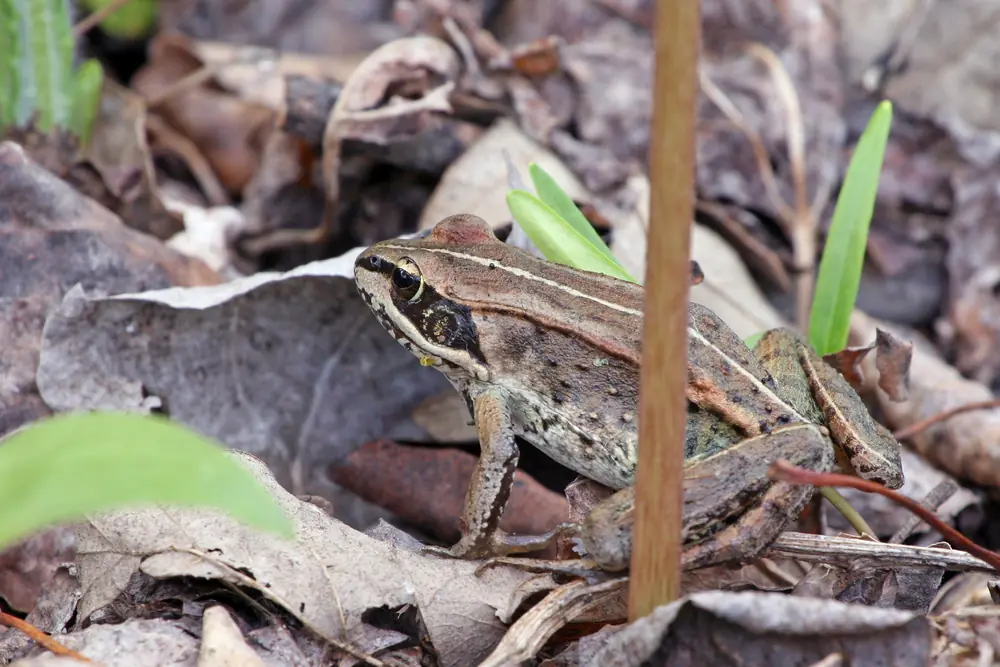
IFW calls wood frogs explosive breeders: a whole local population may breed within about three days, and the males’ call sounds like quacking ducks. Wood frogs spend the winter under leaf litter and can freeze solid for days, protected by glucose in their tissues that works like antifreeze, then thaw and walk to the pool when conditions are right.
-
Spotted and blue-spotted salamanders
The first night of warm rain after the thaw, often called Big Night · Mature woods with vernal pools, and the roads between them
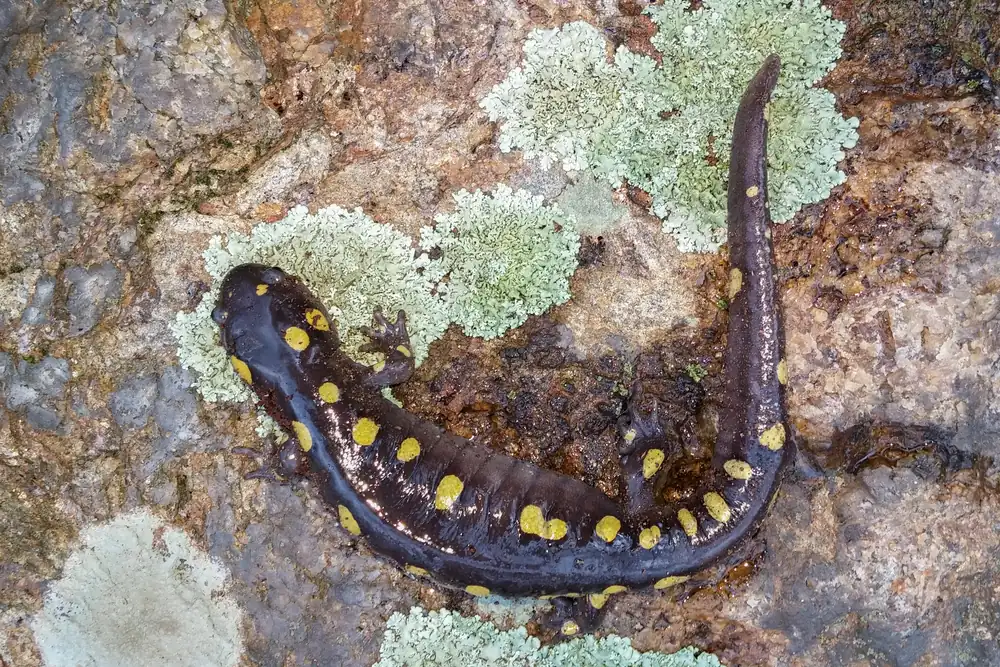
The spotted salamander, common statewide according to IFW, is six to eight inches long with bright yellow spots on a dark back. It lives underground in rodent burrows or under stumps, and a female lays two or three globular egg masses of up to about 200 eggs each. IFW’s migration notes name the blue-spotted salamander among the pool walkers too.
-
Spring peepers
From the first mild nights; the chorus builds as pools warm · Forest edges beside ponds, swamps and flooded fields
Maine’s smallest frog is only about 0.8 to 1.5 inches long, marked with a dark X on its back, yet its high peep carries across a whole wetland. IFW lists it as one of only two native tree frogs in the state and notes that it is partly freeze tolerant. The Chebeague and Cumberland Land Trust ties its Big Night to the time when peepers start calling from thawing pools in late March or early April.
-
Helping on Big Night
Late March or April, on the first warm rainy night; organizers decide each year · Road crossings near vernal pools, with local land trusts and Maine Audubon
IFW suggests rain gear, a safety vest and a flashlight. The statewide Maine Big Night project recruits volunteers to help amphibians across busy roads and to log species, injuries and traffic. Organizers cap the number of volunteers: the land trust above posted that its 2026 registration had closed when its limit was reached, and the most recent dates it names are in mid-April. No 2027 date is posted, so check with a local land trust or Maine Audubon in March. IFW also takes any reptile or amphibian sighting for its Maine Amphibian and Reptile Atlas Project.
Slow down on roads beside woods and wetlands on warm, wet nights, because a dark, wet salamander is nearly invisible. Leave animals where you find them unless one is in the road and you are certain it is safe to move it.
Where can you watch Maine’s woodcock sky dance in March?
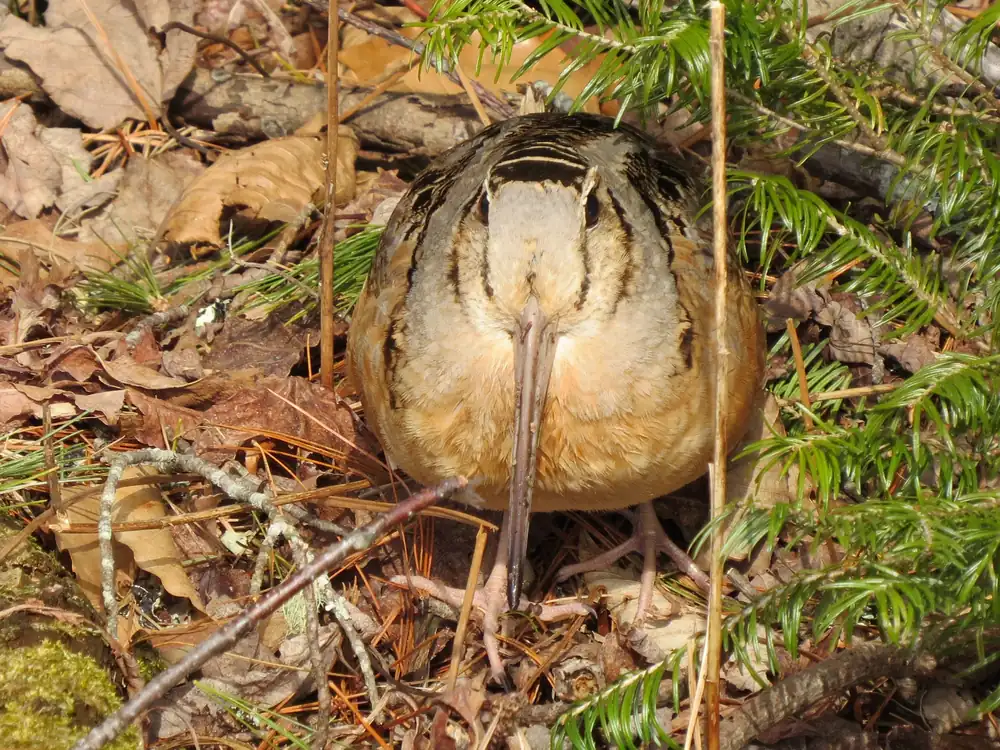
The American woodcock, classed with the shorebirds, is a stout, long-billed bird of young woods and old fields. The Wells National Estuarine Research Reserve says it arrives in Maine in March and that April brings the best sky dancing. In warm winters the first males start north as early as January, according to the National Audubon Society, so some may be on their dance floors when March begins.
-
The performance
Dusk, starting 15 to 24 minutes after sunset depending on cloud, and lasting about 30 to 45 minutes · Open fields of at least a quarter acre beside young woods, alder thickets or other damp tangles
The Reserve describes a male first walking in a jerky circle, giving a nasal, buzzy peent. He then climbs in a spiral as high as 250 feet, his wing feathers twittering, and zigzags down with a liquid, chirping song to land almost exactly where he began. He repeats the whole show until true darkness comes. Watch from well back so you do not disturb the birds.
-
What the birds eat
Soon as the ground softens · Moist soil in woods and fields
Audubon’s field guide says earthworms are the woodcock’s main food nearly everywhere, along with soil insect larvae, millipedes and spiders. That is why the birds follow the thaw north, and SeaSky’s calendar explains the Worm Moon’s name by the softening ground and the return of earthworms.
-
A guided evening
Maine Audubon has held woodcock evenings in April; check its calendar for 2027 · Fields Pond Audubon Center and other Audubon sanctuaries
Maine Audubon’s Fields Pond Audubon Center has offered a program that pairs a talk on woodcock migration and breeding, including University of Maine GPS-tracking research, with a twilight walk to watch the dance. The 2025 program was in mid-April and required pre-registration, so look for the 2027 version on the organization’s events page.
Woodcock hunting is a fall sport, from late September to mid-November under IFW’s 2026–27 seasons. If you have a field with a regular performer, note the minute after sunset when the first peent sounds and compare it with next year.
When does Maine’s maple sap run in March, and when is Maine Maple Sunday?
March is the heart of sugaring in much of Maine. Sap flows best, University of Maine Cooperative Extension explains, on days near 40 °F that follow nights below freezing. The tapping bulletin puts the southern season at mid-February to early April and the northern one at mid-March to late April, so in March the sugarhouses near the coast are in full steam while many in the north are only beginning to tap.
-
Boiling down the sap
Through March in the south, mid-March into late April in the north · Sugarhouses and backyard rigs statewide
Extension gives maple sap as about 1.5 to 3 percent sugar, which means the sap must be boiled down at a ratio of roughly 10 to 15 gallons for each quart of syrup. Syrup is done when it reaches 66 to 69 percent sugar, which is about 7 degrees Fahrenheit above the boiling point of water. Its safety warning bears repeating: never leave sap boiling over a wood fire unattended.
-
Maine Maple Sunday
The association says it is always the fourth Sunday in March; no 2027 date is posted yet, so check its list · Participating sugarhouses statewide
The Maine Maple Producers Association states that Maine Maple Sunday is always the fourth Sunday in March, with some sugarhouses also open on Saturday. Its page still shows the 2026 weekend, March 21 and 22, and has no 2027 listing yet. Because the date is set by a rule and the calendar around Easter can shift plans, confirm the date and hours on the association’s site before you visit.
As the sap season ends, the buds on the maples swell and redden. Revisit the tree you watched in winter and note which buds have grown.
Are the harp seals leaving the Maine coast in March, and what is open for smelt?
The coast is a place of leave-takings this month. Marine Mammals of Maine, the group that responds to seal strandings in southern and midcoast Maine, says harp seals usually leave in March or April after three to four months in Maine waters, and the winter freeze on tidal coves begins to loosen.
-
Harp seals on their way north
Departing in March or April · Beaches, rocks, floats and ice along the southern and midcoast shore
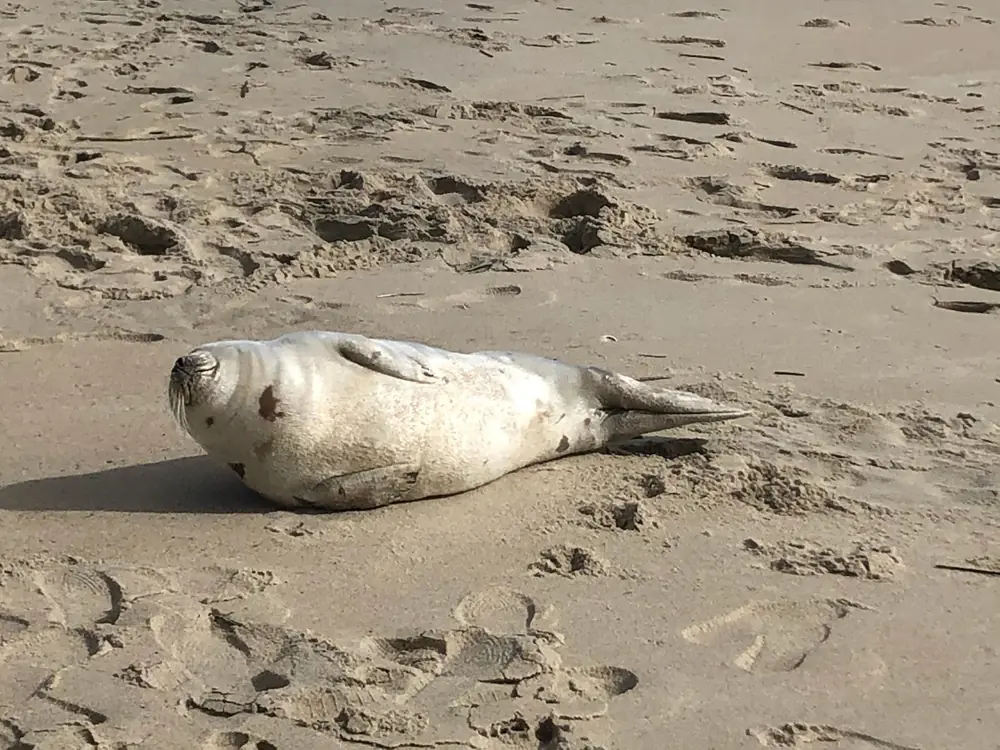
The group writes that harp seals were rare this far south only about twenty years ago and now reach New Jersey. A seal lying quietly on a beach is usually resting; ice seals depend on snow and ice for water, so those hauled out in a mild, snowless winter can be dehydrated. Do not pour water on one or try to move it.
-
Seal rules
All year · Any shore
NOAA recommends watching from at least 50 yards for 30 minutes or less. The Marine Mammal Protection Act makes handling a seal illegal, and seals have sharp teeth. A seal that looks injured, sick, abandoned or stuck among crowds should be reported on the state hotline, 1-800-532-9551.
-
Sea-run smelt
Under DMR’s 2026 rules, dip netting becomes legal in Zone 2 on March 15; check 2027 rules · Tidal rivers and streams along the coast, by zone
DMR’s 2026 rules divide the coast into three zones. East of Owl’s Head Light in Rockland, dip nets become legal along with hook and line on March 15 (Zone 2 has a 1-quart daily limit and no smelting on Tuesdays or Wednesdays; Zone 3 has a 2-quart limit), while in Zone 1, from the New Hampshire line to Rockland, smelt may be taken only by hook and line through the ice. Standing in coastal waters while smelting is unlawful statewide. These are 2026 rules, so confirm the 2027 version with DMR.
For the pups and winter seals of earlier months, see our Maine February guide. Cold rain and wind off the water make March a hard month on the shore, so dress for it.
Which birds are nesting or arriving in Maine in March?
Migration is only a trickle in March. The real wave of warblers and thrushes is still a month or more away,. But a few species are already starting their season, and some of the largest are already on eggs.
-
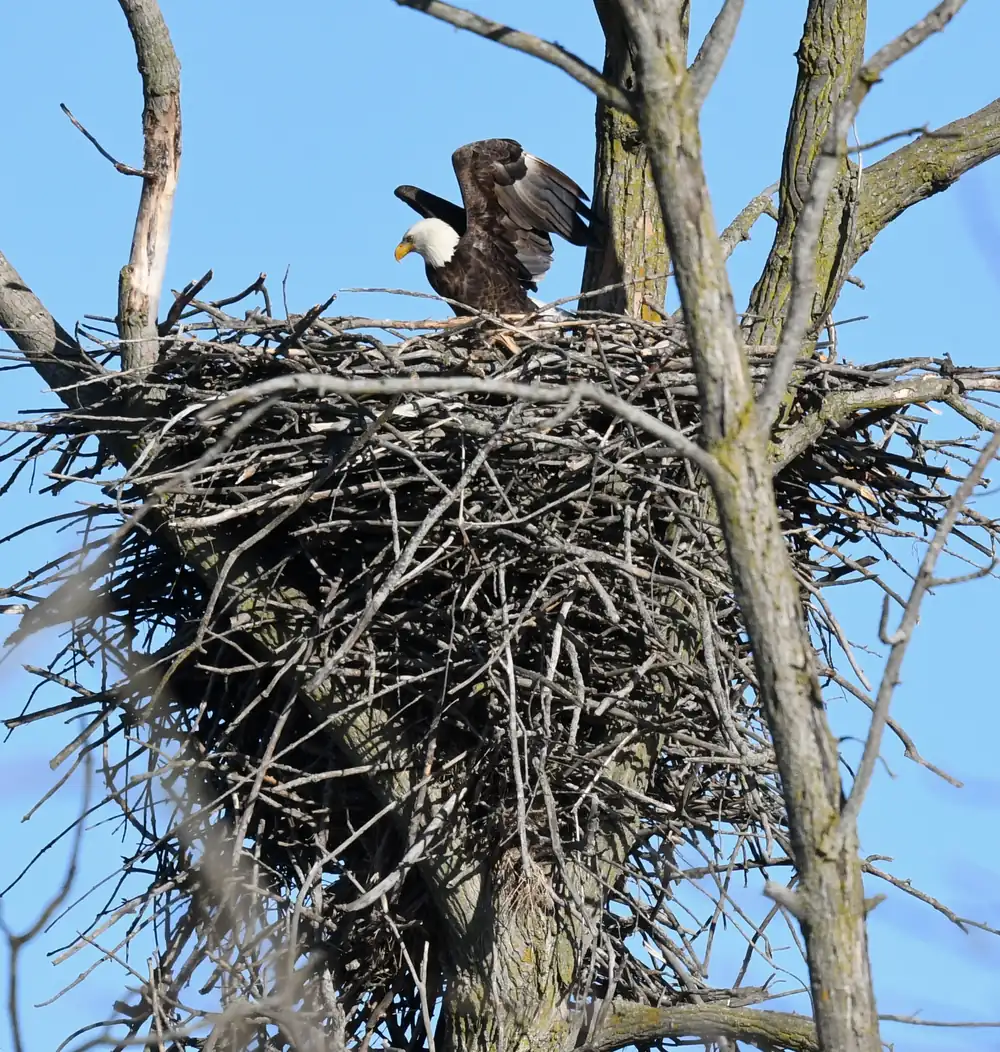
Bald eagles on eggs
Courtship and nest repair now; first eggs from late February on the coast to early May inland · Large pines and other tall trees near the coast, lakes and rivers
IFW’s species assessment says Maine’s eagles spend seven to eight months of the year at their nests, with peak timing in the interior four to five weeks behind the coast. Clutches of one to three eggs are laid from as early as February 25 on the coast to as late as May 6 inland, and interior egg-laying usually comes before ice-out. Incubation lasts 35 days, with the female doing about 80 percent of it, and hatching runs from April 1 to June 10, mostly in May. IFW’s raptor page says that apart from midwinter, at least 2,000 bald eagles can be found in Maine. Watch a known nest only from far off.
-
Red-winged blackbirds
Early spring, with the males arriving before the females · Cattail marshes, wet fields and roadside ditches
Audubon’s field guide notes that males reach northern breeding grounds before the females and sing from high perches with their red shoulder patches flared. Listen for their rising, musical calls over wet fields and marshes.
-
Ducks and geese on open water
March into April · River mouths, tidal creeks, marshes and any lake that has opened
IFW says 34 waterfowl species pass through Maine, 18 of them wintering and 15 staying to breed. Dabbling ducks, such as mallards and black ducks, are among the earliest nesters, starting in March and April, and Canada geese begin as early as March. Look along the first open edges of rivers and estuaries.
-
The feeder season is not over
Through the end of April · Backyard feeders
FeederWatch counts continue until April 30, so March tallies still count. IFW asks Mainers to bring feeders in on April 1, and sooner is wise if a bear has already been reported near you.
Our February page covers the chickadee’s song and the owls on eggs.
What are Maine’s mammals doing as the snow melts?
As the snow settles, what it uncovers tells the story of the whole winter. Several of Maine’s mammals are courting, a few are leaving dens, and the deer that lived on stored fat are at their most vulnerable.
-
The world under the snow
As the snow melts · Lawns, fields, orchards and woodland edges
IFW’s wildlife blog explains that melting snow exposes the runways, nests, food caches and latrines of the subnivean zone, the insulated space between ground and snowpack where mice, voles and shrews stay active all winter. Short-tailed weasels slip through the tunnels, red foxes pounce on sounds they hear below the snow, and owls track the same sounds with their facial discs. Look for winding trails in matted grass and for tiny holes marking tunnel entrances.
-
Woodchucks wake first
Males in late winter, others in spring · Fields, roadsides and burrows near open grass
IFW calls the woodchuck a true hibernator whose body temperature drops from 97 to about 40 °F for up to six months. Only males come out in late winter to mate, then return underground. A mild day in late winter can bring one out.
-
Bobcats, beavers and otters
Bobcats mate February to March; beavers breed January to March; otter kits are born in April · Woodlands, beaver flowages and river banks
IFW says bobcats mate between February and March, with kittens born in May, and beavers breed from January to March, with kits in May or June. River otters, which slide on mud and snow, have two to three kits in April in a den near the water. Thaw is when their tracks and slides show most clearly.
-
Bears wake up hungry
Usually early April, a few in March · Dens statewide
IFW says Maine’s black bears typically leave their dens in early April, when natural food appears, though a warm spell can bring some out sooner. They emerge hungry, looking for about 5,000 calories a day. Cubs weigh 4 to 10 pounds by mid-April, according to the department’s bear page. Bird feeders, garbage and grills are the main attractions, so IFW asks Mainers to take feeders in from April 1 to November 1 and to store seed indoors.
Our Maine January page covers how deer and moose find shelter, and the field journal has room for what you find.
When does the ice go out on Maine’s lakes, and could the rivers flood in March?
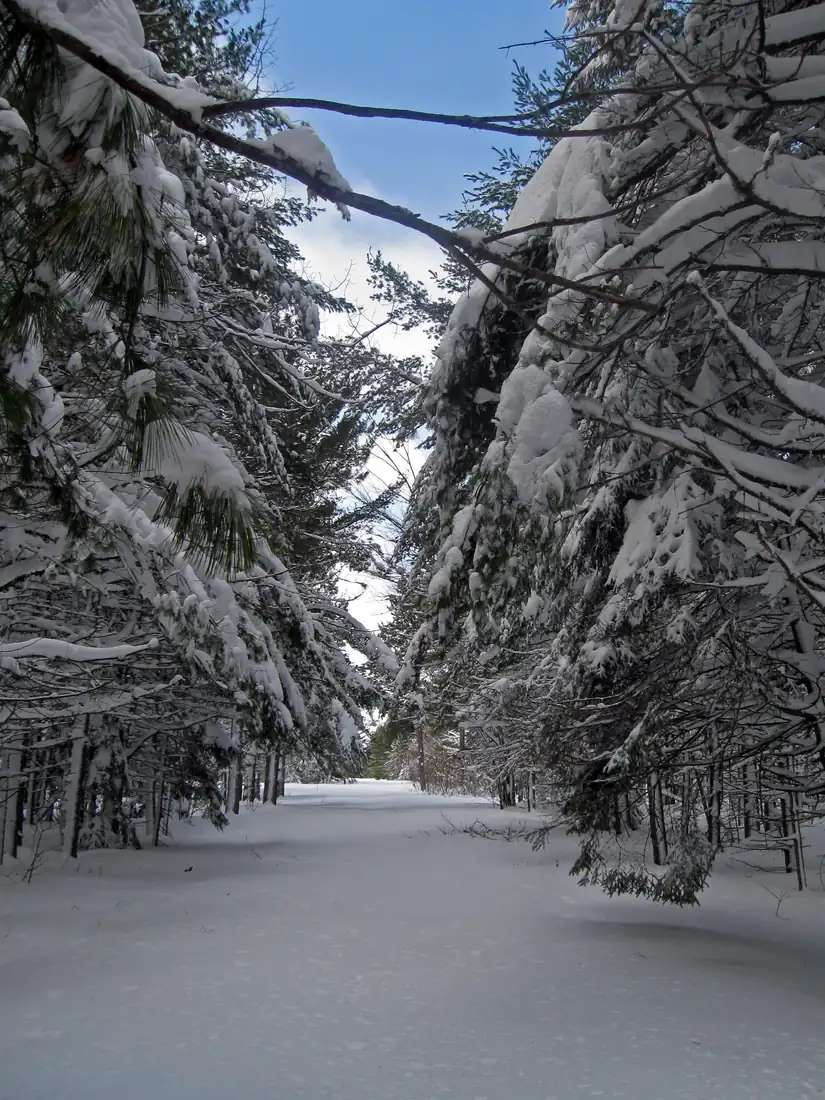
Ice-out, the day a lake’s ice finally gives way, is a spring ritual in Maine. Lake Stewards of Maine says it is declared when a lake is navigable or mostly ice-free, and lakes follow local custom: every bit of ice gone, the main basin clear, or about 80 percent melted. A 2005 U.S. Geological Survey study of 29 New England lakes, most of them in Maine, found ice-out dates have grown significantly earlier since the 1800s, by about 9 days in northern and mountain lakes and 16 days in southern lakes between 1850 and 2000. About half of the year-to-year swing tracks March and April air temperatures.
-
Ice jams and thaw floods
Usually with the first big warm spell and rain; ice can last into April on big rivers · Ice-prone river stretches such as the Kennebec near Augusta and the St. John and Aroostook in the north
The state’s River Flow Advisory Commission meets every year in late winter to review snowpack, river ice, streamflow, reservoir levels and long-range forecasts. Its report explains how ice jams happen: rising water lifts and moves ice sheets, which pile against obstructions. Jams are sudden and local, and standard long-range flood forecasts do not capture them. The commission asks communities along ice-prone river segments to stay alert through the thaw and to report ice movement to the National Weather Service and the county emergency management agency. Dam operators also draw reservoirs down at this time of year to make room for snowmelt and spring rain.
-
Reporting ice-out
From the first open water to the last ice · Any lake you watch regularly
Lake Stewards of Maine collects ice-out dates through an online form and keeps an ice coverage map. It advises observers to follow the method historically used for their lake. A date logged year after year builds the kind of long record the USGS study relied on.
| Station | Average high | Average low | Precipitation | March snowfall | April snowfall |
|---|---|---|---|---|---|
| Portland International Jetport | 42.3 °F | 26.0 °F | 4.08 in | 13.6 in | 2.8 in |
| Eastport | 39.1 °F | 24.4 °F | 4.08 in | 12.7 in | 4.1 in |
| Bangor International Airport | 40.1 °F | 21.1 °F | 3.22 in | 15.2 in | 3.7 in |
| Farmington | 38.9 °F | 17.9 °F | 3.99 in | 18.8 in | 5.3 in |
| Presque Isle | 35.7 °F | 16.0 °F | 2.35 in | 19.0 in | 6.3 in |
| Caribou Municipal Airport | 34.3 °F | 15.6 °F | 2.77 in | 21.4 in | 8.3 in |
What March can throw at you. The National Weather Service office in Caribou says the average high there rises from 29 °F on March 1 to 40 °F at month’s end and the average low from 9 to 22 °F, while snow depth at the airport falls from about 18 inches to 9. Extremes are large: 75 °F on March 21, 2012, −28 °F on March 2, 2001, and March snowfall from 1.4 inches in 2006 to 47.1 inches in 1955, with 28.6 inches falling on March 14, 1984. Freezing rain, thaw-driven river rises and washed-out dirt roads can all arrive in the same month, so follow your county’s National Weather Service forecast; our weather page shows the week ahead, and our cloud guide helps you read an approaching front. The Climate Prediction Center posts new seasonal outlooks monthly on its 90-day outlook page.
How fast do the days lengthen in Maine in March?
March brings the biggest daily gains of the whole year. Between March 1 and March 31, Fort Kent’s day grows by 102 minutes and Kittery’s by 88, and every town in the table adds about three minutes of daylight each day. Day and night come close to equal around the equinox on March 20. The clock change on Sunday, March 14, at 2 a.m., moves sunrise and sunset an hour later by the clock overnight, but it does not alter the length of the day, so the table shows day length only.
| City | Mar 1 | Mar 31 | Gained | Per day |
|---|---|---|---|---|
| Kittery | 11 h 13 m | 12 h 41 m | 88 min | 2.9 min |
| Portland | 11 h 12 m | 12 h 41 m | 89 min | 3.0 min |
| Augusta | 11 h 10 m | 12 h 43 m | 93 min | 3.1 min |
| Bangor | 11 h 09 m | 12 h 43 m | 94 min | 3.1 min |
| Bar Harbor | 11 h 11 m | 12 h 43 m | 92 min | 3.1 min |
| Eastport | 11 h 09 m | 12 h 43 m | 94 min | 3.1 min |
| Millinocket | 11 h 07 m | 12 h 45 m | 98 min | 3.3 min |
| Fort Kent | 11 h 04 m | 12 h 46 m | 102 min | 3.4 min |
Our sunrise and sunset calculator gives exact clock times for any Maine address, with the daylight-saving change built in. Days keep lengthening until the June solstice, though the daily gain starts to ease from late spring.
When is the last spring freeze in Maine?
Winter lets go slowly in Maine. By NOAA’s 1991–2020 normals, the typical last 32 °F night comes in the final days of April at Portland, Augusta and Eastport, and in the first half of May at Bangor and Millinocket. In the table, the first date is one that only the earliest tenth of springs reach; by the last date, nine springs in ten have finished freezing. A late freeze after a warm spell can hurt early blooms and gardens, so many Maine gardeners wait for the last column before setting out tender plants.
| Station | One year in ten | Median | Nine years in ten |
|---|---|---|---|
| Portland | Apr 16 | Apr 26 | May 7 |
| Augusta | Apr 15 | Apr 27 | May 7 |
| Bangor | Apr 24 | May 4 | May 17 |
| Eastport | Apr 16 | Apr 29 | May 11 |
| Millinocket | Apr 28 | May 9 | May 24 |
Use our frost dates for Maine page to check the dates for your own town. Cold air drains into valleys and hollows, so a low field may freeze weeks after a hillside nearby.
What can you see in Maine’s night sky in March 2027?
There are no eclipses this month. The sky is a quiet one: Mercury appears at dawn, Jupiter and Mars share the evening sky, and the Moon makes several close visits to bright stars and planets. Times are Eastern Standard Time through March 13 and Eastern Daylight Time from March 14 on.
-
Mercury at dawn, with Venus above it
Best from about March 8 to March 25; widest from the Sun at 12:20 a.m. EDT on Wednesday, March 17 · Low in the east-southeast, roughly an hour before sunrise
Mercury’s best dawn showing of the spring peaks around March 17, when it stands 27.6° west of the Sun; SeaSky rates the viewing optimal. Early in the month it rises about an hour before sunrise. The morning ecliptic is tilted shallowly at Maine’s latitudes in spring, so a shore or lake edge with open sky to the east is a help. Venus, far brighter, hangs well above, with the slimmest of old moons beside it at dawn on March 4 and again on the 5th, before the clock change.
-
Jupiter and Mars in the evening sky
All month; the Moon visits Jupiter on March 18 and 19; Mars and Jupiter draw closest on the night of March 30–31 · High in the east and south after dark, among the stars of Leo and Cancer
Jupiter, still bright after its February opposition, is up most of the night, setting close to dawn at the start of March. On March 19, at 5:26 a.m. EDT, a gibbous Moon passes less than a degree from it, so the evenings before and after show a striking pair. Around the night of March 30 into 31, Mars comes within roughly 4.3 degrees of Jupiter, a wide but easy pairing overhead in the evening. The positions are our own computations, so treat the hours as approximate.
-
The Worm Moon
Full on Monday, March 22, at 6:44 a.m. EDT; the best evening is Sunday, March 21 · Rising in the east around sunset
Fullness comes shortly before sunrise on the 22nd, so the Moon appears round on the 21st and the 22nd both. On the 21st it rises near sunset, at about 6:24 p.m. in Boston; the minute varies across Maine, so check the moon calendar for your town. SeaSky explains the traditional name by the softening ground and the return of earthworms. It is a regular full moon, not a supermoon.
-
The clocks and the equinox
Clocks move forward at 2 a.m. on Sunday, March 14; equinox on Saturday, March 20, at 4:25 p.m. EDT · Everywhere
From March 14 every sunrise and sunset comes an hour later by the clock. At the equinox the Sun crosses the celestial equator and day and night are nearly equal worldwide. Easter Sunday is March 28. On the evening of March 13 a slim crescent Moon passes within about a degree of the Pleiades, a pretty scene in binoculars.
-
Milky Way and aurora
Milky Way in the hour or two before dawn near the March 8 new moon; aurora on any clear, dark night · Dark places in the Highlands, the western mountains and Downeast
In March the Milky Way’s bright core is a pre-dawn sight only. Our calculations allow at most about 85 minutes of dark sky with the core up at 40 degrees north, around the new moon, and less farther north, so in Maine it is a marginal target. Storms on the Sun can still spark aurora while the solar cycle declines, and March is statistically a better month for it than most. The NOAA Space Weather Prediction Center posts warnings.
| Phase | Date | Time |
|---|---|---|
| New moon | Monday, Mar 8 | 4:29 a.m. EST |
| First quarter | Monday, Mar 15 | 12:25 p.m. EDT |
| Full moon, the Worm Moon | Monday, Mar 22 | 6:44 a.m. EDT |
| Last quarter | Monday, Mar 29 | 8:54 p.m. EDT |
For moonrise and moonset in your town, use our moon calendar.
What can Maine families do outdoors in March 2027?
Few organizers have posted March 2027 dates yet, and weather can change any plan, so check before you go.
- Sunday, March 14: daylight saving time begins at 2 a.m., which gives after-school and after-work walks a fresh supply of light.
- Saturday, March 20: the spring equinox, at 4:25 p.m. EDT. Mark a stick’s noon shadow and compare it with December’s.
- Maine Maple Sunday: no 2027 date is posted yet; the association says it is always the fourth Sunday in March, so confirm the day and the participating farms on its site.
- Big Night: the dates depend on the weather. Land trusts and Maine Audubon recruit volunteers in advance, so ask your local group about 2027.
- All month: FeederWatch counts continue to April 30, and Lake Stewards of Maine welcomes ice-out reports from your own lake.
- Reports: Journey North takes migration sightings, and NestWatch from the Cornell Lab of Ornithology guides nest monitoring.
Maine Audubon posts its programs on its events page, and local land trusts run walks that fill early. Record the first frog, woodcock or blackbird of the season in the field journal, and browse our state-by-state guides for other months. IFW lists the next free fishing weekend after February’s as June 5 and 6, 2027.
Safety notes for March in Maine
Hunting and trapping. Under IFW’s 2026–27 seasons, crow hunting continues through March 31 in wildlife management districts 7 through 29 and through April 15 in districts 1 through 6. Snowshoe hare may be hunted through March 31, and coyotes have no closed season by day, with night hunting allowed from December 16, 2026, to August 31, 2027. Woodchuck, porcupine and red squirrel have no closed season either. Beaver trapping continues after the general trapping season ended on December 31: through April 30 in districts 1 through 6 and 8 through 11, and through April 15 in districts 7 and 12 through 29, so keep dogs leashed near beaver flowages. Spring turkey season does not begin until May 3, with youth days at the end of April (see IFW for the dates). Maine does not allow hunting on Sundays.
Hunter orange. IFW’s orange rules apply to the firearms and muzzleloader deer seasons and to moose districts while moose hunting is on. Both are over, so March hunters need none, though walkers and dogs are safer in bright colors.
Ice and water. Late-season ice weakens fast in sun and rain, especially near inlets, outlets and moving water, and cold spring river water can be deadly. Stay off weak ice, ice-jammed rivers and flooded roads.
Ticks. The University of Maine Cooperative Extension Tick Lab advises checking for ticks after any time outdoors and will identify a tick you submit. Check yourself and your pets after walks through leaf litter or brush.
Mud, roads and trails. Dirt roads and trails soften in mud season. Baxter State Park runs a daily conditions line at 207-723-9500, and Acadia National Park usually leaves only one section of its Park Loop Road open to vehicles in winter, so check its alerts. Acadia’s peregrine falcons require seasonal trail closures on some cliffs during nesting; obey posted signs.
Amphibian nights. If you help frogs and salamanders cross the road, wear a safety vest, carry a flashlight and watch for traffic first.
Indoors, the Naturalist’s Field Journal gives each first of spring a place to live. Our February guide covers the ice-safety basics.
Sources (51)
- Maine Maple Producers Association: Maine Maple Sunday Weekend
- University of Maine Cooperative Extension: Bulletin 7036, how to tap maple trees and make maple syrup
- Maine Department of Inland Fisheries and Wildlife: why did the amphibian cross the road?
- Maine Department of Inland Fisheries and Wildlife: wood frog
- Maine Department of Inland Fisheries and Wildlife: spring peeper
- Maine Department of Inland Fisheries and Wildlife: spotted salamander
- Maine Department of Inland Fisheries and Wildlife: reptiles and amphibians
- Maine Audubon: Big Night, Maine’s amphibian migration
- Chebeague and Cumberland Land Trust: Big Night
- Wells National Estuarine Research Reserve: enjoy the greatest show of spring, the sky dance
- Maine Audubon: Woodcock Watch at Fields Pond (2025 program)
- National Audubon Society field guide: American woodcock
- National Audubon Society field guide: red-winged blackbird
- Maine Department of Inland Fisheries and Wildlife: waterfowl
- Maine Department of Inland Fisheries and Wildlife: raptors
- Maine Department of Inland Fisheries and Wildlife: seabirds
- Maine Department of Inland Fisheries and Wildlife: bald eagle species assessment
- Marine Mammals of Maine: ice is nice for ice seals
- Maine Department of Marine Resources: seals
- NOAA Fisheries: gray seal
- Maine Department of Marine Resources: 2026 sea-run rainbow smelt regulations
- Maine Department of Inland Fisheries and Wildlife: woodchuck
- Maine Department of Inland Fisheries and Wildlife: bobcat
- Maine Department of Inland Fisheries and Wildlife: beaver
- Maine Department of Inland Fisheries and Wildlife: river otter
- Maine Department of Inland Fisheries and Wildlife: black bears
- Maine Department of Inland Fisheries and Wildlife: be bear wise
- Maine Department of Inland Fisheries and Wildlife: white-tailed deer
- Maine Department of Inland Fisheries and Wildlife: spring reveals subnivean secrets (April 15, 2026)
- U.S. Geological Survey: historical ice-out dates for 29 lakes in New England
- Lake Stewards of Maine: ice-in and ice-out tracking
- Maine Emergency Management Agency: River Flow Advisory Commission report on hydrologic conditions, March 5, 2026
- National Weather Service Caribou: March climate facts for Caribou
- National Weather Service Gray, Maine
- NOAA National Centers for Environmental Information: 1991–2020 monthly normals for Maine stations
- Climate Prediction Center: seasonal outlooks
- Maine Department of Inland Fisheries and Wildlife: 2026–27 Maine hunting seasons
- Maine Department of Inland Fisheries and Wildlife: trapping laws and rules
- Maine Department of Inland Fisheries and Wildlife: laws pertaining to hunting equipment (hunter orange)
- Maine Department of Inland Fisheries and Wildlife: fishing (Free Fishing Weekends in 2027)
- University of Maine Cooperative Extension: Tick Lab
- Project FeederWatch: how to participate
- NestWatch, Cornell Lab of Ornithology
- Journey North
- National Park Service: birds of Acadia National Park
- National Park Service: Park Loop Road, Acadia National Park
- Baxter State Park
- U.S. Naval Observatory: moon phases, 2027
- U.S. Naval Observatory: Earth’s seasons, 2027
- Sea and Sky: astronomy calendar of celestial events 2027
- Photos via Wikimedia Commons; licenses and photographers are credited under each picture
