What to look for in nature in Maine this December
Meteorologists count winter from December 1, grouping the year’s three coldest months together, and Maine settles in. Wreath makers are out cutting balsam fir tips, Christmas Bird Count teams are planning their routes, great horned owls are calling across frozen fields at night, and snowshoe hares are finishing their change into white coats. The sun sets earliest around December 9 to 11, not on the solstice, and on the shortest day Fort Kent gets just 8 hours and 29 minutes of daylight. The guide below follows the month region by region.
Other months in Maine: October, November.
Start here
- Join a bird count. Christmas Bird Count teams take to the field between December 14 and January 5. Maine Audubon posts each Maine circle’s date and organizer as counts are scheduled; write to a compiler early, since most Maine counts happen in the first part of the window.
- Stay up for the Geminids. Sunday, December 13: Portland’s slim crescent moon drops below the horizon at 8:20 p.m., leaving a dark sky for the richest meteor shower of the year. Rates climb after midnight and are usually best around 2 a.m.
- Learn fir from spruce. Pinch a needle and roll it. A balsam fir needle is flat, blunt and about an inch long, and young fir bark has resin blisters; a red spruce needle is half that length, stiff and sharp. It is the one tree lesson every Maine wreath maker knows.
Keep a record: draw a hare’s big hind prints or a lynx trail in fresh snow on the Naturalist’s Field Journal’s tracks-to-know plate, sketch a hemlock cone next to the bare spike a fir cone leaves behind, and give a night of great horned owls calling back and forth its own map of sounds. The dusk and dawn watch suits the early sunsets of the second week; note the temperature with every entry.
Regions used below: Southern Maine and Casco Bay; Midcoast and Penobscot Bay; Downeast and Acadia; Western mountains and lakes; The Highlands, Moosehead and Katahdin; Aroostook County.
How do you tell Maine’s evergreens apart in winter?
With the hardwoods bare, December is when Maine’s conifers take over the view, and it is also wreath season, when the state’s most abundant tree becomes a cottage industry. The Maine Forest Service handbook Forest Trees of Maine gives a few simple clues for each species, and a minute with a twig in hand is usually enough. White pine, the state tree, is the easy one: soft needles in bundles of five.
-
Balsam fir, and the wreath harvest
Tipping from November into mid-December · Statewide, in damp woods, thickets and well-drained hillsides
Balsam fir is the most common tree in Maine. Look for smooth gray bark on young trees dotted with blisters of sticky resin, and needles about an inch long, dark and glossy on top with two white lines underneath. Its cones stand upright and fall apart on the branch, leaving bare spikes behind. The University of Maine Cooperative Extension explains that wreath brush, called tips, can be cut only once the needles have “set” for the winter: the Maine Christmas Tree Association’s standard is after November 1 and after at least three nights in a row at 20 °F or colder. Tips of 12 to 20 inches are snapped from the branches, and the season usually runs until mid-December, leaving time to make and ship wreaths. Millions are made in Maine each year. If you see tippers along a woods road, know that they need written permission from the landowner.
-
Red spruce
All winter · Rocky uplands statewide, especially north-facing mountain slopes
Red spruce is the signature tree of the Acadian forest of northern New England and the Maritimes. Its shiny needles are about half an inch long, stiff and prickly, and its bark breaks into thin reddish-brown scales. The hanging cones start dropping in autumn or early winter, so look for them on the snow.
-
Eastern hemlock
All winter · Cool, moist slopes and ravines in nearly every part of the state
Hemlock needles are flat, blunt and short, roughly half an inch, whitish beneath, set in a flat spray along the twig, and the tree’s top shoot droops. Its small cones hang on all winter, dropping winged seeds onto the snow. Nick the bark and the inner layer shows a purplish tint.
-
Northern white cedar
All winter · Swamps, stream banks and old pastures, most common in the north and east
Cedar has tiny, blunt, scale-like leaves pressed flat along the twigs, and stringy bark tinged with orange. The Forest Service handbook calls its foliage a major winter food for deer, which is why cedar swamps so often double as deer wintering yards.
Tamarack is Maine’s one conifer that is bare in December; look for its knobby twigs and small round cones at the edges of bogs.
When is the Christmas Bird Count in Maine in 2026?
Audubon’s winter census dates to Christmas Day 1900, when a census replaced the old holiday “side hunt” for birds. This winter’s count, the 127th, starts Monday, December 14 and ends Tuesday, January 5. Every circle is 15 miles in diameter and is counted on one day its compiler picks, with teams covering set routes and tallying every bird seen or heard. Maine has several dozen circles, and Maine Audubon notes that most of them count early in the window.
-
Finding your circle
Sign up in late November or early December · maineaudubon.org/cbc and Audubon’s national map
Maine Audubon keeps a table of the state’s counts with dates and coordinators, filled in as each circle schedules its day; Audubon’s online map shows which circles still want help. Beginners are usually paired with experienced birders, and feeder watchers living within a circle’s boundary can often report their yard birds. York County Audubon runs two circles: its York County count, traditionally on the first Monday of the count period, and the Biddeford and Kennebunkport count later in the month. Check the published date before planning around it.
-
Long-running Maine counts
Every December since the 1970s or earlier · Farmington, Biddeford and Kennebunkport, Portland, Mount Desert Island and more
The Farmington circle held its 50th count on December 14, 2025: 19 volunteers spent about 45 hours and found 41 species, close to the long-term average, including 52 snow buntings and a northern shrike. The Biddeford and Kennebunkport circle ran for the 66th time and found 42 species, five bald eagles among them. Coastal circles usually top the list; in the 2022–23 season Portland logged 103 species to Bangor’s 59.
-
What the counts are showing
Results each winter · Greater Portland and statewide
Counts catch changes no single birder would notice. Maine Audubon’s staff naturalist reported in December 2025 that the Greater Portland count found 1,320 herring gulls in 2023, 1,055 in 2024 and 784 in 2025, while great black-backed gulls fell from 178 to 40. He tied the drop to avian influenza, present in Maine since 2022, so count the gulls carefully.
Pine siskins and red crossbills could pad this year’s totals: the Finch Research Network rates the white pine and white cedar seed crops in the Northeast very good.
Why are owls hooting in Maine in December, and where are the eagles?
Long nights make December an owl month. Eleven owl species live in or visit Maine, according to the state’s Department of Inland Fisheries and Wildlife (IFW), and the two most common, the great horned and the barred owl, are both easy to hear in the weeks around the solstice.
-
Great horned owls
Hooting most from fall into winter; pairs settle from mid-January · Woodlots next to fields, farms and suburbs statewide
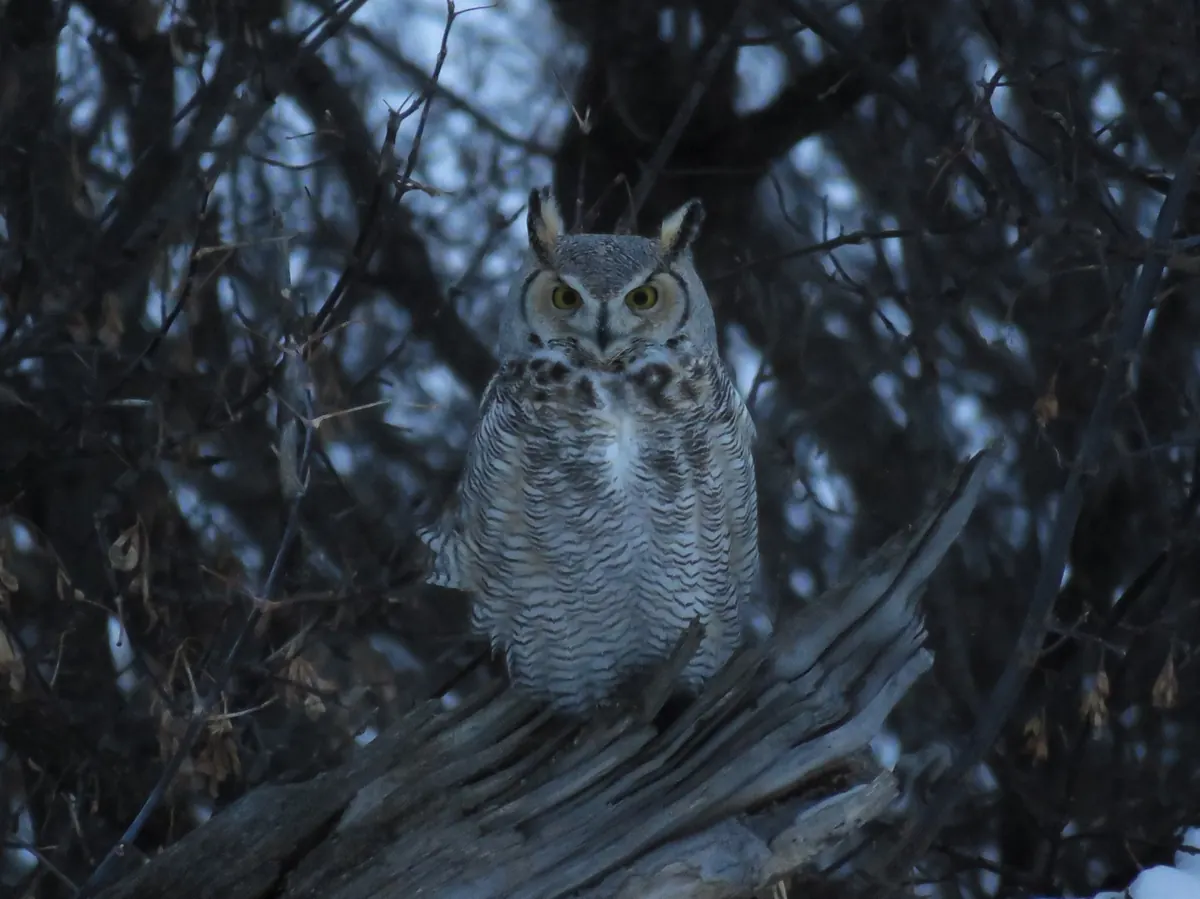
IFW calls the great horned owl Maine’s earliest-nesting bird. Males hoot in every season, but most in fall and winter, when they are advertising and defending a territory, and Audubon describes pairs calling back and forth through the nights of December. In Maine, pairs form from mid-January to mid-March, depending on how far north they are, and the female sits on her eggs for 28 to 35 days, sometimes under a coat of snow. Nesting this early gives the young a whole summer and fall to learn to hunt before their first winter. Listen on a calm evening just after dark for a deep, rhythmic series of four or five hoots; a pair answering each other often differ in pitch.
-
Barred owls
All year, more vocal on still winter nights · Mixed and wet woods, river bottoms and swamps
The barred owl is a bit smaller, and IFW notes it is the only Maine owl with dark brown eyes, no ear tufts and a thick-necked look. Its rhythmic “who cooks for you” carries a long way across a frozen beaver pond.
-
Bald eagles
All winter · Open water: tidal rivers, river mouths, dam tailraces and the coast
Maine’s eagle comeback is one of the state’s best conservation stories. In 1967 IFW found only 21 nesting pairs, which raised just four young; its last full aerial survey, in 2018, counted 733 pairs. IFW says many of these eagles stay in Maine for the winter rather than leaving. As lakes and rivers freeze, fishing gets harder, and scavenging on carcasses becomes a bigger part of their diet. The places to look in December are wherever the water stays open, and along the coast, where the birds perch on high trees above tidal flats.
IFW lists the northern hawk owl as a rare winter visitor to the northernmost part of the state; report one, or a snowy owl, to eBird.
How do Maine’s animals get through the winter?
By December every Maine animal has committed to a winter plan. IFW sorts them into a few strategies: leaving, sleeping deeply, slowing down, or staying active and toughing it out. Here are some of the ones you can watch for, or at least know are there under the snow.
-
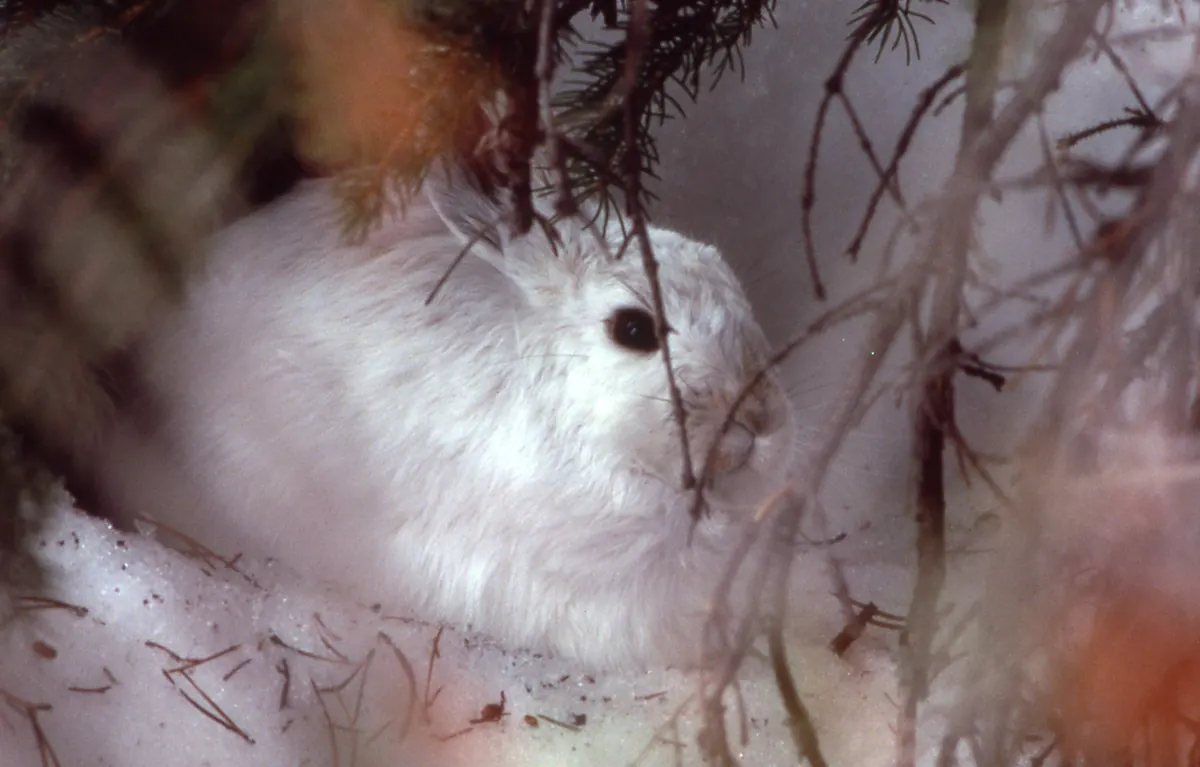
Snowshoe hares turning white
The color change runs from October into December · Dense softwoods statewide, from coastal spruce to the North Woods
IFW’s species assessment says a snowshoe hare needs 70 to 90 days to turn from brown to white, from October into December. The winter coat is about 30 percent warmer than the summer one. In a December with little snow, a white hare on brown leaves stands out; once snow comes, its huge hind feet keep it on top. Look at dusk along thick young fir and spruce.
-
Wood frogs, frozen solid
Through the winter · Under leaf litter, moss and rotting logs on the forest floor, statewide
Wood frogs spend the winter just under the leaves, not in mud or water. IFW says they can freeze solid for days at a time, protected by glucose, a natural antifreeze, that they pack into their tissues. Their hearts stop until a thaw. The same frogs will be quacking in vernal pools by April.
-
The true hibernators
Late fall until spring · Burrows, caves, mines and old buildings
IFW counts only three Maine mammals as true hibernators: bats, woodchucks and meadow jumping mice. A woodchuck’s body temperature falls by more than half for about five months, its heart beating just a few times a minute. Bears, raccoons and skunks enter torpor, a lighter sleep they can wake from on mild days.
-
Black-capped chickadees
All winter · Every woodlot and backyard
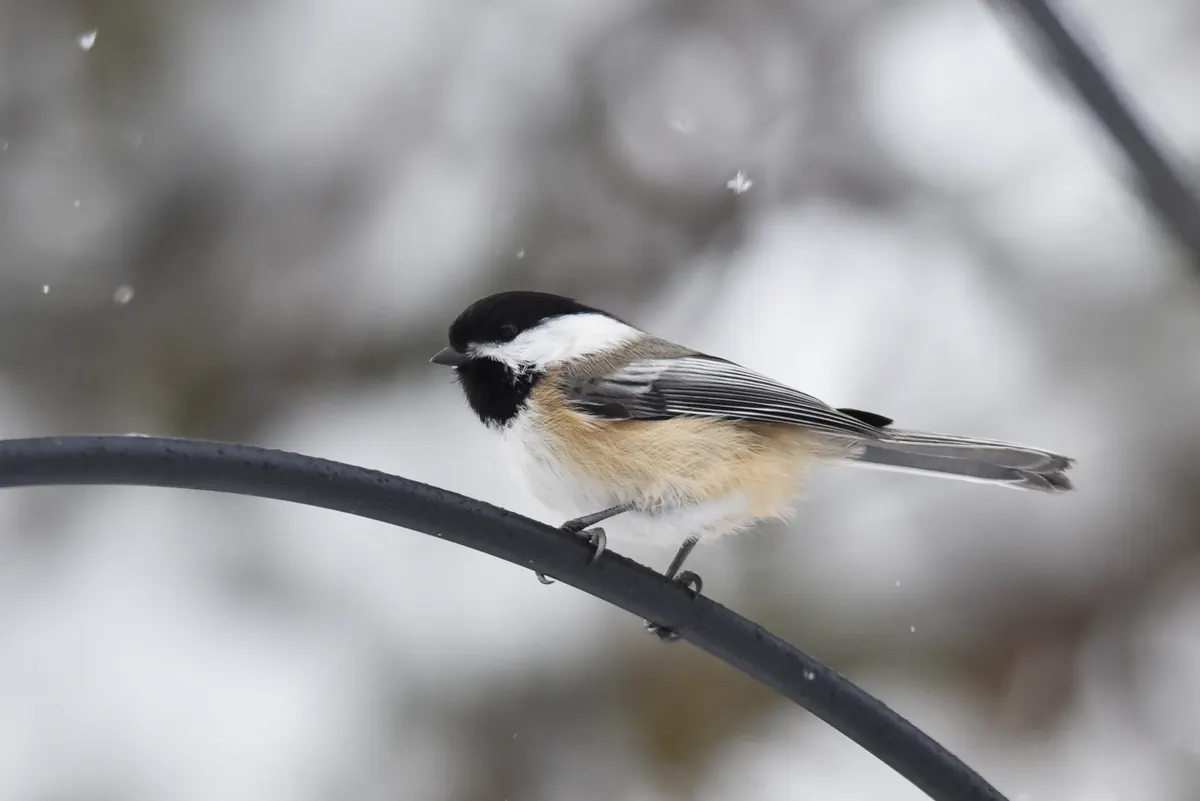
Maine’s state bird is just over five inches long and weighs less than five pennies, yet it stays all winter. Maine Audubon credits its memory: the brain’s memory center grows in the fall, and a chickadee can recall where it hid a seed, and how good it was, for up to 28 days. Insects and spiders still make up as much as half of its winter food.
Ruffed grouse take a different route, diving into soft snow to roost, so a walker can flush one from right underfoot. Red squirrels are living on their cone caches, and the heaps of stripped scales they leave, called middens, can be knee deep under an old spruce.
What tracks can you find in the snow in Maine?
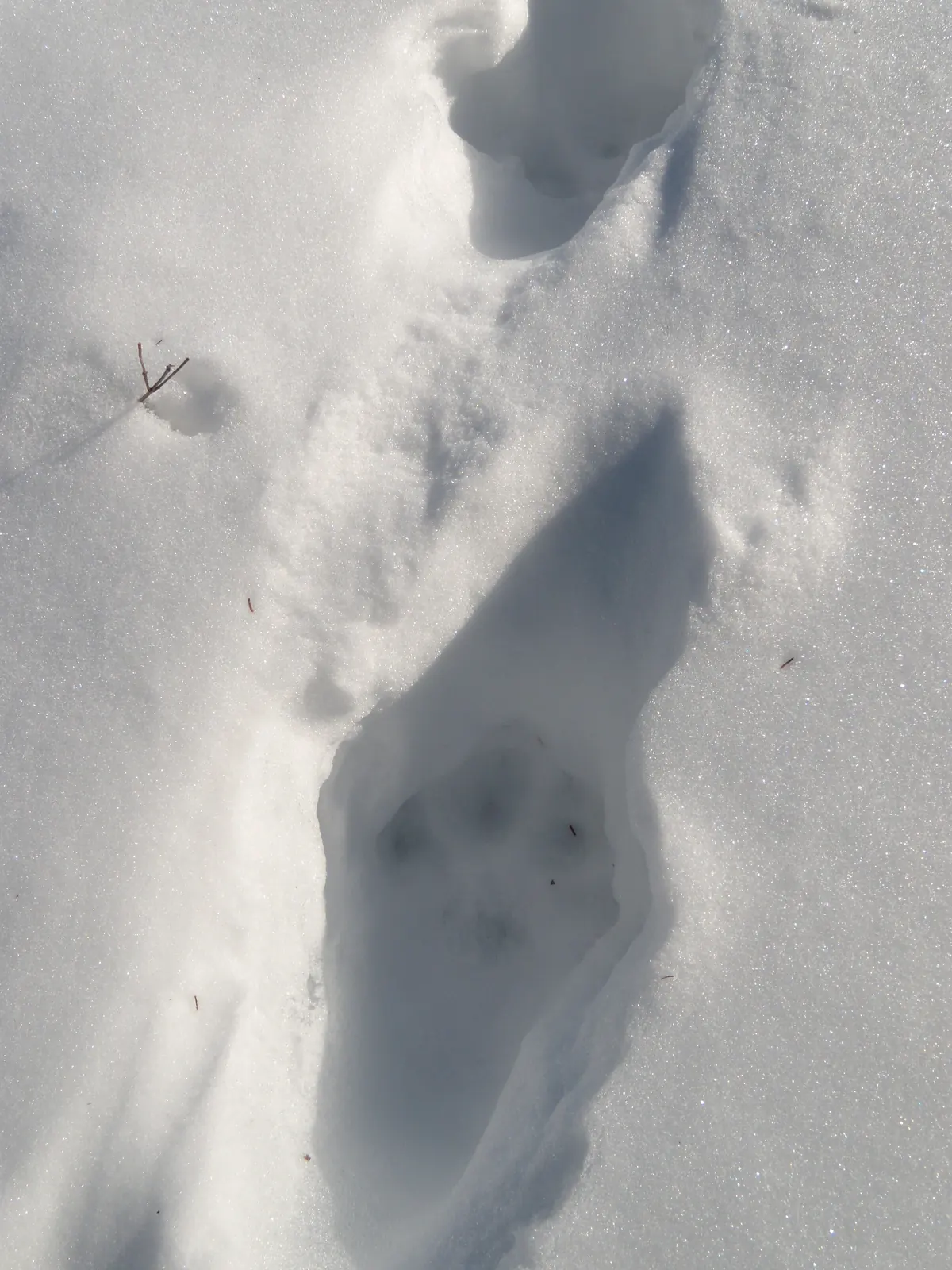
The first good snow turns every woods walk into a record of who passed in the night. December snow is often fresh and shallow, the easiest kind for reading clear prints, and a light snowfall that ends before dawn sets up the best mornings of all.
-
Canada lynx
All winter, best in fresh snow · Young spruce-fir forest in Aroostook and Piscataquis counties, the western mountains and northern Washington County
IFW estimates that more than 1,000 adult lynx live in the spruce and fir flats of northern and western Maine, and track surveys from 2015 to 2019 found them in 51 townships. Their feet are oversized and furred like snowshoes, leaving round prints more than 3 inches wide that barely sink in, while a bobcat’s are smaller and punch deeper. Lynx depend on snowshoe hares, which make up more than 75 percent of their diet when hares are plentiful, about one or two a day. The species is federally threatened. A lynx also has ear tufts longer than an inch and a tail tip that is black all the way around, both good clues if you see the animal itself.
-
Snowshoe hare
All winter · Thick softwood cover
A hare’s tracks come in groups of four, and the two large hind prints sit in front of the two small front prints, because the hind feet swing past them at every bound. Well-used hare runways become packed trails through the firs, and lynx and fox tracks often follow them.
Deer trails converging on a stand of hemlock, spruce or cedar are a sign the herd is moving into its winter yard. Measure any print with a glove or a ruler, photograph the two together, and draw it on the tracks-to-know plate the same day; sun and wind blur the details fast.
What can you do in Acadia National Park in winter?
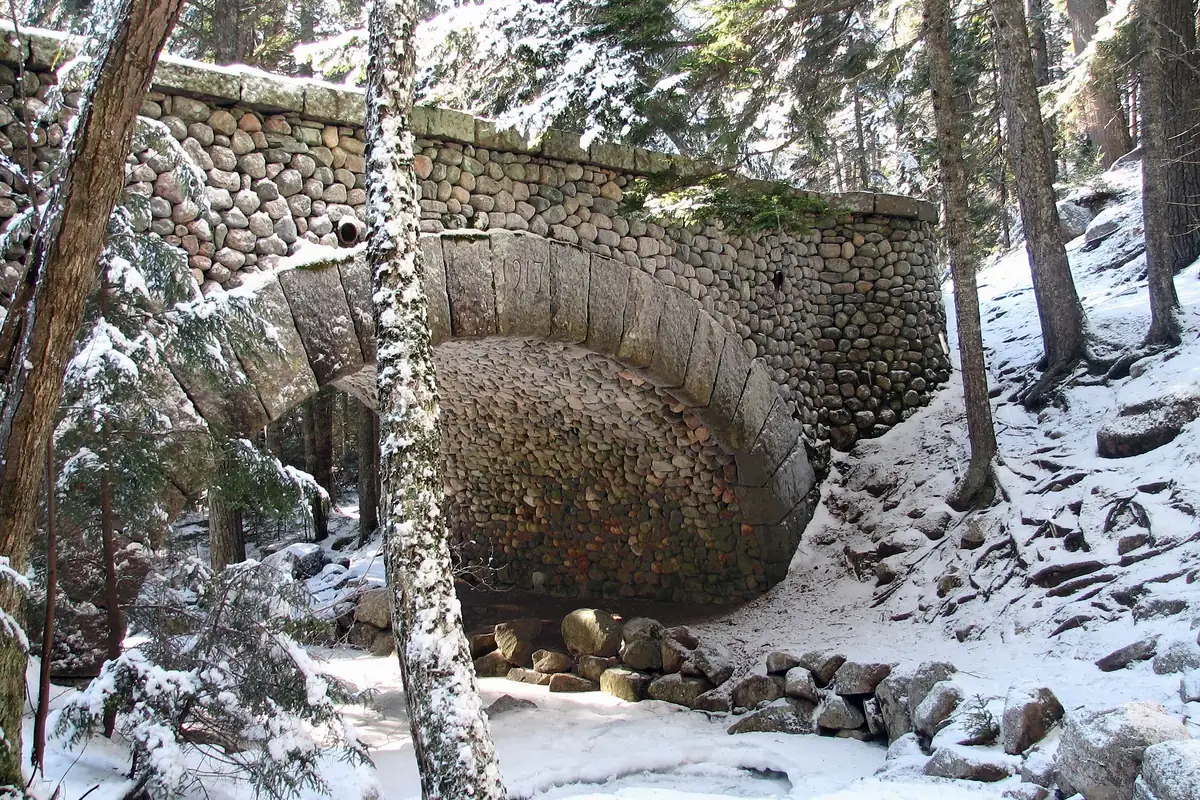
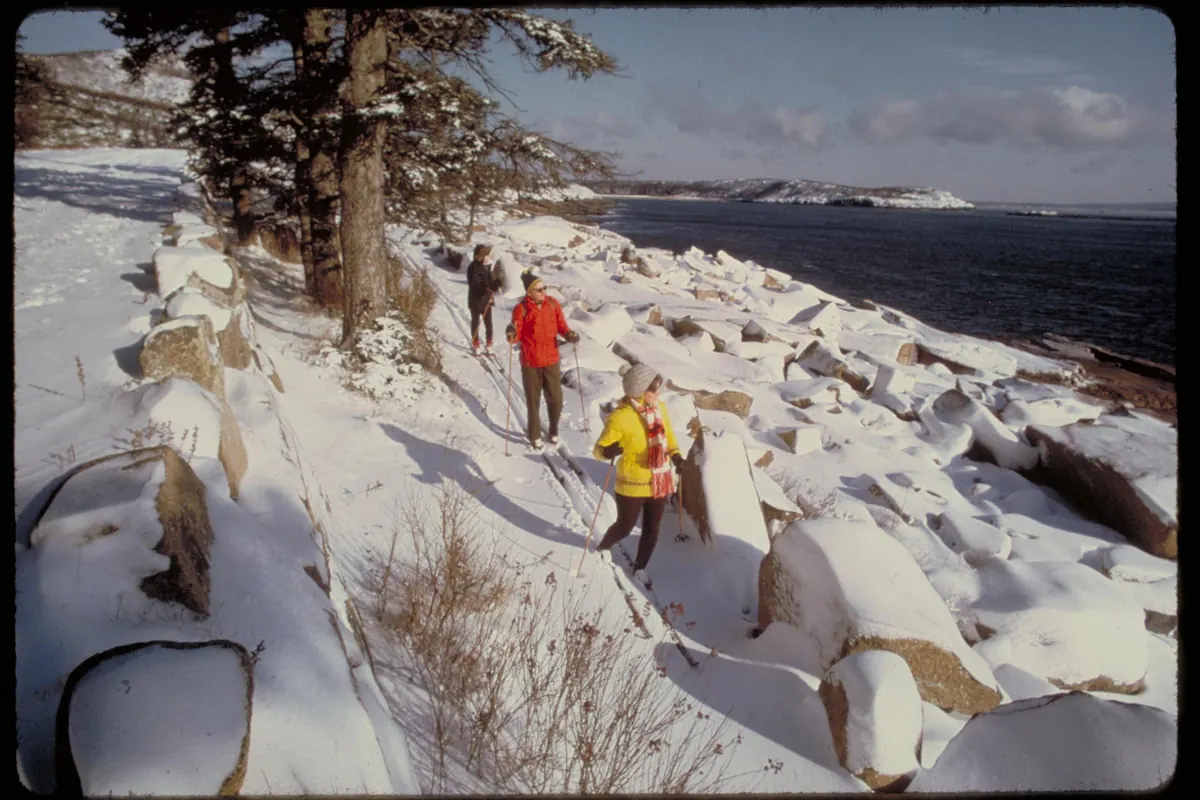
From December 1 to April 14, most of the Park Loop Road is closed to cars and handed over to people on foot, skis and snowshoes. With the summer crowds gone, December is a fine time for a quiet walk on Mount Desert Island.
-
Skiing and snowshoeing the carriage roads
Whenever snow allows · 45 miles of carriage roads across Mount Desert Island
The park’s broken-stone carriage roads, closed to cars all year, turn into cross-country ski trails. Volunteers groom sections once more than six inches of snow lies on a frozen roadbed, and walkers and snowshoers are asked to stay off the set tracks. Without snow, the loops around Eagle Lake and Jordan Pond make a sheltered winter walk.
-
Driving and walking the shore
All winter · Ocean Drive and Jordan Pond Road
Cars can still use Ocean Drive between Schooner Head and Otter Cliff, and the Jordan Pond Road up to the pond. The park suggests Ocean Path and Ship Harbor among the trails for a winter hike. Watch the water for common eiders, long-tailed ducks and loons, and on the coldest, calmest mornings for sea smoke rising off Frenchman Bay.
Winter rules: no camping or overnight parking, leashes no longer than six feet, a Maine license for ice fishing, and a park pass from the automated machine at Hulls Cove or the Schoodic Institute gatehouse. Schoodic Point is also a fine place to watch December storm surf on pink granite, from a safe distance.
When is the ice safe on Maine lakes and ponds?
Small ponds and coves start to freeze in December, the big lakes much later, and early ice is the most dangerous kind because it varies so much from spot to spot. IFW’s rule is short: if you don’t know, don’t go. Its guidance for new, clear ice is below; cloudy white ice formed from snow holds roughly half as much.
- Under 4 inches: stay off.
- 4 inches: may hold a person on foot, for example to ice fish.
- 5 to 7 inches: often enough for a snowmobile or ATV.
- 8 to 12 inches: holds most cars and small pickups.
- 12 to 15 inches: likely holds a medium-sized truck.
-
How to check
Every time you go out · Any frozen water
Test from shore outward with an auger, chisel or axe. Ice is thinner near inlets, outlets, springs and current, and clear blue ice beats gray, dark or slushy ice. IFW suggests carrying ice picks within reach, wearing layers without cotton, going with a partner and leaving word of your plans.
Rivers and tidal coves are the most deceptive of all, because current and tide eat the ice from below. Admire them from shore in December.
When is the earliest sunset in Maine?
Not on the shortest day. Across Maine, the sun sets earliest in the second week of December: at 4:04 p.m. in Portland around December 9, at 3:54 in Bangor around the 10th, and at 3:44 in Fort Kent around the 11th. By the solstice on Monday, December 21, sunsets are already a few minutes later, yet the days keep shrinking because sunrise is moving later even faster. Portland’s sun comes up at 7:11 a.m. on the solstice and 7:15 by New Year’s Eve, which is why the mornings stay dark into January. The shortest day ranges from 9 hours exactly at Kittery to 8 hours 29 minutes at Fort Kent.
| City | Dec 1 | Dec 21 | Dec 31 | Earliest sunset |
|---|---|---|---|---|
| Kittery | 9 h 14 m | 9 h 00 m | 9 h 04 m | 4:08 p.m., Dec 9 |
| Portland | 9 h 10 m | 8 h 56 m | 8 h 59 m | 4:04 p.m., Dec 9 |
| Augusta | 9 h 06 m | 8 h 51 m | 8 h 55 m | 4:00 p.m., Dec 9 |
| Bangor | 9 h 04 m | 8 h 47 m | 8 h 51 m | 3:54 p.m., Dec 10 |
| Bar Harbor | 9 h 06 m | 8 h 50 m | 8 h 54 m | 3:53 p.m., Dec 9 |
| Eastport | 9 h 02 m | 8 h 46 m | 8 h 50 m | 3:47 p.m., Dec 10 |
| Millinocket | 8 h 57 m | 8 h 42 m | 8 h 45 m | 3:51 p.m., Dec 10 |
| Fort Kent | 8 h 46 m | 8 h 29 m | 8 h 33 m | 3:44 p.m., Dec 11 |
The earliest sunset changes so little from day to day that it barely moves for a week or two around the listed date; in Portland it reads 4:04 or 4:05 p.m. from December 1 to 17. To get times for your own town, enter it in our sunrise and sunset calculator.
How cold and snowy is December in Maine, and what could El Niño mean this winter?
December is the month Maine’s snow season gets going in earnest outside the County. In NOAA’s 1991–2020 normals, December brings more than 14 inches of snow to Portland, Bangor and Eastport, about 21 to 25 inches to Farmington, Presque Isle and Caribou, and average lows that sit in the low 20s on the coast and near 12 °F in Aroostook. Compare the columns and you can see the coast’s problem: Portland and Eastport get more precipitation than the County but much less snow, largely because more of it falls as rain or mixed with sleet.
| Station | Average high | Average low | Precipitation | Snowfall |
|---|---|---|---|---|
| Portland International Jetport | 38.3 °F | 22.4 °F | 4.50 in | 14.6 in |
| Eastport | 36.6 °F | 22.8 °F | 4.57 in | 14.3 in |
| Bangor International Airport | 34.5 °F | 17.3 °F | 3.72 in | 14.7 in |
| Farmington | 32.8 °F | 14.8 °F | 4.31 in | 20.8 in |
| Presque Isle | 28.2 °F | 12.5 °F | 3.16 in | 21.7 in |
| Caribou Municipal Airport | 27.5 °F | 12.3 °F | 3.60 in | 25.2 in |
Sea smoke. Maine Sea Grant explains that it forms when very cold air drifts over water that is still relatively warm, and a forecaster at the National Weather Service office in Gray told it the smoke shows up over coastal waters once the air falls below 10 °F, and surely below zero. Look for it at sunrise from any sheltered harbor; Maine Sea Grant’s own pictures were taken in Camden.
El Niño and the Maine winter. A powerful El Niño is building in the tropical Pacific; in its September 10 update, NOAA rated a very strong event through winter as better than 90 percent likely. The agency’s official winter outlook is due October 15, too late to summarize here; it will appear among the 90-day outlook maps. For Maine the signal is weak. Climate.gov’s El Niño blog gives the Northeast little attention because the relationship there is weak, though its snowfall analysis tilts toward less snow in interior New England. Recent big events lean that way: NOAA’s index ranks 2015–16 as the strongest El Niño since 1950, and by late January 2016 the National Weather Service in Caribou called it the warmest winter so far on record there, with only 16.2 inches of snow at Bangor. In 2023–24, Maine Public reported statewide snowfall of 97.4 inches against an average of 128. One winter can still break the pattern.
Maine also enters winter dry, with some streams and groundwater at record or near-record lows after summer. For the days ahead, see our local forecast page, and our sky and cloud outlook before a night of meteor watching.
What can you see in Maine’s night sky in December 2026?
From sunset to sunrise, a Maine December night lasts around 15 hours, so even a clear evening after supper is a dark one. Times below are Eastern Standard Time.
-
The Geminid meteor shower
Night of Sunday, December 13 into Monday, December 14 · Anywhere dark; the radiant near Castor and Pollux is up by mid-evening
No shower of the year beats the Geminids, and the International Meteor Organization expects a zenithal rate near 150 an hour, with the moon out of the way. In Portland the crescent moon, 18 percent lit, sets at 8:20 p.m. on the 13th, and the radiant climbs highest around 2 a.m. Real counts from a backyard will be far lower than the ideal number, but dozens an hour are possible from a dark site in the North Woods or Downeast.
-
The Cold Moon, the closest full moon of 2026
Evening of Wednesday, December 23 (nearly as full on Christmas Eve) · Rising in the northeast at dusk
The moon is exactly full at 8:28 p.m. on the 23rd, and the moon’s closest approach to Earth (perigee) follows about seven hours later, making this the year’s nearest and largest full moon; EarthSky and BBC Sky at Night both call it a supermoon. In Portland it rises at 3:29 p.m., some 40 minutes before the 4:08 sunset, so watch for it lifting out of the eastern haze in full daylight. Its light will swamp the faint Ursid meteors, which peak the night before.
-
The winter solstice
Monday, December 21 at 3:50 p.m. · Watch the sunset in the southwest
The solstice falls close to sunset across Maine. At that instant the sun reaches its southernmost point, so its arc across Maine’s sky is the lowest of the year and it sets well around in the southwest. That evening the bright gibbous moon also passes near the Pleiades in the east.
-
Planets
All month · Saturn in the south-southwest after dark; Venus, Mars and Jupiter before dawn
After dark, look south-southwest for Saturn, which sets a little earlier every week and has the evening to itself. Dawn is busier: Venus blazes in the southeast, and Jupiter and Mars shine in Leo, Jupiter coming up by mid-evening as the month ends. A thin old moon joins Venus and the star Spica in the dawn sky on the 4th and 5th.
| Phase | Date | Time |
|---|---|---|
| Last quarter | Tuesday, Dec 1 | 1:08 a.m. |
| New moon | Tuesday, Dec 8 | 7:52 p.m. |
| First quarter | Thursday, Dec 17 | 12:42 a.m. |
| Full moon, the Cold Moon | Wednesday, Dec 23 | 8:28 p.m. |
| Last quarter | Wednesday, Dec 30 | 1:59 p.m. |
Solar activity has passed its peak but strong storms remain possible, says NOAA’s Space Weather Prediction Center, and the long nights give northern Maine its best aurora odds of the year. Looking ahead: the Quadrantid meteors peak late on January 3, 2027, with almost no moon. Moonrise and moonset for any Maine town are on our moon calendar.
What can Maine families do outdoors in December 2026?
Dated events and projects for the month. Each comes from the organizer’s own 2026 listing; winter weather can change plans, so check before you set out.
- Through Saturday, January 2: Gardens Aglow lights up Coastal Maine Botanical Gardens in Boothbay, Thursday to Sunday plus select dates, 4 to 9 p.m. Tickets are sold ahead online or by phone, and the show is dark on December 24 and 25 and January 1.
- Monday, December 14 to Tuesday, January 5: Christmas Bird Count season; Maine Audubon lists the circles.
- Wednesday, December 16, 2 to 3:30 p.m.: the Chebeague and Cumberland Land Trust’s free winter solstice nature walk, led by Maine Master Naturalists, rain, snow or shine, for adults and interested older kids (no dogs). The land trust will announce the meeting place.
- Saturday, December 19, 10 a.m. to noon: the Casco Bay Wildlife Tracking Club meets at the Chebeague and Cumberland Land Trust in Cumberland. It is free, open to all skill levels, for ages 12 and up with an adult, and you register through the organizer, Northern Songlines.
- Monday, December 21, 5 to 6:30 p.m.: Harpswell Heritage Land Trust’s Winter Solstice Lantern Walk and Celebration. The location has not yet been announced; the land trust’s email list will carry registration details.
- Friday, January 1, 2027: First Day Hikes, part of a national program. For the 2026 edition, Maine State Parks offered free admission, guided hikes at Camden Hills, Holbrook Island Sanctuary, Sebago Lake and Two Lights, and self-guided walks at parks such as Bradbury Mountain, Popham Beach, Reid and Wolfe’s Neck Woods. The 2027 lineup had not been posted when this page was written; last year’s announcement came on December 10.
A snow-day project: put out a shallow tray of seed, then check the snow around it every morning for a week and sketch each new set of prints. More ideas are on our nature guides page, and the Maine November guide covers the sea ducks and snowy owls still on the coast.
Safety notes for December in Maine
Hunting seasons. The firearms deer season is over, but guns are still in the woods early in the month. From IFW’s 2026–27 schedule: the statewide muzzleloader deer season runs Monday, November 30 through Saturday, December 5, and a second week, December 7 to 12, is open only in Wildlife Management Districts 12 to 18 and 20 to 29. Expanded archery in designated areas closes December 12, bobcat season opens December 1, night coyote hunting starts December 16, and grouse, pheasant and hare stay open through the month. For ducks, the North Zone closes December 5 (Canada geese December 9), the South Zone December 26, and the Coastal Zone stays open until January 5, so expect gunfire around coastal marshes and coves. Hunting is not allowed on any Sunday.
Hunter orange. Through the muzzleloader weeks, IFW’s two-item orange rule applies to all hunters armed with a firearm or crossbow, whatever they are after, except duck and goose hunters set up in boats, blinds or with decoys: a solid orange hat, plus a vest, coat or poncho over the upper body that is no less than 50 percent orange. Walkers are not covered, but orange on people and dogs is wise until mid-December.
Ice. Early ice is the season’s greatest hazard. Keep children and dogs off ponds until you have measured at least four inches of clear ice, and never trust ice over moving water.
Cold and the dark. With sunset before 4 p.m. in much of the state, start hikes early, carry a headlamp, spare batteries, a warm hat and a dry layer, and turn around with daylight to spare. Summits and headlands can be far colder than town once wind is figured in.
Storms and boats. December nor’easters can bring heavy snow inland and rain, surge and high surf on the coast; stay well back from breaking waves on wet ledges. In a small boat, sea smoke can cut visibility suddenly and freezing spray can ice a deck.
Bring the season home: the Naturalist’s Field Journal has plates for tracks, birds, trees and night sounds, all suited to a Maine December. Frost dates for your town are on our Maine frost page.
Sources
- Maine Forest Service: Forest Trees of Maine, species index
- Maine Forest Service: Forest Trees of Maine, balsam fir
- Maine Forest Service: Forest Trees of Maine, red spruce
- Maine Forest Service: Forest Trees of Maine, eastern hemlock
- Maine Forest Service: Forest Trees of Maine, eastern white pine
- Maine Forest Service: Forest Trees of Maine, northern white cedar
- University of Maine Cooperative Extension: Bulletin #7011, Balsam Fir Tip Harvesting
- Audubon: join the Christmas Bird Count (December 14, 2026 to January 5, 2027)
- Maine Audubon: Christmas Bird Count
- Maine Audubon: Christmas Bird Count helps identify trends in bird population (December 2024)
- York County Audubon: Christmas Bird Counts
- Central Maine: Farmington circle marks 50th year with 126th Christmas Bird Count (December 26, 2025)
- Maine Young Birders Club: 2025 Biddeford/Kennebunkport Christmas Bird Count
- Portland Press Herald: results from Maine Christmas Bird Counts (January 29, 2023)
- Central Maine: what are we learning from early Christmas Bird Counts? (December 20, 2025)
- Finch Research Network: winter finch forecast 2026–2027
- Project FeederWatch: how to participate
- Maine Department of Inland Fisheries and Wildlife: owls
- Audubon: why great horned owls start nesting in the winter
- Maine Department of Inland Fisheries and Wildlife: bald eagles
- Maine Department of Inland Fisheries and Wildlife: bald eagle population survey release (October 4, 2018)
- Maine Department of Inland Fisheries and Wildlife: snowshoe hare species assessment
- Maine Department of Inland Fisheries and Wildlife: New England cottontail and snowshoe hare
- Maine Department of Inland Fisheries and Wildlife: Canada lynx
- Maine Department of Inland Fisheries and Wildlife: strategies for the snowy season (December 2, 2022)
- Maine Department of Inland Fisheries and Wildlife: wood frog
- Maine Audubon: backyard bird of the month, black-capped chickadee
- Acadia National Park: visiting in winter
- Maine Department of Inland Fisheries and Wildlife: ice safety tips
- NOAA National Centers for Environmental Information: 1991–2020 monthly normals for Maine stations (December)
- NOAA National Centers for Environmental Information: U.S. climate normals
- Maine Sea Grant: Cold enough yet? The science behind sea smoke
- Climate Prediction Center: ENSO diagnostic discussion, September 10, 2026
- Climate Prediction Center: seasonal outlooks (winter outlook issued October 15, 2026)
- Climate Prediction Center: Oceanic Niño Index
- NOAA Climate.gov: United States El Niño impacts
- NOAA Climate.gov: how El Niño affects snowfall over North America
- National Weather Service Caribou: winter 2015–2016 at Bangor and Caribou
- Maine Public: Maine’s snowfall this winter is 30 inches below normal (April 1, 2024)
- Northeast Regional Climate Center and partners: Gulf of Maine quarterly climate impacts and outlook, September 2026
- U.S. Naval Observatory: moon phases from November 2026
- U.S. Naval Observatory: Earth’s seasons, 2026 (December solstice)
- U.S. Naval Observatory: sun and moon data, Portland, December 13, 2026
- U.S. Naval Observatory: sun and moon data, Portland, December 23, 2026
- International Meteor Organization: 2026 meteor shower calendar (archived copy)
- EarthSky: what is a supermoon? (2026 supermoons)
- BBC Sky at Night: supermoons in 2026
- Full Moonology: the Cold Moon
- NOAA Space Weather Prediction Center: solar cycle progression
- Coastal Maine Botanical Gardens: Gardens Aglow 2026
- Chebeague and Cumberland Land Trust: Get Out! Nature Walk, Winter Solstice (December 16, 2026)
- Chebeague and Cumberland Land Trust: Casco Bay Wildlife Tracking Club (December 19, 2026)
- Harpswell Heritage Land Trust: 2026 Winter Solstice Lantern Walk and Celebration
- Maine Department of Agriculture, Conservation and Forestry: First Day Hikes at Maine State Parks (December 10, 2025)
- America’s State Parks: First Day Hikes
- Maine Department of Inland Fisheries and Wildlife: 2026–27 Maine hunting seasons
- Maine Department of Inland Fisheries and Wildlife: migratory game bird seasons 2026–27
- Maine Department of Inland Fisheries and Wildlife: laws pertaining to hunting equipment (hunter orange)
- Photos via Wikimedia Commons; licenses and photographers are credited under each picture
